
1 Corinthians 5:3

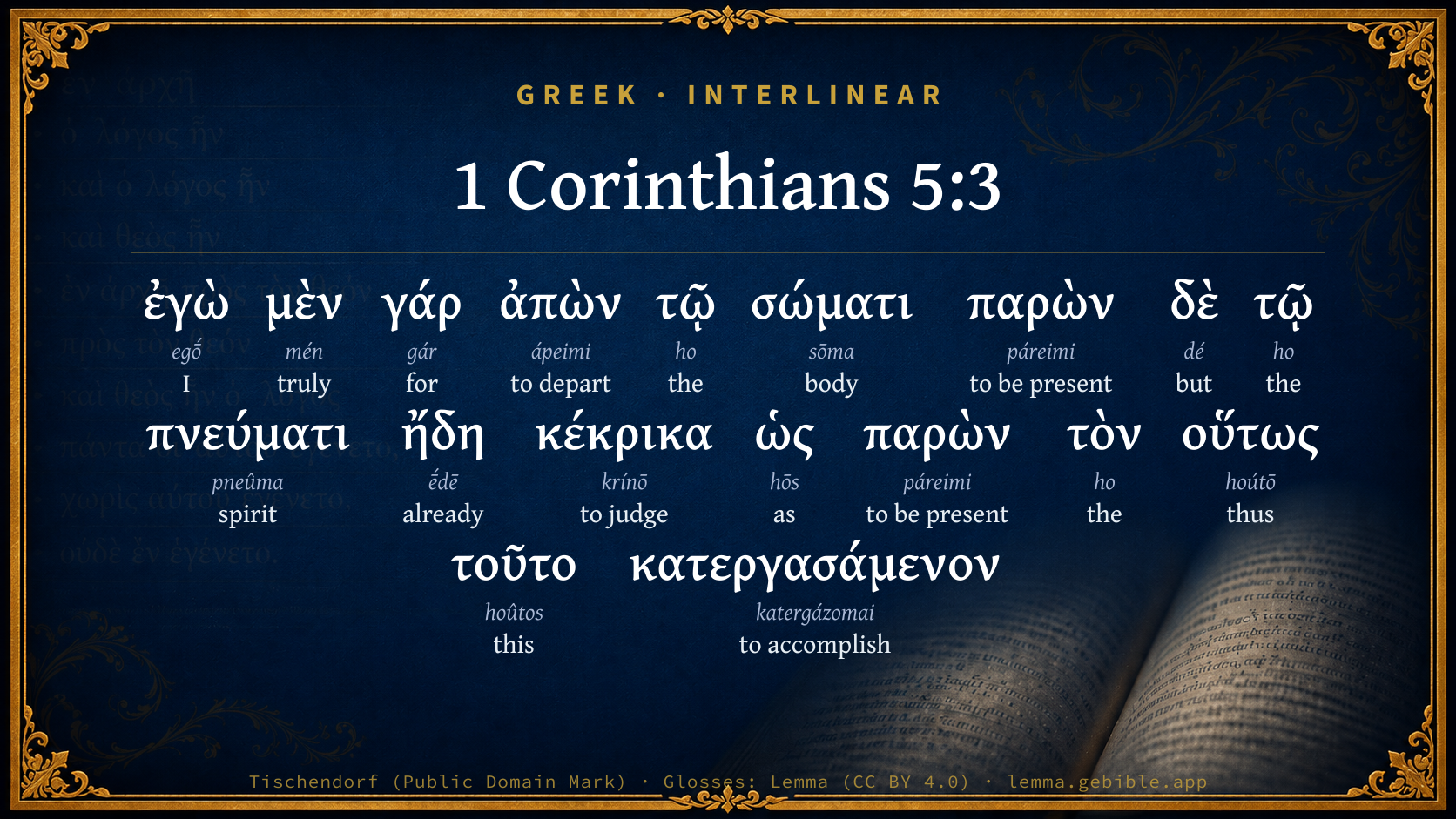
Greek (Tischendorf 8th ed.) 1 Corinthians 5:3 appears in the Greek New Testament. The text above is from the Tischendorf 8th edition. Each word links to its Strong’s number and a concise gloss. Click any word for its full Thayer’s Greek Lexicon entry.
Download image
Cite this verse

1 Corinthians 5:3 (World English Bible). Public Domain. Lemma interlinear Bible study tool, https://lemma.gebible.app/v/1-corinthians/5/3.

Show BibTeX & RIS
BibTeX
RIS
English Translation
For I most assuredly, as being absent in body but present in spirit, have already, as though I were present, judged him who has done this thing.
World English Bible · Public Domain
Highlights
  • 1 first appearance in the Greek New Testament
Full analysis ↓
Download a study sheet

One document with this verse’s original text, its word-by-word gloss line, the meaning frame, cross-references with their text, attributed commentary, and full source and license credits — printable, and it pastes into notes with its structure intact.

This verse Autodidact and up

Study sheet (.html) Plain text (.txt)

A passage Seminary Student

Up to 50 verses in one chapter. A passage sheet keeps up to 6 commentary sources and 12 cross-references per verse, in the order this page ranks them, and says so on the sheet whenever that leaves anything out. Ask for a single verse and you get the Autodidact verse sheet above.

Everything on this page stays free to read, with no account — the sheet is a download of what is already on screen, not access to it.

Want to remove ads? Support Godless Engineer
Compare translations 3

The same verse in 3 English versions, stacked beneath the original-language interlinear above. Click any original word for its lexicon entry.

Each is an independent rendering of the whole verse — the interlinear is not word-aligned to these translations.

Highlighted words mark where these versions differ — a whole-verse word diff, not a word-by-word alignment.

  • World English Bible Public Domain
    For I most assuredly, as being absent in body but present in spirit, have already, as though I were present, judged him who has done this thing.
  • King James Version Public Domain
    For I verily, as absent in body, but present in spirit, have judged already, as though I were present, concerning him that hath so done this deed,
  • unfoldingWord Literal Text CC BY-SA 4.0
    For even I, being absent in the body but being present in the spirit, have already passed judgment on the one having done such a thing, as if being present.

unfoldingWord Literal Text — © unfoldingWord, licensed CC BY-SA 4.0. Word-aligned USFM3 via Door43 (git.door43.org/unfoldingWord/en_ult).

Versions to compare (up to 4)

3 of 4 selected

Show all 19 translations

Every available English version of this verse, each an independent rendering of the whole verse.

  • World English Bible Public Domain
    For I most assuredly, as being absent in body but present in spirit, have already, as though I were present, judged him who has done this thing.
  • Berean Standard Bible Public Domain
    Although I am absent from you in body, I am present with you in spirit, and I have already pronounced judgment on the one who did this, just as if I were present.
  • Majority Standard Bible Public Domain
    Although I am absent from you in body, I am present with you in spirit, and I have already pronounced judgment on the one who did this, just as if I were present.
  • King James Version Public Domain
    For I verily, as absent in body, but present in spirit, have judged already, as though I were present, concerning him that hath so done this deed,
  • American Standard Version (1901) Public Domain
    For I verily, being absent in body but present in spirit, have already as though I were present judged him that hath so wrought this thing,
  • Revised Version (1885) Public Domain
    For I verily, being absent in body but present in spirit, have already, as though I were present, judged him that hath so wrought this thing,
  • Geneva Bible (1599) Public Domain
    For I verely as absent in bodie, but present in spirit, haue determined already as though I were present, that he that hath thus done this thing,
  • Douay-Rheims (1899) Public Domain
    I indeed, absent in body, but present in spirit, have already judged, as though I were present, him that hath so done,
  • Young's Literal Translation Public Domain
    for I indeed, as being absent as to the body, and present as to the spirit, have already judged, as being present, him who so wrought this thing:
  • Literal Standard Version CC BY-SA 4.0
    for I indeed, as being absent as to the body, and present as to the spirit, have already judged, as being present, him who so worked this thing:
  • Unlocked Literal Bible CC BY-SA 4.0
    For even though I am absent in body, I am present in spirit. I have already passed judgment on the one who did this, just as though I were there.
  • unfoldingWord Literal Text CC BY-SA 4.0
    For even I, being absent in the body but being present in the spirit, have already passed judgment on the one having done such a thing, as if being present.
  • Darby Bible Public Domain
    For *I*, [as] absent in body but present in spirit, have already judged as present,
  • World Messianic Bible Public Domain
    For I most certainly, as being absent in body but present in spirit, have already, as though I were present, judged him who has done this thing.
  • Webster's Bible Public Domain
    For I verily, as absent in body, but present in spirit, have judged already as though I were present, concerning him that hath so done this deed,
  • Free Bible Version CC BY-SA 4.0
    Even though I'm not physically present there, I am there in spirit and just as if I were there I've already made my judgment of the one who has done this.
  • Bible in Basic English Public Domain
    For I myself, being present in spirit though not in body, have come to a decision about him who has done this thing;
  • Text-Critical English NT CC BY 4.0
    For though I am absent in body, I am present in spirit. And I have already judged the man who did this, just as though I were present.
  • Tyndale New Testament (1534) Public Domain
    For I verely as absent in body even so present in sprete have determyned all redy (as though I were present) of him that hath done this dede

Literal Standard Version (2020), Covenant Press — licensed CC BY-SA 4.0. Text via the HelloAO Bible API (eBible.org). Unlocked Literal Bible (unfoldingWord) — licensed CC BY-SA 4.0. Text via the HelloAO Bible API (eBible.org). unfoldingWord Literal Text — © unfoldingWord, licensed CC BY-SA 4.0. Word-aligned USFM3 via Door43 (git.door43.org/unfoldingWord/en_ult). Free Bible Version, Dr. Jonathan Gallagher — licensed CC BY-SA 4.0. Text via the HelloAO Bible API (eBible.org).

Word by word

More ways to search: Search by grammar → Find every occurrence → Compare this word →

Practice this passage: Drill this verse → Learn its vocabulary →

ἀπὼν
ápeimi
G548
“to depart”
Verb, Present, Active, Participle, Nominative, Singular, Masculine
Part of Speech
Verb
Tense
Present
Voice
Active
Mood
Participle
Case
Nominative
Number
Singular
Gender
Masculine
Full Thayer's Definition

Origin: from G575 and G1510

TDNT: None

1. to go away, depart
  1. ἐγὼ egṓ G1473 “I” Personal pronoun, 1st person, Nominative, Singular
  2. μὲν mén G3303 “truly” Particle
  3. γάρ gár G1063 “for” Conjunction
  4. τῷ ho G3588 “the” Article, Dative, Singular, Neuter
  5. σώματι sōma G4983 “body” Noun, Dative, Singular, Neuter
  6. παρὼν páreimi G3918 “to be present” Verb, Present, Active, Participle, Nominative, Singular, Masculine
  7. δὲ dé G1161 “but” Conjunction
  8. τῷ ho G3588 “the” Article, Dative, Singular, Neuter
  9. πνεύματι pneûma G4151 “spirit” Noun, Dative, Singular, Neuter
  10. ἤδη ḗdē G2235 “already” Adverb
  11. κέκρικα krínō G2919 “to judge” Verb, Perfect, Active, Indicative, 1st person, Singular
  12. ὡς hōs G5613 “as” Adverb
  13. παρὼν páreimi G3918 “to be present” Verb, Present, Active, Participle, Nominative, Singular, Masculine
  14. τὸν ho G3588 “the” Article, Accusative, Singular, Masculine
  15. οὕτως hoútō G3779 “thus” Adverb
  16. τοῦτο hoûtos G3778 “this” Demonstrative pronoun, Accusative, Singular, Neuter
  17. κατεργασάμενον katergázomai G2716 “to accomplish” Verb, Aorist, Middle deponent, Participle, Accusative, Singular, Masculine

About this verse

These counts appear in no published source. They are computed here, from the morphology-tagged text and Lemma’s own curated glosses. What Lemma adds →

18
words
15
distinct lemmas
Pauline Epistles
section

Notable vocabulary

The rarest word here is ἀπὼν to depart G548 — appearing just 7 times in the whole Greek New Testament.

First appearance in Scripture

This word makes its first canonical appearance in the Greek New Testament here:

  • ἀπὼν to depart G548

Shared distinctive vocabulary

ἀπὼν to depart G548 occurs in 7 verses of the Greek New Testament. Also found in:

Repetition

Words recur within this verse:

  • παρὼν to be present G3918 ×2
  • τῷ the G3588 ×3

Cross-references

5

Topical passages linked to 1 Corinthians 5:3 in the Treasury of Scripture Knowledge — connected by theme and wording, ordered by reader-vote popularity; previews shown in the World English Bible.

  • Colossians 2:5 For though I am absent in the flesh, yet am I with you in the spirit, rejoicing and seeing your order, and the steadfastness of your faith in Christ.
  • 1 Thessalonians 2:17 But we, brothers, being bereaved of you for a short season, in presence, not in heart, tried even harder to see your face with great desire,
  • 2 Corinthians 13:2 I have said beforehand, and I do say beforehand, as when I was present the second time, so now, being absent, I write to those who have sinned before now, and to all the rest, that, if I come again, I will not spare;
  • 2 Corinthians 10:11 Let such a person consider this, that what we are in word by letters when we are absent, such are we also in deed when we are present.
  • 2 Corinthians 10:1 Now I Paul, myself, entreat you by the humility and gentleness of Christ; I who in your presence am lowly among you, but being absent am of good courage toward you.

Cross-references courtesy of OpenBible.info (CC BY 4.0).

Where the printed editions differ

1 variant

Places in this verse where the major printed Greek editions disagree on the wording in a way that affects the translation — a comparison of editions, not a manuscript-by-manuscript collation. The editions are the modern critical texts (Nestlé-Aland 28/27, SBL, Westcott-Hort, Tregelles, Tyndale House) and the traditional texts behind the KJV (the Textus Receptus and the Byzantine/Majority text). It is not a claim about which reading is original.

  1. Extra text
    ὡς

    “as”

    In TRByz Not in NA28NA27TynSBLWHTreg

    ὡς (hōs) 'as' is only in traditional manuscripts (TR+Byz)

Textual data: Translators Amalgamated Greek New Testament (STEPBible TAGNT) · CC BY 4.0.

Commentary

Notes on 1 Corinthians 5:3 from classic Christian and Jewish commentators (each source and its license shown beneath its notes). The classic Christian expositions comment on the surrounding passage and are grouped to its opening verse, so a note may address several verses; the Jewish commentaries on the Tanakh (Rashi and others) are per-verse, so they appear only where the commentator wrote on this verse.

Lemma curates 59 commentaries, every one of them public domain or Creative Commons licensed, each selected and text-cleaned for this edition rather than reprinted as found. About our sources →

Joseph Benson's Commentary

1Co 5:3-5. I verily, as absent — Or though absent; in body, but present in spirit — Having a full (it seems a miraculous) view of the whole fact; have judged already — Passed sentence upon him by my apostolical authority, since you have neglected doing it; as though I were present — As deliberately, justly, and authoritatively; that hath so done — Hath acted in such a scandalous manner. In the name of our Lord Jesus — By his authority and command; when ye are gathered together — In an assembly for judgment, and calling upon his name, Mat 18:20; and my spirit — Being present with you; with the power of our Lord Jesus — To confirm what you do; to deliver such a one to Satan — To expel him from your communion. This was the highest degree of punishment in the Christian Church; and we may observe, the passing this sentence was the act of the apostle, not of the Corinthians: whereupon usually followed terrors of conscience, and bodily pains or diseases inflicted by Satan, the terrible executioner of the divine justice and displeasure. For the destruction — Though slowly and gradually; of the flesh — Unless prevented by speedy repentance; that the spirit — Being brought to true contrition and humiliation; may be saved — From those infinitely more insupportable and everlasting agonies to which it might otherwise be doomed. It was observed, in the note on 1Co 4:21, that the apostles were empowered to punish notorious offenders miraculously with diseases and death. And doubtless the command here given by the apostle to deliver the incestuous person to Satan, was an exertion of that power, especially as it was to be done at the command of the inspired apostle, and by the power of the Lord Jesus. “Accordingly Chrysostom, Theophylact, and Œcumenius conjectured, that in consequence of his being delivered to Satan, the offender’s body was weakened and wasted by some painful disease. The Latin fathers and Beza, however, thought no such effect followed that sentence; because when the Corinthians were ordered (2Co 2:7) to forgive him, no mention is made of any bodily disease that was to be removed from him. Wherefore, by the destruction of the flesh, they understood the destruction of the offender’s pride, lust, and other fleshly passions; which they thought would be mortified, when he found himself despised and shunned by all. This interpretation, however, does not, in my opinion,” says Macknight, “agree with the threatenings written 1Co 4:21; 2Co 13:1-2; 2Co 13:10; nor with the apostle’s design in inflicting that punishment. For when the faction found the offender’s flesh wasted by some grievous disease, in consequence of the apostle’s sentence, it could not fail to terrify such of them as were capable of serious thought.”

Joseph Benson's Commentary on the Old and New Testaments (1811–1818) — public domain. Text from a community e-Sword module.

Tyndale Open Study Notes

Tyndale Open Resources

5:3 in the Spirit: Paul’s spiritual unity with them and the authority he had received from God through the Spirit were effective among them.

Tyndale Open Study Notes — © Tyndale Open Resources, licensed CC BY-SA 4.0. Text via the HelloAO Bible API.

Bengel's Gnomon

Johann Albrecht Bengel

1Co 5:3. Ἐγὼ μὲν γὰρ, I indeed for my part) An antithesis between the lighter punishment, which would have been inflicted by the Corinthians, and the severer one, which is threatened by Paul: thence also we have in 1Co 5:2, ποιήσας, he that hath done, a gentler expression; but in 1Co 5:3 κατεργασάμενον, he that hath perpetrated, a much more severe expression. Afterwards the Corinthians did what they ought, 2Co 2:6. Therefore the severer punishment pronounced on the sinner (here in 1Co 5:5) admitted of being superseded. Thence arose the joy of Paul, 2Co 1:24; 2Co 2:1, etc.—τῳ πνεῦματι, in spirit) Col 2:5, 2Ki 5:26.—ἤδη κέκρικα, I have already judged) A weighty effect is produced by the sense of the sentence continuing to be gravely suspended and poised [as it were a lance], till we come to 1Co 5:5, where the expression, he who hath perpetrated [κατεργασάμενον] is again taken up in the expression, such a one [τὸν τοιοῦτον].—ὡς παρὼν, as though I were present) It is construed with, to deliver, 1Co 5:5.—τὀν οὕτω τοῦτο) A triple demonstrative.—οὓτω, so) very shamefully, so, while he was called a brother.

Bengel's Gnomon of the New Testament — English translation (T&T Clark, Edinburgh, 1860) — public domain. Text from a community e-Sword module.

Meyer's Critical & Exegetical Commentary

Heinrich August Wilhelm Meyer

1Co_5:3. Ἐγὼ μὲν γάρ] introduces the independent resolution already arrived at by himself, and therewith the justification of the ἵνα ἀρθῇ; for he, Paul, for his part, has resolved already to inflict a yet heavier punishment upon him. Comp also Winer, p. 422 [E. T. 568]; the contents of 1Co_5:3-5 correspond to the ἵνα ἀρθῇ in its connection with καὶ … ἐπενθήσ. The μέν solitarium must be taken as meaning: I at least. See Hermann, a[763] Viger. p. 841 f.; Wunder, a[764] Soph. Phil. 159; Hartung, Partikell. II. p. 413.

τῷ πνεύματι] Comp 1Co_5:4 : τοῦ ἐμοῦ πνεύματος, hence not to be understood, as Chrysostom and others hold,[766] of the Holy Spirit, against which τῷ σώματι also militates, comp 1Co_7:34; Rom_8:10; Col_2:5.

ἤδη κέκρ. ὡς παρών] have made up my mind already, as though I were present (personally superintending your community).[768]

τὸν οὕτω τοῦτο κατεργ.] belongs to πάραδ. τῳ Σατ., 1Co_5:5, so that, after the intermediate statements which follow, the object of the sentence is taken up again by τὸν τοιοῦτον in 1Co_5:5 (hunc talem inquam), comp 2Co_12:2. See Matthiae, p. 1045; Schaefer, Melet. p. 84. Bengel says happily: Graviter suspensa manet et vibrat oratio usque ad 1Co_5:5. Not so happy is Hofmanns view, that τὸν … κατεργ. belongs to ΚΈΚΡΙΚΑ as an accusative of the object, whereupon ΠΑΡΑΔΟῦΝΑΙ Κ.Τ.Λ[770] is then set down to a mixing up of two constructions, this being coupled with an inappropriate comparison of Mar_14:64.

οὕτω] after such fashion, in such a way. The way and manner thereby referred to as aggravating the offence were known to the readers, but are unknown to us. Respecting οὕτω in a bad sense, see on Joh_18:22, and Bremi, a[771] Dem. Phil. I. p. 120. Pott and Olshausen explain it wrongly: licet Christianus sit, which is not implied in the text, and would state nothing special, for it was a matter of course that the person in question was not a non-Christian.

κατεργ.] has perpetrated, more emphatic than ποιήσας, 1Co_5:2. See on Rom_1:27.

[763] d refers to the note of the commentator or editor named on the particular passage.

[764] d refers to the note of the commentator or editor named on the particular passage.

[766] So, too, Holsten, z. Ev. d. Paul. u. Petr. p. 385.

[768] Were the ὡς before ἀπών the genuine reading,and Hofmann persists in retaining it as such, notwithstanding that cod. א, too, has added its weight to the side of the overwhelming contrary testimony,this ὡς might be very simply distinguished from that which stands before παρών in this way, that the first ὡς would mean as, and the second as if.

[770] .τ.λ. καὶ τὰ λοιπά.

[771] d refers to the note of the commentator or editor named on the particular passage.

Meyer — Critical and Exegetical Commentary on the New Testament — English translation by Peter Christie, edited by Frederick Crombie (T&T Clark, 1880) — public domain. Text from a community e-Sword module.

Expositor's Greek Testament

ed. W. Robertson Nicoll

1Co 5:3-5 . The removal of the culprit is, in any case, a settled matter: ἐγὼ μὲν γάρ , “For I at least” … ἤδη κέκρικα , “have already decided” without waiting till you should act or till I could come. For ἤδη see note, 1Co 4:8 ; κέκρικα , pf. of judgment that has determinate effect. f1μέν solitarium “I indeed (whatever you may do)”. ἀπὼν τῷ σώματι παρὼν δὲ τῷ πνεύματι , “while absent in the body yet present in the spirit”: by absence the Ap. might seem disqualified for judging ( cf. 2Co 12:20 to 2Co 13:2 ); he declares that he is spiritually present , so present to his inmost consciousness are the facts of the case; cf. Col 2:5 . “St. Paul’s spirit, illumined and vivified, as it unquestionably was, by the Divine Spirit, must have been endowed on certain occasions with a more than ordinary insight into the state of a Church at a distance” (Ev [813] ; cf. Joh 1:48 ; 2Ki 5:26 ): “I have already passed sentence, as one present, on him that has so wrought this thing”. ὡς παρὼν means “as being present,” not “as though present” which rendering virtually surrenders the previous ἀπών … παρὼν δέ . κατεργάζομαι , to work out, consummate (see parls.); the qualifying οὕτως probably refers to the man’s being a Christian ( cf. 1Co 5:12 f.) “under these conditions” ( cf. 1Co 3:16 f., 1Co 6:15 ).

[813] T. S. Evans in Speaker’s Commentary .

The judgment already determined in the Apostle’s mind is delivered in 1Co 5:5 , supplying a further obj [814] ( of the thing: cf. for the construction, Act 15:38 ) to κέκρικα : “I have already judged him … (have given sentence), in the name of our Lord Jesus, to deliver him that is such ( τὸν τοιοῦτον ) to Satan for destruction of his flesh, that his spirit may be saved in the day of the Lord Jesus”. The clauses of 1Co 5:4 , with their solemn, rounded terms, make fit way for this awful sentence; “graviter suspensa manet et vibrat oratio usque ad 1Co 5:5 ” (Bg [815] ). The prp [816] phrases ἐν τῷ ὀνόματι τ . κυρ . Ἰ ., σὺν τ . δυνάμει τ . κυρ . ἡμῶν Ἰ ., may be connected, either of them or both, with παραδοῦναι or with the subordinate συναχθέντων ; and the four combinations thus grammatically possible have each found advocates. The order of words and balance of clauses, as well as intrinsic fitness of connexion, speak for the attachment of the former adjunct to παραδ . Σατ ., the latter to συναχθ . ὑμῶν : so Luther, Bg [817] , Mr [818] , Al [819] , Ev [820] , Bt [821] , El [822] “In the name of the Lord Jesus” every Church act is done, every word of blessing or banning uttered; that Name must be formally used when doom is pronounced in the assembly (see parls.). The gen [823] abs. clause is parenthetic, supplying the occasion and condition precedent ( aor [824] ptp [825] ) of the public sentence; all the responsible parties must be concurrent: “when you have assembled together, and my spirit, along with the power of our Lord Jesus”. Along with the gathered assembly, under Paul’s unseen directing influence, a third Supreme Presence is necessary to make the sentence valid; the Church associates itself “with the power” of its Head. Realising that it is clothed therewith, the Cor [826] Church will deliver the appalling sentence inspired by the absent Ap. σὺν τῇ δυνάμει κ . τ . λ . is a h.l [827] ; ἐν δυνάμει (1Co 2:5 , etc.) is frequent in P. “Our Lord Jesus” is Christ the Judge (see 1Co 1:8 ).

[814] grammatical object.

[815] Bengel’s Gnomon Novi Testamenti.

[816] preposition.

[817] Bengel’s Gnomon Novi Testamenti.

[818] Meyer’s Critical and Exegetical Commentary (Eng. Trans.).

[819] Alford’s Greek Testament .

[820] T. S. Evans in Speaker’s Commentary .

[821] J. A. Beet’s St. Paul’s Epp. to the Corinthians (1882).

[822] C. J. Ellicott’s St. Paul’s First Epistle to the Corinthians .

[823] genitive case.

[824] aorist tense.

[825] participle

[826] Corinth, Corinthian or Corinthians.

[827] .l. hapax legomenon , a solitary expression.

“Delivering to Satan,” in the view of many (including Aug [828] , Cv [829] , Bz [830] , and latterly Hn [831] ), is a synonym for excommunication , a thrusting out of the condemned into “the kingdom of darkness,” where “the god of this world” holds sway (2Co 4:4 , Eph 2:2 ; Eph 6:12 , Col 1:13 , etc.); similarly in 1Ti 1:20 . But there is no proof that such a formula of excommunication existed either in the Synagogue or the early Church; and the added words, εἰς ὄλεθρον τῆς σαρκός κ . τ . λ ., point to some physically punitive and spiritually remedial visitation of the sinner. The σὰρξ to be destroyed, it is replied, lies in the man’s sinful passions; but these would, presumably, be strengthened rather than destroyed by sending him back to the world. “The flesh,” as antithetical to “the spirit” (see parls.), is rather the man’s bodily nature; and physical maladies, even death, are ascribed in the N.T. to Satan (2Co 12:7 , Luk 13:16 , Joh 8:44 , Heb 2:14 ), while on the other hand affliction is made an instrument of spiritual benefit (1Co 9:27 , 1Co 11:30 ff., 2Co 4:16 f., 1Co 12:7 , 1Pe 4:1 f.); moreover, the App. did occasionally, as in the cases of Ananias and Elymas (Act 5:13 ), pronounce penal sentences in the physical sphere, which took immediate effect on the condemned. It appears certain that P. imposed in this case a severe physical infliction indeed, if ὄλεθρος is to be pressed (see parls.), a mortal stroke as the only means of marking the gravity of the crime and saving the criminal. “Il ne faut pas endouter, c’est une condamnation à mort que Paul prononce” (Renan); not however a sudden death, rather “a slow consumption, giving the sinner time to repent” (Gd [832] ). The ejection of the culprit the Church of itself could and must effect (1Co 5:2 ; 1Co 5:13 ); for the aggravated chastisement the presence of the Apostle’s “spirit,” allied “with the power of the Lord Jesus,” was necessary. ὁ Σατανᾶς (Heb. hassatân , Aram. s’tanâ: see parls.), “the Adversary,” sc. of God and man, to whom every such opportunity is welcome (Joh 8:44 ). That Satan’s malignity should be (as one may say) overreached by God’s wisdom and mercy ( cf. 1Co 3:19 ) is nothing very, wonderful (see 2Co 12:7 , Luk 22:31 f., also the temptation of our Lord, and of Job); hate is proverbially blind. On “ the day of the Lord,” when the ultimate salvation or perdition of each is fixed, see 1Co 1:8 , Rom 2:5-16 . That some Cor [833] afterwards sought proof of Paul’s supernatural power goes to show, not that this sentence proved abortive, but rather that the offender averted it by prompt repentance.

[828] Augustine.

[829] Calvin’s In Nov. Testamentum Commentarii .

[830] Beza’s Nov. Testamentum: Interpretatio et Annotationes (Cantab., 1642).

[831] C. F. G. Heinrici’s Erklärung der Korintherbriefe (1880), or 1 Korinther in Meyer’s krit.-exegetisches Kommentar (1896).

[832] F. Godet’s Commentaire sur la prem. Ép. aux Corinthiens (Eng. Trans.).

[833] Corinth, Corinthian or Corinthians.

The Expositor's Greek Testament, edited by W. Robertson Nicoll (1897–1910) — public domain. Text from a community e-Sword module.

Godet's Commentaries

Frédéric Louis Godet

Vv. 3. “For I verily, as absent in body, but present in spirit, have decided already, as though I were present, [to deliver over] him that hath so done this deed...”

The for is thus explained: “Such is what you ought to have done; for, as for me, this is what I have done. The μέν, to which there is no corresponding δέ, serves to isolate Paul, putting him in contrast to the Church, and so strengthens the force of the ἐγώ, I: “I, for my part, while you...!”

The first ὡς, as, is rejected by the majority of the Mjj., perhaps wrongly; it has been thought incompatible with the following ὡς before the second παρών. But these two ὡς may have their distinct value. The first bears strictly on the second participle: present in spirit. It signifies: “So far as absent in body, no doubt, but really present spiritually.” It is the as which serves to express the real character in which the person acts; the second signifies, on the contrary, as if. Paul would bring out this contrast: “As for you who were present, you did nothing; and as for me, distant from you though I am, yet living spiritually among you, this is how I acted!” The word already has great force here, whether it signifies, “while you remained inactive, you wise and eloquent preachers;” or whether Paul rather means, “before even arriving among you.”

The verb κέκρικα may be rendered by I have judged, or I have decided. Not being able to say [in French] judged to deliver, we have used the second term; but in a passage of a judicial character like this the verb ought to express rather the idea of a sentence pronounced than of a simple resolution taken. This is undoubtedly what has led Hofmann and Edwards to give this verb for its direct object the following accusative: τὸν κατεργασάμενον, him who has thus acted. Now, as the verb παραδοῦναι (1Co 5:5) can be nothing else than the object of κέκρικα, we must hold in this case a mixture of two constructions, “I have judged this man,” and “I have judged to deliver him over to Satan.” This rather forced interpretation seems to me unnecessary. It is simpler to make τὸν κατεργασάμενον the object of παραδοῦναι, and τὸν τοιοῦτον (1Co 5:5) the grammatical repetition of the object, a repetition occasioned by the interposition of 1Co 5:4.

But the important question is, whether the παραδοῦναι, the act of delivering over, the object of I have judged, or decided, should be regarded as the result of a future decision which Paul proposes to be taken by the Corinthians themselves, or whether he thinks of it as a decision already taken and decreed between God and him. Commentators agree in holding the first sense. Paul waits, they say, till, in consequence of the decision which he has taken by himself, the Church of Corinth shall assemble and pronounce a sentence in keeping, if one may so speak, with his premonition. This meaning is open to certain doubts. Would not Paul say in that case: “I have decided that the man should be delivered over,” and not: “I have judged to deliver him over”? It might therefore be supposed that the judicial assembly of which the apostle speaks has already taken place at the time of his writing, and that the three deputies represented the Church in his presence. Thus the three acts would be naturally explained: κέκρικα, συναχθέντων, παραδοῦναι. But the participle συναχθέντων would in this sense require rather to be placed before κέκρικα, and the idea of a purely spiritual presence would rather apply to the Church than to Paul. We must therefore return to the ordinary explanation. Only there is not the faintest hint of making the pronouncing of the sentence dependent on the vote of the assembly which is to be held at Corinth, as if the apostle’s decision could be annulled by the contrary opinion of a majority. For his part (μέν), everything is decided, and with his apostolical competency he has judged to deliver over [the offender]; there will be joined to him, in the assembly which he convokes to take part in this terrible act, whoever wishes and dares.

The apparent pleonasm, οὕτω τοῦτο, “who has so done this,” has been variously explained. The word so is said to signify, “as a Christian,” or “with the aggravating circumstances which you know,” etc. It seems to me that we have here one of those circumlocutions in which judicial sentences delight. The protocol of a tribunal would be precisely expressed in this way. The object is to exactly define the deed, with all the circumstances known or unknown which make it what it is: its publicity, the shamelessness of its author, etc. In fact, these last words of 1Co 5:3 contain, as it were, the preamble to the sentence delivered; and, in what immediately follows, everything bears a very pronounced judicial character.

But the essential thing with the apostle is not that the sentence be delivered, it is that it be so with the assent of the Church. For his aim, besides the saving of the guilty one, is to awaken the conscience of the whole community, its energetic protest against the scandal which it has witnessed till now in silence. And such is the intent of 1Co 5:4, which indicates three things: 1. the assembly which is to take place; 2. its competency; 3. its power of execution. We are thus reminded of a tribunal prepared for the sentences delivered by it.

Frédéric Louis Godet — Commentaries on Luke, John, Romans, and 1 Corinthians — English translation (T&T Clark, Edinburgh, 1870s–1890s) — public domain. Text from a community e-Sword module.

Hodge's Commentary on Romans, Ephesians & First Corinthians

Charles Hodge

1Co_5:3-5

For I verily, as absent in body, but present in Spirit, have judged already, as though I were present, (concerning) him that hath so done this deed, in the name of our Lord Jesus Christ; when ye are gathered together, and my Spirit, with the power of our Lord Jesus Christ, to deliver such an one unto Satan for the destruction of the flesh, that the Spirit may be saved in the day of the Lord Jesus.

These verses constitute one sentence, and must be taken together in order to be understood. The construction of the principal clauses is plain. Paul says, I have determined to deliver this man unto Satan. All the rest is subordinate and circumstantial. The connection of the subordinate clauses is doubtful. Perhaps the best interpretation of the whole passage is the following: I, though absent as to the body, yet present as to the Spirit, have determined as though present, in the name of the Lord Jesus, ye being gathered together, and my Spirit being with you, with the power (i.e. clothed or armed with the power) of our Lord Jesus Christ, to deliver this man to Satan. There was to be a meeting of the church, where Paul, spiritually present, would, in the name of Christ, and in the exercise of the miraculous power with which he was invested, deliver the offender to the power of Satan. The connection with what precedes is indicated by the particle for. I would ye were in a state of mind to remove this offender for I have determined to cut him off. I verily (μέν), or I at least. Whatever you do or leave undone, I at least will do my duty. Absent in body, but present in Spirit. Neither Pauls capacity nor his authority to judge, nor his power to execute his judgment, depended on his bodily presence. He was present in Spirit. This does not mean simply that he was present in mind, as thinking of them and interested in their welfare; but it was a presence of knowledge, authority, and power. Have judged already. That is, without waiting either for your decision in the matter, or until I can be personally present with you.

Him that hath so done this deed. This is one of the clauses, the construction of which is doubtful. Our translators insert the word concerning, which has nothing to answer to it in the text, unless it be considered a part of the translation of the preceding verb, (κέκρικα) I have judged concerning, i.e. I have judged or passed sentence upon him. This, however, creates embarrassment in the explanation of the fifth verse. The best explanation is to make this clause the object of the verb to deliver, in 1Co_5:5. I have already determined to deliver him who did this deed. As, however, so much intervenes between the object and the verb, the object (such an one) is repeated in 1Co_5:5.

In the name of Christ, means by the authority of Christ, acting as his representative. The phrase includes, on the one hand, the denial that the thing done was done in virtue of his own authority; and on the other, the claim of the right to act as the organ and agent of Christ. This clause may be connected with what follows. Ye being gathered in the name of Christ. Against this construction, however, it may be urged,

1. That the words would in that case most naturally have been differently placed. That is, it would be more natural to say Assembled in the name of Christ, than In the name of Christ assembled.

2. It is a common formula for expressing apostolical authority, to say, In the name of Christ.

3. The sense and parallelism of the clauses are better if these words are connected with the main verb, I have determined in the name of Christ to deliver, etc. Paul was acting in the consciousness of the authority received from Christ. Compare 2Th_3:6; Act_16:18.

When ye are gathered together, and my Spirit. The church was to be convened, and Paul spiritually present. The sentence was not to be passed or executed in secret, but openly. It was to have the solemnity of a judicial proceeding, and, therefore, the people were convened, though they were merely spectators. With the power of our Lord Jesus Christ. This may be connected with the immediately preceding words, My Spirit invested with the power of Christ being present. Or with what follows, I have determined to deliver such an one with the power of Christ to Satan. The sense is substantially the same. The sentence was to be passed and carried into effect in the name of Christ and by his power.

To deliver such an one unto Satan. There have from the earliest times been two prevalent interpretations of this expression. According to one view, it means simply excommunication; according to the other, it includes a miraculous subjection of the person to the power of Satan. Those who regard it as merely excommunication, say that to deliver to Satan answers to might be taken away from you, in 1Co_5:2, and therefore means the same thing. The Corinthians had neglected to excommunicate this offender, and Paul says he had determined to do it. Besides, it is argued that excommunication is properly expressed by the phrase to deliver to Satan, because, as the world is the kingdom of Satan, to cast a man out of the church, was to cast him from the kingdom of Christ into the kingdom of Satan. Comp. Col_1:13. In favor of the idea of something more than excommunication, it may be argued,

1. That it is clearly revealed in scripture, that bodily evils are often inflicted on men by the agency of Satan.

2. That the apostles were invested with the power of miraculously inflicting such evils, Act_5:1-11; Act_13:9-11; 2Co_10:8; 2Co_13:10;

3. That in 1Ti_1:20 the same formula occurs probably in the same sense. Paul there says, he had delivered Hymeneus and Alexander unto Satan, that they might learn not to blaspheme.

4. There is no evidence that the Jews of that age ever expressed excommunication by this phrase, and therefore it would not, in all probability, be understood by Pauls readers in that sense.

5. Excommunication would not have the effect of destroying the flesh, in the sense in which that expression is used in the following clause.

Most commentators, therefore, agree in understanding the apostle to threaten the infliction of some bodily evil, when he speaks of delivering this offender to Satan. For the destruction of the flesh. This is by many understood to mean, for the destruction of his corrupt nature, so that the end contemplated is merely a moral one. But as flesh here stands opposed to spirit, it most naturally means the body. The man was delivered to Satan that his body might be afflicted, in order that his soul might be saved. In the day of the Lord Jesus. That is, the day when the Lord Jesus shall come the second time without sin unto salvation. It appears from 2Co_7:9-12 that this solemn exercise of the judicial power of the apostle, had its appropriate effect. It led the offender himself, and the whole church, to sincere and deep repentance.

Charles Hodge — Commentary on Romans (1835), First Corinthians (1857), and Ephesians (1856) — public domain. Text from a community e-Sword module.

Geneva Bible (1599)

Geneva Bible translators

In mind, thought, and will.

Excommunication ought not to be committed to one man’s power, but must be done by the authority of the whole Congregation, after that the matter is diligently examined.

Geneva Bible (1599) marginal notes — public domain. Text via Bolls.life.

Jamieson, Fausset & Brown

Robert Jamieson, A. R. Fausset & David Brown

as absent--The best manuscripts read, "being absent."

present in spirit-- (Kg2 5:26; Col 2:5).

so done--rather, "perpetrated," as the Greek word here is stronger than that for "done" in Co1 5:2. "So," that is, so scandalously while called a brother.

Jamieson, Fausset & Brown — Commentary Critical and Explanatory on the Whole Bible (1871) — public domain (CC PDM 1.0). Text via the HelloAO Bible API.

Adam Clarke's Commentary

Verse 3. Absent in body, but present in spirit] Perhaps St. Paul refers to the gift of the discernment of spirits, which it is very likely the apostles in general possessed on extraordinary occasions. He had already seen this matter so clearly, that he had determined on that sort of punishment which should be inflicted for this crime.

Adam Clarke's Commentary on the Bible (1810–1826) — public domain. Text from a community e-Sword/MySword module.

John Calvin's Commentaries

3. I truly, etc. As the Corinthians were wanting in their duty, having condemned their negligence, he now shows what ought to be done. In order that this stain may be removed, they must cast out this incestuous person from the society of the faithful. He prescribes, then, as a remedy for the disease, excommunication, which they had sinfully delayed so long. When he says, that he had, while absent in body, already determined this, he severely reproves in this way the remissness of the Corinthians, for there is here all implied contrast. It is as though he had said: “You who are present ought before this time to have applied a remedy to this disease, having it every day before your eyes, and yet you do nothing; while for my part I cannot, even though absent, endure it.” Lest any one should allege that he acted rashly in forming a judgment when at so great a distance, he declares himself to be present in spirit, meaning by this, that the line of duty was as plain to him as if he were present, and saw the thing with his eyes. Now it is of importance to observe what he teaches as to the mode of excommunication.

John Calvin's Commentaries (1540-1563) — public domain. Text from the Calvin Translation Society English edition (1840s-50s) via the Christian Classics Ethereal Library (ccel.org). Calvin's coverage is partial (roughly two-thirds of the Bible); uncommented books and verses are honest gaps, never fabricated. The 19th-century editor's footnotes and remarks are omitted so the notes are faithfully Calvin's own voice.

Ellicott's Commentary for English Readers

(3) For I verily.—The Apostle had fully made up his mind that this offender must be removed, and insists on the Corinthians doing it. So that the previous words imply they might as well have done it without waiting for his interference.

As absent in body.—Better, omit “as,” which is not in the best MSS.

A Bible Commentary for English Readers, edited by Charles John Ellicott (1878–1897) — public domain. Text from a community e-Sword module.

The Cambridge Bible for Schools and Colleges

gen. ed. J. J. S. Perowne

3. I verily, as absent in body] Cf. Col_2:5; 1Th_2:17. Here we have the method of excommunication pursued in the Apostolic Church. It is important to observe it narrowly. First, it is to be remarked that the Apostle is acting not only as the president, but as the founder of the Corinthian Church. Next we remark that the whole Church at Corinth was associated with him in the work. “When ye are gathered together, and my spirit.” Hence it came to pass that in primitive times it was usual for such acts of discipline to be carried out in the presence of the Church or congregation in which the offender was accustomed to worship. Thirdly, it is observable that such excommunication was pronounced ‘in the Name of our Lord Jesus Christ,’ that is, with His authority and in accordance with His Divine Law of purity and love, whereby, while hating the sin, He desired to convert the offender.

have judged already] This may either be taken (1) as in the Authorized Version, with the word concerning inserted before him that hath so done this deed, or (2) these last words may be regarded as the accusative after “deliver,” and the word “judged” taken absolutely. The former appears preferable, but the whole passage is very intricate.

concerning him that hath so done this deed] Literally, he that hath perpetrated this deed in such a manner, i.e. as though to add to the guilt and shame of it by his way of doing it.

The Cambridge Bible for Schools and Colleges (gen. ed. J. J. S. Perowne; Cambridge University Press, 1878–1918) — public domain. Text from a community e-Sword module.

John Gill's Exposition

For I verily, as absent in body,.... As he really was, being now at Philippi, if any dependence is to be had upon the subscription of this epistle; or rather at Ephesus; however, wherever he was, it is certain he was not at Corinth:

but present in spirit; in his affection to them, care of them, and concern for their good, and the glory of God:

have judged already; he had considered of the matter, thought very deliberately about it, and was now come to a point, to a determination concerning it, what to do in it:

as though I were present; upon the spot, in person, to do what he had resolved upon:

to him that hath so done this deed; this infamous one, and in so scandalous a manner, and which was continued in: what that was which the apostle, upon mature deliberation and judgment, determined to do with this wicked man, is expressed in Co1 5:5 which is to be connected with this, the whole fourth verse being to be read in a parenthesis, and that was to deliver him to Satan.

John Gill's Exposition of the Whole Bible (1746–1763) — public domain (CC PDM 1.0). Text via the HelloAO Bible API.

Trapp's Complete Commentary

John Trapp

3 For I verily, as absent in body, but present in spirit, have judged already, as though I were present, concerning him that hath so done this deed,

Ver. 3. Have judged already, &c.] q.d. I by mine apostolic authority do excommunicate him. And yet how fiercely doth learned Erastus contend with Calvin and Beza about excommunication, denying the Church any such power. The Jews had their three sorts of excommunication. The heathen also had theirs; among the old Gauls, if any one did not obey the decrees of their Druids or priests, he was forbidden their sacrifices; and therehence shunned by all as a wicked man, he had no benefit of their laws, nor any respect given him, &c.

John Trapp, A Commentary or Exposition upon All the Books of the Old and New Testament (1647–1656) — public domain. Text from a community e-Sword module.

Albert Barnes' Notes on the Bible

For I verily - But I, whatever it may cost me; however you may esteem my interference; and whatever personal ill-will may be the result toward me, have adjudged this case to be so flagrant as to demand the exercise of discipline, and since the church to whom it belongs have neglected it, I use the authority of an apostle, and of a spiritual father, in directing it to take place. This was not a formal sentence of excommunication; but it was the declared opinion of an apostle that such a sentence should be passed, and an injunction on the church to exercise this act of discipline.

As absent in body - Since I am not personally present with you, I express my opinion in this manner. I am absent in body from you, and cannot, therefore, take those steps in regard to it which I could were I present.

But present in spirit - My heart is with you; my feelings are with you; I have a deep and tender interest in the case; and I judge as if I were personally present. Many suppose that Paul by this refers to a power which was given to the apostles, though at a distance, to discern the real circumstances of a case by the gift of the Spirit. Compare Col 2:5; 2Ki 5:26; 2Ki 6:12. (Whitby, Doddridge, etc.) But the phrase does not demand this interpretation. Paul meant, probably, that though he was absent, yet his mind and attention had been given to this subject; he felt as deeply as though he were present, and would act in the same way. He had, in some way, been fully apprized of all the circumstances of the case, and he felt it to be his duty to express his views on the subject.

Have judged already - Margin, “Determined” κέκρικα kekrika. I have made up my mind; have decided, and do decide. That is, he had determined what ought to be done in the case. It was a case in which the course which ought to be pursued was plain, and on this point his mind was settled. What that course should be he states immediately.

As though I were present - As though I had a personal knowledge of the whole affair, and were with you to advise - We may be certain that Paul had the fullest information as to this case; and that the circumstances were well known. Indeed, it was a case about the facts of which there could be no doubt. They were everywhere known 1Co 5:1, and there was no need, therefore, to attempt to establish them by formal proof.

Albert Barnes' Notes on the Bible (1834–1885) — public domain. Text from a community e-Sword/MySword module.

Haydock's Catholic Bible Commentary

Have already judged, decreed, and do decree, being present in spirit with you, and with your congregation. --- In the name....with the power of our Lord Jesus, to deliver such a one to Satan by a sentence of excommunication, depriving him of the sacraments, the prayers, and communion, and even of the conversation of the rest of the faithful. It is likely in those times, such excommunicated persons were delivered over to Satan, so as to be corporally tormented by the devil, to strike a terror into others. See St. John Chrysostom, hom. xv. and this is said to be done for the destruction, or punishment of the flesh, that the spirit, or soul, may be saved. (Witham) --- It is the opinion of most of the Greek fathers, that this man was either really possessed by the devil, or at least struck with such a complaint as a mortification, and humiliation to his body, whilst it served to purify his soul. We have seen from many instances in holy Scripture, that it was not unusual, in the origin of Christianity, for persons who had fallen into crimes of this nature, to be punished with death, some grievous sickness, or by being possessed by the devil, so as to be separated from the communion of the Church. (St. Ambrose; Estius; Just. [St. Justin Martyr?]; Menochius)

George Leo Haydock (1774–1849), Haydock's Catholic Family Bible and Commentary, 1859 edition — public domain. Excludes Psalms (Douay-Rheims chapter numbering differs from Protestant) and Deuterocanonical books (Catholic canon only).

Matthew Poole's English Annotations

Though I be absent as to my bodily presence, yet God having intrusted me with a superintendency and care over his church amongst you, out of the care and solicitude which I have for you, as well as the other churches of Christ, and in discharge of that trust which God hath reposed in me, I do determine, and have determined as much as if I were present amongst you, what ought to be done by you concerning this person so notoriously scandalous.

Matthew Poole's English Annotations on the Holy Bible (1683–1685) — public domain. Text from a community e-Sword/MySword module.

Whedon's Commentary on the Bible

Daniel D. Whedon

3. Present in spirit—Though I am here in Ephesus, yet do you conceive me as sitting in apostolic power and spirit in your midst at Corinth, ordering the execution of the sentence I now write.

Have judged already—In instant contrast with your tardiness and tolerance.

Daniel D. Whedon (gen. ed.), Commentary on the Old and New Testaments (1874–1909) — public domain. Text from a community e-Sword module.

The Pulpit Commentary

For I verily. The broken structure of the verse shows the deep emotion with which it was penned as it were with sobs. St. Paul contrasts the line which he means to take with the lax condonation granted by the Corinthian Church. As absent; rather, being absent or though absent. The as is omitted in the best manuscripts. But present in spirit; literally, in the spirit; but he is referring to his own spirit: "Bodily I am absent; but speaking as though my spirit were present in your assembly, (2Ki_5:26) I have already judged," etc. Have judged already. My decision was instantaneous and is final. As though I were present. My sentence is as clear as though I were at this moment standing in the midst of you. That hath so done. The verb is not as before, poiesas, but katergasamenon, which is stronger, "the perpetrator of this deed." The "so" means "with all these circumstances of aggravation." The same verb is used in. Rom_1:27. The broken periods of the Greek reflect the emotion of the writer. The passage is as it were written with sobs (Wordsworth)

Absent in body, but present in spirit.

Much as Paul loved his converts in the city of Corinth, he could not, at the period when he wrote this Epistle, think of visiting them. Their conduct in the matter treated in this chapter so distressed his pure and affectionate heart, so disappointed his expectations, that he felt constrained to remain absent from them. But in so doing he was not showing any lack of interest in their Christian life or their Church proceedings. Quite the contrary; he was content to stay away because, as the text makes evident, he knew there was a sense in which he was really with them.

I THE SPECIAL INSTANCE OF THIS PRINCIPLE FURNISHED IN THE CASE OF PAUL AND THE CORINTHIANS. In what senses could the apostle deem himself to be with these Corinthian Christians "in spirit"?

1. By his teaching. He had long laboured in word and doctrine in this great centre of Greek commerce and literature, and amongst this company, of whom not many were wise or noble, but many were called and washed and sanctified by the gospel of Christ and by the Spirit of God. His teaching laid the foundation upon which Apollos and others had built. And we know enough of that teaching to be sure that it included many precepts and motives to holiness. This instruction had sunk into the hearts of the spiritually susceptible, and by it the apostle yet spake of this society, summoning them to a holy life, and bidding them maintain a standard of social purity.

2. By his authority. Paul never forgot that he was an inspired apostle of the Lord. He spake by the Spirit of the Lord, and his counsels were not those of human wisdom merely, but of celestial authority. What the Corinthians were directed to do they were to do in his name, and with the assurance that their action would be sanctioned by the Divine Head of the Church. In vindicating the purity of Christian communion, in cleansing the Bride of Christ from any stain of the world that had fallen upon her white robe, the Corinthians were to feel that the apostle was with them, inspiring and corroborating their lawful necessary action.

II THE GENERAL OPERATION OF THIS PRINCIPLE IN THE LIVING CHURCH OF CHRIST JESUS.

1. The great Saviour and Founder of the Church is absent in body, but present in spirit. He himself assured his disciples that it was good for them

2. that he should go away, for that thus the Comforter should come. And the spiritual and universal and perpetual presence of the great Head of the Church is thus delightfully and graciously secured.

3. The action of Christ"s Church, when in accordance with the express and plain instructions of our Lord and of his inspired apostles, must be recognized as prompted by his Spirit and sanctioned by his authority. In the application of this principle there are and will be many differences among the people of Christ, but with regard to the principle itself there should be no diversity or hesitation. We do not see his form or hear his voice; but we cannot question his spiritual presence. And he is at hand, not only to teach the disciple, to comfort the sufferer, to counsel those perplexed but to impart a Divine authority to the actions and to the discipline of who rely upon his Word and do his will. T.

The Pulpit Commentary (1880–1919), ed. H.D.M. Spence-Jones & Joseph S. Exell — public domain. Text from a community e-Sword module.

John Wesley's Explanatory Notes

I verily, as present in spirit - Having a full (it seems, a miraculous) view of the whole fact. Have already, as if I were actually present, judged him who hath so scandalously done this.

John Wesley, Explanatory Notes Upon the Whole Bible (1754–1765) — public domain. Text via the GEBible commentary corpus.

Kretzmann's Popular Commentary

Paul E. Kretzmann

The apostle’s sentence:

v. 3. For I verily, as absent in. body, but present in spirit, have judged already, as though I were present, concerning him that hath, so done this deed,

v. 4. in the name of our Lord Jesus Christ, when ye are gathered together, and my spirit, with the power of our Lord Jesus Christ,

v. 5. to deliver such an one unto Satan for the destruction of the flesh, that the spirit may be saved in the day of the Lord Jesus.

The case was so clear that Paul, on his part, had reached a decision. The Corinthian Christians were present in the midst of the scandal every day and seemed to experience no inconvenience, whereas the apostle, although not present according to the body, but only in spirit, even so writhed under the insult which had been inflicted upon the Church of God by this flagrant trespass. And so there was only one sentence to be given: I have already passed judgment, as though I were present, upon him that in this manner has perpetrated this. Note how the apostle emphasizes the flagrancy, the heinousness, of the offense. It was a case in which long negotiations and discussions were superfluous; it concerned a sin which both Greek and Roman law stamped as infamy, which represented the height of unnatural vice. And here, under these conditions, a man flouted his infamy in the sight of the entire congregation. Only one decision was possible under the circumstances. The energetic and prompt conduct on the part of the absent apostle forms a contrast all the more striking over against the slackness of those among whom the shameful scandal had occurred.

The apostle now delivers his sentence: to deliver the man of this kind to Satan for destruction of his flesh, that the spirit may be saved in the day of the Lord Jesus. But he also shows in what way the sentence is to be spoken: In the name of our Lord Jesus Christ, when you have assembled for a formal meeting, and my spirit, together with the power of the Lord Jesus. The Corinthian Christians were, then, to call a meeting of the brethren, and in this meeting, under the directing influence of Paul’s spirit, his mind in the matter now being known, they were to pronounce sentence. And this was to be done in the name of the Lord Jesus, in whom alone every church act has validity; the sin being an offense against His holy name, judgment must be passed as coming from Him. And it must be uttered with the power of our Lord Jesus, with that peculiar church power with which every Christian congregation is vested, that of retaining the sins of the impenitent sinners, as long as they do not repent. Through His power also the content of the appalling sentence could be carried out. The offender was to be delivered to Satan, by formal resolution deprived of his relationship to the Lord of light and thrust out into the kingdom of darkness, where the god of this world has jurisdiction, 2Co 4:4; Eph 2:2; Eph 6:12; Col 1:13. For the destruction of the flesh the incestuous person was to be delivered. By indulging in such a heinous sin, the offender had yielded his body to the power of Satan. And Satan, through the effects of sin, perhaps of this very transgression, would destroy the body, would afflict it with diseases peculiar to such an unnatural vice and voluptuous behavior. And thus the exalted Lord would use the devil himself as His instrument, in order to work in the mind of the transgressor a fear and horror of his sin and its consequences, that eventually the spirit might be saved in the day of the Lord Jesus. By means of the punishment which Satan carries out as a righteous judgment, the Lord hopes to effect a cure for the man and thus to snatch his soul like a brand from the burning. Satan has nothing but the everlasting destruction of both soul and body of the sinner in mind, but the Lord, merciful even when the decrees of His holiness must be carried out, plans to use the punishment as a means to call the sinner to repentance. In this way many a sinner, upon whom the sentence of excommunication had to be pronounced, may, according to the gracious intention of the Lord, have come to the realization of his transgression through the effects and consequences of his sin, and, like the thief on the cross, turned to his Savior even in the last hour. On the great day of the Lord, when the salvation or perdition of every human being will be pronounced, many a person may thus be placed on the right hand of the Lord, because the gracious intention of the Lord was realized in this manner. Note: A Christian congregation must always be mindful of the fact that the purpose of excommunication is not the destruction, but the salvation of the soul.

Paul E. Kretzmann, Popular Commentary of the Bible (1921–1924) — public domain. Text from a community e-Sword module.

Burkitt's Expository Notes on the New Testament

William Burkitt

As if the apostle had said, "Although I am absent from you in body, yet in mind and consent I am present with you, and also by my discerning spirit, by which I am enabled to discern things done at a distance; and accordingly by the authority and power given me by our Lord Jesus Christ, I have already determined, that when you are solemnly gathered together in the name of Christ, and have my spirit concurring with you, and the power of Christ confirming the sentence pronounced by you, that you deliver this incestuous person unto Satan, by casting him out of the church, and leaving him to God’s executioner to inflict destructive punishment on his body, to bring him to repentance on his body, to bring him to repentance for the saving of his soul."

Here note, 1. The censure and sentence pronounced: excommunication, which consisteth of two parts,

(1) Privative, in a separation from the communion of saints.

(2) Positive, which is here expressed by delivering unto Satan, who had then a power over the excommunicated person’s body to torment it with diseases; which power though now ceased, yet the Christian church has at this day a power to exclude enormous offenders from the ordinary means of grace and salvation, and to expose them to the malice and temptations of their grand adversary the devil, by depriving them of church communion, which is a more dreadful punishment than persons are sensible of.

Note, 2. The person inflicting this censure, St. Paul, I have judged already. He pronounced it judicially, and requires the Corinthians to denounce it solemnly. I have judged already; implying that he did not determine rashly and suddenly, but advisedly, as became a judge.

And mark, they must denounce solemnly what he had determined judicially, and this in the face of the whole church, when ye are gathered together; that is, in the presence of the chief pastor, and all his flock at Corinth.

A public crime must have a public doom, that others may hear and fear: yet remark, the congregation or church were witnesses of the censure, but they did not judge and determine it: the apostle did that. The power of the keys is in the hand of the church only, quoad khreysin not quoad khteysin: that the church may have the benefit of them, not the managing of them, for that is committed to the pastors only, as appears, Mat 16:17-20.

Note, 3. The solemn and awful manner in which the censure and excommunication was and ought to be pronounced, In the name of our Lord Jesus Christ; that is, having first, in a solemn manner, called upon the Lord Jesus Christ for his direction and benediction; or, in the name of our Lord Jesus, that is, according to the command of Christ, by the power and authority of Christ, and with an eye to the glory of Christ; this should be the ends, in denouncing church censures: and then Christ will by at the consistory, and his co-operation will make good the censure, as his commission was our warrant to pronounce it; and then the penitent may and ought to dread the sentence, as coming out of Christ’s own mouth, and to be inflicted by Christ’s own hand.

Note, 4. The miserable case and state which the person that is duly excommunicated is in: by is then delivered unto Satan, as God’s executioner, to inflict severe punishments on the person’s body, now cast out of God’s special protection, deprived of the church’s communion, and exposed to the temptations and snares of our grand adversary, Satan. St. Austin in his time declared, that it was then thought gravius quam gladio feriri, much more grievous to be excommunicated than to be beheaded.

But, Lord! where are the persons at this day, who tremble when their sins have brought them into this miserable case and state?

Note, 5. That persons ought not to be in this severe and solemn manner proceeded against, but for notorious, scandalous sins. To denounce this awful censure upon every slight and trivial occasion, is to prostitute one of the most venerable ordinances of Christ to contempt and scorn.

Note, 6. The great and special end for which the ordinance of excommunication was instituted by Christ in his church, and executed by his apostles; namely, to recover the fallen person by repentance, and to be a warning to others. The reforming, and not the ruining of men, was the intention of this ordinance: the censure is not mortal, but medicinal.

It is, 1. For the destruction of the flesh, so lasciviant in him; for the mortifying his lusts, by afflicting him with grief and sorrow.

2. For the saving of his spirit, that is, his soul, that this may be recovered out of the snare of the devil.

Lastly, The time is expressed, when the penitent person shall find the benefit of this painful ordinance; namely, in the day of the Lord Jesus; not but that a penitent in this life shall find some ease in his conscience, and satisfaction in his spirit: but the full benefit of ecclesiastical censure is reserved to the day of the Lord, the day of judgment: then will Christ manifest to the church triumphant the good effect of the power of the keys, which he hath committed to his ministers, to be exercised publicly in the church militant; he will then reveal how all stand bound in heaven, whom his church never loosed on earth; and all whom his church hath loosed on earth, shall then appear to be loosed in heaven.

William Burkitt's Expository Notes on the New Testament (1700–1703) — public domain. Text from a community e-Sword module.

Godbey's Commentary on the New Testament

William B. Godbey

3. “For indeed I, being absent in body but present in spirit, have already as being present judged the one having thus done this.

William B. Godbey, Commentary on the New Testament (1896–1900) — public domain. Text from a community e-Sword module.

McGarvey & Pendleton's Commentaries

J. W. McGarvey

For I verily, being absent in body but present in spirit, have already as though I were present judged him that hath so wrought this thing [The swiftness of Paul's judgment stands in sharp contrast with the tardiness and toleration of the Corinthians. The broken structure of this verse and the one which follows it, shows Paul's deep emotion. "The passage is, as it were, written with sobs."--Wordsworth],

J. W. McGarvey (with Philip Y. Pendleton), Commentaries on the New Testament (The Fourfold Gospel, 1914; Acts; and the epistles) — public domain. Text from a community e-Sword/MySword module.

The People's New Testament

B. W. Johnson

3. For I verily, etc. Though absent, yet with them in spirit, Paul judged the case as present, and commanded the church as a body to take action by withdrawal at once from the evil doer.

B. W. Johnson's The People's New Testament with Notes (1889–1891) — public domain. Electronic text from the Christian Classics Ethereal Library (CCEL) ThML edition.

unfoldingWord translationNotes

Door43 World Missions Community

I am present in spirit

"I am with you in spirit." Being with them in spirit represents caring about them or wanting to be with them. AT: "I care about you" or "I want to be with you"

I have already passed judgment on the one who did this

Possible meanings are 1) "I have decided decided what you should do with the one who did this" or 2) "I have found the person who did this guilty"

When you are assembled

"When you are together" or "When you meet together"

in the name of our Lord Jesus

Possible meanings are 1) the name of the Lord Jesus is a metonym that represents his authority. AT: "with the authority of our Lord Jesus" or 2) being assembled in the Lord's name implies meeting together to worship him. AT: "to worship our Lord Jesus" (See: Metonymy and Assumed Knowledge and Implicit Information)

hand this man over to Satan

Handing the man over to Satan represents not allowing the man to be part of their group so that Satan would be allowed to harm him. AT: "make this man leave your group so that Satan can harm him" (See: Metaphor)

for the destruction of the flesh

Possible meanings are 1) "flesh" refers to his physical body. AT: "so that Satan may harm his body" or 2) "flesh" is a metaphor for the sinful nature. AT: "so that his sinful nature will be destroyed" or "so that he will not continue to live according to his sinful nature" (See: Metaphor)

so that his spirit may be saved on the day of the Lord

This can be stated in active form. AT: "so that God may save his spirit on the day of the Lord" (See: Active or Passive)

translationWords

body

spirit

judge

lord

power

Satan

flesh

day of the Lord

unfoldingWord translationNotes — © Distant Shores Media and the Door43 World Missions Community, licensed CC BY-SA 4.0. Source: git.door43.org/Door43/en_tn.

Cambridge Greek Testament for Schools and Colleges

3. [ὡς] before ἀπών. Om. אABCD Vulg. Peshito. Rec. inserts it with EFG and Vetus Lat.

3. ἐγὼ μὲν γάρ. For I, on the contrary. The μἐν seems to indicate a feeling which is not further expressed (the corresponding clause with δέ not appearing), of contrast between his view of the matter and that taken by the Corinthians. Here we have the method of excommunication pursued in the Apostolic Church. It is important to observe it narrowly. First, it is to be remarked that the Apostle is acting not only as the president, but as the founder of the Corinthian Church. Next we remark that the whole Church at Corinth was associated with him in the work. ‘When ye are gathered together, and my spirit.’ Hence it came to pass that in primitive times it was usual for such acts of discipline to be carried out in the presence of the Church or congregation in which the offender was accustomed to worship. Thirdly, it is observable that such excommunication was pronounced ‘in the name of our Lord Jesus Christ,’ that is, with His authority and in accordance with His Divine Law of purity and love, whereby, while hating the sin, He desired to convert the offender.

παρὼν δέ. Cf. Col 2:5; 1Th 2:17. The δέ is not in opposition to μέν above, but marks the opposition between ἀπών and παρών. Had μέν referred to this opposition, it would have been placed after ἀπών.

ἤδη κέκρικα. This may either be taken (1) as in the Authorized Version, with the word concerning inserted before him that hath so done this deed, or (2) these last words may be regarded as the accusative after ‘deliver,’ and the word ‘judged’ taken absolutely. The former appears preferable, but the whole passage is very intricate. There is authority for (1) in Act 20:16; Act 25:25; Tit 3:12. See also ch. 1Co 2:2.

τὸν οὕτως τοῦτο κατεργασάμενον. Literally, he that hath perpetrated this deed in such a manner, i. e. as though to add to the guilt and shame of it by his way of doing it.

Cambridge Greek Testament for Schools and Colleges (Cambridge University Press, 1896; 21 vols, various authors incl. Carr, Maclear, Plummer, Farrar, Lumby, Moule, M. R. James, Simcox) — public domain. Text from a community e-Sword module.

Alford’s Greek Testament

Henry Alford

3-5.] justifies the expression ἵνα ἀρθῇ just used, by declaring the judgment which the Apostle, although absent, had already passed on the offender.

3.] ἐγὼ μὲν γάρ, I for my part … ‘ego certe:’ so Aristoph. Plut. 355, μὰ Δίʼ, ἐγὼ μὲν οὔ: see Hartung, Partikellchre, ii. 413.

ὡς παρών, as if really present, not, as being present in spirit.

τὸν οὕτως τοῦτο κατ.] The object is put foremost for emphasis’ sake, and after several intervening clauses, taken up again with τὸν τοιοῦτον, ver. 5.

οὕτως, Meyer thinks, alludes to some peculiarly offensive method in which he had brought about the marriage, which was known to the Corinthians, but unknown to us. Olsh. understands it, ‘under such circumstances,’ ‘being such as he is, a member of Christ’s body.’ But this, being before patent, would hardly be thus emphatically denoted. Perhaps after all, τοῦτο κατεργασάμενον refers to πορνεία generally, οὕτως to τοιαύτη πορνεία, ver. 1.

Henry Alford, The Greek Testament (1849–1861) — public domain. Text from a community e-Sword module.

International Critical Commentary

3. ἐγὼ μὲν γάρ. ‘For I, ’ with much emphasis on the pronoun, which is in contrast to the preceding ὑμεῖς: ‘my feelings about it are very different from yours.’ The γάρ introduces the justification of ἵνα ἀρθῇ, showing what expulsion involves. St Paul does not mean that, as the Corinthians have not excommunicated the offender, he must inflict a graver penalty: this would be punishing the offender for what was the fault of his fellows. He is explaining what he has just said about their failing to remove the man. No δέ follows the μέν: the contrast which μέν marks is with what goes before (v. 2), not with anything that is to follow. The correlation of μὲν … δέ is much less common in N.T. than in class. Grk. In some books μέν does not occur, and in several cases it has no δέ as here: 1Th 2:18; Rom 7:12, Rom 10:1, etc. See Blass, Gr. § 77. 12.

ἀπὼν τῷ σώματι. ‘Although absent in the body.’ Again a contrast: ‘you, who are on the spot, do nothing; I, who am far away, and might excuse myself on that account, take very serious action.’ Origen compares Elisha (2Ki 5:26).

τῷ πνεύματι. ‘His own spirit,’ as in v. 4: cf. v. 5 and 2:11. In Col 2:5 we have a similar utterance, but there σάρξ takes the place of σῶμα. It is the highest constituent element in man’s nature, and his point of contact with the Spirit of God.

ἤδη κέκρικα ὡς παρὼν τὸν κ.τ.λ. Either, ‘have already, as if I were present, judged the man’; or, ‘have already, as if I were present, decided with regard to the man’; or, ‘have already come to a decision, as if I were present: with regard to the man,’ etc. In the last case, which is perhaps the best, τὸν … κατεργασάμενον is governed by παραδοῦναι and is repeated in τὸν τοιοῦτον.*

Before ἀπών, D 3 E F G L, AV, insert ὡς: א A B C D* P 17, Vulg. Copt. Aeth. RV. omit.

International Critical Commentary — older volumes (1896–1929), various authors — public domain. Text from a community e-Sword module.

Lesson kit

Teaching starters — assembled from the data on this page, not authored interpretation. Every prompt links to the verse data it draws on. Edit before teaching.

1 Corinthians, in the Pauline Epistles, opens this verse with 18 words (15 distinct Greek lemmas). Its most distinctive word is ápeimi (“to depart”). A historical commentator’s framing appears above. Read the whole chapter for the surrounding context.

Discussion questions

  1. How does “to depart” (ápeimi) shape what this verse is saying?
  2. This is the first place “to depart” appears in Scripture (first appears here). What does its debut here establish?
  3. How does 2 Corinthians 10:1, which shares the word «to depart», read alongside this verse?
  4. What does the repetition of “to be present” (2× in this one verse) do in this verse?
  5. These translations render this verse differently. What is at stake in choosing one wording over another?
  6. Compare how Joseph Benson's Commentary and Tyndale Open Study Notes read this verse. Where do they agree or differ?

Things to notice

  • 1 word makes its first canonical appearance in Scripture here.
  • These translations choose different wording for 18 words in this verse.
  • “to be present” occurs 2× in this single verse.
  • 15 distinct Greek lemmas span 18 words in this verse.

Reading settings

Reading text

Shown beneath each verse's original-language words.

Old Testament
Old Testament edition

Read the OT as the Masoretic Hebrew (MT) or the Greek Septuagint (LXX).

English shown for the Greek Septuagint (in the Hebrew ↔ Greek comparison).

Comparing translations? Open the Compare panel on any verse page to stack up to four side by side.