Acts 24:14

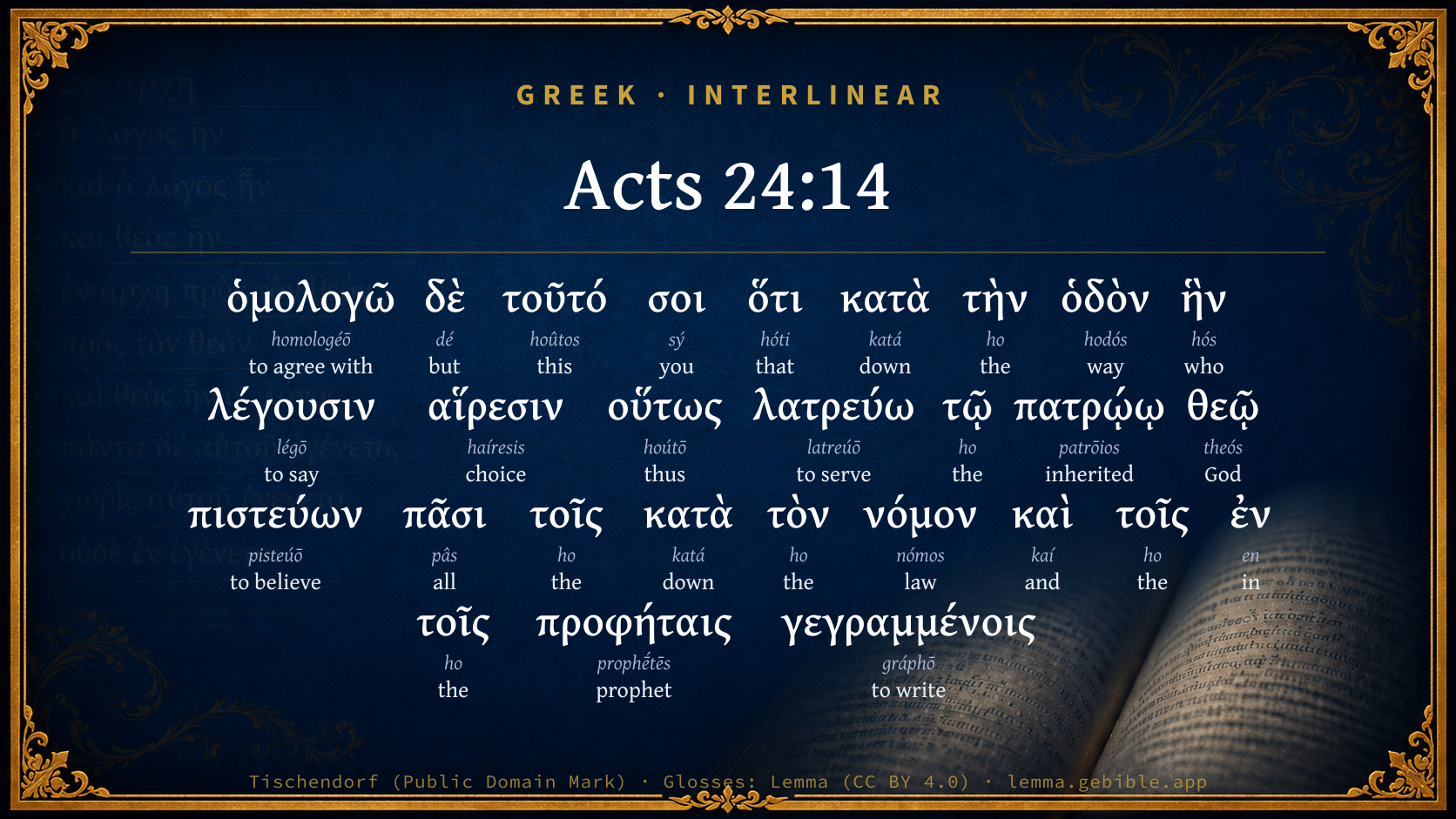
Greek (Tischendorf 8th ed.) Acts 24:14 appears in the Greek New Testament. The text above is from the Tischendorf 8th edition. Each word links to its Strong’s number and a concise gloss. Click any word for its full Thayer’s Greek Lexicon entry.
Download image
Cite this verse

Acts 24:14 (World English Bible). Public Domain. Lemma interlinear Bible study tool, https://lemma.gebible.app/v/acts/24/14.

Show BibTeX & RIS
BibTeX
RIS
English Translation
But this I confess to you, that after the Way, which they call a sect, so I serve the God of our fathers, believing all things which are according to the law, and which are written in the prophets;
World English Bible · Public Domain
Download a study sheet

One document with this verse’s original text, its word-by-word gloss line, the meaning frame, cross-references with their text, attributed commentary, and full source and license credits — printable, and it pastes into notes with its structure intact.

This verse Autodidact and up

Study sheet (.html) Plain text (.txt)

A passage Seminary Student

Up to 50 verses in one chapter. A passage sheet keeps up to 6 commentary sources and 12 cross-references per verse, in the order this page ranks them, and says so on the sheet whenever that leaves anything out. Ask for a single verse and you get the Autodidact verse sheet above.

Everything on this page stays free to read, with no account — the sheet is a download of what is already on screen, not access to it.

Want to remove ads? Support Godless Engineer
Compare translations 3

The same verse in 3 English versions, stacked beneath the original-language interlinear above. Click any original word for its lexicon entry.

Each is an independent rendering of the whole verse — the interlinear is not word-aligned to these translations.

Highlighted words mark where these versions differ — a whole-verse word diff, not a word-by-word alignment.

  • World English Bible Public Domain
    But this I confess to you, that after the Way, which they call a sect, so I serve the God of our fathers, believing all things which are according to the law, and which are written in the prophets;
  • King James Version Public Domain
    But this I confess unto thee, that after the way which they call heresy, so worship I the God of my fathers, believing all things which are written in the law and in the prophets:
  • unfoldingWord Literal Text CC BY-SA 4.0
    But I confess this to you, that according to the Way that they call a sect, thus I serve the fathers’ God, being faithful to all the things according to the law and the things written in the Prophets,

unfoldingWord Literal Text — © unfoldingWord, licensed CC BY-SA 4.0. Word-aligned USFM3 via Door43 (git.door43.org/unfoldingWord/en_ult).

Versions to compare (up to 4)

3 of 4 selected

Show all 19 translations

Every available English version of this verse, each an independent rendering of the whole verse.

  • World English Bible Public Domain
    But this I confess to you, that after the Way, which they call a sect, so I serve the God of our fathers, believing all things which are according to the law, and which are written in the prophets;
  • Berean Standard Bible Public Domain
    I do confess to you, however, that I worship the God of our fathers according to the Way, which they call a sect. I believe everything that is laid down by the Law and written in the Prophets,
  • Majority Standard Bible Public Domain
    I do confess to you, however, that I worship the God of our fathers according to the Way, which they call a sect. I believe everything that is written throughout the Law and the Prophets,
  • King James Version Public Domain
    But this I confess unto thee, that after the way which they call heresy, so worship I the God of my fathers, believing all things which are written in the law and in the prophets:
  • American Standard Version (1901) Public Domain
    But this I confess unto thee, that after the Way which they call a sect, so serve I the God of our fathers, believing all things which are according to the law, and which are written in the prophets;
  • Revised Version (1885) Public Domain
    But this I confess unto thee, that after the Way which they call a sect, so serve I the God of our fathers, believing all things which are according to the law, and which are written in the prophets:
  • Geneva Bible (1599) Public Domain
    But this I confesse vnto thee, that after the way (which they call heresie) so worship I the God of my fathers, beleeuing all things which are written in the Lawe and the Prophets,
  • Douay-Rheims (1899) Public Domain
    But this I confess to thee, that according to the way, which they call a heresy, so do I serve the Father and my God, believing all things which are written in the law and the prophets:
  • Young's Literal Translation Public Domain
    `And I confess this to thee, that, according to the way that they call a sect, so serve I the God of the fathers, believing all things that in the law and the prophets have been written,
  • Literal Standard Version CC BY-SA 4.0
    And I confess this to you, that, according to The Way that they call a sect, so I serve the God of the fathers, believing all things that have been written in the Law and the Prophets,
  • Unlocked Literal Bible CC BY-SA 4.0
    But I admit this to you, that according to the Way that they call a sect, in that same way I serve the God of our fathers. I am faithful to all that is in the law and the writings of the prophets.
  • unfoldingWord Literal Text CC BY-SA 4.0
    But I confess this to you, that according to the Way that they call a sect, thus I serve the fathers’ God, being faithful to all the things according to the law and the things written in the Prophets,
  • Darby Bible Public Domain
    But this I avow to thee, that in the way which they call sect, so I serve my fathers' God, believing all things which are written throughout the law, and in the prophets;
  • World Messianic Bible Public Domain
    But this I confess to you, that according to the Way, which they call a sect, so I serve the God of our fathers, believing all things which are according to the Torah, and which are written in the Prophets;
  • Webster's Bible Public Domain
    But this I confess to thee, that after the way which they call heresy, so I worship the God of my fathers, believing all things which are written in the law and in the prophets:
  • Free Bible Version CC BY-SA 4.0
    But I will admit this to you: I serve the God of our fathers following the beliefs of the Way, which they call a heretical sect. I believe everything the law teaches and what is written in the books of the prophets.
  • Bible in Basic English Public Domain
    But this I will say openly to you, that I do give worship to the God of our fathers after that Way, which to them is not the true religion: but I have belief in all the things which are in the law and in the books of the prophets:
  • Text-Critical English NT CC BY 4.0
    But I confess this to yoʋ, that according to the Way, which they call a sect, I serve the God of our fathers, believing everything that is written throughout the Law and in the Prophets,
  • Tyndale New Testament (1534) Public Domain
    But this I confesse vnto the that after that waye (which they call heresy) so worshippe I the God of my fathers belevinge all thinges which are writte in the lawe and the Prophetes

Literal Standard Version (2020), Covenant Press — licensed CC BY-SA 4.0. Text via the HelloAO Bible API (eBible.org). Unlocked Literal Bible (unfoldingWord) — licensed CC BY-SA 4.0. Text via the HelloAO Bible API (eBible.org). unfoldingWord Literal Text — © unfoldingWord, licensed CC BY-SA 4.0. Word-aligned USFM3 via Door43 (git.door43.org/unfoldingWord/en_ult). Free Bible Version, Dr. Jonathan Gallagher — licensed CC BY-SA 4.0. Text via the HelloAO Bible API (eBible.org).

Word by word

More ways to search: Search by grammar → Find every occurrence → Compare this word →

Practice this passage: Drill this verse → Learn its vocabulary →

πατρῴῳ
patrōios
G3971
“inherited”
Adjective, Dative, Singular, Masculine
Part of Speech
Adjective
Case
Dative
Number
Singular
Gender
Masculine
Full Thayer's Definition

Origin: from G3962

TDNT: 5:1014,*

1. descending from father to son or from ancestors to their posterity as it were by right of inheritance 2. received from the fathers
  1. ὁμολογῶ homologéō G3670 “to agree with” Verb, Present, Active, Indicative, 1st person, Singular
  2. δὲ dé G1161 “but” Conjunction
  3. τοῦτό hoûtos G3778 “this” Demonstrative pronoun, Accusative, Singular, Neuter
  4. σοι sý G4771 “you” Personal pronoun, 2nd person, Dative, Singular
  5. ὅτι hóti G3754 “that” Conjunction
  6. κατὰ katá G2596 “down” Preposition
  7. τὴν ho G3588 “the” Article, Accusative, Singular, Feminine
  8. ὁδὸν hodós G3598 “way” Noun, Accusative, Singular, Feminine
  9. ἣν hós G3739 “who” Relative pronoun, Accusative, Singular, Feminine
  10. λέγουσιν légō G3004 “to say” Verb, Present, Active, Indicative, 3rd person, Plural
  11. αἵρεσιν haíresis G139 “choice” Noun, Accusative, Singular, Feminine
  12. οὕτως hoútō G3779 “thus” Adverb
  13. λατρεύω latreúō G3000 “to serve” Verb, Present, Active, Indicative, 1st person, Singular
  14. τῷ ho G3588 “the” Article, Dative, Singular, Masculine
  15. θεῷ theós G2316 “God” Noun, Dative, Singular, Masculine
  16. πιστεύων pisteúō G4100 “to believe” Verb, Present, Active, Participle, Nominative, Singular, Masculine
  17. πᾶσι pâs G3956 “all” Adjective, Dative, Plural, Neuter
  18. τοῖς ho G3588 “the” Article, Dative, Plural, Neuter
  19. κατὰ katá G2596 “down” Preposition
  20. τὸν ho G3588 “the” Article, Accusative, Singular, Masculine
  21. νόμον nómos G3551 “law” Noun, Accusative, Singular, Masculine
  22. καὶ kaí G2532 “and” Conjunction
  23. τοῖς ho G3588 “the” Article, Dative, Plural, Neuter
  24. ἐν en G1722 “in” Preposition
  25. τοῖς ho G3588 “the” Article, Dative, Plural, Masculine
  26. προφήταις prophḗtēs G4396 “prophet” Noun, Dative, Plural, Masculine
  27. γεγραμμένοις gráphō G1125 “to write” Verb, Perfect, Passive, Participle, Dative, Plural, Neuter

About this verse

These counts appear in no published source. They are computed here, from the morphology-tagged text and Lemma’s own curated glosses. What Lemma adds →

28
words
22
distinct lemmas
Acts
section

Notable vocabulary

The rarest word here is πατρῴῳ inherited G3971 — appearing just 3 times in the whole Greek New Testament.

Shared distinctive vocabulary

πατρῴῳ inherited G3971 occurs in 3 verses of the Greek New Testament. Also found in:

Repetition

Words recur within this verse:

Cross-references

39

Topical passages linked to Acts 24:14 in the Treasury of Scripture Knowledge — connected by theme and wording, ordered by reader-vote popularity; previews shown in the World English Bible.

  • Acts 9:2 and asked for letters from him to the synagogues of Damascus, that if he found any who were of the Way, whether men or women, he might bring them bound to Jerusalem.
  • Romans 3:21 But now apart from the law, a righteousness of God has been revealed, being testified by the law and the prophets;
  • Acts 3:13 The God of Abraham, Isaac, and Jacob, the God of our fathers, has glorified his Servant Jesus, whom you delivered up, and denied in the presence of Pilate, when he had determined to release him.
  • Acts 28:23 When they had appointed him a day, many people came to him at his lodging. He explained to them, testifying about the Kingdom of God, and persuading them concerning Jesus, both from the law of Moses and from the prophets, from morning until evening.
  • Acts 24:5 For we have found this man to be a plague, an instigator of insurrections among all the Jews throughout the world, and a ringleader of the sect of the Nazarenes.
  • Acts 26:22 Having therefore obtained the help that is from God, I stand to this day testifying both to small and great, saying nothing but what the prophets and Moses said would happen,
  • Acts 13:15 After the reading of the law and the prophets, the rulers of the synagogue sent to them, saying, "Brothers, if you have any word of exhortation for the people, speak."
  • Acts 19:9 But when some were hardened and disobedient, speaking evil of the Way before the multitude, he departed from them, and separated the disciples, reasoning daily in the school of Tyrannus.
  • Acts 24:22 But Felix, having more exact knowledge concerning the Way, deferred them, saying, "When Lysias, the commanding officer, comes down, I will decide your case."
  • Acts 26:27 King Agrippa, do you believe the prophets? I know that you believe."
  • 2 Timothy 1:3 I thank God, whom I serve as my forefathers did, with a pure conscience. How unceasing is my memory of you in my petitions, night and day
  • Exodus 3:15 God said moreover to Moses, "You shall tell the children of Israel this, 'Yahweh, the God of your fathers, the God of Abraham, the God of Isaac, and the God of Jacob, has sent me to you.' This is my name forever, and this is my memorial to all generations.
  • 1 Chronicles 29:18 Yahweh, the God of Abraham, of Isaac, and of Israel, our fathers, keep this forever in the imagination of the thoughts of the heart of your people, and prepare their heart to you;
  • Psalms 119:46 I will also speak of your statutes before kings, And will not be disappointed.
  • Amos 8:14 Those who swear by the sin of Samaria, And say, 'As your god, Dan, lives;' And, 'As the way of Beersheba lives;' They will fall, and never rise up again."
  • Micah 4:2 Many nations will go and say, "Come, and let us go up to the mountain of Yahweh, And to the house of the God of Jacob; And he will teach us of his ways, And we will walk in his paths." For out of Zion will go forth the law, And the word of Yahweh from Jerusalem;
  • Matthew 7:12 Therefore whatever you desire for men to do to you, you shall also do to them; for this is the law and the prophets.
  • Matthew 10:32 Everyone therefore who confesses me before men, him I will also confess before my Father who is in heaven.
  • Matthew 22:40 The whole law and the prophets depend on these two commandments."
  • Luke 1:70 (As he spoke by the mouth of his holy prophets who have been from of old),
  • Luke 16:16 The law and the prophets were until John. From that time the Gospel of the Kingdom of God is preached, and everyone is forcing his way into it.
  • Luke 16:29 "But Abraham said to him, 'They have Moses and the prophets. Let them listen to them.'
  • Luke 24:27 Beginning from Moses and from all the prophets, he explained to them in all the Scriptures the things concerning himself.
  • Luke 24:44 He said to them, "This is what I told you, while I was still with you, that all things which are written in the law of Moses, the prophets, and the psalms, concerning me must be fulfilled."
  • John 1:45 Philip found Nathanael, and said to him, "We have found him, of whom Moses in the law, and the prophets, wrote: Jesus of Nazareth, the son of Joseph."
  • John 5:39–47 "You search the Scriptures, because you think that in them you have eternal life; and these are they which testify about me.
  • Acts 3:22–24 For Moses indeed said to the fathers, 'The Lord God will raise up a prophet for you from among your brothers, like me. You shall listen to him in all things whatever he says to you.
  • Acts 22:14 He said, 'The God of our fathers has appointed you to know his will, and to see the Righteous One, and to hear a voice from his mouth.
  • Acts 26:6 Now I stand here to be judged for the hope of the promise made by God to our fathers,
  • 1 Corinthians 11:19 For there also must be factions among you, that those who are approved may be revealed among you.
  • 1 Peter 1:11 searching for who or what kind of time the Spirit of Christ, which was in them, pointed to, when he predicted the sufferings of Christ, and the glories that would follow them.
  • 2 Peter 2:1–2 But there also arose false prophets among the people, as among you also there will be false teachers, who will secretly bring in destructive heresies, denying even the Master who bought them, bringing on themselves swift destruction.
  • Revelation 19:10 I fell down before his feet to worship him. He said to me, "Look! Don't do it! I am a fellow bondservant with you and with your brothers who hold the testimony of Jesus. Worship God, for the testimony of Jesus is the Spirit of Prophecy."
  • Acts 5:30 The God of our fathers raised up Jesus, whom you killed, hanging him on a tree.
  • Acts 7:32 'I am the God of your fathers, the God of Abraham, the God of Isaac, and the God of Jacob.' Moses trembled, and dared not look.
  • Acts 10:43 All the prophets testify about him, that through his name everyone who believes in him will receive remission of sins."
  • Acts 19:23 About that time there arose no small stir concerning the Way.
  • Galatians 5:20 idolatry, sorcery, hatred, strife, jealousies, outbursts of anger, rivalries, divisions, heresies,
  • Titus 3:10 Avoid a factious man after a first and second warning;

Cross-references courtesy of OpenBible.info (CC BY 4.0).

Commentary

Notes on Acts 24:14 from classic Christian and Jewish commentators (each source and its license shown beneath its notes). The classic Christian expositions comment on the surrounding passage and are grouped to its opening verse, so a note may address several verses; the Jewish commentaries on the Tanakh (Rashi and others) are per-verse, so they appear only where the commentator wrote on this verse.

Lemma curates 59 commentaries, every one of them public domain or Creative Commons licensed, each selected and text-cleaned for this edition rather than reprinted as found. About our sources →

The Biblical Illustrator

Joseph S. Exell

Act_24:14-16

But this I confess unto thee, that after the way which they call heresy, so worship I the God of my fathers.

What is heresy

I. Here is the case of men holding high office in the Church of God, yet mistaking truth for error, and branding as heresy that which is Divine. These men have had many successors, who at various points in the Churchs history have, in the name of religion, inflicted the most inhuman cruelties on the noblest saints of God. Nor can these foul deeds be declared the sole heritage of any one Church. Nor can we look calmly into history without seeing that the barbarities inflicted in the name of orthodoxy have arisen largely from a mistaken estimate of heresy. What is heresy? Judging from history, heresy might be defined as the faith of the minority. The word heretical has been loosely held to the opposite of orthodox. Orthodoxy has been held to mean the commonly received opinions. But this is an abuse of words. Orthodoxy means right opinions, whether held by the few or the many. Again, heresy is not confined in its application to opinions, but includes anything that takes from the truth; and truth is not only formulated in opinion, it is also revealed in feeling and embodied in life. By blindness to this truth, the Church has sinned grievously. Let me emphasise this important truth by showing--

1. That heresies of heart and life are unspeakably the more vital. Doctrine is important only as it points to duty and fruits out in life. Of necessity, therefore, it holds a second place. Heresy of creed may be the result of many influences acting on the mind from childhood, and may exist along with entire loyalty of heart to Christ. But heresy of spirit and life can only be the offspring of a depraved heart. The honour of our Master and the interests of His kingdom are far more seriously imperilled by that which is un-Christly in the behaviour of His followers, than by what may be defective in their doctrines.

2. Heresies of heart and life are unspeakably the more prevalent. In what land is membership in a Christian Church accepted as any guarantee of integrity? Where is the line of demarcation in society, which separates the Christian and non-Christian? Is it not a fact that even among prominent Christian professors there are found features of conduct which can only be regarded as grievous heresies of life. And Churches have shared this grievous guilt. How often have they dealt a grievous blow to vital religion, by manifesting a burning concern for orthodoxy in the order of worship, or creed, and yet a loose indifference as to heresies of spirit and of life?

II. Here is the case of a single man, strong in his own conviction, daring the many who brand him a heretic. This persecuted apostle reveals a grand manliness here. Though a prisoner before the magnates of the Church, and the potentates of the state, yet does he stand boldly forward, and without halt or hesitation declare, This I confess unto thee, etc. Why? Because the heresy had become the voice of God in his soul. It had been burned into his being and become part of himself. Now this daring the public authorities and the popular voice in obedience to conscience--

1. Is seldom met with in our time. And this not because persecution, open and in public courts, is rare in our day, but chiefly because so few think for themselves. It is the custom to go with the crowd. The vast multitude have never made their own those truths which they profess to hold. They are content to use language which they have never examined--to sing songs which they do not feel, and to give their adhesion to declarations which so far as they know may be the very truth of God or the merest drivel.

2. Requires noble and heroic elements of manhood.

(1) Great courage.

(2) Fidelity to conscience.

(3) Readiness of self-sacrifice.

Lessons: Let us--

1. Cultivate more definite personal convictions.

2. Not fear to avow our convictions whoever may gainsay.

3. Guard heart and life as the chief exponents of the truth.

4. Cultivate charity towards all men. (J. B. Wylie.)

Paul before Felix

Two things are of prime importance in this scripture;

1. Pauls answer to the charge of heresy; and--

2. Pauls preaching to the Roman governor and his lady.

I. Pauls answer to the charge of heresy or of being the ringleader of a sect. A heresy is an opinion which someone chooses to hold, and which becomes conspicuous because it is not the commonly held opinion. Paul freely acknowledges that his way is the way which they call a sect or a heresy. He does not accept the popular and prevailing views. He confesses the sin, if it be a sin, of being in the minority. But having made that acknowledgment, he proceeds to defend that heretical way as the way of the old faith and hope. Pauls trouble was not that he did not believe enough, but that he believed too much. That is the sum of my offence--he says--that I believe in all things which are according to law and which are written in the prophets. I belong to a sect! he indignantly cries, much more a leader of it! Nay; but I serve the God of our fathers, and I accept the revelation which He gave them in all its fulness. That is a noble defence to make against such a charge, if it be a true defence, That has been virtually or actually the defence of the whole line of prophets and reformers from the days of Elijah down. The Church of God has from time to time settled down to a half belief in both His law and His love. A few earnest souls accept the message and apply it to their consciences and lives. Soon the cry of heresy and a sect is raised. But it is only the forgotten truth which was always in the Book, and which has been overlaid by the rubbish of neglect or overgrown by the weeds of sinful indulgence and its consequence, which has been brought to light. It is so easy to disbelieve some of the contents of the law and the prophets. Here was one party in this Jewish Church who had given up all belief in the supernatural, and another party who, putting it all in their creed, allowed it no weight in the conduct of their lives. Paul says, I keep to the old faith, and the whole of it; and that is my offence. Paul also defends his way as that of the old hope. He believes in the resurrection both of the just and the unjust. There is glory in being a heretic when the common faith is lifeless and the common hope is dumb. But no one can be called a leader of a sect who in the decay of faith goes back to a vital faith. He represents the old faith and the old hope, and not a new. Paul also defends his way as that of the old righteousness. With this belief in the totality of revelation and this hope based on it, the apostle was striving to live a truly righteous life. He does not say that he has fully attained it, but he is seeking after it. He exercises himself to have a conscience void of offence toward God and man alway. He is following the light of conscience enlightened by Gods Word, and he follows it without fear or faltering. His heresy is too great moral earnestness; too large a receptivity for the whole truth of God.

II. Pauls preaching to the Roman governor (George M. Boynton.)

The charge of sectarianism

To be charged with schism and sectarianism is not the worst thing for a Christian believer. Paul was not afraid of that reputation; nor was John Huss, nor John Wycliffe, nor Martin Luther, nor Hugh Latimer, nor Nicholas Ridley, nor John Calvin, nor John Knox, nor John Wesley. Calling a man a sectarian is no proof that he holds any error in religious doctrine. The real question is, What is the truth? not, Does this man agree with the majority of Christians in the statement of truth? (H. C. Trumbull, D. D.)

Believing all things that are written in the law and the prophets.

Pauls apology

Here is Pauls apology; faith at the bottom, hope as the immediate effect and product of it, and an holy conversation as the fruit and consequent. The same method is observed in 1Ti_1:5, and 2Pe_1:5-6. Note.--

I. The expressions here used.

1. Concerning faith.

(1) The object, Things written in the law and the prophets--all the Scriptures then extant (Mat_11:13; Luk_16:29). The object of our faith, who have received the rule of faith more enlarged (Eph_2:20), is prophets and apostles. The object of faith may be considered--materially, such things as God hath revealed; formally, because God hath revealed them.

(2) The extent, All things. A believer receiveth all truths which are of Divine revelation, whether precepts, promises, threatenings, doctrines, or histories.

(3) The act, Believing. It is not enough not to deny or not to contradict, but we must actually and positively believe. The reason why people feel so little force of their faith is because they leap into the Christian faith by the advantage of their birth, but do not consider what nor why they believe. But true faith is a positive, firm assent, excited in us by the Spirit of God. To a sound belief there is necessary--

(a) A knowledge or full instruction in the things which we believe (1Jn_4:16); first known and then believed.

(b) A due conviction of the certainty of them (Luk_1:4; Joh_6:69; Joh_17:8).

(c) Practical trust and affiance; for Christianity doth not only propound bare truths to be assented unto, but joyful, comfortable truths suitable to our necessity and desires (Heb_3:6).

(d) Application, that we may know for our good (Job_5:27).

2. Concerning hope.

(1) Mark that he propoundeth his hope as the immediate product of faith. What good will it do me to believe the doctrines of the prophets and apostles, if I expect no good from thence? Faith would be vain, and religion vain. Only note here that hope is two fold.

(a) The fruit of regeneration (1Pe_1:3).

(b) Built upon experience (Rom_5:4-5).

(2) Observe that he pitcheth upon the resurrection as the great thing hoped for, because then is our full and final happiness (1Ti_1:16; Joh_20:31). This is the great thing which we hope, wait, and labour for.

3. Concerning his manners and conversation (verse 16). Observe--

(1) His encouragement, Herein.

(a) Interpreters expound this, in the meantime, till faith be turned into vision, hope into fruition (Heb_6:12).

(b) Again, by virtue of this faith and hope. Faith and a good conscience are often coupled (1Ti_1:5). We cannot keep the one without the other.

(2) The integrity of his obedience, set forth in all the necessary requisites.

(a) Sincerity. For his conscience was in it, and a good conscience; and the goodness of conscience consisteth in its ability to do its office, in its clearness, purity, tenderness, quietness, peaceableness.

(b) Strictness and exactness.

He would keep this good conscience void of offence. It may be understood--

(a) Passively, that conscience be not offended, or receive wrong by any miscarriage of ours, for it is a tender thing. The least dust in the eye hindereth its use, so doth sin offend and trouble the conscience.

(b) Actively, that we offend not, nor offer wrong to others.

(3) Impartiality, Both towards God and towards men. There are two tables, and we are to take care we do not give offence to God or men, by neglecting our duty either.

(4) Constancy, Always. A conscience brought forth for certain turns is not a good conscience.

4. The laborious diligence wherewith he carried it on: I exercise myself. We must make it our constant labour and endeavour--

(1) By a diligent search into the mind of God (Rom_12:2; Eph_5:10; Eph_5:17).

(2) By a serious inquiry into the state of our own hearts and ways (Psa_4:4; Jer_8:6).

(3) By a constant watchfulness (Psa_39:1).

(a) By a serious resistance and mortification of sin (Mat_5:29-30; Gal_5:24).

(4) By the use of means which God hath appointed.

II. The reasons why this is true Christianity.

1. The necessity of it. It is a great question how far obedience belongeth to faith, whether as a part or as an end, fruit and consequent. I answer--Both ways. Consent of subjection is a part of faith, actual obedience a fruit of it.

2. The comfort of obedience to us. We cannot make out our evidence and plea but by a uniform, constant, and impartial obedience.

3. It is for the honour of Christ (2Th_1:11-12; Joh_15:8; Php_1:1). (T. Manton, D. D.)

The Biblical Illustrator, edited by Joseph S. Exell (c. 1880s–1900s) — public domain. Text from a community e-Sword module.

Joseph Benson's Commentary

Act 24:14-16. But — As to what they have alleged against me with regard to the Nazarenes; this I confess unto thee — And am not ashamed publicly to avow it in the presence of the greatest personages upon earth; that after the way which they call αιρεσιν, a sect; (so the same word is properly rendered, Act 24:5;) so worship I the God of my fathers — And am authorized by our sacred writings so to do; believing all things which are written in the law and in the prophets — On which every part of the religion which I profess is founded, and which I should not either understand or believe if I worshipped or served the God of my fathers any other way, or did not believe in and receive Jesus Christ as the true Messiah, to whom both the law and the prophets bear witness. And have hope toward God, which they themselves also allow — All the Pharisees allowed it; that there shall be a resurrection of the dead, both of the just and unjust — In a public court, this was peculiarly proper to be observed. The pious Jews expected a resurrection, as Paul did, on the foundation of the promises of God, delivered by Moses and the prophets. This was a very proper defence before a Roman magistrate, who, by the laws of the empire, was bound to allow every man to worship God according to the religion of his country. And herein — Εν τουτω, on this account, because I believe all things written in the law and the prophets, and expect a future resurrection and an eternal state; I exercise myself — And make it the continual care and study of my life; to have always a conscience void of offence toward God, and toward man — That so, whatever accusations are brought against me, my own heart may not condemn me, but I may always find internal support amidst all the external injuries I may receive from mankind.

Joseph Benson's Commentary on the Old and New Testaments (1811–1818) — public domain. Text from a community e-Sword module.

Tyndale Open Study Notes

Tyndale Open Resources

24:14 the Way: See study note on 9:2. • Paul emphasized his common ground with his Jewish audience, including his worship, belief in the Jewish law, acceptance of the prophets, and hope in the resurrection (24:14, 15; see 24:21).

Tyndale Open Study Notes — © Tyndale Open Resources, licensed CC BY-SA 4.0. Text via the HelloAO Bible API.

Bengel's Gnomon

Johann Albrecht Bengel

Act 24:14. Ὁμολογῶ, I confess) A forensic word, and one also used in sacred things, and appropriately employed here. A confession ingenuous, voluntary, full; having respect to faith in this verse; to hope, in the following verse; to love, in Act 24:17. They who assent to this confession are accused of being a sect (heresy), with the same injustice as Paul was.—ὁδὸν, way) He confesses that he is one of those whom Tertullus had termed “Nazarenes.”—λέγουσιν αἴρεσιν, they call a sect, heresy) This appellation (Act 24:5) Paul corrects, not that it was at the time an odious term (as sect or heresy is now), but because it is not a sufficiently worthy one. Αἵρεσις, a sect, is a thing of human caprice (humour): the way (ὁδὸς) is a thing divinely ordained. He had said all that was required for his defence; but now, skilfully making a handle of the opportunity, he adds a confession of faith.—πατρῷῳ) Paul confutes the prejudice as to the newness of Christianity.—νόμον, in the law) Again he refutes Tertullus, Act 24:6.—γεγραμμένοις, written) concerning Jesus of Nazareth, Act 24:5.

Bengel's Gnomon of the New Testament — English translation (T&T Clark, Edinburgh, 1860) — public domain. Text from a community e-Sword module.

Meyer's Critical & Exegetical Commentary

Heinrich August Wilhelm Meyer

Act_24:14-15. Δέ] opposes the positive confession, which now follows, to the preceding merely negative assurance (Act_24:12-13): but, doubtless, I confess: As a Christian I reverence the same God with the Jews, follow the same rule of faith, and I have the same hope on God, that there shall be a resurrection, etc. Thus, notwithstanding that malicious πρωτοστάτην τῆς τῶν Ναζ. αἱρ., I am in nowise an enemy of the existing religion (protected by the roman laws!). And with full truth could this confessio ingenua, voluntaria, plena (Bengel) be furnished by Paul (in opposition to Baur and Zeller; also Schneckenburger, p. 147 f.), as he recognised in Christianity the completion of the divine law and the fulfilment of the prophets; and this recognition, as regards the law, necessarily presupposes the belief in all that is written in the law, namely, in its connection with the fulfilment effected by Christ (comp. Rom_3:31; Rom_13:8 ff.; Gal_3:24), although the law as a rule of justification has reached its end in Christ (Rom_10:4).

κατὰ τὴν ὁδὸν κ.τ.λ.] according to the way, which, etc., according to the Christian mode of life (Act_22:4, Act_9:2, Act_19:23).

ἣν λέγ. αἵρεσιν] for Tertullus had, Act_24:5, used αἵρεσις, in itself a vox media (school, party, see Wetstein on 1Co_11:19), in a bad sense (a schismatic party, sect).

τῷ πατρῴῳ Θεῷ] the God worshipped by the ancestors of my nation and from them received (Act_22:3). How inviolable were even to the heathen their ancestral gods! See Wetstein and Kypke, II. p. 122 f.; and on the expression very common also among the Greeks, Lobeck, Aglaoph. p. 1206, 769 ff.; Ellendt, Lex. Soph. II. 533 f.

πιστεύων κ.τ.λ] is now that which is emphatically indicated by οὕτω: in this way: (namely) believing all things, etc. Comp. Bornemann in Rosenmüller, Repert. II. p. 277; Bernhardy, p. 284.

κατὰ τὸν νόμον] throughout the law (-book).

ἐλπίδα ἔχων] contains a characteristic circumstance accompanying πιστεύων πᾶσι κ.τ.λ.

καὶ αὐτοὶ οὗτοι] even they themselves there, is spoken δεικτικῶς to those present as the representatives of the nation in the transaction. It was natural that this point of view in its generality should admit no reference to the Sadducean deviation from the national belief of the resurrection, or at all to special differences concerning this dogma. It is just as certain that Paul understood δικαίων and ἀδίκων morally, and not according to the sense of the self-conceit of the descendants of Abraham (Bertholdt, Christol. pp. 176 ff., 203 ff.). Comp. on Luk_14:14.

προσδέχονται] expectant. The hope is treated as objective (see on Rom_8:24). Comp. Eur. Alc. 131; Job_2:9; Isa_28:10; Tit_2:13; and comp. on Gal_5:5.

Meyer — Critical and Exegetical Commentary on the New Testament — English translation by Peter Christie, edited by Frederick Crombie (T&T Clark, 1880) — public domain. Text from a community e-Sword module.

Expositor's Greek Testament

ed. W. Robertson Nicoll

Act 24:14 . ὁμολ .: “verbum forense idemque sacrum,” Bengel. “Unum crimen confitetur,” viz. , that of belonging to the sect of the Nazarenes, “sed crimen non esse docet”. κατὰ τὴν ὁδὸν ἢν λέγ . αἴρεσιν : “according to the way which they call a sect,” R.V. For ὁδὸν see Act 9:2 , and for the reading in [381] text critical note. αἵρεσιν : a word of neutral significance, which Tertullus had used in a bad sense. For St. Paul Christianity was not αἵρεσις , a separation from the Jewish religion, but was rather πλήρωσις , cf. Act 13:32 . τῷ πατρ . Θεῷ , cf. Act 22:3 . The Apostle may have used the expression here as a classical one which the Roman might appreciate, cf. θεοὶ πατρῷοι , Thuc., ii., 71; Æn. , ix., 247, and instances in Wetstein. (On the distinctions between πατρῷος and πατρικός , Gal 1:14 , see Syn [382] , Grimm-Thayer.) Moreover St. Paul could appeal to the fact that liberty had been given to the Jews by the Romans themselves to worship the God of their fathers (see Alford’s note, in loco ). λατρεύω : “so serve I,” R.V., see on Act 7:42 ; if it is true that the word always describes a divine service like λατρεία , and that this idea appears to spring from the conception of complete devotion of powers to a master which lies in the root of the word (Westcott), no verb could more appropriately describe the service of one who called himself δοῦλος of God and of Christ. πᾶσι το͂ις κατὰ τὸν ν . κ . τ . λ .: “all things which are according to the law,” R.V., “iterum refutat Tertullum, Act 24:6 ,” Bengel; “and which are written in the prophets,” R.V. The mention of the prophets as well as of the law shows that a reference to the Messianic hopes is intended.

[381] R(omana), in Blass, a first rough copy of St. Luke.

[382] synonym, synonymous.

The Expositor's Greek Testament, edited by W. Robertson Nicoll (1897–1910) — public domain. Text from a community e-Sword module.

Geneva Bible (1599)

Geneva Bible translators

Paul goeth in the cause of Religion from a state conjectural to a state of quality not only not denying that objected against him, but also proving it to be true, to be heavenly and from God, and to be the oldest of all religions.

Here this word, Heresy, or sect, is taken in good part.

Geneva Bible (1599) marginal notes — public domain. Text via Bolls.life.

Jamieson, Fausset & Brown

Robert Jamieson, A. R. Fausset & David Brown

But this I confess to thee--in which Felix would see no crime.

that after the way they call heresy--literally, and better, "a sect."

so worship I the God of my fathers--the ancestral God. Two arguments are contained here: (1) Our nation is divided into what they call sects--the sect of the Pharisees, and that of the Sadducees--all the difference between them and me is, that I belong to neither of these, but to another sect, or religious section of the nation, which from its Head they call Nazarenes: for this reason, and this alone, am I hated. (2) The Roman law allows every nation to worship its own deities; I claim protection under that law, worshipping the God of my ancestors, even as they, only of a different sect of the common religion.

believing all, &c.--Here, disowning all opinions at variance with the Old Testament Scriptures, he challenges for the Gospel which he preached the authority of the God of their fathers. So much for the charge of heresy.

Jamieson, Fausset & Brown — Commentary Critical and Explanatory on the Whole Bible (1871) — public domain (CC PDM 1.0). Text via the HelloAO Bible API.

Adam Clarke's Commentary

Verse 14. That after the way which they call heresy] See the explanation of this word in Clarke's note on "Ac 5:17", and see before, Ac 24:5, where what is here translated heresy, is there rendered sect. At this time the word had no bad acceptation, in reference to religious opinions. The Pharisees themselves, the most respectable body among the Jews, are called a sect; for Paul, defending himself before Agrippa, says that he lived a Pharisee according to the strictest αιρεσιν, sect, or heresy of their religion. And Josephus, who was a Pharisee, speaks, της των Φαρισαιων αἱρεσεως, of the heresy or sect of the Pharisees. LIFE, chap. xxxviii. Therefore it is evident that the word heresy had no bad meaning among the Jews; it meant simply a religious sect. Why then did they use it by way of degradation to St. Paul? This seems to have been the cause. They had already two accredited sects in the land, the Pharisees and Sadducees: the interests of each of these were pretty well balanced, and each had a part in the government, for the council, or Sanhedrin, was composed both of Sadducees and Pharisees: see Ac 23:6. They were afraid that the Christians, whom they called Nazarenes, should form a new sect, and divide the interests of both the preceding; and what they feared, that they charged them with; and, on this account, the Christians had both the Pharisees and the Sadducees for their enemies. They had charged Jesus Christ with plotting against the state, and endeavouring to raise seditions; and they charged his followers with the same. This they deemed a proper engine to bring a jealous government into action.

So worship I the God of my fathers] I bring in no new object of worship; no new religious creed. I believe all things as they profess to believe; and acknowledge the Law and the Prophets as divinely inspired books; and have never, in the smallest measure, detracted from the authority or authenticity of either.

Adam Clarke's Commentary on the Bible (1810–1826) — public domain. Text from a community e-Sword/MySword module.

John Calvin's Commentaries

14. But I confess. Because they had laid to Paul’s charge impiety and the polluting of the temple, he purgeth himself of both now, that Felix may understand that his adversaries were moved with evil will. For though the religion, which is pretended, be false and preposterous, yet the study thereof did oftentimes find favor with men, who took no great heed. Wherefore it was to be feared lest Felix, if he had conceived any sinister suspicion of Paul, should not only have pardoned the zeal of the priests, but also have granted their requests. Wherefore Paul doth also refute this point of the accusation; and that so, that he doth not touch the faith of the gospel, because (as we have said) that was no fit place for making confession thereof. But what is this that he saith, that he worshippeth God according to the way which they call heresy? Some think that this is added like to a concession; because the enemies take that in evil part which ought to be attributed to judgment and right election; as if Paul had said, that that form of religion which he had followed is, indeed, called heresy, but unworthily. But seeing that name was not infamous either among the Jews or Gentiles, it is unlikely that he maketh answer before a profane man, touching that which they counted everywhere rather a commendation than any vice. When Christians have conference together, the Spirit of God commandeth that heretics be counted detestable; and he teacheth us to beware of heresies, because they bring upon the Church plague, dissension, and wasteness. Therefore, it is a thing not to be suffered among the people of God, whose safety consisteth in the unity of faith. But because the Jews did then openly boast of their sects, that excuse, whereof we spake of late, was superfluous. Therefore, it remaineth that he do either mean that he is a Pharisee, or that he call the Jewish religion or the profession of the gospel (without infamy) heresy; because they were distinguished from the use and custom of all nations. Seeing he did before confess himself to be a Pharisee, there shall no inconvenience ensue, if we say that he doth repeat the same now; especially seeing he speaketh shortly after of the resurrection of the dead. But because this first point doth only contain a confession concerning the worship of the God of the fathers, I think that he doth rather speak generally of the Jewish religion, or of the Christian faith which did flow thence. Paul was a citizen of Rome, notwithstanding as he came of the Jews by his ancestry, he confesseth that he continueth in the religion which he had learned of the fathers. And to this end doth the adverb of likeness tend; for it showeth a known thing, namely, the manner of worship whereunto the Jews were addicted. He maketh express mention of the God of his fathers, because it was not lawful for a man that was a Roman to receive the doctrine of the law unless he had come of the Jews. Also he toucheth his adversaries, which handle him so cruelly; whereas, notwithstanding, they both worship one God. I (saith he) worship the same God (according to the manner delivered by mine ancestors) which they themselves worship, and even as they worship him. Neither doth that hinder because he was fallen from the ceremonies of the law, and was content with the spiritual worship of God. For Paul thinketh it sufficient for him to wipe away that blot of impiety which his adversaries had falsely cast upon him. Therefore the Papists are ridiculous, who feign that Paul alloweth [approveth] all manner [of] antiquity. We, say they, worship the God of our fathers with Paul, as the custom was delivered to us from hand to hand; as if (even they themselves being judges) it were sufficient for the Jews or Turks to hold up the same buckler against the faith of Christ. But the apostle meant nothing less than simply to ground religion in the authority of ancestors, and to defend his godliness with that defense, which might have been common to all the superstitions of the Gentiles; he meant only to stop the mouth of his adversaries. Nevertheless, he taketh this for a plain matter, that the fathers, from whom the Jewish religion came, were good and sincere worshippers of God; so that the Jews, which were not degenerate, might well boast, that the God of their fathers whom they worshipped was the only Creator of heaven and earth; and that the country gods of all the rest of the world were mere and vain inventions.

Believing all things. A short exposition of the sentence next going before. For, because he had not simply affirmed that he worshipped God, but did add this word ουτως, or so: he doth now set down how he worshippeth God. Whereby it appeareth what great heed he taketh for fear he entangle himself in those accidental superstitions which reigned among the Jews. As if any of us do at this day answer the Papists, that he worshippeth the God whom they profess, as we be taught out of the law and out of the gospel. By this let us learn that God is not rightly worshipped, so that our obedience can please him, unless it be of faith, which is the only ground-work of godliness. For he (to the end he may prove himself to be the servant of God) doth not thrust upon them bare ceremonies; but he saith flatly that he believeth. Furthermore, this place containeth a profitable doctrine, that this is the only foundation of right and true faith, for a man to submit himself to the Scripture, and reverently to embrace the doctrine thereof. Furthermore, Paul doth in this place divide the Scripture into the law and the prophets, that he may the more plainly prove that he doth not dissent from the universal consent of the Church.

John Calvin's Commentaries (1540-1563) — public domain. Text from the Calvin Translation Society English edition (1840s-50s) via the Christian Classics Ethereal Library (ccel.org). Calvin's coverage is partial (roughly two-thirds of the Bible); uncommented books and verses are honest gaps, never fabricated. The 19th-century editor's footnotes and remarks are omitted so the notes are faithfully Calvin's own voice.

Ellicott's Commentary for English Readers

(14) After the way which they call heresy.—Better, which they call a sect. The Greek noun is the same as in Act_24:5, and ought, therefore, to be translated by the same English word. As it is, the reader does not see that the “way” had been called a heresy. In using the term “the way,” St. Paul adopts that which the disciples used of themselves (see Note on Act_9:2), and enters an implied protest against the use of any less respectful and more invidious epithet.

So worship I the God of my fathers.—Better, perhaps, so serve I, the word being different from that in Act_24:11, and often translated by “serve” elsewhere (Act_7:7; Heb_8:5). The “service” includes worship, but is wider in its range of meaning.

Believing all things which are written . . .—This was a denial of the second charge, of being a ring leader of a sect. His faith in all the authoritative standards of Judaism was as firm and full as that of any Pharisee. The question whether that belief did or did not lead to the conviction that Jesus of Nazareth was the Christ, was one of interpretation, with which Felix, at all events, had nothing to do, and which St. Paul, when making a formal apologia before a Roman ruler, declines to answer.

A Bible Commentary for English Readers, edited by Charles John Ellicott (1878–1897) — public domain. Text from a community e-Sword module.

The Cambridge Bible for Schools and Colleges

gen. ed. J. J. S. Perowne

14. after the way which they call heresy] Better (with Rev. Ver.) “after the Way which they call a sect.” The word is the same which is used in Act_24:5 for the “sect” of the Nazarenes. St Paul employs the expression “the Way,” in that sense in which it soon became well known, to signify “the Christian religion.” See note on Act_9:2.

so worship I the God of my fathers] Better, as Rev. Ver., “so serve I the God of our fathers.” The verb is not the same as in Act_24:11. Here the notion is of service which a man is bound to pay. The Apostle means that he has cast off no morsel of his old allegiance. The adjective can equally be rendered by “my fathers” or “our fathers,” but St Paul’s aim is to shew that he has not severed himself from the ancestral faith of the whole nation, and so his thought would include himself with them.

believing all things which are written in the law and the prophets] The Rev. Ver. gives very literally “all things which are according to the Law, and which are written in the Prophets.” The Apostle thus testifies to his complete acceptance of all the Jewish Scriptures. Sometimes the division is given as “the Law, the Prophets, and the Psalms” (Luk_24:44), but more frequently, as in the text, only two sections are named (cp. Mat_7:12; Mat_11:13; Mat_22:40; Luk_16:16; Joh_1:45).

The Cambridge Bible for Schools and Colleges (gen. ed. J. J. S. Perowne; Cambridge University Press, 1878–1918) — public domain. Text from a community e-Sword module.

John Gill's Exposition

And have hope towards God,.... Of an interest in him, and of enjoying eternal life and happiness with him in a future state:

which they themselves also allow; that is, some of the Jews, not the Sadducees, for they denied what is afterwards asserted; but the Pharisees, who believed the immortality of the soul, and its existence in a future state:

and that there shall be a resurrection of the dead, both of the just and unjust; agreeably to the doctrine of Christ in Joh 5:28. In this article the Pharisees of those times were sounder than the modern Jews; for though the doctrine of the resurrection of the dead is one of their thirteen articles of faith, and is a fundamental one, which he that does not believe, cannot be said to be of the Jewish religion; yet they limit it entirely to the righteous (s), and will not allow that the wicked shall rise again: and this notion obtained also very early; for in their Talmud (t) it is reported, as the saying of R. Abhu, that

"the day of rain is greater than the resurrection of the dead; the resurrection of the dead is for the righteous, but the rain is both for the righteous, and the wicked.''

Though Abarbinel (u) says, that the sense of this expression is not, that they that are not just shall have no part in the resurrection, but that hereby is declared the benefit and reward to be enjoyed at the resurrection; that that is not like rain, from whence both just and unjust equally receive advantage; whereas only the reward is for the righteous, but not for the ungodly: moreover, he observes, that this saying was not received and approved of by all the wise men, particularly that R. Joseph dissented, and others agreed with him; and as for himself, he openly declares, that that assertion, that the just among the Israelites only shall rise again, is foreign from truth, since the Scripture affirms, Dan 12:2 "that many of them that sleep in the dust of the earth shall awake"; but if there should be no other than the righteous in the resurrection, they would without doubt be very few; besides it is said, "some to everlasting life, and some to everlasting contempt"; and Isaiah says, Isa 66:24 "and they shall go forth and look upon the carcasses of the men that have transgressed against me"; which shows, that the ungodly shall rise again, to receive their due punishment: and Manasseh ben Israel (w), in the last century, argued for the resurrection of both the godly and ungodly, from the same passages of Scripture; and yet he was not of opinion, that the resurrection would be general and common to all men, only that some of all sorts, good, and bad, and middling, would rise again, and which he supposed was the sense of the ancients. It is certain the Jews are divided in their sentiments about this matter; some of them utterly deny that any other shall rise but the just; yea, they affirm (x), that only the just among the Israelites, and not any of the nations of the world shall rise; others say that all shall rise at the resurrection of the dead, excepting the generation of the flood (y); and others (z) think, that only they that have been very bad, or very good, shall rise, but not those that are between both; but certain it is, as the apostle affirms, that all shall rise, both just and unjust: the just are they who are made so by the righteousness of Christ imputed to them, and who being created anew unto righteousness and true holiness, live soberly, righteously, and godly; the unjust are they who are destitute of righteousness, and are filled with all unrighteousness; and these latter, as well as the former, will rise again from the dead; which is clear, not only from the words of Christ, and the writings of the apostles, but from the Scriptures of the Old Testament, particularly Dan 12:2 and also from the justice of God, which requires that they who have sinned in the body, should be punished in the body; wherefore it is necessary on this account, that the bodies of the wicked should be raised, that they with their souls may receive the full and just recompense of reward; and likewise from the general judgment, which will include the righteous and the wicked, and who must all stand before the judgment seat of Christ, to receive for the deeds done in the body, whether good or evil; in order to which there must be a resurrection of them; to which add, the account the Scripture gives of the punishment of the wicked in hell, which supposes the resurrection of the body, and in which the body and soul will be both destroyed. Indeed there will be a difference between the resurrection of the just and of the unjust, both in the time of their rising, the dead in Christ will rise first at the beginning of the thousand years, the wicked not until they are ended; and in the means and manner of their rising; they will be both raised by Christ, but the one by virtue of union to him, the other merely by his power; the just will rise in bodies not only immortal, and incorruptible, but powerful, spiritual, and glorious, even like to the glorious body of Christ; the wicked will rise with bodies immortal, but not free from sin, nor glorious: yea, their resurrection will differ in the end of it; the one will rise to everlasting life and glory, the other to everlasting shame and damnation.

(s) Maimon. in Misn. Sanhedrin, c. 11. sect. 1. Kimchi in Isa. xxvi 19. Aben Ezra & Saadiah Gaon in Dan. xii. 2. (t) T. Bab. Taanith, fol. 7. 1. (u) Prefat. in Isa. fol. 3. 1. (w) De Resurrectione Mortuorum, l. 2. c. 8. (x) Vid. Pocock, Not. Miscel. in port. Mosis, p. 183. (y) Pirke Eliezer, c. 34. (z) Vid. Menassah ben Israel, ut supra.

John Gill's Exposition of the Whole Bible (1746–1763) — public domain (CC PDM 1.0). Text via the HelloAO Bible API.

Trapp's Complete Commentary

John Trapp

14 But this I confess unto thee, that after the way which they call heresy, so worship I the God of my fathers, believing all things which are written in the law and in the prophets:

Ver. 14. Which they call heresy] Haeresis est vex Eccleslae peculiaris. Antiquitus enim dicebatur, In hac haeresi sum, id est in hac sum sententia vel sic sentio. (Tull. Paradox.) Ecclesiastical writers take it for an error in religion, for an opinion repugnant to the word of God. There must be in it, Error in ratione, et pertinacia in voluntate. Fevardentius, that fiery friar, feigns 1400 errors and heresies, all which he fathers and fastens on the Calvinists. Genebrard imputes to Calvin as an error, that he taught Christ to be αυτοθεος, God of himself. It is not so long since, whosoever among us was not an Arminian, was eo nomine a doctrinal Puritan, as he was then termed; and now, he that was the old English Puritan, cried out upon as the worst of men, and greatest Heteroclite. {a}

{a} -pudet haec opprobria noble et dici potuisse et non potuisse refelli.

John Trapp, A Commentary or Exposition upon All the Books of the Old and New Testament (1647–1656) — public domain. Text from a community e-Sword module.

Albert Barnes' Notes on the Bible

But this I confess ... - The next specification in the charge of Tertullus was Act 24:5 that he was “a ringleader of the sect of the Nazarenes.” To this, Paul replies in this and the two following verses. Of this reply we may observe:

(1) That he does not stoop to notice the contempt implied in the use of the word “Nazarenes.” He was engaged in a more important business than to contend about the name which they chose to give to Christians.

(2) He admits that he belonged to that sect or class of people. That he was a Christian he neither denied, nor was disposed to deny.

(3) He maintains that in this way he was still worshipping the God of his fathers. Of this, the fact that he was engaged in worship in the temple was sufficient proof.

(4) He shows them that he believed only what was written in the Law and the prophets; that this involved the main doctrine of their religion the hope of the resurrection of the dead, Act 24:15; and that it was his constant and earnest desire to keep a pure conscience in all things, Act 24:16. These are the points of his defense to the second charge, and we shall see that they fully meet and dispose of the accusation.

After the way - After the manner or mode of worship.

Which they call heresy - This translation does not express to us the force of the original. We have attached to the word “heresy” an idea which is not conveyed by the Greek word, since we now commonly understand by it error of doctrine. In Paul’s answer here, there is an explicit reference to their charge which does not appear in our version. The charge of Tertullus was, that he was the ringleader of the sect (τἦς αἱρέσεως tēs haireseōs) of the Nazarenes, Act 24:5. To this Paul replies, “After the way which they call “sect” ἁιρεσιν hairesin, not error of doctrine, but after a way which they affirm is producing division or schism), so worship I the God of my fathers.” Paul was hot ashamed to be called a follower of that sect or party among the Jewish people. Nor should we be ashamed to worship God in a mode that is called heresy or schism, if we do it in obedience to conscience and to God.

So worship I - I continue to worship. I have not departed from the characteristic of the Jewish people, the proper and public acknowledgment of the God of the Jews.

The God of my fathers - My father’s God, Yahweh; the God whom my Jewish ancestors adored. There is something very touching in this, and suited to find its way to the heart of a Jew. He had introduced no new object of worship (compare Deu 13:1-5); he had not become a follower of a false or foreign God; and this fact was really a reply to their charge that he was setting up a new sect in religion. The same thing Paul affirms of himself in 2Ti 1:3; “I thank God, whom I serve from my forefathers with a pure conscience.”

Believing all things ... - Particularly respecting the Messiah. So he more fully explains his meaning in his speech before King Agrippa, Act 26:23.

In the law and in the prophets - Commanded in the Law of Moses, and foretold by the prophets. That Paul had ever disbelieved any of these things they could not prove; and his whole course had shown that he fully credited the sacred records. Most of his arguments in defending Christianity had been drawn from the Jewish writings.

Albert Barnes' Notes on the Bible (1834–1885) — public domain. Text from a community e-Sword/MySword module.

Haydock's Catholic Bible Commentary

The Father,[3] and my God. In the Greek, the Lord of our fathers. (Witham) --- According to the way. The Protestant version has sect for way; but in the, as well as in many other points, the original is not attended to, in which we read Greek: kata ten odon, as in our translation.

===============================

[BIBLIOGRAPHY]

Patri & Deo. Greek: to patroo theo.

====================

George Leo Haydock (1774–1849), Haydock's Catholic Family Bible and Commentary, 1859 edition — public domain. Excludes Psalms (Douay-Rheims chapter numbering differs from Protestant) and Deuterocanonical books (Catholic canon only).

Matthew Poole's English Annotations

But this I confess; he makes here a good confession, and is indeed a follower of Christ, who before Pontius Pilate is said to have witnessed a good confession, 1Ti 6:13.

Heresy: this word is of a middle signification, being sometimes taken in a good sense, as Act 26:5, and thus the Greeks did use it sometimes when they spake of their philosophers; though the Jews called the doctrine of Christ so in the worst acceptation of the word; which doctrine this blessed apostle is not ashamed to own. Yet he does withal truly assert, that he worshipped no other God than the God of his fathers, but worshipped him whom Abraham, Isaac, and Jacob (whom they so much gloried in) had worshipped; and that he had no other religion than what was taught in the law and the prophets, from whom they themselves had received theirs.

Matthew Poole's English Annotations on the Holy Bible (1683–1685) — public domain. Text from a community e-Sword/MySword module.

Whedon's Commentary on the Bible

Daniel D. Whedon

14. Heresy—On the second charge of HERESY he now replies (14-16) by professing his faith in the essentials of Judaism and avowal of conscientious life.

They call—But I do not admit to be so.

God of my fathers—My ancestral God, and, therefore, I am guiltless of breaking Roman law by deserting my ancestral religion.

Daniel D. Whedon (gen. ed.), Commentary on the Old and New Testaments (1874–1909) — public domain. Text from a community e-Sword module.

The Pulpit Commentary

A sect for heresy, A.V.; serve for worship, A.V.; our for my, A.V. (my is better, as following "I serve," and addressed to a Roman judge); which are according to the Law, and which are written in the prophets for which are written in the Law and in the prophets, A.V. A sect, This, of course, refers to this expression of Tertullus in verse 5, Prwtostathv thv twn Nazwraiwn aiJresewv, "Ringleader of the sect of the Nazarenes." The word airesiv, which means primarily "choice," has not necessarily or even ordinarily a bad sense. In classical Greek its secondary sense was a "sect" or "school" of philosophy, Academics, Peripatetics, Stoics, Epicureans, etc. The Jews applied it to their own different schools of thought. So in Act_5:17 we read, Airesiv twn Saddoukai. The sect of the Sadducees;" in Act_15:5, Airesiv twn Farisai) The sect of the Pharisees;" in Act_26:5. St. Paul speaks of himself as having been a Pharisee, Kata ththn airesin thv hJmete qrhskeiav, "After the straitest sect of our religion". (see too Act_28:22) It begins to have a bad sense in St. Paul"s Epistles 1Co_11:19; Gal_5:20; and seiv 2Pe_2:1, aiJre ajpwleiav, where, however, it gets its bad sense from the ajpwleiav joined to it. In ecclesiastical writers it came to have its worst sense of "heresy" as something worse even than schism. " In this reference to Tertullus"s phrase, St. Paul seems hardly to admit that Christianity was properly called "a sect" by the Jews, but gives it the milder term of "the Way". (see Act_9:2, note) The God of our my father (tw patrw Qew); comp. Gal_1:14; and noiv Act_22:3 Act_28:17. Observe how St. Paul throughout insists that, in becoming a Christian, he had not been disloyal to Moses, or the Law, or the prophets, or to the religion of his fathers, but quite the contrary. According to the Law. Kata tomon may mean either, as in the R.V., "according to the Law," or, as Meyer takes it, "throughout the Law," and then is better coupled, as in the A.V., with toiv gegramme. The Law, and...the prophets. (as Mat_5:17; Luk_24:27, Luk_24:44)

The confession of a coherent worship and faith.

Paul is, of course, at no loss to account for the enmity of the Jews manifested toward him. And it is his intention that his judge shall overhear, if not hear, the true state of the case. He has vindicated himself and will still vindicate himself against the ostensible accusations laid to his charge. But now he pierces beneath all pretences and appearances, and touches firm ground. And the concisest way of conveying his view of the state of things to his judge lies in a very simple confession of his religion. To which we may consider (as suggested by Paul"s language here) two things to be essential. They are

I WORSHIP. And Paul is able to say these three things all distinctly germane to the confession.

1. That he worships.

2. That he worships God.

3. That he worships the God of his fathers, i.e. the very same God whom his accusers profess to worship.

II A DEFINITE FAITH. An intelligible faith makes an informed instead of a superstitious worship. There are ways and ways, of worship. And these follow very consistently the faith that is held. Notice:

1. That Paul very decidedly pronounces tot himself that his faith embraces "all things written in the Law and the prophets.

2. He implies that the faith of his enemies failed of this. It felt short, perhaps, partly in its very character, but probably much more seriously in its compass. The typical Jew of the days of Jesus prided himself in reading the Law literally and fully, though with many a corrupt addition. His "way" of interpreting the prophets was of a far more eclectic character. He couldn"t see, because he wouldnt believe, the humble and the humbling prophecies of the Messiah. Paul"s "heresy" was, in fact, that he believed all. " The Jews" ruining sin was that they would not believe "all." This quietly spoken sentence of Paul gave the key to all. And it is another comment upon the Jews in harmony with that uttered by Jesus himself, "Had ye believed Moses, ye would have believed me," etc.. B. (Joh_5:46)

The way called heresy.

The Revised Version reads, "After the Way which they call a sect, so serve I the God of our fathers." St. Paul"s teachings the Jewish party certainly regarded as heresy, and did not hesitate to call heresy. St. Paul urges that he did no more than belong to a sect, or section, of the Jews, who, while worshipping according to the Mosaic system, had received, as they believed, some further light by the direct revelation of God. To some Jews St. Paul"s doctrine of resurrection, based upon the fact of the resurrection of Christ, was a heresy. To others his free announcement of gospel blessings to the Gentiles was a heresy. But his chief offence in the eyes of the more bigoted Jews lay in this, that he freed his Jewish converts from the characteristic demands of the Jewish ritual. This was, in their eyes, heresy indeed. As indicating a wider use of the term sect than that with which we are familiar, it may be noticed that it was used of Jewish sects by Josephus, of schools of philosophy by Greek writers generally, and of schools of medicine by Galen. There are four sides from which heresy, as a misrepresentation or perversion of accepted truth, may be viewed.

I HERESY AS IMPERILLING THE TRUTH. The apostle speaks distinctly of false doctrine, which puts the Christian truth in peril. There are great first principles, great foundation truths, and for these we do well to be jealous. But we must clearly see that while heresy on these points is dangerous to the Christian faith and life, heresy on points which men have been pleased to elaborate on mere details and accepted formulae have never shaken the rock-built house of truth, and never will. God has given us two all-sufficient tests of moral and religious truth. No heresy ever vet has stood the application of these two tests.

1. Is the statement in harmony with God"s revealed Word?

2. Does it practically work out into that which is good morally pure and good? We need never fear any presentation of so-called truth that is in accord with God"s Word, and is manifestly "unto holiness." It is God"s truth, whatever some may call it, if it helps to make men holy.

II HERESY AS A SYNONYM FOR INDIVIDUALITY. This it very often is. A man expresses a well-established truth in some new form or new phraseology, and, without waiting to examine it, and see if it was only new clothing on the old body of truth, his fellow-men raise the heresy shout, and create prejudice against him. St. Paul"s heresy was only individuality, and God gave him that individuality in order that it might make him a holy power. Jews called it heresy, but we have learned to glory in the gospel with the Pauline stamp upon it. The lesson taught by the Christian records of nearly two thousand years, hut which we are strangely unwilling to learn to-day, is that we must never crush individuality by the shout of heresy, but thank God for sending men who can clothe his old truth in adaptation to the thought and life of each succeeding age.

III HERESY AS REQUIRING JUDICIAL INTERFERENCE. This men think it does. This it never does. God"s truth never wants the bolstering of any human courts or judges. God"s truth asks only one thing from the world"s powers and potentates to be let alone. Truth wants the open air and the sunshine, that is all. It can win its own way. It can carry its own conviction. It can take care of its own purity. It can cast off all unworthy additions. We greatly need an absolute and unquestioning confidence that God"s truth is in no danger. It smiles at unbelief and over self-reliant science, much as the granite rocks seem to do at the wild careering waves.

IV HERESY AS THE HEALTHY ASSERTION OF NEGLECTED SIDES OF TRUTH. Truth revealed truth is a great whole, but no one age seems able to take in the whole; some parts are always prominent and some are always in the background; and there is this constant peril, that the truths in the foreground are treated as if they were the whole, and any one who brings up to view the neglected aspects is liable to the charge of heresy. Many a so-called heresy is only a missed truth or a half-truth; and then, after men have done "calling names," they are glad to accept the teaching. One rule is set before us, Prove all things, hold fast that which is good," whatever may be the name by which men call it. R.T.

The Pulpit Commentary (1880–1919), ed. H.D.M. Spence-Jones & Joseph S. Exell — public domain. Text from a community e-Sword module.

John Wesley's Explanatory Notes

After the way which they call heresy - This appellation St. Paul corrects. Not that it was then an odious word; but it was not honourable enough. A party or sect (so that word signifies) is formed by men. This way was prescribed by God. The apostle had now said what was sufficient for his defense; but having a fair occasion, he makes an ingenuous confession of his faith in this verse, his hope in the next, his love in the 17th. verse.So worship I the God of my fathers - This was a very proper plea before a Roman magistrate; as it proved that he was under the protection of the Roman laws, since the Jews were so: whereas had he introduced the worship of new gods he would have forfeited that protection. Believing all things which are written - Concerning the Messiah.

John Wesley, Explanatory Notes Upon the Whole Bible (1754–1765) — public domain. Text via the GEBible commentary corpus.

Kretzmann's Popular Commentary

Paul E. Kretzmann

The charge of being a Nazarene:

v. 14. But this I confess unto thee that after the way which they call heresy, so worship I the God of my fathers, believing all things which are written in the Law and in the prophets;

v. 15, and have hope toward God, which they themselves also allow, that there shall be a resurrection of the dead, both of the just and unjust.

v. 16. And herein do I exercise myself to have always a conscience void of offense toward God and toward men.

Paul here took up the next charge, that of being a ringleader of the Nazarenes. Without referring to the title bestowed upon him, he proudly confesses to the truth of that charge, if that be a crime, incidentally including, however, a rebuke to the Jews themselves. After the way which they were pleased to call a sect, a schismatic party, he served the God of the fathers. The thought underlying Paul’s words was that Christianity was not a separation, but rather a fulfilling of the Jewish religion and belief. There is no difference in kind, but only in degree between the Old and New Testament religion; the Jewish patriarchs were saved by their faith in the coming Messiah, while the Christians are Saved by their faith in the Christ that has come and fulfilled the chief prophecies of old. In this way Paul’s faith was placed in all the things that were written throughout the Law and in the prophets; only Paul knew that the Messianic hopes had been realized in Jesus of Nazareth, while his accusers were still groping about in the darkness and blindness of a hope that would never be fulfilled. And he cherished the same hope toward God as these men also accepted, namely, that a resurrection of the just as well as of the unjust would surely take place. Note that Paul here makes no distinction between the high priest, a Sadducee, and the representatives of the Sanhedrin that were Pharisees, preferring to regard them as simply Jews that held the hope of their entire nation. For that reason, since he was firm in this belief, Paul exercised himself, he earnestly endeavored also, as they did, to have a clear conscience toward God and toward all men everywhere. The strongest motive and impelling power in a Christian is his faith in the Word of God and his hope of the resurrection of the dead. Note: The defense of Paul, in this section especially, is a fine apology of Christianity and the Christian faith. Thus the opponents of the true faith are silenced, when they cannot prove their assertions against the Christians, and when, in addition, the faith and the life of the Christians can truthfully be urged in their defense. The Christians do not constitute a new sect; their religion is the true religion, as it was in the world from the beginning; they believe in the Word of God and have the hope of the resurrection of the body and of eternal life.

Paul E. Kretzmann, Popular Commentary of the Bible (1921–1924) — public domain. Text from a community e-Sword module.

Burkitt's Expository Notes on the New Testament

William Burkitt

Here the apostle answers the second part of the charge brought against him; namely, the charge of heresy, and being the ringleader of the sect of the Nazarenes.

Where note, That although the apostle would not, out of his great modesty, take upon himself to be one of the heads or chiefs among them, a ringleader, as they styled him; yet as to the owning of that way, notwithstanding all the imputations they had cast upon it, he doth it with the greatest freedom and courage, in the presence of his judge and accusers; This I confess, that after the way which they call heresy, so worship I, &c.

Here observe, 1. The false imputation which Christianity suffered under in its first appearance; After the way which they call heresy. It is no new thing to nickname the worshippers of the true God, to call them heretics, and their way to worship heresy.

Observe, 2. The way taken by St. Paul to remove this false imputation; namely, by an appeal to scripture and antiquity: So worship I the God of my fathers, believing all things that are written in the law and the prophets.

Where note, How he appeals to scripture as the ground and rule of his faith, the law and the prophets; and then he appeals to the best and purest antiquity for the object of his worship; So worship I the God of my Fathers.

Observe, 3. The freedom and courage of the apostle in owning his religion, notwithstanding these false imputations, even in the presence of his greatest enemies, and when they were in hopes to destroy him for it; This I confess unto thee. The apostle abhorred that mean and base-spirited principle, which makes it lawful for men to deny their religion when it brings them into danger: no, he valued his above, and preferred it before, his personal safety.

God Almighty inspire us with the same courage and holy resolution, that when our adversaries of the church at Rome pronounce us heretics, and call our religion heresy, we may answer them as our apostle answered their forefathers, the subtle Pharisee, After the way which you call heresy, so worship we the God of our fathers, believing all things which are written in the law and the prophets.

William Burkitt's Expository Notes on the New Testament (1700–1703) — public domain. Text from a community e-Sword module.

Godbey's Commentary on the New Testament

William B. Godbey

14. “I confess this unto thee, that after the way which they call heresy serve I the God of my fathers, believing all things which have been written according to the law and in the prophets,

William B. Godbey, Commentary on the New Testament (1896–1900) — public domain. Text from a community e-Sword module.

McGarvey & Pendleton's Commentaries

J. W. McGarvey

See notes on verse 10

J. W. McGarvey (with Philip Y. Pendleton), Commentaries on the New Testament (The Fourfold Gospel, 1914; Acts; and the epistles) — public domain. Text from a community e-Sword/MySword module.

unfoldingWord translationNotes

Door43 World Missions Community

I admit this to you

"I acknowledge this to you" or "I confess this to you"

that according to the Way

The phrase "the Way" was a title used for Christianity during Paul's time.

they call a sect

This is a smaller group of people within a larger group group. Tertullus considers the Christians to be a small group within Judaism. See how you translated "sect" in Acts 24:5.

in that same way I serve the God of our fathers

Paul uses the phrase "in that same way" to mean that he, as a believer in Jesus, serves God the same way as their Jewish ancestors did. He is not leading a "sect" or teaching something new that is opposed to their ancient religion.

as these men

"as these men have." Here "these men" refers to the Jews who are accusing Paul in court.

that there will be a resurrection of both the righteous and the wicked

The abstract noun "resurrection" can be stated with the verb "resurrect." AT: "that God will resurrect all who have died, both the righteous and the unrighteous" (See: Abstract Nouns)

the righteous and the wicked

These nominal adjectives refer to righteous people and wicked people. AT "righteous people and wicked people" or "those who have done what is right and those who have done what is evil" (See: Nominal Adjectives)

I always strive

"I always work hard" or "I do my best"

to have a clear conscience before God

Here "conscience" refers to a person's inner morality that chooses between right and wrong. AT: "to be blameless" or "to always do what is right" (See: Metonymy)

before God

"in the presence of God"

translationWords

God

ancestor

faithful

law

prophet

confidence

resurrection

die

righteous

righteous

conscience

unfoldingWord translationNotes — © Distant Shores Media and the Door43 World Missions Community, licensed CC BY-SA 4.0. Source: git.door43.org/Door43/en_tn.

Cambridge Greek Testament for Schools and Colleges

14. τοῖς ἐν before τοῖς προφήταις added with אBE. Not added in Vulg.

14. κατὰ τὴν ὁδὸν ἣν λέγουσιν αἵρεσιν, after the Way which they call a sect. So the rendering of αἵρεσις is made to correspond with Act 24:5 above. For ‘the Way’ meaning the Christian religion, see note on Act 9:2.

οὕτω λατρεύω τῷ πατρῴῳ θεῷ, so serve I the God of our fathers. The verb λατρεύω is used of service which a man is bound to pay, and by its use, as well as by the reference to ‘the God of our fathers,’ the Apostle wants to shew that he has cast off no morsel of his old allegiance, has not severed himself from the ancestral faith of the Jewish nation.

πιστεύων … γεγραμμένοις, believing all things which are according to the Law, and which are written in the Prophets. The Apostle thus testifies to his complete acceptance of all the Jewish Scriptures. Sometimes the division is given as ‘the Law, the Prophets, and the Psalms’ (Luk 24:44), but more frequently, as in the text, only two sections are named (cp. Mat 7:12; Mat 11:13; Mat 22:40; Luk 16:16; Joh 1:45).

Cambridge Greek Testament for Schools and Colleges (Cambridge University Press, 1896; 21 vols, various authors incl. Carr, Maclear, Plummer, Farrar, Lumby, Moule, M. R. James, Simcox) — public domain. Text from a community e-Sword module.

Alford’s Greek Testament

Henry Alford

14.] The δέ here has its peculiar force, of taking off the attention from what has immediately preceded, and raising a new point as more worthy of notice. But (‘if thou wouldst truly know the reason why they accuse me’), ‘hinc illæ lacrymæ.’

αἵρεσιν, in allusion to αἱρέσεως used by Tertullus, ver. 5. The word is capable of an indifferent or of a had sense. Tertullus had used it in the latter. Paul explains what it really was.

οὕτως = κατὰ ταύτην. Notice in the words πατρώῳ θεῷ the skill of Paul. The term was one well known to the Greeks and Romans, and which would carry with it its own justification. “Invisum quippe erat gentibus, nominatim etiam Romanis, si quis se peregrinis aut diis aut deorum cultibus addiceret; præterea Judæis per multa imperatorum et magistratuum decreta et senatus consulta sancita erat potestas, Deum patrium colendi, patriis ritibus et sacris utendi. Jos. Antt. xiv. 17; xvi. 4” (Kuinoel). In his address to the Jews (ch. 22:14) the similar expression ὁ θ. τῶν πατέρων ἡμῶν, brings out more clearly those πατέρες, in whom Felix had no interest further than the identification of Paul’s religion with that of his ancestors required.

κατὰ τ. ν.] See on κατ. τ. πόλιν, above. Then (if the words in brackets be omitted: and it is not easy to imagine that St. Luke wrote them) the dat. is used of the personal agents, the prophets. He avoids saying ‘by Moses,’ because the mention of the law would carry more weight.

Henry Alford, The Greek Testament (1849–1861) — public domain. Text from a community e-Sword module.

Vincent's Word Studies in the New Testament

Marvin R. Vincent

The way. See on ch. Act 9:2.

A sect. See on verse 5. The word is commonly used in an indifferent sense, as signifying merely a school or party. So ch. Act 14:5; Act 28:29. Here, however, in a bad sense - a schisomatic sect, as in 1Co 11:19.

Worship [λατρευω] . Better, as Rev., serve. See on Luk 1:74.

God of my fathers [τω πατρωω θεω] . A familiar classical phrase, and therefore well known to Felix. Thus Demosthenes calls Apollo the patrwov (ancestral God) of Athens. Socrates is asked (Plato, "Euthydemus," 302), "Have you an ancestral Zeus [ζευς πατρωος] ? So, frequently, in the classics. Similarly, the Roman phrase, Di patrii," the gods of the forefathers. " On the Roman reverence for the ancestral religion, see note on ch. 16 21. The Roman 's own sentiment would prepare him to respect Paul 's.

Marvin R. Vincent, Word Studies in the New Testament (1887–1900) — public domain. Text from a community e-Sword/MySword module.

Lesson kit

Teaching starters — assembled from the data on this page, not authored interpretation. Every prompt links to the verse data it draws on. Edit before teaching.

Acts, in the Acts, opens this verse with 28 words (22 distinct Greek lemmas). Its most distinctive word is patrōios (“inherited”). A historical commentator’s framing appears above. Read the whole chapter for the surrounding context.

Discussion questions

  1. How does “inherited” (patrōios) shape what this verse is saying?
  2. Acts 22:3 shares the word «inherited» with this verse. How do the two illuminate each other?
  3. “down” occurs 2× in this one verse. What is the effect of the repetition?
  4. The translations on this page render this verse differently — a whole-verse word diff, not a word-by-word alignment. What might account for the different wordings?
  5. Reading how The Biblical Illustrator and Joseph Benson's Commentary read this verse, where do the two commentators agree and where do they part?

Things to notice

Reading settings

Reading text

Shown beneath each verse's original-language words.

Old Testament
Old Testament edition

Read the OT as the Masoretic Hebrew (MT) or the Greek Septuagint (LXX).

English shown for the Greek Septuagint (in the Hebrew ↔ Greek comparison).

Comparing translations? Open the Compare panel on any verse page to stack up to four side by side.