1 Corinthians 15:22

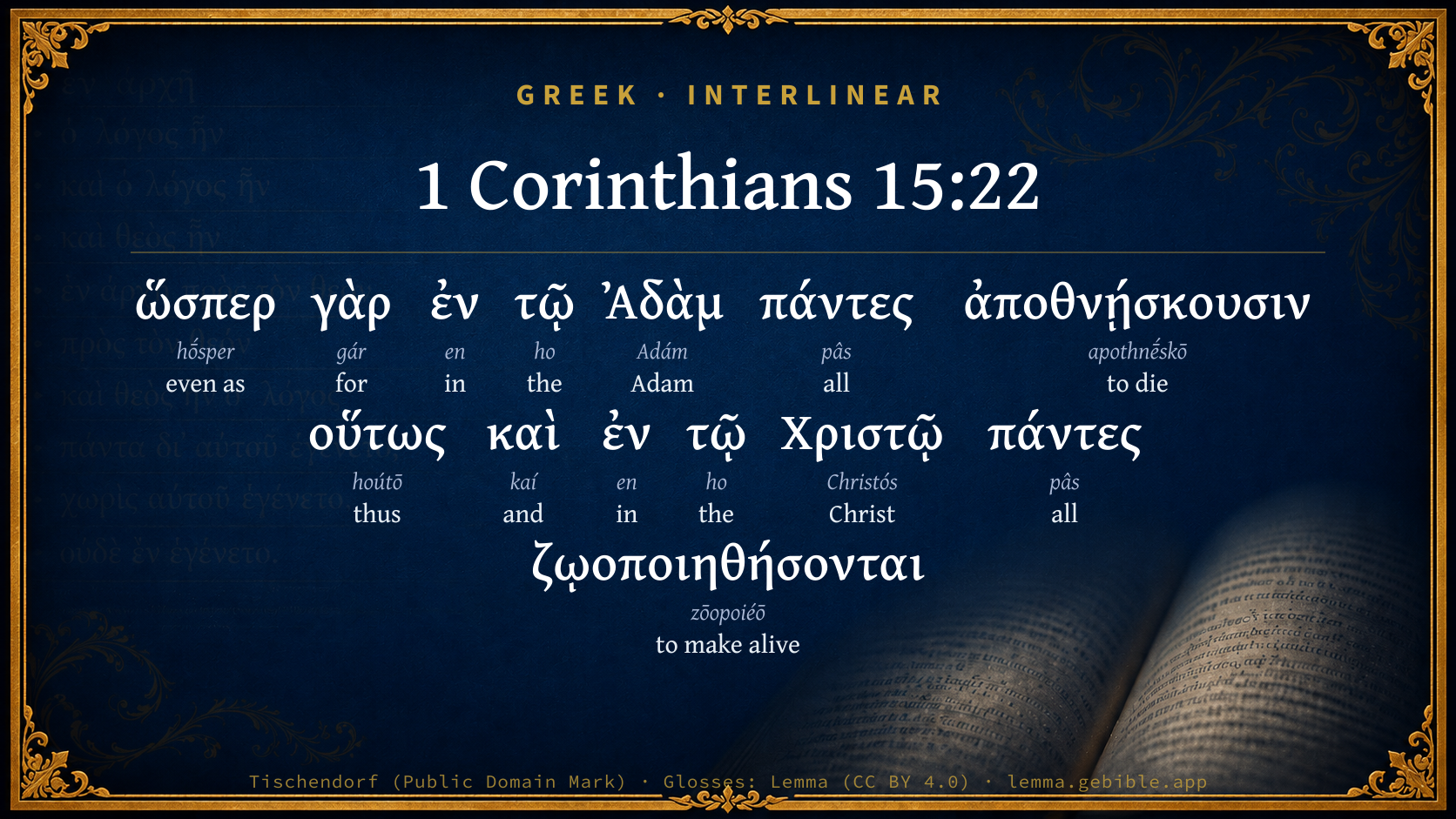
Greek (Tischendorf 8th ed.) 1 Corinthians 15:22 appears in the Greek New Testament. The text above is from the Tischendorf 8th edition. Each word links to its Strong’s number and a concise gloss. Click any word for its full Thayer’s Greek Lexicon entry.
Download image
Cite this verse

1 Corinthians 15:22 (World English Bible). Public Domain. Lemma interlinear Bible study tool, https://lemma.gebible.app/v/1-corinthians/15/22.

Show BibTeX & RIS
BibTeX
RIS
English Translation
For as in Adam all die, so also in Christ all will be made alive.
World English Bible · Public Domain
Download a study sheet

One document with this verse’s original text, its word-by-word gloss line, the meaning frame, cross-references with their text, attributed commentary, and full source and license credits — printable, and it pastes into notes with its structure intact.

This verse Autodidact and up

Study sheet (.html) Plain text (.txt)

A passage Seminary Student

Up to 50 verses in one chapter. A passage sheet keeps up to 6 commentary sources and 12 cross-references per verse, in the order this page ranks them, and says so on the sheet whenever that leaves anything out. Ask for a single verse and you get the Autodidact verse sheet above.

Everything on this page stays free to read, with no account — the sheet is a download of what is already on screen, not access to it.

Want to remove ads? Support Godless Engineer
Compare translations 3

The same verse in 3 English versions, stacked beneath the original-language interlinear above. Click any original word for its lexicon entry.

Each is an independent rendering of the whole verse — the interlinear is not word-aligned to these translations.

Highlighted words mark where these versions differ — a whole-verse word diff, not a word-by-word alignment.

  • World English Bible Public Domain
    For as in Adam all die, so also in Christ all will be made alive.
  • King James Version Public Domain
    For as in Adam all die, even so in Christ shall all be made alive.
  • unfoldingWord Literal Text CC BY-SA 4.0
    For even as in Adam all die, so also in Christ all will be made alive.

unfoldingWord Literal Text — © unfoldingWord, licensed CC BY-SA 4.0. Word-aligned USFM3 via Door43 (git.door43.org/unfoldingWord/en_ult).

Versions to compare (up to 4)

3 of 4 selected

Show all 19 translations

Every available English version of this verse, each an independent rendering of the whole verse.

  • World English Bible Public Domain
    For as in Adam all die, so also in Christ all will be made alive.
  • Berean Standard Bible Public Domain
    For as in Adam all die, so in Christ all will be made alive.
  • Majority Standard Bible Public Domain
    For as in Adam all die, so in Christ all will be made alive.
  • King James Version Public Domain
    For as in Adam all die, even so in Christ shall all be made alive.
  • American Standard Version (1901) Public Domain
    For as in Adam all die, so also in Christ shall all be made alive.
  • Revised Version (1885) Public Domain
    For as in Adam all die, so also in Christ shall all be made alive.
  • Geneva Bible (1599) Public Domain
    For as in Adam all die, euen so in Christ shall all be made aliue,
  • Douay-Rheims (1899) Public Domain
    And as in Adam all die, so also in Christ all shall be made alive.
  • Young's Literal Translation Public Domain
    for even as in Adam all die, so also in the Christ all shall be made alive,
  • Literal Standard Version CC BY-SA 4.0
    for even as in Adam all die, so also in the Christ all will be made alive,
  • Unlocked Literal Bible CC BY-SA 4.0
    For as in Adam all die, so also in Christ all will be made alive.
  • unfoldingWord Literal Text CC BY-SA 4.0
    For even as in Adam all die, so also in Christ all will be made alive.
  • Darby Bible Public Domain
    For as in the Adam all die, thus also in the Christ all shall be made alive.
  • World Messianic Bible Public Domain
    For as in Adam all die, so also in Messiah all will be made alive.
  • Webster's Bible Public Domain
    For as in Adam all die, even so in Christ shall all be made alive.
  • Free Bible Version CC BY-SA 4.0
    Just as in Adam all die, so in Christ all will be made alive.
  • Bible in Basic English Public Domain
    For as in Adam death comes to all, so in Christ will all come back to life.
  • Text-Critical English NT CC BY 4.0
    For just as all die in Adam, so all will be made alive in Christ.
  • Tyndale New Testament (1534) Public Domain
    For as by Adam all dye: Even so by Christ shall all be made alive

Literal Standard Version (2020), Covenant Press — licensed CC BY-SA 4.0. Text via the HelloAO Bible API (eBible.org). Unlocked Literal Bible (unfoldingWord) — licensed CC BY-SA 4.0. Text via the HelloAO Bible API (eBible.org). unfoldingWord Literal Text — © unfoldingWord, licensed CC BY-SA 4.0. Word-aligned USFM3 via Door43 (git.door43.org/unfoldingWord/en_ult). Free Bible Version, Dr. Jonathan Gallagher — licensed CC BY-SA 4.0. Text via the HelloAO Bible API (eBible.org).

Word by word

More ways to search: Search by grammar → Find every occurrence → Compare this word →

Practice this passage: Drill this verse → Learn its vocabulary →

About this verse

These counts appear in no published source. They are computed here, from the morphology-tagged text and Lemma’s own curated glosses. What Lemma adds →

14
words
11
distinct lemmas
Pauline Epistles
section

Notable vocabulary

The rarest word here is Ἀδὰμ Adam G76 — appearing just 9 times in the whole Greek New Testament.

Shared distinctive vocabulary

Ἀδὰμ Adam G76 occurs in 7 verses of the Greek New Testament. Also found in:

Repetition

Words recur within this verse:

Cross-references

6

Topical passages linked to 1 Corinthians 15:22 in the Treasury of Scripture Knowledge — connected by theme and wording, ordered by reader-vote popularity; previews shown in the World English Bible.

  • Romans 5:12–21 Therefore, as sin entered into the world through one man, and death through sin; and so death passed to all men, because all sinned.
  • 1 Corinthians 15:45–49 So also it is written, "The first man, Adam, became a living soul." The last Adam became a life-giving spirit.
  • John 5:21–29 For as the Father raises the dead and gives them life, even so the Son also gives life to whom he desires.
  • Genesis 2:17 but of the tree of the knowledge of good and evil, you shall not eat of it: for in the day that you eat of it you will surely die."
  • Genesis 3:6 When the woman saw that the tree was good for food, and that it was a delight to the eyes, and that the tree was to be desired to make one wise, she took of the fruit of it, and ate; and she gave some to her husband with her, and he ate.
  • Genesis 3:19 By the sweat of your face will you eat bread until you return to the ground, for out of it you were taken. For you are dust, and to dust you shall return."

Cross-references courtesy of OpenBible.info (CC BY 4.0).

Commentary

Notes on 1 Corinthians 15:22 from classic Christian and Jewish commentators (each source and its license shown beneath its notes). The classic Christian expositions comment on the surrounding passage and are grouped to its opening verse, so a note may address several verses; the Jewish commentaries on the Tanakh (Rashi and others) are per-verse, so they appear only where the commentator wrote on this verse.

Lemma curates 59 commentaries, every one of them public domain or Creative Commons licensed, each selected and text-cleaned for this edition rather than reprinted as found. About our sources →

Bengel's Gnomon

Johann Albrecht Bengel

1Co 15:22. Πάντες ἀποθνήσκουσιν, all die) he says, die, not in the preterite, as for example, Rom 5:17; Rom 5:21, but in the present, in order that in the antithesis he may the more plainly speak of the resurrection, as even still future. And he says, all. Those who are in the highest degree wicked die in Adam; but Paul is here speaking of the godly, of whom the first fruits, ἀπαρχὴ, is Christ, and as these all die in Adam, so also shall they all be made alive in Christ. Scripture everywhere deals with believers, and treats primarily of their resurrection, 1Th 4:13-14: and only incidentally of the resurrection of the ungodly.—ἐν τῷ Χριστῷ, in Christ) These are the emphatic words in this clause. The resurrection of Christ being once established, the quickening of all is also established.—ζωοποιηθήσονται, they shall be made alive) He had said; they die, not, they are put to death; whereas now, not, they shall revive; but they shall be made alive, i.e. implying that it is not by their own power.

Bengel's Gnomon of the New Testament — English translation (T&T Clark, Edinburgh, 1860) — public domain. Text from a community e-Sword module.

Meyer's Critical & Exegetical Commentary

Heinrich August Wilhelm Meyer

1Co_15:22. More precise explanation confirmatory of 1Co_15:21, so that the first διʼ ἀνθρώπου is defined in concreto by ἐν τῷ Ἀδάμ, likewise θάνατος by πάντες ἀποθνήσκουσιν κ.τ.λ.

ἐν τῷ Ἀδάμ] In Adam it is causally established that all die, inasmuch as, namely, through Adams sin death has penetrated to all, Rom_5:12; to which statement only Christ Himself, who, as the sinless One, submitted Himself to death in free obedience toward the Father (Php_2:8; Rom_5:19), forms a self-evident exceptio.

ἐν τῷ Χ.] for in Christ lies the ground and cause, why at the final historical completion of His redemptive work the death which has come through Adam upon all shall be removed again, and all shall be made alive through the resurrection of the dead. In this way, therefore, certainly no one shall be made alive except in Christ,[42] but this will happen to all. Since πάντες, namely, is not to be restricted to the totality of believers, but to be taken quite generally (see below), there thus results more specially as the idea of the apostle: Christ, when He appears in His glory, is not simply the giver of life for His believing people; He makes them (through the resurrection, and relatively through the transformation, 1Co_15:51) alive unto the eternal Messianic ζωή (Rom_8:11); but His life-giving power extends also to the other side, that is, to the unbelievers who must experience the necessary opposite of the completed redemption; these He awakes to the resurrection of condemnation. Paul thus agrees with Joh_5:28 f.; Mat_10:28; and thus his declaration recorded in Act_24:15 finds its confirmation in our text (comp. on Php_3:11).

ΠΆΝΤΕς ΖΩΟΠ.] which is to be understood not of the new principle of life introduced into the consciousness of humanity (Baur, neut. Theol. p. 198), but, according to the context and on account of the future, in the eschatological sense, is by most interpreters (including Flatt, Billroth, Rückert, Osiander, van Hengel, Maier, Ewald, Hofmann, Lechler, apost. Zeit. p. 145; Lutterbeck, II. p. 232 ff.) held to refer only to believers. But ἕκαστος, 1Co_15:23, requires us to think of the resurrection of all (so also Olshausen, de Wette); for otherwise we should have to seek the πάντες collectively in the second class ἜΠΕΙΤΑ ΟἹ ΤΟῦ ΧΡΙΣΤΟῦ, so that ΟἹ ΤΟῦ ΧΡΙΣΤΟῦ and the ΠΆΝΤΕς would cover each other, and there could be no mention at all of an ἝΚΑΣΤΟς ἘΝ Τῷ ἸΔΊῼ ΤΆΓΜΑΤΙ in reference to the ΠΆΝΤΕς. Accordingly we must not restrict ΖΩΟΠ. to blessed life, and perhaps explain (so de Wette, comp. also Neander in loc.; Messner, Lehre der Apost. p. 291 f.; Stroh, Christus d. Erstl. d. Entschlaf. 1866) its universality (πάντες) from the (not sanctioned by the N. T.) ἈΠΟΚΑΤΆΣΤΑΣΙς ΠΆΝΤΩΝ (comp. Weizel in the Stud. u. Krit. 1836, p. 978; Kern in the Tüb. Zeitschr. 1840, 3, p. 24). Neither must we so change the literal meaning, as to understand it only of the destination[43] of all to the blessed resurrection (J. Müller in the Stud. u. Krit. 1835, p. 751), or as even to add mentally the condition which holds universally for the partaking in salvation (Hofmann)which alteration of what is said categorically into a hypothetical statement is sheer arbitrariness. On the contrary, ζωοποιηθ. (see also 1Co_15:36), confronted with the quite universal assertion of the opponents that a resurrection of the dead is a non ens (1Co_15:12-16), is in and by itself indifferent (comp. Rom_4:17; 2Ki_5:7; Neh_9:6; Theod. Isa_26:14; Lucian, V. H. i. 22), the abstract opposite of θάνατος (comp. 1Co_15:36), in connection with which the concrete difference as regards the different subjects is left for the reader himself to infer. As early interpreters as Chrysostom, Ambrosiaster, and Theodoret have rightly understood πάντες ζωοπ. not simply of the blessed resurrection, but generally of bodily revivification, and without limiting or attaching conditions to the πάντες. It denotes all without exception, as is necessary from 1Co_15:23, and in keeping with the quite universal πάντες of the first half of the verse. See, too, on 1Co_15:24. In opposition to the error regarding the Apokatastasis, see generally Philippi, Glaubenslehre, III. p. 372 ff.; Martensen, Dogmat. § 286.

[42] Von Zezschwitz in the Erlang. Zeitschr. 1863, Apr. p. 197. Comp. also Luthardt, v. d. letzten Dingen, p. 125.

[43] Comp. Krauss, p. 107 ff., who finds in the whole chain of thought the ἀποκατάστασις τῶν πάντων.

Meyer — Critical and Exegetical Commentary on the New Testament — English translation by Peter Christie, edited by Frederick Crombie (T&T Clark, 1880) — public domain. Text from a community e-Sword module.

Hodge's Commentary on Romans, Ephesians & First Corinthians

Charles Hodge

1Co_15:22

For as in Adam all die, even so in Christ shall all be made alive.

This is the reason why Adam was the cause of death, and why Christ is the cause of life. We die by means of Adam, because we were in Adam; and we live by means of Christ, because we are in Christ. Union with Adam is the cause of death; union with Christ is the cause of life. The nature of this union and its consequences are more fully explained in Rom_5:12-21. In both cases it is a representative and vital union. We are in Adam because he was our head and representative, and because we partake of his nature. And we are in Christ because he is our head and representative, and because we partake of his nature through the indwelling of his Spirit. Adam, therefore, is the cause of death, because his sin is the judicial ground of our condemnation; and because we derive from him a corrupt and enfeebled nature. Christ is the cause of life, because his righteousness is the judicial ground of our justification; and because we derive from him the Holy Ghost, which is the source of life both to the soul and body. Comp. Rom_8:9-11.

That the word all in the latter part of this verse is to be restricted to all believers (or rather, to all the people of Christ, as infants are included) is plain,

1. Because the word in both clauses is limited. It is the all who are in Adam that die; and the all who are in Christ who are made alive. As union with Christ is made the ground of the communication of life here spoken of, it can be extended only to those who are in him. But according to the constant representation of the Scriptures, none are in him but his own people. If any man be in Christ, he is a new creature, 2Co_5:17.

2. Because the verb (ζωοποιέω) here found is never used of the wicked. Whenever employed in reference to the work of Christ it always means to communicate to them that life of which he is the source, Joh_5:21; Joh_6:63. Rom_8:11; 1Co_15:45. Gal_3:21. The real meaning of the verse therefore, is, As in Adam all die, so in Christ shall all be made partakers of a glorious and everlasting life. Unless, therefore, the Bible teaches that all men are in Christ, and that all through him partake of eternal life, the passage must be restricted to his own people.

3. Because, although Paul elsewhere speaks of a general resurrection both of the just and of the unjust, Act_24:15, yet, throughout this chapter he speaks only of the resurrection of the righteous.

4. Because, in the parallel passage in Rom_5:12-21, the same limitation must be made. In Rom_5:18 of that chapter it is said, As by the offense of one judgment came upon all men to condemnation; even so by the righteousness of one the free gift came upon all men to justification of life. That is, as for the offense of Adam all men were condemned, so for the righteousness of Christ all men are justified.

The context and the analogy of Scripture require us to understand this to mean, as all who are in Adam are condemned, so all who are in Christ are justified. No historical Christian church has ever held that all men indiscriminately are justified. For whom God justifies them he also glorifies, Rom_8:30.

There are two other interpretations of this verse. According to one, the verb, shall be made alive, is taken to mean no more than shall be raised from the dead. But this, as already remarked, is not only inconsistent with the prevailing use of the word, but with the whole context. Others, admitting that the passage necessarily treats of a resurrection to glory and blessedness, insist that the word all must be taken to include all men. But this contradicts the constant doctrine of the Bible, and has no support in the context. It is not absolutely all who die through Adam, but those only who were in him; so it is not absolutely all who live through Christ, but those only who are in him.

Charles Hodge — Commentary on Romans (1835), First Corinthians (1857), and Ephesians (1856) — public domain. Text from a community e-Sword module.

Geneva Bible (1599)

Geneva Bible translators

Shall rise by the virtue of Christ.

Geneva Bible (1599) marginal notes — public domain. Text via Bolls.life.

Jamieson, Fausset & Brown

Robert Jamieson, A. R. Fausset & David Brown

in Adam all--in union of nature with Adam, as representative head of mankind in their fall.

in Christ . . . all--in union of nature with Christ, the representative head of mankind in their recovery. The life brought in by Christ is co-extensive with the death brought in by Adam.

Jamieson, Fausset & Brown — Commentary Critical and Explanatory on the Whole Bible (1871) — public domain (CC PDM 1.0). Text via the HelloAO Bible API.

Ellicott's Commentary for English Readers

(22) As in Adam . . .—Better, as in the Adam all die, so in the Christ shall all be made alive. The first Adam and the second Adam here stand as the heads of Humanity. All that is fleshly in our nature is inherited from the Adam; in every true son of God it is dying daily, and will ultimately die altogether. All that is spiritual in our nature we inherit from the Christ; it is immortal, is rising daily, will ultimately be raised with a spiritual and immortal body. We must remember that the relationship of Christ to Humanity is not to be dated only from the Incarnation. Christ stood in the same federal relation to all who went before as He does to all who have come since. (See the same thought in 1Co_10:4, and in Christ’s own words, “Before Abraham was, I am.”) The results of Christ’s death are co-extensive with the results of Adam’s fall—they extend to all men; but the individual responsibility rests with each man as to which he will cherish—that which he derives from Christ or that which he derives from Adam—the “offence” of Adam or the “grace” of Christ. The best comment on this passage is, perhaps, the prayer in the Baptismal Office: “O merciful God, grant that the old Adam in this child may be so buried, that the new man may be raised up in him.” There seems to be this moral significance in these words of St. Paul, as well as the obvious argument that, as all men die physically, so all shall be raised from the dead; as we have the evidence of death in the death of a man and of all men, so we have the evidence (and not the mere theoretical promise) of a resurrection in the resurrection of the Man Christ Jesus.

A Bible Commentary for English Readers, edited by Charles John Ellicott (1878–1897) — public domain. Text from a community e-Sword module.

The Cambridge Bible for Schools and Colleges

gen. ed. J. J. S. Perowne

22. For as in Adam all die] In the possession of a common nature with Adam all mankind are liable to death.

even so in Christ shall all be made alive] By possession of a common nature with Christ all shall partake of that Resurrection to which He has already attained. Cf. St Joh_5:21; Joh_6:27; Joh_6:39-58; Joh_11:25.

The Cambridge Bible for Schools and Colleges (gen. ed. J. J. S. Perowne; Cambridge University Press, 1878–1918) — public domain. Text from a community e-Sword module.

John Gill's Exposition

But every man in his own order,.... Not of time, as if the saints that lived in the first age of the world should rise first, and then those of the next, and so on to the end of the world; nor of dignity, as that martyrs should rise first in the order of martyrs, and preachers of the word in the order of preachers, and private Christians in the order and rank of private Christians; or of age, as the elder first, and then the younger; or of state and condition, as married persons in the order of married persons, and virgins in the order of virgins; these are all foreign from the sense of the words; the order regarded is that of head and members, the firstfruits and the harvest. There seems to be an allusion to the ranging and marshalling of the Israelites, everyone by his "own standard"; which both the Targums of Onkelos and Jonathan render , "by or according to his own order": and so the Septuagint , the word here used; and the sense is, that every man shall be raised from the dead, according to the head under which he is ranged and marshalled. Christ the head is risen first; next all those that are under him, as an head, will rise from the dead; the dead in Christ will rise first; and then a thousand years after that, those who are only in their natural head, by whom death came to them, and have lived and died in a natural estate, will rise last; but as the apostle is only upon the resurrection of the saints, he carries the account and observes the order no further than as it concerns Christ and his people:

Christ the firstfruits; he rose first in order of time, dignity, causality and influence; See Gill on Co1 15:20.

afterwards they that are Christ's; not immediately after; for now almost two thousand years are elapsed since the resurrection of Christ, and yet the saints are not raised; and how many more years are to run out before that, is not to be known; but as there was an interval between the firstfruits, and the ingathering of the harvest; so there is a considerable space of time between the resurrection of Christ as the firstfruits, and the resurrection of his people, which will be the harvest; and that will be at the end of the world, according to Mat 13:39 the persons who shall rise first and next after Christ, are they that are his; who were chosen in him before the foundation of the world, and were given to him by his Father as his spouse, his children, his sheep, his portion, and his jewels; who were purchased and redeemed by his blood, are called by his grace and regenerated by his Spirit, and who give up themselves to him, and are possessed by him: and the interest that Christ has in them here expressed, carries in it a strong argument of their resurrection; which may be concluded from their election in Christ, which can never be made void; from the gift of their whole persons to Christ by his Father, with this declaration of his will, that he should lose nothing of them, but raise it up at the last day; from his redemption of their bodies as well as their souls; from the union of both unto him; and from the sanctification of both, and his Spirit dwelling in their mortal bodies as well as in their souls: the time when they will be raised by Christ is,

at his coming; at his second and personal coming at the last day; then the dead in Christ will rise first, and immediately; and he will judge the quick and dead, those that will be found alive, and those that will be then raised from the dead: when this will be no man knows; yet nothing is more certain, than that Christ will come a second time; and his coming will be speedy and sudden; it will be glorious and illustrious, and to the joy and salvation of his people; since their bodies will then be raised and reunited to their souls, when they, soul and body, shall be for ever with the Lord. The Vulgate Latin reads the words thus, "they that are Christ's, who have believed in his coming"; both in his first and second coming; but there is nothing in the Greek text to encourage and support such a version and sense.

John Gill's Exposition of the Whole Bible (1746–1763) — public domain (CC PDM 1.0). Text via the HelloAO Bible API.

Trapp's Complete Commentary

John Trapp

22 For as in Adam all die, even so in Christ shall all be made alive.

Ver. 22. Shall all be made alive] The saints shall be raised by virtue of the union with Christ to glory, the wicked shall be dragged to his tribunal by his Almighty power as a judge, to be tumbled thence into hell’s torment.

John Trapp, A Commentary or Exposition upon All the Books of the Old and New Testament (1647–1656) — public domain. Text from a community e-Sword module.

Albert Barnes' Notes on the Bible

For as in Adam - (ἐν τῳ Ἀδαμ en tō Adam). By Adam; by the act, or by means of Adam; as a consequence of his act. His deed was the procuring cause, or the reason, why all are subjected to temporal death; see Gen 3:19. It does not mean that all people became actually dead when he sinned, for they had not then an existence; but it must mean that the death of all can be traced to him as the procuring cause, and that his act made it certain that all that came into the world would be mortal. The sentence which went forth against him Gen 3:19 went forth against all; affected all; involved all in the certainty of death; as the sentence that was passed on the serpent Gen 3:14 made it certain that all serpents would he “cursed above all cattle,” and be prone upon the earth; the sentence that was passed upon the woman Gen 3:16 made it certain that all women would be subjected to the same condition of suffering to which Eve was subjected; and the sentence that was passed on man Gen 3:17 that he should cultivate the ground in sorrow all the days of his life, that it should bring forth thistles and thorns to him 1Co 15:18, that he should eat bread in the sweat of his brow 1Co 15:19, made it certain that this would be the condition of all people as well as of Adam. It was a blow at the head of the human family, and they were subjected to the same train of evils as he was himself. In like manner they were subjected to death. It was done in Adam, or by Adam, in the same way as it was in him, or by him, that they were subjected to toil and to the necessity of procuring food by the sweat of the brow; see the notes on Rom 5:12-19; see 1Co 15:47-48.

All die - All mankind are subjected to temporal death; or are mortal. This passage has been often adduced to prove that all mankind became sinful in Adam, or in virtue of a covenant transaction with him; and that they are subjected to spiritual death as a punishment for his sins. But, whatever may he the truth on that subject, it is clear that this passage does not relate to it, and should not he adduced as a proof text. For:

(1) The words “die” and “dieth” obviously and usually refer to temporal death; and they should be so understood, unless there is something in the connection which requires us to understand them in a figurative and metaphorical sense. But there is, evidently, no such necessity here.

(2) The context requires us to understand this as relating to temporal death. There is not here, as there is in Rom. 5, any intimation that men became sinners in consequence of the transgression of Adam, nor does the course of the apostle’s argument require him to make any statement on that subject. His argument has reference to the subject of temporal death, and the resurrection of the dead; and not to the question in what way people became sinners.

(3) The whole of this argument relates to the “resurrection of the dead.” That is the main, the leading, the exclusive point. He is demonstrating that the dead would rise. He is showing how this would be done. It became, therefore, important for him to show in what way people were subjected to temporal death. His argument, therefore requires him to make a statement on that point, and that only; and to show that the resurrection by Christ was adapted to meet and overcome the evils of the death to which people were subjected by the sin of the first man. In Rom. 5 the design of Paul is to prove that the effects of the work of Christ were more than sufficient to meet all the evils introduced by the sin of Adam. This leads him to an examination there of the question in what way people became sinners. Here the design is to show that the work of Christ is adapted to overcome the evils of the sin of Adam in one “specific matter - the matter under discussion, that is,” on the point of the resurrection; and his argument therefore requires him to show only that temporal death, or mortality, was introduced by the first man, and that this has been counteracted by the second; and to this specific point the interpretation of this passage should be confined. Nothing is more important in interpreting the Bible than to ascertain the specific point in the argument of a writer to be defended or illustrated, and then to confine the interpretation to that. The argument of the apostle here is ample to prove that all people are subjected to temporal death by the sin of Adam; and that this evil is counteracted fully by the resurrection of Christ, and the resurrection through him. And to this point the passage should be limited.

(4) If this passage means, that in Adam, or by him, all people became sinners, then the correspondent declaration “all shall be made alive” must mean that all people shall become righteous, or that all shall be saved. This would be the natural and obvious interpretation; since the words “be made alive” must have reference to the words “all die,” and must affirm the co-relative and opposite fact. If the phrase “all die” there means all become sinners, then the phrase “all be made alive” must mean all shall be made holy, or be recovered from their spiritual death; and thus an obvious argument is furnished for the doctrine of universal salvation, which it is difficult, if not impossible, to meet. It is not a sufficient answer to this to say, that the word “all,” in the latter part of the sentence, means all the elect, or all the righteous; for its most natural and obvious meaning is, that it is co-extensive with the word “all” in the former part of the verse.

And although it has been held by many who suppose that the passage refers only to the resurrection of the dead, that it means that all the righteous shall be raised up, or all who are given to Christ, yet that interpretation is not the obvious one, nor is it yet sufficiently clear to make it the basis of an argument, or to meet the strong argument which the advocate of universal salvation will derive from the former interpretation of the passage. It is true literally that all the dead will rise: it is not true literally that all who became mortal, or became sinners by means of Adam, will be saved. And it must be held as a great principle, that this passage is not to be so interpreted as to teach the doctrine of the salvation of all people. At least, this may be adopted as a principle in the argument with those who adduce it to prove that all people became sinners by the transgression of Adam. This passage, therefore, should not be adduced in proof of the doctrine of imputation, or as relating to the question how people became sinners, but should be limited to the subject that was immediately under discussion in the argument of the apostle. “That object was, to show that the doctrine of the resurrection by Christ was such as to meet the obvious doctrine that people became mortal by Adam; or that the one was adapted to counteract the other.”

Even so - (οὕτω houtō.) In this manner; referring not merely to the certainty of the event, but to the mode or manner. As the death of all was occasioned by the sin of one, even so, in like manner, the resurrection of all shall be produced by one. His resurrection shall meet and counteract the evils introduced by the other, so far as the subject under discussion is concerned; that is, so far as relates to temporal death.

In Christ - By Christ; in virtue of him; or as the result of his death and resurrection. Many commentators have supposed that the word “all” here refers only to believers, meaning all who were united to Christ, or all who were his friends; all included in a covenant with him; as the word “all” in the former member of the sentence means all who were included in the covenant with Adam; that is, all mankind. But to this view there are manifest objections:

(1) It is not the obvious sense; it is not that which will occur to the great mass of people who interpret the Scriptures on the principles of common sense; it is an interpretation which is to be made out by reasoning and by theology - always a suspicious circumstance in interpreting the Bible.

(2) It is not necessary. All the wicked will be raised up from the dead as well as all the righteous, Dan 12:2; Joh 5:28-29.

(3) The form of the passage requires us to understand the word “all” in the same sense in both members, unless there be some indispensable necessity for limiting the one or the other.

(4) The argument of the apostle requires this. For his object is to show that the effect of the sin of Adam, by introducing “temporal” death, will be counteracted by Christ in raising up all who die; which would not be shown if the apostle meant to say that only a part of those who had died in consequence of the sin of Adam would he raised up. The argument would then be inconclusive. But now it is complete if it be shown that all shall be raised up, whatever may become of them afterward. The sceptre of death shall be broken, and his dominion destroyed, by the fact that all shall be raised up from the dead.

Be made alive - Be raised from the dead; be made alive, in a sense contradistinguished from that in which he here says they were subjected to death, by Adam. If it should be held that that means that all were made sinners by him, then this means, as has been observed, that all shall be made righteous, and the doctrine of universal salvation has an unanswerable argument; if it means, as it obviously does, that all were subjected to temporal death by him, then it means that all shall be raised from the dead by Christ.

Albert Barnes' Notes on the Bible (1834–1885) — public domain. Text from a community e-Sword/MySword module.

Matthew Poole's English Annotations

As in the first Adam all men, that were in him, became subject both to temporal death, and all the afflictions and miseries of this life, which are so many little deaths, Rom 8:36, and forerunners of natural death, or attendants upon it; and also to that eternal death, which is the consequent of the guilt of sin, Rom 6:23; so in Christ, that is, through the merits of his death, and through his resurrection, all that are in him, being chosen in him, given to him, and by faith implanted into him, are not only spiritually made alive, (being passed from death unto life, 1Jo 3:14), but shall be raised from the dead unto eternal life. But though this text doth not prove the general resurrection, (being only intended of believers, that are members of Christ), yet it doth not oppose it. But that the all here mentioned is no more than all believers, appeareth not only from the term in Christ in this verse, but from the whole following discourse; which is only concerning the resurrection of believers to life, not that of the wicked to eternal condemnation.

Matthew Poole's English Annotations on the Holy Bible (1683–1685) — public domain. Text from a community e-Sword/MySword module.

Whedon's Commentary on the Bible

Daniel D. Whedon

22. In Adam… in Christ—Literally in the Adam, in the Christ. That all the race was done up in Adam and drawn out from him, (just as the successive lengths of a spyglass are done up in and drawn out from the first length,) is not a literal fact. It is an imaginative conception, which, properly guarded, gives a powerful impression of the truth. St. Augustine, by perverting the conception, did almost as much to corrupt Christian theology as he did, in other respects, to defend it. See note on Rom_5:12. The being made alive here, is simply the same as the resurrection in the previous verse, and affirms, merely, a universal bodily resurrection. The being in Christ refers not to the incorporation into Christ’s mystical body of believers by faith, but to their being taken in under his headship of the race, as they were previously in under the headship of Adam by descent.

Daniel D. Whedon (gen. ed.), Commentary on the Old and New Testaments (1874–1909) — public domain. Text from a community e-Sword module.

The Pulpit Commentary

As in Adam all die. All of us partake of Adam"s nature, and are therefore liable to the death which that nature incurred as the law and condition of its humanity. In Christ shall all be made alive. It is St. Paul"s invariable habit to isolate his immediate subject; to think and to treat of one topic at a time. He is not here thinking directly and immediately of the resurrection in general. In this verse, writing to Christians who are "in Christ," he is only thinking and speaking of the resurrection of those who are "in Christ." That any can be nominally "in Christ," yet not really so, is a fact which is not at present under his cognizance; still less is he thinking of the world in general. In other words, he is here dealing with "the resurrection of life" alone, and not also with the "resurrection of judgment". (Joh_5:26-29) Still, as far as his words alone are concerned, it is so impossible to understand the phrase, "shall all be made alive," of a resurrection to endless torments, that his language at least suggests the conclusion that "the principle which has come to actuality in Christ is of sufficient energy to quicken all men for the resurrection to the blessed life" (Baur, "Life of St. Paul," 2:219).

The Pulpit Commentary (1880–1919), ed. H.D.M. Spence-Jones & Joseph S. Exell — public domain. Text from a community e-Sword module.

John Wesley's Explanatory Notes

As through Adam all, even the righteous, die, so through Christ all these shall be made alive - He does not say, "shall revive," (as naturally as they die,) but shall be made alive, by a power not their own.

John Wesley, Explanatory Notes Upon the Whole Bible (1754–1765) — public domain. Text via the GEBible commentary corpus.

Scofield Reference Notes

C. I. Scofield

Adam

Adam was a contrasting type of Christ, 1Co 15:45-47; Rom 5:14-19.

(1) "The first man Adam was made a living soul" Gen 2:7, i.e. he derived life from another, that is, God. "The last Adam was a life-giving spirit." So far from deriving life, He was Himself the fountain of life, and He gave that life to others; Joh 1:4; Joh 5:21; Joh 10:10; Joh 12:24; 1Jn 5:12.

(2) In origin the first man was of the earth, earthy; the Second Man is the Lord from heaven.

(3) Each is the head of a creation, and these also are in contrast: in Adam all die; in Christ all will be made alive; the Adamic creation is "flesh"; the new creation, "spirit." Joh 3:6.

The Scofield Reference Bible (1917 edition), notes by C. I. Scofield — public domain. Text from a community e-Sword module.

Godbey's Commentary on the New Testament

William B. Godbey

22. “For as in Adam all die, even so in Christ shall all be made alive.” This verse is very comprehensive. While, of course, it has direct allusion to the body, confirmatory of the conclusion that every human body will rise from the dead as Christ did, yet this is not only comprehensive of the body, but of the soul. The Universalists very unfairly construe it in favor of universal salvation. While it does mean that all are made alive in Christ, i. e., all regenerated in Him, it is simply no argument in the final salvation of all, from the fact that Hell was never made for any but backsliders in the beginning, Satan himself being an old backslider, having once been an archangel in Heaven (Isa 14:12), and all the demons having once been angels in Heaven (Jud 1:7). Hence they are all backsliders, the same being true of every human being who ever has made, or ever will make, his bed in the bottomless pit. This conclusion is legitimate from the great Bible truth that all human beings are vitalized in Christ. When God created Adam He created all the human race seminally, Eve being no exception, but an evolution from Adam’s rib. Hence the whole human race became corrupted in their federal head and were ejected from the Divine presence.

“I was shapen in iniquity, and in sin did my mother conceive me” (Psa 51:5), tells the sad story which Charles Wesley sang a hundred and fifty years ago:

“Lord, I am vile, conceived in sin, Born unholy and unclean;

Sprung from the man whose guilty Fall Corrupts his race and taints us all.”

While the conception is in Adam the first, the physical birth is in Adam the Second. “He tasted death for every one” (Heb 2:9). The pronoun tis in this passage means every human being from the moment when soul and body, united, constitute personality, which takes place before the physical birth. “Except a man be born again, he can not see the kingdom of God” (Joh 3:5), should read, “Except every one be born from above.” The adverb “again” in the E.V. leads to the conclusion that it must always follow the natural birth, which is not true of the original anoothen, which simply means “from above.” This corroborates the uniform teaching of the Scriptures that every human being must be renewed by grace, and that every infant is actually born in the kingdom of God, and only gets out by sinning out; e. g., the prodigal son (Luke 15) was born in his father’s house, to which he returned when he was converted; his older brother never getting out, so never losing his infantile justification, though he much needed sanctification to take the fret out of him which he evinced when they made so great ado over his returned brother, who, despite the scheming of Satan, had already gotten ahead of his clever older brother, being happily justified when the father gave him the kiss of reconciliation, and gloriously sanctified when they put on him the “best robe” of holiness. Then, if the infants are all born in the kingdom of grace, justified by the normal efficacy of the atonement without faith, and regenerated by the normal renewing grace of Christ, so they are not the children of Satan, i. e., sinners, but the children of God, i. e., Christians, why do they need conversion if they are brought up so as not to forfeit their infantile justification, of which there is a gracious possibility, and of whose delinquency they ought to be ashamed? Conversion simply means a turning, and does not necessarily include justification nor regeneration, which are only incidental to it in case of actual sins. Hence God’s time to get everybody converted is before they forfeit infantile justification. In that case, you have nothing to do but preach Jesus to the little one, turn him round and introduce him to the Savior. Then, instead of going right away into sin, as all do without conversion, pursuant to inbred depravity, the little one, turned round, introduced to the Savior, his countenance electrified by His glory, leaps for joy and sets out on the way to Heaven. Hence, “In Adam all die, and in Christ shall all be made alive,” is true spiritually as well as corporeally. The latter is verified in the fact that all do rise from the dead, and the former in the fact that every human being in all ages and nations is born in the kingdom of God, not because of original purity, but because Christ tasted death for every one, i. e., every human being. Hence the very moment soul and body are united, personality obtains, the vicarious atonement avails, the law is satisfied, and the Holy Spirit imparts life to the soul. Hence every sinner in all the world is like Satan, a backslider, having been a Christian in his innocent infancy, but fallen away since he reached responsibility. Hence Bishop Taylor is right in the assumption that heathen infants are Christians till they are made sinners and heathens by human influence. Hence the importance of establishing nurseries throughout heathendom, gathering in the infants, and retaining them in the kingdom; i. e., getting them converted before they are old enough to sin, and then getting them sanctified before they backslide.

William B. Godbey, Commentary on the New Testament (1896–1900) — public domain. Text from a community e-Sword module.

McGarvey & Pendleton's Commentaries

J. W. McGarvey

For as in Adam all die [ Gen_3:1 ], so also in Christ shall all be made alive .

J. W. McGarvey (with Philip Y. Pendleton), Commentaries on the New Testament (The Fourfold Gospel, 1914; Acts; and the epistles) — public domain. Text from a community e-Sword/MySword module.

The People's New Testament

B. W. Johnson

22. For as in Adam all die, so in Christ shall all be made alive, etc. All the race in Adam became subject to death; so in Christ all the race shall be raised from the dead to appear at the bar of eternal judgment. The passage does not affirm the final salvation of all, but the final resurrection of all. There is a “resurrection of the just and of the unjust.”

B. W. Johnson's The People's New Testament with Notes (1889–1891) — public domain. Electronic text from the Christian Classics Ethereal Library (CCEL) ThML edition.

unfoldingWord translationNotes

Door43 World Missions Community

who is the firstfruits

Here "firstfruits" is a metaphor, comparing Christ to the first of the harvest, which would be followed by the rest of the harvest. Christ was the first to be raised from the dead. AT: "who is like the first part of the harvest" (See: Metaphor)

translationWords

Adam

die

Christ

life

firstfruits

unfoldingWord translationNotes — © Distant Shores Media and the Door43 World Missions Community, licensed CC BY-SA 4.0. Source: git.door43.org/Door43/en_tn.

Cambridge Greek Testament for Schools and Colleges

22. ἐν τῷ Ἀδὰμ πάντες ἀποθνήσκουσιν. In the possession of a common nature with Adam all mankind are liable to death. The pres. as in 1Co 15:15.

ζωοποιηθήσονται. By possession of a common nature with Christ all shall partake of that Resurrection to which He has already attained. Cf. Joh 5:21; Joh 6:27; Joh 6:39-58; Joh 11:25.

Cambridge Greek Testament for Schools and Colleges (Cambridge University Press, 1896; 21 vols, various authors incl. Carr, Maclear, Plummer, Farrar, Lumby, Moule, M. R. James, Simcox) — public domain. Text from a community e-Sword module.

Alford’s Greek Testament

Henry Alford

22.] (2) In that He is (and here the fact of His being the Lord of Life and Righteousness, and the second and spiritual Head of our nature, is assumed) to us the bringer-in of Life, as Adam was the bringer-in of Death.

ἐν τῷ Ἀδ., ἐν τῷ χριστῷ] in community with, as partakers in a common nature with, Adam and Christ: who are respectively the sources, to the whole of that nature (πάντες), of death, and life, i.e. (here) physical death, and rescue from physical death. The practice of Paul to insulate the objects of his present attention from all ulterior considerations, must be carefully here borne in mind. The antithesis is merely between the bringing in of death by Adam, and of life (its opposite) by Christ. No consequence, whether on the side of death or of life, is brought into consideration. That death physical involved death eternal—that life eternal (in its only worthy sense) involves bliss eternal, is not so much as thought of, while the two great opposites, Death and Life, are under consideration. This has been missed by many Interpreters, and the reasoning thereby marred. But the ancients, Chrys., Theophyl., Theodoret, Œcum., and Olsh., De Wette, and Meyer, keep to the universal reference. Theophylact’s note is clear and striking: αἰτίαν προστίθησι διʼ ἧς πιστοῦται τὰ εἰρημένα· ἔδει γάρ, φησιν, αὐτὴν νικῆσαι τὴν ἡττηθεῖσαν φύσιν, καὶ τὸν καταβληθέντα, αὐτὸν ἐκνικῆσαι· καὶ γὰρ ἐν τῷ Ἀδάμ, τουτέστι διὰ τὸ τοῦ Ἀδὰμ πταῖσμα, πάντες τῷ θανάτῳ ὑπέπεσον· οὕτως οὖν ἐν χριστῷ πάντες ἀναστήσονται· τουτέστι διὰ τὸ εὑρεθῆναι τὸν χριστὸν ἀναμάρτητον κ. ἀνένοχον τῷ θανάτῳ, καὶ ἑκόντα μὲν ἀποθανεῖν, ἀναστῆναι δέ, καθὸ οὐκ ἦν δυνατὸν αὐτὸν κρατεῖσθαι ὑπὸ τῆς φθορᾶς, τὸν ἀρχηγὸν τῆς ξωῆς. See on the great antithesis, Rom 5:12 ff., and notes.

Henry Alford, The Greek Testament (1849–1861) — public domain. Text from a community e-Sword module.

International Critical Commentary

22. Transition from abstract to concrete. ‘For as in Adam all die, so also in Christ shall all be made alive.’* By ‘in Adam’ and ‘in Christ’ is meant ‘in the person of,’ as having a community of nature with. In different ways, Adam and Christ were each of them Head of the human race and could represent it. But the simple ‘in’ is as intelligible as any paraphrase. It is more important to determine the meaning of πάντες in each clause. The argument, that πάντες must have the same meaning in both clauses; πάντες in the first clause must mean the whole human race; therefore πάντες in the second clause must mean the whole human race, is somewhat precarious. The meaning may be, ‘As it is in Adam that all who die die, so it is in Christ that all who are made alive are made alive.’ It is still more precarious to argue that ‘in Christ shall all be made alive’ implies that all mankind will at last be saved.† The meaning may be that all will be raised, will be quickened, which is not the same as saying that all will be saved. See Dan 12:2, where a resurrection of the wicked is taught for the first time in the O.T., together with a belief in future rewards and punishments; but of Israelites only, and perhaps not all of them, for the ‘many’ (not ‘all’) possibly refers to great saints and great sinners, and to no others. ‘Many of them that sleep (Jer 51:39, Jer 51:57) in the ground of dust (Job 20:11, Job 21:26) shall awake (Isa 26:19), some to eternal life (Ps. of Sol. 3:16; Son_4 Macc. 15:3; Enoch 37:4, 40:9, 58:3, 62:14), and some to reproaches and eternal abhorrence’ (Isa 66:24). See Driver, ad loc.; Dalman, The Words of Jesus, pp. 156 f.; and the parallel passage Joh 5:28, Joh 5:29. In v. 36, as in Rom 4:17, ζωοποιεῖν is used in a natural sense, in Joh 5:21, Joh 6:63 in a spiritual sense: in each case the context must decide. See Hatch, Ess. in Bibl. Grk., p. 5, for the Hellenistic use of the word.

International Critical Commentary — older volumes (1896–1929), various authors — public domain. Text from a community e-Sword module.

Vincent's Word Studies in the New Testament

Marvin R. Vincent

All - all. What the all means in the one case it means in the other.

Marvin R. Vincent, Word Studies in the New Testament (1887–1900) — public domain. Text from a community e-Sword/MySword module.

Godet's Commentaries

Frédéric Louis Godet

Vv. 22. The fact proves the principle; hence the for.

It is not without intention that Paul in this verse substitutes the preposition ἐν, in, for the διά, by, of the preceding verse. The relation expressed by διά was more external; it was that of causality. The relation expressed by ἐν is more intimate; it is that of moral solidarity, community of life. The latter explains the former: “If all died by Adam, it is because all were smitten with death in him, in whom they were embraced; if all are to live again by Christ, it is because there is in Him the power which justifies them and which will make them live again because of their relation to Him.”

Must we give to the word πάντες, all, the same extension in the two propositions? Some answer in the affirmative, and infer from it universal final salvation; so Origen, Olshausen, de Wette, etc. But this notion does not seem to agree either with the scriptural view in general, or with that of Paul in particular: Mat 12:32; Mat 25:46; Mar 9:48; Mar 14:21; 2Th 1:9; Php 3:19.

Others, like Julius Müller, find expressed in the verse merely the destination of all to resurrection in Christ, a destination which may be annulled by refusal to believe in Him. But the future shall be made alive means more than this. It denotes, especially in contrast to the present, die, a positive and indubitable fact. Most commentators (Augustine, Bengel, Rückert, Hofmann, Holsten, Beet, Edwards, etc.) think that we must understand a self-evident condition, that of faith: “As in Adam all men die, so in Christ shall all (believers) be made alive.” This limitation of the meaning of the second πάντες, all, seems at first sight very arbitrary, in view of the absolute meaning of the first. But we shall get reconciled to this interpretation if we take account of Hofmann’s observation that ζωοποιεῖσθαι, to be made alive, is a more limited idea than ἐγείρεσθαι, to be raised. For this second term applies in general to all who shall live again, even to perish, whereas the first applies to the complete gift of perfect life (Rom 8:11). The limitation of the subject can therefore naturally proceed from the special meaning of the verb itself. “The two πάντες embrace those only to whom each of the two powers extends” (Hofmann). Moreover, it should be remembered that Christ can hardly be regarded as the first-fruits of the damned who are raised again, and 1Co 15:23, which continues the development begun in 1Co 15:20, evidently takes account only of believers. These reasons have great force, and perhaps this interpretation is really that which corresponds best to the apostle’s view. But there is another which, without falling into the thought of universal salvation, preserves the equality of extension which it is so natural to hold between the two πάντες. It is more or less the view of Chrysostom, Calvin, Meyer, etc. May it not be said of those who shall rise to condemnation, that they also shall rise in Christ? The judgment to which they shall be subjected in the clear and perfect consciousness of their personality will bear on their sins in general, but especially on their unbelief in the Lord and on their rejection of the amnesty which was offered them in Him. The Saviour having once appeared, it is on their relation to Him that the lot of all depends for weal or woe; it is this relation consequently which determines their return to life, either to glory or to condemnation. And it is with this fact of a moral nature that the other, and more external one, is connected, which was implied in the διά of 1Co 15:21, and which is expressed in Joh 5:28-29: the resurrection of all by the power of the Son of man, whether to condemnation or to life. It is true that in this passage John does not use the term ζωοποιεῖν, which he had employed in 1Co 15:21, in an exclusively favourable sense. And the New Testament contains no other passage in which the term is not applied to spiritual or physical quickening in a good sense. But we have just seen the word ζωή (1Co 15:19) applied to earthly existence in itself, and there is nothing to prevent the word ζωοποιεῖν, taken alone, from being used to denote restoration to the fulness of spiritual and bodily existence, with a view either to perdition or salvation. The term is applied to bodily healing and bodily life in the LXX. (2Ki 5:7; Neh 9:6); see Meyer. It has also been proposed to give πάντες a purely restrictive sense: “None will be raised otherwise than in Him.”

This meaning would be admissible if Paul were here treating of the means of resurrection. But the one point about which he is concerned is the certainty of the event, which does not suit this explanation.

In what follows, the apostle assigns to the resurrection its place in the totality of the Divine dispensations which are to close the history of the development of humanity.

Frédéric Louis Godet — Commentaries on Luke, John, Romans, and 1 Corinthians — English translation (T&T Clark, Edinburgh, 1870s–1890s) — public domain. Text from a community e-Sword module.

Lesson kit

Teaching starters — assembled from the data on this page, not authored interpretation. Every prompt links to the verse data it draws on. Edit before teaching.

1 Corinthians, in the Pauline Epistles, opens this verse with 14 words (11 distinct Greek lemmas). Its most distinctive word is Adám (“Adam”). A historical commentator’s framing appears above. Read the whole chapter for the surrounding context.

Discussion questions

  1. The word Adám carries the sense “Adam.” How does it shape the verse?
  2. How does Luke 3:38, which shares the word «Adam», read alongside this verse?
  3. What does the repetition of “all” (2× in this one verse) do in this verse?
  4. These translations render this verse differently; the difference is in the English rendering, not the original. What questions does that raise?
  5. Compare how Bengel's Gnomon and Meyer's Critical & Exegetical Commentary read this verse. Where do they agree or differ?

Things to notice

Reading settings

Reading text

Shown beneath each verse's original-language words.

Old Testament
Old Testament edition

Read the OT as the Masoretic Hebrew (MT) or the Greek Septuagint (LXX).

English shown for the Greek Septuagint (in the Hebrew ↔ Greek comparison).

Comparing translations? Open the Compare panel on any verse page to stack up to four side by side.