Luke 12:21

Greek (Tischendorf 8th ed.) Luke 12:21 appears in the Greek New Testament. The text above is from the Tischendorf 8th edition. Each word links to its Strong’s number and a concise gloss. Click any word for its full Thayer’s Greek Lexicon entry.
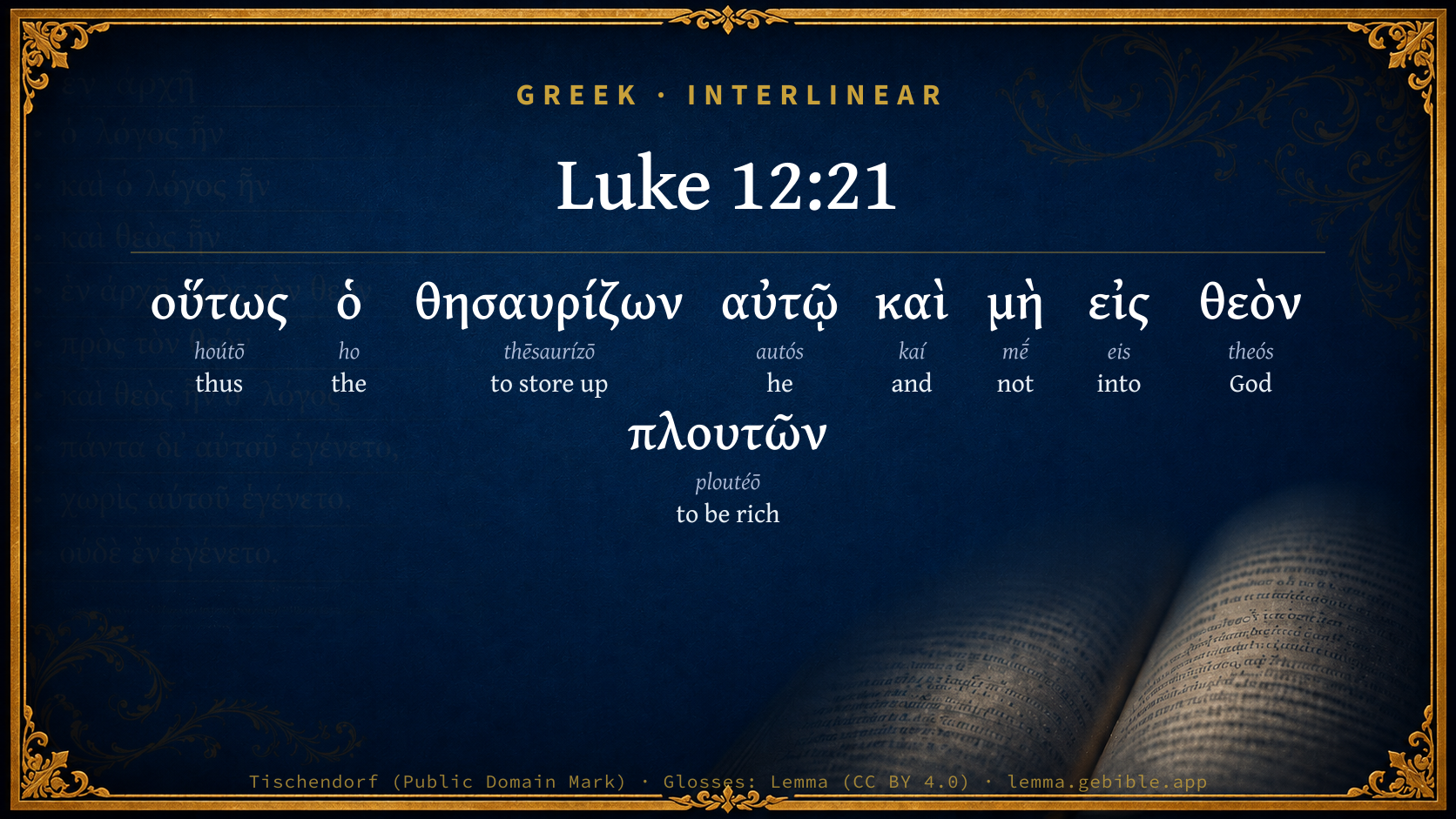
Download image
Cite this verse

Luke 12:21 (World English Bible). Public Domain. Lemma interlinear Bible study tool, https://lemma.gebible.app/v/luke/12/21.

Show BibTeX & RIS
BibTeX
RIS
English Translation
So is he who lays up treasure for himself, and is not rich toward God."
World English Bible · Public Domain
Download a study sheet

One document with this verse’s original text, its word-by-word gloss line, the meaning frame, cross-references with their text, attributed commentary, and full source and license credits — printable, and it pastes into notes with its structure intact.

This verse Autodidact and up

Study sheet (.html) Plain text (.txt)

A passage Seminary Student

Up to 50 verses in one chapter. A passage sheet keeps up to 6 commentary sources and 12 cross-references per verse, in the order this page ranks them, and says so on the sheet whenever that leaves anything out. Ask for a single verse and you get the Autodidact verse sheet above.

Everything on this page stays free to read, with no account — the sheet is a download of what is already on screen, not access to it.

Want to remove ads? Support Godless Engineer
Compare translations 3

The same verse in 3 English versions, stacked beneath the original-language interlinear above. Click any original word for its lexicon entry.

Each is an independent rendering of the whole verse — the interlinear is not word-aligned to these translations.

Highlighted words mark where these versions differ — a whole-verse word diff, not a word-by-word alignment.

  • World English Bible Public Domain
    So is he who lays up treasure for himself, and is not rich toward God."
  • King James Version Public Domain
    So is he that layeth up treasure for himself, and is not rich toward God.
  • unfoldingWord Literal Text CC BY-SA 4.0
    Thus the one storing up treasure for himself, and not being rich toward God.”

unfoldingWord Literal Text — © unfoldingWord, licensed CC BY-SA 4.0. Word-aligned USFM3 via Door43 (git.door43.org/unfoldingWord/en_ult).

Versions to compare (up to 4)

3 of 4 selected

Show all 19 translations

Every available English version of this verse, each an independent rendering of the whole verse.

  • World English Bible Public Domain
    So is he who lays up treasure for himself, and is not rich toward God."
  • Berean Standard Bible Public Domain
    This is how it will be for anyone who stores up treasure for himself but is not rich toward God.”
  • Majority Standard Bible Public Domain
    This is how it will be for anyone who stores up treasure for himself but is not rich toward God.”
  • King James Version Public Domain
    So is he that layeth up treasure for himself, and is not rich toward God.
  • American Standard Version (1901) Public Domain
    So is he that layeth up treasure for himself, and is not rich toward God.
  • Revised Version (1885) Public Domain
    So is he that layeth up treasure for himself, and is not rich toward God.
  • Geneva Bible (1599) Public Domain
    So is he that gathereth riches to himselfe, and is not riche in God.
  • Douay-Rheims (1899) Public Domain
    So is he that layeth up treasure for himself, and is not rich towards God.
  • Young's Literal Translation Public Domain
    so `is' he who is treasuring up to himself, and is not rich toward God.'
  • Literal Standard Version CC BY-SA 4.0
    So [is] he who is treasuring up to himself, and is not rich toward God.”
  • Unlocked Literal Bible CC BY-SA 4.0
    That is what someone is like who stores up treasure for himself and is not rich toward God.”
  • unfoldingWord Literal Text CC BY-SA 4.0
    Thus the one storing up treasure for himself, and not being rich toward God.”
  • Darby Bible Public Domain
    Thus is he who lays up treasure for himself, and is not rich toward God.
  • World Messianic Bible Public Domain
    So is he who lays up treasure for himself, and is not rich toward God.”
  • Webster's Bible Public Domain
    So is he that layeth up treasure for himself, and is not rich towards God.
  • Free Bible Version CC BY-SA 4.0
    This is what happens to people who hoard up wealth for themselves but are not rich as far as God is concerned.”
  • Bible in Basic English Public Domain
    So that is what comes to the man who gets wealth for himself, and has not wealth in the eyes of God.
  • Text-Critical English NT CC BY 4.0
    This is how it will be with anyone who lays up treasure for himself and is not rich toward God.”
  • Tyndale New Testament (1534) Public Domain
    So is it with him that gadereth ryches and is not ryche in God.

Literal Standard Version (2020), Covenant Press — licensed CC BY-SA 4.0. Text via the HelloAO Bible API (eBible.org). Unlocked Literal Bible (unfoldingWord) — licensed CC BY-SA 4.0. Text via the HelloAO Bible API (eBible.org). unfoldingWord Literal Text — © unfoldingWord, licensed CC BY-SA 4.0. Word-aligned USFM3 via Door43 (git.door43.org/unfoldingWord/en_ult). Free Bible Version, Dr. Jonathan Gallagher — licensed CC BY-SA 4.0. Text via the HelloAO Bible API (eBible.org).

Word by word

More ways to search: Search by grammar → Find every occurrence → Compare this word →

Practice this passage: Drill this verse → Learn its vocabulary →

About this verse

These counts appear in no published source. They are computed here, from the morphology-tagged text and Lemma’s own curated glosses. What Lemma adds →

9
words
9
distinct lemmas
Gospels
section

Notable vocabulary

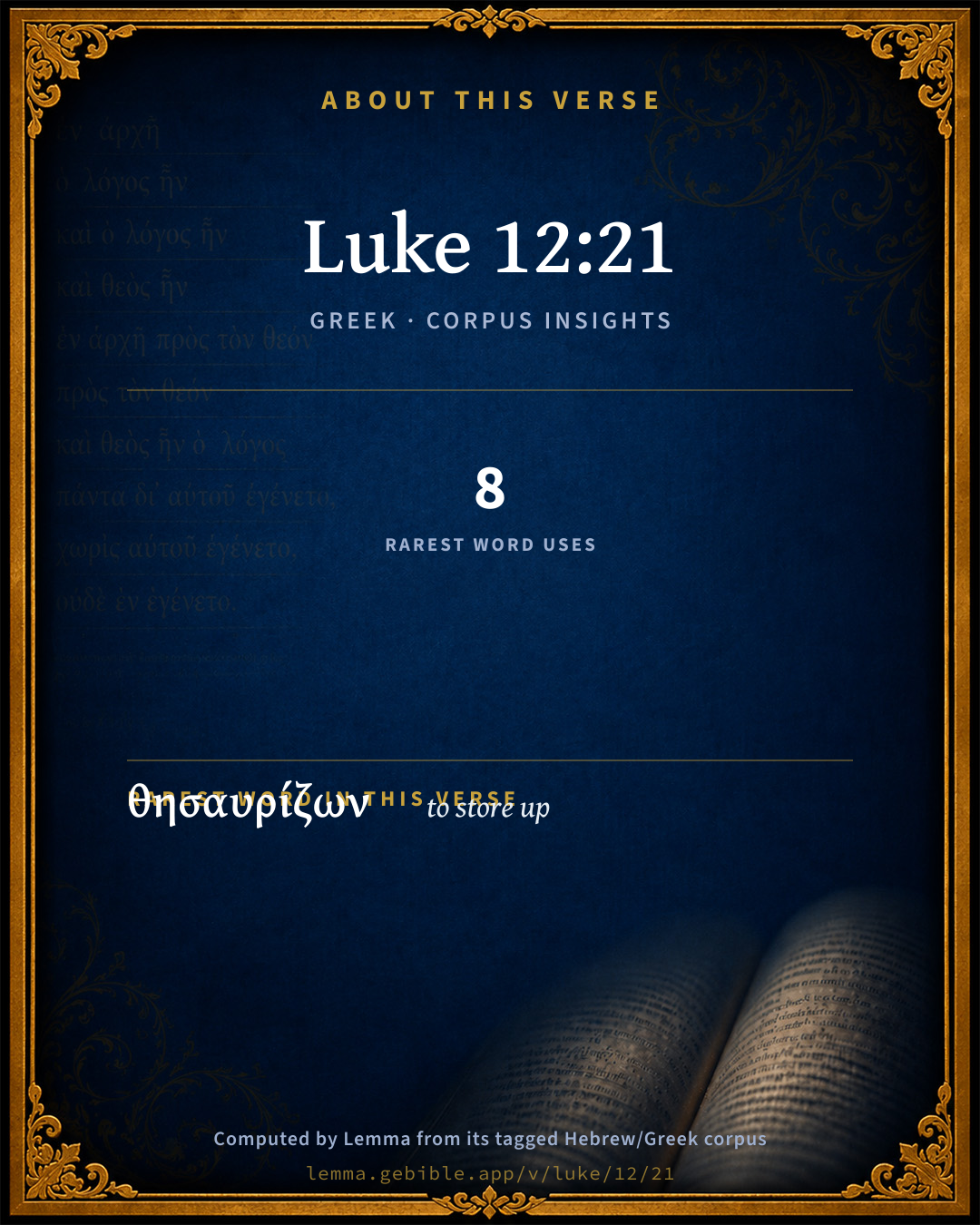
The rarest word here is θησαυρίζων to store up G2343 — appearing just 8 times in the whole Greek New Testament.

Shared distinctive vocabulary

θησαυρίζων to store up G2343 occurs in 8 verses of the Greek New Testament. Also found in:

Cross-references

12

Topical passages linked to Luke 12:21 in the Treasury of Scripture Knowledge — connected by theme and wording, ordered by reader-vote popularity; previews shown in the World English Bible.

  • Matthew 6:19–20 "Don't lay up treasures for yourselves on the earth, where moth and rust consume, and where thieves break through and steal;
  • Luke 12:33 Sell that which you have, and give gifts to the needy. Make for yourselves purses which don't grow old, a treasure in the heavens that doesn't fail, where no thief approaches, neither moth destroys.
  • James 2:5 Listen, my beloved brothers. Didn't God choose those who are poor in this world to be rich in faith, and heirs of the Kingdom which he promised to those who love him?
  • James 5:1–3 Come now, you rich, weep and howl for your miseries that are coming on you.
  • 1 Timothy 6:18–19 that they do good, that they be rich in good works, that they be ready to distribute, willing to communicate;
  • Revelation 2:9 "I know your works, oppression, and your poverty (but you are rich), and the blasphemy of those who say they are Jews, and they are not, but are a synagogue of Satan.
  • Habakkuk 2:9 Woe to him who gets an evil gain for his house, that he may set his nest on high, that he may be delivered from the hand of evil!
  • Hosea 10:1 Israel is a luxuriant vine that puts forth his fruit. According to the abundance of his fruit he has multiplied his altars. As their land has prospered, they have adorned their sacred stones.
  • Luke 6:24 "But woe to you who are rich! For you have received your consolation.
  • Luke 16:11 If therefore you have not been faithful in the unrighteous mammon, who will commit to your trust the true riches?
  • Romans 2:5 But according to your hardness and unrepentant heart you are treasuring up for yourself wrath in the day of wrath, revelation, and of the righteous judgment of God;
  • 2 Corinthians 6:10 as sorrowful, yet always rejoicing; as poor, yet making many rich; as having nothing, and yet possessing all things.

Cross-references courtesy of OpenBible.info (CC BY 4.0).

Commentary

Notes on Luke 12:21 from classic Christian and Jewish commentators (each source and its license shown beneath its notes). The classic Christian expositions comment on the surrounding passage and are grouped to its opening verse, so a note may address several verses; the Jewish commentaries on the Tanakh (Rashi and others) are per-verse, so they appear only where the commentator wrote on this verse.

Lemma curates 59 commentaries, every one of them public domain or Creative Commons licensed, each selected and text-cleaned for this edition rather than reprinted as found. About our sources →

Joseph Benson's Commentary

Luk 12:21. So — Such a fool, is he, in the divine account; that layeth up treasure for himself — Here on earth: and is not rich toward God — In acts of piety and charity, which would secure a fund of celestial treasures, lodged in his almighty hand, and therefore inviolably safe from such calamitous accidents as these. In other words, the covetous sensualist, who, in pursuing riches, has nothing but the gratification of his senses and appetites in view, no regard to the glory of God, who has commanded men to impart to others a portion of the good things which they enjoy, by almsgiving and other acts of beneficence; the man who thus lives only for himself, is as great a fool, and as far from real happiness, as the rich glutton in the parable, who proposes no other end to himself, from his riches, but eating, drinking, and making merry, little suspecting that he was but a few hours from death. Wherefore in this parable we have a perfect picture of the men whose affections are engrossed by the things of this present life. They forget that riches, honour, and power, are bestowed on them in trust. They do not consider that God has put these things into their hands for the good of others, and in order to their own improvement in religion and virtue, by the opportunities thus afforded them of exercising holy and benevolent dispositions. They rather look upon these advantages as mere instruments of self-indulgence and luxury, and use them accordingly. But at the very time when they are inwardly applauding themselves, in having such an abundance of the means of pleasure, and are laying schemes for futurity, as if they were never to die, and are thinking of nothing but happy days, God suddenly strips them of all their joys, overturns the treasures of the ant-hillock, which they had been idly busy in gathering together, and sends the foot of death to tread down, and spurn all abroad, the tottering piles which, like children in their play, they had foolishly, though laboriously, employed themselves in erecting.

Joseph Benson's Commentary on the Old and New Testaments (1811–1818) — public domain. Text from a community e-Sword module.

Bengel's Gnomon

Johann Albrecht Bengel

Luk 12:21. Οὕτως, so) viz. shall be.—ἑαυτῷ, for himself) for his own soul. See Luk 12:19; Luk 12:22.—μὴ εἰς Θεὸν, not toward God) It is not said, Θεῷ, for God, as ἑαυτῷ, for himself. Nothing can be added or diminished from the perfection of God [whether a man seeks His glory or not in laying out his wealth]. He is rich toward God, who uses and enjoys his riches in the way that God would have him [1Ti 6:17].—πλουτῶν, who acts the part of a rich man [who is in the enjoyment of wealth]) This denotes the state: θησαυρίζων, one who layeth up treasure, denotes the aim and desire [to be rich].

Bengel's Gnomon of the New Testament — English translation (T&T Clark, Edinburgh, 1860) — public domain. Text from a community e-Sword module.

Expositor's Greek Testament

ed. W. Robertson Nicoll

Luk 12:21 . εἰς Θεὸν πλουτῶν , rich with treasure laid up with God. Other interpretations are: rich in a way that pleases God, or rich in honorem Dei , for the advancement of God’s glory. The last sense implies that the riches are literal, the first implies that they are spiritual.

The Expositor's Greek Testament, edited by W. Robertson Nicoll (1897–1910) — public domain. Text from a community e-Sword module.

Geneva Bible (1599)

Geneva Bible translators

Caring for no man but for himself, and minding to trust in himself.

Geneva Bible (1599) marginal notes — public domain. Text via Bolls.life.

Jamieson, Fausset & Brown

Robert Jamieson, A. R. Fausset & David Brown

So is he, &c.--Such is a picture of his folly here, and of its awful issue.

and is not rich toward God--lives to amass and enjoy riches which terminate on self, but as to the riches of God's favor, which is life (Psa 30:5), of "precious" faith (Pe2 1:1; Jam 2:5), of good works (Ti1 6:18), of wisdom which is better than rubies (Pro 8:11) --lives and dies a beggar!

Jamieson, Fausset & Brown — Commentary Critical and Explanatory on the Whole Bible (1871) — public domain (CC PDM 1.0). Text via the HelloAO Bible API.

Adam Clarke's Commentary

Verse 21. So is he] That is, thus will it be. This is not an individual case; all who make this life their portion, and who are destitute of the peace and salvation of God, shall, sooner or later, be surprised in the same way.

Layeth up treasure for himself] This is the essential characteristic of a covetous man: he desires riches; he gets them; he lays them up, not for the necessary uses to which they might be devoted, but for himself; to please himself, and to gratify his avaricious soul. Such a person is commonly called a miser, i.e. literally, a wretched, miserable man.

Adam Clarke's Commentary on the Bible (1810–1826) — public domain. Text from a community e-Sword/MySword module.

Ellicott's Commentary for English Readers

(21) So is he that layeth up treasure for himself.—See Note on Mat_6:19. To be “rich towards God” finds its explanation in the language, probably suggested by it, which bids us to be “rich in good works” (1Ti_6:18).

A Bible Commentary for English Readers, edited by Charles John Ellicott (1878–1897) — public domain. Text from a community e-Sword module.

The Cambridge Bible for Schools and Colleges

gen. ed. J. J. S. Perowne

21. is not rich towards God] Rather, if he is not. We are often taught elsewhere in Scripture in what way we can be rich toward God. Mat_6:19-21; 1Ti_6:17-19; Jas_2:5. There is a close parallel to this passage in Sir_11:18-19, “There is that waxeth rich by his wariness and pinching, and this is the portion of his reward. Likewise he saith, I have found rest, and now will eat continually of my goods, and yet he knoweth not what time shall come upon him, and that he must leave those things to others, and die.” This would seem to shew that our Lord was not unfamiliar with some of the Apocryphal writings.

The Cambridge Bible for Schools and Colleges (gen. ed. J. J. S. Perowne; Cambridge University Press, 1878–1918) — public domain. Text from a community e-Sword module.

John Gill's Exposition

So is he that layeth up treasure for himself,.... This is the accommodation of the parable. Just such a fool is he, and this will be the end or him, who employs all his thoughts, and spends all his time, in amassing to himself worldly riches and wealth, in laying up treasures on earth for himself, for futurity: and makes no use of his earthly substance to be the good of others; nor shows any concern for spiritual and eternal riches; but places all his hope, trust, and confidence, in uncertain riches:

and is not rich towards God; or "in God", as the Syriac and Arabic versions read; in things pertaining to God, in spiritual things, in faith, and in good works; and is not concerned to lay up a treasure in heaven, to have an interest in durable riches and righteousness; whereas one that is rich towards God, acknowledges that he receives all his riches from God, as the Ethiopic version reads; he gives up all into the hands of God, depends upon his providence for the increase, security, and continuance of it; and uses it to his honour and glory, and for the good of his interest; and is chiefly concerned for the riches of grace and glory; and enjoys much of God, and places all his riches in him: such a man is a wise man, but the reverse of this is the fool in the parable.

John Gill's Exposition of the Whole Bible (1746–1763) — public domain (CC PDM 1.0). Text via the HelloAO Bible API.

Trapp's Complete Commentary

John Trapp

21 So is he that layeth up treasure for himself, and is not rich toward God.

Ver. 21. Rich to God] That is, rich in faith, Jas 2:5; rich in good works, 1Ti 6:18.

John Trapp, A Commentary or Exposition upon All the Books of the Old and New Testament (1647–1656) — public domain. Text from a community e-Sword module.

Albert Barnes' Notes on the Bible

So is he - This is the portion or the doom.

Layeth up treasure for himself - Acquires riches for his own use - for “himself.” This is the characteristic of the covetous man. It is all for “himself.” His plans terminate there. He lives only for himself, and acts only with regard to his own interest.

Rich toward God - Has no inheritance in the kingdom of God - no riches laid up in heaven. His affections are all fixed on this world, and he has none for God.

From this instructive parable we learn:

1. That wicked people are often signally prospered - their ground brings forth plentifully. God gives them their desire, but sends leanness into their souls.

2. That riches bring with them always an increasing load of cares and anxieties.

3. That they steal away the affections from God - are sly, insinuating, and dangerous to the soul.

4. That the anxiety of a covetous man is not what “good” he may do with his wealth, but where he may hoard it, and keep it secure from doing any good.

5. That riches cannot secure their haughty owners from the grave. Death will come upon them suddenly, unexpectedly, awfully. In the very midst of the brightest anticipations - in a moment - in the twinkling of an eye it may come, and all the wealth that has been accumulated cannot alleviate one pang, or drive away one fear, or prolong life for one moment.

6. That the man who is trusting to his riches in this manner is a fool in the sight of God. Soon, also, he will be a fool in his “own” sight, and will go to hell with the consciousness that his life has been one of eminent folly.

7. That the path of true wisdom is to seek first the kingdom of God, and to be ready to die; and “then” it matters little what is our portion here, or how suddenly or soon we are called away to meet our Judge. If our affections are not fixed on our riches, we shall leave them without regret. If our treasures are laid up in heaven, death will be but “going home,” and happy will be that moment when we are called to our rest.

Albert Barnes' Notes on the Bible (1834–1885) — public domain. Text from a community e-Sword/MySword module.

Whedon's Commentary on the Bible

Daniel D. Whedon

21. Treasure for himself—Whose accumulations have no aim but the gratification of the selfish desires and appetites. He is rich for himself and to himself.

Not rich toward God—He is rich toward man, who possesses those things which man values. He is rich toward God, who possesses those things which are in the sight of God of great value. God’s rich man and man’s rich man may be paupers to each other.

Daniel D. Whedon (gen. ed.), Commentary on the Old and New Testaments (1874–1909) — public domain. Text from a community e-Sword module.

The Pulpit Commentary

And is not rich toward God; better rendered, if he is not. And this slight change helps us, too, in drawing the right lesson. The being rich is never condemned by Jesus Christ; nor even the growing richer. Among the saints of God in both Testaments are many notable rich men, whose possessions seem to have helped rather than hindered their journey to the city of God. The lesson which lies on the forefront of this parable-story is the especial danger which riches ever bring of gradually deadening the heart and rendering it impervious to any feeling of love either for God or man.

The directions which immediately followed upon this parable were addressed to the inner circle of disciples. The general instruction, it will be seen, belongs to all who in any age wish to be "of his Church;" but several of the particular charges cannot he pressed as general commands, being addressed to men whose work and office were unique.

"Rich toward God.

Jesus Christ is here drawing a contrast between the inward and the abiding on the one hand, and the outward and the perishing on the other hand. When he disparages the act of "laying up treasure for ourselves," he does not mean to say either

(1) that material wealth is not of God, for it is he who gives us "power to get wealth"; (Deu_8:18) or

(2) that the spiritual treasure a man secures is not "for himself, indeed, that is the only treasure he can make permanently his own; he that is wise is wise for himself, (Pro_9:12) and he has "rejoicing in himself alone, and not in another." But Christ would have us regard material acquisitions as of very small account indeed in comparison with the enrichment of the soul in God, with spiritual wealth. To be rich toward God may include

I A WEALTH OF RIGHT FEELING TOWARD GOD. There are certain thoughts and feelings which every intelligent being ought to cherish toward his Creator, in the absence of which he himself is poor, and in the presence of which he is rich. The more we have in our hearts of reverence for God; of trust in his Word of promise; of gratitude for his goodness and faithfulness; of love for him, our Father and our Savior; of filial submission to his holy will; of consecration to his cause and interest in the advancement of his kingdom, the more "rich we are toward" him.

II WEALTH IN QUALITIES WHICH ARE DIVINE, or being rich in the direction in which God himself is rich. We cannot, indeed, hope to be rich in some of his attributes in majesty, in power, in wisdom. But there are qualities in him in which we may have a real and a valuable share. As God is rich in righteousness, in truth and faithfulness, in goodness and kindness, in mercy and magnanimity, so may we hope, and so should we strive and pray, that we may be "partakers of the Divine nature" in these things also. Illumined by his truth, guided by his example, and inspired by his Spirit, we may have a goodly share in these great and noble qualities.

III WEALTH IN GOD HIMSELF; in the enjoyment of his Divine favor and friendship; in the indwelling of his Holy Spirit in our souls, being thus enriched with his abiding presence and his gracious influence; in the enlarging and elevating contemplation of his character and worship of himself.

1. Have we any treasure at all in God. ? As the Church at Laodicea imagined itself to be spiritually rich when it was miserably poor, (Rev_3:17) so may any Christian society of our own time; so may any individual member of a Church of Christ. If, in a searching and devout examination, we find that we are poor, there is nothing for us but to go to Jesus Christ anew, in humblest penitence and simplest faith and whole-hearted surrender.

2. Are we rich toward God? There are many degrees between beggary and wealth. We may not be absolutely destitute, and yet we may be far from rich toward God. We should aspire to "abound," to "be enlarged," to have a good measure of those qualities which constitute spiritual wealth. We must "buy of Christ", (Rev_3:18) that we "may be rich;" we must abide in him, and so "bring forth much fruit". (Joh_15:5)

3. If we are rich toward God we may thankfully rejoice. The man who is "laying up treasure for himself" may be essentially and radically poor; he may be securing that which will give him no happiness, but only be a burden and a bane to him; he must part with it all soon. But he who is "rich toward God" has that which is wealth indeed; has a treasure which will gladden his heart and brighten his life; has a joy and an inheritance which are his for ever. C.

The Pulpit Commentary (1880–1919), ed. H.D.M. Spence-Jones & Joseph S. Exell — public domain. Text from a community e-Sword module.

John Wesley's Explanatory Notes

Rich toward God - Namely, in faith, and love, and good works.

John Wesley, Explanatory Notes Upon the Whole Bible (1754–1765) — public domain. Text via the GEBible commentary corpus.

Cambridge Greek Testament for Schools and Colleges

21. μὴ … πλουτῶν. ‘If he is not rich.’ We are often taught elsewhere in Scripture in what way we can be rich toward God. Mat 6:19-21; 1Ti 6:17-19; Jas 2:5. There is a close parallel to this passage in Sir 11:18-19, “There is that waxeth rich by his wariness and pinching, and this is the portion of his reward. Likewise he saith, I have found rest, and now will eat continually of my goods, and yet he knoweth not what time shall come upon him, and that he must leave those things to others, and die.” This would seem to shew that our Lord was not unfamiliar with some of the Apocryphal writings.

Cambridge Greek Testament for Schools and Colleges (Cambridge University Press, 1896; 21 vols, various authors incl. Carr, Maclear, Plummer, Farrar, Lumby, Moule, M. R. James, Simcox) — public domain. Text from a community e-Sword module.

Alford’s Greek Testament

Henry Alford

21.] οὕτως, thus: in utter confusion, and sudden destitution of all help and provision for eternity. There is no ἔσται: because the case, alas, is an every-day one in every place.

ἑαυτῷ … εἰς θεὸν …] The meaning of these expressions will be brought out thus: He who is rich for himself, laying up treasure for himself, is by so much robbing his real inward life, his life in and toward God, of its resources: he is laying up store for, providing for, the flesh; but the spirit, that which God looketh into and searcheth, is stripped of all its riches.

These words may also, as remarked on ch. 6:20, shew that Luke does not, as supposed by some recent critics, use ‘riches’ as merely this world’s wealth, but with a deeper spiritual meaning.

Henry Alford, The Greek Testament (1849–1861) — public domain. Text from a community e-Sword module.

International Critical Commentary

21. θησαυρίζων αὑτῷ. Comp. Mat 6:19; 2Co 12:14; and for the εἰς before Θεόν comp. 16:8. It is to be regretted that the εἰς is rendered differently in the two passages in both AV. (“in, towards”) and RV. (“for, toward”). “Being rich toward God” means being rich in those things which are pleasing to Him. Amassing wealth without reference to the God who bestows it is πλεονεξία, and πλεονεξία is ἀφροσύνη.

The change from αὐτῷ to εἰς Θεόν, instead of Θεῷ, is intentional, and Juvenal’s dives tibi, pauper amicis (v. 113) is not quite parallel, nor at Hecato in Cic. De Off. iii. 15. 63: Neque enim solum nobis divites esse volumus, sed liberis, propinquis, amicis, maximeque rei publicæ. The whole verse is omitted in D and a b d.

International Critical Commentary — older volumes (1896–1929), various authors — public domain. Text from a community e-Sword module.

Lesson kit

Teaching starters — assembled from the data on this page, not authored interpretation. Every prompt links to the verse data it draws on. Edit before teaching.

Luke, in the Gospels, opens this verse with 9 words (9 distinct Greek lemmas). Its most distinctive word is thēsaurízō (“to store up”). A historical commentator’s framing appears above. Read the whole chapter for the surrounding context.

Discussion questions

  1. The word thēsaurízō carries the sense “to store up.” How does it shape the verse?
  2. How does Matthew 6:19, which shares the word «to store up», read alongside this verse?
  3. These translations render this verse differently. What is at stake in choosing one wording over another?
  4. Compare how Joseph Benson's Commentary and Bengel's Gnomon read this verse. Where do they agree or differ?

Things to notice

Reading settings

Reading text

Shown beneath each verse's original-language words.

Old Testament
Old Testament edition

Read the OT as the Masoretic Hebrew (MT) or the Greek Septuagint (LXX).

English shown for the Greek Septuagint (in the Hebrew ↔ Greek comparison).

Comparing translations? Open the Compare panel on any verse page to stack up to four side by side.