
1 Corinthians 7:36

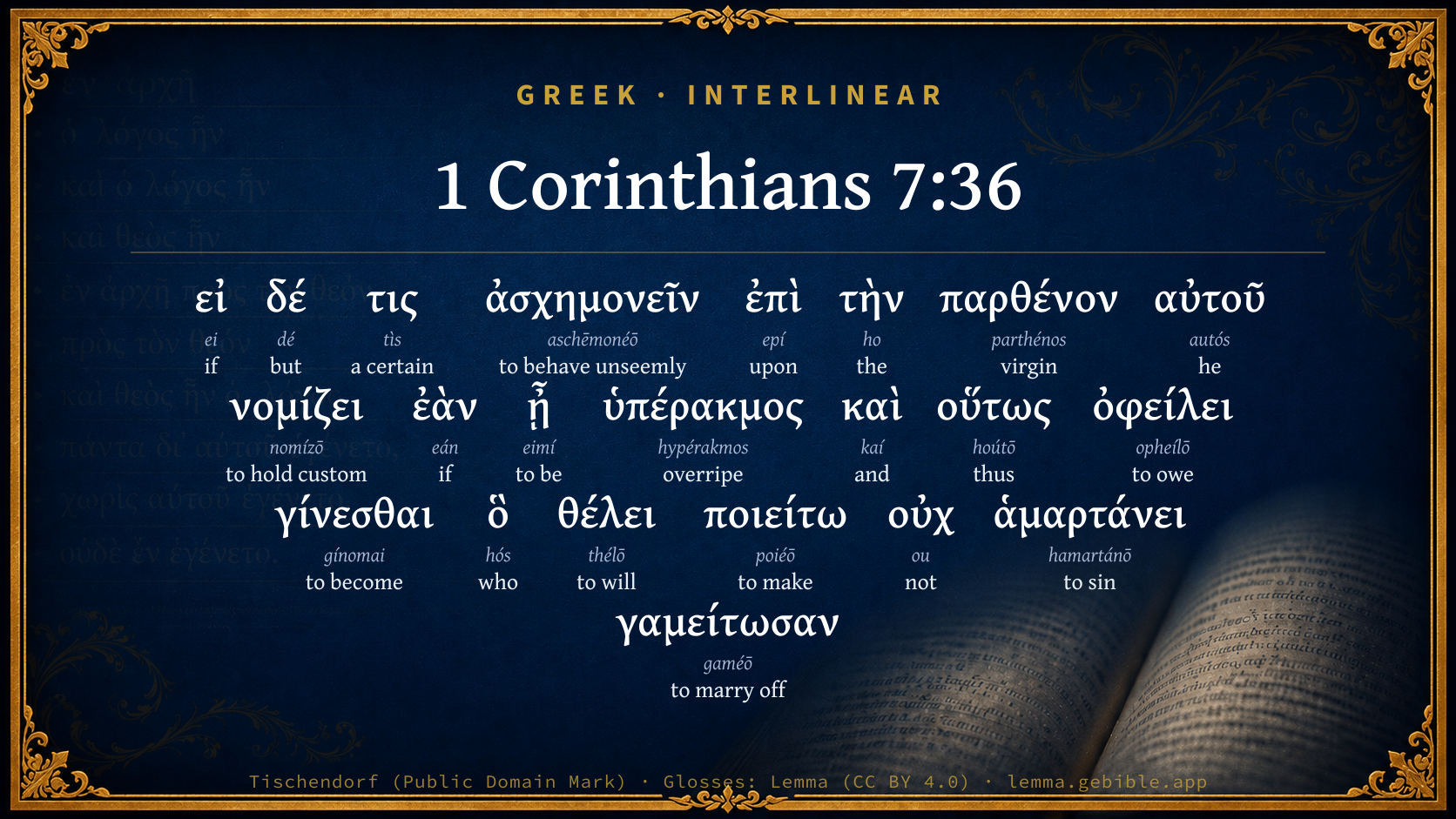
Greek (Tischendorf 8th ed.) 1 Corinthians 7:36 appears in the Greek New Testament. The text above is from the Tischendorf 8th edition. Each word links to its Strong’s number and a concise gloss. Click any word for its full Thayer’s Greek Lexicon entry.
Download image
Cite this verse

1 Corinthians 7:36 (World English Bible). Public Domain. Lemma interlinear Bible study tool, https://lemma.gebible.app/v/1-corinthians/7/36.

Show BibTeX & RIS
BibTeX
RIS
English Translation
But if any man thinks that he is behaving inappropriately toward his virgin, if she is past the flower of her age, and if need so requires, let him do what he desires. He doesn't sin. Let them marry.
World English Bible · Public Domain
Highlights
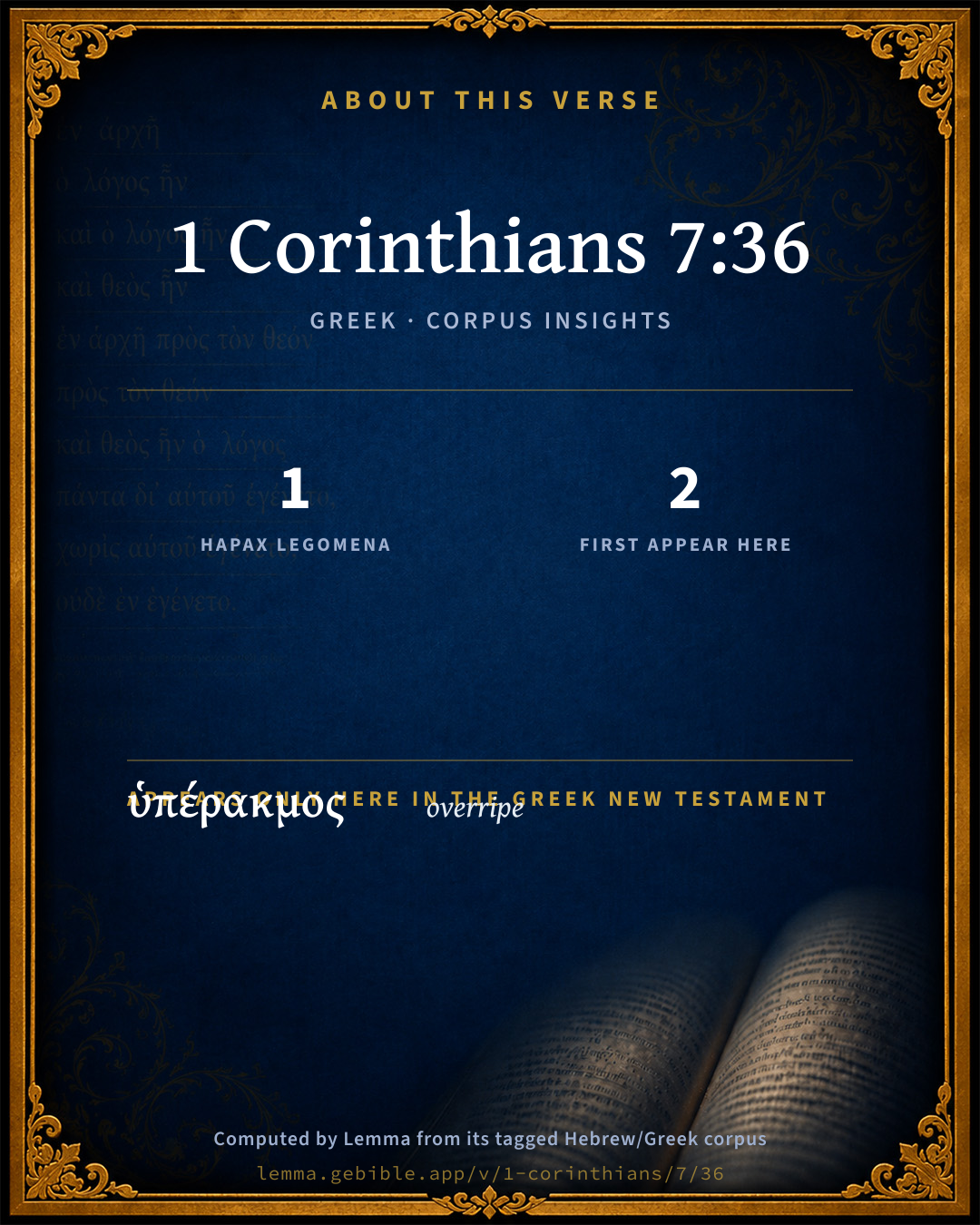
  • 1 hapax legomenon — only here in the Greek New Testament
  • 2 first appearances in the Greek New Testament
Full analysis ↓
Download a study sheet

One document with this verse’s original text, its word-by-word gloss line, the meaning frame, cross-references with their text, attributed commentary, and full source and license credits — printable, and it pastes into notes with its structure intact.

This verse Autodidact and up

Study sheet (.html) Plain text (.txt)

A passage Seminary Student

Up to 50 verses in one chapter. A passage sheet keeps up to 6 commentary sources and 12 cross-references per verse, in the order this page ranks them, and says so on the sheet whenever that leaves anything out. Ask for a single verse and you get the Autodidact verse sheet above.

Everything on this page stays free to read, with no account — the sheet is a download of what is already on screen, not access to it.

Want to remove ads? Support Godless Engineer
Compare translations 3

The same verse in 3 English versions, stacked beneath the original-language interlinear above. Click any original word for its lexicon entry.

Each is an independent rendering of the whole verse — the interlinear is not word-aligned to these translations.

Highlighted words mark where these versions differ — a whole-verse word diff, not a word-by-word alignment.

  • World English Bible Public Domain
    But if any man thinks that he is behaving inappropriately toward his virgin, if she is past the flower of her age, and if need so requires, let him do what he desires. He doesn't sin. Let them marry.
  • King James Version Public Domain
    But if any man think that he behaveth himself uncomely toward his virgin, if she pass the flower of her age, and need so require, let him do what he will, he sinneth not: let them marry.
  • unfoldingWord Literal Text CC BY-SA 4.0
    But if anyone thinks he is acting improperly toward his virgin—if she is beyond the age of marriage and it must be so—he should do what he wants. He is not sinning; let them marry.

unfoldingWord Literal Text — © unfoldingWord, licensed CC BY-SA 4.0. Word-aligned USFM3 via Door43 (git.door43.org/unfoldingWord/en_ult).

Versions to compare (up to 4)

3 of 4 selected

Show all 19 translations

Every available English version of this verse, each an independent rendering of the whole verse.

  • World English Bible Public Domain
    But if any man thinks that he is behaving inappropriately toward his virgin, if she is past the flower of her age, and if need so requires, let him do what he desires. He doesn't sin. Let them marry.
  • Berean Standard Bible Public Domain
    However, if someone thinks he is acting inappropriately toward his betrothed, and if she is beyond her youth and they ought to marry, let him do as he wishes; he is not sinning; they should get married.
  • Majority Standard Bible Public Domain
    However, if someone thinks he is acting inappropriately toward his betrothed, and if she is beyond her youth and they ought to marry, let him do as he wishes; he is not sinning; they should get married.
  • King James Version Public Domain
    But if any man think that he behaveth himself uncomely toward his virgin, if she pass the flower of her age, and need so require, let him do what he will, he sinneth not: let them marry.
  • American Standard Version (1901) Public Domain
    But if any man thinketh that he behaveth himself unseemly toward his virgin `daughter', if she be past the flower of her age, and if need so requireth, let him do what he will; he sinneth not; let them marry.
  • Revised Version (1885) Public Domain
    But if any man thinketh that he behaveth himself unseemly toward his virgin daughter, if she be past the flower of her age, and if need so requireth, let him do what he will; he sinneth not; let them marry.
  • Geneva Bible (1599) Public Domain
    But if any man thinke that it is vncomely for his virgine, if shee passe the flower of her age, and neede so require, let him do what he will, he sinneth not: let them be maried.
  • Douay-Rheims (1899) Public Domain
    But if any man think that he seemeth dishonoured, with regard to his virgin, for that she is above the age, and it must so be: let him do what he will; he sinneth not, if she marry.
  • Young's Literal Translation Public Domain
    and if any one doth think `it' to be unseemly to his virgin, if she may be beyond the bloom of age, and it ought so to be, what he willeth let him do; he doth not sin -- let him marry.
  • Literal Standard Version CC BY-SA 4.0
    and if anyone thinks [it] to be unseemly to his virgin, if she may be beyond the bloom of age, and it ought to be so, what he wills let him do; he does not sin—let him marry.
  • Unlocked Literal Bible CC BY-SA 4.0
    But if anyone thinks that he is not treating his fiancée with respect—if she is beyond the age of marriage and it must be so—he should do what he wants. He is not sinning. They should marry.
  • unfoldingWord Literal Text CC BY-SA 4.0
    But if anyone thinks he is acting improperly toward his virgin—if she is beyond the age of marriage and it must be so—he should do what he wants. He is not sinning; let them marry.
  • Darby Bible Public Domain
    But if any one think that he behaves unseemly to his virginity, if he be beyond the flower of his age, and so it must be, let him do what he will, he does not sin: let them marry.
  • World Messianic Bible Public Domain
    But if any man thinks that he is behaving inappropriately toward his virgin, if she is past the flower of her age, and if need so requires, let him do what he desires. He doesn’t sin. Let them marry.
  • Webster's Bible Public Domain
    But if any man thinketh that he behaveth himself uncomely towards his virgin, if she hath passed the flower of her age, and need so requireth, let him do what he will, he sinneth not: let them marry.
  • Free Bible Version CC BY-SA 4.0
    But if a man thinks he's behaving improperly with the woman he's engaged to, and if he thinks he will give in to his strong sexual desire, and if he thinks he ought to get married, he is not sinning by getting married.
  • Bible in Basic English Public Domain
    But if, in any man's opinion, he is not doing what is right for his virgin, if she is past her best years, and there is need for it, let him do what seems right to him; it is no sin; let them be married.
  • Text-Critical English NT CC BY 4.0
    Now if any man thinks that he is acting improperly toward his virgin daughter by not letting her marry, if she is past the bloom of her youth and it seems necessary to do so, he should do what he wants. He is not sinning by letting her get married.
  • Tyndale New Testament (1534) Public Domain
    If eny man thinke that it is vncomly for his virgin if she passe the tyme of mariage ad if so nede requyre let him do what he listeth he synneth not: let the be coupled in mariage.

Literal Standard Version (2020), Covenant Press — licensed CC BY-SA 4.0. Text via the HelloAO Bible API (eBible.org). Unlocked Literal Bible (unfoldingWord) — licensed CC BY-SA 4.0. Text via the HelloAO Bible API (eBible.org). unfoldingWord Literal Text — © unfoldingWord, licensed CC BY-SA 4.0. Word-aligned USFM3 via Door43 (git.door43.org/unfoldingWord/en_ult). Free Bible Version, Dr. Jonathan Gallagher — licensed CC BY-SA 4.0. Text via the HelloAO Bible API (eBible.org).

Word by word

More ways to search: Search by grammar → Find every occurrence → Compare this word →

Practice this passage: Drill this verse → Learn its vocabulary →

ὑπέρακμος
hypérakmos
G5230
“overripe”
Adjective, Nominative, Singular, Masculine
Part of Speech
Adjective
Case
Nominative
Number
Singular
Gender
Masculine
Full Thayer's Definition

Origin: from G5228 and the base of G188

TDNT: None

1. beyond the bloom or prime of life 2. overripe, plump and ripe, (and so in a greater danger of defilement) a. of a virgin
  1. εἰ ei G1487 “if” Conditional
  2. δέ dé G1161 “but” Conjunction
  3. τις tìs G5100 “a certain” Indefinite pronoun, Nominative, Singular, Masculine
  4. ἀσχημονεῖν aschēmonéō G807 “to behave unseemly” Verb, Present, Active, Infinitive
  5. ἐπὶ epí G1909 “upon” Preposition
  6. τὴν ho G3588 “the” Article, Accusative, Singular, Feminine
  7. παρθένον parthénos G3933 “virgin” Noun, Accusative, Singular, Feminine
  8. αὐτοῦ autós G846 “he” Personal pronoun, Genitive, Singular, Masculine
  9. νομίζει nomízō G3543 “to hold custom” Verb, Present, Active, Indicative, 3rd person, Singular
  10. ἐὰν eán G1437 “if” Conditional
  11. ᾖ eimí G1510 “to be” Verb, Present, Active, Subjunctive, 3rd person, Singular
  12. καὶ kaí G2532 “and” Conjunction
  13. οὕτως hoútō G3779 “thus” Adverb
  14. ὀφείλει opheílō G3784 “to owe” Verb, Present, Active, Indicative, 3rd person, Singular
  15. γίνεσθαι gínomai G1096 “to become” Verb, Present, Middle or Passive deponent, Infinitive
  16. ὃ hós G3739 “who” Relative pronoun, Accusative, Singular, Neuter
  17. θέλει thélō G2309 “to will” Verb, Present, Active, Indicative, 3rd person, Singular
  18. ποιείτω poiéō G4160 “to make” Verb, Present, Active, Imperative, 3rd person, Singular
  19. οὐχ ou G3756 “not” Particle, Negative
  20. ἁμαρτάνει hamartánō G264 “to sin” Verb, Present, Active, Indicative, 3rd person, Singular
  21. γαμείτωσαν gaméō G1060 “to marry off” Verb, Present, Active, Imperative, 3rd person, Plural

About this verse

These counts appear in no published source. They are computed here, from the morphology-tagged text and Lemma’s own curated glosses. What Lemma adds →

22
words
22
distinct lemmas
Pauline Epistles
section

Notable vocabulary

1 hapax legomenon — a word that appears only here in the entire Greek New Testament:

  • ὑπέρακμος overripe G5230

First appearance in Scripture

These words make their first canonical appearance in the Greek New Testament here:

  • ἀσχημονεῖν to behave unseemly G807
  • ὑπέρακμος overripe G5230

Shared distinctive vocabulary

ἀσχημονεῖν to behave unseemly G807 occurs in 2 verses of the Greek New Testament. Also found in:
Cross-references

2

Topical passages linked to 1 Corinthians 7:36 in the Treasury of Scripture Knowledge — connected by theme and wording, ordered by reader-vote popularity; previews shown in the World English Bible.

  • 1 Corinthians 7:9 But if they don't have self-control, let them marry. For it's better to marry than to burn.
  • 1 Corinthians 7:37 But he who stands steadfast in his heart, having no necessity, but has power over his own heart, to keep his own virgin, does well.

Cross-references courtesy of OpenBible.info (CC BY 4.0).

Commentary

Notes on 1 Corinthians 7:36 from classic Christian and Jewish commentators (each source and its license shown beneath its notes). The classic Christian expositions comment on the surrounding passage and are grouped to its opening verse, so a note may address several verses; the Jewish commentaries on the Tanakh (Rashi and others) are per-verse, so they appear only where the commentator wrote on this verse.

Lemma curates 59 commentaries, every one of them public domain or Creative Commons licensed, each selected and text-cleaned for this edition rather than reprinted as found. About our sources →

Joseph Benson's Commentary

1Co 7:36-38. But if any man — Who is a parent or guardian; think that he behaveth himself uncomely — That he should act indecently, or in a manner unbecoming his character, or unsuitably to her credit and reputation; toward his virgin — By hindering her from marriage; if she pass, &c. — Greek, εαν η υπερακμος, if she be above age, or of full age; and need so require — Και ουτως οφειλει γινεσθαι, and it be necessary to be so done, whether the necessity ariseth from her conscience and inclination, or her being sought in marriage; let him do what he will — As he sees occasion, according to circumstances, either to marry her, or keep her single. Or, as the words may be rendered, Let him do what she inclineth to; he sinneth not — In complying with her inclination in such a case: let them — Let such virgin daughters, marry — See on 1Co 7:9. “As both the Jews and Gentiles reckoned celibacy dishonourable, some fathers might think it sinful to restrain their daughters from marriage; while others, following the opinion of the Essenes and rigid philosophers, fancied they acted properly in restraining them. The Corinthians, therefore, had judged it necessary to consult the apostle on that head.” Nevertheless — Or but; he that standeth steadfast, &c. — Who continueth firmly persuaded in his mind, that it is no sin in his daughter to remain unmarried; having no necessity — From her opinion, or inclination, or circumstances, to give her in marriage; and hath power over his own will — Which would incline him to desire the increase of his family, and the strengthening of it by new relations; or, who hath the direction of his own will — In that affair, being a freeman, and not a slave; and hath so decreed, &c. — Hath determined this in his mind; to keep his virgin — Unmarried, agreeably to her own inclination; doeth well — Doeth what is preferable. So then he that giveth her in marriage — When need so requires, doeth well — Doth what is lawful, and in his daughter’s case is, on the whole, proper, even in the present distress; but he that giveth her not doeth better — What is better for her, more for her spiritual improvement; because if she agrees to it, by keeping her in his own family unmarried, she will be exposed to fewer temptations than if she were married, and in a better condition for acquiring that knowledge of, and faith in, the gospel, with holiness in heart and life, which will enable her to adhere to and adorn the cause of Christ in a time of persecution.

Joseph Benson's Commentary on the Old and New Testaments (1811–1818) — public domain. Text from a community e-Sword module.

Whedon's Commentary on the Bible

Daniel D. Whedon

36-38. Paul here treats the case of a parent having maiden daughters. By ancient law and custom the parent had absolute disposal of the child in marriage, and Paul speaks as assuming such to be the case. Among the Jews it was a disgrace to parent and daughter for her to pass her marriageable age unmarried. Hence in Ecclesiasticus (Apoc.) 42:9, it is said, “The father waketh for the daughter when no man knoweth, and the care for her taketh away sleep while she is young, lest she pass the flower of her age.” This last clause includes the very word Paul uses in 1Co_7:36. If the best good of the daughter require it (36) her marriage is right. But if no proper obstacle to her celibacy offer (37) he does well to retain her unmarried. Her marriage would, then, be well, but her celibacy would be better (38). Paul throughout speaks in reference to the established custom that a father had absolute right of decision in the case.

36. Behaveth himself uncomely—Either by bringing upon her the discredit of celibacy, or exposing her to the danger of incontinence by disregarding her inclinations.

Pass… flower—And so the plea of immaturity is past. So—Refers to marry at the close of the verse. A closer rendering would be, ought so to become. St. Paul, though recognising the absolute legal authority of the parent, holds that the daughter’s wishes, character, and happiness should be the paramount consideration in the Christian parent’s decision.

Let him do what he will—What Paul assumes from these considerations will be the father’s purpose.

Let them—May mean the daughter and her suitor; or it may refer to daughters, generally, in such circumstances.

Daniel D. Whedon (gen. ed.), Commentary on the Old and New Testaments (1874–1909) — public domain. Text from a community e-Sword module.

Tyndale Open Study Notes

Tyndale Open Resources

7:36-38 Paul recommends celibate life in preference to marriage, but he allows for marriage if a person’s sexual desires prove too much of a temptation. Those in firm control of their sexual desires are encouraged to choose the celibate life.

Tyndale Open Study Notes — © Tyndale Open Resources, licensed CC BY-SA 4.0. Text via the HelloAO Bible API.

Bengel's Gnomon

Johann Albrecht Bengel

1Co 7:36. Τὶς, any man) a parent.—ἀσχημονεῖν) viz. ἑαυτὸν.—τὴν παρθένον αὐτοῦ) a virgin, his daughter.—νομίζει, thinks) Antithesis to, I think (suppose), 1Co 7:26.—εἂν ᾖ ὑπέρακμος) if she pass, ἀκμὴν, the flower, of her age without marriage, as it were despised by suitors.—ὀφείλει, it so ought to be [need so require, Engl. V.] [because he cannot see how better to consult the advantage of his daughter.—V. g.], having no necessity, in the following verse is the antithesis.—οὐχʼ ἁμαρτάνει, he sinneth not) The matter is sweetly expressed by short clauses.

Bengel's Gnomon of the New Testament — English translation (T&T Clark, Edinburgh, 1860) — public domain. Text from a community e-Sword module.

Meyer's Critical & Exegetical Commentary

Heinrich August Wilhelm Meyer

1Co_7:36. Δέ] introduces something opposed to the εὔσχημον.

ἀσχημονεῖν] means ἀσχήμονα εἶναι (comp εὐσχημονεῖν = εὐσχήμονα εἶναι, Plat. Legg. v. p. 732 C), and may therefore be explained either in the active sense (to act dishonourably, conduct oneself in a dishonourable way, Plato, Pol. vi. p. 506 D, Theaet. p. 165 B; Xen. de re eq. xi. 6; Herodian, v. 8. 16; Lucian, de sacrif. 7), or in the passive sense (to have dishonour, Eur. Hec. 407; Herodian, viii. 3. 21; Deu_25:5; Eze_16:7). The former of the two interpretations is the common and the correct one, namely: if any one thinks that he is acting dishonourably towards his virgin (daughter or ward), i.e. if he thinks that he is bringing disgrace upon her; which means, however, not the disgrace of old maidenhood (see Soph. Ant. 810 ff., O. Rex. 1492 ff.; Eur. Hel. 291; comp Sir_42:9; and Lennep, a[1258] Phalar. p. 362), but the dishonour of seduction, which the father or guardian fears he may give occasion to by refusing permission to marry; see the following context (against Theodoret: ὁ δὲ τὴν ἀγαμίαν ἀκοσμίαν ὑπολαμβάνων, Theophylact, al[1259]). Taking it in the passive sense, we have: if any one thinks to have disgrace in respect of his virgin (from seduction, or her being left unwedded). So in substance the Syriac (despici), Grotius, Mosheim, Zachariae, Heydenreich, Pott, Neander; comp Hofmann, who holds that what is here expressed is the matter of fact of its being the fathers fault that the daughter remains unmarried. But even apart from the consideration that ἀσχημ. is most commonly found in the active meaning (see also 1Co_13:5), there is this against the second rendering, that ἐπί with the accusative takes for granted that ἀσχημονεῖν implies activity, since it states the direction in which it is exerted (comp ἀσχημονεῖν εἴς τινα, Dion. Hal. ii. 26).

νομίζει] Si perspecto filiae suae ingenio judicet, coelibatui non esse aptam, Calvin.

ἐὰν ᾖ ὑπέρακμ.] is the case, in connection with which that εἰ δέ τις ἀσχημονεῖν, κ.τ.λ[1262] is supposed: in case she pass her time, pass the highest point of her youthful bloom. As regards the ἀκμή itself, see Plato, Rep. p. 460 E: ἆρʼ οὖν σοι ξυνδοκεῖ μέτριος χρόνος ἀκμῆς τὰ εἴκοσιν ἔτη γυναικί, ἀνδρὶ δὲ τὰ τριάκοντα, and Stallbaum, a[1263] hunc loc.; other definitions of the age may be seen in Locella, a[1264] Xen. Eph. p. 145. Pauls opinion is, that before the ἀκμή is reached the ἈΣΧΗΜΟΝΕῖΝ … ΝΟΜΊΖΕΙ is not likely to take place with the father or guardian of the girl; but, judging from experience, he conceived that the maiden who is ὙΠΈΡΑΚΜΟς would be more ready to yield to a lover, if she is not allowed to marry. Respecting the word ὙΠΈΡΑΚΜ., which is not found in ancient Greek, see Eustath. Il. i. p. 11, 31; Od. p. 1915, 29. The classical writers use instead of it the perfect of παρακμάζειν, as in Xen. Mem. iv. 4. 23; or the adjective παρακμαστική, as in Galen, VI. p. 312, 14.

ΚΑῚ ΟὝΤΩς ὈΦΕΊΛΕΙ ΓΊΝΕΣΘΑΙ] depends on the ΕἸ:[1265] and if so (namely, that the virgin marry), it must be. Thus there is added to the subjective condition of things, expressed in δέ τις ἀσχημ. Κ.Τ.Λ[1266], the corresponding (not heterogeneous, as Hofmann objects) objective condition on the part of the maiden, whose natural temperament makes marriage needful. It is quite akin to the German phrase: und wenns nicht anders sein kann [and if it cannot be otherwise]; the expression has a somewhat euphemistic turn, as referring to the daughters inclination to marriage, which determines the ὀφείλει. According to Rückert, κ. οὕτ. ὀφ. γίν. depends upon ἐάν: and she must remain so (i.e. unwedded). But the indicative ὀφείλει is decisive against this rendering; and what an amount of straining is needed to make γίνεσθαι, equivalent to remain! for she is unwedded, and, if she so remains, cannot become so.

ὃ θέλει ποιείτω] not: let him do what pleases him (so ordinarily; but this is contrary to the context; see what follows, and the preceding ὀφείλει), but: let him do what he intends (to give his virgin in marriage). Theodoret puts it well: τὸ δοκοῦν πραττέτω.

γαμείτωσαν] namely, the virgin and he who wishes to have her. It is arbitrary, considering the general form of the whole discussion (1Co_7:25), to maintain, as Rückert does, that the plural refers to a particular couple respecting whom the Corinthians had asked a question. Wolf, Heydenreich, and others adopt a needlessly harsh assumption, that Paul passes here from the singular to the plural (the virgins). Billroth again propounds the very unlikely view that the youths should be supplied here as the subject, and αὐτήν as the object.

[1258] d refers to the note of the commentator or editor named on the particular passage.

[1259] l. and others; and other passages; and other editions.

[1262] .τ.λ. καὶ τὰ λοιπά.

[1263] d refers to the note of the commentator or editor named on the particular passage.

[1264] d refers to the note of the commentator or editor named on the particular passage.

[1265] Theophylact begins the apodosis with καὶ οὕτως: γενέσθω, φησὶ, καὶ οὕτω. πῶς; ὃ θέλει ποιείτω. In that case κ. οὕτως ὀφ. γίν. would be quite superfluous, the καί deprived of its reference, and οὐχ ἁμαρτ. would not suit the obligatory ὀφείλει. Similarly Hofmann, who follows the same view, paraphrasing it thus: This too (?) is a necessity arising from the nature of the case, that he do what he will. Laurent also makes καὶ οὕτως ὀφ. γίν. the apodosis, expounding it to mean: so it must be in this case also. The clauses which follow he considers explanatory; and καί must go back for its reference all the way to ver. 9 : not merely in the case of the πυροῦσθκι.

[1266] .τ.λ. καὶ τὰ λοιπά.

Meyer — Critical and Exegetical Commentary on the New Testament — English translation by Peter Christie, edited by Frederick Crombie (T&T Clark, 1880) — public domain. Text from a community e-Sword module.

Expositor's Greek Testament

ed. W. Robertson Nicoll

1Co 7:36-40 . § 24. FREEDOM TO MARRY. The question of the marriage of Cor [1201] Christian maidens Paul has discussed on grounds of expediency. The narrow earthly horizon, the perils of the Christian lot, the division between religious and domestic duty esp. probable under these conditions, render the married state undesirable (1Co 7:28-34 ). The Ap. does not on these grounds forbid marriage, to do so would entangle some of his readers perilously; he recommends what appears to him the course generally fitting, and advantageous for their spiritual interests (1Co 7:35 f.). If the parent’s judgment points the other way, or if circumstances are such as to enforce consent, then so let it be (1Co 7:36 ). But where the father can thus decide without misgiving, he will do well to keep his daughter at home (1Co 7:37 f.). Similarly in the case of the Christian widow : she is free to marry “in the Lord”; but, in Paul’s decided opinion, she will be happier to refrain (1Co 7:39 f.). The Ap. gives inspired advice , and the bias of his own mind is clearly seen; but he finds no sin in marriage; he guards sensitively the rights of individual feeling and conscience, and leaves the decision in each case to the responsible parties.

[1201] Corinth, Corinthian or Corinthians.

1Co 7:36 . By a contrastive δὲ P. passes from the εὔσχημον at which his dissuasive was aimed, to the ἀσχημονεῖν that might be thought to result in some cases from following it. The vb [1202] (= ἀσχήμωι εἶναι ) signifies either to act unbecomingly (1Co 13:5 ), or to suffer disgrace, turpem videri (Vg [1203] ); the antithesis, and the ad junct ἐπὶ τὴν παρθένον , dictate the former sense, which is post-classical. On νομίζε ( is of opinion ), see 1Co 7:26 . It was socially discreditable, both amongst Greeks and Jews ( cf. Sir 42:9 ), to keep one’s daughter at home, without obvious reason, for any long period beyond adult age; a Christian father might feel this discredit for his religion’s sake ( cf. 1Co 10:32 ), and might be reproached as doing his child and society a wrong. ἐὰν ᾖ ὑπέρακμος , “if she be past the bloom (of youth)” the μέτριος χρόνος ἀκμῆς , fixed by Plato ( Rep. , vi., 460 E) at twenty, the œtas nubilis . καὶ οὕτως ὀφείλει (see parls.) γίνεσθαι “and so matters ought to proceed” (pr [1204] inf [1205] ) states a further presumable reason for consent: duty may require it where, e.g. , the girl has been promised , or is so situated that a continued veto may give rise to peril or scandal ( cf. 1Co 7:2 ). In such circumstances the father’s course is clear: “let him do what he wills” ( θέλει ); cf. 1Co 7:35 . γαμείτωσαν i.e. , the daughter and her suitor, the claim of the latter being hinted at in the previous ὀφείλει : pr [1206] impv [1207] ; “Let the marriage take its course”.

[1202] verb

[1203] Latin Vulgate Translation.

[1204] present tense.

[1205] infinitive mood.

[1206] present tense.

[1207] imperative mood.

The Expositor's Greek Testament, edited by W. Robertson Nicoll (1897–1910) — public domain. Text from a community e-Sword module.

Hodge's Commentary on Romans, Ephesians & First Corinthians

Charles Hodge

1Co_7:36

But if any man think that he behaveth himself uncomely toward his virgin, if she pass the flower of (her) age, and need so require, let him do what he will he sinneth not: let them marry.

This and the following verse are addressed to fathers, for with them, according to the usage both of Jews and Greeks, rested the disposal of the daughters of the family. Though the apostle regarded marriage at that time as inexpedient, he tells fathers that they were perfectly free to exercise their own judgment in giving their daughters in marriage, or keeping them single. If any man (i.e. any father) thinketh he behaveth himself uncomely towards his virgin. The word (ἀσχημονέω) may be taken either actively or passively. The meaning may therefore be, If any father think he exposes himself to disgrace by keeping his daughter unmarried; as it was considered a reproach to be unmarried. Or, If he think that he exposes her to disgrace. The latter interpretation is to be preferred because agreeable to the common use of the word, and because it is required by the preposition (ἐπί), which indicates the object of the action of the verb. If she pass the flower of her age. This is one of the conditions of the case on which Paul gives his advice. The daughter must be of full age; and secondly, there must be some reason why in her case marriage is necessary: if need so require. The daughters happiness may be involved. Under these circumstances the father may do what he will; he does not sin in giving his daughter in marriage, and, therefore, let them i.e. the parties) marry. In all cases of indifference, where no moral principle is concerned, our conduct must be regulated by a wise consideration of circumstances. But where a thing is in its own nature either right or wrong, there is no room for discretion.

Charles Hodge — Commentary on Romans (1835), First Corinthians (1857), and Ephesians (1856) — public domain. Text from a community e-Sword module.

Geneva Bible (1599)

Geneva Bible translators

He doeth well: for so he expoundeth it verse 38.

Now he turneth himself to the Parents, in whose power and authority their children are, warning them that according to the former doctrine they consider what is meet and convenient for their children, that they neither deprive them of the necessary remedy against incontinency, nor constrain them to marriage, whereas neither their will doth lead them, nor any necessity urgeth them. And again he praiseth virginity, but of itself, and not in all.

Geneva Bible (1599) marginal notes — public domain. Text via Bolls.life.

Matthew Henry's Commentary

In this passage the apostle is commonly supposed to give advice about the disposal of children in marriage, upon the principle of his former determination. In this view the general meaning is plain. It was in that age, and those parts of the world, and especially among the Jews, reckoned a disgrace for a woman to remain unmarried past a certain number of years: it gave a suspicion of somewhat that was not for her reputation. "Now," says the apostle, "if any man thinks he behaves unhandsomely towards his daughter, and that it is not for her credit to remain unmarried, when she is of full age, and that upon this principle it is needful to dispose of her in marriage, he may use his pleasure. It is no sin in him to dispose of her to a suitable mate. But if a man has determined in himself to keep her a virgin, and stands to this determination, and is under no necessity to dispose of her in marriage, but is at liberty, with her consent, to pursue his purpose, he does well in keeping her a virgin. In short, he that gives her in marriage does well; but he that keeps her single, if she can be easy and innocent in such a state, does what is better; that is, more convenient for her in the present state of things, if not at all times and seasons." Note, 1. Children should be at the disposal of their parents, and not dispose of themselves in marriage. Yet, 2. Parents should consult their children's inclinations, both to marriage in general and to the person in particular, and not reckon they have uncontrollable power to do with them, and dictate to them, as they please. 3. It is our duty not only to consider what is lawful, but in many cases, at least, what is fit to be done, before we do it.

But I think the apostle is here continuing his former discourse, and advising unmarried persons, who are at their own disposal, what to do, the man's virgin being meant of his virginity. Tērein tēn heautou parthenon seems to be rather meant of preserving his own virginity than keeping his daughter a virgin, though it be altogether uncommon to use the word in this sense. Several other reasons may be seen in Locke and Whitby, by those who will consult them. And it was a common matter of reproach among Jews and civilized heathens, for a man to continue single beyond such a term of years, though all did not agree in limiting the single life to the same term. The general meaning of the apostle is the same, that it was no sin to marry, if a man thought there was a necessity upon, to avoid popular reproach, much less to avoid the hurrying fervours of lust. But he that was in his own power, stood firm in his purpose, and found himself under no necessity to marry, would, at that season, and in the circumstances of Christians at that time, at least, make a choice every way most for his own conveniency, ease, and advantage, as to his spiritual concerns. And it is highly expedient, if not a duty, for Christians to be guided by such a consideration.

Matthew Henry's Commentary on the Whole Bible (1708–1710) — public domain (CC PDM 1.0). Text via the HelloAO Bible API.

Jamieson, Fausset & Brown

Robert Jamieson, A. R. Fausset & David Brown

behaveth . . . uncomely--is not treating his daughter well in leaving her unmarried beyond the flower of her age, and thus debarring her from the lawful gratification of her natural feeling as a marriageable woman.

need so require--if the exigencies of the case require it; namely, regard to the feelings and welfare of his daughter. Opposed to "having no necessity" (Co1 7:37).

let them marry--the daughter and her suitor.

Jamieson, Fausset & Brown — Commentary Critical and Explanatory on the Whole Bible (1871) — public domain (CC PDM 1.0). Text via the HelloAO Bible API.

Adam Clarke's Commentary

Verse 36. Uncomely towards his virgin] Different meanings have been assigned to this verse; I shall mention three of the principal.

1. "In those early times, both among the Hebrews and Christians, the daughters were wholly in the power of the father, so that he might give or not give them in marriage as he chose; and might bind them to perpetual celibacy if he thought proper; and to this case the apostle alludes. If the father had devoted his daughter to perpetual virginity, and he afterwards found that she had fixed her affections upon a person whom she was strongly inclined to marry, and was now getting past the prime of life; he, seeing from his daughter's circumstances that it would be wrong to force her to continue in her state of celibacy; though he had determined before to keep her single, yet he might in this case alter his purpose without sin, and let her and her suitor marry."

2. "The whole verse and its context speaks of young women dedicated to the service of God, who were called παρθενοι, virgins, in the primitive Church. And a case is put here, 'that circumstances might occur to render the breach of even a vow of this kind necessary, and so no sin be committed.'"

3. "The apostle by παρθενος, does not mean a virgin, but the state of virginity or celibacy, whether in man or woman." Both Mr. Locke and Dr. Whitby are of this opinion, and the latter reasons on it thus:-

It is generally supposed that these three verses relate to virgins under the power of parents and guardians and the usual inference is, that children are to be disposed of in marriage by the parents, guardians, c. Now this may be true, but it has no foundation in the text, for τηρειν την ἑαυτου παρθενον is not to keep his daughter's, but his own virginity, or rather his purpose of virginity for, as Phavorinus says, He is called a virgin who freely gives himself up to the Lord, renouncing matrimony, and preferring a life spent in continency. And that this must be the true import of these words appears from this consideration, that this depends upon the purpose of his own heart, and the power he has over his own will, and the no necessity arising from himself to change this purpose. Whereas the keeping a daughter unmarried depends not on these conditions on her father's part but on her own; for, let her have a necessity, and surely the apostle would not advise the father to keep her a virgin, because he had determined so to do; nor could there be any doubt whether the father had power over his own will or not, when no necessity lay upon him to betroth his virgin. The Greek runs to this sense: if he had stood already firm in his heart, finding no necessity, viz. to change his purpose; and hath power over his own will, not to marry; finding himself able to persist in the resolution he had made to keep his virginity, he does well to continue a virgin: and then the phrase, if any man think he behaves himself unseemly towards his virgin, if it be over-aged, and thinks he ought rather to join in marriage, refers to the opinions both of Jews and Gentiles that all ought to marry. The Jews say that the time of marriage is from 16 or 17 to 20; while some of the Gentiles specify from 30 to 35. If any think thus, says the apostle, let them do what they will, they sin not: let them marry. And then he concludes with those words applied to both cases: so then, both he that marries doeth well, and he that marries not, doeth better.

This last opinion seems to be the true sense of the apostle.

It may be necessary to make a few general observations on these verses, summing up what has been said.

1. παρθενος here should be considered as implying not a virgin, but the state of virginity or celibacy.

2. υπερακμος, over-aged, must refer to the passing of that time in which both the laws and customs of Jews and Gentiles required men to marry. See above, and 1Co 7:6.

3. και ουτως οφειλει γινεσθαι, And need so require; or, if there appear to be a necessity; is to be understood of any particular change in his circumstances or in his feelings; or, that he finds, from the law and custom in the case, that it is a scandal for him not to marry; then let him do what he wills or purposes.

4. Instead of γαμειτωσαν, let THEM marry, I think γαμειτω, let HIM marry, is the true reading, and agrees best with the context. This reading is supported by D*EFG, Syriac, in the Arabic, Slavonic, one of the Itala, and St. Augustine. Si nubat, if he marry, is the reading of the Vulgate, several copies of the Itala, Ambrose, Jerome, Ambrosiaster, Sedulius, and Bede. This reading is nearly of the same import with the other: Let him do what he willeth, he sinneth not, let him marry; or, he sinneth not if he marry.

5. The whole of the 37th verse relates to the purpose that the man has formed; and the strength that he has to keep his purpose of perpetual celibacy, being under no necessity to change that purpose.

6. Instead of ο εκγαμιζων, he who giveth her in marriage, I purpose to read ο γαμιζων, he who marrieth, which is the reading of the Codex Alexandrinus, the Codex Vaticanus, No. 1209, and of some others: with Clement, Methodius, and Basil. την εαυτου παρθενον, his own virgin, is added after the above, by several very ancient and reputable MSS, as also by the Syriac, Armenian, Vulgate, AEthiopic, Clement, Basil, Optatus, and others; but it seems so much like a gloss, that Griesbach has not made it even a candidate for a place in the text. He then who marrieth, though previously intending perpetual virginity, doeth well; as this is agreeable to laws both Divine and human: and he who marrieth not, doeth better, because of the present distress. See 1Co 7:26.

Adam Clarke's Commentary on the Bible (1810–1826) — public domain. Text from a community e-Sword/MySword module.

John Calvin's Commentaries

36. But if any one thinketh that it were unseemly for his virgin. He now directs his discourse to parents, who had children under their authority. For having heard the praises of celibacy, and having heard also of the inconveniences of matrimony, they might be in doubt, whether it were at all a kind thing to involve their children in so many miseries, lest it should seem as if they were to blame for the troubles that might befall them. For the greater their attachment to their children, so much the more anxiously do they exercise fear and caution on their account. Paul, then, with the view of relieving them from this difficulty, teaches that it is their duty to consult their advantage, exactly as one would do for himself when at his own disposal. Now he still keeps up the distinction, which he has made use of all along, so as to commend celibacy, but, at the same time, to leave marriage as a matter of choice; and not simply a matter of choice, but a needful remedy for incontinency, which ought not to be denied to any one. In the first part of the statement he speaks as to the giving of daughters in marriage, and he declares that those do not sin in giving away their daughters in marriage, who are of opinion that an unmarried life is not suitable for them.

The word ἀσχημονεῖν (to be unseemly) must be taken as referring to a special propriety, which depends on what is natural to the individual; for there is a general propriety, which philosophers make to be a part of temperance. That belongs equally to all. There is another, that is special, because one thing becomes one individual that would not be seemly in another. Every one therefore should consider (as Cicero observes) what is the part that nature has assigned to him. Celibacy will be seemly for one, but he must not measure all by his own foot; and others should not attempt to imitate him without taking into view their ability; for it is the imitation of the ape — which is at variance with nature. If, therefore, a father, having duly considered his daughter’s disposition, is of opinion that she is not prepared for celibacy, let him give her away in marriage.

By the flower of her age he means the marriageable age. This lawyers define to be from twelve to twenty years of age. Paul points out, in passing, what equity and humanity ought to be exercised by parents, in applying a remedy in that tender and slippery age, when the force of the disease requires it. And it requires to be so. In this clause I understand him as referring to the girl’s infirmity — in the event of her not having the gift of continency; for in that case, necessity constrains her to marry. As to Jerome’s making a handle of the expression sinneth not, for reviling marriage, with a view to its disparagement, as if it were not a praiseworthy action to dispose of a daughter in marriage, it is quite childish. For Paul reckoned it enough to exempt fathers from blame, that they might not reckon it a cruel thing to subject their daughters to the vexations connected with marriage.

John Calvin's Commentaries (1540-1563) — public domain. Text from the Calvin Translation Society English edition (1840s-50s) via the Christian Classics Ethereal Library (ccel.org). Calvin's coverage is partial (roughly two-thirds of the Bible); uncommented books and verses are honest gaps, never fabricated. The 19th-century editor's footnotes and remarks are omitted so the notes are faithfully Calvin's own voice.

Ellicott's Commentary for English Readers

(36) But if any man think.—Here the writer turns to the duty of parents, and there is a further explanation to such that the previous expressions are not binding commandments, but apostolic advice. If the case arises that a parent thinks he would be acting unfairly towards his unmarried daughter (i.e., exposing her to temptation) by withholding his permission for her marriage, he ought to do as he feels inclined—i.e., let the lover and his daughter marry.

Let him do what he will.—This sentence does not—as it may at first sight in the English appear to do—imply that he may consent or not, and whichever course he adopts he does right. It is implied, in the earlier part of the sentence, that he thinks he ought to give his consent, and therefore that is what he wishes to do. Let him do that which he so wills, says St. Paul, and he need not in doing so fear that he does wrong.

A Bible Commentary for English Readers, edited by Charles John Ellicott (1878–1897) — public domain. Text from a community e-Sword module.

The Cambridge Bible for Schools and Colleges

gen. ed. J. J. S. Perowne

36. his virgin] i.e. his daughter. The advice here given is to parents. In St Paul’s time, and in most continental countries now, it is the parents who decide on the marriage of their children. In France, and in some other foreign countries, the young people very often do not even see one another before they are contracted. But St Paul thinks it might in some cases be ‘unseemly’ conduct on the part of a parent to refuse a proposal of marriage for a daughter who desired to serve God in the married state.

if she pass the flower of her age] Rather, If she have fully attained it.

and need so require] Literally, and so it ought to be; that is, if it be fair and reasonable that the wish of both parties should be carried out, and it would be harsh to act otherwise. Some think that the reference is to the disgrace incurred by a maiden, especially a Jewish maiden who had passed the age of maturity, and was still unmarried—a disgrace which also attached to a Jewish father who had not provided a suitable marriage for her. Cf. Sir_7:25, “Marry thy daughter, and thou hast performed a weighty matter.” See also Sir_42:9. The Rabbins advised rather that a slave should be released as a husband for the daughter, than that she should remain unmarried. Others, again think that the danger of sin (1Co_7:2; 1Co_7:5; 1Co_7:9) is here referred to. See Sir_42:10.

let them marry] i.e. the daughter and her lover.

The Cambridge Bible for Schools and Colleges (gen. ed. J. J. S. Perowne; Cambridge University Press, 1878–1918) — public domain. Text from a community e-Sword module.

John Gill's Exposition

But if any man think,.... This some understand of a man that is engaged, or betrothed to a virgin, and protracts marriage, who may use his prudence in consummating it, if he pleases, for any thing the apostle has said to the contrary: but it is better to understand it of a parent, or one that has the care and guardianship of virgins; if such an one is of opinion,

that he behaveth himself uncomely towards his virgin: by exposing her to contempt and reproach, in retaining her at home, and not giving her in marriage when at proper age for such a state; it being reckoned reproachful to be at, or past the age of marriage, or to be in years, and not married; or by so doing lay her under temptation to do that which is uncomely, to commit fornication, which would be uncomely, both to him, and to her; and such a tendency has living in a single state, contrary to inclination. The apostle may have respect to a Jewish tradition founded upon the supposed sense of Lev 19:29 "do not prostitute thy daughter to cause her to be a whore" (s).

"Says R. Eliezer, this is he who marries his daughter to an old man. Says R. Akiba, (who was contemporary with the apostle,) this is he who detains his daughter at home when she is marriageable.''

If she pass the flower of her age; that is, one that is arrived to years of maturity, is ripe for marriage, and is what the Jewish doctors call who, according to them, was one of twelve years and a half old (t), at which age virgins were judged fit to marry: hence that saying of theirs (u).

"if thy daughter, "is ripe", or come to the flower of her age, make thy servant free and give her to him.''

Moreover, according to their canons, such an one was no longer under her father's power; for so runs the canon (w),

"hrgbv Nwyk "when she is at the flower of her age", she is no more under her father's power:''

her father cannot make void her vows, though a husband can (x):

and need so require: that she be given in marriage to a man; if she has not the gift of continence; if she is in danger of falling into the sin of fornication, and the father or guardian are sensible of this:

let him do what he will, he sinneth not; he is under no obligation by what the apostle had said to detain her in a single life; he may give her in marriage if he pleases: he may

do what she will, as it may be rendered; comply with her inclination and desire in marrying her to some person; in doing which, neither he nor she will break any law of God, and so not sin therein:

let them marry; let parents marry their children when this is the case; let the young men and young women marry who are so disposed; there is no reason why they should not; there is nothing contrary to it in the word of God, nor in the advice of the apostle; nay, according to him, it was much better to marry than to burn, or to be exposed to any snare and temptation.

(s) T. Bab. Sanhedrin, fol. 76. 1. (t) Maimon. Hilchot Ishot, c. 2. sect. 2. (u) T. Bab. Pesach. fol. 113. 1. (w) Misn. Nidda, c. 5. sect. 7. (x) Misn. Nedarim, c. 10. sect. 2. T. Bab. Nedarim, fol. 70. 2. Maimon. Hilch. Nedarim, c. 11, sect. 7.

John Gill's Exposition of the Whole Bible (1746–1763) — public domain (CC PDM 1.0). Text via the HelloAO Bible API.

Trapp's Complete Commentary

John Trapp

36 But if any man think that he behaveth himself uncomely toward his virgin, if she pass the flower of her age, and need so require, let him do what he will, he sinneth not: let them marry.

Ver. 36. If she pass the flower] Childhood is counted the flower of age: so long the apostle would have marriage forborne. While the flower of the plant sprouteth, the seed is green, unfit to be sown.

John Trapp, A Commentary or Exposition upon All the Books of the Old and New Testament (1647–1656) — public domain. Text from a community e-Sword module.

Albert Barnes' Notes on the Bible

That he behaveth himself uncomely - Acts an unbecoming part, imposes an unnecessary, painful, and improper constraint, crosses her inclinations which are in them selves proper.

Toward his virgin - His daughter, or his ward, or any unmarried female committed to his care.

If she pass the flower of her age - If she pass the marriageable age and remains unmarried. It is well known that in the east it was regarded as especially dishonorable to remain unmarried; and the authority of a father, therefore, might be the means of involving his daughter in shame and disgrace. When this would be the case, it would be wrong to prohibit her marriage.

And need so require - And she ought to be allowed to marry. If it will promote her happiness, and if she would be unhappy, and regarded as dishonored, if she remained in a state of celibacy.

Let him do what he will - He has the authority in the case, for in the east the authority resided with the father. He may either give her in marriage or not, as he pleases. But in this case it is advisable that she should marry.

He sinneth not - He errs not; he will do nothing positively wrong in the case. Marriage is lawful, and in this case it is advisable, and he may consent to it, for the reasons above stated, without error or impropriety.

Albert Barnes' Notes on the Bible (1834–1885) — public domain. Text from a community e-Sword/MySword module.

Haydock's Catholic Bible Commentary

Let him do what he will, he sinneth not, &c. The meaning is not as libertines would have it, that persons may do what they will, and not sin; provided they afterwards marry: but that the father with regard to the giving his virgin in marriage, may do as he pleaseth: and that it will be no sin to him if she marries. (Challoner)

George Leo Haydock (1774–1849), Haydock's Catholic Family Bible and Commentary, 1859 edition — public domain. Excludes Psalms (Douay-Rheims chapter numbering differs from Protestant) and Deuterocanonical books (Catholic canon only).

Matthew Poole's English Annotations

But if any man think that he behaveth himself uncomely: there is a general and a particular uncomeliness; some things are uncomely with respect to all persons; of such things the apostle doth not here speak; but of a particular uncomeliness with respect to the circumstances of particular persons. Neither doth uncomely here signify a mere indecency and unhandsomeness, but such a behaviour as suiteth not the general rules of the gospel, which judgment is to be ruled by the circumstances of persons, as they more or less desire marriage.

If she pass the flower of her age; if she be of marriageable years, or rather, if she beginneth to grow old,

and need so require, and be desirous of marriage, so as the parent seeth reason to fear that, if he gives her not in marriage, she will so dispose of herself without asking her father’s advice or leave, or be exposed, possibly, to worse temptations: which two things seem to interpret that term, if need so require.

Let him do what he will, he sinneth not: let them marry; in such a case as this a Christian parent shall not sin, if he disposeth her in marriage let her marry to such a person as she loveth, and her parent seeth proper for her. He speaks in the plural number because marriage is between two persons. The reason of this determination is, because the apostle, in his former discourse, had no where condemned a married estate during the present distress of things, as sinful or unlawful, but only as inexpedient, or not so expedient as a single life during the present distress; he had before determined, 1Co 7:9, that it was better to marry than to burn. Now no inexpediency of a thing can balance what is plainly sinful. If therefore the case be such, that a man or woman must marry, or sin, through marriage brings with it more care and trouble, yet it is to be preferred before plain sinning.

Matthew Poole's English Annotations on the Holy Bible (1683–1685) — public domain. Text from a community e-Sword/MySword module.

The Pulpit Commentary

Uncomely. If any father thinks, by keeping his virgin daughter unmarried, he is acting in a way which may cause sin or scandal, then let him permit her to marry her suitor. The word "uncomeliness" is terribly illustrated in Rom_1:27. (For "comely," see 1Co_7:25 1Co_12:24) His virgin. Obviously a daughter or ward. Pass the flower of her age. If she be more than twenty years old, which the ancients regarded as the acme of the woman"s life. And need so require. If there be some moral obligation or necessity in the case. Let them marry. The "them" means the virgin and her unmarried lover.

Vers. 36-40.

Duties of parents to children as to marriage.

The apostle"s words apply directly to daughters only. Among Jews and Greeks the disposal of the daughters of the family rested with the father. What is said, however, may extend very largely to sons as well.

I MARRIAGE IS NOT TO BE INSISTED UPON. It too commonly is in many circles, especially in the case of daughters, and thus becomes prolific of evils. The apostle rather commends the father who does not give his daughter in marriage (ver. 38). Doubtless with an eye to the "present distress," but assuredly in opposition to any forcing of the inclination, and to any notion that marriage is universally desirable. It is not the parent"s wish so much as the child"s which should be consulted. Spheres should be opened for unmarried females. This has been done largely of late years, but a greater extension is one urgent need of the times.

II CONSENT TO MARRIAGE IS NOT TO BE CAPRICIOUSLY WITHHELD. (Ver. 36.) The dread of refusal of consent has often led to rash acts involving much subsequent suffering. Parents often blame their children for marrying without consent when they should blame themselves for withholding it. Some parents seem to think that their convenience and predilections are the chief things concerned, as though it were their marriage and not their child"s.

III THE CHILD"S WISHES SHOULD BE CONSULTED. This seems to be involved in "Let them marry," as though a specific attachment was supposed. "Having no necessity" (ver. 37) and "behaveth himself uncomely" (ver. 36) bear also upon this point. Certainly obtains in case of widows (ver. 39). The child"s wish, not only as to marriage itself, but as to the one with whom a union is proposed should never be left out of account. Parental counsel and guidance are wise and well; parental compulsion is gross folly. Consent to marriage may be withheld, and must be, if there are sufficient grounds, but to in any way force a union is to pave the way for misery, if not for something worse. Modern usages much more favour consultation of the child"s wish than ancient, but in some circles there seems to be a tendency to revert to barbaric customs. In the land where there are no slaves, daughters are in many cases as truly sold to the highest bidder as was ever an African upon an American auction block. When parental selfishness and folly run to such lengths, divorce courts are likely to be in great request and never to lack causes.

IV CHRISTIAN PARENTS SHOULD DESIRE T. HE MARRIAGE OF THEIR CHILDREN "ONLY IN THE LORD." Alas! how many professedly Christian parents seem to have but little regard for this! Position, wealth, influence, titles, if these, or any one of them, can be attained, there is not only satisfaction but jubilation. Yet what possible joy should there be to a Christian parent in giving his child to be the lifelong companion of an enemy of Christ? He may not be able to prevent such a union, but to rejoice in it is quite another matter. A suitor"s spiritual position should be weighed as well as his temporal. A union with an unbeliever may promise much, as men judge, for this world, but it promises very little for the next. Such marriages are not "made in heaven," nor can they be expected to lead thither. But a godly husband wonderfully aids the spiritual life of a godly wife, and vice versa; and they walk well together, because they are "agreed." Mixed marriages seem generally to end in an "agreement" to give up attendance at the house of God on the sabbath, and to care nothing for the God of the house during the week. Yet many parents scarcely consider for a moment whether they are giving their daughter to a child of God or to a child of the devil. And sons are congratulated if they succeed in making "a good match," which is very possibly one of the worst matches they could have made. Parents should give the supreme place to the spiritual interests of their children. H.

The Pulpit Commentary (1880–1919), ed. H.D.M. Spence-Jones & Joseph S. Exell — public domain. Text from a community e-Sword module.

John Wesley's Explanatory Notes

But if any parent think he should otherwise act indecently - Unbecoming his character. Toward his virgin daughter, if she be above age, (or of full age,) and need so require, ver. 9, let them marry - Her suitor and she.

John Wesley, Explanatory Notes Upon the Whole Bible (1754–1765) — public domain. Text via the GEBible commentary corpus.

Scofield Reference Notes

C. I. Scofield

sinneth

Sin. (See Scofield "Rom 3:23").

The Scofield Reference Bible (1917 edition), notes by C. I. Scofield — public domain. Text from a community e-Sword module.

Kretzmann's Popular Commentary

Paul E. Kretzmann

The right of the father to give his daughter in marriage:

v. 36. But if any man think that he behaves himself uncomely toward his virgin, if she pass the flower of her age, and need so require, let him do what he will, he sinneth not; let them marry.

v. 37. Nevertheless he that standeth steadfast in his heart, having no necessity, but hath power over his own will, and hath so decreed in his heart that he will keep his virgin, doeth well.

v. 38. So, then, he that giveth her in marriage doeth well; but he that giveth her not in marriage doeth better.

v. 39. The wife is bound by the law as long as her husband liveth; but if her husband be dead, she is at liberty to be married to whom she will; only in the Lord.

v. 40. But she is happier if she so abide, after my judgment; and I think also that I have the Spirit of God.

Although Paul was so strongly in favor of celibacy, yet he was very careful not to agree to a false asceticism. Therefore he writes: If anyone is of the opinion that he is acting unbecomingly toward his virgin daughter, since it was thought socially discreditable to keep a daughter at home in an unmarried state. The procreative faculty is God’s creation and blessing, and therefore, under ordinary circumstances, the normal adult, and also the adult virgin, especially if she be past the bloom of youth and have not the gift of continence, is acting in accordance with the institution of God in desiring marriage. In such a case, duty may require it, and so matters ought to proceed, ought to be brought to a conclusion, and the father or guardian should act as he wishes and as circumstances point the way: he does not sin, let the marriage take its course. On the other hand, a father may keep his virgin unmarried and do well in so acting under certain conditions. He must be firmly established in his own mind, he must be sure that his course is the right one. If he himself is in doubt, and yet would want to make his daughter bow to his will, he would be sinning, Rom 14:23. The second condition is the absence of constraint, that the chastity and the peace of mind of the virgin is not endangered. The third is that the father or guardian have power and authority concerning his own will, that he can follow his will without conflicting with the higher command of love. And the fourth is that he comes to a conclusion in his own heart, that he acts with the full understanding of his own responsibility. It would be well for modern parents to heed these words of the apostle and not to permit their children to contract foolish and frivolous marriages, particularly when they are not yet able to realize the obligations and responsibilities which the married state imposes upon both husband and wife. And so the application which Paul makes, the conclusion which he reaches, is: So he that gives his virgin in marriage does well, he acts in full accordance with God’s institution; and he that does not give her in marriage does better, he considers the advantages more carefully, considering the times and the duties to be performed. Thus the apostle recommends what appears to him the course generally fitting under the circumstances without, even here, binding the consciences and setting aside the fundamental principles of God’s institution.

The same thoughts are applied to the case of widows: A wife is bound bylaw for as long a time as her husband lives. See Rom 7:2. But she is released from all obligations to her husband by his death, when he falls asleep, as Paul writes. Then she is free also to become married, if she wants to. A remarriage after the death of the first husband is by no means denied a widow, 1Ti 5:11-14. Neither the reverence for the former husband, nor the submission to the will of another, nor the objections made by slanderous tongues need cause a woman to waive her rights in this respect. Only one consideration she must observe, as must all Christians at all times: the step must be taken in the Lord. If the man whom she intends to marry is within the degrees prohibited by God, or if he expresses the avowed intention of interfering with her religion and its exercises, then she certainly would not be entering upon her second marriage in the Lord. And in general, Paul says: But happier she will be, both in her freedom from the specific cares of the married state and in her opportunity to devote herself more exclusively to the Lord’s service, if she remains unmarried. But again he adds: According to my advice. He is referring to the conditions as he saw them before him, to the perils that were imminent. But he thought that he also had the Spirit of God, his advices and opinions, as well as his commands based upon principles, were under divine guidance. "The apostle commends his advice in all these matters, conscious that it proceeds from the highest source and is not the outcome of mere human prudence or personal inclination."

Summary.The apostle gives instructions concerning the propriety of marriage, the duties of the wedded state, the question of mixed marriages, of divorce and celibacy, and of the extent and limitations of a father’s authority in giving his daughter in marriage.

Paul E. Kretzmann, Popular Commentary of the Bible (1921–1924) — public domain. Text from a community e-Sword module.

Burkitt's Expository Notes on the New Testament

William Burkitt

The next case, which our apostle speaks to, is concerning virgins, who are under the power of others, (and not at their own disposal,) as parents and guardians, namely, whether it be best and most advisable for them to dispose of their virgins in marriage or not?

The apostle answers, that in this case particular respect must be had to particular circumstances; as, namely, if she be of marriageable years, and be fully satisfied in his own mind that he wrongs not his daughter in declining to marry her, if he has a perfect freedom in his own will, and his will is not contradicted by his daughter’s desire, he doth well, yea, he doth best, not to marry her; best, with respect to the distressed condition of the church, best, with respect to the troubles of the world, which she will be the more free from; and best, with respect to the young woman’s liberty and freedom for the service of God, and the exercises of religion.

Learn hence, That although children are to be disposed of in marriage by their parents, yet parents have no such absolute power over their children, as to hinder them from marriage, or to compel them to it. To do either is very sinful, very unnatural.

William Burkitt's Expository Notes on the New Testament (1700–1703) — public domain. Text from a community e-Sword module.

Godbey's Commentary on the New Testament

William B. Godbey

36. “If any one thinks that he is deporting himself injudiciously toward his virgin, if she may be old enough to marry, and it ought so to be, let him do what he willeth: he does not sin, let them get married.” Here is a case of a Christian father whose daughter has arrived at marriageable age, and has a good opportunity to marry a worthy Christian man; her father, feeling that she will be more efficient for the Lord in celibacy, like Paul, their spiritual father, has refused to give her in matrimony till the matter has assumed the attitude of rather a serious domestic controversy, the daughter and her Christian lover anxious to get married, and her father hitherto having withheld his consent. Now Paul says in that case let the man walk in the light which God gives, following the leading of the Spirit and Providence. “Let him do what he will,” i. e., give his daughter in matrimony or withhold her that she may be a more efficient soul-saver. In either case, he sins not.

If he decides in favor of matrimony, “let them marry,” i. e., this Christian man’s daughter and her Christian lover. It is all right.

William B. Godbey, Commentary on the New Testament (1896–1900) — public domain. Text from a community e-Sword module.

McGarvey & Pendleton's Commentaries

J. W. McGarvey

But if any man thinketh that he behaveth himself unseemly toward his virgin daughter, if she be past the flower of her age, and if need so requireth, let him do what he will; he sinneth not; let them [such daughters] marry .

J. W. McGarvey (with Philip Y. Pendleton), Commentaries on the New Testament (The Fourfold Gospel, 1914; Acts; and the epistles) — public domain. Text from a community e-Sword/MySword module.

The People's New Testament

B. W. Johnson

36–38. But if any man think that he behaveth himself uncomely toward his virgin daughter. While giving a judgment in favor of the unmarried state, at that time, he gives full liberty. A man may give his daughter in marriage. Behaveth uncomely. Improperly in withholding her from marriage. If she pass the flower of her age. If she is fully matured. If need so require. If circumstances of any kind seem to require her marriage.

B. W. Johnson's The People's New Testament with Notes (1889–1891) — public domain. Electronic text from the Christian Classics Ethereal Library (CCEL) ThML edition.

unfoldingWord translationNotes

Door43 World Missions Community

not treating ... with respect

"not being kind to" or "not honoring"

his fiancée

Possible meanings are 1) "the woman whom he promised to marry" or 2) "his virgin daughter."

They should marry

Possible meanings are 1) "He should marry his fiancée" or 2) "He should let his daughter get married."

But if he is standing firm in his heart

Here "standing firm" is a metaphor for deciding something with certainty. Here "heart" is metonym for a person's mind or thoughts. AT: "But if he has decided firmly in his own mind" (See: Metaphor and Metonymy)

translationWords

wrong

sin

unfoldingWord translationNotes — © Distant Shores Media and the Door43 World Missions Community, licensed CC BY-SA 4.0. Source: git.door43.org/Door43/en_tn.

Cambridge Greek Testament for Schools and Colleges

36. δέ. On the other hand.

ἀσχημονεῖν. See Lucian, De Sacrif. c. 7 ἡ Ῥέα δὲ πῶς οὐκ ἀσχημονεῖ; Our modern colloquial English has imitated this expression. It is ‘bad form’ to do this or that. See ch. 1Co 12:23, 1Co 13:5, and Rom 1:27; Rev 16:15. See also εὔσχημον, 1Co 7:35 and ch. 1Co 12:23-24, 1Co 14:40.

τὴν παρθένον αὐτοῦ. I.e. his daughter. The advice here given is to parents. In St Paul’s time, and in most continental countries now, it is the parents who decide on the marriage of their children. In France, and in some other foreign countries, the young people very often do not even see one another before they are contracted. But St Paul thinks it might in some cases be ‘unseemly’ conduct on the part of a parent to refuse a proposal of marriage for a daughter who desired to serve God in the married state. ‘That the maiden’s will should be left entirely out of account by Paul can surprise no one who is aware of the power given to fathers among the Jews (comp. Ewald. Alterth. p. 287) and Greeks (Herm. PrivAlterth. § 30 ff.).’ Meyer.

ἐὰν ᾖ ὑπέρακμος. Either (1) as A. and R.V., if she be past the flower of her age, or more probably (2) if she have reached the age of maturity, implying her having past the period at which she attained it. The word is not found in classical Greek. In Eustathius, the well-known commentator on Homer, the word is used in sense (1). Here the context seems to require (2). The classical equivalent for (1) is παρακμάζω. Aesch. Epist. 10 uses ὑπέρωρον in sense (2).

καὶ οὕτως ὀφείλει γίνεσθαι. Literally, and so it ought to be; that is, if it be fair and reasonable that the wish of either or both parties should be carried out, and it would be harsh to act otherwise. Some think that the reference is to the disgrace incurred by a maiden, especially a Jewish maiden, who had passed the age of maturity and was still unmarried—a disgrace which also attached to a Jewish father who had not provided a suitable marriage for her. Cf. Sir 7:25, ‘Marry thy daughter, and thou hast performed a weighty matter.’ The Rabbis advised rather that a slave should be released as a husband for the daughter, than that she should remain unmarried. Others, again, think that the danger of sin (1Co 10:2; 1Co 10:5; 1Co 10:9) is here referred to. See Sir 42:9.

γαμείτωσαν. I.e. the daughter and her suitor.

Cambridge Greek Testament for Schools and Colleges (Cambridge University Press, 1896; 21 vols, various authors incl. Carr, Maclear, Plummer, Farrar, Lumby, Moule, M. R. James, Simcox) — public domain. Text from a community e-Sword module.

Alford’s Greek Testament

Henry Alford

36-38.] For seemliness’ sake: and consequently, if there be danger, by a father withholding his consent to his daughter’s marriage, of unseemly treatment of her, let an exception be made in that case: but otherwise, if there be no such danger, it is better not to give her in marriage. But (introduces an inconsistency with εὔσχημον) if any one (any father) thinks that he is behaving unseemly towards his virgin daughter (viz. in setting before her a temptation to sin with her lover, or at least, bringing on her the imputation of it, by withholding his consent to her marriage. Or the reference may be to the supposed disgrace of having an unmarried daughter in his house), if she be of full age (for before that the imputation and the danger consequent on preventing the marriage would not be such as to bring in the ἀσχημοσύνη.

The ἀκμή of woman is defined by Plato, Rep. v. p. 460, to be twenty years, that of man thirty. See Stanley’s note [and ref. Sir.]), and thus it must be (i.e. and there is no help for it,—they are bent on it beyond the power of dissuasion:—depends not on ἐάν, as the indic. shews, but on εἰ. οὕτως, viz. that they must marry.

Theophyl. takes the words for the beginning of the consequent sentence = οὕτως καὶ γενέσθω. But, as Meyer remarks, the words would thus be altogether superfluous, and after ὀφείλει, οὐχ ἁμαρτάνει would be inapplicable), what he will (as his determination on this νομίζειν), let him do (τὸ δοκοῦν πραττέτω, Theodoret), he sinneth not (ἁμαρτίας γὰρ ὁ γάμος ἐλεύθερος, Theodoret); let them (his daughter and her lover) marry. Some (Syr., Grot., al.) take ἀσχημονεῖν passively,—‘thinks that he is (likely to be) brought into disgrace as regards his daughter,’ viz. by her seduction, or by her being despised as unmarried. But this would require (1) the future ἀσχημονήσειν.—(2) ἐπί with a dative, the acc. shewing that the verb is one of action: Meyer compares ἀσχημονεῖν εἴς τινα, Dion. Hal. ii. 26. And (3) the active sense of the verb is found in this Epistle (ref.), the only other place where it occurs in the N. T.

Henry Alford, The Greek Testament (1849–1861) — public domain. Text from a community e-Sword module.

International Critical Commentary

36. The verse indicates that the Corinthians had asked him about the duty of a father with a daughter of age to marry. The question is what he ought to do, not what she ought to do: his wishes, not hers, are paramount. This is in accordance with the ideas of that age, and the Apostle does not condemn them.

There is no need to place a comma after νομίζει: her being of full age is what suggested to the father (who may have been warned also by friends) that he is not behaving becomingly towards his child in not furthering her marriage. Apparently νομίζει, like νομίζω in v. 26, is used, not of a hesitating opinion but of a settled conviction; and verbally ἀσχηνονεῖν looks back to εὔσχημον in v. 35; but perhaps only verbally, because the spheres are so very different. ‘Past the flower of her age’ is perhaps too strong for ὑπέρακμος (Vulg. superadulta): Luther is right; weil sie eben wohl mannbar ist, and to Corinth there was danger that a girl, who was old enough to marry and anxious to marry, might go disastrously astray if marriage was refused. In Ecclus. 42:9 the father is anxious ἐν νεότητι αὐτῆς μή ποτε παρακμάσῃ. Plato (Rep. 460 E) speaks of μέτριος χρόνος ἀκμῆς as being 20 for a woman and 30 for a man. Ἀσχημονεῖν occurs here and 13:5 in N.T., and ὑπέρακμος nowhere else in the Bible.

οὕτως ὀφείλει γίνεσθαι. That he had better let her marry, not simply propter voluntatem puellae (Primasius), but because of the possible consequences of refusing. “Let him do what he will’ does not mean that it is a matter of indifference whether he allows the marriage or not, and that he can please himself; it means that he is free to do what his conviction (νομίζει) has led him to wish. It is wholly improbable that τις, αὐτοῦ and ὅς (v. 37) refer to the suitor, the prospective bridegroom. The Corinthians would not have asked about him. It is the father’s or guardian’s duty that is the question. Still more improbable is the conjecture that the Apostle is referring to a kind of spiritual betrothal between unmarried persons. It is supposed that Christian spinsters with ascetic tendencies, in order to avoid ordinary marriage, each placed themselves formally under the protection of a man, who was in some sense responsible for the woman. She might or might not share the same house, but she was pledged to share his spiritual life. And the meaning of v. 36 would then be that the man who has formed a connexion of this kind may, without sin, turn it into an ordinary marriage. In this way the plural γαμείτωσαν is free from all difficulty. But, quite independently of the improbability that St. Paul would sanction so perilous an arrangement, there is the obstacle of γαμίζων in v. 38, which everywhere in N.T. (Mat 22:30, Mat 22:24:38; Mar 12:25; Luk 17:27, Luk 20:35) means ‘give in marriage’ (in LXX it does not occur). In spite of this, some make it mean ‘marry’; while others accept the absurdity that the man who has formed a special union with a woman may give her in marriage to another man. The γαμίζων is decisive: the Apostle is speaking of a father or guardian disposing of an unmarried daughter or ward.

γαμείωσαν. The plural is elliptic, but quite intelligible; ‘Let the daughter and her suitor marry.’ Cf. μείνωσιν, 1Ti 2:15.

To avoid the awkwardness, D* F G, Arm., Aug. read γαμείτω, while d e f Vulg., Ambrst. have non peccat si nubat, ‘he sinneth not if she marry.’

International Critical Commentary — older volumes (1896–1929), various authors — public domain. Text from a community e-Sword module.

Vincent's Word Studies in the New Testament

Marvin R. Vincent

Behaveth himself uncomely [ασχημονειν] . Acts unbecomingly, either by throwing temptation in the daughter 's way by constraining her to remain unmarried, or by exposing her to the disgrace which was supposed to attach to the unmarried state. But Paul, in his preceding words, has regarded the latter consideration as set aside by the peculiar circumstances of the time.

His virgin [την παρθενον αυτου] . Rev. properly inserts daughter. It is an unusual expression for daughter. Xenophon uses it with the word qugathr daughter (" Cyropaedia, "4, 6, 9), and Oedipus speaks of his two daughters as my maidens (Sophocles," Oedipus Tyrannus, "1462) Pass the flower of her age [η υπερακμος] . Rev., correctly, be past. Beyond the bloom of life. Plato fixes the point at twenty years (" Republic," 460). Diogenes Laertius says : "An undowered maiden is a heavy burden to a father after she has outrun the flower of her age" (" Lycon, " 5, 65) Let them marry. Evidently there was assumed to be another in the case beside the father and the virgin.

Marvin R. Vincent, Word Studies in the New Testament (1887–1900) — public domain. Text from a community e-Sword/MySword module.

Godet's Commentaries

Frédéric Louis Godet

Vv. 36. “But if any man think that he behaveth himself uncomely toward his virgin, if she pass the flower of her age, and need so require, let him do what he will; he sinneth not; let them marry.”

Paul introduces his advice by δέ, but, because this counsel is in contrast to the thought expressed, 1Co 7:35. The antithesis of ἀσχημονεῖν to τὸ εὔσχημον is manifest.

The verb ἀσχημονεῖν may have the active or passive sense: to behave uncomely toward any one, or: to be the object of unsuitable treatment. Of these two meanings the first only agrees with the preposition ἐπί which follows, and which indicates the object of the action; comp. also 1Co 13:5. But it might be a question whether the verb should not be taken here in an impersonal sense: “that there is no uncomeliness for his virgin.” I know no example of this usage; but the if she pass the age, which has embarrassed Hofmann, would fall in better with this meaning than with the active sense. The proposition ἐὰν ᾖ would then be the logical subject of ἀσχημονεῖν. Several commentators (de Wette, Meyer, Edwards even) think that the dishonour of which Paul speaks is that which the virgin contracts by allowing herself to be drawn into evil. But the apostle’s thought is far removed from such a supposition; and he would have expressed it by saying: “if any one fears,” and not: “if any one thinks.” He is speaking solely of that sort of shame which attached to the position of spinster, still more among the ancients than among us; comp. Psa 78:63, and a passage quoted by Heinrici (p. 213).

With the words: “If she pass the flower of her age” (ὑπέρακμος), we must, of course, understand without marrying.

The meaning of the word οὕτως, thus, so, is explained by the beginning of the verse and by the contrast to 1Co 7:26; it is the state of marriage, whereas in 1Co 7:26 the context would show that it was the state of celibacy. Hofmann, after Theophylact, makes the proposition καὶ οὕτως the principal one: “If any one..., well! so it must be.” But there would be a glaring tautology with the three following propositions, and there would be no ground for the καί. The καί here signifies, and consequently. The ὀφείλει, it must be, follows first from the father’s judgment, determined by the general prejudice, and next from the circumstances (the desire of the daughter and mother) which press in favour of a consent, which nothing but the firmly opposed conviction of the father could prevent. Under these conditions, things must take their course.

In what follows the apostle means: “He might, no doubt, have done better for his child’s happiness; but he has not made himself liable to any reproach.” Holsten thinks that the subject of ἁμαρτάνει is the virgin; but it is the father who is regarded as acting throughout the whole passage.

The subject of γαμείτωσαν, let them marry, is, quite naturally, the virgin and the young man who asks her in marriage. For there is no reason to suppose that the apostle is alluding, as Rückert has thought, to a definite couple, about whom the Corinthians had addressed a question to him.

The second case:

Frédéric Louis Godet — Commentaries on Luke, John, Romans, and 1 Corinthians — English translation (T&T Clark, Edinburgh, 1870s–1890s) — public domain. Text from a community e-Sword module.

Lesson kit

Teaching starters — assembled from the data on this page, not authored interpretation. Every prompt links to the verse data it draws on. Edit before teaching.

1 Corinthians, in the Pauline Epistles, opens this verse with 22 words (22 distinct Greek lemmas). Its most distinctive word is hypérakmos (“overripe”). A historical commentator’s framing appears above. Read the whole chapter for the surrounding context.

Discussion questions

  1. The word hypérakmos carries the sense “overripe.” How does it shape the verse?
  2. 1 word here appears nowhere else in the Greek New Testament. Why might the author reach for such rare wording?
  3. 2 words make their first appearance in Scripture here. What does this debut establish?
  4. How does 1 Corinthians 13:5, which shares the word «to behave unseemly», read alongside this verse?
  5. These translations render this verse differently. What is at stake in choosing one wording over another?
  6. Compare how Joseph Benson's Commentary and Whedon's Commentary on the Bible read this verse. Where do they agree or differ?

Things to notice

  • 1 word in this verse appears nowhere else in the Greek New Testament.
  • 2 words make their first canonical appearance in Scripture here.
  • These translations choose different wording for 33 words in this verse.
  • 22 distinct Greek lemmas span 22 words in this verse.

Reading settings

Reading text

Shown beneath each verse's original-language words.

Old Testament
Old Testament edition

Read the OT as the Masoretic Hebrew (MT) or the Greek Septuagint (LXX).

English shown for the Greek Septuagint (in the Hebrew ↔ Greek comparison).

Comparing translations? Open the Compare panel on any verse page to stack up to four side by side.