Hebrews 9:28

Greek (Tischendorf 8th ed.) Hebrews 9:28 appears in the Greek New Testament. The text above is from the Tischendorf 8th edition. Each word links to its Strong’s number and a concise gloss. Click any word for its full Thayer’s Greek Lexicon entry.
Download image
Cite this verse

Hebrews 9:28 (World English Bible). Public Domain. Lemma interlinear Bible study tool, https://lemma.gebible.app/v/hebrews/9/28.

Show BibTeX & RIS
BibTeX
RIS
English Translation
so Christ also, having been once offered to bear the sins of many, will appear a second time, without sin, to those who are eagerly waiting for him for salvation.
World English Bible · Public Domain
Download a study sheet

One document with this verse’s original text, its word-by-word gloss line, the meaning frame, cross-references with their text, attributed commentary, and full source and license credits — printable, and it pastes into notes with its structure intact.

This verse Autodidact and up

Study sheet (.html) Plain text (.txt)

A passage Seminary Student

Up to 50 verses in one chapter. A passage sheet keeps up to 6 commentary sources and 12 cross-references per verse, in the order this page ranks them, and says so on the sheet whenever that leaves anything out. Ask for a single verse and you get the Autodidact verse sheet above.

Everything on this page stays free to read, with no account — the sheet is a download of what is already on screen, not access to it.

Want to remove ads? Support Godless Engineer
Compare translations 3

The same verse in 3 English versions, stacked beneath the original-language interlinear above. Click any original word for its lexicon entry.

Each is an independent rendering of the whole verse — the interlinear is not word-aligned to these translations.

Highlighted words mark where these versions differ — a whole-verse word diff, not a word-by-word alignment.

  • World English Bible Public Domain
    so Christ also, having been once offered to bear the sins of many, will appear a second time, without sin, to those who are eagerly waiting for him for salvation.
  • King James Version Public Domain
    So Christ was once offered to bear the sins of many; and unto them that look for him shall he appear the second time without sin unto salvation.
  • unfoldingWord Literal Text CC BY-SA 4.0
    so also, Christ, having been offered once to bear the sins of many, will appear for a second time, apart from sin, for salvation to the ones eagerly waiting him.

unfoldingWord Literal Text — © unfoldingWord, licensed CC BY-SA 4.0. Word-aligned USFM3 via Door43 (git.door43.org/unfoldingWord/en_ult).

Versions to compare (up to 4)

3 of 4 selected

Show all 19 translations

Every available English version of this verse, each an independent rendering of the whole verse.

  • World English Bible Public Domain
    so Christ also, having been once offered to bear the sins of many, will appear a second time, without sin, to those who are eagerly waiting for him for salvation.
  • Berean Standard Bible Public Domain
    so also Christ was offered once to bear the sins of many; and He will appear a second time, not to bear sin, but to bring salvation to those who eagerly await Him.
  • Majority Standard Bible Public Domain
    so also Christ was offered once to bear the sins of many; and He will appear a second time, not to bear sin, but to bring salvation to those who eagerly await Him.
  • King James Version Public Domain
    So Christ was once offered to bear the sins of many; and unto them that look for him shall he appear the second time without sin unto salvation.
  • American Standard Version (1901) Public Domain
    so Christ also, having been once offered to bear the sins of many, shall appear a second time, apart from sin, to them that wait for him, unto salvation.
  • Revised Version (1885) Public Domain
    so Christ also, having been once offered to bear the sins of many, shall appear a second time, apart from sin, to them that wait for him, unto salvation.
  • Geneva Bible (1599) Public Domain
    So Christ was once offered to take away the sinnes of many, and vnto them that looke for him, shall he appeare the second time without sinne vnto saluation.
  • Douay-Rheims (1899) Public Domain
    So also Christ was offered once to exhaust the sins of many; the second time he shall appear without sin to them that expect him unto salvation.
  • Young's Literal Translation Public Domain
    so also the Christ, once having been offered to bear the sins of many, a second time, apart from a sin-offering, shall appear, to those waiting for him -- to salvation!
  • Literal Standard Version CC BY-SA 4.0
    so also the Christ, having been offered once to bear the sins of many, will appear a second time, apart from a sin-offering, for salvation to those waiting for Him!
  • Unlocked Literal Bible CC BY-SA 4.0
    so also, Christ was offered once to take away the sins of many, and will appear a second time, not to deal with sin, but for the salvation of those who are waiting for him.
  • unfoldingWord Literal Text CC BY-SA 4.0
    so also, Christ, having been offered once to bear the sins of many, will appear for a second time, apart from sin, for salvation to the ones eagerly waiting him.
  • Darby Bible Public Domain
    thus the Christ also, having been once offered to bear the sins of many, shall appear to those that look for him the second time without sin for salvation.
  • World Messianic Bible Public Domain
    so Messiah also, having been offered once to bear the sins of many, will appear a second time, not to deal with sin, but to save those who are eagerly waiting for him.
  • Webster's Bible Public Domain
    So Christ was once offered to bear the sins of many; and to them that look for him he will appear the second time without sin to salvation.
  • Free Bible Version CC BY-SA 4.0
    so too for Christ—having been sacrificed once to take away the sins of many people, he will come again, not to deal with sin, but to save those who wait for him.
  • Bible in Basic English Public Domain
    So Christ, having at his first coming taken on himself the sins of men, will be seen a second time, without sin, by those who are waiting for him, for their salvation.
  • Text-Critical English NT CC BY 4.0
    so also Christ, having been offered once to bear the sins of many, will appear a second time, not to bear sin, but to bring salvation to those who are eagerly waiting for him.
  • Tyndale New Testament (1534) Public Domain
    even so Christ was once offered to take awaye the synnes of many and vnto them that loke for him shall he appeare agayne without synne vnto saluacion.

Literal Standard Version (2020), Covenant Press — licensed CC BY-SA 4.0. Text via the HelloAO Bible API (eBible.org). Unlocked Literal Bible (unfoldingWord) — licensed CC BY-SA 4.0. Text via the HelloAO Bible API (eBible.org). unfoldingWord Literal Text — © unfoldingWord, licensed CC BY-SA 4.0. Word-aligned USFM3 via Door43 (git.door43.org/unfoldingWord/en_ult). Free Bible Version, Dr. Jonathan Gallagher — licensed CC BY-SA 4.0. Text via the HelloAO Bible API (eBible.org).

Word by word

More ways to search: Search by grammar → Find every occurrence → Compare this word →

Practice this passage: Drill this verse → Learn its vocabulary →

ἀνενεγκεῖν
anaphérō
G399
“to offer”
Verb, Aorist, Active, Infinitive
Part of Speech
Verb
Tense
Aorist
Voice
Active
Mood
Infinitive
Full Thayer's Definition

Origin: from G303 and G5342

TDNT: 10:00,1

1. to carry or bring up, to lead up a. men to a higher place 2. to put upon the altar, to bring to the altar, to offer 3. to lift up one's self, to take upon one's self a. to place on one's self anything as a load to be carried b. to sustain, i.e. their punishment
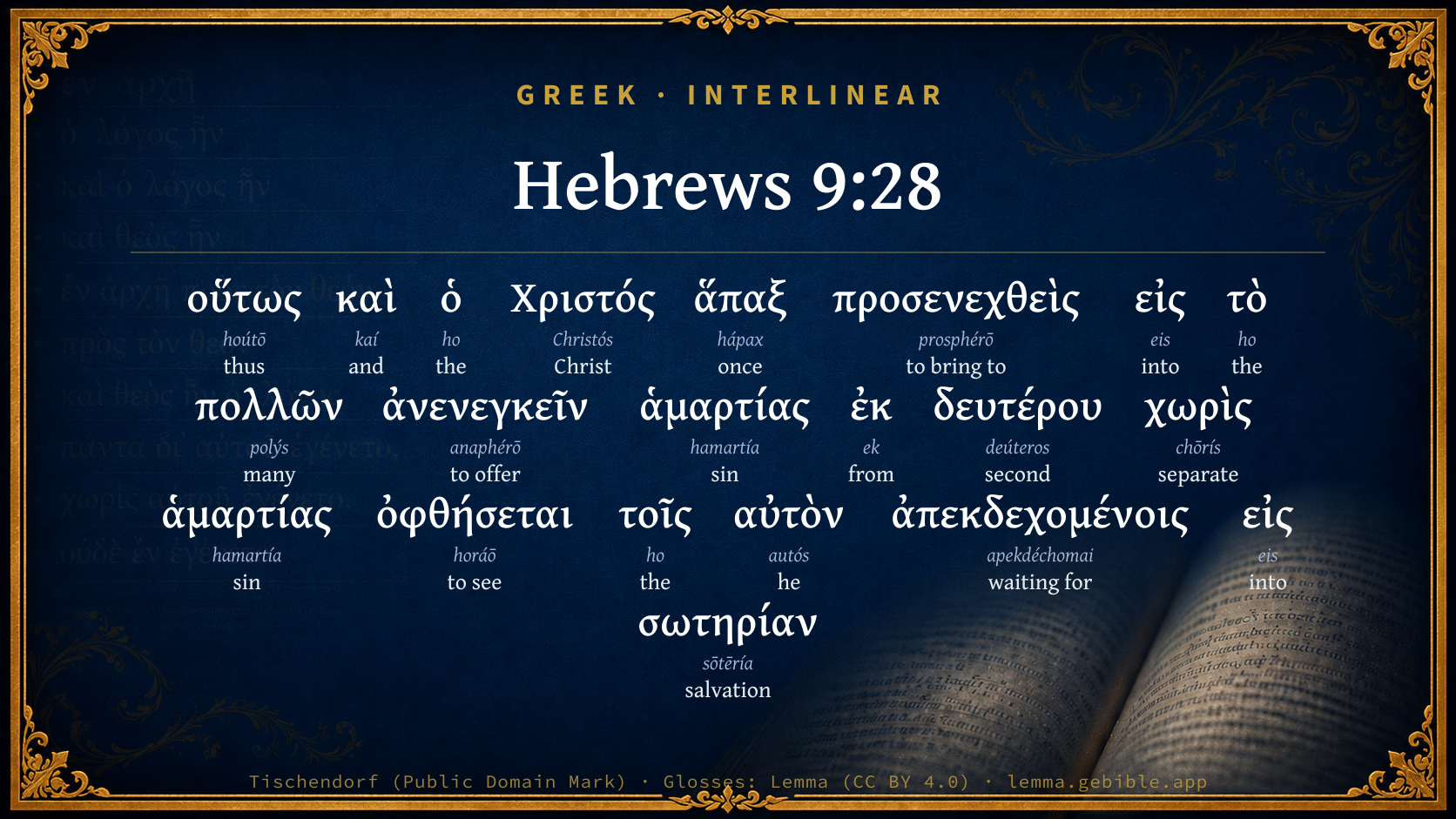
  1. οὕτως hoútō G3779 “thus” Adverb
  2. καὶ kaí G2532 “and” Conjunction
  3. ὁ ho G3588 “the” Article, Nominative, Singular, Masculine
  4. Χριστός Christós G5547 “Christ” Noun, Nominative, Singular, Masculine
  5. ἅπαξ hápax G530 “once” Adverb
  6. προσενεχθεὶς prosphérō G4374 “to bring to” Verb, Aorist, Passive, Participle, Nominative, Singular, Masculine
  7. εἰς eis G1519 “into” Preposition
  8. τὸ ho G3588 “the” Article, Accusative, Singular, Neuter
  9. πολλῶν polýs G4183 “many” Adjective, Genitive, Plural, Masculine
  10. ἁμαρτίας hamartía G266 “sin” Noun, Accusative, Plural, Feminine
  11. ἐκ ek G1537 “from” Preposition
  12. δευτέρου deúteros G1208 “second” Adjective, Genitive, Singular, Neuter
  13. χωρὶς chōrís G5565 “separate” Adverb
  14. ἁμαρτίας hamartía G266 “sin” Noun, Genitive, Singular, Feminine
  15. ὀφθήσεται horáō G3708 “to see” Verb, Future, Passive, Indicative, 3rd person, Singular
  16. τοῖς ho G3588 “the” Article, Dative, Plural, Masculine
  17. αὐτὸν autós G846 “he” Personal pronoun, Accusative, Singular, Masculine
  18. ἀπεκδεχομένοις apekdéchomai G553 “waiting for” Verb, Present, Middle or Passive deponent, Participle, Dative, Plural, Masculine
  19. εἰς eis G1519 “into” Preposition
  20. σωτηρίαν sōtēría G4991 “salvation” Noun, Accusative, Singular, Feminine

About this verse

These counts appear in no published source. They are computed here, from the morphology-tagged text and Lemma’s own curated glosses. What Lemma adds →

21
words
17
distinct lemmas
General Epistles
section

Notable vocabulary

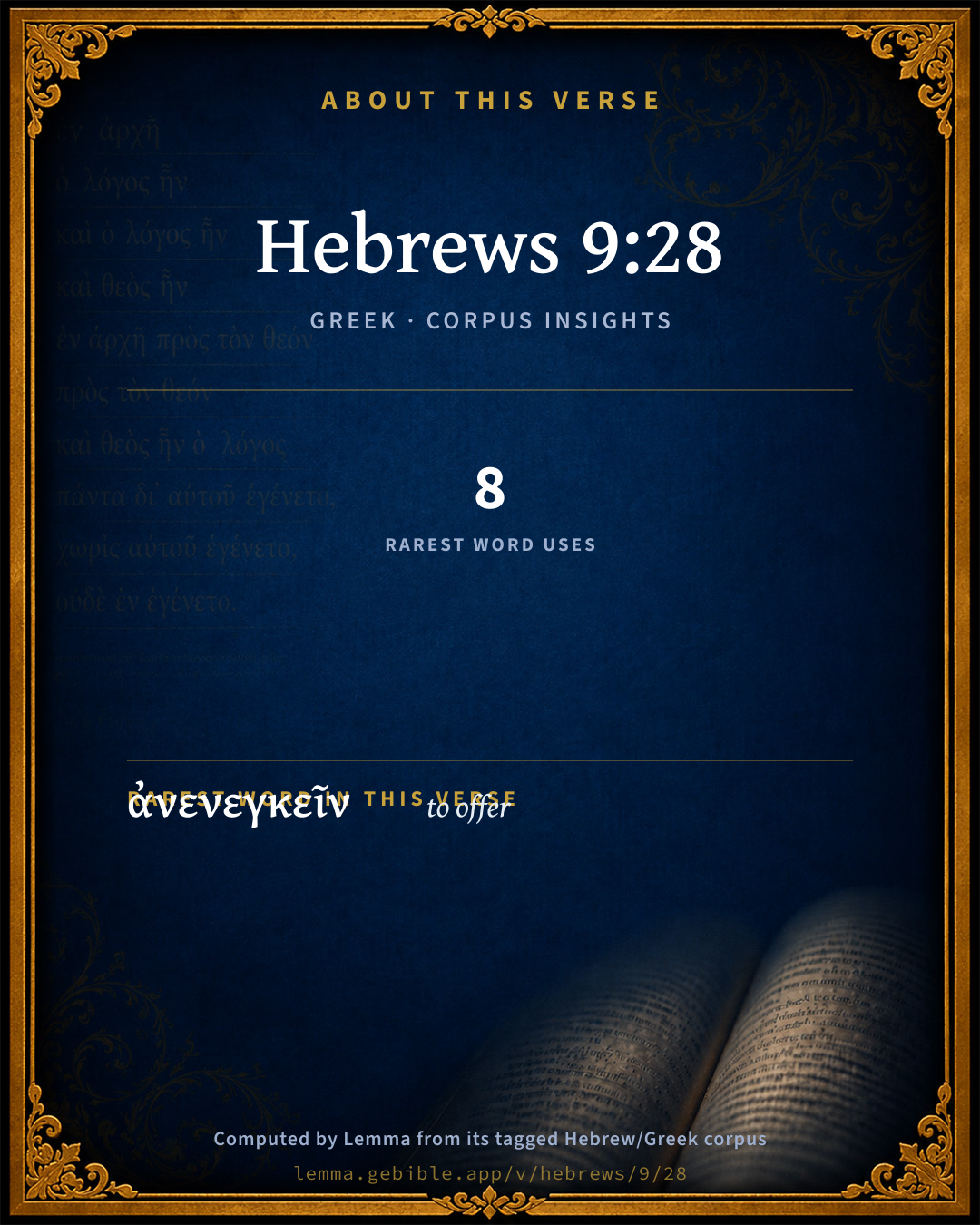
The rarest word here is ἀνενεγκεῖν to offer G399 — appearing just 8 times in the whole Greek New Testament.

Shared distinctive vocabulary

ἀνενεγκεῖν to offer G399 occurs in 8 verses of the Greek New Testament. Also found in:

Repetition

Words recur within this verse:

  • εἰς into G1519 ×2
  • ἁμαρτίας sin G266 ×2
  • ὁ the G3588 ×3

Cross-references

30

Topical passages linked to Hebrews 9:28 in the Treasury of Scripture Knowledge — connected by theme and wording, ordered by reader-vote popularity; previews shown in the World English Bible.

  • Titus 2:13 looking for the blessed hope and appearing of the glory of our great God and Savior, Jesus Christ;
  • 1 Peter 2:24 who his own self bore our sins in his body on the tree, that we, having died to sins, might live to righteousness; by whose stripes you were healed.
  • Isaiah 25:9 It shall be said in that day, Behold, this is our God; we have waited for him, and he will save us: this is Yahweh; we have waited for him, we will be glad and rejoice in his salvation.
  • Romans 6:10 For the death that he died, he died to sin one time; but the life that he lives, he lives to God.
  • 2 Timothy 4:8 From now on, there is stored up for me the crown of righteousness, which the Lord, the righteous judge, will give to me on that day; and not to me only, but also to all those who have loved his appearing.
  • Romans 8:23 Not only so, but ourselves also, who have the first fruits of the Spirit, even we ourselves groan within ourselves, waiting for adoption, the redemption of our body.
  • 1 John 3:2 Beloved, now we are children of God, and it is not yet revealed what we will be. But we know that, when he is revealed, we will be like him; for we will see him just as he is.
  • Philippians 3:20–21 For our citizenship is in heaven, from where we also wait for a Savior, the Lord Jesus Christ;
  • 1 Thessalonians 1:10 and to wait for his Son from heaven, whom he raised from the dead-- Jesus, who delivers us from the wrath to come.
  • Acts 1:11 who also said, "You men of Galilee, why do you stand looking into the sky? This Jesus, who was received up from you into the sky will come back in the same way as you saw him going into the sky."
  • Matthew 26:28 for this is my blood of the new covenant, which is poured out for many for the remission of sins.
  • 1 Peter 3:18 Because Christ also suffered for sins once, the righteous for the unrighteous, that he might bring you to God; being put to death in the flesh, but made alive in the spirit;
  • John 14:3 If I go and prepare a place for you, I will come again, and will receive you to myself; that where I am, you may be there also.
  • Romans 8:3 For what the law couldn't do, in that it was weak through the flesh, God did, sending his own Son in the likeness of sinful flesh and for sin, he condemned sin in the flesh;
  • 1 Corinthians 15:54 But when this corruptible will have put on incorruption, and this mortal will have put on immortality, then what is written will happen: "Death is swallowed up in victory."
  • Hebrews 4:15 For we don't have a high priest who can't be touched with the feeling of our infirmities, but one who has been in all points tempted like we are, yet without sin.
  • 2 Peter 3:12 looking for and earnestly desiring the coming of the day of God, by reason of which the heavens being on fire will be dissolved, and the elements will melt with fervent heat?
  • Isaiah 53:11–12 He shall see of the travail of his soul, [and] shall be satisfied: by the knowledge of himself shall my righteous servant justify many; and he shall bear their iniquities.
  • Zechariah 14:5 You shall flee by the valley of my mountains; for the valley of the mountains shall reach to Azel; yes, you shall flee, just like you fled from before the earthquake in the days of Uzziah king of Judah. Yahweh my God will come, and all the holy ones with you.
  • 1 Corinthians 1:7 so that you come behind in no gift; waiting for the revelation of our Lord Jesus Christ;
  • 2 Thessalonians 1:5–10 This is an obvious sign of the righteous judgment of God, to the end that you may be counted worthy of the Kingdom of God, for which you also suffer.
  • 2 Thessalonians 2:1 Now, brothers, concerning the coming of our Lord Jesus Christ, and our gathering together to him, we ask you
  • 1 John 3:5 You know that he was revealed to take away our sins, and in him is no sin.
  • Revelation 1:7 Behold, he is coming with the clouds, and every eye will see him, including those who pierced him. All the tribes of the earth will mourn over him. Even so, Amen.
  • Romans 5:15 But the free gift isn't like the trespass. For if by the trespass of the one the many died, much more did the grace of God, and the gift by the grace of the one man, Jesus Christ, abound to the many.
  • 1 Thessalonians 4:14–17 For if we believe that Jesus died and rose again, even so those who have fallen asleep in Jesus will God bring with him.
  • Hebrews 9:25 nor yet that he should offer himself often, as the high priest enters into the holy place year by year with blood not his own,
  • Isaiah 53:4–6 Surely he has borne our sickness, and carried our suffering; yet we considered him plagued, struck by God, and afflicted.
  • Leviticus 10:17 "Why haven't you eaten the sin offering in the place of the sanctuary, seeing it is most holy, and he has given it you to bear the iniquity of the congregation, to make atonement for them before Yahweh?
  • Numbers 18:23 But the Levites shall do the service of the tent of meeting, and they shall bear their iniquity: it shall be a statute forever throughout your generations; and among the children of Israel they shall have no inheritance.

Cross-references courtesy of OpenBible.info (CC BY 4.0).

Commentary

Notes on Hebrews 9:28 from classic Christian and Jewish commentators (each source and its license shown beneath its notes). The classic Christian expositions comment on the surrounding passage and are grouped to its opening verse, so a note may address several verses; the Jewish commentaries on the Tanakh (Rashi and others) are per-verse, so they appear only where the commentator wrote on this verse.

Lemma curates 59 commentaries, every one of them public domain or Creative Commons licensed, each selected and text-cleaned for this edition rather than reprinted as found. About our sources →

Adam Clarke's Commentary

Verse 28. So Christ was once offered] He shall die no more; he has borne away the sins of many, and what he has done once shall stand good for ever. Yet he will appear a second time without sin, χωρις αμαρτιας, without a sin-offering; THAT he has already made.

Unto salvation.] To deliver the bodies of believers from the empire of death, to reunite them to their purified souls, and bring both into his eternal glory. This is salvation, and the very highest of which the human being is capable. Amen! Even so, come Lord Jesus! Hallelujah!

1. IN the preceding notes I have given my reasons for dissenting from our translation of the 15th, 16th, and 17th verses. Many learned men are of the same opinion; but I have not met with one who appears to have treated the whole in a more satisfactory manner than Dr. Macknight, and for the edification of my readers I shall here subjoin the substance of what he has written on this point.

"Heb 9:15. Mediator of the new covenant. See Heb 8:7. The word διαθηκη, here translated covenant, answers to the Hebrew word berith, which all the translators of the Jewish Scriptures have understood to signify a covenant. The same signification our translators have affixed to the word διαθηκη, as often as it occurs in the writings of the evangelists and apostles, except in the history of the institution of the supper, and in 2Cor 3:6: and Heb 7:22, and in the passage under consideration; in which places, copying the Vulgate version, they have rendered διαθηκη by the word testament. Beza, following the Syriac Version, translates διαθηκη everywhere by the words foedas, pactum, except in the 16th, 17th, and 20th verses of this chapter, where likewise following the Syriac version, he has testamentum. Now if καινη διαθηκη, the new testament, in the passages above mentioned, means the Gospel covenant, as all interpreters acknowledge, παλαια διαθηκη, the old testament, 2Co 3:14, and πρωτηδιαθηκη, the first testament, Heb 9:15, must certainly be the Sinaitic covenant or law of Moses, as is evident also from Heb 9:20. On this supposition it may be asked,

1. In what sense the Sinaitic covenant or law of Moses, which required perfect obedience to all its precepts under penalty of death, and allowed no mercy to any sinner, however penitent, can be called a testament, which is a deed conferring something valuable on a person who may accept or refuse it, as he thinks fit? Besides, the transaction at Sinai, in which God promised to continue the Israelites in Canaan, on condition they refrained from the wicked practices of the Canaanites, and observed his statutes, Lev. 18, can in no sense be called a testament.

2. If the law of Moses be a testament, and if, to render that testament valid, the death of the testator be necessary, as the English translators have taught us, Heb 9:16, I ask who it was that made the testament of the law? Was it God or Moses? And did either of them die to render it valid?

3. I observe that even the Gospel covenant is improperly called a testament, because, notwithstanding all its blessings were procured by the death of Christ, and are most freely bestowed, it lost any validity which, as a testament, it is thought to have received by the death of Christ, when he revived again on the third day.

4. The things affirmed in the common translation of Heb 9:15, concerning the new testament, namely, that it has a Mediator; that that Mediator is the Testator himself; that there were transgressions of a former testament, for the redemption of which the Mediator of the new testament died; and, Heb 9:19, that the first testament was made by sprinkling the people in whose favour it was made with blood; are all things quite foreign to a testament. For was it ever known in any nation that a testament needed a mediator? Or that the testator was the mediator of his own testament? Or that it was necessary the testator of a new testament should die to redeem the transgressions of a former testament? Or that any testament was ever made by sprinkling the legatees with blood? These things however were usual in covenants. They had mediators who assisted at the making of them, and were sureties for the performance of them. They were commonly ratified by sacrifices, the blood of which was sprinkled on the parties; withal, if any former covenant was infringed by the parties, satisfaction was given at the making of a second covenant.

5. By calling Christ the Mediator of the new testament our thoughts are turned away entirely from the view which the Scriptures give us of his death as a sacrifice for sin; whereas, if he is called the Mediator of the new covenant, which is the true translation of διαθηκης καινης μεσιτης, that appellation directly suggests to us that the new covenant was procured and ratified by his death as a sacrifice for sin. Accordingly Jesus, on account of his being made a priest by the oath of God, is said to be the Priest or Mediator of a better covenant than that of which the Levitical priests were the mediators. I acknowledge that in classical Greek διαθηκη, commonly signifies a testament. Yet, since the Seventy have uniformly translated the Hebrew word berith, which properly signifies a covenant, by the word διαθηκη, in writing Greek the Jews naturally used διαθηκη for σονθηκη as our translators have acknowledged by their version of Heb 10:16. To conclude: Seeing in the verses under consideration διαθηκη may be translated a covenant; and seeing, when so translated, these verses make a better sense, and agree better with the scope of the apostle's reasoning than if it were translated a testament; we can be at no loss to know which translation of διαθηκη in these verses ought to be preferred. Nevertheless, the absurdity of a phraseology to which readers have been long accustomed, without attending distinctly to its meaning, does not soon appear.

"He is the Mediator. Here it is remarkable that Jesus is not called διαθεμενος, the Testator, but μεσιτης, the Mediator, of the new covenant; first, because he procured the new covenant for mankind, in which the pardon of sin is promised; for, as the apostle tells us, his death, as a sacrifice for sin, is the consideration on account of which the pardon of the transgressions of the first covenant is granted. Secondly, because the new covenant having been ratified as well as procured by the death of Christ, he is fitly called the Mediator of that covenant in the same sense that God's oath is called, Heb 6:17, the mediator, or confirmor, of his promise. Thirdly, Jesus, who died to procure the new covenant, being appointed by God the high priest thereof, to dispense his blessings, he is on that account also called, Heb 8:6, the mediator of that better covenant.

"Verse 16. For where a covenant [is made by sacrifice,] there is a necessity that the death of the appointed sacrifice be produced. This elliptical expression must be completed, if, as is probable, the apostle had now in his eye the covenant which God made with Noah and Abraham. His covenant is recorded, Ge 8:20, where we are told, that on coming out of the ark Noah offered a burnt-offering of every clean beast and fowl. And the Lord smelled a sweet savour. And the Lord said in his heart, I will not again curse the ground, neither will I again smite any more every living thing as I have done. This promise or declaration God called his covenant with men, and with every living creature. Ge 9:9; Ge 9:10. In like manner God made a covenant with Abraham by sacrifice, Ge 15:9; Ge 15:18, and with the Israelites at Sinai, Ex 24:8. See also Ps 50:5. By making his covenants with men in this manner, God taught them that his intercourses with them were all founded on an expiation afterwards to be made for their sins by the sacrifice of the seed of the woman, the bruising of whose heel, or death, was foretold at the fall. On the authority of these examples, the practice of making covenants by sacrifice prevailed among the Jews; Jer 34:18; Zec 9:11; and even among the heathens; for they had the knowledge of these examples by tradition. Stabant et caesa jungebant foedera porca; Virgil, AEneid, viii. 611. Hence the phrases, foedus ferire and percutere, to strike or kill the covenant.

"There is a necessity that the death του διαθεμενου, of the appointed. Here we may supply either the word θυματος, sacrifice, or ζωου, animal, which might be either a calf, a goat, a bull, or any other animal which the parties making the covenant chose. διαθεμενου is the participle of the second aorist of the middle voice of the verb διατιθημι, constituo, I appoint. Wherefore its primary and literal signification is, of the appointed. Our translators have given the word this sense, Lu 22:29; Καγω διατιθεμαι ὑμιν, καθως διετιθετο μοι ὁ Πατηρ μου, βασιλειαν. And I appoint to you a kingdom, as my Father hath appointed to me a kingdom.

"Be brought in; Θανατον αναγκη φερεσθαι του διαθεμενου, Elsner, vol. ii., p. 381, has shown that the word φερεσθαι is sometimes used in a forensic sense for what is produced, or proved, or made apparent in a court of judicature. Wherefore the apostle's meaning is, that it is necessary the death of the appointed sacrifice be brought in, or produced, at the making of the covenant. In the margin of our Bibles this clause is rightly translated, be brought in. See Ac 25:7, where φεροντες is used in the forensic sense.

"Verse 17. A covenant is firm over dead sacrifices; επι νεκοις. νεκροις being an adjective, it must have a substantive agreeing with it, either expressed or understood. The substantive understood in this place, I think, is θυμασι, sacrifices; for which reason I have supplied it in the translation. Perhaps the word ζωοις, animals, may be equally proper; especially as, in the following clause, διαθεμενος is in the gender of the animals appointed for the sacrifice. Our translators have supplied the word ανθρωποις, men, and have translated επι νεκροις, after men are dead, contrary to the propriety of the phrase.

"It never hath force whilst the appointed liveth; Ὁτε ζῃ ὁ διαθεμενος. Supply μοσχος, or τραγος, or ταυρος. whilst the calf, or goat, or bull, appointed for the sacrifice of ratification, liveth. The apostle having, in Heb 9:15, showed that Christ's death was necessary as ο μεσιτης, the Mediator, that is, the procurer, and ratifier of the new covenant, he in the 16th and 17th verses observes that, since God's covenants with men were all ratified by sacrifice to show that his intercourses with men are founded on the sacrifice of his Son, it was necessary that the new covenant itself should be ratified by his Son's actually dying as a sacrifice.

"The faultiness of the common translation of the 15th, 16th, 17th, 18th, and 20th verses of this chapter having been already shown in the notes, nothing needs be added here, except to call the reader's attention to the propriety and strength of the apostle's reasoning, as it appears in the translation of these verses which I have given, compared with his reasoning as represented in the common version."

2. It is supposed that in Heb 9:28, the apostle, in speaking about Christ's bearing the sins of many, alludes to the ceremony of the scape goat. This mysterious sacrifice was to be presented to God, Le 16:7, and the sins of the people were to be confessed over the head of it, Le 16:21, and after this the goat was dismissed into a land uninhabited, laden, as the institution implied, with the sins of the people; and this the word ανενεγκειν, to bear or carry away, seems to imply. So truly as the goat did metaphorically bear away the sins of the many, so truly did Christ literally bear the punishment due to our sins; and in reference to every believer, has so borne them away that they shall never more rise in judgment against him.

3. In Christ's coming, or appearing the second time, it is very probable, as Dr. Doddridge and others have conjectured, that there is an allusion to the return of the high priest from the inner tabernacle; for, after appearing there in the presence of God, and making atonement for the people in the plain dress of an ordinary priest, Le 16:23; Le 16:24, he came out arrayed in his magnificent robes, to bless the people, who waited for him in the court of the tabernacle of the congregation. "But there will be this difference," says Dr. Macknight, "between the return of Christ to bless his people, and the return of the high priest to bless the congregation. The latter, after coming out of the most holy place, made a new atonement in his pontifical robes for himself and for the people, Le 16:24, which showed that the former atonement was not real but typical. Whereas Jesus, after having made atonement, [and presented himself in heaven, before God,] will not return to the earth for the purpose of making himself a sacrifice the second time; but having procured an eternal redemption for us, by the sacrifice of himself once offered, he will return for the purpose of declaring to them who wait for him that they are accepted, and of bestowing on them the great blessing of eternal life. This reward he, being surrounded with the glory of the Father, Mt 16:27, will give them in the presence of an assembled universe, both as their King and their Priest. This is the great salvation which Christ came to preach, and which was confirmed to the world by them who heard him: Heb 2:3." Reader, lay this sincerely to heart!

4. The form in which the high priest and the ordinary priests were to bless the people, after burning the incense in the tabernacle, is prescribed, Nu 6:23-26. Literally translated from the Hebrew it is as follows, and consists of three parts or benedictions:-

1. May Jehovah bless thee, and preserve thee!

2. May Jehovah cause his face to shine upon thee, and be gracious unto thee!

3. May Jehovah lift up his faces upon thee, and may he put prosperity unto thee! (See my notes on the place.)

We may therefore say that Christ, our High Priest, came to bless each of us, by turning us away from our iniquity. And let no one ever expect to see him at his second coming with joy, unless he have, in this life, been turned away from his iniquity, and obtained remission of all his sins, and that holiness without which none can see God. Reader, the time of his reappearing is, to thee, at hand! Prepare to meet thy God!

On the word conscience, which occurs so often in this chapter, and in other parts of this epistle, see the observations at the end of "Heb 13:25".

Adam Clarke's Commentary on the Bible (1810–1826) — public domain. Text from a community e-Sword/MySword module.

Ellicott's Commentary for English Readers

(28) So Christ was once offered.—The ordinary translation, dividing the verse into two similar portions, fails to show where the emphasis really lies. The two members of the verse correspond to each other, point by point, with remarkable distinctness; but the first is clearly subordinated to the second. “So the Christ. also, having been once offered that He might bear the sins of many, shall appear a second time apart from sin to them that wait for Him unto salvation.” It is important to notice that, not only is there perfect. parallelism between the two members of this verse, but there is a similar relation between this verse as a whole and Heb_9:27. In that were presented two cardinal points of the history of sinful man; in this the main outlines of the Redeemer’s work. Each verse deals first with the present world, and secondly with “the last things.” The two verses, taken together, are connected with the preceding argument by the word “once.” Christ will not “suffer” often. He has been manifested once, to accomplish by one act the “annulling” of sin (Heb_9:26). And this is in harmony with the lot of man, who must die once, and but once (Heb_9:27-28). But what is the exact nature of this correspondence? Do the words simply mean that, as the Christ was man, so it was laid up for Him to die but once? Or may the connection of thought be expressed thus?—The work of redemption is so ordered as to correspond to the course of man’s history: as man must die once, and what remains is the judgment which he must abide, so the Christ has died once, and what remains is His return for judgment—a judgment which He Himself administers, giving salvation to His people. We will not venture to say that the former thought is absent from the words (which are sufficiently general to include both), but certainly the second is the more important. If now we return to Heb_9:28, it will be seen that the words “having been once offered” in the first member are answered by “shall appear” in the second; “to bear sins,” by “apart from sin . . . unto salvation;” and “of many,” by “to them that wait for Him.” In Heb_9:14; Heb_9:25, the writer spoke of Christ as offering Himself, here as “having been offered;” so in Eph_5:2 we read that He “delivered Himself up for us,” but in Rom_8:32 that God “delivered Him up for us all,” and in Rom_4:25, “who was delivered up for our offences.” The words which follow are taken (with a slight change) from Isa_53:12, “and He bare the sin of many.” These words clearly involve sacrificial imagery. What is signified is not directly the removal of sin (as in the different words of Joh_1:29); but, as on the animal to be slain the sins of the offerer were in figure laid, and the death which followed signified the death which the offerer had deserved, so, with an infinite extension of meaning, are the words here applied. It is certainly no mere accident that the writer, thus availing himself of the prophet’s words, speaks of the Christ. In contrast with the one Sufferer are the “many” whose sins are borne (comp. Heb_2:10; Mat_26:28). When the Christ shall appear the second time, it shall be “apart from sin”—no longer bearing sin, but “separate from sinners” (Heb_7:26). Of the judgment which He shall pass upon “the adversaries” (Heb_10:27) this verse does not speak, but only of His appearing to His own people, who “wait for Him.” This expressive word, again and again used by St. Paul (see Note on Rom_8:19) to describe the attitude of Christ’s people upon earth towards their Lord (Php_3:20; 1Co_1:7) and His salvation (Rom_8:23; Rom_8:25), is here applied to all who love His appearing. By these “He shall be seen” as He is (1Jn_3:2). The last words “unto salvation” declare the purpose of His appearing, in a form which at once recalls the teaching of earlier verses in the Epistle (Heb_5:9; Heb_7:26), and especially Heb_9:12 of this chapter, and which brings to mind the name of Him for whom we wait, the Saviour (Php_3:20).

A Bible Commentary for English Readers, edited by Charles John Ellicott (1878–1897) — public domain. Text from a community e-Sword module.

Bengel's Gnomon

Johann Albrecht Bengel

Heb 9:28. Οὕτω, so) i.e. Christ hath delivered us from death and judgment, notwithstanding that, as death, so also judgment remains, as far as the name is concerned.—προσενεχθεὶς εἰς τὸ ἀνενεγκεῖν, having been offered to bear) There is a difference between the words; comp. 1Pe 2:24, τὰς ἁμαρτίας ἀνήνεγκεν, He bore our sins: Our sins were laid on Him by the Father: while therefore He was lifted np on the cross, He bore (took) up our sins along with Him. The LXX. use the same expression, Num 14:33, ἀνοίσουσι τὴν πορνείαν ὑμῶν, they shall bear your whoredoms. In other places they are put indiscriminately: ch. Heb 7:27.—πολλῶν, of many) A pleasant antithesis: once; of many, who lived during so many ages. Isa 53:12, in the LXX. version, καὶ αὐτὸς ἁμαρτίας πολλῶν ἀνήνεγκε, and He bore the sins (sin, Heb.) of many. Thus the absolute power of the one sacrifice of Christ is very clearly evinced. The word again, Joh 14:3, accords with a second time, here. Both places treat of His coming, regarded as to itself (secundum se). But His coming, for the first time in the flesh, was in the strange form of a servant: His second coming is in His own glory. In the eyes of all, who had not formerly seen, [not only so] but had not either acknowledged Him, He is at that time Coming (ὁ ἐρχόμενος, The Comer). Let us suppose the arrival of a guest, the intimate friend of the father of the family, but unknown to the family. The father of the family will think, A brother RETURNS; whereas in the family it will be said, A guest IS COMING.—ὀφθήσεται, He will be seen) in His glory.—ἀπεκδεχομένοις, to them that look for Him) The dative of advantage. The unrighteous also will see Him, but not for salvation. To them that look for Him, He will be the Saviour, Php 3:20.—εἰς σωτηρίαν, unto salvation) and therefore to set us free from condemnation.

—————

Bengel's Gnomon of the New Testament — English translation (T&T Clark, Edinburgh, 1860) — public domain. Text from a community e-Sword module.

Meyer's Critical & Exegetical Commentary

Heinrich August Wilhelm Meyer

Heb_9:28. Ἅπαξ προσενεχθείς] once offered (by the suffering of death). Chrysostom: ὑπὸ τίνος προσενεχθείς; ὑφ ̓ ἑαυτοῦ δηλονότι. Wrongly (comp. ἑαυτόν, Heb_9:25; Heb_9:14) Delitzsch: in connection with the passive προσενεχθείς we have to think of the violence proceeding from the human and demoniac power, which Christ endured, in order to become the προσφορά for the propitiation of mankind; Kurtz and Hofmann: ὑπὸ τοῦ θεοῦ is to be supplemented, which, accordingly, is interpreted by Kurtz into the signification of the sending of the Son into the world, in behoof of the vicarious atoning for sin by means of His sacrificial death; by Hofmann: into a being brought to that place where He was to be at the disposal of Him who had ordained Him to be an expiatory sacrifice for sins. The words ἅπαξ προσενεχθείς correspond to the ἅπαξ ἀποθανεῖν, Heb_9:27, and προσενεχθείς forms a paronomasia with the following ἀνενεγκεῖν: borne as a sacrifice, that He might bear away, dargebracht, um fortzubringen [oblatus ut auferret]. For ἀνενεγκεῖν denotes not the bearing up (and fastening) to the cross (Jac. Cappellus, Calov, Wolf, Bengel, and others, after 1Pe_2:24, where, however, ἐπὶ τὸ ξύλον is employed with it), or the substitutionary bearing (Augustine, de pecc. mer. i. 28; Estius, Seb. Schmidt, Böhme, de Wette, Bloomfield, Bisping, Delitzsch, Riehm, Lehrbegr. des Hebräerbr. p. 544 f.; Alford, Maier, Conybeare, Moll, Kurtz, Ewald, MCaul, Hofmann, and others, in accordance with the signification of the verb, Isa_53:12, LXX.: αὐτὸς ἁμαρτίας πολλῶν ἀνήνεγκε, an utterance which certainly may have been before the mind of the author at the time of his writing this passage), or the offering up of the sins, as it were, as a sacrifice (Peshito, Chrysostom, Oecumenius, Theophylact, Michaelis); but the expiation of sins, conceived under the form of the result immediately of necessity attaching itself thereto, i.e. the putting away of sins, in such wise that it takes up again the idea expressed by εἰς ἀθέτησιν ἁμαρτίας, Heb_9:26, and becomes identical with ἀφαιρεῖν ἁμαρτίας, Heb_10:4. From a linguistic point of view this interpretation encounters no difficulty (against Delitzsch and others), since the ἀνά in ἀνενεγκεῖν was employed not otherwise than, e.g., very frequently the ἀνά in ἀναιρεῖν. How easily the notion of bearing in φέρειν could pass over into that of bearing away or doing away with, is shown in the kindred verb βαστάζειν, which is unquestionably used, Mat_8:17, Joh_20:15, in the sense of auferre. Comp. also Galen, de compos. medicam. 2 : ψώρας τε θεραπεύει καὶ ὑπώπια βαστάζει.

πολλῶν] here too, as Heb_2:10 and often (see p. 122), lays stress only on the notion of multitude or plurality, without regard to the question whether this plurality constitutes the totality of mankind or not.

ἐκ δευτέρου ὀφθήσεται] shall appear the second time before the eyes of men, namely, at His Parousia. According to Bleek, there arises a difficulty from the words, if we explain προσενεχθείς of the death suffered upon earth, and not, with him, of an action accomplished in heaven, only after the resurrection, inasmuch as in the former case Christ already appeared in a visible form the second time after His resurrection. But such difficulty does not at all present itself in connection with that application of προσενεχθείς either. For ἐκ δευτέρου ὀφθήσεται can only be understood of a second appearing in a visible form upon earth; when, however, Christ after His resurrection appeared again to His disciples, He had not yet left the earth; those manifestations of the risen Christ before His ascension belonged consequently to His first visible coming forth upon earth.

χωρὶς ἁμαρτίας] forms the opposition to εἰς τὸ πολλῶν ἀνενεγκεῖν ἁμαρτίας, is therefore to be interpreted after the analogy of these words. (Erroneously Bleek, according to whom χωρὶς ἁμαρτίας forms the opposition to εἰς ἀθέτησιν ἁμαρτίας διὰ τῆς θυσίας αὐτοῦ πεφανέρωται, Heb_9:26.) Christ has once offered Himself up for the expiation of the sins of men; when He returns to earth the second time, He will not once more have to do with the expiation of human sin, but He will, apart from sin, or free from all relation to sin, appear to bring the σωτηρία to the believers. Free from the guilt and punishment of sin, Christ has already rendered His believers by means of His sacrificial death at His first appearing upon earth. Positively, He will bless them with salvation at His return. To combine χωρὶς ἁμαρτίας with τοῖς ἀπεκδεχομένοις by means of an hyperbaton (so Faber Stapulensis and Grotius) is grammatically impossible. The sense, however, cannot be either, as the Irvingites will, that Christ Himself will be free from sin at His second appearing, in opposition to the lust which they suppose to have attached to Him during His first appearing; for that Christ during this period too, notwithstanding all the temptation to which He was subject, was free from sin, the author certainly distinctly asserts at Heb_4:15. Incorrectly also does Bleekafter the example of Theodore of Mopsuestia (τὸ γὰρ χωρὶς ἁμαρτίας τοῦτο λέγει, ὅτι μὴ κρατούσης ἔτι τῆς ἁμαρτίας οὕτω καὶ αὐτὸς ἔξω παντὸς ἀνθρωπίνου πάθους ὀφθήσεται τότε) and of Theodoret (οὐκέτι τῆς ἁμαρτίας κρατούσης, ἀντὶ τοῦ χώραν οὐκέτι ἐχούσης κατὰ τῶν ἀνθρώπων τῆς ἁμαρτίας)take χωρὶς ἁμαρτίας as equivalent in signification to μὴ οὔσης ἁμαρτίας, so that the sense would be: at the return of Christ sin will no longer be present, at least in the domain to which the operation of the Redeemer will relate. Even in a grammatical respect this application of the words is inadmissible, since χωρὶς ἁμαρτίας must stand in relation to the subject in ὀφθήσεται, thus cannot be torn away from this reference by being made equivalent to an independent participial clause. But also the thought thence arising would be encumbered with difficulty, as Bleek himself admits, by the addition of at least, etc., although Bleek has sought to justify it. Additional misinterpretations of χωρὶς ἁμαρτίας are met with in other writers. Thus it is supposed to mean: without, again vicariously laden with the sins of men, being made sin (2Co_5:21) for them (Oecumenius, Theophylact, Clarius, Akersloot, Wolf, Carpzov, Chr. Fr. Schmid, Heinrichs, de Wette, Bloomfield, Bisping, Delitzsch, Riehm, Lehrbegr. des Hebräerbr. p. 545, Obs.; Alford, Maier, Moll, and others), which is already refuted by the erroneousness of explaining the foregoing ἀνενεγκεῖν of the vicarious bearing of sins; without the punishment of sin (Klee, al.); without the sufferings undertaken for sin (Tholuck); sine corporis, peccato obnoxii, mortalitate (Zeger); sine sacrificio pro peccato (Jac. Cappellus, Stuart, MCaul, and many); not as a sufferer for the guilt of others, but as the holy judge of the guilt of others (Ebrard, Delitzsch; similarly Stein and others), and so forth, all of which have the plain expression of the language against them.

εἰς σωτηρίαν] belongs to ὀφθήσεται, not, as it is true, upon the retention of the spurious addition (see the critical remark) διὰ πίστεως, it must be conjoined, to ἀπεκδεχομένοις (so Primasius, Faber Stapulensis, Camerarius, Wolf, Klee, Paulus, Stein). For τοῖς αὐτὸν ἀπεκδεχομένοις contains a non-essential element of the statement, Heb_9:28; εἰς σωτηρίαν, on the other hand, an essential element of the same. εἰς σωτηρίαν, namely, is the positive nearer defining of the negative χωρὶς ἁμαρτίας, and forms consequently, like the latter, an antithesis to εἰς τὸ πολλῶν ἀνενεγκεῖν ἁμαρτίας. The whole clause, however, ἐκ δευτέρου … εἰς σωτηρίαν, corresponds to the second member of the clause, Heb_9:27 : μετὰ δὲ τοῦτο κρίσις.

Meyer — Critical and Exegetical Commentary on the New Testament — English translation by Peter Christie, edited by Frederick Crombie (T&T Clark, 1880) — public domain. Text from a community e-Sword module.

Expositor's Greek Testament

ed. W. Robertson Nicoll

Heb 9:28 . οὕτως . The comparison extends to both terms, the once dying and the judgment. [ Cf. Kübel, “die Korrespondenz ist nicht bloss die der gleichen Menschennatur, sondern das, dass mit dem Tod das, was das Leben bedeutet, abgeschlossen, fertigist”]. The results of the life are settled. And in Christ’s case the result is that He appears the second time without sin unto salvation, the sin having been destroyed by His death, ἅπαξ προσενεχθεὶς corresponds to ἅπαξ ἀποθανεῖν of Heb 9:27 . The passive is used to be more in keeping with the universal law expressed in ἀπόκειται of Heb 9:27 . Though the “offering” as we have seen includes both the death and the entrance into the Holiest with the blood, it is the death which is here prominent. εἰς τὸ πολλῶν ἀνενεγκεῖν ἁμαρτίας , “to bear the sins of many”. Westcott says, “the burden which Christ took upon Him and bore to the cross was ‘the sins of many’ not, primarily, or separately from the sins, the punishment of sins.” But in what intelligible sense can sins be borne but by bearing their punishment? In Num 14:33 , e.g. , it is said “your sins shall be fed in the wilderness forty years καὶ ἀνοίσουσι τὴν πορνείαν ὑμῶν , where the same verb is used as here to express the idea of suffering punishment for the sins of others, πολλῶν , although it was the death of but one, cf. Rom 5:12-21 , but probably only a reminiscence of Isa 58:12 . αὐτὸς ἁμαρτίας πολλῶν ἀνήνεγκε . ἐκ δευτέρου … a second time He shall appear, ὀφθήσεται , visible to the eye. The word is probably used because appropriate to the appearances after the resurrection, cf. Luk 24:34 , Act 9:17 ; Act 13:31 , 1Co 5:6 , 1Co 5:7 , 1Co 5:8 where ὤφθη is regularly used. But on this “second” appearance His object is different. He will come not εἰς τὸ πολ . ἀνεν . ἁμαρτίας , but χωρὶς ἁμ . εἰς σωτηρίαν irrespective of sin, not to be a sin offering but to make those who wait for Him partakers of the great salvation, Heb 2:3 , cf. Heb 10:37-39 ; and Heb 9:12 . τοῖς αὐτὸν ἀπεκδεχομένοις “There may be an illusion to the reappearance of the High Priest after the solemn ceremonial in the Holy of Holies on the day of atonement to the anxiously waiting people” (Vaughan). Cf. Luk 1:21 . The word is used in 1Co 1:7 and Phi 3:20 of the expectation of the second advent, and in 2Ti 4:8 is varied by the beautiful expression “they that have loved His appearing”.

The Expositor's Greek Testament, edited by W. Robertson Nicoll (1897–1910) — public domain. Text from a community e-Sword module.

Geneva Bible (1599)

Geneva Bible translators

Shortly by the way he setteth out Christ as Judge, partly to terrify them, which do not rest themselves in the only oblation of Christ once made, and partly to keep the faithful in their duty, that they will go not back.

Thus the general promise is restrained to the elect only: and we have to seek the testimony of our election: not in the secret counsel of God, but in the effects that our faith worketh, and so we must climb up from the lowest step to the highest, there to find such comfort as is most certain, and shall never be moved.

Geneva Bible (1599) marginal notes — public domain. Text via Bolls.life.

Jamieson, Fausset & Brown

Robert Jamieson, A. R. Fausset & David Brown

Christ--Greek, "THE Christ"; the representative MAN; representing all men, as the first Adam did.

once offered--not "often," Heb 9:25; just as "men," of whom He is the representative Head, are appointed by God once to die. He did not need to die again and again for each individual, or each successive generation of men, for He represents all men of every age, and therefore needed to die but once for all, so as to exhaust the penalty of death incurred by all. He was offered by the Father, His own "eternal Spirit" (Heb 9:14) concurring; as Abraham spared not Isaac, but offered him, the son himself unresistingly submitting to the father's will (Gen. 22:1-24).

to bear the sins--referring to Isa 53:12, "He bare the sins of many," namely, on Himself; so "bear" means, Lev 24:15; Num 5:31; Num 14:34. The Greek is literally "to bear up" (Pe1 2:24). "Our sins were laid on Him. When, therefore, He was lifted up on the cross, He bare up our sins along with Him" [BENGEL].

many--not opposed to all, but to few. He, the One, was offered for many; and that once for all (compare Mat 20:28).

look for him--with waiting expectation even unto the end (so the Greek). It is translated "wait for" in Rom 8:19, Rom 8:23; Co1 1:7, which see.

appear--rather, as Greek, "be seen." No longer in the alien "form of a servant," but in His own proper glory.

without sin--apart from, separate from, sin. Not bearing the sin of many on Him as at His first coming (even then there was no sin in Him). That sin has been at His first coming once for all taken away, so as to need no repetition of His sin offering of Himself (Heb 9:26). At His second coming He shall have no more to do with sin.

unto salvation--to bring in completed salvation; redeeming then the body which is as yet subject to the bondage of corruption. Hence, in Phi 3:20 he says, "we look for THE SAVIOUR." Note, Christ's prophetical office, as the divine Teacher, was especially exercised during His earthly ministry; His priestly is now from His first to His second coming; His kingly office shall be fully manifested at, and after, His second coming.

Next: Hebrews Chapter 10

Jamieson, Fausset & Brown — Commentary Critical and Explanatory on the Whole Bible (1871) — public domain (CC PDM 1.0). Text via the HelloAO Bible API.

John Calvin's Commentaries

28. The second time without sin, etc. The Apostle urges this one thing, — that we ought not to be disquieted by vain and impure longings for new kinds of expiations, for the death of Christ is abundantly sufficient for us. Hence he says, that he once appeared and made a sacrifice to abolish sins, and that at his second coming he will make openly manifest the efficacy of his death, so that sin will have no more power to hurt us.

To bear, or, take away sins, is to free from guilt by his satisfaction those who have sinned. He says the sins of many, that is, of all, as in Romans 5:15. It is yet certain that all receive no benefit from the death of Christ; but this happens, because their unbelief prevents them. At the same time this question is not to be discussed here, for the Apostle is not speaking of the few or of the many to whom the death of Christ may be available; but he simply means that he died for others and not for himself; and therefore he opposes many to one.

But what does he mean by saying that Christ will appear without sin? Some say, without a propitiation or an expiatory sacrifice for sin, as the word sin is taken in Romans 8:3; 2 Corinthians 5:21; and in many places in the writings of Moses; but in my judgment he intended to express something more suitable to his present purpose, namely, that Christ at his coming will make it known how truly and really he had taken away sins, so that there would be no need of any other sacrifice to pacify God; as though he had said, “When we come to the tribunal of Christ, we shall find that there was nothing wanting in his death.”

And to the same effect is what he immediately adds, unto salvation to them who look, or wait for him. Others render the sentence differently, “To them who look for him unto salvation;” But the other meaning is the most appropriate; for he means that those shall find complete salvation who recumb with quiet minds on the death of Christ; for this looking for or wanting has a reference to the subject discussed. The Scripture indeed does elsewhere ascribe this in common to believers, that they look for the coming of the Lord, in order to distinguish them from the ungodly, by whom his coming is dreaded, (1 Thessalonians 1:10;) but as the Apostle now contends that we ought to acquiesce in the one true sacrifice of Christ, he calls it the looking for Christ, when we are satisfied with his redemption alone, and seek no other remedies or helps.

John Calvin's Commentaries (1540-1563) — public domain. Text from the Calvin Translation Society English edition (1840s-50s) via the Christian Classics Ethereal Library (ccel.org). Calvin's coverage is partial (roughly two-thirds of the Bible); uncommented books and verses are honest gaps, never fabricated. The 19th-century editor's footnotes and remarks are omitted so the notes are faithfully Calvin's own voice.

The Cambridge Bible for Schools and Colleges

gen. ed. J. J. S. Perowne

28. was once offered] Christ may also be said as in Heb_9:14 “to offer Himself;” just as He is said “to be delivered for us” (Rom_4:25) and “to deliver up Himself” (Eph_5:2).

to bear the sins] The word rendered “to bear” may mean “to carry them with Him on to the Cross,” as in 1Pe_2:24; or as probably in Isa_53:12 “to take them away.”

of many] “Many” is only used as an antithesis to “few.” Of course the writer does not mean to contradict the lesson which runs throughout the N.T. that Christ died for all. Once for all One died for all who were “many” (see my Life of St Paul, ii. 216).

without sin] Not merely “without (χωρὶς)” but “apart from (ἄτερ) sin,” i.e. apart from all connexion with it, because He shall have utterly triumphed over, and annulled it (Heb_9:26); Dan_9:24-25; Isa_25:7-8). The words do not go with “the second time” for at Christ’s first coming He appeared without sin indeed, but not “apart from sin,” seeing that “He was numbered with the transgressors” (Isa_53:12) and was “made sin for us” (2Co_5:21).

unto salvation] “It shall be said in that day, Lo, this is our God; … we have waited for Him, we will be glad and rejoice in his salvation” (Isa_25:9). It is remarkable that the Sacred Writers—unlike the Mediæval painters and moralists—almost invariably avoid the more terrible aspects of the Second Advent. “How shall He appear?” asks St Chrysostom on this passage, “As a Punisher? He did not say this, but the bright side.” The parallelism of these verses is Man dies once, and is judged; Christ died once and shall return—he might have said “to be man’s judge” (Act_17:31)—but he does say “He shall return … for salvation.”

We may sum up some of the contrasts of this previous chapter as follows. The descendants of Aaron were but priests; Christ, like Melchisedek, was both Priest and King. They were for a time; He is a Priest for ever. They were but links in a long succession, inheriting from forefathers, transmitting to dependents; He stands alone, without lineage, without successor. They were established by a transitory ordinance, He by an eternal oath. They were sinful, He is sinless. They weak, He all-powerful. Their sacrifices were ineffectual, His was perfect. Their sacrifices were offered daily, His once for all. Theirs did but cleanse from ceremonial defilement, His purged the conscience. Their tabernacle was but a copy, and their service a shadow; His tabernacle was the Archetype, and His service the substance. They died and passed away; He sits to intercede for us for ever at God’s right hand. Their Covenant is doomed to abrogation; His, founded on better promises, is to endure unto the End. Their High Priest could but enter once and that with awful precautions, with the blood of bulls and goats, into a material shrine; He, entering with the blood of His one perfect sacrifice into the Heaven of Heavens, has thrown open to all the right of continual and fearless access to God. What a sin then was it, and what a folly, to look back with apostatising glances at the shadows of a petty Levitism while Christ the Mediator of a New, of a better, of a final Dispensation—Christ whose blood had a real and no mere symbolic efficacy had died once for all, and Alone for all, as the sinless Son of God to obtain for us an eternal redemption, and to return for our salvation as the Everlasting Victor over sin and death!

The Cambridge Bible for Schools and Colleges (gen. ed. J. J. S. Perowne; Cambridge University Press, 1878–1918) — public domain. Text from a community e-Sword module.

John Gill's Exposition

So Christ was once offered to bear the sins of many,.... As man dies but once, Christ was offered but once, or he suffered and died but once; and that was not on his own account, or for his own sins, "but to bear the sins of many": not of angels but of men, and these not a few, but "many"; which is said to magnify the grace of God, to exalt the satisfaction and righteousness of Christ, and to encourage souls to hope in him: hence many are brought to believe in him, and many are justified by him, have their sins forgiven them, and are glorified; though Christ bore not the sins of all men; for as all men have not faith, all are not justified, pardoned, and saved: what he bore were "sins"; all kind of sin, every act of sin, and all that belongs to it; its filth, guilt, and punishment, even the iniquity of all his people; which must be a prodigious weight, and than which nothing could be more nauseous: his bearing them supposes they were upon him, though not in him, imputed, though not inherent; that he did not sink under them; that he made an entire satisfaction for them, and bore them wholly away, both from the persons of his people, and from the sight of justice. The way in which he came to bear them was this; he became a surety for all the elect; his Father imputed to him all their sins, and he voluntarily took them upon himself; where justice found them, and demanded satisfaction of him for them, and he gave it; which is an instance both of his great love, and of his great strength:

and unto them that look for him: with affection, faith and patience:

shall he appear the second time without sin unto salvation; this is to be understood of Christ's visible and personal appearance on earth, which will be a glorious one; he will appear in his own glory, and in his Father's glory, and in the glory of the holy angels, and in the glory of his power, to the joy of saints, and to the terror of the wicked; for every eye shall see him: and this is said to be "the second time"; that is, that he appears on earth, and personally; for though he often appears to his people, it is in a spiritual way; and though he appeared to Stephen and to Paul, yet not on earth, but in heaven; and this is called the second time, with reference to his first appearance in human nature at his incarnation, and after that he ascended to heaven; and as this will be the second, it will be the last: the manner in which he will appear, will be, "without sin"; without sin itself; without any thing like it: without any infirmities, which though not sinful are the effects of sin; without sin imputed to him, with which he appeared before; without being a sacrifice for sin; and without sin upon his people that come with him, or he shall meet whom he shall raise, or change, and take to himself: and the end of his appearance with respect to them, will be "unto salvation"; the end of his first appearance was to obtain salvation for his people, and he has obtained it, and there is a comfortable application of it made unto them by the Spirit of God; but the full possession of it will be hereafter, and into this will Christ put them, when he shall appear: the Alexandrian copy adds, "by faith", and also some other copies.

Next: Hebrews Chapter 10

John Gill's Exposition of the Whole Bible (1746–1763) — public domain (CC PDM 1.0). Text via the HelloAO Bible API.

Trapp's Complete Commentary

John Trapp

28 So Christ was once offered to bear the sins of many; and unto them that look for him shall he appear the second time without sin unto salvation.

Ver. 28. The second time without sin] Imputed to him, as Isa 53:6; 2Co 5:21. {See Trapp on "Isa 53:6"} {See Trapp on "2Co 5:21"}

John Trapp, A Commentary or Exposition upon All the Books of the Old and New Testament (1647–1656) — public domain. Text from a community e-Sword module.

Albert Barnes' Notes on the Bible

So Christ was once offered - Since people are to die but once; and as all beyond the grave is fixed by the judgment, so that his death there would make no change in the destiny, there was a propriety that he should die but once for sin. The argument is, there is one probation only, and therefore there was need of but one sacrifice, or of his dying but once. If death were to occur frequently in the existence of each individual, and if each intermediate period were a state of probation, then there might be a propriety that an atonement should be made with reference to each state. Or if beyond the grave there were a state of probation still, then also there might be propriety that an atoning sacrifice should be offered there. But since neither of these things is true, there was a fitness that the great victim should die but once.

(Rather, perhaps, as in the original sentence, “once dying” was the penalty denounced on the sinner, so the substitute in enduring it, is in like manner, under necessity of dying but once. By this he fully answers the requirement of the Law. Or there may be in the passage a simple intimation that, in this respect, as in others. Christ is like us, namely, in being but once subject to death. It would be inconsistent with the nature which he sustains, to suppose him a second time subject to death.)

To bear the sins of many - To suffer and die on account of their sins; see Isa 53:6, Isa 53:11 notes; Gal 3:13 note. The phrase does not mean:

(1) That Christ was a “sinner” - for that was in no sense true. See Heb 7:26. Nor

(2) That he literally bore the penalty due to transgression - for that is equally untrue.

The penalty of the Law for sin is all which the Law when executed inflicts on the offender for his transgression, and includes, in “fact,” remorse of conscience, overwhelming despair, and eternal punishment. But Christ did not suffer forever, nor did he experience remorse of conscience, nor did he endure utter despair. Nor.

(3) Does it mean that he was literally “punished” for our sins. Punishment pertains only to the guilty. An innocent being may “suffer” for what another does, but there is no propriety in saying that he is “punished” for it. A father suffers much from the misconduct of a son, but we do not say that he is punished for it; a child suffers much from the intemperance of a parent - but no one would say that it was a punishment on the child. Men always connect the idea of criminality with punishment, and when we say that a man is punished, we suppose at once that there is “guilt.” The phrase here means simply, that Christ endured sufferings in his own person, which, if they had been inflicted on us, would have been the proper punishment of sin. He who was innocent interposed, and received on himself what was descending to meet us, and consented to be treated “as he would have deserved if he had been a sinner.” Thus, he bore what was due to us; and this, in Scripture phrase, is what is meant by “bearing our iniquities;” see the notes Isa 53:4.

(It is indeed true, that Christ did not endure the very penalty which we had incurred, and, but for his interference, should have endured. His sufferings must be regarded in the light of an equivalent to the Law’s original claim, of a satisfaction to its injured honor, which the Lawgiver has been pleased to accept. It is, however, equally true, that the sufferings of Christ were strictly penal. They were the punishment of sin. The true meaning of the important phrase in this verse, “to bear sin,” establishes this point. It can have no other meaning than bearing the punishment of sin. See Stuart’s xix. Excursus. That punishment supposes guilt is not denied. What then? Not certainly that Christ was personally guilty, but that our guilt has been imputed to him - that he has taken the place of the guilty, and become answerable for their transgressions. See Supp. note, 2Co 5:21.)

And unto them that look for him - To his people. It is one of the characteristics of Christians that they look for the return of their Lord; Tit 2:13; 2Pe 3:12; compare the notes, 1Th 1:10. They fully believe that he will come. They earnestly desire that he will come; 2Ti 4:8; Rev 22:20. They are waiting for his appearing; 1Th 1:10. He left the world and ascended to heaven, but he will again return to earth, and his people are looking for that time as the period when they shall be raised up from their graves; when they shall be publicly acknowledged to be his, and when they shall be admitted to heaven; see the notes on Joh 14:3.

Shall he appear the second time - He first appeared as the man of sorrows to make atonement for sin. His second appearance will be as the Lord of his people, and the Judge of the quick and the dead; Mat 25:31, see the notes, Act 1:11. The apostle does not say when this would be, nor is any intimation given in the Scriptures when it will occur. It is on the contrary everywhere declared that this is concealed from people Act 1:7; Mat 24:36, and all that is known respecting the time is, that it will be suddenly and at an unexpected moment; Mat 24:42, Mat 24:44, Mat 24:50.

Without sin - That is, when be comes again he will not make himself a sin-offering; or will not come in order to make atonement for sin. It is not implied that when he came the first time he was in any sense a sinner, but that he came then with reference to sin. or that the main object of his incarnation was to “put away sin by the sacrifice of himself.” When he comes the second time, it will be with reference to another object.

Unto salvation - That is, to receive his friends and followers to eternal salvation. He will come to save them from all their sins and temptations; to raise them from their graves; to place them at his right hand in glory, and to confirm them in the everlasting inheritance which he has promised to all who truly love him, and who wait for his appearing.

In view of this anticipated return of the Redeemer, we may remark:

(1) There is a propriety that the Lord Jesus should thus return. He came once to be humbled, despised, and put to death; and there is a fitness that he should come to be honored in his own world.

(2) Every person on earth is interested in the fact that he will return, for “every eye shall see him;” Rev 1:7. All who are now In their graves, and all who now live, and all who will hereafter live, will behold the Redeemer in his glory.

(3) It will not be merely to gaze upon him, and to admire his magnificence that they will see him. It will be for greater and more momentous purposes - with reference to an eternal doom.

(4) The great mass of people are not prepared to meet him. They do not believe that he will return; they do not desire that he should appear; they are not ready for the solemn interview which they will have with him. His appearing now would overwhelm them with surprise and horror. There is nothing in the future which they less expect and desire than the second coming of the Son of God, and in, the present state of the world his appearance would produce almost universal consternation and despair. It would be like the coming of the flood of waters on the old world; like the sheets of flame on the cities of the plain; or as “death” now comes to the great mass of those who die.

(5) Christians “are” prepared for his coming. They believe in it; they desire it; they are expecting it. In this they are distinguished from all the world besides, and they would be ready to hail his coming as that of a friend, and to rejoice in his appearance as that of “their” Saviour.

(6) Let us then live in habitual preparation for his advent. To each one of us he will come soon; to all he will come suddenly. Whether he come to remove us by death, or whether in the clouds of heaven to judge the world, the period is not far distant when “we” shall see him. Yes, our eyes shall behold the Son of God in his glory! That which we have long desired - a sight of our Saviour who died for us, shall soon, very soon be granted unto us. No Christian begins a week or a day in which there is not a possibility that, before its close, he may have seen the Son of God in his glory; none lies down upon his bed at night who may not, when the morning dawns upon this world, be gazing with infinite delight on the glories of the Great Redeemer in the heavens.

Albert Barnes' Notes on the Bible (1834–1885) — public domain. Text from a community e-Sword/MySword module.

Haydock's Catholic Bible Commentary

To exhaust the sins of many. That is, of all, according to the style of the Scriptures. When he came first, he took upon him the load of our sins; but at his second coming, at the end of the world, he will come in a quite different manner, not as laden with our sins, not after the similitude of a sinful man, not to redeem us, but with great power and majesty to judge all men. (Witham) --- To exhaust. That is, to empty or draw out to the very bottom, by a plentiful and perfect redemption. (Challoner)

George Leo Haydock (1774–1849), Haydock's Catholic Family Bible and Commentary, 1859 edition — public domain. Excludes Psalms (Douay-Rheims chapter numbering differs from Protestant) and Deuterocanonical books (Catholic canon only).

Matthew Poole's English Annotations

So Christ was once offered to bear the sins of many: ουτως και is an illative connection between the antecedent Heb 9:27, and this consequent; As it was appointed to men once to die, so it was appointed to Christ once to offer himself. God’s statute determineth both of these; Christ the High Priest, opposed to men, Heb 9:27, having died once as a sacrifice for sins, and offered his blood to God to expiate them, bearing their punishment which God laid on him, Isa 53:6; and so took away sins, guilt, filth, power and condemnation from many, whom the Father gave to him, and he undertook for, in it, Mat 20:28; 26:28; Joh 10:15,16.

And unto them that look for him shall he appear the second time without sin; and to his believing, penitent expectants, such as long for his coming, Phi 3:20; Tit 2:13, stretching out their heads, as the mother of Sisera, Jdg 5:28, with a holy impatience of seeing him, such as by faith and prayer are hastening it, Rom 8:23; 2Co 5:1-10; 1Pe 1:3-9, shall he once more visibly appear to them and the world, Act 1:11; Rev 1:7, gloriously, without need to suffer or die again for them, having at his departure after his first coming, carried all their sins into the land of forgetfulness.

Unto salvation; and to their persons will he bring entire and complete salvation, raising and uniting bodies and souls together, Phi 3:21; and then take them as assistants to himself in the judgment-work on men and angels in the air; and having despatched that work, return with them to the holy of holiest in heaven, there to be completely blessed, in praising, serving, glorifying, and enjoying God in Christ, and the blessedness that attends that state, for ever and ever, as 1Co 6:2,3; 1Th 4:17.

Matthew Poole's English Annotations on the Holy Bible (1683–1685) — public domain. Text from a community e-Sword/MySword module.

Whedon's Commentary on the Bible

Daniel D. Whedon

28. Once—The first point of comparison—that Christ died once as men die once, his death being sacrificial. Second point—between judgment and appear. From different quarters the bodies of men and the person of Christ meet at one terminus. He descends from heaven, they ascend from earth; he to judge, they to be judged. Third point of comparison—between bear the sins and without, or irrespective of, sin. Christ died under the weight of human sins; he returns without connexion with sin.

Unto salvation—It is judgment for all; it is salvation only to those that look for, or await him, with hopeful expectation. As writing to Christians, our author takes into view only the blessed side of the judgment.

On the last two verses we may note:—

1. Of whatever other things men are sceptical, none doubt, however they may try to forget, that they must die. This is appointed by the great Author of nature, who has the right to take the life he gives. And if Edenic man was at first placed above this law, yet by sin he sunk into the level of nature under the appointed penalty of death. See note on Rom_5:12.

2. But as sure as death is appointed unto men, so sure, also, an after judgment. Suffering, discipline, may belong to this life, but the real retributive judgment comes after life has closed. God hath appointed a day in which he will judge the world in righteousness by that man whom he hath ordained. Act_17:31.

3. How long the interval after death until the judgment our apostle expresses no opinion. Conceptually it was a momentous event; and, like God himself, however distant it is yet nigh at hand. It should take place when Christ should appear a second time; and that is not to be until the close of this new dispensation or covenant, which is second to the first, as the eighth chapter fully states.

4. The intermediate disembodied state is one of hopeful expectation of that second coming. Saints, both in the body and out of the body, are agreed in this looking-for of that glorious appearing. Death is not the point on which the Christian heart most deeply rests; paradise is not the goal to which we most earnestly look, but the advent, the glorious resurrection, the judgment, and eternal life.

Daniel D. Whedon (gen. ed.), Commentary on the Old and New Testaments (1874–1909) — public domain. Text from a community e-Sword module.

The Pulpit Commentary

The difference between Christ"s first and second advent.

I THE FIRST ADVENT. Here Christ shares the common lot of men; he dies, and dies once for all. There is no dying and rising and dying again. He is offered as a Sacrifice once for all, to bear the sins of many. And here, of course, the death of Christ must be taken as representing the whole of his life in the flesh. His life in every hour and every faculty was vicarious. He was ever striving to show that he could neutralize the consequence of sins committed, and prevent the commission of sins to come. His great aim was, in every sense of the expression, to take away sin. And from his place of power and glory on high this is his aim still. No matter how laden the conscience may be with guilt and the remembrance of folly, no matter how full of weakness the life, Christ has all fullness of power and steadiness of disposition to restore strength, rectitude, and purity. Let it be remembered that this is Christ"s present work. Christ is in his Church continually, that his Church may have success in setting him forth as taking away the sin of the world. Whenever we come across sin, in ourselves or in others, we should ever view it in relation to Christ. Then we shall be filled with a sense both of responsibility and hope. Sin is not a burden to be sullenly endured, but to be removed by faith in Christ.

II THE SECOND ADVENT. In Christ"s first coming everything is connected with sin. He is lifted up to draw sinners to him. All the energy of the Spirit and all the agencies of the gospel are employed to persuade sinners to accept the sin-bearing, sin-removing work of Christ. But he is coming a second time, altogether apart from sin coming to deliver into everlasting security those who have believed in him. The completeness of salvation is always looked upon in the New Testament as a thing yet to come. The promise is of immediate safety, as far as it can be given in our present surroundings. It is our own fault if we are not safe from backsliding, temptation, and doctrinal error. But in the fullest sense of the word salvation, we are saved, as Paul says, by hope. We are hoping for full possession of every good, full security from every evil. When Christ has taken away the sin of the world, he will take away the peril, the insecurity, of the world. Y.

The Pulpit Commentary (1880–1919), ed. H.D.M. Spence-Jones & Joseph S. Exell — public domain. Text from a community e-Sword module.

John Wesley's Explanatory Notes

Christ having once died to bear the sins - The punishment due to them. Of many - Even as many as are born into the world. Will appear the second time - When he comes to judgment. Without sin - Not as he did before, bearing on himself the sins of many, but to bestow everlasting salvation.

John Wesley, Explanatory Notes Upon the Whole Bible (1754–1765) — public domain. Text via the GEBible commentary corpus.

Scofield Reference Notes

C. I. Scofield

sins Sin. (See Scofield "Rom 3:23").

salvation (See Scofield "Rom 1:16").

The Scofield Reference Bible (1917 edition), notes by C. I. Scofield — public domain. Text from a community e-Sword module.

The People's New Testament

B. W. Johnson

28. So Christ was once offered. Died once as a sin offering. But judgment followed, and he was justified and vindicated by his resurrection. He died once, and after it was the judgment, that made him the King of glory. His work of redemption was done once for all. So unto them that look for him. All the saints who desire his appearing; to them he shall appear a second time, at his second advent, sinless and the mighty Savior. He becomes a sin offering but once, and appears the second time without a sin offering, because he hath done the work once and forever.

B. W. Johnson's The People's New Testament with Notes (1889–1891) — public domain. Electronic text from the Christian Classics Ethereal Library (CCEL) ThML edition.

Cambridge Greek Testament for Schools and Colleges

28. ὁ Χριστός. “The Christ”; the Anointed High Priest.

ἅπαξ προσενεχθείς. “Having been once offered.” Christ may also be said as in Heb 9:14 “to offer Himself”; just as He is said “to be delivered for us” (Rom 4:25) and “to deliver up Himself” (Eph 5:2).

πολλῶν. “Many” is only used as an antithesis to “few.” Of course the writer does not mean to contradict the lesson which runs throughout the N. T. that Christ died for all. Once for all One died for all who were “many” (see my Life of St Paul, II. 216).

ἀνενεγκεῖν. “To carry them with Him on to the Cross,” as in 1Pe 2:24: or as probably in Isa 53:12 “to take them away.”

χωρίς. Not merely “without (ἄτερ)” but “apart from (χωρὶς) sin,” i.e. apart from all connexion with it, because He shall have utterly triumphed over, and annulled it (Heb 9:26; Dan 9:24-25; Isa 25:7-8). The words do not go with “the second time,” for at Christ’s first coming He appeared without sin indeed, but not “apart from sin,” seeing that “He was numbered with the transgressors” (Isa 53:12) and was “made sin for us” (2Co 5:21).

εἰς σωτηρίαν. “It shall be said in that day, Lo, this is our God; … we have waited for Him, we will be glad and rejoice in His salvation” (Isa 25:9). It is remarkable that the Sacred writers—unlike the Mediaeval painters and moralists—almost invariably avoid the more terrible aspects of the Second Advent. “How shall He appear?” asks St Chrysostom on this passage, “As a Punisher? He did not say this, but the bright side.” The parallelism of these verses is: Man dies once, and is judged; Christ died once, and shall return—he might have said “to be man’s judge” (Act 17:31)—but he does say “He shall return … for salvation.”

We may sum up some of the contrasts of this previous chapter as follows. The descendants of Aaron were but priests; Christ, like Melchisedek, was both Priest and King. They were for a time; He is a Priest for ever. They were but links in a long succession, inheriting from forefathers, transmitting to descendants; He stands alone, without lineage, without successor. They were established by a transitory ordinance, He by an eternal oath. They were sinful, He is sinless. They weak, He all-powerful. Their sacrifices were ineffectual, His was perfect. Their sacrifices were offered daily. His once for all. Theirs did but cleanse from ceremonial defilement, His purged the conscience. Their tabernacle was but a copy, and their service a shadow; His tabernacle was the Archetype, and His service the substance. They died and passed away; He sits to intercede for us for ever at God’s right hand. Their Covenant is doomed to abrogation; His, founded on better promises, is to endure unto the end. Their High Priest could but enter once and that with awful precautions, with the blood of bulls and goats, into a material shrine; He, entering once for all with the blood of His one perfect sacrifice into the Heaven of Heavens, has thrown open to all the right of continual and fearless access to God. What a sin then was it, and what a folly, to look back with apostatising glances at the shadows of a petty Levitism while Christ the Mediator of a New, of a better, of a final Dispensation—Christ whose blood had a real and no mere symbolic efficacy, had died once for all, and Alone for all, as the sinless Son of God to obtain for us an eternal redemption, and to return for our salvation as the Everlasting Victor over sin and death!

Cambridge Greek Testament for Schools and Colleges (Cambridge University Press, 1896; 21 vols, various authors incl. Carr, Maclear, Plummer, Farrar, Lumby, Moule, M. R. James, Simcox) — public domain. Text from a community e-Sword module.

Alford’s Greek Testament

Henry Alford

28.] It is shewn by a comparison with our human lot in general, of which Christ, Himself man, is partaker, that this often suffering (dying) and often offering Himself, has no place: that as in our case, we die once only, and after that comes the judgment, for us who are to be judged, so for Him there was one death from sin, and after that no repetition of it, but the judgment, for Him who is to judge. But in this latter member of the comparison, the bright and saving side only is put forward (see below): it is not said he shall appear to judge the world, but He shall appear without sin (and therefore with no more purpose to-expiate sin) to them that wait for Him, unto salvation: these last words carrying with them a hortatory force, that the readers might thus wait for Him.

28.] so also the Christ (not χριστός, anarthrous, which would seem to point to some one contrasted with, or at all events merely compared with, οἱ ἄνθρωποι: but ὁ χριστός, that man who was God’s Christ—the Christ, it being plain and palpable to all that ὁ χριστός belongs to the category οἱ ἄνθρωποι. Cf. the anarthrous χριστός in ver. 24, where the case is different) once (for all) having been offered (not = ‘having offered himself:’ for it might well have been προσενέγκας ἑαυτόν. The form and the meaning are both passive; and the reason of this is I believe to be found in the fact that it is in this verse not so much the agency, as the destiny of Christ, that is spoken of; that which, though the expression itself is avoided with regard to Him, ἀπόκειται for Him as for us. And this consideration removes from us all necessity of supplying an agent for this προσενεχθείς, as ὑφʼ ἑαυτοῦ (Chrys.) or ὑπὸ τοῦ θεοῦ (al.), which as Delitzsch remarks would not be correct; Christ might be δοθείς or παραδοθεὶς ὑπὸ τοῦ θεοῦ, but not προσενεχθείς. Nor would ὑπὸ τῶν ἀνθρώπων express the right agency; for it was no conscious act of mankind, willing its sin to be atoned for, that offered up Christ: but if an agent must be supplied, it would be = διὰ πνεύματος αἰωνίου as in ver. 14,—the divine submission of our Lord subjecting Himself to the external force which was exerted against Him,—that force being in some sort the agent, but not without His own will co-operating. It is hardly necessary to mention, that the very terms of the context here necessitate the understanding this προσενεχθῆναι of the death of Christ,—not as in ver. 25, where the context, as there insisted, confines it to His offering of Himself to God in the heavenly sanctuary) to bear the sins of many (a plain allusion to ref. Isa., αὐτὸς ἁμαρτίας πολλῶν ἀνήνεγκεν: and here, as there, importing the “bearing,” “carrying on Himself,” Heb. נָשָׂא, cf. also in Lev 24:15, “Whosoever curseth his God shall bear (λήψεται LXX) his sin:” Num 5:31, “the woman shall bear (λήψεται) her iniquity:” 14:34, “each day for a year shall ye bear (λήψεσθε) your iniquities, even forty years.” And so in id. ver. 33, “shall bear your whoredoms,” where the LXX have ἀνοίσουσιν. The Heb. word may also have the sense of auferre, which many (e. g. Luth., Schlicht., Grot., Limb., Bl., Lünem., Hofm.) have wished to give it here: but not so ἀνενέγκαι. The sense given by Syr., “sacrificed” (“immolavit”) the sins of many,” and defended also by Chrys., Œc., Thl., would introduce a new and irrelevant idea, and cannot be maintained; so Michaelis also, taking however ἁμαρτία for a sin-offering, which it never means. Besides which, it is here πολλῶν ἁμαρτίας, which would at all events preclude that meaning. On πολλῶν, and its supposed contrast to πάντων (Chrys., διὰ τί πολλῶν εἶπε, καὶ μὴ πάντων; ἐπειδὴ μὴ πάντες ἐπίστευσαν: so Œc., Thl., and Thdrt., drawing from it the inference that Christ only διέλυσε the sin of believers), see above, ch. 2:10, and Schlichting’s true distinction, “Multi non opponuntur h. l. omnibus, sed tantum paucis.” πολλῶν is, as Del. says, the qualitative designation of πάντων: all men are many in number. There is reference in it to ἅπαξ: He was offered, One, for all (“Multos uni opponit,” Calv.): and once for all), shall appear (ὀφθήσεται, the usual verb of the appearances of Christ after his resurrection) a second time (reff.) without (separate from) sin (in order to understand this, we must remember what it is that the Writer is proving: viz. that Christ’s death, the repetition of which would be the condition of a repeated offering of Himself in heaven to God, admits of no such repetition. It was a death in which He bore the sins of many—but He shall appear the second time χωρὶς ἁμαρτίας, with no sin upon Him, and consequently the whole work of atonement done and accomplished by that first offering. So that there is no need of any far-fetched explanation, either of ἁμαρτίας, or of χωρὶς ἁμαρτίας. We need not say with Storr, that it is without an offering for sin: nor with Klee, that it is without punishment of sin: nor with Bleek, without meeting with sin (so Thdrt., οὐκέτι τῆς ἁμαρτίας κρατούσης, ἀντὶ τοῦ χώραν οὐκέτι ἐχούσης κατὰ τῶν ἀνθρώπων τῆς ἁμαρτίας: and an explanation mentioned by Œc., ἐκ δευτέρου ἐρχόμενος οὐχ ἥξει πάλιν διὰ τὰς ὑμῶν ἁμαρτίας ὀφείλων ἀποθανεῖν): nor with Ebr., that He will have no more concern with sin: nor, with De Wette, without contact with sin: nor, with Lünem., free from all reference to sin. As distinguished from all these, we take, with Delitzsch and Hofmann, the simple sense of the words, and apply it to the argument in hand. At His first appearance in the world He came with sin, not in him, but on him: He was made to be ἁμαρτία: but this sin has been once for all taken away by his bearing it as our Sacrifice: and at his second appearance He shall appear without. having done with, separate from, sin. Theodore of Mopsuestia, though he has not exactly and clearly struck the right note, is yet very near it, when he says, νῦν, φησίν, ὀφθείς, ὅτε τὴν ἁμαρτίαν κρατεῖν συνέβαινεν, ἀναγκαίως τὸν διὰ τὴν ἁμαρτίαν κρατοῦντα θάνατον ἐδέξατο, τότε δὲ τῆς ἁμαρτίας ὡς εἰκὸς λελυμένης, ἀνάγκη καὶ αὐτὸν ἀπαθῶς ὀφθῆναι· τὸ γὰρ χωρὶς ἁμαρτίας τοῦτο λέγει, ὅτι μὴ κρατούσης ἔτι τῆς ἁμαρτίας οὕτω καὶ αὐτὸς ἔξω παντὸς ἀνθρωπίνου πάθους ὀφθήσεται τότε) to them that wait for Him (see reff.)—unto (to bring in: for the purpose of) salvation (these last words belong to ὀφθήσεται, not, as Primas., Faber Stap., Camer., Wolf, al., to τοῖς ἀπεκδεχομένοις. This latter notion has led to the curious insertion of the words διὰ πίστεως in A al. The object of Christ’s second appearance shall be, to bring in salvation: this is the bright and Christian side of His appearing, the side which we, who ought to be ἀπεκδεχόμενοι αὐτόν, should ever look upon. As Chrys. beautifully says, πῶς ὀφθήσεται; κολάζων, φησίν, ἀλλʼ οὐκ εἶπε τοῦτο, ἀλλὰ τὸ φαιδρόν).

Henry Alford, The Greek Testament (1849–1861) — public domain. Text from a community e-Sword module.

Westcott on Hebrews & the Epistles of John

Brooke Foss Westcott

28. οὕτως xal...] Death finally closes man’s earthly work, and is followed by the judgment which reveals its issue. So too Christ as man died once only; and that which answors to judgment in His case is the revelation of Ilis glory, tho rovolation of IIimself as He is.

Bicnt onim unusquisquo nostrnm post mortem recipit juxta opera sua, ita Christus devicta morte et adepto regno secundo apparebit oxpectantibus se in salutem ut juste vindicet suos qui injuste pnssus cst ab alienis (Primas.).

For the force of ὁ χριστός, ‘the Christ,’ see Addit. Note i. 4.

ἅπαξ προσενεχθείς] Vulg. semel oblatus. The passive form (contrast Ὁ. 25 iva προσφέρῃ ἑαυτόν) completes the conception of the Lord’s offering. It is on the one side voluntary and on the other sido it is the result of outward force. How this outward force was exerted and by whom is not made known. It cannot be said directly that Ohrist was ‘ offered up’ by God, nor yot that Ho wns ‘offered up’ by men; nor would such a form be used to oxpress tho offering of Christ by δαυτοῦ δηλονότι" ἐνταῦθα οὐδὲ ἱερέα δείκνυσιν αὐτὸν μόνον ἀλλὰ καὶ θῦμα καὶ ἱερεῖον. Ohrys.). There is a divine law which men unconsciously and oven involuntarily fulfil. This embodies the divine will of love and right. The Jows wore instruments in carrying it out.

εἷς τὸ πολλ. ἦνεν. ἀμ. ἐο carry the sins of many, Vulg. ad multorum exhaurienda peccata. This most remarkable phrase appears to be taken from Is. liii. 12 (6) Lxx., where the sense is ‘to take upon himself and bear the burden of sin’ But φέρειν as distinguished from βαστάζειν (comp. c. i. 3 note) involves the notion of carrying to some end; and so in τ Pet. fi. 24 (the nearest parallel in the N. T.) we read rds ἁμαρτίας ἀνήνεγκεν ἐπὶ τὸ ξύλον (‘carried up to’). Hence comes the sense of ‘ offering,’ ‘carrying up to the altar’ (vii. 27; xiii. 15; James ii. 21); and it is difficult to suppose that this idea is not present in the phrase horo. Christ ‘carried to the cross’ and there did away with sin and sins. φορᾶς ἧς ἀναφέρομεν, προφέρομεν καὶ τὰ ἁ para λέγοντες Elre ἑκόντες εἴτε ἄκοντες ἡμάρτομεν συγχώρησον" τουτέστι μεμνήμεθα αὐτῶν πρῶτον καὶ τότε τὴν συγχώρησιν αἰτοῦμεν, οὕτω δὴ καὶ ἐνταῦθα γέγονε. ποῦ τοῦτο πεποίηκεν ὑπὲρ αὐτῶν ἁγιάζω ἐμαυτόν. ἰδοὺ ἀνήγεγκε τὰ ἁμαρτήματα, ἦρεν αὐτὰ ἀπὸ τῶν ἀνθρώπων καὶ ἀνήνεγκε τῷ πατρὶ οὐχ ἵνα τι ὁρίσῃ κατ᾽ αὐτῶν ἀλλ᾽ ἵνα αὐτὰ ἄρῃ.

In any case it is essential to the understanding of the passage to keep strictly to the literal statement. The burden which Ohrist took upon Him and bore to the cross was ‘tho sins of many,’ not, primarily or sopnaratoly from the sins, the punishment of sins. ‘Punishment’ may be a blessing to the child conscious of his sonship.

In the LXX. ἀναφέρειν is used with

Num. xiv. 33; and 18. liii. 11 (239). Commonly 8¥} in connexion with Sin

The vision is regarded from the side of man who seos, and not (Ὁ. 26 πεφανέρωται) from that of Gud who reveals.

By the uso of the word ὀφϑήσεται the Roturn of Ohrist is prosontod as ἃ historical fuct (comp. Acta i. 10 f.). But it is to be noticed that the writer does not use the word παρουσία, which is found in St Matthew, 2 Peter, St James, δὲ Paul, 8t John. Nor docs he use the word ἐπιφάνεια Which hasamore limited range: 2 Thess. (ii, 8 ἡ ἐπιφ. τῆς wapovoias αὐτοῦ), 1, 2 Tim., Tit.

This revelation will be the completion of the transitory revelations after the Resurrection (1 Cor. xv. 5 ff ὥφθηλ But, like those, it will be for such as watt for Him, even as the people of Israel waited for tho return of tho High-priost from the Holy of Holies after the atonement had been made.

The word ἀκεκδέχεσθαι appears to be always used in the N. T. with reference to a future manifestation of the glory of Christ (1 Cor. i. 7; Phil. iii. 20), or of Ilis pooplo (Rom. viii. 19, 23, 25). Comp. 2 Tim. iv. 8.

els σωτηρίαν] to accomplish, consumniato salvation, which includes not only the removal of sin but also the attainment of the ideal of humanity.

Brooke Foss Westcott (1825–1901), The Epistle to the Hebrews (1889) and The Epistles of St John (1883) — public domain (pre-1929). Text recovered from Internet Archive / Google Books OCR scans. Westcott’s Gospel of John commentary is not included (its OCR lost the chapter running-heads required for reliable verse-keying). Some Greek quoted in the Hebrews volume is imperfectly rendered by the OCR.

Lesson kit

Teaching starters — assembled from the data on this page, not authored interpretation. Every prompt links to the verse data it draws on. Edit before teaching.

Hebrews, in the General Epistles, opens this verse with 21 words (17 distinct Greek lemmas). Its most distinctive word is anaphérō (“to offer”). A historical commentator’s framing appears above. Read the whole chapter for the surrounding context.

Discussion questions

  1. What does “to offer” (anaphérō) contribute to the verse as a whole?
  2. How does Matthew 17:1, which shares the word «to offer», read alongside this verse?
  3. What does the repetition of “into” (2× in this one verse) do in this verse?
  4. The translations on this page render this verse differently — a whole-verse word diff, not a word-by-word alignment. What might account for the different wordings?
  5. Compare how Adam Clarke's Commentary and Ellicott's Commentary for English Readers read this verse. Where do they agree or differ?

Things to notice

Reading settings

Reading text

Shown beneath each verse's original-language words.

Old Testament
Old Testament edition

Read the OT as the Masoretic Hebrew (MT) or the Greek Septuagint (LXX).

English shown for the Greek Septuagint (in the Hebrew ↔ Greek comparison).

Comparing translations? Open the Compare panel on any verse page to stack up to four side by side.