1 Corinthians 14:25

Greek (Tischendorf 8th ed.) 1 Corinthians 14:25 appears in the Greek New Testament. The text above is from the Tischendorf 8th edition. Each word links to its Strong’s number and a concise gloss. Click any word for its full Thayer’s Greek Lexicon entry.
Download image
Cite this verse

1 Corinthians 14:25 (World English Bible). Public Domain. Lemma interlinear Bible study tool, https://lemma.gebible.app/v/1-corinthians/14/25.

Show BibTeX & RIS
BibTeX
RIS
English Translation
And thus the secrets of his heart are revealed. So he will fall down on his face and worship God, declaring that God is among you indeed.
World English Bible · Public Domain
Download a study sheet

One document with this verse’s original text, its word-by-word gloss line, the meaning frame, cross-references with their text, attributed commentary, and full source and license credits — printable, and it pastes into notes with its structure intact.

This verse Autodidact and up

Study sheet (.html) Plain text (.txt)

A passage Seminary Student

Up to 50 verses in one chapter. A passage sheet keeps up to 6 commentary sources and 12 cross-references per verse, in the order this page ranks them, and says so on the sheet whenever that leaves anything out. Ask for a single verse and you get the Autodidact verse sheet above.

Everything on this page stays free to read, with no account — the sheet is a download of what is already on screen, not access to it.

Want to remove ads? Support Godless Engineer
Compare translations 3

The same verse in 3 English versions, stacked beneath the original-language interlinear above. Click any original word for its lexicon entry.

Each is an independent rendering of the whole verse — the interlinear is not word-aligned to these translations.

Highlighted words mark where these versions differ — a whole-verse word diff, not a word-by-word alignment.

  • World English Bible Public Domain
    And thus the secrets of his heart are revealed. So he will fall down on his face and worship God, declaring that God is among you indeed.
  • King James Version Public Domain
    And thus are the secrets of his heart made manifest; and so falling down on his face he will worship God, and report that God is in you of a truth.
  • unfoldingWord Literal Text CC BY-SA 4.0
    the secrets of his heart become visible, and so, having fallen on his face, he will worship God, declaring, “God is really among you.”

unfoldingWord Literal Text — © unfoldingWord, licensed CC BY-SA 4.0. Word-aligned USFM3 via Door43 (git.door43.org/unfoldingWord/en_ult).

Versions to compare (up to 4)

3 of 4 selected

Show all 19 translations

Every available English version of this verse, each an independent rendering of the whole verse.

  • World English Bible Public Domain
    And thus the secrets of his heart are revealed. So he will fall down on his face and worship God, declaring that God is among you indeed.
  • Berean Standard Bible Public Domain
    and the secrets of his heart will be made known. So he will fall facedown and worship God, proclaiming, “God is truly among you!”
  • Majority Standard Bible Public Domain
    and so the secrets of his heart will be made known. So he will fall facedown and worship God, proclaiming, “God is truly among you!”
  • King James Version Public Domain
    And thus are the secrets of his heart made manifest; and so falling down on his face he will worship God, and report that God is in you of a truth.
  • American Standard Version (1901) Public Domain
    the secrets of his heart are made manifest; and so he will fall down on his face and worship God, declaring that God is among you indeed.
  • Revised Version (1885) Public Domain
    the secrets of his heart are made manifest; and so he will fall down on his face and worship God, declaring that God is among you indeed.
  • Geneva Bible (1599) Public Domain
    And so are the secrets of his heart made manifest, and so he will fall downe on his face and worship God, and say plainely that God is in you in deede.
  • Douay-Rheims (1899) Public Domain
    The secrets of his heart are made manifest; and so, falling down on his face, he will adore God, affirming that God is among you indeed.
  • Young's Literal Translation Public Domain
    and so the secrets of his heart become manifest, and so having fallen upon `his' face, he will bow before God, declaring that God really is among you.
  • Literal Standard Version CC BY-SA 4.0
    and so the secrets of his heart become visible, and so having fallen on [his] face, he will worship God, declaring that God really is among you.
  • Unlocked Literal Bible CC BY-SA 4.0
    The secrets of his heart would be revealed. As a result, he would fall on his face and worship God. He would declare that God is really among you.
  • unfoldingWord Literal Text CC BY-SA 4.0
    the secrets of his heart become visible, and so, having fallen on his face, he will worship God, declaring, “God is really among you.”
  • Darby Bible Public Domain
    the secrets of his heart are manifested; and thus, falling upon [his] face, he will do homage to God, reporting that God is indeed amongst you.
  • World Messianic Bible Public Domain
    And thus the secrets of his heart are revealed. So he will fall down on his face and worship God, declaring that God is among you indeed.
  • Webster's Bible Public Domain
    And thus are the secrets of his heart made manifest; and so falling down on his face, he will worship God, and report that God is in you in truth.
  • Free Bible Version CC BY-SA 4.0
    Their secret thoughts will be revealed, so they will fall to their knees and worship God, affirming that God is truly among you.
  • Bible in Basic English Public Domain
    The secrets of his heart are made clear; and he will go down on his face and give worship to God, saying that God is truly among you.
  • Text-Critical English NT CC BY 4.0
    The secrets of his heart will thus be revealed, and he will fall on his face and worship God, declaring that God is truly among you.
  • Tyndale New Testament (1534) Public Domain
    and so are the secretes of his hert opened and so falleth he doune on his face and worshippeth God and sayth that God is with you in dede.

Literal Standard Version (2020), Covenant Press — licensed CC BY-SA 4.0. Text via the HelloAO Bible API (eBible.org). Unlocked Literal Bible (unfoldingWord) — licensed CC BY-SA 4.0. Text via the HelloAO Bible API (eBible.org). unfoldingWord Literal Text — © unfoldingWord, licensed CC BY-SA 4.0. Word-aligned USFM3 via Door43 (git.door43.org/unfoldingWord/en_ult). Free Bible Version, Dr. Jonathan Gallagher — licensed CC BY-SA 4.0. Text via the HelloAO Bible API (eBible.org).

Word by word

More ways to search: Search by grammar → Find every occurrence → Compare this word →

Practice this passage: Drill this verse → Learn its vocabulary →

ὄντως
óntōs
G3689
“truly”
Adverb
Part of Speech
Adverb
Full Thayer's Definition

Origin: from the oblique cases of G5607

TDNT: None

1. truly, in reality, in point of fact, as opp. to what is pretended, fictitious, false, conjectural 2. that which is truly etc., that which is indeed
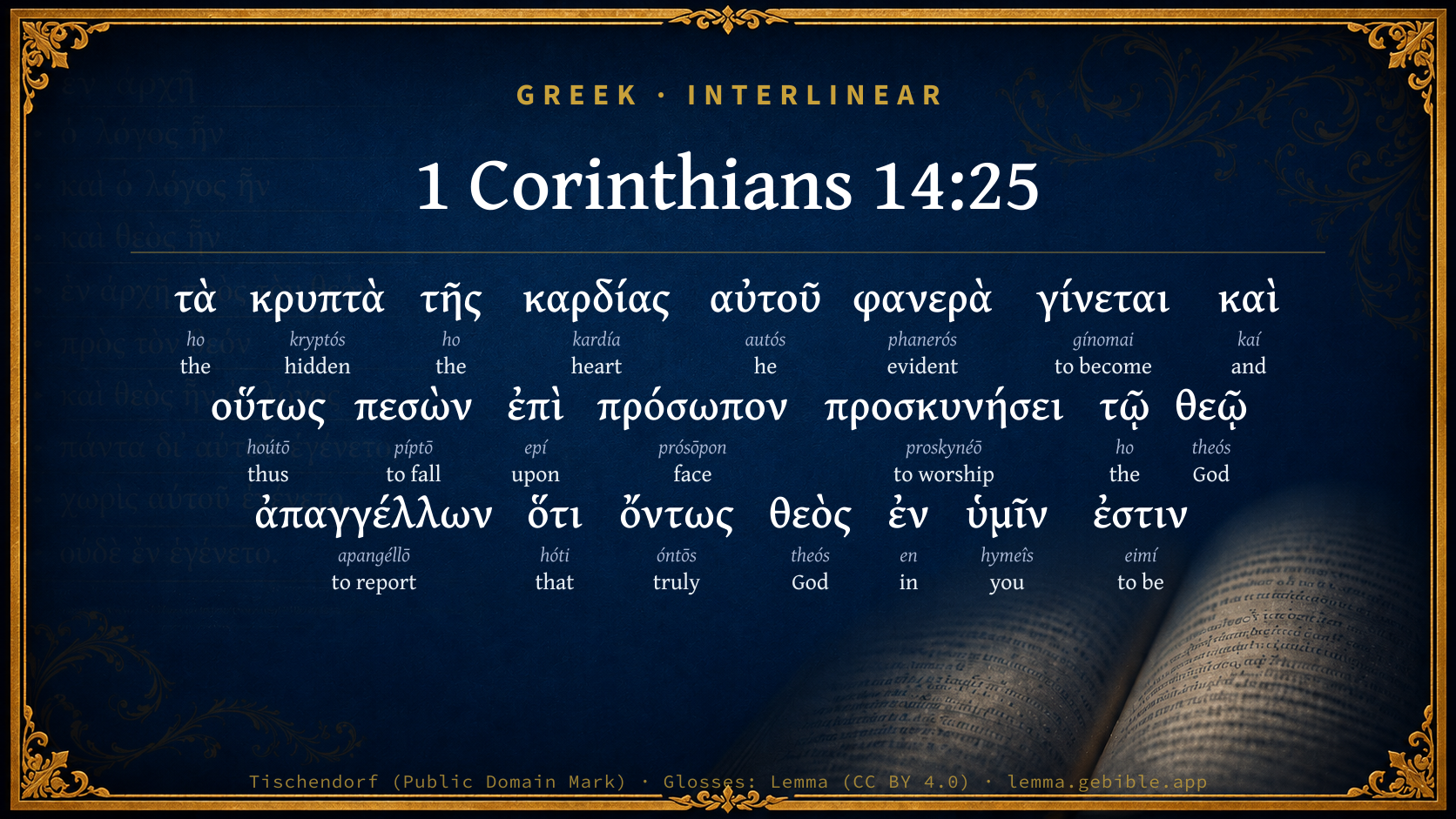
  1. τὰ ho G3588 “the” Article, Nominative, Plural, Neuter
  2. κρυπτὰ kryptós G2927 “hidden” Adjective, Nominative, Plural, Neuter
  3. τῆς ho G3588 “the” Article, Genitive, Singular, Feminine
  4. καρδίας kardía G2588 “heart” Noun, Genitive, Singular, Feminine
  5. αὐτοῦ autós G846 “he” Personal pronoun, Genitive, Singular, Masculine
  6. φανερὰ phanerós G5318 “evident” Adjective, Nominative, Plural, Neuter
  7. γίνεται gínomai G1096 “to become” Verb, Present, Middle or Passive deponent, Indicative, 3rd person, Singular
  8. καὶ kaí G2532 “and” Conjunction
  9. οὕτως hoútō G3779 “thus” Adverb
  10. πεσὼν píptō G4098 “to fall” Verb, Aorist, Active, Participle, Nominative, Singular, Masculine
  11. ἐπὶ epí G1909 “upon” Preposition
  12. πρόσωπον prósōpon G4383 “face” Noun, Accusative, Singular, Neuter
  13. προσκυνήσει proskynéō G4352 “to worship” Verb, Future, Active, Indicative, 3rd person, Singular
  14. τῷ ho G3588 “the” Article, Dative, Singular, Masculine
  15. θεῷ theós G2316 “God” Noun, Dative, Singular, Masculine
  16. ἀπαγγέλλων apangéllō G518 “to report” Verb, Present, Active, Participle, Nominative, Singular, Masculine
  17. ὅτι hóti G3754 “that” Conjunction
  18. θεὸς theós G2316 “God” Noun, Nominative, Singular, Masculine
  19. ἐν en G1722 “in” Preposition
  20. ὑμῖν hymeîs G5210 “you” Personal pronoun, 2nd person, Dative, Plural
  21. ἐστιν eimí G1510 “to be” Verb, Present, Active, Indicative, 3rd person, Singular

About this verse

These counts appear in no published source. They are computed here, from the morphology-tagged text and Lemma’s own curated glosses. What Lemma adds →

22
words
19
distinct lemmas
Pauline Epistles
section

Notable vocabulary

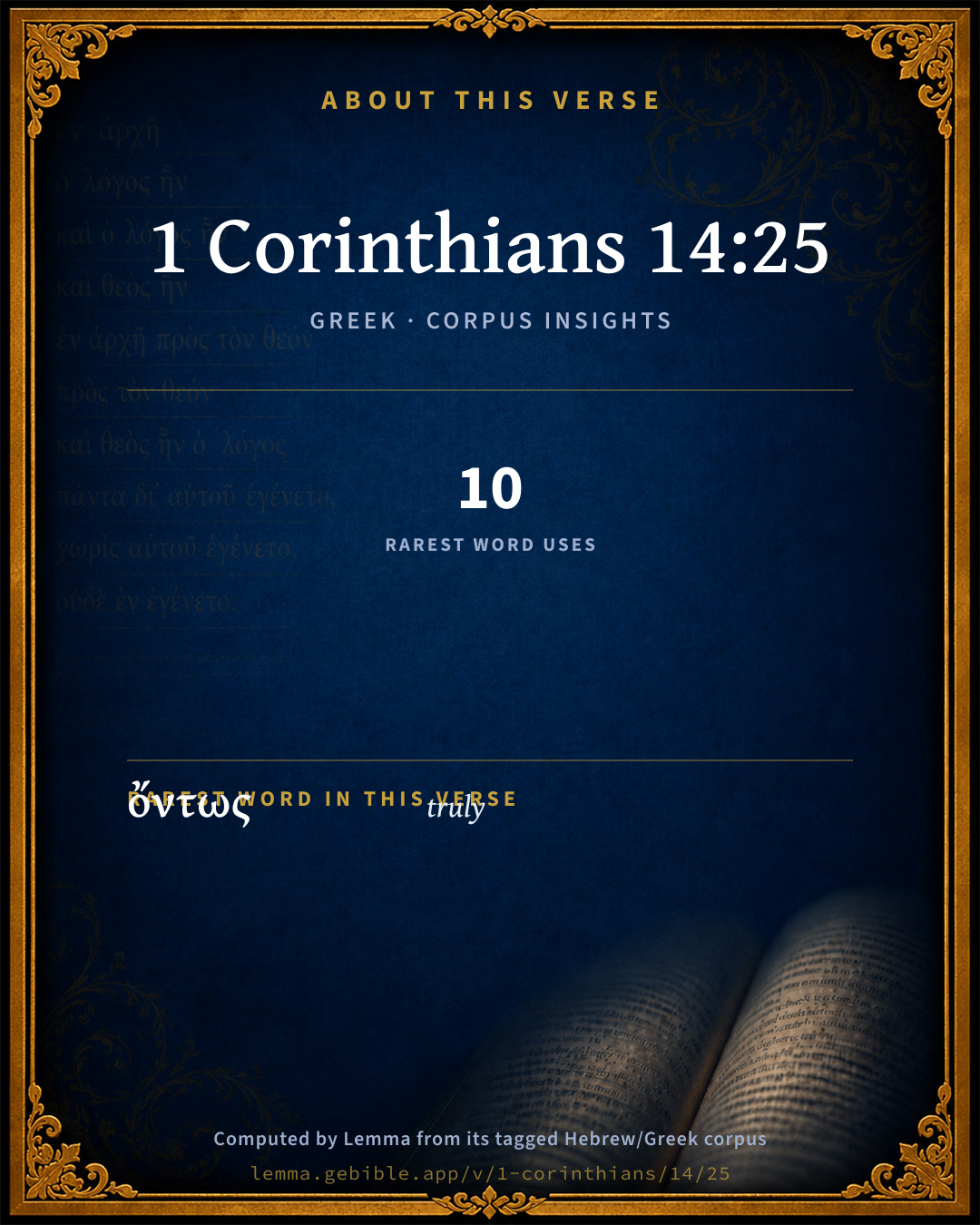
The rarest word here is ὄντως truly G3689 — appearing just 10 times in the whole Greek New Testament.

Shared distinctive vocabulary

ὄντως truly G3689 occurs in 10 verses of the Greek New Testament. Also found in:

Repetition

Words recur within this verse:

Cross-references

11

Topical passages linked to 1 Corinthians 14:25 in the Treasury of Scripture Knowledge — connected by theme and wording, ordered by reader-vote popularity; previews shown in the World English Bible.

  • Isaiah 45:14 Thus says Yahweh: "The labor of Egypt, and the merchandise of Ethiopia, and the Sabeans, men of stature, shall come over to you, and they shall be yours. They shall go after you. In chains they shall come over; and they shall fall down to you. They shall make supplication to you: 'Surely God is in you; and there is none else, there is no other god.
  • Zechariah 8:23 Thus says Yahweh of Hosts: "In those days, ten men will take hold, out of all the languages of the nations, they will take hold of the skirt of him who is a Jew, saying, 'We will go with you, for we have heard that God is with you.'"
  • Genesis 44:14 Judah and his brothers came to Joseph's house, and he was still there. They fell on the ground before him.
  • Deuteronomy 9:18 I fell down before Yahweh, as at the first, forty days and forty nights; I did neither eat bread nor drink water; because of all your sin which you sinned, in doing that which was evil in the sight of Yahweh, to provoke him to anger.
  • Psalms 72:11 Yes, all kings shall fall down before him. All nations shall serve him.
  • Isaiah 60:14 The sons of those who afflicted you shall come bending to you; and all those who despised you shall bow themselves down at the soles of your feet; and they shall call you The city of Yahweh, The Zion of the Holy One of Israel.
  • Luke 5:8 But Simon Peter, when he saw it, fell down at Jesus' knees, saying, "Depart from me, for I am a sinful man, Lord."
  • Luke 17:16 He fell on his face at Jesus' feet, giving him thanks; and he was a Samaritan.
  • Revelation 5:8 Now when he had taken the book, the four living creatures and the twenty-four elders fell down before the Lamb, each one having a harp, and golden bowls full of incense, which are the prayers of the saints.
  • Luke 8:28 When he saw Jesus, he cried out, and fell down before him, and with a loud voice said, "What do I have to do with you, Jesus, you Son of the Most High God? I beg you, don't torment me!"
  • Revelation 19:4 The twenty-four elders and the four living creatures fell down and worshiped God who sits on the throne, saying, "Amen! Hallelujah!"

Cross-references courtesy of OpenBible.info (CC BY 4.0).

Where the printed editions differ

1 variant

Places in this verse where the major printed Greek editions disagree on the wording in a way that affects the translation — a comparison of editions, not a manuscript-by-manuscript collation. The editions are the modern critical texts (Nestlé-Aland 28/27, SBL, Westcott-Hort, Tregelles, Tyndale House) and the traditional texts behind the KJV (the Textus Receptus and the Byzantine/Majority text). It is not a claim about which reading is original.

  1. Extra text
    καὶ οὕτως

    “and thus”

    In TRByz Not in NA28NA27TynSBLWHTreg

    καὶ οὕτως (kai houtōs) 'and thus' is only in traditional manuscripts (TR+Byz)

Textual data: Translators Amalgamated Greek New Testament (STEPBible TAGNT) · CC BY 4.0.

Commentary

Notes on 1 Corinthians 14:25 from classic Christian and Jewish commentators (each source and its license shown beneath its notes). The classic Christian expositions comment on the surrounding passage and are grouped to its opening verse, so a note may address several verses; the Jewish commentaries on the Tanakh (Rashi and others) are per-verse, so they appear only where the commentator wrote on this verse.

Lemma curates 59 commentaries, every one of them public domain or Creative Commons licensed, each selected and text-cleaned for this edition rather than reprinted as found. About our sources →

Tyndale Open Study Notes

Tyndale Open Resources

14:25 “God is truly here among you.” Paul is alluding to Isa 45:14.

Tyndale Open Study Notes — © Tyndale Open Resources, licensed CC BY-SA 4.0. Text via the HelloAO Bible API.

Bengel's Gnomon

Johann Albrecht Bengel

1Co 14:25. Τὰ κρυπτὰ τῆς καρδίας αὐτοῦ, the secrets of his heart) all the inmost thoughts of the heathen’s heart, which has never experienced such feelings, and has now for the first time become acquainted with itself and makes confession concerning itself: for the unbeliever is here principally intended. The unlearned man is added by the way, on account of his case being not altogether dissimilar. Any one with the lowest degree of faith before entering an assembly of that kind knew, that God is truly in believers.—αὐτοῦ, of him) the unbelieving stranger.—φανερὰ γίνεται, are made manifest) Dan 2:30 at the end.—οὕτω) so, at last.—πεσὼν, falling down) a public declaration on the part of those, who feel and experience in themselves the power of the word, is generally made too sparingly in our times.—ἀπαγγέλλων, declaring) spontaneously, clearly, expressly announcing this fact either in the Church, or even out of it elsewhere: comp. on this word, Greg. Paneg. § 123 cum Annot.—ὅτι, that) comp. Dan 2:46-47. A most conclusive argument for the truth of religion, from the operations of God on godly men.—ὄντως, indeed) He will confess, that you are not mad, but that God is truly in you, and that He is the true God, who is in you.

Bengel's Gnomon of the New Testament — English translation (T&T Clark, Edinburgh, 1860) — public domain. Text from a community e-Sword module.

Hodge's Commentary on Romans, Ephesians & First Corinthians

Charles Hodge

1Co_14:24, 1Co_14:25

But if all prophesy, and there come in one that believeth not, or (one) unlearned, he is convinced of all, he is judged of all: and thus are the secrets of his heart made manifest; and so falling down on (his) face he will worship God, and report that God is in you of a truth.

This is another part of the inference from what was said in 1Co_14:21, 1Co_14:22. Speaking in languages unknown to the hearers is not adapted to do good; speaking intelligibly is suited to produce the happiest effects. If all prophesy, i.e. if all the speakers speak under the guidance of the Spirit in a language which the hearers can understand. If one that believeth not, or one unlearned. From these words it is manifest that the unlearned were not Christians as distinguished from Jews or Gentiles here called unbelievers, for the same effect is said to be produced on both. The unlearned were therefore as much the subjects of conversion as the unbelieving. The meaning is, if any person, either ignorant or destitute of faith, should come in, he would be convinced by all. That is, what he heard from all would carry conviction to his mind. He would be convinced of the truth of what he heard; convinced of sin, of righteousness and of judgment, Joh_16:8; convinced that Jesus is the Christ, the Son of the living God, Act_9:20, Act_9:22; and that it is a faithful saying, and worthy of all acceptation, that Jesus Christ is come into the world to save sinners, 1Ti_1:15. He is judged of all, i.e. examined, searched into (ἀνακρίνεται); for the word of God is a discerner (κριτικός) of the thoughts and intents of the heart, Heb_4:12. The result of this searching examination is, that the secrets of his heart are made manifest; that is, they are revealed to himself. His real character and moral state, with regard to which he was before ignorant, are made known to him. The effect of this is humility, contrition, self-condemnation, and turning unto God. This is expressed by saying, so i.e. in this condition of a convinced sinner who has been brought to the knowledge of himself, falling down on his face, he will worship God. The first step in religion is entire self-abasement; such a conviction of sin, i.e. of guilt and pollution, as shall lead to self-condemnation and self-abhorrence, and to a complete renunciation of all dependence on our own righteousness and strength. When the soul is thus humbled God reveals himself sooner or later, in mercy, manifesting himself as reconciled in Jesus Christ; and then we worship him. This expresses reverence, love and confidence. It is the return of the soul to the favor and fellowship of God. One who has had such an experience cannot keep it to himself. The apostle therefore describes the convert as declaring, i.e. proclaiming aloud that God is in you of a truth. With the heart man believeth unto righteousness, and with the mouth confession is made unto salvation, Rom_10:10. It is not enough to believe the truth, it must be publicly professed; because confession is the natural fruit of faith. When there is a proper apprehension of the value of the truth, and a sincere appropriation of the promises of God to ourselves, there will be the desire to acknowledge his goodness and to proclaim the truth to others. The thing acknowledged is, that God is in you, i.e. that Christianity is divine; that Christians are not deluded fanatics, but the true children of God, in whom he dwells by his Spirit. The convert therefore joins himself to them to share their fate, to take part in whatever of reproach or persecution falls to their lot. This confession is made with confidence. Declaring that God is in you of a truth. It is not a mere conjecture, but a firm conviction, founded on experience, i.e. on the demonstration of the Spirit, 1Co_2:4.

Charles Hodge — Commentary on Romans (1835), First Corinthians (1857), and Ephesians (1856) — public domain. Text from a community e-Sword module.

Jamieson, Fausset & Brown

Robert Jamieson, A. R. Fausset & David Brown

And thus--omitted in the oldest manuscripts and versions.

secrets of his heart made manifest--He sees his own inner character opened out by the sword of the Spirit (Heb 4:12; Jam 1:23), the word of God, in the hand of him who prophesieth. Compare the same effect produced on Nebuchadnezzar (Dan 2:30 and end of Dan 2:47). No argument is stronger for the truth of religion than its manifestation of men to themselves in their true character. Hence hearers even now often think the preacher must have aimed his sermon particularly at them.

and so--convicted at last, judged, and manifested to himself. Compare the effect on the woman of Samaria produced by Jesus' unfolding of her character to herself (Joh 4:19, Joh 4:29).

and report--to his friends at home, as the woman of Samaria did. Rather, as the Greek is, "He will worship God, announcing," that is, openly avowing then and there, "that God is in you of a truth," and by implication that the God who is in you is of a truth the God.

Jamieson, Fausset & Brown — Commentary Critical and Explanatory on the Whole Bible (1871) — public domain (CC PDM 1.0). Text via the HelloAO Bible API.

Adam Clarke's Commentary

Verse 25. And thus are the secrets of his heart] As these, who were the prophets or teachers, had often the discernment of spirits, they were able in certain cases, and probably very frequently, to tell a man the secrets of his own heart; and, where this was not directly the case, God often led his ministers to speak those things that were suitable to the case before them, though they themselves had no particular design. The sinner, therefore, convinced that God alone could uncover the secrets of his heart, would be often obliged to fall down on his face, abashed and confounded, and acknowledge that God was truly among them. This seems to be the plain meaning of the passages before us.

Adam Clarke's Commentary on the Bible (1810–1826) — public domain. Text from a community e-Sword/MySword module.

John Calvin's Commentaries

25. Falling down on his face, he will worship For it is only the knowledge of God that can bring down the pride of the flesh. To that, prophecy brings us. Hence, it is its proper effect and nature to bring down men from their loftiness, that they may, with prostrate homage, render worship to God. To many, however, prophecy also is of no benefit — nay more, they are made worse by what they hear. Nor was it even Paul’s intention to ascribe this effect to prophecy, as if it were always the result of it. He simply designed to show how much advantage is derived from it, and what is its office. It is therefore a singular commendation, that it extorts from unbelievers this confession — that God is present with his people, and that his majesty shines forth in the midst of their assembly.

John Calvin's Commentaries (1540-1563) — public domain. Text from the Calvin Translation Society English edition (1840s-50s) via the Christian Classics Ethereal Library (ccel.org). Calvin's coverage is partial (roughly two-thirds of the Bible); uncommented books and verses are honest gaps, never fabricated. The 19th-century editor's footnotes and remarks are omitted so the notes are faithfully Calvin's own voice.

Ellicott's Commentary for English Readers

(25) And thus are the secrets of his heart made manifest.—Better, and the secrets of his heart are made manifest—such being the reading of the best MSS. It is the third result of the prophetic utterances explained in previous Note. His complete conversion is evidenced by his worshipping God and recognising the presence of God in that assembly of Christians: “He will confess that you are not mad, but that God is truly in you, and that He is the true God who is in you” (Bengel). It is to be noticed that though the Apostle speaks in this passage of an “unlearned” person (i.e., a private person, one who has no gift of prophecy or tongues), or an “unbeliever,” it is the latter that is most prominently before his mind, and the former only so far as he shared in common with the latter his ignorance and inability to understand.

A Bible Commentary for English Readers, edited by Charles John Ellicott (1878–1897) — public domain. Text from a community e-Sword module.

The Cambridge Bible for Schools and Colleges

gen. ed. J. J. S. Perowne

25. and thus are the secrets of his heart made manifest] The nature of Christian prophecy is here plainly shewn. See note on 1Co_14:1. ‘And thus’ is omitted by most modern editors.

that God is in you of a truth] Literally, that God is really in you (or among you). This description of the effect of prophecy upon the unbeliever is in no way contrary to the assertion in 1Co_14:22. There the Apostle is speaking of a sign to attract the attention of the unbeliever; here his attention is already attracted. He has come to the Christian assembly, and is listening to the words spoken there in the name of Jesus Christ. Unless his conscience is ‘seared with a hot iron’ there will be no further need of signs to induce him to give his attention to what is spoken.

The Cambridge Bible for Schools and Colleges (gen. ed. J. J. S. Perowne; Cambridge University Press, 1878–1918) — public domain. Text from a community e-Sword module.

John Gill's Exposition

How is it then, brethren?.... Or "what is it brethren?" The Arabic renders it, "what is the sense of my words?" The meaning of what he had said, the drift of his whole discourse; or rather the sense is, what is to be done in the case he was about to propose?

when ye come together; as a church into one place, to worship God;

everyone of you hath a psalm; not that everyone had this, or any other gift here mentioned, but that there were some among them that had one or other of these several gifts: some of them had a gift of composing and singing a psalm extempore; they delighted in psalmody, and were forward to promote it, and fond of spending the time wholly in it.

Hath a doctrine; others of them had a gift of deducing doctrines out of the word of God, which is profitable for that purpose, in an extraordinary manner, without study, and were capable of teaching them, and instructing men in them in a very edifying way:

hath a tongue others had the gift of speaking with divers tongues; or had knowledge and skill in the Hebrew tongue, could not only pray and sing in that language, and read the sacred text, but could deliver a sermon in it.

Hath a revelation; others had a peculiar insight into the types and figures of the Mosaic dispensation, a clear view of the prophetic writings, and a large discovery of the mysteries of the Gospel, by the Spirit, as a spirit of wisdom and revelation.

Hath an interpretation; others had a gift of interpreting languages, particularly the Hebrew language, when anything was delivered therein by another. Now the apostle answers to the question, what is to be done in such a case, where there is such a variety of gifts, and everyone is desirous of exercising his peculiar gift?

let all things be done to edifying; intimating, that each of these things might be done; every gift might be made use of: he that had a psalm might sing it; and he that had a doctrine might deliver it; he that had a tongue might speak with it; and he that had a revelation might declare it; and he that had an interpretation might make use of it; provided that care was taken that each was done in such a manner, as might be for the edifying of the church that was met together; otherwise, if it was only for ostentation sake to make a show of their gifts and talents, and to nourish their own pride and vanity, no good end would be answered; it had better be let alone: but if edification could be promoted, each gift might be employed; for which the apostle gives the following directions.

John Gill's Exposition of the Whole Bible (1746–1763) — public domain (CC PDM 1.0). Text via the HelloAO Bible API.

Trapp's Complete Commentary

John Trapp

25 And thus are the secrets of his heart made manifest; and so falling down on his face he will worship God, and report that God is in you of a truth.

Ver. 25. The secrets of his heart] God’s word is a curious critic, Heb 4:12; "a discerner of the thoughts," &c. It finds and ferrets out secret sins.

John Trapp, A Commentary or Exposition upon All the Books of the Old and New Testament (1647–1656) — public domain. Text from a community e-Sword module.

Albert Barnes' Notes on the Bible

And thus are the secrets of his heart made manifest - Made manifest to himself in a surprising and remarkable manner. He shall be led to see the “real” designs and motives of his heart. His conscience would be awakened; he would recall his former course of life; he would see that it was evil; and the present state of his heart would be made known to himself. It is possible that he would “suppose that the speaker was aiming directly at him, and “revealing” his feelings to others; for such an effect is often produced. The convicted sinner often supposes that the preacher particularly intends “him,” and wonders that he has such an acquaintance with his feelings and his life; and often supposes that he is designing to disclose his feelings to the congregation. It is possible that Paul here may mean that the prophets, by inspiration, would be able to reveal some secret facts in regard to the stranger; or to state the ill design which he might have had in coming into the assembly; or to state some things in regard to him which could be known only to himself; as was the case with Ananias and Sapphira (Act 5:1, seq.); but perhaps it is better to understand this in a more general sense, as describing the proper and more common effect of truth, when it is applied by a man’s own conscience. Such effects are often witnessed now; and such effects show the truth of religion; its adaptedness to people; the omniscience and the power of God; the design of the conscience, and its use in the conversion of sinners.

And so falling down on his face - The usual posture of worship or reverence in eastern countries. It was performed by sinking on the knees and hands, and then placing the face on the ground. This might be done publicly; or the apostle may mean to say that it would lead him to do it in private.

He will worship God - He will be converted, and become a Christian.

And report that God ... - Will become your friend, and an advocate for the Christian religion. An enemy will be turned to a friend. Doubtless this was often done. It is now often done. Paul’s argument is, that they should so conduct their public devotions as that they should be adapted to produce this result.

Albert Barnes' Notes on the Bible (1834–1885) — public domain. Text from a community e-Sword/MySword module.

Matthew Poole's English Annotations

God either, by an extraordinary providence, discovering to him that prophesieth the secrets of such a sinner’s heart, and causing him that prophesieth to make them manifest; or, by a more ordinary providence, (often experienced at this day), directing the preacher to such subjects and discourses, as he that cometh to hear shall think directed to himself, and confess that he is the man, and be convinced of his errors, and converted, and turn to the Christian religion, and report that God indeed is amongst you. So as prophesying will have these two great advantages of speaking with tongues, God will be more glorified, and the souls of others will be more profited; which makes the gift of prophesying much preferable to the gift of tongues.

Matthew Poole's English Annotations on the Holy Bible (1683–1685) — public domain. Text from a community e-Sword/MySword module.

Whedon's Commentary on the Bible

Daniel D. Whedon

25. Secrets of his heart—The man (as has often been the case under a searching ministry) feels as if the speaker knew him through and through, and was preaching at, and to, and through him alone.

Falling… face—In complete submission, self-surrender, and worship.

Report—As Dr. Hodge says, “The man who has had such an experience cannot keep it to himself.” He will joyfully declare, in substance, that he “has experienced religion;”

or, if witlings will so have it, he “has got religion.”

That God—No longer identified with the deities of heathen mythology.

Is in you—Both among you as a Church, and in your hearts individually by his Spirit.

Daniel D. Whedon (gen. ed.), Commentary on the Old and New Testaments (1874–1909) — public domain. Text from a community e-Sword module.

The Pulpit Commentary

The secrets of his heart. "The Word of God is quick and powerful, and sharper than any two-edged sword,.., and is a discerner of the thoughts and intents of the heart. (Heb_4:12) Falling down on his face. An Oriental. mode of showing humility and deep conviction. (Isa_45:14; 1Sa_19:24) It does not furnish the shadow of an excuse for the encouragement of catalepsy by the mechanical excitement of revivalism. That God is in you of a truth. St. Paul is probably thinking both of Isa_45:14 and Zec_8:23, where similar phrases are used. Truth from his lips prevailed with double sway,

And fools, who came to scoff, remained to pray. (Goldsmith. )

The Pulpit Commentary (1880–1919), ed. H.D.M. Spence-Jones & Joseph S. Exell — public domain. Text from a community e-Sword module.

John Wesley's Explanatory Notes

The secrets of his heart are made manifest - Laid open, clearly described; in a manner which to him is most astonishing and utterly unaccountable. How many instances of it are seen at this day! So does God still point his word.

John Wesley, Explanatory Notes Upon the Whole Bible (1754–1765) — public domain. Text via the GEBible commentary corpus.

Godbey's Commentary on the New Testament

William B. Godbey

25. “The secrets of his heart are made manifest, and thus falling down on his face he will worship God, confessing that God is truly in you all.” Oh, how infinitely profitable is this paragraph to the people of God in all ages and nations! because here we have vividly described a normal gospel meeting, which we may regard as a sample elucidatory of the true gospel economy amid all environments. Here you see the roaring, shouting demonstrations of newborn souls, and gloriously sanctified people speaking aloud the languages of their newly found rhapsody, arousing and magnetizing Satan’s idiots on all sides, and bringing them together helter- skelter and pell-mell to see what is the matter. Now the curious rabble have poured in and crowded the house, gazing on as if it were a monkey show, and pronouncing all the dramedians “crazy.” Now immediately they all turn to prophesying, their attention attracted by the sight of the curious rabble, every one besieging a sinner and “speaking to him edification, exhortation or comfort,” which is the definition of prophesying (1Co 14:3). What is the effect of all this rally by those shouting Christians encompassing those wicked people with their burning words of prophetic fire? Conviction seizes them; “the secrets of their hearts are made manifest,” i. e., they proceed to make awful confessions of their terrible sins. They are discerned by all;

i. e., those Spirit filled saints read them like books, and see that they are thunder-riven with conviction. What is the ultimatum of the enterprise? “Falling down on their faces, they will confess that God is surely in the midst of you;” i. e., they are gloriously and rousingly converted to God, and turn “crazy” like the balance. Here we have an inspired illustration of a gospel meeting, and we see that it is characterized by the old-style knockdown power. The Holiness Movement much needs a general quickening and toning up, lest we slow down as our predecessors have done. Oh, how infinitely valuable this literal description of a normal gospel meeting, and how vividly contrastive with the humdrum, deadbeat routine of modern churchism!

William B. Godbey, Commentary on the New Testament (1896–1900) — public domain. Text from a community e-Sword module.

McGarvey & Pendleton's Commentaries

J. W. McGarvey

the secrets of his heart are made manifest [being exposed by the cleaving sword of the Spirit-- Heb_4:12 ; Jam_1:23-24 ; comp. Joh_4:19 ; Joh_4:29 ]; and so he will fall down on his face [The Oriental mode of showing deep emotion ( Isa_45:14 ; 1Sa_19:24 ). Here it indicates feelings of submission and self-abasement] and worship God, declaring that God is among you indeed . [Paul supposes the case of one who dropped into the meeting out of curiosity. If he heard many people speaking at once in an unknown tongue, he would regard the gathering as little better than bedlam ( Act_2:13 ), and the more he heard speaking at once, the worse it would be. Therefore the meeting would be to him void of blessing from God, and the sign without any signification, for he would hear his fellow-citizens addressing him in a foreign tongue, which was to him a mere jargon, instead of hearing foreigners address him in his own tongue, similar to the miracle at Pentecost. If, on the other hand, he heard all his fellow-citizens prophesying in his own tongue, he would be reproved by all, and the secrets of his heart would be laid bare as though he had been cross-examined by a skillful attorney. This would lead to his conversion, and so be of profit to him, and would make him a witness to the divine nature of the church, instead of one who looked upon it as a hive of fanatics. Prophetic preaching must have had great power to make men feel that they stood face to face with God, for even the faithful preaching of our day lays bare the sinner's heart. He feels that sermons are aimed at him, and is often convinced that some one has been tattling to the preacher because the life is so fully exposed by his words. It should be observed that if truth is more potent than signs, much more is it more efficacious in revivals than mere excitement or pumped-up enthusiasm.]

J. W. McGarvey (with Philip Y. Pendleton), Commentaries on the New Testament (The Fourfold Gospel, 1914; Acts; and the epistles) — public domain. Text from a community e-Sword/MySword module.

The People's New Testament

B. W. Johnson

25. The secrets of his heart are made manifest. He is made to feel that he is face to face with God, who knows his life, and he is brought to confession. It is still often the case that the hearer thinks that the preacher knows his life, and is laying it bare, when it is his own conscience that is stirred up.

B. W. Johnson's The People's New Testament with Notes (1889–1891) — public domain. Electronic text from the Christian Classics Ethereal Library (CCEL) ThML edition.

Cambridge Greek Testament for Schools and Colleges

25. [καὶ οὕτω] rec. at beginning of verse. Text אABDFG, Vetus Lat. Vulg. Peshito.

25. τὰ κρυπτὰ τῆς καρδίας. The nature of Christian prophecy is here plainly shewn. See note on 1Co 14:1.

ἐπὶ πρόσωπον. See note on 1Co 14:4, and Luk 5:12; Luk 17:16.

ὄντως ὁ θεὸς ἐν ὑμῖν. Literally, that God is really in you (or among you). This description of the effect of prophecy upon the unbeliever is in no way contrary to the assertion in 1Co 14:22. There the Apostle is speaking of a sign to attract the attention of the unbeliever; here his attention is already attracted. He has come to the Christian assembly, and is listening to the words spoken there in the name of Jesus Christ. Unless his conscience is ‘seared with a hot iron’ there will be no further need of signs to induce him to give his attention to what is spoken.

Cambridge Greek Testament for Schools and Colleges (Cambridge University Press, 1896; 21 vols, various authors incl. Carr, Maclear, Plummer, Farrar, Lumby, Moule, M. R. James, Simcox) — public domain. Text from a community e-Sword module.

International Critical Commentary

25. The scrutiny in the court of conscience (ἀνάκρισις) produces self-revelation, self-condemnation, and submission. ‘The secrets of his heart become manifest, and thus, falling upon his face, he will worship God.’ A spontaneous expression of submission and thankfulness; but the homage is to God, not to the inspired speaker. The gift of prophesying, however successful, is no glory to the possessor of it. It is the Spirit of God, not the preacher’s own power, that works the wonderful effect. This verse seems to be at variance with v. 22; ‘prophesying is not for the unbelieving’ : but the discrepancy is only apparent. The comparison with the disobedient Israelites shows that the ἄπιστοι in v. 22 have heard the word and rejected it. Here the context shows that the ἄπιστος has not previously heard. Comp. Saul and his messengers (1Sa 19:20-24). With ‘fall down on his face’ comp. the Samaritan leper (Luk 17:16). In the Gospels προσκυνεῖν is frequent, but here only in St Paul. The ἰδιώτης is almost forgotten in this stronger instance: if an unbeliever is thus τετραχηλισμένος (Heb 4:13), how much more the ungifted or inexperienced Christian.

ἀπαγγέλλων ὅτι ὄντως ὁ Θεὸς ἐν ὑμῖν ἐστίν. ‘Proclaiming that (so far from your being mad, and little as he had hitherto supposed that you were thus blessed) verily God is among you.’ In ἀπαγγέλλων the sender rather than the destination (ἀνσγγ.) of the message is thought of: he spreads it abroad from (abkündigen). This declaration begins there and then, and is continued afterwards: ultro, plane, diserte pronuncians Deum vere esse in vobis et verum Deum esse qui in vobis est (Beng.); ὄντως, in spite of his previous scoffs and denials, there is the Real Presence of the true God. The article before Θεός is doubtless genuine (א 3 B D2 D3 E K L); it has special point in the unbeliever’s confession. Both ‘among you’ as a congregation and ‘in your hearts’ as individuals would be included in ἐν ὑμῖν, but the former most strongly. Compare the confession of Alcibiades as to the effect of Socrates upon him; “I have heard Pericles and other great orators, but I never had any similar feeling; my soul was not stirred by them, nor was I angry at the thought of my slavish state. But Socrates makes me confess that I ought not to live as I do, neglecting the wants of my soul. And he is the only person who ever made me ashamed: for I know that I cannot answer him or say that I ought not to do as he bids,” etc. (Plato, Symposium, 215, 216). For ὄντως, see Gal 3:21; Mar 11:32.

The A V., with some inferior MSS., has ‘and thus’ (καί οὔτω or καὶ οὔτως) at the beginning of the verse (א A B D* F G, Vulg. omit), and repeats ‘and so’ in the proper place.

International Critical Commentary — older volumes (1896–1929), various authors — public domain. Text from a community e-Sword module.

Godet's Commentaries

Frédéric Louis Godet

Vv. 25. Then a sudden penetrating illumination, spread over his whole life, is produced in him: he sees himself, as a whole and in the particular details of his life, as God sees him. One might apply this description to the revelation of certain particular circumstances of his life, as when Elisha speaks to Gehazi (2Ki 5:26), or Jesus to Nathanael and to the Samaritan woman (John 1, 4). But it is simpler to think here of a moral illumination, similar to that of the judgment, which shows a man his past and present state in its true light. What passes in him at such a moment resembles what passed in Paul on the way to Damascus. Struck by this light, he casts himself in the dust, not before man, but before God, acknowledging that such brightness can only proceed from the Holy of holies and the Searcher of hearts; that consequently it is He who speaks by the mouth of those into the midst of whom He has come.

The participle ἀπαγγέλλων, reporting, may refer only to what passes at the time in the assembly itself; it is a cry escaping from him under the power of overwhelming emotion: “Yes, God is among you of a truth!” But this declaration may be regarded also as extending after his departure from the assembly to those whom he meets.

The ἐν ὑμῖν may signify: among you; but in this context, where inspiration is the matter in question, perhaps it is more natural to explain it: in you. So Meyer, Edwards, etc. — By the ὄντως, really, the man recognises that the claim of Christians to Divine inspiration is well-founded. Here is the opposite of the μαίνεσθε, ye are mad (1Co 14:23). The apostle could not better close the discussion on the relative value of the gifts of tongues and of prophecy than by these two examples; and now he can go on to lay down the practical rules which will secure the salutary use of these gifts.

Frédéric Louis Godet — Commentaries on Luke, John, Romans, and 1 Corinthians — English translation (T&T Clark, Edinburgh, 1870s–1890s) — public domain. Text from a community e-Sword module.

Lesson kit

Teaching starters — assembled from the data on this page, not authored interpretation. Every prompt links to the verse data it draws on. Edit before teaching.

1 Corinthians, in the Pauline Epistles, opens this verse with 22 words (19 distinct Greek lemmas). Its most distinctive word is óntōs (“truly”). A historical commentator’s framing appears above. Read the whole chapter for the surrounding context.

Discussion questions

  1. The word óntōs carries the sense “truly.” How does it shape the verse?
  2. How does Mark 11:32, which shares the word «truly», read alongside this verse?
  3. What does the repetition of “God” (2× in this one verse) do in this verse?
  4. These translations render this verse differently; the difference is in the English rendering, not the original. What questions does that raise?
  5. Compare how Tyndale Open Study Notes and Bengel's Gnomon read this verse. Where do they agree or differ?

Things to notice

Reading settings

Reading text

Shown beneath each verse's original-language words.

Old Testament
Old Testament edition

Read the OT as the Masoretic Hebrew (MT) or the Greek Septuagint (LXX).

English shown for the Greek Septuagint (in the Hebrew ↔ Greek comparison).

Comparing translations? Open the Compare panel on any verse page to stack up to four side by side.