1 Corinthians 14:12

Greek (Tischendorf 8th ed.) 1 Corinthians 14:12 appears in the Greek New Testament. The text above is from the Tischendorf 8th edition. Each word links to its Strong’s number and a concise gloss. Click any word for its full Thayer’s Greek Lexicon entry.
Download image
Cite this verse

1 Corinthians 14:12 (World English Bible). Public Domain. Lemma interlinear Bible study tool, https://lemma.gebible.app/v/1-corinthians/14/12.

Show BibTeX & RIS
BibTeX
RIS
English Translation
So also you, since you are zealous for spiritual gifts, seek that you may abound to the building up of the assembly.
World English Bible · Public Domain
Download a study sheet

One document with this verse’s original text, its word-by-word gloss line, the meaning frame, cross-references with their text, attributed commentary, and full source and license credits — printable, and it pastes into notes with its structure intact.

This verse Autodidact and up

Study sheet (.html) Plain text (.txt)

A passage Seminary Student

Up to 50 verses in one chapter. A passage sheet keeps up to 6 commentary sources and 12 cross-references per verse, in the order this page ranks them, and says so on the sheet whenever that leaves anything out. Ask for a single verse and you get the Autodidact verse sheet above.

Everything on this page stays free to read, with no account — the sheet is a download of what is already on screen, not access to it.

Want to remove ads? Support Godless Engineer
Compare translations 3

The same verse in 3 English versions, stacked beneath the original-language interlinear above. Click any original word for its lexicon entry.

Each is an independent rendering of the whole verse — the interlinear is not word-aligned to these translations.

Highlighted words mark where these versions differ — a whole-verse word diff, not a word-by-word alignment.

  • World English Bible Public Domain
    So also you, since you are zealous for spiritual gifts, seek that you may abound to the building up of the assembly.
  • King James Version Public Domain
    Even so ye, forasmuch as ye are zealous of spiritual gifts, seek that ye may excel to the edifying of the church.
  • unfoldingWord Literal Text CC BY-SA 4.0
    So also you, since you are zealous for spiritual gifts for the building up of the church, seek that you would abound in them.

unfoldingWord Literal Text — © unfoldingWord, licensed CC BY-SA 4.0. Word-aligned USFM3 via Door43 (git.door43.org/unfoldingWord/en_ult).

Versions to compare (up to 4)

3 of 4 selected

Show all 19 translations

Every available English version of this verse, each an independent rendering of the whole verse.

  • World English Bible Public Domain
    So also you, since you are zealous for spiritual gifts, seek that you may abound to the building up of the assembly.
  • Berean Standard Bible Public Domain
    It is the same with you. Since you are eager to have spiritual gifts, strive to excel in gifts that build up the church.
  • Majority Standard Bible Public Domain
    It is the same with you. Since you are eager to have spiritual gifts, strive to excel in gifts that build up the church.
  • King James Version Public Domain
    Even so ye, forasmuch as ye are zealous of spiritual gifts, seek that ye may excel to the edifying of the church.
  • American Standard Version (1901) Public Domain
    So also ye, since ye are zealous of spiritual `gifts', seek that ye may abound unto the edifying of the church.
  • Revised Version (1885) Public Domain
    So also ye, since ye are zealous of spiritual gifts, seek that ye may abound unto the edifying of the church.
  • Geneva Bible (1599) Public Domain
    Euen so, forasmuch as ye couet spirituall giftes, seeke that ye may excell vnto the edifying of the Church.
  • Douay-Rheims (1899) Public Domain
    So you also, forasmuch as you are zealous of spirits, seek to abound unto the edifying of the church.
  • Young's Literal Translation Public Domain
    so also ye, since ye are earnestly desirous of spiritual gifts, for the building up of the assembly seek that ye may abound;
  • Literal Standard Version CC BY-SA 4.0
    so you also, since you are earnestly desirous of spiritual gifts, seek for the building up of the Assembly that you may abound;
  • Unlocked Literal Bible CC BY-SA 4.0
    So it is with you. Since you are eager for the manifestations of the Spirit, try to excel in the gifts that build up the church.
  • unfoldingWord Literal Text CC BY-SA 4.0
    So also you, since you are zealous for spiritual gifts for the building up of the church, seek that you would abound in them.
  • Darby Bible Public Domain
    Thus *ye* also, since ye are desirous of spirits, seek that ye may abound for the edification of the assembly.
  • World Messianic Bible Public Domain
    So also you, since you are zealous for spiritual gifts, seek that you may abound to the building up of the assembly.
  • Webster's Bible Public Domain
    Even so ye, forasmuch as ye are zealous of spiritual gifts, seek that ye may excel to the edifying of the church.
  • Free Bible Version CC BY-SA 4.0
    It's the same for you—if you are keen to have spiritual gifts, try to have many of those that will build up the church.
  • Bible in Basic English Public Domain
    So if you are desiring the things which the Spirit gives, let your minds be turned first to the things which are for the good of the church.
  • Text-Critical English NT CC BY 4.0
    It is the same with you. Since you earnestly desire spiritual gifts, seek to abound in them for the edification of the church.
  • Tyndale New Testament (1534) Public Domain
    Even so ye (for as moche as ye covet spretuall giftes) seke that ye maye have plentye vnto the edifyinge of the congregacion.

Literal Standard Version (2020), Covenant Press — licensed CC BY-SA 4.0. Text via the HelloAO Bible API (eBible.org). Unlocked Literal Bible (unfoldingWord) — licensed CC BY-SA 4.0. Text via the HelloAO Bible API (eBible.org). unfoldingWord Literal Text — © unfoldingWord, licensed CC BY-SA 4.0. Word-aligned USFM3 via Door43 (git.door43.org/unfoldingWord/en_ult). Free Bible Version, Dr. Jonathan Gallagher — licensed CC BY-SA 4.0. Text via the HelloAO Bible API (eBible.org).

Word by word

More ways to search: Search by grammar → Find every occurrence → Compare this word →

Practice this passage: Drill this verse → Learn its vocabulary →

ζηλωταί
zēlōtḗs
G2207
“zealot”
Noun, Nominative, Plural, Masculine
Part of Speech
Noun
Case
Nominative
Number
Plural
Gender
Masculine
Full Thayer's Definition

Origin: from G2206

TDNT: 16:42,3

1. one burning with zeal, a zealot 2. used of God as jealous of any rival and sternly vindicating his control 3. most eagerly desirous of, zealous for, a thing a. to acquire a thing, (zealous of) b. to defend and uphold a thing, vehemently contending for a thing
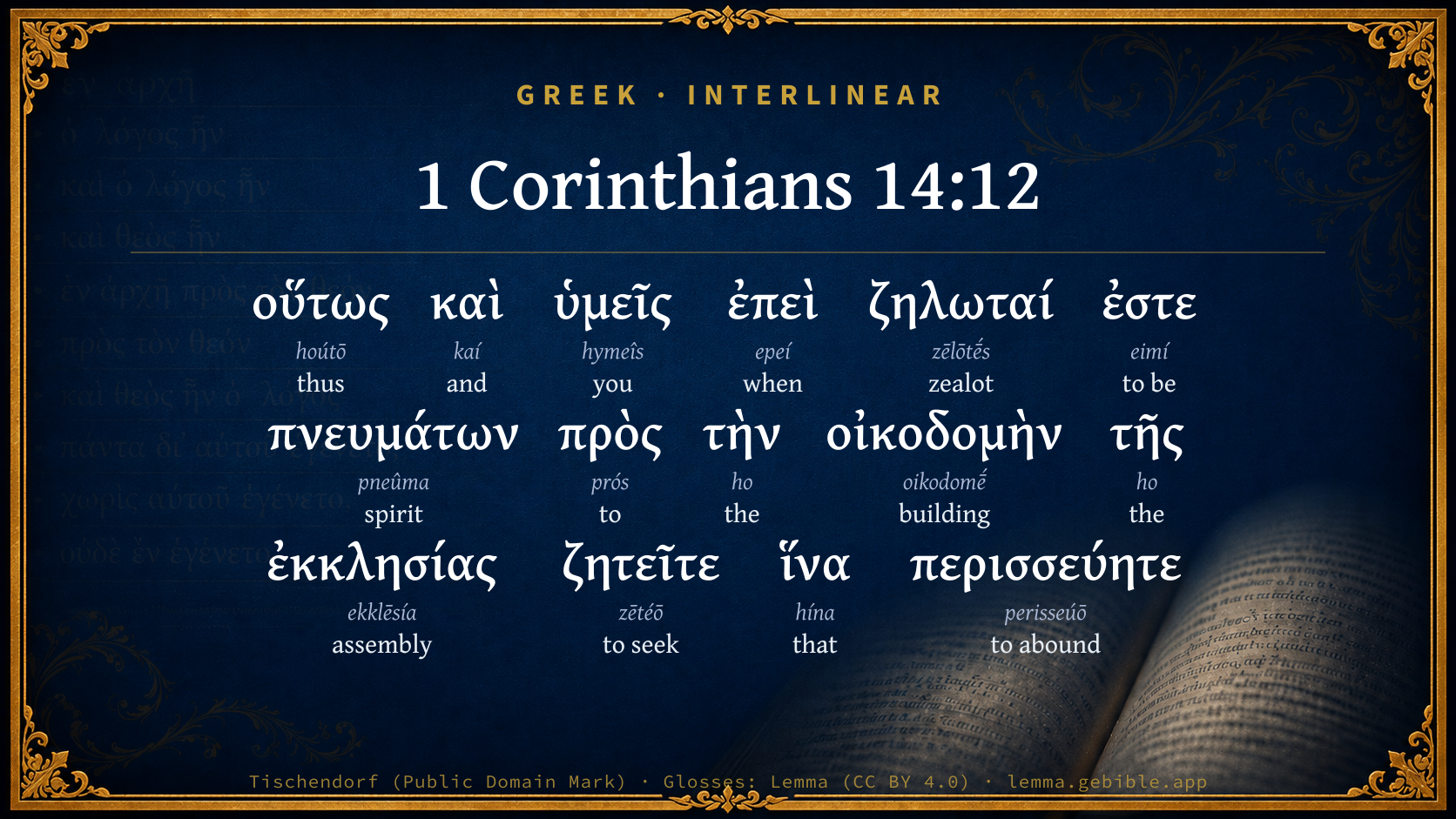
  1. οὕτως hoútō G3779 “thus” Adverb
  2. καὶ kaí G2532 “and” Conjunction
  3. ὑμεῖς hymeîs G5210 “you” Personal pronoun, 2nd person, Nominative, Plural
  4. ἐπεὶ epeí G1893 “when” Conjunction
  5. ἐστε eimí G1510 “to be” Verb, Present, Active, Indicative, 2nd person, Plural
  6. πνευμάτων pneûma G4151 “spirit” Noun, Genitive, Plural, Neuter
  7. πρὸς prós G4314 “to” Preposition
  8. τὴν ho G3588 “the” Article, Accusative, Singular, Feminine
  9. οἰκοδομὴν oikodomḗ G3619 “building” Noun, Accusative, Singular, Feminine
  10. τῆς ho G3588 “the” Article, Genitive, Singular, Feminine
  11. ἐκκλησίας ekklēsía G1577 “assembly” Noun, Genitive, Singular, Feminine
  12. ζητεῖτε zētéō G2212 “to seek” Verb, Present, Active, Imperative, 2nd person, Plural
  13. ἵνα hína G2443 “that” Conjunction
  14. περισσεύητε perisseúō G4052 “to abound” Verb, Present, Active, Subjunctive, 2nd person, Plural

About this verse

These counts appear in no published source. They are computed here, from the morphology-tagged text and Lemma’s own curated glosses. What Lemma adds →

15
words
14
distinct lemmas
Pauline Epistles
section

Notable vocabulary

The rarest word here is ζηλωταί zealot G2207 — appearing just 8 times in the whole Greek New Testament.

Shared distinctive vocabulary

ζηλωταί zealot G2207 occurs in 8 verses of the Greek New Testament. Also found in:

Repetition

A word recurs within this verse:

Cross-references

6

Topical passages linked to 1 Corinthians 14:12 in the Treasury of Scripture Knowledge — connected by theme and wording, ordered by reader-vote popularity; previews shown in the World English Bible.

  • 1 Corinthians 14:26 What is it then, brothers? When you come together, each one of you has a psalm, has a teaching, has a revelation, has another language, has an interpretation. Let all things be done to build each other up.
  • 1 Corinthians 12:31 But earnestly desire the best gifts. Moreover, I show a most excellent way to you.
  • 1 Corinthians 14:3–4 But he who prophesies speaks to men for their edification, exhortation, and consolation.
  • 1 Corinthians 14:1 Follow after love, and earnestly desire spiritual gifts, but especially that you may prophesy.
  • 1 Corinthians 12:7 But to each one is given the manifestation of the Spirit for the profit of all.
  • Titus 2:14 who gave himself for us, that he might redeem us from all iniquity, and purify for himself a people for his own possession, zealous for good works.

Cross-references courtesy of OpenBible.info (CC BY 4.0).

Commentary

Notes on 1 Corinthians 14:12 from classic Christian and Jewish commentators (each source and its license shown beneath its notes). The classic Christian expositions comment on the surrounding passage and are grouped to its opening verse, so a note may address several verses; the Jewish commentaries on the Tanakh (Rashi and others) are per-verse, so they appear only where the commentator wrote on this verse.

Lemma curates 59 commentaries, every one of them public domain or Creative Commons licensed, each selected and text-cleaned for this edition rather than reprinted as found. About our sources →

Ellicott's Commentary for English Readers

(12) Even so ye.—Here follows the practical application of the previous teaching and illustration. The “ye” of 1Co_14:9 was addressed to them as human beings generally; but here the Apostle returns to the immediate subject in hand, viz., the exaltation of particular spiritual gifts in the Corinthian Church. He passes now from the contrast between prophecy and tongues to give practical instruction (1Co_14:12-19) as to how they should seek to use the gift of tongues. The word for “spiritual gifts” is, in the Greek, literally spirits, but is evidently meant to imply the gifts, and especially that one under consideration—the gift of tongues.

Seek that ye may excel to the edifying of the church.—Better, seek, then, to the edifying of the Church, that ye may abound. The point cannot be that they were to seek to excel in spiritual gifts, that so they might edify the Church, for the next verse explains how the gift is to be sought so that it may edify others; but the force of the passage here is as given above—they are to seek this gift for the benefit of others, and so they will themselves, by serving others, abound yet more and more (1Co_8:7; 1Th_4:1).

A Bible Commentary for English Readers, edited by Charles John Ellicott (1878–1897) — public domain. Text from a community e-Sword module.

The Biblical Illustrator

Joseph S. Exell

1Co_14:12-14

As ye are zealous of spiritual gifts, seek that ye may excel to the edifying of the Church.

Edification

consists both in building up from first principles to their practical application, and of fitting each member of the society into the proper places which the growth and rise of the old building require. It is development, not only in the sense of unfolding new truth, but of unfolding all the resources contained in the existing institution or body. Hence the stress laid on the excellence of prophesying as the special gift by which men were led to know themselves (1Co_14:24-25), and by which (as through the prophets of the older dispensations) higher and more spiritual views of life were gradually revealed. Hence the repeated injunctions that all the gifts should have their proper honour (1Co_12:20-30); that those gifts should be most honoured by which not a few, but all, should benefit (1Co_14:1-23); that all who had the gift of prophecy should have the opportunity of exercising that gift (1Co_14:29-31); that all might have an equal chance of instruction and comfort for their own special cases (1Co_14:40). (Dean Stanley.)

Doing ones best at the best thing

I. In doing our best we must have the best thing to work at. Industry, concentration, perseverance, etc., should not be wasted on inferior aims. Steel may be sharpened into tools for making tables and chairs, and into weapons of war.

1. Rivalry is condemned by the very illustration. When rivalry comes in at the door, Christianity flies out at the window. There can be no rivalry between the man who shapes the stones and him who makes them into a wall; no rivalry between him who works in stone and him who works in wood.

2. But absence of rivalry is not enough. Co-operation must be added. A house can only be built by several men each working according to his own particular handicraft. He who comprehends that his powers were given him in order to make his contribution to a far larger whole, is the man who will find all things marvellously working together with him. Lubricating influences pour in from everywhere. Friction diminishes.

3. The method of successful co-operation pointed out. It is not a Tower of Babel which we work at; but the Chinch of Christ, an institution which is for the highest good of everybody in the world. What can be more dreadful than that a Christian should use his place in the Christian company for self-aggrandisement? Some of the Christians in Corinth were acting as if a man employed to put up the walls of a building in which he and all the other workmen should afterwards dwell and be fed and clothed at the employers expense were to take the stones away and try to put up a little private and unsocial house of his own. If we try to use Christ for worldly ends we are bound to fail; if we try rather to use the world for Christ we are bound to succeed. Let the perishing praise the perishing; we work, however obscurely, at a building that will endure when all Babel fabrics are in ruins.

II. Having the best thing to work at, we must do our best. That Jesus who condemns rivalry, equally condemns indifference to excellence. That is a poor sort of contentment which has not some noble and elevating element mixed up with it. We are bound to be as good as we can be. We must not creep and loiter in the way of holy service. Gods building goes on so slowly, and seems as yet so little more than a neighbourhood of fragments, just because the building is crowded up from age to age with loiterers and ornamental people. Their names are down in the list of workmen, but they do little or nothing. Indeed who is there that does anything like what he ought to do? (D. Young, B. A.)

The Biblical Illustrator, edited by Joseph S. Exell (c. 1880s–1900s) — public domain. Text from a community e-Sword module.

Tyndale Open Study Notes

Tyndale Open Resources

14:12 Special abilities from the Spirit are given to strengthen the whole church (see 12:7; 14:4; cp. Eph 4:15-16).

Tyndale Open Study Notes — © Tyndale Open Resources, licensed CC BY-SA 4.0. Text via the HelloAO Bible API.

Bengel's Gnomon

Johann Albrecht Bengel

1Co 14:12. Πνευμάτων, of spirits) [of spiritual gifts]. Plural as 1Co 14:32; 1Co 12:10. As there is one sea, and many seas, so there is one spirit, and many spirits; one trumpet gives many sounds.—προς τὴν οἰκοδομην, to edification) that the Church may be as much as possible edified.

Bengel's Gnomon of the New Testament — English translation (T&T Clark, Edinburgh, 1860) — public domain. Text from a community e-Sword module.

Meyer's Critical & Exegetical Commentary

Heinrich August Wilhelm Meyer

1Co_14:12. Inference, which the readers have to draw from 1Co_14:10 f. Therefore (itaque), seeing, namely, that the unintelligible speaking is, according to 1Co_14:10 f., something so absurd, seek ye also, since ye are indeed zealous after spirits, with a view to the edification of the church therein, that ye may have abundance. The οὕτω κ. ὑμεῖς, which is repeated here, must be related to 1Co_14:10 f., just as the οὕτω κ. ὑμεῖς in 1Co_14:9 is to 1Co_14:7 f., and may not therefore be made to refer to all that precedes it back as far as 1Co_14:6 (Hofmann). As the former οὕτω κ. ὑμεῖς set forth an inference for warning, so the present one infers the requisite precept, and for both what in each case immediately precedes serves as the premis.

Πρὸς τ. οἰκοδ. τ. ἐκκλησ. has the emphasis (in opposition to Hofmann). The absurdity referred to is meant to point the readers, with their zealous striving after gifts of the Spirit, to the right way, namely, that with a view to the edification of the church[6] they should seek after ever richer endowments. Consequently it is just as superfluous to isolate οὕτω κ. ὑμεῖς as a sentence by itself (τινές in Theophylact, Mosheim, Flatt, Heydenreich), which, moreover, would be quite unsuitable in respect of sense, as it is to assume a suppressed inference after 1Co_14:11 (Estius, Rückert).

Καὶ ὑμεῖς] you too; for the Corinthians were in fact to form no exception from this general maxim, as in their striving after higher charismata, and especially after the gift of speaking with tongues, seemed, alas, to be the case!

ἐπεὶ ζηλωταί ἐστε πνευμ.] on which account you have all the more need of the right regulative! A pointed hint for the readers, the force of which they could doubtless feel for themselve.

πνευμάτων] the genitive of the object, to which the zealous striving relates. The plural expression is purposely chosen κατὰ τὸ φαινόμενον (comp. Hofmann) in keeping with the emulous doings at Corinth. For the specifically different manifestations, in which the manifold working of the One Spirit displayed itself, assumed indeed, in presence of such jealous seeking and striving, such an appearance to the eyes of the observer of this unseemly state of things, as though not one Spirit, but a plurality of spirits, differing in kind and importance, were the object of the rivalry. What were διαιρέσεις χαρισμάτων, and hence only different φανερώσεις τοῦ πνευμάτος, presented themselves, as matters stood at Corinth, to the eye and pen of the apostle as διαιρέσεις πνευμάτων. Πνευμάτων, therefore, is just as far from standing for πνευματικῶν (Beza, Piscator, Storr, Flatt, and others) as it is from denoting the glossolalia (Heydenreich, Billroth).[7] To suppose a real plurality of spirits, after the analogy of the persons possessed by a number of evil spirits (see Hilgenfeld, p. 52 f.), so that a number of divine spirits would be meant, is at variance with the N. T. generally, and at variance with 1Co_12:4; 1Co_12:7 ff.

ἵνα περισσ.] Οὐκ εἶπεν· ἵνα κτήσησθε τὰ χαρίσματα, ἀλλʼ ἵνα περισσεύητε, τουτέστιν ἵνα καὶ μετὰ δαψιλείας πολλῆς αὐτὰ ἔχητε· τοσοῦτον γὰρ ἀπέχω τοῦ μὴ βούλεσθαι ἔχειν ὑμᾶς αὐτὰ, ὅτι καὶ περισσεύειν ὑμᾶς ἐν αὐτοὶς βούλομαι, μόνον ἂν εἰς τὸ κοινῇ συμφέρον αὐτὰ μεταχειρίζητε, Chrysosto.

ἽΝΑ] sets before us the object of the striving as its design, as at 1Co_14:1; 1Co_4:2.

What we are to conceive as the contents of the περισσεύειν (to have to the full, 1Co_8:8; Php_1:9; Php_4:12, al.) is self-evident, namely, what was previously meant by πνευμάτων, spiritual gifts.

[6] πρὸς τ. οἰκ. τ. ἐκκλ. belongs to ζητεῖτε, not to περισσ. (Grotius and many others), because Paul has not written: ζητεῖτε, πρὸς τ. οἰκ τ. ἐκκλ. ἵνα περισσ. That would be the correct way of putting it first with the emphasis, if it were meant to belong to περισσ., 2Co_2:4; Gal_2:10; Act_19:4. This also in opposition to Hofmann, who takes πρ. τ. οἰκ. τ. ἐκκλ. as only a subordinate thought (which then comes to be profitable for the edification of the church) belonging to περισς. The edification of the church is in truth just the normative test for the appreciation and right pursuit of the charismata (vv. 3, 4, 17, 26; Eph_4:12; Eph_4:16). The article before οἰκοδ. does not denote the edification already otherwise taking place, but is simply = πρὸς τὸ οἰκοδομεῖσθαι τ. ἐκκλησίαν. Paul might either put it or leave it out (ver. 26; Rom_15:2; Eph_4:29).

[7] The endeavour to be a speaker with tongues was rather only a particular mode, in which the πνεύματα ζηλοῦν, this general tendency, came into manifestation especially in Corinth.

Meyer — Critical and Exegetical Commentary on the New Testament — English translation by Peter Christie, edited by Frederick Crombie (T&T Clark, 1880) — public domain. Text from a community e-Sword module.

Expositor's Greek Testament

ed. W. Robertson Nicoll

1Co 14:12 . οὕτως καὶ ὑμεῖς is parl [2063] to 1Co 14:9 ; but the application is now turned into an exhortation. P. leaves the last comparison to speak for itself, and hastens to enforce his lesson: “So also with yourselves; since you are coveters of spirits ( ζηλωταί ἐστε πνευμάτων ), seek that you may abound (in them) with a view to the edifying of the church” or “for the edifying of the church seek (them), that you may abound (therein)”. The latter rendering, preferred by Cv [2064] , Mr [2065] , Al [2066] , Hf [2067] , Sm [2068] , is truer to the order of the words, and reproduces the emphasis of πρὸς τὴν οἰκοδομ . τῆς ἐκκλ . ζητεῖτε has its object supplied before hand in the previous clause, and ἵνα ( περισσεύητε ) bears its ordinary sense as conj. of purpose . Spiritual powers are indeed to be sought ( cf. 1Co 14:1 , 1Co 12:31 ), provided that they be sought for the religious profiting of others, with a view to abound in service to the Church. The ἵνα clause is thus parl [2069] to πρὸς τ . οἰκοδομήν ( cf. 1Co 7:35 , 2Ti 3:16 ); cf. Joh 10:10 , and other parls. for περισσεύω . ζηλωταί , zealots, enthusiasts after spirits (Ev [2070] ), used perhaps with a touch of irony (Hn [2071] ). The Cor [2072] have already the eagerness that P. commends in 1Co 14:1 ; but it is not prompted by the best motives, nor directed to the most useful end: this word was common amongst Greeks as describing the ardent votaries of a school or party, or those jealous for the honour of some particular master ( cf. Gal 1:14 ). πνεύματα differs somewhat from τὰ πνευματικά (1Co 14:1 ), signifying not “the (proper) spiritual” powers, but unseen forces generally (see 1Co 12:10 , διακρίσεις πνευμάτων , 1Jn 4:1 , and the warning of 1Co 12:3 ; cf. the notes); “the Cor [2073] sought supernatural endowments, no matter what their nature might be” (Ed [2074] ) at any rate, they thought too little of the true source and use of the charisms, but too much and too emulously of their outward impression and prestige (see πνευμάτων , 1Co 14:32 ). Everling ( Die paul. Angel, u. Dämonologie , pp. 40 ff.) infers from this passage, along with Rev 22:6 , the conception of a number of Divine “spirits” that may possess men; but he overpresses the turn of a single phrase, in contradiction to the context, which knows only “the one and the self-same Spirit” as from God (1Co 12:11 ).

[2063] parallel.

[2064] Calvin’s In Nov. Testamentum Commentarii .

[2065] Meyer’s Critical and Exegetical Commentary (Eng. Trans.).

[2066] Alford’s Greek Testament .

[2067] J. C. K. von Hofmann’s Die heilige Schrift N.T. untersucht , ii. 2 (2te Auflage, 1874).

[2068] P. Schmiedel, in Handcommentar zum N.T. (1893).

[2069] parallel.

[2070] T. S. Evans in Speaker’s Commentary .

[2071] C. F. G. Heinrici’s Erklärung der Korintherbriefe (1880), or 1 Korinther in Meyer’s krit.-exegetisches Kommentar (1896).

[2072] Corinth, Corinthian or Corinthians.

[2073] Corinth, Corinthian or Corinthians.

[2074] T. C. Edwards’ Commentary on the First Ep. to the Corinthians . 2

The Expositor's Greek Testament, edited by W. Robertson Nicoll (1897–1910) — public domain. Text from a community e-Sword module.

Godet's Commentaries

Frédéric Louis Godet

Vv. 12. “Even so ye, forasmuch as ye are zealous of inspirations, seek that ye may excel to the edifying of the Church.”

Several have made the first three words of the verse a separate proposition: Even so ye; that is to say: “Ye also would be as barbarians to one another, if ye spoke in tongues without interpretation.” But the asyndeton which would follow from this construction, in relation to the following proposition, would be without good reason. The οὕτω indicates the inference to be drawn from what precedes: “So, since distinct language is necessary to your being understood, take care, in view of the Church’s good, to develop the spiritual gifts which you love, so as to make yourselves more and more intelligible.” One cannot help feeling that there is something slightly ironical in the words: forasmuch as ye are zealous...; “since ye are so eager for manifestations of this kind.” There is an allusion here, as Edwards says, to the spirit of ostentation which led them to seek gifts.

The plural πνεύματα, spirits, has given commentators much concern. The word cannot be identified with spiritual gifts, πνευματικά in general; it implies something more special. It must be taken as a strong individualizing of the Holy Spirit, not in the sense of many personalities, as Hilgenfeld thinks, who makes a comparison between spirits thus understood and the evil spirits in cases of possession of which the gospel speaks; but in the sense that the one Divine principle spoken of in chap. 12 manifested itself in transient and very various breathings of inspirations in the assemblies of the Church; comp. 1Co 14:26-27. This extraordinary form of the Spirit’s influence, of which tongues were the most emphatic manifestation, was that in which the Corinthians loved above all to enjoy the presence of this Divine principle. The apostle does not absolutely combat this disposition, but he seeks to guide it: “Well and good! Seek inspirations, but such as will always serve the good of the Church, and not the gratification of the curiosity of some or the vanity of others!” To this end prophecy should have the preponderance, or tongues be accompanied with interpretation.

The regimen: for the edification of the Church, is placed first by inversion; it depends, of course, on the verb περισσεύητε. The apostle is fond of this sort of construction, which sets in relief the regimen containing the principal idea; comp. 1Co 3:5, 1Co 7:17, 1Co 9:15, etc. Meyer and others prefer to connect this regimen directly with ζητεῖτε, seek, for the reason that otherwise the regimen should have been placed after this verb, immediately before ἵνα, that. But this reason is not at all decisive, and the meaning is simpler in the former case: “You seek inspirations; let it only be in the interest of the Church, and not in your own, that you seek to abound in this respect” (see Edwards).

This general conclusion, drawn in 1Co 14:12, is expressed in 1Co 14:13-15 in a concrete and practical form.

Frédéric Louis Godet — Commentaries on Luke, John, Romans, and 1 Corinthians — English translation (T&T Clark, Edinburgh, 1870s–1890s) — public domain. Text from a community e-Sword module.

Hodge's Commentary on Romans, Ephesians & First Corinthians

Charles Hodge

1Co_14:12

Even so ye, forasmuch as ye are zealous of spiritual (gifts), seek that ye may excel to the edifying of the church.

Even so ye. That is, as the man who speaks a language which I do not understand, is a foreigner to me and I to him, so are ye. You too are foreigners to those who do not understand the language which you use. As all such unintelligible speaking is worthless, the apostle exhorts them to seek to edify the church. As ye are zealous of spiritual gifts; literally, of spirits. The most probable explanation of this expression is to be sought from 1Co_12:7, where it is said that to every one is given a manifestation of the Spirit. One and the same Spirit manifests himself in different ways in different persons; and these different manifestations are called spirits. Somewhat analogous are the expressions, spirits of the prophets, 1Co_14:32; discernment of spirits, 1Co_12:11; try the spirits, 1Jo_4:1; and the given Spirits of God, spoken of in the Apocalypse. In all these cases spirits mean manifestations of the Spirit, or forms under which the Spirit manifests himself. It is not an unusual metonomy when the effect receives the name of its cause. Comp. Gal_5:17, The spirit lusteth against the flesh, where spirit may mean the renewed principle produced by the Spirit.

Seek that ye may excel (or abound) to the edifying of the church. This is the common explanation of this clause. But taking the words in their order the passage reads, Seek (these gifts) with a view to the edification of the church, in order that ye may excel. The former explanation is the more natural. The end or object to be sought is not that they might excel; that is not the ultimate object, but the edification of the church. The words ζητεῖτε ἵνα, ktl., therefore, naturally go together. Seek that ye may abound unto the edification of the church, i.e. that ye may possess in rich abundance those gifts which are useful.

Charles Hodge — Commentary on Romans (1835), First Corinthians (1857), and Ephesians (1856) — public domain. Text from a community e-Sword module.

Geneva Bible (1599)

Geneva Bible translators

The conclusion: if they will excel in those spiritual gifts, as it is meet, they must seek the profit of the Church, and therefore they must not use gift of tongues, unless there is an interpreter to expound the strange and unknown tongue, whether it be himself that speaketh, or another interpreter.

Geneva Bible (1599) marginal notes — public domain. Text via Bolls.life.

Jamieson, Fausset & Brown

Robert Jamieson, A. R. Fausset & David Brown

zealous--emulously desirous.

spiritual gifts--literally, "spirits"; that is, emanations from the one Spirit.

seek that ye may excel to--Translate, "Seek them, that ye may abound in them to the edifying," &c.

Jamieson, Fausset & Brown — Commentary Critical and Explanatory on the Whole Bible (1871) — public domain (CC PDM 1.0). Text via the HelloAO Bible API.

Adam Clarke's Commentary

Verse 12. For as much as ye are zealous] Seeing ye affect so much to have spiritual gifts, seek that ye may get those by which ye may excel in edifying the Church.

Adam Clarke's Commentary on the Bible (1810–1826) — public domain. Text from a community e-Sword/MySword module.

John Calvin's Commentaries

12. Since you are in pursuit of spiritual gifts Paul concludes that the gift of tongues has not been conferred with the view of giving occasion of boasting to a few, without yielding advantage to the Church. “If spiritual gifts,” says he, “delight you, let the end be edification. Then only may you reckon, that you have attained an excellence that is true and praiseworthy — when the Church receives advantage from you. Paul, however, does not hereby give permission to any one to cherish an ambition to excel, even to the benefit of the Church, but by correcting the fault, he shows how far short they come of what they are in pursuit of, and at the same time lets them know who they are that should be most highly esteemed. He would have a man to be held in higher estimation, in proportion as he devotes himself with eagerness to promote edification. In the meantime, it is our part to have this one object in view — that the Lord may be exalted, and that his kingdom may be, from day to day, enlarged.

The term spirits, he employs here, by metonymy, to denote spiritual gifts, as the spirit of doctrine, or of understanding, or of judgment, is employed to denote spiritual doctrine, or understanding, or judgment. Otherwise we must keep in view what he stated previously, that it is one and the same Spirit, who distributeth to every man various gifts according to his will. (1 Corinthians 12:11.)

John Calvin's Commentaries (1540-1563) — public domain. Text from the Calvin Translation Society English edition (1840s-50s) via the Christian Classics Ethereal Library (ccel.org). Calvin's coverage is partial (roughly two-thirds of the Bible); uncommented books and verses are honest gaps, never fabricated. The 19th-century editor's footnotes and remarks are omitted so the notes are faithfully Calvin's own voice.

The Cambridge Bible for Schools and Colleges

gen. ed. J. J. S. Perowne

12. spiritual gifts] Literally, as margin, spirits, a word obviously standing here for the gifts of the Spirit.

seek that ye may excel] i.e. by prayer, see next verse. Excel should rather be translated abound. Be plenteous, Wiclif. Have plenty, Tyndale.

The Cambridge Bible for Schools and Colleges (gen. ed. J. J. S. Perowne; Cambridge University Press, 1878–1918) — public domain. Text from a community e-Sword module.

John Gill's Exposition

Even so ye, forasmuch as ye are zealous of spiritual gifts,.... Gr. "of spirits"; that is, "of the gifts of the Spirit", as the Syriac version renders it; and we rightly, "spiritual gifts"; the extraordinary gifts of the Spirit, for which the apostle does not blame them; these being what he had before exhorted them to covet earnestly, and zealously affect and desire: but then he further advises,

seek that ye may excel, to the edifying of the church: above all, be desirous of such gifts, and of excelling in them, and abounding in the exercise of them, which may be most profitable and edifying to the members of the church; and what these were, and in what manner to be used, he had before signified: the Alexandrian copy reads, seek that ye may prophesy.

John Gill's Exposition of the Whole Bible (1746–1763) — public domain (CC PDM 1.0). Text via the HelloAO Bible API.

Trapp's Complete Commentary

John Trapp

12 Even so ye, forasmuch as ye are zealous of spiritual gifts, seek that ye may excel to the edifying of the church.

Ver. 12. To the edifying of the Church] Clouds when full pour down, and the presses overflow, and the aromatic trees sweat out their precious and sovereign oils; and every learned scribe must bring out his treasure for the Church’s behoof and benefit.

John Trapp, A Commentary or Exposition upon All the Books of the Old and New Testament (1647–1656) — public domain. Text from a community e-Sword module.

Albert Barnes' Notes on the Bible

Even so ye - Since you desire spiritual gifts, I may urge it upon you to seek to he able to speak in a clear and intelligible manner, that you may edify the church. This is one of the most valuable endowments of the Spirit; and this should be earnestly desired.

Forasmuch as ye are zealous - Since you earnestly desire; See the note at 1Co 12:31.

Spiritual gifts - The endowments conferred by the Holy Spirit; See the note at 1Co 12:1.

Seek that ye may excel ... - Seek that you may be able to convey truth in a clear and plain manner; seek to be distinguished for that. It is one of the most rare and valuable endowments of the Holy Spirit.

Albert Barnes' Notes on the Bible (1834–1885) — public domain. Text from a community e-Sword/MySword module.

Haydock's Catholic Bible Commentary

Of spirits. Of spiritual gifts. (Challoner)

George Leo Haydock (1774–1849), Haydock's Catholic Family Bible and Commentary, 1859 edition — public domain. Excludes Psalms (Douay-Rheims chapter numbering differs from Protestant) and Deuterocanonical books (Catholic canon only).

Matthew Poole's English Annotations

This proves that the members of the church of Corinth were very ambitious of

spiritual gifts. The particle ουτω, which our translation here renders so, plainly signifies therefore in this place. In the Greek it is, because, or

forasmuch as ye are zealous of spirits; the efficient is put for the effect, the Spirit, which is the author of those gifts, for the gifts themselves.

Seek that ye may excel to the edifying of the church; seek that ye may excel in them, and that will be, if you most desire those which tend to the edifying the church, and use those with which God hath blessed you in the best order and manner for that end. From whence it is observable, that the improvement of the people to whom we preach in the knowledge of God, and in faith and obedience, is the great end which we ought to propose to ourselves in the discharge of our office, and in the use of our gifts.

Matthew Poole's English Annotations on the Holy Bible (1683–1685) — public domain. Text from a community e-Sword/MySword module.

Whedon's Commentary on the Bible

Daniel D. Whedon

12. Edifying—Be not by your tongue a barbarian to the Church, but an edifier, an upbuilder of it.

Daniel D. Whedon (gen. ed.), Commentary on the Old and New Testaments (1874–1909) — public domain. Text from a community e-Sword module.

The Pulpit Commentary

Even so ye. A general form of conclusion from the previous remarks. Of spiritual gifts; literally, since ye are zealots of spirits. That ye may excel to the edifying of the Church; rather, seek them to the edifying of the Church, that ye may abound. The same word is used in; Mat_5:20 ("exceed 1Co_8:8 ("are we the better

The Pulpit Commentary (1880–1919), ed. H.D.M. Spence-Jones & Joseph S. Exell — public domain. Text from a community e-Sword module.

Godbey's Commentary on the New Testament

William B. Godbey

12. “Since ye are zealots of spirits.” This clause shows that the Corinthian Christians were literally on fire with enthusiasm to command and utilize all of these spiritual gifts. The English “zealous” is zelootai (a noun), and means zealots. Now, a zealot is a violent, impetuous, red-hot advocate of some favorite theme or enterprise. We see many of them in the political arena about the polls at the times of the regular elections. Hence we see that the Corinthian saints were full of fire and zeal, running after, utilizing and appreciating those nine spiritual gifts. All this Paul highly commends. Good Lord, help thy people to be “zealots” of these spiritual gifts. And at the same time he exhorts them, “Seek that ye may abound unto the edification of the church.” Hence you see this thrilling commandment that everything is to be done for edification. If people actually heard the gospel intelligently, whether in sermon, exhortation, private appeal, prayer, testimony or song, it would have its effect on them. God’s lightning would not long play around them, without striking them dead. The trouble is they get no lightning. It is left out by the unintelligibility of the service. They only hear the thunder of human voices and instruments. The thunder never kills anything, hence the devil does not care how much thunder you give the people, just so you give them no lightning. These sad facts account for the rapid heathenization of the Christian nations. We are in the midst of multiplied thousands living in practical heathenism, ignorant of the gospel alphabet. The proportion of non-churchgoing people in Europe and America is rapidly on the increase, and I trust destined so to continue, fearfully foreboding the awful end to which we hasten while this old, wicked world fast ripens for destruction. The Romanists, with their two hundred and fifty millions of members, have already defiantly locked up their church service in a dead language, thus taking it utterly out of the reach of the people. The Protestants are fast on their track, becoming more and more numismatical, ritualistic, operatic and unintelligible. Go into a popular church. Your eyes are entertained on all sides by artistic show and your ears by senseless sounds. Hence the entire opus operatum is simply an appeal to the sensuous nature, nothing for the heart and exceedingly little even for the intellect, which might be ever so much edified without serious damage to the devil.

William B. Godbey, Commentary on the New Testament (1896–1900) — public domain. Text from a community e-Sword module.

McGarvey & Pendleton's Commentaries

J. W. McGarvey

So also ye, since ye are zealous of spiritual gifts, seek that ye may abound unto the edifying of the church . [If there be any place where sound without sense is apparently valuable, or profitable, argues Paul, it will be found in the use of musical instruments. But even here there are laws of cadence, modulation, harmony, etc., which form a veritable grammar of tongue-language, which, when obeyed, give to music what we may call a tone-sense, analogous to the intellectual sense embodied in language. Hence one may play an instrument so as to make it meaningless, and if he does he makes it profitless. Moreover, some instruments, such as the trumpet, because of the fixed and established laws of tone, are used to convey a language as well defined and unmistakable as that of the voice. Thus certain notes on the trumpet command a charge, others the joining of battle, and yet others the retreat, etc. Now, if the trumpet or trumpeter fails to produce this tone-language intelligibly, the army is thrown into confusion. Spiritual guidance uttered in an unknown tongue was like a blare of the trumpet which gave no order. Both disappointed the expectation of the listener. Both spoke idly into the air, instead of profitably into the ear. There are many sounds in the world, but they only become voices when they convey some form of sense. Thus we speak properly enough of the "voice of the trumpet," when it is blown, but no one speaks of the voice of the boiler when it is being riveted. Sense, meaning, signification, are the very essence of voice--the qualities which distinguish it from mere sound. If you use your voice to speak a foreign, and hence a meaningless, language, you degrade it, so that to your hearer it becomes a mere profitless sound. This you should not do. Since you earnestly seek gifts, you should seek them for practical purposes; viz.: for the abundant edification of the church.]

J. W. McGarvey (with Philip Y. Pendleton), Commentaries on the New Testament (The Fourfold Gospel, 1914; Acts; and the epistles) — public domain. Text from a community e-Sword/MySword module.

The People's New Testament

B. W. Johnson

12–17. Seek that ye may excel to the edifying of the church. If you seek for spiritual gifts, seek rather those that will build up the church, such as prophesying and teaching.

B. W. Johnson's The People's New Testament with Notes (1889–1891) — public domain. Electronic text from the Christian Classics Ethereal Library (CCEL) ThML edition.

unfoldingWord translationNotes

Door43 World Missions Community

the manifestations of the Spirit

"being able to do things that show that the Spirit controls you"

try to excel in the gifts that build up the church

Paul speaks of the church as if it were a house that one could build and of the work of building the church as if it were something one could harvest. AT: "to succeed greatly in making God's people more able to serve God" (See: Metaphor)

interpret

This means to tell what someone has said in a language to others who do not understand that language. See how this is translated in 1 Corinthians 2:13.

my mind is unfruitful

The mind not understanding what is being prayed and, therefore, receiving no benefit from the prayer is spoken of as if the "mind is unfruitful." AT: "I do not understand it in my mind" or "my mind does not benefit from the prayer, because I do not understand the words I am saying" (See: Metaphor)

translationWords

Holy Spirit

church

tongue

pray

spirit

mind

unfoldingWord translationNotes — © Distant Shores Media and the Door43 World Missions Community, licensed CC BY-SA 4.0. Source: git.door43.org/Door43/en_tn.

Cambridge Greek Testament for Schools and Colleges

12. πνευμάτων. Spirits, standing here for the gifts of the Spirit.

ἵνα περισσεύητε. For ἵνα see note on 1Co 14:1.

Cambridge Greek Testament for Schools and Colleges (Cambridge University Press, 1896; 21 vols, various authors incl. Carr, Maclear, Plummer, Farrar, Lumby, Moule, M. R. James, Simcox) — public domain. Text from a community e-Sword module.

Alford’s Greek Testament

Henry Alford

12.] Application of the analogy, as in ver. 9. The οὕτως is evidently meant as in ver. 9, but is rendered somewhat difficult by the change of the construction into a direct exhortation. It is best therefore to suppose an ellipsis; and give to οὕτως the pregnant meaning, after the lesson conveyed by this example. Meyer’s rendering, since in such a manner (i.e. so as to be barbarians to one another) ye also are emulous, &c., is very harsh, besides making the second clause, standing as it does without a μᾶλλον or any disjunctive particle, mean (and I do not see that it will bear any other meaning), seek this βαρβαροφωνία to the edifying of the Church. Thus likewise ye (i.e. after the example of people who would not wish to be barbarians to one another,—avoiding the absurdity just mentioned), emulous as ye are of spiritual gifts (reff.), seek them to the edifying of the church, that ye may abound: or perhaps (but I can find no instance of ζητῶ ἵνα thus used: ch. 4:2 is no case in point, see note there) as in E. V. ‘seek that ye may excel (abound in them) to the edifying of the church.’

Henry Alford, The Greek Testament (1849–1861) — public domain. Text from a community e-Sword module.

International Critical Commentary

12. οὕτως καὶ ὑμεῖς … ἵνα περισσεύητε. ‘So also ye (v. 9), seeing that ye are earnestly desirous of spiritual manifestations (enthusiastic after spirits), let it be for the edifying of the Church that ye seek to abound.’ The Corinthians were eager for these brilliant charismata. St Paul does not blame them, but charges them to have a right motive for desiring them, viz, the building up of others rather than their own gratification. Origen says that the way to increase one’s charismata is to use them for the good of others: otherwise the gifts may wane. Cf. Philo, De Decalogo, 105. For οὕτως see 6:5, 8:12; for ζηλωταί, Gal 1:14; Act 22:3; for πνευμάτων in this sense, 12:10; for the inversion of order for the sake of emphasis, 3:5, 7:17; Rom 12:3. Some would translate; ‘For the edifying of the Church seek (them), that ye may abound (in them).’ This is not so probable as the other. There is perhaps a touch of irony or of rebuke in ‘seeing that ye are so eager for.’ This exhortation closes the first series of arguments. The next verse (13) is a corollary from πρὸς τὴν οἰκοδομὴν …, and leads to the second series.

International Critical Commentary — older volumes (1896–1929), various authors — public domain. Text from a community e-Sword module.

Vincent's Word Studies in the New Testament

Marvin R. Vincent

Spiritual gifts [πνευματων] . Lit., spirits. Paul treats the different spiritual manifestations as if they represented a variety of spirits. To an observer of the unseemly rivalries it would appear as if not one spirit, but different spirits, were the object of their zeal.

Marvin R. Vincent, Word Studies in the New Testament (1887–1900) — public domain. Text from a community e-Sword/MySword module.

Lesson kit

Teaching starters — assembled from the data on this page, not authored interpretation. Every prompt links to the verse data it draws on. Edit before teaching.

1 Corinthians, in the Pauline Epistles, opens this verse with 15 words (14 distinct Greek lemmas). Its most distinctive word is zēlōtḗs (“zealot”). A historical commentator’s framing appears above. Read the whole chapter for the surrounding context.

Discussion questions

  1. What does “zealot” (zēlōtḗs) contribute to the verse as a whole?
  2. How does Luke 6:15, which shares the word «zealot», read alongside this verse?
  3. What does the repetition of “the” (2× in this one verse) do in this verse?
  4. These translations render this verse differently. What is at stake in choosing one wording over another?
  5. Compare how Ellicott's Commentary for English Readers and The Biblical Illustrator read this verse. Where do they agree or differ?

Things to notice

Reading settings

Reading text

Shown beneath each verse's original-language words.

Old Testament
Old Testament edition

Read the OT as the Masoretic Hebrew (MT) or the Greek Septuagint (LXX).

English shown for the Greek Septuagint (in the Hebrew ↔ Greek comparison).

Comparing translations? Open the Compare panel on any verse page to stack up to four side by side.