1 Thessalonians 5:2

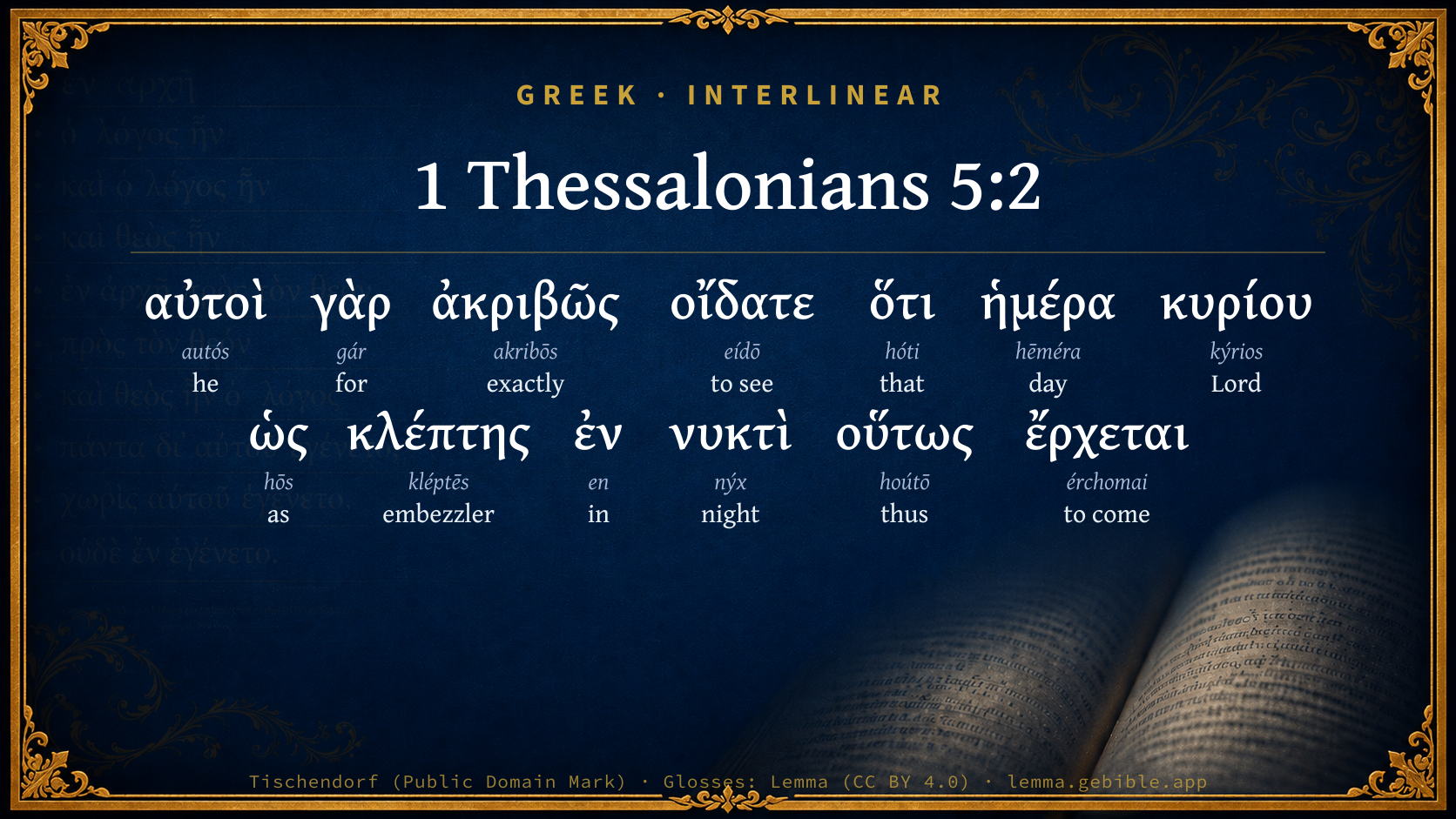
Greek (Tischendorf 8th ed.) 1 Thessalonians 5:2 appears in the Greek New Testament. The text above is from the Tischendorf 8th edition. Each word links to its Strong’s number and a concise gloss. Click any word for its full Thayer’s Greek Lexicon entry.
Download image
Cite this verse

1 Thessalonians 5:2 (World English Bible). Public Domain. Lemma interlinear Bible study tool, https://lemma.gebible.app/v/1-thessalonians/5/2.

Show BibTeX & RIS
BibTeX
RIS
English Translation
For you yourselves know well that the day of the Lord comes like a thief in the night.
World English Bible · Public Domain
Download a study sheet

One document with this verse’s original text, its word-by-word gloss line, the meaning frame, cross-references with their text, attributed commentary, and full source and license credits — printable, and it pastes into notes with its structure intact.

This verse Autodidact and up

Study sheet (.html) Plain text (.txt)

A passage Seminary Student

Up to 50 verses in one chapter. A passage sheet keeps up to 6 commentary sources and 12 cross-references per verse, in the order this page ranks them, and says so on the sheet whenever that leaves anything out. Ask for a single verse and you get the Autodidact verse sheet above.

Everything on this page stays free to read, with no account — the sheet is a download of what is already on screen, not access to it.

Want to remove ads? Support Godless Engineer
Compare translations 3

The same verse in 3 English versions, stacked beneath the original-language interlinear above. Click any original word for its lexicon entry.

Each is an independent rendering of the whole verse — the interlinear is not word-aligned to these translations.

Highlighted words mark where these versions differ — a whole-verse word diff, not a word-by-word alignment.

  • World English Bible Public Domain
    For you yourselves know well that the day of the Lord comes like a thief in the night.
  • King James Version Public Domain
    For yourselves know perfectly that the day of the Lord so cometh as a thief in the night.
  • unfoldingWord Literal Text CC BY-SA 4.0
    For you yourselves know perfectly well that the day of the Lord comes in this manner—as a thief in the night.

unfoldingWord Literal Text — © unfoldingWord, licensed CC BY-SA 4.0. Word-aligned USFM3 via Door43 (git.door43.org/unfoldingWord/en_ult).

Versions to compare (up to 4)

3 of 4 selected

Show all 19 translations

Every available English version of this verse, each an independent rendering of the whole verse.

  • World English Bible Public Domain
    For you yourselves know well that the day of the Lord comes like a thief in the night.
  • Berean Standard Bible Public Domain
    For you are fully aware that the Day of the Lord will come like a thief in the night.
  • Majority Standard Bible Public Domain
    For you are fully aware that the Day of the Lord will come like a thief in the night.
  • King James Version Public Domain
    For yourselves know perfectly that the day of the Lord so cometh as a thief in the night.
  • American Standard Version (1901) Public Domain
    For yourselves know perfectly that the day of the Lord so cometh as a thief in the night.
  • Revised Version (1885) Public Domain
    For yourselves know perfectly that the day of the Lord so cometh as a thief in the night.
  • Geneva Bible (1599) Public Domain
    For ye your selues knowe perfectly, that the day of the Lord shall come, euen as a thiefe in the night.
  • Douay-Rheims (1899) Public Domain
    For yourselves know perfectly, that the day of the Lord shall so come, as a thief in the night.
  • Young's Literal Translation Public Domain
    for yourselves have known thoroughly that the day of the Lord as a thief in the night doth so come,
  • Literal Standard Version CC BY-SA 4.0
    for you have thoroughly known that the Day of the LORD so comes as a thief in the night,
  • Unlocked Literal Bible CC BY-SA 4.0
    For you yourselves know perfectly well that the day of the Lord is coming like a thief in the night.
  • unfoldingWord Literal Text CC BY-SA 4.0
    For you yourselves know perfectly well that the day of the Lord comes in this manner—as a thief in the night.
  • Darby Bible Public Domain
    for ye know perfectly well yourselves, that the day of [the] Lord so comes as a thief by night.
  • World Messianic Bible Public Domain
    For you yourselves know well that the day of the Lord comes like a thief in the night.
  • Webster's Bible Public Domain
    For yourselves know perfectly that the day of the Lord so cometh as a thief in the night.
  • Free Bible Version CC BY-SA 4.0
    You yourselves know very well that the day of the Lord will come like a thief in the night.
  • Bible in Basic English Public Domain
    For you yourselves have the knowledge that the day of the Lord will come like a thief in the night.
  • Text-Critical English NT CC BY 4.0
    For you yourselves know very well that the day of the Lord will come like a thief in the night.
  • Tyndale New Testament (1534) Public Domain
    for ye youre selves knowe parfectly that the daye of the Lorde shall come even as a thefe in the nyght.

Literal Standard Version (2020), Covenant Press — licensed CC BY-SA 4.0. Text via the HelloAO Bible API (eBible.org). Unlocked Literal Bible (unfoldingWord) — licensed CC BY-SA 4.0. Text via the HelloAO Bible API (eBible.org). unfoldingWord Literal Text — © unfoldingWord, licensed CC BY-SA 4.0. Word-aligned USFM3 via Door43 (git.door43.org/unfoldingWord/en_ult). Free Bible Version, Dr. Jonathan Gallagher — licensed CC BY-SA 4.0. Text via the HelloAO Bible API (eBible.org).

Word by word

More ways to search: Search by grammar → Find every occurrence → Compare this word →

Practice this passage: Drill this verse → Learn its vocabulary →

About this verse

These counts appear in no published source. They are computed here, from the morphology-tagged text and Lemma’s own curated glosses. What Lemma adds →

13
words
13
distinct lemmas
Pauline Epistles
section

Notable vocabulary

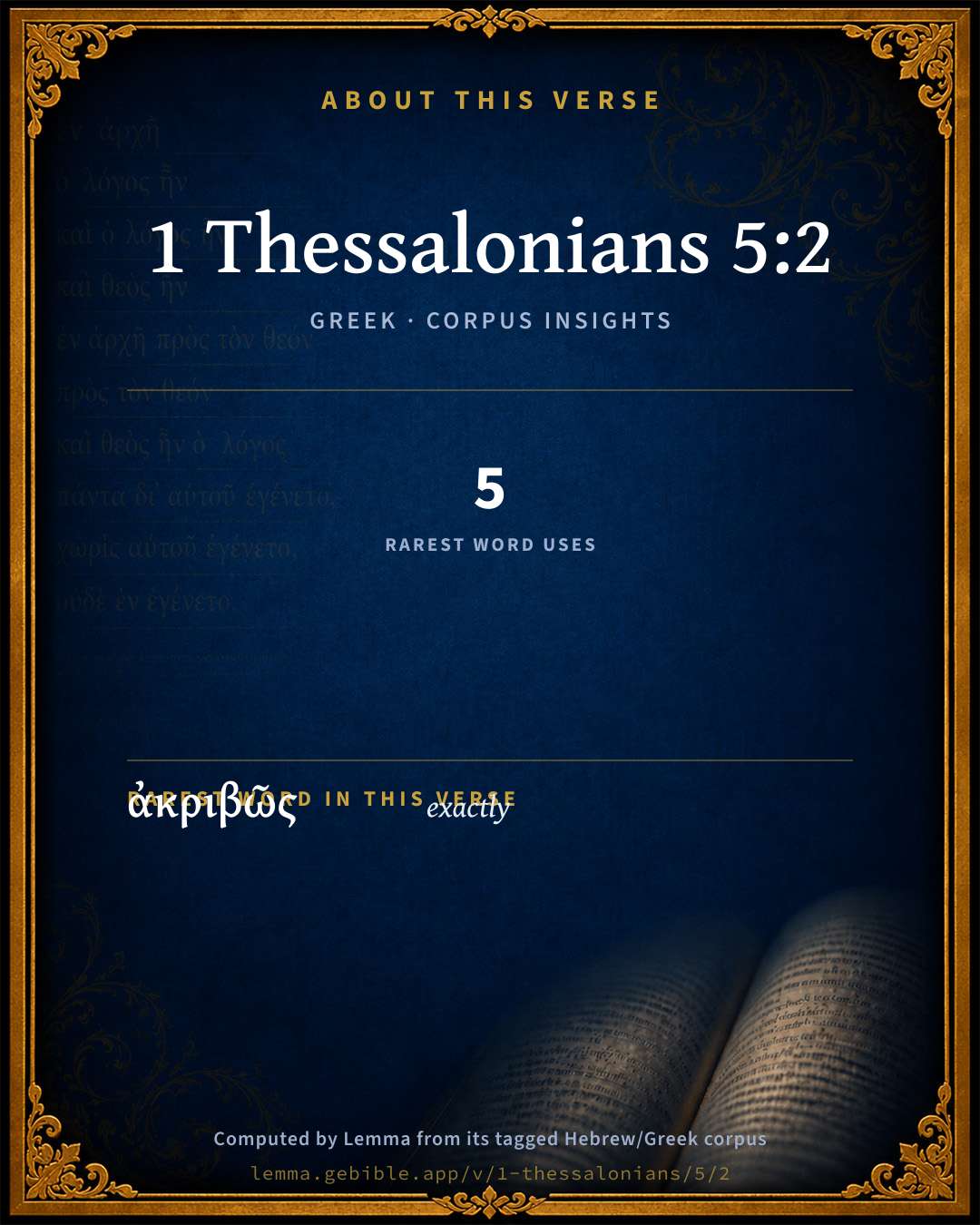
The rarest word here is ἀκριβῶς exactly G199 — appearing just 5 times in the whole Greek New Testament.

Shared distinctive vocabulary

ἀκριβῶς exactly G199 occurs in 5 verses of the Greek New Testament. Also found in:

Cross-references

9

Topical passages linked to 1 Thessalonians 5:2 in the Treasury of Scripture Knowledge — connected by theme and wording, ordered by reader-vote popularity; previews shown in the World English Bible.

  • Revelation 16:15 "Behold, I come like a thief. Blessed is he who watches, and keeps his clothes, so that he doesn't walk naked, and they see his shame."
  • 2 Peter 3:10 But the day of the Lord will come as a thief in the night; in which the heavens will pass away with a great noise, and the elements will be dissolved with fervent heat, and the earth and the works that are in it will be burned up.
  • Matthew 24:42–44 Watch therefore, for you don't know in what hour your Lord comes.
  • Revelation 3:3 Remember therefore how you have received and heard. Keep it, and repent. If therefore you won't watch, I will come as a thief, and you won't know what hour I will come upon you.
  • Matthew 25:13 Watch therefore, for you don't know the day nor the hour in which the Son of Man is coming.
  • Luke 12:39–40 But know this, that if the master of the house had known in what hour the thief was coming, he would have watched, and not allowed his house to be broken into.
  • Mark 13:34–35 "It is like a man, traveling to another country, having left his house, and given authority to his servants, and to each one his work, and also commanded the doorkeeper to keep watch.
  • Jeremiah 23:20 The anger of Yahweh shall not return, until he has executed, and until he have performed the intents of his heart: in the latter days you shall understand it perfectly.
  • 1 Corinthians 1:8 who will also confirm you until the end, blameless in the day of our Lord Jesus Christ.

Cross-references courtesy of OpenBible.info (CC BY 4.0).

Commentary

Notes on 1 Thessalonians 5:2 from classic Christian and Jewish commentators (each source and its license shown beneath its notes). The classic Christian expositions comment on the surrounding passage and are grouped to its opening verse, so a note may address several verses; the Jewish commentaries on the Tanakh (Rashi and others) are per-verse, so they appear only where the commentator wrote on this verse.

Lemma curates 59 commentaries, every one of them public domain or Creative Commons licensed, each selected and text-cleaned for this edition rather than reprinted as found. About our sources →

The Biblical Illustrator

Joseph S. Exell

1Th_5:2

For ye yourselves know perfectly that the day of the Lord so cometh as a thief in the night

Christ coming as a thief in the night

Here we have a striking comparison--one which, to all appearance, had passed into a recognized formula, yet one which no Christian would have dared to use had it not been hallowed by our Lords own lips.

And so we find it first of all in His own parable (Mat_24:43; Luk_12:39-40). Next we find it caught up by His disciple Peter (2Pe_3:10). Then we find it adopted by Paul; and last of all we hear it again from our Lord (Rev_3:3; Rev_16:15). The formula means--

I. That as the thief comes unexpectedly, So His coming will be stealthy, under cover, as it were, of darkness; when the children of night and darkness, the dreamers (Jud_1:8), do not in the slumber of carnal security, even momentarily think of His approach. But if this were all, the idea would lack much of aptness and dignity. Therefore--

II. As the thief comes to steal, So the day of the Lord comes to take away by force the so-called goods--the possessions of the worldling. The children of the night have their most valued substance snatched from them. They are robbed of their soul (see Rev_16:15). Vigilance is needed that the garment may be kept--not torn from him--that he may not be found robbed of the robe of the Redeemers righteousness, but clothed therewith, and accepted at last. (J. Hutchison, D. D.)

The suddenness of the Second Advent

This present state of things is ever close upon the next world, and resolves itself into it. As when a man is given over, he may die any moment, yet lingers; as an instrument of war may any moment explode, and must at some time; as we listen for a clock to strike, and at length it surprises us; as a crumbling arch hangs, we know not how, and is not safe to pass under, so creeps on this feeble, weary world, and one day, before we know where we are, it will end. (J. H. Newman, D. D.)

A reminder of mortality

One of Gottholds friends had a little scent box, made in the shape of a deaths head, with a screw at the skull for opening and taking it asunder. It then showed various cells filled with fragrant balm. Being asked why he had made the box in this particular shape, he replied, In order to have something continually reminding me of my mortality. On this, Gotthold rejoined, You have done well if such was indeed your object, and not, rather, to possess a curiosity for people to gaze and wonder at. The thought of the mortality to which, like all your race, you are subjected, may be infinitely more profitable to you than all kinds of balm. If seized with the delirium of pride, reflect that death will one day reduce you to dust and ashes, and wither your pomp like a flower. If overcome by angry passion, take to heart that death stands behind you with his axe, and only waits the signal from God to reduce you in an instant to the impotency of a dead gnat. If your heart ache, and your head be distracted with cares, recollect that all your trouble and anxiety will one day come to a blessed end.

Preparedness

When war was declared between France and Prussia, Von Molkte was fully prepared. The news was brought to him late one night: he had already gone to bed. Very well, he said to the messenger, the third portfolio on the left, and went to sleep again until morning. (H. D. Mackay.)

The day of the Lord

The day of the Lord, yet future, is the day on which, most assuredly, all thoughts will turn to Him, whether willingly or by constraint, whether in terror or in joy; the day in which His truth will silence into nothingness all human errors and guesses at truth, in which His justice will take the place of all that is named justice, rightly or wrongly, among the sons of men; the day in which everything else but He will be lost sight of, and will be as though it were not, in which the eternal reality of His relation to the world and to man will also be the acknowledged reality. As surely as we have seen this mornings sunlight, we shall hereafter behold the eternal Judge upon His throne, the countless multitudes before Him, the division between His creatures deep and irreversible, the disciplined activities of His angels, the issues on this side and on that, as all gradually settles down into the last unchangeable award. (Canon Liddon.)

The Biblical Illustrator, edited by Joseph S. Exell (c. 1880s–1900s) — public domain. Text from a community e-Sword module.

Joseph Benson's Commentary

1Th 5:2-3. For yourselves know perfectly — It being a matter plainly revealed both by Christ and his apostles; that the day of the Lord — That great decisive day, to which our eyes and hearts are so much directed; so cometh as a thief in the night — Cometh suddenly and unexpectedly; and will occasion the greatest consternation to the ungodly. This comparison is used by our Lord himself to illustrate the unexpectedness of his coming, Mat 24:43. It is used by St. Peter also, 2Pe 3:10; see likewise Rev 3:3. The ancients, from this comparison, and from the parable of the virgins, fancying that Christ’s coming to judgment would be in the night, instituted their vigils, in order that at his coming he might find them watching. But the true meaning of the comparison is, that, like the coming of a thief in the night, on those who are asleep and unarmed, the coming of Christ will be unexpected, and full of terror to the wicked; without determining whether it will be in the daytime or in the night. For when they — The men of the world; shall say — Shall promise to one another; peace and safety — And shall fear no evil of any kind; then sudden destruction cometh upon them — And a destruction of the most terrible kind; as travail upon a woman with child — “Nothing can be conceived more forcible to represent the anguish and torment of the wicked, occasioned by the stinging of their own consciences, and by the horrid fears which shall be excited in them, when they find themselves over-taken by the judgment, than to compare it to the pains of child- bearing.” And they shall not escape — Condemnation and punishment at that terrible day. See 2Th 1:8-9.

Joseph Benson's Commentary on the Old and New Testaments (1811–1818) — public domain. Text from a community e-Sword module.

Tyndale Open Study Notes

Tyndale Open Resources

5:2 For you know quite well: Paul reminds them of the teaching they had already received (3:3-4). • The day of the Lord’s return is the time when God will come to judge humanity (Isa 13:6, 9; Ezek 30:3) and save his people (Joel 2:21-32; 3:18; Zech 14). • like a thief in the night: Cp. Matt 24:43-44; Luke 12:39-40; 2 Pet 3:10; Rev 3:3; 16:15.

Tyndale Open Study Notes — © Tyndale Open Resources, licensed CC BY-SA 4.0. Text via the HelloAO Bible API.

Bengel's Gnomon

Johann Albrecht Bengel

1Th 5:2. Ὡς κλέπτης, as a thief) 2Pe 3:10. A usual expression with the apostles, agreeing with the parable of the Lord, Mat 24:43.—ἐν νυκτὶ, in the night) Refer those words to a thief, just now mentioned [not, the day of the Lord cometh in the night; but, as a thief cometh in the night]. The night is there, where there is unconcern and quiet; comp. however, Mat 25:6.[25]—οὕτως) so, as we shall describe in the following verse. Comp. so after[26] for, Mat 1:18, [“The birth of Christ was so; for when His mother Mary was espoused,” etc.: οὕτως ἦν. μνηστευθείσης γὰρ, etc.]—ἔρχεται, comes) The present expressing a sudden event with great emphasis. So 1Th 5:3, Sudden destruction cometh; comp. Luk 21:34.

[25] “At midnight there was a cry made, Behold the Bridegroom cometh;” which seems to imply that it shall not be merely in a figurative, but in a literal sense, that the Lord shall come in the night.—ED.

[26] Here, however, γὰρ, for, is thought to be better omitted by the margin of both Ed. The Germ. Vers., for the sake of connection, puts nemlich.—E. B.

AGfg, Iren. 329, Cypr. 326, and Syr. Version, omit γὰρ, and so Tisch. Lachm. reads δὲ, with BD(Δ), Memph. and later Syr. Rec. Text reads γὰρ. with Vulg.—ED.

Bengel's Gnomon of the New Testament — English translation (T&T Clark, Edinburgh, 1860) — public domain. Text from a community e-Sword module.

Meyer's Critical & Exegetical Commentary

Heinrich August Wilhelm Meyer

1Th_5:2. Αὐτοὶ γάρ] For ye yourselves, emphatically contrasted with the person of the writer, as in 1Th_4:9.

ἀκριβῶς] exactly, i.e. very well.

By the ἡμέρα κυρίου, Hammond, Schoettgen, and Harduin arbitrarily understand the time of the destruction of Jerusalem; Nicolas de Lyra, Bloomfield, and others, the day of each mans death; Oecumenius, Theophylact, and Zwingli, the death of the individual and the end of everything earthly, ἡμέρα κυρίου can only be another expression for παρουσία τοῦ κυρίου, 1Th_4:15, and denotes, as everywhere else, the near impending period, when the present order of the world will come to an end, and Christ in His glory will return to the earth for the resurrection of the dead, the general judgment, and the completion of the kingdom of God; comp. 2Th_2:2; 1Co_1:8; 1Co_5:5; 2Co_1:14; Php_1:6; Php_1:10; Php_2:16. Besides, the corresponding expression יוֹם יְהֹוָה is used in the Old Testament to denote a time in which God will manifest in a conspicuous manner His penal justice, or also His power and goodness; comp. Joe_1:15; Joe_2:11; Eze_13:5; Isa_2:12.

ὡς κλέπτης ἐν νυκτί] as a thief in the night, sc. ἔρχεται; comp. 2Pe_3:10. The figure is designed to depict the suddenness and unexpectedness of the coming; comp. Mat_24:43; Luk_12:39. Others, as Flatt, Schott, and Alford (similarly also Hofmann and Riggenbach), find expressed therein the further reference that the day of the Lord will also be terrible to all those who are not properly prepared for it. But this further idea is not contained in 1Th_5:2, but only meets us in what follows. The comparison ὡς κλέπτης ἐν νυκτί was undoubtedly the chief reason of the opinion in the ancient church, that the advent is to be expected at night (more specifically, on an Easter-eve), which gave rise to the vigils, as one wished to be overtaken in a waking condition by the return of Christ. Comp. Lactantius, Institt. vii. 19: Haec est nox, quae a nobis propter adventum regis ac Dei nostri pervigilio celebratur; cujus noctis duplex ratio est, quod in ea et vitam turn recepit, quum passus est, et postea orbis terrae regnum recepturus est. Jerome on Mat_25:6 (vol. vii. p. 203): Traditio Judaeorum est, Christum media nocte venturum in similitudinem Aegyptii temporis, quando pascha celebratum est et exterminator venit, et dominus super tabernacula transiit.… Unde reor et traditionem apostolicam permansisse, ut in die vigiliarum paschae ante noctis dimidium populos dimittere non liceat, exspectantes adventum Christi.

οὕτως] even so, a strong resumption of the preceding ὡς.

The present ἔρχετε is not here used instead of the future ἐλεύσεται (Vorstius, Koppe, Flatt, Pelt), but is designed to characterize the coming thus taking place as an absolute and certain truth. See Bernhardy, Syntax, p. 371; Winer, p. 237 [E. T. 331].

Meyer — Critical and Exegetical Commentary on the New Testament — English translation by Peter Christie, edited by Frederick Crombie (T&T Clark, 1880) — public domain. Text from a community e-Sword module.

Expositor's Greek Testament

ed. W. Robertson Nicoll

1Th 5:2 . οἴδατε , referring to the teaching of Jesus on this crucial point, which Paul had transmitted to them (see Introduction).

The Expositor's Greek Testament, edited by W. Robertson Nicoll (1897–1910) — public domain. Text from a community e-Sword module.

Vincent's Word Studies in the New Testament

Marvin R. Vincent

Perfectly [ακριβως] . See on Luk 1:3.

The day of the Lord [ημερα κυριου] . The day of Christ 's second coming. In Paul 's Epistles this is expressed by hJ hJmera the day, absolutely, 1Th 5:4; 1Co 3:13; Rom 13:12 : hJ hJmera ejkeinh that day, 2Th 1:10 : hJmera cristou the day of Christ, Phi 1:10; Phi 2:16 : hJmera kuriou or tou kuriou day of the Lord, 1Co 5:5; 1Th 5:2; 2Th 2:2 : hJmera tou kuriou hJmwn Ihsou [χριστου] , 1Co 1:8; 2Co 1:14. These expressions refer to a definite time when the Lord is expected to appear, and Paul expects this appearance soon. Attempts to evade this by referring such expressions to the day of death, or to the advance toward perfection after death until the final judgment, are forced, and are shaped by dogmatic conceptions of the nature of Biblical inspiration. 30 In the O. T. the phrase day of the Lord denotes a time in which God will conspicously manifest his power and goodness or his penal justice. See Isa 2:12; Eze 13:5; Joe 1:15; Joe 2:11; and comp. Rom 2:5. The whole class of phrases is rare in N. T. outside of Paul 's Epistles. As a thief [ως κλεπτης] . Comp. Mt 24:43; Luk 12:39; 2Pe 3:10; Rev 16:15, and see on Rev 3:3.

In the night [εν νυκιτι] . The ancient church held that the advent was to be expected at night, on an Easter eve. This gave rise to the custom of vigils. Jerome, on Mt 25:6, says : "It is a tradition of the Jews that Messiah will come at midnight, after the likeness of that season in Egypt when the Passover was celebrated, and the Destroyer came, and the Lord passed over the dwellings. I think that this idea was perpetuated in the apostolic custom, that, on the day of vigils, at the Pascha, it was not alloxved to dismiss the people before midnight, since they expected the advent of Christ."

It is noteworthy how many of the gospel lessons on watchfulness are associated with the night and a visit by night. See Mt 24:43; Mt 25:1 - 13; Mr 13:35; Luk 12:35, 38; Luk 17:34; Luk 12:9 0.

Marvin R. Vincent, Word Studies in the New Testament (1887–1900) — public domain. Text from a community e-Sword/MySword module.

Jamieson, Fausset & Brown

Robert Jamieson, A. R. Fausset & David Brown

as a thief in the night--The apostles in this image follow the parable of their Lord, expressing how the Lord's coming shall take men by surprise (Mat 24:43; Pe2 3:10). "The night is wherever there is quiet unconcern" [BENGEL]. "At midnight" (perhaps figurative: to some parts of the earth it will be literal night), Mat 25:6. The thief not only gives no notice of his approach but takes all precaution to prevent the household knowing of it. So the Lord (Rev 16:15). Signs will precede the coming, to confirm the patient hope of the watchful believer; but the coming itself shall be sudden at last (Mat 24:32-36; Luk 21:25-32, Luk 21:35).

Jamieson, Fausset & Brown — Commentary Critical and Explanatory on the Whole Bible (1871) — public domain (CC PDM 1.0). Text via the HelloAO Bible API.

John Calvin's Commentaries

2 Ye know perfectly. He places exact knowledge in contrast with an anxious desire of investigation. But what is it that he says the Thessalonians know accurately? It is, that the day of Christ will come suddenly and unexpectedly, so as to take unbelievers by surprise, as a thief does those that are asleep. This, however, is opposed to evident tokens, which might portend afar off his coming to the world. Hence it were foolish to wish to determine the time precisely from presages or prodigies.

John Calvin's Commentaries (1540-1563) — public domain. Text from the Calvin Translation Society English edition (1840s-50s) via the Christian Classics Ethereal Library (ccel.org). Calvin's coverage is partial (roughly two-thirds of the Bible); uncommented books and verses are honest gaps, never fabricated. The 19th-century editor's footnotes and remarks are omitted so the notes are faithfully Calvin's own voice.

Ellicott's Commentary for English Readers

(2) Know perfectly.—Or, accurately. There is something of an oxymoron (see Note on 1Th_4:11) here. “I need not tell you about the time, for you know to a nicety—not the hour of Christ’s coming, but—the utter uncertainty respecting it.” The word shows at the same time with what scrupulous care St. Paul had instructed them on this topic.

The day of the Lord.—Here “the Lord” (as usual in the New Testament) means Jesus Christ; and this day can mean nothing else than the great day of His return to judgment. The expression is taken from the Old Testament, where, of course, it does not primarily mean what we call “the Day of Judgment,” but the set time which God has fixed for any great visitation. Thus in Joe_2:1, et seq., it means the time appointed for the plague of locusts; in Eze_13:5, generally, any day when God visits His people; in Joe_3:14, the fixed time for vengeance to be taken upon the heathen for persecuting the Church; which, in Isa_2:12 (a passage largely influenced by recollections of Joel), seems to widen into a general day of judgment for mankind.

Cometh.—Not merely, will come; it is an absolute certainty that the time is on its way to come. (See Note on 1Th_1:10.)

As a thief in the night—i.e. unexpectedly (Mat_24:43), and under cover of darkness. The frequency of the simile (see references) throws light on the words “know perfectly,” making it apparent that it was the ordinary formula in which the doctrine was universally taught by the Apostles.

A Bible Commentary for English Readers, edited by Charles John Ellicott (1878–1897) — public domain. Text from a community e-Sword module.

The Cambridge Bible for Schools and Colleges

gen. ed. J. J. S. Perowne

2. For yourselves know perfectly] “For yourselves know:” a turn of expression characteristic of these Epistles; ch. 1Th_1:5 (see note), 1Th_2:1 (Identical with this), 2, 5, 11; 1Th_3:4; 1Th_4:2; 2Th_2:6; 2Th_3:7 (identical).

“Perfectly” is a somewhat vague rendering of an adverb that with verbs of knowing signifies precisely, or accurately; in Mat_2:8, &c., it is rendered carefully (R. V.). Possibly the Thessalonians In sending their query had used this very word: “We should like to know more precisely,” they may have said, “about the times and seasons, and when the Day of the Lord will be.” 2Th_2:1-3 shows that the Church was full of eagerness about the Second Advent, and even after this caution many of its members continued to listen to those who professed to answer their Irrepressible questions. The Apostle replies, with a touch of gentle irony (comp. note on ch. 1Th_4:11): “You already know precisely that nothing precise on the subject can be known,—that the Great Day will steal upon the world like a thief in the night!”

the day of the Lord so cometh as a thief in the night] More exactly, as a thief in the night, so there is coming a day of the Lord; the definite article is absent in the Greek. Such a Day of the Lord as the Church expected is coming; it is on the way (comp. note on ch. 1Th_1:10). The event is certain: when it will arrive, no man can tell. Even in the act of going away Jesus said repeatedly, “I come,” “I am coming to you” (Joh_14:3; Joh_14:18; Joh_14:28; &c.).

The figure of the night-thief points, as the next verse shows, to the effect of the Day upon the unprepared. The simile is taken from the lips of Jesus in His discourse of the Judgement (Mat_24:43; also Luk_12:39-40, where It is applied In warning to Christ’s servants): it is employed by other Apostles, in 2Pe_3:10; Rev_3:3, &c. It signifies, beside the unexpectedness of the event, its bereaving effect: it brings “sudden destruction” (1Th_5:3); the house of the worldling is “broken through.”

“The day of the Lord” was a standing designation in the O.T., occurring first in Joel (ch. Joe_1:15; Joe_2:1-2; Joe_2:11; Joe_2:31; Joe_3:14; comp. Amo_5:18) amongst the written prophets and handed down to Isaiah and Ezekiel, denoting the great epoch of judgement which in their age impended over Israel and the surrounding nations, and closed the prophetical horizon. In the O.T. therefore, the Day of the Lord has chiefly, if not exclusively, a judicial aspect. This meaning the expression carries over into the N.T.; and “the day of the Lord” is synonymous with “the day of Judgement” (Mat_11:22, &c.)—often called simply “that day” (Mat_7:22; Luk_17:31; &c.), also “the last day” (Joh_6:39, &c.). Moreover Christ ascribes to Himself, “the Son of Man” (Luk_17:24; Luk_17:26; Luk_17:30), what the O. T. in this connection predicts of “the Lord” (Jehovah). Hence St Paul describes the same Day of the Lord as “the day of Jesus Christ” (Php_1:6, &c.). But our Apostle loves to regard the Day on its brighter side, as the time when Christ’s glory will be revealed in His people (2Th_1:10; Php_2:16; &c.), “when He comes to be glorified in His saints and wondered at in all that believed.” Now the world is having its day; “this is your hour,” said Jesus to those who seized Him, “and the reign of darkness” (Luk_22:53). But that will be the Lord’s day, when the Lord and His Christ will be manifested, and vindicated whether in salvation or judgement,—when “the glory of the Lord shall be revealed, and all flesh shall see it together” (Isa_40:5). Afterwards the weekly day of Christ’s resurrection came to be called “the Lord’s Day,” as we call it now (Rev_1:10)—this also a day of Divine vindication, and a pledge and foretaste of the final and perfect Day of the Lord: comp. the connection of the resurrection of Jesus with the Last Judgement in ch. 1Th_1:10 and Act_17:31.

We have already observed a tacit reference under the words “as a thief in the night” to our Lord’s discourse on the Judgement; and we shall find others in the sequel. These allusions make one think that the Apostle in his preaching at Thessalonica had surely quoted from Christ’s words on this solemn theme. Otherwise, how would the Thessalonians “precisely know” that “the Day comes as a thief in the night”? While in regard to the state of the sainted dead a new revelation was needed (ch. 1Th_4:15), on the question of the time of His coming His own well-remembered words were sufficiently explicit.

The Cambridge Bible for Schools and Colleges (gen. ed. J. J. S. Perowne; Cambridge University Press, 1878–1918) — public domain. Text from a community e-Sword module.

John Gill's Exposition

For yourselves know perfectly,.... With great exactness and accuracy, with great clearness and perspicuity, as a certain truth, which was made plain and evident to them, and about which there could be no question; and which perfect knowledge they had, either from the words of Christ, Mat 24:42, or from the ministration of the apostle and his fellow labourers, when among them:

that the day of the Lord; of the Lord Jesus, when he will show himself to be King of kings, and Lord of lords, and the Judge of the whole earth; and which is sometimes styled the day of the Son of man, and the day of God, for Christ will appear then most gloriously, both in his divine and human nature; the day of redemption, that is, of the body from the grave, and from corruption and mortality; and the last day in which will be the resurrection of the dead, and the day of judgment, in which Christ will come to judge the quick and dead: and which

so cometh as a thief in the night; at an unawares, and the Lord himself in that day will so come, Rev 3:3 respect is had not to the character of the thief, nor to the end of his coming; but to the manner of it, in the dark, indiscernibly, suddenly, and when not thought of and looked for; and such will be the coming of Christ, it will be sudden, and unknown before hand, and when least thought of and expected: and since the Thessalonians knew this full well, it was needless for the apostle to write about the time and season of it; which they were sensible of, could no more be known and fixed, than the coming of a thief into anyone of their houses.

John Gill's Exposition of the Whole Bible (1746–1763) — public domain (CC PDM 1.0). Text via the HelloAO Bible API.

Trapp's Complete Commentary

John Trapp

2 For yourselves know perfectly that the day of the Lord so cometh as a thief in the night.

Ver. 2. The day of the Lord] That day, by a specialty, Luk 21:34, that great day, Rev 6:17, that day of the declaration of God’s just judgment, Rom 2:5; Rom 2:16, that day of Christ, 2Th 2:2, of God, 2Pe 3:12, wherein he will show himself to be God of gods and Lord of lords.

As a thief in the night] Who giveth no warning, Mat 24:43. {See Trapp on "Mat 24:43"}

John Trapp, A Commentary or Exposition upon All the Books of the Old and New Testament (1647–1656) — public domain. Text from a community e-Sword module.

Albert Barnes' Notes on the Bible

For yourselves know perfectly - That is, they had been fully taught this. There could be no doubt in their minds respecting it.

The day of the Lord so cometh - Of the Lord Jesus - for so the word “Lord” in the New Testament commonly means; see the notes, Act 1:24. The “day of the Lord” means that day in which he will be manifested, or in which he will be the prominent object in view of the assembled universe.

As a thief in the night - Suddenly and unexpectedly, as a robber breaks into a dwelling. A thief comes without giving any warning, or any indications of his approach. He not only gives none, but he is careful that none shall be given. It is a point with him that, if possible, the man whose house he is about to rob shall have no means of ascertaining his approach until he comes suddenly upon him; compare Mat 24:37-43 notes; Luk 12:39-40 notes. In this way the Lord Jesus will return to judgment; and this proves that all the attempts to determine the day, the year, or the century when he will come, must be fallacious. He intends that his coming to this world shall be sudden and unexpected, “like that of a thief in the night;” that there shall be no such indications of his approach that it shall not be sudden and unexpected; and that no warning of it shall be given so that people may know the time of his appearing. If this be not the point of the comparison in expressions like this, what is it? Is there anything else in which his coming will resemble that of a thief? And if this be the true point of comparison, how can it be true that people can ascertain when that is to occur? Assuredly, if they can, his coming will not be like that of a thief; comp. notes on Act 1:7.

Albert Barnes' Notes on the Bible (1834–1885) — public domain. Text from a community e-Sword/MySword module.

Matthew Poole's English Annotations

By times and seasons then, before mentioned, he meant the time: of the Lord’s coming, or he applies what he spoke in general to this particular, which he here calls

the day of the Lord. And though they knew not the particular time, yet they did know this, it would be sudden and unexpected, coming

as a thief in the night, Rev 16:15; the comparison is to be restrained only to the suddenness of it; for his coming will be welcome, and so not as a thief, to all that believe. And it is called

the day of the Lord here and elsewhere, 1Co 3:13; Phi 1:6,10, and that day, 2Ti 1:18, not to be taken for a natural day, but a certain period of time. Any eminent manifestation of God, either in works of mercy or judgment, is called his day in Scripture, Isa 2:12; Jer 46:10. And so because Christ will be more eminently manifested now than ever before, therefore his coming is called his day; and that it would be sudden they did not only know, but

know perfectly, or accurately; Eph 5:15, circumspectly: there could be only conjectures about the particular time: the influence hereof was powerful upon their hearts, and so they may be said to know it perfectly. In religion, knowledge is not perfect which is not operative.

Matthew Poole's English Annotations on the Holy Bible (1683–1685) — public domain. Text from a community e-Sword/MySword module.

Whedon's Commentary on the Bible

Daniel D. Whedon

2. Yourselves—Emphatic; as also 1Th_4:9.

Day of the Lord—An Old Testament phrase to designate any period of God’s terrible visitation. Joe_1:15; Joe_2:11; Eze_13:5; Isa_2:12. Here specifically applied to the day of the event just described, 1Th_4:15-18, the Parousia.

A thief in the night—This remarkable comparison of the Lord to a thief was first used by our Lord himself in Mat_24:43-44; and Luk_12:39-40. And thence it became a standard simile. 2Pe_3:10. Wordsworth acutely argues that none but Jesus would have invented such a comparison, and that, therefore, the Thessalonians must have had a gospel of either Matthew or Luke, to have learned it from. That Matthew, in its Hebrew form, was early written, we have indicated in our Introduction to that gospel. And we are inclined to believe that Luke was now extant. But had the Thessalonians a copy of either in possession, how could they be so ignorant of the resurrection as 1Th_4:13-18 implies? There are striking coincidents of Greek words, however, between St. Paul’s language and our Lord’s in Luke.

Lunemann calls to mind the impression made by this phrase in the night on the mind of the early Church. The so-called vigils, or watch-nights, were held, especially on Easter-night, in expectation that the sign of the coming Son of man would streak the darkness of the midnight sky. They awaited that solemn token with watching, and fasting, and prayer. A beautiful error, solemnizing the soul and reforming the character! So Lactantius, in the fourth century, says: “This is the night which by us is celebrated; of which night, twofold is the reason, because in it He received life when he suffered, and because in it He will soon receive the dominion of the earth.” And Jerome says, on Mat_25:6, “It is a tradition of the Jews, that the Messiah is to come at midnight, as in the time of Egypt; when the Passover was celebrated, and the destroyer came, and the Lord passed over their tents. Whence I recognise the permanent apostolic tradition, that in the paschal vigils it is not permissible to dismiss the people in the earlier half of the night, while they are waiting the advent of Christ.”

Cometh—Not future; for it is an ever-pending He cometh!

Daniel D. Whedon (gen. ed.), Commentary on the Old and New Testaments (1874–1909) — public domain. Text from a community e-Sword module.

The Pulpit Commentary

For yourselves know perfectly; namely, not from Scripture, nor from oral tradition, but from the teaching of the apostle when in Thessalonica. That the day of the Lord. "The day of the Lord" is a common Old Testament expression, denoting the coming of the Divine judgments; (Joe_1:15 Joe_2:1) and by the phrase here is meant, not the destruction of Jerusalem, nor the day of one"s death, but the day of the Lord"s advent, when Christ shall descend from heaven in glory for the resurrection of the dead and the judgment of the world. The idea of judgment is contained in the term "day." So cometh as a thief in the night. The same comparison is used by our Lord himself, (Luk_12:39) and the very words are employed by Peter. (2Pe_3:10) The point of resemblance is evidently the unexpectedness and suddenness of the coming. The thief comes upon people in the night season, when they are asleep and unprepared; so, in a similar manner, when Christ comes, he will find the world unprepared and not expecting his advent. The ancient Fathers inferred from this passage that Christ would come to judgment in the night season, and hence they instituted vigils, or night watches. Some, still more precisely, fixed the coming on Easter night, from the analogy of the deliverance of the Israelites from Egypt on the paschal evening.

HOMILIES BY W.F. ADENEY Vers. 2-4.

A thief in the night.

The one idea to be impressed upon us by this striking image is that of unexpectedness. The thief succeeds in making his entrance when he is least expected. So will it be on "the day of the Lord." The idea is derived from the teaching of Christ, in which it is more fully expanded. (see Mat_24:43, Mat_24:44) The "day of the Lord" which is to come thus suddenly is often referred to in the Old Testament. There it is a dreadful occasion of Divine manifestation for judgment, to be hailed with gladness when the judgment falls on the enemies of Israel and brings the chosen people deliverance, but to be regarded with terror by sinful Israelites. (Amo_5:18) St. Paul regards it as the day of Christ"s second advent. But the general use of the expression in the Old Testament justifies us in applying the warning concerning it to various forms of the parousia.

I THE DAY OF THE LOUD WILL COME UPON THE BENIGHTED AS A THIEF.

1. The day is unexpected. What did the heathen fellow-citizens of the Thessalonians know, or think, or care about the glorious advent of Christ, with its angel-summons and its trumpet-blast for which the Christians were watching so eagerly? The Jews did not expect the coming of the Son of man in the destruction of Jerusalem. The world does not think of the great judgment-day. Worldly people do not contemplate death.

2. No signs are given to the world of the dawning of this dread day. No lurid twilight betokens the tempestuous morning. It bursts suddenly upon a world slumbering in darkness. Science, philosophy, ordinary signs of the times, give no hint of it to the unspiritual. The biblical arithmetic of our modern prophets is always proving itself at fault. No bare intellectual calculation will ever discover the "day of the Lord.

3. It is best for the world that no natural signs should herald this day.

(1) Christian people are better without the common signs which could be discerned by ordinary observation. To possess them would be to walk by sight. They are not given in order that faith may be exercised.

(2) The world at large is better without these signs. They would disarrange all the necessary pursuits of life. Some would cry abjectly for mercy without really repenting at heart. Some, as when plagues raged in cities, would fling off all restraints and plunge into a reckless course of debauchery. Some would coldly calculate the time allowed for sinning before they would need to bethink them of preparing for the end.

II THE DAY OF THE LORD WILL NOT COME UPON THE ENLIGHTENED AS A THIEF. St. Paul makes an important distinction here one that is not always recognized: "But ye, brethren, are not in darkness, that that day should overtake you as a thief.

1. No men are enlightened as to the date of the second advent. Even Christ did not know it. This he distinctly says. (Mar_13:32)

2. Christians are enlightened as to the fact and the character of the second advent.

(1) They know that Christ will come again, which is more than the unbelieving world knows. They have Christ"s own promise to rely upon. (Mat_24:30)

(2) They know that Christ will come unexpectedly. At least, they ought to know this if they read the teachings of Scripture on the subject.

3. The enlightenment of Christians will prevent the second advent from coming upon them like a thief. When we are prepared for a surprise, it is no longer a surprise. If we know a thing may happen at any time, its occurrence will not give us the shock of an unexpected event. Christ, longed for, eagerly desired, fondly expected, will come at an hour when his people know not, but not when his true disciples are unprepared to welcome him. W.F.A.

The Pulpit Commentary (1880–1919), ed. H.D.M. Spence-Jones & Joseph S. Exell — public domain. Text from a community e-Sword module.

John Wesley's Explanatory Notes

For this in general ye do know; and ye can and need know no more.

John Wesley, Explanatory Notes Upon the Whole Bible (1754–1765) — public domain. Text via the GEBible commentary corpus.

McGarvey & Pendleton's Commentaries

J. W. McGarvey

For yourselves know perfectly that the day of the Lord so cometh as a thief in the night . [Here is an echo from the lips of Jesus ( Mat_24:36-51 ; Luk_12:39-40 ). See also 2Pe_3:10 ; Rev_3:3 . The coming of the thief implies our loss, if he catches his asleep and unprepared. How fearful our loss if we are not prepared for the coming of the Lord-- Heb_10:31 ]

J. W. McGarvey (with Philip Y. Pendleton), Commentaries on the New Testament (The Fourfold Gospel, 1914; Acts; and the epistles) — public domain. Text from a community e-Sword/MySword module.

The People's New Testament

B. W. Johnson

2. For yourselves know perfectly, etc. They had been fully taught that the time of the Lord's coming was unrevealed, and that it would be unexpected. Compare Matt. 24:43; 2 Thess. 2:2; 2 Peter 3:10; Joel 1:15. The day of the Lord. Not alone, the day of each individual's death, nor of the destruction of Jerusalem, not of the final coming of the Lord at the end of the world, but rather it may be applied to all of these. As a thief in the night. Without warning. Compare Luke 12:39; Rev. 3:3.

B. W. Johnson's The People's New Testament with Notes (1889–1891) — public domain. Electronic text from the Christian Classics Ethereal Library (CCEL) ThML edition.

Cambridge Greek Testament for Schools and Colleges

2. AKL introduce η before ημερα κυριου: cf. 1Th 5:4; 2Th 2:2, &c.

2. αὐτοὶ γὰρ ἀκριβῶς οἴδατε. For of yourselves you know precisely. On αὐτοὶ οἴδατε, see 1Th 2:1; and cf. again 1Th 4:9. The readers “know,” because they have been already told (cf. 1Th 3:4; 2Th 2:5); their question was needless, if they reflected on what they had previously learned respecting “the day of the Lord.” The allusions in the sequel to our Lord’s discourse on the Judgement imply that the Apostles had quoted His sayings on this mysterious theme. While in regard to the matter of § 8 a new revelation was required (1Th 4:15), on this question the Lord’s own well-remembered words were sufficient.

The word ἀκριβῶς is puzzling here: “perfectly” (A.V., R.V.) is not a strict equivalent; in Mat 2:8 it is rendered “carefully,” in Luk 1:3 “accurately,” and so on; the Vulg. turns it into diligenter; Erasmus and Estius, better, exacte. The adverb seems out of place, until one remembers that the Apostles are replying to enquiries from their readers, and that in such correspondence St Paul is fond of retorting words addressed to him (see J. Rendel Harris in the Expositor, V. viii. 161–180; also W. Lock in Expositor, V. vi. 65 ff.). Probably the Thessalonians in sending their query had used this very word: “We should like to know more precisely about the times and seasons, and when the day of the Lord will be.” The Apostle replies, with a touch of irony (cf. note on 1Th 4:11): “You already know precisely that nothing precise on the subject can be known—the Great Day will steal on the world like a thief in the night!” 2Th 2:1-3 shows that even after this caution the Church continued to entertain speculations about the details of the Advent.

ὅτι ἡμέρα Κυρίου ὡς κλέπτης ἐν νυκτὶ οὕτως ἔρχεται, that the day of the Lord, as a thief in the night, so is coming. Ἡμέρα Κυρίου—anarthrous (cf. Php 1:6; Php 1:10; Php 2:16), as a sort of proper noun—the well-known prophetic “Day of the Lord” (יוֹם יהיה). It “is coming,”—is on the way (cf. notes on 1Th 1:10, 1Th 2:16; also Eph 5:6; Rom 1:18; 2Pe 2:3, &c.). Even in the act of departing Jesus said repeatedly, “I come,” “I am coming to you” (Joh 14:3; Joh 14:18; Joh 14:28, &c.). Lightfoot, Winer-Moulton (pp. 331 f.), and others, read this as a prophetic present: “cometh” = “will surely come.” The event is certain and in preparation; when it will arrive none can tell.

The figure of the κλέπτης ἐν νυκτί points (1Th 5:3) to the unhappy surprise that “the day” brings to the wicked. This simile of Jesus (cf. Mat 24:43; Luk 12:39 f.; see note above, on αὐτοὶ οἴδατε) recurs in 2Pe 3:10; Rev 3:3; Rev 16:15. It gave rise to the tradition that the Advent would take place on the night before the Passover, through which therefore vigil was wont to be kept (see Jerome on Mat 25:6; Lactantius Instit. vii. 19). The metaphor possibly implies, beside the unexpectedness, the bereaving effect of the Coming: that Day will rob the wicked of ease and wealth (cf. Luk 12:20; Luk 12:33). There is a certain incongruity in the representation of a “day coming” (breaking in upon evildoers) “as a thief in the night”; but it is the Lord Himself who “comes” on this great day of His (2Th 1:7 ff.; cf. Rev 3:3, &c.).

The doctrine of “the day of Jehovah” may be traced through the O.T., in Joe 1:15; Joe 2:1 ff., &c., Joe 3:14; Amo 5:18 ff.; Isa 2:11 ff; Isa 13:6, &c., Isa 19:16-25, Isa 26:1, Isa 27:1 ff.; Zep 1:7 ff., &c.; Jer 31:31 ff; Jer 46:10; Eze 13:5; Eze 39:8, &c.; Mal 3:2, &c. It denotes the great epoch of judgement impending over Israel and the surrounding nations, which dominated the prophetic horizon; it had a further outlook, however, of blessing and restoration for God’s people (see Zec 14:7 ff.). The judicial aspect of the Day of the Lord in the O.T. was carried over into the New, mutatis mutandis. The Judgement now assumes a more spiritual and supernatural character; it is individualized, bearing no longer on nations and their destiny, but on men universally—on personal character and relations to God; it follows upon the resurrection of the dead; and, above all, Jesus Christ is disclosed as the Judge of “that Day”: see, amongst many other passages, Mat 25:31-46; Joh 5:21-29; Joh 6:39 f.; Luk 17:24; Luk 17:26; Luk 17:30; Act 17:31; Rom 2:16; 1Co 4:3 ff.; 2Co 5:10, &c. Hence this Day of the Lord is called by the Apostle “the day of Jesus Christ” (Php 1:6, &c.); sometimes “that day” (2Ti 1:12, &c.), since it is the finale to which all Christianity points. St Paul loves to regard it on its brighter side, as the time when Christ’s glory will be revealed in His saints (1Th 3:13; 2Th 1:10; Php 2:16; Rom 8:19, &c.). Now the world has its day; “this is your hour,” said Jesus to the Jewish officers, “and the power of darkness” (Luk 22:53): then comes the Lord’s day, when He will be vindicated both in salvation and in judgement, when “the glory of the Lord shall be revealed, and all flesh shall see it together” (Isa 40:5). At a later period the weekly day of Christ’s resurrection received this name (see Rev 1:10; cf. 1Co 16:2)—this is also a day of Divine vindication, and thus a pledge and anticipation of the great Day; cf. the connexion between the resurrection of Jesus and the Last Judgement indicated in 1Th 1:10, Act 17:31.

Cambridge Greek Testament for Schools and Colleges (Cambridge University Press, 1896; 21 vols, various authors incl. Carr, Maclear, Plummer, Farrar, Lumby, Moule, M. R. James, Simcox) — public domain. Text from a community e-Sword module.

Alford’s Greek Testament

Henry Alford

2.] [ἡ] ἡμέρα κυρίου is not the destruction of Jerusalem, as Hammond, Schöttg., al.,—nor the day of each man’s death, as Chrys., Œc., Thl., Lyr., al.,—but the day of the Lord’s coming, the παρουσία, which has been spoken of, in some of its details, above. So Thdrt.—ἡ δεσποτικὴ παρονσία. This is plain, by comparing 2Th 2:2: 1Co 1:8; 1Co 5:5: 2Co 1:14: Php 1:6, Php 1:10; Php 2:16. It is both the suddenness, and the terribleness (surely we cannot with Ellic. omit this element, in the presence of the image in the next verse) of the Day’s coming, which is here dwelt on: cf. next verse.

οὕτως fills up the comparison—as a thief in the night (comes), so … it comes (not for future, but expressing, as so often by the present, the absolute truth and certainty of that predicated—it is its attribute, to come).

Henry Alford, The Greek Testament (1849–1861) — public domain. Text from a community e-Sword module.

International Critical Commentary

2. αὐτοὶ γὰρ ἀκριβῶς κτλ. The reason why (γά as in 4:9) it is unnecessary to write is not that he is unable to teach them anything new (Th. Mops.), but that, in view of the purpose of encouragement, it is inexpedient and superfluous (cf. Chrys.) to do any more than call attention to the facts which they already know accurately, namely (1), that the day of the Lord comes “as a thief at night comes” (sc. ἔρχετα), that is, suddenly and unexpectedly; and (2) that, as the explanation (vv. 3-5) indicates, although the day comes suddenly for both believers and unbelievers alike, it is only the latter (v. 3) and not the former (vv. 4-5a) who are taken by surprise.

On αὐτοὶ γὰρ οἴδατ, see 2:1. ἁχριβῶ (Act 24:22) occurs elsewhere in Paul only Eph 5:15 and elsewhere in Gk. Bib. about a dozen times. Findlay thinks that ἀχριβῶ is quoted from the letter sent to Paul. The O. T. (ἡ) ἡμέρα (τοῦ) χυρίο, which appears first in Amo 5:18 (see Robertson Smith, Prophets, 396, and Davidson, HDB I, 736) is retained by Paul, though χύριο is Christ, as the context here and elsewhere (e. g. Php 1:10, Php 1:2:16, 1Co 1:8, 2Co 1:14) attests. The omission of the articles (here and Php 1:6, Php 1:10, Php 1:2:16; cf. Isa 2:12, Isa 2:13:6, Isa 2:9, etc.) indicates a fixed formula (cf. θεὸς πατή, 1:1). A reads with Amo 5:18a ἡ ἡμέρα χυρίο The mention of νύ, literal here and v. 7, prepares the way for the metaphors in the contrasts between darkness and daylight (v. 4), darkness and light (v. 5), and night time and daytime (v. 5; cf. v. 8). On ὡ … οὕτω, cf. 1Co 7:17 (οὕτως χαι, Rom 5:15, Rom 5:18, etc.). As the emphasis is on ὡσχλέπτη not on ἔρχετα, the present tense is general or gnomic (BMT 12), not present for future, or prophetic. For the early belief that the Lord would come at night, expecially Easter eve, see Lün. ad loc. who quotes Lactantius, Inst. 719, and Jerome on Mat_25:

Paul does not tell us (contrast 4:15) whence he derived the information assumed to be possessed by the readers. The comparison to a thief is in itself natural enough (cf. Jer 29:10 ὡς χλέπται ἐν νυκτὶ ἐπιθήσουσιν χεῖρα αὐτῶ; also Job 24:14, Joe 2:9); but the first extant comparison of the coming of the Lord to a thief appears to be the word of Jesus in Luk 12:39 = Mat 24:43: εἰ ἤδει ὁ οἰκοδεσπότης ποίᾳ ὥρᾳ ὁ χλέπτης ἔρχετα To be sure ἐν νυχτι does not appear in the logion, and it is the Lord himself (by context) not the day of the Lord that is compared to a thief. But despite these differences, it is better to see in our passage an allusion to that word of the Lord than to postulate an agraphon or a citation from an unknown Jewish apocalypse (as Brückner does in his Entstehung der paulinischen Christologie, 179 ff.). Ephr. (who wrongly takes ὅτ as = quia) remarks on οἴδατ: “sicut didicistis etiam haec a nobis; quoniam et nos ex ipso evangelio Domini nostri didicimus. 2Pe 3:10 (where CKL add ἐν νυκτι) is evidently based on our passage.

International Critical Commentary — older volumes (1896–1929), various authors — public domain. Text from a community e-Sword module.

Lesson kit

Teaching starters — assembled from the data on this page, not authored interpretation. Every prompt links to the verse data it draws on. Edit before teaching.

1 Thessalonians, in the Pauline Epistles, opens this verse with 13 words (13 distinct Greek lemmas). Its most distinctive word is akribōs (“exactly”). A historical commentator’s framing appears above. Read the whole chapter for the surrounding context.

Discussion questions

  1. What does “exactly” (akribōs) contribute to the verse as a whole?
  2. Matthew 2:8 shares the word «exactly» with this verse. How do the two illuminate each other?
  3. These translations render this verse differently; the difference is in the English rendering, not the original. What questions does that raise?
  4. Reading how The Biblical Illustrator and Joseph Benson's Commentary read this verse, where do the two commentators agree and where do they part?

Things to notice

Reading settings

Reading text

Shown beneath each verse's original-language words.

Old Testament
Old Testament edition

Read the OT as the Masoretic Hebrew (MT) or the Greek Septuagint (LXX).

English shown for the Greek Septuagint (in the Hebrew ↔ Greek comparison).

Comparing translations? Open the Compare panel on any verse page to stack up to four side by side.