Hebrews 6:15

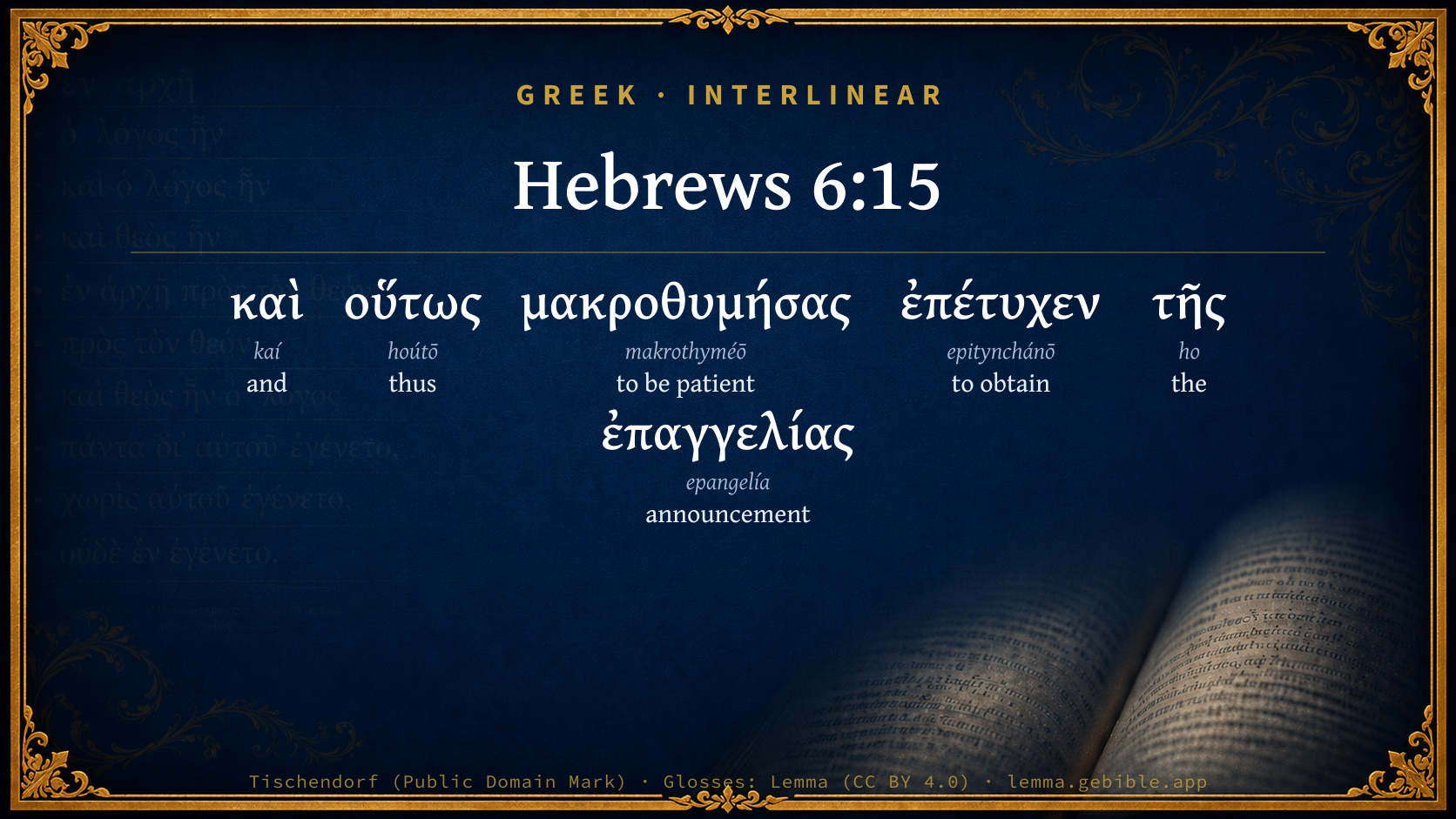
Greek (Tischendorf 8th ed.) Hebrews 6:15 appears in the Greek New Testament. The text above is from the Tischendorf 8th edition. Each word links to its Strong’s number and a concise gloss. Click any word for its full Thayer’s Greek Lexicon entry.
Download image
Cite this verse

Hebrews 6:15 (World English Bible). Public Domain. Lemma interlinear Bible study tool, https://lemma.gebible.app/v/hebrews/6/15.

Show BibTeX & RIS
BibTeX
RIS
English Translation
Thus, having patiently endured, he obtained the promise.
World English Bible · Public Domain
Download a study sheet

One document with this verse’s original text, its word-by-word gloss line, the meaning frame, cross-references with their text, attributed commentary, and full source and license credits — printable, and it pastes into notes with its structure intact.

This verse Autodidact and up

Study sheet (.html) Plain text (.txt)

A passage Seminary Student

Up to 50 verses in one chapter. A passage sheet keeps up to 6 commentary sources and 12 cross-references per verse, in the order this page ranks them, and says so on the sheet whenever that leaves anything out. Ask for a single verse and you get the Autodidact verse sheet above.

Everything on this page stays free to read, with no account — the sheet is a download of what is already on screen, not access to it.

Want to remove ads? Support Godless Engineer
Compare translations 3

The same verse in 3 English versions, stacked beneath the original-language interlinear above. Click any original word for its lexicon entry.

Each is an independent rendering of the whole verse — the interlinear is not word-aligned to these translations.

Highlighted words mark where these versions differ — a whole-verse word diff, not a word-by-word alignment.

  • World English Bible Public Domain
    Thus, having patiently endured, he obtained the promise.
  • King James Version Public Domain
    And so, after he had patiently endured, he obtained the promise.
  • unfoldingWord Literal Text CC BY-SA 4.0
    And in this way, having patiently waited, he obtained the promise.

unfoldingWord Literal Text — © unfoldingWord, licensed CC BY-SA 4.0. Word-aligned USFM3 via Door43 (git.door43.org/unfoldingWord/en_ult).

Versions to compare (up to 4)

3 of 4 selected

Show all 19 translations

Every available English version of this verse, each an independent rendering of the whole verse.

  • World English Bible Public Domain
    Thus, having patiently endured, he obtained the promise.
  • Berean Standard Bible Public Domain
    And so Abraham, after waiting patiently, obtained the promise.
  • Majority Standard Bible Public Domain
    And so Abraham, after waiting patiently, obtained the promise.
  • King James Version Public Domain
    And so, after he had patiently endured, he obtained the promise.
  • American Standard Version (1901) Public Domain
    And thus, having patiently endured, he obtained the promise.
  • Revised Version (1885) Public Domain
    And thus, having patiently endured, he obtained the promise.
  • Geneva Bible (1599) Public Domain
    And so after that he had taried patiently, he enioyed the promise.
  • Douay-Rheims (1899) Public Domain
    And so patiently enduring he obtained the promise.
  • Young's Literal Translation Public Domain
    and so, having patiently endured, he did obtain the promise;
  • Literal Standard Version CC BY-SA 4.0
    and so, having patiently endured, he obtained the promise;
  • Unlocked Literal Bible CC BY-SA 4.0
    In this way, Abraham obtained what was promised after he had patiently waited.
  • unfoldingWord Literal Text CC BY-SA 4.0
    And in this way, having patiently waited, he obtained the promise.
  • Darby Bible Public Domain
    and thus, having had long patience, he got the promise.
  • World Messianic Bible Public Domain
    Thus, having patiently endured, he obtained the promise.
  • Webster's Bible Public Domain
    And so, after he had patiently endured, he obtained the promise.
  • Free Bible Version CC BY-SA 4.0
    And so, after patiently waiting, Abraham received the promise.
  • Bible in Basic English Public Domain
    And so, when he had been waiting calmly for a long time, God's word to him was put into effect.
  • Text-Critical English NT CC BY 4.0
    And so Abraham, having patiently endured, obtained the promise.
  • Tyndale New Testament (1534) Public Domain
    And so after that he had taryed a longe tyme he enioyed the promes.

Literal Standard Version (2020), Covenant Press — licensed CC BY-SA 4.0. Text via the HelloAO Bible API (eBible.org). Unlocked Literal Bible (unfoldingWord) — licensed CC BY-SA 4.0. Text via the HelloAO Bible API (eBible.org). unfoldingWord Literal Text — © unfoldingWord, licensed CC BY-SA 4.0. Word-aligned USFM3 via Door43 (git.door43.org/unfoldingWord/en_ult). Free Bible Version, Dr. Jonathan Gallagher — licensed CC BY-SA 4.0. Text via the HelloAO Bible API (eBible.org).

Word by word

More ways to search: Search by grammar → Find every occurrence → Compare this word →

Practice this passage: Drill this verse → Learn its vocabulary →

About this verse

These counts appear in no published source. They are computed here, from the morphology-tagged text and Lemma’s own curated glosses. What Lemma adds →

6
words
6
distinct lemmas
General Epistles
section

Notable vocabulary

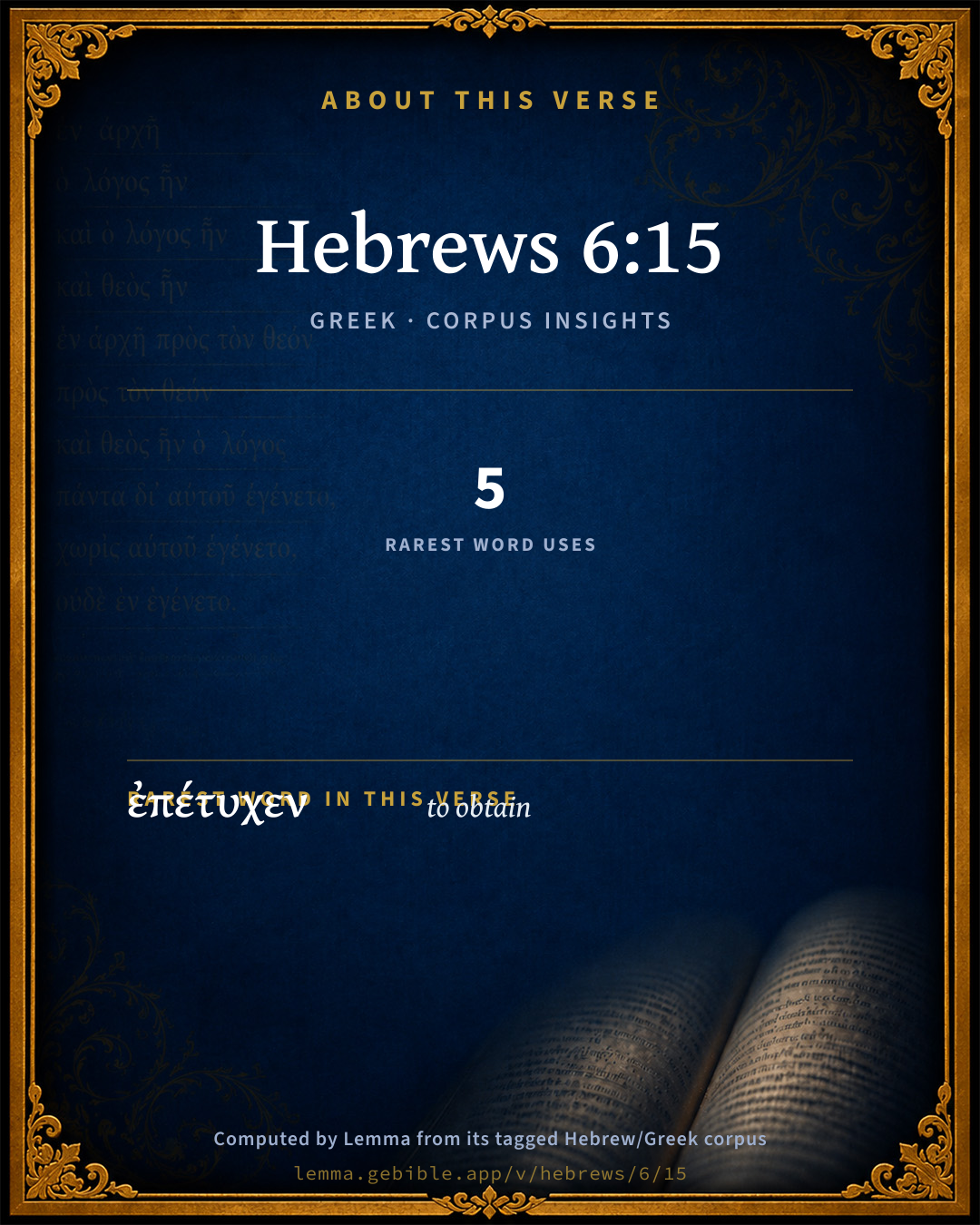
The rarest word here is ἐπέτυχεν to obtain G2013 — appearing just 5 times in the whole Greek New Testament.

Shared distinctive vocabulary

ἐπέτυχεν to obtain G2013 occurs in 4 verses of the Greek New Testament. Also found in:

Cross-references

8

Topical passages linked to Hebrews 6:15 in the Treasury of Scripture Knowledge — connected by theme and wording, ordered by reader-vote popularity; previews shown in the World English Bible.

  • Genesis 12:2–3 I will make of you a great nation. I will bless you, and make your name great. You will be a blessing.
  • Romans 4:17–25 As it is written, "I have made you a father of many nations." This is in the presence of him whom he believed: God, who gives life to the dead, and calls the things that are not, as though they were.
  • Genesis 15:2–6 Abram said, "Lord Yahweh, what will you give me, seeing I go childless, and he who will inherit my estate is Eliezer of Damascus?"
  • Exodus 1:7 The children of Israel were fruitful, and increased abundantly, and multiplied, and grew exceedingly mighty; and the land was filled with them.
  • Hebrews 6:12 that you won't be sluggish, but imitators of those who through faith and patience inherited the promises.
  • Genesis 17:16–17 I will bless her, and moreover I will give you a son by her. Yes, I will bless her, and she will be a mother of nations. Kings of peoples will come from her."
  • Genesis 21:2–7 Sarah conceived, and bore Abraham a son in his old age, at the set time of which God had spoken to him.
  • Habakkuk 2:2–3 Yahweh answered me, "Write the vision, and make it plain on tablets, that he may run who reads it.

Cross-references courtesy of OpenBible.info (CC BY 4.0).

Commentary

Notes on Hebrews 6:15 from classic Christian and Jewish commentators (each source and its license shown beneath its notes). The classic Christian expositions comment on the surrounding passage and are grouped to its opening verse, so a note may address several verses; the Jewish commentaries on the Tanakh (Rashi and others) are per-verse, so they appear only where the commentator wrote on this verse.

Lemma curates 59 commentaries, every one of them public domain or Creative Commons licensed, each selected and text-cleaned for this edition rather than reprinted as found. About our sources →

The Biblical Illustrator

Joseph S. Exell

Heb_6:15

After he had patiently endured, he obtained

Endurance and reward

I.

ENDURANCE.

1. Trials.

2. The frailties of human nature.

3. The Christian contest.

II. PATIENCE.

1. Gives calmness.

2. Bestows strength.

3. Takes away the bitterness of the endurance.

III. REWARD. Not anything actually tangible--a promise. Not the thing itself, but the shadow of the thing. This is to try our faith. But is not the promise really as sure as the reality? It was to Abraham. For there is no uncertainty with God. (Homilist.)

Patience and the promises

Good old Spurstow says that some Of the promises are like the almond tree--they blossom hastily in the very earliest spring; but, saith he, there are others that resemble the mulberry--they are very slow in putting forth their leaves. Then what is a man to do, if he has a mulberry tree promise which is late in blossoming? Why, he is to wait till it does. If the vision tarry, wait for it till it come, and the appointed time shall surely bring it. (C. H. Spurgeon.)

Time necessary for development

O impatient ones! Did the leaves say nothing to you as they murmured when you came hither to-day? They were not created this spring, but months ago; and the summer, just begun, will fashion others for another year. At the bottom of every leaf-stem is a cradle, and in it is an infant germ; and the winds will rock it, and the birds will sing to it all summer long; and next season it will unfold. So God is working for you, and carrying forward to the perfect development all the processes of your lives. (H. W. Beecher.)

Patience

Patience is but lying to, and riding out the gale. (H. W.Beecher.)

Pray and stay

Pray and stay are two blessed morn)syllables. (J. Donne.)

Patience

The husbandman is fain to have much patience, before he have his corn into the barn: with great toil he ploughs his ground, harrows it, casts his seed into the earth; he knows not whether he shall see it any more, but rests patiently in Gods providence. The merchant is fain to have much patience, before he can mount up to any wealth: many a storm he endures on the sea, often in danger of his life. The clothier must have much patience, in buying of his wool, is making of it out, in selling of his cloth, he is fain to stand to many casualties; yet hope of a convenient gain in the end, makes him with cheerfulness to pass through them all. They do it for earthly things, that are h re to-day and gone to-morrow; and shall not we be patient for heavenly treasures, for a kingdom that cannot be shaken, but is eternal in the heavens? Be patient a while: pass through poverty, sickness, malevolent tongues, and all other calamities in this life, that we may at length be taken up into that place, where we shall have need of patience no more; for all tears shall be wiped away from our eyes. (W. Johns, D. D.)

The Biblical Illustrator, edited by Joseph S. Exell (c. 1880s–1900s) — public domain. Text from a community e-Sword module.

Tyndale Open Study Notes

Tyndale Open Resources

6:15 what God had promised: Through Isaac, God made Abraham into a great nation (Exod 1:7).

Tyndale Open Study Notes — © Tyndale Open Resources, licensed CC BY-SA 4.0. Text via the HelloAO Bible API.

Bengel's Gnomon

Johann Albrecht Bengel

Heb 6:15. Μακροθυμήσας, after he had patiently endured) This is evident from the life of Abraham.—ἐπέτυχε τῆς ἐπαγγελίας, he obtained the promise) he got what was promised; Heb 6:14.

Bengel's Gnomon of the New Testament — English translation (T&T Clark, Edinburgh, 1860) — public domain. Text from a community e-Sword module.

Meyer's Critical & Exegetical Commentary

Heinrich August Wilhelm Meyer

Heb_6:15. Καὶ οὕτως] and in this way, i.e. since God on His part had in such manner afforded documentary evidence for the solemnity of His resolve. οὕτως belongs to ἐπέτυχεν. The combining of it with μακροθυμήσας, as is done by Stein, Tholuck,[79] and Bisping, and consequently taking the participle as an epexegesis of ΟὝΤΩς, is inadmissible, because in that case the ΜΑΚΡΟΘΥΜΊΑ of Abraham in particular must have been spoken of immediately before. The opinion of Delitzsch, however, who is followed by Maier, that the combination of the two combinations is the right one, refutes itself, since it requires that which is logically impossible.

ΜΑΚΡΟΘΥΜΉΣΑς] because he showed [or: had shown] persevering stedfastness (sc. in the faith, comp. Heb_6:12), in particular by the fact that he had just now been so ready at Gods behest to sacrifice his son Isaac, although this soon appeared to afford the only hold for the realization of the divine promise.

ἐπέτυχεν τῆς ἐπαγγελίας] he obtained the promise, i.e. the thing promised, inasmuch, namely, as not only Isaac was given back alive to Abraham, but he further lived to see the time when two sons were born to Isaac (comp. Gen_21:5; Gen_25:7; Gen_25:26), and thus the divine promise was fulfilled in its earlier stage. Not a fulfilment, which Abraham first witnessed in the life beyond the grave (Maier, Hofmann), is intended. Nor have we here to take ἐπαγγελία, with Bleek, in the active sense [the giving of a promise], and to refer it to the Messianic salvation placed in prospect. For, apart from the consideration that in this case ἐπέτυχεν τῆς ἐπαγγελίας would, in relation to ἘΠΑΓΓΕΙΛΆΜΕΝΟς, Heb_6:13, indicate no advance, the emphatically preposed ἘΠΈΤΥΧΕΝ can be understood only of the obtaining possession of the promised object itself. The promise repeated to Abraham, Gen_22:17-18, presented itself under a two fold point of view. His seed was to be multiplied, and in his seed were all nations of the earth to be blessed. Only the first of these in its earlier stage could Abraham, from the nature of the case, live to see; the fulfilment of the latter was attached to the appearing of Christ upon earth, which was to be looked for in the distant future. The first-named reference obtains Heb_6:15. The last-named mode of contemplating the subject underlies the ΚΛΗΡΟΝΌΜΟΙς Τῆς ἘΠΑΓΓΕΛΊΑς, Heb_6:17. That, too, which we read Heb_11:13; Heb_11:39, is spoken from the last-named point of view, on which account there is not to be found in these passages a contradiction of ours.

[79] Who unaccountably advances, as an argument in support, the supposition that then a parallel arises between the Christians, who, according to vv. 17, 18, are, on the ground of the divine oath, to hold fast the hope, and Abraham, who likewise did so.

Meyer — Critical and Exegetical Commentary on the New Testament — English translation by Peter Christie, edited by Frederick Crombie (T&T Clark, 1880) — public domain. Text from a community e-Sword module.

Expositor's Greek Testament

ed. W. Robertson Nicoll

Heb 6:15 . καὶ οὕτω μακροθυμήσας … “and thus having patiently waited he [Abraham] obtained the promise”. οὕτω , in these circumstances; that is, thus upheld by a promise and an oath. The oath warned him of trial. It would not have been given had the promise been a trifling one or had it been destined for immediate fulfilment. f1μακροθυμήσας , having long kept up his courage and his hope. Delay followed delay; disappointment followed disappointment. He was driven out of the promised land, and a barren wife mocked the hope of the promised seed, but he waited expectant, and at length ἐπέτυχε τῆς ἐπαγγελίας , for although it was true of him, as of all O.T. saints, that he did not obtain the promise, [ μὴ λαβόντες τὰς ἐπαγγελίας , Heb 11:13 ; οὐκ ἐκομίσαντο τὴν ἐπαγγελίαν , Heb 11:39 ], but could only wave his hand to it and salute it at a distance, yet the initial fulfilment he did see and was compensated for all his waiting by seeing the beginnings of that great history which ran on to the consummate performance of the promise in Christ. Bleek and Rendall understand by ἐπέτυχε … “obtained from God a promise of future blessing,” and not the thing itself. But in this case μακροθυμήσας would be irrelevant. He had not to wait for the promise, but for its fulfilment.

The Expositor's Greek Testament, edited by W. Robertson Nicoll (1897–1910) — public domain. Text from a community e-Sword module.

Jamieson, Fausset & Brown

Robert Jamieson, A. R. Fausset & David Brown

so--thus relying on the promise.

Jamieson, Fausset & Brown — Commentary Critical and Explanatory on the Whole Bible (1871) — public domain (CC PDM 1.0). Text via the HelloAO Bible API.

Adam Clarke's Commentary

Verse 15. He obtained the promise.] Isaac was supernaturally born; and in his birth God began to fulfil the promise: while he lived, he saw a provision made for the multiplication of his seed; and, having continued steadfast in the faith, he received the end of all the promises in the enjoyment of an eternal glory. And the inference from this is: If we believe and prove faithful unto death, we shall also inherit the promises; and this is what is implied in the apostle's exhortation, Heb 6:12: Be not slothful, but followers of them, &c.

Adam Clarke's Commentary on the Bible (1810–1826) — public domain. Text from a community e-Sword/MySword module.

Ellicott's Commentary for English Readers

(15) And so, after he had patiently endured.—Better, and thus (thus being in possession of the promise and the oath of God), having patiently waited (Heb_6:12) he obtained the promise—the promised gift. Though some portions of the promise received a partial accomplishment during Abraham’s life, it is not this that the writer has in view. (See Heb_6:12, and Heb_11:13.)

A Bible Commentary for English Readers, edited by Charles John Ellicott (1878–1897) — public domain. Text from a community e-Sword module.

The Cambridge Bible for Schools and Colleges

gen. ed. J. J. S. Perowne

15. after he had patiently endured] Lit., “having patiently endured,” which may mean “by patient endurance.” The participles in this passage are really contemporaneous with the principal verbs.

he obtained the promise] Gen_15:1; Gen_21:5; Gen_22:17-18; Gen_25:7, &c.; Joh_8:56. There is of course no contradiction to Heb_11:13; Heb_11:39, which refers to a farther future and a wider hope.

The Cambridge Bible for Schools and Colleges (gen. ed. J. J. S. Perowne; Cambridge University Press, 1878–1918) — public domain. Text from a community e-Sword module.

John Gill's Exposition

For men verily swear by the greater,.... These words contain a reason why God swore by himself, and why his promises, having an oath annexed to them, ought to be believed. Men when they swear, they swear by the greater; not by themselves, as God does, because there is one greater than they; not by any of the creatures on earth, nor by the angels in heaven, but by God; because he is the God of truth, the searcher of hearts, and who can take vengeance on perjurers: and an oath may lawfully be taken, when it is truth that is sworn to, and is just and good; and in cases of weight and moment; and in what is possible and right to perform; and when it is done with deliberation, in the fear of God, with a view to his glory, and the good of men: for an oath is of a moral nature, what God has commanded, and he himself has taken; it has been used by Christ, and by the saints of the Old and New Testament; and is prophesied of the New Testament saints, as what they should practise; and is a part of religious worship:

and an oath for confirmation is to them an end of all strife; it is used to confirm things that are doubtful, and in dispute; and to put an end to strife and contention; so Philo (o) the Jew says,

"by an oath things doubtful are determined, and things uncertain are confirmed, and what were not believed receive credit.''

The manner in which an oath was taken among the Jews, to which, the apostle writing to such, must be thought to have respect, was this;

"he that swore took the book of the law in his hand, and he stood and swore by the name (of God), or by his surnames; and the judges did not suffer anyone to swear but in the holy tongue; and thus he said, behold I swear by the God of Israel, by him whose name is merciful and gracious, that I do not owe this man anything (p).''

The Hebrew word used for an oath, is of the root which signifies to "fill, satiate, satisfy": for an oath being taken about matters in controversy, not clear but doubtful give content unto and satisfy the minds of men; and the same word also signifies "seven", a number of fulness and perfection; an oath being for the perfecting and finishing an affair in debate; agreeably, when covenants were made by oaths, seven witnesses were used, Gen 21:28 and Herodotus says (q) as Cocceius (r) observes, that the Arabians, when they swore at making covenants, anointed the stones with blood.

(o) De Somniis, p. 567. (p) Moses Kotsensis Mitzvot Torah, pr. Affirm. 123. (q) Thalia, l. 3. c. 8. (r) Lexic. Rad. col. 848.

John Gill's Exposition of the Whole Bible (1746–1763) — public domain (CC PDM 1.0). Text via the HelloAO Bible API.

Trapp's Complete Commentary

John Trapp

15 And so, after he had patiently endured, he obtained the promise.

Ver. 15. After he had patiently endured] Waited many years for an Isaac, and yet longer for eternal life. "I have waited for thy salvation, O Lord," saith dying Jacob, Gen 49:18.

John Trapp, A Commentary or Exposition upon All the Books of the Old and New Testament (1647–1656) — public domain. Text from a community e-Sword module.

Albert Barnes' Notes on the Bible

And so, after he had patiently endured - After he had waited for a long time. He did not faint or grow weary, but he persevered in a confident expectation of the fulfillment of what God had so solemnly promised.

He obtained the promise - Evidently the promise referred to in the oath - that he would have a numerous posterity. The apostle intimates that he had waited for that a long time; that his faith did not waver, and that in due season the object of his wishes was granted. To see the force of this, we are to remember:

(1)That when he was called by God from Haran, and when the promise of a numerous posterity was made to him, he was seventy-five years old; Gen 12:1-5.

Twenty-four years elapsed after this, during which he was a sojourner in a strange land, before the manner in which this promise would be fulfilled was made known to him; Gen. 17:1-16. It was only when he was an hundred years old, and when he had persevered in the belief of the truth of the promise against all the natural improbabilities of its accomplishment, that he received the pledge of its fulfillment in the birth of his son Isaac; Gen 21:1-5. The birth of that son was a pledge that the other blessings implied in the promise would be granted, and in that pledge Abraham may be said to have “received the promise.”

He did not actually see the numerous posterity of which he was to be the honored ancestor, nor the Messiah who was to descend from him, nor the happy influences which would result to mankind from the fulfillment of the promise. But he saw the certainty that all this would occur; he saw by faith the Messiah in the distance Joh 8:56, and the numerous blessings which would result from his coming. It was a remarkable instance of faith, and one well suited to the purpose of the apostle. It would furnish ample encouragement to the Christians to whom he wrote, to persevere in their course, and to avoid the dangers of apostasy. If Abraham persevered when “appearances” were so much against the fulfillment of what had been promised, then Christians should persevere under the clearer light and with the more distinct promises of the gospel.

Albert Barnes' Notes on the Bible (1834–1885) — public domain. Text from a community e-Sword/MySword module.

Matthew Poole's English Annotations

And so, after he had patiently endured: Abraham’s carriage was suitable to this sworn promise, his soul did patiently wait for it full thirty years, enduring and suffering many temptations about it; yet he overcame all, and continued firm in the covenant to the end; his faith extended his soul in a patient expectation of its accomplishment, without doubting or murmuring, knowing God would fulfil it in the best time: he was a long-breathed believer, Joh 8:56; Rom 4:20,21; Jas 1:2,3.

He obtained the promise; he did not fall short of any piece of the promise, but fully possessed it at last, both in Isaac, the type of the blessed Seed, and the Messiah himself, as to all the spiritual and eternal good promised in him and by him in the heavenly Canaan, Mat 22:32.

Matthew Poole's English Annotations on the Holy Bible (1683–1685) — public domain. Text from a community e-Sword/MySword module.

Whedon's Commentary on the Bible

Daniel D. Whedon

15. He had patiently endured—The endurance was from him, the assurance of reward from God. Obtained the (fulfilment of the) promise—Namely, in the birth of Isaac. In Isaac, the Messiah and all the blessings the Messiah includes, were respectively embodied, as the oak in the acorn.

Daniel D. Whedon (gen. ed.), Commentary on the Old and New Testaments (1874–1909) — public domain. Text from a community e-Sword module.

John Wesley's Explanatory Notes

After he had waited - Thirty years. He obtained the promise - Isaac, the pledge of all the promises.

John Wesley, Explanatory Notes Upon the Whole Bible (1754–1765) — public domain. Text via the GEBible commentary corpus.

The People's New Testament

B. W. Johnson

15. He obtained the promise. It was sure, but he had to patiently endure in order to obtain. The history of Abraham shows how he was blessed.

B. W. Johnson's The People's New Testament with Notes (1889–1891) — public domain. Electronic text from the Christian Classics Ethereal Library (CCEL) ThML edition.

Cambridge Greek Testament for Schools and Colleges

15. μακροθυμήσας. “Having patiently endured,” which may mean “by patient endurance.” The participles in this passage are really contemporaneous with the principal verbs.

ἐπέτυχεν. Gen 15:1; Gen 21:5; Gen 22:17-18; Gen 25:7, &c.; Joh 8:56. There is of course no contradiction to Heb 11:13; Heb 11:39, which refers to a farther future and a wider hope.

Cambridge Greek Testament for Schools and Colleges (Cambridge University Press, 1896; 21 vols, various authors incl. Carr, Maclear, Plummer, Farrar, Lumby, Moule, M. R. James, Simcox) — public domain. Text from a community e-Sword module.

Alford’s Greek Testament

Henry Alford

15.] and thus (οὕτως belongs to ἐπέτυχε, not to μακροθυμήσας, as Tholuck, and Hofm. Enst. p. 311, for then some particular instance or kind of patience would be most naturally pointed out. It then signifies, when he had received this promise—being in this state of dependence on the divine promise: see below, and reff.) having endured with patience (viz. in his waiting so long for God’s promise to be fulfilled—in having, when it was partially fulfilled, again shewn noble endurance in the will of God by offering up Isaac), he obtained the promise (i. e. not as Bleek, he had made to him the promise above related: this would nearly stultify the sentence, which proceeds on the faithfulness of God, confirming his promise with an oath by Himself, and the faith and endurance of Abraham, waiting for that promise to be fulfilled: but as Lün., he obtained, got fulfilled to him, the promise, the thing promised, to wit, the birth of Isaac, as the commencement of the fulfilment—as much of it as he could see. And thus Abraham became a κληρονόμος τῶν ἐπαγγελιῶν. That there is here no inconsistency with ch. 11:39, see shewn there. ἐπιτυγχάνω is always used of the actual getting in possession: ὁλκάδος ἀναγομένης ἐπέτυχον, Thuc. iii. 3: εἰ ἀγαθοῦ ὠνητοῦ ἐπιτύχοιμι, Xen. Œc. 2. 3: ἵππου ἐπιτυχὼν ἀγαθοῦ, ib. 12. 20: al. in Bleek. And the above is the explanation, I believe, of every expositor ancient and modern, except Schulz and Bleek. Ebrard indeed varies thus far, as to understand ἐπέτυχεν of Abraham’s final and heavenly enjoyment of the fulfilment of the Messianic promises: but I believe the aorist will be generally considered to preclude this).

Henry Alford, The Greek Testament (1849–1861) — public domain. Text from a community e-Sword module.

Vincent's Word Studies in the New Testament

Marvin R. Vincent

After he had patiently endured [μακροθυμησας] . Pointing back to makroqumia long - suffering, ver. 12.

He obtained [επετυχεν] . The compounded preposition ejpi has the force of upon : to light or hit upon. The verb indicates that Abraham did not personally receive the entire fulfillment of the promise, but only the germ of its fulfillment. It was partially fulfilled in the birth of Isaac. See Rom 4:18.

The security of the divine promise illustrated by the analogy of human practice.

Marvin R. Vincent, Word Studies in the New Testament (1887–1900) — public domain. Text from a community e-Sword/MySword module.

Lesson kit

Teaching starters — assembled from the data on this page, not authored interpretation. Every prompt links to the verse data it draws on. Edit before teaching.

Hebrews, in the General Epistles, opens this verse with 6 words (6 distinct Greek lemmas). Its most distinctive word is epitynchánō (“to obtain”). A historical commentator’s framing appears above. Read the whole chapter for the surrounding context.

Discussion questions

  1. What does “to obtain” (epitynchánō) contribute to the verse as a whole?
  2. Romans 11:7 shares the word «to obtain» with this verse. How do the two illuminate each other?
  3. The translations on this page render this verse differently — a whole-verse word diff, not a word-by-word alignment. What might account for the different wordings?
  4. Reading how The Biblical Illustrator and Tyndale Open Study Notes read this verse, where do the two commentators agree and where do they part?

Things to notice

Reading settings

Reading text

Shown beneath each verse's original-language words.

Old Testament
Old Testament edition

Read the OT as the Masoretic Hebrew (MT) or the Greek Septuagint (LXX).

English shown for the Greek Septuagint (in the Hebrew ↔ Greek comparison).

Comparing translations? Open the Compare panel on any verse page to stack up to four side by side.