1 Corinthians 3:15

Greek (Tischendorf 8th ed.) 1 Corinthians 3:15 appears in the Greek New Testament. The text above is from the Tischendorf 8th edition. Each word links to its Strong’s number and a concise gloss. Click any word for its full Thayer’s Greek Lexicon entry.
Download image
Cite this verse

1 Corinthians 3:15 (World English Bible). Public Domain. Lemma interlinear Bible study tool, https://lemma.gebible.app/v/1-corinthians/3/15.

Show BibTeX & RIS
BibTeX
RIS
English Translation
If any man's work is burned, he will suffer loss, but he himself will be saved, but as through fire.
World English Bible · Public Domain
Download a study sheet

One document with this verse’s original text, its word-by-word gloss line, the meaning frame, cross-references with their text, attributed commentary, and full source and license credits — printable, and it pastes into notes with its structure intact.

This verse Autodidact and up

Study sheet (.html) Plain text (.txt)

A passage Seminary Student

Up to 50 verses in one chapter. A passage sheet keeps up to 6 commentary sources and 12 cross-references per verse, in the order this page ranks them, and says so on the sheet whenever that leaves anything out. Ask for a single verse and you get the Autodidact verse sheet above.

Everything on this page stays free to read, with no account — the sheet is a download of what is already on screen, not access to it.

Want to remove ads? Support Godless Engineer
Compare translations 3

The same verse in 3 English versions, stacked beneath the original-language interlinear above. Click any original word for its lexicon entry.

Each is an independent rendering of the whole verse — the interlinear is not word-aligned to these translations.

Highlighted words mark where these versions differ — a whole-verse word diff, not a word-by-word alignment.

  • World English Bible Public Domain
    If any man's work is burned, he will suffer loss, but he himself will be saved, but as through fire.
  • King James Version Public Domain
    If any man's work shall be burned, he shall suffer loss: but he himself shall be saved; yet so as by fire.
  • unfoldingWord Literal Text CC BY-SA 4.0
    if anyone’s work will be burned up, he will suffer loss, but he himself will be saved, but as though through fire.

unfoldingWord Literal Text — © unfoldingWord, licensed CC BY-SA 4.0. Word-aligned USFM3 via Door43 (git.door43.org/unfoldingWord/en_ult).

Versions to compare (up to 4)

3 of 4 selected

Show all 19 translations

Every available English version of this verse, each an independent rendering of the whole verse.

  • World English Bible Public Domain
    If any man's work is burned, he will suffer loss, but he himself will be saved, but as through fire.
  • Berean Standard Bible Public Domain
    If it is burned up, he will suffer loss. He himself will be saved, but only as if through the flames.
  • Majority Standard Bible Public Domain
    If it is burned up, he will suffer loss. He himself will be saved, but only as if through the flames.
  • King James Version Public Domain
    If any man's work shall be burned, he shall suffer loss: but he himself shall be saved; yet so as by fire.
  • American Standard Version (1901) Public Domain
    If any man's work shall be burned, he shall suffer loss: but he himself shall be saved; yet so as through fire.
  • Revised Version (1885) Public Domain
    If any man’s work shall be burned, he shall suffer loss: but he himself shall be saved; yet so as through fire.
  • Geneva Bible (1599) Public Domain
    If any mans worke burne, he shall lose, but he shalbe saued himselfe: neuerthelesse yet as it were by the fire.
  • Douay-Rheims (1899) Public Domain
    If any man's work burn, he shall suffer loss; but he himself shall be saved, yet so as by fire.
  • Young's Literal Translation Public Domain
    if of any the work is burned up, he shall suffer loss; and himself shall be saved, but so as through fire.
  • Literal Standard Version CC BY-SA 4.0
    if the work of any is burned up, he will suffer loss, but himself will be saved, but so as through fire.
  • Unlocked Literal Bible CC BY-SA 4.0
    but if anyone's work is burned up, he will suffer loss, but he himself will be saved, as though escaping through fire.
  • unfoldingWord Literal Text CC BY-SA 4.0
    if anyone’s work will be burned up, he will suffer loss, but he himself will be saved, but as though through fire.
  • Darby Bible Public Domain
    If the work of any one shall be consumed, he shall suffer loss, but *he* shall be saved, but so as through [the] fire.
  • World Messianic Bible Public Domain
    If any man’s work is burned, he will suffer loss, but he himself will be saved, but as through fire.
  • Webster's Bible Public Domain
    If any man's work shall be burned, he will suffer loss: but he himself shall be saved; yet so as by fire.
  • Free Bible Version CC BY-SA 4.0
    Those whose building is burned up will lose out. They will still be saved, but it will be like passing through fire!
  • Bible in Basic English Public Domain
    If the fire puts an end to any man's work, it will be his loss: but he will get salvation himself, though as by fire.
  • Text-Critical English NT CC BY 4.0
    If anyone's work is burned up, he will suffer loss; yet he himself will be saved, but only as through fire.
  • Tyndale New Testament (1534) Public Domain
    If eny manes worke burne he shall suffre losse: but he shalbe safe him selfe: neverthelesse yet as it were thorow fyre.

Literal Standard Version (2020), Covenant Press — licensed CC BY-SA 4.0. Text via the HelloAO Bible API (eBible.org). Unlocked Literal Bible (unfoldingWord) — licensed CC BY-SA 4.0. Text via the HelloAO Bible API (eBible.org). unfoldingWord Literal Text — © unfoldingWord, licensed CC BY-SA 4.0. Word-aligned USFM3 via Door43 (git.door43.org/unfoldingWord/en_ult). Free Bible Version, Dr. Jonathan Gallagher — licensed CC BY-SA 4.0. Text via the HelloAO Bible API (eBible.org).

Word by word

More ways to search: Search by grammar → Find every occurrence → Compare this word →

Practice this passage: Drill this verse → Learn its vocabulary →

ζημιωθήσεται
zēmióō
G2210
“to damage”
Verb, Future, Passive, Indicative, 3rd person, Singular
Part of Speech
Verb
Tense
Future
Voice
Passive
Mood
Indicative
Person
3rd person
Number
Singular
Full Thayer's Definition

Origin: from G2209

TDNT: 16:48,3

1. to affect with damage, do damage to 2. to sustain damage, to receive injury, suffer loss
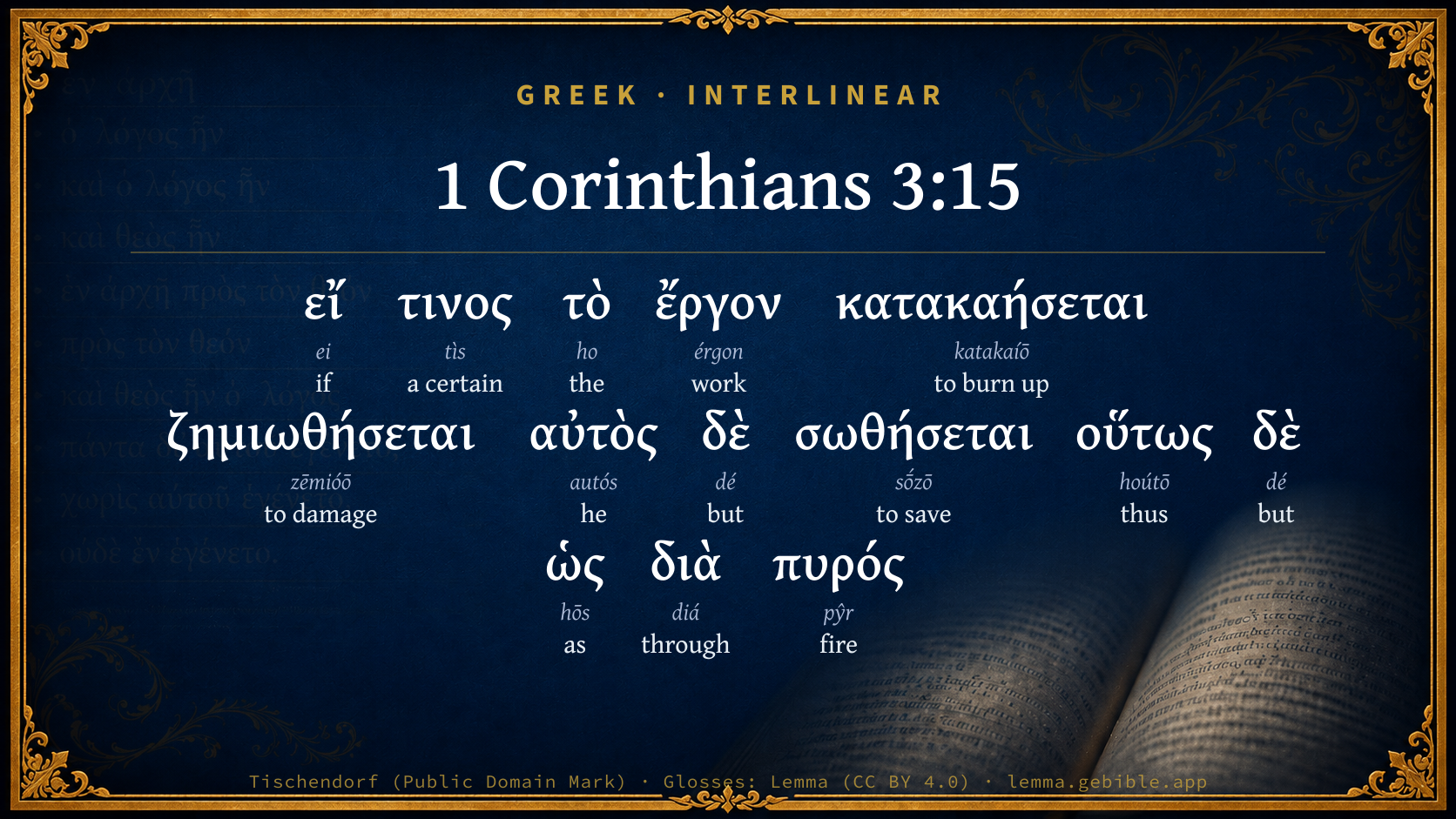
  1. εἴ ei G1487 “if” Conditional
  2. τινος tìs G5100 “a certain” Indefinite pronoun, Genitive, Singular, Masculine
  3. τὸ ho G3588 “the” Article, Nominative, Singular, Neuter
  4. ἔργον érgon G2041 “work” Noun, Nominative, Singular, Neuter
  5. κατακαήσεται katakaíō G2618 “to burn up” Verb, Future, Passive, Indicative, 3rd person, Singular
  6. αὐτὸς autós G846 “he” Personal pronoun, Nominative, Singular, Masculine
  7. δὲ dé G1161 “but” Conjunction
  8. σωθήσεται sṓzō G4982 “to save” Verb, Future, Passive, Indicative, 3rd person, Singular
  9. οὕτως hoútō G3779 “thus” Adverb
  10. δὲ dé G1161 “but” Conjunction
  11. ὡς hōs G5613 “as” Adverb
  12. διὰ diá G1223 “through” Preposition
  13. πυρός pŷr G4442 “fire” Noun, Genitive, Singular, Neuter

About this verse

These counts appear in no published source. They are computed here, from the morphology-tagged text and Lemma’s own curated glosses. What Lemma adds →

14
words
13
distinct lemmas
Pauline Epistles
section

Notable vocabulary

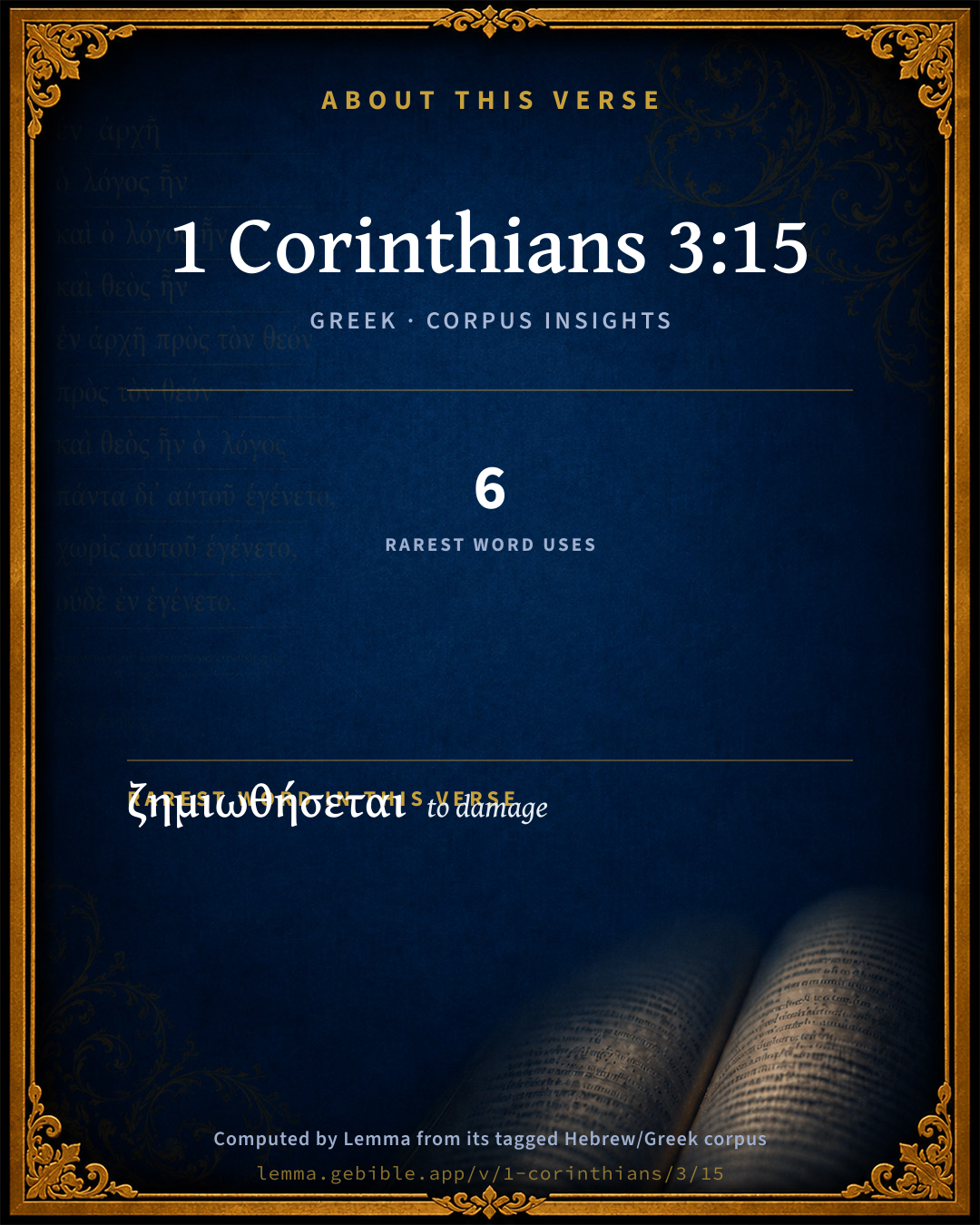
The rarest word here is ζημιωθήσεται to damage G2210 — appearing just 6 times in the whole Greek New Testament.

Shared distinctive vocabulary

ζημιωθήσεται to damage G2210 occurs in 6 verses of the Greek New Testament. Also found in:

Repetition

A word recurs within this verse:

Cross-references

8

Topical passages linked to 1 Corinthians 3:15 in the Treasury of Scripture Knowledge — connected by theme and wording, ordered by reader-vote popularity; previews shown in the World English Bible.

  • 2 John 1:8 Watch yourselves, that we don't lose the things which we have accomplished, but that we receive a full reward.
  • 1 Corinthians 3:12–13 But if anyone builds on the foundation with gold, silver, costly stones, wood, hay, or stubble;
  • Jude 1:23 and some save, snatching them out of the fire with fear, hating even the clothing stained by the flesh.
  • Revelation 3:18 I counsel you to buy from me gold refined by fire, that you may become rich; and white garments, that you may clothe yourself, and that the shame of your nakedness may not be revealed; and eye salve to anoint your eyes, that you may see.
  • 1 Peter 4:18 "If it is hard for the righteous to be saved, what will happen to the ungodly and the sinner?"
  • Zechariah 3:2 Yahweh said to Satan, "Yahweh rebuke you, Satan! Yes, Yahweh who has chosen Jerusalem rebuke you! Isn't this a burning stick plucked out of the fire?"
  • Psalms 66:12 You allowed men to ride over our heads. We went through fire and through water, But you brought us to the place of abundance.
  • Amos 4:11 "I have overthrown some of you, As when God overthrew Sodom and Gomorrah, And you were like a burning stick plucked out of the fire; Yet you haven't returned to me," says Yahweh.

Cross-references courtesy of OpenBible.info (CC BY 4.0).

Commentary

Notes on 1 Corinthians 3:15 from classic Christian and Jewish commentators (each source and its license shown beneath its notes). The classic Christian expositions comment on the surrounding passage and are grouped to its opening verse, so a note may address several verses; the Jewish commentaries on the Tanakh (Rashi and others) are per-verse, so they appear only where the commentator wrote on this verse.

Lemma curates 59 commentaries, every one of them public domain or Creative Commons licensed, each selected and text-cleaned for this edition rather than reprinted as found. About our sources →

Jamieson, Fausset & Brown

Robert Jamieson, A. R. Fausset & David Brown

If . . . be burnt--if any teacher's work consist of such materials as the fire will destroy [ALFORD].

suffer loss--that is, forfeit the special "reward"; not that he shall lose salvation (which is altogether a free gift, not a "reward" or wages), for he remains still on the foundation (Co1 3:12; Jo2 1:6).

saved; yet so as by fire--rather, "so as through fire" (Zac 3:2; Amo 4:11; Jde 1:23). "Saved, yet not without fire" (Rom 2:27) [BENGEL]. As a builder whose building, not the foundation, is consumed by fire, escapes, but with the loss of his work [ALFORD]; as the shipwrecked merchant, though he has lost his merchandise, is saved, though having to pass through the waves [BENGEL]; Mal 3:1-2; Mal 4:1, give the key to explain the imagery. The "Lord suddenly coming to His temple" in flaming "fire," all the parts of the building which will not stand that fire will be consumed; the builders will escape with personal salvation, but with the loss of their work, through the midst of the conflagration [ALFORD]. Again, a distinction is recognized between minor and fundamental doctrines (if we regard the superstructure as representing the doctrines superadded to the elementary essentials); a man may err as to the former, and yet be saved, but not so as to the latter (compare Phi 3:15).

Jamieson, Fausset & Brown — Commentary Critical and Explanatory on the Whole Bible (1871) — public domain (CC PDM 1.0). Text via the HelloAO Bible API.

Bengel's Gnomon

Johann Albrecht Bengel

1Co 3:15. Ζημιωθήσεται, he shall suffer loss) He shall fail in obtaining the reward, not in obtaining salvation.—αὐτὸς) he himself.—σωθήσεται, shall be saved) because he does not forsake this foundation, 1Co 3:12.—ὡς, as) a particle of explanation and limitation; as one who should be obliged to go through fire.—διὰ, through) So διὰ, through [= with], Rom 2:27: not without fire, comp. 1Co 3:13. As the shipwrecked merchant, though he has lost his merchandise and his gain, is saved through the waves.[28]

[28] Is saved, though having to pass through the waves.—ED.

Bengel's Gnomon of the New Testament — English translation (T&T Clark, Edinburgh, 1860) — public domain. Text from a community e-Sword module.

Hodge's Commentary on Romans, Ephesians & First Corinthians

Charles Hodge

1Co_3:14, 1Co_3:15

If any mans work abide which he hath built thereupon, he shall receive a reward. If any mans work shall be burned, he shall suffer loss: but he himself shall be saved; yet so as by fire.

This is an amplification of what precedes. If the materials employed by a spiritual builder stand the test of the day of judgment, he shall receive the reward of a faithful servant. Which he hath built thereupon, i.e. upon the foundation. Comp. 1Co_3:12. If any mans work shall be burned (κατακαήσεται for κατακαυθήσεται); that is, if the materials used by any builder shall not stand the test of that day, he shall suffer loss (ζημιωθήσεται see 2Co_7:9; Phi_3:8). That is, he will lose his reward.

But he himself shall be saved. Just as a man who has built his house of combustible materials, though he may escape when the fire comes, his property is lost, and all his labor comes to nothing. The apostle is here speaking of those teachers who, although they retain the fundamental doctrines of the gospel, yet combine them with error. This is plain from 1Co_3:12, If any man shall build on this foundation. It is not enough, therefore, that a minister hold fast to fundamental truth; he must take heed what he teaches in connection with that truth. If he mingles with it the wood, hay and stubble of his own philosophy, he will find himself a loser on the day of judgment. Many of the Fathers understand σωθήσεται here in the sense of shall be preserved. His work shall be consumed, but he himself shall be kept alive in the midst of the fire. It is not then the salvation, but the final perdition of the false teacher that the passage teaches. This, however, is contrary to the uniform meaning of the word in the New Testament. The common interpretation is therefore to be preferred.

Yet so as by fire, i.e. with difficulty. Comp. 1Pe_3:20; Jud_1:23; Zec_3:2. He will just escape with his life, as a man is rescued from a burning building. His salvation will not only be effected with difficulty, but it will be attended with great loss. He will occupy a lower place in the kingdom of heaven than he would have done. Romanists found their doctrine of purgatory on tradition rather than on Scripture. They are glad, however, to avail themselves of any semblance of scriptural support, and therefore appeal to this passage to prove that men are saved through fire. But,

1. Paul is here speaking of ministers and of their doctrines, and not of believers in general.

2. The fire of which he speaks is not a state of trial preceding the judgment, but the judgment itself.

3. The fire is that in the midst of which Jesus Christ is to appear.

4. Paul does not say, the man is to be saved by being purified by fire, but simply with difficulty, as the expression so as by fire familiarly means.

Charles Hodge — Commentary on Romans (1835), First Corinthians (1857), and Ephesians (1856) — public domain. Text from a community e-Sword module.

Geneva Bible (1599)

Geneva Bible translators

He taketh not away hope of salvation from the unskillful and foolish builders, which hold fast the foundation, of which sort were those Rhetoricians rather than pastors of Corinth: but he addeth an exception, that they must notwithstanding suffer this trial of their work, and also abide the loss of their vain labors.

Geneva Bible (1599) marginal notes — public domain. Text via Bolls.life.

Adam Clarke's Commentary

Verse 15. If any man's work shall be burned, he shall suffer loss] If he have preached the necessity of incorporating the law with the Gospel, or proclaimed as a doctrine of God any thing which did not proceed from heaven, he shall suffer loss-all his time and labour will be found to be uselessly employed and spent. Some refer the loss to the work, not to the man; and understand the passage thus: If any man's work be burned, IT shall suffer loss-much shall be taken away from it; nothing shall he left but the measure of truth and uprightness which it may have contained.

But he himself shall be saved] If he have sincerely and conscientiously believed what he preached, and yet preached what was wrong, not through malice or opposition to the Gospel, but through mere ignorance, he shall be saved; God in his mercy will pass by his errors; and he shall not suffer punishment because he was mistaken. Yet, as in most erroneous teachings there is generally a portion of wilful and obstinate ignorance, the salvation of such erroneous teachers is very rare; and is expressed here, yet so as by fire, i.e. with great difficulty; a mere escape; a hair's breadth deliverance; he shall be like a brand plucked out of the fire.

The apostle obviously refers to the case of a man, who, having builded a house, and begun to dwell in it, the house happens to be set on fire, and he has warning of it just in time to escape with his life, losing at the same time his house, his goods, his labour, and almost his own life. So he who, while he holds the doctrine of Christ crucified as the only foundation on which a soul can rest its hopes of salvation, builds at the same time, on that foundation, Antinomianism, or any other erroneous or destructive doctrine, he shall lose all his labour, and his own soul scarcely escape everlasting perdition; nor even this unless sheer ignorance and inveterate prejudice, connected with much sincerity, be found in his case.

The popish writers have applied what is here spoken to the fire of purgatory; and they might with equal propriety have applied it to the discovery of the longitude, the perpetual motion, or the philosopher's stone; because it speaks just as much of the former as it does of any of the latter. The fire mentioned here is to try the man's work, not to purify his soul; but the dream of purgatory refers to the purging in another state what left this impure; not the work of the man, but the man himself; but here the fire is said to try the work: ergo, purgatory is not meant even if such a place as purgatory could be proved to exist; which remains yet to be demonstrated.

Adam Clarke's Commentary on the Bible (1810–1826) — public domain. Text from a community e-Sword/MySword module.

John Calvin's Commentaries

15. If any man’s work shall be burned. It is as though he had said: Let no man flatter himself on the ground that, in the opinion of men, he is reckoned among the most eminent master-builders, for as soon as the day breaks in, his whole work must go utterly to nothing, if it is not approved of by the Lord. This, then, is the rule to which every one’s ministry requires to be conformed. Some explain this of doctrine, so that ζημιουσθαι means simply to perish, and then what immediately follows they view as referring to the foundation, because in the Greek θεμελιος (foundation) is in the masculine gender. They do not, however, sufficiently attend to the entire context. For Paul in this passage subjects to trial, not his own doctrine, but that of others. Hence it were out of place to make mention at present of the foundation. He has stated a little before, that every man’s work will be tried by fire. He comes afterwards to state an alternative, which ought not to be extended beyond that general observation. Now it is certain that Paul spoke there simply of the structure which had been erected upon the foundation. He has already in the first clause promised a reward to good master-builders, whose labor shall have been approved of. Hence the contrast in the second clause suits admirably well — that those who have mixed stubble, or wood, or straw, will be disappointed of the commendation which they had expected.

He himself will be saved, etc. It is certain that Paul speaks of those who, while always retaining the foundations, mix hay with gold, stubble with silver, and wood with precious stones — that is, those who build upon Christ, but in consequence of the weakness of the flesh, admit something that is man’s, or through ignorance turn aside to some extent from the strict purity of God’s word. Such were many of the saints, Cyprian, Ambrose, Augustine, and the like. Add to these, if you choose, from those of later times, Gregory and Bernard, and others of that stamp, who, while they had it as their object to build upon Christ, did nevertheless often deviate from the right system of building. Such persons, Paul says, could be saved, but on this condition — if the Lord wiped away their ignorance, and purged them from all dross.

This is the meaning of the clause so as by fire. He means, therefore, to intimate, that he does not take away from them the hope of salvation, provided they willingly submit to the loss of their labor, and are purged by the mercy of God, as gold is refined in the furnace. Farther, although God sometimes purges his own people by afflictions, yet here by the name of fire, I understand the touchstone of the Spirit, by which the Lord corrects and removes the ignorance of his people, by which they were for a time held captive. I am aware, indeed, that, many refer this to the cross, but I am confident that my interpretation will please all that are of sound judgment.

It remains, that we give an answer in passing to the Papists, who endeavor from this passage to prop up Purgatory. “The sinners whom God forgives, pass through the fire, that they may be saved.” Hence they in this way suffer punishment in the presence of God, so as to afford satisfaction to his justice I pass over their endless fictions in reference to the measure of punishment, and the means of redemption from them, but I ask, who they are that pass through the fire? Paul assuredly speaks of ministers alone. “There is the same reason,” they say, “as to all.” It is not for us but for God to judge as to this matter. But even granting them this, how childishly they stumble at the term fire. For to what purpose is this fire, but for burning up the hay and straw, and on the other hand, for proving the gold and silver. Do they mean to say that doctrines are discerned by the fire of their purgatory? Who has ever learned from that, what difference there is between truth and falsehood? Farther, when will that day come that will shine forth so as to discover every one’s work? Did it begin at the beginning of the world, and will it continue without interruption to the end? If the terms stubble, hay, gold, and silver are figurative, as they must necessarily allow, what correspondence will there be between the different clauses, if there is nothing figurative in the term fire? Away, then, with such silly trifles, which carry their absurdity in their forehead, for the Apostle’s true meaning is, I think, sufficiently manifest.

John Calvin's Commentaries (1540-1563) — public domain. Text from the Calvin Translation Society English edition (1840s-50s) via the Christian Classics Ethereal Library (ccel.org). Calvin's coverage is partial (roughly two-thirds of the Bible); uncommented books and verses are honest gaps, never fabricated. The 19th-century editor's footnotes and remarks are omitted so the notes are faithfully Calvin's own voice.

Ellicott's Commentary for English Readers

(15) So as.—These words remind us that the whole passage, and especially the reference to fire, is to be regarded as metaphorical, and not to be understood in a literal and physical sense. Forgetting this, Roman divines have evolved from these words the doctrine of purgatory.

A Bible Commentary for English Readers, edited by Charles John Ellicott (1878–1897) — public domain. Text from a community e-Sword module.

The Cambridge Bible for Schools and Colleges

gen. ed. J. J. S. Perowne

15. yet so as by fire] The absolute equality of all in the world to come is no part of St Paul’s system. ‘One star differeth from another star in glory’ (ch. 1Co_15:41). But the history of the Apostle himself is a sufficient evidence that God will not punish with the loss of His presence the man who has acted up to the highest dictates of a conscience not yet fully enlightened. The work perishes, but he who believed himself to be actively serving God when in fact he was doing nothing shall not be driven into the outer darkness. “Sincerity does not verify doctrine, but it saves the man; his person is accepted, though his work perish.”—Robertson. Yet he will be saved ‘so as by fire.’ Surely the ‘smell of fire’ may be said to pass on him who sees all those works which he so honestly believed to be for God vanishing as worthless stubble in the searching trial which will ‘purge away all the dross’ of our human doings, and leave only what is of real value in God’s sight.

The Cambridge Bible for Schools and Colleges (gen. ed. J. J. S. Perowne; Cambridge University Press, 1878–1918) — public domain. Text from a community e-Sword module.

John Gill's Exposition

If any man's work shall be burnt,.... If any minister's doctrine he has preached shall be destroyed and disappear, shall be disapproved of, and rejected by the churches, not being able, to bear the light and heat of the fire of God's word:

he shall suffer loss; of all his labour and pains he has been at, in collecting together such trifling, useless, and inconsistent things; and of all that glory and popular applause he might expect from men, on account of them, and which was the snare that drew him into such a way of preaching:

but he himself shall be saved; with an everlasting salvation; not by his ministerial labours, much less by his wood, hay, and stubble, which will be all burnt up; but through his being, notwithstanding all the imperfections of his ministry, upon the foundation Christ:

yet so as by fire; with much difficulty, and will be scarcely saved; see Pe1 4:17 with great danger, loss, and shame; as a man that is burnt out of house and home, he escapes himself with his own life, but loses all about him: so the Syriac version reads it, , "as out of the fire": see Zac 3:2. Or the sense is, that he shall be tried by the fire of the word, and convinced by the light of it of the errors, irregularities, and inconsistencies of his ministry; either in his time of life and health, or on a death bed; and shall have all his wood, hay, and stubble burnt up, for nothing of this kind shall he carry with him in his judgment to heaven; only the gold, silver, and precious stones; and will find that the latter doctrines, and not the former, will only support him in the views of death and eternity.

John Gill's Exposition of the Whole Bible (1746–1763) — public domain (CC PDM 1.0). Text via the HelloAO Bible API.

Trapp's Complete Commentary

John Trapp

15 If any man’s work shall be burned, he shall suffer loss: but he himself shall be saved; yet so as by fire.

Ver. 15. He shall suffer loss] Of his work (his laborious loss of time) and of some part of his wages.

Yet so as by fire] Not of purgatory (a Popish fiction), but of the Holy Ghost. Or (as one interprets it) like unto them who save themselves naked out of the fire without carrying away any of their goods; so his person shall be saved, but he shall not have the reward of a well-qualified minister.

John Trapp, A Commentary or Exposition upon All the Books of the Old and New Testament (1647–1656) — public domain. Text from a community e-Sword module.

Albert Barnes' Notes on the Bible

If any man’s work shall be burned - If it shall not be found to hear the test of the investigation of that Day - as a cottage of wood, hay, and stubble would not bear the application of fire. If his doctrines have not been true; if he has had mistaken views of piety; if he has nourished feelings which he thought were those of religion; and inculcated practices which, however well meant, are not such as the gospel produces; if he has fallen into error of opinion, feeling, practice, however conscientious, yet he shall suffer loss.

He shall suffer loss - :

(1) He shall not be elevated to as high a rank and to as high happiness as he otherwise would. That which he supposed would be regarded as acceptable by the Judge, and rewarded accordingly, shall be stripped away, and shown to be unfounded and false; and in consequence, he shall not obtain those elevated rewards which he anticipated. This, compared with what he expected, may be regarded as a loss.

(2) He shall be injuriously affected by this forever. It shall be a detriment to him to all eternity. The effects shall be felt in all his residence in heaven - not producing misery but attending him with the consciousness that he might have been raised to superior bliss in the eternal abode - The phrase here literally means, “he shall be mulcted.” The word is a legal term, and means that he shall be fined, that is, he shall suffer detriment.

But he himself shall be saved - The apostle all along has supposed that the true foundation was laid 1Co 3:11, and if that is laid, and the edifice is reared upon that, the person who does it shall be safe. There may be much error, and many false views of religion, and much imperfection, still the man that is building on the true foundation shall be safe. His errors and imperfections shall be removed, and he may occupy a lower place in heaven, but he shall be safe.

Yet so as by fire - ὡς διὰ πυρός hōs dia puros. This passage has greatly perplexed commentators; but probably without any good reason. The apostle does not say that Christians will be doomed to the fires of purgatory; nor that they will pass through fire; nor that they will be exposed to pains and punishment at all; but he “simply carries out the figure” which he commenced, and says that they will be saved, as if the action of fire had been felt on the edifice on which he is speaking. That is, as fire would consume the wood, hay, and stubble, so on the great Day everything that is erroneous and imperfect in Christiana shall be removed, and that which is true and genuine shall be preserved as if it had passed through fire. Their whole character and opinions shall be investigated; and that which is good shall be approved; and that which is false and erroneous be removed.

The idea is not that of a man whose house is burnt over his head and who escapes through the flames, nor that of a man who is subjected to the pains and fires of purgatory; but that of a man who had been spending his time and strength to little purpose; who had built, indeed, on the true foundation, but who had reared so much on it which was unsound, and erroneous, and false, that he himself would be saved with great difficulty, and with the loss of much of that reward which he had expected, as if the fire had passed over him and his works. The simple idea, therefore, is, that that which is genuine and valuable in his doctrines and works, shall be rewarded, and the man shall be saved; that which is not sound and genuine, shall be removed, and he shall suffer loss. Some of the fathers, indeed, admitted that this passage taught that all people would be subjected to the action of fire in the great conflagration with which the world shall close; that the wicked shall be consumed; and that the righteous are to suffer, some more and some less, according to their character. On passages like this, the Roman Catholic doctrine of purgatory is based. But we may observe:

(1) That this passage does not necessarily or naturally give any such idea. The interpretation stated above is the natural interpretation, and one which the passage will not only bear, but which it demands.

(2) If this passage would give any countenance to the absurd and unscriptural idea that the souls of the righteous at the Day of Judgment are to be re-united to their bodies, in order to be subjected to the action of intense heat, to be brought from the abodes of bliss and compelled to undergo the burning fires of the last conflagration, still it would give no countenance to the still more absurd and unscriptural opinion that those fires have been and are still burning; that all souls are to be subjected to them; and that they can be removed only by masses offered for the dead, and by the prayers of the living. The idea of danger and peril is, indeed, in this text; but the idea of personal salvation is retained and conveyed.

Albert Barnes' Notes on the Bible (1834–1885) — public domain. Text from a community e-Sword/MySword module.

Haydock's Catholic Bible Commentary

===============================

[BIBLIOGRAPHY]

In the Council of Florence, which began at Ferrara an. [in the year] 1438. The Greeks at the very first declared they admitted a third place, where souls were punished for a time, which they called a place of darkness and sorrow. See Labb. tom. xiii. Con. p. 20. Græci fatentur pænam temporaneam, quod peccatis obnoxiorum animæ in locum abeunt tenebricosum, in locum mæroris, in quo, ad tempus, versantur in mœrore & pænis, Greek: eis topon skoteinon, kai topon lupes, kai lupountai merikos. --- Again, Hæc est inter eos differentia: Græci pœnam, mærorem, & pœnæ locum asserunt, Itali pænam, purgationemque per ignem. See again p. 491. Sess. 25. where the Greeks say of such souls, that they are in a middle state, medias autem esse in loco tormentorum, sed sive ignis sit, sive caligo, sive turbo, sive quid aliud, non contendimus. See also the definition of the Council, p. 515, where it is only defined, eorum animas pœnis purgatoriis post mortem purgari, & ut a pœnis hujusmodi releventur, prodesse vivorum suffragia, which was the doctrine both of the Greek and Latin Church. See on this place of St. Paul, Bellarmine, lib. i. de Purgatorio, cahp. 5; Salmeron disp. 7. in lib. ad Corint.; Estius; a Lapide; etc.

====================

George Leo Haydock (1774–1849), Haydock's Catholic Family Bible and Commentary, 1859 edition — public domain. Excludes Psalms (Douay-Rheims chapter numbering differs from Protestant) and Deuterocanonical books (Catholic canon only).

Matthew Poole's English Annotations

But if his work do not abide, if it shall appear upon the more clear and bright shining out of the truth of the gospel, that though he hath held the foundation right, yet he hath built upon it wood, hay, and stubble, mixed fables, and idle stories, and corrupt doctrine with the doctrine of the gospel,

he shall suffer loss by it, either by the afflicting hand of God, or by a loss of his reputation, or some other way. But yet God will not cast off a soul for every such error, if he keeps to the main foundation, Jesus Christ; he shall be saved, though it be as by fire, that is, with difficulty; which certainly is a more natural sense of this text, than those give, who interpret as by fire, of the fire of the gospel, or the fire of purgatory, of which the papists understand it. For:

1. It is, and always hath been, a proverbial form of speech to express a thing obtained by difficulty; we say: It is got out of the fire, &c.

2. For the fire of purgatory, it is a fiction, and mere imaginary thing, and of no further significancy than to make the pope’s chimney smoke.

3. That pretended fire only purgeth venial sins; this fire trieth every man’s work, the gold as well as the stubble.

Matthew Poole's English Annotations on the Holy Bible (1683–1685) — public domain. Text from a community e-Sword/MySword module.

Whedon's Commentary on the Bible

Daniel D. Whedon

15. Suffer loss—Like a householder who loses his home. It is true, the parable starts with the man as a builder; but the image becomes more expressive by allowing a change; namely, from a builder to an occupant.

As by fire—Like a refugee from his own “house-a-fire;” his home lost, his life scarce saved. This text plainly teaches the doctrine neither of purgatory nor of restorationism. It describes not the purging away by fire the sin or guilt within a man either before the judgment day, as in purgatory, nor after, as in a temporary hell; but the destruction of all false systems by the light of Christ’s final judgment, and the loss of their reward by the inventor of those systems.

Daniel D. Whedon (gen. ed.), Commentary on the Old and New Testaments (1874–1909) — public domain. Text from a community e-Sword module.

The Pulpit Commentary

He shall suffer loss. He shall not receive the full reward to which he might otherwise look. (2Jn_1:8) He himself shall be saved. It is an inexpressible source of comfort to us, amid the weakness and ignorance of our lives, to know that if we have only erred through human frailty and feebleness, while yet we desired to be sincere and faithful, the work will be burnt, yet the workman will be saved. Some of the Fathers gave to this beautiful verse the shockingly perverted meaning that "the workman would be preserved alive for endless torments," "salted with fire" in order to endure interminable agonies. The meaning is impossible, for it reverses the sense of the word "saved;" and makes it equivalent to "damned;" but the interpretation is an awful proof of the distortions to which a merciless human rigorism and a hard, self styled orthodoxy have sometimes subjected the Word of God. Yet so as by fire; rather, through or by means of fire (diav). We may be, as it were, "snatched as a brand from the burning" (Zec_3:2; Amo_4:11; Jud_1:23) and "scarcely" saved. (1Pe_4:18) Similarly it is said. 1Pe_3:20 that Noah was saved "through water" (di udatov) The ship is lost, the sailor saved; the workman is saved, the work is burned.

The Pulpit Commentary (1880–1919), ed. H.D.M. Spence-Jones & Joseph S. Exell — public domain. Text from a community e-Sword module.

John Wesley's Explanatory Notes

He shall suffer loss - The loss of that peculiar degree of glory.

John Wesley, Explanatory Notes Upon the Whole Bible (1754–1765) — public domain. Text via the GEBible commentary corpus.

Scofield Reference Notes

C. I. Scofield

saved

(See Scofield "Rom 1:16")

The Scofield Reference Bible (1917 edition), notes by C. I. Scofield — public domain. Text from a community e-Sword module.

Godbey's Commentary on the New Testament

William B. Godbey

15. “If the work of any one shall be burnt up, he shall suffer loss, but he himself shall be saved, but truly as through fire.” Here you see the case is clear and lucid: this man whose foundation is all right, for the Holy Ghost laid it, has been truly regenerated, and has as good a foundation as his neighbor who builds on his foundation a fire-proof superstructure. But, unfortunately, this man builds on his foundation a house out of wood, hay and stubble, which he is bound to lose when fiery trials come. Now, it says he shall lose his house — “it shall be utterly consumed,” which is the meaning of the Greek, much stronger than E.V. “But he himself shall be saved through the fire;” i. e., he shall go to Heaven, but go through the fire, which will burn his house and everything he possesses, so that he will barely escape by the skin of his teeth, leaping out of a second-story window and running away for his life. So we find both of these vividly contrasted characters get to Heaven, the one rich in gold, silver and precious stones, and the other utterly impoverished, but merely squeezing in through the pearly gates, entering Heaven in spiritual infancy, where he must begin de novo to build his heavenly superstructure, which shall continue, tower and brighten through all eternity. Now, who is this man? He is no apostate, for in that case he would have lost his foundation, i. e., his regeneration. Rest assured, he is the man who, having been truly converted, blessedly born from above, has failed to go on to perfection. He has not been idle: he has built a great mansion, but, unfortunately, made it out of wood, hay and stubble; i. e., instead of going for holiness to the Lord, bottom-rock sanctification, the baptism of the Holy Ghost and fire, Christ crowned within, the fullness of the Spirit and the gifts of the Spirit, he said, like a noted religious editor recently: “The conversion God gave me in an old log school-house out in the country, when a boy, is good enough for me; I am satisfied with it.” This man is none of your deadheads, as you see he builds a great house. I know he becomes very active in the church, builds fine edifices, is a successful financier, looking after all the (human) institutions of the church. They make him a doctor of divinity, and send him to the general conference. Truly he is no ordinary man. He is beloved and honored by thousands, a popular and acceptable pastor, his Christian and ministerial character is irreproachable. He is Heaven-bound. Justification is a title-deed to Heaven, and holiness before we get there as a necessary qualification. So this good man comes to life’s end. He has not fought holiness, and backslidden in that way, but simply neglected it, holding fast his justification and thinking that it is enough. Here he has a title-deed to Heaven; but he can not go without entire sanctification. Therefore, like all genuine Christians who reach life’s end, and like all infants, he must receive it as the old theologians all tell us, in articulo mortis, i. e., in the article of death. The fires of the Holy Ghost coming on him, to sanctify him for Heaven, burn up his life-work, which was simply ecclesiastical, socialistic and philanthropic, in its very nature only appertaining to this world, and utterly heterogeneous to the heavenly state. Consequently he loses his life-work, because it will not do for Heaven, but himself, through the fires of the Holy Ghost in a death-bed sanctification, makes his way into Heaven, entering glory in spiritual infancy much as if he had died when a boy, soon after he was converted. Hence you see he has lost the opportunities of this life in the grand curriculum of heavenly holiness and perennial glory which shall constitute the employment and fruition of the saints through all eternity. Quite different was the case of his comrade who got converted at the same altar, but went for radical holiness and entire sanctification with all his might, the theme of his ministry and the battle-cry of his life being “Holiness to the Lord.” Consequently he built upon his foundation a holy experience, and spent his life in the straight line of holiness, making the salvation of sinners and the sanctification of believers his constant theme and lifework. Therefore he actually entered the heavenly state when he got sanctified wholly, and spent his whole life building a heavenly superstructure made out of heavenly materials, fire-proof, water- proof and time-proof. Consequently, when he rises from the battlefield to the mount of victory, the work of his whole life goes with him; is fully recognized in Heaven, valid and satisfactory, and becomes the glorious substratum of the heavenly superstructure which all the saints in glory build on through all eternity, ever towering and brightening, the admiration of angels and archangels, and the song of cherubim and seraphim, while the cycles of eternity speed their flight.

“Ye are God’s Temple. ”

William B. Godbey, Commentary on the New Testament (1896–1900) — public domain. Text from a community e-Sword module.

McGarvey & Pendleton's Commentaries

J. W. McGarvey

If any man's work shall be burned, he shall suffer loss [if a teacher's disciples endure the test of judgment, he shall receive a reward, of which his converts will be at least a part ( 1Th_2:19 ; Phi_2:16 ); but if his disciples do not stand that test, he shall of course lose whatever property he had in them, and perhaps more-- 2 John 1:8]: but he himself shall be saved; yet so as through fire . [The teacher may of course be saved independently of his disciples, for salvation is a gift and not a reward; but he will be saved as a steward who has lost the things of his stewardship; as a tenant who has had his harvest burned, or as a contractor whose structure has gone up in flames: see 1Co_3:9 ]

J. W. McGarvey (with Philip Y. Pendleton), Commentaries on the New Testament (The Fourfold Gospel, 1914; Acts; and the epistles) — public domain. Text from a community e-Sword/MySword module.

The People's New Testament

B. W. Johnson

15. If any man's work shall be burned. Shall perish as worthless. Such an one will forfeit his reward. So as by fire. He is saved, because he intended well, but is barely saved, like one who escapes from a burning house where all his property is consumed.

B. W. Johnson's The People's New Testament with Notes (1889–1891) — public domain. Electronic text from the Christian Classics Ethereal Library (CCEL) ThML edition.

Cambridge Greek Testament for Schools and Colleges

15. κατακαήσεται. Shall be burned up.

οὕτως δὲ ὡς διὰ πυρος. The absolute equality of all in the world to come is no part of St Paul’s system. ‘One star differeth from another star in glory’ (ch. 1Co 15:41). But the history of the Apostle himself is a sufficient evidence that God will not punish with the loss of His presence the man who has acted up to the highest dictates of a conscience not yet fully enlightened. The work perishes, but he who believed himself to be actively serving God when in fact he was doing harm shall not be driven into the outer darkness. ‘Sincerity does not verify doctrine, but it saves the man; his person is accepted, though his work perish.’ Robertson. Yet he will be saved ‘so as by fire.’ Surely the ‘smell of fire’ may be said to pass on him who sees all those works which he so honestly believed to be for God vanishing as worthless stubble in the searching trial which will ‘purge away all the dross’ of our human doings, and leave only what is of real value in God’s sight.

Cambridge Greek Testament for Schools and Colleges (Cambridge University Press, 1896; 21 vols, various authors incl. Carr, Maclear, Plummer, Farrar, Lumby, Moule, M. R. James, Simcox) — public domain. Text from a community e-Sword module.

Alford’s Greek Testament

Henry Alford

15.] if any man’s work shall be burnt up (i.e. consist of such materials as the fire will destroy: Stanley adds, “It is possible that this whole image, as addressed to the Corinthians, may have been suggested, or at least illustrated, by the conflagration of Corinth under Mummius: the stately temples (one of them remaining to this day) left standing amidst the universal crash and destruction of the meaner buildings”), he shall [suffer loss (literally,) be mulcted. ζημιωθ., scil. τὸν μισθόν, see ref. Matt., and Herod. vii. 39, τοῦ δὲ ἑνός, τοῦ περιέχεαι μάλιστα, τὴν ψυχὴν ζημιώσεαι, and Plato, Legg., vi. p. 774, εἰς μὲν οὖν χρήματα ὁ μὴ θέλων γαμεῖν τοσαῦτα ζημιούσθω): but he himself shall be saved (having held, and built on, the true foundation Jesus Christ, he shall not be excluded from that salvation which is the free gift of God to all who believe on Christ, but shall get no especial reward as a faithful and effectual teacher. Cf. 2Jn 1:8, βλέπετε ἑαυτούς, ἵνα μὴ ἀπολέσητε ἃ εἰργασάμεθα, ἀλλὰ μισθὸνπλήρη ἀπολάβητε. Meyer remarks, that our Lord hints at such persons under the name of ἔσχατοι, Mat 20:16; Mar 10:31), but so, as through fire:—i.e. as a builder whose building was consumed would escape with personal safety, but with the loss of his work.

Chrys., Theophyl., Œ, strangely understand it, that he shall be burnt for ever in the fire of Hell, unconsumed: οὐχὶ καὶ αὐτὸς οὕτως ἀπολεῖται ὡς τὰ ἔργα, εἰς τὸ μηδὲν χωρῶν· ἀλλὰ μενεῖ ἐν τῷ πυρί, Chrys. σώζεται, τουτέστι, σῶος τηρεῖται. δίκας αἰωνίους ὑπέχων, Theophyl. But (1) the fire of Hell is quite alien from the context (see above),—and (2) the meaning given to σώζεσθαι is unexampled,—and least of all could be intended where the coming of the Lord is spoken of: cf. inter alia, ch. 5:5, παραδοῦναι κ.τ.λ.… ἵνα τὸ πνεῦμα σωθῇ ἐν τῇ ἡμέρᾳ τ. κυρίου.

Grot., Elsn., al., explain ὡς διὰ πυρός as a proverb, ‘tanquam ex incendio,’ for ‘with difficulty.’ But this is needless here, as the figure itself is that of an ‘incendium:’ and ὡς is not ‘tanquam,’ but belongs to οὕτως, see reff.

The whole imagery of the passage will be best understood by carefully keeping in mind the key, which is to be found in the θεοῦ οἰκοδομή, and the ναὸς θεοῦ, as connected with the prophecy of Mal_3 and 4. There, ἐξαίφνης ἥξει εἰς τὸν ναὸν ἑαυτοῦ κύριος … αὐτὸς εἰσπορεύεται ὡς πῦρ χωνευτηρίου … καθιεῖται χωνεύων καὶ καθαρίζων ὡς τὸ ἀργύριον καὶ ὡς τὸ χρυσίον.… διότι ἰδοὺ ἡμέρα (add κυρίου A) ἔρχεται καιομένη ὡς κλίβανος, κ. φλέξει αὐτούς, καὶ ἔσονται … καλάμη, κ. ἀνάψει αὐτοὺς ἡ ἡμέρα ἡ ἐρχομένη. The Lord thus coming to His temple in flaming fire, all the parts of the building which will not stand that fire will be consumed: the builders of them will escape with personal salvation, but with the loss of their work, through the midst of the conflagration.

Henry Alford, The Greek Testament (1849–1861) — public domain. Text from a community e-Sword module.

International Critical Commentary

15. κατακαήσεται. This later form is found as a v.l. (AL) in 2Pe 3:10, where it is probably a correction of the puzzling εὑρεθήσεται (א B K P). In Rev 18:8 the more classical κατακαυθήσεται is found. The burning of Corinth by Mummius may have suggested this metaphor.

ζημιωθήσεται. It does not much matter whether we regard this as indefinite, ‘He shall suffer loss’ (AV., RV.), detrimentum patietur (Vulg.), damnum faciet (Beza), or understand τὸν μισθόν from v. 14, ‘He shall be mulcted of the expected reward.’ In Exo 21:22 we have ἐπιζήμιον ζημιωθήσεται. The αὐτός is in favour of the latter.

αὐτὸς δὲ σωθήσεται. The αὐτός is in contrast to the μισθός: the reward will be lost, but the worker himself will be saved. If ζημιωθήσεται is regarded as indefinite, then αὐτός may be in contrast to the ἔργον: the man’s bad work will perish, but that does not involve his perdition. The σωθήσεται can hardly refer to anything else than eternal salvation, which he has not forfeited by his bad workmanship: he has built on the true foundation. Salvation is not the μισθός, and so it may be gained when all μισθός is lost. But it may also be lost as well as the μισθός. The Apostle does not mean that every teacher who takes Christ as the basis of his teaching will necessarily be saved: his meaning is that a very faulty teacher may be saved, and ‘will be saved, if at all, so as through fire.’ See Augustine, De Civ. Dei, xxi. 21, 26.

οὕτως δὲ ὡς διὰ πυρός. ‘But only as one passing through fire is saved’: a quasi-proverbial expression, indicative of a narrow escape from a great peril, as ‘a firebrand pluckt out of the fire’ (Amo 4:11; Zec 3:2). It is used here with special reference to the fire which tests the whole work (v. 13). The διά is local rather than instrumental. The fire is so rapid in its effects that the workman has to rush through it to reach safety: cf. διʼὕδατος (1Pe 3:20), and διήλθομεν διὰ πυρὸς καὶ ὕδατος (Psa 66:12). To explain σωθήσεται διὰ πυρός as meaning ‘shall be kept alive in the midst of hell-fire’ is untenable translation and monstrous exegesis. Such a sense is quite inadmissible for σωθήσεται and incompatible with οὕτως ὡς. Moreover, the fire in v. 13 is the fire alluded to, and that fire cannot be Gehenna. Atto of Vercelli thinks that this passage is one of the ‘things hard to be understood’ alluded to in 2Pe 3:16. Augustine (Enchir. 68) says that the Christian who ‘cares for the things of the Lord’ (7:32) is the man who builds with ‘gold, silver, and precious stones,’ while he who ‘cares for the things of the world, how he may please his wife’ (7:33), builds with ‘wood, hay, stubble.’

3:16-17. The Temple

St Paul now passes away from the builders to the Temple. The section is linked with vv. 10-15 both by the opening words, which imply some connexion, and by the word ναός, which is doubtless suggested by the ‘building’ of vv. 9 f. (cf. Eph 2:20-22). On the other hand, it is quite certain that there is a change of subject: αὐτὸς σωθήσεται (v. 15) and φθερεῖ τοῦτον ὁ Θεός are contradictory propositions, and they cannot be made to apply to the same person, for φθείρειν cannot be attenuated to an equivalent for ζημιοῦν (v. 15).

The subject of the σχίσματα still occupies the Apostle’s mind, and he seems to be thinking of their ultimate tendency. By giving rein to the flesh (v. 3) they tend to banish the Holy Spirit, and so to destroy the Temple constituted by His presence.

International Critical Commentary — older volumes (1896–1929), various authors — public domain. Text from a community e-Sword module.

Vincent's Word Studies in the New Testament

Marvin R. Vincent

Shall suffer loss [ζημιωθησεται] . He shall be mulcted, not punished. See on Mt 16:26; Luk 9:25.

He himself shall be saved. Compare Dante of Constantine : "The next who follows, with the laws and me, Under the good intent that bore bad fruit Became a Greek by ceding to the pastor; Now knoweth he how all the ill deduced From his good action is not harmful to him, Although the world thereby may be destroyed." " Paradiso, " 20 55 - 60.

By fire [δια πυρος] . Better, Rev., through fire. He will escape as through the fire that consumes his work, as one does through the flames which destroy his house.

Marvin R. Vincent, Word Studies in the New Testament (1887–1900) — public domain. Text from a community e-Sword/MySword module.

Godet's Commentaries

Frédéric Louis Godet

Vv. 15. To understand the picture which the apostle draws of the opposite result, we must undoubtedly suppose the workmen occupying the portion of the building which has been committed to them, and to which they are putting the last touch. In proportion as the fire, set to the building, consumes the combustible materials of which the bad workman has made use, the latter of course finds himself in danger of perishing along with his work; if he is saved, it can only be by escaping through the flames, and thanks to the solidity of the foundation.

The second future κατακαήσεται, shall be burned, is an ancient form (Homer, Hesiod) which had been replaced by the first future καυθήσομαι, and which reappears in the later Greek writers. By the perishable work of this labourer, Paul understands the Christian life without seriousness, humility, self-denial, personal communion with Christ, which has been produced among the members of the Church by the ministry of a preacher solely concerned to move sensibility, to charm the mind and please his audience.

The loss, ζημία, with which he is threatened, consists above all in the proved uselessness of his labour and in its destruction, which will take place under his own eyes. With what pain will he contemplate the merely external fruits of his brilliant or profound preaching passing away in smoke! Then he will see himself refused the reward of the faithful servant, the honourable position in Christ’s kingdom, to which he imagined himself entitled: the payment of his cheque will be refused him.

But the apostle adds that this worker shall be saved. Chrysostom and the old Greek commentators understood the word save here in the sense of keep: “kept in Gehenna to suffer for ever.” But the pronoun αὐτός establishes an evident contrast between the reward lost and the person saved; then the verb σώζειν, to save, is always taken in a favourable sense; Paul would have required to say in the sense indicated τηρηθήσεται, shall be kept; finally, the διὰ πυρός, through fire, is not identical with ἐν πυρί, in fire. The apostle certainly means, that though this workman has put bad materials into the building, yet because he built on the foundation he will not be given over to condemnation. But if he reaches salvation, it will only be through the furnace, like one who is obliged, in order to save his life, to pass through the flames. This furnace comprehends all the terrors of this judgment: the shame of this revelation, the horror caused by the look of the offended Judge, the grief of seeing the work on which he congratulated himself reduced to nothingness, and the souls whom he thought he had built up incapable of undergoing the last trial, and lost partly through his fault...! “I have searched myself and I have found myself,” said a dying pastor; “this is all the punishment God reserves for me.” Were not these the first kindlings of the fire of which the apostle here speaks?

Some Catholic commentators have thought to find in the words, as through fire, a proof in favour of the doctrine of purgatory, and the Council of Florence, in 1439, based the dogma on this passage (Edwards). This is to forget,—1. that the fire is allegorical like the building; 2. that it is only teachers who are in question; 3. that the trial indicated is a means of valuation, not of purification; 4. that this fire is lighted at Christ’s coming, and consequently does not yet burn in the interval between the death of Christians and that advent; 5. that the salvation of the worker, of which Paul speaks, takes place not by, but in spite of the fire.

There is something more serious than to build badly, and that is to do violence to what is already built. Such is the relation between the following passage, 1Co 3:16-20, and the preceding. Hofmann well states this transition: “Paul passes from those who took upon them, without serious reflection, to continue his work at Corinth, to those who did not fear to destroy the fruit of his labour.” Only it need not be said: of his labour; for he has not given himself out as one of the ἐποικοδομοῦντες, of those who have raised the building on the foundation laid. We must therefore speak of the work done, and successfully done, after Paul’s ministry. To whom are we to ascribe such labour if not to Apollos, who had watered what the apostle had planted? As, then, it was impossible to apply to this teacher the figure of the bad workman in the previous picture, it is still more impossible to apply to him the figure of the destroyers in the following representation. And since the labour of demolition, about to be spoken of, is attributed to that same human wisdom spoken of in chap. 1, we find the opinion confirmed which we had expressed in explaining the chapter, viz. that it had no reference whatever to the ministry of Apollos.

Frédéric Louis Godet — Commentaries on Luke, John, Romans, and 1 Corinthians — English translation (T&T Clark, Edinburgh, 1870s–1890s) — public domain. Text from a community e-Sword module.

Lesson kit

Teaching starters — assembled from the data on this page, not authored interpretation. Every prompt links to the verse data it draws on. Edit before teaching.

1 Corinthians, in the Pauline Epistles, opens this verse with 14 words (13 distinct Greek lemmas). Its most distinctive word is zēmióō (“to damage”). A historical commentator’s framing appears above. Read the whole chapter for the surrounding context.

Discussion questions

  1. How does “to damage” (zēmióō) shape what this verse is saying?
  2. Matthew 16:26 shares the word «to damage» with this verse. How do the two illuminate each other?
  3. “but” occurs 2× in this one verse. What is the effect of the repetition?
  4. These translations render this verse differently; the difference is in the English rendering, not the original. What questions does that raise?
  5. Reading how Jamieson, Fausset & Brown and Bengel's Gnomon read this verse, where do the two commentators agree and where do they part?

Things to notice

Reading settings

Reading text

Shown beneath each verse's original-language words.

Old Testament
Old Testament edition

Read the OT as the Masoretic Hebrew (MT) or the Greek Septuagint (LXX).

English shown for the Greek Septuagint (in the Hebrew ↔ Greek comparison).

Comparing translations? Open the Compare panel on any verse page to stack up to four side by side.