Romans 11:5

Greek (Tischendorf 8th ed.) Romans 11:5 appears in the Greek New Testament. The text above is from the Tischendorf 8th edition. Each word links to its Strong’s number and a concise gloss. Click any word for its full Thayer’s Greek Lexicon entry.
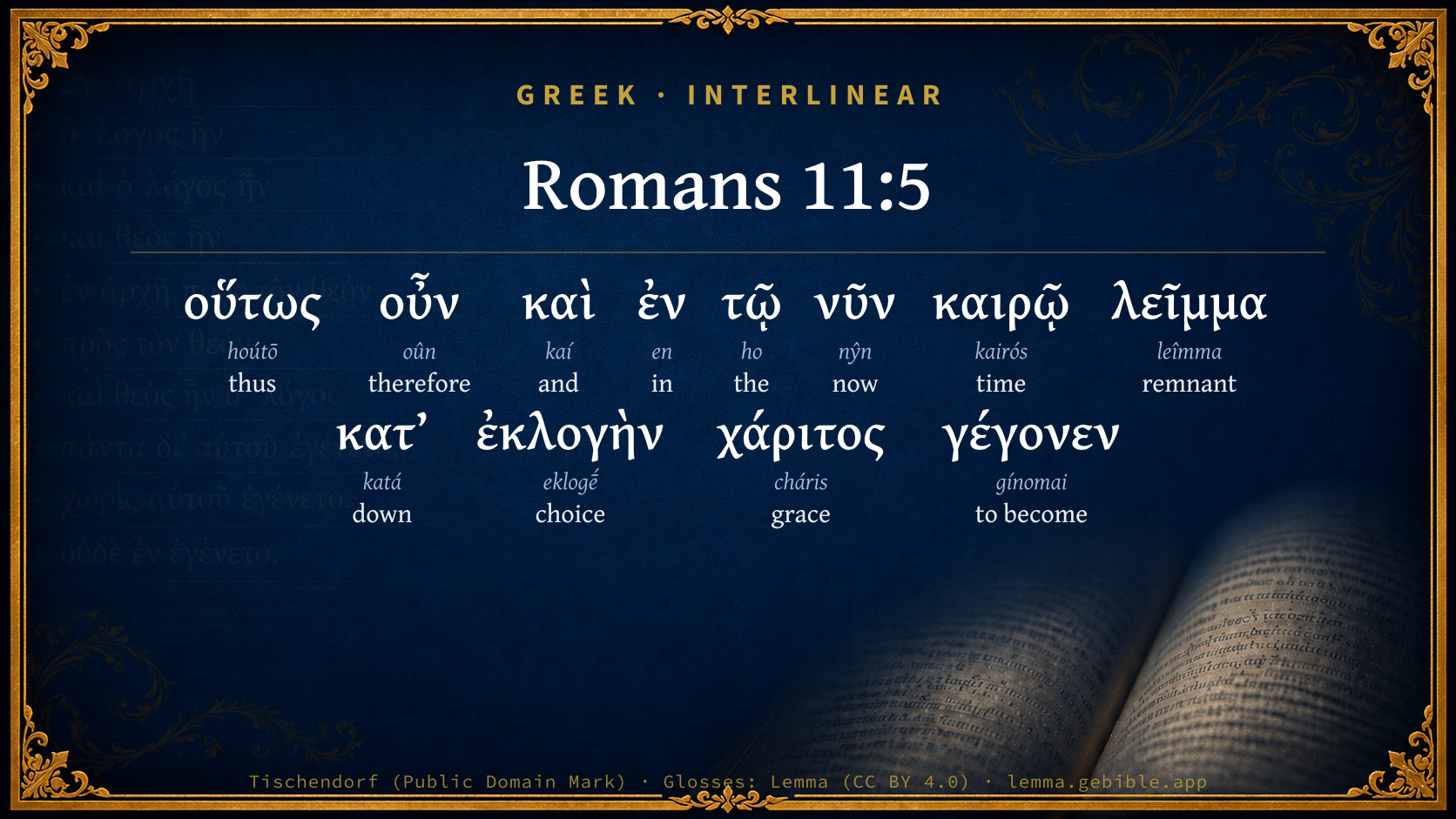
Download image
Cite this verse

Romans 11:5 (World English Bible). Public Domain. Lemma interlinear Bible study tool, https://lemma.gebible.app/v/romans/11/5.

Show BibTeX & RIS
BibTeX
RIS
English Translation
Even so then at this present time also there is a remnant according to the election of grace.
World English Bible · Public Domain
Download a study sheet

One document with this verse’s original text, its word-by-word gloss line, the meaning frame, cross-references with their text, attributed commentary, and full source and license credits — printable, and it pastes into notes with its structure intact.

This verse Autodidact and up

Study sheet (.html) Plain text (.txt)

A passage Seminary Student

Up to 50 verses in one chapter. A passage sheet keeps up to 6 commentary sources and 12 cross-references per verse, in the order this page ranks them, and says so on the sheet whenever that leaves anything out. Ask for a single verse and you get the Autodidact verse sheet above.

Everything on this page stays free to read, with no account — the sheet is a download of what is already on screen, not access to it.

Want to remove ads? Support Godless Engineer
Compare translations 3

The same verse in 3 English versions, stacked beneath the original-language interlinear above. Click any original word for its lexicon entry.

Each is an independent rendering of the whole verse — the interlinear is not word-aligned to these translations.

Highlighted words mark where these versions differ — a whole-verse word diff, not a word-by-word alignment.

  • World English Bible Public Domain
    Even so then at this present time also there is a remnant according to the election of grace.
  • King James Version Public Domain
    Even so then at this present time also there is a remnant according to the election of grace.
  • unfoldingWord Literal Text CC BY-SA 4.0
    In the same way, then, at this present time also there is a remnant according to the election of grace.

unfoldingWord Literal Text — © unfoldingWord, licensed CC BY-SA 4.0. Word-aligned USFM3 via Door43 (git.door43.org/unfoldingWord/en_ult).

Versions to compare (up to 4)

3 of 4 selected

Show all 18 translations

Every available English version of this verse, each an independent rendering of the whole verse.

  • World English Bible Public Domain
    Even so then at this present time also there is a remnant according to the election of grace.
  • Berean Standard Bible Public Domain
    In the same way, at the present time there is a remnant chosen by grace.
  • Majority Standard Bible Public Domain
    In the same way, at the present time there is a remnant chosen by grace.
  • King James Version Public Domain
    Even so then at this present time also there is a remnant according to the election of grace.
  • American Standard Version (1901) Public Domain
    Even so then at this present time also there is a remnant according to the election of grace.
  • Revised Version (1885) Public Domain
    Even so then at this present time also there is a remnant according to the election of grace.
  • Geneva Bible (1599) Public Domain
    Euen so then at this present time is there a remnant according to the election of grace.
  • Young's Literal Translation Public Domain
    So then also in the present time a remnant according to the choice of grace there hath been;
  • Literal Standard Version CC BY-SA 4.0
    So then also in the present time there has been a remnant according to the [divine] selection of grace;
  • Unlocked Literal Bible CC BY-SA 4.0
    Even so then, at this present time also there is a remnant because of the choice of grace.
  • unfoldingWord Literal Text CC BY-SA 4.0
    In the same way, then, at this present time also there is a remnant according to the election of grace.
  • Darby Bible Public Domain
    Thus, then, in the present time also there has been a remnant according to election of grace.
  • World Messianic Bible Public Domain
    Even so too at this present time also there is a remnant according to the election of grace.
  • Webster's Bible Public Domain
    Even so then at this present time also there is a remnant according to the election of grace.
  • Free Bible Version CC BY-SA 4.0
    Today it's just the same: there are still some faithful people left, chosen by God's grace.
  • Bible in Basic English Public Domain
    In the same way, there are at this present time some who are marked out by the selection of grace.
  • Text-Critical English NT CC BY 4.0
    So then, in the present time also there is a remnant chosen by grace.
  • Tyndale New Testament (1534) Public Domain
    Even so at this tyme ys ther a remmaunt lefte thorow the eleccion of grace.

Literal Standard Version (2020), Covenant Press — licensed CC BY-SA 4.0. Text via the HelloAO Bible API (eBible.org). Unlocked Literal Bible (unfoldingWord) — licensed CC BY-SA 4.0. Text via the HelloAO Bible API (eBible.org). unfoldingWord Literal Text — © unfoldingWord, licensed CC BY-SA 4.0. Word-aligned USFM3 via Door43 (git.door43.org/unfoldingWord/en_ult). Free Bible Version, Dr. Jonathan Gallagher — licensed CC BY-SA 4.0. Text via the HelloAO Bible API (eBible.org).

Word by word

More ways to search: Search by grammar → Find every occurrence → Compare this word →

Practice this passage: Drill this verse → Learn its vocabulary →

About this verse

These counts appear in no published source. They are computed here, from the morphology-tagged text and Lemma’s own curated glosses. What Lemma adds →

12
words
12
distinct lemmas
Pauline Epistles
section

Notable vocabulary

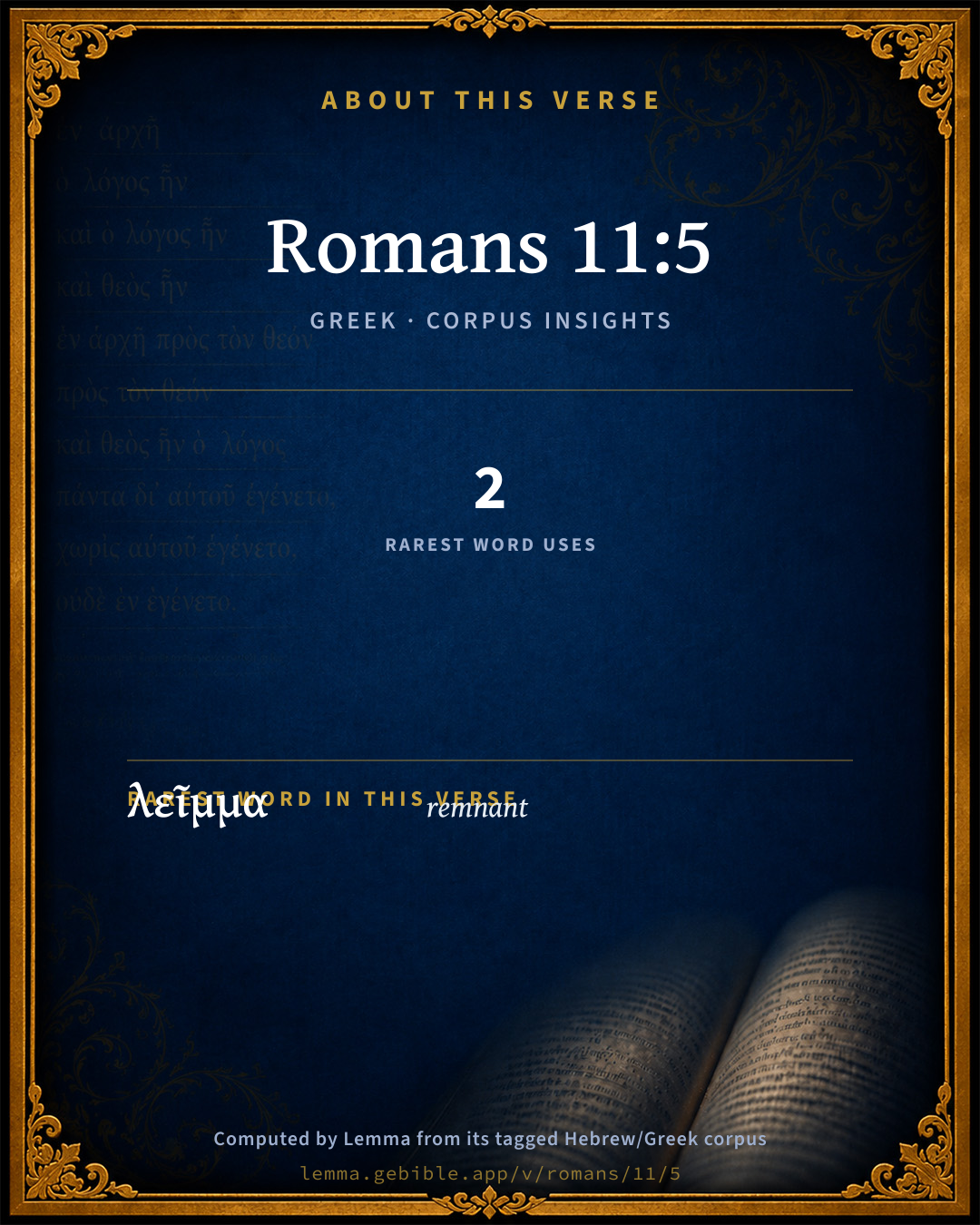
The rarest word here is λεῖμμα remnant G3005 — appearing just 2 times in the whole Greek New Testament.

Shared distinctive vocabulary

λεῖμμα remnant G3005 occurs in 2 verses of the Greek New Testament. Also found in:

Cross-references

5

Topical passages linked to Romans 11:5 in the Treasury of Scripture Knowledge — connected by theme and wording, ordered by reader-vote popularity; previews shown in the World English Bible.

  • Romans 9:27 Isaiah cries concerning Israel, "If the number of the children of Israel are as the sand of the sea, It is the remnant who will be saved;
  • Ephesians 1:5–6 having predestined us for adoption as children through Jesus Christ to himself, according to the good pleasure of his desire,
  • Romans 9:11 For being not yet born, neither having done anything good or bad, that the purpose of God according to election might stand, not of works, but of him who calls,
  • Romans 11:6–7 And if by grace, then it is no longer of works; otherwise grace is no longer grace. But if it is of works, it is no longer grace; otherwise work is no longer work.
  • Romans 11:28 Concerning the Gospel, they are enemies for your sake. But concerning the election, they are beloved for the fathers' sake.

Cross-references courtesy of OpenBible.info (CC BY 4.0).

Commentary

Notes on Romans 11:5 from classic Christian and Jewish commentators (each source and its license shown beneath its notes). The classic Christian expositions comment on the surrounding passage and are grouped to its opening verse, so a note may address several verses; the Jewish commentaries on the Tanakh (Rashi and others) are per-verse, so they appear only where the commentator wrote on this verse.

Lemma curates 59 commentaries, every one of them public domain or Creative Commons licensed, each selected and text-cleaned for this edition rather than reprinted as found. About our sources →

Scofield Reference Notes

C. I. Scofield

Remnant

Remnant, Summary: In the history of Israel, a "remnant" may be discerned, a spiritual Israel within the national Israel. In Elijah’s time 7,000 had not bowed the knee to Baal 1Ki 19:18. In Isaiah’s time it was the "very small remnant" for whose sake God still forbore to destroy the nation Isa 1:9. During the captivities the remnant appears in Jews like Ezekiel, Daniel, Shadrach, Meshach, and Abednego, Esther, and Mordecai. At the end of the 70 years of Babylonian captivity it was the remnant which returned under Ezra and Nehemiah. At the advent of our Lord, John the Baptist, Simeon, Anna, and "them that looked for redemption in Jerusalem" Luk 2:38 were the remnant. During the church-age the remnant is composed of believing Jews Rom 11:4; Rom 11:5. But the chief interest in the remnant is prophetic. During the great tribulation a remnant out of all Israel will turn to Jesus as Messiah, and will become His witnesses after the removal of the church Rev 7:3-8. Some of these will undergo martyrdom Rev 6:9-11 some will be spared to enter the millennial kingdom Zec 12:6 to Zec 13:9. Many of the Psalms express, prophetically, the joys and sorrows of the tribulation remnant.

remnant Remnant. See, Isa 1:9.

grace Grace (in salvation). vs. 2Co 8:9; Rom 3:24 See note, (See Scofield "Joh 1:17").

The Scofield Reference Bible (1917 edition), notes by C. I. Scofield — public domain. Text from a community e-Sword module.

Tyndale Open Study Notes

Tyndale Open Resources

11:5 a few of the people of Israel (literally a remnant): Paul returns to the Old Testament concept of the remnant that he used in 9:27-29. This solid core of godly Israelites represents God’s pledge of his continuing faithfulness to his promises and to his people.

Tyndale Open Study Notes — © Tyndale Open Resources, licensed CC BY-SA 4.0. Text via the HelloAO Bible API.

Bengel's Gnomon

Johann Albrecht Bengel

Rom 11:5. Οὖν, then) The conclusion drawn from the Old to the New Testament.

Bengel's Gnomon of the New Testament — English translation (T&T Clark, Edinburgh, 1860) — public domain. Text from a community e-Sword module.

Meyer's Critical & Exegetical Commentary

Heinrich August Wilhelm Meyer

Rom_11:5. In this way, corresponding to this Old Testament historical precedent, therefore (in order to make the application of Rom_11:3-4), there has been (there has come into existence, and actually existsperfect) also in the present time, in consequence of an election made out of grace, a remnant, namely, a small part taken out of the hardened mass of the people, i.e. the comparatively insignificant number of believing Jews, whom Gods grace has chosen out of the totality of the people. It is related to the latter as a remainder (Herod. i. 119; 2Ki_19:4) to a whole, from which the largest part is removed (Rom_11:3-4; Rom_9:27; Rom_9:29), notwithstanding Act_21:20. The point of comparison is the notion of the λεῖμμα in contrast to the remaining mass; the latter in the typical history has perished, but in the antitypical event has forfeited saving deliverance.

κατʼ ἐκλ. χάρ.] opposed to the presumption in reference to works of the Jewish character; hence, too, the emphatic declaration in Rom_11:6. It is to be connected not with λεῖμμα as its more precise definition (Hofmann), but with γέγονεν as its mode. This is evinced by the following εἰ δὲ χάριτι, sc. γέγονεν, where χάριτι is equivalent to the κατʼ ἐκλογ. χάριτος.

Meyer — Critical and Exegetical Commentary on the New Testament — English translation by Peter Christie, edited by Frederick Crombie (T&T Clark, 1880) — public domain. Text from a community e-Sword module.

Expositor's Greek Testament

ed. W. Robertson Nicoll

Rom 11:5 . Application of the principle of Rom 11:4 to the present. ὁ νῦν καιρὸς is the present regarded not merely as a date, but as in some sense a crisis. λεῖμμα γέγονεν : a remnant has come to be this is the fact which has emerged from the general unbelief of Israel. κατʼ ἐκλογὴν χάριτος : on these words the emphasis lies. The existence of the remnant is due to an election of grace, a choice on the part of God the motive of which is to be sought in His unmerited love alone. The idea is the same as in chap. Rom 9:6-13 : but cf. note on Rom 11:4 .

The Expositor's Greek Testament, edited by W. Robertson Nicoll (1897–1910) — public domain. Text from a community e-Sword module.

Hodge's Commentary on Romans, Ephesians & First Corinthians

Charles Hodge

Rom_11:5

Even so then at this present time also there is a remnant according to the election of grace. As in the days of Elias, there was a number which, although small in comparison with the whole nation, was still much greater than appeared to human eyes, who remained faithful, so at the present time, amidst the general defection of the Jews, and their consequent rejection as a people, there is a remnant, (λεῖμμα, what is left, answering to κατέλιπον in Rom_11:4,) according to the election of grace; that is, graciously chosen. The election was gracious, not merely in the sense of kind, but gratuitous, sovereign, not founded on the merits of the persons chosen, but the good pleasure of God. This explanation of the term is given by the apostle himself in the next verse. Remnant according to the gracious election is equivalent to remnant gratuitously chosen, see Rom_9:11, and Rom_11:21, Rom_11:24 of this chapter. Paul, therefore, designs to teach that the rejection of the Jews was not total, because there was a number whom God had chosen, who remained faithful, and constituted the true Israel or elected people, to whom the promises were made. As in the days of Elias, the number of those who had not bowed the knee to Baal was far greater than the prophet believed it to be, so the number of those who acknowledged Christ as the Messiah, in the times of the apostle, was much larger probably than is generally supposed. The apostle James speaks of many myriads (πόσαι μυριάδες), Act_21:20, of believing Jews.

Charles Hodge — Commentary on Romans (1835), First Corinthians (1857), and Ephesians (1856) — public domain. Text from a community e-Sword module.

Geneva Bible (1599)

Geneva Bible translators

The election of grace, is not whereby men chose grace, but whereby God chose us of his grace and goodness.

Geneva Bible (1599) marginal notes — public domain. Text via Bolls.life.

Jamieson, Fausset & Brown

Robert Jamieson, A. R. Fausset & David Brown

Even so at this present time--"in this present season"; this period of Israel's rejection. (See Act 1:7, Greek).

there is--"there obtains," or "hath remained"

a remnant according to the election of grace--"As in Elijah's time the apostasy of Israel was not so universal as it seemed to be, and as he in his despondency concluded it to be, so now, the rejection of Christ by Israel is not so appalling in extent as one would be apt to think: There is now, as there was then, a faithful remnant; not however of persons naturally better than the unbelieving mass, but of persons graciously chosen to salvation." (See Co1 4:7; Th2 2:13). This establishes our view of the argument on Election in Rom. 9:1-29, as not being an election of Gentiles in the place of Jews, and merely to religious advantages, but a sovereign choice of some of Israel itself, from among others, to believe and be saved. (See on Rom 9:6.)

Jamieson, Fausset & Brown — Commentary Critical and Explanatory on the Whole Bible (1871) — public domain (CC PDM 1.0). Text via the HelloAO Bible API.

Adam Clarke's Commentary

Verse 5. Even so then at this present time] As in the present day the irreligion of the Jews is very great; yet there is a remnant, a considerable number, who have accepted of the grace of the Gospel.

According to the election of grace.] And these are saved just as God has saved all believers from the beginning; they are chosen by his grace, not on account of any worth or excellence in themselves, but through his goodness are they chosen to have a place in his Church, and continue to be his people, entitled to all the privileges of the new covenant. The election of grace simply signifies God's gracious design in sending the Christian system into the world, and saving under it all those who believe in Christ Jesus, and none else. Thus the believers in Christ are chosen to inherit the blessings of the Gospel, while those who seek justification by the works of the law are rejected.

Adam Clarke's Commentary on the Bible (1810–1826) — public domain. Text from a community e-Sword/MySword module.

Ellicott's Commentary for English Readers

(5, 6) As there was a remnant then, so also is there a remnant now. That there should be so is due not to any human merit on the part of those exempted from the fate of their nation, but to the spontaneous act of the divine grace selecting them from the rest. These two things,” grace” and “works,” really exclude each other.

The Apostle reverts somewhat parenthetically, and because his mind is full of the thought, to his idea of Rom_9:11-16. We have here also a break in the train of argument. After establishing the fact that there is this remnant, the Apostle inquires how there came to be one. The reason was because the mass of the people trusted to their own works instead of relying upon grace; therefore grace deserted them, and they were left to a judicial blindness.

A Bible Commentary for English Readers, edited by Charles John Ellicott (1878–1897) — public domain. Text from a community e-Sword module.

The Cambridge Bible for Schools and Colleges

gen. ed. J. J. S. Perowne

5. at this present time] In which the mournful phenomenon of Jewish unbelief occasioned this whole discussion.

there is] Lit. there hath been: it was and still is.

a remnant] a reserve, a leaving. The noun is cognate to the verb “I reserved” in Rom_11:4. This “remnant” at some stages of apostolic history (Act_6:7; Act_21:20,) was in itself very numerous. But it was always, no doubt, small comparatively; and it became more and more so the more the distinctive character of the New Kingdom came out, (as in Stephen’s and now in Paul’s teaching,) and the nearer the last crisis of the old order approached.

according to the election of grace] i.e. “on the scale determined by the Divine choice (to faith and salvation), whose only motive and reason is grace—the free favour of Him who chooses out His own.”—See on Rom_8:33.

The Cambridge Bible for Schools and Colleges (gen. ed. J. J. S. Perowne; Cambridge University Press, 1878–1918) — public domain. Text from a community e-Sword module.

John Gill's Exposition

Even so then at this present time also,.... In which the apostle lived, the time of preaching the Gospel, the accepted time, the day of salvation, which then was, and also now is; at that time when the Gospel was sent unto the Gentiles, and God took out of them a people for his name; when multitudes of them were converted, and embraced the faith of Christ; and when the Jews in general had rejected the Messiah, killed the Lord Jesus, persecuted his apostles, and contradicted and blasphemed the Gospel; yet still God had made a reserve of some among them, for himself:

there is a remnant; alluding either to Isa 10:21, or to the oracle delivered to Elijah, saying, "I have reserved", or "left", &c. Kg1 19:18, that as God had reserved for himself, in Elijah's time, a number of persons, who had not gone into the idolatrous worship of Baal, when the greater part of the Israelites did, so he had taken care to make a like reserve in the apostle's time, when the bulk of the Jewish nation had refused the Messiah, and despised his Gospel. This is a further proof, that God had not cast away all the people of the Jews; and that as Elijah was not the only worshipper of the true God in his time, so the apostle was not the only instance of grace among that people now; there was a number of them; the number of the disciples after our Lord's ascension, was an hundred and twenty; upon the first sermon preached by Peter, three thousand were converted, and added to them; after that, they are said to be about five thousand, and still multitudes were added, both of men and women, and a great company of the priests were obedient to the faith; so that before the dispersion of the church at Jerusalem by a persecution, there might be at least such a number called by grace, as God had reserved in Elijah's time; though these, when compared with the generality of the nation, which remained in unbelief, were but a few, and therefore called a "remnant", or a "reserve", as the word may be rendered; for these were a set of men, whom God had reserved and preserved in his Son, and in the covenant of his grace, from everlasting; and had kept a watchful eye over them in time, reserved them in his providence, and saved them to be called; and by calling them, had reserved them by his grace, and preserved them by his power, from the general unbelief, impenitence, blindness, and ignorance, which prevailed over the people of the Jews; which reserve was not owing to their superior goodness, they being in no wise, with respect to nature, birth, and privileges, better than those who were not reserved; nor to the disposition of their minds and wills, their minds and consciences being defiled, and their wills naturally as obstinate and perverse as others; nor to any good works done by them, since works before calling are not properly good, and those after are the fruits of that grace: but this reverse was made,

according to the election of grace; God's choice of these persons before the world was, which is the source and spring of all the blessings of grace, both in time eternity: hence these persons were put into the hands of Christ, secured in an everlasting covenant, took special care of by divine Providence, were called by grace, justified, sanctified, and at last glorified: and this choice is owing to grace, for not men's choice of God's grace, but God's choice, owing to his, own grace, is here meant. The Pelagians would have it, that this election is the choice which man makes of the grace of God: whereas such is the enmity of mans nature, and will against God and his grace, that he would never make choice of that, if the grace of God did not first make choice of him, and lay hold upon him: grace here, does not design the object of the choice, but the cause, spring, and motive of it, which is not any habit or quality in men, as faith and holiness, for these are fruits and effects of electing grace, and so not causes, motives, or conditions of it, but the free love and favour of God in his own heart; and shows the sovereignty and freeness of election, which is no ways depending on the will and works of men, but upon the sovereign good will and pleasure of God.

John Gill's Exposition of the Whole Bible (1746–1763) — public domain (CC PDM 1.0). Text via the HelloAO Bible API.

Trapp's Complete Commentary

John Trapp

5 Even so then at this present time also there is a remnant according to the election of grace.

Ver. 5. According to the election of grace] St Paul was Constantissimus gratiae praedicator, as Austin calleth him, a most constant preacher of God’s free grace.

John Trapp, A Commentary or Exposition upon All the Books of the Old and New Testament (1647–1656) — public domain. Text from a community e-Sword module.

Albert Barnes' Notes on the Bible

At this present time - In the time when the apostle wrote. Though the mass of the nation was to be rejected, yet it did not follow that all were to be excluded from the favor of God. As in the time of Elijah, when all appeared to be dark, and all the nation, except one, seemed to have become apostate, yet there was a considerable number of the true friends of God; so in the time of Paul, though the nation had rejected their Messiah, though, as a consequence, they were to be rejected as a people: and though they were eminently wicked and corrupt, yet it did not follow that all were cast off, or that any were excluded on whom God had purposed to bestow salvation.

A remnant - That which is left or reserved; Rom 9:27. He refers here doubtless, to that part of the nation which was truly pious, or which had embraced the Messiah.

According to the election of grace - By a gracious or merciful choosing, or election; and not by any merit of their own. As in the tinge of Elijah, it was because God had reserved them unto himself that any were saved from idolatry, so now it was by the same gracious sovereignty that any were saved from the prevalent unbelief. The apostle here does not specify the number, but there can be no doubt that a multitude of Jews had been saved by becoming Christians, though compared with the nation - the multitude who rejected the Messiah it was but a remnant. The apostle thus shows that neither all the ancient people of God were cast way, nor that any whom he foreknew were rejected. And though he had proved that a large part of the Jews were to be rejected and though infidelity was prevalent, yet still there were some who had been Jews who were truly pious, and entitled to the favor of God. Nor should they deem this state of things remarkable, for a parallel case was recorded in their own Scriptures. We may learn from this narrative,

(1) That it is no unparalleled thing for the love of many to wax cold, and for iniquity to abound.

(2) The tendency of this is to produce deep feeling and solicitude among the true friends of God. Thus, David says, “Rivers of waters run down mine eyes because they keep not thy law;” Psa 119:136; compare Jer 9:1; Luk 19:41.

(3) That in these darkest times we should not be discouraged. There may be much more true piety in the world than in our despondency we may suppose. We should take courage in God, and believe that he will not forsake any that are his true friends, or on whom he has purposed to bestow eternal life.

(4) It is of God that all are not corrupt and lost. It is owing only to the election of grace, to his merciful choosing, that any are saved. And as in the darkest times he has reserved a people to himself, so we should believe that he will still meet abounding evil, and save those whom he has chosen from eternal death.

Albert Barnes' Notes on the Bible (1834–1885) — public domain. Text from a community e-Sword/MySword module.

Matthew Poole's English Annotations

q.d. As it was in the times of Elias, so it is now;

there is a remnant of the Jews, which God hath graciously elected; therefore their rejection is not total, which was the thing to be proved. Though those that believe are few in respect of those that believe not, as a remnant is but little in respect of the whole piece, yet there are many thousands of them, as James said to Paul, Act 21:20; Thou seest, brother, how many thousands of Jews there are which believe.

Matthew Poole's English Annotations on the Holy Bible (1683–1685) — public domain. Text from a community e-Sword/MySword module.

Whedon's Commentary on the Bible

Daniel D. Whedon

5. A remnant—Parallel to the seven thousand of the fallen Israel of old is the Christian Church of Paul’s day. They are denounced as renegades by the Jewish people; but Paul claims them as the pure Israel in the chosen Abrahamic line.

Election of grace—Just as Abraham is claimed from the Old Testament to have been justified and called on account of faith, and not by works, so the faithful seven thousand are claimed on account of their persevering faith in Jehovah in the midst of an apostasy to Baal.

Daniel D. Whedon (gen. ed.), Commentary on the Old and New Testaments (1874–1909) — public domain. Text from a community e-Sword module.

John Wesley's Explanatory Notes

According to the election of grace - According to that gracious purpose of God, "He that believeth shall be saved."

John Wesley, Explanatory Notes Upon the Whole Bible (1754–1765) — public domain. Text via the GEBible commentary corpus.

Burkitt's Expository Notes on the New Testament

William Burkitt

Here we have St. Paul making application of the foregoing example to the present case. As Elias was not alone in the corrupt state of Israel then, so neither was the apostle alone now, in this time of general rejection of the Jewish church and nation. God had a number then, he has a remnant now, which, according to his free and gracious purpose, are brought to believe in his Son. Although the Jews who believed were few in comparison of them that were rejected, called therefore a remnant, which is but small and little in respect of the whole piece; yet there were many thousands of them that did believe on the Lord Jesus Christ, and obtained, no doubt, salvation by him, Thou seest, brother, how many thousand Jews there are which believe. Act 21:20.

Observe farther, The conclusion which the apostle doth infer and draw from the fore-mentioned assertion "If a remnant be saved, according to the free purpose and gracious election of God, then ’tis not upon the consideration of the merit of their own works; they are not justified and accepted for the works of the law, otherwise grace is no more grace: for what need is there of grace, where men have continued in all things written in the law to do them? for the man that doeth those things shall live in them. But, on the other hand, if it be of works that we are justified and accepted, then it is no more of grace, otherwise work is no more work."

Learn hence, 1. That such as are chosen in Christ to be a people near unto God, are put into this state by mere grace, and unmerited favour.

Learn, 2. That grace comes in to supply the defect of our works, and to procure pardon for the non-performance of them, according to the tenor of the law. God was good to man before his fall, in making him his creature; he is gracious to man since his fall, in recovering him to the divine favour, by restoring him to the divine likeness.

The fabric of grace in the hearts of his people goes up, as did the building of the second temple, with shouts and acclamations, Grace! grace! and every stone in the building of our salvation, from the foundation to the superstructure, is all free-stone; Otherwise grace is no more grace.

William Burkitt's Expository Notes on the New Testament (1700–1703) — public domain. Text from a community e-Sword module.

Godbey's Commentary on the New Testament

William B. Godbey

5. “Thus indeed therefore there is at this time a remnant according to the election of grace.

William B. Godbey, Commentary on the New Testament (1896–1900) — public domain. Text from a community e-Sword module.

McGarvey & Pendleton's Commentaries

J. W. McGarvey

Even so then at this present time also there is a remnant according to the election of grace . [Resuming, the argument. "As at the time of the great deflection in Elijah's day there seemed to him to be but one, yet God had reserved to himself seven thousand, so now in this time of falling away, you who judge by outward appearance will judge just as poorly. You may think derisively that I am the sole representative of the election of which I speak, but, scattered and dispersed as they are, there are vastly more than you dream (comp. Act_21:20 ); for the unchangeable God always reserves to himself a remnant, whom he has chosen as his own." "One thing indeed," says Godet, "follows from the election of grace applied to the whole of Israel; not the salvation of such or such individuals, but the indestructible existence of a believing remnant at all periods of their history, even in the most disastrous crises of unbelief, as at the time of the ministry of Elijah, or of the coming of Jesus Christ. The idea contained in the words, 'according to the election of grace,' is therefore this: In virtue of the election of Israel as the salvation-people, God has not left them in our day without a faithful remnant, any more than he did in the kingdom of the ten tribes at the period when a far grosser heathenism was triumphant." In the eternal purpose of God the election of the salvation-class preceded any human act, but it does not therefore follow that it preceded a presumptive, suppositious act. The same wisdom which foresaw the election also foresaw the compliance of the elect individual with the terms and conditions of election. This must be so, for in the outworking of the eternal purpose in the realms of the actual, man must first comply with the conditions of election before he becomes one of the elect; for, as Lard wisely says, "election or choosing, in the case of the redeemed, does not precede obedience, and therefore is neither the cause of it nor reason for it. On the contrary, obedience precedes election, and is both the condition of it and reason for it. Obedience is man's own free act, to which he is never moved by any prior election of God. Choosing, on the other hand, is God's free act, prompted by favor and conditioned on obedience. This obedience, it is true, he seeks to elicit by the proper motives; but to this he is led solely by love of man, and never by previous choice. True Scriptural election, therefore, is a simple, intelligible thing, when suffered to remain unperplexed by the subtleties of schoolmen." As the open reference to Elijah contains a covert one to Ahab and his Israel, Chrysostom bids us "reflect on the apostle's skill, and how, in proving the proposition before him, he secretly augments the charge against the Jews. For the object he had in view, in bringing forward the whole of that testimony, was to manifest their ingratitude, and to show that of old they had been what they were now."]

J. W. McGarvey (with Philip Y. Pendleton), Commentaries on the New Testament (The Fourfold Gospel, 1914; Acts; and the epistles) — public domain. Text from a community e-Sword/MySword module.

The People's New Testament

B. W. Johnson

5, 6. Even so … there is a remnant. As in the times of Ahab, there is “a remnant,” a portion of Israel left, which is faithful. According to the election of grace. “The ideas contained in these words is this: In virtue of the election of Israel as the salvation-people, God has not left them in our days without a faithful remnant any more than he did the in the kingdom of the Ten Tribes at the period when a far grosser heathenism prevailed.”—Godet. The idea is that Israel was the elected (chosen people), and out of it God had always preserved a remnant by his grace. The election of individuals is not referred to, but the election of a remnant to represent the race.

B. W. Johnson's The People's New Testament with Notes (1889–1891) — public domain. Electronic text from the Christian Classics Ethereal Library (CCEL) ThML edition.

Cambridge Greek Testament for Schools and Colleges

5. λίμμα only here in N. T.; cf. Rom 9:27 (ὑπολ. or καταλ. seems to be the usual word in LXX[211]).

[211] LXX. the Septuagint Version of the Old Testament

κατ’ ἐκλογὴν χάριτος on a principle of selection made by GOD’s free grace, cf. Rom 9:11. The genitive marks the ground of selection and forestalls at once any sense of superiority or merit. It is GOD’s free generosity, not their own deserts, which preserves the remnant; cf. Eph 2:9. The statement seems to rest on the words κατέλιπον ἐμαυτῷ.

Cambridge Greek Testament for Schools and Colleges (Cambridge University Press, 1896; 21 vols, various authors incl. Carr, Maclear, Plummer, Farrar, Lumby, Moule, M. R. James, Simcox) — public domain. Text from a community e-Sword module.

Alford’s Greek Testament

Henry Alford

5.] Thus then (analogical inference from the example just cited) in the present time also (or, even in the present time, scil. of Israel’s national rejection) there is a remnant (a part has remained faithful, which thus has become a λεῖμμα) according to (in virtue of,—in pursuance of) the election (selection, choice of a few out of many) of grace (made not for their desert, nor their foreseen congruity, but of God’s free unmerited favour).

Henry Alford, The Greek Testament (1849–1861) — public domain. Text from a community e-Sword module.

International Critical Commentary

5. οὓτως οὖν. The application of the preceding instance to the circumstances of the Apostle’s own time. The facts were the same. St. Paul would assume that his readers, some of whom were Jewish Christians, and all of whom were aware of the existence of such a class, would recognize this. And if this were so the same deduction might be made. As then the Jewish people were not rejected, because the remnant was saved; so now there is a remnant, and this implies that God has not cast away His people as such.

λεῖμμα (on the orthography cf. WH. ii. App. p. 154, who read λίμμα), ‘a remnant.’ The word does not occur elsewhere in the N. T., and in the O. T. only twice, and then not in the technical sense of the ‘remnant.’ The usual word for that is τὸ καταλειφθέν.

κατʼ ἐκλογὴν χάριτος. Predicate with γέγονεν. ‘There has come to be through the principle of selection which is dependent on the Divine grace or favour.’ This addition to the thought, which is further explained in ver. 6, reminds the reader of the result of the previous discussion: that ‘election’ on which the Jews had always laid so much stress had operated, but it was a selection on the part of God of those to whom He willed to give His grace, and not an election of those who had earned it by their works.

International Critical Commentary — older volumes (1896–1929), various authors — public domain. Text from a community e-Sword module.

Godet's Commentaries

Frédéric Louis Godet

Vv. 5. This verse applies the case of the seven thousand to present circumstances. The remnant, of whom the apostle speaks, evidently denotes the small portion of the Jewish people who in Jesus have recognized the Messiah. The term λεῖμμα, remnant, is related to the preceding verb κατέλιπον, I have reserved to myself, kept. There is no reference whatever to the members of the Jewish people who shall survive the destruction of Jerusalem, and shall be preserved to go into exile. These form, on the contrary, the rejected portion to whom the words, Rom 11:7-10, apply.

The three particles which connect this verse with the preceding context: so, then, also, refer, the first to the internal resemblance of the two facts, for the same principle is realized in both; the second, to the moral necessity with which the one follows from the other in consequence of this analogy. The third simply indicates the addition of a new example to the former.

The words: according to the election of grace, might apply to the individuals more or less numerous who are embraced in this remnant, now become the nucleus of the church. The word election would in that case be explained, as in the case of the elect in general, Rom 8:29-30, by the fact of the foreknowledge which God had of their faith. But the matter in question throughout the whole of this chapter is the lot of the Jewish people in general; it is therefore to them in their entirety that the idea of the divine election refers; comp. Rom 11:2; Rom 11:28. One thing indeed follows from the election of grace applied to the whole of Israel; not the salvation of such or such individuals, but the indestructible existence of a believing remnant at all periods of their history, even in the most disastrous crises of unbelief, as at the time of the ministry of Elias, or of the coming of Jesus Christ. The idea contained in the words: “according to the election of grace,” is therefore this: In virtue of the election of Israel as the salvation-people, God has not left them in our days without a faithful remnant, any more than He did in the kingdom of the ten tribes at the period when a far grosser heathenism was triumphant.

Frédéric Louis Godet — Commentaries on Luke, John, Romans, and 1 Corinthians — English translation (T&T Clark, Edinburgh, 1870s–1890s) — public domain. Text from a community e-Sword module.

Lesson kit

Teaching starters — assembled from the data on this page, not authored interpretation. Every prompt links to the verse data it draws on. Edit before teaching.

Romans, in the Pauline Epistles, opens this verse with 12 words (12 distinct Greek lemmas). Its most distinctive word is leîmma (“remnant”). A historical commentator’s framing appears above. Read the whole chapter for the surrounding context.

Discussion questions

  1. How does “remnant” (leîmma) shape what this verse is saying?
  2. How does Romans 9:27, which shares the word «remnant», read alongside this verse?
  3. These translations render this verse differently; the difference is in the English rendering, not the original. What questions does that raise?
  4. Compare how Scofield Reference Notes and Tyndale Open Study Notes read this verse. Where do they agree or differ?

Things to notice

Reading settings

Reading text

Shown beneath each verse's original-language words.

Old Testament
Old Testament edition

Read the OT as the Masoretic Hebrew (MT) or the Greek Septuagint (LXX).

English shown for the Greek Septuagint (in the Hebrew ↔ Greek comparison).

Comparing translations? Open the Compare panel on any verse page to stack up to four side by side.