
Hebrews 12:21

Greek (Tischendorf 8th ed.) Hebrews 12:21 appears in the Greek New Testament. The text above is from the Tischendorf 8th edition. Each word links to its Strong’s number and a concise gloss. Click any word for its full Thayer’s Greek Lexicon entry.
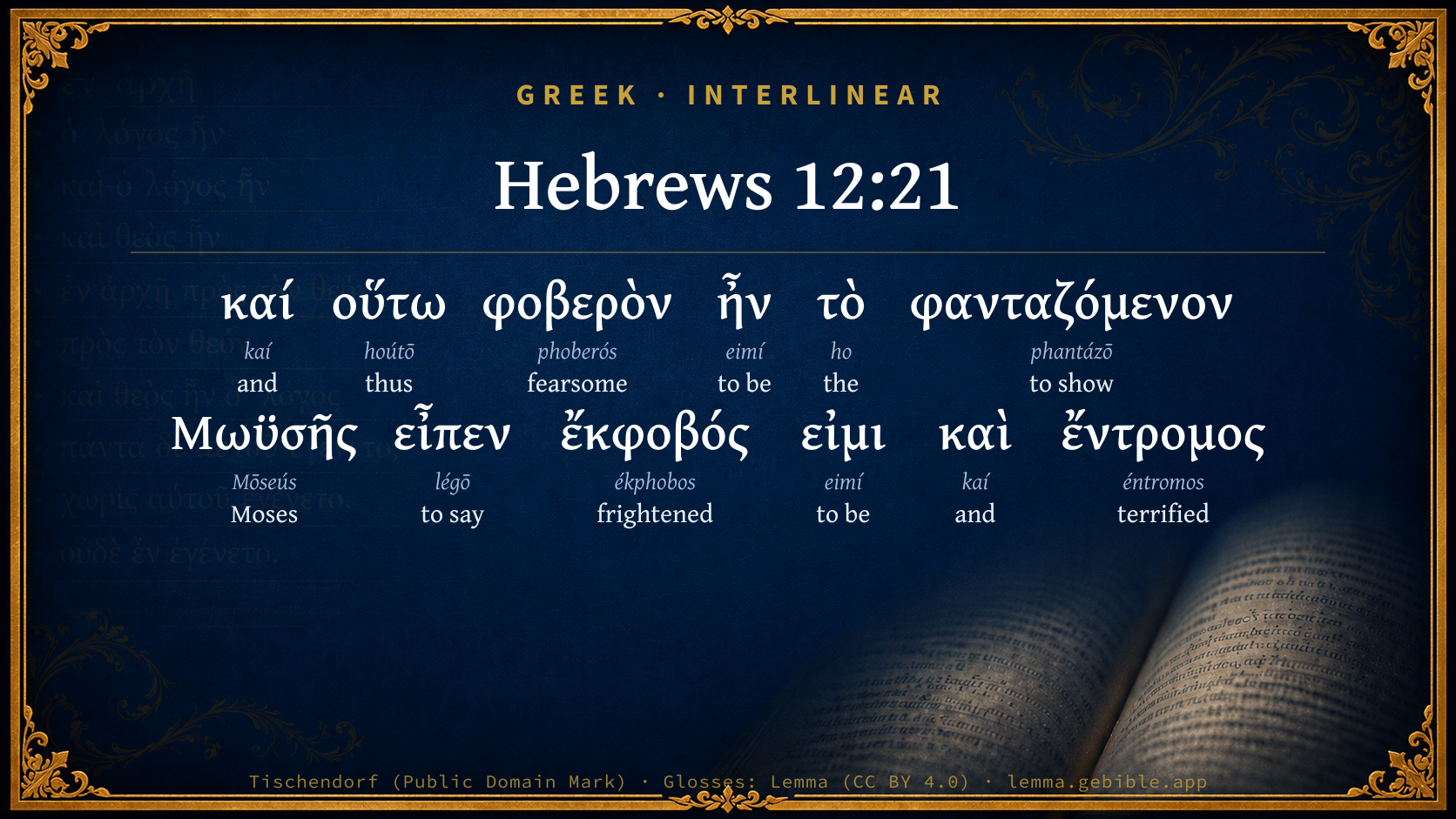
Download image
Cite this verse

Hebrews 12:21 (World English Bible). Public Domain. Lemma interlinear Bible study tool, https://lemma.gebible.app/v/hebrews/12/21.

Show BibTeX & RIS
BibTeX
RIS
English Translation
and so fearful was the appearance, that Moses said, "I am terrified and trembling."
World English Bible · Public Domain
Highlights
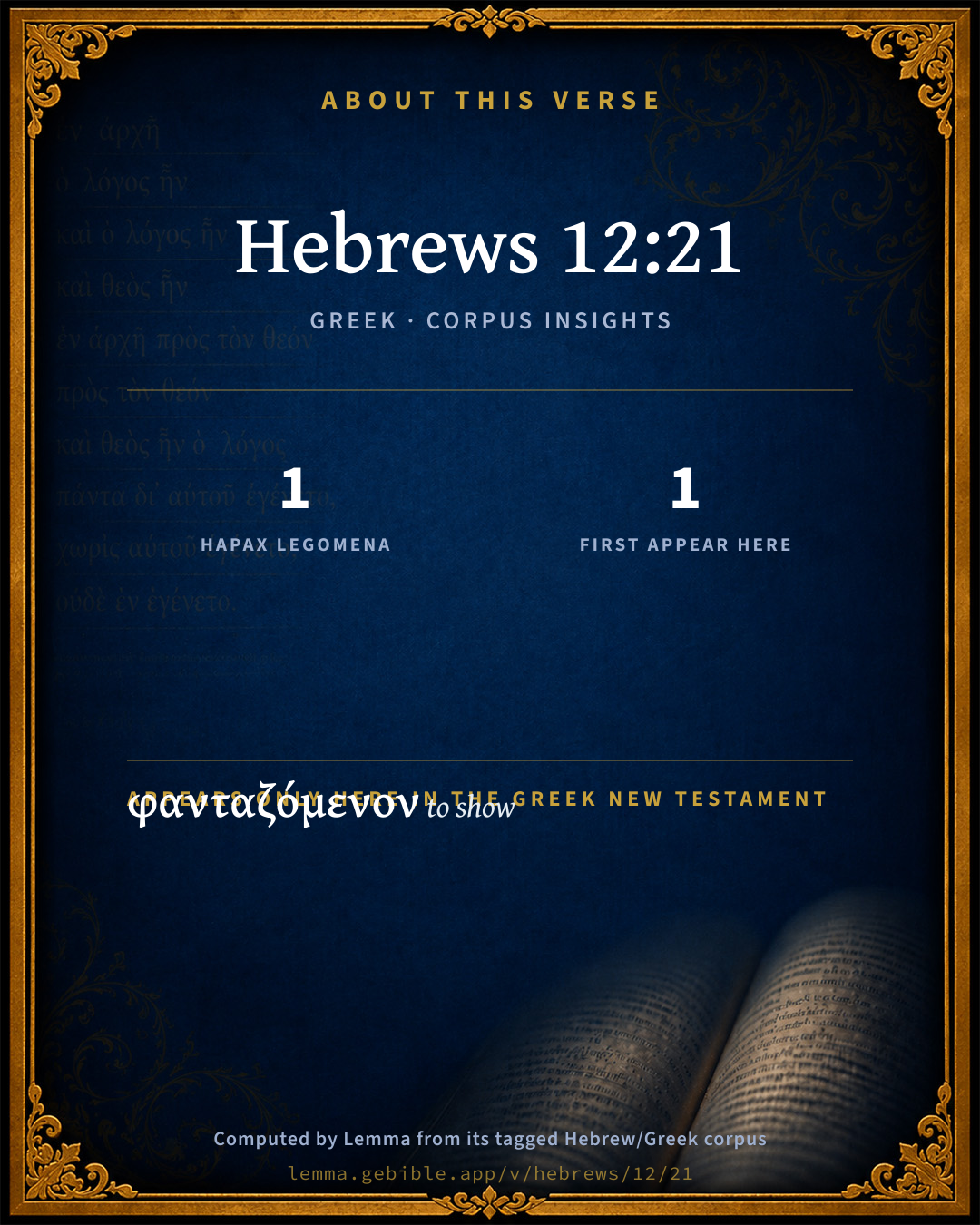
  • 1 hapax legomenon — only here in the Greek New Testament
  • 1 first appearance in the Greek New Testament
Full analysis ↓
Download a study sheet

One document with this verse’s original text, its word-by-word gloss line, the meaning frame, cross-references with their text, attributed commentary, and full source and license credits — printable, and it pastes into notes with its structure intact.

This verse Autodidact and up

Study sheet (.html) Plain text (.txt)

A passage Seminary Student

Up to 50 verses in one chapter. A passage sheet keeps up to 6 commentary sources and 12 cross-references per verse, in the order this page ranks them, and says so on the sheet whenever that leaves anything out. Ask for a single verse and you get the Autodidact verse sheet above.

Everything on this page stays free to read, with no account — the sheet is a download of what is already on screen, not access to it.

Want to remove ads? Support Godless Engineer
Compare translations 3

The same verse in 3 English versions, stacked beneath the original-language interlinear above. Click any original word for its lexicon entry.

Each is an independent rendering of the whole verse — the interlinear is not word-aligned to these translations.

Highlighted words mark where these versions differ — a whole-verse word diff, not a word-by-word alignment.

  • World English Bible Public Domain
    and so fearful was the appearance, that Moses said, "I am terrified and trembling."
  • King James Version Public Domain
    And so terrible was the sight, that Moses said, I exceedingly fear and quake:)
  • unfoldingWord Literal Text CC BY-SA 4.0
    And the thing being made visible was so fearful that Moses said, “I am terrified and trembling.”

unfoldingWord Literal Text — © unfoldingWord, licensed CC BY-SA 4.0. Word-aligned USFM3 via Door43 (git.door43.org/unfoldingWord/en_ult).

Versions to compare (up to 4)

3 of 4 selected

Show all 19 translations

Every available English version of this verse, each an independent rendering of the whole verse.

  • World English Bible Public Domain
    and so fearful was the appearance, that Moses said, "I am terrified and trembling."
  • Berean Standard Bible Public Domain
    The sight was so terrifying that even Moses said, “I am trembling with fear.”
  • Majority Standard Bible Public Domain
    The sight was so terrifying that even Moses said, “I am trembling with fear.”
  • King James Version Public Domain
    And so terrible was the sight, that Moses said, I exceedingly fear and quake:)
  • American Standard Version (1901) Public Domain
    and so fearful was the appearance, `that' Moses said, I exceedingly fear and quake:
  • Revised Version (1885) Public Domain
    and so fearful was the appearance, that Moses said, I exceedingly fear and quake:
  • Geneva Bible (1599) Public Domain
    And so terrible was the sight which appeared, that Moses said, I feare and quake.)
  • Douay-Rheims (1899) Public Domain
    And so terrible was that which was seen, Moses said: I am frighted, and tremble.
  • Young's Literal Translation Public Domain
    and, (so terrible was the sight,) Moses said, `I am fearful exceedingly, and trembling.'
  • Literal Standard Version CC BY-SA 4.0
    and (so terrible was the sight), Moses said, “I am exceedingly fearful, and trembling.”
  • Unlocked Literal Bible CC BY-SA 4.0
    So fearful was this sight that Moses said, “I am terrified and am trembling.”
  • unfoldingWord Literal Text CC BY-SA 4.0
    And the thing being made visible was so fearful that Moses said, “I am terrified and trembling.”
  • Darby Bible Public Domain
    and, so fearful was the sight, Moses said, I am exceedingly afraid and full of trembling;)
  • World Messianic Bible Public Domain
    So fearful was the appearance that Moses said, “I am terrified and trembling.”
  • Webster's Bible Public Domain
    And so terrible was the sight, that Moses said, I exceedingly fear and tremble:)
  • Free Bible Version CC BY-SA 4.0
    The sight was so terrifying that Moses himself said, “I'm so scared I'm shaking!”
  • Bible in Basic English Public Domain
    And the vision was so overpowering that even Moses said, I am shaking and full of fear.
  • Text-Critical English NT CC BY 4.0
    Indeed, the sight was so terrifying that Moses said, “I am trembling with fear.”
  • Tyndale New Testament (1534) Public Domain
    even so terreble was the sight which appered. Moses sayde I feare and quake.

Literal Standard Version (2020), Covenant Press — licensed CC BY-SA 4.0. Text via the HelloAO Bible API (eBible.org). Unlocked Literal Bible (unfoldingWord) — licensed CC BY-SA 4.0. Text via the HelloAO Bible API (eBible.org). unfoldingWord Literal Text — © unfoldingWord, licensed CC BY-SA 4.0. Word-aligned USFM3 via Door43 (git.door43.org/unfoldingWord/en_ult). Free Bible Version, Dr. Jonathan Gallagher — licensed CC BY-SA 4.0. Text via the HelloAO Bible API (eBible.org).

Word by word

More ways to search: Search by grammar → Find every occurrence → Compare this word →

Practice this passage: Drill this verse → Learn its vocabulary →

φανταζόμενον
phantázō
G5324
“to show”
Verb, Present, Passive, Participle, Nominative, Singular, Neuter
Part of Speech
Verb
Tense
Present
Voice
Passive
Mood
Participle
Case
Nominative
Number
Singular
Gender
Neuter
Full Thayer's Definition

Origin: from a derivative of G5316

TDNT: 09:06,1

1. to cause to appear, make visible, expose to view, show a. the appearance, sight
  1. καί kaí G2532 “and” Conjunction
  2. οὕτω hoútō G3779 “thus” Adverb
  3. φοβερὸν phoberós G5398 “fearsome” Adjective, Nominative, Singular, Neuter
  4. ἦν eimí G1510 “to be” Verb, Imperfect, Active, Indicative, 3rd person, Singular
  5. τὸ ho G3588 “the” Article, Nominative, Singular, Neuter
  6. Μωϋσῆς Mōseús G3475 “Moses” Noun, Nominative, Singular, Masculine
  7. εἶπεν légō G3004 “to say” Verb, Aorist, Active, Indicative, 3rd person, Singular
  8. ἔκφοβός ékphobos G1630 “frightened” Adjective, Nominative, Singular, Masculine
  9. εἰμι eimí G1510 “to be” Verb, Present, Active, Indicative, 1st person, Singular
  10. καὶ kaí G2532 “and” Conjunction
  11. ἔντρομος éntromos G1790 “terrified” Adjective, Nominative, Singular, Masculine

About this verse

These counts appear in no published source. They are computed here, from the morphology-tagged text and Lemma’s own curated glosses. What Lemma adds →

12
words
10
distinct lemmas
General Epistles
section

Notable vocabulary

1 hapax legomenon — a word that appears only here in the entire Greek New Testament:

  • φανταζόμενον to show G5324

First appearance in Scripture

This word makes its first canonical appearance in the Greek New Testament here:

  • φανταζόμενον to show G5324

Shared distinctive vocabulary

ἔκφοβός frightened G1630 occurs in 2 verses of the Greek New Testament. Also found in:
Repetition

Words recur within this verse:

Cross-references

8

Topical passages linked to Hebrews 12:21 in the Treasury of Scripture Knowledge — connected by theme and wording, ordered by reader-vote popularity; previews shown in the World English Bible.

  • Exodus 19:16 It happened on the third day, when it was morning, that there were thunders and lightnings, and a thick cloud on the mountain, and the sound of an exceedingly loud trumpet; and all the people who were in the camp trembled.
  • Deuteronomy 9:19 For I was afraid of the anger and hot displeasure, with which Yahweh was angry against you to destroy you. But Yahweh listened to me that time also.
  • Isaiah 6:3–5 One called to another, and said, "Holy, holy, holy, is Yahweh of Hosts! The whole earth is full of his glory!"
  • Exodus 19:19 When the sound of the trumpet grew louder and louder, Moses spoke, and God answered him by a voice.
  • Psalms 119:120 My flesh trembles for fear of you. I am afraid of your judgments.
  • Revelation 1:17 When I saw him, I fell at his feet like a dead man. He laid his right hand on me, saying, "Don't be afraid. I am the first and the last,
  • Daniel 10:17 For how can the servant of this my lord talk with this my lord? for as for me, immediately there remained no strength in me, neither was there breath left in me.
  • Daniel 10:8 So I was left alone, and saw this great vision, and there remained no strength in me; for my comeliness was turned in me into corruption, and I retained no strength.

Cross-references courtesy of OpenBible.info (CC BY 4.0).

Commentary

Notes on Hebrews 12:21 from classic Christian and Jewish commentators (each source and its license shown beneath its notes). The classic Christian expositions comment on the surrounding passage and are grouped to its opening verse, so a note may address several verses; the Jewish commentaries on the Tanakh (Rashi and others) are per-verse, so they appear only where the commentator wrote on this verse.

Lemma curates 59 commentaries, every one of them public domain or Creative Commons licensed, each selected and text-cleaned for this edition rather than reprinted as found. About our sources →

Bengel's Gnomon

Johann Albrecht Bengel

Heb 12:21. Τὸ φανταζόμενον, the sight) A most real sight is meant. Herodian, εἴτε ἀληθῶς ἐφαντάσθη τισὶν, ἢ, κ.τ.λ., whether it was really seen by some, or, etc.—Μωϋσῆς, Moses) who however was the only one admitted very near, and therefore saw and felt more than the rest. He indeed acted as the messenger between God and the people; but while the very words of the Ten Commandments were pronounced, he stood by as one of the hearers; Exo 19:25; Exo 20:16 (19).—ἔκφοβός εἰμι καὶ ἔντρομος) I am struck with fear of mind, and trembling of body. The words differ: 1Co 2:3, notes. In Deu 9:19, for יגרתי, “I was afraid,” the LXX. have ἔκφοβός εἰμι, in the present. The apostle adopts that version, and supplies, καὶ ἔντρομος. Thereby Moses shows his fear and trembling for the anger of God, which had been kindled by the misconduct of the people after the giving of the law: but the sight itself presented to the eyes of Moses, who was previously also reckoned one of the people, Exo 19:23, in the word, בנו; ch. Exo 34:27, rendered his fear the greater on account of the misconduct of the people, while the burning of the mountain still continued; Deu 9:15.

Bengel's Gnomon of the New Testament — English translation (T&T Clark, Edinburgh, 1860) — public domain. Text from a community e-Sword module.

Meyer's Critical & Exegetical Commentary

Heinrich August Wilhelm Meyer

Heb_12:21. Καί] is the ordinary conjunctive and. It belongs not to οὕτως φοβερὸν ἦν τὸ φανταζόμενον, in such wise that Μωϋσῆς εἶπεν κ.τ.λ. is added by way of appendix, with an accentuation of the subject which renders any connecting particle unnecessary (Hofmann), but to Μωϋσῆς εἶπεν, in such wise that οὕτως φοβερὸν ἦν τὸ φανταζόμενον forms an exclamation, inserted parenthetically within the greater parenthesis: andso terrible was the appearing!

MOSES said, I am sore afraid and tremble. καί cannot be taken, with Jac. Cappellus, Carpzov, Schulz, Knapp, Böhme, Bloomfield, and others, for the enhancing even. For, from its position, it can only serve for the connection of the clauses, while for the indication of the sense alleged an additional καί immediately before Μωϋσῆς (or even an αὐτός before the same) would have been required. Yet the right feeling underlies this interpretation: that, regarded as a fact, Heb_12:21 contains an ascending gradation from Heb_12:20, inasmuch as the being seized with fear, which at Heb_12:20 was asserted of the people, is now in like manner predicated of Moses, the leader of the people.

τὸ φανταζόμενον] equivalent to τὸ φαινόμενον, the appearing, the visible covering in which the invisible God manifested Himself to the Israelites. Theodoret: φανταζόμενον δὲ εἶπεν, ἐπειδὴ οὐκ αὐτὸν ἑώρων τὸν τῶν ὅλων θεὸν ἀλλά τινα φαντασίαν τῆς θείας ἐπιφανείας

The verb φαντάζεσθαι, in the N. T. only here.

ἔκφοβός εἰμι καὶ ἔντρομος] In the accounts of the promulgation of the law given in the Pentateuch, an expression of this kind on the part of Moses is not met with. According to Zeger, Beza, Estius, Schlichting, Chr. Fr. Schmid [MLean, with hesitation], Heinrichs, Stuart, Stein, and others, the author drew the same from tradition; according to Owen and Calov, he gained the knowledge even from immediate inspiration; while Carpzov will not have an actual utterance of Moses thought of at all, but, on the contrary, takes the formula: Moses dicit: horreo et tremo, as of the same meaning with the bare Moses horret et tremit; and Calvin has recourse to the not less violent expedient: Mosem nomine populi sic loquutum, cujus mandata quasi internuntius ad Deum referebat. Fuit igitur haec communis totius populi querimonia; sed Moses inducitur, qui fuit veluti commune et omnium. Without doubt the words of LXX. Deu_9:19 [cf. Heb_12:15] were present to the mind of the author, where in another connection Moses says: καὶ ἔκφοβός εἰμι. These words he then transferred, by virtue of an inexact reminiscence, to the time of the promulgation of the law.

Meyer — Critical and Exegetical Commentary on the New Testament — English translation by Peter Christie, edited by Frederick Crombie (T&T Clark, 1880) — public domain. Text from a community e-Sword module.

Geneva Bible (1599)

Geneva Bible translators

The shape and form which he saw, which was no counterfeit and forged shape, but a true one.

Geneva Bible (1599) marginal notes — public domain. Text via Bolls.life.

Jamieson, Fausset & Brown

Robert Jamieson, A. R. Fausset & David Brown

the sight--the vision of God's majesty.

quake--Greek, "I am in trembling"; "fear" affected his mind: "trembling," his body. Moses is not recorded in Exodus to have used these words. But Paul, by inspiration, supplies (compare Act 20:35; Ti2 3:8) this detail. We read in Deu 9:19, Septuagint, of similar words used by Moses after breaking the two tables, through fear of God's anger at the people's sin in making the golden calves. He doubtless similarly "feared" in hearing the ten commandments spoken by the voice of Jehovah.

Jamieson, Fausset & Brown — Commentary Critical and Explanatory on the Whole Bible (1871) — public domain (CC PDM 1.0). Text via the HelloAO Bible API.

Ellicott's Commentary for English Readers

(21) And so terrible was the sight that. . . .—Better, And (so fearful was the appearance) Moses said, I exceedingly fear and tremble. Deu_9:19, as it stands in the Greek translation, contains these words in part (“I exceedingly fear”); there, however, they belong to a later time, when Moses was “afraid of the anger and hot displeasure” of the Lord against the worshippers of the golden calf (Exodus 32). Various Jewish traditions speak of the terror of Moses as upon Mount Sinai he beheld the wonders of the heavenly world (see Heb_2:2); but no saying that has been preserved throws additional light on the words before us.

A Bible Commentary for English Readers, edited by Charles John Ellicott (1878–1897) — public domain. Text from a community e-Sword module.

The Cambridge Bible for Schools and Colleges

gen. ed. J. J. S. Perowne

21. the sight] “the splendour of the spectacle” (τὸ φανταζόμενον, here only in N.T.). The true punctuation of the verse is And—so fearful was the spectacle—Moses said …

I exceedingly fear and quake] No such speech of Moses at Sinai is recorded in the Pentateuch. The writer is either drawing from the Jewish Hagadah or (by a mode of citation not uncommon) is compressing two incidents into one. For in Deu_9:19 Moses, after the apostasy of Israel in worshipping the Golden Calf, said, “I was afraid (LXX. καὶ ἔκφοβός εἰμι) of the anger and hot displeasure of the Lord,” and in Act_7:32 we find the words “becoming a-tremble” (ἔντρομος γενόμενος) to express the fear of Moses on seeing the Burning Bush (though here also there is no mention of any trembling in Exo_3:6). The tradition of Moses’ terror is found in Jewish writings. In Shabbath f. 88. 2 he explains “Lord of the Universe I am afraid lest they (the Angels) should consume me with the breath of their mouths.” Comp. Midrash Koheleth f. 69. 4.

The Cambridge Bible for Schools and Colleges (gen. ed. J. J. S. Perowne; Cambridge University Press, 1878–1918) — public domain. Text from a community e-Sword module.

John Gill's Exposition

But ye are come unto Mount Sion,.... The Alexandrian copy reads, as in Heb 12:18 "for ye are not come"; which may seem to favour that interpretation of this passage, which refers it to the heavenly state; to which saints, in this present life, are not, as yet, come: but, by "Mount Sion", and the other names here given, is meant the church of God, under the Gospel dispensation, to which the believing Hebrews were come; in distinction from the legal dispensation, signified by Mount Sinai, from which they were delivered: and this is called Mount Sion, because, like that, it is beloved of God; chosen by him; and is the place of his habitation; here his worship is, and his word and ordinances are administered; here he communes with his people, and distributes his blessings and this, as Mount Sion, is a perfection of beauty the joy of the whole earth; is strongly fortified by divine power, and is immovable; and is comparable to that mountain, for its height and holiness: and to come to Sion is to become a member of a Gospel church, and partake of the ordinances, enjoy the privileges, and perform the duties belonging to it:

and unto the city of the living God; the Gospel church is a city, built on Christ, the foundation; and is full of habitants, true believers, at least it will be, in the latter day; it is pleasantly situated by the river of God's love, and by the still waters of Gospel ordinances; it is governed by wholesome laws, of Christ's enacting, and is under proper officers, of his appointing; and is well guarded by watchmen, which he has set upon the walls of it; and it is endowed with many privileges, as access to God, freedom from the arrests of justice, and from condemnation, adoption, and a right to the heavenly inheritance: and this may be called "the city of God", because it is of his building, and here he dwells, and protects, and defends it; and who is styled "the living God", to distinguish him from the idols of the Gentiles, which are lifeless and inanimate, no other than sticks and stones.

The heavenly Jerusalem: the church of God goes by the name of Jerusalem often, both in the Old and in the New Testament; with which it agrees in its name, which signifies the vision of peace, or they shall see peace: Christ, the King of it, is the Prince of peace; the members of it are sons of peace, who enjoy a spiritual peace now, and an everlasting one hereafter: like that, it is compact together, consisting of saints, cemented together in love, in the order and fellowship of the Gospel; and is well fortified, God himself, and his power, being all around it, and having salvation, for walls and bulwarks, and being encamped about by angels; and it is a free city, being made so by Christ, and, through him, enjoying the liberty of grace now, and having a title to the liberty of glory in the world to come; as Jerusalem was, it is the object of God's choice, the palace of the great King, and the place of divine worship: it is called "heavenly", to distinguish it from the earthly Jerusalem; and to express the excellency of it, as well as to point out its original: the members of it are from heaven, being born from above; their conversation is now in heaven; and they are designed for that place; and its doctrines and ordinances are all from thence.

And to an innumerable company of angels; which are created spirits, immaterial and immortal; very knowing, and very powerful; and swift to do the will of God; they are holy, and immutably so, being the elect of God, and confirmed by Christ: and saints now are brought into a state of friendship with them; and into the same family; and are social worshippers with them; and they have access into heaven, where angels are; and with whom they shall dwell for ever: and, in the present state of things, they share the benefit and advantages of their kind offices; who have, sometimes, provided food for their bodies; healed their diseases; directed and preserved them on journeys; prevented outward calamities; delivered them out of them, when in danger; restrained things hurtful, and cut off their enemies: and, with regard to things spiritual they have, sometimes, made known the mind and will of God unto the saints; have comforted them under their distresses; helped them against Satan's temptations; are present at their death, and carry their souls to glory; and will gather the saints together, at the last day: and, as to the number of them, they are innumerable; they are the armies of heaven; and there is a multitude of the heavenly host; there are more than twelve legions of angels; their number is ten thousand times ten thousand, and thousands of thousands: and this makes both for the glory and majesty of God, whose attendants they are; and for the comfort and safety of saints, to whom they minister, and about whom they encamp: a like phrase is used in the Apocrypha:

"Before the fair flowers were seen, or ever the moveable powers were established, before the innumerable multitude of angels were gathered together,'' (2 Esdras 6:3)

John Gill's Exposition of the Whole Bible (1746–1763) — public domain (CC PDM 1.0). Text via the HelloAO Bible API.

Trapp's Complete Commentary

John Trapp

21 And so terrible was the sight, that Moses said, I exceedingly fear and quake:)

Ver. 21. Moses said, I exceedingly] This Paul might have by tradition, or rather by revelation, unless he gathered it from Exo 19:19, compared with Dan 10:8; Dan 10:16-17; Dan 10:19.

John Trapp, A Commentary or Exposition upon All the Books of the Old and New Testament (1647–1656) — public domain. Text from a community e-Sword module.

Albert Barnes' Notes on the Bible

And so terrible was the sight, that Moses said ... - This is not recorded in the account of the giving of the Law in Exodus, and it has been made a question on what authority the apostle made this declaration respecting Moses. In Deu 9:19, Moses indeed says, of himself, after he had come down from the mountain, and had broken the two tables of stone that were in his hand, that he was greatly afraid of the anger of the Lord on account of the sin of the people. “I was afraid of the anger and hot displeasure wherewith the Lord was wroth against you to destroy you;” and it has been supposed by many that this is the passage to which the apostle here alludes. But it is very evident that was spoken on a different occasion from the one which is referred to in the passage before us. That was after the Law was promulgated, and Moses had descended from the mount; and it was not said in view of the terrors of the scene when the Law was given, but of the apprehension of the wrath of God against the people for their sin in making the golden calf.

I know not how to explain this, except by the supposition that the apostle here refers to some tradition that the scene produced this effect on his mind. In itself it is not improbable that Moses thus trembled with alarm (compare Exo 19:16), nor that the remembrance of it should have been handed down among the numerous traditions which the Jews transmitted from age to age. There must have been many things that occurred in their journey through the wilderness which are not recorded in the Books of Moses. Many of them would be preserved naturally in the memory of the people, and transmitted to their posterity; and though those truths might become intermingled with much that was fabulous, yet it is not irrational to suppose that an inspired writer may have adduced pertinent and true examples from these traditions of what actually occurred. It was one method of preserving “the truth,” thus to select such instances of what actually took place from the mass of traditions which were destined to perish, at would be useful in future times. The circumstance here mentioned was greatly suited to increase the impression of the sublimity and fearfulness of the scene. Moses was accustomed to commune with God. He had met him at the “bush,” and had been addressed by him face to face, and yet so awful were the scenes at Horeb that even he could not bear it with composure. What may we then suppose to have been the alarm of the body of the people, when the mind of the great leader himself was thus overpowered!

Albert Barnes' Notes on the Bible (1834–1885) — public domain. Text from a community e-Sword/MySword module.

Matthew Poole's English Annotations

It must needs be a dreadful, fearful, horrid, and astonishing apparition, and exhibition of the great Lawgiver here, that such a person as Moses, so sanctified by him, so favoured with familiarity with him, so constituted mediator between the people and God in this work for their good and comfort, so called and ordered by God to manage it, yet should cry to God to succour him, while he did quake and tremble at it; and was comforted and strengthened by God’s voice to him again, Exo 19:19. Christians now have no call nor access to so terrible a dispensation of the covenant, but have immunity, exemption, and freedom from it, which was not so helpful to holiness as the gospel dispensation, to which now they have actual admission, having freed them from all the terrors and curses of the Mosaical one.

Matthew Poole's English Annotations on the Holy Bible (1683–1685) — public domain. Text from a community e-Sword/MySword module.

Whedon's Commentary on the Bible

Daniel D. Whedon

21. And… Moses said—Drop out that, which is not in the Greek, and enclose so… sight in a parenthesis.

I exceedingly fear… quake—These words are not in the Exodus narrative. In Deu_9:19, Septuagint, the Greek for I exceedingly feared occurs. They there describe Moses’s fear of the anger of Jehovah at the violation of the decalogue by the people. Lunemann says, that our author transferred these words by a slip of memory. Erasmus, Beza, Stuart, and others conjecture that he writes them from a traditional account; Calovius attributes them to his original inspiration; Rosenmuller, Stier, and Delitzsch hold that he does not mean that Moses used these very words, except mentally, but that the words, as in Deu_9:19, are used to express Moses’s emotions at the Sinaitic scene. Stuart says: “It is implied, however, [that Moses trembled,] where it is said that ‘all the people in the camp trembled,’ and Moses was with them.”

Daniel D. Whedon (gen. ed.), Commentary on the Old and New Testaments (1874–1909) — public domain. Text from a community e-Sword module.

John Wesley's Explanatory Notes

Even Moses - Though admitted to so near an intercourse with God, who "spake to him as a man speaketh to his friend." At other times he acted as a mediator between God and the people. But while the ten words were pronounced, he stood as one of the hearers, Exod. xix, 25; Exod. xx, 19.

John Wesley, Explanatory Notes Upon the Whole Bible (1754–1765) — public domain. Text via the GEBible commentary corpus.

The People's New Testament

B. W. Johnson

21. Moses said. Even Moses was filled with fearful awe (Exod. 19:19).

B. W. Johnson's The People's New Testament with Notes (1889–1891) — public domain. Electronic text from the Christian Classics Ethereal Library (CCEL) ThML edition.

Cambridge Greek Testament for Schools and Colleges

21. τὸ φανταζόμενον. “The splendour of the spectacle” (here only in N. T.). The true punctuation of the verse is And—so fearful was the spectacle—Moses said …

Ἔκφοβός εἰμι κ.τ.λ. No such speech of Moses at Sinai is recorded in the Pentateuch. The writer is either drawing from the Jewish Haggadah or (by a mode of citation not uncommon) is compressing two incidents into one. For in Deu 9:19 Moses, after the apostasy of Israel in worshipping the Golden Calf, said “I was afraid (LXX. καὶ ἔκφοβός εἰμι) of the anger and hot displeasure of the Lord,” and in Act 7:32 we find the words “becoming a-tremble” (ἔντρομος γενομενος) to express the fear of Moses on seeing the Burning Bush (though here also there is no mention of any trembling in Exo 3:6). The tradition of Moses’ terror is found in Jewish writings. In Shabbath f. 88. 2 he exclaims “Lord of the Universe, I am afraid lest they (the Angels) should consume me with the breath of their mouths.” Comp. Midrash Koheleth, f. 69. 4.

Cambridge Greek Testament for Schools and Colleges (Cambridge University Press, 1896; 21 vols, various authors incl. Carr, Maclear, Plummer, Farrar, Lumby, Moule, M. R. James, Simcox) — public domain. Text from a community e-Sword module.

Alford’s Greek Testament

Henry Alford

21.] Parenthetical, explaining the reason of this horror on the part of the hearers.

21.] and (this clause is diversely punctuated. Before Beza, there was no comma at καί, and the sense was read straight on, “and so terrible was the sight, (that) Moses said,” as in E. V. So the Fathers: so some mss. of the vulg. So Mill, Bengel, Michaelis, and Lachmann. And thus, as Bl. well observes, should we have punctuated in an Epistle of St. Paul, who is full of these broken constructions. But nothing can be more different than the style of this Epistle, which is weighed and rhetorically balanced with constant care. There can be little doubt in any who take this style into account, that the punctuation which began with Beza is right, viz. the setting a comma at καί, and regarding οὕτως φοβ. ἦν τὸ φαντ. as a parenthesis. καί must not, with Carpzov, Cramer, al., be taken for “even,” for thus we should have an asyndeton: and it is too far separated from Μωυσῆς),—so fearful was that which was revealed (which appeared to them as a vision of the glory and majesty of Jehovah: φανταζόμενον δʼ εἶπεν, ἐπειδὴ οὐκ αὐτὸν ἑώρων τὸν τῶν ὅλων θεόν, ἀλλά τινα φαντασίαν τῆς θείας ἐπιφανείας, Thdrt.),—Moses said, I am in great terror and in trembling (no such saying of Moses at this time is to be found in the sacred narrative. In ref. Deut. he says, καὶ ἔκφοβός εἰμι, which εἰμί should be ἤμην, and refers to the time when Moses went up to the mount after he had broken the tables. Our Writer probably transfers these words from that time to this, indicative of the terror which Moses felt at the divine presence on Sinai. Some have supposed that the saying is taken from some tradition: but none has been found to justify the idea. Others, as Calvin, suppose that “hæc communis totius populi querimonia; sed Moses inducitur, qui fuit veluti commune os omnium.” But if so, where would be any climax, as there manifestly is in this verse?):

Henry Alford, The Greek Testament (1849–1861) — public domain. Text from a community e-Sword module.

Vincent's Word Studies in the New Testament

Marvin R. Vincent

The sight [το φανταζομενον] . N. T. o. LXX, Wisd. 6 16; Sir. 31 5. Rend. "the appearance" : that which was made to appear.

I exceedingly fear and quake [εκφοβος ειμι και εντρομος] . Lit. I am frightened away (or out) and trembling. Ekfobov only here and Mr 9:6. Comp. LXX, Deu 9:19. Entromov, only Act 7:32; Act 16:29. Rare in LXX

Marvin R. Vincent, Word Studies in the New Testament (1887–1900) — public domain. Text from a community e-Sword/MySword module.

Lesson kit

Teaching starters — assembled from the data on this page, not authored interpretation. Every prompt links to the verse data it draws on. Edit before teaching.

Hebrews, in the General Epistles, opens this verse with 12 words (10 distinct Greek lemmas). Its most distinctive word is phantázō (“to show”). A historical commentator’s framing appears above. Read the whole chapter for the surrounding context.

Discussion questions

  1. The word phantázō carries the sense “to show.” How does it shape the verse?
  2. This verse holds 1 word here found nowhere else in the Greek New Testament. What might the rare word draw attention to?
  3. The word “to show” first appears here in Scripture. What is being introduced at this debut?
  4. Mark 9:6 shares the word «frightened» with this verse. How do the two illuminate each other?
  5. “to be” occurs 2× in this one verse. What is the effect of the repetition?
  6. These translations render this verse differently. What is at stake in choosing one wording over another?
  7. Reading how Bengel's Gnomon and Meyer's Critical & Exegetical Commentary read this verse, where do the two commentators agree and where do they part?

Things to notice

  • 1 word in this verse appears nowhere else in the Greek New Testament.
  • 1 word makes its first canonical appearance in Scripture here.
  • These translations choose different wording for 14 words in this verse.
  • “to be” occurs 2× in this single verse.
  • 10 distinct Greek lemmas span 12 words in this verse.

Reading settings

Reading text

Shown beneath each verse's original-language words.

Old Testament
Old Testament edition

Read the OT as the Masoretic Hebrew (MT) or the Greek Septuagint (LXX).

English shown for the Greek Septuagint (in the Hebrew ↔ Greek comparison).

Comparing translations? Open the Compare panel on any verse page to stack up to four side by side.