
2 Corinthians 8:6

Greek (Tischendorf 8th ed.) 2 Corinthians 8:6 appears in the Greek New Testament. The text above is from the Tischendorf 8th edition. Each word links to its Strong’s number and a concise gloss. Click any word for its full Thayer’s Greek Lexicon entry.
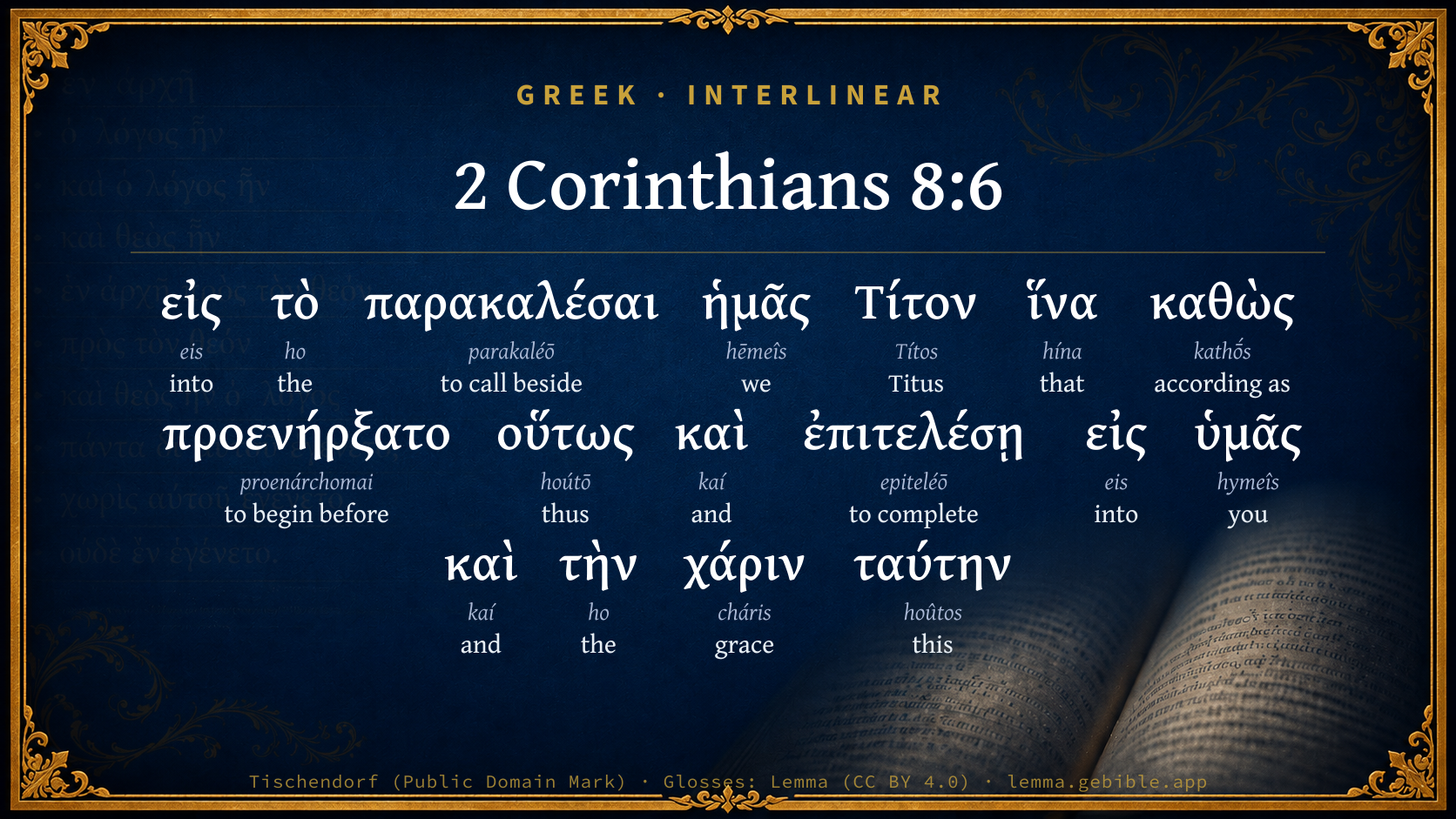
Download image
Cite this verse

2 Corinthians 8:6 (World English Bible). Public Domain. Lemma interlinear Bible study tool, https://lemma.gebible.app/v/2-corinthians/8/6.

Show BibTeX & RIS
BibTeX
RIS
English Translation
So we urged Titus, that as he made a beginning before, so he would also complete in you this grace.
World English Bible · Public Domain
Highlights
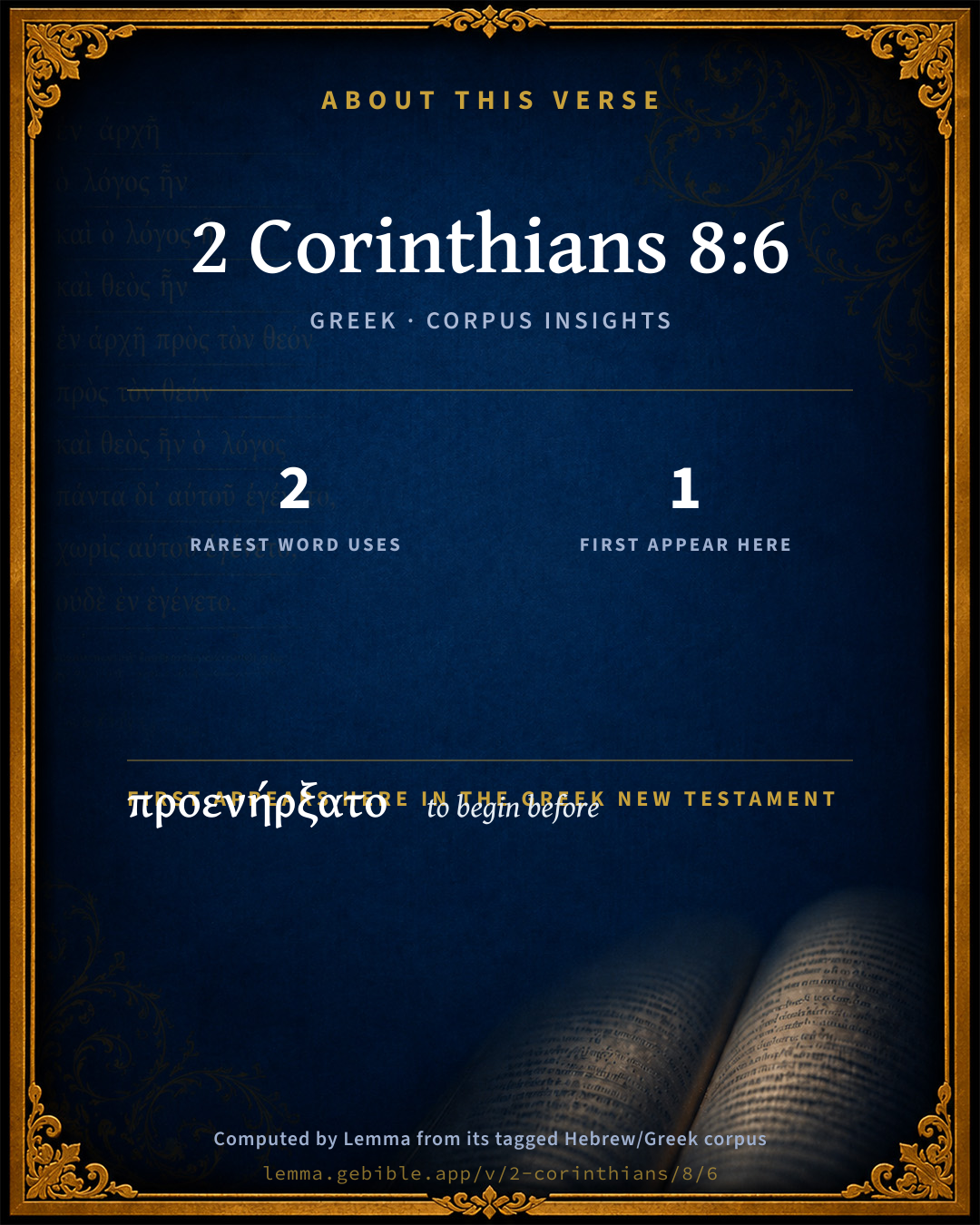
  • 1 first appearance in the Greek New Testament
Full analysis ↓
Download a study sheet

One document with this verse’s original text, its word-by-word gloss line, the meaning frame, cross-references with their text, attributed commentary, and full source and license credits — printable, and it pastes into notes with its structure intact.

This verse Autodidact and up

Study sheet (.html) Plain text (.txt)

A passage Seminary Student

Up to 50 verses in one chapter. A passage sheet keeps up to 6 commentary sources and 12 cross-references per verse, in the order this page ranks them, and says so on the sheet whenever that leaves anything out. Ask for a single verse and you get the Autodidact verse sheet above.

Everything on this page stays free to read, with no account — the sheet is a download of what is already on screen, not access to it.

Want to remove ads? Support Godless Engineer
Compare translations 3

The same verse in 3 English versions, stacked beneath the original-language interlinear above. Click any original word for its lexicon entry.

Each is an independent rendering of the whole verse — the interlinear is not word-aligned to these translations.

Highlighted words mark where these versions differ — a whole-verse word diff, not a word-by-word alignment.

  • World English Bible Public Domain
    So we urged Titus, that as he made a beginning before, so he would also complete in you this grace.
  • King James Version Public Domain
    Insomuch that we desired Titus, that as he had begun, so he would also finish in you the same grace also.
  • unfoldingWord Literal Text CC BY-SA 4.0
    So we urged Titus that, just as he began, in the same way he would also complete for you this grace as well.

unfoldingWord Literal Text — © unfoldingWord, licensed CC BY-SA 4.0. Word-aligned USFM3 via Door43 (git.door43.org/unfoldingWord/en_ult).

Versions to compare (up to 4)

3 of 4 selected

Show all 19 translations

Every available English version of this verse, each an independent rendering of the whole verse.

  • World English Bible Public Domain
    So we urged Titus, that as he made a beginning before, so he would also complete in you this grace.
  • Berean Standard Bible Public Domain
    So we urged Titus to help complete your act of grace, just as he had started it.
  • Majority Standard Bible Public Domain
    So we urged Titus to help complete your act of grace, just as he had started it.
  • King James Version Public Domain
    Insomuch that we desired Titus, that as he had begun, so he would also finish in you the same grace also.
  • American Standard Version (1901) Public Domain
    Insomuch that we exhorted Titus, that as he made a beginning before, so he would also complete in you this grace also.
  • Revised Version (1885) Public Domain
    Insomuch that we exhorted Titus, that as he had made a beginning before, so he would also complete in you this grace also.
  • Geneva Bible (1599) Public Domain
    That we should exhort Titus, that as hee had begon, so he would also accomplish the same grace among you also.
  • Douay-Rheims (1899) Public Domain
    Insomuch, that we desired Titus, that as he had begun, so also he would finish among you this same grace.
  • Young's Literal Translation Public Domain
    so that we exhorted Titus, that, according as he did begin before, so also he may finish to you also this favour,
  • Literal Standard Version CC BY-SA 4.0
    so that we exhorted Titus, that, according as he began before, so also he may also finish this favor to you,
  • Unlocked Literal Bible CC BY-SA 4.0
    So we urged Titus, who had already begun this task, to complete among you this act of grace.
  • unfoldingWord Literal Text CC BY-SA 4.0
    So we urged Titus that, just as he began, in the same way he would also complete for you this grace as well.
  • Darby Bible Public Domain
    So that we begged Titus that, according as he had before begun, so he would also complete as to you this grace also;
  • World Messianic Bible Public Domain
    So we urged Titus, that as he had made a beginning before, so he would also complete in you this grace.
  • Webster's Bible Public Domain
    So that we desired Titus, that as he had begun, so he would also finish in you the same grace also.
  • Free Bible Version CC BY-SA 4.0
    So we have encouraged Titus—since it was he who started this work with you—to return and complete this gracious ministry of yours.
  • Bible in Basic English Public Domain
    So that we made a request to Titus that, as he had made a start before, so he might make this grace complete in you.
  • Text-Critical English NT CC BY 4.0
    So we have urged Titus, who previously encouraged you to begin gathering money, to return and help you complete this gracious gift.
  • Tyndale New Testament (1534) Public Domain
    so that we coulde not but desyre Titus to acomplysshe the same benivolence amonge you also even as he had begonne.

Literal Standard Version (2020), Covenant Press — licensed CC BY-SA 4.0. Text via the HelloAO Bible API (eBible.org). Unlocked Literal Bible (unfoldingWord) — licensed CC BY-SA 4.0. Text via the HelloAO Bible API (eBible.org). unfoldingWord Literal Text — © unfoldingWord, licensed CC BY-SA 4.0. Word-aligned USFM3 via Door43 (git.door43.org/unfoldingWord/en_ult). Free Bible Version, Dr. Jonathan Gallagher — licensed CC BY-SA 4.0. Text via the HelloAO Bible API (eBible.org).

Word by word

More ways to search: Search by grammar → Find every occurrence → Compare this word →

Practice this passage: Drill this verse → Learn its vocabulary →

προενήρξατο
proenárchomai
G4278
“to begin before”
Verb, Aorist, Middle deponent, Indicative, 3rd person, Singular
Part of Speech
Verb
Tense
Aorist
Voice
Middle deponent
Mood
Indicative
Person
3rd person
Number
Singular
Full Thayer's Definition

Origin: from G4253 and G1728

TDNT: None

1. to make a beginning before
  1. εἰς eis G1519 “into” Preposition
  2. τὸ ho G3588 “the” Article, Accusative, Singular, Neuter
  3. παρακαλέσαι parakaléō G3870 “to call beside” Verb, Aorist, Active, Infinitive
  4. ἡμᾶς hēmeîs G2249 “we” Personal pronoun, 1st person, Accusative, Plural
  5. Τίτον Títos G5103 “Titus” Noun, Accusative, Singular, Masculine
  6. ἵνα hína G2443 “that” Conjunction
  7. καθὼς kathṓs G2531 “according as” Adverb
  8. οὕτως hoútō G3779 “thus” Adverb
  9. καὶ kaí G2532 “and” Conjunction
  10. ἐπιτελέσῃ epiteléō G2005 “to complete” Verb, Aorist, Active, Subjunctive, 3rd person, Singular
  11. εἰς eis G1519 “into” Preposition
  12. ὑμᾶς hymeîs G5210 “you” Personal pronoun, 2nd person, Accusative, Plural
  13. καὶ kaí G2532 “and” Conjunction
  14. τὴν ho G3588 “the” Article, Accusative, Singular, Feminine
  15. χάριν cháris G5485 “grace” Noun, Accusative, Singular, Feminine
  16. ταύτην hoûtos G3778 “this” Demonstrative pronoun, Accusative, Singular, Feminine

About this verse

These counts appear in no published source. They are computed here, from the morphology-tagged text and Lemma’s own curated glosses. What Lemma adds →

17
words
14
distinct lemmas
Pauline Epistles
section

Notable vocabulary

The rarest word here is προενήρξατο to begin before G4278 — appearing just 2 times in the whole Greek New Testament.

First appearance in Scripture

This word makes its first canonical appearance in the Greek New Testament here:

  • προενήρξατο to begin before G4278

Shared distinctive vocabulary

προενήρξατο to begin before G4278 occurs in 2 verses of the Greek New Testament. Also found in:
Repetition

Words recur within this verse:

Cross-references

7

Topical passages linked to 2 Corinthians 8:6 in the Treasury of Scripture Knowledge — connected by theme and wording, ordered by reader-vote popularity; previews shown in the World English Bible.

  • 2 Corinthians 12:18 I exhorted Titus, and I sent the brother with him. Did Titus take any advantage of you? Didn't we walk in the same spirit? Didn't we walk in the same steps?
  • 2 Corinthians 8:16–17 But thanks be to God, who puts the same earnest care for you into the heart of Titus.
  • 2 Corinthians 8:19 Not only so, but who was also appointed by the assemblies to travel with us in this grace, which is served by us to the glory of the Lord himself, and to show our readiness.
  • 2 Corinthians 8:4 begging us with much entreaty to receive this grace and the fellowship in the service to the saints.
  • 2 Corinthians 9:5 I thought it necessary therefore to entreat the brothers that they would go before to you, and arrange ahead of time the generous gift that you promised before, that the same might be ready as a matter of generosity, and not of greediness.
  • Philippians 4:18 But I have all things, and abound. I am filled, having received from Epaphroditus the things that came from you, a sweet-smelling fragrance, an acceptable and well-pleasing sacrifice to God.
  • 1 Peter 4:10 According as each has received a gift, be ministering it among yourselves, as good stewards of the grace of God in its various forms.

Cross-references courtesy of OpenBible.info (CC BY 4.0).

Commentary

Notes on 2 Corinthians 8:6 from classic Christian and Jewish commentators (each source and its license shown beneath its notes). The classic Christian expositions comment on the surrounding passage and are grouped to its opening verse, so a note may address several verses; the Jewish commentaries on the Tanakh (Rashi and others) are per-verse, so they appear only where the commentator wrote on this verse.

Lemma curates 59 commentaries, every one of them public domain or Creative Commons licensed, each selected and text-cleaned for this edition rather than reprinted as found. About our sources →

Joseph Benson's Commentary

2Co 8:6-8. Insomuch that — Seeing this forwardness in them; we desired Titus, that as he had begun — When he was with you before; so he would also now finish among you the same grace — That is, fruit of grace, or charity; also. Therefore, as ye abound in every thing — In all other gifts and attainments; in faith — A full assurance of the truth of the gospel; and utterance — In eloquence, or ability to speak a variety of languages; and knowledge — Of divine things; and in all diligence — In performing every Christian duty; and in your love to us — To me your spiritual father; see that ye abound — Or I pray that you would abound; in this grace of Christian liberality also. I speak not by commandment — Or by way of injunction, because works of charity ought to be voluntary; but by occasion of the forwardness of others — I recommend it on account of the diligence (δια της σπουδης, through the zeal) of the Macedonians, which I wish you to imitate; and reprove the sincerity — Το γνησιον, the sincere thing, or the genuine sincerity; of your love — To God, to your brethren, and to me.

Joseph Benson's Commentary on the Old and New Testaments (1811–1818) — public domain. Text from a community e-Sword module.

Tyndale Open Study Notes

Tyndale Open Resources

8:6 Titus would start taking up the collection when he returned to Corinth carrying this letter from Paul in Macedonia.

Tyndale Open Study Notes — © Tyndale Open Resources, licensed CC BY-SA 4.0. Text via the HelloAO Bible API.

Bengel's Gnomon

Johann Albrecht Bengel

2Co 8:6. Εἰς) Not the end, but the consequence is intended [“insomuch that”].—καθῶς προενήρξατο, as he formerly began) in regard to spiritual things, ch. 2Co 7:15. To him, who has begun well, the things which are beyond turn out easy. He had gone to the Corinthians; he was going to the Corinthians.—ἐπιτελέσῃ, he would finish) in this matter. [If you have attempted any good thing, finish it.—V. g.]—εἰς ὑμᾶς, in respect of you) that you might imitate the Macedonians.

Bengel's Gnomon of the New Testament — English translation (T&T Clark, Edinburgh, 1860) — public domain. Text from a community e-Sword module.

Meyer's Critical & Exegetical Commentary

Heinrich August Wilhelm Meyer

2Co_8:6. In order that we should exhort Titus, etc. Comp. 2Co_8:17. εἰς τό with the infinitive is here, as in all passages (see on Rom_1:20), to be taken, not as so that (so usually, and by Winer), but as telic: in order that. Comp. Kühner, ad Xen. Anab. vii. 8. 20. Certainly the παρακαλέσαι ἡμᾶς τίτον κ.τ.λ. was a consequence of the beyond expectation successful course of the matter in Macedonia, in accordance with which Paul might promise himself no less a success among the Corinthians; but delicately and piously he presents the state of the case, as if this further prosecution of the work of collection, amidst the self-sacrificing liberality of the Macedonians effected by the divine will, had lain in Gods purpose, and was therefore a consequence that had been aimed at by God. This flows from the διὰ θελήμ. θεοῦ immediately preceding. Comp. Hofmann also. Paul sees in the fact, that the divinely-willed success of the collecting work in Macedonia has encouraged him to the continuance of it expressed in 2Co_8:6, the fulfilment of the divine counsel and will, which he is thereby servin.

ἵνα] Design in the παρακαλέσαι, and consequently its content.

καθὼς προενήρξατο] as he formerly has begun, without doubt during his sojourn in Corinth after our first Epistle, see Introd. § 1. The word is indeed without example elsewhere, but it is formed from ἐνάρχομαι, after the analogy of προάρχω and other.

οὕτω καὶ ἐπιτελέσῃ εἰς ὑμᾶς] so also might complete it among you. The emphasis lies, as before on προενήρξατο, so here on ἐπιτελέσῃ. With the verb of rest εἰς associates the thought of the previous arrival, so that ἐλθέν may for clearness be supplied. See Kühner, § 622 b; Jacobs, ad Anthol. XIII. p. 71; Ellendt, Lex. Soph. I. p. 537. The correlation of ἐνάρχεσθαι and ἐπιτελεῖν is simply as in Php_1:6, Gal_3:3; we should anticipate (2Co_9:12) by importing the idea of sacrifice (Osiander).

καὶ τὴν χάριν ταύτην] not hanc quoque gratiam (Beza, Calvin, comp. Castalio), but: etiam gratiam istam (Vulgate). For also belongs to τὴν χάριν, not to ταύτην. He shall complete among youin addition to whatever else he has already begun and has still to completealso this benefit. This better suits the context, namely, the connection of the οὕτω καὶ ἐπιτελ. with καθὼς προενήρξατο, than the interpretation of Estius: dicit etiam, ut innuat Titum alia quaedam apud ipsos jam perfecisse. So also Flatt. It is quite superfluous to invoke, with Hofmann, an involution of two sentences in order to explain the double καί. And since καί refers to the activity of Titus, Billroth is wrong in explaining it: they are to distinguish themselves in this good deed, as in all things.

The work of collection is designated as χάρις, for on the side of the givers it was a showing of kindness, a work of love, an opus charitativum. Observe that here and in 2Co_8:4; 2Co_8:19, θεοῦ is not added, as in 2Co_8:1; 2Co_9:14, according to which Hofmann and older commentators explain it here also of the divine grace, of which they are made worthy through the service rendered.

Meyer — Critical and Exegetical Commentary on the New Testament — English translation by Peter Christie, edited by Frederick Crombie (T&T Clark, 1880) — public domain. Text from a community e-Sword module.

Expositor's Greek Testament

ed. W. Robertson Nicoll

2Co 8:6-7 . εἰς τὸ παρακαλέσαι κ . τ . λ .: so that we exhorted Titus (the epistolary aor. infin.; this is the exhortation to Titus on his meeting with St. Paul in Macedonia after accomplishing his first Mission to Corinth; παρακαλ . is the word used throughout of the Apostle’s directions to Titus; see 2Co 8:17 , 2Co 9:5 , 2Co 12:17 , and on chap. 2Co 1:4 ), that as he made a beginning before, sc. , in the matter of the collection, during the Mission from which he has now returned, so he would also complete in you this grace also, i.e. , the grace of liberal giving in addition to the graces of repentance and goodwill which rejoiced him so much to observe (2Co 7:13-14 ). ἐπιτελεῖν is to bring to a successful issue a work already begun; see 2Co 5:11 below. ἀλλʼ ὥσπερ κ . τ . λ .: yea rather ( ὥσπερ having an ascensive force as at 2Co 1:9 , 2Co 5:7 being strictly parallel to and explanatory of 2Co 5:6 ) that as ye abound ( cf. 1Co 15:58 ) in everything (so he had said of the Corinthians in 1Co 1:5 , ἐν παντὶ ἐπλουτίσθητε ), in faith (see chap. 2Co 1:24 and 1Co 12:8 , where πίστις is named as one of the gifts of the Spirit exhibited among them), and utterance, i.e. , the grace of ready exposition of the Gospel message, and knowledge, i.e. , of Divine things ( λόγος and γνῶσις are conjoined, as here, at 1Co 1:5 , and γνῶσις is also mentioned with πίστις at 1Co 12:8 ; at 1Co 8:1 he points out with marked emphasis that γνῶσις is not comparable in importance to ἀγάπη as shown in condescension to a brother’s intellectual weakness), and all earnestness (see reff. and cf. 2Co 7:11 , where he mentions the σπουδή that the Corinthians had exhibited when they received his message of reproof), and in your love to us ( cf. 2Co 1:11 and 2Co 8:24 ; the variant reading ἐξ ἡμῶν ἐν ὑμῖν would disturb the sense all through he is speaking of the graces of the Corinthians, not of his own), so ye may abound in this grace also ( cf. 2Co 9:8 ). The English versions and comm. take ἵνα with the subj. here as a periphrasis for the imperative, and understand some verb like βλέπετε , “ See that ye abound, etc.,” but this usage of ἵνα is unexampled. We follow Kennedy in taking 2Co 8:7 in close connexion with 2Co 8:6 , although we do not agree with the inferences which he draws (2 and 3 Cor. , p. 122). 2Co 8:7 seems “to have been added by St. Paul,” he rightly observes “to avoid any appearance of depreciating the work which Titus had already accomplished among the Corinthian Christians, by the description of it in 2Co 8:6 as a beginning”. Cf. the shrewd remark of Grotius, “non ignoravit Paulus artem rhetorum, movere laudando”.

The Expositor's Greek Testament, edited by W. Robertson Nicoll (1897–1910) — public domain. Text from a community e-Sword module.

Jamieson, Fausset & Brown

Robert Jamieson, A. R. Fausset & David Brown

Insomuch that--As we saw the Macedonians' alacrity in giving, we could not but exhort Titus, that as we collected in Macedonia, so he in Corinth should complete the work of collecting which he had already begun there, lest ye, the wealthy people of Corinth, should be outdone in liberality by the poor Macedonians.

as he had begun--Greek, "previously begun," namely, the collection at Corinth, before the Macedonians began to contribute, during the visit to Corinth from which he had just returned.

finish in you the same grace--complete among you this act of grace or beneficence on your part.

also--as well as other things which he had to do among them [ALFORD].

Jamieson, Fausset & Brown — Commentary Critical and Explanatory on the Whole Bible (1871) — public domain (CC PDM 1.0). Text via the HelloAO Bible API.

Adam Clarke's Commentary

Verse 6. That we desired Titus] Titus had probably laid the plan of this contribution when he was before at Corinth, according to the direction given by the apostle, 1Co 16:1, c.

The same grace] Liberality. See the note on 2Co 8:1.

Adam Clarke's Commentary on the Bible (1810–1826) — public domain. Text from a community e-Sword/MySword module.

John Calvin's Commentaries

6. That we should exhort Titus. Now this is an exhortation that is of greater force, when they learn that they are expressly summoned to duty. Nor was it offensive to the Macedonians, that he was desirous to have the Corinthians as partners in beneficence. In the mean time an apology is made for Titus, that the Corinthians may not think that he pressed too hard upon them, as if he had not confidence in their good disposition. For he did that, from having been entreated, and it was rather in the name of the Macedonians, than in his own.

John Calvin's Commentaries (1540-1563) — public domain. Text from the Calvin Translation Society English edition (1840s-50s) via the Christian Classics Ethereal Library (ccel.org). Calvin's coverage is partial (roughly two-thirds of the Bible); uncommented books and verses are honest gaps, never fabricated. The 19th-century editor's footnotes and remarks are omitted so the notes are faithfully Calvin's own voice.

Ellicott's Commentary for English Readers

(6) Insomuch that we desired Titus . . .—The sequence of events seems to have been this: When Titus came to Corinth, he, among other things, after seeing the satisfactory results of the First Epistle in other respects, had begun to take measures for this collection for the poor of Jerusalem. He had been, to a certain extent, successful. Encouraged by the report of that success, St. Paul had now entreated Titus to return to Corinth, and to bring the good work to its completion. “This grace also” practically means—this work of liberality, as well as that of repentance and loyal obedience already spoken of in 2 Corinthians 7.

A Bible Commentary for English Readers, edited by Charles John Ellicott (1878–1897) — public domain. Text from a community e-Sword module.

The Cambridge Bible for Schools and Colleges

gen. ed. J. J. S. Perowne

6. Insomuch that we desired Titus] Titus, it seems clear by the words ‘as he had begun,’ went a second time to Corinth before the Apostle arrived there (see, however, note on 2Co_8:18). His first visit began, his second completed the collection for the saints. For desired see ch. 2Co_1:3, the word receiving a great variety of translations in the N. T. Perhaps incited (or urged) would be the best translation here.

finish] Literally, complete.

in you] Literally, unto you. “Erga vos.” Estius.

the same grace also] See note on 2Co_8:4. The Greek word is the same in both instances. The grace or favour is either (1) (see last note) the work of love which St Paul had accomplished in Macedonia, that of stirring up their zeal in giving; or (2) it may refer to the good work which God performed in their souls by means of His ministers, in drawing out all the best qualities of their renewed humanity.

The Cambridge Bible for Schools and Colleges (gen. ed. J. J. S. Perowne; Cambridge University Press, 1878–1918) — public domain. Text from a community e-Sword module.

John Gill's Exposition

Insomuch that we desired Titus,.... Observing the very great readiness, cheerfulness, and liberality of the poor Macedonians in this matter, the apostles could do no other than desire Titus to forward, hasten, and accomplish a like liberal contribution among the Corinthians; or the sense is, that the Macedonians not only prayed with much entreaty, as in Co2 8:4 that the apostle would be pleased to take their collection, and send or carry it to Jerusalem; but also that they would entreat Titus,

that as he had begun, so he would also finish in you the same grace also; that is, that as he had already moved this affair to the Corinthians while he was with them, and had made some progress in it, though what, through one thing or another, it had been retarded, and lay in some measure neglected; that he might be desired to go again, on purpose to complete so good a work, so acceptable to God, and so useful to the poor saints; which carries in it a new and strong argument to stir up the Corinthians to this service; since they had not only the example of the Macedonian churches, but it was even at their request that Titus was desired to go upon this errand; and to this sense read the Vulgate Latin, Syriac, and Arabic versions.

John Gill's Exposition of the Whole Bible (1746–1763) — public domain (CC PDM 1.0). Text via the HelloAO Bible API.

Trapp's Complete Commentary

John Trapp

6 Insomuch that we desired Titus, that as he had begun, so he would also finish in you the same grace also.

Ver. 6. So he would finish] Finis opus coronat. The end crowns the work. "The end is better than the beginning," saith Solomon. Charles V’s emblem was Ulterius, Farther. Titus was here desired to take up the whole alms, and not to faint till he had finished, Gal 6:9.

John Trapp, A Commentary or Exposition upon All the Books of the Old and New Testament (1647–1656) — public domain. Text from a community e-Sword module.

Albert Barnes' Notes on the Bible

Insomuch - The sense of this passage seems to be this, “We were encouraged by this unexpected success among the Macedonians. We were surprised at the extent of their liberality. And encouraged by this, we requested Titus to go among you and finish the collection which you had proposed and which you had begun. Lest you should be outstripped in liberality by the comparatively poor Macedonian Christians, we were anxious that you should perform what you had promised and contemplated, and we employed Titus, therefore, that he might go at once and finish the collection among you.”

The same grace also - Margin, “Gift;” see the note on 2Co 8:1. The word refers to the contribution which he wished to be made.

Albert Barnes' Notes on the Bible (1834–1885) — public domain. Text from a community e-Sword/MySword module.

Haydock's Catholic Bible Commentary

We desired Titus. Having experienced the benevolence and generosity of the faithful of Macedon, St. Paul dismisses his faithful disciple, Titus, to exhort the Corinthians to imitate the example of their brethren in Macedon, laying before their eyes, in the following verses, the charity of Christ, who reduced himself to the greatest poverty and indulgence, to shew us an example of humility and charity.

George Leo Haydock (1774–1849), Haydock's Catholic Family Bible and Commentary, 1859 edition — public domain. Excludes Psalms (Douay-Rheims chapter numbering differs from Protestant) and Deuterocanonical books (Catholic canon only).

Matthew Poole's English Annotations

The same grace, in this place, signifieth no more than the same gift, or the same good work, in collecting in the church of Corinth. If by grace here be understood the grace of God, the cause is put for the effect (as we had it in the first verse); but του yeou being not here added, possibly it had been better translated gift, or free contribution; for how a minister should finish the grace of God, is hard to conceive; and the phrase is at best very hard, but he may be an instrument for completing a good work, which is done from a habit of Divine grace, by exhortations and arguments, which he may use to press the performance of it. Titus (it seemeth) had been diligent in some other places to make this collection; going to Corintlh the apostle presseth him to go on with it there also.

Matthew Poole's English Annotations on the Holy Bible (1683–1685) — public domain. Text from a community e-Sword/MySword module.

Whedon's Commentary on the Bible

Daniel D. Whedon

6. Titus… begun… finish—Titus was bearer of the first epistle to Corinth, and he appears to have initiated a fulfilment of 1Co_16:1-3, in regard to collections. Incited by the generosity of the Macedonians, Paul decides that Titus is the man to complete the contribution in Corinth; as, having witnessed the bright Macedonian example, he was prepared to rouse Corinth to a joyous emulation.

Daniel D. Whedon (gen. ed.), Commentary on the Old and New Testaments (1874–1909) — public domain. Text from a community e-Sword module.

The Pulpit Commentary

Insomuch that. Their liberality encouraged me so greatly that I exhorted Titus to return to Corinth once more, and see whether he could not receive some proof that you were equally liberal. The remarks that follow are full of delicate reserve, but under their exquisite tact and urbanity we can perceive that the Corinthians had talked very loudly about their contributions, and had promised with great zeal, but had shown themselves somewhat slack in redeeming their promises. We exhorted Titus. It is curious that this word is constantly used of the missions of Titus (ver. 17; 2Co_12:18; 1Co_16:12) As he had began. "That as no inaugurated (this collection), so he would also complete towards you this gracious work also." Among other works of grace which Titus might complete by returning to them from Macedonia was the kindly collection which he had begun to set on foot in his previous. (2Co_12:18)

The Pulpit Commentary (1880–1919), ed. H.D.M. Spence-Jones & Joseph S. Exell — public domain. Text from a community e-Sword module.

John Wesley's Explanatory Notes

As he had begun - When he was with you before.

John Wesley, Explanatory Notes Upon the Whole Bible (1754–1765) — public domain. Text via the GEBible commentary corpus.

Burkitt's Expository Notes on the New Testament

William Burkitt

Here our apostle proceeds to make use of several other arguments to persuade the Corinthians to the exercise of the duty and grace of charity: as namely,

(1.) Because he had desired Titus to go to them; and as he had in his last visit begun to stir them up to this duty, and to exercise this grace, so he would farther promote and bring it to perfection.

And, (2.) Because they abounded in other graces and gifts; as namely, in faith, in utterance, and knowledge, &c. therefore they ought to abound in this grace also, otherwise they would not be complete in the whole will of God.

(3.) Because hereby they would testify the sincerity of their love to the saints. It is not good words, but charitable deeds, that evidence the truth of our love to our fellow members in Christ; not saying, Be ye warmed or be ye clothed; but distributing to their necessities according to our abilities.

Yet, observe, The apostle doth not command their purses, and require so much of them for charity; he mentions no particular sum, much less doth he command them to give away all their estates, and live upon a common stock, and leave nothing to themselves which they could call their own; for if a man has nothing of his own, there is no room for liberality. There must be prudence then in the exercise of our charity, prudence in finding out proper objects for our charity, prudence in timing of our charity, prudence in the measure of our charity, and prudence in the end which we propound to ourselves in the exercise of our charity.

William Burkitt's Expository Notes on the New Testament (1700–1703) — public domain. Text from a community e-Sword module.

McGarvey & Pendleton's Commentaries

J. W. McGarvey

Insomuch that we exhorted Titus, that as he had made a beginning before, so he would also complete in you this grace also . [Inspired by the example of the Macedonians, Paul was moved to exhort Titus to return to Corinth, that having begun the work of gathering an offering from the church there, he might continue until the Corinthians made a liberal offering.]

J. W. McGarvey (with Philip Y. Pendleton), Commentaries on the New Testament (The Fourfold Gospel, 1914; Acts; and the epistles) — public domain. Text from a community e-Sword/MySword module.

The People's New Testament

B. W. Johnson

6–9. We desired Titus, that as he had begun. This faithful fellow laborer of Paul, when he had gone to Corinth when Paul's first epistle was sent, had begun the collection which it commanded in 1 Cor. 16:1. Now Paul directs that he return and complete the collection before the arrival of Paul (Acts 20:1–3). Grace. The grace of giving.

B. W. Johnson's The People's New Testament with Notes (1889–1891) — public domain. Electronic text from the Christian Classics Ethereal Library (CCEL) ThML edition.

unfoldingWord translationNotes

Door43 World Missions Community

who had already begun this task

Paul is referring to the collection of money from the Corinthians for the believers in Jerusalem. AT: "who had encouraged your giving in the first place" (See: Assumed Knowledge and Implicit Information)

to complete among you this act of grace

Titus was to help the Corinthians to complete the collection of money. AT: "to encourage you to finish collecting and giving your generous gift" (See: Assumed Knowledge and Implicit Information)

But you abound in everything

Paul speaks of the Corinthian believers as if they were producing physical goods. AT: "You do well in so many ways" (See: Metaphor)

make sure that you excel in this act of grace

Paul speaks of the Corinthian believers as if they should produce physical goods. AT: "make sure you do well in giving for the believers in Jerusalem" (See: Metaphor)

translationWords

Titus

faith

know

love

works

unfoldingWord translationNotes — © Distant Shores Media and the Door43 World Missions Community, licensed CC BY-SA 4.0. Source: git.door43.org/Door43/en_tn.

Cambridge Greek Testament for Schools and Colleges

6. εἰς τὸ παρακαλέσαι ἡμᾶς Τίτον. This depends upon ἔδωκαν, and there should be at most a semicolon at the end of 2Co 8:5: They gave their own selves … so that we exhorted (or, entreated) Titus, that, just as he made a beginning before, so he would also complete towards you this grace also. Here εἰς τό means ‘so that,’ rather than ‘in order that’: Blass, Gr. N.T. § 71. 5. It is frequent in the Pauline Epistles.

προενήρξατο. A rare compound. In Gal 3:3 and Php 1:6 we have ἐνάρχομαι, which B reads here. This ‘making a beginning before’ points to an early mission of Titus to Corinth, previous both to the one mentioned here and to that alluded to in 2Co 7:6; 2Co 7:13. See on 2Co 12:18. Titus had given them a start in other things; it was fitting that he should bring to completion among them this good thing also. There is no reason for bringing in here the notion of beginning and completing sacrificial rites, although ἐνάρχεσθαι is sometimes used of the one and ἐπιτελεῖν of the other.

Cambridge Greek Testament for Schools and Colleges (Cambridge University Press, 1896; 21 vols, various authors incl. Carr, Maclear, Plummer, Farrar, Lumby, Moule, M. R. James, Simcox) — public domain. Text from a community e-Sword module.

Alford’s Greek Testament

Henry Alford

6.] So that we besought Titus (not, Titus besought us, see ver. 17), that (the aim, and purport as well, of our request), as he had previously (before the Macedonians began to contribute: ‘during his visit from which he had now returned’) begun it, so he would also complete among you (the construction is pregnant—ἔλθῃ εἰς ὑμᾶς καὶ ἐπιτελέσῃ) this grace also (this act of grace or mercy, reff.

καί,—as well as other things which he had to do among them. It does not belong to ταύτην, ‘this grace also, as well as other graces,’ but to τὴν χάριν ταύτην altogether).

Henry Alford, The Greek Testament (1849–1861) — public domain. Text from a community e-Sword module.

International Critical Commentary

6. εἰς τὸ παρακαλέσαι ἡμᾶς Τίτον. We are still under the influence of the rather hard-worked ἔδωκαν, which totam periochae structuram sustinet (Beng.). ‘It was their own selves that they gave … so that we entreated Titus, that, just as he started (the collection) before, so he would also complete among you this gracious work also.’ The εἰς τό implies some such connecting thought as ‘I was so encouraged by the generosity of the Macedonians that I thought I would send Titus to you.’ We hardly need καί in both places, but the pleonasm would easily be made in dictating. The second καί, however, may mean that there were other things which Titus had started. The rare verb προενήρξατο implies that Titus has been at Corinth before he took the severe letter alluded to in 7:12. This is some confirmation of the view that he, rather than Timothy, was the bearer of 1 Cor. But he may have been in Corinth before 1 Cor. to start the collection. In 1Co 16:1 the λογία is mentioned as a subject already known to the Corinthians; see note there. They may have asked about it. See on 12:18. B here has ἐνήρξατο, a verb which occurs Gal 3:3 and Php 1:6, in both of which passages it is combined with ἐπιτελέω, and in both of them Lightfoot thinks that a sacrificial metaphor may be intended, for both verbs are sometimes used of religious ceremonials, the one of initiatory rites and the other of sacrifices and other sacred observances. See Westcott on Heb 9:6. * The ἵνα gives the purport rather than the purpose of the entreaty or exhortation, and ἵνα ἐπιτελέσῃ is almost equivalent to a simple infinitive; cf. 1Co 4:3, 1Co 16:12.

εἰς ὑμᾶς. ‘Among you’; lit. ‘towards you,’ ‘in reference to you.’

καὶ τὴν χάριν ταύτην. ‘This gracious work also.’ This has no reference to τὴν χάριν τοῦ Θεοῦ (v. 1): it is not ‘the grace of God’ which Titus is to make efficacious, but the gracious efforts for the poor Christians that he is to bring to a fruitful conclusion. Nor is it likely that there is any reference to the good work done by Titus in reconciling the Corinthians to the Apostle; that would hardly be spoken of as χάρις. It is remarkable how frequently ταύτην, ταύτῃ or ταύτης recurs in this connexion; vv. 7, 19, 20, 9:5, 12, 13. In 9:1. εἰς τοὺς ἁγίους takes its place for variety. The precise force of καί, ‘as well as something else,’ remains doubtful.

7.ἀλλʼ ὥσπερ ἐν παντὶ περισσεύετε. ‘But there is another and a stronger consideration. What God has enabled the Macedonians to do is one incentive; you must also remember what He has done for you. You abound in everything; do not fall short of your great powers.’

πίστει. Faith in Christ, such as every believer has. See on Rom 1:17, pp. 31f.

λόγῳ καὶ γνώσει. These were specially valued at Corinth; St Paul treats both as Divine gifts, and, except in his Epistles and 2 Pet., γνῶσις is rarely so regarded in N.T. There is probably no reference to speaking with Tongues. See on 1Co 1:5, which to a considerable extent is parallel to this.

σπουδῇ. The word combines the ideas of eagerness, earnestness, and carefulness. AV employs seven different terms in translating it; in the Epistles, ‘carefulness,’ ‘care,’ ‘diligence,’ ‘forwardness,’ ‘earnest care,’ and ‘business’; in the Gospels, ‘haste.’ Even the Revisers use four; in the Epistles, ‘earnest care,’ ‘earnestness,’ and ‘diligence’; in the Gospels, ‘haste.’ These variations show the wide compass of the word.

τῇ ἐξ ὑμῶν ἐν ἡμῖν ἀγάπῃ. The reading is doubtful, and the meaning in either case is not quite certain, whether we read ὑμῶν ἐν ἡμῖν or ἡμῶν ἐν ὑμῖν. Neither ‘the love which comes from you and dwells in us,’ nor ‘the love which comes from us and dwells in you,’ is a phrase which has a very clear meaning. The love which wins love in return may be meant, and that may be expressed by either reading; ‘your love for us which binds us to you’ seems to suit the context. The love, like the faith, etc., is in the Corinthians.

ἵνα καὶ ἐν ταύτῃ τῇ χάριτι π. This shows clearly the meaning of τὴν χάριν ταύτην in v. 6. The ἵνα is probably elliptical, and we may understand παρακαλῶ from v. 6, or a similar verb. The elliptical ἵνα is then a gentle substitute for the direct imperative, as in the letter of the Jerusalem Jews to those in Egypt, 2 Macc. 1:9; καὶ νῦν ἵνα ἄγητε τὰς ἡμέρας τῆς σκηνοπηγίας τοῦ Χασιλεὺ μηνός. Cf. also Gal 2:10; 33; 23. This use of ἵνα is found in papyri. The ἀλλά is against making ἵνα co-ordinate with the ἵνα v. 6; and in any case this would be an awkward constr. Ἀλλά is at rather than sed; it marks, not opposition, but the transition from statement to exhortation (Mat 9:18; Mar 9:22; Luk 7:7). Ταύτῃ is emphatic by position; ‘in this gracious work also,’ as in faith, utterance, knowledge, and love. He is anxious not to seem to be finding fault.

8:8-15. I Give No Orders. The Example of Christ Need Only Be Mentioned. Each of You Must Decide How Much He Ought to Give.

3 Do not think that I am issuing commands. I am not dictating to you. Not at all. I am merely calling your attention to the enthusiasm of the Macedonians in order to prove how genuine is your love also. (9 There is no need to give orders to you. You know how gracious the Lord Jesus Christ was. He was so rich in the glory of the Godhead; yet all for your sake He became so poor, in order that you, yes you, might become spiritually rich.) 10 I say I am not giving orders; it is just a view of the matter that I am offering you in what I write. This surely is the proper way in dealing with people like you, who were first in the field, not merely in doing something but in cherishing a desire to help, and that was as far back as last year. 11 But now do carry the doing also through, so that your readiness in desiring to help may be equalled by your way of carrying it through, so far, of course, as your means allow. 12 For if the readiness to give is forthcoming, and to give in proportion to one’s possessions, this is very acceptable: no one is expected to give in proportion to what he does not possess. 13 I do not mean that other people should be relieved at the cost of bringing distress on you, but that there should be equality of burdens. At the present crisis your surplus goes to meet their deficit, 14 in order that some day their surplus may come to meet your deficit, so that there may be equality. 15 This is just what stands written in Scripture;—

‘He who gathered his much had not too much,

And he who gathered his little had not too little.

International Critical Commentary — older volumes (1896–1929), various authors — public domain. Text from a community e-Sword module.

Vincent's Word Studies in the New Testament

Marvin R. Vincent

Had begun [προενηρξατο] . Only here and ver. 10. Rev., giving the force of pro before, had made a beginning before : on his first visit to Corinth.

Complete - this grace also [επιτελεση και την χαριν ταυτην] . Should complete among you the act of love [χαριν] , the contribution already begun, in addition to whatever else He has yet to complete among you [και αλσο] .

Marvin R. Vincent, Word Studies in the New Testament (1887–1900) — public domain. Text from a community e-Sword/MySword module.

Lesson kit

Teaching starters — assembled from the data on this page, not authored interpretation. Every prompt links to the verse data it draws on. Edit before teaching.

2 Corinthians, in the Pauline Epistles, opens this verse with 17 words (14 distinct Greek lemmas). Its most distinctive word is proenárchomai (“to begin before”). A historical commentator’s framing appears above. Read the whole chapter for the surrounding context.

Discussion questions

  1. What does “to begin before” (proenárchomai) contribute to the verse as a whole?
  2. The word “to begin before” first appears here in Scripture. What is being introduced at this debut?
  3. 2 Corinthians 8:10 shares the word «to begin before» with this verse. How do the two illuminate each other?
  4. “into” occurs 2× in this one verse. What is the effect of the repetition?
  5. These translations render this verse differently; the difference is in the English rendering, not the original. What questions does that raise?
  6. Reading how Joseph Benson's Commentary and Tyndale Open Study Notes read this verse, where do the two commentators agree and where do they part?

Things to notice

  • 1 word makes its first canonical appearance in Scripture here.
  • These translations choose different wording for 15 words in this verse.
  • “into” occurs 2× in this single verse.
  • 14 distinct Greek lemmas span 17 words in this verse.

Reading settings

Reading text

Shown beneath each verse's original-language words.

Old Testament
Old Testament edition

Read the OT as the Masoretic Hebrew (MT) or the Greek Septuagint (LXX).

English shown for the Greek Septuagint (in the Hebrew ↔ Greek comparison).

Comparing translations? Open the Compare panel on any verse page to stack up to four side by side.