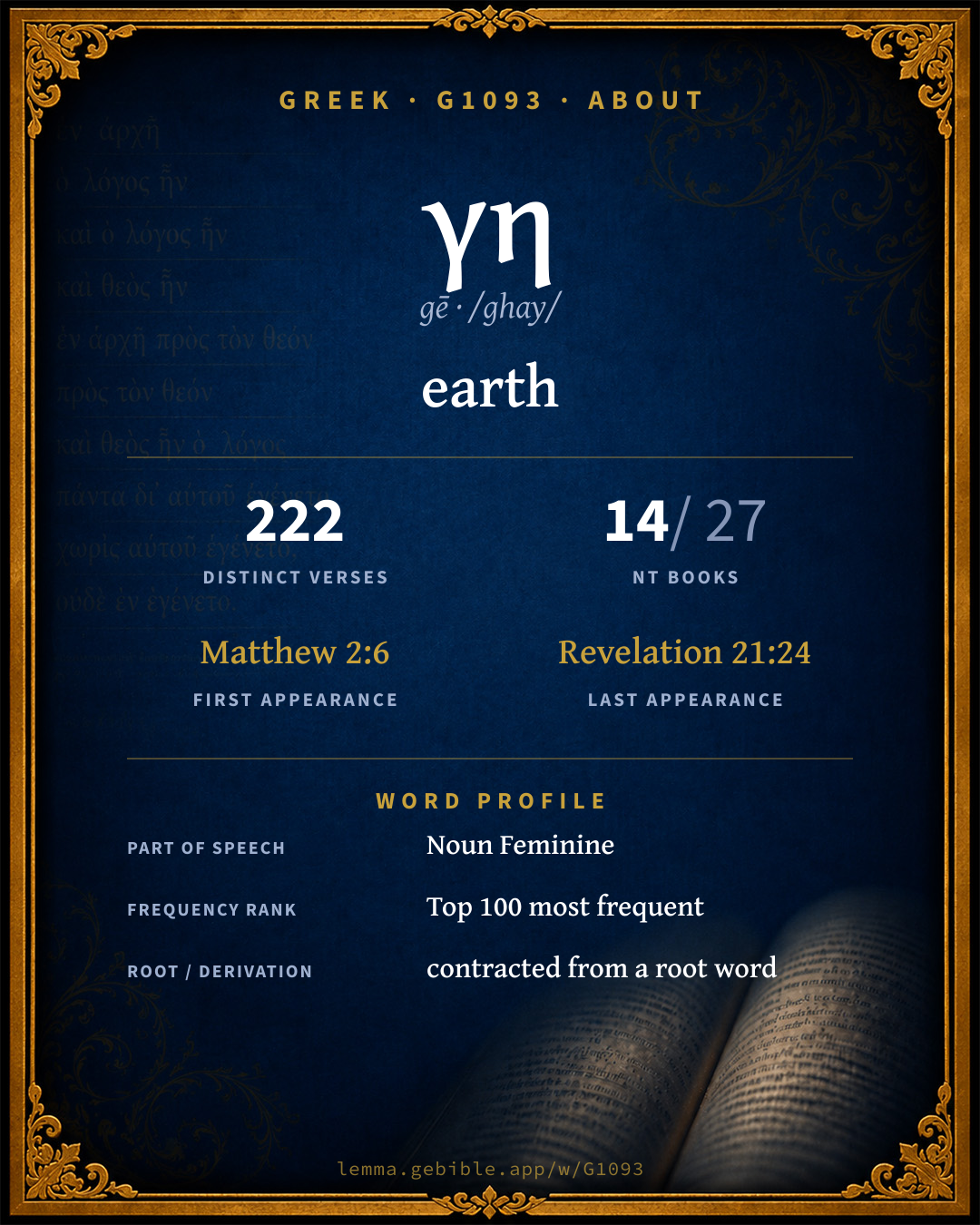
γῆ
earth
‘earth’ is one of 6 main senses fuller range ↓
Full lexicon entry — Thayer's Greek Lexicon
From Thayer's Greek Lexicon
Where this word appears
See every Genitive-case word in the Greek New Testament →
Grammar key — what these labels mean
Part of speech
- Noun
- A naming word — a person, place, thing, or idea.
Case
- Genitive
- The case of source, possession, or “of” — answers “whose / from what.”
- Accusative
- The case of the direct object and of extent.
- Nominative
- The case of the subject (and the predicate nominative).
- Dative
- The case of the indirect object, means, or location — “to / for / with / in.”
- Vocative
- The case of direct address (“O Lord”).
Gender
- Feminine
- Grammatically feminine.
Number
- Singular
- One.
Grammatical forms
- Noun, Genitive, Singular, Feminine 133 times (53%)
- Noun, Accusative, Singular, Feminine 79 times (32%)
- Noun, Nominative, Singular, Feminine 21 times (8%)
- Noun, Dative, Singular, Feminine 13 times (5%)
- Noun, Vocative, Singular, Feminine 3 times (1%)
Parsed forms decoded from the imported morphology (Robinson–Tischendorf, public domain), counted across 249 parsed occurrences — not distinct verses.
Page 1 of 2 — showing verses 1–200 of 222 distinct verses where G1093 appears, across 14 books. Click any verse to open its interlinear word-by-word view. Verse text shown in the World English Bible for context — . Each verse’s Greek form is shown with its reference; the English is not keyword-highlighted, since the data carries no word-level English alignment. Use “Compare translations” on any verse to read it across multiple English versions. This concordance covers the Greek New Testament; Septuagint (Greek Old Testament) occurrences of this word are not indexed here.
Matthew 38 verses
- Matthew 2:6 γῆ n voc sg fem 'You Bethlehem, land of Judah, Are in no way least among the princes of Judah: For out of you shall come forth a governor, Who shall shepherd my people, Israel.'"
- Matthew 2:20 γῆν n acc sg fem "Arise and take the young child and his mother, and go into the land of Israel, for those who sought the young child's life are dead."
- Matthew 2:21 γῆν n acc sg fem He arose and took the young child and his mother, and came into the land of Israel.
- Matthew 4:15 γῆ γῆ n voc sg fem n voc sg fem "The land of Zebulun and the land of Naphtali, Toward the sea, beyond the Jordan, Galilee of the Gentiles,
- Matthew 5:4 γῆν n acc sg fem Blessed are those who mourn, For they shall be comforted.
- Matthew 5:13 γῆς n gen sg fem "You are the salt of the earth, but if the salt has lost its flavor, with what will it be salted? It is then good for nothing, but to be cast out and trodden under the feet of men.
- Matthew 5:18 γῆ n nom sg fem For most assuredly, I tell you, until heaven and earth pass away, not even one smallest letter or one tiny pen stroke shall in any way pass away from the law, until all things are accomplished.
- Matthew 5:35 γῇ n dat sg fem nor by the earth, for it is the footstool of his feet; nor by Jerusalem, for it is the city of the great King.
- Matthew 6:10 γῆς n gen sg fem Let your Kingdom come. Let your will be done, as in heaven, so on earth.
- Matthew 6:19 γῆς n gen sg fem "Don't lay up treasures for yourselves on the earth, where moth and rust consume, and where thieves break through and steal;
- Matthew 9:6 γῆς n gen sg fem But that you may know that the Son of Man has authority on earth to forgive sins..." (then he said to the paralytic), "Get up, and take up your mat, and go up to your house."
- Matthew 9:26 γῆν n acc sg fem The report of this went out into all that land.
- Matthew 9:31 γῇ n dat sg fem But they went out and spread abroad his fame in all that land.
- Matthew 10:15 γῇ n dat sg fem Most assuredly I tell you, it will be more tolerable for the land of Sodom and Gomorrah in the day of judgment than for that city.
- Matthew 10:29 γῆν n acc sg fem "Aren't two sparrows sold for an assarion? Not one of them falls on the ground apart from your Father's will,
- Matthew 10:34 γῆν n acc sg fem "Don't think that I came to send peace on the earth. I didn't come to send peace, but a sword.
- Matthew 11:24 γῇ n dat sg fem But I tell you that it will be more tolerable for the land of Sodom, on the day of judgment, than for you."
- Matthew 11:25 γῆς n gen sg fem At that time, Jesus answered, "I thank you, Father, Lord of heaven and earth, that you hid these things from the wise and understanding, and revealed them to infants.
- Matthew 12:40 γῆς n gen sg fem For as Jonah was three days and three nights in the belly of the whale, so will the Son of Man be three days and three nights in the heart of the earth.
- Matthew 12:42 γῆς n gen sg fem The queen of the south will rise up in the judgment with this generation, and will condemn it, for she came from the ends of the earth to hear the wisdom of Solomon; and behold, someone greater than Solomon is here.
- Matthew 13:5 γῆν γῆς n acc sg fem n gen sg fem Others fell on rocky ground, where they didn't have much soil, and immediately they sprang up, because they had no depth of earth.
- Matthew 13:8 γῆν n acc sg fem and others fell on good soil, and yielded fruit: some one hundred times as much, some sixty, and some thirty.
- Matthew 13:23 γῆν n acc sg fem What was sown on the good ground, this is he who hears the word, and understands it, who most assuredly bears fruit, and brings forth, some one hundred times as much, some sixty, and some thirty."
- Matthew 14:34 γῆν n acc sg fem When they had crossed over, they came to the land of Gennesaret.
- Matthew 15:35 γῆν n acc sg fem He commanded the multitude to sit down on the ground;
- Matthew 16:19 γῆς γῆς n gen sg fem n gen sg fem I will give to you the keys of the Kingdom of Heaven, and whatever you bind on earth will be bound in heaven; and whatever you release on earth will be released in heaven."
- Matthew 17:25 γῆς n gen sg fem He said, "Yes." When he came into the house, Jesus anticipated him, saying, "What do you think, Simon? From whom do the kings of the earth receive toll or tribute? From their children, or from strangers?"
- Matthew 18:18 γῆς γῆς n gen sg fem n gen sg fem Most assuredly I tell you, whatever things you will bind on earth will be bound in heaven, and whatever things you will release on earth will be released in heaven.
- Matthew 18:19 γῆς n gen sg fem Again, assuredly I tell you, that if two of you will agree on earth concerning anything that they will ask, it will be done for them by my Father who is in heaven.
- Matthew 23:9 γῆς n gen sg fem Call no man on the earth your father, for one is your Father, he who is in heaven.
- Matthew 23:35 γῆς n gen sg fem that on you may come all the righteous blood shed on the earth, from the blood of righteous Abel to the blood of Zachariah son of Barachiah, whom you killed between the sanctuary and the altar.
- Matthew 24:30 γῆς n gen sg fem and then the sign of the Son of Man will appear in the sky. Then all the tribes of the earth will mourn, and they will see the Son of Man coming on the clouds of the sky with power and great glory.
- Matthew 24:35 γῆ n nom sg fem Heaven and earth will pass away, but my words will not pass away.
- Matthew 25:18 γῆν n acc sg fem But he who received the one went away and dug in the earth, and hid his lord's money.
- Matthew 25:25 γῇ n dat sg fem I was afraid, and went away and hid your talent in the earth. Behold, you have what is yours.'
- Matthew 27:45 γῆν n acc sg fem Now from the sixth hour there was darkness over all the land until the ninth hour.
- Matthew 27:51 γῆ n nom sg fem Behold, the veil of the temple was torn in two from the top to the bottom. The earth quaked and the rocks were split.
- Matthew 28:18 γῆς n gen sg fem Jesus came to them and spoke to them, saying, "All authority has been given to me in heaven and on earth.
Mark 17 verses
- Mark 2:10 γῆς n gen sg fem But that you may know that the Son of Man has authority on earth to forgive sins"--he said to the paralytic--
- Mark 4:1 γῆς n gen sg fem Again he began to teach by the seaside. A great multitude was gathered to him, so that he entered into a boat in the sea, and sat down. All the multitude were on the land by the sea.
- Mark 4:5 γῆν γῆς n acc sg fem n gen sg fem Others fell on the rocky ground, where it had little soil, and immediately it sprang up, because it had no depth of soil.
- Mark 4:8 γῆν n acc sg fem Others fell into the good ground, and yielded fruit, growing up and increasing. Some brought forth thirty times, some sixty times, and some one hundred times as much."
- Mark 4:20 γῆν n acc sg fem These are those which were sown on the good ground: such as hear the word, and accept it, and bear fruit, some thirty times, some sixty times, and some one hundred times."
- Mark 4:26 γῆς n gen sg fem He said, "The Kingdom of God is as if a man should cast seed on the earth,
- Mark 4:28 γῆ n nom sg fem For the earth bears fruit: first the blade, then the ear, then the full grain in the ear.
- Mark 4:31 γῆς γῆς n gen sg fem n gen sg fem It's like a grain of mustard seed, which, when it is sown in the earth, though it is less than all the seeds that are on the earth,
- Mark 6:47 γῆς n gen sg fem When evening had come, the boat was in the midst of the sea, and he was alone on the land.
- Mark 6:53 γῆν n acc sg fem When they had crossed over, they came to land at Gennesaret, and moored to the shore.
- Mark 8:6 γῆς n gen sg fem He commanded the multitude to sit down on the ground, and he took the seven loaves. Having given thanks, he broke them, and gave them to his disciples to serve, and they served the multitude.
- Mark 9:3 γῆς n gen sg fem His clothing became glistening, exceedingly white, like snow, such as no launderer on earth can whiten them.
- Mark 9:20 γῆς n gen sg fem They brought him to him, and when he saw him, immediately the spirit convulsed him, and he fell on the ground, wallowing and foaming at the mouth.
- Mark 13:27 γῆς n gen sg fem Then he will send out his angels, and will gather together his chosen ones from the four winds, from the ends of the earth to the ends of the sky.
- Mark 13:31 γῆ n nom sg fem Heaven and earth will pass away, but my words will not pass away.
- Mark 14:35 γῆς n gen sg fem He went forward a little, and fell on the ground, and prayed that, if it were possible, the hour might pass away from him.
- Mark 15:33 γῆν n acc sg fem When the sixth hour had come, there was darkness over the whole land until the ninth hour.
Luke 25 verses
- Luke 2:14 γῆς n gen sg fem "Glory to God in the highest, On earth peace, good will toward men."
- Luke 4:25 γῆν n acc sg fem But truly I tell you, there were many widows in Israel in the days of Elijah, when the sky was shut up three years and six months, when a great famine came over all the land.
- Luke 5:3 γῆς n gen sg fem He entered into one of the boats, which was Simon's, and asked him to put out a little from the land. He sat down and taught the multitudes from the boat.
- Luke 5:11 γῆν n acc sg fem When they had brought their boats to land, they left everything, and followed him.
- Luke 5:24 γῆς n gen sg fem But that you may know that the Son of Man has authority on earth to forgive sins" (he said to the paralyzed man), "I tell you, arise, and take up your cot, and go to your house."
- Luke 6:49 γῆν n acc sg fem But he who hears, and doesn't do, is like a man who built a house on the earth without a foundation, against which the stream broke, and immediately it fell, and the ruin of that house was great."
- Luke 8:8 γῆν n acc sg fem Other fell into the good ground, and grew, and brought forth fruit one hundred times." As he said these things, he called out, "He who has ears to hear, let him hear!"
- Luke 8:15 γῇ n dat sg fem That in the good ground, these are such as in an honest and good heart, having heard the word, hold it tightly, and bring forth fruit with patience.
- Luke 8:27 γῆν n acc sg fem When Jesus stepped ashore, a certain man out of the city who had demons for a long time met him. He wore no clothes, and didn't live in a house, but in the tombs.
- Luke 10:21 γῆς n gen sg fem In that same hour Jesus rejoiced in the Holy Spirit, and said, "I thank you, O Father, Lord of heaven and earth, that you have hidden these things from the wise and understanding, and revealed them to little children. Yes, Father, for so it was well-pleasing in your sight."
- Luke 11:31 γῆς n gen sg fem The Queen of the South will rise up in the judgment with the men of this generation, and will condemn them: for she came from the ends of the earth to hear the wisdom of Solomon; and behold, one greater than Solomon is here.
- Luke 12:49 γῆν n acc sg fem "I came to throw fire on the earth. I wish it were already kindled.
- Luke 12:51 γῇ n dat sg fem Do you think that I have come to give peace in the earth? I tell you, no, but rather division.
- Luke 12:56 γῆς n gen sg fem You hypocrites! You know how to interpret the appearance of the earth and the sky, but how is it that you don't interpret this time?
- Luke 13:7 γῆν n acc sg fem He said to the vine dresser, 'Behold, these three years I have come looking for fruit on this fig tree, and found none. Cut it down. Why does it waste the soil?'
- Luke 14:35 γῆν n acc sg fem It is fit neither for the soil nor for the manure pile. It is thrown out. He who has ears to hear, let him hear."
- Luke 16:17 γῆν n acc sg fem But it is easier for heaven and earth to pass away, than for one tiny stroke of a pen in the law to fall.
- Luke 18:8 γῆς n gen sg fem I tell you that he will avenge them quickly. Nevertheless, when the Son of Man comes, will he find faith on the earth?"
- Luke 21:23 γῆς n gen sg fem Woe to those who are pregnant and to those who nurse infants in those days! For there will be great distress in the land, and wrath to this people.
- Luke 21:25 γῆς n gen sg fem There will be signs in the sun, moon, and stars; and on the earth anxiety of nations, in perplexity for the roaring of the sea and the waves;
- Luke 21:33 γῆ n nom sg fem Heaven and earth will pass away, but my words will by no means pass away.
- Luke 21:35 γῆς n gen sg fem For it will come like a snare on all those who dwell on the surface of all the earth.
- Luke 22:44 γῆν n acc sg fem Being in agony he prayed more earnestly. His sweat became like great drops of blood falling down on the ground.
- Luke 23:44 γῆν n acc sg fem It was now about the sixth hour, and darkness came over the whole land until the ninth hour.
- Luke 24:5 γῆν n acc sg fem Becoming terrified, they bowed their faces down to the earth. They said to them, "Why do you seek the living among the dead?
John 11 verses
- John 3:22 γῆν n acc sg fem After these things, Jesus came with his disciples into the land of Judea. He stayed there with them, and baptized.
- John 3:31 γῆς γῆς γῆς n gen sg fem n gen sg fem n gen sg fem He who comes from above is above all. He who is from the Earth belongs to the Earth, and speaks of the Earth. He who comes from heaven is above all.
- John 6:21 γῆν n acc sg fem They were willing therefore to receive him into the boat. Immediately the boat was at the land where they were going.
- John 8:6 γῆν n acc sg fem They said this testing him, that they might have something to accuse him of. But Jesus stooped down, and wrote on the ground with his finger.
- John 8:8 γῆν n acc sg fem Again he stooped down, and with his finger wrote on the ground.
- John 12:24 γῆν n acc sg fem Most assuredly I tell you, unless a grain of wheat falls into the earth and dies, it remains by itself alone. But if it dies, it bears much fruit.
- John 12:32 γῆς n gen sg fem And I, if I am lifted up from the earth, will draw all people to myself."
- John 17:4 γῆς n gen sg fem I glorified you on the earth. I have accomplished the work which you have given me to do.
- John 21:8 γῆς n gen sg fem But the other disciples came in the little boat (for they were not far from the land, but about two hundred cubits away), dragging the net full of fish.
- John 21:9 γῆν n acc sg fem So when they got out on the land, they saw a fire of coals there, and fish laid on it, and bread.
- John 21:11 γῆν n acc sg fem Simon Peter went up, and drew the net to land, full of great fish, one hundred fifty-three; and even though there were so many, the net wasn't torn.
Acts 30 verses
- Acts 1:8 γῆς n gen sg fem But you will receive power when the Holy Spirit has come upon you. You will be witnesses to me in Jerusalem, in all Judea and Samaria, and to the uttermost parts of the earth."
- Acts 2:19 γῆς n gen sg fem I will show wonders in the sky above, And signs on the earth beneath; Blood, and fire, and billows of smoke.
- Acts 3:25 γῆς n gen sg fem You are the children of the prophets, and of the covenant which God made with our fathers, saying to Abraham, 'In your seed will all the families of the earth be blessed.'
- Acts 4:24 γῆν n acc sg fem When they heard it, they lifted up their voice to God with one accord, and said, "O Lord, you are God, who made the heaven, the earth, the sea, and all that is in them;
- Acts 4:26 γῆς n gen sg fem The kings of the earth take a stand, And the rulers take council together, Against the Lord, and against his Christ.'
- Acts 7:3 γῆς γῆν n gen sg fem n acc sg fem and said to him, 'Get out of your land, and from your relatives, and come into a land which I will show you.'
- Acts 7:4 γῆς γῆν n gen sg fem n acc sg fem Then he came out of the land of the Chaldaeans, and lived in Haran. From there, when his father was dead, God moved him into this land, where you are now living.
- Acts 7:6 γῇ n dat sg fem God spoke in this way: that his seed would live as aliens in a strange land, and that they would be enslaved and mistreated for four hundred years.
- Acts 7:29 γῇ n dat sg fem Moses fled at this saying, and became a stranger in the land of Midian, where he became the father of two sons.
- Acts 7:33 γῆ n nom sg fem The Lord said to him, 'Take your sandals off of your feet, for the place where you stand is holy ground.
- Acts 7:36 γῇ n dat sg fem This man led them out, having worked wonders and signs in Egypt, in the Red Sea, and in the wilderness for forty years.
- Acts 7:40 γῆς n gen sg fem saying to Aaron, 'Make us gods that will go before us, for as for this Moses, who led us out of the land of Egypt, we don't know what has become of him.'
- Acts 7:49 γῆ n nom sg fem 'heaven is my throne, And the earth a footstool for my feet. What kind of house will you build me?' says the Lord; 'Or what is the place of my rest?
- Acts 8:33 γῆς n gen sg fem In his humiliation, his judgment was taken away. Who will declare His generation? For his life is taken from the earth."
- Acts 9:4 γῆν n acc sg fem He fell on the earth, and heard a voice saying to him, "Saul, Saul, why do you persecute me?"
- Acts 9:8 γῆς n gen sg fem Saul arose from the ground, and when his eyes were opened, he saw no one. They led him by the hand, and brought him into Damascus.
- Acts 10:11 γῆς n gen sg fem He saw heaven opened and a certain container descending to him, like a great sheet let down by four corners on the earth,
- Acts 10:12 γῆς n gen sg fem in which were all kinds of four-footed animals of the earth, wild animals, reptiles, and birds of the sky.
- Acts 11:6 γῆς n gen sg fem When I had looked intently at it, I considered, and saw the four-footed animals of the earth, wild animals, creeping things, and birds of the sky.
- Acts 13:17 γῇ n dat sg fem The God of this people chose our fathers, and exalted the people when they stayed as aliens in the land of Egypt, and with an uplifted arm, he led them out of it.
- Acts 13:19 γῇ γῆν n dat sg fem n acc sg fem When he had destroyed seven nations in the land of Canaan, he gave them their land for an inheritance, for about four hundred fifty years.
- Acts 13:47 γῆς n gen sg fem For so has the Lord commanded us, saying, 'I have set you as a light for the Gentiles, That you should bring salvation to the uttermost parts of the earth.'"
- Acts 14:15 γῆν n acc sg fem "Men, why are you doing these things? We also are men of like passions with you, and bring you good news, that you should turn from these vain things to the living God, who made the sky and the earth and the sea, and all that is in them;
- Acts 17:24 γῆς n gen sg fem The God who made the world and all things in it, he, being Lord of heaven and earth, doesn't dwell in temples made with hands,
- Acts 17:26 γῆς n gen sg fem He made from one blood every nation of men to dwell on all the surface of the earth, having determined appointed seasons, and the boundaries of their dwellings,
- Acts 22:22 γῆς n gen sg fem They listened to him until he said that; then they lifted up their voice, and said, "Rid the earth of this fellow, for he isn't fit to live!"
- Acts 26:14 γῆν n acc sg fem When we had all fallen to the earth, I heard a voice saying to me in the Hebrew language, 'Saul, Saul, why are you persecuting me? It is hard for you to kick against the goads.'
- Acts 27:39 γῆν n acc sg fem When it was day, they didn't recognize the land, but they noticed a certain bay with a beach, and they decided to try to drive the ship onto it.
- Acts 27:43 γῆν n acc sg fem But the centurion, desiring to save Paul, stopped them from their purpose, and commanded that those who could swim should throw themselves overboard first to go toward the land;
- Acts 27:44 γῆν n acc sg fem and the rest should follow, some on planks, and some on other things from the ship. So it happened that they all escaped safely to the land.
Romans 3 verses
- Romans 9:17 γῇ n dat sg fem For the Scripture says to Pharaoh, "For this very purpose I caused you to be raised up, that I might show in you my power, and that my name might be published abroad in all the earth."
- Romans 9:28 γῆς n gen sg fem For He will finish the work and cut it short in righteousness, Because the LORD will make a short work upon the earth."
- Romans 10:18 γῆν n acc sg fem But I say, didn't they hear? Yes, most assuredly, "Their sound went out into all the earth, Their words to the ends of the world."
1 Corinthians 3 verses
- 1 Corinthians 8:5 γῆς n gen sg fem For though there are things that are called "gods," whether in the heavens or on earth; as there are many "gods" and many "lords;"
- 1 Corinthians 10:26 γῆ n nom sg fem for "the earth is the Lord's, and its fullness."
- 1 Corinthians 15:47 γῆς n gen sg fem The first man is of the earth, made of dust. The second man is the Lord from heaven.
Ephesians 4 verses
- Ephesians 1:10 γῆς n gen sg fem to an administration of the fullness of the times, to sum up all things in Christ, the things in the heavens, and the things on the earth, in him;
- Ephesians 3:15 γῆς n gen sg fem from whom every family in heaven and on earth is named,
- Ephesians 4:9 γῆς n gen sg fem Now this, "He ascended," what is it but that he also first descended into the lower parts of the earth?
- Ephesians 6:3 γῆς n gen sg fem "that it may be well with you, and you may live long on the earth."
Colossians 4 verses
- Colossians 1:16 γῆς n gen sg fem For by him were all things created, in the heavens and on the earth, things visible and things invisible, whether thrones or dominions or principalities or powers; all things have been created through him, and for him.
- Colossians 1:20 γῆς n gen sg fem and through him to reconcile all things to himself, by him, whether things on the earth, or things in the heavens, having made peace through the blood of his cross.
- Colossians 3:2 γῆς n gen sg fem Set your mind on the things that are above, not on the things that are on the earth.
- Colossians 3:5 γῆς n gen sg fem Put to death therefore your members which are on the earth: sexual immorality, uncleanness, depraved passion, evil desire, and covetousness, which is idolatry;
Hebrews 10 verses
- Hebrews 1:10 γῆν n acc sg fem And, "You, Lord, in the beginning, laid the foundation of the earth. The heavens are the works of your hands.
- Hebrews 6:7 γῆ n nom sg fem For the land which has drunk the rain that comes often on it, and brings forth a crop suitable for them for whose sake it is also tilled, receives blessing from God;
- Hebrews 8:4 γῆς n gen sg fem For if he were on earth, he would not be a priest at all, seeing there are priests who offer the gifts according to the law;
- Hebrews 8:9 γῆς n gen sg fem Not according to the covenant that I made with their fathers, In the day that I took them by the hand to lead them out of the land of Egypt; For they didn't continue in my covenant, And I disregarded them," says the Lord.
- Hebrews 11:9 γῆν n acc sg fem By faith, he lived as an alien in the land of promise, as in a land not his own, dwelling in tents, with Isaac and Jacob, the heirs with him of the same promise.
- Hebrews 11:13 γῆς n gen sg fem These all died in faith, not having received the promises, but having seen them and embraced them from afar, and having confessed that they were strangers and pilgrims on the earth.
- Hebrews 11:29 γῆς n gen sg fem By faith, they passed through the Red sea as on dry land. When the Egyptians tried to do so, they were swallowed up.
- Hebrews 11:38 γῆς n gen sg fem (of whom the world was not worthy), wandering in deserts, mountains, caves, and the holes of the earth.
- Hebrews 12:25 γῆς n gen sg fem See that you don't refuse him who speaks. For if they didn't escape when they refused him who warned on the Earth, how much more will we not escape who turn away from him who warns from heaven,
- Hebrews 12:26 γῆν γῆν n acc sg fem n acc sg fem whose voice shook the earth, then, but now he has promised, saying, "Yet once more I will shake not only the earth, but also the heavens."
James 5 verses
- James 5:5 γῆς n gen sg fem You have lived delicately on the earth, and taken your pleasure. You have nourished your hearts as in a day of slaughter.
- James 5:7 γῆς n gen sg fem Be patient therefore, brothers, until the coming of the Lord. Behold, the farmer waits for the precious fruit of the earth, being patient over it, until it receives the early and late rain.
- James 5:12 γῆν n acc sg fem But above all things, my brothers, don't swear, neither by heaven, nor by the earth, nor by any other oath; but let your "yes" be "yes," and your "no," "no;" so that you don't fall into hypocrisy.
- James 5:17 γῆς n gen sg fem Elijah was a man with a nature like ours, and he prayed earnestly that it might not rain, and it didn't rain on the earth for three years and six months.
- James 5:18 γῆ n nom sg fem He prayed again, and the sky gave rain, and the earth brought forth its fruit.
2 Peter 4 verses
- 2 Peter 3:5 γῆ n nom sg fem For this they willfully forget, that there were heavens from of old, and an earth formed out of water and amid water, by the word of God;
- 2 Peter 3:7 γῆ n nom sg fem But the heavens that now are, and the earth, by the same word have been stored up for fire, being reserved against the day of judgment and destruction of ungodly men.
- 2 Peter 3:10 γῆ n nom sg fem But the day of the Lord will come as a thief in the night; in which the heavens will pass away with a great noise, and the elements will be dissolved with fervent heat, and the earth and the works that are in it will be burned up.
- 2 Peter 3:13 γῆν n acc sg fem But, according to his promise, we look for new heavens and a new earth, in which dwells righteousness.
Jude 1 verse
Revelation 67 verses
- Revelation 1:5 γῆς n gen sg fem and from Jesus Christ, the faithful witness, the firstborn of the dead, and the ruler of the kings of the earth. To him who loves us, and washed us from our sins by his blood;
- Revelation 1:7 γῆς n gen sg fem Behold, he is coming with the clouds, and every eye will see him, including those who pierced him. All the tribes of the earth will mourn over him. Even so, Amen.
- Revelation 3:10 γῆς n gen sg fem Because you kept my command to endure, I also will keep you from the hour of testing, which is to come on the whole world, to test those who dwell on the earth.
- Revelation 5:3 γῆς γῆς n gen sg fem n gen sg fem No one in heaven above, or on the earth, or under the earth, was able to open the book, or to look in it.
- Revelation 5:6 γῆν n acc sg fem I saw in the midst of the throne and of the four living creatures, and in the midst of the elders, a Lamb standing, as though it had been slain, having seven horns, and seven eyes, which are the seven Spirits of God, sent out into all the earth.
- Revelation 5:10 γῆς n gen sg fem And made them kings and priests to our God, And they reign on earth."
- Revelation 5:13 γῆς γῆς n gen sg fem n gen sg fem I heard every created thing which is in heaven, on the earth, under the earth, on the sea, and everything in them, saying, "To him who sits on the throne, and to the Lamb be the blessing, the honor, the glory, and the dominion, forever and ever! Amen!"
- Revelation 6:4 γῆς n gen sg fem Another came forth, a red horse. To him who sat on it was given power to take peace from the earth, and that they should kill one another. There was given to him a great sword.
- Revelation 6:8 γῆς γῆς n gen sg fem n gen sg fem And behold, a pale horse, and he who sat on it, his name was Death. Hades followed with him. Authority over one fourth of the earth, to kill with the sword, with famine, with death, and by the wild animals of the earth was given to him.
- Revelation 6:10 γῆς n gen sg fem They cried with a loud voice, saying, "How long, Master, the holy and true, until you judge and avenge our blood on those who dwell on the earth?"
- Revelation 6:13 γῆν n acc sg fem The stars of the sky fell to the earth, like a fig tree dropping its unripe figs when it is shaken by a great wind.
- Revelation 6:15 γῆς n gen sg fem The kings of the earth, the princes, the commanding officers, the rich, the strong, and every slave and free person, hid themselves in the caves and in the rocks of the mountains.
- Revelation 7:1 γῆς γῆς γῆς n gen sg fem n gen sg fem n gen sg fem After this, I saw four angels standing at the four corners of the earth, holding the four winds of the earth, so that no wind would blow on the earth, or on the sea, or on any tree.
- Revelation 7:2 γῆν n acc sg fem I saw another angel ascend from the sunrise, having the seal of the living God. He cried with a loud voice to the four angels to whom it was given to harm the earth and the sea,
- Revelation 7:3 γῆν n acc sg fem saying, "Don't harm the earth, neither the sea, nor the trees, until we have sealed the bondservants of our God on their foreheads!"
- Revelation 8:5 γῆν n acc sg fem The angel took the censer, and he filled it with the fire of the altar, and threw it on the earth. There followed thunders, sounds, lightnings, and an earthquake.
- Revelation 8:7 γῆν γῆς n acc sg fem n gen sg fem The first sounded, and there followed hail and fire, mixed with blood, and they were thrown to the earth. One third of the earth was burnt up, and one third of the trees were burnt up, and all green grass was burnt up.
- Revelation 8:13 γῆς n gen sg fem I saw, and I heard an eagle, flying in mid heaven, saying with a loud voice, "Woe! Woe! Woe for those who dwell on the earth, because of the other voices of the trumpets of the three angels, who are yet to sound!"
- Revelation 9:1 γῆν n acc sg fem The fifth angel sounded, and I saw a star from the sky which had fallen to the earth. The key to the pit of the abyss was given to him.
- Revelation 9:3 γῆν γῆς n acc sg fem n gen sg fem Then out of the smoke came forth locusts on the earth, and power was given to them, as the scorpions of the earth have power.
- Revelation 9:4 γῆς n gen sg fem They were told that they should not hurt the grass of the earth, neither any green thing, neither any tree, but only those people who don't have God's seal on their foreheads.
- Revelation 10:2 γῆς n gen sg fem He had in his hand a little open book. He set his right foot on the sea, and his left on the land.
- Revelation 10:5 γῆς n gen sg fem The angel who I saw standing on the sea and on the land lifted up his right hand to the sky,
- Revelation 10:6 γῆν n acc sg fem and swore by him who lives forever and ever, who created heaven and the things that are in it, the earth and the things that are in it, and the sea and the things that are in it, that there will no longer be delay,
- Revelation 10:8 γῆς n gen sg fem The voice which I heard from heaven, again speaking with me, said, "Go, take the book which is open in the hand of the angel who stands on the sea and on the land."
- Revelation 11:4 γῆς n gen sg fem These are the two olive trees and the two lampstands, standing before the Lord of the earth.
- Revelation 11:6 γῆν n acc sg fem These have the power to shut up the sky, that it may not rain during the days of their prophecy. They have power over the waters, to turn them into blood, and to strike the earth with every plague, as often as they desire.
- Revelation 11:10 γῆς γῆς n gen sg fem n gen sg fem Those who dwell on the earth rejoice over them, and they will be glad. They will give gifts to one another, because these two prophets tormented those who dwell on the earth.
- Revelation 11:18 γῆν n acc sg fem The nations were angry, and your wrath came, as did the time for the dead to be judged, and to give your bondservants the prophets, their reward, as well as to the saints, and those who fear your name, to the small and the great; and to destroy those who destroy the earth."
- Revelation 12:4 γῆν n acc sg fem His tail drew one third of the stars of the sky, and threw them to the earth. The dragon stood before the woman who was about to give birth, so that when she gave birth he might devour her child.
- Revelation 12:9 γῆν n acc sg fem The great dragon was thrown down, the old serpent, he who is called the devil and Satan, the deceiver of the whole world. He was thrown down to the earth, and his angels were thrown down with him.
- Revelation 12:12 γῆν n acc sg fem Therefore rejoice, heavens, and you who dwell in them. Woe to the earth and to the sea, because the devil has gone down to you, having great wrath, knowing that he has but a short time."
- Revelation 12:13 γῆν n acc sg fem When the dragon saw that he was thrown down to the earth, he persecuted the woman who gave birth to the male child.
- Revelation 12:16 γῆ γῆ n nom sg fem n nom sg fem The earth helped the woman, and the earth opened its mouth and swallowed up the river which the dragon spewed out of his mouth.
- Revelation 13:3 γῆ n nom sg fem One of his heads looked like it had been wounded fatally. His fatal wound was healed, and the whole earth marveled at the beast.
- Revelation 13:8 γῆς n gen sg fem All who dwell on the earth will worship him, everyone whose name has not been written from the foundation of the world in the book of life of the Lamb who has been killed.
- Revelation 13:11 γῆς n gen sg fem I saw another beast coming up out of the earth. He had two horns like a lamb, and he spoke like a dragon.
- Revelation 13:12 γῆν n acc sg fem He exercises all the authority of the first beast in his presence. He makes the earth and those who dwell in it to worship the first beast, whose fatal wound was healed.
- Revelation 13:13 γῆν n acc sg fem He performs great signs, even making fire come down out of the sky to the earth in the sight of people.
- Revelation 13:14 γῆς γῆς n gen sg fem n gen sg fem He deceives my own people who dwell on the earth because of the signs he was granted to do in front of the beast; saying to those who dwell on the earth, that they should make an image to the beast who had the sword wound and lived.
- Revelation 14:3 γῆς n gen sg fem They sing a new song before the throne, and before the four living creatures and the elders. No one could learn the song except the one hundred forty-four thousand, those who had been redeemed out of the earth.
- Revelation 14:6 γῆς n gen sg fem I saw an angel flying in mid heaven, having an eternal Gospel to proclaim to those who dwell on the earth, and to every nation, tribe, language, and people.
- Revelation 14:7 γῆν n acc sg fem He said with a loud voice, "Fear the Lord, and give him glory; for the hour of his judgment has come. Worship him who made the heaven, the earth, the sea, and the springs of waters!"
- Revelation 14:15 γῆς n gen sg fem Another angel came out from the temple, crying with a loud voice to him who sat on the cloud, "Send forth your sickle, and reap; for the hour to reap has come; for the harvest of the earth is ripe!"
- Revelation 14:16 γῆν γῆ n acc sg fem n nom sg fem He who sat on the cloud thrust his sickle on the earth, and the earth was reaped.
About this entry
At a glance — auto-summarized from this page’s data, not written by a person. Every figure links to its source below. This summary describes the numbers; it doesn’t interpret them.
γη — transliterated gē — is a Greek noun carrying the sense “earth.” Its lexical range runs to 6 senses. Spanning 222 verses in 14 books, it ranks among the common words of the Greek New Testament. Its uses concentrate in Revelation (30% of all occurrences). Debuting at Matthew 2:6, it then recurs through the corpus. See the sense tree, 222-verse concordance, and the renderings breakdown below.
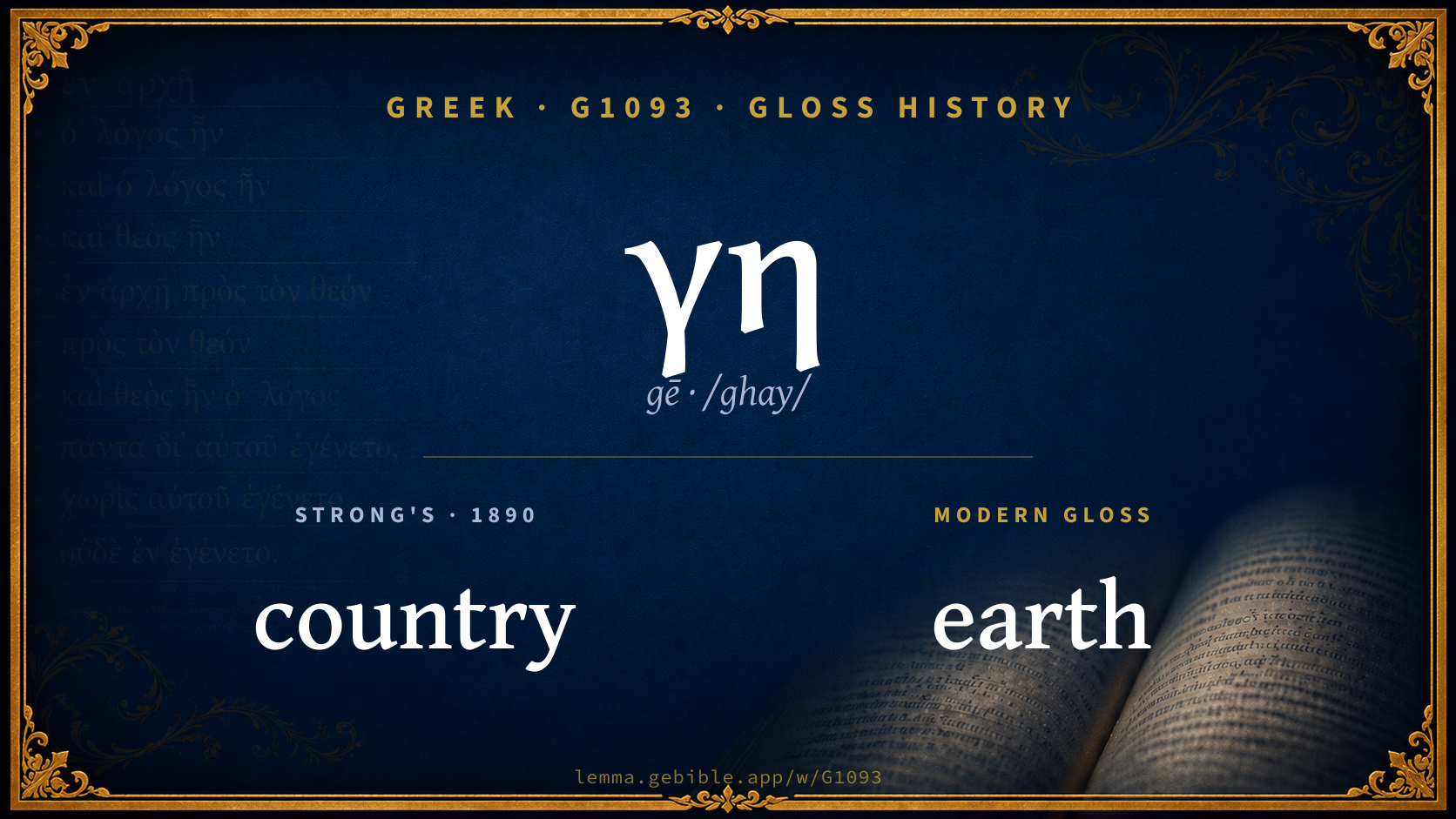
Gloss history
Strong's 1890 vs modern scholarship
About this word
Strong's G1093 catalogs a Greek word from the Greek New Testament.
These counts are not copied from any lexicon or concordance. They are computed here, from the morphology-tagged Greek New Testament. What Lemma adds →
- 222
- distinct verses
- The word appears in 222 distinct verses.
- 14 / 27
- NT books
- The word appears in 14 of 27 New Testament books.
- #63
- by frequency
- Top 100 most frequent Greek words (rank 63 of 5,347 Greek words by occurrence).
View all 222 occurrences in the concordance →
Most concentrated in
- Revelation 67 verses 30%
- Matthew 38 verses 17%
- Acts 30 verses 14%
By section of the New Testament
By traditional corpus
Conventional, traditional groupings — biblical authorship is debated, so this is a traditional corpus grouping, not an authorship claim. Some books belong to more than one corpus (Luke is in both the Gospels and the Lukan corpus, and so on), so these shares overlap and need not total 100%. Each figure is a share of the word’s 222 distinct verses.
- Gospels 91 verses · 41%
- Johannine 78 verses · 35%
- Revelation 67 verses · 30%
- Lukan (Luke–Acts) 55 verses · 25%
- Pauline corpus 14 verses · 6%
- Hebrews 10 verses · 5%
- General (Catholic) Epistles 10 verses · 5%
How translations render this word
Counts come from each version’s own published word-to-Strong’s tagging or interlinear alignment — an approximate guide to how each version renders this word, not a word-level alignment the data otherwise carries. Because each total is that version’s own tagged count, the per-version totals vary from one another and need not match the appearance or distinct-verse counts above. These counts may also differ from a printed concordance because Lemma counts each distinctly tagged rendering and does not collapse phrase taggings into a single head-word total. This is a fixed set of word-tagged versions (KJV, ASV, BSB, ULT) and does not change with the reading translation you choose elsewhere. Each version’s license is shown beside its name below (and on Sources).
- King James Version: Earth 187×, Land 42×, Ground 18×
- American Standard Version: Earth 181×, Land 44×, Ground 16×
- Berean Standard Bible: Earth 157×, Land 37×, Ground 19×
- unfoldingWord Literal Text: Earth 167×, Land 47×, Ground 19×
King James Version Public Domain
Renders G1093 across 250 tagged occurrences — most commonly:
Plus 1 rendering that appears only once — usually multi-word phrases or single function words the recovered tagging swept in, not distinct renderings. Not rendered by a distinct English word in 2 further occurrences.
American Standard Version Public Domain
Renders G1093 across 246 tagged occurrences — most commonly:
Plus 5 renderings that appear only once — usually multi-word phrases or single function words the recovered tagging swept in, not distinct renderings.
Berean Standard Bible Public Domain
Renders G1093 across 238 tagged occurrences — most commonly:
Plus 6 renderings that appear only once — usually multi-word phrases or single function words the recovered tagging swept in, not distinct renderings. Not rendered by a distinct English word in 12 further occurrences.
unfoldingWord Literal Text CC BY-SA 4.0
Renders G1093 across 254 tagged occurrences — most commonly:
Plus 3 renderings that appear only once — usually multi-word phrases or single function words the recovered tagging swept in, not distinct renderings.
Senses in Thayer's
The 6 senses Thayer's distinguishes for this word, in lexicon order (not ranked by frequency or importance). The full entry — with sub-senses — is in the Lexicon Entry tab.
- arable land
- the ground, the earth as a standing place
- the main land as opposed to the sea or water
- the earth as opposed to the heavens
- the inhabited earth, the abode of men and animals
- a country, land enclosed within fixed boundaries, a tract of land, territory, region
Word origin
Origin: contracted from a root word
Contracted from a primary word; soil ; by extension a region or the solid part or the whole of the terrene globe (including the occupants in each application): - country earth (-ly) ground land world.
— Strong’s Exhaustive Concordance (1890), public domain.
Forms in the corpus
The 4 distinct written forms G1093 takes in the Greek New Testament, most frequent first — each parse links to that case’s occurrences in the concordance.
| Form | Parsing | Example | Uses |
|---|---|---|---|
| γῆς gē̂s | Noun, Genitive, Singular, Feminine | Matthew 5:13 | 133 |
| γῆν gē̂n | Noun, Accusative, Singular, Feminine | Matthew 2:20 | 79 |
| γῆ gē̂ | Noun, Nominative, Singular, Feminine | Matthew 5:18 | 24 |
| γῇ gē̂ | Noun, Dative, Singular, Feminine | Matthew 5:35 | 13 |
Same root — word family
Other Thayer's entries built from the same root as G1093, grouped by Strong’s listed origin. These share a root / origin per the lexicon — not necessarily a shared meaning. Each links to that word’s own entry.
Derived from this word
Compare all same-root words → They share a root, not necessarily a meaning.
Septuagint usage
The same Greek word γη appears 2,715 times in the Greek Old Testament (Septuagint), across 2,348 verses in 38 books.
- 2,715
- LXX occurrences
- Tagged occurrences of this Greek word in the Septuagint.
- 2,348
- verses
- Distinct Septuagint verses containing this word.
- 38 / 39
- OT books
- The word appears in 38 of the 39 Old Testament books.
Sample Septuagint occurrences
- Genesis 1:1 γῆ
- Exodus 1:7 γῆ
- Leviticus 4:27 γῆ
- Numbers 1:1 γῆ
- Deuteronomy 1:5 γῆ
- Joshua 1:2 γῆ
- Judges 1:2 γῆ
- Ruth 1:1 γῆ
- 1 Samuel 1:21 γῆ
- 2 Samuel 1:2 γῆ
- 1 Kings 1:23 γῆ
- 2 Kings 2:15 γῆ
Septuagint occurrences (same lexeme)
Every verse where the same Strong’s number (G1093) appears in the Greek Septuagint — showing the first 50 of 2,348. Verse text shown in the World English Bible for context; the Greek form is the matched word — the English is not keyword-highlighted.
- Genesis 1:1 γῆ In the beginning God created the heavens and the earth.
- Genesis 1:2 γῆ Now the earth was formless and empty. Darkness was on the surface of the deep. God's Spirit was hovering over the surface of the waters.
- Genesis 1:10 γῆ God called the dry land Earth, and the gathering together of the waters he called Seas. God saw that it was good.
- Genesis 1:11 γῆ God said, "Let the earth put forth grass, herbs yielding seed, and fruit trees bearing fruit after their kind, with its seed in it, on the earth," and it was so.
- Genesis 1:12 γῆ The earth brought forth grass, herbs yielding seed after their kind, and trees bearing fruit, with its seed in it, after their kind: and God saw that it was good.
- Genesis 1:14 γῆ God said, "Let there be lights in the expanse of sky to divide the day from the night; and let them be for signs, and for seasons, and for days and years;
- Genesis 1:15 γῆ and let them be for lights in the expanse of sky to give light on the earth," and it was so.
- Genesis 1:17 γῆ God set them in the expanse of sky to give light to the earth,
- Genesis 1:20 γῆ God said, "Let the waters swarm with swarms of living creatures, and let birds fly above the earth in the open expanse of sky."
- Genesis 1:22 γῆ God blessed them, saying, "Be fruitful, and multiply, and fill the waters in the seas, and let birds multiply on the earth."
- Genesis 1:24 γῆ God said, "Let the earth bring forth living creatures after their kind, cattle, creeping things, and animals of the earth after their kind," and it was so.
- Genesis 1:25 γῆ God made the animals of the earth after their kind, and the cattle after their kind, and everything that creeps on the ground after its kind. God saw that it was good.
- Genesis 1:26 γῆ God said, "Let us make man in our image, after our likeness: and let them have dominion over the fish of the sea, and over the birds of the sky, and over the cattle, and over all the earth, and over every creeping thing that creeps on the earth."
- Genesis 1:28 γῆ God blessed them. God said to them, "Be fruitful, multiply, fill the earth, and subdue it. Have dominion over the fish of the sea, over the birds of the sky, and over every living thing that moves on the earth."
- Genesis 1:29 γῆ God said, "Behold, I have given you every herb yielding seed, which is on the surface of all the earth, and every tree, which bears fruit yielding seed. It will be your food.
- Genesis 1:30 γῆ To every animal of the earth, and to every bird of the sky, and to everything that creeps on the earth, in which there is life, I have given every green herb for food." And it was so.
- Genesis 2:1 γῆ The heavens and the earth were finished, and all the host of them.
- Genesis 2:4 γῆ This is the history of the generations of the heavens and of the earth when they were created, in the day that Yahweh God made earth and the heavens.
- Genesis 2:5 γῆ No plant of the field was yet in the earth, and no herb of the field had yet sprung up; for Yahweh God had not caused it to rain on the earth. There was not a man to till the ground,
- Genesis 2:6 γῆ but a mist went up from the earth, and watered the whole surface of the ground.
- Genesis 2:7 γῆ Yahweh God formed man from the dust of the ground, and breathed into his nostrils the breath of life; and man became a living soul.
- Genesis 2:9 γῆ Out of the ground Yahweh God made every tree to grow that is pleasant to the sight, and good for food; the tree of life also in the midst of the garden, and the tree of the knowledge of good and evil.
- Genesis 2:11 γῆ The name of the first is Pishon: this is the one which flows through the whole land of Havilah, where there is gold;
- Genesis 2:12 γῆ and the gold of that land is good. There is aromatic resin and the onyx stone.
- Genesis 2:13 γῆ The name of the second river is Gihon: the same river that flows through the whole land of Cush.
- Genesis 2:19 γῆ Out of the ground Yahweh God formed every animal of the field, and every bird of the sky, and brought them to the man to see what he would call them. Whatever the man called every living creature, that was its name.
- Genesis 3:1 γῆ Now the serpent was more subtle than any animal of the field which Yahweh God had made. He said to the woman, "Yes, has God said, 'You shall not eat of any tree of the garden?'"
- Genesis 3:14 γῆ Yahweh God said to the serpent, "Because you have done this, cursed are you above all cattle, and above every animal of the field. On your belly shall you go, and you shall eat dust all the days of your life.
- Genesis 3:17 γῆ To Adam he said, "Because you have listened to your wife's voice, and have eaten of the tree, of which I commanded you, saying, 'You shall not eat of it,' cursed is the ground for your sake. In toil you will eat of it all the days of your life.
- Genesis 3:19 γῆ By the sweat of your face will you eat bread until you return to the ground, for out of it you were taken. For you are dust, and to dust you shall return."
- Genesis 3:23 γῆ Therefore Yahweh God sent him forth from the garden of Eden, to till the ground from whence he was taken.
- Genesis 4:2 γῆ Again she gave birth, to Cain's brother Abel. Abel was a keeper of sheep, but Cain was a tiller of the ground.
- Genesis 4:3 γῆ As time passed, it happened that Cain brought an offering to Yahweh from the fruit of the ground.
- Genesis 4:10 γῆ Yahweh said, "What have you done? The voice of your brother's blood cries to me from the ground.
- Genesis 4:11 γῆ Now you are cursed because of the ground, which has opened its mouth to receive your brother's blood from your hand.
- Genesis 4:12 γῆ From now on, when you till the ground, it won't yield its strength to you. You shall be a fugitive and a wanderer in the earth."
- Genesis 4:14 γῆ Behold, you have driven me out this day from the surface of the ground. I will be hidden from your face, and I will be a fugitive and a wanderer in the earth. It will happen that whoever finds me will kill me."
- Genesis 4:16 γῆ Cain went out from Yahweh's presence, and dwelt in the land of Nod, on the east of Eden.
- Genesis 5:29 γῆ and he named him Noah, saying, "This same will comfort us in our work and in the toil of our hands, because of the ground which Yahweh has cursed."
- Genesis 6:1 γῆ It happened, when men began to multiply on the surface of the ground, and daughters were born to them,
- Genesis 6:4 γῆ The Nephilim were in the earth in those days, and also after that, when God's sons came to men's daughters. They bore children to them: the same were the mighty men who were of old, men of renown.
- Genesis 6:5 γῆ Yahweh saw that the wickedness of man was great in the earth, and that every imagination of the thoughts of his heart was only evil continually.
- Genesis 6:6 γῆ Yahweh was sorry that he had made man on the earth, and it grieved him in his heart.
- Genesis 6:7 γῆ Yahweh said, "I will destroy man whom I have created from the surface of the ground; man, along with animals, creeping things, and birds of the sky; for I am sorry that I have made them."
- Genesis 6:11 γῆ The earth was corrupt before God, and the earth was filled with violence.
- Genesis 6:12 γῆ God saw the earth, and saw that it was corrupt, for all flesh had corrupted their way on the earth.
- Genesis 6:13 γῆ God said to Noah, "The end of all flesh has come before me, for the earth is filled with violence through them. Behold, I will destroy them with the earth.
- Genesis 6:17 γῆ I, even, I do bring the flood of waters on this earth, to destroy all flesh having the breath of life from under the sky. Everything that is in the earth will die.
- Genesis 6:20 γῆ Of the birds after their kind, of the cattle after their kind, of every creeping thing of the ground after its kind, two of every sort shall come to you, to keep them alive.
- Genesis 7:3 γῆ Also of the birds of the sky, seven and seven, male and female, to keep seed alive on the surface of all the earth.
These are occurrences of the same Greek lexeme (G1093) in the Septuagint — not a translation of any one Hebrew word. The store carries no word-level Hebrew↔Greek alignment, so no Hebrew original is asserted here. Counts come from the recovered LXX Strong's tagging — high-frequency vocabulary is well covered, while rare or late forms may be untagged — so they reflect tagged occurrences and may slightly undercount.