Mark 6:53

Greek (Tischendorf 8th ed.) Mark 6:53 appears in the Greek New Testament. The text above is from the Tischendorf 8th edition. Each word links to its Strong’s number and a concise gloss. Click any word for its full Thayer’s Greek Lexicon entry.

Download image
Cite this verse

Mark 6:53 (World English Bible). Public Domain. Lemma interlinear Bible study tool, https://lemma.gebible.app/v/mark/6/53.

Show BibTeX & RIS
BibTeX
RIS
English Translation
When they had crossed over, they came to land at Gennesaret, and moored to the shore.
World English Bible · Public Domain
Highlights
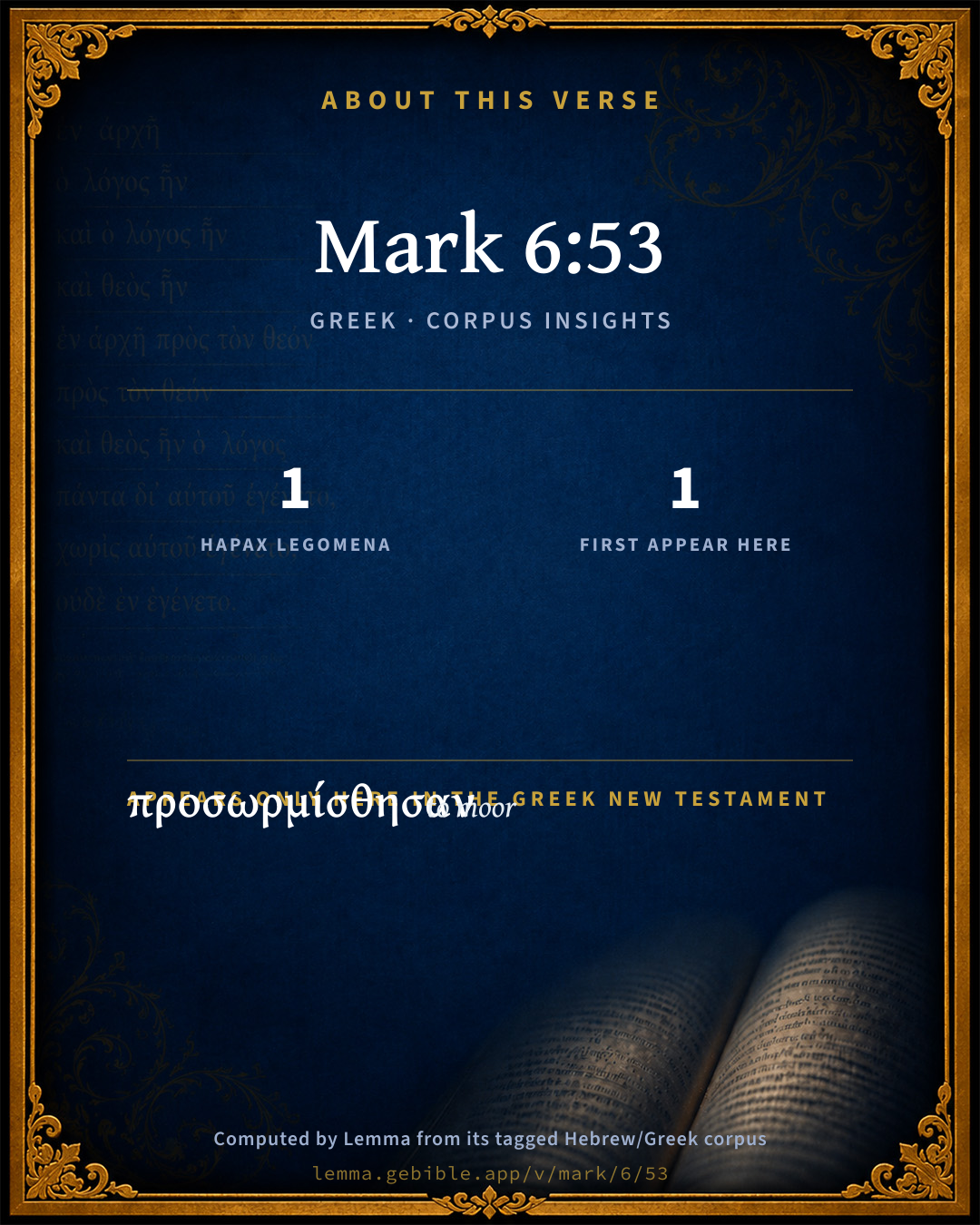
  • 1 hapax legomenon — only here in the Greek New Testament
  • 1 first appearance in the Greek New Testament
Full analysis ↓
Download a study sheet

One document with this verse’s original text, its word-by-word gloss line, the meaning frame, cross-references with their text, attributed commentary, and full source and license credits — printable, and it pastes into notes with its structure intact.

This verse Autodidact and up

Study sheet (.html) Plain text (.txt)

A passage Seminary Student

Up to 50 verses in one chapter. A passage sheet keeps up to 6 commentary sources and 12 cross-references per verse, in the order this page ranks them, and says so on the sheet whenever that leaves anything out. Ask for a single verse and you get the Autodidact verse sheet above.

Everything on this page stays free to read, with no account — the sheet is a download of what is already on screen, not access to it.

Want to remove ads? Support Godless Engineer
Compare translations 3

The same verse in 3 English versions, stacked beneath the original-language interlinear above. Click any original word for its lexicon entry.

Each is an independent rendering of the whole verse — the interlinear is not word-aligned to these translations.

Highlighted words mark where these versions differ — a whole-verse word diff, not a word-by-word alignment.

  • World English Bible Public Domain
    When they had crossed over, they came to land at Gennesaret, and moored to the shore.
  • King James Version Public Domain
    And when they had passed over, they came into the land of Gennesaret, and drew to the shore.
  • unfoldingWord Literal Text CC BY-SA 4.0
    And having crossed over, they came to the land at Gennesaret and anchored there.

unfoldingWord Literal Text — © unfoldingWord, licensed CC BY-SA 4.0. Word-aligned USFM3 via Door43 (git.door43.org/unfoldingWord/en_ult).

Versions to compare (up to 4)

3 of 4 selected

Show all 19 translations

Every available English version of this verse, each an independent rendering of the whole verse.

  • World English Bible Public Domain
    When they had crossed over, they came to land at Gennesaret, and moored to the shore.
  • Berean Standard Bible Public Domain
    When they had crossed over, they landed at Gennesaret and moored the boat.
  • Majority Standard Bible Public Domain
    When they had crossed over, they came to the land of Gennesaret and moored the boat.
  • King James Version Public Domain
    And when they had passed over, they came into the land of Gennesaret, and drew to the shore.
  • American Standard Version (1901) Public Domain
    And when they had crossed over, they came to the land unto Gennesaret, and moored to the shore.
  • Revised Version (1885) Public Domain
    And when they had crossed over, they came to the land unto Gennesaret, and moored to the shore.
  • Geneva Bible (1599) Public Domain
    And they came ouer, and went into the land of Gennesaret, and arriued.
  • Douay-Rheims (1899) Public Domain
    And when they had passed over, they came into the land of Genezareth, and set to the shore.
  • Young's Literal Translation Public Domain
    And having passed over, they came upon the land of Gennesaret, and drew to the shore,
  • Literal Standard Version CC BY-SA 4.0
    And having passed over, they came on the land of Gennesaret, and drew to the shore,
  • Unlocked Literal Bible CC BY-SA 4.0
    When they had crossed over, they came to land at Gennesaret and anchored the boat.
  • unfoldingWord Literal Text CC BY-SA 4.0
    And having crossed over, they came to the land at Gennesaret and anchored there.
  • Darby Bible Public Domain
    And having passed over, they came to the land of Gennesaret and made the shore.
  • World Messianic Bible Public Domain
    When they had crossed over, they came to land at Gennesaret and moored to the shore.
  • Webster's Bible Public Domain
    And when they had passed over, they came into the land of Gennesaret, and drew to the shore.
  • Free Bible Version CC BY-SA 4.0
    After crossing the Sea they arrived at Gennesaret and moored the boat.
  • Bible in Basic English Public Domain
    And when they had gone across, they came to Gennesaret, and got their boat to land.
  • Text-Critical English NT CC BY 4.0
    When they had crossed the sea, they came to the land of Gennesaret and moored the boat.
  • Tyndale New Testament (1534) Public Domain
    And they came over and went into the londe of Genezareth and drue vp into the haven.

Literal Standard Version (2020), Covenant Press — licensed CC BY-SA 4.0. Text via the HelloAO Bible API (eBible.org). Unlocked Literal Bible (unfoldingWord) — licensed CC BY-SA 4.0. Text via the HelloAO Bible API (eBible.org). unfoldingWord Literal Text — © unfoldingWord, licensed CC BY-SA 4.0. Word-aligned USFM3 via Door43 (git.door43.org/unfoldingWord/en_ult). Free Bible Version, Dr. Jonathan Gallagher — licensed CC BY-SA 4.0. Text via the HelloAO Bible API (eBible.org).

Word by word

More ways to search: Search by grammar → Find every occurrence → Compare this word →

Practice this passage: Drill this verse → Learn its vocabulary →

About this verse

These counts appear in no published source. They are computed here, from the morphology-tagged text and Lemma’s own curated glosses. What Lemma adds →

10
words
9
distinct lemmas
Gospels
section

Notable vocabulary

1 hapax legomenon — a word that appears only here in the entire Greek New Testament:

  • προσωρμίσθησαν to moor G4358

First appearance in Scripture

This word makes its first canonical appearance in the Greek New Testament here:

  • προσωρμίσθησαν to moor G4358

Shared distinctive vocabulary

Γεννησαρὲτ Gennesaret G1082 occurs in 3 verses of the Greek New Testament. Also found in:

Repetition

A word recurs within this verse:

Cross-references

3

Topical passages linked to Mark 6:53 in the Treasury of Scripture Knowledge — connected by theme and wording, ordered by reader-vote popularity; previews shown in the World English Bible.

  • Matthew 14:34–36 When they had crossed over, they came to the land of Gennesaret.
  • John 6:24–25 When the multitude therefore saw that Jesus wasn't there, nor his disciples, they themselves got into the boats, and came to Capernaum, seeking Jesus.
  • Luke 5:1 Now it happened, while the multitude pressed on him and heard the word of God, that he was standing by the lake of Gennesaret.

Cross-references courtesy of OpenBible.info (CC BY 4.0).

Commentary

Notes on Mark 6:53 from classic Christian and Jewish commentators (each source and its license shown beneath its notes). The classic Christian expositions comment on the surrounding passage and are grouped to its opening verse, so a note may address several verses; the Jewish commentaries on the Tanakh (Rashi and others) are per-verse, so they appear only where the commentator wrote on this verse.

Lemma curates 59 commentaries, every one of them public domain or Creative Commons licensed, each selected and text-cleaned for this edition rather than reprinted as found. About our sources →

The Biblical Illustrator

Joseph S. Exell

Mar_6:53-56

They laid the sick in the streets.

The multitude in affliction

I. A beautiful country, inhabitated by a multitude of sick.

II. A prompt recognition of a former benefactor-They knew Him (Mat_9:35; Mat_11:20-24; Mar_3:7-11).

III. Energetic exertion-And ran, etc.

IV. An affecting picture of human helplessness-Began to carry about, etc.

V. An admission that healing virtue dwelt alone in Christ.

VI. The infallible nature of the remedy. (F. Wagstaff.)

Jesus and His fulness

I. The landing. Wherever the Son of God landed there was blessing, peace, health, liberty.

II. The recognizing-Straightway they knew Him, If thou knewest, etc.

III. The gathering.

IV. The touching.

V. The healing. (H. Bonar, D. D.)

Touch Jesus and be healed

1. The touch was needy.

2. The touch was wise.

3. The touch was prompt.

4. The touch was believing.

5. The touch was personal.

6. The touch was unrestricted. There was no exception to the healing.

7. The touch was efficacious. No failure.

8. The lost will be inexcusable. (J. Smith.)

A crowd of eager applicants

;-It was after a walk through the village of Ehden, beneath the mountain of the cedars, our last Syrian expedition, in which we visited several of the churches and cottages of the place, that we found the stairs and corridors of the castle of the Maronite chief, Sheykh Joseph, lined with a crowd of eager applicants, sick people taken with divers diseases, who, hearing that there was a medical man in the party, had thronged round him, beseeching him that he would heal them. I mention this incident because it illustrates so forcibly these scenes in the gospel history, from which I have almost of necessity borrowed the language best fitted to express the eagerness, the hope, the anxiety of the multitude who had been attracted by the fame of this beneficent influence. It was an affecting scene, our kind doctor was distressed to find how many cases there were which with proper medical appliances might have been cured; and on returning to the ship, by the Prince of Wales desire, a store of medicines was sent back, with Arabic labels directing how and for what purpose they should be used. (Dean Stanley.)

Spiritual healing

I. The necessity for such an application to Christ.

1. You have a disease of guilt upon you.

2. You have a disease of corruption upon you.

II. The manner of it.

1. They persuaded themselves that Christ was able to do this thing for them.

2. They put themselves in His way.

3. Those who could not come of themselves, sought the help of their stronger neighbours; none of them were so unfeeling as to refuse the needful aid.

4. They earnestly prayed for the blessing which they desired.

5. They complied with the simple method which was prescribed. This was to touch Him.

III. The certain success of it-Made whole. (J. Jowett, M. A.)

.

The Biblical Illustrator, edited by Joseph S. Exell (c. 1880s–1900s) — public domain. Text from a community e-Sword module.

The Expositor's Bible

CHAPTER 6:53-7:13 (Mar_6:53-56 - Mar_7:1-13)

UNWASHEN HANDS

"And when they had crossed over, they came to the land unto Gennesaret, and moored to the shore. . . . Making void the word of God by your tradition, which ye have delivered: and many such like things ye do." Mar_6:53-56 - Mar_7:1-13 (R.V.)

THERE is a condition of mind which readily accepts the temporal blessings of religion, and yet neglects, and perhaps despises, the spiritual truths which they ratify and seal. When Jesus landed on Gennesaret, He was straightway known, and as He passed through the district, there was hasty bearing of all the sick to meet Him, laying them in public places, and beseeching Him that they might touch, if no more, the border of His garment. By the faith which believed in so easy a cure, a timid woman had recently won signal commendation. But the very fact that her cure had become public, while it accounts for the action of these crowds, deprives it of any special merit. We only read that as many as touched Him were made whole. And we know that just now He was forsaken by many even of His disciples, and had to ask His very apostles, Will ye also go away?

Thus we find these two conflicting movements: among the sick and their friends a profound persuasion that He can heal them; and among those whom He would fain teach, resentment and revolt against His doctrine. The combination is strange, but we dare not call it unfamiliar. We see the opposing tendencies even in the same man, for sorrow and pain drive to his knees many a one who will not take upon his neck the easy yoke. Yet how absurd it is to believe in Christ's goodness and His power, and still to dare to sin against Him, still to reject the inevitable inference that His teaching must bring bliss. Men ought to ask themselves what is involved when they pray to Christ and yet refuse to serve Him.

As Jesus moved thus around the district, and responded so amply to their supplication that His very raiment was charged with health as if with electricity, which leaps out at a touch, what an effect He must have produced, even upon the ceremonial purity of the district. Sickness meant defilement, not for the sufferer alone, but for his friends, his nurse, and the bearers of his little pallet. By the recovery of one sick man, a fountain of Levitical pollution was dried up. And the harsh and rigid legalist ought to have perceived that from his own point of view the pilgrimage of Jesus was like the breath of spring upon a garden, to restore its freshness and bloom.

It was therefore an act of portentous waywardness when, at this juncture, a complaint was made of His indifference to ceremonial cleanness. For of course a charge against His disciples was really a complaint against the influence which guided them so ill.

It was not a disinterested complaint. Jerusalem was alarmed at the new movement resulting from the mission of the Twelve, their miracles, and the mighty works which He Himself had lately wrought. And a deputation of Pharisees and scribes came from this center of ecclesiastical prejudice, to bring Him to account. They do not assail His doctrine, nor charge Him with violating the law itself, for He had put to shame their querulous complaints about the sabbath day. But tradition was altogether upon their side: it was a weapon ready sharpened for their use against one so free, unconventional and fearless.

The law had imposed certain restrictions upon the chosen race, restrictions which were admirably sanitary in their nature, while aiming also at preserving the isolation of Israel from the corrupt and foul nations which lay around. All such restrictions were now about to pass away, because religion was to become aggressive, it was henceforth to invade the nations from whose inroads it had heretofore sought a covert. But the Pharisees had not been content even with the severe restrictions of the law. They had not regarded these as a fence for themselves against spiritual impurity, but as an elaborate and artificial substitute for love and trust. And therefore, as love and spiritual religion faded out of their hearts they were the more jealous and sensitive about the letter of the law. They "fenced" it with elaborate rules, and precautions against accidental transgressions, superstitiously dreading an involuntary infraction of its minutest details. Certain substances were unclean food. But who could tell whether some atom of such substance, blown about in the dust of summer, might adhere to the hand with which he ate, or the cups and pots whence his food was drawn? Moreover, the Gentile nations were unclean, and it was not possible to avoid all contact with them in the market-places, returning whence, therefore, every devout Jew was careful to wash himself, which washing, though certainly not an immersion, is here plainly called a baptism. Thus an elaborate system of ceremonial washing, not for cleansing, but as a religious precaution, had grown up among the Jews.

But the disciples of Jesus had begun to learn their emancipation. Deeper and more spiritual conceptions of God and man and duty had grown up in them. And the Pharisees saw that they ate their bread with unwashen hands. It availed nothing that half a population owed purity and health to their Divine benevolence, if in the process the letter of a tradition were infringed. It was necessary to expostulate with Jesus, because they walked not according to the tradition of the elders, that dried skin of an old orthodoxy in which prescription and routine would ever fain shut up the seething enthusiasms and insights of the present time.

With such attempts to restrict and cramp the free life of the soul, Jesus could have no sympathy. He knew well that an exaggerated trust in any form, any routine or ritual whatever, was due to the need of some stay and support for hearts which have ceased to trust in a Father of souls. But He chose to leave them without excuse by showing their transgression of actual precepts which real reverence for God would have respected. Like books of etiquette for people who have not the instincts of gentlemen; so do ceremonial religions spring up where the instinct of respect for the will of God is dull or dead. Accordingly Jesus quotes against these Pharisees a distinct precept, a word not of their fathers, but of God, which their tradition had caused them to trample upon. If any genuine reverence for His commandment had survived, it would have been outraged by such a collision between the text and the gloss, the precept and the precautionary supplement. But they had never felt the incongruity, never been jealous enough for the commandment of God to revolt against the encroaching tradition which insulted it. The case which Jesus gave, only as one of "many such like things," was an abuse of the system of vows, and of dedicated property. It would seem that from the custom of "devoting" a man's property, and thus putting it beyond his further control, had grown up the abuse of consecrating it with such limitations, that it should still be available for the owner, but out of his power to give to others. And thus, by a spell as abject as the taboo of the South Sea islanders, a man glorified God by refusing help to his father and mother, without being at all the poorer for the so-called consecration of his means. And even if he awoke up to the shameful nature of his deed, it was too late, for "ye no longer suffer him to do ought for his father or his mother." And yet Moses had made it a capital offense to "speak evil of father or mother." Did they then allow such slanders? Not at all, and so they would have refused to confess any aptness in the quotation. But Jesus was not thinking of the letter of a precept, but of the spirit and tendency of a religion, to which they were blind. With what scorn He regarded their miserable subterfuges, is seen by His vigorous word, "full well do ye make void the commandment of God that ye may keep your traditions."

Now the root of all this evil was unreality. It was not merely because their heart was far from God that they invented hollow formalisms; indifference leads to neglect, not to a perverted and fastidious earnestness. But while their hearts were earthly, they had learned to honor God with their lips. The judgments which had sent their fathers into exile, the pride of their unique position among the nations, and the self-interest of privileged classes, all forbade them to neglect the worship in which they had no joy, and which, therefore, they were unable to follow as it reached out into infinity, panting after God, a living God. There was no principle of life, growth, aspiration, in their dull obedience. And what could it turn into but a routine, a ritual, a verbal homage, and the honor of the lips only? And how could such a worship fail to shelter itself in evasions from the heart-searching earnestness of a law which was spiritual, while the worshipper was carnal and sold under sin?

It was inevitable that collisions should arise. And the same results will always follow the same causes. Wherever men bow the knee for the sake of respectability, or because they dare not absent themselves from the outward haunts of piety, yet fail to love God and their neighbor, there will the form outrage the spirit, and in vain will they worship, teaching as their doctrines the traditions of men.

Very completely indeed was the relative position of Jesus and His critics reversed, since they had expressed pain at the fruitless effort of His mother to speak with Him, and He had seemed to set the meanest disciple upon a level with her. But He never really denied the voice of nature, and they never really heard it. An affectation of respect would have satisfied their heartless formality: He thought it the highest reward of discipleship to share the warmth of His love. And therefore, in due time, it was seen that His critics were all unconscious of the wickedness of filial neglect which set His heart on fire.

William Robertson Nicoll, ed., The Expositor's Bible (London: Hodder & Stoughton, 1887–1910) — public domain. 65 of 66 books (1 Corinthians is not separately keyed, as that volume carries no machine-parseable verse references); section-level commentary keyed to the opening verse. Introductory and overview sections not keyed to a specific passage are excluded.

Tyndale Open Study Notes

Tyndale Open Resources

6:53-56 This summary of Jesus’ ministry in Galilee emphasizes his great popularity and healing ability.

6:53 Gennesaret refers to a fertile plain, 3.5 miles long by 0.5 miles wide (5.6 by 0.8 kilometers), between Tiberias and Capernaum on the northwest coast of the Sea of Galilee. The original journey was to Bethsaida (6:45), so perhaps the winds (6:48) blew the ship off course and they landed at Gennesaret. Alternatively, 6:45 might indicate the direction of the journey (i.e., northeast) and not the actual goal of the voyage.

Tyndale Open Study Notes — © Tyndale Open Resources, licensed CC BY-SA 4.0. Text via the HelloAO Bible API.

Bengel's Gnomon

Johann Albrecht Bengel

Mar 6:53. Προσωρμίσθησαν, they drew to the shore) promptly.

Bengel's Gnomon of the New Testament — English translation (T&T Clark, Edinburgh, 1860) — public domain. Text from a community e-Sword module.

Expositor's Greek Testament

ed. W. Robertson Nicoll

Mar 6:53-56 . The landing (Mat 14:34-36 ).

Mar 6:53 . προσωρμίσθησαν ( πρὸς ὁρμίζω from ὄρμος ), they came to anchor, or landed on the beach; here only in N. T.

The Expositor's Greek Testament, edited by W. Robertson Nicoll (1897–1910) — public domain. Text from a community e-Sword module.

Adam Clarke's Commentary

Verse 53. The land of Gennesaret] This country lay on the coast of the sea of Galilee: it is described by Josephus as being exceedingly pleasant and fertile. It had its name of Gennesaret from גן, gen, a garden, and סר sar, a prince, either because the king had a garden there, or because of its great fertility.

Adam Clarke's Commentary on the Bible (1810–1826) — public domain. Text from a community e-Sword/MySword module.

Ellicott's Commentary for English Readers

(53-56) And when they had passed over.—See Notes on Mat_14:34-36.

A Bible Commentary for English Readers, edited by Charles John Ellicott (1878–1897) — public domain. Text from a community e-Sword module.

The Cambridge Bible for Schools and Colleges

gen. ed. J. J. S. Perowne

53–56. Miracles of Healing in the Land of Gennesaret

53. the land of Gennesaret is only mentioned here and in Mat_14:34. It is the same as the modern el-Ghuweir, a fertile crescent-shaped plain, on the north-western shore of the Lake of Gennesaret, about 3 miles in length and 1 in width. From its sheltered situation, and especially from its depression of more than 500 feet below the level of the ocean, its climate is of an almost tropical character. Josephus speaks of it as if it were an earthly paradise, in which every kind of useful plant grew and flourished. Jos. B. J. III. 10. 8.

drew to the shore] or, as Tyndale and Cranmer translate it, “drew up into the haven.”

The Cambridge Bible for Schools and Colleges (gen. ed. J. J. S. Perowne; Cambridge University Press, 1878–1918) — public domain. Text from a community e-Sword module.

John Gill's Exposition

And when they were come out of the ship,.... Christ and his disciples, and were ashore,

straightway they knew him; that is, the men of that place, as in Mat_. 14:35; see Gill on Mat 14:35; and so the Syriac, Arabic, and Persic versions read here, "the inhabitants of that country", the country of Gennesaret; they knew him, having seen and heard him before.

John Gill's Exposition of the Whole Bible (1746–1763) — public domain (CC PDM 1.0). Text via the HelloAO Bible API.

Matthew Poole's English Annotations

See Poole on "Mat 14:34", and following verses to Mat 14:36. The charity of this people to their sick neighbours is very commendable, and instructive of us as to our duty to do good to others, as to their bodily wants and necessities, so far as we are able; but how much greater is that charity, which is showed to people’s souls, inviting them to Christ that they may be spiritually healed! It was not their touching the hem of his garment, nor of his body, which healed these sick persons, those who had a hand in crucifying of him did both; it was the virtue that went out from Christ, upon the testification of their faith, by coming to him, and touching, and desiring to touch, the hem of his garment: neither is it men’s coming to the congregation, and hearing the word of God, that will heal their souls, unless there goeth forth a Divine power from the Spirit of grace upon men’s hungering and thirsting after Christ in his ordinances, and by faith laying hold upon the promise exhibited in the preaching of the gospel.

Matthew Poole's English Annotations on the Holy Bible (1683–1685) — public domain. Text from a community e-Sword/MySword module.

The Pulpit Commentary

They came into the land of Gennesaret; literally (epi tht), they came to the land unto Gennesaret. This was the plain on the western side of the sea sometimes called "the lake of Gennesaret." The name Gennesaret (says Cornelius a Lapide) means "a fertile garden." There was a city originally called "Chinnereth" or "Cinneroth," mentioned in Jos_19:25, which probably gave one of its names to this lake.

Vers. 53-56. The popularity of the Divine Physician.

At this time the tide of Christ"s popularity was at the flood. In a few verses, the evangelist strikingly depicts the general excitement which the presence of the Prophet of Nazareth awakened amidst the thronging and busy population.

I THE PRESENCE OF THE DIVINE PHYSICIAN AMONG THE PEOPLE. Jesus sometimes retired to desert solitudes; but, for the most part, he chose to live among the people, and to be accessible to all classes and to all characters. This might well be his motive for spending so much of his life in the thickly peopled district on the western shores of the lake of Gennesaret. As the Son of man, Jesus mingled freely with the race he came to save and bless.

II THE SPREAD AMONG THE PEOPLE OF THE GOOD TIDINGS. If Jesus was willing to live and work amongst the inhabitants of this district, they, for their part, were eager to embrace every opportunity of intercourse with him. Not that they were generally influenced by high motives that they resorted to him as to a spiritual teacher. It is evident that the interest felt in Jesus was very largely owing to his power and willingness to heal the sick and suffering. But, from whatever motive, it is of the highest importance that the children of men should be led to interest themselves in Christ. The tidings that Jesus is the Saviour of the world deserve to be published far and wide, as the best news for all mankind.

III THE AGENCY EMPLOYED TO BRING THE NEEDY INTO THE PRESENCE OF THE SAVIOUR. As we read the vigorous language of the evangelist, we seem to see the eager, kindhearted people, the peasantry and the fishermen, hurrying throughout the district, seeking out all the diseased and infirm, carrying them on their couches to the places where Jesus is expected, and laying them in the open spaces, that they may be brought under the notice of the mighty and benevolent physician.

IV THE CONTACT OF THE PATIENTS WITH THE PHYSICIAN. The healing looked for was effected, not by means and instruments, but by the great Healer himself. Accordingly, what the sufferers desired was, to lay hold upon Jesus, or even upon the hem or fringe of his garment. An indication this of the method of the sinner"s salvation. To come to Christ, and spiritually to lay hold upon him, such is the condition of securing all the blessings which Jesus brings to man.

V THE EXPERIENCE OF HEALING. It mattered not how many came, by whom they were brought, in what place they encountered Jesus, from what disease they suffered; "as many as touched him were made whole." There is no limitation to the healing power or to the healing grace of Immanuel. He is "mighty to save;" he saves "to the uttermost.;" and his salvation is perfect and eternal.

APPLICATION.

1. This narrative reminds the sinner where to look for deliverance to Christ, and Christ alone.

2. This narrative sets before us the office of the Church; it is to bring sinful souls to the one Divine, almighty Saviour.

Vers. 53-56. Secondary benefits of the gospel.

I THESE ARE GENERALLY FIRST RECOMMENDATION.

II THE END THEY ARE MEANT TO SERVE.

1. To draw men to Christ.

2. To demonstrate that the gospel the Christ blesses the whole man and the whole life.

III THEIR SNARE AND DANGER. M.

Vers. 53-56. Commotion in Gennesaret.

I A STIR AMONG THE, SICK AND THEIR FRIENDS. We read of "fashionable events" and "arrivals in the fashionable world." This was not such. The quality of a movement teaches much as to its origin. The poor and sick know their friends, and their thronging is a testimonial to worth.

II THE PROGRESS OF HEALING AND PITY. Contrast with the progress of the conqueror or the cold pomp of royalty. Wherever Christ goes, and men come into contact with him, they are made well. Worth much is the testimony of any suffering one to the private Christian: "I am the better for seeing you; you do me more good than the doctor." There is a contagion of health as well as of disease. J.

The Pulpit Commentary (1880–1919), ed. H.D.M. Spence-Jones & Joseph S. Exell — public domain. Text from a community e-Sword module.

John Wesley's Explanatory Notes

Matt. xiv, 34; John vi, 21.

John Wesley, Explanatory Notes Upon the Whole Bible (1754–1765) — public domain. Text via the GEBible commentary corpus.

Kretzmann's Popular Commentary

Paul E. Kretzmann

New work for the Lord:

v. 53. And when they had passed over, they came into the land of Gennesaret, and drew to the shore.

v. 54. And when they were come out of the ship, straightway they knew Him.

v. 55. And ran through that whole region round about, and began to carry about in beds those that were sick, where they heard He was.

v. 56. And whithersoever He entered, into villages, or cities, or country, they laid the sick in the streets, and besought Him that they might touch if it were but the border of His garment; and as many as touched Him were made whole.

On the western shore of the lake there was a region, Gennesaret, "the garden of the prince," or the "garden of fertility," a rich and beautiful country. Here they cast anchor or fastened their boat. But no sooner had Jesus stepped to the shore than He was recognized by some of the people living in that neighborhood, and there was a repetition of former experiences. They ran throughout the region and spread the news of His coming. And now the sick were brought to Him. Also, whether He walked along city streets or country lanes, the relatives of the sick, undiscouraged and unwearied, brought their unfortunate ones with the plea that they might touch but the border of His garment. As once before, chapter 3:10, He permitted the mere touch of His garment to work the miracle of healing. The people were worked up to the highest pitch of excitement at this time, which may have been augmented by the news of the miraculous feeding brought back by those that had been present upon that occasion. His sympathy and mercy were tireless in the interest of suffering humanity, but He was always concerned most about their souls, which He fed with the bread of life unto salvation.

Summary.Jesus makes a visit to Nazareth. sends out the twelve apostles, while His fame spreads to Herod, who had caused the execution of John the Baptist; He seeks rest, but is prevented by a great multitude of five thousand, whom He feeds in the wilderness; He walks on the sea and performs many miracles of healing in the region of Gennesaret.

Paul E. Kretzmann, Popular Commentary of the Bible (1921–1924) — public domain. Text from a community e-Sword module.

Burkitt's Expository Notes on the New Testament

William Burkitt

Here observe, 1. The unwearied diligence and industry of our Saviour in going about to do good: he no sooner landeth, but he goeth to Gennesaret, and healeth their sick. It was the great business and constant employment of our Saviour’s life to travel from place to place, that he might be useful and beneficial to mankind: he went to those that would not come to him.

Observe, 2. The people of Gennesaret’s charity to their sick neighbours; they sent abroad to let all the country know, that Christ the great Physician was come amongst them. There is a duty of love and mercy which we owe unto those that are in affliction and misery; namely, to afford them the best help, relief, and succour, we are able, both in their inward and outward afflictions.

Observe, 3. The suddenness and certainty of the cure; they touched him, and were made whole. The healing virtue lay not in their fingers, but in their faith; or rather in Christ, whom their faith apprehended.

William Burkitt's Expository Notes on the New Testament (1700–1703) — public domain. Text from a community e-Sword module.

unfoldingWord translationNotes

Door43 World Missions Community

Connecting Statement:

When Jesus and his disciples arrive at Gennesaret in their boat, people see him and bring people for him to heal. This happens wherever they go.

Gennesaret

This is the name of the region to the northwest of the Sea of Galilee. (See: How to Translate Names)

they ran throughout the whole region

It may be helpful to state why they ran through the region. AT: "they ran throughout the whole district in order to tell others that Jesus was there" (See: Assumed Knowledge and Implicit Information)

they ran ... they heard

The word "they" refers to the people who recognized Jesus, not to the disciples.

the sick

This phrase refers to people. AT: "the sick people" (See: Nominal Adjectives)

translationWords

Jesus

unfoldingWord translationNotes — © Distant Shores Media and the Door43 World Missions Community, licensed CC BY-SA 4.0. Source: git.door43.org/Door43/en_tn.

Cambridge Greek Testament for Schools and Colleges

53–56. MINISTRY IN THE PLAIN OF GENNESARET

Mat 14:34-36

53. διαπεράσαντες ἐπὶ τ. γῆν. When they had crossed over to the land (R.V. marg.); cf. διασωθῆναι ἐπὶ τ. γῆν (Act 27:44). The δια- points to their getting through their perils and toils. Jn says that they did so εὐθέως, on their welcoming Christ into the boat.

Γεννησαρέτ. Mt. says the same; elsewhere only Luk 5:1. It was a little [1362] of Capernaum, and was then a fertile and populous district (Joseph. B.J. III. x. 8).

[1362] Codex Vaticanus. 10th cent. Dated A.D. 949.

προσωρμίσθησαν. Here only in Bibl. Grk. Wetstein gives classical examples. Syr-Sin. omits καὶ πρ.

Cambridge Greek Testament for Schools and Colleges (Cambridge University Press, 1896; 21 vols, various authors incl. Carr, Maclear, Plummer, Farrar, Lumby, Moule, M. R. James, Simcox) — public domain. Text from a community e-Sword module.

Alford’s Greek Testament

Henry Alford

53-56.] Mat 14:34-36. The two accounts much alike, but Mark’s the richer in detail: e.g. καὶ προσωρμίσθησαν ver. 53, καὶ ὅπου … ἀσθενοῦντας ver. 56.

53.] ἐπί denotes the direction of their course, προσωρμ. the fact of their arrival: we can hardly make the distinction in English, but must render ἐπί, to: ‘towards,’ or ‘off’ would not indicate enough. But ‘into’ (E. V.) indicates too much.

Henry Alford, The Greek Testament (1849–1861) — public domain. Text from a community e-Sword module.

International Critical Commentary

53-56. On their return to the western side, Jesus and his disciples land in the district of Gennesaret, and are no sooner landed, than the people recognize them, and there is a popular uprising throughout the region. Those who first recognize him spread the report from village to village, and wherever Jesus goes, they bring their sick to him, and beg that they may as much as touch the hem of his garment as he passes. And as many as touched were healed.

53. ἐπὶ τὴν γῆν ἦλθον εἰς Γεννησαρέτ—they came upon the land to Gennesaret. Gennesaret was a fertile plain on the west side of the lake, about three miles long and a mile wide, lying just south of Capernaum. See Bib. Dic. This landing place was several miles south of Bethsaida, for which they had started originally, showing how much they had been driven out of their course. προσωρμίσθησαν—they moored.

ἐπὶ τὴν γὴν ἦλθον εἰς, instead of ἦλθον ἐπὶ τὴν Γεννησαρέτ, Tisch. Treg. WH. RV. א BL Δ 28, 33.

International Critical Commentary — older volumes (1896–1929), various authors — public domain. Text from a community e-Sword module.

Vincent's Word Studies in the New Testament

Marvin R. Vincent

Drew to the shore [προσωρμισθησαν] . Peculiar to Mark. Rev., moored to the shore, though the meaning may be near the shore. jAnebh, he went up (verse 51), seems to indicate a vessel of considerable size, standing quite high out of the water. They may have anchored off shore.

Marvin R. Vincent, Word Studies in the New Testament (1887–1900) — public domain. Text from a community e-Sword/MySword module.

Lesson kit

Teaching starters — assembled from the data on this page, not authored interpretation. Every prompt links to the verse data it draws on. Edit before teaching.

Mark, in the Gospels, opens this verse with 10 words (9 distinct Greek lemmas). Its most distinctive word is prosormízō (“to moor”). A historical commentator’s framing appears above. Read the whole chapter for the surrounding context.

Discussion questions

  1. The word prosormízō carries the sense “to moor.” How does it shape the verse?
  2. 1 word here appears nowhere else in the Greek New Testament. Why might the author reach for such rare wording?
  3. This is the first place “to moor” appears in Scripture (first appears here). What does its debut here establish?
  4. How does Matthew 14:34, which shares the word «Gennesaret», read alongside this verse?
  5. What does the repetition of “and” (2× in this one verse) do in this verse?
  6. These translations render this verse differently. What is at stake in choosing one wording over another?
  7. Compare how The Biblical Illustrator and The Expositor's Bible read this verse. Where do they agree or differ?

Things to notice

  • 1 word in this verse appears nowhere else in the Greek New Testament.
  • 1 word makes its first canonical appearance in Scripture here.
  • These translations choose different wording for 11 words in this verse.
  • “and” occurs 2× in this single verse.
  • 9 distinct Greek lemmas span 10 words in this verse.

Reading settings

Reading text

Shown beneath each verse's original-language words.

Old Testament
Old Testament edition

Read the OT as the Masoretic Hebrew (MT) or the Greek Septuagint (LXX).

English shown for the Greek Septuagint (in the Hebrew ↔ Greek comparison).

Comparing translations? Open the Compare panel on any verse page to stack up to four side by side.