Revelation 5:10

Greek (Tischendorf 8th ed.) Revelation 5:10 appears in the Greek New Testament. The text above is from the Tischendorf 8th edition. Each word links to its Strong’s number and a concise gloss. Click any word for its full Thayer’s Greek Lexicon entry.
Download image
Cite this verse

Revelation 5:10 (World English Bible). Public Domain. Lemma interlinear Bible study tool, https://lemma.gebible.app/v/revelation/5/10.

Show BibTeX & RIS
BibTeX
RIS
English Translation
And made them kings and priests to our God, And they reign on earth."
World English Bible · Public Domain
Download a study sheet

One document with this verse’s original text, its word-by-word gloss line, the meaning frame, cross-references with their text, attributed commentary, and full source and license credits — printable, and it pastes into notes with its structure intact.

This verse Autodidact and up

Study sheet (.html) Plain text (.txt)

A passage Seminary Student

Up to 50 verses in one chapter. A passage sheet keeps up to 6 commentary sources and 12 cross-references per verse, in the order this page ranks them, and says so on the sheet whenever that leaves anything out. Ask for a single verse and you get the Autodidact verse sheet above.

Everything on this page stays free to read, with no account — the sheet is a download of what is already on screen, not access to it.

Want to remove ads? Support Godless Engineer
Compare translations 3

The same verse in 3 English versions, stacked beneath the original-language interlinear above. Click any original word for its lexicon entry.

Each is an independent rendering of the whole verse — the interlinear is not word-aligned to these translations.

Highlighted words mark where these versions differ — a whole-verse word diff, not a word-by-word alignment.

  • World English Bible Public Domain
    And made them kings and priests to our God, And they reign on earth."
  • King James Version Public Domain
    And hast made us unto our God kings and priests: and we shall reign on the earth.
  • unfoldingWord Literal Text CC BY-SA 4.0
    And you made them a kingdom and priests to our God, and they will reign on the earth.”

unfoldingWord Literal Text — © unfoldingWord, licensed CC BY-SA 4.0. Word-aligned USFM3 via Door43 (git.door43.org/unfoldingWord/en_ult).

Versions to compare (up to 4)

3 of 4 selected

Show all 19 translations

Every available English version of this verse, each an independent rendering of the whole verse.

  • World English Bible Public Domain
    And made them kings and priests to our God, And they reign on earth."
  • Berean Standard Bible Public Domain
    You have made them to be a kingdom and priests to serve our God, and they will reign upon the earth.”
  • Majority Standard Bible Public Domain
    You have made them to be kings and priests to serve our God, and they will reign upon the earth.”
  • King James Version Public Domain
    And hast made us unto our God kings and priests: and we shall reign on the earth.
  • American Standard Version (1901) Public Domain
    and madest them `to be' unto our God a kingdom and priests; and they reign upon earth.
  • Revised Version (1885) Public Domain
    and madest them to be unto our God a kingdom and priests; and they reign upon the earth.
  • Geneva Bible (1599) Public Domain
    And hast made vs vnto our God Kings and Priests, and we shall reigne on the earth.
  • Douay-Rheims (1899) Public Domain
    And hast made us to our God a kingdom and priests, and we shall reign on the earth.
  • Young's Literal Translation Public Domain
    and didst make us to our God kings and priests, and we shall reign upon the earth.'
  • Literal Standard Version CC BY-SA 4.0
    and made them [to be] to our God kings and priests, and they will reign on the earth.”
  • Unlocked Literal Bible CC BY-SA 4.0
    You made them a kingdom and priests to serve our God, and they will reign on the earth.”
  • unfoldingWord Literal Text CC BY-SA 4.0
    And you made them a kingdom and priests to our God, and they will reign on the earth.”
  • Darby Bible Public Domain
    and made them to our God kings and priests; and they shall reign over the earth.
  • World Messianic Bible Public Domain
    and made us kings and priests to our God; and we will reign on the earth.”
  • Webster's Bible Public Domain
    And hast made us to our God kings and priests: and we shall reign on the earth.
  • Free Bible Version CC BY-SA 4.0
    You made them into a kingdom and priests for our God, and they will reign on the earth.”
  • Bible in Basic English Public Domain
    And have made them a kingdom and priests to our God, and they are ruling on the earth.
  • Text-Critical English NT CC BY 4.0
    Yoʋ have made them kings and priests to our God, and they will reign on the earth.”
  • Tyndale New Testament (1534) Public Domain
    and haste made vs vnto oure god kynges and prestes and we shall raygne on the erth.

Literal Standard Version (2020), Covenant Press — licensed CC BY-SA 4.0. Text via the HelloAO Bible API (eBible.org). Unlocked Literal Bible (unfoldingWord) — licensed CC BY-SA 4.0. Text via the HelloAO Bible API (eBible.org). unfoldingWord Literal Text — © unfoldingWord, licensed CC BY-SA 4.0. Word-aligned USFM3 via Door43 (git.door43.org/unfoldingWord/en_ult). Free Bible Version, Dr. Jonathan Gallagher — licensed CC BY-SA 4.0. Text via the HelloAO Bible API (eBible.org).

Word by word

More ways to search: Search by grammar → Find every occurrence → Compare this word →

Practice this passage: Drill this verse → Learn its vocabulary →

βασιλεύσουσιν
basileúō
G936
“to reign”
Verb, Future, Active, Indicative, 3rd person, Plural
Part of Speech
Verb
Tense
Future
Voice
Active
Mood
Indicative
Person
3rd person
Number
Plural
Full Thayer's Definition

Origin: from G935

TDNT: 10:51,0

1. to be king, to exercise kingly power, to reign a. of the governor of a province b. of the rule of the Messiah c. of the reign of Christians in the millennium 2. metaph. to exercise the highest influence, to control
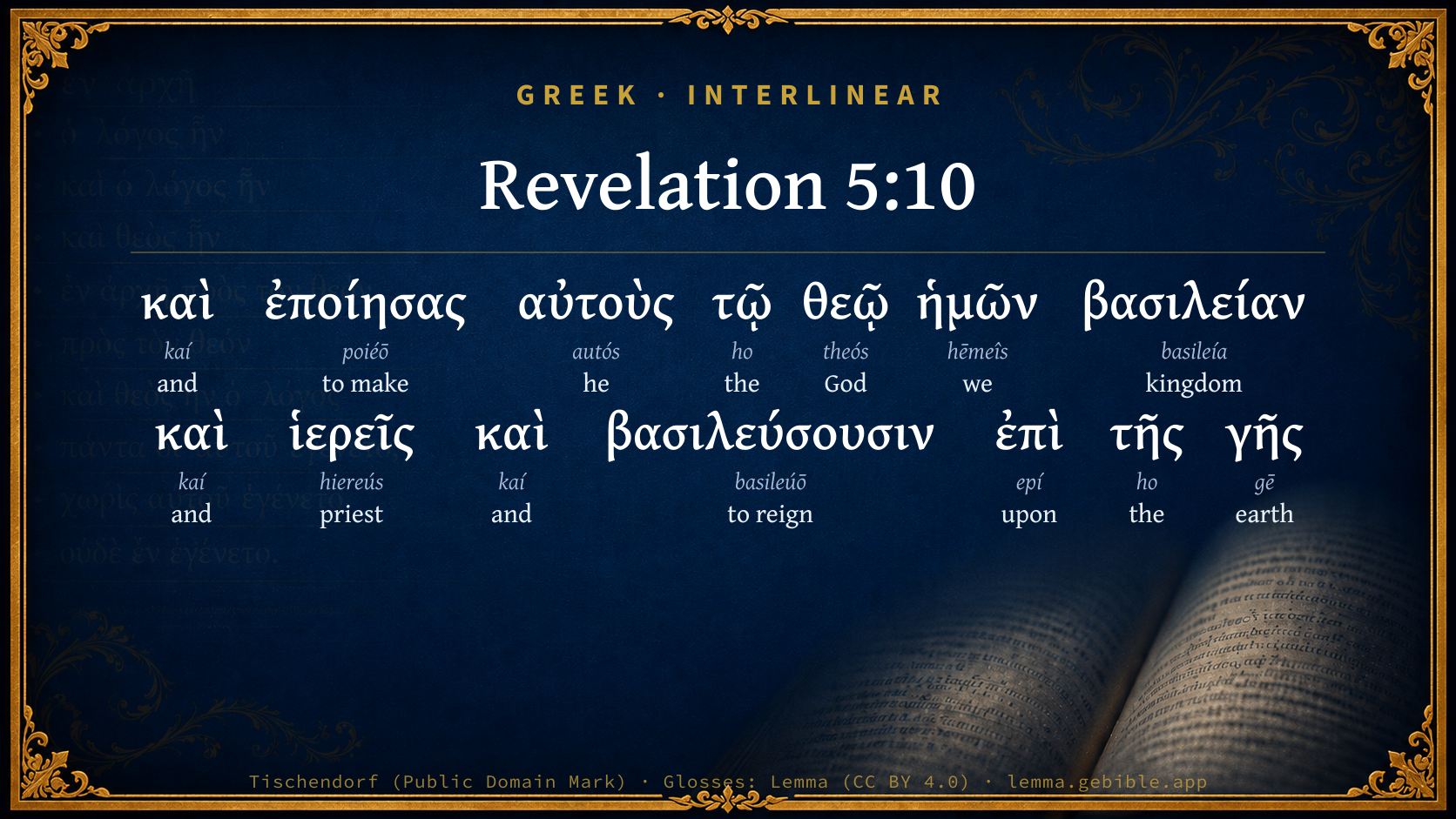
  1. καὶ kaí G2532 “and” Conjunction
  2. ἐποίησας poiéō G4160 “to make” Verb, Aorist, Active, Indicative, 2nd person, Singular
  3. αὐτοὺς autós G846 “he” Personal pronoun, Accusative, Plural, Masculine
  4. τῷ ho G3588 “the” Article, Dative, Singular, Masculine
  5. θεῷ theós G2316 “God” Noun, Dative, Singular, Masculine
  6. ἡμῶν hēmeîs G2249 “we” Personal pronoun, 1st person, Genitive, Plural
  7. βασιλείαν basileía G932 “kingdom” Noun, Accusative, Singular, Feminine
  8. καὶ kaí G2532 “and” Conjunction
  9. ἱερεῖς hiereús G2409 “priest” Noun, Accusative, Plural, Masculine
  10. καὶ kaí G2532 “and” Conjunction
  11. ἐπὶ epí G1909 “upon” Preposition
  12. τῆς ho G3588 “the” Article, Genitive, Singular, Feminine
  13. γῆς gē G1093 “earth” Noun, Genitive, Singular, Feminine

About this verse

These counts appear in no published source. They are computed here, from the morphology-tagged text and Lemma’s own curated glosses. What Lemma adds →

14
words
11
distinct lemmas
Revelation
section

Notable vocabulary

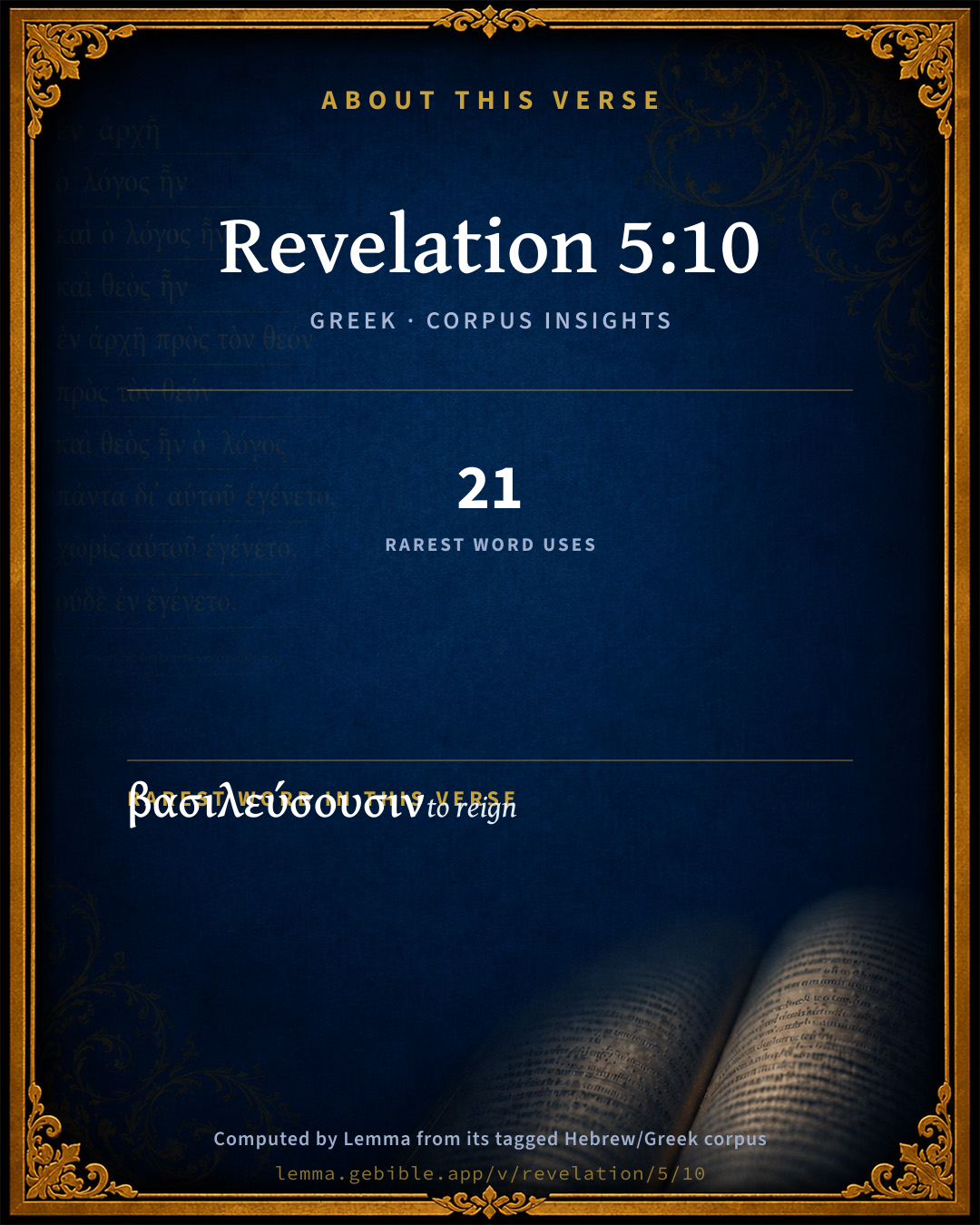
The rarest word here is βασιλεύσουσιν to reign G936 — appearing just 21 times in the whole Greek New Testament.

Shared distinctive vocabulary

βασιλεύσουσιν to reign G936 occurs in 18 verses of the Greek New Testament. Also found in:

Repetition

Words recur within this verse:

Cross-references

7

Topical passages linked to Revelation 5:10 in the Treasury of Scripture Knowledge — connected by theme and wording, ordered by reader-vote popularity; previews shown in the World English Bible.

  • Revelation 1:6 and he made us to be a Kingdom, priests to his God and Father; to him be the glory and the dominion forever and ever. Amen.
  • Daniel 7:27 The kingdom and the dominion, and the greatness of the kingdoms under the whole the sky, shall be given to the people of the saints of the Most High: his kingdom is an everlasting kingdom, and all dominions shall serve and obey him.
  • Revelation 20:6 Blessed and holy is he who has part in the first resurrection. Over these, the second death has no power, but they will be priests of God and of Christ, and will reign with him one thousand years.
  • Daniel 7:18 But the saints of the Most High shall receive the kingdom, and possess the kingdom forever, even forever and ever.
  • Revelation 22:5 There will be no night, and they need no lamp light; for the Lord God will illuminate them. They will reign forever and ever.
  • 1 Peter 2:5–9 You also, as living stones, are built up as a spiritual house, to be a holy priesthood, to offer up spiritual sacrifices, acceptable to God through Jesus Christ.
  • Exodus 19:6 and you shall be to me a kingdom of priests, and a holy nation.' These are the words which you shall speak to the children of Israel."

Cross-references courtesy of OpenBible.info (CC BY 4.0).

Where the printed editions differ

2 variants

Places in this verse where the major printed Greek editions disagree on the wording in a way that affects the translation — a comparison of editions, not a manuscript-by-manuscript collation. The editions are the modern critical texts (Nestlé-Aland 28/27, SBL, Westcott-Hort, Tregelles, Tyndale House) and the traditional texts behind the KJV (the Textus Receptus and the Byzantine/Majority text). It is not a claim about which reading is original.

  1. Different wording
    αὐτοὺς

    “them”

    In NA28NA27TynSBLWHTregByz Not in TR

    ἡμᾶς (hēmas) 'us' occurs in traditional manuscripts (TR) instead of αὐτοὺς (autous) 'them' in older manuscripts (NA28+NA27+Tyn+SBL+WH+Treg+Byz)

  2. Different wording
    βασιλείαν

    “a kingdom”

    In NA28NA27TynSBLWHTreg Not in TRByz

    βασιλεῖς (basileis) 'kings' occurs in traditional manuscripts (TR+Byz) instead of βασιλείαν (basileian) 'a kingdom' in older manuscripts (NA28+NA27+Tyn+SBL+WH+Treg)

Textual data: Translators Amalgamated Greek New Testament (STEPBible TAGNT) · CC BY 4.0.

Commentary

Notes on Revelation 5:10 from classic Christian and Jewish commentators (each source and its license shown beneath its notes). The classic Christian expositions comment on the surrounding passage and are grouped to its opening verse, so a note may address several verses; the Jewish commentaries on the Tanakh (Rashi and others) are per-verse, so they appear only where the commentator wrote on this verse.

Lemma curates 59 commentaries, every one of them public domain or Creative Commons licensed, each selected and text-cleaned for this edition rather than reprinted as found. About our sources →

Tyndale Open Study Notes

Tyndale Open Resources

5:10 The description of God’s people as a Kingdom of priests who will enjoy ultimate victory and will reign with Christ reflects the images of Jesus as both King (Rom 1:3) and High Priest (Heb 6:20).

Tyndale Open Study Notes — © Tyndale Open Resources, licensed CC BY-SA 4.0. Text via the HelloAO Bible API.

Bengel's Gnomon

Johann Albrecht Bengel

Rev 5:10. Αὐτοὺς—καὶ βασιλεύσουσιν) See App. Crit., Ed. ii., on this passage. Comp. Mat 23:37, and Jud 1:24. So also ἐν αὐτῇ, for ἐν σοὶ, ch. Rev 18:24; ἡ λέγουσα ἐν τῇ καρδίᾳ αὐτῆς, for σοῦ, Isa 47:8; Isa 47:10. In this passage the Hebrew construction of the third person for the first has a graphic relation to the redeemed, and at the same time has a more modest sound, than us, priests,[67] etc.—βασιλείαν) Thus the Alex. Lat. Cypria[68] read, as ch. Rev 1:6. The more recent copies here also have βασιλεῖς.[69] But they who cast their crowns before the throne do not call themselves kings, in the sight of the great King, although their priestly access has such dignity, that the power of reigning on earth cannot certainly exceed it. In like manner, in ch. Rev 20:6, they who have part in the first resurrection are called priests, and are said to be about to reign; and yet the name of kings is not given to them.—ἐπὶ τῆς γῆς, upon the earth) Ἐπὶ here denotes locality, as ch. Rev 3:10 and everywhere: or rather power, as ch. Rev 2:26; as it is said, βασιλεύει ἐπὶ τῆς Ἰουδαίας, Mat 2:22. And thus the Septuagint, Jdg 9:8; 1Sa 8:7; 1Sa 12:12; 1Sa 12:14; 2Ki 8:20; 2Ki 11:3. I should not therefore venture to assert, from this phrase, that these remain on the earth, though they rule over the earth. The elders were meek (comp. Mat 5:5): but the flock of the meek independently is much larger.

[67] AB Amiat. MS. of Vulg. Memph. Syr. read αὐτούς. Rec. Text, with h Cypr. 291, reads ἡμᾶς.—E.

[68] yprian (in the beginning and middle of the third century: a Latin father). Ed. Steph. Baluzii, Paris. 1726.

[69] Which reading, though it was preferred in Ed. maj., was yet thought inferior to the other, both in the Gnom. and in Ed. ii. and Vers. Germ.—E. B.

A Vulg. h, Memph. Cypr. read βασιλείαν. B supports Rec. Text, βασιλεῖς.—E.

Bengel's Gnomon of the New Testament — English translation (T&T Clark, Edinburgh, 1860) — public domain. Text from a community e-Sword module.

Expositor's Greek Testament

ed. W. Robertson Nicoll

Rev 5:10 . An allusion not so much to the idea of Rev 20:4 , where the literal sway of the saints (= life eternal, in substance) is confined to a certain section of them, or to Rev 22:5 (on the new earth, cf. Rev 21:1 ), as to Rev 2:26 . Compare the primitive patristic notion, reflected, e.g. , by Viet, on Rev 1:15 : adorabimus in loco ubi steterunt pedes eius, quoniam ubi illi primum steterunt et ecclesiam confirmauerunt, i.e. , in Judæa, ibi omnes sancti conuenturi sunt et dominum suum adoraturi. The whole verse sets aside implicitly such a Jewish pretension as of Philo, who ( de Abrah. 19) hails Israel as the people ὅ μοι δοκεῖ τὴν ὑπὲρ παντὸς ἀνθρώπων γένους ἱερωσύνην καὶ προφητείαν λαχεῖν .

The Expositor's Greek Testament, edited by W. Robertson Nicoll (1897–1910) — public domain. Text from a community e-Sword module.

Jamieson, Fausset & Brown

Robert Jamieson, A. R. Fausset & David Brown

made us--A, B, Aleph, Vulgate, Syriac, and Coptic read, "them." The Hebrew construction of the third person for the first, has a graphic relation to the redeemed, and also has a more modest sound than us, priests [BENGEL].

unto our God--So B and Aleph read. But A omits the clause.

kings--So B reads. But A, Aleph, Vulgate, Coptic, and CYPRIAN, read, "A kingdom." Aleph reads also "a priesthood" for priests. They who cast their crowns before the throne, do not call themselves kings in the sight of the great King (Rev 4:10-11); though their priestly access has such dignity that their reigning on earth cannot exceed it. So in Rev 20:6 they are not called "kings" [BENGEL].

we shall reign on the earth--This is a new feature added to Rev 1:6. Aleph, Vulgate, and Coptic read, "They shall reign." A and B read, "They reign." ALFORD takes this reading and explains it of the Church EVEN NOW, in Christ her Head, reigning on the earth: "all things are being put under her feet, as under His; her kingly office and rank are asserted, even in the midst of persecution." But even if we read (I think the weightiest authority is against it), "They reign," still it is the prophetical present for the future: the seer being transported into the future when the full number of the redeemed (represented by the four living creatures) shall be complete and the visible kingdom begins. The saints do spiritually reign now; but certainly not as they shall when the prince of this world shall be bound (see on Rev 20:2-6). So far from reigning on the earth now, they are "made as the filth of the world and the offscouring of all things." In Rev 11:15, Rev 11:18, the locality and time of the kingdom are marked. KELLY translates, "reign over the earth" (Greek, "epi tees gees"), which is justified by the Greek (Septuagint, Jdg 9:8; Mat 2:22). The elders, though ruling over the earth, shall not necessarily (according to this passage) remain on the earth. But English Version is justified by Rev 3:10. "The elders were meek, but the flock of the meek independently is much larger" [BENGEL].

Jamieson, Fausset & Brown — Commentary Critical and Explanatory on the Whole Bible (1871) — public domain (CC PDM 1.0). Text via the HelloAO Bible API.

Adam Clarke's Commentary

Verse 10. Kings and priests] See Ex 19:6; 1Pe 2:5; 1Pe 2:9, and the notes there.

Adam Clarke's Commentary on the Bible (1810–1826) — public domain. Text from a community e-Sword/MySword module.

The Cambridge Bible for Schools and Colleges

gen. ed. J. J. S. Perowne

10. unto our God kings and priests] See on the last verse for the true reading: on Rev_1:6 for the origin of the phrase.

we shall reign] Authorities are nearly evenly divided between the readings “they reign” and “they shall reign.” Perhaps the present is to be preferred, as the more difficult in sense; the future could be easily understood of the millennial reign (Rev_20:4), whatever that means. If we accept the present, it can hardly be used for a future, every one must feel that Rev_2:22, &c. are not really parallel: rather, we may say that the faithful on earth are, even in their exile, kings de jure, as David was “when he was in the wilderness of Judah” (Psalms 63 ult. cf. title).

The Cambridge Bible for Schools and Colleges (gen. ed. J. J. S. Perowne; Cambridge University Press, 1878–1918) — public domain. Text from a community e-Sword module.

John Gill's Exposition

And hast made us unto our God kings and priests,.... See Gill on Rev 1:6. The Alexandrian copy, and Complutensian edition, and the Syriac, Arabic, and the Ethiopic versions, read "them", instead of "us":

and we shall reign on the earth; meaning not merely in a spiritual sense, through grace reigning over sin and corruption, through Satan being bruised under their feet, and through the victory they have in Christ over the world, but in the millennium state, in the thousand years' reign with Christ in the new earth, wherein dwelleth righteousness; see Rev 20:4. The Alexandrian copy, and the Complutensian edition, Syriac and Arabic versions, read "they shall reign".

John Gill's Exposition of the Whole Bible (1746–1763) — public domain (CC PDM 1.0). Text via the HelloAO Bible API.

Trapp's Complete Commentary

John Trapp

10 And hast made us unto our God kings and priests: and we shall reign on the earth.

Ver. 10. And we shall reign on the earth] Reign over our lusts; reign with and in Christ over all our enemies by a spiritual, not secular sceptre; and at last judge the world, 1Co 6:2.

John Trapp, A Commentary or Exposition upon All the Books of the Old and New Testament (1647–1656) — public domain. Text from a community e-Sword module.

Albert Barnes' Notes on the Bible

And hast made us unto our God kings and priests - See the notes on Rev 1:6.

And we shall reign on the earth - The redeemed, of whom we are the representatives. The idea clearly is, in accordance with what is so frequently said in the Scriptures, that the dominion on the earth will be given to the saints; that is, that there will be such a prevalence of true religion, and the redeemed will be so much in the ascendency, that the affairs of the nations will be in their hands. Righteous people will hold the offices; will fill places of trust and responsibility; will have a controlling voice in all that pertains to human affairs. See the notes on Dan 7:27, and Rev 20:1-6 notes. To such a prevalence of religion all things are tending; and to this, in all the disorder and sin which now exist, are we permitted to look forward. It is not said that this will be a reign under the Saviour in a literal kingdom on the earth; nor is it said that the saints will descend from heaven, and occupy thrones of power under Christ as a visible king. The simple affirmation is, that they will reign on the earth; and as this seems to be spoken in the name of the redeemed, all that is necessary to be understood is, that there will be such a prevalence of true religion on the earth that it will become a vast kingdom of holiness, and that, instead of being in the minority, the saints will everywhere have the ascendency.

Albert Barnes' Notes on the Bible (1834–1885) — public domain. Text from a community e-Sword/MySword module.

Haydock's Catholic Bible Commentary

And hast made us to our God, &c. See 1 Peter ii. 5, 9. (Witham) --- All Christians may justly be styled kings and priests of God, by the spiritual empire they possess over their passions and the world; and by the continual offering they make on the altar of their hearts, by means of the prayers they daily offer up to God. (Origen) --- Thus they say, we shall reign on the earth by the empire we shall exercise over our passions; and by the union we shall have with Jesus Christ and his Church, triumph over all who have persecuted us. (Estius; Andræas.)

George Leo Haydock (1774–1849), Haydock's Catholic Family Bible and Commentary, 1859 edition — public domain. Excludes Psalms (Douay-Rheims chapter numbering differs from Protestant) and Deuterocanonical books (Catholic canon only).

Matthew Poole's English Annotations

The four living creatures and four and twenty elders (by which are represented the ministers and members of the church of Christ) go on in showing why they had reason to proclaim Christ worthy to be the Prophet to his church, to open the counsels of God to them, viz. because of the great love he had showed to them, not only in redeeming them with his blood from the guilt and power of sin, but in making them kings and priests; giving them the same privileges that the Jewish church had, who were called a royal priesthood, Exo 19:6; giving them a power (as priests) to offer up not such bloody fleshly sacrifices as they offered, but) spiritual sacrifices, acceptable to God through the Beloved, 1Pe 2:5; and also (as kings) to rule over their lusts and sensitive appetite; and to

reign hereafter on the earth, judging the world {1Co 6:3} at the great day, with the great Judge of the quick and the dead.

Matthew Poole's English Annotations on the Holy Bible (1683–1685) — public domain. Text from a community e-Sword/MySword module.

Whedon's Commentary on the Bible

Daniel D. Whedon

10. Hast made—Rather, didst make; coordinate with didst redeem, in Rev_5:9. Us—Them, as said in our note on Rev_5:9.

Kings and priests— The true reading seems to be, Thou didst make them, unto God, a kingdom, instead of kings and priests. We shall reign should read, and they reign on the earth. Not that we shall reign, in the future, but they, the redeemed, do now reign on earth.

The important changes made by textual criticisms in this song, suggest its reproduction thus:—Thou art worthy to take the roll, and to open the seals thereof; for thou wast slain, and didst redeem to God by thy blood out of every kindred, and tongue, and people, and nation. And didst make them unto our God a kingdom and priests, and they reign on earth.

These changes are important, as showing that the kingdom and the reign of the saints on earth are truly now already begun and existing, and waiting future enlargements, confirmations, and developments.

To this song of the cherubic beasts and the elders, there now comes, by a sublime surprise, a reenforcement of an innumerable company of angels. It begins to dawn upon us that we have at this great hour a fivefold song. It begins, first, with the trisagion, Rev_4:8, by the cherubim, which, second, is responded to by the elders. Third, the elders have just now celebrated the opening of the roll; and, fourth, peals the angelic anthem, and their peal wakens every creature in all parts of creation to a fifth and last reverberation.

Daniel D. Whedon (gen. ed.), Commentary on the Old and New Testaments (1874–1909) — public domain. Text from a community e-Sword module.

The Pulpit Commentary

And hast made us unto our God kings and priests; and didst make them to be unto our God a kingdom and priests. Of those whom thou didst redeem from every nation, thou didst make a kingdom and priests. Wordsworth remarks that these honours conferred upon the redeemed imply duties as well as privileges. They receive the princely honours conferred upon them only on condition that they also become priests, presenting themselves, their souls and bodies, a living sacrifice to God, (Rom_12:1, Rom_12:2) and, being a holy priesthood, offering up spiritual sacrifices acceptable to God by Jesus Christ. (1Pe_2:5) (On the person of "us," see on previous verse.) And we shall reign on the earth; or, and they reign on the earth (see on ver. 9). The interpretation of this passage will necessarily be influenced to some extent by the view adopted of the millennium (see on Revelation 20), Those who expect a personal reign of Christ on the earth for a thousand years naturally consider that in this verse reference is made to that period. And if the thousand years be understood to denote the time which elapses between the first and second comings of Christ, that is to say, the present time, the two passages that in Rev_20:4 and the one before us may be connected, and intended to refer to the same time. We have, therefore, to inquire in what sense the word "reign" is used, and how the redeemed can be said to reign on the earth at the present time. In the first place, nothing is more plainly taught us than that Christ"s reigning, his power, and his kingdom on earth are a spiritual reign, a spiritual power, a spiritual kingdom; though the Jews and our Lord"s disciples themselves frequently erred by supposing that his kingdom would be a visible, worldly power. It seems natural, therefore, that if such is the meaning of Christ"s reigning, that of his servants should be of the same nature; and we ought not to err in the same way as the Jews did, by expecting to see the redeemed exercise at any time visible authority over their fellowmen. The redeemed reign, then, spiritually. But it will be well to inquire more fully and exactly what we intend to signify by this expression. The word "reign" is not often used of Christians in the New Testament. In Rom_5:17 we read, "Much more they which receive abundance of grace and of the gift of righteousness shall reign in life by one, Jesus Christ." And in 1Co_4:8. "And I would to God ye did reign." In both these places St. Paul seems to intend a reigning over self an ability to subdue personal passions; a power which comes from the "abundance of grace and of the gift of righteousness" which are mentioned, and which are possessed only by the redeemed, through Jesus Christ. This ability to subdue personal passions and ambitions is what the apostle wishes for the Corinthians, and of which many of them had shown themselves to be destitute, or only possessing in an inadequate degree. It is the truth which is expressed by Solomon in the words, "Better is he that ruleth his spirit than he that taketh a city"; (Pro_16:32) and in the words of the Collect for Peace in the Morning Prayer of the Church of England, "Whose service is perfect freedom;" or, as it should be rendered, "Whom to serve is to reign." The representatives of the Church and of creation, then, adore the Lamb, through whose redeeming act grace may be given to men of every kindred and tongue, to enable them to overcome sin and Satan, and in the freedom of God"s service to reign on earth as kings and conquerors over all unworthy passions. In this way, too, we account for the present tense of the verb, which is most probably the correct reading.

The Pulpit Commentary (1880–1919), ed. H.D.M. Spence-Jones & Joseph S. Exell — public domain. Text from a community e-Sword module.

John Wesley's Explanatory Notes

And hast made them - The redeemed. So they speak of themselves also in the third person, out of deep self-abasement. They shall reign over the earth - The new earth: herewith agree the golden crowns of the elders. The reign of the saints in general follows, under the trumpet of the seventh angel; particularly after the first resurrection, as also in eternity, chap. xi, 18; xv, 7; xx, 4; xxii, 5;Dan. vii, 27;Psalm xlix, 14.

John Wesley, Explanatory Notes Upon the Whole Bible (1754–1765) — public domain. Text via the GEBible commentary corpus.

The People's New Testament

B. W. Johnson

10. Hast made them. Not “us,” as in the Common Version. Kings and priests. A kingdom and priests. See note on 1:6. And they (not we) shall reign on the earth. As coadjutors of Christ. See note on 2:10.

B. W. Johnson's The People's New Testament with Notes (1889–1891) — public domain. Electronic text from the Christian Classics Ethereal Library (CCEL) ThML edition.

Cambridge Greek Testament for Schools and Colleges

10. ἐποίησας αὐτούς. Text. Rec[207] reads ἐπ. ἡμᾶς with all Latin authorities, except Cyp[208] and cod. am[209]

[207] Rec. Textus Receptus as printed by Scrivener.

[208] St Cyprian as quoted by Haussleiter.

[209] Codex Amiatinus 6th century in Laurentian Library at Florence.

βασιλείαν. Text. Rec[210] reads βασιλεῖς with B2.

[210] Rec. Textus Receptus as printed by Scrivener.

βασιλεύσουσιν. With אP 1; Lachmann reads βασιλεύουσιν with AB2; Text. Rec[211] reads βασιλεύσομεν with Primas[212] and Vg[213]

[211] Rec. Textus Receptus as printed by Scrivener.

[212] Primasius, edited by Haussleiter.

[213] Vulgate.

10. βασιλείαν καὶ ἱερεῖς. See on Rev 1:6 for the origin of the phrase.

βασιλεύ[σ]ουσιν. Authorities are nearly evenly divided between the present and future, and from the nature of the case authorities have here to be counted not weighed. Perhaps the present is to be preferred, as the more difficult in sense; the future could be easily understood of the millennial reign (Rev 20:4), whatever that means. If we accept the present, it can hardly be used for a future; every one must feel that Rev 2:22, &c. are not really parallel: rather, we may say that the faithful on earth are, even in their exile, kings de jure, as David was “when he was in the wilderness of Judah” (Psalms 63 ult., cf. title).

Cambridge Greek Testament for Schools and Colleges (Cambridge University Press, 1896; 21 vols, various authors incl. Carr, Maclear, Plummer, Farrar, Lumby, Moule, M. R. James, Simcox) — public domain. Text from a community e-Sword module.

Vincent's Word Studies in the New Testament

Marvin R. Vincent

Us [ημας] . Read aujtouv them.

Kings [βασιλεις] . Read, basileian a kingdom. See on chapter Rev 1:6. We shall reign [βασιλευσομεν] . Read basileuousin they reign. Their reigning is not future, but present.

Marvin R. Vincent, Word Studies in the New Testament (1887–1900) — public domain. Text from a community e-Sword/MySword module.

Lesson kit

Teaching starters — assembled from the data on this page, not authored interpretation. Every prompt links to the verse data it draws on. Edit before teaching.

Revelation, in the Revelation, opens this verse with 14 words (11 distinct Greek lemmas). Its most distinctive word is basileúō (“to reign”). A historical commentator’s framing appears above. Read the whole chapter for the surrounding context.

Discussion questions

  1. The word basileúō carries the sense “to reign.” How does it shape the verse?
  2. How does Matthew 2:22, which shares the word «to reign», read alongside this verse?
  3. What does the repetition of “and” (3× in this one verse) do in this verse?
  4. These translations render this verse differently; the difference is in the English rendering, not the original. What questions does that raise?
  5. Compare how Tyndale Open Study Notes and Bengel's Gnomon read this verse. Where do they agree or differ?

Things to notice

Reading settings

Reading text

Shown beneath each verse's original-language words.

Old Testament
Old Testament edition

Read the OT as the Masoretic Hebrew (MT) or the Greek Septuagint (LXX).

English shown for the Greek Septuagint (in the Hebrew ↔ Greek comparison).

Comparing translations? Open the Compare panel on any verse page to stack up to four side by side.