Revelation 6:8

Greek (Tischendorf 8th ed.) Revelation 6:8 appears in the Greek New Testament. The text above is from the Tischendorf 8th edition. Each word links to its Strong’s number and a concise gloss. Click any word for its full Thayer’s Greek Lexicon entry.
Download image
Cite this verse

Revelation 6:8 (World English Bible). Public Domain. Lemma interlinear Bible study tool, https://lemma.gebible.app/v/revelation/6/8.

Show BibTeX & RIS
BibTeX
RIS
English Translation
And behold, a pale horse, and he who sat on it, his name was Death. Hades followed with him. Authority over one fourth of the earth, to kill with the sword, with famine, with death, and by the wild animals of the earth was given to him.
World English Bible · Public Domain
Download a study sheet

One document with this verse’s original text, its word-by-word gloss line, the meaning frame, cross-references with their text, attributed commentary, and full source and license credits — printable, and it pastes into notes with its structure intact.

This verse Autodidact and up

Study sheet (.html) Plain text (.txt)

A passage Seminary Student

Up to 50 verses in one chapter. A passage sheet keeps up to 6 commentary sources and 12 cross-references per verse, in the order this page ranks them, and says so on the sheet whenever that leaves anything out. Ask for a single verse and you get the Autodidact verse sheet above.

Everything on this page stays free to read, with no account — the sheet is a download of what is already on screen, not access to it.

Want to remove ads? Support Godless Engineer
Compare translations 3

The same verse in 3 English versions, stacked beneath the original-language interlinear above. Click any original word for its lexicon entry.

Each is an independent rendering of the whole verse — the interlinear is not word-aligned to these translations.

Highlighted words mark where these versions differ — a whole-verse word diff, not a word-by-word alignment.

  • World English Bible Public Domain
    And behold, a pale horse, and he who sat on it, his name was Death. Hades followed with him. Authority over one fourth of the earth, to kill with the sword, with famine, with death, and by the wild animals of the earth was given to him.
  • King James Version Public Domain
    And I looked, and behold a pale horse: and his name that sat on him was Death, and Hell followed with him. And power was given unto them over the fourth part of the earth, to kill with sword, and with hunger, and with death, and with the beasts of the earth.
  • unfoldingWord Literal Text CC BY-SA 4.0
    And I looked, and behold, a pale horse! And the one sitting on it was named Death, and Hades was following after him. And authority was given to them over one fourth of the earth, to kill with the sword and with famine and with death and by the wild animals of the earth.

unfoldingWord Literal Text — © unfoldingWord, licensed CC BY-SA 4.0. Word-aligned USFM3 via Door43 (git.door43.org/unfoldingWord/en_ult).

Versions to compare (up to 4)

3 of 4 selected

Show all 19 translations

Every available English version of this verse, each an independent rendering of the whole verse.

  • World English Bible Public Domain
    And behold, a pale horse, and he who sat on it, his name was Death. Hades followed with him. Authority over one fourth of the earth, to kill with the sword, with famine, with death, and by the wild animals of the earth was given to him.
  • Berean Standard Bible Public Domain
    Then I looked and saw a pale green horse. Its rider’s name was Death, and Hades followed close behind. And they were given authority over a fourth of the earth, to kill by sword, by famine, by plague, and by the beasts of the earth.
  • Majority Standard Bible Public Domain
    Then I saw a pale green horse. Its rider’s name was Death, and Hades followed close behind. And he was given authority over a fourth of the earth, to kill by sword, by famine, by plague, and by the beasts of the earth.
  • King James Version Public Domain
    And I looked, and behold a pale horse: and his name that sat on him was Death, and Hell followed with him. And power was given unto them over the fourth part of the earth, to kill with sword, and with hunger, and with death, and with the beasts of the earth.
  • American Standard Version (1901) Public Domain
    And I saw, and behold, a pale horse: and he that sat upon him, his name was Death; and Hades followed with him. And there was given unto them authority over the fourth part of the earth, to kill with sword, and with famine, and with death, and by the wild beasts of the earth.
  • Revised Version (1885) Public Domain
    And I saw, and behold, a pale horse: and he that sat upon him, his name was Death; and Hades followed with him. And there was given unto them authority over the fourth part of the earth, to kill with sword, and with famine, and with death, and by the wild beasts of the earth.
  • Geneva Bible (1599) Public Domain
    And I looked, and beholde, a pale horse, and his name that sate on him was Death, and Hell folowed after him, and power was giuen vnto them ouer the fourth part of the earth, to kill with sworde, and with hunger, and with death, and with beasts of the earth.
  • Douay-Rheims (1899) Public Domain
    And behold a pale horse, and he that sat upon him, his name was Death, and hell followed him. And power was given to him over the four parts of the earth, to kill with sword, with famine, and with death, and with the beasts of the earth.
  • Young's Literal Translation Public Domain
    and I saw, and lo, a pale horse, and he who is sitting upon him -- his name is Death, and Hades doth follow with him, and there was given to them authority to kill, (over the fourth part of the land,) with sword, and with hunger, and with death, and by the beasts of the land.
  • Literal Standard Version CC BY-SA 4.0
    And I saw, and behold, a pale horse, and he who is sitting on him—his name is Death, and Hades follows with him, and there was given to them authority to kill over the fourth part of the earth with sword, and with hunger, and with death, and by the beasts of the earth.
  • Unlocked Literal Bible CC BY-SA 4.0
    Then I saw a pale horse. The rider on it was named Death, and Hades was following him. They were given authority over one-fourth of the earth, to kill with the sword, with famine and disease, and with the wild animals of the earth.
  • unfoldingWord Literal Text CC BY-SA 4.0
    And I looked, and behold, a pale horse! And the one sitting on it was named Death, and Hades was following after him. And authority was given to them over one fourth of the earth, to kill with the sword and with famine and with death and by the wild animals of the earth.
  • Darby Bible Public Domain
    And I saw: and behold, a pale horse, and he that sat upon it, his name [was] Death, and hades followed with him; and authority was given to him over the fourth of the earth to slay with sword, and with hunger, and with death, and by the beasts of the earth.
  • World Messianic Bible Public Domain
    And behold, a pale horse, and the name of he who sat on it was Death. Sheol followed with him. Authority over one fourth of the earth, to kill with the sword, with famine, with death, and by the wild animals of the earth was given to him.
  • Webster's Bible Public Domain
    And I looked, and behold, a pale horse: and his name that sat on him was Death, and hell followed with him. And power was given to them over the fourth part of the earth, to kill with sword, and with hunger, and with death, and with the beasts of the earth.
  • Free Bible Version CC BY-SA 4.0
    I looked and saw a pale horse. The rider was called Death, and Hades followed him. They received authority over a quarter of the earth to kill people by the sword, by famine, by plague, and by wild beasts.
  • Bible in Basic English Public Domain
    And I saw a grey horse, and the name of him who was seated on it was Death; and Hell came after him. And there was given to them authority over the fourth part of the earth, to put to destruction by the sword, and by taking away their food, and by death, and by the beasts of the earth.
  • Text-Critical English NT CC BY 4.0
    And behold, there was a pale green horse! The name of its rider was Death, and Hades followed him. He was given authority over a fourth of the earth to kill by the sword, by famine and pestilence, and by the wild beasts of the earth.
  • Tyndale New Testament (1534) Public Domain
    And I loked and beholde a grene horsse and his name that sat on him was deeth and hell folowed after him and power was geven vnto them over the fourthe parte of the erth to kyll with swearde and with honger and with deeth that cometh of vermen of the erth.

Literal Standard Version (2020), Covenant Press — licensed CC BY-SA 4.0. Text via the HelloAO Bible API (eBible.org). Unlocked Literal Bible (unfoldingWord) — licensed CC BY-SA 4.0. Text via the HelloAO Bible API (eBible.org). unfoldingWord Literal Text — © unfoldingWord, licensed CC BY-SA 4.0. Word-aligned USFM3 via Door43 (git.door43.org/unfoldingWord/en_ult). Free Bible Version, Dr. Jonathan Gallagher — licensed CC BY-SA 4.0. Text via the HelloAO Bible API (eBible.org).

Word by word

More ways to search: Search by grammar → Find every occurrence → Compare this word →

Practice this passage: Drill this verse → Learn its vocabulary →

χλωρός
chlōrós
G5515
“green”
Adjective, Nominative, Singular, Masculine
Part of Speech
Adjective
Case
Nominative
Number
Singular
Gender
Masculine
Full Thayer's Definition

Origin: from the same as G5514

TDNT: None

1. green 2. yellowish pale
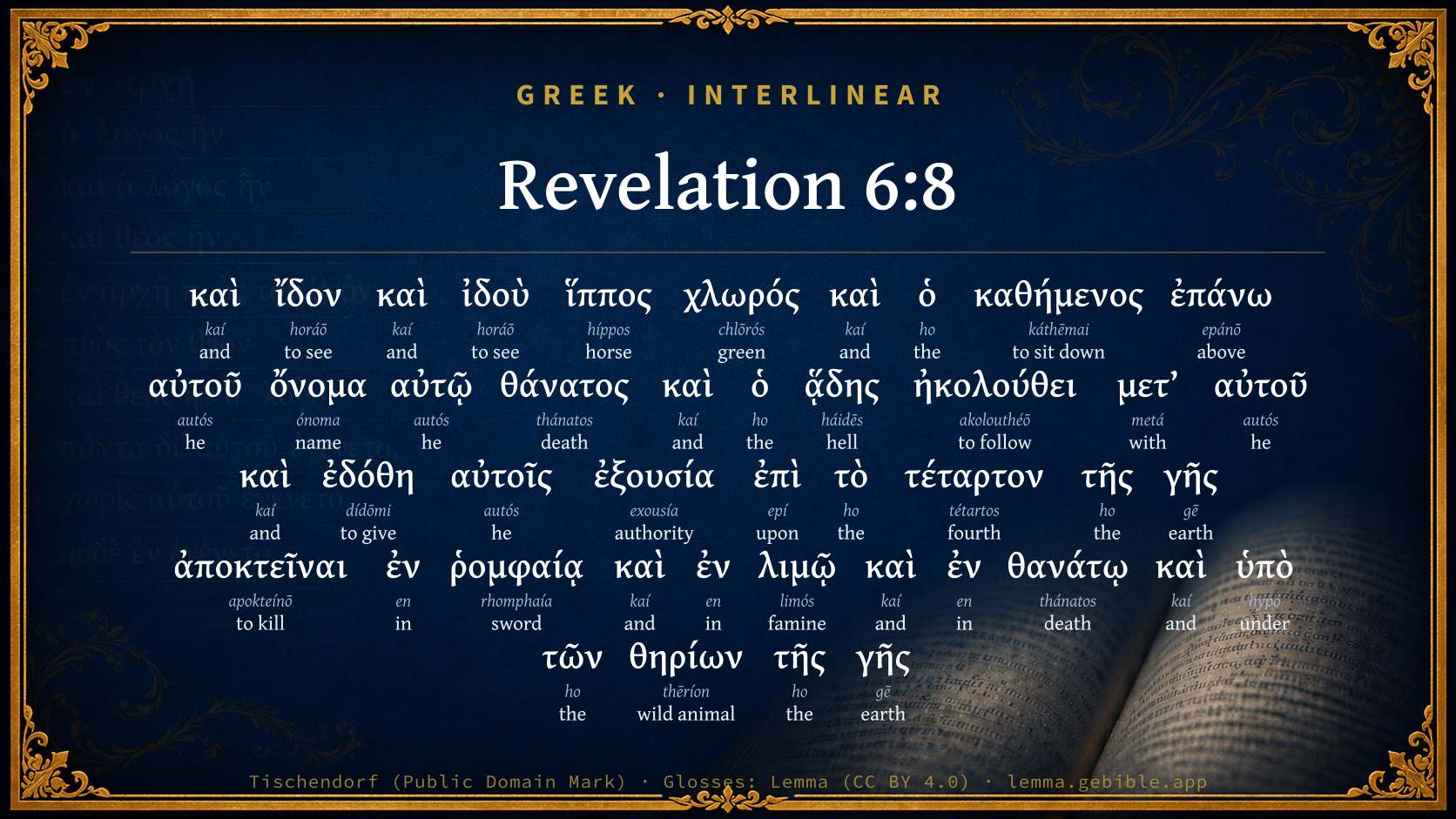
  1. καὶ kaí G2532 “and” Conjunction
  2. ἴδον horáō G3708 “to see” Verb, Aorist, Active, Indicative, 1st person, Singular
  3. καὶ kaí G2532 “and” Conjunction
  4. ἰδοὺ horáō G3708 “to see” Verb, Aorist, Middle, Imperative, 2nd person, Singular
  5. ἵππος híppos G2462 “horse” Noun, Nominative, Singular, Masculine
  6. καὶ kaí G2532 “and” Conjunction
  7. ὁ ho G3588 “the” Article, Nominative, Singular, Masculine
  8. καθήμενος káthēmai G2521 “to sit down” Verb, Present, Middle or Passive deponent, Participle, Nominative, Singular, Masculine
  9. ἐπάνω epánō G1883 “above” Adverb
  10. αὐτοῦ autós G846 “he” Personal pronoun, Genitive, Singular, Masculine
  11. ὄνομα ónoma G3686 “name” Noun, Nominative, Singular, Neuter
  12. αὐτῷ autós G846 “he” Personal pronoun, Dative, Singular, Masculine
  13. θάνατος thánatos G2288 “death” Noun, Nominative, Singular, Masculine
  14. καὶ kaí G2532 “and” Conjunction
  15. ὁ ho G3588 “the” Article, Nominative, Singular, Masculine
  16. ᾅδης háidēs G86 “hell” Noun, Nominative, Singular, Masculine
  17. ἠκολούθει akolouthéō G190 “to follow” Verb, Imperfect, Active, Indicative, 3rd person, Singular
  18. μετ’ metá G3326 “with” Preposition
  19. αὐτοῦ autós G846 “he” Personal pronoun, Genitive, Singular, Masculine
  20. καὶ kaí G2532 “and” Conjunction
  21. ἐδόθη dídōmi G1325 “to give” Verb, Aorist, Passive, Indicative, 3rd person, Singular
  22. αὐτοῖς autós G846 “he” Personal pronoun, Dative, Plural, Masculine
  23. ἐξουσία exousía G1849 “authority” Noun, Nominative, Singular, Feminine
  24. ἐπὶ epí G1909 “upon” Preposition
  25. τὸ ho G3588 “the” Article, Accusative, Singular, Neuter
  26. τέταρτον tétartos G5067 “fourth” Adjective, Accusative, Singular, Neuter
  27. τῆς ho G3588 “the” Article, Genitive, Singular, Feminine
  28. γῆς gē G1093 “earth” Noun, Genitive, Singular, Feminine
  29. ἀποκτεῖναι apokteínō G615 “to kill” Verb, Aorist, Active, Infinitive
  30. ἐν en G1722 “in” Preposition
  31. ῥομφαίᾳ rhomphaía G4501 “sword” Noun, Dative, Singular, Feminine
  32. καὶ kaí G2532 “and” Conjunction
  33. ἐν en G1722 “in” Preposition
  34. λιμῷ limós G3042 “famine” Noun, Dative, Singular, Masculine
  35. καὶ kaí G2532 “and” Conjunction
  36. ἐν en G1722 “in” Preposition
  37. θανάτῳ thánatos G2288 “death” Noun, Dative, Singular, Masculine
  38. καὶ kaí G2532 “and” Conjunction
  39. ὑπὸ hypó G5259 “under” Preposition
  40. τῶν ho G3588 “the” Article, Genitive, Plural, Neuter
  41. θηρίων thēríon G2342 “wild animal” Noun, Genitive, Plural, Neuter
  42. τῆς ho G3588 “the” Article, Genitive, Singular, Feminine
  43. γῆς gē G1093 “earth” Noun, Genitive, Singular, Feminine

About this verse

These counts appear in no published source. They are computed here, from the morphology-tagged text and Lemma’s own curated glosses. What Lemma adds →

44
words
24
distinct lemmas
Revelation
section

Notable vocabulary

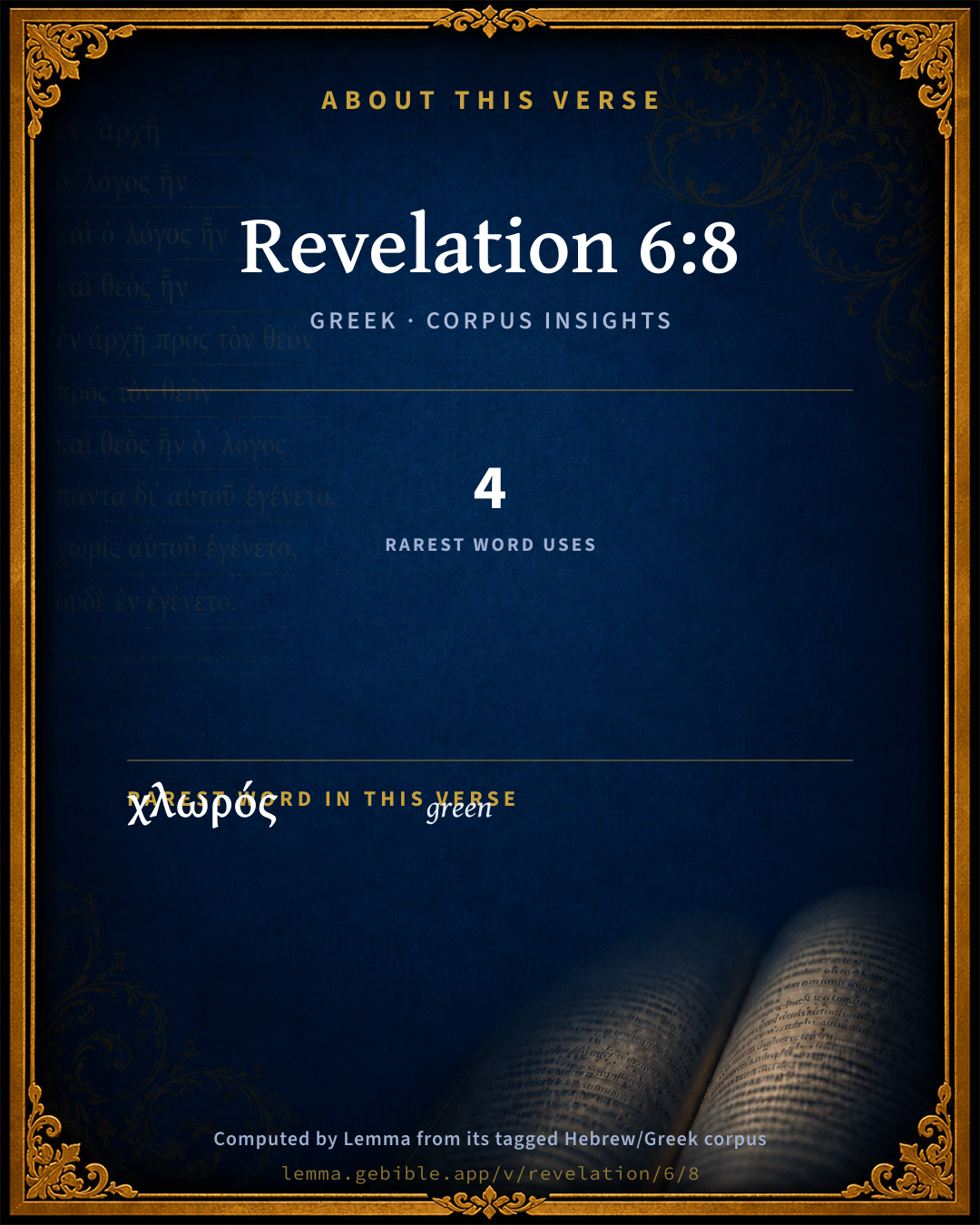
The rarest word here is χλωρός green G5515 — appearing just 4 times in the whole Greek New Testament.

Shared distinctive vocabulary

χλωρός green G5515 occurs in 4 verses of the Greek New Testament. Also found in:

Repetition

Words recur within this verse:

Cross-references

20

Topical passages linked to Revelation 6:8 in the Treasury of Scripture Knowledge — connected by theme and wording, ordered by reader-vote popularity; previews shown in the World English Bible.

  • Hosea 13:14 I will ransom them from the power of Sheol. I will redeem them from death! Death, where are your plagues? Sheol, where is your destruction? Compassion will be hidden from my eyes.
  • Jeremiah 15:2–3 It shall happen, when they tell you, Where shall we go forth? then you shall tell them, Thus says Yahweh: Such as are for death, to death; and such as are for the sword, to the sword; and such as are for the famine, to the famine; and such as are for captivity, to captivity.
  • Revelation 1:18 and the Living one. I was dead, and behold, I am alive forevermore. Amen. I have the keys of Death and of Hades.
  • Zechariah 6:3 in the third chariot white horses; and in the fourth chariot dappled horses, all of them powerful.
  • Jeremiah 16:4 They shall die grievous deaths: they shall not be lamented, neither shall they be buried; they shall be as dung on the surface of the ground; and they shall be consumed by the sword, and by famine; and their dead bodies shall be food for the birds of the sky, and for the animals of the earth.
  • Ezekiel 5:12 A third part of you shall die with the pestilence, and with famine shall they be consumed in the midst of you; and a third part shall fall by the sword round about you; and a third part I will scatter to all the winds, and will draw out a sword after them.
  • Ezekiel 14:13–21 Son of man, when a land sins against me by committing a trespass, and I stretch out my hand on it, and break the staff of the bread of it, and send famine on it, and cut off from it man and animal;
  • Revelation 20:13–14 The sea gave up the dead who were in it. Death and Hades gave up the dead who were in them. They were judged, each one according to his works.
  • Isaiah 25:8 He has swallowed up death forever; and the Lord Yahweh will wipe away tears from off all faces; and the reproach of his people will he take away from off all the earth: for Yahweh has spoken it.
  • Ezekiel 5:15–17 So it shall be a reproach and a taunt, an instruction and an astonishment, to the nations that are round about you, when I shall execute judgments on you in anger and in wrath, and in wrathful rebukes; (I, Yahweh, have spoken it;)
  • Revelation 9:18 By these three plagues were one third of mankind killed: by the fire, the smoke, and the sulfur, which proceeded out of their mouths.
  • Leviticus 26:22–33 I will send the wild animals among you, which will rob you of your children, destroy your cattle, and make you few in number; and your roads will become desolate.
  • Jeremiah 16:16 Behold, I will send for many fishermen, says Yahweh, and they shall fish them up; and afterward I will send for many hunters, and they shall hunt them from every mountain, and from every hill, and out of the clefts of the rocks.
  • Habakkuk 2:5 Yes, moreover, wine is treacherous. A haughty man who doesn't stay at home, who enlarges his desire as Sheol, and he is like death, and can't be satisfied, but gathers to himself all nations, and heaps to himself all peoples.
  • 1 Corinthians 15:55 "Death, where is your sting? Hades, where is your victory?"
  • Revelation 8:7–12 The first sounded, and there followed hail and fire, mixed with blood, and they were thrown to the earth. One third of the earth was burnt up, and one third of the trees were burnt up, and all green grass was burnt up.
  • Revelation 9:15 The four angels were freed who had been prepared for that hour and day and month and year, so that they might kill one third of mankind.
  • Jeremiah 43:11 He shall come, and shall strike the land of Egypt; such as are for death [shall be given] to death, and such as are for captivity to captivity, and such as are for the sword to the sword.
  • Matthew 11:23 You, Capernaum, who are exalted to Heaven, you will go down to Hades. For if the mighty works had been done in Sodom which were done in you, it would have remained until this day.
  • Proverbs 5:5 Her feet go down to death. Her steps lead straight to Sheol.

Cross-references courtesy of OpenBible.info (CC BY 4.0).

Where the printed editions differ

1 variant

Places in this verse where the major printed Greek editions disagree on the wording in a way that affects the translation — a comparison of editions, not a manuscript-by-manuscript collation. The editions are the modern critical texts (Nestlé-Aland 28/27, SBL, Westcott-Hort, Tregelles, Tyndale House) and the traditional texts behind the KJV (the Textus Receptus and the Byzantine/Majority text). It is not a claim about which reading is original.

  1. Different wording
    αὐτοῖς

    “to them”

    In NA28NA27TynSBLWHTregTR Not in Byz

    αὐτῷ (autō) 'to him' occurs in a few manuscripts (Byz) instead of αὐτοῖς (autois) 'to them' in older manuscripts (NA28+NA27+Tyn+SBL+WH+Treg+TR)

Textual data: Translators Amalgamated Greek New Testament (STEPBible TAGNT) · CC BY 4.0.

Commentary

Notes on Revelation 6:8 from classic Christian and Jewish commentators (each source and its license shown beneath its notes). The classic Christian expositions comment on the surrounding passage and are grouped to its opening verse, so a note may address several verses; the Jewish commentaries on the Tanakh (Rashi and others) are per-verse, so they appear only where the commentator wrote on this verse.

Lemma curates 59 commentaries, every one of them public domain or Creative Commons licensed, each selected and text-cleaned for this edition rather than reprinted as found. About our sources →

Bengel's Gnomon

Johann Albrecht Bengel

Rev 6:8. Χλωρὸς) χλωρὸς, ch. Rev 8:7, is green; but here it is pale, ὠχρός, which sense is confirmed by Eustathius: as also the Septuagint renders the Hebrew ירק by each of these Greek words.—ἐξουσία ἐπὶ τὸ τέταρτον) There is a similar construction, ἐπὶ with an accusative, ch. Rev 16:9.—ἐν θανάτῳ) by pestilence. דבר pestilence; Septuagint, θάνατος, Exo 9:3; 2Sa 24:13, and repeatedly. [An accumulation of different calamities.—V. g.]

Bengel's Gnomon of the New Testament — English translation (T&T Clark, Edinburgh, 1860) — public domain. Text from a community e-Sword module.

Expositor's Greek Testament

ed. W. Robertson Nicoll

Rev 6:8 . χλωρός , pale or livid as a corpse. ἐπάνω αὐτοῦ , for the ordinary ἐπʼ αὐτόν , a grammatical variation which has no special significance. In this Dureresque vignette the spectre of Hades, bracketed here as elsewhere with Death, accompanies the latter to secure his booty of victims. So Nergal, the Babylonian Pluto, is not content with ruling the regions of the dead but appears as an active personification of violent destruction, especially pestilence and war, inflicting his wounds on large masses rather than on individuals (Jastrow, 66, 67). A similar duality of conception, local and personal, obtained in Semitic and Hellenic mythology ( cf e.g. , Rev 9:11 ); only, Death is not here personified as an angel (with Jewish theology, cf. Eisenmenger’s Eindecktes Jud. i. 854 f., 862 f.). As the chief partner in this grim league, he is given destructive power over a certain quarter of the earth ( τὸ τέτ . colloquially); his agents are the usual apocalyptic scourges ( cf. Eze 14:21 , Ps. Sol. 13:2 f., with Plut. Iside , 47 for the Iranian expectation of λοιμὸς καὶ λιμός as inflictions of Ahriman) against which the Jewish evening prayer was directed (“keep far from us the enemy, the pestilence, the sword, famine and affliction”). War, followed by famine which bred pestilence, was familiar in Palestine (Jos. Antiq. xv. 9) during the first century A.D. Indeed throughout the ancient world war and pestilence were closely associated, while wild beasts multiplied and preyed on human life, as the land was left untilled. In Test. Naphth. 8, etc., Beliar is the captain of wild beasts. Note that the prophet sees only the commissions, not the actual deeds, of these four dragoons: not until Rev 6:12 f. does anything happen. The first four seals are simply arranged on the rabbinic principle (Sohar Gen. fol. 91), “quodcunque in terra est, id etiam in coelo est, et nulla res tarn exigua est in mundo quae non ab alia simili quae in coelo est dependeat”. The four plagues (a Babylonian idea) are adapted from Eze 14:12 f. Contemporary disasters which may have lent vividness to the sketch are collected by Renan (pp. 323 f.).

The Expositor's Greek Testament, edited by W. Robertson Nicoll (1897–1910) — public domain. Text from a community e-Sword module.

Jamieson, Fausset & Brown

Robert Jamieson, A. R. Fausset & David Brown

pale--"livid" [ALFORD].

Death--personified.

Hell--Hades personified.

unto them--Death and Hades. So A, C read. But B and Vulgate read, "to him."

fourth part of the earth--answering to the first four seals; his portion as one of the four, being a fourth part.

death--pestilence; compare Eze 14:21 with the four judgments here, the sword, famine, pestilence, and wild beasts; the famine the consequence of the sword; pestilence, that of famine; and beasts multiplying by the consequent depopulation.

with the beasts--Greek, "by"; more direct agency. These four seals are marked off from the three last, by the four living creatures introducing them with "Come." The calamities indicated are not restricted to one time, but extend through the whole period of Church history to the coming of Christ, before which last great and terrible day of the Lord they shall reach highest aggravation. The first seal is the summary, Christ going forth conquering till all enemies are subdued under Him, with a view to which the judgments subsequently specified accompany the preaching of the Gospel for a witness to all nations.

Jamieson, Fausset & Brown — Commentary Critical and Explanatory on the Whole Bible (1871) — public domain (CC PDM 1.0). Text via the HelloAO Bible API.

Adam Clarke's Commentary

Verse 8. A pale horse] The symbol of death. Pallida mors, pale death, was a very usual poetic epithet; of this symbol there can be no doubt, because it is immediately said, His name that sat on him was DEATH.

And hell followed with him] The grave, or state of the dead, received the slain. This is a very elegant prosopopaeia, or personification.

Over the fourth part of the earth] One fourth of mankind was to feel the desolating effects of this seal.

To kill with sword] WAR; with hunger-FAMINE; with death-PESTILENCE; and with the beasts of the earth-lions, tigers, hyaenas, &c., which would multiply in consequence of the devastations occasioned by war, famine, and pestilence.

Adam Clarke's Commentary on the Bible (1810–1826) — public domain. Text from a community e-Sword/MySword module.

The Cambridge Bible for Schools and Colleges

gen. ed. J. J. S. Perowne

8. a pale horse] Or livid, lit. green, as in Rev_8:7, but used constantly of the paleness of the human face when terror-struck, or dead or dying. It is not certain whether it here expresses a possible colour for a real horse: it seems not very appropriate for the “grisled” of Zec_6:3. Perhaps it might apply to the colour of the bare skin of a mangy horse.

and his name &c.] Lit. and he that sat upon him, his name was Death.

that sat on him] Alford remarks on the fact that the phrase for “upon him” is different from that used of the previous riders, and may be rendered “on the top of him,” perhaps taking it to suggest that the spectre (or skeleton, or demon?) did not ride astride and manage his horse, but simply sat clumsily on his back.

and Hell] Hades, personified as a demon, as in Rev_20:13-14. He follows Death, to devour those slain by him.

the fourth part of the earth] No good explanation of this proportion has been given: the best is, that the four riders divide the earth between them, and that the three afflict or decimate their subjects, while the last exterminates his.

with sword, and with hunger, and with death, and with the beasts of the earth] God’s “four sore judgements,” Eze_14:21. For “pestilence” there the LXX have “death,” which fixes the sense of the word in this clause: but the personified Death, the rider, is not to be so limited; he is the sovereign over all four modes of death. The preposition “with the beasts of the earth” is different from those before: it might be rendered “by” instead of “with.”

The first four Seals are distinguished from the rest (a) by Personification; (b) by the part which the four living creatures bear in the representation.

The Cambridge Bible for Schools and Colleges (gen. ed. J. J. S. Perowne; Cambridge University Press, 1878–1918) — public domain. Text from a community e-Sword module.

John Gill's Exposition

And I looked, and behold a pale horse,.... An emblem either of the state of the church, pale not with persecution, as some think, for through that it was red; but with the hypocrisy and superstition of many of its members, who were paving the way for the man of sin, and on account of whom the church was grown sickly and dying; or rather this is an emblem of the sickly and dying state of the Pagan Roman empire, through a complication of judgments upon it, hereafter mentioned, as war, famine, pestilence, and wild beasts:

and his name that sat on him was Death; not Satan, who has the power of death, but death itself; who is represented as a person, as he elsewhere is, sometimes as a king, Rom 5:14; and as an enemy, Co1 15:25; see Isa 28:15; and this was a very ancient way of speaking of death among the Heathens; in the theology of the Phoenicians, according to Sanchoniathon (k), who wrote before the Trojan wars, a son of Saturn by Rhea was called Muth, whom the Phoenicians sometimes called Death, and sometimes Pluto; which is manifestly the same with the Hebrew word "death"; the name of the rider of this horse may well be called Death, both with respect to the various kinds of death under this seal, and with respect to the short lives of the emperors; for in less than fifty years' time, which is the period of this seal, namely, from Maximinus, A. D. 235, or 237, to Dioclesian, A. D. 284, or 286, there were more than twenty emperors, and who most of them were cut off by violent deaths; besides the thirty tyrants who sprung up under one of them, as so many mushrooms, and were soon destroyed. This is the only rider that has a name given him; and from hence we may learn what to call the rest, as the rider of the white horse "Truth", or Christ, who is truth itself; the rider of the red horse "War"; and the rider of the black horse "Famine": and because both the last, with other judgments, meet together under this seal, the rider of this horse is emphatically called "Death":

and hell followed with him: that is, the grave, which attended on death, or followed after him, and was a sort of an undertaker, to bury the dead killed by death; so these two are put together, Rev 1:18;

and power was given unto them; to death and hell, or the grave, or rather to death only, for the Vulgate Latin, Syriac, Arabic, and Ethiopic versions, read, "to him": and the power that was given him reached

over the fourth part of the earth; not of the church, which is never called the earth in this book, but is distinguished from it, Rev 12:16; nor the land of Judea, but the Roman empire; some understand it of Europe, the fourth part of the world:

to kill with the sword; Maximinus, with whom this seal begins, was of a very barbarous disposition, and a more cruel creature, it is said, was not upon earth; and besides his persecution of the Christians, he acted a most inhuman part to the Pagan Romans themselves, so that the senate dreaded him; and the women and children at Rome, having heard of his barbarities, deprecated his ever seeing that city; and he was called by the names of the worst of tyrants; more than four thousand men he killed without any charge or judicial process against them, and yet his blood thirsty mind was not satisfied (l): Gallienus, another emperor after him, emptied many cities entirely of men, and killed three or four thousand a day of his own soldiers, whom he understood had thoughts of a new emperor (m); under him thirty tyrants sprung up together in the empire, who made great havoc before they were cut off; and in his time the Alemanni (a people in Germany) having wasted France, broke into Italy; Dacia, which beyond the Danube was added by Trajan (to the Roman empire) was lost; Greece, Macedonia, Pontus, and Asia, were destroyed by the Goths; Pannonia was depopulated by (the people called) Sarmatae and Quadi; the Germans penetrated into Spain, and took the famous city of Tarracon; the Parthians having seized Mesopotamia, began to claim Syria to themselves; so that, as the Roman historian observes (n), things were now desperate, and the Roman empire was almost destroyed: not to take notice of the multitudes that were killed in after wars and persecutions, under other emperors, during this seal:

and with hunger; or famine; there was a grievous famine in the times of Gallus and Volusianus, which Dionysius bishop of Alexandria makes mention of (o); and Cyprian, who lived under this seal, also speaks of famine, and indeed of all these three, war, famine, and pestilence, as then imputed to the Christians, and to their irreligion, which charge he removes (p):

and with death; that is, with the pestilence, which, by the Targumist (q), and other Jewish writers (r), is commonly called "death", because it sweeps away and carries off such large numbers with it: now in the reign of the last mentioned emperors was a very noisome pestilence, which raged most cruelly; the Roman historian says (s), that their reign is only known, or was famous, for the pestilence, diseases, and sicknesses; Hostilianus, who was created emperor by the senate, died of it (t); Dionysius of Alexandria has given a most shocking account of it, who lived at the same time (u); it began in Ethiopia, and went through the east, and through all parts of the Roman empire, and lasted fifteen years; to which perhaps, for its large extent and long duration, there never was the like:

and with the beasts of the earth; by which many of the Christians were destroyed in the persecutions of those times; and is also one of God's four judgments, and which goes about with the sword, famine, and pestilence, Eze 14:21, and may be literally understood of destruction by wild beasts, as Arnobius, who lived at this time, observes (w); or allegorically, of men comparable to wild beasts, as Herod is called a fox, and Nero a lion; and such savage creatures were most of the Roman emperors, and particularly the thirty tyrants under Gallienus: so the Targum on Jer 3:12; interprets "the beasts of the field", , "the kings of the nations". The Alexandrian copy reads, "and upon the fourth part of the beasts", as if the power of death reached to them as well as to men. Under this seal all the judgments of God on Rome Pagan meet together; and it is observable that Maximinus, a Roman emperor, and one of the last of the Pagans, boasted, that for worshipping of the gods, and persecuting Of the Christians, neither pestilence, famine, nor war, were in his times, when on a sudden all these three came together at once (x); to which may be added the following observation, that though the several steps and methods which God took to punish, weaken, and destroy the Roman Pagan empire, were remarkably seen in the distinct periods to which these first four seals belong, yet they must not be entirely restrained and limited to these periods, as if they were not made use of in others; so though the Gospel proceeded with remarkable success under the first seal, in the times of the apostles, to the subduing of multitudes in the Roman empire, it was also preached with great success under the following seals; and though there were most grievous wars under the second seal, in the times of Trajan and Adrian, so there were also in after times; that was not the only period of war, though it was remarkably so; likewise there was a famine in the times of Claudius, under the first seal, Act 11:28; and in the time of Trajan, under the second seal (y), and of Commodus (z) as well as under the third; and there were pestilences also in those times, as well as under the fourth seal; and because God did by each of these weaken, break, and at last bring to ruin that empire, they are showed to John one after another.

(k) Apud Euseb. Prepar. Evangel. l. 2. p. 38. (l) Capitolinus in Vita ejus. (m) Pollio in Vita Gallieni. (n) Eutropius, l. 9. (o) Apud Euseb. Hist. Eccl. l. 7. c. 22. (p) Ad Demetrianum, p. 278. (q) Targum in 1 Chron. xxi. 12, 14, 17. & in 2 Chron. vi. 28. & xx. 9. (r) T. Bab. Taanith, fol. 8. 2. & Sanhedrin, fol. 29. 1. (s) Eutrop. l. 9. (t) Victor. Aurel. de Caesaribus, & Epitome. (u) Apud Euseb. l. 7. c. 21, 22. (w) Adv. Gentes, l. 1. p. 13. (x) Euseb. l. 9. c. 8. (y) Aurel. Victor. Epitome. (z) Herodian, l. 1. c. 37.

John Gill's Exposition of the Whole Bible (1746–1763) — public domain (CC PDM 1.0). Text via the HelloAO Bible API.

Trapp's Complete Commentary

John Trapp

8 And I looked, and behold a pale horse: and his name that sat on him was Death, and Hell followed with him. And power was given unto them over the fourth part of the earth, to kill with sword, and with hunger, and with death, and with the beasts of the earth.

Ver. 8. A pale horse] Fit for pestilence and pale death to ride on.

And hell followed] sc. To them that were killed with death, Rev 2:23; {See Trapp on "Rev 2:23"} that died in their sins, which is far worse than to die in a ditch.

Over the fourth part of the earth] That is, of the Roman empire. This happened in the days of Decius; Oresius bearing witness that the pestilence which then raged did extend no further quam ad profligandas ecelesias edicta Decii cucurrerunt, that is, than the proclamations of Decius came for the overthrow of the Churches.

And with death.] i.e. The pestilence, that harbinger and purveyor of death: this is somewhere called "God’s evil angel;" and by ecclesiastical writers mortality. Hippocrates calleth it το θειον, the divine stroke, because God hath a special hand in it.

John Trapp, A Commentary or Exposition upon All the Books of the Old and New Testament (1647–1656) — public domain. Text from a community e-Sword module.

Albert Barnes' Notes on the Bible

And I looked, and behold a pale horse - - ἵππος χλωρὸς hippos chlōros. On the horse, as an emblem, see the notes on Rev 6:2. The uniqueness of this emblem consists in the color of the horse, the rider, and the power that was given unto him. In these there is entire harmony, and there can be comparatively little difficulty in the explanation and application. The color of the horse was “pale” - χλωρὸς chlōros This word properly means “pale-green, yellowish-green,” like the color of the first shoots of grass and herbage; then green, verdant, like young herbage, Mar 6:39; Rev 8:7; Rev 9:4; and then pale yellowish (Robinson, Lexicon). The color here would be an appropriate one to denote the reign of death - as one of the most striking effects of death is paleness - and, of course, of death produced by any cause, famine, pestilence, or the sword. From this portion of the symbol, if it stood with nothing to limit and define it, we should naturally look for some condition of things in which death would prevail in a remarkable manner, or in which multitudes of human beings would be swept away. And yet, perhaps, from the very nature of this part of the symbol, we should look for the prevalence of death in some such peaceful manner as by famine or disease. The red color would more naturally denote the ravages of death in war; the black, the ravages of death by sudden calamity; the pale would more obviously suggest famine or wasting disease.

And his name that sat on him was Death - No description is given of his aspect; nor does he appear with any emblem - as sword, or spear, or bow. There is evident scope for the fancy to picture to itself the form of the destroyer; and there is just that kind of obscurity about it which contributes to sublimity. Accordingly, there has been ample room for the exercise of the imagination in the attempts to paint “Death on the pale horse,” and the opening of this seal has furnished occasion for some of the greatest triumphs of the pencil The simple idea in this portion of the symbol is, that death would reign or prevail under the opening of this seal - whether by sword, by famine, or by pestilence, is to be determined by other descriptions in the symbol.

And Hell followed with him - Attended him as he went forth. On the meaning of the word rendered here as “hell” - ᾍδης Hadēs, Hades - see the Luk 16:23 note, compare the Job 10:21-22 notes; Isa 14:9 note. It is used here to denote the abode of the dead, considered as a place where they dwell, and not in the more restricted sense in which the word is now commonly used as a place of punishment. The idea is, that the dead would be so numerous at the going forth of this horseman, that it would seem as if the pale nations of the dead had come again upon the earth. A vast retinue of the dead would accompany him; that is, it would be a time when death would prevail on the earth, or when multitudes would die.

And power was given unto them - Margin, to him. The common Greek text is αὐτοὶς autois - “to them.” There are many mss., however, which read αὐτῷ autō - “to him.” So Prof. Stuart reads it. The authority, however, is in favor of them as the reading; and according to this, death and his train are regarded as grouped together, and the power is considered as given to them collectively. The sense is not materially varied.

Over the fourth part of the earth - That is, of the Roman world. It is not absolutely necessary to understand this as extending over precisely a fourth part of the world. Compare Rev 8:7-10, Rev 8:12; Rev 9:15, et al. Undoubtedly we are to look in the fulfillment of this to some far-spread calamity; to some severe visitations which would sweep off great multitudes of people. The nature of that visitation is designated in the following specifications.

To kill with sword - In war and discord - and we are, therefore, to look to a period of wax.

And with hunger - With famine - one of the accompaniments of war - where armies ravage a nation, trampling down the crops of grain; consuming the provisions laid up; employing in war, or cutting off, the people who would be occupied in cultivating the ground; making it necessary that they should take the field at a time when the grain should be sown or the harvest collected; and shutting up the people in besieged cities to perish by hunger. Famine has been not an infrequent accompaniment of war; and we are to look for the fulfillment of this in its extensive prevalence.

And with death - Each of the other forms - “with the sword and with hunger” - imply that death would reign; for it is said that “power was given to kill with sword and with hunger.” This word, then, must refer to death in some other form - to death that seemed to reign without any such visible cause as the “sword” and “hunger.” This would well denote the pestilence - not an infrequent accompaniment of war. For nothing is better suited to produce this than the unburied bodies of the slain; the filth of a camp; the want of food; and the crowding together of multitudes in a besieged city; and, accordingly, the pestilence, especially in Oriental countries, has been often closely connected with war. That the pestilence is referred to here is rendered more certain by the fact that the Hebrew word דבר deber, “pestilence,” which occurs about fifty times in the Old Testament, is rendered θάνατος thanatos, “death,” more than thirty times in the Septuagint.

And with the beasts of the earth - With wild beasts. This, too, would be one of the consequences of war, famine, and pestilence. Lands would be depopulated, and wild beasts would be multiplied. Nothing more is necessary to make them formidable than a prevalence of these things; and nothing, in the early stages of society, or in countries ravaged by war, famine, and the pestilence, is more formidable. Homer, at the very beginning of his Iliad, presents us with a representation similar to this. Compare Eze 14:21; “I send my four sore judgments upon Jerusalem, the sword, and the famine, and the noisome beast, and the pestilence,” דבר deber - Septuagint, as here, θάνατον thanaton. See also 2Ki 17:26.

In regard to the fulfillment of this there can be little difficulty, if the principles adopted in the interpretation of the first three seals are correct. We may turn to Gibbon, and, as in the other cases, we shall find that he has been an unconscious witness of the fidelity of the representation in this seal. Two general remarks may be made before there is an attempt to illustrate the particular things in the symbol:

(a) The first relates to the place in the order of time, or in history, which this seal occupies. If the three former seals have been located with any degree of accuracy, we should expect that this would follow, not very remotely, the severe laws pertaining to taxation, which, according to Mr. Gibbon, contributed so essentially to the downfall of the empire. And if it be admitted to be probable that the fifth seal refers to a time of persecution, it would be most natural to fix this period between those times and the times of Diocletian, when the persecution ceased. I may be permitted to say, that I was led to fix on this period without having any definite view beforehand of what occurred in it, and was surprised to find in Mr. Gibbon what seems to be so accurate a correspondence with the symbol.

(b) The second remark is, that the general characteristics of this period, as stated by Mr. Gibbon, agree remarkably with what we should expect of the period from the symbol. Thus, speaking of this whole period (248-268 a.d.), embracing the reigns of Decius, Gallus, Aemilianus, Valerian, and Gallienus, he says, “From the great secular games celebrated by Philip to the death of the emperor Gallienus, there elapsed twenty years of shame and misfortune. During this calamitous period every instant of time was marked, every province of the Roman world was afflicted by barbarous invaders and military tyrants, and the ruined empire seemed to approach the last and fatal moment of its dissolution,” i. 135.

In regard to the particular things referred to in the symbol, the following specifications may furnish a sufficient confirmation and illustration:

(a) The killing with the sword. A fulfillment of this, so far as the words are concerned, might be found indeed in many portions of Roman history, but no one can doubt that it was eminently true of this period. It was the period of the first Gothic invasion of the Roman empire; the period when those vast hordes, having gradually come down from the regions of Scandinavia, and having moved along the Danube toward the Ukraine and the countries bordering on the Borysthenes, invaded the Roman territories from the East, passed over Greece, and made their appearance almost, as Mr. Gibbon says, within sight of Rome. Of this invasion Mr. Gibbon says, “This is the first considerable occasion (the fact that the emperor Decius was summoned to the banks of the Danube, 250 a.d., by the invasion of the Goths) in which history mentions that great people, who afterward broke the Roman power, sacked the Capitol, and reigned in Gaul, Spain, and Italy. So memorable was the part which they acted in the subversion of the Western empire, that the name of Goths is frequently, but improperly, used as a general appellation of rude and warlike barbarism,” i. p. 136.

As one of the illustrations that the “sword” would be used by “Death” in this period, we may refer to the siege and capture of Philippolis. “A hundred thousand persons are reported to have been massacred in the sack of that great city” (Decline and Fall of the Roman Empire, i. 140). “The whole period,” says Mr. Gibbon, speaking of the reigns of Valerian and Gallienus, “was one uninterrupted series of confusion and calamity. The Roman empire was, at the same time, and on every side, attacked by the blind fury of foreign invaders, and the wild ambition of domestic usurpers,” i. 144. “Such were the barbarians,” says Mr. Gibbon in the close of his description of the Goths at this period, and of the tyrants that reigned, “and such the tyrants, who, under the reigns of Valerian and Gallienus, dismembered the provinces, and reduced the empire to the lowest pitch of disgrace and ruin, from whence it seemed impossible that it should ever emerge,” i. 158.

(b) Famine: “Shall kill with hunger.” This would naturally be the consequence of long-continued wars, and of such invasions as those of the Goths. Mr. Gibbon says of this period: “Our habits of thinking so fondly connect the order of the universe with the fate of man, that this gloomy period of history has been decorated with inundations, earthquakes, uncommon meteors, preternatural darkness, and a crowd of prodigies, fictitious or exaggerated. But a long and general famine was a calamity of a more serious kind. It was the inevitable consequence of rapine and oppression, which extirpated the produce of the present, and the hope of future harvests,” i. p. 159. Prodigies, and preternatural darkness, and earthquakes, were not seen in the vision of the opening of the seal - but war and famine were; and the facts stated by Mr. Gibbon are such as would be now appropriately symbolized by Death on the pale horse.

(c) Pestilence: “And shall kill with death.” Of the pestilence which raged in this period Mr. Gibbon makes the following remarkable statement, in immediate connection with what he says of the famine: “Famine is almost always followed by epidemical diseases, the effect of scanty and unwholesome food. Other causes must, however, have contributed to the furious plague, which, from the year 250 to the year 265, raged without interruption in every province, every city, and almost every family of the Roman empire. During some time five thousand persons died daily at Rome; and many towns that had escaped the hands of the barbarians were entirely depopulated,” i. 159.

(d) Wild beasts: “And shall kill with the beasts of the earth.” As already remarked, these are formidable enemies in the early stages of society, and when a country becomes, from any cause, depopulated. They are not mentioned by Mr. Gibbon as contributing to the decline and fall of the empire, or as connected with the calamities that came upon the world at that period. But no one can doubt that in such circumstances they would be likely to abound, especially if the estimate of Mr. Gibbon be correct (i. 159), when speaking of these times, and making an estimate of the proportion of the inhabitants of Alexandria that had perished - which he says was more than one-half - he adds, “Could we venture to extend the analogy to the other provinces, we might suspect that war, pestilence, and famine had consumed in a few years the moiety of the human species.” Yet, though not adverted to by Mr. Gibbon, there is a record pertaining to this very period, which shows that this was one of the calamities with which the world was then afflicted.

It occurs in Arnobius, Adv. Gentes, lib. i. p. 5. Within a few years after the death of Gallienus (about 300 a.d.) he speaks of wild beasts in such a manner as to show that they were regarded as a sore calamity. The public peril and suffering on this account were so great, that in common with other evils this was charged on Christians as one of the judgments of heaven which they brought upon the world. In defending Christians against the general charge that these judgments were sent from heaven on their account, he adverts to the prevalence of wild beasts, and shows that they could not have been sent as a judgment on account of the existence of Christianity, by the fact that they had prevailed also in the times of paganism, long before Christianity was introduced into the empire. “Quando cum feris bella, et proelia cum leonibus gesta sunt? Non ante nos? Quando pernicies populis venenatis ab anguibus data est? Non ante nos?” “When were wars waged with wild beasts, and contests with lions? Was it not before our times? When did a plague come upon people poisoned by serpents? Was it not before our times?”

In regard to the extent of the destruction which these causes would bring upon the world, there is a remarkable confirmation in Gibbon. To say, as is said in the account of the seal, that “a fourth part of the earth” would be subjected to the reign of death by the sword, by famine, by pestilence, and by wild beasts, may seem to many to be an improbable statement - a statement for the fulfillment of which we should look in vain to any historical records. Yet Mr. Gibbon, without expressly mentioning the plague of wild beasts, but referring to the three others - “war, pestilence, and famine” - goes into a calculation, in a passage already referred to, by which he shows that it is probable that from these causes half the human race was destroyed. The following is his estimate: “We have the knowledge of a very curious circumstance, of some use perhaps in the melancholy calculation of human calamities. An exact register was kept at Alexandria of all the citizens entitled to receive the distribution of grain. It was found that the ancient number of those comprised between the ages of forty and seventy had been equal to the whole sum of claimants, from fourteen to fourscore years of age, who remained alive after the reign of Gallienus. Applying this authentic fact to the most correct tables of mortality, it evidently proves that above half the people of Alexandria had perished; and could we venture to extend the analogy to the other provinces, we might suspect that war, pestilence, and famine had consumed in a few years the moiety of the human species,” i. 159. The historian says that it might be “suspected” from these data that one-half of the human race had been cut off in a few years, from these causes; in the Apocalyptic vision it is said that power was given over one “fourth” of the earth. We may remark:

(a) that the description in the symbol is as likely to be correct as the “suspicion” of the historian; and,

(b) that his statement that in this period “a moiety of the race,” or one-half of the race, perished, takes away all improbability from the prediction, and gives a most graphic confirmation of the symbol of Death on the pale horse. If such a desolation in fact occurred, there is no improbability in the supposition that it might have been prefigured by the opening of a prophetic seal. Such a widespread desolation would be likely to be referred to in a series of symbols that were designed to represent the downfall of the Roman power, and the great changes in human affairs that would affect the welfare of the church.

Albert Barnes' Notes on the Bible (1834–1885) — public domain. Text from a community e-Sword/MySword module.

Matthew Poole's English Annotations

A pale horse; a horse of the colour of his rider,

Death, which makes men look pale, and bringeth them into the state of the dead, (here translated hell), whether heaven or hell, as they have lived.

And power was given unto them over the fourth part of the earth; over a great part of the earth.

To kill with sword, and with hunger, and with death, and with the beasts of the earth; to kill men all manner of ways, with the sword, famine, pestilence, and by throwing them to wild beasts. Interpreters judge that here was prophesied what should happen to the Roman empire, and the church within it, from the time when Maximinus was made emperor, which was about the year 237, to the time of Aurelianus, which was about 271. Some extend it to Dioclesian’s time, which ended about 294; but Mr. Mede rather reserveth that for the fifth seal. If the former time only be taken in, there was within it the seventh, eighth, and ninth persecutions; Dioclesian began the tenth and greatest of all. Within this time this prophecy was eminently fulfilled: Maximinus destroyed all the towns in Germany, for three or four hundred miles. There was a plague lasted fifteen years together in the time of Gallus, who had the empire Anno 255. Three hundred and twenty thousand Goths were slain by Flavius Claudius. Maximinus and Gallienus were both great butchers, both to their own subjects that were heathens, and to Christians. Gallienus is said to have killed three or four thousand every day. Such wars and devastations could not but be followed with famine; besides that we are confirmed in it, both by the testimony of Eusebius and Cyprian, the latter of whom lived within this period.

Matthew Poole's English Annotations on the Holy Bible (1683–1685) — public domain. Text from a community e-Sword/MySword module.

Whedon's Commentary on the Bible

Daniel D. Whedon

Fourth seal—of fourfold DEATH, Rev_6:7-8.

8. A pale horse—Literally, a green horse; or, as Alford, “when used of flesh implies that greenish pallor which we know as livid; the colour of the corpse in incipient decay, or of the complexion extremely pale through disease.” Death, as riding the horse, was, of course, beheld as a personal being. Hell, hades, is supposed by Stuart to be personified here as well as in Rev_20:14. It certainly is personified in 1Co_15:55. But that it is in either case so fully personified as to be shaped into form and figure we doubt. We rather conceive hades, here, to be a shadowy vague, a moving nebulous region, a ghostly receptacle for the souls of men slain by death, and for that purpose following in his track.

Fourth part—A limitation divine in its origin, (as indicated by given in previous clause,) yet expressed by the creational fourth as being wrought through creational or secondary causations. Notes on Rev_9:5; Rev_9:15.

To kill with—The creational four.

Hunger—Unlike the third symbol, this is deadly famine.

With death—Grotius says, “By the term death, here, according to a Hebraism, we are to understand pestilence. For so death is taken in Jer_9:21; Jer_18:21. So, in the Son of Sirach we read, (Sir_39:29,) ‘pestilence and death,’ where death undoubtedly signifies pestilence. The Syriac, also, as well here as on Luke, renders the Greek word for pestilence by the Hebrew death; and the Septuagint, as well as the Chaldaic and Latin, translate the Hebrew for pestilence by death.” In Eze_14:21, God says, “I send my four sore judgments upon Jerusalem—the sword, and the famine, and the noisome beast, and the pestilence.”

In conclusion, upon the four creational symbols we may note, that while there is nothing chronological, yet the last three are the ordinary sequents of the first; that is, from conquest result carnage, scarcity, and the fourfold destructions above mentioned.

Daniel D. Whedon (gen. ed.), Commentary on the Old and New Testaments (1874–1909) — public domain. Text from a community e-Sword module.

The Pulpit Commentary

And I looked; I saw. The usual expression drawing attention to a new sight or fresh phase of the vision. (see on Rev_4:1; ver. 2, etc.) And behold a pale horse. Pale (clwrov , "greenish-white, livid"); the colour of one stricken with disease or death, or moved with emotions of terror. The same word is used of the green grass in Rev_8:7 and in Mar_6:39, and of the vegetation in Rev_9:4; but, applied to man, it is generally connected with terror, disease, or death. The Greek poets use it as an epithet of fear, and Thucydides thus describes the colour of persons affected by the plague. And his name that sat on him was Death, and Hell followed with him. The preposition differs from that used in the preceding verses: it is here epanw , "above," not epi , "upon." And he who was sitting above him, his name was Death. Here we have it plainly stated that the vision is a personification of Death death in general, death in any and every way, as indicated in the latter part of the verse. This supports the view taken of the first three visions of the seals (see on ver. 2). Hades follows with Death, not as a separate infliction, but as the necessary complement of Death in the completion of the vision, swallowing up and guarding, as it were, those seized by the latter. Death is personified in a similar way in Psa_49:14, "Like sheep they are laid in the grave; death shall feed on them;" and Hades in Isa_14:9, "Hell from beneath is moved for thee to meet thee at thy coming." The two are also conjoined in Rev_1:18, "The keys of hell and of death;" and in Rev_20:13, Rev_20:14, "Death and hell delivered up the dead." Hades cannot signify the place of torment, as Hengstenberg thinks, since these trials are to be inflicted on Christians, not on the wicked merely. Nor is it consonant with the context to suppose (as Ebrard) that Hades signifies "the dwellers in Hades." And power was given unto them. The reading "them" is supported by A, C, P, a, n 17, 49 (1.40 e sil) Andreas; while B and the Vulgate read autw , "him." The context shows that both are intended. Over the fourth part of the earth. There is a general consensus of opinion that this expression betokens a part of mankind. Why the fourth part is selected is difficult to say. Alford suggests that a reference is intended to the four first seals, each one of which embraces in its action a portion of mankind. But the first seal can hardly be interpreted in this way. Probably the intention is to denote that a part of mankind must be afflicted in this particular way, though no definite proportion is signified. In other words, the second, third, and fourth seals depict troubles which Christians and all mankind will have to undergo; some being afflicted more especially in one way, others in another. The troubles mentioned are not an exhaustive catalogue, but are typical of all sorrows; the selection being probably prompted by the Old Testament passages quoted below, viz. Lev_26:23-26 2Sa_24:13; and Eze_14:21. "The fourth part" is an expression found only in this passage. Zullig agrees with Alford in the explanation given above; Hengstenberg, and somewhat similarly Volkmar, think it denotes the partial character of this judgment. Elliott, with very little reason, follows the Vulgate reading, "over the four parts of the earth;" Isaac Williams also thinks the judgment is universal, since that is the idea that the number four signifies, which, however, is a different thing from a fourth part. To kill with sword, and with hunger, and with death, and with the beasts of the earth. The passage is another example of the influence of the prophecy of Ezekiel upon the composition of the Apocalypse. In Eze_14:21 the "four sore judgments" are "the sword, and the famine, and the noisome beast, and the pestilence? This indicates the signification of yanatw in this place; viz. death by pestilence, not, as in the preceding passage, death in any form (comp. Lev_26:23-26, where the judgments threatened are the sword, pestilence, and famine. Cf. also the alternative punishments of David; (2Sa_24:13) also 4 Est 15:5, "the sword, and hunger, and death, and destruction"). The wild beasts of the earth (yhriwn) is very probably a reference to the death of many Christians in the pagan amphitheatres; though the meaning is not necessarily restricted to this form of death. Those to whom the Apocalypse was first addressed would irresistibly be reminded of our Lord"s words in Mat_24:7, Mat_24:13, "Nation shall rise against nation, and kingdom against kingdom; and there shall be famines, and pestilences, and earthquakes, in divers places... But he that shall endure unto the end, the same shall be saved." It is as though St. John echoed the words of our Lord, "These are the words which I spake unto you, while I was yet with you, that all things must be fulfilled which were written in the Law of Moses, and in the prophets, and in the psalms, concerning me"; (Luk_24:44) and would say, "I am commissioned to relate these visions of the present and future trials of all in the world, which, however, have been already foretold you by our blessed Lord himself." While, therefore, this passage may be understood literally, since doubtless the Church has suffered all these afflictions at different times, in different members of her body, yet we must understand these four typical judgments to be representative of trouble in all its forms; the fourfold character pointing to its universal nature. (see on Rev_5:9) This has led many writers to see in these inflictions trials of a spiritual nature a view which may well be included in the proper application, but must not be pressed to the exclusion of any other more literal interpretation. We may thus sum up the results of our investigation of these eight verses. They relate the circumstances attending the opening of the first four seals, and doubtless typify various phases of the trials which are permitted by God to afflict Christians on earth in common with all mankind. Each of the four visions is preceded by the invitation of one of the four living beings, which are representative of creation; and a second feature common to these four visions is the appearance of a rider as the personification of the idea set forth.

(1) The visions open with a personification of Christianity, and an assurance of the ultimate victory which it will gain over the powers of the world.

(2) Then appears a vision of war, as one of the typical troubles of mankind, which will ultimately be overcome by the triumph of Christianity.

(3) Next follows famine with all its attendant evils, though it is not permitted to extend to the extremity of the extirpation of mankind.

(4) Fourthly comes death in every form a trial of which every one feels the weight at some time. These four do not picture consecutive events; they may be successive or concurrent; the first is certainly being fulfilled side by side with the others. We may, therefore, be able to point to a particular period or event as a fulfilment of any one of these, but we cannot assign definite times to each as the complete and ultimate fulfilment, since the trials which are signified must extend to the end of time. And, in conclusion, while the first application was doubtless intended for the support of the Christians of St. John"s age in their temporal difficulties, we must consider the visions equally intended to console Christians of every age, and even to portray the spiritual conflict, destitution, and apostasy which must and will continually arise while the Church remains in part in the world.

The Pulpit Commentary (1880–1919), ed. H.D.M. Spence-Jones & Joseph S. Exell — public domain. Text from a community e-Sword module.

John Wesley's Explanatory Notes

And I saw, and behold a pale horse - Suitable to pale death, his rider. And hades - The representative of the state of separate souls. Followeth even with him - The four first seals concern living men. Death therefore is properly introduced. Hades is only occasionally mentioned as a companion of death. So the fourth seal reaches to the borders of things invisible, which are comprised in the three last seals. And power was given to him over the fourth part of the earth - What came single and in a lower degree before, comes now together, and much more severely. The first seal brought victory with it: in the second was "a great sword;" but here a scimitar. In the third was moderate dearth; here famine, and plague, and wild beasts beside. And it may well be, that from the time of Trajan downwards, the fourth part of men upon the earth, that is, within the Roman empire, died by sword, famine, pestilence, and wild beasts. "At that time," says Aurelius Victor, "the Tyber overflowed much more fatally than under Nerva, with a great destruction of houses and there was a dreadful earthquake through many provinces, and a terrible plague and famine, and many places consumed by fire." By death - That is, by pestilence wild beasts have, at several times, destroyed abundance of men; and undoubtedly there was given them, at this time, an uncommon fierceness and strength. It is observable that war brings on scarcity, and scarcity pestilence, through want of wholesome sustenance; and pestilence, by depopulating the country, leaves the few survivors an easier prey to the wild beasts. And thus these judgments make way for one another in the order wherein they are here represented. What has been already observed may be a fourfold proof that the four horsemen, as with their first entrance in the reign of Trajan, (which does by no means exhaust the contents of the four first seals,) so with all their entrances in succeeding ages, and with the whole course of the world and of visible nature, are in all ages subject to Christ, subsisting by his power, and serving his will, against the wicked, and in defense of the righteous. Herewith, likewise, a way is paved for the trumpets which regularly succeed each other; and the whole prophecy, as to what is future, is confirmed by the clear accomplishment of this part of it.

John Wesley, Explanatory Notes Upon the Whole Bible (1754–1765) — public domain. Text via the GEBible commentary corpus.

Scofield Reference Notes

C. I. Scofield

hades

(See Scofield "Luk 16:23").

The Scofield Reference Bible (1917 edition), notes by C. I. Scofield — public domain. Text from a community e-Sword module.

Cambridge Greek Testament for Schools and Colleges

8. ἠκολούθει μετʼ αὐτοῦ. Origen quotes this as if he read ὁ θάνατος, καὶ ὁ ᾄδης ἀκολουθεῖ αὐτοῖς.

ἐδόθη αὐτοῖς. B2 &c. read ἐδ. αὐτῷ.

ὑπὸ τῶν θηρ. A reads τὸ τέταρτον τε͂ν θηρίων.

8. χλωρός. “Livid,” lit. “green,” as in Rev 8:7, but used constantly of the paleness of the human face when terror-struck, or dead or dying. The colour is certainly symbolical, and it is not certain whether it here expresses a possible colour for a real horse: it seems not very appropriate for the “grisled” of Zec 6:3.

ἐπάνω αὐτοῦ. For the previous riders the phrase is ἐπʼ αὐτόν; Alford remarks upon the contrast and proposes the rendering “atop of him,” perhaps taking it to suggest that the spectre (or skeleton or demon?) did not ride astride and manage his horse, but simply sat clumsily on his back.

ὄνομα αὐτῷ ὁ θάνατος. Practically a Hebraism for κέκληται ὁ θάνατος, which gives rather more emphasis to the name, while maintaining the symmetry by leaving ὁ καθήμενος in the nominative.

ὁ ᾅδης. Personified as a demon, as in Rev 20:13-14. He follows Death, to devour those slain by him.

τὸ τέταρτον τῆς γῆς. Are we to suppose that a fourth part of the earth is a prey to each of the four riders? that the three first decimate or afflict their subjects and the last exterminates his? or that sword, famine, and pestilence, cut off the fourth part of men and deliver them to Hades? It would agree with this that a third part is smitten by the plagues of the first four trumpets and of the sixth. The difficulty of this view is that, though θάνατος in the next clause clearly stands for pestilence as in Eze 14:21 (LXX.), we cannot limit it so here: the Rider on the Pale Horse is sovereign over all four modes of death, though perhaps pestilence is most closely connected with his nature.

ἐν ῥομφαίᾳ καὶ ἐν λιμῷ καὶ ἐν θανάτῳ καὶ ὑπὸ τῶν θηρίων τῆς γῆς. God’s “four sore judgements,” Eze 14:21. “The beasts of the earth,” which have not been hinted at before, are no doubt suggested by the parallel: there is no reason to vary the preposition in English, but in Greek the instrumental Hellenistic ἐν would be ambiguous in the fourth clause, as ἐν τοῖς θηρίοις might mean “among the beasts.”

Cambridge Greek Testament for Schools and Colleges (Cambridge University Press, 1896; 21 vols, various authors incl. Carr, Maclear, Plummer, Farrar, Lumby, Moule, M. R. James, Simcox) — public domain. Text from a community e-Sword module.

Alford’s Greek Testament

Henry Alford

8.] And when he opened the fourth seal, I heard the voice of the fourth living-being saying, Come (see above on ver. 1). And I saw, and behold a livid horse (χλωρός, originally and properly grass-green, when used of flesh implies that greenish pallor which we know as livid: the colour of the corpse in incipient decay, or of the complexion extremely pale through disease. Thus Thucyd. in describing the symptoms of the plague at Athens, says that the body was οὐκ ἄγαν θερμόν, οὔτε χλωρόν, ἀλλʼ ὑπέρυθρον. Callistratus, as quoted in Wetst. says, ἡ μὲν γὰρ χεὶρ ὑπὸ τοῦ φόβου χλωρόν τε καὶ τεθνηκὸς ὁρῶσα. Hippocrates, ibid. says of the colour, μελάντερόν ἐστι τοῦ ἐρυθροῦ, καὶ οἷον ἀρχή τις τοῦ μελαίνεσθαι καὶ πελιδνοῦσθαι. And again, in describing the symptoms of approaching death,—ῥὶς ὀξεῖα, ὀφθαλμοὶ κοιλοί, … καὶ τὸ χρῶμα τοῦ ξύμπαντος προσώπου χλωρόν τε καὶ μέλαν ἐὸν.… σημαίνει θανατῶδες. See also Wetst.’s other quotations), and he that sat upon him (ἐπάνω αὐτοῦ, lit. on the top of him: in the three other cases, ἐπʼ αὐτόν. The nominative is pendent, see ch. 3:12, 21) his name was Death (i. e. he was death personified. In this case only of the four is the explanation given. It is wrong to understand Pestilence by this θάνατος: see below), and Hades (the impersonation of the place of the departed: see ch. 1:18, 20:14, where as here θανάτου καὶ ᾅδου go together. Eichhorn and Ebrard understand it of the whole multitude of the departed: but this clearly is beside the purpose: personification being the prevailing character of these four riders) was following with him (in his train: ready to engulf and detain his victims), and there was given to them (Death and Hades, considered as joint partners in the baleful work) power over the fourth part of the earth (ἐπί with accus., as extending over, spreading over, τὸ τέταρτον τῆς γῆς, perhaps owing to the fourfold division of these former seals: not implying thereby that this last rider divided the earth with the three former, but thus specifying his portion as being one of four. At all events this suggests itself here as a possible reference of the number four: whereas in ch. 8 the continually recurring τὸ τρίτον has no such assignable solution. The expositors for the most part pass it over, merely as signifying a considerable portion. Elliott, with whose historical interpretation it will not square, takes refuge in the reading of the vulg., “super quatuor partes terræ”), to kill with (the ἐν of investiture, expressing the element or vehicle in which the action transpires) sword and with famine and with death (i. e. here, pestilence: see below), and by (ὑπο, seeing that the other three were rather general indications of the manner in which, but this last of the actual agent by whose administration. Wetst. gives examples of ἀποθανεῖν, τελευτᾷν, ὑπο, but the construction with an active verb is not common. See Matthiæ, § 592, who gives, besides ref., Eurip. Alcest. 753, εἰ δὲ ἀπειπεῖν χρῆν με κηρύκων ὕπο τὴν σὴν πατρῴαν ἑστίαν,—Plato, Phileb. p. 320, ὑπὸ ἀγγέλων φράζειν,—and Thuc. vi. 32, ὑπὸ κήρυκος εὐχὰς ποιεῖσθαι. It is singular that these examples should all belong to the same description of employment of agents) the wild beasts of the earth (the enumeration comprehends the “four sore judgments” enumerated in Eze 14:21, and in the same terms: τὰς τέσσαρας ἐκδικήσεις μου τὰς πονηράς, ῥομφαίαν καὶ λιμὸν καὶ θηρία πονηρὰ καὶ θάνατον. This fixes the meaning of this second and subordinate θανάτῳ as above.

This seal also is interpreted as above by the earliest Commentators: e. g. Victorinus: “Hæc eadem quoque inter cæteras clades præmiserat Dominus, venturas pestes magnas et mortalitates.” But as on the third seal, so here also, he goes off into vague allegory about the latter part of the vision).

We have now passed the four first seals, after which the character of the vision changes. One feature common to these four is, Personification: the representation of processions of events by the impersonation of their leading features. Another is, the share which the four living-creatures bear in the representation, which after this point ceases, as far as the seals are concerned. No interpretation can be right, which does not take both these common features into account. And in my view this may best be done by viewing, as above, these four visions as the four solemn preparations for the coming of the Lord as regards the visible Creation, which these four living-beings symbolize. The whole Creation demands His coming. Ἔρχου, is the cry of all its tribes. This cry is answered, first by the vision of the great Conqueror, whose arrows are in the heart of his enemies, and whose career is the world’s history. The breaking of this first seal is the great opening of the mystery of God. This in some sense includes and brings in the others. Those others then, as we might expect, hold a place subordinate to this. They are, in fact, but exponents of the mysteries enwrapt within this conquering career: visions of the method of its being carried out to the end in its operation on the outward world. That the world-wide declaration of the everlasting Gospel should be accompanied by war, by famine, by pestilence, and other forms of death, had been announced by our Lord Himself (Mat 24:7), and is now repeated in this series of visions. The fulfilment of each of these judgments is, as it were, the removing a seal from the book of God’s mysterious purposes: the bringing nearer of the time when that book shall be open for all the redeemed to read.

With regard to the question whether these four visions are to be regarded as consecutive or contemporaneous, I have already expressed an opinion. In their fulness, I believe them to be contemporaneous, and each of them to extend through the whole lifetime of the church. The analogy of the whole four symbols seems to require this. We read nothing implying that there are “days” of the opening of any particular seal, as there are, ch. 10:7, of the sounding of the several trumpets. The ἵνα νικήσῃ of the first seal speaks of a purpose which will not be accomplished till the earth be all subjugated: and if I am right in supposing the other visions subordinate to this, their agency is necessarily included in its process. At the same time I would by no means deny that they may receive continually recurring, or even ultimate fulfilments, as the ages of the world go on, in distinct periods of time, and by distinctly assignable events. So far we may derive benefit from the Commentaries of those who imagine that they have discovered their fulfilment in successive periods of history, that, from the very variety and discrepancy of the periods assigned by them, we may verify the fact of the prevalence of these announced judgments, hitherto, throughout the whole lifetime of the Church.

As regards ultimate fulfilment, there can be no doubt, that all these judgments on the world without, as well as the manifestation (of which they form a part) of the conquering career of the Kingdom of Christ, will reach their culminating point before the coming of the great and terrible day of the Lord. I may add, that no account whatever is taken, in the common historic interpretation, of the distinctive character of the four first seals, as introduced by the cry of the four living-beings: nor indeed is any interpretation commonly given of that cry itself.

Henry Alford, The Greek Testament (1849–1861) — public domain. Text from a community e-Sword module.

Vincent's Word Studies in the New Testament

Marvin R. Vincent

Pale [χλωρος] . Only in Revelation, except Mr 6:39. Properly, greenish - yellow, like young grass or unripe wheat. Homer applies it to honey, and Sophocles to the sand. Generally, pale, pallid. Used of a mist, of sea - water, of a pale or bilious complexion. Thucydides uses it of the appearance of persons stricken with the plague (ii., 49). In Homer it is used of the paleness of the face from fear, and so as directly descriptive of fear (" Iliad, "10, 376; 14, 4). Of olive wood (" Odyssey," 9, 320, 379) of which the bark is gray. Gladstone says that in Homer it indicates rather the absence than the presence of definite color. In the New Testament, always rendered green, except here. See Mr 6:39; Rev 8:7; Rev 9:14. Hell. Properly, Hades. The realm of the dead personified, See on Mt 16:18.

Power [εξουσια] . See on Mr 2:10; 2Pe 2:11. Rev., better, authority. With the sword [εν ρομφαια] . Another word for sword. Compare verse 4, and see on Luk 2:35.

With death [ει θανατω] . Or pestilence. The Hebrew deber, pestilence, is rendered by the Greek word for death in the Septuagint. See Jer 14:12; Jer 21:7. Compare the term black - death applied to an Oriental plague which raged in the fourteenth century.

With the beasts [υπο των θηριων] . Rev., by. The preposition uJpo by is used here instead of ejn in or with, indicating more definitely the actual agent of destruction; while ejn denotes the element in which the destruction takes place, and gives a general indication of the manner in which it was wrought. With these four judgments compare Eze 14:21.

Marvin R. Vincent, Word Studies in the New Testament (1887–1900) — public domain. Text from a community e-Sword/MySword module.

Lesson kit

Teaching starters — assembled from the data on this page, not authored interpretation. Every prompt links to the verse data it draws on. Edit before teaching.

Revelation, in the Revelation, opens this verse with 44 words (24 distinct Greek lemmas). Its most distinctive word is chlōrós (“green”). A historical commentator’s framing appears above. Read the whole chapter for the surrounding context.

Discussion questions

  1. How does “green” (chlōrós) shape what this verse is saying?
  2. How does Mark 6:39, which shares the word «green», read alongside this verse?
  3. What does the repetition of “to see” (2× in this one verse) do in this verse?
  4. These translations render this verse differently; the difference is in the English rendering, not the original. What questions does that raise?
  5. Compare how Bengel's Gnomon and Expositor's Greek Testament read this verse. Where do they agree or differ?

Things to notice

Reading settings

Reading text

Shown beneath each verse's original-language words.

Old Testament
Old Testament edition

Read the OT as the Masoretic Hebrew (MT) or the Greek Septuagint (LXX).

English shown for the Greek Septuagint (in the Hebrew ↔ Greek comparison).

Comparing translations? Open the Compare panel on any verse page to stack up to four side by side.