Revelation 14:16

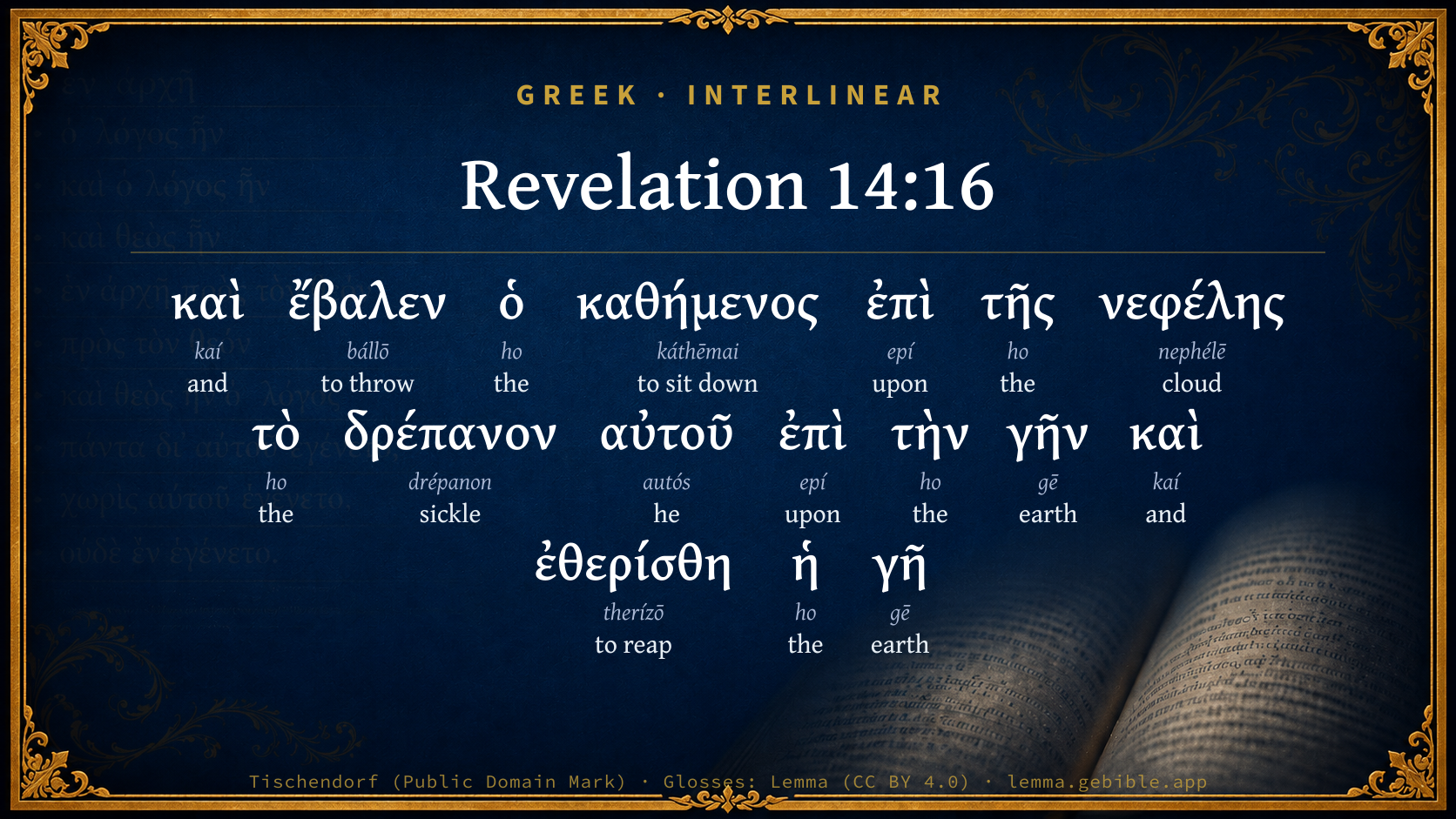
Greek (Tischendorf 8th ed.) Revelation 14:16 appears in the Greek New Testament. The text above is from the Tischendorf 8th edition. Each word links to its Strong’s number and a concise gloss. Click any word for its full Thayer’s Greek Lexicon entry.
Download image
Cite this verse

Revelation 14:16 (World English Bible). Public Domain. Lemma interlinear Bible study tool, https://lemma.gebible.app/v/revelation/14/16.

Show BibTeX & RIS
BibTeX
RIS
English Translation
He who sat on the cloud thrust his sickle on the earth, and the earth was reaped.
World English Bible · Public Domain
Download a study sheet

One document with this verse’s original text, its word-by-word gloss line, the meaning frame, cross-references with their text, attributed commentary, and full source and license credits — printable, and it pastes into notes with its structure intact.

This verse Autodidact and up

Study sheet (.html) Plain text (.txt)

A passage Seminary Student

Up to 50 verses in one chapter. A passage sheet keeps up to 6 commentary sources and 12 cross-references per verse, in the order this page ranks them, and says so on the sheet whenever that leaves anything out. Ask for a single verse and you get the Autodidact verse sheet above.

Everything on this page stays free to read, with no account — the sheet is a download of what is already on screen, not access to it.

Want to remove ads? Support Godless Engineer
Compare translations 3

The same verse in 3 English versions, stacked beneath the original-language interlinear above. Click any original word for its lexicon entry.

Each is an independent rendering of the whole verse — the interlinear is not word-aligned to these translations.

Highlighted words mark where these versions differ — a whole-verse word diff, not a word-by-word alignment.

  • World English Bible Public Domain
    He who sat on the cloud thrust his sickle on the earth, and the earth was reaped.
  • King James Version Public Domain
    And he that sat on the cloud thrust in his sickle on the earth; and the earth was reaped.
  • unfoldingWord Literal Text CC BY-SA 4.0
    And the one sitting on the cloud swung his sickle upon the earth, and the earth was harvested.

unfoldingWord Literal Text — © unfoldingWord, licensed CC BY-SA 4.0. Word-aligned USFM3 via Door43 (git.door43.org/unfoldingWord/en_ult).

Versions to compare (up to 4)

3 of 4 selected

Show all 19 translations

Every available English version of this verse, each an independent rendering of the whole verse.

  • World English Bible Public Domain
    He who sat on the cloud thrust his sickle on the earth, and the earth was reaped.
  • Berean Standard Bible Public Domain
    So the One seated on the cloud swung His sickle over the earth, and the earth was harvested.
  • Majority Standard Bible Public Domain
    So the One seated on the cloud swung His sickle over the earth, and the earth was harvested.
  • King James Version Public Domain
    And he that sat on the cloud thrust in his sickle on the earth; and the earth was reaped.
  • American Standard Version (1901) Public Domain
    And he that sat on the cloud cast his sickle upon the earth; and the earth was reaped.
  • Revised Version (1885) Public Domain
    And he that sat on the cloud cast his sickle upon the earth; and the earth was reaped.
  • Geneva Bible (1599) Public Domain
    And he that sate on the cloude, thrust in his sickle on the earth, and the earth was reaped.
  • Douay-Rheims (1899) Public Domain
    And he that sat on the cloud thrust his sickle into the earth, and the earth was reaped.
  • Young's Literal Translation Public Domain
    and he who is sitting upon the cloud did put forth his sickle upon the earth, and the earth was reaped.
  • Literal Standard Version CC BY-SA 4.0
    and He who is sitting on the cloud put forth His sickle on the earth, and the earth was reaped.
  • Unlocked Literal Bible CC BY-SA 4.0
    Then the one who was sitting on the cloud swung his sickle over the earth, and the earth was harvested.
  • unfoldingWord Literal Text CC BY-SA 4.0
    And the one sitting on the cloud swung his sickle upon the earth, and the earth was harvested.
  • Darby Bible Public Domain
    And he that sat on the cloud put his sickle on the earth, and the earth was reaped.
  • World Messianic Bible Public Domain
    He who sat on the cloud thrust his sickle on the earth, and the earth was reaped.
  • Webster's Bible Public Domain
    And he that sat on the cloud thrust in his sickle on the earth; and the earth was reaped.
  • Free Bible Version CC BY-SA 4.0
    The one sitting on the cloud swung his sickle towards the earth, and reaped earth's harvest.
  • Bible in Basic English Public Domain
    And he who was seated on the cloud sent in his blade on the earth; and the grain of the earth was cut.
  • Text-Critical English NT CC BY 4.0
    So he who was sitting on the cloud swung his sickle over the earth, and the earth was reaped.
  • Tyndale New Testament (1534) Public Domain
    And he that sate on the clowde thrust in his sykle on the erth and the erth was reped.

Literal Standard Version (2020), Covenant Press — licensed CC BY-SA 4.0. Text via the HelloAO Bible API (eBible.org). Unlocked Literal Bible (unfoldingWord) — licensed CC BY-SA 4.0. Text via the HelloAO Bible API (eBible.org). unfoldingWord Literal Text — © unfoldingWord, licensed CC BY-SA 4.0. Word-aligned USFM3 via Door43 (git.door43.org/unfoldingWord/en_ult). Free Bible Version, Dr. Jonathan Gallagher — licensed CC BY-SA 4.0. Text via the HelloAO Bible API (eBible.org).

Word by word

More ways to search: Search by grammar → Find every occurrence → Compare this word →

Practice this passage: Drill this verse → Learn its vocabulary →

δρέπανον
drépanon
G1407
“sickle”
Noun, Accusative, Singular, Neuter
Part of Speech
Noun
Case
Accusative
Number
Singular
Gender
Neuter
Full Thayer's Definition

Origin: from drepo (to pluck)

TDNT: None

1. a sickle, a pruning-hook, a hooked vine knife, such as reapers and vinedressers use
  1. καὶ kaí G2532 “and” Conjunction
  2. ἔβαλεν bállō G906 “to throw” Verb, Aorist, Active, Indicative, 3rd person, Singular
  3. ὁ ho G3588 “the” Article, Nominative, Singular, Masculine
  4. καθήμενος káthēmai G2521 “to sit down” Verb, Present, Middle or Passive deponent, Participle, Nominative, Singular, Masculine
  5. ἐπὶ epí G1909 “upon” Preposition
  6. τῆς ho G3588 “the” Article, Genitive, Singular, Feminine
  7. νεφέλης nephélē G3507 “cloud” Noun, Genitive, Singular, Feminine
  8. τὸ ho G3588 “the” Article, Accusative, Singular, Neuter
  9. αὐτοῦ autós G846 “he” Personal pronoun, Genitive, Singular, Masculine
  10. ἐπὶ epí G1909 “upon” Preposition
  11. τὴν ho G3588 “the” Article, Accusative, Singular, Feminine
  12. γῆν gē G1093 “earth” Noun, Accusative, Singular, Feminine
  13. καὶ kaí G2532 “and” Conjunction
  14. ἐθερίσθη therízō G2325 “to reap” Verb, Aorist, Passive, Indicative, 3rd person, Singular
  15. ἡ ho G3588 “the” Article, Nominative, Singular, Feminine
  16. γῆ gē G1093 “earth” Noun, Nominative, Singular, Feminine

About this verse

These counts appear in no published source. They are computed here, from the morphology-tagged text and Lemma’s own curated glosses. What Lemma adds →

17
words
10
distinct lemmas
Revelation
section

Notable vocabulary

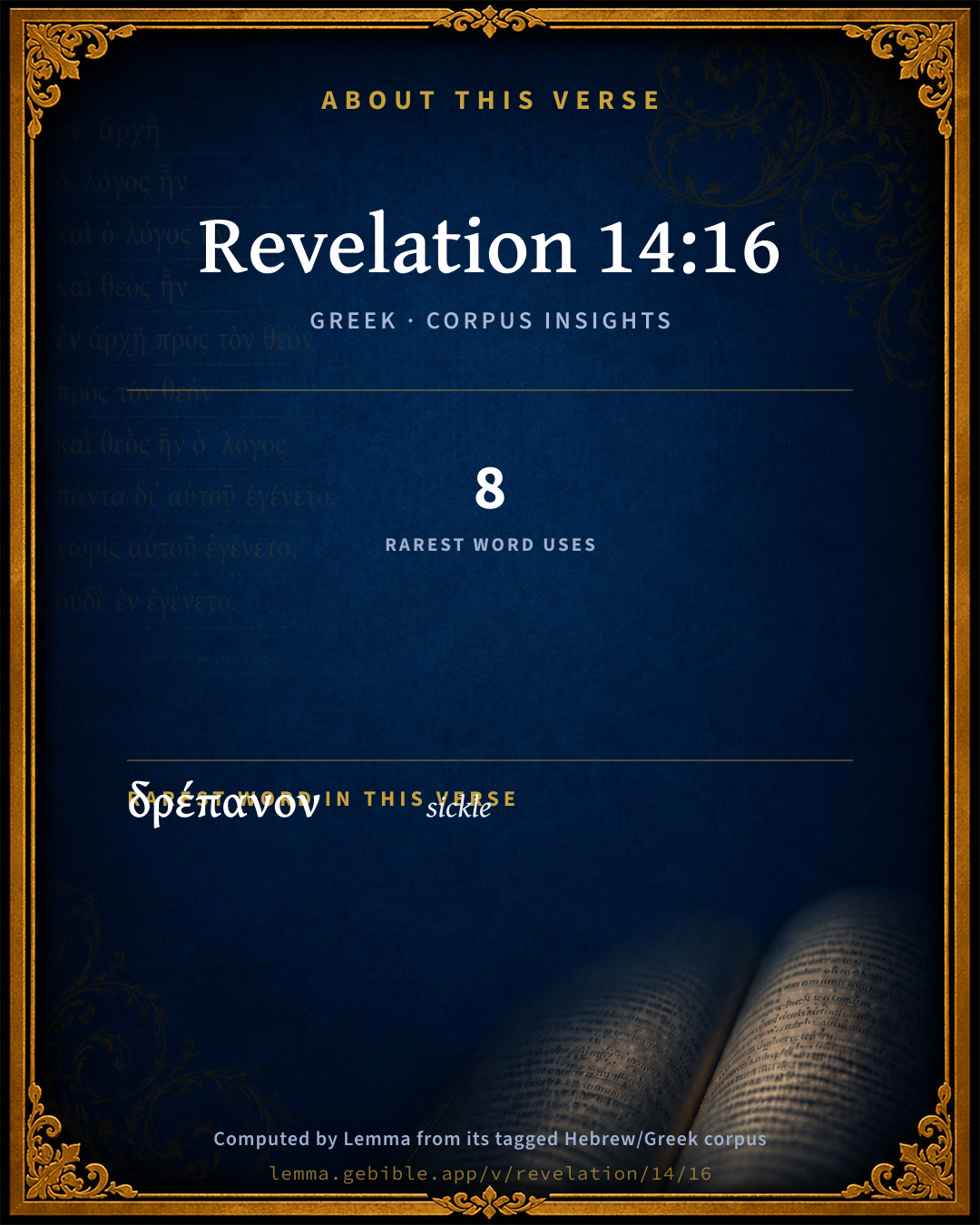
The rarest word here is δρέπανον sickle G1407 — appearing just 8 times in the whole Greek New Testament.

Shared distinctive vocabulary

δρέπανον sickle G1407 occurs in 7 verses of the Greek New Testament. Also found in:

Repetition

Words recur within this verse:

Cross-references

5

Topical passages linked to Revelation 14:16 in the Treasury of Scripture Knowledge — connected by theme and wording, ordered by reader-vote popularity; previews shown in the World English Bible.

  • Matthew 16:27 For the Son of Man will come in the glory of his Father with his angels, and then he will render to everyone according to his deeds.
  • Revelation 14:14 I looked, and behold, a white cloud; and on the cloud one sitting like a son of man, having on his head a golden crown, and in his hand a sharp sickle.
  • Revelation 14:19 The angel thrust his sickle into the earth, and gathered the vintage of the earth, and threw it into the great winepress of the wrath of God.
  • Revelation 16:1–21 I heard a loud voice out of the temple, saying to the seven angels, "Go and pour out the seven bowls of the wrath of God on the earth!"
  • John 5:22–23 For the Father judges no one, but he has given all judgment to the Son,

Cross-references courtesy of OpenBible.info (CC BY 4.0).

Commentary

Notes on Revelation 14:16 from classic Christian and Jewish commentators (each source and its license shown beneath its notes). The classic Christian expositions comment on the surrounding passage and are grouped to its opening verse, so a note may address several verses; the Jewish commentaries on the Tanakh (Rashi and others) are per-verse, so they appear only where the commentator wrote on this verse.

Lemma curates 59 commentaries, every one of them public domain or Creative Commons licensed, each selected and text-cleaned for this edition rather than reprinted as found. About our sources →

Expositor's Greek Testament

ed. W. Robertson Nicoll

Rev 14:16 . The δρέπανον (only here, Rev 14:14-19 , in Apocalypse; cf. C. B. P. ii. 652 f. for a Phrygian inscription καὶ τὸ ἀρᾶς δρέπανον εὶς τὸν ὗκον αὐτοῦ ) is represented as a living thing, probably like the δρέπανον πετὸμενον of Zec 5:1 (Wellhausen). The classical use of reaping to symbolise death and destruction is too common to need illustration. “The harvest of the earth is ripe and dry,” but this ripeness of paganism for judgment (Jer 51:33 ) is re-stated dramatically (Rev 14:17-20 ) in a parallel O.T. symbol from the wine-press. The angelic mise-en-scène recalls that of Rev 8:3-5 . Unlike the harvest-symbol, the vintage-symbol is worked out vividly ( cf. Gen 49:11 ; Isa 63:1 f.).

The Expositor's Greek Testament, edited by W. Robertson Nicoll (1897–1910) — public domain. Text from a community e-Sword module.

Jamieson, Fausset & Brown

Robert Jamieson, A. R. Fausset & David Brown

thrust in--Greek, "cast."

Jamieson, Fausset & Brown — Commentary Critical and Explanatory on the Whole Bible (1871) — public domain (CC PDM 1.0). Text via the HelloAO Bible API.

Adam Clarke's Commentary

Verse 16. The earth was reaped.] The judgments were executed. But where, or on whom, who can tell?

Adam Clarke's Commentary on the Bible (1810–1826) — public domain. Text from a community e-Sword/MySword module.

The Cambridge Bible for Schools and Colleges

gen. ed. J. J. S. Perowne

16. thrust in] Lit. cast: but the word is used in much milder senses, e.g. of the Lord “putting” His fingers in the deaf man’s ears, St Mar_7:33. The A. V. can therefore be defended: but it is perhaps likelier, that He Who sat on the cloud threw down the sickle, for others (unnamed angels) to reap with.

the earth was reaped] Comparing the parables in SS. Matthew and Mark, there is little doubt that the gathering of the harvest indicates the gathering of the Elect. In Jer_51:33, it is true, the image of harvest is used of the time of God’s vengeance, and so Joe_3:13, where, as here, it is combined with that of the vintage. But it would be pointless to have the two images successively worked out, if they meant exactly the same: while the vengeance of the other image is clearly defined in Rev_14:19-20, and there is nothing (like the threshing of Jer., l.c.) to indicate it here.

The Cambridge Bible for Schools and Colleges (gen. ed. J. J. S. Perowne; Cambridge University Press, 1878–1918) — public domain. Text from a community e-Sword module.

John Gill's Exposition

And he that sat on the cloud thrust in his sickle on the earth,.... He put forth, and made use of that power which he had in his hand, in answer to the entreaty of the angel, the time being fully come which was fixed for this great event:

and the earth was reaped; and the harvest of it was got in; reaping and harvest sometimes are used in an ill sense, and design the wrath of God, and his judgments inflicted upon men; see Isa 17:5. Hence some think, that both this and the vintage following intend the judgments of God upon antichrist, and that they are contemporary with the pouring out of the fifth and sixth vials upon the beast and his followers; and the rather, since the destruction of Babylon, literally taken, is expressed in such language, Jer 51:33 though these seem to have respect to times after the fall of the Romish Babylon, before declared in Rev 14:8 and most interpreters refer the harvest to the last judgment at the end of the world; and which sense is greatly countenanced, and to be illustrated by the parable of the tares and wheat, in Mat 13:30 sometimes these phrases are used in a good sense, and intend the gathering in of souls by the preaching of the Gospel; as there are the appointed weeks of the harvest, so there is a time fixed for the calling and conversion of God's elect; and when this time is come, and especially to any number of them in any particular place, it is an harvest, as in Galilee and Samaria in the times of Christ, Mat 9:37 the reapers are the ministers of the Gospel; such were the apostles of Christ, Joh 4:36 and the sickle is the Gospel, by which not only men are cut to the heart, and cut down, and removed from their old bottom, and principles and practices, but are gathered to Christ, and into his churches; and when large numbers are brought in, it is an harvest time, as in the times of Christ and his apostles; see Isa 9:1 hence some interpreters think that the harvest here has respect to the Reformation, which followed upon the preaching of Luther, Calvin, and others, when a large harvest of souls were gathered in, in Germany, France, England, and elsewhere; but rather it may be thought to refer to the conversion of the Jews, and the bringing in the fulness of the Gentiles in the latter day, in the spiritual reign of Christ, to which the preceding visions belong, as we have seen; the earth will be reaped indeed, and a great harvest it will be, when a nation shall be born at once, and the vast multitudes of the Gentiles shall be brought in, as in Isa 66:8 and the rather this may be judged to be the meaning of it, since the passage from whence these phrases are borrowed respects the bringing again the captivity of Judah and Jerusalem, Joe 3:1 though it seems best to understand it of the Lord's wheat harvest at the end of the world, when the wheat of the earth shall be reaped, and gathered into Christ's barn, or garner, or into his and his Father's kingdom; this reaping of the earth is the removing of the saints out of it, not by death, but by the resurrection of them from the dead; for when Christ shall come in the clouds of heaven, and sit on the white cloud, or throne, the dead in him will rise first, and the living saints will be changed, and both will be caught up together, to meet the Lord in the air; so that the earth will be reaped, and be clear of them, and there will be none left in it but the wicked of the world; and what will become of them is declared in the following verses, under the representation of a vintage.

John Gill's Exposition of the Whole Bible (1746–1763) — public domain (CC PDM 1.0). Text via the HelloAO Bible API.

Trapp's Complete Commentary

John Trapp

16 And he that sat on the cloud thrust in his sickle on the earth; and the earth was reaped.

Ver. 16. And he that sat on the cloud] That is, Christ, who soon condescendeth to the suits of his servants. Iste vir potuit quod voluit, said one concerning Luther. The death of Arius was precationis opus, non morbi, the fruit of prayer, rather than the effect of his disease, saith another. He was brought to confusion by the prayers of Alexander, the good bishop of Constantinople.

John Trapp, A Commentary or Exposition upon All the Books of the Old and New Testament (1647–1656) — public domain. Text from a community e-Sword module.

Albert Barnes' Notes on the Bible

And he that sat on the cloud - The Saviour, Rev 14:14.

Thrust in his sickle on the earth - To cut down the harvest - that is, to gather his people to himself.

And the earth was reaped - So far as the righteous were concerned. The end had come; the church was redeemed; the work contemplated was accomplished; and the results of the work of the Saviour were like a glorious harvest.

Albert Barnes' Notes on the Bible (1834–1885) — public domain. Text from a community e-Sword/MySword module.

Matthew Poole's English Annotations

According to the before mentioned different notion of the harvest, there is amongst them a different interpretation of this verse; some interpreting it of God’s calling in the Jews, or his elect, by the preaching of the gospel; others, of his vengeance upon antichrist and his adherents, more fully expressed, Rev 15:1-16:21.

Matthew Poole's English Annotations on the Holy Bible (1683–1685) — public domain. Text from a community e-Sword/MySword module.

The Pulpit Commentary

And he that sat on the cloud thrust in his sickle on the earth; and the earth was reaped. "Cast his sickle;" not the same verb as that in ver. 15, but which, nevertheless, has the same signification. (cf. the use of this verb in Joh_20:25, Joh_20:27) There are two gatherings described in this place:

(1) the harvest of the earth by the Son of man;

(2) the gathering of the vintage by the angel.

On the whole, it seems probable that the first refers to the selection by Christ of the faithful at the end of the world, while the secured describes the ingathering of the wicked for punishment immediately afterwards. This agrees with the general tenor of the whole chapter, viz, a portrayal of the opposite fates in store for the faithful and the wicked. The description thus corresponds with the account of the end of the world given in Re 7, with which chapter this one has so much in common (see on the first verses of the present chapter). In Re 7 the saints are first selected and sealed, before the wicked meet their doom. Thus, also, the judgment is described by our Lord in his parables of the wheat and the tares, and the sheep and the goats. This accounts also for the first gathering being presided over by the Son of man, while the second is conducted by an angel. The punishment in connection with the vintage seems to distinguish it from the first harvest. This also corresponds to the announcements of the former angels, who first preach the everlasting gospel, and afterwards denounce those who serve the beast (vers. 6-11).

The Pulpit Commentary (1880–1919), ed. H.D.M. Spence-Jones & Joseph S. Exell — public domain. Text from a community e-Sword module.

John Wesley's Explanatory Notes

Crying - By the command of God. Thrust in thy sickle, for the harvest is ripe - This implies an high degree of holiness in those good men, and an earnest desire to be with God.

John Wesley, Explanatory Notes Upon the Whole Bible (1754–1765) — public domain. Text via the GEBible commentary corpus.

Burkitt's Expository Notes on the New Testament

William Burkitt

In the sixteenth verse we have observable,

1. Christ’s ready answering of, and complying with, the desire of his people, to thrust in the sickle of his judgment, and reap the earth: he that sat on the cloud did thrust in his sickle. How ready is Christ to fulfill the desires of them that fear him, to hear their cry and help them in his own time, in the best and fittest season!

Observe, 2. The great and infinite power of our Lord Jesus Christ, that upon the thrusting in of his sickle, the whole earth was presently reaped. Behold the ability of Christ for judgment, as well as his impartiality in judging: such a Judge is he, as the power of the mightiest cannot daunt; such a Judge, as the riches of the wealthiest cannot bribe; such a Judge, as the subtilty of the wisest cannot deceive; in a word, such a Judge, as there is no appealing from, no repealing of, his sentence.

O great day; when the stiffest knee shall bow at the tribunal of Christ, and the strongest back shall bend under the insupportable burden of the wrath of the Lamb; when the Alexanders and Caesars, which once shook the earth, and caused the world to tremble, shall revere and lie prostrate at the foot of Christ! Behold then, and admire the wonderful power and dexterity of Christ in judging, that upon the thrusting in of his sickle the whole earth was presently reaped!

William Burkitt's Expository Notes on the New Testament (1700–1703) — public domain. Text from a community e-Sword module.

The People's New Testament

B. W. Johnson

16. The earth was reaped. The harvest of souls is ended forever. But those who are upon the earth “shall not prevent them that are asleep.” At the voice of the archangel the dead shall wake from their long sleep in the embrace of earth. Death shall be swallowed up in victory. “Blessed henceforth forever are the dead who died in the Lord. Yea, saith the Spirit, they do not rest from their labors and their works do follow them.”

B. W. Johnson's The People's New Testament with Notes (1889–1891) — public domain. Electronic text from the Christian Classics Ethereal Library (CCEL) ThML edition.

Cambridge Greek Testament for Schools and Colleges

16. ἐθερίσθη ἡ γῆ. Cod. flor[491] demensus est terram.

[491] flor. Codex Toletanus 10th century at Madrid.

16. ἔβαλεν. Lit. “cast”: but the word is used in much milder senses, e.g. of the Lord “putting” His fingers in the deaf man’s ears, St Mar 7:33. The A.V[500] rendering “thrust” can therefore be defended: but it is also possible that He Who sat on the cloud threw down the sickle, for others (unnamed angels) to reap with.

[500] Authorised Version.

ἐθερίσθη ἡ γῆ. Comparing the parables in SS. Matthew and Mark there is little doubt that the gathering the harvest indicates or includes the gathering of the Elect. In Jer 51:33, it is true, the image of harvest is used of the time of God’s vengeance, and so Joe 3:13, where, as here, it is combined with that of the vintage. But it would be pointless to have the two images successively worked out, if they meant exactly the same: while the vengeance of the other image is clearly defined in Rev 14:19-20, and there is nothing (like the threshing of Jer., l.c.) to indicate it here.

Cambridge Greek Testament for Schools and Colleges (Cambridge University Press, 1896; 21 vols, various authors incl. Carr, Maclear, Plummer, Farrar, Lumby, Moule, M. R. James, Simcox) — public domain. Text from a community e-Sword module.

Vincent's Word Studies in the New Testament

Marvin R. Vincent

Thrust in [εβαλεν] . Lit., cast.

Marvin R. Vincent, Word Studies in the New Testament (1887–1900) — public domain. Text from a community e-Sword/MySword module.

Lesson kit

Teaching starters — assembled from the data on this page, not authored interpretation. Every prompt links to the verse data it draws on. Edit before teaching.

Revelation, in the Revelation, opens this verse with 17 words (10 distinct Greek lemmas). Its most distinctive word is drépanon (“sickle”). A historical commentator’s framing appears above. Read the whole chapter for the surrounding context.

Discussion questions

  1. What does “sickle” (drépanon) contribute to the verse as a whole?
  2. How does Mark 4:29, which shares the word «sickle», read alongside this verse?
  3. What does the repetition of “upon” (2× in this one verse) do in this verse?
  4. These translations render this verse differently; the difference is in the English rendering, not the original. What questions does that raise?
  5. Compare how Expositor's Greek Testament and Jamieson, Fausset & Brown read this verse. Where do they agree or differ?

Things to notice

  • These translations choose different wording for 9 words in this verse.
  • “upon” occurs 2× in this single verse.
  • 10 distinct Greek lemmas span 17 words in this verse.

Reading settings

Reading text

Shown beneath each verse's original-language words.

Old Testament
Old Testament edition

Read the OT as the Masoretic Hebrew (MT) or the Greek Septuagint (LXX).

English shown for the Greek Septuagint (in the Hebrew ↔ Greek comparison).

Comparing translations? Open the Compare panel on any verse page to stack up to four side by side.