Mark 14:35

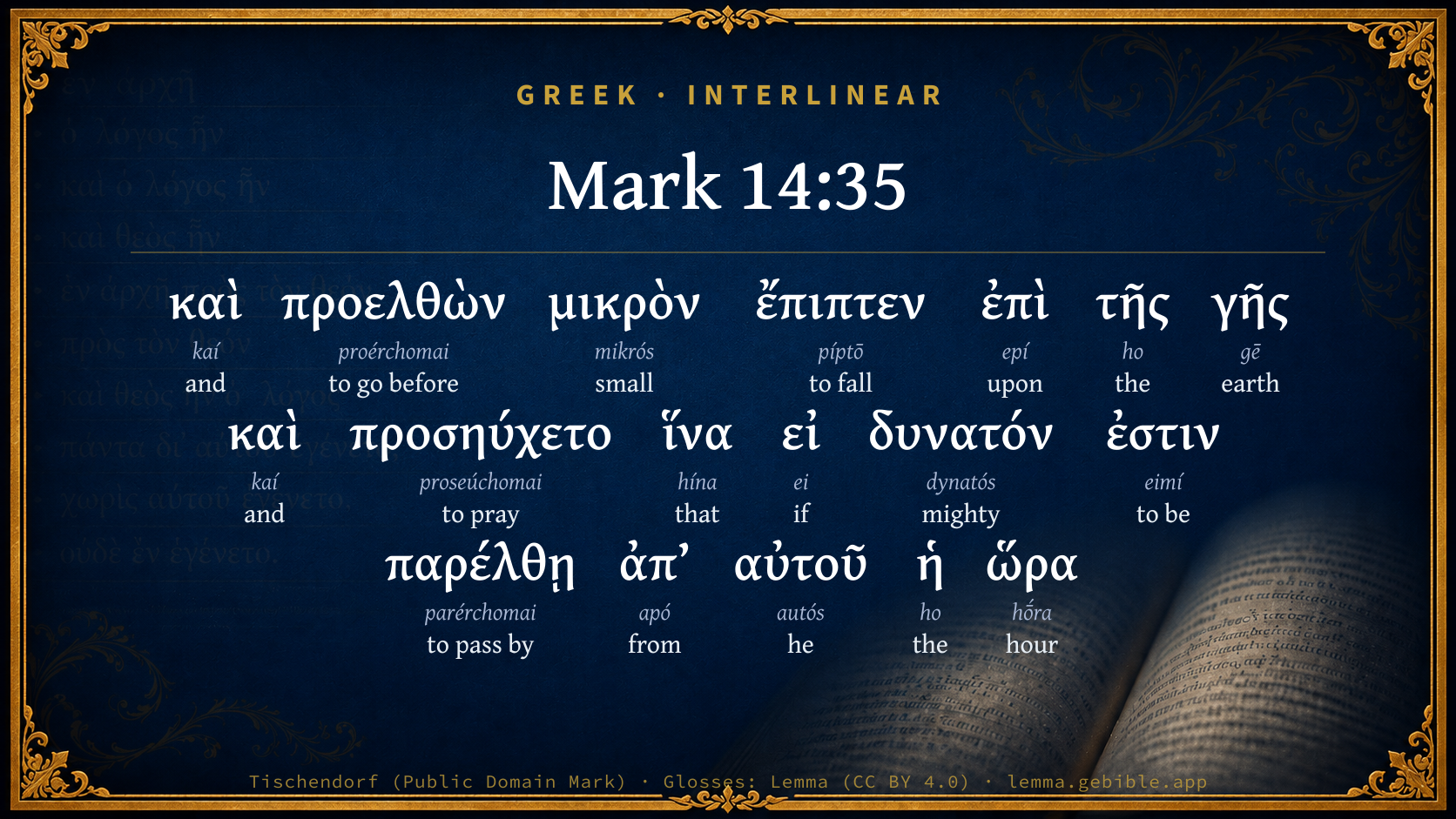
Greek (Tischendorf 8th ed.) Mark 14:35 appears in the Greek New Testament. The text above is from the Tischendorf 8th edition. Each word links to its Strong’s number and a concise gloss. Click any word for its full Thayer’s Greek Lexicon entry.
Download image
Cite this verse

Mark 14:35 (World English Bible). Public Domain. Lemma interlinear Bible study tool, https://lemma.gebible.app/v/mark/14/35.

Show BibTeX & RIS
BibTeX
RIS
English Translation
He went forward a little, and fell on the ground, and prayed that, if it were possible, the hour might pass away from him.
World English Bible · Public Domain
Download a study sheet

One document with this verse’s original text, its word-by-word gloss line, the meaning frame, cross-references with their text, attributed commentary, and full source and license credits — printable, and it pastes into notes with its structure intact.

This verse Autodidact and up

Study sheet (.html) Plain text (.txt)

A passage Seminary Student

Up to 50 verses in one chapter. A passage sheet keeps up to 6 commentary sources and 12 cross-references per verse, in the order this page ranks them, and says so on the sheet whenever that leaves anything out. Ask for a single verse and you get the Autodidact verse sheet above.

Everything on this page stays free to read, with no account — the sheet is a download of what is already on screen, not access to it.

Want to remove ads? Support Godless Engineer
Compare translations 3

The same verse in 3 English versions, stacked beneath the original-language interlinear above. Click any original word for its lexicon entry.

Each is an independent rendering of the whole verse — the interlinear is not word-aligned to these translations.

Highlighted words mark where these versions differ — a whole-verse word diff, not a word-by-word alignment.

  • World English Bible Public Domain
    He went forward a little, and fell on the ground, and prayed that, if it were possible, the hour might pass away from him.
  • King James Version Public Domain
    And he went forward a little, and fell on the ground, and prayed that, if it were possible, the hour might pass from him.
  • unfoldingWord Literal Text CC BY-SA 4.0
    And having gone a little farther, he fell to the ground and was praying that, if it is possible, the hour might pass from him.

unfoldingWord Literal Text — © unfoldingWord, licensed CC BY-SA 4.0. Word-aligned USFM3 via Door43 (git.door43.org/unfoldingWord/en_ult).

Versions to compare (up to 4)

3 of 4 selected

Show all 19 translations

Every available English version of this verse, each an independent rendering of the whole verse.

  • World English Bible Public Domain
    He went forward a little, and fell on the ground, and prayed that, if it were possible, the hour might pass away from him.
  • Berean Standard Bible Public Domain
    Going a little farther, He fell to the ground and prayed that, if it were possible, the hour would pass from Him.
  • Majority Standard Bible Public Domain
    Going a little farther, He fell to the ground and prayed that, if it were possible, the hour would pass from Him.
  • King James Version Public Domain
    And he went forward a little, and fell on the ground, and prayed that, if it were possible, the hour might pass from him.
  • American Standard Version (1901) Public Domain
    And he went forward a little, and fell on the ground, and prayed that, if it were possible, the hour might pass away from him.
  • Revised Version (1885) Public Domain
    And he went forward a little, and fell on the ground, and prayed that, if it were possible, the hour might pass away from him.
  • Geneva Bible (1599) Public Domain
    So he went forward a litle, and fell downe on the ground, and praied, that if it were possible, that houre might passe from him.
  • Douay-Rheims (1899) Public Domain
    And when he was gone forward a little, he fell flat on the ground; and he prayed, that if it might be, the hour might pass from him.
  • Young's Literal Translation Public Domain
    And having gone forward a little, he fell upon the earth, and was praying, that, if it be possible the hour may pass from him,
  • Literal Standard Version CC BY-SA 4.0
    And having gone forward a little, He fell on the earth, and was praying that, if it be possible, the hour may pass from Him,
  • Unlocked Literal Bible CC BY-SA 4.0
    Going a little farther, Jesus fell to the ground and prayed that if it were possible the hour might pass from him.
  • unfoldingWord Literal Text CC BY-SA 4.0
    And having gone a little farther, he fell to the ground and was praying that, if it is possible, the hour might pass from him.
  • Darby Bible Public Domain
    And, going forward a little, he fell upon the earth; and he prayed that, if it were possible, the hour might pass away from him.
  • World Messianic Bible Public Domain
    He went forward a little, and fell on the ground, and prayed that if it were possible, the hour might pass away from him.
  • Webster's Bible Public Domain
    And he went forward a little, and fell on the ground, and prayed that, If it were possible, the hour might pass from him.
  • Free Bible Version CC BY-SA 4.0
    He went a little farther on and then fell to the ground. He prayed, asking to be spared the time that was coming, if it were possible.
  • Bible in Basic English Public Domain
    And he went forward a little, and falling down on the earth, made request that, if possible, the hour might go from him.
  • Text-Critical English NT CC BY 4.0
    Going a little farther, he fell on the ground and prayed that, if it were possible, the hour might pass from him.
  • Tyndale New Testament (1534) Public Domain
    And he went forth a lytle and fell doune on the grounde and prayed: that yf it were possible the houre myght passe from him.

Literal Standard Version (2020), Covenant Press — licensed CC BY-SA 4.0. Text via the HelloAO Bible API (eBible.org). Unlocked Literal Bible (unfoldingWord) — licensed CC BY-SA 4.0. Text via the HelloAO Bible API (eBible.org). unfoldingWord Literal Text — © unfoldingWord, licensed CC BY-SA 4.0. Word-aligned USFM3 via Door43 (git.door43.org/unfoldingWord/en_ult). Free Bible Version, Dr. Jonathan Gallagher — licensed CC BY-SA 4.0. Text via the HelloAO Bible API (eBible.org).

Word by word

More ways to search: Search by grammar → Find every occurrence → Compare this word →

Practice this passage: Drill this verse → Learn its vocabulary →

προελθὼν
proérchomai
G4281
“to go before”
Verb, Aorist, Active, Participle, Nominative, Singular, Masculine
Part of Speech
Verb
Tense
Aorist
Voice
Active
Mood
Participle
Case
Nominative
Number
Singular
Gender
Masculine
Full Thayer's Definition

Origin: from G4253 and G2064 (including its alternate)

TDNT: None

1. to go forward, go on 2. to go before a. to go before, precede b. to go before, in the advance of another
  1. καὶ kaí G2532 “and” Conjunction
  2. μικρὸν mikrós G3398 “small” Adjective, Accusative, Singular, Neuter
  3. ἔπιπτεν píptō G4098 “to fall” Verb, Imperfect, Active, Indicative, 3rd person, Singular
  4. ἐπὶ epí G1909 “upon” Preposition
  5. τῆς ho G3588 “the” Article, Genitive, Singular, Feminine
  6. γῆς gē G1093 “earth” Noun, Genitive, Singular, Feminine
  7. καὶ kaí G2532 “and” Conjunction
  8. προσηύχετο proseúchomai G4336 “to pray” Verb, Imperfect, Middle or Passive deponent, Indicative, 3rd person, Singular
  9. ἵνα hína G2443 “that” Conjunction
  10. εἰ ei G1487 “if” Conditional
  11. δυνατόν dynatós G1415 “mighty” Adjective, Nominative, Singular, Neuter
  12. ἐστιν eimí G1510 “to be” Verb, Present, Active, Indicative, 3rd person, Singular
  13. παρέλθῃ parérchomai G3928 “to pass by” Verb, Aorist, Active, Subjunctive, 3rd person, Singular
  14. ἀπ’ apó G575 “from” Preposition
  15. αὐτοῦ autós G846 “he” Personal pronoun, Genitive, Singular, Masculine
  16. ἡ ho G3588 “the” Article, Nominative, Singular, Feminine
  17. ὥρα hṓra G5610 “hour” Noun, Nominative, Singular, Feminine

About this verse

These counts appear in no published source. They are computed here, from the morphology-tagged text and Lemma’s own curated glosses. What Lemma adds →

18
words
16
distinct lemmas
Gospels
section

Notable vocabulary

The rarest word here is προελθὼν to go before G4281 — appearing just 8 times in the whole Greek New Testament.

Shared distinctive vocabulary

προελθὼν to go before G4281 occurs in 8 verses of the Greek New Testament. Also found in:

Repetition

Words recur within this verse:

Cross-references

11

Topical passages linked to Mark 14:35 in the Treasury of Scripture Knowledge — connected by theme and wording, ordered by reader-vote popularity; previews shown in the World English Bible.

  • Mark 14:41 He came the third time, and said to them, "Sleep on now, and take your rest. It is enough. The hour has come. Behold, the Son of Man is betrayed into the hands of sinners.
  • Genesis 17:3 Abram fell on his face. God talked with him, saying,
  • Deuteronomy 9:18 I fell down before Yahweh, as at the first, forty days and forty nights; I did neither eat bread nor drink water; because of all your sin which you sinned, in doing that which was evil in the sight of Yahweh, to provoke him to anger.
  • Matthew 26:39 He went forward a little, fell on his face, and prayed, saying, "My Father, if it is possible, let this cup pass away from me; nevertheless, not what I desire, but what you desire."
  • Acts 10:25–26 When it happened that Peter entered, Cornelius met him, fell down at his feet, and worshiped him.
  • Hebrews 5:7 He, in the days of his flesh, having offered up prayers and petitions with strong crying and tears to him who was able to save him from death, and having been heard for his godly fear,
  • 2 Chronicles 7:3 All the children of Israel looked on, when the fire came down, and the glory of Yahweh was on the house; and they bowed themselves with their faces to the ground on the pavement, and worshiped, and gave thanks to Yahweh, [saying], For he is good; for his loving kindness endures for ever.
  • Revelation 4:10 the twenty-four elders fall down before him who sits on the throne, and worship him who lives forever and ever, and throw their crowns before the throne, saying,
  • 1 Chronicles 21:15–16 God sent an angel to Jerusalem to destroy it: and as he was about to destroy, Yahweh saw, and he repented him of the evil, and said to the destroying angel, It is enough; now stay your hand. The angel of Yahweh was standing by the threshing floor of Ornan the Jebusite.
  • Luke 17:15–16 One of them, when he saw that he was healed, turned back, glorifying God with a loud voice.
  • Revelation 5:14 The four living creatures said, "Amen!" The elders fell down and worshiped.

Cross-references courtesy of OpenBible.info (CC BY 4.0).

Commentary

Notes on Mark 14:35 from classic Christian and Jewish commentators (each source and its license shown beneath its notes). The classic Christian expositions comment on the surrounding passage and are grouped to its opening verse, so a note may address several verses; the Jewish commentaries on the Tanakh (Rashi and others) are per-verse, so they appear only where the commentator wrote on this verse.

Lemma curates 59 commentaries, every one of them public domain or Creative Commons licensed, each selected and text-cleaned for this edition rather than reprinted as found. About our sources →

Tyndale Open Study Notes

Tyndale Open Resources

14:35-36 Jesus fell to the ground to pray because of his deep distress (see Gen 17:1-3; Lev 9:24; Num 14:5; 16:4). Since it was normal to pray out loud, Jesus’ prayer was probably overheard by the three disciples, who would not have fallen asleep immediately. • Jesus addressed God as Abba, Father, indicating their close relationship (see Rom 8:15; Gal 4:6). • Please take this cup . . . from me: In faith, Jesus expressed his own feelings and desires to the Father. It was not only the physical agony of crucifixion that terrified him, but also the unique death that he would experience. He who knew no sin would experience the wrath of God against sin (Mark 15:34; 2 Cor 5:21; Gal 3:13). • Yet I want your will to be done, not mine: Jesus’ submission to the Father’s will is a model for his followers.

Tyndale Open Study Notes — © Tyndale Open Resources, licensed CC BY-SA 4.0. Text via the HelloAO Bible API.

Expositor's Greek Testament

ed. W. Robertson Nicoll

Mar 14:35 . ἔπιπτεν ( [130] [131] [132] , ἔπεσεν T.R. as in Mt.), imperfect: He fell again and again on the ground. It was a protracted desperate struggle. καὶ προσηύχετο ἵνα : Mk. first indicates the gist of Christ’s prayers (= that if possible the hour might pass from Him), then reports what Jesus said (Mar 14:36 ). In the prayer of Jesus the experience dreaded is called the cup , as in Mt. The Hour and the Cup both alike solemn, suggestive names.

[130] Codex Sinaiticus (sæc. iv.), now at St. Petersburg, published in facsimile type by its discoverer, Tischendorf, in 1862.

[131] Codex Vaticanus (sæc. iv.), published in photographic facsimile in 1889 under the care of the Abbate Cozza-Luzi.

[132] Codex Regius--eighth century, represents an ancient text, and is often in agreement with א and B.

The Expositor's Greek Testament, edited by W. Robertson Nicoll (1897–1910) — public domain. Text from a community e-Sword module.

The Cambridge Bible for Schools and Colleges

gen. ed. J. J. S. Perowne

35. forward a little] “about a stone’s throw” (Luk_22:41), perhaps out of the moonlight into the shadow of the garden.

The Cambridge Bible for Schools and Colleges (gen. ed. J. J. S. Perowne; Cambridge University Press, 1878–1918) — public domain. Text from a community e-Sword module.

John Gill's Exposition

And he said, Abba, Father,.... In the original text, the former of these is a Syriac word, and the latter a Greek one, explanative of the former, as in Rom 8:15 and Gal 4:6 or the repetition is made, to express the vehemency of his affection, and his strong confidence in God, as his Father, amidst his distress, as the Syriac version renders it, , "Abba, my Father": or "my Father, my Father"; and so the Ethiopic version:

all things are possible unto thee; so Philo the Jew (b), taking notice of Isaac's question about the burnt offering, and Abraham's answer to it, represents the latter as adding, in confirmation of it,

"all things are possible to God, and which are both difficult and impossible to be done by men;''

suggesting, that God could easily provide a lamb for a sacrifice; and Christ here intimates, that every thing consistent with his perfections, counsels, and covenant, were possible to be done by him; and how far what he prays for, was agreeable to these, he submits to him, and to his sovereign will:

take away this cup from me; nevertheless, not what I will, but what thou wilt: See Gill on Mat 26:39.

(b) De Abrahamo, p. 374.

John Gill's Exposition of the Whole Bible (1746–1763) — public domain (CC PDM 1.0). Text via the HelloAO Bible API.

The Pulpit Commentary

Ver. 35. Our Lord now separated himself, though apparently, as St. Luke (Luk_22:41) says, only "about a stone"s cast" from the three disciples, and threw himself on the ground in mortal agony, and prayed that this hour of his supreme mental anguish might, if possible, pass from him.

The Pulpit Commentary (1880–1919), ed. H.D.M. Spence-Jones & Joseph S. Exell — public domain. Text from a community e-Sword module.

Kretzmann's Popular Commentary

Paul E. Kretzmann

The agony of Christ:

v. 35. And He went forward a little, and fell on the ground, and prayed that, if it were possible, the hour might pass from Him.

v. 36. And He said, Abba, Father, all things are possible unto Thee; take away this cup from Me; nevertheless, not what I will, but what Thou wilt.

v. 37. And He cometh and findeth them sleeping, and saith unto Peter, Simon, sleepest thou? Couldest not thou watch one hour?

v. 38. Watch ye and pray lest ye enter into temptation. The spirit truly is ready, but the flesh is weak.

v. 39. And again He went away, and prayed, and spake the same words.

v. 40. And when He returned, He found them asleep again, (for their eyes were heavy,) neither wist they what to answer Him.

v. 41. And He cometh the third time and saith unto them, Sleep on now and take your rest; it is enough, the hour is come. Behold, the Son of Man is betrayed into the hands of sinners.

v. 42. Rise up, let us go; lo, he that betrayeth Me is at hand.

It was Christ, the man, the human being, that had uttered the pitiful appeal to the three disciples to aid Him at least by watching and praying with Him. And it was His human nature, aided and sustained, indeed, by His divine nature, that here suffered the wrath of the just God. As wave after wave of anguish swept over Him, threatening to engulf and overwhelm Him, the presence of even these devoted disciples became too much for His weakness. He went on from there a little distance, farther into the darkness and loneliness of the garden. Again and again He fell to the ground; it was a long, desperate struggle. And all the while His soul was battling in prayer with God, the sum and substance of His pleading being that the hour, this hour of terrible anguish, of unspeakable torture, might pass by without touching Him. He prays that this be done, if it be possible. He knows that all things are possible to His Father, but He knows also that there can be no contradiction between God’s justice and His love. The evangelist records a part of His urgent prayer: My Lord and My Father, all things are possible to Thee; let this cup pass by Me, so it may not touch Me! What deep, incomprehensible humiliation on the part of Christ! And yet. there is not the slightest murmuring or opposing the will of God. The just and stern Judge of the sins of the world is still His dear Father, under whose will He places His human will without restriction or reservation: But not what I will, but what Thou. The sentence is short, incomplete, as one would speak under the influence of great emotion. He sacrifices His will for the good of the world, for its redemption. After some time, Jesus returned to His disciples and found them sleeping. They had not been equal to the test which He had proposed to them. Sorrow and dread had so weighted down their eyelids that they could not throw off sleep. It was Peter whom the Lord addressed in a reproachful tone: Simon, sleepest thou? Not even one hour couldest thou watch? The name Simon itself is a rebuke, for it was the name he bore before becoming the disciple of Christ. Loudly, emphatically, and repeatedly he had I protested his ability to bear everything with the Lord, even death; and here he was not even able to watch with and for Him for one short hour! Again Jesus admonishes the disciples to watch I and pray, to be wide awake and to use the weapon of prayer. For the spirit, the new man in them, may be ever so willing and ready to work for Christ, yet the flesh, their old weak nature, is weak and stands in need of assistance in spiritual matters all the time. If only all Christians would remember this admonition in all times of spiritual crises, there would be little need of special efforts and unusual sacrifices after the damage has been done. A second and a third time Jesus left the disciples to return to His place of prayer and to wrestle with God in the fierce struggle because of the sins of mankind. When He returned to the disciples the second time, He found them asleep again, in spite of His earnest warning, and their eyes seemed weighted down with sleep; their answer to His call was given in a dazed manner, and they had no excuse to offer; they were helplessly overcome. In the meantime the struggle was continuing in the soul of the Lord, but He was gaining strength toward its close, He was conquering the fear of death, the pains of hell. When He came back to His disciples for the third time, His words sounded almost crisp: Are you still sleeping and resting nicely? It is enough! If not expressed in so many words, the meaning found by some commentators seems to be contained here: The struggle has been brought to an end, the agony has been conquered. Further suffering is before Me; I am about to be delivered into the hands of the heathen, the sinners. But the prospect holds no terrors for Me, though I know that the traitor is even now on his way and at the gates of the garden. Arise; let us go! The Scripture must be fulfilled amid the final conquest made. Christ is ever the Champion of His believers, He goes before them and leads the way; He also battles for them and overcomes the enemies in their stead. But He does not want them to sit idly by and do nothing. They shall follow in His footsteps, go the way that He has gone, and in His power vanquish the enemies.

Paul E. Kretzmann, Popular Commentary of the Bible (1921–1924) — public domain. Text from a community e-Sword module.

unfoldingWord translationNotes

Door43 World Missions Community

if it were possible

This means that if God would allow it to happen. AT: "if God would allow it" (See: Assumed Knowledge and Implicit Information)

the hour might pass

Here "this hour" refers to Jesus' time of suffering, both now in the garden and later. AT: "that he would not have to go through this time of suffering" (See: Assumed Knowledge and Implicit Information)

Abba

a term used by Jewish children to address their father. Since it is followed by "Father," it is best to transliterate this word. (See: Copy or Borrow Words)

Father

This is an important title for God. (See: Translating Son and Father)

Remove this cup from me

Jesus speaks of the suffering that he must endure as if it were a cup. (See: Metonymy)

But not my will, but yours

Jesus is asking God to do what he wants to be done and not what Jesus wants. AT: "But do not do what I want, do what you want" (See: Ellipsis)

translationWords

hour, hours

God the Father

unfoldingWord translationNotes — © Distant Shores Media and the Door43 World Missions Community, licensed CC BY-SA 4.0. Source: git.door43.org/Door43/en_tn.

Bengel's Gnomon

Johann Albrecht Bengel

[35. Παρέλθῃ ἀπʼ αὐτοῦ ἡ ὥρα, the hour might pass from Him) The hour, He saith. Jesus knew that the cup would speedily be drained, and His passion speedily be terminated; and as heretofore He had been sure of the issue being good, so not even now had He any room for doubting it. This certainty of the issue does not in any degree detract from the love either of the Son delivering Himself up, or even of the Father delivering His Son up for us. Yet the cup and the hour struck Jesus with anguish; for which reason He prayed for their passing from Him, subject to the condition of the Father’s will, and the possibility of the case.—Harm. p. 527.]

Bengel's Gnomon of the New Testament — English translation (T&T Clark, Edinburgh, 1860) — public domain. Text from a community e-Sword module.

Cambridge Greek Testament for Schools and Colleges

35. προελθών ([3181][3182][3183][3184][3185] rather than προσελθών ([3186][3187][3188][3189][3190][3191][3192]). ἔπιπτεν ([3193][3194][3195][3196]) rather than ἔπεσεν ([3197][3198][3199] etc.).

[3181] Codex Sinaiticus. 4th cent. Discovered by Tischendorf in 1859 at the Monastery of St Katharine on Mount Sinai. Now at St Petersburg. The whole Gospel, ending at Mar 16:8. Photographic facsimile, 1911.

[3182] Codex Vaticanus. 4th cent., but perhaps a little later than א. In the Vatican Library almost since its foundation by Pope Nicolas V., and one of its greatest treasures. The whole Gospel, ending at Mar 16:8. Photographic facsimile, 1889.

[3183] Codex Boreelianus. Once in the possession of John Boreel. 9th cent. At Utrecht. Contains Mk 1–41; Mar 2:8-23; Mar 3:5 to Mar 11:6; Mar 11:27 to Mar 14:54; Mar 15:6-39; Mar 16:19-20.

[3184] Codex Campianus. 9th cent. At Paris. Gospels complete.

[3185] Codex Purpureus. 6th cent. Full text in Texts and Studies v. No. 4, 1899. Contains Mar 5:20 to Mar 7:4; Mar 7:20 to Mar 8:32; Mar 9:1 to Mar 10:43; Mar 11:7 to Mar 12:19; Mar 14:25 to Mar 15:23; Mar 15:33-42. See below on Ψ.

[3186] Codex Alexandrinus. 5th cent. Brought by Cyril Lucar, Patriarch of Constantinople, from Alexandria, and afterwards presented by him to King Charles I. in 1628. In the British Museum. The whole Gospel. Photographic facsimile, 1879.

[3187] Codex Ephraemi. 5th cent. A palimpsest: the original writing has been partially rubbed out, and the works of Ephraem the Syrian have been written over it; but a great deal of the original writing has been recovered; of Mark we have Mar 1:17 to Mar 6:31, Mar 8:5 to Mar 12:29, Mar 13:19 to Mar 16:20. In the National Library at Paris.

[3188] Codex Bezae. 6th cent. Has a Latin translation (d) side by side with the Greek text, and the two do not quite always agree. Presented by Beza to the University Library of Cambridge in 1581. Remarkable for its frequent divergences from other texts. Contains Mark, except Mar 16:15-20, which has been added by a later hand. Photographic facsimile, 1899.

[3189] Codex Regius. 8th cent. An important witness. At Paris. Contains Mar 1:1 to Mar 10:15; Mar 10:30 to Mar 15:1; Mar 15:20 to Mar 16:20, but the shorter ending is inserted between Mar 16:8 and Mar 16:9, showing that the scribe preferred it to the longer one.

[3190] Codex Monacensis. 10th cent. Contains Mar 6:47 to Mar 16:20. Many verses in 14, 15, 16 are defective.

[3191] Codex Oxoniensis. 9th cent. Contains Mark, except Mar 3:35 to Mar 6:20.

[3192] Codex Sangallensis. 9th or 10th cent. Contains the Gospels nearly complete, with an interlinear Latin translation. The text of Mark is specially good, agreeing often with CL. At St Gall.

[3193] Codex Sinaiticus. 4th cent. Discovered by Tischendorf in 1859 at the Monastery of St Katharine on Mount Sinai. Now at St Petersburg. The whole Gospel, ending at Mar 16:8. Photographic facsimile, 1911.

[3194] Codex Vaticanus. 4th cent., but perhaps a little later than א. In the Vatican Library almost since its foundation by Pope Nicolas V., and one of its greatest treasures. The whole Gospel, ending at Mar 16:8. Photographic facsimile, 1889.

[3195] Codex Regius. 8th cent. An important witness. At Paris. Contains Mar 1:1 to Mar 10:15; Mar 10:30 to Mar 15:1; Mar 15:20 to Mar 16:20, but the shorter ending is inserted between Mar 16:8 and Mar 16:9, showing that the scribe preferred it to the longer one.

[3196] Codex Athous Laurae. 8th cent. Like N and Σ, it is written in silver letters on purple vellum. Contains Mar 9:5 to Mar 16:20, and, as in L, the shorter ending is inserted between Mar 16:8 and Mar 16:9. As in Δ, the text of Mark is specially good.

[3197] Codex Alexandrinus. 5th cent. Brought by Cyril Lucar, Patriarch of Constantinople, from Alexandria, and afterwards presented by him to King Charles I. in 1628. In the British Museum. The whole Gospel. Photographic facsimile, 1879.

[3198] Codex Ephraemi. 5th cent. A palimpsest: the original writing has been partially rubbed out, and the works of Ephraem the Syrian have been written over it; but a great deal of the original writing has been recovered; of Mark we have Mar 1:17 to Mar 6:31, Mar 8:5 to Mar 12:29, Mar 13:19 to Mar 16:20. In the National Library at Paris.

[3199] Codex Bezae. 6th cent. Has a Latin translation (d) side by side with the Greek text, and the two do not quite always agree. Presented by Beza to the University Library of Cambridge in 1581. Remarkable for its frequent divergences from other texts. Contains Mark, except Mar 16:15-20, which has been added by a later hand. Photographic facsimile, 1899.

35. προελθὼν μικρόν. See crit. note. “About a stone’s cast” (Lk.). They could not only see but hear.

ἔπιπτεν … προσηύχετο. Here Mt. does well in changing the first imperf. to aor., and inferior texts have ἔπεσεν in Mk. The prayer continued after the fall.

παρέλθῃ ἀπʼ αὐτοῦ ἡ ὥρα. Mk only. The hora fatalis (Mar 14:41; Joh 7:30; Joh 12:27, etc.) is meant.

Cambridge Greek Testament for Schools and Colleges (Cambridge University Press, 1896; 21 vols, various authors incl. Carr, Maclear, Plummer, Farrar, Lumby, Moule, M. R. James, Simcox) — public domain. Text from a community e-Sword module.

International Critical Commentary

35. ἡ ὥρα—the hour; the time used for the event with which it was big. There is a theologizing attempt to minimize it, as if it referred not to the sacrificial death, which our Lord had no desire to escape, but to the unnecessary incidents of it, from the denial by Peter, and the betrayal by Judas, to the crucifixion itself, as if these were not the very things that made his death sacrificial. It was the bitterness put into death by human sin that gave it its significance as a sin-offering. εἰ δυνατόν ἐστι—if it is possible. This possibility is limited only by the accomplishment of his work. If it is possible for him to do his work of redemption without that sacrificial death, he would escape that tragic fate. But it is not the bitterness of death itself nor even the agonies of crucifixion, that he would escape, but the bitterness poured into it by the sin of men, which makes his cross to be the place where all the horror of sin gathered itself together to strike him down, and made his torn and bleeding heart to become then and there the sin-bearer for the race.

ἔπιπτεν, instead of ἔπεσεν, Tisch. Treg. marg. WH. RV. א BL Memph. edd.

International Critical Commentary — older volumes (1896–1929), various authors — public domain. Text from a community e-Sword module.

Vincent's Word Studies in the New Testament

Marvin R. Vincent

Prayed [προσηυχετο] . Imperfect tense : began to pray.

Marvin R. Vincent, Word Studies in the New Testament (1887–1900) — public domain. Text from a community e-Sword/MySword module.

Lesson kit

Teaching starters — assembled from the data on this page, not authored interpretation. Every prompt links to the verse data it draws on. Edit before teaching.

Mark, in the Gospels, opens this verse with 18 words (16 distinct Greek lemmas). Its most distinctive word is proérchomai (“to go before”). A historical commentator’s framing appears above. Read the whole chapter for the surrounding context.

Discussion questions

  1. What does “to go before” (proérchomai) contribute to the verse as a whole?
  2. Mark 6:33 shares the word «to go before» with this verse. How do the two illuminate each other?
  3. “and” occurs 2× in this one verse. What is the effect of the repetition?
  4. The translations on this page render this verse differently — a whole-verse word diff, not a word-by-word alignment. What might account for the different wordings?
  5. Reading how Tyndale Open Study Notes and Expositor's Greek Testament read this verse, where do the two commentators agree and where do they part?

Things to notice

Reading settings

Reading text

Shown beneath each verse's original-language words.

Old Testament
Old Testament edition

Read the OT as the Masoretic Hebrew (MT) or the Greek Septuagint (LXX).

English shown for the Greek Septuagint (in the Hebrew ↔ Greek comparison).

Comparing translations? Open the Compare panel on any verse page to stack up to four side by side.