1 Corinthians 10:26

Greek (Tischendorf 8th ed.) 1 Corinthians 10:26 appears in the Greek New Testament. The text above is from the Tischendorf 8th edition. Each word links to its Strong’s number and a concise gloss. Click any word for its full Thayer’s Greek Lexicon entry.
Download image
Cite this verse

1 Corinthians 10:26 (World English Bible). Public Domain. Lemma interlinear Bible study tool, https://lemma.gebible.app/v/1-corinthians/10/26.

Show BibTeX & RIS
BibTeX
RIS
English Translation
for "the earth is the Lord's, and its fullness."
World English Bible · Public Domain
Download a study sheet

One document with this verse’s original text, its word-by-word gloss line, the meaning frame, cross-references with their text, attributed commentary, and full source and license credits — printable, and it pastes into notes with its structure intact.

This verse Autodidact and up

Study sheet (.html) Plain text (.txt)

A passage Seminary Student

Up to 50 verses in one chapter. A passage sheet keeps up to 6 commentary sources and 12 cross-references per verse, in the order this page ranks them, and says so on the sheet whenever that leaves anything out. Ask for a single verse and you get the Autodidact verse sheet above.

Everything on this page stays free to read, with no account — the sheet is a download of what is already on screen, not access to it.

Want to remove ads? Support Godless Engineer
Compare translations 3

The same verse in 3 English versions, stacked beneath the original-language interlinear above. Click any original word for its lexicon entry.

Each is an independent rendering of the whole verse — the interlinear is not word-aligned to these translations.

Highlighted words mark where these versions differ — a whole-verse word diff, not a word-by-word alignment.

  • World English Bible Public Domain
    for "the earth is the Lord's, and its fullness."
  • King James Version Public Domain
    For the earth is the Lord's, and the fulness thereof.
  • unfoldingWord Literal Text CC BY-SA 4.0
    For “the earth the Lord’s, and the fullness of it.”

unfoldingWord Literal Text — © unfoldingWord, licensed CC BY-SA 4.0. Word-aligned USFM3 via Door43 (git.door43.org/unfoldingWord/en_ult).

Versions to compare (up to 4)

3 of 4 selected

Show all 19 translations

Every available English version of this verse, each an independent rendering of the whole verse.

  • World English Bible Public Domain
    for "the earth is the Lord's, and its fullness."
  • Berean Standard Bible Public Domain
    for, “The earth is the Lord’s, and the fullness thereof.”
  • Majority Standard Bible Public Domain
    for, “The earth is the Lord’s, and the fullness thereof.”
  • King James Version Public Domain
    For the earth is the Lord's, and the fulness thereof.
  • American Standard Version (1901) Public Domain
    for the earth is the Lord's, and the fulness thereof.
  • Revised Version (1885) Public Domain
    for the earth is the Lord’s, and the fulness thereof.
  • Geneva Bible (1599) Public Domain
    For the earth is the Lords, and all that therein is.
  • Douay-Rheims (1899) Public Domain
    The earth is the Lord's, and the fulness thereof.
  • Young's Literal Translation Public Domain
    for the Lord's `is' the earth, and its fulness;
  • Literal Standard Version CC BY-SA 4.0
    for the earth and its fullness [are] the LORD’s;
  • Unlocked Literal Bible CC BY-SA 4.0
    For “the earth is the Lord's, and the fullness of it.”
  • unfoldingWord Literal Text CC BY-SA 4.0
    For “the earth the Lord’s, and the fullness of it.”
  • Darby Bible Public Domain
    For the earth [is] the Lord's and its fulness.
  • World Messianic Bible Public Domain
    for “the earth is the Lord’s, and its fullness.”
  • Webster's Bible Public Domain
    For the earth is the Lord's, and its fullness.
  • Free Bible Version CC BY-SA 4.0
    for “the earth and everything in it belong to God.”
  • Bible in Basic English Public Domain
    For the earth is the Lord's and all things in it.
  • Text-Critical English NT CC BY 4.0
    for “the earth is the Lord's and the fullness thereof.”
  • Tyndale New Testament (1534) Public Domain
    For the erth is the lordis and all that therein is.

Literal Standard Version (2020), Covenant Press — licensed CC BY-SA 4.0. Text via the HelloAO Bible API (eBible.org). Unlocked Literal Bible (unfoldingWord) — licensed CC BY-SA 4.0. Text via the HelloAO Bible API (eBible.org). unfoldingWord Literal Text — © unfoldingWord, licensed CC BY-SA 4.0. Word-aligned USFM3 via Door43 (git.door43.org/unfoldingWord/en_ult). Free Bible Version, Dr. Jonathan Gallagher — licensed CC BY-SA 4.0. Text via the HelloAO Bible API (eBible.org).

Word by word

More ways to search: Search by grammar → Find every occurrence → Compare this word →

Practice this passage: Drill this verse → Learn its vocabulary →

πλήρωμα
plḗrōma
G4138
“fullness”
Noun, Nominative, Singular, Neuter
Part of Speech
Noun
Case
Nominative
Number
Singular
Gender
Neuter
Full Thayer's Definition

Origin: from G4137

TDNT: 10:58,9

1. that which is (has been) filled a. a ship inasmuch as it is filled (i.e. manned) with sailors, rowers, and soldiers b. in the NT, the body of believers, as that which is filled with the presence, power, agency, riches of God and of Christ 2. that which fills or with which a thing is filled a. of those things which a ship is filled, freight and merchandise, sailors, oarsmen, soldiers b. completeness or fulness of time 3. fulness, abundance 4. a fulfilling, keeping
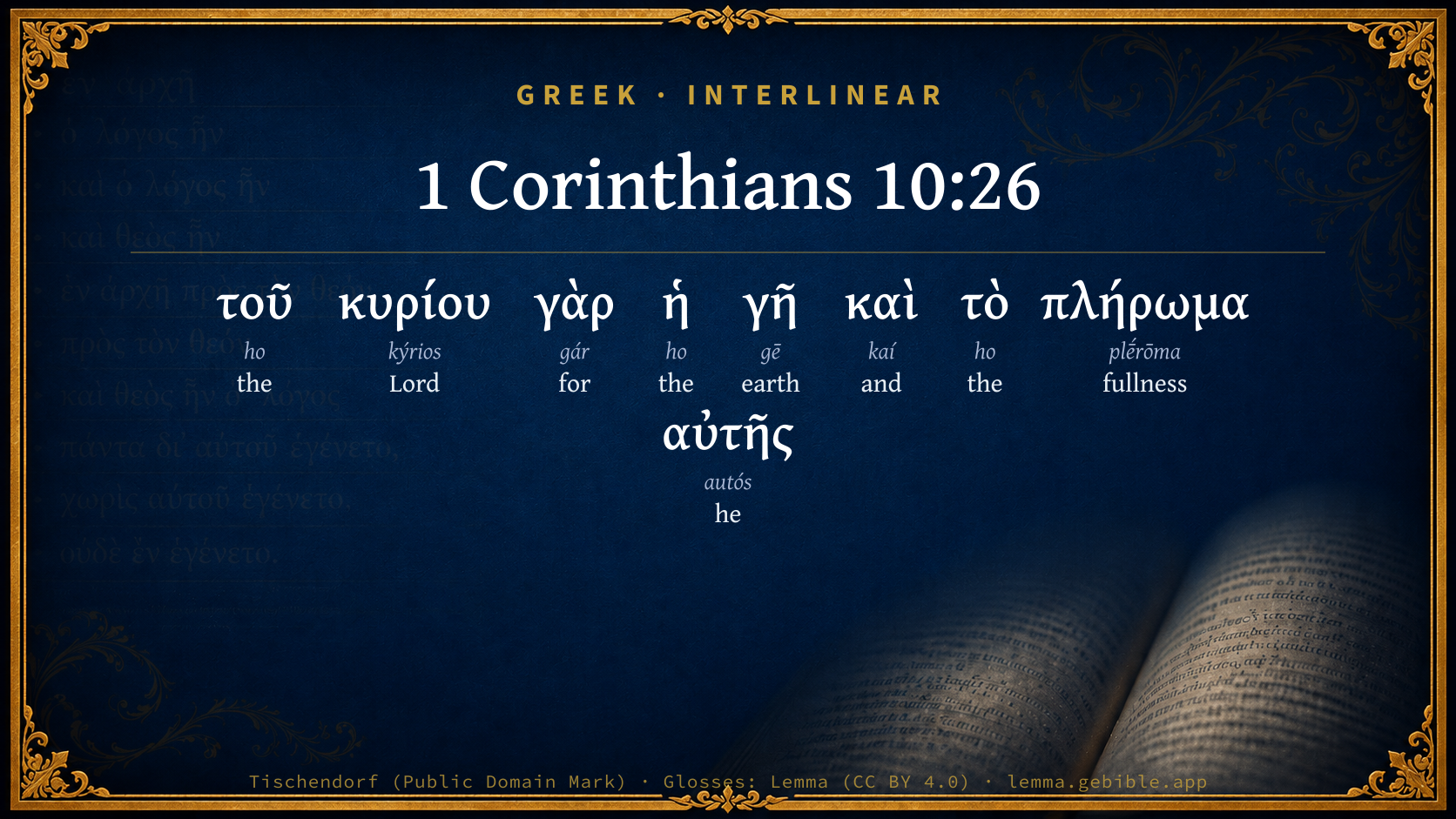
  1. τοῦ ho G3588 “the” Article, Genitive, Singular, Masculine
  2. κυρίου kýrios G2962 “Lord” Noun, Genitive, Singular, Masculine
  3. γὰρ gár G1063 “for” Conjunction
  4. ἡ ho G3588 “the” Article, Nominative, Singular, Feminine
  5. γῆ gē G1093 “earth” Noun, Nominative, Singular, Feminine
  6. καὶ kaí G2532 “and” Conjunction
  7. τὸ ho G3588 “the” Article, Nominative, Singular, Neuter
  8. αὐτῆς autós G846 “he” Personal pronoun, Genitive, Singular, Feminine

About this verse

These counts appear in no published source. They are computed here, from the morphology-tagged text and Lemma’s own curated glosses. What Lemma adds →

9
words
7
distinct lemmas
Pauline Epistles
section

Notable vocabulary

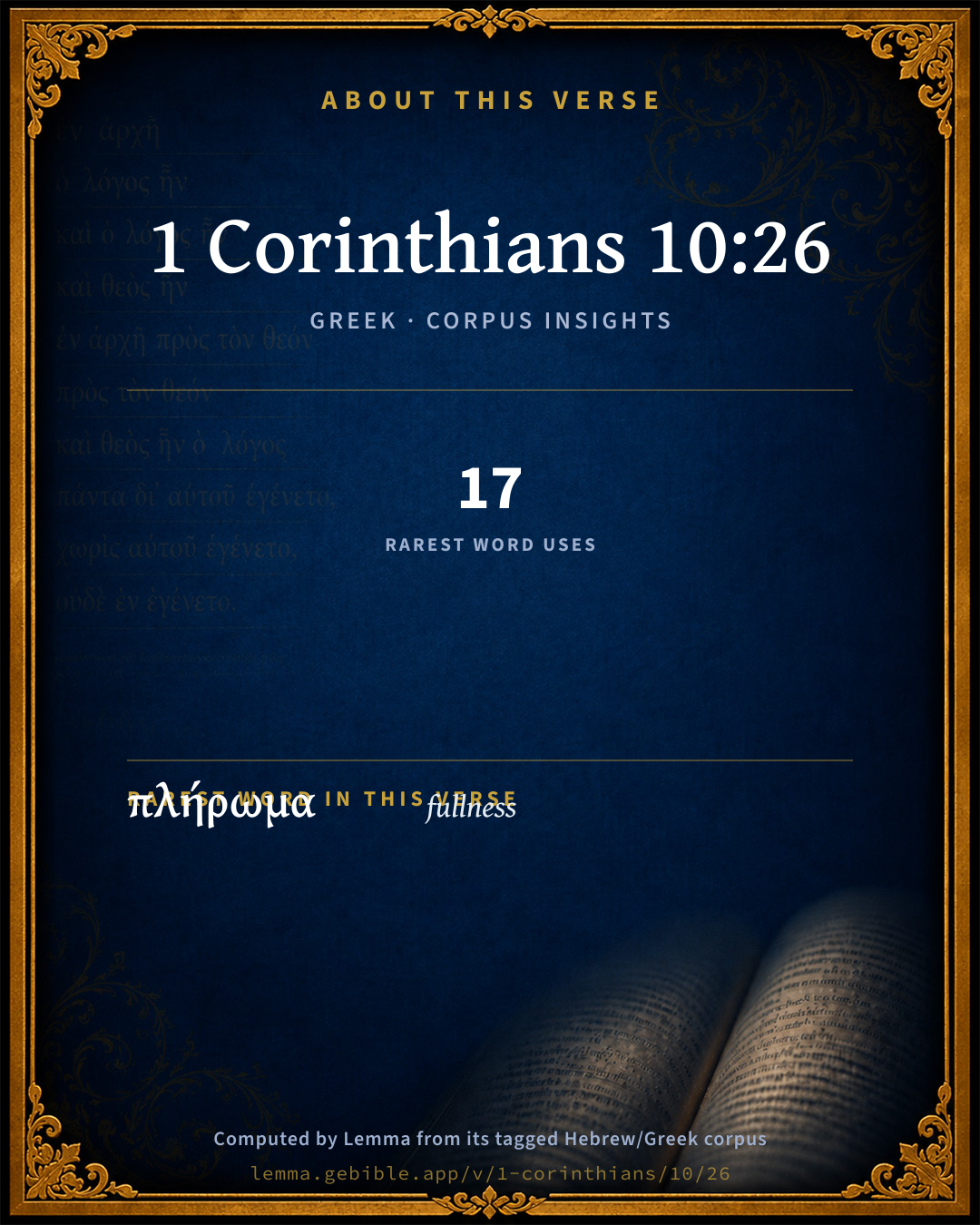
The rarest word here is πλήρωμα fullness G4138 — appearing just 17 times in the whole Greek New Testament.

Shared distinctive vocabulary

πλήρωμα fullness G4138 occurs in 17 verses of the Greek New Testament. Also found in:

Repetition

A word recurs within this verse:

Cross-references

7

Topical passages linked to 1 Corinthians 10:26 in the Treasury of Scripture Knowledge — connected by theme and wording, ordered by reader-vote popularity; previews shown in the World English Bible.

  • Psalms 24:1 The earth is Yahweh's, with its fullness; The world, and those who dwell therein.
  • Exodus 19:5 Now therefore, if you will indeed obey my voice, and keep my covenant, then you shall be my own possession from among all peoples; for all the earth is mine;
  • Deuteronomy 10:14 Behold, to Yahweh your God belongs heaven and the heaven of heavens, the earth, with all that is therein.
  • Psalms 50:12 If I were hungry, I would not tell you, For the world is mine, and all that is in it.
  • Job 41:11 Who has first given to me, that I should repay him? Everything under the heavens is mine.
  • 1 Timothy 6:17 Charge those who are rich in this present world that they not be haughty, nor have their hope set on the uncertainty of riches, but on the living God, who richly provides us with everything to enjoy;
  • 1 Corinthians 10:28 But if anyone says to you, "This was offered to idols," don't eat it for the sake of the one who told you, and for the sake of conscience. For "the earth is the Lord's, and all its fullness."

Cross-references courtesy of OpenBible.info (CC BY 4.0).

Commentary

Notes on 1 Corinthians 10:26 from classic Christian and Jewish commentators (each source and its license shown beneath its notes). The classic Christian expositions comment on the surrounding passage and are grouped to its opening verse, so a note may address several verses; the Jewish commentaries on the Tanakh (Rashi and others) are per-verse, so they appear only where the commentator wrote on this verse.

Lemma curates 59 commentaries, every one of them public domain or Creative Commons licensed, each selected and text-cleaned for this edition rather than reprinted as found. About our sources →

Bengel's Gnomon

Johann Albrecht Bengel

1Co 10:26. Τοῦ Κυρίου, of the Lord) not of idols. Psa 24:1, τοῦ Κυρίου ἡ γῆ καὶ τὸ πλήρωμα αὐτῆς—The earth is the Lord’s and the fulness thereof. Psalms 50(49):12, ἐμὴ γὰρ ἐστιν ἡ οἰκουμένη καὶ τὸ πλήρωμα αὐτῆς—The world is mine and its fulness.—πλήρωμα, fulness) including all kinds of meats.

Bengel's Gnomon of the New Testament — English translation (T&T Clark, Edinburgh, 1860) — public domain. Text from a community e-Sword module.

Meyer's Critical & Exegetical Commentary

Heinrich August Wilhelm Meyer

1Co_10:26 supplies the religious ground for the injunction just given: μηδὲν ἀνακρίνειν διὰ τ. συνείδησιν, expressed in the words of Psa_24:1 (comp Psa_50:12), which Paul here makes his own. If the earth and its fulness belong to God, how should it be necessary before using somewhat of them for food to institute an investigation on grounds of conscience, as if such gifts of God could be in themselves unholy, or involve sin in the use of them? Comp 1Ti_4:4. For the rest, the passage affords another proof that the apostle had now in principle gone beyond the standpoint of the decree of Acts 15. Comp on 1Co_8:1, remark.

As to ΠΛΉΡΩΜΑ, id, quo res impletur, see Fritzsche, a[1710] Rom. II. p. 469 ff. Calvin had already put the point well: Terra enim, si arboribus, herbis, animalibus et aliis rebus careret, esset tanquam domus … vacua.

[1710] d refers to the note of the commentator or editor named on the particular passage.

Meyer — Critical and Exegetical Commentary on the New Testament — English translation by Peter Christie, edited by Frederick Crombie (T&T Clark, 1880) — public domain. Text from a community e-Sword module.

Hodge's Commentary on Romans, Ephesians & First Corinthians

Charles Hodge

1Co_10:26

For the earth (is) the Lords, and the fullness thereof.

This was the common form of acknowledgment among the Jews before meals. It was the recognition of God as the proprietor and giver of all things, and specially of the food provided for his children. The words are taken from Psa_24:1. The fullness of the earth is that by which it is filled; all the fruits and animals with which it is replenished; which were created by God, and therefore good. Nothing, therefore, can in itself be polluting, if used in obedience to the design of its creation. And as the animals offered in sacrifice were intended to be food for man, they cannot defile those who use them for that purpose. This is the reason which the apostle gives to show that, so far as God is concerned, the Corinthians need entertain no scruples in eating meat that had been offered to idols. It was a creature of God, and therefore not to be regarded as unclean. Comp. 1Ti_4:4, where the same doctrine is taught, and for the same purpose.

Charles Hodge — Commentary on Romans (1835), First Corinthians (1857), and Ephesians (1856) — public domain. Text from a community e-Sword module.

Geneva Bible (1599)

Geneva Bible translators

All those things whereof it is full.

Geneva Bible (1599) marginal notes — public domain. Text via Bolls.life.

Jamieson, Fausset & Brown

Robert Jamieson, A. R. Fausset & David Brown

The ground on which such eating without questioning is justified is, the earth and all its contents ("the fulness thereof," Psa 20:1; Psa 50:12), including all meats, belong to the Lord, and are appointed for our use; and where conscience suggests no scruple, all are to be eaten (Rom 14:14, Rom 14:20; Ti1 4:4-5; compare Act 10:15).

Jamieson, Fausset & Brown — Commentary Critical and Explanatory on the Whole Bible (1871) — public domain (CC PDM 1.0). Text via the HelloAO Bible API.

Adam Clarke's Commentary

Verse 26. For the earth is the Lord's] And because God made the earth and its fulness, all animals, plants, and vegetables, there can be nothing in it or them impure or unholy; because all are the creatures of God.

Adam Clarke's Commentary on the Bible (1810–1826) — public domain. Text from a community e-Sword/MySword module.

John Calvin's Commentaries

26. The earth is the Lord’s He establishes, from the testimony of David, the liberty which he had allowed. (Psalm 24:1, and Psalm 50:12.) But it will be asked by some one, “What has this to do with the point?” I answer, If the fullness of the earth is the Lord’s, there is nothing in the world that is not sacred and pure. We must always keep in view, what the question is of which the Apostle treats. It might be doubted, whether the creatures of God were polluted by the sacrifices of the wicked. Paul says they are not, inasmuch as the rule and possession of the whole earth remain always in the hands of God. Now, what things the Lord has in his hands, he preserves by his power, and consequently sanctifies them. The sons of God, therefore, have the pure use of everything, because they receive them no otherwise than from the hand of God.

The fullness of the earth, is an expression which is made use of by the Prophet to denote the abundance of blessings, with which the earth is furnished and adorned by the Lord. For if the earth were stripped of trees, herbs, animals, and other things, it would be like a house devoid of furniture and every kind of utensil: nay more, it would be mutilated and disfigured. Should any one object, that the earth is cursed on account of sin, the answer is easy — that he has an eye to its pure and perfect nature, because Paul is speaking of believers, to whom all things are sanctified through Christ.

John Calvin's Commentaries (1540-1563) — public domain. Text from the Calvin Translation Society English edition (1840s-50s) via the Christian Classics Ethereal Library (ccel.org). Calvin's coverage is partial (roughly two-thirds of the Bible); uncommented books and verses are honest gaps, never fabricated. The 19th-century editor's footnotes and remarks are omitted so the notes are faithfully Calvin's own voice.

Ellicott's Commentary for English Readers

(26) The earth is the Lord’s. . . .—All food that earth brings forth or nourishes is God’s gift, and therefore good. It was merely when regarded as an actual sacrifice that any meat could be considered that “of devils.” This great truth, recognised in the Old Testament as well as in the New, is the reason of the previous statement that conscience need not come into the matter at all.

A Bible Commentary for English Readers, edited by Charles John Ellicott (1878–1897) — public domain. Text from a community e-Sword module.

The Cambridge Bible for Schools and Colleges

gen. ed. J. J. S. Perowne

26. for the earth is the Lord’s, and the fulness thereof] See Psa_26:1. Cf. Psa_50:12. It is not the eating of meats that is sinful. ‘An idol is nothing in the world,’ and all creatures are made by God, and are therefore fit for food. (Cf. 1Ti_4:4.) But knowingly to countenance idolatrous rites, to give to another the glory due to the one True God alone, is a grievous sin. Therefore the whole question of sinfulness depends, not on the meat, but on the knowledge of him who eats it, what kind of meat it is. If he does not know that it has been offered to an idol, he may dismiss all scruples, for it is only this knowledge, and not the perishable meat (see ch. 1Co_6:13), which makes him partaker of the ‘table of devils.’ So 1Co_10:27.

The Cambridge Bible for Schools and Colleges (gen. ed. J. J. S. Perowne; Cambridge University Press, 1878–1918) — public domain. Text from a community e-Sword module.

John Gill's Exposition

For the earth is the Lord's, and the fulness thereof,.... Which words are taken out of Psa 24:1 and to be understood of Christ, who by creation and preservation is Lord of the whole earth, and as Mediator has all in his possession; and having broken down the middle wall of partition, gives his people the free use of all creatures, of the beasts of the field, the fowls of the air, the fishes of the sea, and the trees, fruits, and plants of the earth, which are the fulness thereof; and therefore as the saints have a full right from Christ, to make use of all the creatures in a moderate way, and with thankfulness, they need not fear being defiled by any of them; provided they do not act contrary to the honour of God, and in favour of an idol, or against their own conscience, and the peace of weak believers.

and to be understood of Christ, who by creation and preservation is Lord of the whole earth, and as Mediator has all in his possession; and having broken down the middle wall of partition, gives his people the free use of all creatures, of the beasts of the field, the fowls of the air, the fishes of the sea, and the trees, fruits, and plants of the earth, which are the fulness thereof; and therefore as the saints have a full right from Christ, to make use of all the creatures in a moderate way, and with thankfulness, they need not fear being defiled by any of them; provided they do not act contrary to the honour of God, and in favour of an idol, or against their own conscience, and the peace of weak believers.

1 Corinthians 10:27

co1 10:27

co1 10:27

co1 10:27If any of them that believe not,.... In Christ, and make no profession of faith in him; but are infidels to his person, office, grace, righteousness, Gospel, and ordinances, as there were many such at Corinth: "bid you" to a feast; invite you to dine or sup with them in their own houses:

and ye be disposed to go; the apostle does not lay any commands upon them to go, or not go, but leaves them to their own will, inclination, and discretion; for as circumstances might be, it might be either proper or improper to listen to an invitation from such a quarter; but if they were inclined, and did think fit to go, which they might without sin; for as it is lawful to trade, so to eat and drink with unbelievers; then his advice is,

whatsoever is set before you, eat, asking no questions for conscience sake; that is, as before, as whether it is offered to idols or not; lest either their own, or another's conscience should be hurt thereby.

John Gill's Exposition of the Whole Bible (1746–1763) — public domain (CC PDM 1.0). Text via the HelloAO Bible API.

Trapp's Complete Commentary

John Trapp

26 For the earth is the Lord’s, and the fulness thereof.

Ver. 26. For the earth is the Lord’s] God, of his bounty, spreads a table for all; make no scruple therefore, eat freely.

John Trapp, A Commentary or Exposition upon All the Books of the Old and New Testament (1647–1656) — public domain. Text from a community e-Sword module.

Albert Barnes' Notes on the Bible

For the earth is the Lord’s - This is quoted from Psa 24:1. The same sentiment is also found in Psa 50:11, and in Deu 10:14. It is here urged as a reason why it; is right to partake of the meat offered in the market. It all belongs to the Lord. It does not really belong to the idol, even though it has been offered to it. It may, therefore, be partaken of as his gift, and should be received with gratitude.

And the fulness thereof - All that the earth produces belongs to Him. He causes if to grow; and He has given it to be food for man; and though it may have been devoted to an idol, yet its nature is not changed. It is still the gift of God; still the production of His hand; still the fruit of His goodness and love.

Albert Barnes' Notes on the Bible (1834–1885) — public domain. Text from a community e-Sword/MySword module.

Matthew Poole's English Annotations

This sentence is taken out of Psa 24:1. The earth is God’s, or the Lord Christ’s, who hath sanctified all things for the use of man, and all the variety of creatures that are in it are sanctified by him. An idol cannot pollute any kind of meat, it hath no such malign influence upon any thing; you may pollute yourselves by your action, eating it in the idol’s temple, at an idolater’s feast immediately upon his sacrifice, but the idol itself is no operative thing, nor can cause an ill quality in the meat; let the meat be once returned to its common use, (the idolater’s sacred mysteries being over), it is the Lord’s, what he hath appointed for the use of man. In the idol’s temple they took the meat out of the devil’s hand, that was indeed unlawful; but if it were once returned to its common use, and sold in the market, they took it out of the hand of God’s common providence, and every creature of God is good, and nothing to be refused, if it be received with thanksgiving, 1Ti 4:4.

Matthew Poole's English Annotations on the Holy Bible (1683–1685) — public domain. Text from a community e-Sword/MySword module.

Whedon's Commentary on the Bible

Daniel D. Whedon

26. The Lord’s—This meat is like any thing else in the Lord’s earth made for man’s use so far as it is usable.

Fulness—All with which the earth is filled. The passage is quoted from Psa_24:1. It was used by the Jews in their thanksgiving before meal. It probably formed part of the eucharistic blessing, and indicates that the meat so eaten was consistent with the sacramental communion.

Daniel D. Whedon (gen. ed.), Commentary on the Old and New Testaments (1874–1909) — public domain. Text from a community e-Sword module.

The Pulpit Commentary

For the earth is the Lord"s. (Psa_24:1) Consequently, "Every creature of God is good, and nothing to be refused, if it be received with thanksgiving". (1Ti_4:4) The text formed the ordinary Jewish "grace before meat." The fulness thereof. The plenitude of its created furniture plants, animals, etc.

The great Proprietor.

I REALIZE AND REMEMBER THE FACT OF GOD"S UNIVERSAL PROPRIETORSHIP. It is easy to say that all things are God"s, but difficult to adequately grasp and to retain this in our minds. We yield a ready acquiescence, are but little impressed because the truth is cloudy to us, and then go our way thinking, speaking, and acting, as though God did not own a square foot of ground in the universe! Yet all things are his the earth and its fulness, small things and great, "our possessions" and the possessions of others, things consecrated to him and things unconsecrated, creatures who obey and creatures who disobey, all are his.

II GOD"S PROPRIETORSHIP MAKES THE WORLD MORE BEAUTIFUL.

1. His possessions become associated with himself. We prize certain things because they belong or belonged to our dear ones. All around us has been and is God"s. Interesting in themselves, their interest is increased without limit as the whisper comes to us, "They are all God"s and of God.

2. As his proprietorship springs from his creation of all things, we may be able to trace his mind in objects around us, to see the marks of his fingers, to behold his skill and power. He will be reflected to some extent in his works.

3. He has purposes in connection with his possessions. Everything was made for some end. We may discern some of these ends. We may know that the principle is universal, and may thus be stimulated to seek for further knowledge.

4. Brings good cheer into a world where there is much to sadden. Not the earth was the Lord"s, but the earth is the Lord"s. It is still in his hands. Here is light amid dense darkness. The world has not slipped from the grasp of the Eternal he holds it now.

III GOD"S PROPRIETORSHIP SHOULD INFLUENCE OUR USE OF THE WORLD AND THE THINGS THEREOF. If all things are God"s, they should not be used

(1) thoughtlessly,

(2) irreverently,

(3) selfishly,

(4) injuriously,

(5) contrary to his revealed will,

(6) to the dishonour of his Name.

IV GOD"S PROPRIETORSHIP EXTENDS TO OURSELVES. If "the earth is the Lord"s, and the fulness thereof," we are his.

1. We are not our own.

2. Let us not think, feel, speak, or act as though we were.

V IF WE ARE REDEEMED, WE SHARE IN GOD"S PROPRIETORSHIP. As children do in the possessions of their father. If we are in Christ, God is our Father. We have received the adoption of children. We are "heirs of God and joint heirs with Christ." How rich is the condition of the poorest believer! how exalted the status of the humblest! The way to power, dignity, and wealth is the way of the cross; for thus we become the inheritors of all things. "All things are yours. H.

The Pulpit Commentary (1880–1919), ed. H.D.M. Spence-Jones & Joseph S. Exell — public domain. Text from a community e-Sword module.

John Wesley's Explanatory Notes

For God, who is the Creator, Proprietor, and Disposer of the earth and all that is therein, hath given the produce of it to the children of men, to be used without scruple. Psalm xxiv, 1

John Wesley, Explanatory Notes Upon the Whole Bible (1754–1765) — public domain. Text via the GEBible commentary corpus.

Godbey's Commentary on the New Testament

William B. Godbey

26. “For the earth is the Lord’s, and the fullness of the same.” Hence you have a right to enjoy all the bounty of earth in harmony with hygiene and the diversified interests of God’s kingdom, of which you are a member for this world and all eternity. “If any one of the unbelievers call you, and you wish to go, eat everything set before you, asking no questions for conscience sake.” Hence we have broad liberties and we are not to bring our conscience in the matter as we are walking in the clear light of God. Hence, so far as we personally are concerned, our liberties are unbounded.

William B. Godbey, Commentary on the New Testament (1896–1900) — public domain. Text from a community e-Sword module.

McGarvey & Pendleton's Commentaries

J. W. McGarvey

for the earth is the Lord's, and the fullness thereof . [ Psa_24:1 ; Psa_50:12 . Meat sold in the public market might be bought and used by the Christian without stopping to make investigation or to consult his conscience, for when thus sold it was wholly disassociated from the rites of idolatrous sacrifice, and one so using it could not be suspected of doing so as an act of worship. Moreover, all meat was pure, since it had come from the Lord. Being part of the furniture of the earth, it was to be eaten without scruple-- Rom_14:14 ; Rom_14:20 ; 1Ti_4:4-5 ; Act_10:15 ]

J. W. McGarvey (with Philip Y. Pendleton), Commentaries on the New Testament (The Fourfold Gospel, 1914; Acts; and the epistles) — public domain. Text from a community e-Sword/MySword module.

The People's New Testament

B. W. Johnson

26. For the earth is the Lord's. All that is offered for sale is the Lord's bounty.

B. W. Johnson's The People's New Testament with Notes (1889–1891) — public domain. Electronic text from the Christian Classics Ethereal Library (CCEL) ThML edition.

Cambridge Greek Testament for Schools and Colleges

26. τοῦ κυρίου γὰρ ἡ γῆ. See Psa 24:1. Cf. Psa 50:12. It is not the eating of meats that is sinful. ‘An idol is nothing in the world,’ and all creatures are made by God, and are therefore fit for food. (Cf. 1Ti 4:4.) But knowingly to countenance idolatrous rites, to give to another the glory due to the one true God alone, is a grievous sin. Therefore the whole question of sinfulness depends, not on the meat, but on the knowledge of him who eats it, what kind of meat it is. If he does not know that it has been offered to an idol, he may dismiss all scruples, for it is only this knowledge, and not the perishable meat (see ch. 1Co 6:13), which makes him partaker of the ‘table of daemons.’ So 1Co 10:27.

Cambridge Greek Testament for Schools and Colleges (Cambridge University Press, 1896; 21 vols, various authors incl. Carr, Maclear, Plummer, Farrar, Lumby, Moule, M. R. James, Simcox) — public domain. Text from a community e-Sword module.

Alford’s Greek Testament

Henry Alford

26.] The principle on which such an eating ought to rest: that all is God’s, and for our use: and where no subjective scruple is cast in, all to be freely partaken of: see 1Ti 4:4.

Henry Alford, The Greek Testament (1849–1861) — public domain. Text from a community e-Sword module.

International Critical Commentary

26. τοῦ Κυρίου γάρ. Quotation from Psa 24:1 to justify the advice just given. The emphasis is on τοῦ Κυρίου, ‘To the Lord belongs the earth.’ Meat does not cease to be God’s creature and possession because it has been offered in sacrifice: what is His will not pollute any one. This agrees with Mar 7:19, καθαρίζων πάντα τὰ βρώματα, and with Act 10:15, ἃ ὁ Θεὸς ἐκαθάρισεν. It is stated that the words here quoted are used by Jews as grace at meals. Whether or no they were so used in St Paul’s day, the principle laid down in 1Ti 4:4 was recognized; ‘Every creature of God is good, and nothing to be rejected, if it be received with thanksgiving.’

τὸ πλήρωμα αὐτῆς. ‘That which fills it,’ ‘its contents.’ See J. A. Robinson, Ephesians, p. 259. Cf. Psa 96:11, ‘The sea and all that therein is,’ ἡ θάλασσα καὶ τὸ πλήρωμα αὐτῆς.

International Critical Commentary — older volumes (1896–1929), various authors — public domain. Text from a community e-Sword module.

Vincent's Word Studies in the New Testament

Marvin R. Vincent

The earth is the Lord 's, etc. The common form of Jewish thanksgiving before the meal. For fullness, see on Rom 11:12.

Marvin R. Vincent, Word Studies in the New Testament (1887–1900) — public domain. Text from a community e-Sword/MySword module.

Lesson kit

Teaching starters — assembled from the data on this page, not authored interpretation. Every prompt links to the verse data it draws on. Edit before teaching.

1 Corinthians, in the Pauline Epistles, opens this verse with 9 words (7 distinct Greek lemmas). Its most distinctive word is plḗrōma (“fullness”). A historical commentator’s framing appears above. Read the whole chapter for the surrounding context.

Discussion questions

  1. The word plḗrōma carries the sense “fullness.” How does it shape the verse?
  2. Matthew 9:16 shares the word «fullness» with this verse. How do the two illuminate each other?
  3. “the” occurs 3× in this one verse. What is the effect of the repetition?
  4. These translations render this verse differently. What is at stake in choosing one wording over another?
  5. Reading how Bengel's Gnomon and Meyer's Critical & Exegetical Commentary read this verse, where do the two commentators agree and where do they part?

Things to notice

  • These translations choose different wording for 5 words in this verse.
  • “the” occurs 3× in this single verse.
  • 7 distinct Greek lemmas span 9 words in this verse.

Reading settings

Reading text

Shown beneath each verse's original-language words.

Old Testament
Old Testament edition

Read the OT as the Masoretic Hebrew (MT) or the Greek Septuagint (LXX).

English shown for the Greek Septuagint (in the Hebrew ↔ Greek comparison).

Comparing translations? Open the Compare panel on any verse page to stack up to four side by side.