

Luke 5:24
Greek (Tischendorf 8th ed.) Luke 5:24 appears in the Greek New Testament. The text above is from the Tischendorf 8th edition. Each word links to its Strong’s number and a concise gloss. Click any word for its full Thayer’s Greek Lexicon entry.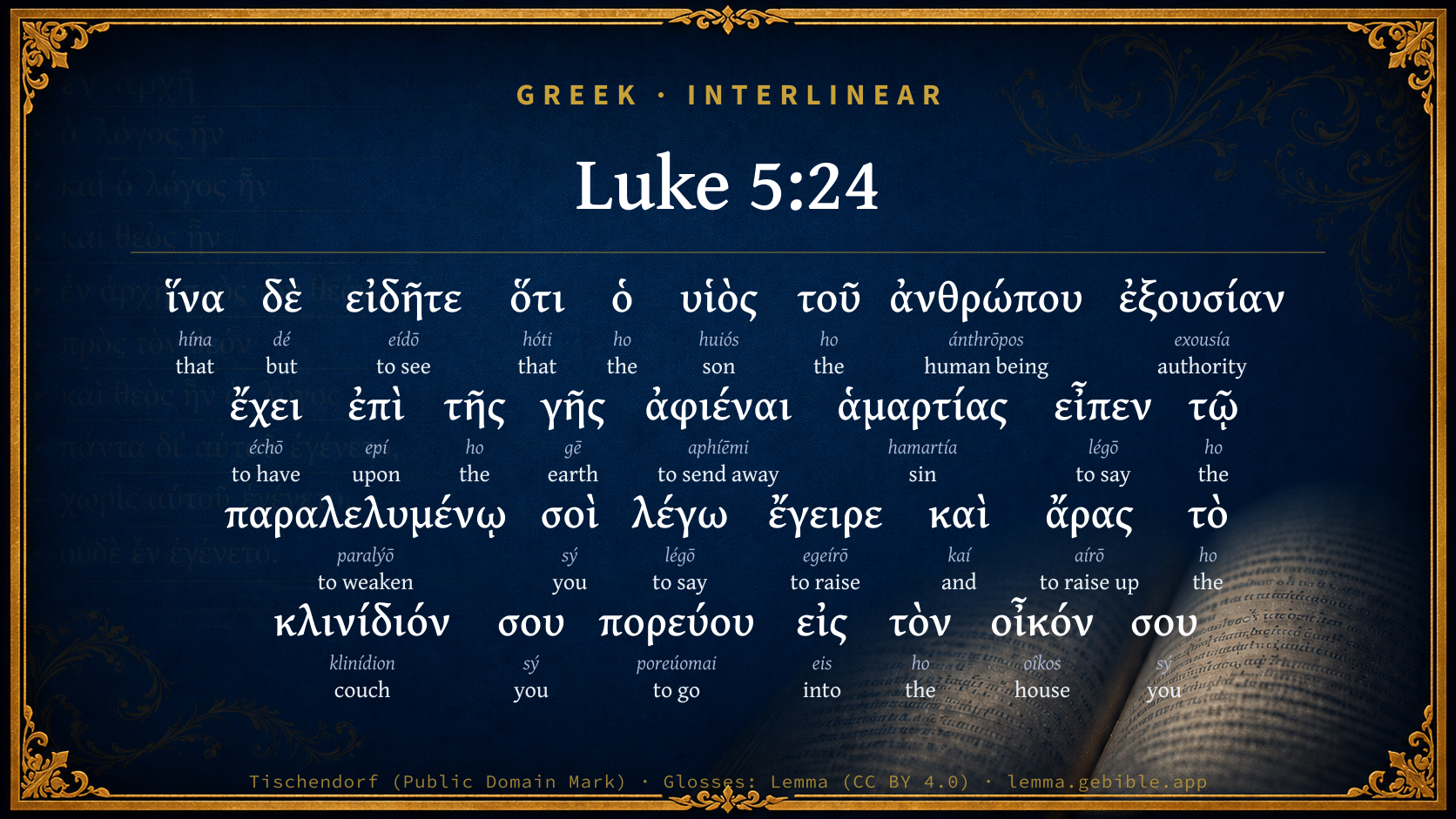
But that you may know that the Son of Man has authority on earth to forgive sins" (he said to the paralyzed man), "I tell you, arise, and take up your cot, and go to your house."
Download a study sheet
One document with this verse’s original text, its word-by-word gloss line, the meaning frame, cross-references with their text, attributed commentary, and full source and license credits — printable, and it pastes into notes with its structure intact.
This verse Autodidact and up
A passage Seminary Student
Up to 50 verses in one chapter. A passage sheet keeps up to 6 commentary sources and 12 cross-references per verse, in the order this page ranks them, and says so on the sheet whenever that leaves anything out. Ask for a single verse and you get the Autodidact verse sheet above.
Everything on this page stays free to read, with no account — the sheet is a download of what is already on screen, not access to it.
Compare translations 3
The same verse in 3 English versions, stacked beneath the original-language interlinear above. Click any original word for its lexicon entry.
Each is an independent rendering of the whole verse — the interlinear is not word-aligned to these translations.
Highlighted words mark where these versions differ — a whole-verse word diff, not a word-by-word alignment.
-
World English Bible Public Domain
But that you may know that the Son of Man has authority on earth to forgive sins" (he said to the paralyzed man), "I tell you, arise, and take up your cot, and go to your house."
-
King James Version Public Domain
But that ye may know that the Son of man hath power upon earth to forgive sins, (he said unto the sick of the palsy,) I say unto thee, Arise, and take up thy couch, and go into thine house.
-
unfoldingWord Literal Text CC BY-SA 4.0
But in order that you may know that the Son of Man has authority on the earth to forgive sins,”—he said to the one that had been paralyzed—“I say to you, get up, and picking up your mat, go to your house.”
unfoldingWord Literal Text — © unfoldingWord, licensed CC BY-SA 4.0. Word-aligned USFM3 via Door43 (git.door43.org/unfoldingWord/en_ult).
Show all 19 translations
Every available English version of this verse, each an independent rendering of the whole verse.
-
World English Bible Public Domain
But that you may know that the Son of Man has authority on earth to forgive sins" (he said to the paralyzed man), "I tell you, arise, and take up your cot, and go to your house."
-
Berean Standard Bible Public Domain
But so that you may know that the Son of Man has authority on the earth to forgive sins...” He said to the paralytic, “I tell you, get up, pick up your mat, and go home.”
-
Majority Standard Bible Public Domain
But so that you may know that the Son of Man has authority on the earth to forgive sins ” He said to the paralytic, “I tell you, get up, pick up your mat, and go home.”
-
King James Version Public Domain
But that ye may know that the Son of man hath power upon earth to forgive sins, (he said unto the sick of the palsy,) I say unto thee, Arise, and take up thy couch, and go into thine house.
-
American Standard Version (1901) Public Domain
But that ye may know that the Son of man hath authority on earth to forgive sins (he said unto him that was palsied), I say unto thee, Arise, and take up thy couch, and go unto thy house.
-
Revised Version (1885) Public Domain
But that ye may know that the Son of man hath power on earth to forgive sins (he said unto him that was palsied), I say unto thee, Arise, and take up thy couch, and go unto thy house.
-
Geneva Bible (1599) Public Domain
But that ye may know that that Sonne of man hath authoritie to forgiue sinnes in earth, (he sayd vnto the sicke of the palsie) I say to thee, Arise: take vp thy bed, and goe to thine house.
-
Douay-Rheims (1899) Public Domain
But that you may know that the Son of man hath power on earth to forgive sins, (he saith to the sick of the palsy,) I say to thee, Arise, take up thy bed, and go into thy house.
-
Young's Literal Translation Public Domain
`And that ye may know that the Son of Man hath authority upon the earth to forgive sins -- (he said to the one struck with palsy) -- I say to thee, Arise, and having taken up thy little couch, be going on to thy house.'
-
Literal Standard Version CC BY-SA 4.0
And that you may know that the Son of Man has authority on the earth to forgive sins—(He said to the one struck with palsy)—I say to you, arise, and having taken up your little bed, be going on to your house.”
-
Unlocked Literal Bible CC BY-SA 4.0
But that you may know that the Son of Man has authority on earth to forgive sins,”—he said to the paralysed man—”I tell you, get up, pick up your mat and go to your house.”
-
unfoldingWord Literal Text CC BY-SA 4.0
But in order that you may know that the Son of Man has authority on the earth to forgive sins,”—he said to the one that had been paralyzed—“I say to you, get up, and picking up your mat, go to your house.”
-
Darby Bible Public Domain
But that ye may know that the Son of man has power on earth to forgive sins, he said to the paralysed man, I say to thee, Arise, and take up thy little couch and go to thine house.
-
World Messianic Bible Public Domain
But that you may know that the Son of Man has authority on earth to forgive sins,” he said to the paralyzed man, “I tell you, arise, take up your cot, and go to your house.”
-
Webster's Bible Public Domain
But that ye may know that the Son of man hath power upon earth to forgive sins, He said to the sick with the palsy, I say to thee, Arise, and take up thy couch, and go into thy house.
-
Free Bible Version CC BY-SA 4.0
However, I will prove to you that the Son of man has the authority here on earth to forgive sins.” Then he said to the paralyzed man, “I tell you: Get up, pick up your mat, and go home.”
-
Bible in Basic English Public Domain
But so that you may see that on earth the Son of man has authority for the forgiveness of sins, (he said to the man who was ill,) I say to you, Get up, and take up your bed, and go into your house.
-
Text-Critical English NT CC BY 4.0
But so that you may know that the Son of Man has authority on earth to forgive sins” —he said to the paralyzed man— “I say to yoʋ, rise, pick up yoʋr mat, and go to yoʋr house.”
-
Tyndale New Testament (1534) Public Domain
But that ye maye knowe that the sonne of man hath power to forgeve synnes on erth he sayde vnto the sicke of the palsie: I saye to the aryse take vp thy beed and go home to thy housse.
Literal Standard Version (2020), Covenant Press — licensed CC BY-SA 4.0. Text via the HelloAO Bible API (eBible.org). Unlocked Literal Bible (unfoldingWord) — licensed CC BY-SA 4.0. Text via the HelloAO Bible API (eBible.org). unfoldingWord Literal Text — © unfoldingWord, licensed CC BY-SA 4.0. Word-aligned USFM3 via Door43 (git.door43.org/unfoldingWord/en_ult). Free Bible Version, Dr. Jonathan Gallagher — licensed CC BY-SA 4.0. Text via the HelloAO Bible API (eBible.org).
Word by word
More ways to search: Search by grammar → Find every occurrence → Compare this word →
Practice this passage: Drill this verse → Learn its vocabulary →
- Appears 3× in the Greek New Testament
- First appears at Luke 5:19
- Part of Speech
- Noun
- Case
- Accusative
- Number
- Singular
- Gender
- Neuter
Full Thayer's Definition
- ἵνα hína G2443 “that” Conjunction
- δὲ dé G1161 “but” Conjunction
- εἰδῆτε eídō G1492 “to see” Verb, Perfect, Active, Subjunctive, 2nd person, Plural
- ὅτι hóti G3754 “that” Conjunction
- ὁ ho G3588 “the” Article, Nominative, Singular, Masculine
- υἱὸς huiós G5207 “son” Noun, Nominative, Singular, Masculine
- τοῦ ho G3588 “the” Article, Genitive, Singular, Masculine
- ἀνθρώπου ánthrōpos G444 “human being” Noun, Genitive, Singular, Masculine
- ἐξουσίαν exousía G1849 “authority” Noun, Accusative, Singular, Feminine
- ἔχει échō G2192 “to have” Verb, Present, Active, Indicative, 3rd person, Singular
- ἐπὶ epí G1909 “upon” Preposition
- τῆς ho G3588 “the” Article, Genitive, Singular, Feminine
- γῆς gē G1093 “earth” Noun, Genitive, Singular, Feminine
- ἀφιέναι aphíēmi G863 “to send away” Verb, Present, Active, Infinitive
- ἁμαρτίας hamartía G266 “sin” Noun, Accusative, Plural, Feminine
- εἶπεν légō G3004 “to say” Verb, Aorist, Active, Indicative, 3rd person, Singular
- τῷ ho G3588 “the” Article, Dative, Singular, Masculine
- παραλελυμένῳ paralýō G3886 “to weaken” Verb, Perfect, Passive, Participle, Dative, Singular, Masculine
- σοὶ sý G4771 “you” Personal pronoun, 2nd person, Dative, Singular
- λέγω légō G3004 “to say” Verb, Present, Active, Indicative, 1st person, Singular
- ἔγειρε egeírō G1453 “to raise” Verb, Present, Active, Imperative, 2nd person, Singular
- καὶ kaí G2532 “and” Conjunction
- ἄρας aírō G142 “to raise up” Verb, Aorist, Active, Participle, Nominative, Singular, Masculine
- τὸ ho G3588 “the” Article, Accusative, Singular, Neuter
- κλινίδιόν klinídion G2826 “couch” Noun, Accusative, Singular, Neuter
- σου sý G4771 “you” Personal pronoun, 2nd person, Genitive, Singular
- πορεύου poreúomai G4198 “to go” Verb, Present, Middle or Passive deponent, Imperative, 2nd person, Singular
- εἰς eis G1519 “into” Preposition
- τὸν ho G3588 “the” Article, Accusative, Singular, Masculine
- οἶκόν oîkos G3624 “house” Noun, Accusative, Singular, Masculine
- σου sý G4771 “you” Personal pronoun, 2nd person, Genitive, Singular
About this verse
These counts appear in no published source. They are computed here, from the morphology-tagged text and Lemma’s own curated glosses. What Lemma adds →
- 31
- words
- 23
- distinct lemmas
- Gospels
- section
Cross-references
23Topical passages linked to Luke 5:24 in the Treasury of Scripture Knowledge — connected by theme and wording, ordered by reader-vote popularity; previews shown in the World English Bible.
- Isaiah 53:11 He shall see of the travail of his soul, [and] shall be satisfied: by the knowledge of himself shall my righteous servant justify many; and he shall bear their iniquities.
- Luke 8:54 But he put them all outside, and taking her by the hand, he called, saying, "Child, arise!"
- Acts 9:40 Peter put them all out, and kneeled down and prayed. Turning to the body, he said, "Tabitha, get up!" She opened her eyes, and when she saw Peter, she sat up.
- Acts 14:10 said with a loud voice, "Stand upright on your feet!" He leaped up and walked.
- Revelation 1:13 And among the lampstands was one like a son of man, clothed with a robe reaching down to his feet, and with a golden sash around his chest.
- Daniel 7:13 I saw in the night-visions, and, behold, there came with the clouds of the sky one like a son of man, and he came even to the ancient of days, and they brought him near before him.
- Matthew 9:6 But that you may know that the Son of Man has authority on earth to forgive sins..." (then he said to the paralytic), "Get up, and take up your mat, and go up to your house."
- Matthew 16:13 Now when Jesus came into the parts of Caesarea Philippi, he asked his disciples, saying, "Who do men say that I, the Son of Man, am?"
- Matthew 25:31 "But when the Son of Man comes in his glory, and all the holy angels with him, then he will sit on the throne of his glory.
- Matthew 26:64 Jesus said to him, "You have said it. Nevertheless, I tell you, henceforth you will see the Son of Man sitting at the right hand of Power, and coming on the clouds of the sky."
- Matthew 28:18 Jesus came to them and spoke to them, saying, "All authority has been given to me in heaven and on earth.
- Luke 5:13 He stretched out his hand, and touched him, saying, "I want to. Be made clean." Immediately the leprosy left him.
- Luke 7:14 He came near and touched the coffin, and the bearers stood still. He said, "Young man, I tell you, arise!"
- John 3:13 No one has ascended into heaven, but he who descended out of heaven, the Son of Man, who is in heaven.
- John 5:8–12 Jesus said to him, "Arise, take up your mat, and walk."
- John 5:22–23 For the Father judges no one, but he has given all judgment to the Son,
- John 11:43 When he had said this, he cried with a loud voice, "Lazarus, come out!"
- John 17:2 even as you gave him authority over all flesh, he will give eternal life to all whom you have given him.
- John 20:22–23 When he had said this, he breathed on them, and said to them, "Receive the Holy Spirit!
- Acts 3:6–8 But Peter said, "Silver and gold have I none, but what I have, that I give you. In the name of Jesus Christ of Nazareth, get up and walk!"
- Acts 5:31 God exalted him with his right hand to be a Prince and a Savior, to give repentance to Israel, and remission of sins.
- Acts 9:34 Peter said to him, "Aeneas, Jesus Christ heals you. Get up and make your bed!" Immediately he arose.
- John 5:27 He also gave him authority to execute judgment, because he is a son of man.
Cross-references courtesy of OpenBible.info (CC BY 4.0).
Lesson kit
Teaching starters — assembled from the data on this page, not authored interpretation. Every prompt links to the verse data it draws on. Edit before teaching.
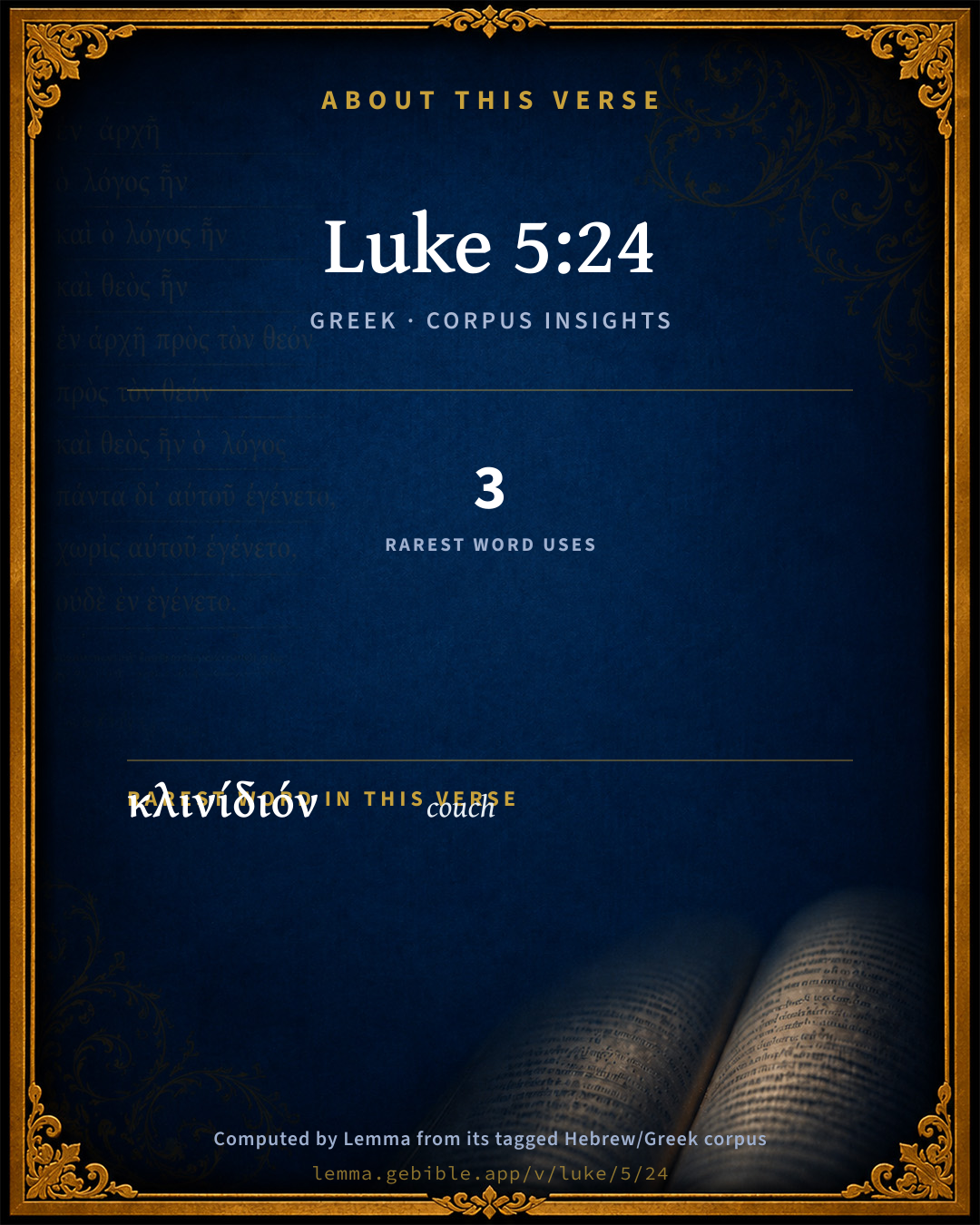
Luke, in the Gospels, opens this verse with 31 words (23 distinct Greek lemmas). Its most distinctive word is klinídion (“couch”). A historical commentator’s framing appears above. Read the whole chapter for the surrounding context.
Discussion questions
- How does “couch” (klinídion) shape what this verse is saying?
- Luke 5:19 shares the word «couch» with this verse. How do the two illuminate each other?
- “to say” occurs 2× in this one verse. What is the effect of the repetition?
- These translations render this verse differently; the difference is in the English rendering, not the original. What questions does that raise?
- Reading how Tyndale Open Study Notes and Expositor's Greek Testament read this verse, where do the two commentators agree and where do they part?
Things to notice
- These translations choose different wording for 26 words in this verse.
- “to say” occurs 2× in this single verse.
- 23 distinct Greek lemmas span 31 words in this verse.
Commentary
Notes on Luke 5:24 from classic Christian and Jewish commentators (each source and its license shown beneath its notes). The classic Christian expositions comment on the surrounding passage and are grouped to its opening verse, so a note may address several verses; the Jewish commentaries on the Tanakh (Rashi and others) are per-verse, so they appear only where the commentator wrote on this verse.
Lemma curates 59 commentaries, every one of them public domain or Creative Commons licensed, each selected and text-cleaned for this edition rather than reprinted as found. About our sources →
Tyndale Open Study Notes
Tyndale Open Resources
Tyndale Open Study Notes — © Tyndale Open Resources, licensed CC BY-SA 4.0. Text via the HelloAO Bible API.
Expositor's Greek Testament
ed. W. Robertson Nicoll
The Expositor's Greek Testament, edited by W. Robertson Nicoll (1897–1910) — public domain. Text from a community e-Sword module.
Jamieson, Fausset & Brown
Robert Jamieson, A. R. Fausset & David Brown
Jamieson, Fausset & Brown — Commentary Critical and Explanatory on the Whole Bible (1871) — public domain (CC PDM 1.0). Text via the HelloAO Bible API.
The Cambridge Bible for Schools and Colleges
gen. ed. J. J. S. Perowne
The Cambridge Bible for Schools and Colleges (gen. ed. J. J. S. Perowne; Cambridge University Press, 1878–1918) — public domain. Text from a community e-Sword module.
John Gill's Exposition
John Gill's Exposition of the Whole Bible (1746–1763) — public domain (CC PDM 1.0). Text via the HelloAO Bible API.
Trapp's Complete Commentary
John Trapp
John Trapp, A Commentary or Exposition upon All the Books of the Old and New Testament (1647–1656) — public domain. Text from a community e-Sword module.
Haydock's Catholic Bible Commentary
George Leo Haydock (1774–1849), Haydock's Catholic Family Bible and Commentary, 1859 edition — public domain. Excludes Psalms (Douay-Rheims chapter numbering differs from Protestant) and Deuterocanonical books (Catholic canon only).
The Pulpit Commentary
The Pulpit Commentary (1880–1919), ed. H.D.M. Spence-Jones & Joseph S. Exell — public domain. Text from a community e-Sword module.
Cambridge Greek Testament for Schools and Colleges
Cambridge Greek Testament for Schools and Colleges (Cambridge University Press, 1896; 21 vols, various authors incl. Carr, Maclear, Plummer, Farrar, Lumby, Moule, M. R. James, Simcox) — public domain. Text from a community e-Sword module.
Alford’s Greek Testament
Henry Alford
Henry Alford, The Greek Testament (1849–1861) — public domain. Text from a community e-Sword module.
International Critical Commentary
International Critical Commentary — older volumes (1896–1929), various authors — public domain. Text from a community e-Sword module.
Vincent's Word Studies in the New Testament
Marvin R. Vincent
Marvin R. Vincent, Word Studies in the New Testament (1887–1900) — public domain. Text from a community e-Sword/MySword module.