
Hebrews 11:38

Greek (Tischendorf 8th ed.) Hebrews 11:38 appears in the Greek New Testament. The text above is from the Tischendorf 8th edition. Each word links to its Strong’s number and a concise gloss. Click any word for its full Thayer’s Greek Lexicon entry.
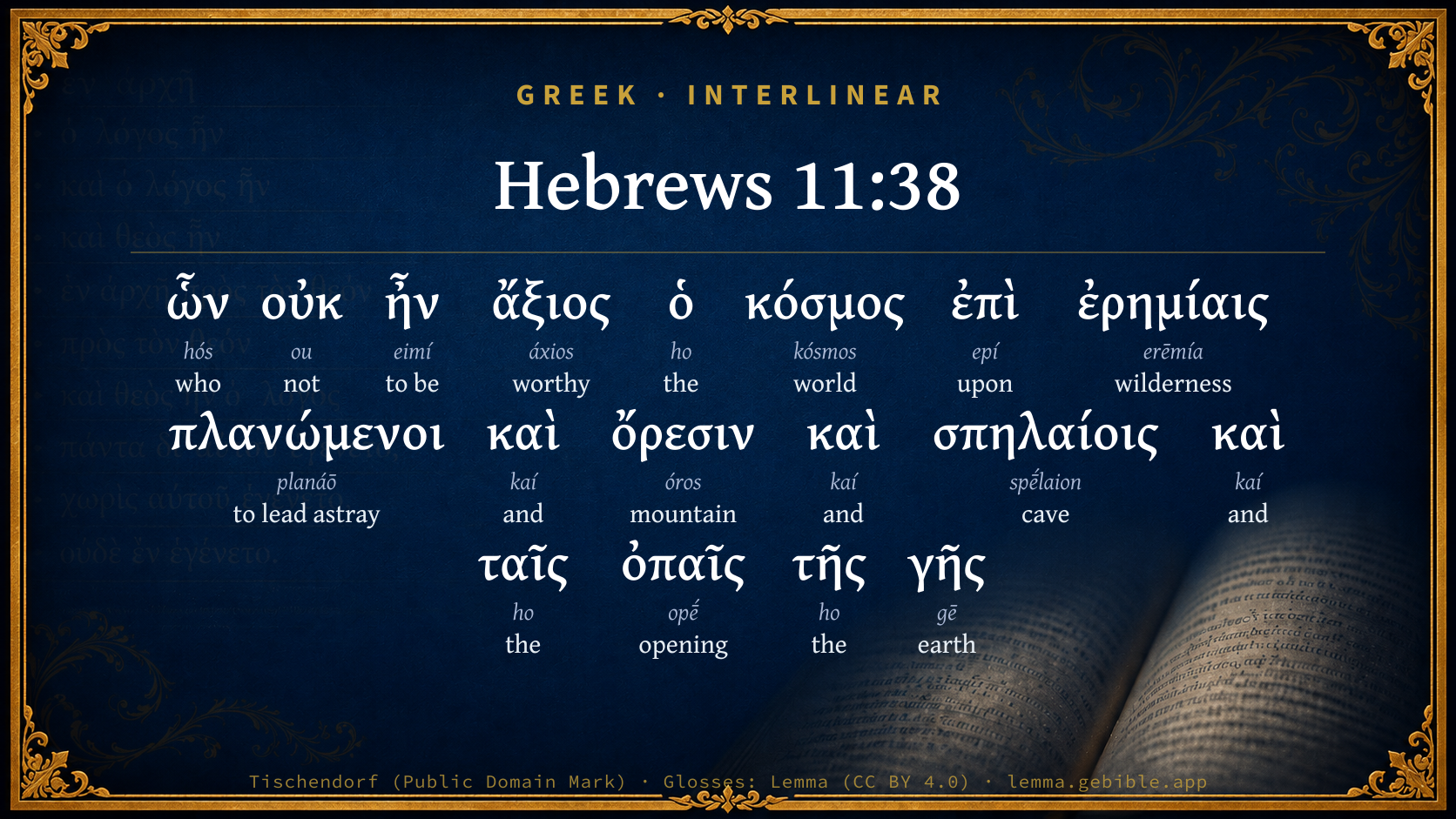
Download image
Cite this verse

Hebrews 11:38 (World English Bible). Public Domain. Lemma interlinear Bible study tool, https://lemma.gebible.app/v/hebrews/11/38.

Show BibTeX & RIS
BibTeX
RIS
English Translation
(of whom the world was not worthy), wandering in deserts, mountains, caves, and the holes of the earth.
World English Bible · Public Domain
Highlights
  • 1 first appearance in the Greek New Testament
Full analysis ↓
Download a study sheet

One document with this verse’s original text, its word-by-word gloss line, the meaning frame, cross-references with their text, attributed commentary, and full source and license credits — printable, and it pastes into notes with its structure intact.

This verse Autodidact and up

Study sheet (.html) Plain text (.txt)

A passage Seminary Student

Up to 50 verses in one chapter. A passage sheet keeps up to 6 commentary sources and 12 cross-references per verse, in the order this page ranks them, and says so on the sheet whenever that leaves anything out. Ask for a single verse and you get the Autodidact verse sheet above.

Everything on this page stays free to read, with no account — the sheet is a download of what is already on screen, not access to it.

Want to remove ads? Support Godless Engineer
Compare translations 3

The same verse in 3 English versions, stacked beneath the original-language interlinear above. Click any original word for its lexicon entry.

Each is an independent rendering of the whole verse — the interlinear is not word-aligned to these translations.

Highlighted words mark where these versions differ — a whole-verse word diff, not a word-by-word alignment.

  • World English Bible Public Domain
    (of whom the world was not worthy), wandering in deserts, mountains, caves, and the holes of the earth.
  • King James Version Public Domain
    (Of whom the world was not worthy:) they wandered in deserts, and in mountains, and in dens and caves of the earth.
  • unfoldingWord Literal Text CC BY-SA 4.0
    (of which the world was not worthy), being caused to wander about in deserts and mountains and caves and the holes in the ground.

unfoldingWord Literal Text — © unfoldingWord, licensed CC BY-SA 4.0. Word-aligned USFM3 via Door43 (git.door43.org/unfoldingWord/en_ult).

Versions to compare (up to 4)

3 of 4 selected

Show all 19 translations

Every available English version of this verse, each an independent rendering of the whole verse.

  • World English Bible Public Domain
    (of whom the world was not worthy), wandering in deserts, mountains, caves, and the holes of the earth.
  • Berean Standard Bible Public Domain
    The world was not worthy of them. They wandered in deserts and mountains, and hid in caves and holes in the ground.
  • Majority Standard Bible Public Domain
    The world was not worthy of them. They wandered in deserts and mountains, and hid in caves and holes in the ground.
  • King James Version Public Domain
    (Of whom the world was not worthy:) they wandered in deserts, and in mountains, and in dens and caves of the earth.
  • American Standard Version (1901) Public Domain
    (of whom the world was not worthy), wandering in deserts and mountains and caves, and the holes of the earth.
  • Revised Version (1885) Public Domain
    (of whom the world was not worthy), wandering in deserts and mountains and caves, and the holes of the earth.
  • Geneva Bible (1599) Public Domain
    Whom the world was not worthie of: they wandered in wildernesses and mountaines, and dennes, and caues of the earth.
  • Douay-Rheims (1899) Public Domain
    Of whom the world was not worthy; wandering in deserts, in mountains, and in dens, and in caved of the earth.
  • Young's Literal Translation Public Domain
    of whom the world was not worthy; in deserts wandering, and `in' mountains, and `in' caves, and `in' the holes of the earth;
  • Literal Standard Version CC BY-SA 4.0
    of whom the world was not worthy; wandering in deserts, and mountains, and caves, and the holes of the earth;
  • Unlocked Literal Bible CC BY-SA 4.0
    The world was not worthy of them. They were always wandering about in the deserts and mountains, and in caves and holes in the ground.
  • unfoldingWord Literal Text CC BY-SA 4.0
    (of which the world was not worthy), being caused to wander about in deserts and mountains and caves and the holes in the ground.
  • Darby Bible Public Domain
    (of whom the world was not worthy,) wandering in deserts and mountains, and [in] dens and caverns of the earth.
  • World Messianic Bible Public Domain
    of whom the world was not worthy—wandering in deserts, mountains, caves, and the holes of the earth.
  • Webster's Bible Public Domain
    (Of whom the world was not worthy:) they wandered in deserts, and in mountains, and in dens and caves of the earth.
  • Free Bible Version CC BY-SA 4.0
    The world was not worthy to have such people who wandered in the deserts and mountains, living in caves and holes in the ground.
  • Bible in Basic English Public Domain
    Wandering in waste places and in mountains and in holes in the rocks; for whom the world was not good enough.
  • Text-Critical English NT CC BY 4.0
    The world was not worthy of them. They wandered in deserts and mountains, hiding in caves and holes in the ground.
  • Tyndale New Testament (1534) Public Domain
    which the worlde was not worthy of: they wadred in wildernes in moutaynes in dennes and caves of the erth.

Literal Standard Version (2020), Covenant Press — licensed CC BY-SA 4.0. Text via the HelloAO Bible API (eBible.org). Unlocked Literal Bible (unfoldingWord) — licensed CC BY-SA 4.0. Text via the HelloAO Bible API (eBible.org). unfoldingWord Literal Text — © unfoldingWord, licensed CC BY-SA 4.0. Word-aligned USFM3 via Door43 (git.door43.org/unfoldingWord/en_ult). Free Bible Version, Dr. Jonathan Gallagher — licensed CC BY-SA 4.0. Text via the HelloAO Bible API (eBible.org).

Word by word

More ways to search: Search by grammar → Find every occurrence → Compare this word →

Practice this passage: Drill this verse → Learn its vocabulary →

ὀπαῖς
opḗ
G3692
“opening”
Noun, Dative, Plural, Feminine
Part of Speech
Noun
Case
Dative
Number
Plural
Gender
Feminine
Full Thayer's Definition

Origin: probably from G3700

TDNT: None

1. through which one can see, an opening, an aperture a. of a window b. of fissures in the earth c. of caves in rocks or mountains, holes
  1. ὧν hós G3739 “who” Relative pronoun, Genitive, Plural, Masculine
  2. οὐκ ou G3756 “not” Particle, Negative
  3. ἦν eimí G1510 “to be” Verb, Imperfect, Active, Indicative, 3rd person, Singular
  4. ἄξιος áxios G514 “worthy” Adjective, Nominative, Singular, Masculine
  5. ὁ ho G3588 “the” Article, Nominative, Singular, Masculine
  6. κόσμος kósmos G2889 “world” Noun, Nominative, Singular, Masculine
  7. ἐπὶ epí G1909 “upon” Preposition
  8. ἐρημίαις erēmía G2047 “wilderness” Noun, Dative, Plural, Feminine
  9. πλανώμενοι planáō G4105 “to lead astray” Verb, Present, Passive, Participle, Nominative, Plural, Masculine
  10. καὶ kaí G2532 “and” Conjunction
  11. ὄρεσιν óros G3735 “mountain” Noun, Dative, Plural, Neuter
  12. καὶ kaí G2532 “and” Conjunction
  13. σπηλαίοις spḗlaion G4693 “cave” Noun, Dative, Plural, Neuter
  14. καὶ kaí G2532 “and” Conjunction
  15. ταῖς ho G3588 “the” Article, Dative, Plural, Feminine
  16. τῆς ho G3588 “the” Article, Genitive, Singular, Feminine
  17. γῆς gē G1093 “earth” Noun, Genitive, Singular, Feminine

About this verse

These counts appear in no published source. They are computed here, from the morphology-tagged text and Lemma’s own curated glosses. What Lemma adds →

18
words
14
distinct lemmas
General Epistles
section

Notable vocabulary

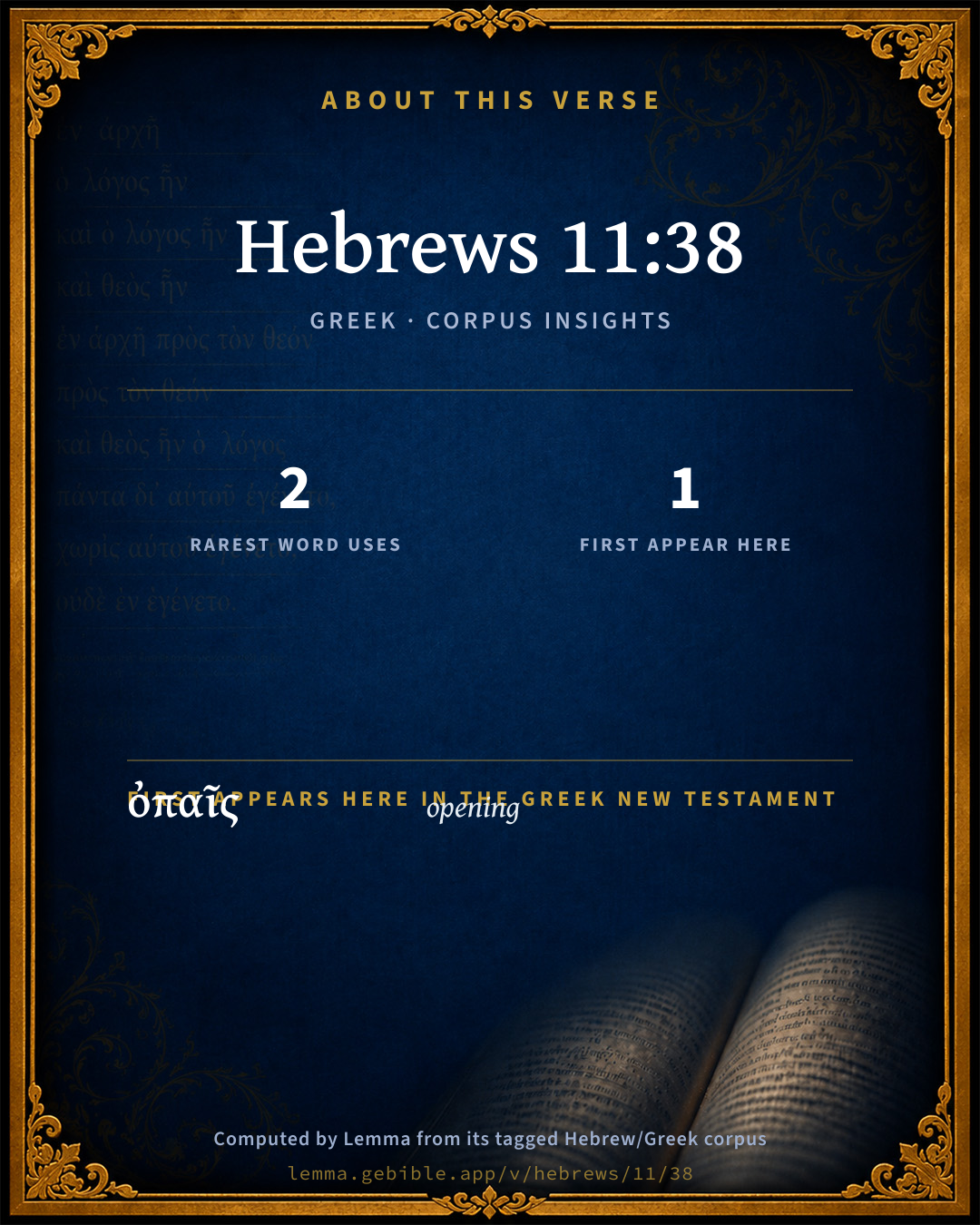
The rarest word here is ὀπαῖς opening G3692 — appearing just 2 times in the whole Greek New Testament.

First appearance in Scripture

This word makes its first canonical appearance in the Greek New Testament here:

  • ὀπαῖς opening G3692

Shared distinctive vocabulary

ὀπαῖς opening G3692 occurs in 2 verses of the Greek New Testament. Also found in:
Repetition

Words recur within this verse:

Cross-references

14

Topical passages linked to Hebrews 11:38 in the Treasury of Scripture Knowledge — connected by theme and wording, ordered by reader-vote popularity; previews shown in the World English Bible.

  • 1 Kings 18:4 for it was so, when Jezebel cut off the prophets of Yahweh, that Obadiah took one hundred prophets, and hid them by fifty in a cave, and fed them with bread and water.)
  • 1 Samuel 22:1 David therefore departed there, and escaped to the cave of Adullam: and when his brothers and all his father's house heard it, they went down there to him.
  • 1 Kings 19:9 He came there to a cave, and lodged there; and, behold, the word of Yahweh came to him, and he said to him, What are you doing here, Elijah?
  • Isaiah 57:1 The righteous perishes, and no man lays it to heart; and merciful men are taken away, none considering that the righteous is taken away from the evil [to come].
  • 1 Samuel 24:1–3 It happened, when Saul was returned from following the Philistines, that it was told him, saying, Behold, David is in the wilderness of En Gedi.
  • 1 Samuel 26:1 The Ziphites came to Saul to Gibeah, saying, Doesn't David hide himself in the hill of Hachilah, which is before the desert?
  • 1 Kings 14:12–13 Arise you therefore, get you to your house: [and] when your feet enter into the city, the child shall die.
  • 1 Kings 17:3 Get you hence, and turn you eastward, and hide yourself by the brook Cherith, that is before the Jordan.
  • 1 Kings 18:13 Wasn't it told my lord what I did when Jezebel killed the prophets of Yahweh, how I hid one hundred men of Yahweh's prophets by fifty in a cave, and fed them with bread and water?
  • Psalms 142:1–7 I cry with my voice to Yahweh. With my voice, I ask Yahweh for mercy.
  • 1 Samuel 23:15 David saw that Saul had come out to seek his life: and David was in the wilderness of Ziph in the wood.
  • 1 Samuel 23:19 Then came up the Ziphites to Saul to Gibeah, saying, Doesn't David hide himself with us in the strongholds in the wood, in the hill of Hachilah, which is on the south of the desert?
  • 1 Samuel 23:23 See therefore, and take knowledge of all the lurking-places where he hides himself, and come you again to me of a certainty, and I will go with you: and it shall happen, if he be in the land, that I will search him out among all the thousands of Judah.
  • 2 Kings 23:25–29 Like him was there no king before him, who turned to Yahweh with all his heart, and with all his soul, and with all his might, according to all the law of Moses; neither after him arose there any like him.

Cross-references courtesy of OpenBible.info (CC BY 4.0).

Commentary

Notes on Hebrews 11:38 from classic Christian and Jewish commentators (each source and its license shown beneath its notes). The classic Christian expositions comment on the surrounding passage and are grouped to its opening verse, so a note may address several verses; the Jewish commentaries on the Tanakh (Rashi and others) are per-verse, so they appear only where the commentator wrote on this verse.

Lemma curates 59 commentaries, every one of them public domain or Creative Commons licensed, each selected and text-cleaned for this edition rather than reprinted as found. About our sources →

Tyndale Open Study Notes

Tyndale Open Resources

11:38 too good for this world: Their hope was in God more than in the pleasures and comforts of this world.

Tyndale Open Study Notes — © Tyndale Open Resources, licensed CC BY-SA 4.0. Text via the HelloAO Bible API.

Bengel's Gnomon

Johann Albrecht Bengel

Heb 11:38. Ὧν οὐκ ἦν ἄξιος ὁ κόσμος, of whom the world was not worthy) The saints, although few and wretched, are of more value than all the world besides. So Pro 8:11, πᾶν τίμιον οὐκ ἄξιον αὐτῆς ἐστιν, no precious thing is to be compared with it (wisdom). The clause is construed with they went about; and yet it is in this passage in particular that it is put, on account of the antithesis between the spacious world and the dens and caves of the earth.—πλανώμενοι, wandering) shut out by wicked men.—σπηλαίοις, caves) 1Ki 18:4; 1Ki 18:13.—καὶ ταῖς) The article makes an emphatic addition (Epitasis), and so therefore; comp. annot. on Chrysost. de Sacerd. p. 493.

Bengel's Gnomon of the New Testament — English translation (T&T Clark, Edinburgh, 1860) — public domain. Text from a community e-Sword module.

Meyer's Critical & Exegetical Commentary

Heinrich August Wilhelm Meyer

Heb_11:38. Ὧν οὐκ ἦν ἄξιος ὁ κόσμος] Men, to possess whom the (corrupt) world (Heb_11:7) was not worthy. Theophylact: Οὐκ ἔχετε, φησίν, εἰπεῖν ὅτι ἁμαρτωλοὶ ὄντες τοιαῦτα ἔπασχον, ἀλλὰ τοιοῦτοι, οἷοι καὶ τοῦ κόσμου αὐτοῦ τιμιώτεροι εἶναι. Calvin: Quum ita profugi inter feras vagabantur sancti prophetae, videri poterant indigni, quos terra sustineret. Qui fit enim, ut inter homines locum non inveniant? Sed apostolus in contrariam partem hoc retorquet, nempe quod mundus illis non esset dignus. Nam quocunque veniant servi Dei, ejus benedictionem, quasi fragrantiam boni odoris, secum afferunt.

ὧν] goes back to the subject in περιῆλθον, Heb_11:37. In a forced manner Böhme (as also Kuinoel, Klee, and Stein): it points to that which follows, and the sense is: oberravisse illos in desertis tales, quibus vulgus hominum, ut esse soleat, pravum ac impium, haud dignum fuerit, quocum illi eodem loco versarentur. Not less unnaturally does Hofmann look upon ὧν οὐκ ἦν ἄξιος ὁ κόσμος as only a following definition of subject to περιῆλθον, in that he begins a new section of the discourse with περιῆλθον. To a yet greater extent, finally, has Carpzov missed the true interpretation, when, taking ὧν as a neuter, he supplies κακῶν (ὑστερήσεων, θλίψεων)), and gives as the sense: quorum indignus malorum erat mundus. Id est: tam crudelibus affecti sunt suppliciis, ut illa mundo indigna sint; ut orbem terrarum non deceat, tam horrenda ac φοβερώτατα de eo dici.

ἐν ἐρημίαις πλανώμενοι κ.τ.λ.] wandering in deserts and upon mountains, and in caves and the clefts [clifts] of the earth. Comp. 1Ki_18:4; 1Ki_18:13; 1Ki_19:4; 1Ki_19:8-9; 1Ki_19:13; 1Ma_2:28-29; 2Ma_5:27; 2Ma_6:11; 2Ma_10:6.

Meyer — Critical and Exegetical Commentary on the New Testament — English translation by Peter Christie, edited by Frederick Crombie (T&T Clark, 1880) — public domain. Text from a community e-Sword module.

Jamieson, Fausset & Brown

Robert Jamieson, A. R. Fausset & David Brown

Of whom the world was not worthy--So far from their being unworthy of living in the world, as their exile in deserts, &c., might seem to imply, "the world was not worthy of them." The world, in shutting them out, shut out from itself a source of blessing; such as Joseph proved to Potiphar (Gen 39:5), and Jacob to Laban (Gen 30:27). In condemning them, the world condemned itself.

caves--literally, "chinks." Palestine, from its hilly character, abounds in fissures and caves, affording shelter to the persecuted, as the fifty hid by Obadiah (Kg1 18:4, Kg1 18:13) and Elijah (Kg1 19:8, Kg1 19:13); and Mattathias and his sons (1 Maccabees 2:28, 29); and Judas Maccabeus (2 Maccabees 5:27).

Jamieson, Fausset & Brown — Commentary Critical and Explanatory on the Whole Bible (1871) — public domain (CC PDM 1.0). Text via the HelloAO Bible API.

Adam Clarke's Commentary

Verse 38. Of whom the world was not worthy] Yet they were obliged to wander by day in deserts and mountains, driven from the society of men, and often obliged to hide by night in dens and caves of the earth, to conceal themselves from the brutal rage of men. Perhaps he refers here principally to the case of Elijah, and the hundred prophets hidden in caves by Obadiah, and fed with bread and water. See 1Kg 18:4. David was often obliged thus to hide himself from Saul; 1Sa 24:3, &c.

Adam Clarke's Commentary on the Bible (1810–1826) — public domain. Text from a community e-Sword/MySword module.

John Calvin's Commentaries

38. Of whom the world was not worthy, etc. As the holy Prophets wandered as fugitives among wild beasts, they might have seemed unworthy of being sustained on the earth; for how was it that they could find no place among men? But the Apostle inverts this sentiment, and says that the world was not worthy of them; for wherever God’s servants come, they bring with them his blessing like the fragrance of a sweet odor. Thus the house of Potiphar was blessed for Joseph’s sake, (Genesis 39:5;) and Sodom would have been spared had ten righteous men been found in it. (Genesis 18:32.) Though then the world may cast out God’s servants as offscourings, it is yet to be regarded as one of its judgments that it cannot bear them; for there is ever accompanying them some blessing from God. Whenever the righteous are taken away from us, let us know that such events are presages of evil to us; for we are unworthy of having them with us, lest they should perish together with us.

At the same time the godly have abundant reasons for consolation, though the world may cast them out as offscourings; for they see that the same thing happened to the prophets, who found more clemency in wild animals than in men. It was with this thought that Hilary comforted himself when he saw the church taken possession of by sanguinary tyrants, who then employed the Roman emperor as their executioner; yea, that holy man then called to mind what the Apostle here says of the Prophets; — “Mountains and forests,” he said, “and dungeons and prisons, are safer for me than splendid temples; for the Prophets, while abiding or buried in these, still prophesied by the Spirit of God.” So also ought we to be animated so as boldly to despise the world; and were it to cast us out, let us know that we go forth from a fatal gulf, and that God thus provides for our safety, so that we may not sink in the same destruction.

John Calvin's Commentaries (1540-1563) — public domain. Text from the Calvin Translation Society English edition (1840s-50s) via the Christian Classics Ethereal Library (ccel.org). Calvin's coverage is partial (roughly two-thirds of the Bible); uncommented books and verses are honest gaps, never fabricated. The 19th-century editor's footnotes and remarks are omitted so the notes are faithfully Calvin's own voice.

The Cambridge Bible for Schools and Colleges

gen. ed. J. J. S. Perowne

38. was not worthy] The world was unworthy of them though it treated them as worthless. The Greek would also admit the meaning that they outweighed in value the whole world (see Pro_8:11, LXX.).

in dens and caves] The Israelites in general (Jdg_6:1). The prophets of the Lord (1Ki_18:4; 1Ki_18:13). Elijah (1Ki_19:9). Mattathias and his sons “fled into the mountains” (1Ma_2:28), and many others “into the wilderness” (id. 29). Judas the Maccabe (2Ma_5:27). Refugees in caves (2Ma_6:11). “Like beasts” (id. Heb_10:6).

of the earth] Rather, “of the land.” The writer’s view rarely extends beyond the horizon of Jewish history.

The Cambridge Bible for Schools and Colleges (gen. ed. J. J. S. Perowne; Cambridge University Press, 1878–1918) — public domain. Text from a community e-Sword module.

John Gill's Exposition

God having provided some better thing for us,.... Not a better state of the church, in such respect, as to be free from suffering reproach and persecutions; for this is the case of saints under the New Testament as under the Old; nor the felicity of the soul after death; nor any greater degree of happiness in the other world; nor the perfection of blessedness in soul and body; things common to all believers; but Christ, as now exhibited in the flesh: Jesus Christ was the same in the yesterday of the Old Testament, as he is in the present day of the Gospel dispensation; he was slain from the foundation of the world; and the saints then were saved as now, by his grace and righteousness: only with this difference between them and us; they had Christ in the promise, we have him himself that was promised; they had him in type and shadow, we have him in reality and truth; they believed in, and were saved by Christ, who was to come; we believe in him, and are saved by him, as being come. Hence our case is, with respect to these circumstances, better than theirs; we have a better covenant, or a better administration of the covenant of grace; we have a better priesthood, and a better sacrifice; the Gospel is dispensed in a better manner, more dearly and fully: our condition is better than theirs; they were as children under tutors and governors, and were under a spirit of bondage; but we are redeemed from under the law, and are clear of its burdensome rites, as well as of its curse and condemnation; and have the spirit of liberty and adoption. And this God has provided for us in his council and covenant: for this denotes God's determination, designation, and appointment of Christ, to be the propitiatory sacrifice for sin; and has respect to the nature and circumstances of his death, which were fixed in the purposes of God; as well as the time of his coming into the world, and the season of his death; and in all this God has shown his great goodness, his amazing love, and the riches of his grace: and his end herein is,

that they without us should not be made perfect; the Old Testament saints are perfectly justified, perfectly sanctified, and perfectly glorified; but their perfection was not by the law, which made nothing perfect, but by Christ, and through his sacrifice, blood, and righteousness; and so were not made perfect without us; since their sins and ours are expiated together by the same sacrifice; their persons and ours justified together by the same righteousness; they and we make up but one church, and general assembly; and as yet all the elect of God among the Jews are not called, and so are not perfect in themselves, or without us. Jews and Gentiles will incorporate together in the latter day; and besides, they and we shall be glorified together, in soul and body, to all eternity.

Next: Hebrews Chapter 12

John Gill's Exposition of the Whole Bible (1746–1763) — public domain (CC PDM 1.0). Text via the HelloAO Bible API.

Trapp's Complete Commentary

John Trapp

38 (Of whom the world was not worthy:) they wandered in deserts, and in mountains, and in dens and caves of the earth.

Ver. 38. Of whom the world] They were fitter to be set as stars in heaven, and be before the Lord in his glory. The world was not worthy of their presence, and yet they were not thought worthy to live in the world.

John Trapp, A Commentary or Exposition upon All the Books of the Old and New Testament (1647–1656) — public domain. Text from a community e-Sword module.

Albert Barnes' Notes on the Bible

Of whom the world was not worthy - The world was so wicked that it had no claim that such holy men should live in it. These poor, despised, and persecuted people, living as outcasts and wanderers, were of a character far elevated above the world. This is a most beautiful expression. It is at once a statement of their eminent holiness, and of the wickedness of the rest of mankind.

They wandered in deserts ... - On the Scripture meaning of the word “desert” or wilderness, see the notes on Mat 3:1. This is a description of persons driven away from their homes, and wandering about from place to place to procure a scanty subsistence; compare 1 Macc. 1:53; 2 Macc. 5:27; 6:7. The instances mentioned in the Books of Maccabees are so much in point, that there is no impropriety in supposing that Paul referred to some such cases, if not these very cases. As there is no doubt about their historic truth, there was no impropriety in referring to them, though they are not mentioned in the canonical books of Scripture. One of those cases may be referred to as strikingly illustrating what is here said. “But Judas Maccabeus with nine others or thereabout, withdrew himself into the wilderness, and lived in the mountains after the manner of beasts, with his company, who fed on herbs continually lest they should be partakers of the pollution;” 2 Macc. 5:27.

Albert Barnes' Notes on the Bible (1834–1885) — public domain. Text from a community e-Sword/MySword module.

Matthew Poole's English Annotations

Of whom the world was not worthy: the Spirit intermixeth an account of what these persons were who were so treated, lest the reader or hearer of these things might be mistaken of them, judging them to be some heinous malefactors, who were thus hurried in and destroyed by the world. Would you know what manner of persons they were? Be it known to you in the judgment of God, the best judge of their persons and states, they were such as the world did not deserve they should live among them, but were unworthy of their society, and the blessings which did attend it; and were it not for their sakes, God would quickly put an end to the sinful world, and burn it up. Such were these as did more for the preservation of the world, when thus brutishly treated by it, than it would or could do for itself.

They wandered in deserts, and in mountains, and in dens and caves of the earth: yet were they wandering over the desolate parts of this earth, being forced from all society with men, to the retirements of wild beasts in deserts, and climbing up mountains and rocks from their persecutors, lodging themselves in the natural or artificial dens and caves of the earth, the only receptacles for these worthies, faith giving them the best company, God and his comforts, there: see 1Sa 22:1,4; 1Ki 17:3; 18:13; 1Ma 1:53; 2:28-30.

Matthew Poole's English Annotations on the Holy Bible (1683–1685) — public domain. Text from a community e-Sword/MySword module.

Whedon's Commentary on the Bible

Daniel D. Whedon

38. World… not worthy—Though treated as not worthy of the world, yet, truly, the world was not worthy of them. It was because they were too good for it that they were driven out of it. Judea abounds in wild coverts for refugees. Obadiah hid fifty prophets in a cave, 1Ki_18:4; 1Ki_18:13. Mattathias and his sons took refuge in the mountains, 1Ma_2:28. Josephus, in his Antiquities, says of the father of the line of Maccabees: “Having said these things, he rushed off with the children into the desert, leaving all his property in the village; the same thing the others doing, with their children and wives, fled into the desert and abode in the caves.”

Daniel D. Whedon (gen. ed.), Commentary on the Old and New Testaments (1874–1909) — public domain. Text from a community e-Sword module.

The Pulpit Commentary

The excellent of the earth. "Of whom the world was not worthy. The text teaches that the world could not bear comparison in respect to worth with the persons named and referred to in this chapter; their character was elevated far above that of the world in general. Let us look at our text

I AS THE STATEMENT OF A HISTORICAL FACT. In all ages there have been men "of whom the world was not worthy." Enoch, Noah, Job, Abraham, Joseph, Moses, Joshua, Caleb, Samuel, et al., are examples. In the apostasy and exile of the Jews there were Jeremiah and Daniel, and Shadrach, Meshach, and Abednego. Amongst the Greeks there was Socrates. Amid the corruptions of the Papal Church there was Savonarola, and after him Martin Luther. And at present there are many who are far superior to the world; who are in the world, yet far above it.

II AS A HISTORICAL FACT OF THE UTMOST IMPORTANCE TO THE WORLD. Without the presence in the world of men of whom the world is not worthy," it would hasten to its doom. A few scientific men "of whom the world is not worthy" save it from scientific stagnation and death. Some of the statesmen of the past who were much abused by the world, and far superior to it, are now recognized as its great benefactors. And as for the heroes of faith, the godly amongst men, they are the saviors of society the salt of the earth," arresting its progress towards utter moral corruption, the light of the world," saving it from unrelieved moral darkness. The presence of ten righteous men would have averted the doom of the cities of the plain. The world knows not its benefactors and saviors. For those who prophesy smooth things to it, it has crowns of honor and thrones of power; but for those who proclaim the truth, it has crowns of thorns, and for a throne the cruel cross. So it treats the men of whom it is not Worthy; so it treated the Divine Man. (cf. Mat_10:24, 25 Joh_15:18-20 Joh_19:1-18)

III THE GREATER THE UNWORTHINESS OF THE WORLD THE MORE URGENT IS ITS NEED OF MEN OF WORTH. The darker the night the greater is our need of the street lamps. When the night is darkest and the storm most furious, the lonely watcher in the lighthouse most diligently trims and tends his lamp. So in the darkest moral night God has often lit and sent forth some of the brightest stars in the firmament of the Church. Israel was in a terrible condition under Ahab and Jezebel, and God raised up the intrepid and holy Elijah. When vice was rampant in the Romish Church God summoned forth the fearless and faithful Martin Luther. At a more recent date, when religion seemed almost extinct in our land, God called and commissioned the Wesleys, and Whitefield, and Fletcher of Madeley, and Selina Countess of Huntingdon. It was because of the unworthiness of the world that Jesus Christ came into it.

IV THE CHRISTIAN SHOULD SO LIVE THAT THE TEXT WILL BE TRUE OF AIM. Is it not true that the world is perfectly worthy of many "who profess and call themselves Christians"? In business, in amusements, in politics, is their standard higher than that of the world? Let us test this question in the matter of gambling: are our hands clean of it? Is it not spreading amongst professedly Christian people in the forms of card-playing, raffling, and lotteries? But listen to our Lord: "Ye are not of the world, even as I am not of the world;" "I pray not that thou shouldest take them out of the world, but that thou shouldest keep them from the evil." And St. John: "If any man love the world, the love of the Father is not in him." Let us live above the world; let us live to God. Be this our ideal, "For to me to live is Christ.

V FOR MEN OF WHOM THIS WORLD IS NOT WORTHY THERE IS A WORLD WHICH IS WELL WORTHY. Into heaven the worthy of all peoples and all ages are gathered. There men are treated according to their own inherent worth. The worthy are worthily received and honored. How the judgments of earth are reversed in that world! All true worthiness is by faith by faith in the unseen, in the soul, in truth, in the Lord Jesus Christ, in the great and gracious God. Let us cultivate this faith. Let us live up to such measure of it as we already possess. W.J.

Seeming unworthiness, real worthiness.

I THE APPEARANCE OF UNWORTHINESS. Men going about in sheepskins and goatskins, wandering in deserts and mountains, sheltering themselves in dens and caves, have had this judgment passed upon them, in effect if not in form, that they are not worthy of the world. They are banished from this world"s social toleration, being held to trouble their fellow men concerning existing institutions and habits without sufficient reason. The world knows no higher standard whereby to judge a man than its own accepted code. If he travels beyond that code of traditions, proprieties, and decencies, he must be ready to be put down among fanatics, madmen, and incomprehensible people generally. In setting out upon a genuine Christian life, we must reckon among other dements in counting the cost that of our relation to the world"s good opinion. If we will not go anywhere or do anything that may lose us the world"s good opinion, then we may at once spare ourselves the trouble and effort of being Christians. If we, living in the world, would be reckoned worthy by the living world around us, then we must be conformed to the world. We must consult its fashions, its prejudices, its vested interests. Originality will be pardoned so long as it keeps to the sphere of the intellect; but once let the conscience break forth into originality and individuality, seeing a right and a wrong where the world has not troubled to consider whether there be right or wrong at all, then henceforth for such a daring spirit, faithful to the light from on high, there is banishment from tolerance by the world. To speak the words "for Christ"s sake" from the very heart means persecution. For then one cannot keep to mere generalities; renewing of the mind brings that transformation which is itself a loosening of those common projects and views that have bound us to the common society of men.

II REAL WORTHINESS. By a decisive expression the writer turns the tables on the calm assumptions of worldly criticism. The world says of the Christian, "This man is not worthy of me; he does not correspond with my attainments, my philosophy, my art, my refinements; he says unappreciative, not to say rude, things about them." But now the Spirit of God steps in to pass a judgment on this same judging spirit of the world. The lamp that has been kindled from light of human making presents but a poor show when set beside the lamp kindled from him who is the true Light of the world. Everything in this matter depends upon the eye with which we look at things. Many there must have been in Jerusalem to lament the dreadful change from Saul the Pharisee to Paul the disciple of Jesus. To them it meant apostasy from all that was godly, honorable, and true. But we know that Christian character, shining by its own light, is its own justification. And we also know that the man of this world, fully exposed in the light of actual Christian character, is his own condemnation. Out of his own avowed and justified words and acts he is condemned. The very fact that he thinks himself right proves how utterly he is wrong. Y.

The Pulpit Commentary (1880–1919), ed. H.D.M. Spence-Jones & Joseph S. Exell — public domain. Text from a community e-Sword module.

John Wesley's Explanatory Notes

Of whom the world was not worthy - It did not deserve so great a blessing. They wandered - Being driven out from men.

John Wesley, Explanatory Notes Upon the Whole Bible (1754–1765) — public domain. Text via the GEBible commentary corpus.

Scofield Reference Notes

C. I. Scofield

world

kosmos = mankind. (See Scofield "Mat 4:8").

The Scofield Reference Bible (1917 edition), notes by C. I. Scofield — public domain. Text from a community e-Sword module.

The People's New Testament

B. W. Johnson

38. Of whom the world was not worthy. When it rejects the good it shows its unworthiness. They wandered in deserts. To hide from persecutors.

B. W. Johnson's The People's New Testament with Notes (1889–1891) — public domain. Electronic text from the Christian Classics Ethereal Library (CCEL) ThML edition.

Cambridge Greek Testament for Schools and Colleges

38. οὐκ ἦν ἄξιος. The world was unworthy of them though it treated them as worthless. The Greek would also admit the meaning that they outweighed in value the whole world (see Pro 8:11, LXX.). The remark would be a striking source of consolation to Christians, on whom every epithet of hatred was exhausted and every disgraceful charge accumulated by their heathen adversaries. No small part of the task of the early Christian apologists consisted in shewing the baselessness and absurdity of the views respecting Christians which were held alike by the multitude, by rulers, and by philosophers.

ὄρεσιν καὶ σπηλαίοις. The Israelites in general (Jdg 6:2). The prophets of the Lord (1Ki 18:4; 1Ki 18:13). Elijah (1Ki 19:9). Mattathias and his sons “fled into the mountains” (1Ma 2:28), and many others “into the wilderness” (id. 29). Judas the Maccabee (2Ma 5:27). Refugees in caves (2Ma 6:11). “Like beasts” (id. Heb 10:6). The catacombs were often used as places of refuge by the early Roman bishops and martyrs.

τῆς γῆς. Not “of the earth” but “of the land.” The writer’s historic view rarely extends beyond the horizon of Jewish history.

Cambridge Greek Testament for Schools and Colleges (Cambridge University Press, 1896; 21 vols, various authors incl. Carr, Maclear, Plummer, Farrar, Lumby, Moule, M. R. James, Simcox) — public domain. Text from a community e-Sword module.

Alford’s Greek Testament

Henry Alford

38.] Examples of those who, though not put to violent death, lived lives of apparent wretchedness in the endurance of faith.

38.] of whom (viz. those who wandered about as in ver. 37: for the participial construction is resumed below, and in reference to these same persons. οὗτοι πάντες first occurs in the next verse.

Of course, Carpzov’s reference of ὧν is inadmissible, “quorum indignus malorum erat mundus: id est, tam crudelibus affecti sunt suppliciis, ut illa mundo indigna sint: ut orbem terrarum non deceat, tam horrenda ac φοβερώτατα de eo dici”) the world was not worthy (the world, by casting them out and persecuting them, proved that it was not fit to have them in it: condemned itself, in condemning them. Cf. Calvin, “Quum ita profugi inter feras vagabantur sancti Prophetæ, videri poterant indigni quos terra sustineret. Qui fit enim ut inter homines locum non inveniant? Sed Apostolus in contrariam partem hoc retorquet, nempe quod mundus illis non esset dignus. Nam quocunque veniant servi Dei, ejus benedictionem, quasi fragrantiam boni odoris, secum afferunt. Sic domus Potiphar benedicta fuit in gratiam Josephi, Gen 39:5, et Sodoma salva futura erat, si in ea inventi fuissent decem justi homines, Gen 18:32”); wandering in deserts and mountains and caves, and the chinks of the earth (the Holy Land was especially calculated, by its geological formation, and its wildernesses, to afford shelter to persecuted persons: so did it to a hundred of the Lord’s prophets whom Obadiah hid by fifty in a cave (σπήλαιον), 1Ki 18:4, 1Ki 18:13: to Elijah, ib. 19:9, 13: to Mattathias and his sons, who fled to the mountains, 1 Macc. 2:28 f., and many others in the wilderness: to Judas Maccabæus, who fled with others εἰς τὴν ἔρημον and there lived ἐν τοῖς ὄρεσι like the wild beasts, 2 Macc. 5:27. Cf. also ib. 6:11; 10:6. Jos. Antt. xii. 6. 2, of Mattathias, καὶ ταῦτα εἰπὼν μετὰ τῶν τέκνων εἰς τὴν ἔρημον ἐξώρμησε, καταλιπὼν ἅπασαν τὴν αὐτοῦ κτῆσιν ἐν τῇ κώμῃ. τὸ δὲ αὐτὸ καὶ πολλοὶ ποιήσαντες, μετὰ τέκνων καὶ γυναικῶν ἔφυγον εἰς τὴν ἔρημον καὶ ἐν τοῖς σπηλαίοις διῆγον. But τῆς γῆς must not be taken for “the land,” viz. Palestine, as Böhme: it is general).

Henry Alford, The Greek Testament (1849–1861) — public domain. Text from a community e-Sword module.

Westcott on Hebrews & the Epistles of John

Brooke Foss Westcott

38. ὧν οὐκ ἦν dé. ὁ κι They were men worth more than the whole world, and they lacked all. This appears to be the meaning, and not that ‘the world in all its beauty was not fit to be their home.’ Comp. Prov. viii. 11

39 πάνγ. papr. οὗτοι Ds.

κρείσσων yap σοφία λίθων πολυτελῶν, πᾶν δὲ τίμιον οὐκ ἄξιον αὐτῆς ἐστί.

El πᾶς ὁ κόσμος, Theophylact asks, οὐκ ἔστιν ἄξιος ἑνὸς ἁγίου, τί μέρος

From this thought the last clause follows naturally. Tho best thing men can give is the sympathy of fellowship: the last thing which they withdraw is simple intercourse. But the prophets had no place among their fellow-mon; and ‘evon the deserts offerod them no safe resting-place’ (Thoophict).

The clause ταῖς ὁπαῖς τῇς ys—the holes of the land—seoms to bo ἃ quotation from somo familiar description. The word ὀπή occurs again James ili. 11 with a reference to another feature of the limestone rocks of Palestine.

(6) 39, 40. General conclusion.

The whole record of past divine history shews us that the trial of faith depended on the will of God, who looked forward to the end. Here then lies our patience.

5 And these all, having had ewtinese borne to them through their Saith, received not the promise, ©God having foreseen some better thing in our cast, that they, apart from us, should not be made perfect.

Brooke Foss Westcott (1825–1901), The Epistle to the Hebrews (1889) and The Epistles of St John (1883) — public domain (pre-1929). Text recovered from Internet Archive / Google Books OCR scans. Westcott’s Gospel of John commentary is not included (its OCR lost the chapter running-heads required for reliable verse-keying). Some Greek quoted in the Hebrews volume is imperfectly rendered by the OCR.

Lesson kit

Teaching starters — assembled from the data on this page, not authored interpretation. Every prompt links to the verse data it draws on. Edit before teaching.

Hebrews, in the General Epistles, opens this verse with 18 words (14 distinct Greek lemmas). Its most distinctive word is opḗ (“opening”). A historical commentator’s framing appears above. Read the whole chapter for the surrounding context.

Discussion questions

  1. What does “opening” (opḗ) contribute to the verse as a whole?
  2. This is the first place “opening” appears in Scripture (first appears here). What does its debut here establish?
  3. How does James 3:11, which shares the word «opening», read alongside this verse?
  4. What does the repetition of “the” (3× in this one verse) do in this verse?
  5. The translations on this page render this verse differently — a whole-verse word diff, not a word-by-word alignment. What might account for the different wordings?
  6. Compare how Tyndale Open Study Notes and Bengel's Gnomon read this verse. Where do they agree or differ?

Things to notice

  • 1 word makes its first canonical appearance in Scripture here.
  • These translations choose different wording for 12 words in this verse.
  • “the” occurs 3× in this single verse.
  • 14 distinct Greek lemmas span 18 words in this verse.

Reading settings

Reading text

Shown beneath each verse's original-language words.

Old Testament
Old Testament edition

Read the OT as the Masoretic Hebrew (MT) or the Greek Septuagint (LXX).

English shown for the Greek Septuagint (in the Hebrew ↔ Greek comparison).

Comparing translations? Open the Compare panel on any verse page to stack up to four side by side.