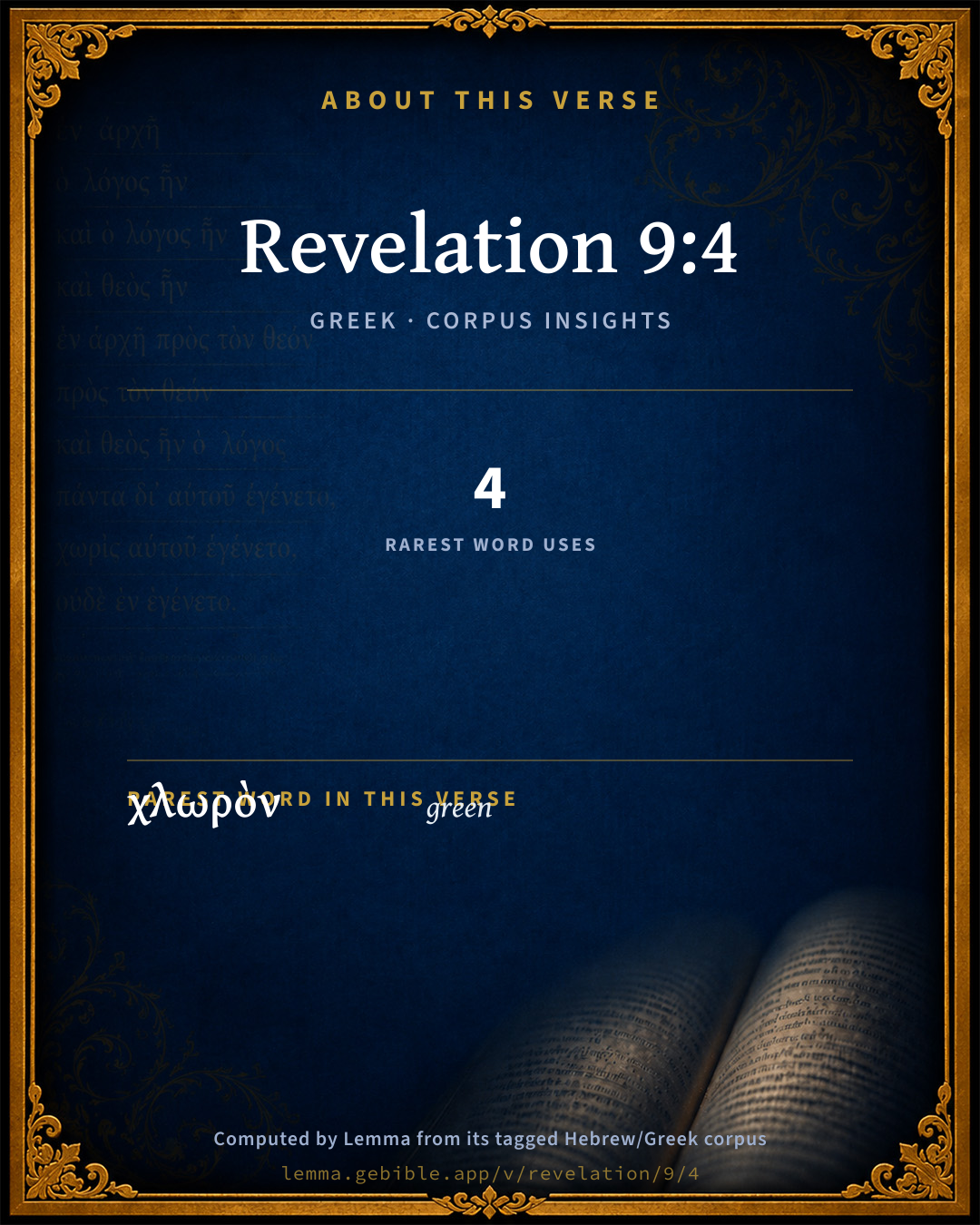
Revelation 9:4

Greek (Tischendorf 8th ed.) Revelation 9:4 appears in the Greek New Testament. The text above is from the Tischendorf 8th edition. Each word links to its Strong’s number and a concise gloss. Click any word for its full Thayer’s Greek Lexicon entry.
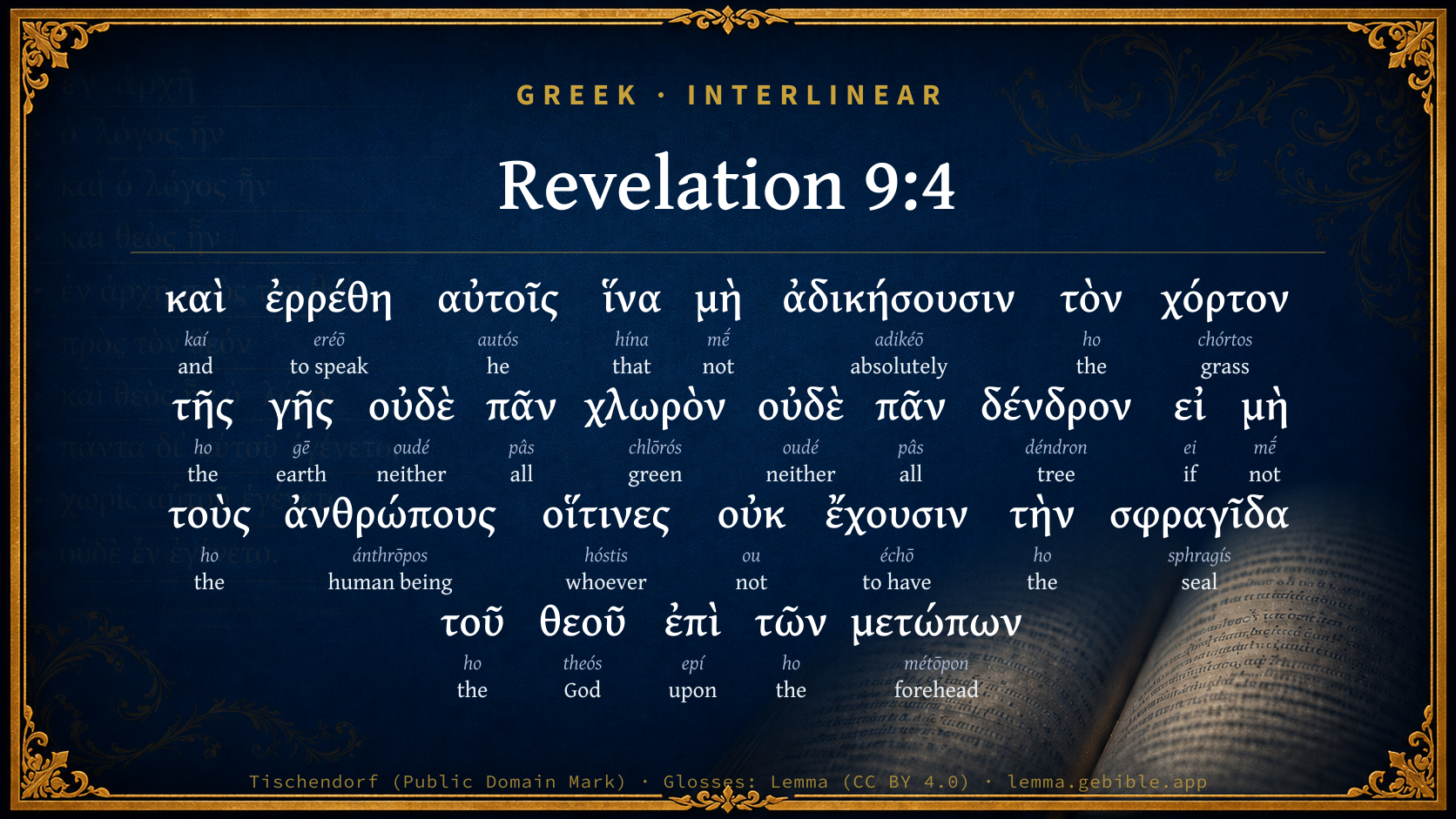
Download image
Cite this verse

Revelation 9:4 (World English Bible). Public Domain. Lemma interlinear Bible study tool, https://lemma.gebible.app/v/revelation/9/4.

Show BibTeX & RIS
BibTeX
RIS
English Translation
They were told that they should not hurt the grass of the earth, neither any green thing, neither any tree, but only those people who don't have God's seal on their foreheads.
World English Bible · Public Domain
Download a study sheet

One document with this verse’s original text, its word-by-word gloss line, the meaning frame, cross-references with their text, attributed commentary, and full source and license credits — printable, and it pastes into notes with its structure intact.

This verse Autodidact and up

Study sheet (.html) Plain text (.txt)

A passage Seminary Student

Up to 50 verses in one chapter. A passage sheet keeps up to 6 commentary sources and 12 cross-references per verse, in the order this page ranks them, and says so on the sheet whenever that leaves anything out. Ask for a single verse and you get the Autodidact verse sheet above.

Everything on this page stays free to read, with no account — the sheet is a download of what is already on screen, not access to it.

Want to remove ads? Support Godless Engineer
Compare translations 3

The same verse in 3 English versions, stacked beneath the original-language interlinear above. Click any original word for its lexicon entry.

Each is an independent rendering of the whole verse — the interlinear is not word-aligned to these translations.

Highlighted words mark where these versions differ — a whole-verse word diff, not a word-by-word alignment.

  • World English Bible Public Domain
    They were told that they should not hurt the grass of the earth, neither any green thing, neither any tree, but only those people who don't have God's seal on their foreheads.
  • King James Version Public Domain
    And it was commanded them that they should not hurt the grass of the earth, neither any green thing, neither any tree; but only those men which have not the seal of God in their foreheads.
  • unfoldingWord Literal Text CC BY-SA 4.0
    And it was told to them that they should not harm the grass of the earth or any green plant or any tree, if not the men who did not have the seal of God on foreheads.

unfoldingWord Literal Text — © unfoldingWord, licensed CC BY-SA 4.0. Word-aligned USFM3 via Door43 (git.door43.org/unfoldingWord/en_ult).

Versions to compare (up to 4)

3 of 4 selected

Show all 19 translations

Every available English version of this verse, each an independent rendering of the whole verse.

  • World English Bible Public Domain
    They were told that they should not hurt the grass of the earth, neither any green thing, neither any tree, but only those people who don't have God's seal on their foreheads.
  • Berean Standard Bible Public Domain
    They were told not to harm the grass of the earth or any plant or tree, but only those who did not have the seal of God on their foreheads.
  • Majority Standard Bible Public Domain
    They were told not to harm the grass of the earth or any plant or tree, but only those who did not have the seal of God on their foreheads.
  • King James Version Public Domain
    And it was commanded them that they should not hurt the grass of the earth, neither any green thing, neither any tree; but only those men which have not the seal of God in their foreheads.
  • American Standard Version (1901) Public Domain
    And it was said unto them that they should not hurt the grass of the earth, neither any green thing, neither any tree, but only such men as have not the seal of God on their foreheads.
  • Revised Version (1885) Public Domain
    And it was said unto them that they should not hurt the grass of the earth, neither any green thing, neither any tree, but only such men as have not the seal of God on their foreheads.
  • Geneva Bible (1599) Public Domain
    And it was comanded them, that they should not hurt the grasse of the earth, neither any greene thing, neither any tree: but onely those men which haue not the seale of God in their foreheads.
  • Douay-Rheims (1899) Public Domain
    And it was commanded them that they should not hurt the grass of the earth, nor any green thing, nor any tree: but only the men who have not the sign of God on their foreheads.
  • Young's Literal Translation Public Domain
    and it was said to them that they may not injure the grass of the earth, nor any green thing, nor any tree, but -- the men only who have not the seal of God upon their foreheads,
  • Literal Standard Version CC BY-SA 4.0
    and it was said to them that they may not injure the grass of the earth, nor any green thing, nor any tree, but only the men who do not have the seal of God on their foreheads,
  • Unlocked Literal Bible CC BY-SA 4.0
    They were told not to damage the grass on the earth or any green plant or tree, but only the people who did not have the seal of God on their foreheads.
  • unfoldingWord Literal Text CC BY-SA 4.0
    And it was told to them that they should not harm the grass of the earth or any green plant or any tree, if not the men who did not have the seal of God on foreheads.
  • Darby Bible Public Domain
    and it was said to them, that they should not injure the grass of the earth, nor any green thing, nor any tree, but the men who have not the seal of God on their foreheads:
  • World Messianic Bible Public Domain
    They were told that they should not hurt the grass of the earth, neither any green thing, neither any tree, but only those people who don’t have God’s seal on their foreheads.
  • Webster's Bible Public Domain
    And it was commanded them that they should not hurt the grass of the earth, neither any green thing, neither any tree; but only those men who have not the seal of God in their foreheads.
  • Free Bible Version CC BY-SA 4.0
    They were told not to harm the grass or any vegetation or any trees, only those who did not have the seal of God on their foreheads.
  • Bible in Basic English Public Domain
    And they were ordered to do no damage to the grass of the earth, or any green thing, or any tree, but only to such men as have not the mark of God on their brows.
  • Text-Critical English NT CC BY 4.0
    They were told not to harm the grass of the earth or any green thing or any tree, but only those who do not have the seal of God on their foreheads.
  • Tyndale New Testament (1534) Public Domain
    And it hurt the grasse of the erth: nether eny grene thinge: nether eny tree: but only those me which have not the seale in their forhedes

Literal Standard Version (2020), Covenant Press — licensed CC BY-SA 4.0. Text via the HelloAO Bible API (eBible.org). Unlocked Literal Bible (unfoldingWord) — licensed CC BY-SA 4.0. Text via the HelloAO Bible API (eBible.org). unfoldingWord Literal Text — © unfoldingWord, licensed CC BY-SA 4.0. Word-aligned USFM3 via Door43 (git.door43.org/unfoldingWord/en_ult). Free Bible Version, Dr. Jonathan Gallagher — licensed CC BY-SA 4.0. Text via the HelloAO Bible API (eBible.org).

Word by word

More ways to search: Search by grammar → Find every occurrence → Compare this word →

Practice this passage: Drill this verse → Learn its vocabulary →

χλωρὸν
chlōrós
G5515
“green”
Adjective, Accusative, Singular, Neuter
Part of Speech
Adjective
Case
Accusative
Number
Singular
Gender
Neuter
Full Thayer's Definition

Origin: from the same as G5514

TDNT: None

1. green 2. yellowish pale
  1. καὶ kaí G2532 “and” Conjunction
  2. ἐρρέθη eréō G2046 “to speak” Verb, Aorist, Passive, Indicative, 3rd person, Singular
  3. αὐτοῖς autós G846 “he” Personal pronoun, Dative, Plural, Masculine
  4. ἵνα hína G2443 “that” Conjunction
  5. μὴ mḗ G3361 “not” Particle, Negative
  6. ἀδικήσουσιν adikéō G91 “absolutely” Verb, Future, Active, Indicative, 3rd person, Plural
  7. τὸν ho G3588 “the” Article, Accusative, Singular, Masculine
  8. χόρτον chórtos G5528 “grass” Noun, Accusative, Singular, Masculine
  9. τῆς ho G3588 “the” Article, Genitive, Singular, Feminine
  10. γῆς gē G1093 “earth” Noun, Genitive, Singular, Feminine
  11. οὐδὲ oudé G3761 “neither” Conjunction, Negative
  12. πᾶν pâs G3956 “all” Adjective, Accusative, Singular, Neuter
  13. οὐδὲ oudé G3761 “neither” Conjunction, Negative
  14. πᾶν pâs G3956 “all” Adjective, Accusative, Singular, Neuter
  15. δένδρον déndron G1186 “tree” Noun, Accusative, Singular, Neuter
  16. εἰ ei G1487 “if” Conditional
  17. μὴ mḗ G3361 “not” Particle, Negative
  18. τοὺς ho G3588 “the” Article, Accusative, Plural, Masculine
  19. ἀνθρώπους ánthrōpos G444 “human being” Noun, Accusative, Plural, Masculine
  20. οἵτινες hóstis G3748 “whoever” Relative pronoun, Nominative, Plural, Masculine
  21. οὐκ ou G3756 “not” Particle, Negative
  22. ἔχουσιν échō G2192 “to have” Verb, Present, Active, Indicative, 3rd person, Plural
  23. τὴν ho G3588 “the” Article, Accusative, Singular, Feminine
  24. σφραγῖδα sphragís G4973 “seal” Noun, Accusative, Singular, Feminine
  25. τοῦ ho G3588 “the” Article, Genitive, Singular, Masculine
  26. θεοῦ theós G2316 “God” Noun, Genitive, Singular, Masculine
  27. ἐπὶ epí G1909 “upon” Preposition
  28. τῶν ho G3588 “the” Article, Genitive, Plural, Neuter
  29. μετώπων métōpon G3359 “forehead” Noun, Genitive, Plural, Neuter

About this verse

These counts appear in no published source. They are computed here, from the morphology-tagged text and Lemma’s own curated glosses. What Lemma adds →

30
words
22
distinct lemmas
Revelation
section

Notable vocabulary

The rarest word here is χλωρὸν green G5515 — appearing just 4 times in the whole Greek New Testament.

Shared distinctive vocabulary

χλωρὸν green G5515 occurs in 4 verses of the Greek New Testament. Also found in:

Repetition

Words recur within this verse:

Cross-references

14

Topical passages linked to Revelation 9:4 in the Treasury of Scripture Knowledge — connected by theme and wording, ordered by reader-vote popularity; previews shown in the World English Bible.

  • Ezekiel 9:4 Yahweh said to him, Go through the midst of the city, through the midst of Jerusalem, and set a mark on the foreheads of the men that sigh and that cry over all the abominations that are done in the midst of it.
  • Revelation 7:2–4 I saw another angel ascend from the sunrise, having the seal of the living God. He cried with a loud voice to the four angels to whom it was given to harm the earth and the sea,
  • Revelation 14:1 I saw, and behold, the Lamb standing on Mount Zion, and with him a number, one hundred forty-four thousand, having his name, and the name of his Father, written on their foreheads.
  • Exodus 12:23 For Yahweh will pass through to strike the Egyptians; and when he sees the blood on the lintel, and on the two side-posts, Yahweh will pass over the door, and will not allow the destroyer to come in to your houses to strike you.
  • Ezekiel 9:6 kill utterly the old man, the young man and the virgin, and little children and women; but don't come near any man on whom is the mark: and begin at my sanctuary. Then they began at the old men that were before the house.
  • Revelation 6:6 I heard a voice in the midst of the four living creatures saying, "A choenix of wheat for a denarius, and three choenix of barley for a denarius! Don't damage the oil and the wine!"
  • Revelation 8:7 The first sounded, and there followed hail and fire, mixed with blood, and they were thrown to the earth. One third of the earth was burnt up, and one third of the trees were burnt up, and all green grass was burnt up.
  • Ephesians 4:30 Don't grieve the Holy Spirit of God, in whom you were sealed for the day of redemption.
  • 2 Timothy 3:8–9 Even as Jannes and Jambres opposed Moses, so do these also oppose the truth; men corrupted in mind, reprobate concerning the faith.
  • Job 1:10 Haven't you made a hedge around him, and around his house, and around all that he has, on every side? You have blessed the work of his hands, and his substance is increased in the land.
  • Job 1:12 Yahweh said to Satan, "Behold, all that he has is in your power. Only on himself don't put forth your hand." So Satan went forth from the presence of Yahweh.
  • Psalms 76:10 Surely the wrath of man praises you. The survivors of your wrath are restrained.
  • Matthew 24:24 For there will arise false christs, and false prophets, and they will show great signs and wonders, so as to lead astray, if possible, even the chosen ones.
  • Job 2:6 Yahweh said to Satan, "Behold, he is in your hand. Only spare his life."

Cross-references courtesy of OpenBible.info (CC BY 4.0).

Commentary

Notes on Revelation 9:4 from classic Christian and Jewish commentators (each source and its license shown beneath its notes). The classic Christian expositions comment on the surrounding passage and are grouped to its opening verse, so a note may address several verses; the Jewish commentaries on the Tanakh (Rashi and others) are per-verse, so they appear only where the commentator wrote on this verse.

Lemma curates 59 commentaries, every one of them public domain or Creative Commons licensed, each selected and text-cleaned for this edition rather than reprinted as found. About our sources →

Joseph Benson's Commentary

Rev 9:4-6. And it was commanded that they should not hurt the grass, &c. — This verse demonstrates that they were not natural, but symbolical locusts. The like injunctions were given to the Arabian officers and soldiers. When Yezid was marching with the army to invade Syria, Abubeker charged him with this among other orders: “Destroy no palm- trees, nor burn any fields of corn; cut down no fruit-trees, nor do any mischief to cattle, only such as you kill to eat.” Their commission is to hurt only those men who had not the seal of God in their foreheads — That is, those who were not the true servants of God, but were corrupt and idolatrous Christians. Now from history it appears evidently, that in those countries of Asia, Africa, and Europe, where the Saracens extended their conquests, the Christians were generally guilty of idolatry in the worshipping of saints, if not of images; and it was the pretence of Mohammed and his followers to chastise them for it, and to re-establish the unity of the Godhead. The parts which remained the freest from the general infection were Savoy, Piedmont, and the southern parts of France, which were afterward the nurseries and habitations of the Waldenses and Albigenses; and it is very memorable that when the Saracens approached these parts, they were defeated with great slaughter by the famous Charles Martel, in several engagements. To them it was given that they should not kill them, but that they should be tormented, &c. — As the Saracens were to hurt only the corrupt and idolatrous Christians, so these they were not to kill, but only to torment, and should bring such calamities upon the earth, as should make men weary of their lives. Not that it could be supposed that the Saracens would not kill many thousands in their incursions. On the contrary, their angel (Rev 9:11) hath the name of the destroyer. They might kill them as individuals, but still they should not kill them as a political body, as a state, or empire. They might greatly harass and torment both the Greek and the Latin churches, but they should not utterly extirpate the one or the other. They besieged Constantinople, and even plundered Rome, but they could not make themselves masters of either of those capital cities. The Greek empire suffered most from them, as it lay nearest to them. They dismembered it of Syria and Egypt, and some other of its best and richest provinces; but they were never able to subdue and conquer the whole. As often as they besieged Constantinople, they were repulsed and defeated. They attempted it in the reign of Constantine Pogonatus, A.D. 672; but their men and ships were miserably destroyed by the sea-fire invented by Callinicus, and after seven years fruitless pains they were compelled to raise the siege, and to conclude a peace. They attempted it again in the reign of Leo Isauricus, A.D. 718; but they were forced to desist by famine and pestilence, and losses of various kinds. In this attempt they exceeded their commission, and therefore they were not crowned with their usual success. The taking of this city, and the putting an end to this empire, was a work reserved for another power, as we shall see under the next trumpet.

Joseph Benson's Commentary on the Old and New Testaments (1811–1818) — public domain. Text from a community e-Sword module.

Meyer's Critical & Exegetical Commentary

Heinrich August Wilhelm Meyer

Rev_9:4-5. There is here a further description as to how this plague of the locusts, proceeding from the abyss, is entirely different from that which the ordinary earthly locusts bring.

καὶ ἐῤῥεθη αὐτ., κ.τ.λ., cf. Rev_6:11. The ready recollection of the Egyptian plague of locusts[2539] makes the plague here appointed appear the more wonderful and dreadful. Not the grass and all the fresh verdure of field and trees, which are elsewhere devoured by locusts, are now regarded,[2540] but only[2541] men, those, viz., ὍΙΤΙΝΕς ΟὐΚ ἜΧΟΥΣΙ ΤῊΝ ΣΦΡΑΓῚΔΑ, Κ.Τ.Λ. Only as those without the seal,[2542] are they subjected to the plague proceeding from the abyss. The allegorizing interpretation of Beda and many others, according to which the rage of heretics (locusts) against the orthodox is regarded as here represented, miscarrieseven though in its individual features it is refutedchiefly in that, according to this exposition, the godly (the sealed) must appear as they who suffer. The explanation also which refers the entire trumpet-vision to the Jewish war, and understands by the locusts the Zealots, is also embarrassed on this point, so that Heinr. must remark: We are unwilling to inquire here whether the Zealots were really grievous and pestilential to the better or the worse part of the race. The poet certainly imagines the latter.

The injury which, in Rev_9:4, the locusts were commanded to inflict upon men, is more precisely defined in Rev_9:5; viz., that they are to torment men with the scorpionic power given them, but are not to inflict death.

ἘΔΌΘΗ ΑὐΤ. ἽΝΑ, Κ.Τ.Λ. Cf. Rev_9:3. That the not killing is to be strictly taken, but that it is not to be said that only the not killed draw attention to themselves, because their number is the greater, and their lot the harder,[2543] is shown by the tenor of the words, the antithesis ἈΛΛʼ ἽΝΑ ΒΑΣΑΝΙΣΘΉΣΟΝΤΑΙ, and the further description, Rev_9:6.

ΒΑΣΑΝΙΣΘΉΣΟΝΤΑΙ. It harmonizes well with the change of subject, that the indic. fut. now follows ἽΝΑ. Cf. a similar change of inf. and indic. fut., Rev_6:4.

ΜῆΝΑς ΠΈΝΤΕ. The allegorizing explanations depend, as always, upon extreme arbitrariness. Beda: That heretics temporarily attack the good. For by five months it signifies the time of a generation, on account of the five senses which we use in this life. Others reckon five mystical months, as 5 × 30, i.e., 150 mystical days; i.e., ordinary years, which time is referred by Vitr. to the dominion of the Goths, and by Calov. to the duration of Arianism. Bengel fixes five prophetic months as equal to 79 ⅓ years, and proposes the sufferings of the Jews in Persia during the sixth century, which were of that length. Utterly out of place is the reference to Gen_7:24;[2544] or that to the five sins, Rev_9:20 sqq.,[2545] for even if the number of sins were marked there in any way as five, it would nevertheless be preposterous if an entirely special feature of one vision found its significance not within this itself, but only in another. Yet the five months are not to be passed by as mystical without an explanation, as if this must be actually given only by its fulfilment.[2546] Besides, Hengstenb. says, arbitrarily, the number five is absolutely the sign of the half, unfinished, as the broken number. Five months are mentioned, because only the five, in its relation to the twelve months of the year, gives the idea of relatively long duration and dreadfulness; against which Ebrard already replies that to this sense the number six, the half of the twelve months, would most simply correspond. Eichh., Ew., De Wette,[2547] have properly recognized the designation of the five months as a feature in the vision, which is derived from the popular idea that the locusts usually appeared during the five months from May.[2548] As generally the entire description of visionary locusts, however supernatural they appear, depends upon the basis of a natural view, so, also, that natural conception lies at the foundation of the period given; yet even in this point the natural relation is heightened, as the locusts remain out of the abyss for fully five months, while, naturally, it is only within this time that occasionally a swarm of locusts may come.

ὁ βασανισμὸς αὐτῶν. The ΑὐΤῶΝ is the gen. subj., as in the corresponding Ὡς ΒΑΣΑΝ. ΣΚΟΡΠΊΟΥ. The subj. again is the ἈΚΡΊΔΕς, and ΒΑΣΑΝΙΣΜΌς has an active sense, as the form corresponds.[2549]

ὍΤΑΝ ΠΑΊΣῌ ἈΝΘΡ., when he shall have struck a man.[2550] The correct Greek mode of expression regards a case naturally possible as having already occurred. Significant is the expression ΠΑΊΕΙΝ, which in the LXX., besides ΠΑΤΆΣΣΕΙΝ,[2551] corresponds to the Heb. חִכָֹּה.[2552] The Latins also speak forcibly of the scorpions stroke.[2553]

[2539] Exo_10:12-15. Cf. also Joe_1:2.

[2540] Cf. also Rev_8:7.

[2541] εἰ μή. Cf. Mat_12:4; Gal_1:19; Gal_2:16.

[2542] Cf. Rev_7:1 sqq.

[2543] Heugstenb.

[2544] Züll.

[2545] Hofmann.

[2546] Ebrard.

[2547] Cf. already Calov., Vitr., etc.

[2548] Cf. Bochart, Hieroz. ii. 495.

[2549] De Wette.

[2550] Cf. Winer, p. 289.

[2551] Jon_4:7.

[2552] Num_22:28; 2Sa_14:6.

[2553] Plin., H. N., vi. 28.

Meyer — Critical and Exegetical Commentary on the New Testament — English translation by Peter Christie, edited by Frederick Crombie (T&T Clark, 1880) — public domain. Text from a community e-Sword module.

Geneva Bible (1599)

Geneva Bible translators

Here that power of the devils is particularly described according to their actions and effects of the same. Their actions are said to be bounded by the counsel of God: both because they hurt not all men, but only the reprobate (for the godly and elect, in whom there is any part of a better life, God guardeth by his decree) whom Christ shall not have sealed, in this verse: and also because they neither had all power not at all times, no not over those that are their own, but limited in manner and time, by the prescript of God, verse 5. So their power to afflict the godly, is none, and for the wicked is limited in act and in effect by the will of God: for the manner was prescribed unto them that they should not slay, but torment the wretched world. The time is for five months or for an hundred and fifty days, that is, for so many years in which the devils have indeed mightily perverted all things in the world: and yet without that public and unpunished license of killing, which afterward they usurped when the sixth Angel had blown his trumpet, as shall be said upon verse 13. Now this space is to be accounted from the end of that thousand years mentioned, Rev. 20:3, and that is from the Popedom of that Gregory the seventh, a most monstrous Necromancer, who before was called Hildebrandus Senensis: for this man being made altogether of impiety and wickedness, as a slave of the devil, whom he served, was the most wicked firebrand of the world: he excommunicated the Emperor Henry the fourth: went about by all manner of treachery to set up and put down empires and kingdoms as liked himself: and doubted not to set Rodolph the Swedon over the Empire instead of Henry before named, sending unto him a Crown with this verse annexed unto it: Petra dedit Petro, Petrus diadema Rodolpho: that is, The Rock to Peter gave the crown, and Peter Rodolph doth renown. Finally, he so finely bestirred himself in his affairs, as he miserably set all Christendom on fire, and conveyed over unto his successors the burning brand of the same: who enraged with like ambition, never ceased to nourish that flame, and to enkindle it more and more: whereby Cities, Commonwealths, and whole kingdoms set together by the ears amongst themselves by most expert cut-throats, came to ruin, whiles they miserably wounded one another. This term of an hundred and fifty years, taketh end in the time of Gregory the ninth, or Hugolinus Anagniensis (as he was before called) who caused to be compiled by one Raimond his chaplain and confessor, the body of Decretals, and by sufferance of the Kings and Princes to be published in the Christian world, and established for a law. For by this sleight at length the Popes arrogated unto themselves license to kill whom they would, whiles others were unawares: and without fear established a butchery out of many of the wicked Canons of the Decretals, which the trumpet of the fifth Angel had expressly forbidden, and had hindered until this time. The effects of the bloody actions are declared upon the sixth verse: that the miserable world languishing in so great calamities, should willingly run together unto death, and prefer the same before life, by reason of the grievousness of the miseries that oppressed them.

Geneva Bible (1599) marginal notes — public domain. Text via Bolls.life.

Jamieson, Fausset & Brown

Robert Jamieson, A. R. Fausset & David Brown

not hurt the grass . . . neither . . . green thing . . . neither . . . tree--the food on which they ordinarily prey. Therefore, not natural and ordinary locusts. Their natural instinct is supernaturally restrained to mark the judgment as altogether divine.

those men which--Greek, "the men whosoever."

in, &c.--Greek, "upon their forehead." Thus this fifth trumpet is proved to follow the sealing in Rev 7:1-8, under the sixth seal. None of the saints are hurt by these locusts, which is not true of the saints in Mohammed's attack, who is supposed by many to be meant by the locusts; for many true believers fell in the Mohammedan invasions of Christendom.

Jamieson, Fausset & Brown — Commentary Critical and Explanatory on the Whole Bible (1871) — public domain (CC PDM 1.0). Text via the HelloAO Bible API.

Adam Clarke's Commentary

Verse 4. They should not hurt the grass] Neither the common people, the men of middling condition, nor the nobles. However, this appears rather to refer to the prudent counsels of a military chief, not to destroy the crops and herbage of which they might have need in their campaigns.

Which have not the seal of God] All false, hypocritical, and heterodox Christians.

Adam Clarke's Commentary on the Bible (1810–1826) — public domain. Text from a community e-Sword/MySword module.

Ellicott's Commentary for English Readers

(4) And it was commanded . . .—Translate, And it was commanded them that they shall not injure the grass of the earth, nor yet any green thing, nor yet any tree; but only (or, except) the men whosoever have not the seal of God on their foreheads. The locusts which are sent not to injure the vegetation are clearly not literal locusts, and the security of those who have the seal of God in their foreheads (those who were described as sealed, and so assured of safety against the tempest blast: see Rev_7:1-3, et seq.) may confirm us in this view. Whatever the plague be, it is one which cannot injure God’s children. “Nothing,” Christ has said, “shall by any means hurt you. I give you power to tread on serpents and scorpions, and over all the power of the enemy” (Luk_10:19). It is interesting and suggestive to notice that this promise of our Lord was given immediately after the saying, “I beheld Satan as lightning fall from heaven,” as the safety of the sealed ones is mentioned here after the vision of the star fallen from heaven. The coincidence is hardly undesigned; at least, the sense in which we understand the danger from which Christ promised His disciples protection may afford us a guiding meaning here. Now, none have maintained that Christ promised His disciples entire freedom from danger, pain, and death. He said, “They shall persecute you and kill you; ye shall be hated of all men for My name’s sake, but he that endureth to the end shall be saved.” No real injury can happen to them; pain and death might be encountered, but all things work together for their higher good. They have a joy which no pain or peril can take away; they have a joy in this (it is the same chapter as above—Luke 10), that their “names are written in heaven.” For such, death has no sting, the grave no victory. They meet famine and nakedness, and peril and sword; but in these they are more than conquerors. No plague can hurt those who have the seal of God in their foreheads. A plague from which those whose way is through tribulation are exempt can hardly be a physical one.

A Bible Commentary for English Readers, edited by Charles John Ellicott (1878–1897) — public domain. Text from a community e-Sword module.

The Cambridge Bible for Schools and Colleges

gen. ed. J. J. S. Perowne

4. that they should not hurt the grass, &c.] i.e. not to do the damage that natural locusts do—these natural objects having been plagued already, Rev_8:7—but other damage, still more directly distressing the sinful world.

the seal of God] See Rev_7:3 and note.

The Cambridge Bible for Schools and Colleges (gen. ed. J. J. S. Perowne; Cambridge University Press, 1878–1918) — public domain. Text from a community e-Sword module.

John Gill's Exposition

And it was commanded them,.... The locusts, by Christ, who has a sovereign power over all men, and lays them under the restraints of his providence:

that they should not hurt the grass of the earth: true Christians, private believers, it may be those of the lower class; who for their numbers, and for their flourishing estate under the dews of heavenly grace, and the distillations of the doctrine of grace, and the clear shining of the sun of righteousness upon them, and for their weakness, may be compared to grass; and yet as these being a company reserved by Christ for himself, who will not break nor bruise them, so neither will he suffer others to hurt them, and resents every offence done to these little ones:

neither any green thing; who have the truth of grace in them, are spiritually alive, and in prosperous circumstances, in a fruitful condition, being filled with the fruits of righteousness from Christ, the green fir tree, and whose leaves of profession continue green; and are themselves, as David says of himself; like a green olive tree in the house of God, Psa 3:8.

Neither any tree; any trees of righteousness, good and righteous who are often compared to trees planted by rivers of water, Psa 1:3 Jer 17:8; it may be the ministers of the Gospel, then of great grace and gifts, the tall cedars in Lebanon, may be intended; and so by these various expressions, Christians of every size, from the lowest to the highest class, may be signified. Green things and leaves of trees are what the locusts generally destroy, as appears from the plague of them in Egypt, Exo 10:5; and as they did in Syria in the year 1586, as Thuanus reports (g). Now as grass, green things, and trees, are what locusts most desire to feed upon and hurt, so real believers, truly godly persons, are those which both the eastern and western locusts, the Mahometans and Papists, have been very desirous of rooting out and destroying; but Christ takes care of these; these are as the apple of his eye, his jewels, his sheep, his sealed ones; none shall hurt them, they shall never perish; he knows them that are his, and he will preserve them amidst fire and smoke, amidst all the corruptions and calamities in the world:

but only those men which have not the seal of God in their foreheads; see Rev 7:2; the antichristian party, those of the Romish apostasy, the Papists; and these were they that suffered most by the Saracens, who abhorred image worship, and fell foul on the idolaters of this kind: and, on the other hand, the western locusts, the clergy of the church of Rome, had only influence over the reprobate part of mankind, and only wrought with all deceivableness of unrighteousness in them that perish, who were giver, up to believe a lie, that they might be damned, but not upon any of the chosen ones, Th2 2:11.

(g) Hist. sui Temporis, par. 4. l. 84. p. 162. Ed. Francofurt.

John Gill's Exposition of the Whole Bible (1746–1763) — public domain (CC PDM 1.0). Text via the HelloAO Bible API.

Trapp's Complete Commentary

John Trapp

4 And it was commanded them that they should not hurt the grass of the earth, neither any green thing, neither any tree; but only those men which have not the seal of God in their foreheads.

Ver. 4. And as it was commanded] As David charged his captains to handle the young man Absalom gently, so and much more solicitous is the Lord of his servants’ safety.

The grass of the earth, nor any green thing] I say that under the Papacy was true Christianity, saith Luther (Contra Anabap.), yea, the very kernel of Christianity.

Which have not the seal of God, &c.] Profession, that outward mark of a Christian; and of such there were in the worst of times, even in the darkest midnight of damned Popery, a considerable company. As in this day there are said to be even in Italy 4000 professed Protestants: as in Seville itself, a chief city of Spain, there are thought to be no fewer than 20,000 Protestants. (Spec. Europ.)

John Trapp, A Commentary or Exposition upon All the Books of the Old and New Testament (1647–1656) — public domain. Text from a community e-Sword module.

Albert Barnes' Notes on the Bible

And it was commanded them - The writer does not say by whom this command was given, but it is clearly by someone who had the direction of them. As they were evoked from the “bottomless pit” by one who had the key to that dark abode, and as they are represented in Rev 9:11 as under the command of one who is there called Abaddon, or Apollyon - the Destroyer - it would seem most probable that the command referred to is one that is given by him; that is, that this expresses one of the principles on which he would act in his devastations. At all events, this denotes what would be one of the characteristics of these destroyers. Their purpose would be to vex and trouble people; not to spread desolation over vineyards, olive-yards, and fields of grain.

That they should not hurt the grass of the earth, ... - See the notes on Rev 8:7. The meaning here is plain. There would be some sense in which these invaders would be characterized in a manner that was not common among invaders, to wit, that they would show particular care not to carry their devastations into the vegetable world. Their warfare would be with people, and not with orchards and green fields.

But only those men which have not the seal of God in their foreheads - See the notes on Rev 7:2-3. They commenced war against that part of the human race only. The language here properly denotes those who were not the friends of God. It may here refer, however, either to those who in reality were not such, or to those who were regarded by him who gave this command as not being such. In the former case, the commission would have respect to real infidels in the sight of God - that is, to those who rejected the true religion; in the latter it would express the sentiment of the leader of this host, as referring to those who in his apprehension were infidels or enemies of God. The true interpretation must depend on the sense in which we understand the phrase “it was commanded”; whether as referring to God, or to the leader of the host himself. The language, therefore, is ambiguous, and the meaning must be determined by the other parts of the passage. Either method of understanding the passage would be in accordance with its fair interpretation.

Albert Barnes' Notes on the Bible (1834–1885) — public domain. Text from a community e-Sword/MySword module.

Haydock's Catholic Bible Commentary

Nor any green thing. The Greek and Latin texts express it every green thing; meaning, that though the locusts, or the sects of Protestants, are allowed by the Almighty to seduce some of all sorts from the Church, yet that the generality of the faithful will be preserved unhurt. (Pastorini)

George Leo Haydock (1774–1849), Haydock's Catholic Family Bible and Commentary, 1859 edition — public domain. Excludes Psalms (Douay-Rheims chapter numbering differs from Protestant) and Deuterocanonical books (Catholic canon only).

Matthew Poole's English Annotations

And it was commanded them; that is, these locusts; God so ordered it by his providence.

That they should not hurt, &c.: this makes it appear, that these locusts were no insects so called, but typical; for natural locusts live upon green things; they were only to hurt profane men, and hypocrites. It is a sure rule, that when things are attributed: to living creatures which do not agree to their natures, the terms are to be understood typically, not literally. Locusts use not to kill men; we may therefore be assured, that the locusts here intended, were men, not insects.

Matthew Poole's English Annotations on the Holy Bible (1683–1685) — public domain. Text from a community e-Sword/MySword module.

Whedon's Commentary on the Bible

Daniel D. Whedon

4. Commanded—Divine limitation over the powers of evil.

Not hurt the grass—And so unlike the natural locusts. Their hurt was for men— profane men—without the seal of justifying grace. The blessed Spirit given through the atonement is the great preserver from sin and deliverer from hell.

Daniel D. Whedon (gen. ed.), Commentary on the Old and New Testaments (1874–1909) — public domain. Text from a community e-Sword module.

The Pulpit Commentary

And it was commanded them that they should not hurt the grass of the earth, neither any green thing, neither any tree. The force of this plague is to fall directly upon mankind, not, as in the former judgments, upon the earth, and then indirectly upon men. This appears to be stated with the greater plainness, because it might readily be inferred, from the nature of locusts, that the immediate object of their destructiveness would be the vegetation of the world. But only those men which have not the seal of God in their foreheads; but only such men as have not, etc.. (Revised Version; cf. Rev_7:3, to which this is an allusion) Here, by proleipsis, the servants of God are described as "those that have the seal of God in their foreheads." It is not stated, nor is it necessarily implied, that the seal is visible to man at the time of the infliction of this judgment upon the ungodly. In a similar way our Lord speaks of the elect, (Mat_24:22) not thereby implying that there is any visible manifestation by which the elect may be known to men, though known to God. (so also Tit_1:1 Mar_13:22, etc.) Thus also it is said in 2Ti_2:19, "The foundation of God standeth sure, having this seal, The Lord knoweth them that are his." The frequent use of the term to denote those who were sealed by baptism may have led to the employment of the expression in this place, as being equivalent to "the servants of God". (cf. Eph_1:13 Eph_4:30 2Co_1:22) The locusts may not hurt God"s servants (see on ver. 3). Thus we are taught that God in reality preserves his own, though it may sometimes appear to man as though the innocent suffer with the guilty.

The Pulpit Commentary (1880–1919), ed. H.D.M. Spence-Jones & Joseph S. Exell — public domain. Text from a community e-Sword module.

John Wesley's Explanatory Notes

And it was commanded them - By the secret power of God. Not to hurt the grass, neither any green thing, nor any tree - Neither those of low, middling, or high degree, but only such of them as were not sealed - Principally the unbelieving Israelites. But many who were called Christians suffered with them.

John Wesley, Explanatory Notes Upon the Whole Bible (1754–1765) — public domain. Text via the GEBible commentary corpus.

Scofield Reference Notes

C. I. Scofield

which had not

Rev 7:2; Rev 7:3 contra, Rev 13:16; Rev 13:17.

The Scofield Reference Bible (1917 edition), notes by C. I. Scofield — public domain. Text from a community e-Sword module.

The People's New Testament

B. W. Johnson

4. They should not hurt the grass, etc. The locusts usually devour every green thing. These, however, shall seek to preserve trees and vegetation. Only the men. Their special hurt shall be directed against men who are not sealed as God's own.

B. W. Johnson's The People's New Testament with Notes (1889–1891) — public domain. Electronic text from the Christian Classics Ethereal Library (CCEL) ThML edition.

Cambridge Greek Testament for Schools and Colleges

4. ἵνα μὴ ἀδικήσωσιν, i.e. not to do the damage that natural locusts do—these natural objects having been plagued already, Rev 8:7—but other damage, still more directly distressing the sinful world.

τὴν σφραγῖδα τοῦ θεοῦ. Cf. Rev 7:3 and note.

Cambridge Greek Testament for Schools and Colleges (Cambridge University Press, 1896; 21 vols, various authors incl. Carr, Maclear, Plummer, Farrar, Lumby, Moule, M. R. James, Simcox) — public domain. Text from a community e-Sword module.

Vincent's Word Studies in the New Testament

Marvin R. Vincent

Green. See on ch. Rev 6:8.

Men which [ανθρωπους οιτινες] . The double relative denotes the class. Rev., such men as have, etc.

Marvin R. Vincent, Word Studies in the New Testament (1887–1900) — public domain. Text from a community e-Sword/MySword module.

Lesson kit

Teaching starters — assembled from the data on this page, not authored interpretation. Every prompt links to the verse data it draws on. Edit before teaching.

Revelation, in the Revelation, opens this verse with 30 words (22 distinct Greek lemmas). Its most distinctive word is chlōrós (“green”). A historical commentator’s framing appears above. Read the whole chapter for the surrounding context.

Discussion questions

  1. The word chlōrós carries the sense “green.” How does it shape the verse?
  2. Mark 6:39 shares the word «green» with this verse. How do the two illuminate each other?
  3. “neither” occurs 2× in this one verse. What is the effect of the repetition?
  4. The translations on this page render this verse differently — a whole-verse word diff, not a word-by-word alignment. What might account for the different wordings?
  5. Reading how Joseph Benson's Commentary and Meyer's Critical & Exegetical Commentary read this verse, where do the two commentators agree and where do they part?

Things to notice

Reading settings

Reading text

Shown beneath each verse's original-language words.

Old Testament
Old Testament edition

Read the OT as the Masoretic Hebrew (MT) or the Greek Septuagint (LXX).

English shown for the Greek Septuagint (in the Hebrew ↔ Greek comparison).

Comparing translations? Open the Compare panel on any verse page to stack up to four side by side.