

Revelation 11:10
Greek (Tischendorf 8th ed.) Revelation 11:10 appears in the Greek New Testament. The text above is from the Tischendorf 8th edition. Each word links to its Strong’s number and a concise gloss. Click any word for its full Thayer’s Greek Lexicon entry.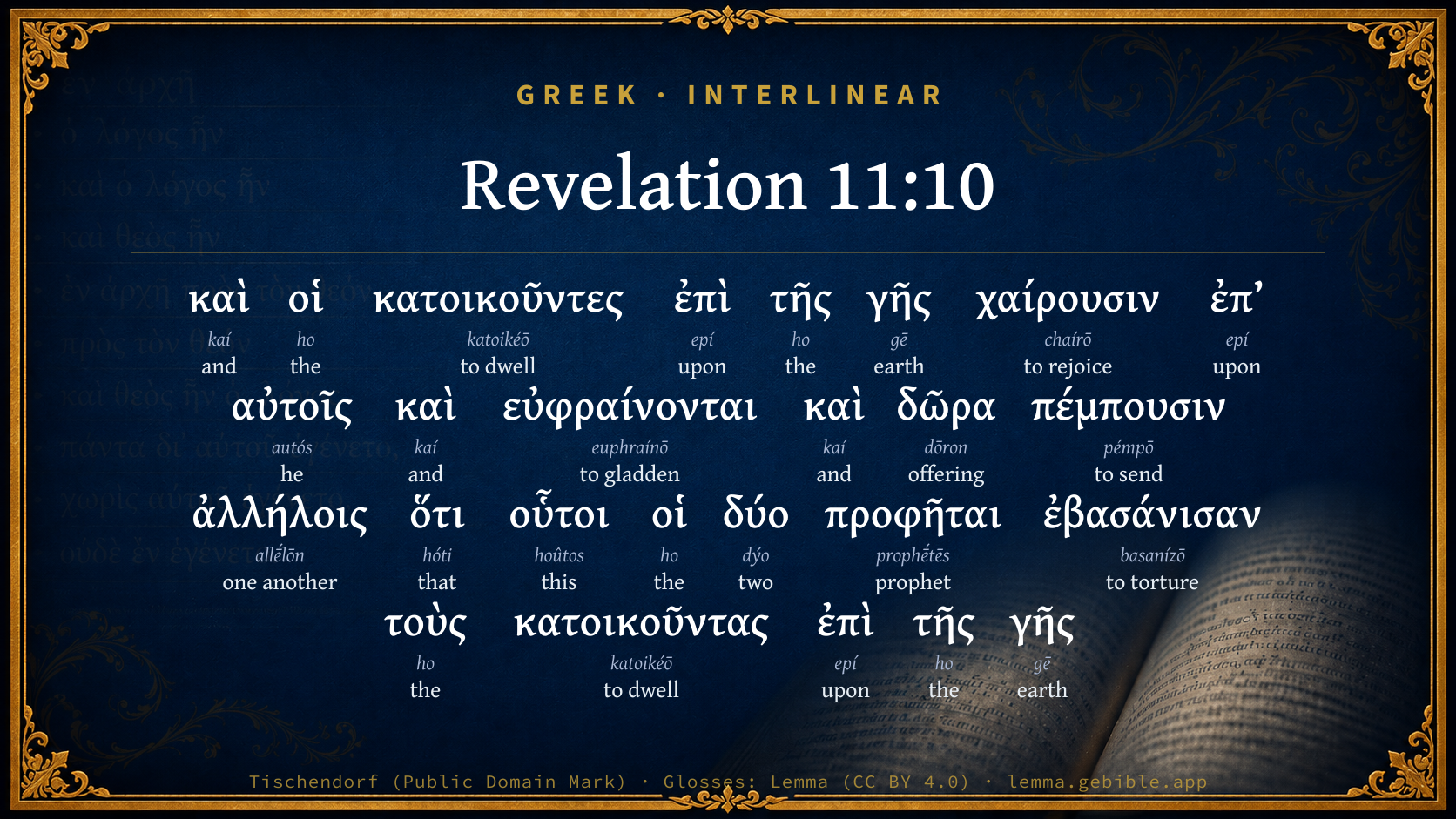
Those who dwell on the earth rejoice over them, and they will be glad. They will give gifts to one another, because these two prophets tormented those who dwell on the earth.
Download a study sheet
One document with this verse’s original text, its word-by-word gloss line, the meaning frame, cross-references with their text, attributed commentary, and full source and license credits — printable, and it pastes into notes with its structure intact.
This verse Autodidact and up
A passage Seminary Student
Up to 50 verses in one chapter. A passage sheet keeps up to 6 commentary sources and 12 cross-references per verse, in the order this page ranks them, and says so on the sheet whenever that leaves anything out. Ask for a single verse and you get the Autodidact verse sheet above.
Everything on this page stays free to read, with no account — the sheet is a download of what is already on screen, not access to it.
Compare translations 3
The same verse in 3 English versions, stacked beneath the original-language interlinear above. Click any original word for its lexicon entry.
Each is an independent rendering of the whole verse — the interlinear is not word-aligned to these translations.
Highlighted words mark where these versions differ — a whole-verse word diff, not a word-by-word alignment.
-
World English Bible Public Domain
Those who dwell on the earth rejoice over them, and they will be glad. They will give gifts to one another, because these two prophets tormented those who dwell on the earth.
-
King James Version Public Domain
And they that dwell upon the earth shall rejoice over them, and make merry, and shall send gifts one to another; because these two prophets tormented them that dwelt on the earth.
-
unfoldingWord Literal Text CC BY-SA 4.0
And the ones living on the earth rejoice over them and celebrate and send gifts to one another, because these two prophets tormented the ones living on the earth.
unfoldingWord Literal Text — © unfoldingWord, licensed CC BY-SA 4.0. Word-aligned USFM3 via Door43 (git.door43.org/unfoldingWord/en_ult).
Show all 19 translations
Every available English version of this verse, each an independent rendering of the whole verse.
-
World English Bible Public Domain
Those who dwell on the earth rejoice over them, and they will be glad. They will give gifts to one another, because these two prophets tormented those who dwell on the earth.
-
Berean Standard Bible Public Domain
And those who dwell on the earth will gloat over them, and will celebrate and send one another gifts, because these two prophets had tormented them.
-
Majority Standard Bible Public Domain
And those who dwell on the earth will gloat over them, and will celebrate and give one another gifts, because these two prophets had tormented them.
-
King James Version Public Domain
And they that dwell upon the earth shall rejoice over them, and make merry, and shall send gifts one to another; because these two prophets tormented them that dwelt on the earth.
-
American Standard Version (1901) Public Domain
And they that dwell on the earth rejoice over them, and make merry; and they shall send gifts one to another; because these two prophets tormented them that dwell on the earth.
-
Revised Version (1885) Public Domain
And they that dwell on the earth rejoice over them, and make merry; and they shall send gifts one to another; because these two prophets tormented them that dwell on the earth.
-
Geneva Bible (1599) Public Domain
And they that dwell vpon the earth, shall reioyce ouer them and be glad, and shall sende giftes one to an other: for these two Prophets vexed them that dwelt on the earth.
-
Douay-Rheims (1899) Public Domain
And they that dwell upon the earth shall rejoice over them, and make merry: and shall send gifts one to another, because these two prophets tormented them that dwelt upon the earth.
-
Young's Literal Translation Public Domain
and those dwelling upon the land shall rejoice over them, and shall make merry, and gifts they shall send to one another, because these -- the two prophets -- did torment those dwelling upon the land.'
-
Literal Standard Version CC BY-SA 4.0
and those dwelling on the earth will rejoice over them, and will make merry, and they will send gifts to one another, because these—the two prophets—tormented those dwelling on the earth.
-
Unlocked Literal Bible CC BY-SA 4.0
Those who live on the earth will rejoice over them and celebrate. They will even send gifts to one another because these two prophets tormented those who lived on the earth.
-
unfoldingWord Literal Text CC BY-SA 4.0
And the ones living on the earth rejoice over them and celebrate and send gifts to one another, because these two prophets tormented the ones living on the earth.
-
Darby Bible Public Domain
And they that dwell upon the earth rejoice over them, and are full of delight, and shall send gifts one to another, because these, the two prophets, tormented them that dwell upon the earth.
-
World Messianic Bible Public Domain
Those who dwell on the earth will rejoice over them, and they will be glad. They will give gifts to one another, because these two prophets tormented those who dwell on the earth.
-
Webster's Bible Public Domain
And they that dwell upon the earth shall rejoice over them, and make merry, and shall send gifts one to another; because these two prophets tormented them that dwelt on the earth.
-
Free Bible Version CC BY-SA 4.0
The inhabitants of the earth are delighted they are dead, and celebrate, sending gifts to each other, because these two prophets had been a torment to them.
-
Bible in Basic English Public Domain
And those who are on the earth will have pleasure and delight over them; and they will send offerings one to another because these two prophets gave great trouble to all on the earth.
-
Text-Critical English NT CC BY 4.0
And those who dwell on the earth will rejoice over them and celebrate and give each other gifts, because these two prophets had tormented those who dwell on the earth.
-
Tyndale New Testament (1534) Public Domain
And they that dwell apon the erth shall reioyce over them and be glad and shall send gyftes one to another for these two prophetes vexed them that dwelt on the erth.
Literal Standard Version (2020), Covenant Press — licensed CC BY-SA 4.0. Text via the HelloAO Bible API (eBible.org). Unlocked Literal Bible (unfoldingWord) — licensed CC BY-SA 4.0. Text via the HelloAO Bible API (eBible.org). unfoldingWord Literal Text — © unfoldingWord, licensed CC BY-SA 4.0. Word-aligned USFM3 via Door43 (git.door43.org/unfoldingWord/en_ult). Free Bible Version, Dr. Jonathan Gallagher — licensed CC BY-SA 4.0. Text via the HelloAO Bible API (eBible.org).
Word by word
More ways to search: Search by grammar → Find every occurrence → Compare this word →
Practice this passage: Drill this verse → Learn its vocabulary →
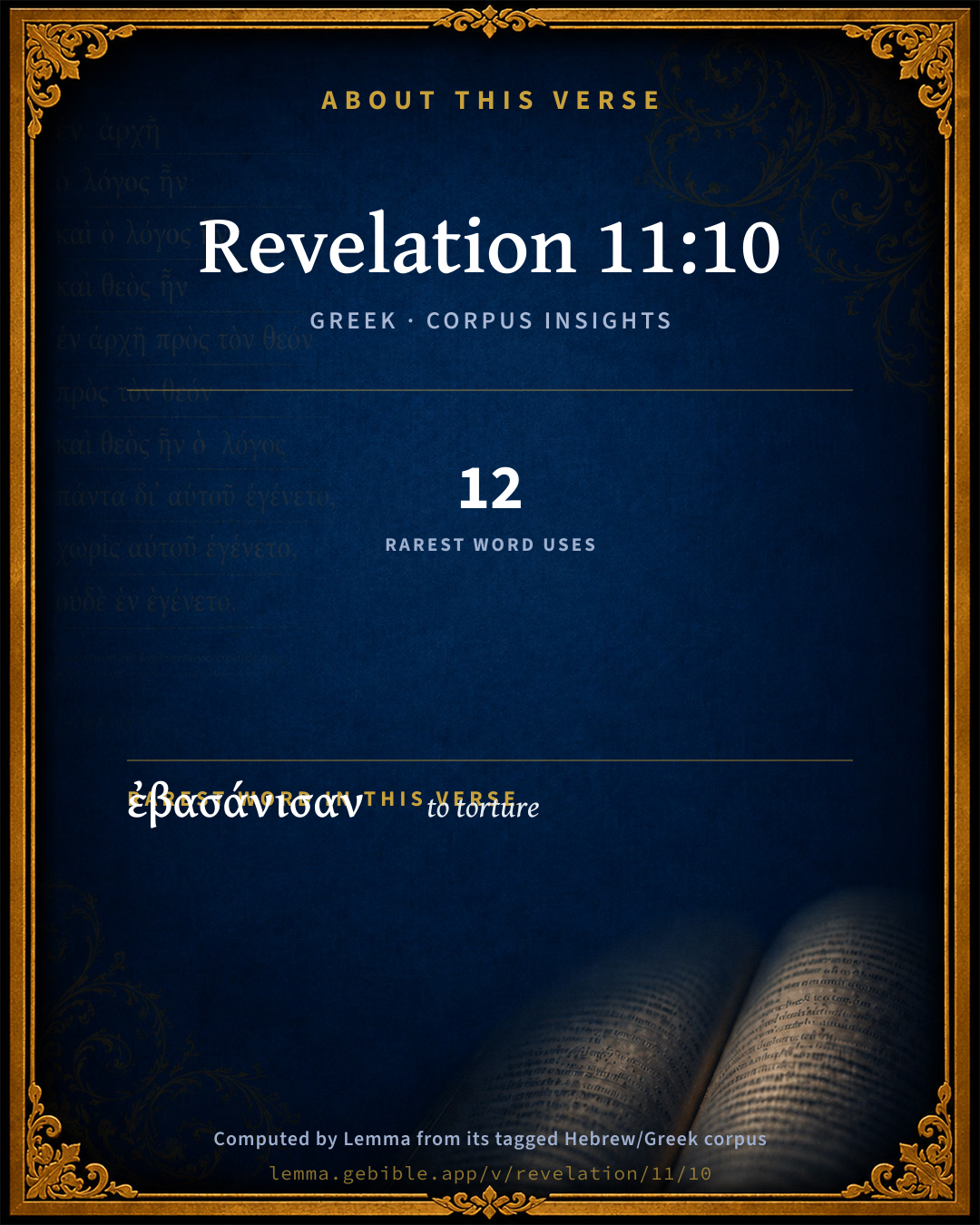
- Appears 12× in the Greek New Testament
- First appears at Matthew 8:6
- Part of Speech
- Verb
- Tense
- Aorist
- Voice
- Active
- Mood
- Indicative
- Person
- 3rd person
- Number
- Plural
Full Thayer's Definition
- καὶ kaí G2532 “and” Conjunction
- οἱ ho G3588 “the” Article, Nominative, Plural, Masculine
- κατοικοῦντες katoikéō G2730 “to dwell” Verb, Present, Active, Participle, Nominative, Plural, Masculine
- ἐπὶ epí G1909 “upon” Preposition
- τῆς ho G3588 “the” Article, Genitive, Singular, Feminine
- γῆς gē G1093 “earth” Noun, Genitive, Singular, Feminine
- χαίρουσιν chaírō G5463 “to rejoice” Verb, Present, Active, Indicative, 3rd person, Plural
- ἐπ’ epí G1909 “upon” Preposition
- αὐτοῖς autós G846 “he” Personal pronoun, Dative, Plural, Masculine
- καὶ kaí G2532 “and” Conjunction
- εὐφραίνονται euphraínō G2165 “to gladden” Verb, Present, Passive, Indicative, 3rd person, Plural
- καὶ kaí G2532 “and” Conjunction
- δῶρα dōron G1435 “offering” Noun, Accusative, Plural, Neuter
- πέμπουσιν pémpō G3992 “to send” Verb, Present, Active, Indicative, 3rd person, Plural
- ἀλλήλοις allḗlōn G240 “one another” Reciprocal pronoun, Dative, Plural, Masculine
- ὅτι hóti G3754 “that” Conjunction
- οὗτοι hoûtos G3778 “this” Demonstrative pronoun, Nominative, Plural, Masculine
- οἱ ho G3588 “the” Article, Nominative, Plural, Masculine
- δύο dýo G1417 “two” Adjective, Numeral (indeclinable)
- προφῆται prophḗtēs G4396 “prophet” Noun, Nominative, Plural, Masculine
- ἐβασάνισαν basanízō G928 “to torture” Verb, Aorist, Active, Indicative, 3rd person, Plural
- τοὺς ho G3588 “the” Article, Accusative, Plural, Masculine
- κατοικοῦντας katoikéō G2730 “to dwell” Verb, Present, Active, Participle, Accusative, Plural, Masculine
- ἐπὶ epí G1909 “upon” Preposition
- τῆς ho G3588 “the” Article, Genitive, Singular, Feminine
- γῆς gē G1093 “earth” Noun, Genitive, Singular, Feminine
About this verse
These counts appear in no published source. They are computed here, from the morphology-tagged text and Lemma’s own curated glosses. What Lemma adds →
- 26
- words
- 16
- distinct lemmas
- Revelation
- section
Cross-references
29Topical passages linked to Revelation 11:10 in the Treasury of Scripture Knowledge — connected by theme and wording, ordered by reader-vote popularity; previews shown in the World English Bible.
- 1 Kings 18:17 It happened, when Ahab saw Elijah, that Ahab said to him, Is it you, you troubler of Israel?
- 1 Kings 22:8 The king of Israel said to Jehoshaphat, there is yet one man by whom we may inquire of Yahweh, Micaiah the son of Imlah: but I hate him; for he does not prophesy good concerning me, but evil. Jehoshaphat said, "Don't let the king say so."
- Psalms 35:24–26 Vindicate me, Yahweh my God, according to your righteousness; Don't let them gloat over me.
- Micah 7:8 Don't rejoice against me, my enemy. When I fall, I will arise. When I sit in darkness, Yahweh will be a light to me.
- Matthew 10:22 You will be hated by all men for my name's sake, but he who endures to the end will be saved.
- John 7:7 The world can't hate you, but it hates me, because I testify about it, that its works are evil.
- Acts 5:33 But they, when they heard this, were cut to the heart, and determined to kill them.
- Acts 7:54–57 Now when they heard these things, they were cut to the heart, and they gnashed at him with their teeth.
- Revelation 3:10 Because you kept my command to endure, I also will keep you from the hour of testing, which is to come on the whole world, to test those who dwell on the earth.
- Revelation 11:5–6 If anyone desires to harm them, fire proceeds out of their mouth and devours their enemies. If anyone desires to harm them, he must be killed in this way.
- Revelation 13:14 He deceives my own people who dwell on the earth because of the signs he was granted to do in front of the beast; saying to those who dwell on the earth, that they should make an image to the beast who had the sword wound and lived.
- Judges 16:23–24 The lords of the Philistines gathered them together to offer a great sacrifice to Dagon their god, and to rejoice; for they said, Our god has delivered Samson our enemy into our hand.
- 1 Kings 21:20 Ahab said to Elijah, Have you found me, my enemy? He answered, I have found you, because you have sold yourself to do that which is evil in the sight of Yahweh.
- 1 Kings 22:18 The king of Israel said to Jehoshaphat, Didn't I tell you that he would not prophesy good concerning me, but evil?
- Esther 9:19–22 Therefore do the Jews of the villages, who dwell in the unwalled towns, make the fourteenth day of the month Adar [a day of] gladness and feasting, and a good day, and of sending portions one to another.
- Psalms 13:4 Lest my enemy say, "I have prevailed against him;" Lest my adversaries rejoice when I fall.
- Psalms 89:42 You have exalted the right hand of his adversaries. You have made all of his enemies rejoice.
- Proverbs 24:17 Don't rejoice when your enemy falls. Don't let your heart be glad when he is overthrown;
- Jeremiah 38:4 Then the princes said to the king, Let this man, we pray you, be put to death; because he weakens the hands of the men of war who remain in this city, and the hands of all the people, in speaking such words to them: for this man doesn't seek the welfare of this people, but the hurt.
- John 16:20 Most assuredly I tell you, that you will weep and lament, but the world will rejoice. You will be sorrowful, but your sorrow will be turned into joy.
- 1 Corinthians 13:6 doesn't rejoice in unrighteousness, but rejoices with the truth;
- Revelation 13:8 All who dwell on the earth will worship him, everyone whose name has not been written from the foundation of the world in the book of life of the Lamb who has been killed.
- Nehemiah 8:10–12 Then he said to them, Go your way, eat the fat, and drink the sweet, and send portions to him for whom nothing is prepared; for this day is holy to our Lord: neither be you grieved; for the joy of Yahweh is your strength.
- Psalms 35:19 Don't let those who are my enemies wrongfully rejoice over me; Neither let them wink with the eye who hate me without a cause.
- Jeremiah 50:11 Because you are glad, because you rejoice, O you who plunder my heritage, because you are wanton as a heifer that treads out [the grain], and neigh as strong horses;
- Obadiah 1:12 But don't look down on your brother in the day of his disaster, and don't rejoice over the children of Judah in the day of their destruction. Don't speak proudly in the day of distress.
- Acts 17:5–6 But the unpersuaded Jews took along some wicked men from the marketplace, and gathering a crowd, set the city in an uproar. Assaulting the house of Jason, they sought to bring them out to the people.
- Revelation 12:13 When the dragon saw that he was thrown down to the earth, he persecuted the woman who gave birth to the male child.
- Revelation 16:10 The fifth poured out his bowl on the throne of the beast, and his kingdom was darkened. They gnawed their tongues because of the pain,
Cross-references courtesy of OpenBible.info (CC BY 4.0).
Where the printed editions differ
1 variantPlaces in this verse where the major printed Greek editions disagree on the wording in a way that affects the translation — a comparison of editions, not a manuscript-by-manuscript collation. The editions are the modern critical texts (Nestlé-Aland 28/27, SBL, Westcott-Hort, Tregelles, Tyndale House) and the traditional texts behind the KJV (the Textus Receptus and the Byzantine/Majority text). It is not a claim about which reading is original.
-
Different wording
πέμψουσιν
“will send”
In NA28NA27TynSBLWHTregTR Not in Byzδώσουσιν (dōsousin) 'will give' occurs in a few manuscripts (Byz) instead of πέμψουσιν (pempsousin) 'will send' in older manuscripts (NA28+NA27+Tyn+SBL+WH+Treg+TR)
Textual data: Translators Amalgamated Greek New Testament (STEPBible TAGNT) · CC BY 4.0.
Lesson kit
Teaching starters — assembled from the data on this page, not authored interpretation. Every prompt links to the verse data it draws on. Edit before teaching.
Revelation, in the Revelation, opens this verse with 26 words (16 distinct Greek lemmas). Its most distinctive word is basanízō (“to torture”). A historical commentator’s framing appears above. Read the whole chapter for the surrounding context.
Discussion questions
- How does “to torture” (basanízō) shape what this verse is saying?
- Matthew 8:6 shares the word «to torture» with this verse. How do the two illuminate each other?
- “upon” occurs 3× in this one verse. What is the effect of the repetition?
- The translations on this page render this verse differently — a whole-verse word diff, not a word-by-word alignment. What might account for the different wordings?
- Reading how Tyndale Open Study Notes and Expositor's Greek Testament read this verse, where do the two commentators agree and where do they part?
Things to notice
- These translations choose different wording for 14 words in this verse.
- “upon” occurs 3× in this single verse.
- 16 distinct Greek lemmas span 26 words in this verse.
Commentary
Notes on Revelation 11:10 from classic Christian and Jewish commentators (each source and its license shown beneath its notes). The classic Christian expositions comment on the surrounding passage and are grouped to its opening verse, so a note may address several verses; the Jewish commentaries on the Tanakh (Rashi and others) are per-verse, so they appear only where the commentator wrote on this verse.
Lemma curates 59 commentaries, every one of them public domain or Creative Commons licensed, each selected and text-cleaned for this edition rather than reprinted as found. About our sources →
Tyndale Open Study Notes
Tyndale Open Resources
Tyndale Open Study Notes — © Tyndale Open Resources, licensed CC BY-SA 4.0. Text via the HelloAO Bible API.
Expositor's Greek Testament
ed. W. Robertson Nicoll
The Expositor's Greek Testament, edited by W. Robertson Nicoll (1897–1910) — public domain. Text from a community e-Sword module.
Geneva Bible (1599)
Geneva Bible translators
Geneva Bible (1599) marginal notes — public domain. Text via Bolls.life.
Jamieson, Fausset & Brown
Robert Jamieson, A. R. Fausset & David Brown
Jamieson, Fausset & Brown — Commentary Critical and Explanatory on the Whole Bible (1871) — public domain (CC PDM 1.0). Text via the HelloAO Bible API.
Adam Clarke's Commentary
Adam Clarke's Commentary on the Bible (1810–1826) — public domain. Text from a community e-Sword/MySword module.
John Gill's Exposition
John Gill's Exposition of the Whole Bible (1746–1763) — public domain (CC PDM 1.0). Text via the HelloAO Bible API.
Trapp's Complete Commentary
John Trapp
John Trapp, A Commentary or Exposition upon All the Books of the Old and New Testament (1647–1656) — public domain. Text from a community e-Sword module.
Albert Barnes' Notes on the Bible
Albert Barnes' Notes on the Bible (1834–1885) — public domain. Text from a community e-Sword/MySword module.
Haydock's Catholic Bible Commentary
George Leo Haydock (1774–1849), Haydock's Catholic Family Bible and Commentary, 1859 edition — public domain. Excludes Psalms (Douay-Rheims chapter numbering differs from Protestant) and Deuterocanonical books (Catholic canon only).
Matthew Poole's English Annotations
Matthew Poole's English Annotations on the Holy Bible (1683–1685) — public domain. Text from a community e-Sword/MySword module.
Whedon's Commentary on the Bible
Daniel D. Whedon
Daniel D. Whedon (gen. ed.), Commentary on the Old and New Testaments (1874–1909) — public domain. Text from a community e-Sword module.
The Pulpit Commentary
The Pulpit Commentary (1880–1919), ed. H.D.M. Spence-Jones & Joseph S. Exell — public domain. Text from a community e-Sword module.
John Wesley's Explanatory Notes
John Wesley, Explanatory Notes Upon the Whole Bible (1754–1765) — public domain. Text via the GEBible commentary corpus.
The People's New Testament
B. W. Johnson
B. W. Johnson's The People's New Testament with Notes (1889–1891) — public domain. Electronic text from the Christian Classics Ethereal Library (CCEL) ThML edition.
unfoldingWord translationNotes
Door43 World Missions Community
unfoldingWord translationNotes — © Distant Shores Media and the Door43 World Missions Community, licensed CC BY-SA 4.0. Source: git.door43.org/Door43/en_tn.
Cambridge Greek Testament for Schools and Colleges
Cambridge Greek Testament for Schools and Colleges (Cambridge University Press, 1896; 21 vols, various authors incl. Carr, Maclear, Plummer, Farrar, Lumby, Moule, M. R. James, Simcox) — public domain. Text from a community e-Sword module.
Vincent's Word Studies in the New Testament
Marvin R. Vincent
Marvin R. Vincent, Word Studies in the New Testament (1887–1900) — public domain. Text from a community e-Sword/MySword module.