

Acts 7:36
Greek (Tischendorf 8th ed.) Acts 7:36 appears in the Greek New Testament. The text above is from the Tischendorf 8th edition. Each word links to its Strong’s number and a concise gloss. Click any word for its full Thayer’s Greek Lexicon entry.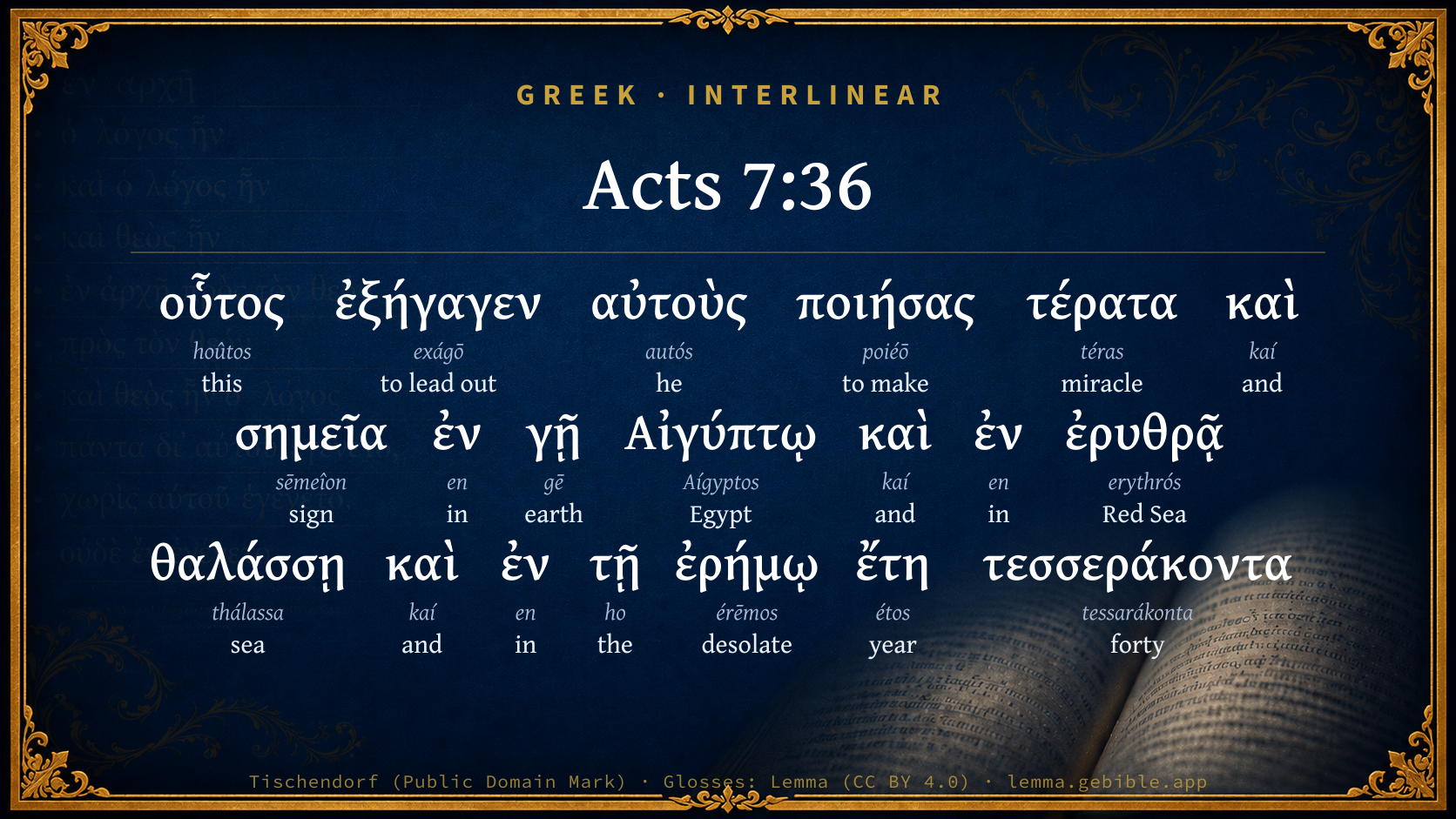
This man led them out, having worked wonders and signs in Egypt, in the Red Sea, and in the wilderness for forty years.
Download a study sheet
One document with this verse’s original text, its word-by-word gloss line, the meaning frame, cross-references with their text, attributed commentary, and full source and license credits — printable, and it pastes into notes with its structure intact.
This verse Autodidact and up
A passage Seminary Student
Up to 50 verses in one chapter. A passage sheet keeps up to 6 commentary sources and 12 cross-references per verse, in the order this page ranks them, and says so on the sheet whenever that leaves anything out. Ask for a single verse and you get the Autodidact verse sheet above.
Everything on this page stays free to read, with no account — the sheet is a download of what is already on screen, not access to it.
Compare translations 3
The same verse in 3 English versions, stacked beneath the original-language interlinear above. Click any original word for its lexicon entry.
Each is an independent rendering of the whole verse — the interlinear is not word-aligned to these translations.
Highlighted words mark where these versions differ — a whole-verse word diff, not a word-by-word alignment.
-
World English Bible Public Domain
This man led them out, having worked wonders and signs in Egypt, in the Red Sea, and in the wilderness for forty years.
-
King James Version Public Domain
He brought them out, after that he had shewed wonders and signs in the land of Egypt, and in the Red sea, and in the wilderness forty years.
-
unfoldingWord Literal Text CC BY-SA 4.0
This one led them out, doing wonders and signs in the land of Egypt and at the Red Sea, and in the wilderness during 40 years.
unfoldingWord Literal Text — © unfoldingWord, licensed CC BY-SA 4.0. Word-aligned USFM3 via Door43 (git.door43.org/unfoldingWord/en_ult).
Show all 19 translations
Every available English version of this verse, each an independent rendering of the whole verse.
-
World English Bible Public Domain
This man led them out, having worked wonders and signs in Egypt, in the Red Sea, and in the wilderness for forty years.
-
Berean Standard Bible Public Domain
He led them out and performed wonders and signs in the land of Egypt, at the Red Sea, and for forty years in the wilderness.
-
Majority Standard Bible Public Domain
He led them out and performed wonders and signs in the land of Egypt, at the Red Sea, and for forty years in the wilderness.
-
King James Version Public Domain
He brought them out, after that he had shewed wonders and signs in the land of Egypt, and in the Red sea, and in the wilderness forty years.
-
American Standard Version (1901) Public Domain
This man led them forth, having wrought wonders and signs in Egypt, and in the Red Sea, and in the wilderness forty years.
-
Revised Version (1885) Public Domain
This man led them forth, having wrought wonders and signs in Egypt, and in the Red sea, and in the wilderness forty years.
-
Geneva Bible (1599) Public Domain
Hee brought them out, doing wonders, and miracles in the land of Egypt, and in the red sea, and in the wildernes fourtie yeeres.
-
Douay-Rheims (1899) Public Domain
He brought them out, doing wonders and signs in the land of Egypt, and in the Red Sea, and in the desert forty years.
-
Young's Literal Translation Public Domain
this one did bring them forth, having done wonders and signs in the land of Egypt, and in the Red Sea, and in the wilderness forty years;
-
Literal Standard Version CC BY-SA 4.0
this one brought them forth, having done wonders and signs in the land of Egypt, and in the Red Sea, and in the wilderness forty years;
-
Unlocked Literal Bible CC BY-SA 4.0
Moses led them out of Egypt, after doing miracles and signs in Egypt and at the Sea of Reeds, and in the wilderness during forty years.
-
unfoldingWord Literal Text CC BY-SA 4.0
This one led them out, doing wonders and signs in the land of Egypt and at the Red Sea, and in the wilderness during 40 years.
-
Darby Bible Public Domain
*He* led them out, having wrought wonders and signs in the land of Egypt, and in the Red sea, and in the wilderness forty years.
-
World Messianic Bible Public Domain
This man led them out, having worked wonders and signs in Egypt, in the Sea of Suf, and in the wilderness for forty years.
-
Webster's Bible Public Domain
He brought them out, after he had showed wonders and signs in the land of Egypt, and in the Red sea, and in the wilderness forty years.
-
Free Bible Version CC BY-SA 4.0
Moses led them out after performing miraculous signs in Egypt, and in the Red Sea, and continued to do so in the desert for forty years.
-
Bible in Basic English Public Domain
This man took them out, having done wonders and signs in Egypt and in the Red Sea and in the waste land, for forty years.
-
Text-Critical English NT CC BY 4.0
He is the one who led them out, performing wonders and signs in the land of Egypt, at the Red Sea, and in the wilderness for forty years.
-
Tyndale New Testament (1534) Public Domain
And the same brought them out shewynge wonders and signes in Egypte and in the reed see and in the wyldernes.xl. yeares.
Literal Standard Version (2020), Covenant Press — licensed CC BY-SA 4.0. Text via the HelloAO Bible API (eBible.org). Unlocked Literal Bible (unfoldingWord) — licensed CC BY-SA 4.0. Text via the HelloAO Bible API (eBible.org). unfoldingWord Literal Text — © unfoldingWord, licensed CC BY-SA 4.0. Word-aligned USFM3 via Door43 (git.door43.org/unfoldingWord/en_ult). Free Bible Version, Dr. Jonathan Gallagher — licensed CC BY-SA 4.0. Text via the HelloAO Bible API (eBible.org).
Word by word
More ways to search: Search by grammar → Find every occurrence → Compare this word →
Practice this passage: Drill this verse → Learn its vocabulary →
- Appears 2× in the Greek New Testament
- First appears here
- Part of Speech
- Adjective
- Case
- Dative
- Number
- Singular
- Gender
- Feminine
Full Thayer's Definition
- οὗτος hoûtos G3778 “this” Demonstrative pronoun, Nominative, Singular, Masculine
- ἐξήγαγεν exágō G1806 “to lead out” Verb, Aorist, Active, Indicative, 3rd person, Singular
- αὐτοὺς autós G846 “he” Personal pronoun, Accusative, Plural, Masculine
- ποιήσας poiéō G4160 “to make” Verb, Aorist, Active, Participle, Nominative, Singular, Masculine
- τέρατα téras G5059 “miracle” Noun, Accusative, Plural, Neuter
- καὶ kaí G2532 “and” Conjunction
- σημεῖα sēmeîon G4592 “sign” Noun, Accusative, Plural, Neuter
- ἐν en G1722 “in” Preposition
- γῇ gē G1093 “earth” Noun, Dative, Singular, Feminine
- Αἰγύπτῳ Aígyptos G125 “Egypt” Noun, Dative, Singular, Feminine
- καὶ kaí G2532 “and” Conjunction
- ἐν en G1722 “in” Preposition
- ἐρυθρᾷ erythrós G2063 “Red Sea” Adjective, Dative, Singular, Feminine
- θαλάσσῃ thálassa G2281 “sea” Noun, Dative, Singular, Feminine
- καὶ kaí G2532 “and” Conjunction
- ἐν en G1722 “in” Preposition
- τῇ ho G3588 “the” Article, Dative, Singular, Feminine
- ἐρήμῳ érēmos G2048 “desolate” Adjective, Dative, Singular, Feminine
- ἔτη étos G2094 “year” Noun, Accusative, Plural, Neuter
- τεσσεράκοντα tessarákonta G5062 “forty” Adjective, Numeral (indeclinable)
About this verse
These counts appear in no published source. They are computed here, from the morphology-tagged text and Lemma’s own curated glosses. What Lemma adds →
- 20
- words
- 16
- distinct lemmas
- Acts
- section
Notable vocabulary
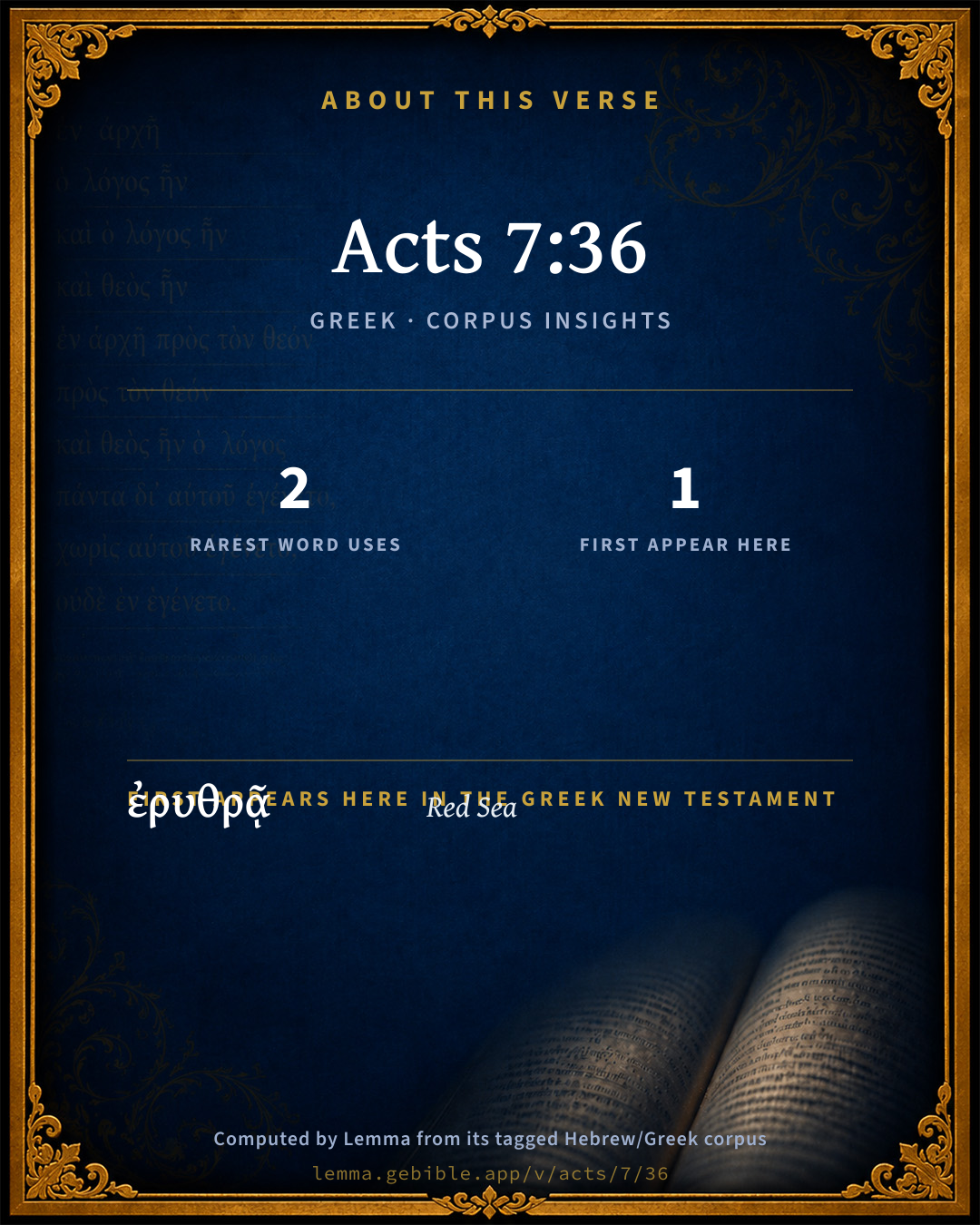
The rarest word here is ἐρυθρᾷ Red Sea G2063 — appearing just 2 times in the whole Greek New Testament.
First appearance in Scripture
This word makes its first canonical appearance in the Greek New Testament here:
- ἐρυθρᾷ Red Sea G2063
Shared distinctive vocabulary
ἐρυθρᾷ Red Sea G2063 occurs in 2 verses of the Greek New Testament. Also found in:
Cross-references
33Topical passages linked to Acts 7:36 in the Treasury of Scripture Knowledge — connected by theme and wording, ordered by reader-vote popularity; previews shown in the World English Bible.
- Exodus 12:41 It happened at the end of four hundred thirty years, even the same day it happened, that all the hosts of Yahweh went out from the land of Egypt.
- Exodus 14:21 Moses stretched out his hand over the sea, and Yahweh caused the sea to go back by a strong east wind all the night, and made the sea dry land, and the waters were divided.
- Exodus 33:1 Yahweh spoke to Moses, "Depart, go up from here, you and the people that you have brought up out of the land of Egypt, to the land of which I swore to Abraham, to Isaac, and to Jacob, saying, 'I will give it to your seed.'
- Exodus 7:1–14 Yahweh said to Moses, "Behold, I have made you as God to Pharaoh; and Aaron your brother shall be your prophet.
- Exodus 14:27–29 Moses stretched out his hand over the sea, and the sea returned to its strength when the morning appeared; and the Egyptians fled against it. Yahweh overthrew the Egyptians in the midst of the sea.
- Exodus 16:35 The children of Israel ate the manna forty years, until they came to an inhabited land. They ate the manna until they came to the borders of the land of Canaan.
- Psalms 78:12–33 He did marvelous things in the sight of their fathers, In the land of Egypt, in the field of Zoan.
- Exodus 15:23–25 When they came to Marah, they couldn't drink from the waters of Marah, for they were bitter. Therefore the name of it was called Marah.
- Exodus 16:1–17 They took their journey from Elim, and all the congregation of the children of Israel came to the wilderness of Sin, which is between Elim and Sinai, on the fifteenth day of the second month after their departing out of the land of Egypt.
- Exodus 19:1–20 In the third month after the children of Israel had gone forth out of the land of Egypt, on that same day they came into the wilderness of Sinai.
- Numbers 11:1–35 The people were as murmurers, [speaking] evil in the ears of Yahweh: and when Yahweh heard it, his anger was kindled; and the fire of Yahweh burnt among them, and devoured in the uttermost part of the camp.
- Numbers 14:1–45 All the congregation lifted up their voice, and cried; and the people wept that night.
- Numbers 16:1–17 Now Korah, the son of Izhar, the son of Kohath, the son of Levi, with Dathan and Abiram, the sons of Eliab, and On, the son of Peleth, sons of Reuben, took [men]:
- Numbers 20:1–21 The children of Israel, even the whole congregation, came into the wilderness of Zin in the first month: and the people abode in Kadesh; and Miriam died there, and was buried there.
- Deuteronomy 2:25–37 This day will I begin to put the dread of you and the fear of you on the peoples who are under the whole sky, who shall hear the report of you, and shall tremble, and be in anguish because of you.
- Deuteronomy 4:33–37 Did ever a people hear the voice of God speaking out of the midst of the fire, as you have heard, and live?
- Deuteronomy 6:21–22 then you shall tell your son, We were Pharaoh's bondservants in Egypt: and Yahweh brought us out of Egypt with a mighty hand;
- Deuteronomy 8:4 Your clothing didn't grow old on you, neither did your foot swell, these forty years.
- Nehemiah 9:10 and shown signs and wonders on Pharaoh, and on all his servants, and on all the people of his land; for you knew that they dealt proudly against them, and did get you a name, as it is this day.
- Nehemiah 9:12–15 Moreover in a pillar of cloud you led them by day; and in a pillar of fire by night, to give them light in the way in which they should go.
- Nehemiah 9:18–22 Yes, when they had made them a molten calf, and said, This is your God who brought you up out of Egypt, and had committed awful blasphemies;
- Psalms 78:42–51 They didn't remember his hand, Nor the day when he redeemed them from the adversary;
- Psalms 95:10 Forty long years I was grieved with that generation, And said, "It is a people that errs in their heart. They have not known my ways."
- Psalms 105:27–36 They performed miracles among them, And wonders in the land of Ham.
- Psalms 105:39–45 He spread a cloud for a covering, Fire to give light in the night.
- Psalms 106:8–11 Nevertheless he saved them for his name's sake, That he might make his mighty power known.
- Psalms 106:17–18 The earth opened and swallowed up Dathan, And covered the company of Abiram.
- Psalms 135:8–12 Who struck the firstborn of Egypt, Both of man and animal;
- Psalms 136:9–21 The moon and stars to rule by night; For his loving kindness endures forever:
- Acts 7:42 But God turned, and gave them up to serve the host of the sky, as it is written in the book of the prophets, 'Did you offer to me slain animals and sacrifices Forty years in the wilderness, O house of Israel?
- Acts 13:18 For a period of about forty years he put up with them in the wilderness.
- Hebrews 8:9 Not according to the covenant that I made with their fathers, In the day that I took them by the hand to lead them out of the land of Egypt; For they didn't continue in my covenant, And I disregarded them," says the Lord.
- Numbers 9:15–23 On the day that the tabernacle was raised up, the cloud covered the tabernacle, even the Tent of the Testimony: and at evening it was over the tabernacle as it were the appearance of fire, until morning.
Cross-references courtesy of OpenBible.info (CC BY 4.0).
Lesson kit
Teaching starters — assembled from the data on this page, not authored interpretation. Every prompt links to the verse data it draws on. Edit before teaching.
Acts, in the Acts, opens this verse with 20 words (16 distinct Greek lemmas). Its most distinctive word is erythrós (“Red Sea”). A historical commentator’s framing appears above. Read the whole chapter for the surrounding context.
Discussion questions
- What does “Red Sea” (erythrós) contribute to the verse as a whole?
- This is the first place “Red Sea” appears in Scripture (first appears here). What does its debut here establish?
- How does Hebrews 11:29, which shares the word «Red Sea», read alongside this verse?
- What does the repetition of “and” (3× in this one verse) do in this verse?
- These translations render this verse differently; the difference is in the English rendering, not the original. What questions does that raise?
- Compare how Bengel's Gnomon and Expositor's Greek Testament read this verse. Where do they agree or differ?
Things to notice
- 1 word makes its first canonical appearance in Scripture here.
- These translations choose different wording for 14 words in this verse.
- “and” occurs 3× in this single verse.
- 16 distinct Greek lemmas span 20 words in this verse.
Commentary
Notes on Acts 7:36 from classic Christian and Jewish commentators (each source and its license shown beneath its notes). The classic Christian expositions comment on the surrounding passage and are grouped to its opening verse, so a note may address several verses; the Jewish commentaries on the Tanakh (Rashi and others) are per-verse, so they appear only where the commentator wrote on this verse.
Lemma curates 59 commentaries, every one of them public domain or Creative Commons licensed, each selected and text-cleaned for this edition rather than reprinted as found. About our sources →
Bengel's Gnomon
Johann Albrecht Bengel
Bengel's Gnomon of the New Testament — English translation (T&T Clark, Edinburgh, 1860) — public domain. Text from a community e-Sword module.
Expositor's Greek Testament
ed. W. Robertson Nicoll
The Expositor's Greek Testament, edited by W. Robertson Nicoll (1897–1910) — public domain. Text from a community e-Sword module.
Adam Clarke's Commentary
Adam Clarke's Commentary on the Bible (1810–1826) — public domain. Text from a community e-Sword/MySword module.
Ellicott's Commentary for English Readers
A Bible Commentary for English Readers, edited by Charles John Ellicott (1878–1897) — public domain. Text from a community e-Sword module.
The Cambridge Bible for Schools and Colleges
gen. ed. J. J. S. Perowne
The Cambridge Bible for Schools and Colleges (gen. ed. J. J. S. Perowne; Cambridge University Press, 1878–1918) — public domain. Text from a community e-Sword module.
John Gill's Exposition
John Gill's Exposition of the Whole Bible (1746–1763) — public domain (CC PDM 1.0). Text via the HelloAO Bible API.
Trapp's Complete Commentary
John Trapp
John Trapp, A Commentary or Exposition upon All the Books of the Old and New Testament (1647–1656) — public domain. Text from a community e-Sword module.
Albert Barnes' Notes on the Bible
Albert Barnes' Notes on the Bible (1834–1885) — public domain. Text from a community e-Sword/MySword module.
Matthew Poole's English Annotations
Matthew Poole's English Annotations on the Holy Bible (1683–1685) — public domain. Text from a community e-Sword/MySword module.
Whedon's Commentary on the Bible
Daniel D. Whedon
Daniel D. Whedon (gen. ed.), Commentary on the Old and New Testaments (1874–1909) — public domain. Text from a community e-Sword module.
The Pulpit Commentary
The Pulpit Commentary (1880–1919), ed. H.D.M. Spence-Jones & Joseph S. Exell — public domain. Text from a community e-Sword module.
Godbey's Commentary on the New Testament
William B. Godbey
William B. Godbey, Commentary on the New Testament (1896–1900) — public domain. Text from a community e-Sword module.
McGarvey & Pendleton's Commentaries
J. W. McGarvey
J. W. McGarvey (with Philip Y. Pendleton), Commentaries on the New Testament (The Fourfold Gospel, 1914; Acts; and the epistles) — public domain. Text from a community e-Sword/MySword module.
Cambridge Greek Testament for Schools and Colleges
Cambridge Greek Testament for Schools and Colleges (Cambridge University Press, 1896; 21 vols, various authors incl. Carr, Maclear, Plummer, Farrar, Lumby, Moule, M. R. James, Simcox) — public domain. Text from a community e-Sword module.