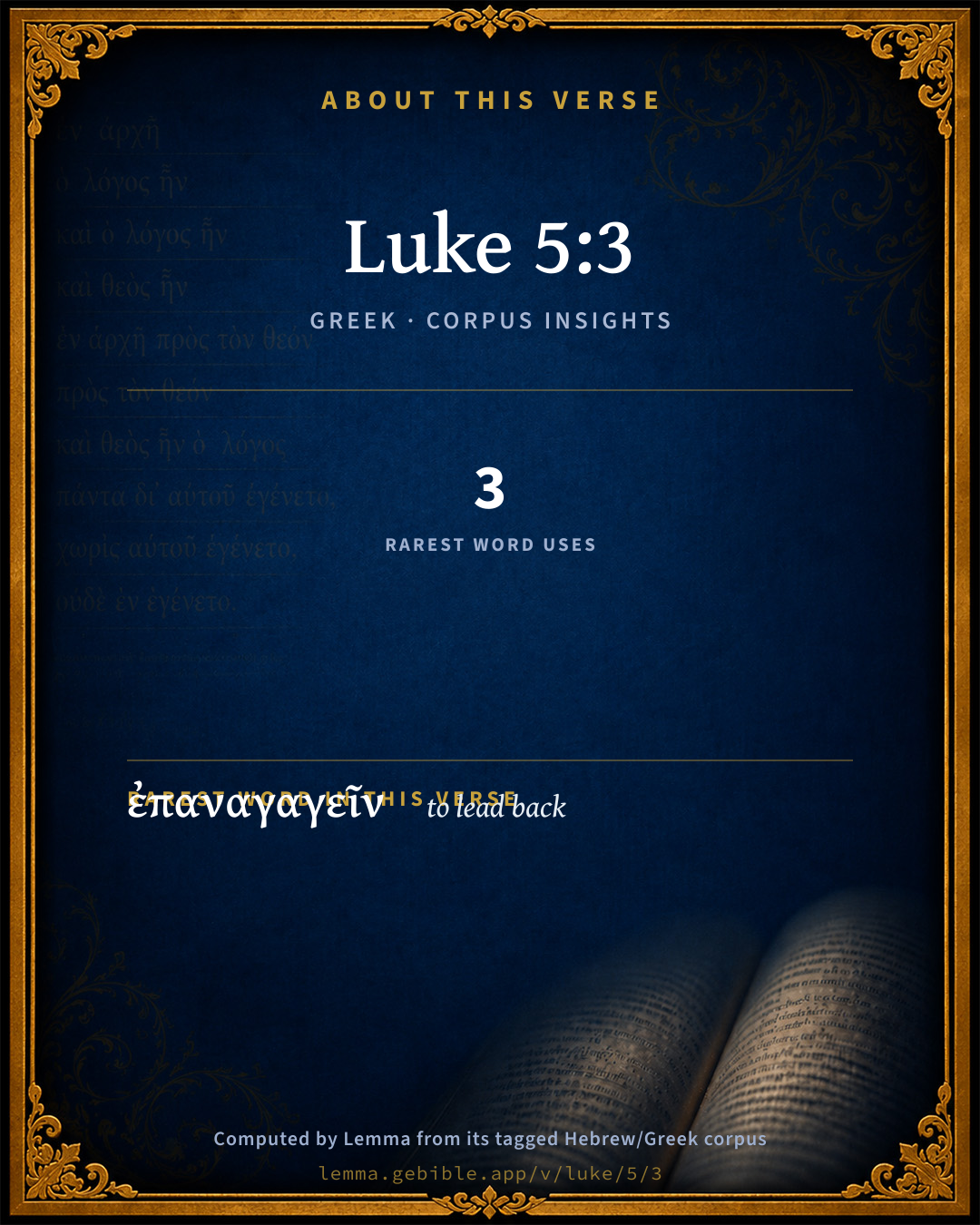
Luke 5:3

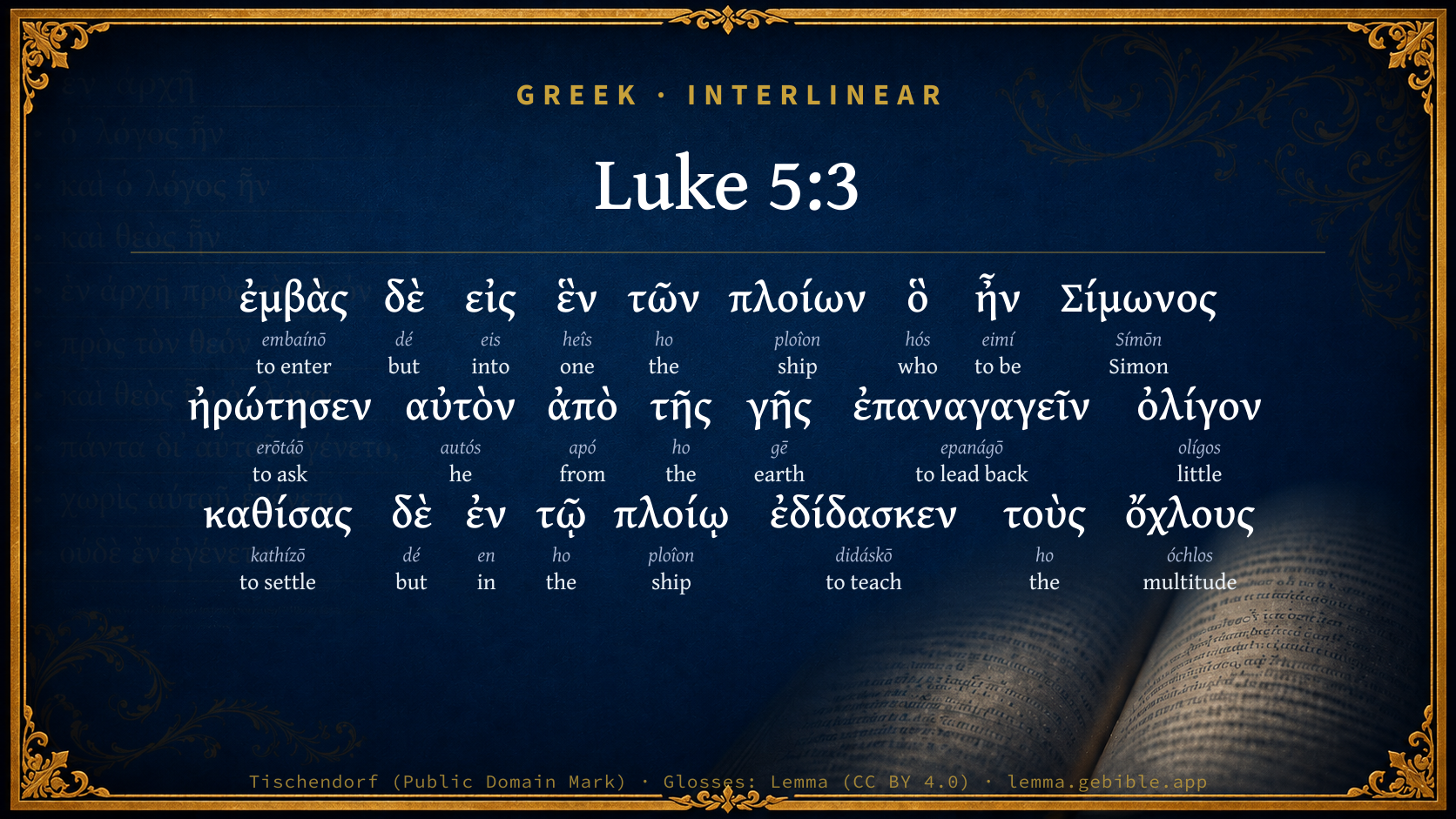
Greek (Tischendorf 8th ed.) Luke 5:3 appears in the Greek New Testament. The text above is from the Tischendorf 8th edition. Each word links to its Strong’s number and a concise gloss. Click any word for its full Thayer’s Greek Lexicon entry.
Download image
Cite this verse

Luke 5:3 (World English Bible). Public Domain. Lemma interlinear Bible study tool, https://lemma.gebible.app/v/luke/5/3.

Show BibTeX & RIS
BibTeX
RIS
English Translation
He entered into one of the boats, which was Simon's, and asked him to put out a little from the land. He sat down and taught the multitudes from the boat.
World English Bible · Public Domain
Download a study sheet

One document with this verse’s original text, its word-by-word gloss line, the meaning frame, cross-references with their text, attributed commentary, and full source and license credits — printable, and it pastes into notes with its structure intact.

This verse Autodidact and up

Study sheet (.html) Plain text (.txt)

A passage Seminary Student

Up to 50 verses in one chapter. A passage sheet keeps up to 6 commentary sources and 12 cross-references per verse, in the order this page ranks them, and says so on the sheet whenever that leaves anything out. Ask for a single verse and you get the Autodidact verse sheet above.

Everything on this page stays free to read, with no account — the sheet is a download of what is already on screen, not access to it.

Want to remove ads? Support Godless Engineer
Compare translations 3

The same verse in 3 English versions, stacked beneath the original-language interlinear above. Click any original word for its lexicon entry.

Each is an independent rendering of the whole verse — the interlinear is not word-aligned to these translations.

Highlighted words mark where these versions differ — a whole-verse word diff, not a word-by-word alignment.

  • World English Bible Public Domain
    He entered into one of the boats, which was Simon's, and asked him to put out a little from the land. He sat down and taught the multitudes from the boat.
  • King James Version Public Domain
    And he entered into one of the ships, which was Simon's, and prayed him that he would thrust out a little from the land. And he sat down, and taught the people out of the ship.
  • unfoldingWord Literal Text CC BY-SA 4.0
    Then he got into one of the boats, which was Simon’s, asked him to put out a little from the land. Then he sat down was teaching the crowds from the boat.

unfoldingWord Literal Text — © unfoldingWord, licensed CC BY-SA 4.0. Word-aligned USFM3 via Door43 (git.door43.org/unfoldingWord/en_ult).

Versions to compare (up to 4)

3 of 4 selected

Show all 19 translations

Every available English version of this verse, each an independent rendering of the whole verse.

  • World English Bible Public Domain
    He entered into one of the boats, which was Simon's, and asked him to put out a little from the land. He sat down and taught the multitudes from the boat.
  • Berean Standard Bible Public Domain
    Jesus got into the boat belonging to Simon and asked him to put out a little from shore. And sitting down, He taught the people from the boat.
  • Majority Standard Bible Public Domain
    Jesus got into the boat belonging to Simon and asked him to put out a little from shore. And sitting down, He taught the people from the boat.
  • King James Version Public Domain
    And he entered into one of the ships, which was Simon's, and prayed him that he would thrust out a little from the land. And he sat down, and taught the people out of the ship.
  • American Standard Version (1901) Public Domain
    And he entered into one of the boats, which was Simon's, and asked him to put out a little from the land. And he sat down and taught the multitudes out of the boat.
  • Revised Version (1885) Public Domain
    And he entered into one of the boats, which was Simon’s, and asked him to put out a little from the land. And he sat down and taught the multitudes out of the boat.
  • Geneva Bible (1599) Public Domain
    And he entred into one of the ships, which was Simons, and required him that he would thrust off a litle from the land: and he sate downe, and taught the people out of the ship.
  • Douay-Rheims (1899) Public Domain
    And going into one of the ships that was Simon's, he desired him to draw back a little from the land. And sitting he taught the multitudes out of the ship.
  • Young's Literal Translation Public Domain
    and having entered into one of the boats, that was Simon's, he asked him to put back a little from the land, and having sat down, was teaching the multitudes out of the boat.
  • Literal Standard Version CC BY-SA 4.0
    and having entered into one of the boats, that was Simon’s, He asked him to put back a little from the land, and having sat down, was teaching the multitudes out of the boat.
  • Unlocked Literal Bible CC BY-SA 4.0
    Jesus got into one of the boats, which was Simon's, and asked him to put it out in the water a short distance from the land. Then he sat down and taught the people out of the boat.
  • unfoldingWord Literal Text CC BY-SA 4.0
    Then he got into one of the boats, which was Simon’s, asked him to put out a little from the land. Then he sat down was teaching the crowds from the boat.
  • Darby Bible Public Domain
    And getting into one of the ships, which was Simon's, he asked him to draw out a little from the land; and he sat down and taught the crowds out of the ship.
  • World Messianic Bible Public Domain
    He entered into one of the boats, which was Simon’s, and asked him to put out a little from the land. He sat down and taught the multitudes from the boat.
  • Webster's Bible Public Domain
    And he entered into one of the boats, which was Simon's, and prayed him that he would thrust out a little from the land. And he sat down, and taught the people out of the boat.
  • Free Bible Version CC BY-SA 4.0
    Jesus got into a boat, the one that belonged to Simon, and asked him to push it out into the water, just offshore. Then Jesus sat down in the boat and taught the people from there.
  • Bible in Basic English Public Domain
    And he got into one of the boats, the property of Simon, and made a request to him to go a little way out from the land. And being seated he gave the people teaching from the boat.
  • Text-Critical English NT CC BY 4.0
    He got into one of the boats, the one that was Simon's, and asked him to put out a little way from the shore. Then he sat down and began teaching the crowds from the boat.
  • Tyndale New Testament (1534) Public Domain
    And he entred in to one of the shippes which perteyned to Simon and prayed him that he wolde thrust out a litell from the londe. And he sate doune and taught the people out of the ship.

Literal Standard Version (2020), Covenant Press — licensed CC BY-SA 4.0. Text via the HelloAO Bible API (eBible.org). Unlocked Literal Bible (unfoldingWord) — licensed CC BY-SA 4.0. Text via the HelloAO Bible API (eBible.org). unfoldingWord Literal Text — © unfoldingWord, licensed CC BY-SA 4.0. Word-aligned USFM3 via Door43 (git.door43.org/unfoldingWord/en_ult). Free Bible Version, Dr. Jonathan Gallagher — licensed CC BY-SA 4.0. Text via the HelloAO Bible API (eBible.org).

Word by word

More ways to search: Search by grammar → Find every occurrence → Compare this word →

Practice this passage: Drill this verse → Learn its vocabulary →

ἐπαναγαγεῖν
epanágō
G1877
“to lead back”
Verb, Aorist, Active, Infinitive
Part of Speech
Verb
Tense
Aorist
Voice
Active
Mood
Infinitive
Full Thayer's Definition

Origin: from G1909 and G321

TDNT: None

1. to lead up upon a. a ship upon the deep, to put out 2. to lead back 3. to return
  1. ἐμβὰς embaínō G1684 “to enter” Verb, Aorist, Active, Participle, Nominative, Singular, Masculine
  2. δὲ dé G1161 “but” Conjunction
  3. εἰς eis G1519 “into” Preposition
  4. ἓν heîs G1520 “one” Adjective, Accusative, Singular, Neuter
  5. τῶν ho G3588 “the” Article, Genitive, Plural, Neuter
  6. πλοίων ploîon G4143 “ship” Noun, Genitive, Plural, Neuter
  7. ὃ hós G3739 “who” Relative pronoun, Nominative, Singular, Neuter
  8. ἦν eimí G1510 “to be” Verb, Imperfect, Active, Indicative, 3rd person, Singular
  9. Σίμωνος Símōn G4613 “Simon” Noun, Genitive, Singular, Masculine
  10. ἠρώτησεν erōtáō G2065 “to ask” Verb, Aorist, Active, Indicative, 3rd person, Singular
  11. αὐτὸν autós G846 “he” Personal pronoun, Accusative, Singular, Masculine
  12. ἀπὸ apó G575 “from” Preposition
  13. τῆς ho G3588 “the” Article, Genitive, Singular, Feminine
  14. γῆς gē G1093 “earth” Noun, Genitive, Singular, Feminine
  15. ὀλίγον olígos G3641 “little” Adjective, Accusative, Singular, Masculine
  16. καθίσας kathízō G2523 “to settle” Verb, Aorist, Active, Participle, Nominative, Singular, Masculine
  17. δὲ dé G1161 “but” Conjunction
  18. ἐν en G1722 “in” Preposition
  19. τῷ ho G3588 “the” Article, Dative, Singular, Neuter
  20. πλοίῳ ploîon G4143 “ship” Noun, Dative, Singular, Neuter
  21. ἐδίδασκεν didáskō G1321 “to teach” Verb, Imperfect, Active, Indicative, 3rd person, Singular
  22. τοὺς ho G3588 “the” Article, Accusative, Plural, Masculine
  23. ὄχλους óchlos G3793 “multitude” Noun, Accusative, Plural, Masculine

About this verse

These counts appear in no published source. They are computed here, from the morphology-tagged text and Lemma’s own curated glosses. What Lemma adds →

24
words
19
distinct lemmas
Gospels
section

Notable vocabulary

The rarest word here is ἐπαναγαγεῖν to lead back G1877 — appearing just 3 times in the whole Greek New Testament.

Shared distinctive vocabulary

ἐπαναγαγεῖν to lead back G1877 occurs in 3 verses of the Greek New Testament. Also found in:

Repetition

Words recur within this verse:

Cross-references

5

Topical passages linked to Luke 5:3 in the Treasury of Scripture Knowledge — connected by theme and wording, ordered by reader-vote popularity; previews shown in the World English Bible.

  • Matthew 4:18 Walking by the sea of Galilee, he saw two brothers: Simon, who is called Peter, and Andrew, his brother, casting a net into the sea; for they were fishermen.
  • Matthew 13:1–2 On that day Jesus went out of the house, and sat by the seaside.
  • Mark 4:1–2 Again he began to teach by the seaside. A great multitude was gathered to him, so that he entered into a boat in the sea, and sat down. All the multitude were on the land by the sea.
  • John 1:41–42 He first found his own brother, Simon, and said to him, "We have found the Messiah!" (which is, being interpreted, Christ).
  • John 8:2 Now very early in the morning, he came again into the temple, and all the people came to him. He sat down, and taught them.

Cross-references courtesy of OpenBible.info (CC BY 4.0).

Commentary

Notes on Luke 5:3 from classic Christian and Jewish commentators (each source and its license shown beneath its notes). The classic Christian expositions comment on the surrounding passage and are grouped to its opening verse, so a note may address several verses; the Jewish commentaries on the Tanakh (Rashi and others) are per-verse, so they appear only where the commentator wrote on this verse.

Lemma curates 59 commentaries, every one of them public domain or Creative Commons licensed, each selected and text-cleaned for this edition rather than reprinted as found. About our sources →

The Biblical Illustrator

Joseph S. Exell

Luk_5:1; Luk_5:3

And it came to pass, that, as the people pressed upon Him to hear the Word of God

The gospel and the masses

What could have been the wonderful secret power by which the great Prophet of Galilee drew all men after Him?

1. One simple and very intelligent element in it was the way in which he recognized the wholeness of human nature, that, at the bottom, peer did not differ from peasant, nor monarch from villager.

2. And not only did He recognize the wholeness of human nature, hut also its many diversified needs.

3. He was sinless, and yet He never had a harsh word for the sinners--provided they were not hypocrites.

4. He had the tenderest feelings for those who enjoyed fewest opportunities.

5. He recognized the natural or social wants which are common to all men. Feeding five thousand; making wine at wedding.

6. He disdained no man.

APPLICATION. Oh that God would give us grace to preach fully, faithfully, wisely, lovingly this gospel in the spirit, and with the simplicity and abounding sympathy with which it was first preached in the cities and on the mountain slopes and by the lake shores of Galilee; and then I believe the people would be found pressing to hear it as they pressed then. (Bishop Fraser.)

The Word of God

I. THE WORD OF GOD THAT IS NOW PREACHED AMONG US.

II. THE EXISTING URGENCY TO HEAR IT. Of diffusive religion we have abundance; a concentrative Christianity is what we require.

III. THE PEOPLE WHO ARE ITS FAVOURED, AND TOO OFTEN ITS FORGETFUL HEARERS. TWO great classes; those who know the revelation of the will of God through Christ as a mass of doctrines and commands demanding from our understandings a simple assent to their truth; and those who know it in such a sense and degree, as that it becomes the pervading principle of all their actions. Beware of the Christianity of the formalist. When rightly received, the Word of God is quick and powerful, and sharper than any two-edged sword. (W. A. Butler, M. A.)

To hear the Word of God

One of the finest conceivable pictures presented in this verse--people pressing to hear the Word of God! They often pressed to see Christs miracles, and to listen to His parables, with more or less of mere curiosity; but in this case the motive was spiritual and pure. Why do people attend the sanctuary? To hear the word of man? Then will there be debate, opposition, doubt, or at best, admiration, fickle and selfish. The remedy is partly in the hands of ministers themselves. When they insist upon delivering the message of God without any admixture of human speculation, their spiritual reverence and earnestness may carry a holy contagion amongst the people. Gods Word should always be supreme in Gods house. Them that honour Me, I will honour. (J. Parker, D. D.)

The Lake of Gennesaret

It is the centre of the ministry of our Lord; it is not too much to say of it what Dean Stanley has said, It is the most sacred sheet of water that the earth contains. The Rabbins say, I have created seven seas, saith the Lord, but out of them I have chosen none but the sea of Gennesaret. In the day of our Lord, it was a scene of teeming life as well as the centre of a peculiarly hushed and hallowed solitude. No doubt, as compared with many quarters of the globe, it was secluded; but still its shores and its waves were the way of traffic. It was situated in the midst of the Jordan valley, or the great thoroughfare from Babylon and Damascus into Palestine; hence it was the way of the sea beyond Jordan. Along its banks a wondrous vegetation spread, and full of especially beautiful birds and flowers and fruits. What a scene it must have presented--fishermen by hundreds on the Lake; in hamlets around the numerous shipbuilders; and the sails and boats of pleasure flying before the frequent gusts from the mountains. There was no other spot which would so instantly have been a conductor to the words of our Lord. There is a Divine providence in even the very spot itself. The dwellers of the Sea of Galilee were free from most of the strong prejudices which, in the south of Palestine, raised a bar to Christs reception. There were the people of Zabulon and Nephthalim, by the way of the sea beyond Jordan, Galilee of the Gentiles. They had sat in darkness; but for that very reason they saw more clearly the great light when it came to them in the region of the shadow of death. There He came, to that spot, to preach the gospel to the poor, the weary, and the heavy laden, to seek and to save that which was lost. Where could He find what He sought so readily as in the ceaseless turmoil of those busy waters and teeming villages? Roman soldiers, centurions quartered with their slaves; here, too, the palaces of the princes. Hardy boatmen, publicans, and tax-collectors sitting at the receipt of custom, women who were sinners from neighbouring Gentile cities and villages. Thus all was prepared to concentrate and give effect to the power of His teaching by the Lake. (E. Paxton Hood.)

Description of the lake

The Sea of Galilee is shaped like a pear, with a width at the broadest part of 6.75 miles, and a length of 121; miles; that is, it is about the same length as our own Windermere, but considerably broader, though in the clear air of Palestine it looks somewhat smaller. Nothing can exceed the bright clearness of the water, which it is delightful to watch as it runs in small waves over the shingle. Its taste, moreover, is sweet, except near the hot springs and at Tiberias, where it is polluted by the sewerage of the town. There is much more level ground on the eastern side than the western, yet the western side was always, in Bible times, much more thickly peopled by the Hebrews than the other; partly from the fact that beyond Jordan was almost a foreign country; partly because the land above the lake on the east was exposed to the Arabs; and in some measure also because it always had a large intermixture of heathen population. (Geikies Holy Land and the Bible.)

Description of the surrounding scenery

The original population of the shores of the lake was Sidonian, and when Tyre and Sidon were founded on the shores of the Mediterranean they moved westward, but the town of Bethsidon still retained the name given it by its first inhabitants. The richest part of the shores was at the north-west, where is a luxuriant plain of half-moon shape, walled out from the north and west winds by mountains, and exposed to the sun. This was where the princes and the nobles had their country residences, and the gardens were filled with all kinds of flowers and fruit. The lake was called by its first colonists, Cenuereth, or the Harp, from its shape. The Jews thought so highly of its beauty that they said, God created seven seas--but for Himself He elected but one, and that the Lake Gennesareth; and again, It is the Gate of Paradise. Josephus says, It is a district where Nature seems to have constrained herself to create an eternal spring, and to gather into one spot the products of every one. To the present day the date-palm, citrons, pomegranate, indigo, rice, sugar-cane, grow there; cotton, balsams, vines, thrive; the purple grapes are as big as plums, and the bunches weigh twelve pounds. Here also the fig-tree yields her fruit throughout the year, ripening every month. The Jews call Gennesareth the Garden Lake, and if there were any place in Palestine that could recall the lost Paradise, it was this fruitful, beautiful tract, watered with its five streams. At Chammath, about two miles south of Tiberias, are hot springs, of old much used for baths, and half an hours walk above Tiberias a cold spring of beautiful water bursts out of the mountain side, and pours down to the lake in five or six streams. At Tabigha also are hot springs, that gush streaming down into the blue waters of the lake. Now the neglect of mismanagement of the Turkish Government have led to the devastation of this beautiful corner of the world, and many of the foreign plants once introduced into it have died out, or are disappearing. We can only guess what a garden of delight it must have been in the time of our Lord, when the aqueducts were in working order, and canals carried water to all the gardens and fields. (S. Baring-Gould, M. A.)

Attractiveness of the true preacher

Let a man be a true preacher, really uttering the truth through his own personality, and it is strange how men will gather to listen to him. We hear that the day of the pulpit is past, and then some morning the voice of a true preacher is heard in the land, and all the streets are full of men crowding to hear him, just exactly as were the streets of Constantinople when Chrysostum was going to preach at the Church of the Apostles, or the streets of London when Latimer was bravely telling the truth at St. Pauls. (Phillips Brooks, D. D.)

The personal power inpreaching

The nameless and potent charm of intense personality cannot all go down into a dead book. Truth in personality is where the hidings of power are. We look in vain along the pages of Whitefield for the secret of his mighty effectiveness. We search the famous sermon of Edwards, and wonder what there was in it that moved men so. It was not the sermon on the printed page; it was the sermon in the living preacher. While men are men, a living man before living men will always be more than white paper and black ink. And therein will for evermore lie the supremest possibilities of pulpit power, which no competing press, however enterprising and ubiquitous, can rival. The Founder of Christianity made no mistake when He staked its triumphal progress down through all ages, and its victorious consummation at the end of the world, on the foolishness of preaching. He chose the agency in full view of the marvels of these later centuries, and the pulpit is not therefore likely to be despoiled of its peculiar glory and made impotent to its work by any device born of the inventive genius of man. (Dr. Herrick Johnson, of Chicago.)

A remarkable pulpit

I have seen in different countries some very wonderful pulpits, some of them exquisitely carved in stone or wood, some of them richly inlaid with the choicest mosaics, some of them illustrating scenes from the Bible. Perhaps the loveliest pulpit I have ever seen is in a place where you would least expect to find it. In Italy you often see places that are called Baptisteries--that is, places built specially for the baptism of children. In the old city of Pisa there is a most lovely Baptistery, and in it the most beautiful pulpit, which every one who sees greatly admires; but, strange to say, it cannot be used, because there is such a wonderful echo in the building that the preachers voice could not be heard. If you speak quite softly in it you hear a sound as of a great choir right up in the roof, and so the pulpit can only be admired and not used. But the pulpit from which Christ preached on this occasion was a very simple one; it was not richly carved, nor beautifully decorated, nor of massive form. It was only a tiny boat resting upon the bosom of a lake. (W. A. Herder.)

The preaching of Christ

The form of the preaching of Jesus was essentially Jewish. The Oriental mind does not work in the same way as the mind of the West. Our thinking and speaking, when at their best, are fluent, expansive, closely reasoned. The kind of discourse which we admire is one which takes up an important subject, divides it out into different branches, treats it fully under each of the heads, closely articulates part to part, and closes with a moving appeal to the feelings, so as to sway the will to some practical result. The Oriental mind, on the contrary, loves to brood long on a single point, to turn it round and round, to gather up all the truth about it into a focus, and pour it forth in a few pointed and memorable words. It is concise, epigrammatic, oracular. A Western speakers discourse is a systematic structure, or like a chain in which link is firmly knit to link; an Orientals is like the sky at night, full of innumerable burning points shining forth from a dark background. Such was the form of the teaching of Jesus. It consisted of numerous sayings, every one of which contained the greatest possible amount of truth in the smallest possible compass, and was expressed in language so concise and pointed as to stick in the memory like an arrow. Read them, and you will find that every one of them, as you ponder it, sucks the mind in and in like a whirlpool, till it is lost in the depths. You will find, too, that there are very few of them which you do not know by heart. They have found their way into the memory of Christendom as no other words have done. Even before the meaning has been apprehended, the perfect, proverb-like expression lodges itself fast in the mind. (James Stalker.)

Attention to the Word of God

I. The circumstance mentioned in the first verse of the text was A NATURAL CONSEQUENCE OF OUR LORDS OFFICE AND CHARACTER. The people pressed upon Him to hear the Word of God. Jesus Christ was that Prophet which should come into the world. He brought down a message of mercy from heaven to earth; a message of pardon for the guilty, of life to the dead, and of salvation to those who were utterly and eternally lost. They were astonished at His doctrine; for He taught them as one having authority. They pressed upon Him to hear the Word of God. And surely it is not too much for us to expect to witness a continuance of the same spirit. If God has indeed sent His Son and His servants to communicate an authentic revelation of His will to man, these teachers must be listened to by all who understand their own character and circumstances, and the great ends for which they live.

II. Such AN ATTENTION TO THE WORD OF GOD IS MATTER OF ABSOLUTE AND UNIVERSAL DUTY AND OBLIGATION. We are all bound to receive Divine instruction, and to receive it in the mode contemplated in the text. The law of Moses directed that, at stated seasons, there were to be holy convocations of the people; when they were to be collected in masses, to engage in holy duties, to enjoy holy delights, to receive holy light and power, and thereby to be filled for those high and holy ends for which they existed as a separate people. In the gospel, Christians are commanded not to forsake the assembling of themselves together. They are to exhort one another. Along with these commands, there are given unto us exceeding great and precious promises. In all places where I record My name I will come unto thee, and I will bless thee (Exo_20:24; Mat_18:20). We are bound to give this attendance on the word and worship of God, because He requires it. We are bound to do this, because we ourselves have need of it. If the highest archangel in heaven were commanded to frequent religious assemblies, as a learner, and as a worshipper, he would not refuse. This was done by Him who has received a name which is above every name. As the Mediator, Jesus Christ was subject to the Father; and He testified that subjection by a devout regard for His ordinances. He was a stated attendant on the services of the Temple. But we are not merely creatures: we are also sinners. We are not only subject to our Makers authority; we need our Makers mercy. If we would obtain His blessing, we must seek it in the way of His own appointment. In any other way He has not promised it; in any other way we have no right to expect it. It does not mean that the vulgar and illiterate must go to Church, but that men of science and literature are at liberty to stay away. A man may be as great a philosopher as Socrates or Plato; but then he is a creature and a sinner. He must therefore attend to his Creators word; he must kneel at his Creators feet. Neither can political rank at all free us from this great obligation. A man may be a lord, a duke, a king, or an emperor; yet he must imitate the example of Him who is Lord of lords, and King of kings. No man is excused on the ground of poverty and meanness. It may mortify him excessively to exhibit his rags before a large and respectable congregation; but Christ hath left us an example that we should tread in His steps. His piety and poverty were great and manifest. The plea of a high and refined spirituality of mind will be equally unavailing. It is useless to say, I have no need to observe the mere forms of piety, since I enjoy its spirit and its power.

III. The men of bustle and business are sometimes disposed to look upon all this attendance on the Word of God AS SO MUCH LOST TIME, AND AN INCONVENIENT INTERFERENCE WITH THE CONCERNS OF LIFE. If such excuses could ever be seasonable, they might have been urged by the fishermen of Galilee, on the occasion referred to in the text. They had toiled all the night before, and caught nothing. They were now in the act of washing their nets, in order at the earliest opportunity to go to sea again and make another attempt. Several of them, it is probable, had families dependent on their industry and success. Under such circumstances they might have said, Lord, we have no time to hear sermons now. It is impossible for us to comply with your request, and to spare our boat for preaching purposes at present. We must follow our employment, or our debts cannot be paid, nor our childrens wants supplied. But not a word of objection or excuse was heard. What follows proves that in the end they suffered no loss. Know, therefore, that there is a providence; a blessing of the Lord which maketh rich.

IV. THE WORD OF GOD DESERVES TO BE IMPLICITLY BELIEVED AND OBEYED. We may always venture to carry out its instructions into practical effect in the face of every difficulty and discouragement. But Peter reasoned on a different principle, and came to a different conclusion. He called Jesus Master, and was consistent with himself. Many of us talk like servants while we act like masters. We say, Lord, Lord, but do not the things which He enjoins. But Peter understood his duty better. When the Master commands, the servants business is, not to argue, but to obey.

V. THAT WORD DESERVES OUR ATTENTION ON ACCOUNT OF ITS POWER TO REACH AND CONTROL THE HUMAN HEART. The Author of the Bible knows what is in man. He can speak to the heart of His own creatures. His Word touches the hidden springs of thought and feeling, and thus turns us about whithersoever He will (Heb_4:12). Peter found this by experience. The sermon was heard, and such was the silent and secret but powerful effect of Divine truth upon his heart, that he saw his unutterable guilt and depravity as in the light of open day; and became so agitated with grief and terror, that, in the end, he fell down at Jesus knees, exclaiming, Depart from me, for I am a sinful man, O Lord (Luk_5:8). You will soon be brought to the same temper, if you listen to the same Teacher.

VI. IT IS NOT INTENDED, HOWEVER, TO INTIMATE THAT THIS MATCHLESS WORD WILL INTRODUCE US TO A REST AND PEACE, WHICH IMPLIES AN EXEMPTION FROM WORLDLY CALAMITIES. When the disciples were favoured with the immediate presence of Christ, and were in the very act of receiving a miraculous blessing at His hands, we scarcely expected to hear anything of a broken net and a sinking boat. Yet both these inconveniences were experienced on this memorable occasion. The afflictions of a good man only tend to heighten his gratitude, by more abundant displays of the Divine faithfulness and love. It was wonderful that the net should be suffered to break; but it was more wonderful that, after this accident, the fishes were not lost. It was wonderful that the boat should be suffered to begin to sink; but it was more wonderful that, in such a state, they should all come safe to land. God often reduces His people to the last extremities, and then shows them His salvation. The vessel which bears the saints to glory is often in a leaky and sinking state. All hope of being saved is not unfrequently taken away. Yet, while they have an ear to hear, and a heart to obey, they continue to float.

VII. THE BENEFITS ARISING FROM. AN ATTENTION TO THE WORD OF GOD ARE NOT CONFINED TO OURSELVES; THEY EXTEND TO OTHERS. While attention to the Word of God teaches us the duty of instructing others, it also gives us the disposition to make the attempt. Piety and charity are inseparably connected. (Samuel Jackson.)

The attractive power of the gospel

Jesus as a preacher drew. What was the attraction? He used no rhetorical device to produce an effect. His method was startling in its novelty. He did not follow the customs of His age. Though claiming to be a religious teacher, He did net adopt the conventional role of a priest or scribe. But to really appreciate the spirit of the Preacher we must understand His doctrine. The message He brought men made it imperative that His attitude towards them should be that of large-hearted sympathy. Now, there are some things I want you to see as the result of this exposition.

1. The first is that the gospel of Christ, when proclaimed in the proper spirit, never fails to touch the heart. In a sermon of Bishop Frasers I read the following story: A well-known Anglican Bishop was announced to preach in a certain church. A tradesman in the parish, the leader of a set of Atheists, made up his mind to go and hear him. He listened attentively, and after the sermon he said to some one, If that bishop had argued, I would have fought with him; but there was no arguing about him; he preached to us simply about the love of God, and that touched me. Let the gospel be preached with the simplicity and sympathy with which it was first preached in Galilee, and people will still be found pressing to hear.

2. The next thing I want you to see is, that the gospel and spirit of Christ are the powers that have been refining and elevating society ever since He lived and taught. Slowly, almost insensibly, the gospel has been making its way in society.

3. The last thing I want you to see is, that the gospel and spirit of Jesus alone have the power to make humanity noble and good. What a principle this is on which to base individual, social, and political life--God is the Father of all men and has given His Son to redeem them from death; all men are the sons of God, bound to obey Him with loving and filial spirit; each man owes to every other man the duties of a brother. Were that principle realized the happiness of the world would far surpass the dreams of the most ardent socialist. Getting rich by methods that injure others would be unknown. (S. If. Hamilton, D. D.)

The Biblical Illustrator, edited by Joseph S. Exell (c. 1880s–1900s) — public domain. Text from a community e-Sword module.

Tyndale Open Study Notes

Tyndale Open Resources

5:3 So he sat in the boat and taught the crowds: By sitting in the boat slightly offshore, Jesus had a platform from which to address the people without being mobbed.

Tyndale Open Study Notes — © Tyndale Open Resources, licensed CC BY-SA 4.0. Text via the HelloAO Bible API.

Bengel's Gnomon

Johann Albrecht Bengel

Luk 5:3. Ὃ ἦν, which was) Even then already his privilege of priority was given to Simon. [The other ship was that of Zebedee.—V. g.]—ἠρώτησεν) begged, as being not yet intimate with Him. [It seems that in different cases He used a different way of asking: for instance, Mar 3:9; Luk 19:5; Mat 21:2-3; Mat 26:18. Therefore it is not altogether likely that the call which we read of in Mat 4:18-19, and in Mar 1:16-17, combined with the cure of Peter’s mother-in-law (Mar 1:30; Mat 8:14: comp. Luk 4:38), was prior to this call of Simon, related here by Luke.[55]—Harm., p. 211.] The Lord does not immediately promise to them the draught of fishes: He first puts to the proof the obedience of Simon.—ἐπαναγαγεῖν) to thrust back again. So Luk 5:4, and Mat 21:18. The prepositions have the same force in ἐπάνειμι, ἐπανέρχομαι, ἐπανήκω, ἐπανακάμπτω, κ.τ.λ. (viz. again, or back again).

[55] Consult, however, Birks’ Horæ Evangelicæ, in which the probability is shown, that the call of Simon, recorded Mat 4:18, Mar 1:16, preceded this call, Luk 5:1, when the Lord, after the first preparatory call, now, at the close of the intervening circuit of Galilee, ch. Luk 4:44, Mat 4:23, by the striking miracle, Luk 5:8-9, draws Simon into closer and more permanent union with Him. The call here comes after, that in Mark and Matt. before, Simon’s mother-in-law is cured. As to the word ἠρώτησεν here, there is nothing in it inconsistent with His having given Simon the preparatory call previously: He asks a favour from Simon, as one already a disciple.—ED. and TRANSL.

Bengel's Gnomon of the New Testament — English translation (T&T Clark, Edinburgh, 1860) — public domain. Text from a community e-Sword module.

Expositor's Greek Testament

ed. W. Robertson Nicoll

Luk 5:3 . ἐμβὰς : this action of Jesus would be noticed of course, and would bring the owner to His side. It was Simon’s boat, the man whose mother-in-law, in Lk.’s narrative, had been healed of fever. ἐπαναγαγεῖν , to put out to sea, here and in Luk 5:4 and Mat 21:18 only. ὀλίγον : just far enough to give command of the audience. ἐδίδασκεν : this teaching from a boat took place again on the day of the parables (Mat 13:2 , Mar 4:1 ). But that feature does not appear in the corresponding narrative of Lk. (Luk 8:4 ). Did Peter’s call attract that feature from the later occasion in the tradition which Lk. followed?

The Expositor's Greek Testament, edited by W. Robertson Nicoll (1897–1910) — public domain. Text from a community e-Sword module.

Adam Clarke's Commentary

Verse 3. And taught - out of the ship.] They pressed so much upon him on the land, through their eagerness to hear the doctrine of life, that he could not conveniently speak to them, and so was obliged to get into one of the boats; and, having pushed a little out from the land, he taught them. The smooth still water of the lake must have served excellently to convey the sounds to those who stood on the shore;

Adam Clarke's Commentary on the Bible (1810–1826) — public domain. Text from a community e-Sword/MySword module.

Ellicott's Commentary for English Readers

(3) He entered into one of the ships.—Our Lord would seem to have chosen this mode of teaching not unfrequently.

A Bible Commentary for English Readers, edited by Charles John Ellicott (1878–1897) — public domain. Text from a community e-Sword module.

The Cambridge Bible for Schools and Colleges

gen. ed. J. J. S. Perowne

3. he sat down] The ordinary attitude (as we have seen, Luk_4:20) for a sermon.

The Cambridge Bible for Schools and Colleges (gen. ed. J. J. S. Perowne; Cambridge University Press, 1878–1918) — public domain. Text from a community e-Sword module.

John Gill's Exposition

And he entered into one of the ships, which was Simon's,.... Simon Peter's, and Andrew his brother's, who were both together at this time, though the last is not here mentioned:

and prayed him that he would thrust out a little from the land: as Simon was the owner of the vessel, Christ desired him; he asked the favour of him to put off a little way from shore; though the Arabic and Ethiopic versions render it, "he commanded him", being his Lord and master: To which the Syriac and Persic versions agree; only they make the orders to be given not to Simon singly, but to others, to all in the boat; the former rendering it, and he said, or ordered, that they should carry him a little way from the dry land to the waters; and the latter thus, and said, carry ye the ship from dry land a little into the sea. And which adds, agreeable to the sense enough, though it is not in the text, "when they had executed his command": had done as he entreated, or ordered, and put off the vessel a little way from the shore:

he sat down and taught the people out of the ship; for the boat was not carried neither out of sight, nor beyond the hearing of the people: this method Christ took at another time, and that for conveniency, as now; see Mat 13:1 and whereas he sat while he taught, this was according to the then custom of the times with the Jews; See Gill on Mat 5:1.

John Gill's Exposition of the Whole Bible (1746–1763) — public domain (CC PDM 1.0). Text via the HelloAO Bible API.

Trapp's Complete Commentary

John Trapp

3 And he entered into one of the ships, which was Simon’s, and prayed him that he would thrust out a little from the land. And he sat down, and taught the people out of the ship.

Ver. 3. He prayed him] Gr. He gently asked him, ηρωτησεν, will you be pleased to thrust out a little? See Php 2:8-9. Posse el nolle, nobile est.

Taught the people out of the ship] Any place served him for a pulpit. So if men be desirous to hear, they will make a mat a seat, a pair of legs a seat.

John Trapp, A Commentary or Exposition upon All the Books of the Old and New Testament (1647–1656) — public domain. Text from a community e-Sword module.

Albert Barnes' Notes on the Bible

Which was Simon’s - Simon Peter’s.

Prayed him - Asked him.

He sat down - This was the common posture of Jewish teachers. They seldom or never spoke to the people “standing.” Compare Mat 5:1. It may be somewhat difficult to conceive why Jesus should go into a boat and put off from the shore in order to speak to the multitude; but it is probable that this was a small bay or cove, and that when he was “in” the boat, the people on the shore stood round him in the form of an amphitheater. It is not improbable that the lake was still; that scarcely a breeze passed over it; that all was silence on the shore, and that there was nothing to disturb his voice. In such a situation he could be heard by multitudes; and no spectacle could be more sublime than that of the Son of God - the Redeemer of the world - thus speaking from the bosom of a placid lake - the emblem of the peaceful influence of his own doctrines - to the poor, the ignorant, and the attentive multitudes assembled on the shore. Oh how much “more” effect may we suppose the gospel would have in such circumstances, than when proclaimed among the proud, the joyful, the honored, even when assembled in the most splendid edifice that wealth and art could finish!

Albert Barnes' Notes on the Bible (1834–1885) — public domain. Text from a community e-Sword/MySword module.

Haydock's Catholic Bible Commentary

Why is it mentioned that there were two ships; that one of them was Simon Peter’s, that Christ went into that one, and sat down in it, and sitting he taught out of that ship? No doubt, answer many of the ancient commentators, to shew that the Church was figured by the bark of Peter, and that in it is the chair of Christ, a permanent authority, prefigured by Christ’s sitting down, and the true word of God.

George Leo Haydock (1774–1849), Haydock's Catholic Family Bible and Commentary, 1859 edition — public domain. Excludes Psalms (Douay-Rheims chapter numbering differs from Protestant) and Deuterocanonical books (Catholic canon only).

Matthew Poole's English Annotations

Here is a plain and orderly story, related with many circumstances, tending to show us the power and influence of God upon men’s successes, in their honest and ordinary callings, and also that God hath a command upon the fish in the sea; together with an account of Christ’s call of Simon Peter to be a preacher of the gospel. The only difficulty is to reconcile this to what Matthew tells us, Mat 4:18,19, &c. Matthew’s words are these: And Jesus, walking by the sea of Galilee, saw two brethren, Simon called Peter, and Andrew his brother, casting a net into the sea: for they were fishers. And he saith unto them, Follow me and I will make you fishers of men. And they straightway left their nets, and followed him. And going on from thence, he saw other two brethren, James the son of Zebedee, and John his brother, in a ship with Zebedee their father, mending their nets; and he called them. And they immediately left the ship, and their father, and followed him. Mark’s relation doth much agree with Matthew’s. The differences are in these things:

1. Matthew and Mark speak of Christ’s calling these disciples as he was walking by the sea. Luke seems to mention it as done in the ship.

Answer: Luke doth not say that Christ spake so to Simon in the ship, though he doth indeed mention those words to Simon, before he mentions their bringing the ship to land, because possibly he would give account of all that Christ did or spake together.

2. a) They might be out of the ship, walking by the sea, before he called James and John, whose call Luke doth not mention, but Matthew and Mark alone.

b) Matthew and Mark mention no ships, nor going of Christ into any, nor any draught of fishes.

Answer: Matthew saith that he saw Simon and Andrew casting their nets into the sea. But there is nothing more ordinary than for one evangelist to relate more fully what another repeateth summarily.

3. Matthew and Mark speak of Andrew being with Simon; Luke mentions Simon alone.

Answer: Luke denies not that Andrew was there, and we are sure Simon alone could not manage the nets with such a draught of fishes.

4. Matthew and Mark speak of the calling of Simon, Andrew, James, and John; Luke only of the calling of Simon.

Answer: It doth not follow from thence that they were not called during Christ’s walk by the sea after he came out of the ship: Matthew and Mark assure us they were.

5. Matthew and Mark say that James and John were mending their nets.

Answer: Luke saith nothing to the contrary, for he doth not mention their call at that instant when Simon was. That immediately after such a draught of fishes their nets should want mending, and they be so employed, is nothing at all strange. So as it was like there was a little distance of time between the call of Peter and the others; yet Luke, omitting some circumstances mentioned by Matthew and Mark, as well as adding much to this history by them omitted, saith (at least) of more than one, they forsook all, and followed him. Hence appeareth that there may be a coherent history, taking in what all three evangelists say, only allowing that Christ came upon the shore, and walked by the sea side some short time, before he called James and John.

The history instructs us:

1. How good a thing it is for men to be employed in their honest callings, though never so mean. There God meets people with blessings.

2. How much it is our duty to yield obedience to God’s commands, and how advantageous it will prove, how contrary soever they appear to our sense and reason.

3. Upon whom our blessing depends, let our labour be what it will.

4. That it is the work of the ministers of the gospel to catch men, to gain souls to God.

5. How powerful God’s calls are: They forsook all, and followed him.

For the difference between what John saith, Joh 1:40,41, of the call of Andrew and Simon, from what the other three evangelists say, we have spoken something in our notes:

See Poole on "Mat 4:18", and shall add more when we come to that place in John. In short, John speaketh of another time, before that either of them were called to follow Christ.

Matthew Poole's English Annotations on the Holy Bible (1683–1685) — public domain. Text from a community e-Sword/MySword module.

Whedon's Commentary on the Bible

Daniel D. Whedon

3. Simon’s—Simon, having descried the approaching Jesus, with the multitude upon his heels, forthwith returns to his boat. Ever since his first blessed interview with Jesus on the banks of the Jordan, where he had been crowned with his new name by Jesus, (as narrated in Joh_1:35-42,) he had no doubt retained his faith in and love for the blessed Redeemer. Residing in two contiguous villages by the lake side, Peter had of course attended the teaching and preaching of Jesus. Hence, on the present occasion, Jesus takes familiar possession of his boat, requests its removal, and makes it his pulpit. But there is nothing to indicate that Peter was called at that first interview to the apostolate. See notes on Joh_1:40-41.

One of the ships—The ship of James and John was at some distance, perhaps around at the farther point of the cove.

Taught the people out of the ship—The shore was the church, the ship the pulpit, the Saviour the preacher. The water would sweetly convey the tones of his voice as the circling shores drew the people around him.

Daniel D. Whedon (gen. ed.), Commentary on the Old and New Testaments (1874–1909) — public domain. Text from a community e-Sword module.

The Pulpit Commentary

And he sat down, as in the synagogue of Capernaum the usual attitude of the Jewish preachers.

The Pulpit Commentary (1880–1919), ed. H.D.M. Spence-Jones & Joseph S. Exell — public domain. Text from a community e-Sword module.

The People's New Testament

B. W. Johnson

3. Which was Simon's. Simon Peter. Taught the people out of the ship. So that they could not press upon him. The “ship” was a fishing boat.

B. W. Johnson's The People's New Testament with Notes (1889–1891) — public domain. Electronic text from the Christian Classics Ethereal Library (CCEL) ThML edition.

Cambridge Greek Testament for Schools and Colleges

3. ἐπαναγαγεῖν. The technical word for putting out to sea, 2Ma 12:4.

καθίσας. The ordinary attitude (as we have seen, Luk 4:20) for a sermon.

Cambridge Greek Testament for Schools and Colleges (Cambridge University Press, 1896; 21 vols, various authors incl. Carr, Maclear, Plummer, Farrar, Lumby, Moule, M. R. James, Simcox) — public domain. Text from a community e-Sword module.

International Critical Commentary

3. ἐπαναγαγεῖν. The correct word for “putting off to sea” (2 Mac. 12:4?; Xen. Hellen. vi. 2, 28): elsewhere in N.T. only Mat 21:18 in the sense of “return.” For the double preposition comp. ἐπανέρχομαι (10:35, 19:15) and ἐπαναπαύω (10:6). Christ uses Peter’s boat as a pulpit, whence to throw the net of the Gospel over His hearers. We have a similar scene Mar 4:1, and in both cases He sits to teach, as in the synagogue at Nazareth. Peter was probably steering, and therefore both before and after the sermon he is addressed as to the placing of the boat. But the letting down of the nets required more than one person, and hence the change to the plural (χαλάσατε). Non statim promittit Dominus capturam: explorat prius obsequia Simonis (Beng.).

International Critical Commentary — older volumes (1896–1929), various authors — public domain. Text from a community e-Sword module.

Vincent's Word Studies in the New Testament

Marvin R. Vincent

Thrust out [επαναγαγειν] . Rev., put out. The special nautical word for putting out to sea.

Taught [εδοδασκεν] . The imperfect. He continued the teaching he had begun on the shore.

Marvin R. Vincent, Word Studies in the New Testament (1887–1900) — public domain. Text from a community e-Sword/MySword module.

Lesson kit

Teaching starters — assembled from the data on this page, not authored interpretation. Every prompt links to the verse data it draws on. Edit before teaching.

Luke, in the Gospels, opens this verse with 24 words (19 distinct Greek lemmas). Its most distinctive word is epanágō (“to lead back”). A historical commentator’s framing appears above. Read the whole chapter for the surrounding context.

Discussion questions

  1. How does “to lead back” (epanágō) shape what this verse is saying?
  2. How does Matthew 21:18, which shares the word «to lead back», read alongside this verse?
  3. What does the repetition of “ship” (2× in this one verse) do in this verse?
  4. These translations render this verse differently; the difference is in the English rendering, not the original. What questions does that raise?
  5. Compare how The Biblical Illustrator and Tyndale Open Study Notes read this verse. Where do they agree or differ?

Things to notice

Reading settings

Reading text

Shown beneath each verse's original-language words.

Old Testament
Old Testament edition

Read the OT as the Masoretic Hebrew (MT) or the Greek Septuagint (LXX).

English shown for the Greek Septuagint (in the Hebrew ↔ Greek comparison).

Comparing translations? Open the Compare panel on any verse page to stack up to four side by side.