Acts 13:19

Greek (Tischendorf 8th ed.) Acts 13:19 appears in the Greek New Testament. The text above is from the Tischendorf 8th edition. Each word links to its Strong’s number and a concise gloss. Click any word for its full Thayer’s Greek Lexicon entry.
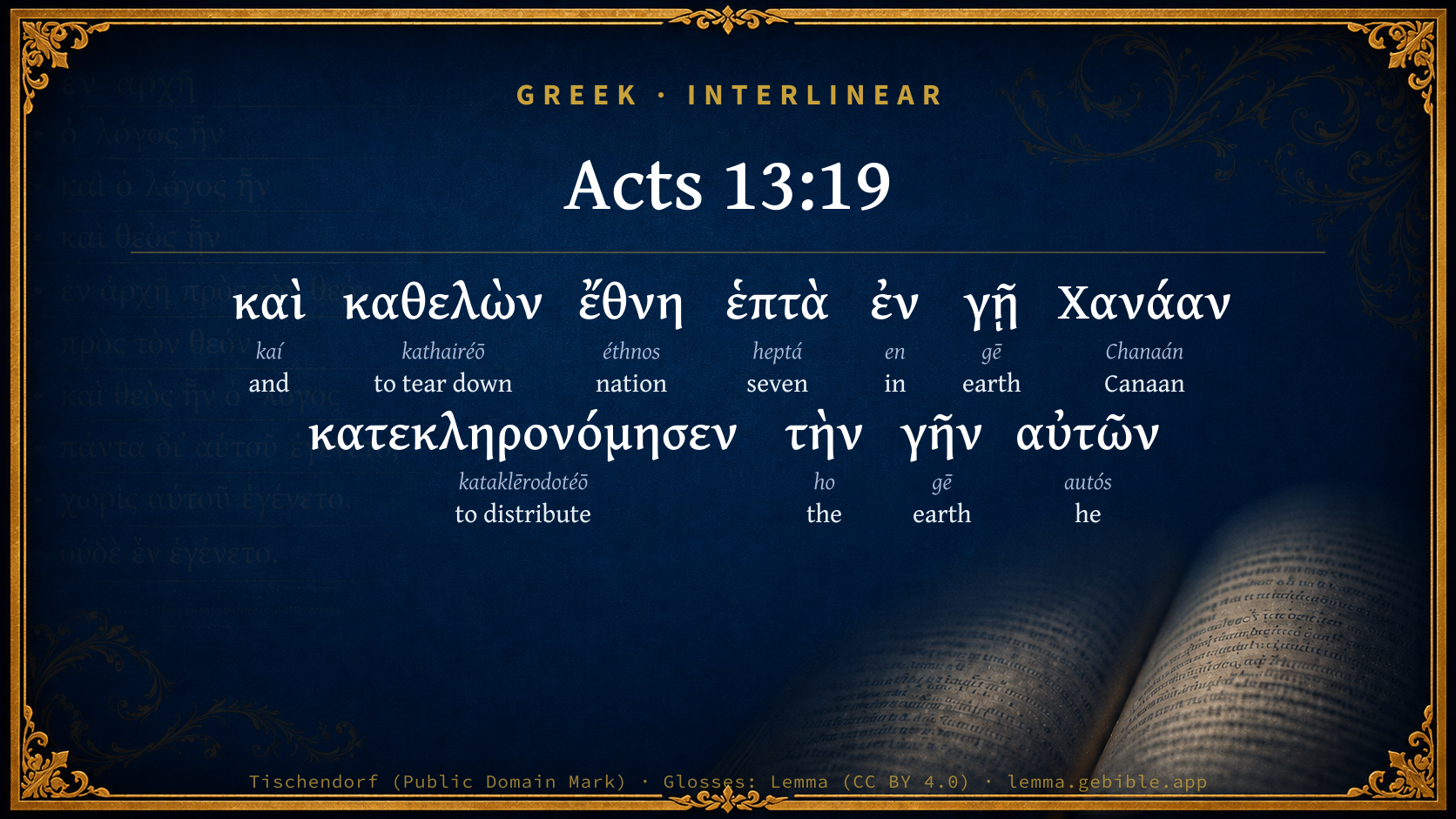
Download image
Cite this verse

Acts 13:19 (World English Bible). Public Domain. Lemma interlinear Bible study tool, https://lemma.gebible.app/v/acts/13/19.

Show BibTeX & RIS
BibTeX
RIS
English Translation
When he had destroyed seven nations in the land of Canaan, he gave them their land for an inheritance, for about four hundred fifty years.
World English Bible · Public Domain
Highlights
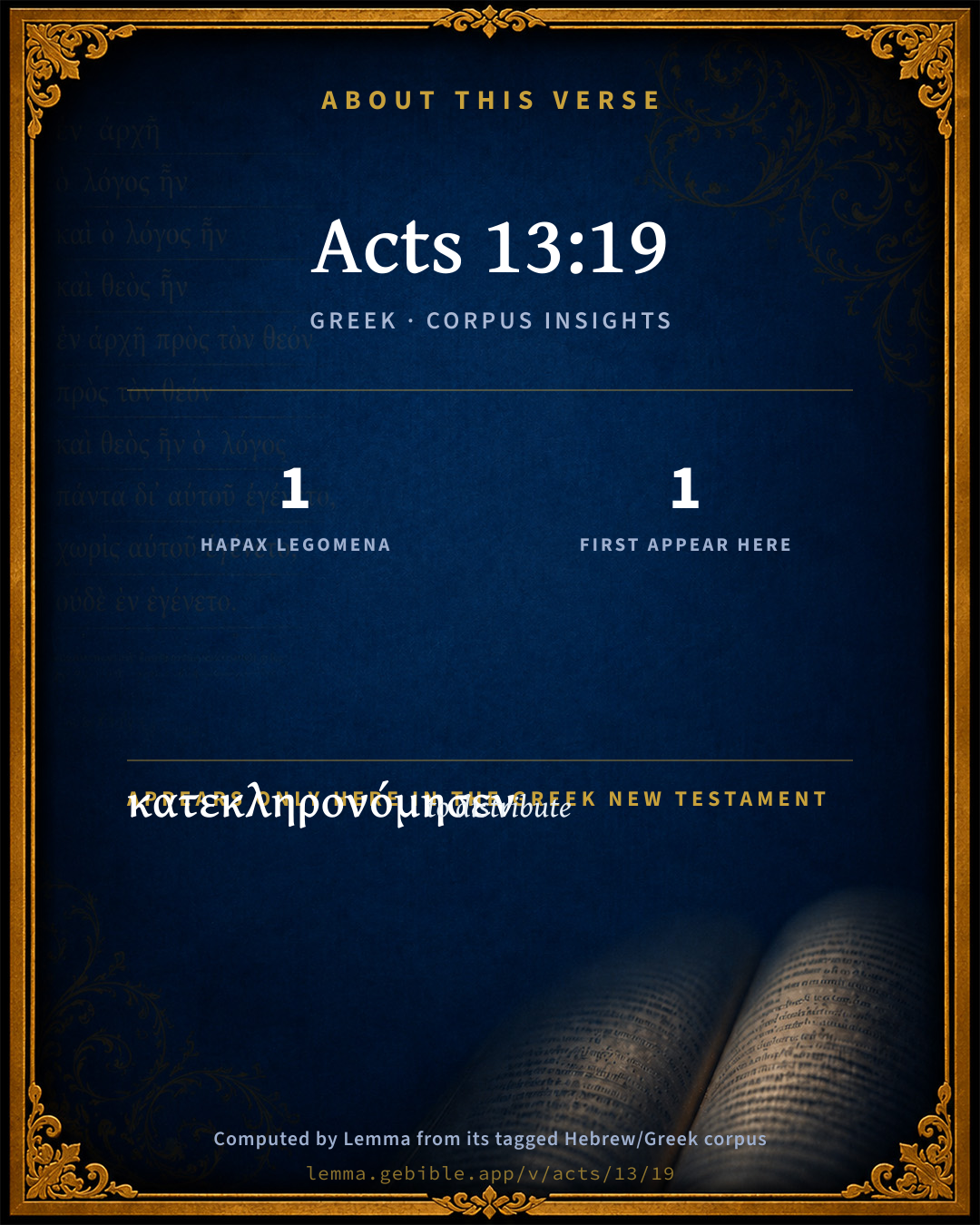
  • 1 hapax legomenon — only here in the Greek New Testament
  • 1 first appearance in the Greek New Testament
Full analysis ↓
Download a study sheet

One document with this verse’s original text, its word-by-word gloss line, the meaning frame, cross-references with their text, attributed commentary, and full source and license credits — printable, and it pastes into notes with its structure intact.

This verse Autodidact and up

Study sheet (.html) Plain text (.txt)

A passage Seminary Student

Up to 50 verses in one chapter. A passage sheet keeps up to 6 commentary sources and 12 cross-references per verse, in the order this page ranks them, and says so on the sheet whenever that leaves anything out. Ask for a single verse and you get the Autodidact verse sheet above.

Everything on this page stays free to read, with no account — the sheet is a download of what is already on screen, not access to it.

Want to remove ads? Support Godless Engineer
Compare translations 3

The same verse in 3 English versions, stacked beneath the original-language interlinear above. Click any original word for its lexicon entry.

Each is an independent rendering of the whole verse — the interlinear is not word-aligned to these translations.

Highlighted words mark where these versions differ — a whole-verse word diff, not a word-by-word alignment.

  • World English Bible Public Domain
    When he had destroyed seven nations in the land of Canaan, he gave them their land for an inheritance, for about four hundred fifty years.
  • King James Version Public Domain
    And when he had destroyed seven nations in the land of Chanaan, he divided their land to them by lot.
  • unfoldingWord Literal Text CC BY-SA 4.0
    And having destroyed seven nations in the land of Canaan, he gave them their land for an inheritance,

unfoldingWord Literal Text — © unfoldingWord, licensed CC BY-SA 4.0. Word-aligned USFM3 via Door43 (git.door43.org/unfoldingWord/en_ult).

Versions to compare (up to 4)

3 of 4 selected

Show all 19 translations

Every available English version of this verse, each an independent rendering of the whole verse.

  • World English Bible Public Domain
    When he had destroyed seven nations in the land of Canaan, he gave them their land for an inheritance, for about four hundred fifty years.
  • Berean Standard Bible Public Domain
    And having vanquished seven nations in Canaan, He gave their land to His people as an inheritance.
  • Majority Standard Bible Public Domain
    And having vanquished seven nations in Canaan, He gave their land to His people as their inheritance.
  • King James Version Public Domain
    And when he had destroyed seven nations in the land of Chanaan, he divided their land to them by lot.
  • American Standard Version (1901) Public Domain
    And when he had destroyed seven nations in the land of Canaan, he gave `them' their land for an inheritance, for about four hundred and fifty years:
  • Revised Version (1885) Public Domain
    And when he had destroyed seven nations in the land of Canaan, he gave them their land for an inheritance, for about four hundred and fifty years:
  • Geneva Bible (1599) Public Domain
    And he destroied seuen nations in the land of Chanaan, and deuided their lad to them by lot.
  • Douay-Rheims (1899) Public Domain
    And destroying seven nations in the land of Chanaan, divided their land among them, by lot,
  • Young's Literal Translation Public Domain
    and having destroyed seven nations in the land of Canaan, He did divide by lot to them their land.
  • Literal Standard Version CC BY-SA 4.0
    and having destroyed seven nations in the land of Canaan, He divided their land to them by lot.
  • Unlocked Literal Bible CC BY-SA 4.0
    After he had destroyed seven nations in the land of Canaan, he gave our people their land for an inheritance.
  • unfoldingWord Literal Text CC BY-SA 4.0
    And having destroyed seven nations in the land of Canaan, he gave them their land for an inheritance,
  • Darby Bible Public Domain
    And having destroyed seven nations in the land of Canaan, he gave them their land as an inheritance.
  • World Messianic Bible Public Domain
    When he had destroyed seven nations in the land of Canaan, he gave them their land for an inheritance for about four hundred fifty years.
  • Webster's Bible Public Domain
    And when he had destroyed seven nations in the land of Canaan, he divided their land to them by lot.
  • Free Bible Version CC BY-SA 4.0
    After he had overthrown seven nations living in the land of Canaan, God divided their land among the Israelites and gave it to them to inherit. This took about four hundred and fifty years.
  • Bible in Basic English Public Domain
    And having put to destruction seven nations in the land of Canaan, he gave them the land for their heritage for about four hundred and fifty years.
  • Text-Critical English NT CC BY 4.0
    and after destroying seven nations in the land of Canaan, he gave his people their land as an inheritance.
  • Tyndale New Testament (1534) Public Domain
    And he destroyed.vii. nacions in the londe of Canaan and devided their londe to them by lot.

Literal Standard Version (2020), Covenant Press — licensed CC BY-SA 4.0. Text via the HelloAO Bible API (eBible.org). Unlocked Literal Bible (unfoldingWord) — licensed CC BY-SA 4.0. Text via the HelloAO Bible API (eBible.org). unfoldingWord Literal Text — © unfoldingWord, licensed CC BY-SA 4.0. Word-aligned USFM3 via Door43 (git.door43.org/unfoldingWord/en_ult). Free Bible Version, Dr. Jonathan Gallagher — licensed CC BY-SA 4.0. Text via the HelloAO Bible API (eBible.org).

Word by word

More ways to search: Search by grammar → Find every occurrence → Compare this word →

Practice this passage: Drill this verse → Learn its vocabulary →

About this verse

These counts appear in no published source. They are computed here, from the morphology-tagged text and Lemma’s own curated glosses. What Lemma adds →

11
words
10
distinct lemmas
Acts
section

Notable vocabulary

1 hapax legomenon — a word that appears only here in the entire Greek New Testament:

  • κατεκληρονόμησεν to distribute G2624

First appearance in Scripture

This word makes its first canonical appearance in the Greek New Testament here:

  • κατεκληρονόμησεν to distribute G2624

Shared distinctive vocabulary

Χανάαν Canaan G5477 occurs in 2 verses of the Greek New Testament. Also found in:

Repetition

A word recurs within this verse:

Cross-references

13

Topical passages linked to Acts 13:19 in the Treasury of Scripture Knowledge — connected by theme and wording, ordered by reader-vote popularity; previews shown in the World English Bible.

  • Deuteronomy 7:1 When Yahweh your God shall bring you into the land where you go to possess it, and shall cast out many nations before you, the Hittite, and the Girgashite, and the Amorite, and the Canaanite, and the Perizzite, and the Hivite, and the Jebusite, seven nations greater and mightier than you;
  • Psalms 78:55 He also drove out the nations before them, Allotted them for an inheritance by line, And made the tribes of Israel to dwell in their tents.
  • Acts 7:45 which also our fathers, in their turn, brought in with Joshua when they entered into the possession of the nations, whom God drove out before the face of our fathers, to the days of David,
  • Joshua 14:1 These are the inheritances which the children of Israel took in the land of Canaan, which Eleazar the priest, and Joshua the son of Nun, and the heads of the fathers' [houses] of the tribes of the children of Israel, distributed to them,
  • Joshua 19:51 These are the inheritances, which Eleazar the priest, and Joshua the son of Nun, and the heads of the fathers' [houses] of the tribes of the children of Israel, distributed for inheritance by lot in Shiloh before Yahweh, at the door of the tent of meeting. So they made an end of dividing the land.
  • Genesis 17:8 I will give to you, and to your seed after you, the land where you are traveling, all the land of Canaan, for an everlasting possession. I will be their God."
  • Genesis 12:5 Abram took Sarai his wife, Lot his brother's son, all their substance that they had gathered, and the souls who they had gotten in Haran; and they went forth to go into the land of Canaan. Into the land of Canaan they came.
  • Numbers 26:53–56 To these the land shall be divided for an inheritance according to the number of names.
  • Joshua 18:10 Joshua cast lots for them in Shiloh before Yahweh: and there Joshua divided the land to the children of Israel according to their divisions.
  • Joshua 24:11 You went over the Jordan, and came to Jericho: and the men of Jericho fought against you, the Amorite, and the Perizzite, and the Canaanite, and the Hittite, and the Girgashite, the Hivite, and the Jebusite; and I delivered them into your hand.
  • Nehemiah 9:24 So the children went in and possessed the land, and you subdued before them the inhabitants of the land, the Canaanites, and gave them into their hands, with their kings, and the peoples of the land, that they might do with them as they would.
  • Psalms 135:11 Sihon king of the Amorites, Og king of Bashan, And all the kingdoms of Canaan,
  • Joshua 23:4 Behold, I have allotted to you these nations that remain, to be an inheritance for your tribes, from the Jordan, with all the nations that I have cut off, even to the great sea toward the going down of the sun.

Cross-references courtesy of OpenBible.info (CC BY 4.0).

Commentary

Notes on Acts 13:19 from classic Christian and Jewish commentators (each source and its license shown beneath its notes). The classic Christian expositions comment on the surrounding passage and are grouped to its opening verse, so a note may address several verses; the Jewish commentaries on the Tanakh (Rashi and others) are per-verse, so they appear only where the commentator wrote on this verse.

Lemma curates 59 commentaries, every one of them public domain or Creative Commons licensed, each selected and text-cleaned for this edition rather than reprinted as found. About our sources →

Joseph Benson's Commentary

Act 13:19-20. And when he had destroyed seven nations — Enumerated Deu 7:1; in the land of Chanaan — Where they had been long settled, and had erected many kingdoms, defended by fortifications of great strength, as well as by numerous forces of horse and foot; he divided their land — Even the whole country; to them by lot — Or, for an inheritance, as κατεκληρονομησεν αυτοις την γην, seems rather to signify, and supported them in it for many generations. After that he gave them judges — By whose heroic interposition he delivered them from those repeated oppressions and miseries which their frequent revolts to idolatry had brought upon them; until Samuel the prophet — Who was the last of these extraordinary leaders and magistrates. About the space of four hundred and fifty years — As the course of the sacred history will by no means permit us to imagine that the judges, in their succession, continued four hundred and fifty years after the settlement of Israel in Canaan, it being stated, (1Ki 6:1,) that Solomon began to build the temple in the four hundred and eightieth year after they came out of Egypt; therefore, Sir Norton Knatchbull (with whom Bengelius, Doddridge, and many other learned men agree) is of opinion, that the apostle is not to be understood as signifying, “how long God gave them judges, but when he gave them.” He therefore refers the first words of this verse, και μετα ταυτα ως ετεσι τετρακοσιοις και πεντηκοντα, to the words going before, (Act 13:17,) that is, to the time when the God of the children of Israel chose their fathers: and points and renders them thus: And afterward, about four hundred and fifty years, or, and about four hundred and fifty years afterward, he gave them judges, &c.; according to which sense, he observes, the old Latin and the Ethiopic interpreters read the passage; adding, (Annot. on some difficult Texts in the New Testament, p. 131,) “now this time, wherein God may properly be said to have chosen their fathers, about four hundred and fifty years before he gave them judges, is by them computed from the birth of Isaac, in whom God may properly be said to have chosen their fathers; for in his family the covenant was to rest. And, to make this computation evident: From the birth of Isaac to the birth of Jacob, are sixty years; from thence to their going into Egypt, one hundred and thirty; from thence to their coming out, two hundred and ten; from thence to their entrance into the land of Canaan, forty; and from thence to the division of the land, the time wherein it had rest, (about which time, it is probable, they began to settle their government by judges,) seven years; which, altogether, make up four hundred and forty-seven. And if it should be reckoned from the year before, when God established his covenant between himself and Abraham, and all his seed after him, (Gen 17:19,) then it will be four hundred and forty-eight years, which comes one nearer to our number of four hundred and fifty; and answers sufficiently the apostle’s manner of expression, ως, about four hundred and fifty years.”

Joseph Benson's Commentary on the Old and New Testaments (1811–1818) — public domain. Text from a community e-Sword module.

Bengel's Gnomon

Johann Albrecht Bengel

Act 13:19. Ἔθνη ἑπτὰ, seven nations) Deu 7:1. [There were ten in all, Gen 15:19-21 (where the Rephaims stand instead of the Hivites, and the Kenites, Kenizzites, and Kadmonites are added to the seven); but seven were destroyed by Joshua.—V. g.]

Act 13:19-20. Ὡς ἔτεσι, κ.τ.λ.) This passage requires a fuller consideration.

I. The ancient reading ought to be retained

Very many MSS., though less ancient, have it thus: ὁ Θεὸς—τὴν γῆν αὐτῶν. Καὶ μετὰ ταῦτα ὡς ἔτεσι, κ.τ.λ. Authorities fewer in number, but yet more ancient and trustworthy, have it thus: ὁ Θεὸς—τὴν γῆν αὐτῶν, ὡς ἔτεσι τετρακοσίσις καὶ πεντήκοντα. Καὶ μετὰ ταῦτα ἔδωκε κοιτὰς, κ.τ.λ. Therefore the mention of about four hundred and fifty years is connected with the distribution of the land among them, not with the giving of judges. The short clause as to the period of about 450 years was readily passed over by less ancient transcribers, and was supplied in the subsequent period.[75]

[75] ABC Memph. and Vulg. have the ὡς ἔτεσιν τετρακοσίοις καὶ πεντήκοντα before καὶ μετὰ ταῦτα; the meaning thus will be, that the distribution of the land was about 450 years after the promise given to Abraham. The only very old authorities for Tisch. and Rec. Text’s placing the words after καὶ μετὰ ταῦτα are Ee. Beng. in the larger Ed. followed the latter reading; but in marg. Ed. 2, and Vers. Germ., and Gnomon, the former. The spurious reading of the Rec. Text has given rise to whole volumes; and in Sir H. Ellis’ Ed. of Blair’s Chronol. Tables this period (altogether the fruit of a wrong reading) is still called “The computation of Paul.”—E. and T.

II. The distribution of the land is not the beginning of the period of about 450 years, but its goal

In marking time, the Dative case or the Accusative is sometimes employed indiscriminately; but here purposely between the Accusative, which goes before in Act 13:18, and that which follows in Act 13:21, the Dative in this one instance is put. The Accusative answers simply to the question, how long? But by the Dative there is implied how great a period of years intervened from the beginning of an event until the event itself came to pass. Comp. Joh 2:20, τεσσαράκοντα καὶ ἕξ ἔτεσιν ᾠκοδομήθη ὁ ναός, “The temple was forty-six years from its commencement to its completion.” If Paul were to say, ἔτη, years, the language would lead to the inference, that the land was distributed to the Israelites, to be possessed for about 450 years, namely, down to the promise given to David concerning the Messiah: for otherwise the whole time of the possession was much longer in continuance. Grotius counts almost 450 years from the Exodus to that time, in which David ejected from the citadel Zion the Jebusites, who had been long before ejected from the city of Jerusalem. So long a space of time, saith he, was spent in settling the Hebrew nation in those seats (possessions). Nay, but the whole nation was settled in those seats by Joshua, Jos 11:23; Jos 14:15; Jos 19:51; Jos 21:43; Jos 21:45; although they were rather slothful in occupying the whole land that was given to them: Jdg 18:1. Wherefore the occupation of the land is no more included in the words, about 450 years, than the possession of the land when occupied. But when Paul says ἔτεσιν, years, he means, that from the time when God chose out their fathers, having given them a promise, and from the time that the fathers were sojourners down to the time of the distribution of the land, there were about 450 years. The following Table shows these about 450 years.

a. m. 2046. Isaac is born.

2485. Sihon and Og are subdued.

2486. Jordan is crossed over.

2491. Caleb especially receives his portion.

The land is distributed, to be subsequently possessed.

2492. The root of the sabbatical years [Jos 14:15].

2493. The beginning of the cultivation of the land.

See Ord. Temp. pp. 3, 4, 66 [Ed. ii. p. 56], which represents the date of the beginning of the agriculture less appropriately, pp. 424, 85 [Ed. ii. pp. 364, 74, 75]; wherefore in this passage I have rendered it more perspicuous. The year 2492 would be the very sabbatical year, if at that time already sabbatical years had been counted: otherwise there would have been seven years of cultivating the land, not six; whereas there ought only to be six. The beginning of the cultivation of the land is removed from the birth of Isaac by 447 years, which are “about 450;” especially since afterwards, also, there was land which was being occupied (which should be occupied). The more common Greek reading is itself bent into much the same sense by Mill.

III. The more modern Greek reading does not cause us a difficulty

The years of the Judges, from Othniel to the death of Eli, are 339, and the years of their servitudes, taken separately, are 111; the sum total is 450. Thus they seem to have calculated the number, who changed the reading. But in actual fact the whole period of the Judges is much shorter, from the distribution of the land to the very death of king Saul. For from the Exodus to the foundation of the temple there are only 480 years. We who embrace the old reading have no necessity to waste our time and labour in accommodating the period of about 450 years to the time of the Judges, or to have recourse to conjecture on the subject, so as to read 350 instead of 450, as Luther, perseveringly and confidently, and many others, as mentioned in Jac. Dorncrellius, have done.

Bengel's Gnomon of the New Testament — English translation (T&T Clark, Edinburgh, 1860) — public domain. Text from a community e-Sword module.

Expositor's Greek Testament

ed. W. Robertson Nicoll

Act 13:19 . καθελὼν , cf. Deu 7:1 . In LXX the stronger verb ἐξαίρειν is used, but καθαιρεῖν in LXX often means to destroy, Jer 24:6 , Psa 27:5 , and so in classical Greek. Weiss prefers the force of the verb as in Luk 1:52 , to cast down, i.e. , from their sovereignty. - κατεκληροδότησεν , see critical notes. If we adopt reading of R.V. W.H [260] : “he gave them their land for an inheritance”.

[260] Westcott and Hort’s The New Testament in Greek: Critical Text and Notes.

The Expositor's Greek Testament, edited by W. Robertson Nicoll (1897–1910) — public domain. Text from a community e-Sword module.

Adam Clarke's Commentary

Verse 19. Destroyed seven nations] The Canaanites, Hittites, Girgasites, Amorites, Hivites, Peresites, and Jebusites. The rabbins frequently call them שבעה אומות Shebaah Omoth, the Seven Nations.

Adam Clarke's Commentary on the Bible (1810–1826) — public domain. Text from a community e-Sword/MySword module.

Ellicott's Commentary for English Readers

(19) He divided their land to them by lot.—Accepting this reading, the reference is to the command given in Num_26:55-56, and recorded as carried into effect in Joshua 14-19. The better MSS., however, give a kindred word, which signifies “he gave as an inheritance.”

A Bible Commentary for English Readers, edited by Charles John Ellicott (1878–1897) — public domain. Text from a community e-Sword module.

The Cambridge Bible for Schools and Colleges

gen. ed. J. J. S. Perowne

19. seven nations] They are enumerated (Deu_7:1) before the people went over the Jordan, viz. the Hittites, the Girgashites, the Amorites, the Canaanites, the Perizzites, the Hivites, and the Jebusites.

In the latter part of this verse and in the next the oldest authorities read, “He gave their land for an heritage, about the space of four hundred and fifty years; and after these things he gave them judges until Samuel the prophet.” This text would carry back the possession of the land to the first promise thereof at the time when Abram was called, for according to the received chronology about four hundred and fifty years elapsed between that event and the death of Joshua.

On Samuel, as the prophet par excellence, cp. Act_3:24 note.

The Cambridge Bible for Schools and Colleges (gen. ed. J. J. S. Perowne; Cambridge University Press, 1878–1918) — public domain. Text from a community e-Sword module.

John Gill's Exposition

And when he had destroyed seven nations in the land of Canaan,.... The Canaanites, Hittites, Amorites, Perizzites, Hivites, Jebusites, and Girgashites; and the name of seven nations is what they are usually called by in Jewish writings; and though they were not utterly destroyed, or everyone of them put to death, or driven out, for some remained to be thorns in the sides of the Israelites; yet they were so wasted and conquered, that they could never recover any more: he divided their land to them; every tribe had its portion of it assigned, by lot; see Jos 14:1.

.

Acts 13:20

act 13:20

act 13:20

act 13:20And after that he gave unto them judges,.... As Othniel, Ehud, Deborah, Gideon, Abimelech, Tola, Jair, Jephthah, Ibzan, Elon, Abdon, Samson, and Eli:

about the space of four hundred and fifty years; not that from the division of the land of Canaan among the tribes, to Samuel the prophet, was such a space of years; for from the coming of the children of Israel out of Egypt, to the year that Solomon began to build the temple, were but four hundred and fourscore years, Kg1 6:1 and out of these must be taken the forty years the children of Israel were in the wilderness, and seven years in subduing the land of Canaan, before the division of it, which reduce this number to four hundred and thirty and three; and from hence must be deducted the time of Samuel's judging Israel, the reigns of Saul and David, and three years of Solomon's, which reduced the years of the judges to less than four hundred years; and according to some, the years of the judges were three hundred and fifty seven; and according to others, three hundred and thirty nine, and both fall short of the space of years here assigned. The Alexandrian copy and the Vulgate Latin version read this clause in connection with the preceding words, "he divided their land unto them, about the space of four hundred years, and after that he gave unto them judges"; agreeably hereunto the Ethiopic version renders it, "and after four hundred and fifty years, he set over them governors, &c". So that this account respects not the time of the judges, or how long they were, but refers to all that goes before, and measures out the space of time from God's choice of the Jewish fathers, to the division of the land of Canaan: and reckoning from the birth of Isaac, when the choice took place, and in whom Abraham's seed was called, there was much about such a number of years; for from the birth of Isaac to the birth of Jacob, were sixty years; from thence to his going down into Egypt, an hundred and thirty years; and from thence to the Israelites coming out of Egypt, two hundred and ten years; and from thence to their entrance into the land of Canaan, forty years; and from that time to the division of the land, seven years, which in all make four hundred and forty seven years: so that, according to this account, there were three years wanting of the sum in the text; hence the apostle might with great propriety say, that it was about the space of so many years. It follows,

until Samuel the prophet; the meaning of which, is not that there was such a space of time as before mentioned, from the distribution of the land of Canaan until the times of Samuel the prophet, during which space judges were given; but that after that term of time was expired, God gave them judges, or raised up one after another, until Samuel the prophet, who was the last of them: of his character as a prophet; see Gill on Act 3:24 and which is a title frequently given him by Jewish writers (u).

(u) Maimon. Cele Hamikdash, c. 4. sect. 3.

John Gill's Exposition of the Whole Bible (1746–1763) — public domain (CC PDM 1.0). Text via the HelloAO Bible API.

Trapp's Complete Commentary

John Trapp

19 And when he had destroyed seven nations in the land of Chanaan, he divided their land to them by lot.

Ver. 19. And when he had destroyed seven nations] Who had "filled the land from one end to another with their uncleanness," Ezr 9:11; so that God was forced to sweep it with the besom of destruction; like as, before that, the face of the old world was grown so foul that God was fain to wash it with a flood.

John Trapp, A Commentary or Exposition upon All the Books of the Old and New Testament (1647–1656) — public domain. Text from a community e-Sword module.

Albert Barnes' Notes on the Bible

And when he had destroyed - Subdued, cast out, or extirpated them as nations. It does not mean that all were put to death, for many of them were left in the land; but that they were subdued as nations, they were broken up and overcome, Deu 7:1, “And hath cast out many nations before them,” etc.

Seven nations - The Hittites, the Girgashites, the Amorites, the Canaanites, the Perizzites, the Hivites, and the Jebusites, Deu 7:1; Jos 3:10; Neh 9:8.

In the land of Canaan - The whole land Was called by the name of one of the principal nations. This was the promised land; the holy land, etc.

He divided ... - See an account of this in Jos. 14–15: The lot was often used among the Jews to determine important questions. See the note at Act 1:26.

Albert Barnes' Notes on the Bible (1834–1885) — public domain. Text from a community e-Sword/MySword module.

Haydock's Catholic Bible Commentary

These seven nations are the Chanaanites, the Hethites, the Hevites, the Pherezites, the Gergesites, and the Jebusites, and the Amorrhites. (Josue iii. 10. and elsewhere)

George Leo Haydock (1774–1849), Haydock's Catholic Family Bible and Commentary, 1859 edition — public domain. Excludes Psalms (Douay-Rheims chapter numbering differs from Protestant) and Deuterocanonical books (Catholic canon only).

Matthew Poole's English Annotations

These seven nations are mentioned, Jos 3:10.

He divided their land to them by lot; the lot being disposed only as God would, Pro 16:33. And it was but reasonable that God, having miraculously got this land, (for the Israelites did rather go to take possession of it than to fight for it), and assumed a special right unto it, that he should divide it to whom he pleased, and in what proportions he thought good.

Matthew Poole's English Annotations on the Holy Bible (1683–1685) — public domain. Text from a community e-Sword/MySword module.

Whedon's Commentary on the Bible

Daniel D. Whedon

19. Seven nations—The names of which may be found in Deu_7:1.

Daniel D. Whedon (gen. ed.), Commentary on the Old and New Testaments (1874–1909) — public domain. Text from a community e-Sword module.

The Pulpit Commentary

Vers. 19, 20. Canaan for Chanaan, A.V.; he gave them their land for an inheritance, for about four hundred and fifty years: and after these things he gave them judges, etc., for he divided their land unto them by lot: and after that he gave unto them judges about the space of four hundred and fifty years, etc., A.V. and T.R. It is difficult to say what is the meaning of the R.T. in regard to the four hundred and fifty years, what is the terminus a quo or ad quem intended by it. The usual explanations of the reading of the R.T. (adopted by Lachman, Bishop Wordsworth, and others) is that the years are dated from the birth of Isaac, and that the meaning is that the promise to give the land to the seed of Abraham was actually performed within four hundred and fifty years (wJv etesi) (after the analogy of, (Gal_3:17) which gives a good sense and is not at all improbable (see Bishop Wordsworth"s note). The reading of the T.R. has grave objections on the score of chronology as well as grammar. Duration of time is expressed by the accusative case, as vers. 18 and 21; the measure of time in which a thing is done by the dative. So that the natural rendering of the T.R. would be that he gave them judges four hundred and fifty years after the entrance into Canaan; which of course cannot be the meaning. The other objection is that, if the times of the judges from the final conquest of the land to the judgeship of Samuel was four hundred and fifty years, the whole time from the Exodus to the building of the temple must have been about six hundred and forty years (37 from death of Moses to Othuiel + 450, + 30 for judgeship of Samuel, + 40 of Saul"s reign, + 40 for David"s reign, +3 years of Solomon, + and the 40 years in the wilderness), whereas 1Ki_6:1 gives the time as four hundred and eighty years; while the genealogies suppose a much shorter time about two hundred and eighty years. It is an immense gain, therefore, to get rid of this four hundred and fifty years for the time of the judges, and by the well-supported reading of the R.T. to get a calculation in agreement withthsen, Gal_3:17 and with the chronology of the times. Gave them... for an inheritance. The T.R. has kateklhrodo the R.T. has kateklhronomhsen, which words are not infrequently interchanged in different codices of the LXX. (see Jos_19:51; Deu_1:38 Deu_21:16, etc.) They have nearly identical meanings, "to give as an inheritance by lot." Neither word occurs elsewhere in the New Testament.

The Pulpit Commentary (1880–1919), ed. H.D.M. Spence-Jones & Joseph S. Exell — public domain. Text from a community e-Sword module.

John Wesley's Explanatory Notes

Seven nations - Enumerated Deut. vii, 1; about four hundred and fifty years - That is, from the choice of the fathers to the dividing of the land; it was about four hundred and fifty years.

John Wesley, Explanatory Notes Upon the Whole Bible (1754–1765) — public domain. Text via the GEBible commentary corpus.

McGarvey & Pendleton's Commentaries

J. W. McGarvey

See notes one verse 17

J. W. McGarvey (with Philip Y. Pendleton), Commentaries on the New Testament (The Fourfold Gospel, 1914; Acts; and the epistles) — public domain. Text from a community e-Sword/MySword module.

unfoldingWord translationNotes

Door43 World Missions Community

General Information:

Here the word "he" refers to God.

General Information:

The words "their land" refer to the land the seven nations had previously occupied.

General Information:

The word "them" refers to the people of Israel. The word "our" refers to Paul and his audience. (See: Inclusive "We")

nations

Here the word "nations" refers to different people groups and not to geographical boundaries.

took place over four hundred and fifty years

"took more than 450 years to accomplish"

until Samuel the prophet

"until the time of the prophet Samuel"

translationWords

nation

Canaan

inherit

judge, judges

Samuel

prophet

unfoldingWord translationNotes — © Distant Shores Media and the Door43 World Missions Community, licensed CC BY-SA 4.0. Source: git.door43.org/Door43/en_tn.

Cambridge Greek Testament for Schools and Colleges

19. αὐτοῖς omitted after κατεκληρονόμησεν with אBD. Vulg. has ‘eis.’

19. ἔθνη ἑπτά, seven nations. They are enumerated (Deu 7:1) before the people went over Jordan, viz. the Hittites, the Girgashites, the Amorites, the Canaanites, the Perizzites, the Hivites, and the Jebusites.

κατεκληρονόμησεν τὴν γῆν αὐτῶν ὡς ἔτεσιν κ.τ.λ., he gave their land for an heritage about the space of four hundred and fifty years. According to the received chronology there was about this length of time between the call of Abraham and the death of Joshua. So that the land is regarded as a κληρονομία from that early time. But it is dangerous to found any conclusions on chronology based, as the O.T. chronology must be, on such insufficient data.

καὶ μετὰ ταῦτα ἔδωκεν κριτὰς ἕως Σαμουὴλ προφήτου, and after these things He gave them judges until Samuel the prophet. On Samuel as the prophet above all others cf. Act 3:24, note.

Cambridge Greek Testament for Schools and Colleges (Cambridge University Press, 1896; 21 vols, various authors incl. Carr, Maclear, Plummer, Farrar, Lumby, Moule, M. R. James, Simcox) — public domain. Text from a community e-Sword module.

Alford’s Greek Testament

Henry Alford

19. ἑπτά] See Deu 7:1; Jos 3:10; Jos 24:11.

The unusual transitive sense of κατεκληρονόμησεν, justified by reff. LXX, has not been understood by the copyists, and has led to the rec. reading.

From the occurrence of manifest references, in these opening verses of the speech, to Deu_1 and Isa_1, combined with the fact that these two chapters form the present lessons in the synagogues on one and the same sabbath, Bengel and Stier conclude that they had been then read. It may have been so: but see on ver. 15.

Henry Alford, The Greek Testament (1849–1861) — public domain. Text from a community e-Sword module.

Vincent's Word Studies in the New Testament

Marvin R. Vincent

Divided by lot [κατεκληρονομησεν] . The A. V. gives the literal rendering. The Rev., gave them their land for an inheritance, is correct, so far as the meaning inheritance is concerned (see on 1Pe 1:4), but does not give the sense of distribution which is contained in the word.

Marvin R. Vincent, Word Studies in the New Testament (1887–1900) — public domain. Text from a community e-Sword/MySword module.

Lesson kit

Teaching starters — assembled from the data on this page, not authored interpretation. Every prompt links to the verse data it draws on. Edit before teaching.

Acts, in the Acts, opens this verse with 11 words (10 distinct Greek lemmas). Its most distinctive word is kataklērodotéō (“to distribute”). A historical commentator’s framing appears above. Read the whole chapter for the surrounding context.

Discussion questions

  1. The word kataklērodotéō carries the sense “to distribute.” How does it shape the verse?
  2. 1 word here appears nowhere else in the Greek New Testament. Why might the author reach for such rare wording?
  3. This is the first place “to distribute” appears in Scripture (first appears here). What does its debut here establish?
  4. How does Acts 7:11, which shares the word «Canaan», read alongside this verse?
  5. What does the repetition of “earth” (2× in this one verse) do in this verse?
  6. These translations render this verse differently. What is at stake in choosing one wording over another?
  7. Compare how Joseph Benson's Commentary and Bengel's Gnomon read this verse. Where do they agree or differ?

Things to notice

  • 1 word in this verse appears nowhere else in the Greek New Testament.
  • 1 word makes its first canonical appearance in Scripture here.
  • These translations choose different wording for 14 words in this verse.
  • “earth” occurs 2× in this single verse.
  • 10 distinct Greek lemmas span 11 words in this verse.

Reading settings

Reading text

Shown beneath each verse's original-language words.

Old Testament
Old Testament edition

Read the OT as the Masoretic Hebrew (MT) or the Greek Septuagint (LXX).

English shown for the Greek Septuagint (in the Hebrew ↔ Greek comparison).

Comparing translations? Open the Compare panel on any verse page to stack up to four side by side.