

Hebrews 11:13
Greek (Tischendorf 8th ed.) Hebrews 11:13 appears in the Greek New Testament. The text above is from the Tischendorf 8th edition. Each word links to its Strong’s number and a concise gloss. Click any word for its full Thayer’s Greek Lexicon entry.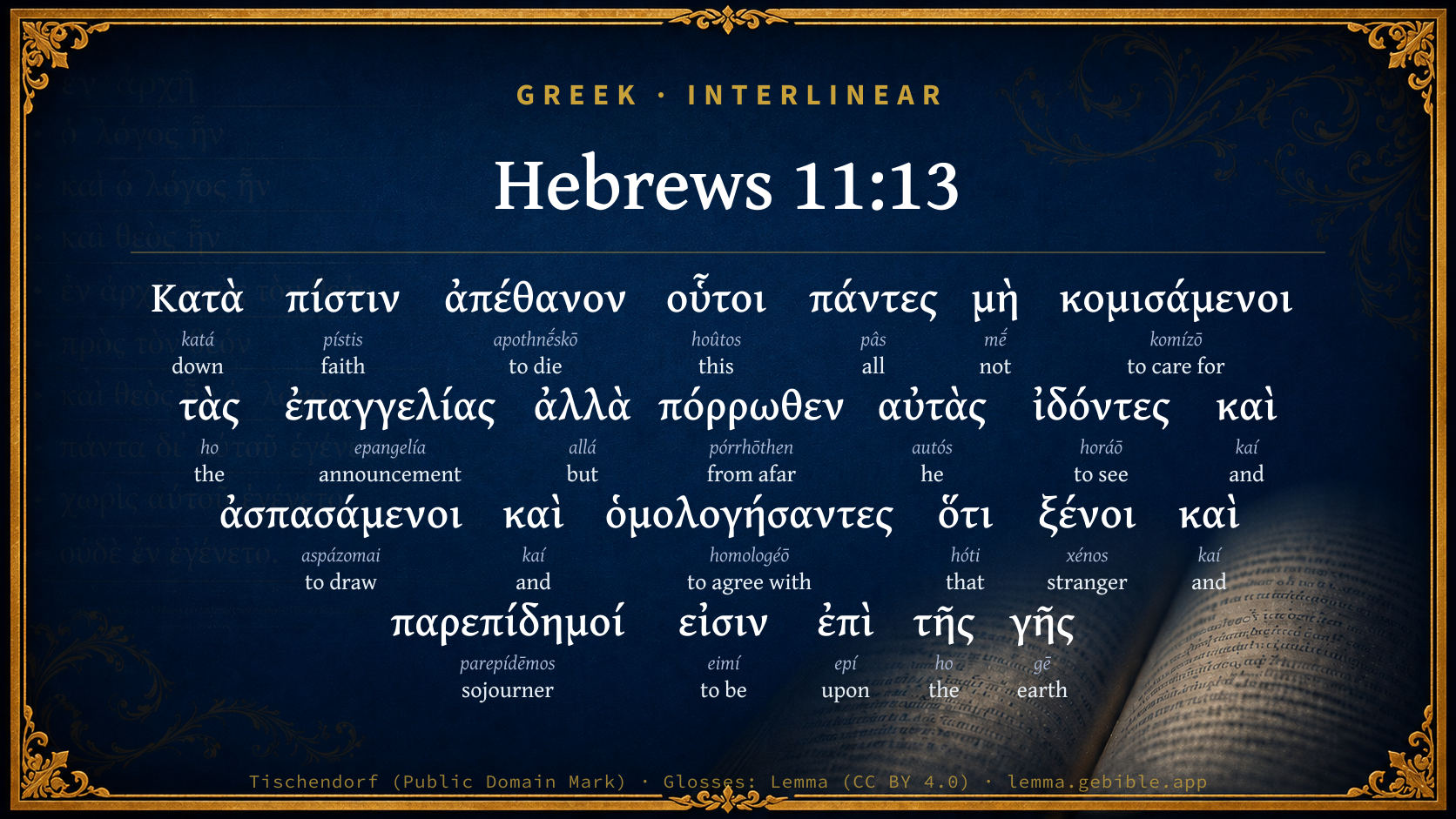
These all died in faith, not having received the promises, but having seen them and embraced them from afar, and having confessed that they were strangers and pilgrims on the earth.
Download a study sheet
One document with this verse’s original text, its word-by-word gloss line, the meaning frame, cross-references with their text, attributed commentary, and full source and license credits — printable, and it pastes into notes with its structure intact.
This verse Autodidact and up
A passage Seminary Student
Up to 50 verses in one chapter. A passage sheet keeps up to 6 commentary sources and 12 cross-references per verse, in the order this page ranks them, and says so on the sheet whenever that leaves anything out. Ask for a single verse and you get the Autodidact verse sheet above.
Everything on this page stays free to read, with no account — the sheet is a download of what is already on screen, not access to it.
Compare translations 3
The same verse in 3 English versions, stacked beneath the original-language interlinear above. Click any original word for its lexicon entry.
Each is an independent rendering of the whole verse — the interlinear is not word-aligned to these translations.
Highlighted words mark where these versions differ — a whole-verse word diff, not a word-by-word alignment.
-
World English Bible Public Domain
These all died in faith, not having received the promises, but having seen them and embraced them from afar, and having confessed that they were strangers and pilgrims on the earth.
-
King James Version Public Domain
These all died in faith, not having received the promises, but having seen them afar off, and were persuaded of them, and embraced them, and confessed that they were strangers and pilgrims on the earth.
-
unfoldingWord Literal Text CC BY-SA 4.0
According to their faith all these died without receiving the promises, but seeing and greeting them from far off, and having confessed that they are strangers and foreigners on the earth.
unfoldingWord Literal Text — © unfoldingWord, licensed CC BY-SA 4.0. Word-aligned USFM3 via Door43 (git.door43.org/unfoldingWord/en_ult).
Show all 19 translations
Every available English version of this verse, each an independent rendering of the whole verse.
-
World English Bible Public Domain
These all died in faith, not having received the promises, but having seen them and embraced them from afar, and having confessed that they were strangers and pilgrims on the earth.
-
Berean Standard Bible Public Domain
All these people died in faith, without having received the things they were promised. However, they saw them and welcomed them from afar. And they acknowledged that they were strangers and exiles on the earth.
-
Majority Standard Bible Public Domain
All these people died in faith, without having received the things they were promised. However, they saw them and welcomed them from afar. And they acknowledged that they were strangers and exiles on the earth.
-
King James Version Public Domain
These all died in faith, not having received the promises, but having seen them afar off, and were persuaded of them, and embraced them, and confessed that they were strangers and pilgrims on the earth.
-
American Standard Version (1901) Public Domain
These all died in faith, not having received the promises, but having seen them and greeted them from afar, and having confessed that they were strangers and pilgrims on the earth.
-
Revised Version (1885) Public Domain
These all died in faith, not having received the promises, but having seen them and greeted them from afar, and having confessed that they were strangers and pilgrims on the earth.
-
Geneva Bible (1599) Public Domain
All these died in faith, and receiued not the promises, but sawe them a farre off, and beleeued them, and receiued them thankefully, and confessed that they were strangers and pilgrims on the earth.
-
Douay-Rheims (1899) Public Domain
All these died according to faith, not having received the promises, but beholding them afar off, and saluting them, and confessing that they are pilgrims and strangers on the earth.
-
Young's Literal Translation Public Domain
In faith died all these, not having received the promises, but from afar having seen them, and having been persuaded, and having saluted `them', and having confessed that strangers and sojourners they are upon the earth,
-
Literal Standard Version CC BY-SA 4.0
All these died in faith, having not received the promises, but having seen them from afar, and having been persuaded, and having greeted [them], and having confessed that they are strangers and sojourners on the earth,
-
Unlocked Literal Bible CC BY-SA 4.0
It was in faith that all these died without receiving the promises. Instead, after seeing and greeting them from far off, they admitted that they were foreigners and exiles on earth.
-
unfoldingWord Literal Text CC BY-SA 4.0
According to their faith all these died without receiving the promises, but seeing and greeting them from far off, and having confessed that they are strangers and foreigners on the earth.
-
Darby Bible Public Domain
All these died in faith, not having received the promises, but having seen them from afar off and embraced [them], and confessed that they were strangers and sojourners on the earth.
-
World Messianic Bible Public Domain
These all died in faith, not having received the promises, but having seen them and embraced them from afar, and having confessed that they were strangers and pilgrims on the earth.
-
Webster's Bible Public Domain
These all died in faith, not having received the promises, but having seen them afar off, and were persuaded of them, and embraced them, and confessed that they were strangers and pilgrims on the earth.
-
Free Bible Version CC BY-SA 4.0
They all died still trusting in God. Though they didn't receive the things God promised, they were still looking for them as it were from a distance and welcomed them, acknowledging that on this earth they were foreigners, people just passing through.
-
Bible in Basic English Public Domain
All these came to their end in faith, not having had the heritage; but having seen it with delight far away, they gave witness that they were wanderers and not of the earth.
-
Text-Critical English NT CC BY 4.0
All these people died in faith without receiving the things that were promised. But they saw them from a distance and welcomed them. And they acknowledged that they were strangers and sojourners on the earth.
-
Tyndale New Testament (1534) Public Domain
And they all dyed in fayth and receaved not the promyses: but sawe them a farre of and beleved them and saluted them: and confessed that they were straungers and pilgrems on the erthe.
Literal Standard Version (2020), Covenant Press — licensed CC BY-SA 4.0. Text via the HelloAO Bible API (eBible.org). Unlocked Literal Bible (unfoldingWord) — licensed CC BY-SA 4.0. Text via the HelloAO Bible API (eBible.org). unfoldingWord Literal Text — © unfoldingWord, licensed CC BY-SA 4.0. Word-aligned USFM3 via Door43 (git.door43.org/unfoldingWord/en_ult). Free Bible Version, Dr. Jonathan Gallagher — licensed CC BY-SA 4.0. Text via the HelloAO Bible API (eBible.org).
Word by word
More ways to search: Search by grammar → Find every occurrence → Compare this word →
Practice this passage: Drill this verse → Learn its vocabulary →
- Appears 2× in the Greek New Testament
- First appears at Luke 17:12
- Part of Speech
- Adverb
Full Thayer's Definition
- Κατὰ katá G2596 “down” Preposition
- πίστιν pístis G4102 “faith” Noun, Accusative, Singular, Feminine
- ἀπέθανον apothnḗskō G599 “to die” Verb, Aorist, Active, Indicative, 3rd person, Plural
- οὗτοι hoûtos G3778 “this” Demonstrative pronoun, Nominative, Plural, Masculine
- πάντες pâs G3956 “all” Adjective, Nominative, Plural, Masculine
- μὴ mḗ G3361 “not” Particle, Negative
- κομισάμενοι komízō G2865 “to care for” Verb, Aorist, Middle, Participle, Nominative, Plural, Masculine
- τὰς ho G3588 “the” Article, Accusative, Plural, Feminine
- ἐπαγγελίας epangelía G1860 “announcement” Noun, Accusative, Plural, Feminine
- ἀλλὰ allá G235 “but” Conjunction
- πόρρωθεν pórrhōthen G4207 “from afar” Adverb
- αὐτὰς autós G846 “he” Personal pronoun, Accusative, Plural, Feminine
- ἰδόντες horáō G3708 “to see” Verb, Aorist, Active, Participle, Nominative, Plural, Masculine
- καὶ kaí G2532 “and” Conjunction
- ἀσπασάμενοι aspázomai G782 “to draw” Verb, Aorist, Middle deponent, Participle, Nominative, Plural, Masculine
- καὶ kaí G2532 “and” Conjunction
- ὁμολογήσαντες homologéō G3670 “to agree with” Verb, Aorist, Active, Participle, Nominative, Plural, Masculine
- ὅτι hóti G3754 “that” Conjunction
- ξένοι xénos G3581 “stranger” Adjective, Nominative, Plural, Masculine
- καὶ kaí G2532 “and” Conjunction
- παρεπίδημοί parepídēmos G3927 “sojourner” Adjective, Nominative, Plural, Masculine
- εἰσιν eimí G1510 “to be” Verb, Present, Active, Indicative, 3rd person, Plural
- ἐπὶ epí G1909 “upon” Preposition
- τῆς ho G3588 “the” Article, Genitive, Singular, Feminine
- γῆς gē G1093 “earth” Noun, Genitive, Singular, Feminine
About this verse
These counts appear in no published source. They are computed here, from the morphology-tagged text and Lemma’s own curated glosses. What Lemma adds →
- 25
- words
- 22
- distinct lemmas
- General Epistles
- section
Notable vocabulary
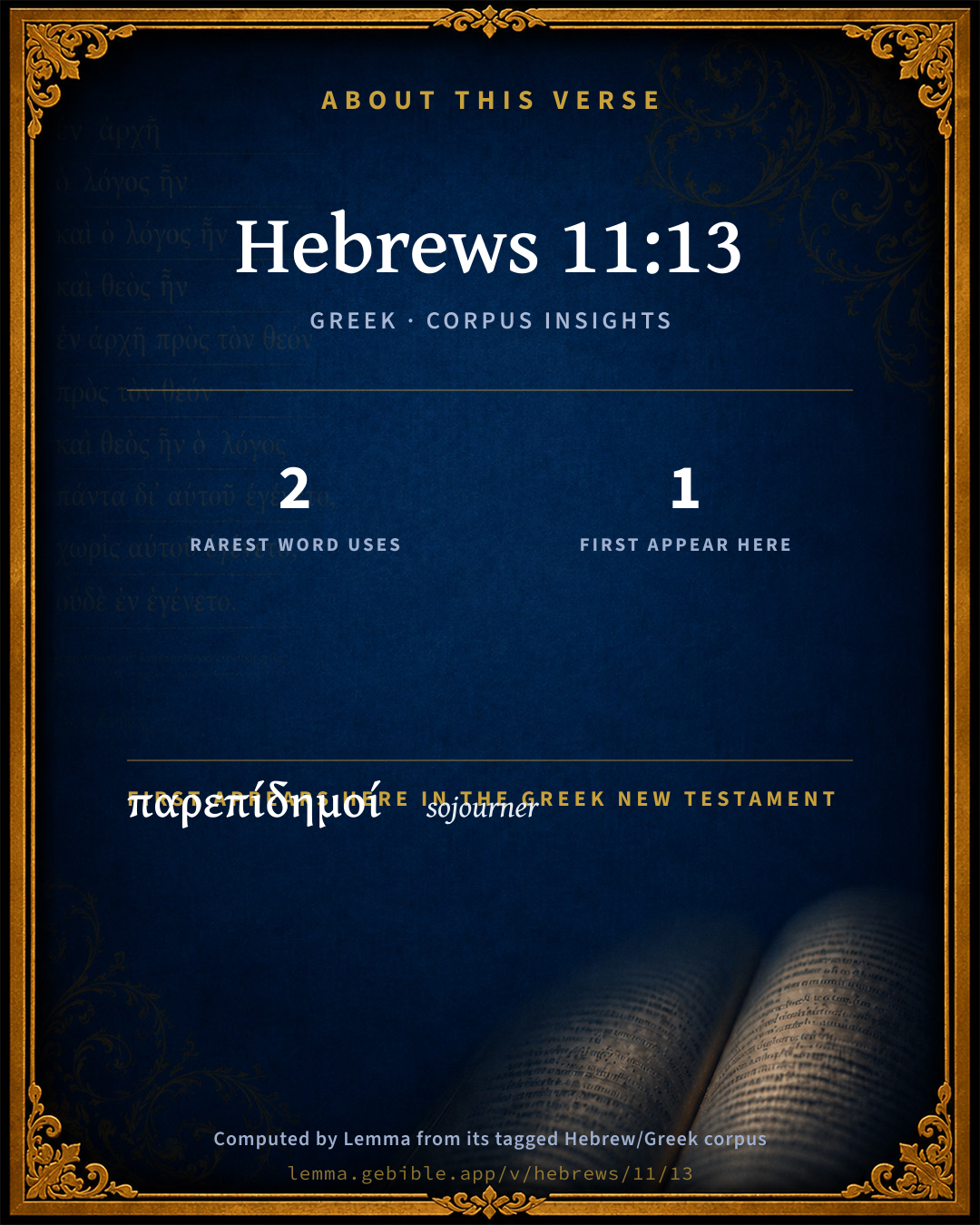
The rarest word here is πόρρωθεν from afar G4207 — appearing just 2 times in the whole Greek New Testament.
First appearance in Scripture
This word makes its first canonical appearance in the Greek New Testament here:
- παρεπίδημοί sojourner G3927
Shared distinctive vocabulary
πόρρωθεν from afar G4207 occurs in 2 verses of the Greek New Testament. Also found in:
Cross-references
27Topical passages linked to Hebrews 11:13 in the Treasury of Scripture Knowledge — connected by theme and wording, ordered by reader-vote popularity; previews shown in the World English Bible.
- Genesis 23:4 "I am a stranger and a foreigner living with you. Give me a possession of a burying-place with you, that I may bury my dead out of my sight."
- Psalms 39:12 "Hear my prayer, Yahweh, and give ear to my cry. Don't be silent at my tears. For I am a stranger with you, A foreigner, as all my fathers were.
- Hebrews 11:27 By faith, he left Egypt, not fearing the wrath of the king; for he endured, as seeing him who is invisible.
- 1 Chronicles 29:14–15 But who am I, and what is my people, that we should be able to offer so willingly as this? For all things come of you, and of your own have we given you.
- John 8:56 Your father Abraham rejoiced to see my day. He saw it, and was glad."
- Romans 8:24 For we were saved in hope, but hope that is seen is not hope. For who hopes for that which he sees?
- Hebrews 11:39 These all, having had testimony given to them through their faith, didn't receive the promise,
- 1 Peter 2:11 Beloved, I beg you as foreigners and pilgrims, to abstain from fleshly lusts, which war against the soul;
- Ephesians 2:19 So then you are no longer strangers and foreigners, but you are fellow citizens with the saints, and of the household of God,
- Genesis 25:8 Abraham gave up the spirit, and died in a good old age, an old man, and full of years, and was gathered to his people.
- Genesis 27:2–4 He said, "See now, I am old. I don't know the day of my death.
- Genesis 47:9 Jacob said to Pharaoh, "The days of the years of my pilgrimage are one hundred thirty years. Few and evil have been the days of the years of my life, and they have not attained to the days of the years of the life of my fathers in the days of their pilgrimage."
- Genesis 49:18 I have waited for your salvation, Yahweh.
- Job 19:25 But as for me, I know that my Redeemer lives. In the end, he will stand upon the earth.
- Romans 4:21 and being fully assured that what he had promised, he was able also to perform.
- 1 Peter 1:10–12 Concerning this salvation, the prophets sought and searched diligently, who prophesied of the grace that would come to you,
- 1 Peter 1:17 If you call on him as Father, who without respect of persons judges according to each man's work, pass the time of your living as strangers here in reverent fear:
- Genesis 49:33 When Jacob made an end of charging his sons, he gathered up his feet into the bed, and yielded up the spirit, and was gathered to his people.
- Matthew 13:17 For most assuredly I tell you that many prophets and righteous men desired to see the things which you see, and didn't see them; and to hear the things which you hear, and didn't hear them.
- 1 John 3:19 And by this we know that we are of the truth, and persuade our hearts before him,
- Genesis 49:10 The scepter will not depart from Judah, Nor the ruler's staff from between his feet, Until he comes to whom it belongs. To him will the obedience of the peoples be.
- Numbers 24:17 I see him, but not now; I see him, but not near: There shall come forth a star out of Jacob, A scepter shall rise out of Israel, Shall strike through the corners of Moab, Break down all the sons of tumult.
- Psalms 119:19 I am a stranger on the earth. Don't hide your commandments from me.
- Genesis 48:21 Israel said to Joseph, "Behold, I am dying, but God will be with you, and bring you again to the land of your fathers.
- Genesis 49:28 All these are the twelve tribes of Israel, and this is what their father spoke to them and blessed them. He blessed everyone according to his blessing.
- Genesis 50:24 Joseph said to his brothers, "I am dying, but God will surely visit you, and bring you up out of this land to the land which he swore to Abraham, to Isaac, and to Jacob."
- John 12:41 Isaiah said these things when he saw his glory, and spoke of him.
Cross-references courtesy of OpenBible.info (CC BY 4.0).
Where the printed editions differ
2 variantsPlaces in this verse where the major printed Greek editions disagree on the wording in a way that affects the translation — a comparison of editions, not a manuscript-by-manuscript collation. The editions are the modern critical texts (Nestlé-Aland 28/27, SBL, Westcott-Hort, Tregelles, Tyndale House) and the traditional texts behind the KJV (the Textus Receptus and the Byzantine/Majority text). It is not a claim about which reading is original.
-
Different wording
λαβόντες
“having received”
In NA28NA27TynSBLTRByz Not in WHTregκομισάμενοι (komisamenoi) 'being repaid' occurs in a few manuscripts (WH+Treg) instead of λαβόντες (labontes) 'having received' in older manuscripts (NA28+NA27+Tyn+SBL+TR+Byz)
-
Extra text
πεισθέντες καὶ
“having been persuaded and”
In TR Not in NA28NA27TynSBLWHTregByzπεισθέντες καὶ (peisthentes kai) 'having been persuaded and' is only in traditional manuscripts (TR)
Textual data: Translators Amalgamated Greek New Testament (STEPBible TAGNT) · CC BY 4.0.
Lesson kit
Teaching starters — assembled from the data on this page, not authored interpretation. Every prompt links to the verse data it draws on. Edit before teaching.
Hebrews, in the General Epistles, opens this verse with 25 words (22 distinct Greek lemmas). Its most distinctive word is pórrhōthen (“from afar”). A historical commentator’s framing appears above. Read the whole chapter for the surrounding context.
Discussion questions
- The word pórrhōthen carries the sense “from afar.” How does it shape the verse?
- The word “sojourner” first appears here in Scripture. What is being introduced at this debut?
- Luke 17:12 shares the word «from afar» with this verse. How do the two illuminate each other?
- “and” occurs 3× in this one verse. What is the effect of the repetition?
- These translations render this verse differently. What is at stake in choosing one wording over another?
- Reading how Jamieson, Fausset & Brown and The Biblical Illustrator read this verse, where do the two commentators agree and where do they part?
Things to notice
- 1 word makes its first canonical appearance in Scripture here.
- These translations choose different wording for 14 words in this verse.
- “and” occurs 3× in this single verse.
- 22 distinct Greek lemmas span 25 words in this verse.
Commentary
Notes on Hebrews 11:13 from classic Christian and Jewish commentators (each source and its license shown beneath its notes). The classic Christian expositions comment on the surrounding passage and are grouped to its opening verse, so a note may address several verses; the Jewish commentaries on the Tanakh (Rashi and others) are per-verse, so they appear only where the commentator wrote on this verse.
Lemma curates 59 commentaries, every one of them public domain or Creative Commons licensed, each selected and text-cleaned for this edition rather than reprinted as found. About our sources →
Jamieson, Fausset & Brown
Robert Jamieson, A. R. Fausset & David Brown
Jamieson, Fausset & Brown — Commentary Critical and Explanatory on the Whole Bible (1871) — public domain (CC PDM 1.0). Text via the HelloAO Bible API.
The Biblical Illustrator
Joseph S. Exell
The Biblical Illustrator, edited by Joseph S. Exell (c. 1880s–1900s) — public domain. Text from a community e-Sword module.
Joseph Benson's Commentary
Joseph Benson's Commentary on the Old and New Testaments (1811–1818) — public domain. Text from a community e-Sword module.
The Preacher's Complete Homiletical Commentary
Joseph S. Exell (gen. ed.)
The Preacher's Complete Homiletical Commentary (gen. ed. Joseph S. Exell; Funk & Wagnalls, c. 1892) — public domain (pre-1929). A full-Bible homiletical/sermon-outline anthology covering 65 of 66 books (2 John is absent from the source module). Text from a community e-Sword module.
Lange's Commentary on the Holy Scriptures
Lange's Commentary on the Holy Scriptures (Critical, Doctrinal, and Homiletical), ed. John Peter Lange, English translation edited by Philip Schaff (1864–1880) — public domain. Text from a community e-Sword module.
MacLaren's Expositions of Holy Scripture
Alexander MacLaren
Alexander MacLaren, Expositions of Holy Scripture (1904–1910) — public domain. Text from a community e-Sword module.
Tyndale Open Study Notes
Tyndale Open Resources
Tyndale Open Study Notes — © Tyndale Open Resources, licensed CC BY-SA 4.0. Text via the HelloAO Bible API.
Bengel's Gnomon
Johann Albrecht Bengel
Bengel's Gnomon of the New Testament — English translation (T&T Clark, Edinburgh, 1860) — public domain. Text from a community e-Sword module.
Meyer's Critical & Exegetical Commentary
Heinrich August Wilhelm Meyer
Meyer — Critical and Exegetical Commentary on the New Testament — English translation by Peter Christie, edited by Frederick Crombie (T&T Clark, 1880) — public domain. Text from a community e-Sword module.
Expositor's Greek Testament
ed. W. Robertson Nicoll
The Expositor's Greek Testament, edited by W. Robertson Nicoll (1897–1910) — public domain. Text from a community e-Sword module.
Geneva Bible (1599)
Geneva Bible translators
Geneva Bible (1599) marginal notes — public domain. Text via Bolls.life.
Adam Clarke's Commentary
Adam Clarke's Commentary on the Bible (1810–1826) — public domain. Text from a community e-Sword/MySword module.
John Calvin's Commentaries
John Calvin's Commentaries (1540-1563) — public domain. Text from the Calvin Translation Society English edition (1840s-50s) via the Christian Classics Ethereal Library (ccel.org). Calvin's coverage is partial (roughly two-thirds of the Bible); uncommented books and verses are honest gaps, never fabricated. The 19th-century editor's footnotes and remarks are omitted so the notes are faithfully Calvin's own voice.
Ellicott's Commentary for English Readers
A Bible Commentary for English Readers, edited by Charles John Ellicott (1878–1897) — public domain. Text from a community e-Sword module.
The Cambridge Bible for Schools and Colleges
gen. ed. J. J. S. Perowne
The Cambridge Bible for Schools and Colleges (gen. ed. J. J. S. Perowne; Cambridge University Press, 1878–1918) — public domain. Text from a community e-Sword module.
John Gill's Exposition
John Gill's Exposition of the Whole Bible (1746–1763) — public domain (CC PDM 1.0). Text via the HelloAO Bible API.
Trapp's Complete Commentary
John Trapp
John Trapp, A Commentary or Exposition upon All the Books of the Old and New Testament (1647–1656) — public domain. Text from a community e-Sword module.
Albert Barnes' Notes on the Bible
Albert Barnes' Notes on the Bible (1834–1885) — public domain. Text from a community e-Sword/MySword module.
Haydock's Catholic Bible Commentary
George Leo Haydock (1774–1849), Haydock's Catholic Family Bible and Commentary, 1859 edition — public domain. Excludes Psalms (Douay-Rheims chapter numbering differs from Protestant) and Deuterocanonical books (Catholic canon only).
Matthew Poole's English Annotations
Matthew Poole's English Annotations on the Holy Bible (1683–1685) — public domain. Text from a community e-Sword/MySword module.
Whedon's Commentary on the Bible
Daniel D. Whedon
Daniel D. Whedon (gen. ed.), Commentary on the Old and New Testaments (1874–1909) — public domain. Text from a community e-Sword module.
The Pulpit Commentary
The Pulpit Commentary (1880–1919), ed. H.D.M. Spence-Jones & Joseph S. Exell — public domain. Text from a community e-Sword module.
John Wesley's Explanatory Notes
John Wesley, Explanatory Notes Upon the Whole Bible (1754–1765) — public domain. Text via the GEBible commentary corpus.
Scofield Reference Notes
C. I. Scofield
The Scofield Reference Bible (1917 edition), notes by C. I. Scofield — public domain. Text from a community e-Sword module.
Kretzmann's Popular Commentary
Paul E. Kretzmann
Paul E. Kretzmann, Popular Commentary of the Bible (1921–1924) — public domain. Text from a community e-Sword module.
Burkitt's Expository Notes on the New Testament
William Burkitt
William Burkitt's Expository Notes on the New Testament (1700–1703) — public domain. Text from a community e-Sword module.
The People's New Testament
B. W. Johnson
B. W. Johnson's The People's New Testament with Notes (1889–1891) — public domain. Electronic text from the Christian Classics Ethereal Library (CCEL) ThML edition.
unfoldingWord translationNotes
Door43 World Missions Community
unfoldingWord translationNotes — © Distant Shores Media and the Door43 World Missions Community, licensed CC BY-SA 4.0. Source: git.door43.org/Door43/en_tn.
Cambridge Greek Testament for Schools and Colleges
Cambridge Greek Testament for Schools and Colleges (Cambridge University Press, 1896; 21 vols, various authors incl. Carr, Maclear, Plummer, Farrar, Lumby, Moule, M. R. James, Simcox) — public domain. Text from a community e-Sword module.
Alford’s Greek Testament
Henry Alford
Henry Alford, The Greek Testament (1849–1861) — public domain. Text from a community e-Sword module.
Vincent's Word Studies in the New Testament
Marvin R. Vincent
Marvin R. Vincent, Word Studies in the New Testament (1887–1900) — public domain. Text from a community e-Sword/MySword module.