Revelation 13:3

Greek (Tischendorf 8th ed.) Revelation 13:3 appears in the Greek New Testament. The text above is from the Tischendorf 8th edition. Each word links to its Strong’s number and a concise gloss. Click any word for its full Thayer’s Greek Lexicon entry.
Download image
Cite this verse

Revelation 13:3 (World English Bible). Public Domain. Lemma interlinear Bible study tool, https://lemma.gebible.app/v/revelation/13/3.

Show BibTeX & RIS
BibTeX
RIS
English Translation
One of his heads looked like it had been wounded fatally. His fatal wound was healed, and the whole earth marveled at the beast.
World English Bible · Public Domain
Download a study sheet

One document with this verse’s original text, its word-by-word gloss line, the meaning frame, cross-references with their text, attributed commentary, and full source and license credits — printable, and it pastes into notes with its structure intact.

This verse Autodidact and up

Study sheet (.html) Plain text (.txt)

A passage Seminary Student

Up to 50 verses in one chapter. A passage sheet keeps up to 6 commentary sources and 12 cross-references per verse, in the order this page ranks them, and says so on the sheet whenever that leaves anything out. Ask for a single verse and you get the Autodidact verse sheet above.

Everything on this page stays free to read, with no account — the sheet is a download of what is already on screen, not access to it.

Want to remove ads? Support Godless Engineer
Compare translations 3

The same verse in 3 English versions, stacked beneath the original-language interlinear above. Click any original word for its lexicon entry.

Each is an independent rendering of the whole verse — the interlinear is not word-aligned to these translations.

Highlighted words mark where these versions differ — a whole-verse word diff, not a word-by-word alignment.

  • World English Bible Public Domain
    One of his heads looked like it had been wounded fatally. His fatal wound was healed, and the whole earth marveled at the beast.
  • King James Version Public Domain
    And I saw one of his heads as it were wounded to death; and his deadly wound was healed: and all the world wondered after the beast.
  • unfoldingWord Literal Text CC BY-SA 4.0
    And one of its heads as if it had been slain unto death, but its wound of death had been healed. And the whole earth was astonished after the beast,

unfoldingWord Literal Text — © unfoldingWord, licensed CC BY-SA 4.0. Word-aligned USFM3 via Door43 (git.door43.org/unfoldingWord/en_ult).

Versions to compare (up to 4)

3 of 4 selected

Show all 19 translations

Every available English version of this verse, each an independent rendering of the whole verse.

  • World English Bible Public Domain
    One of his heads looked like it had been wounded fatally. His fatal wound was healed, and the whole earth marveled at the beast.
  • Berean Standard Bible Public Domain
    One of the heads of the beast appeared to be mortally wounded. But the mortal wound was healed, and the whole world marveled and followed the beast.
  • Majority Standard Bible Public Domain
    One of the heads of the beast appeared to have been mortally wounded. But the mortal wound was healed, and the whole world marveled and followed the beast.
  • King James Version Public Domain
    And I saw one of his heads as it were wounded to death; and his deadly wound was healed: and all the world wondered after the beast.
  • American Standard Version (1901) Public Domain
    And `I saw' one of his heads as though it had been smitten unto death; and his death-stroke was healed: and the whole earth wondered after the beast;
  • Revised Version (1885) Public Domain
    And I saw one of his heads as though it had been smitten unto death; and his death-stroke was healed: and the whole earth wondered after the beast;
  • Geneva Bible (1599) Public Domain
    And I sawe one of his heads as it were wounded to death, but his deadly wound was healed, and all the world wondred and folowed the beast.
  • Douay-Rheims (1899) Public Domain
    And I saw one of his heads as it were slain to death: and his death's wound was healed. And all the earth was in admiration after the beast.
  • Young's Literal Translation Public Domain
    And I saw one of its heads as slain to death, and its deadly stroke was healed, and all the earth did wonder after the beast,
  • Literal Standard Version CC BY-SA 4.0
    And I saw one of its heads as slain to death, and its deadly wound was healed, and all the earth wondered after the beast,
  • Unlocked Literal Bible CC BY-SA 4.0
    One of the beast's heads appeared to have been killed, but its fatal wound was healed. The whole earth marveled as they followed the beast.
  • unfoldingWord Literal Text CC BY-SA 4.0
    And one of its heads as if it had been slain unto death, but its wound of death had been healed. And the whole earth was astonished after the beast,
  • Darby Bible Public Domain
    and one of his heads [was] as slain to death, and his wound of death had been healed: and the whole earth wondered after the beast.
  • World Messianic Bible Public Domain
    One of his heads looked like it had been wounded fatally. His fatal wound was healed, and the whole earth marveled at the beast.
  • Webster's Bible Public Domain
    And I saw one of his heads as it were wounded to death; and his deadly wound was healed: and all the world wondered after the beast.
  • Free Bible Version CC BY-SA 4.0
    One of his heads seemed to have suffered a death-blow, but this fatal wound had been healed. The whole world was filled with wonder at the beast,
  • Bible in Basic English Public Domain
    And I saw one of his heads as if it had been given a death-wound; and his death-wound was made well: and all the earth was wondering at the beast.
  • Text-Critical English NT CC BY 4.0
    One of the beast's heads appeared to be mortally wounded. But his mortal wound had been healed, and the whole world was amazed and followed the beast.
  • Tyndale New Testament (1534) Public Domain
    and I sawe one of his heedes as it were wouded to deth and his dedly woude was healed. And all the worlde wondred at the beast

Literal Standard Version (2020), Covenant Press — licensed CC BY-SA 4.0. Text via the HelloAO Bible API (eBible.org). Unlocked Literal Bible (unfoldingWord) — licensed CC BY-SA 4.0. Text via the HelloAO Bible API (eBible.org). unfoldingWord Literal Text — © unfoldingWord, licensed CC BY-SA 4.0. Word-aligned USFM3 via Door43 (git.door43.org/unfoldingWord/en_ult). Free Bible Version, Dr. Jonathan Gallagher — licensed CC BY-SA 4.0. Text via the HelloAO Bible API (eBible.org).

Word by word

More ways to search: Search by grammar → Find every occurrence → Compare this word →

Practice this passage: Drill this verse → Learn its vocabulary →

ἐσφαγμένην
spházō
G4969
“to slaughter”
Verb, Perfect, Passive, Participle, Accusative, Singular, Feminine
Part of Speech
Verb
Tense
Perfect
Voice
Passive
Mood
Participle
Case
Accusative
Number
Singular
Gender
Feminine
Full Thayer's Definition

Origin: a primary verb

TDNT: 22:25,1

1. to slay, slaughter, butcher 2. to put to death by violence 3. mortally wounded
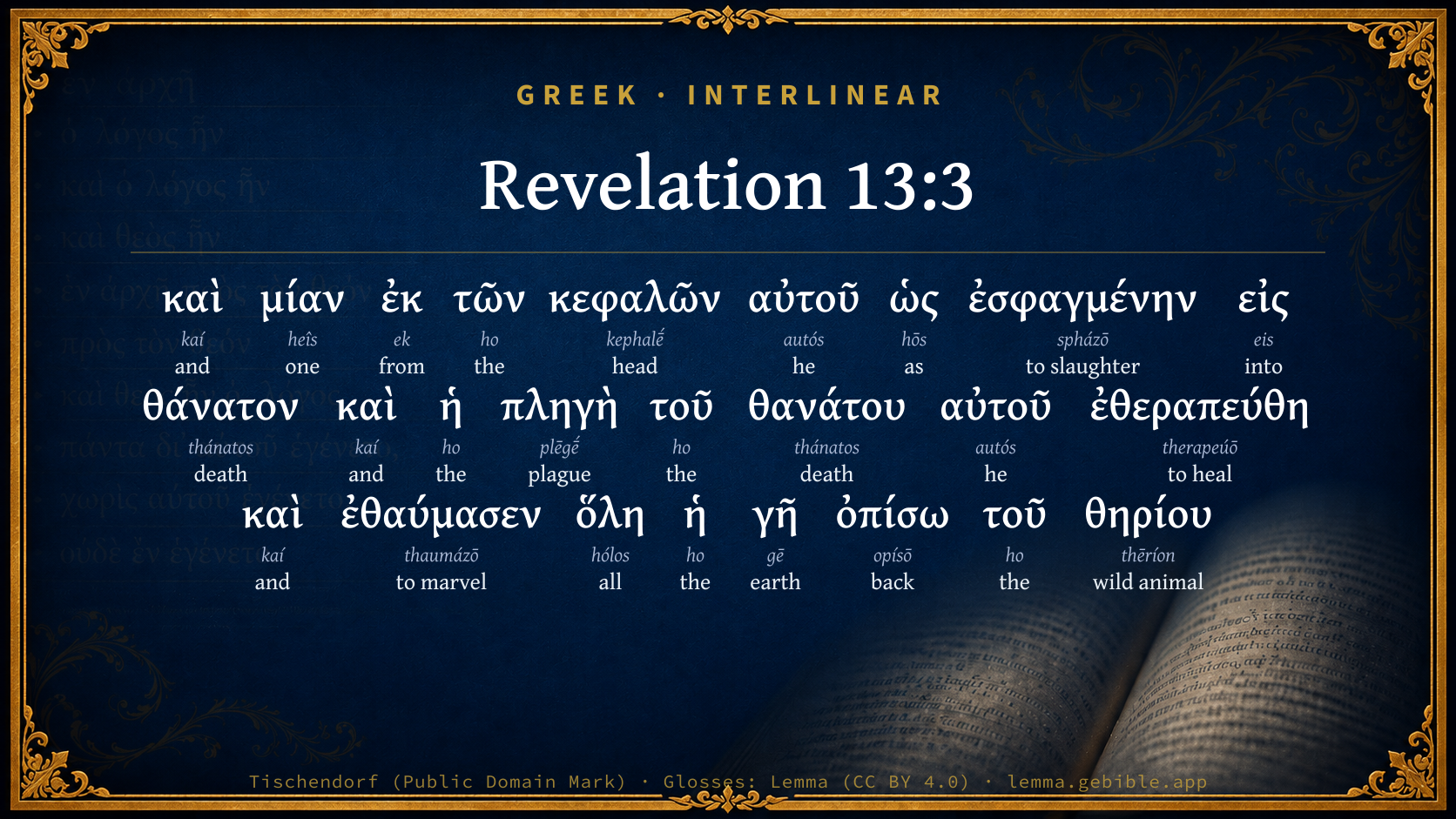
  1. καὶ kaí G2532 “and” Conjunction
  2. μίαν heîs G1520 “one” Adjective, Accusative, Singular, Feminine
  3. ἐκ ek G1537 “from” Preposition
  4. τῶν ho G3588 “the” Article, Genitive, Plural, Feminine
  5. κεφαλῶν kephalḗ G2776 “head” Noun, Genitive, Plural, Feminine
  6. αὐτοῦ autós G846 “he” Personal pronoun, Genitive, Singular, Neuter
  7. ὡς hōs G5613 “as” Adverb
  8. εἰς eis G1519 “into” Preposition
  9. θάνατον thánatos G2288 “death” Noun, Accusative, Singular, Masculine
  10. καὶ kaí G2532 “and” Conjunction
  11. ἡ ho G3588 “the” Article, Nominative, Singular, Feminine
  12. πληγὴ plēgḗ G4127 “plague” Noun, Nominative, Singular, Feminine
  13. τοῦ ho G3588 “the” Article, Genitive, Singular, Masculine
  14. θανάτου thánatos G2288 “death” Noun, Genitive, Singular, Masculine
  15. αὐτοῦ autós G846 “he” Personal pronoun, Genitive, Singular, Neuter
  16. ἐθεραπεύθη therapeúō G2323 “to heal” Verb, Aorist, Passive, Indicative, 3rd person, Singular
  17. καὶ kaí G2532 “and” Conjunction
  18. ἐθαύμασεν thaumázō G2296 “to marvel” Verb, Aorist, Active, Indicative, 3rd person, Singular
  19. ὅλη hólos G3650 “all” Adjective, Nominative, Singular, Feminine
  20. ἡ ho G3588 “the” Article, Nominative, Singular, Feminine
  21. γῆ gē G1093 “earth” Noun, Nominative, Singular, Feminine
  22. ὀπίσω opísō G3694 “back” Adverb
  23. τοῦ ho G3588 “the” Article, Genitive, Singular, Neuter
  24. θηρίου thēríon G2342 “wild animal” Noun, Genitive, Singular, Neuter

About this verse

These counts appear in no published source. They are computed here, from the morphology-tagged text and Lemma’s own curated glosses. What Lemma adds →

25
words
17
distinct lemmas
Revelation
section

Notable vocabulary

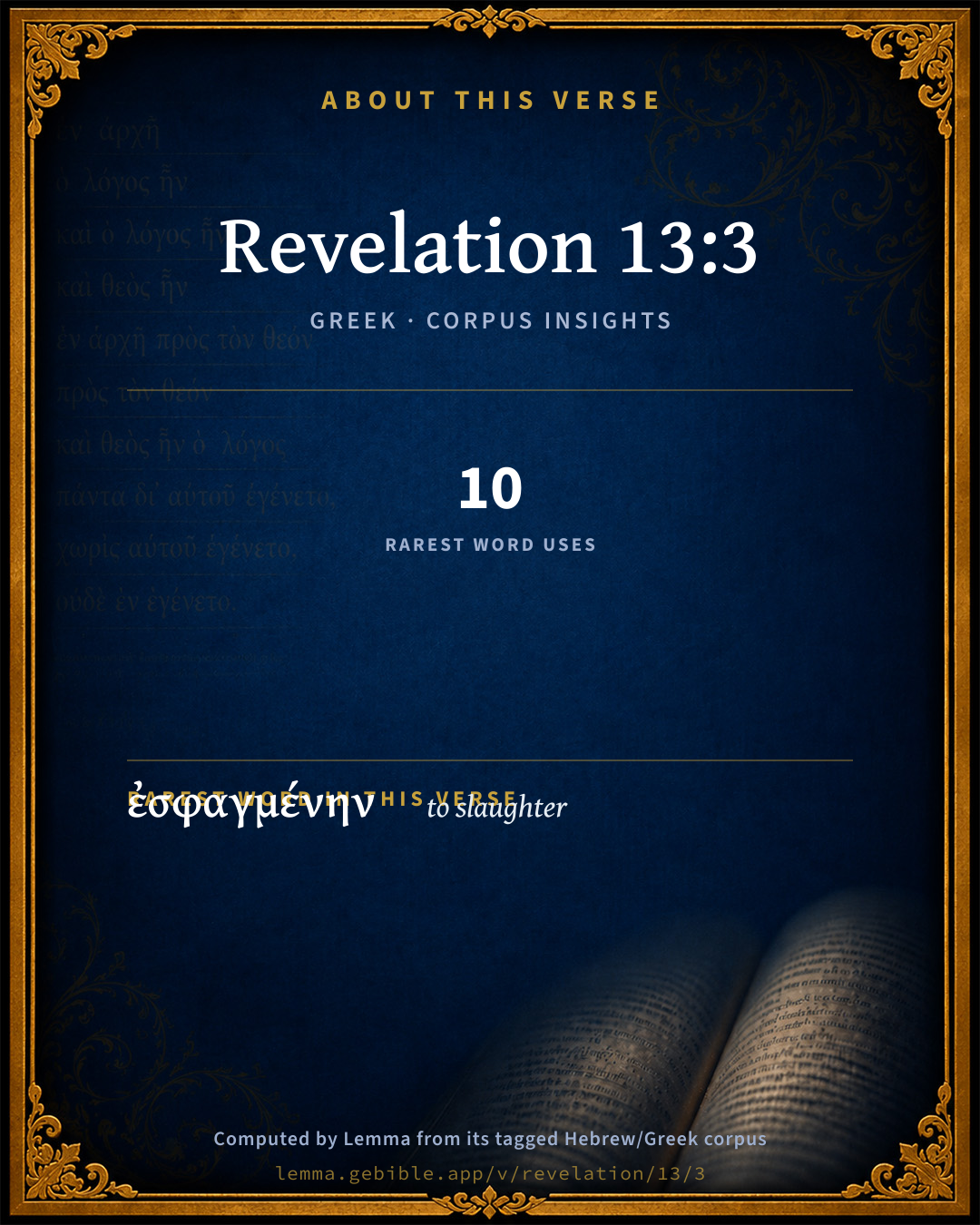
The rarest word here is ἐσφαγμένην to slaughter G4969 — appearing just 10 times in the whole Greek New Testament.

Shared distinctive vocabulary

ἐσφαγμένην to slaughter G4969 occurs in 9 verses of the Greek New Testament. Also found in:

Repetition

Words recur within this verse:

  • θάνατον death G2288 ×2
  • τῶν the G3588 ×5
  • καὶ and G2532 ×3
  • αὐτοῦ he G846 ×2

Cross-references

13

Topical passages linked to Revelation 13:3 in the Treasury of Scripture Knowledge — connected by theme and wording, ordered by reader-vote popularity; previews shown in the World English Bible.

  • Revelation 17:8 The beast that you saw was, and is not; and is about to come up out of the abyss and to go into destruction. Those who dwell on the earth and whose names have not been written in the book of life from the foundation of the world will marvel when they see that the beast was, and is not, and shall be present.
  • Revelation 13:14 He deceives my own people who dwell on the earth because of the signs he was granted to do in front of the beast; saying to those who dwell on the earth, that they should make an image to the beast who had the sword wound and lived.
  • Revelation 17:10 They are seven kings. Five have fallen, the one is, the other has not yet come. When he comes, he must continue a little while.
  • Revelation 17:17 For God has put in their hearts to do what he has in mind, and to be of one mind, and to give their kingdom to the beast, until the words of God should be accomplished.
  • Ezekiel 30:24 I will strengthen the arms of the king of Babylon, and put my sword in his hand: but I will break the arms of Pharaoh, and he shall groan before him with the groanings of a deadly wounded man.
  • Revelation 13:1–2 Then I stood on the sand of the sea. I saw a beast coming up out of the sea, having ten horns and seven heads. On his horns were ten crowns, and on his heads, blasphemous names.
  • Revelation 13:12 He exercises all the authority of the first beast in his presence. He makes the earth and those who dwell in it to worship the first beast, whose fatal wound was healed.
  • Revelation 17:13 These have one mind, and they give their power and authority to the beast.
  • Acts 8:13 Simon himself also believed. Being baptized, he continued with Philip. Seeing signs and great miracles occuring, he was amazed.
  • Luke 2:1 Now it happened in those days, that a decree went out from Caesar Augustus that all the world should be enrolled.
  • Acts 8:10–11 to whom they all listened, from the least to the greatest, saying, "This man is that great power of God."
  • 2 Thessalonians 2:9–12 even he whose coming is according to the working of Satan with all power and signs and lying wonders,
  • Revelation 17:6 I saw the woman drunken with the blood of the saints, and with the blood of the martyrs of Jesus. When I saw her, I wondered with great amazement.

Cross-references courtesy of OpenBible.info (CC BY 4.0).

Where the printed editions differ

1 variant

Places in this verse where the major printed Greek editions disagree on the wording in a way that affects the translation — a comparison of editions, not a manuscript-by-manuscript collation. The editions are the modern critical texts (Nestlé-Aland 28/27, SBL, Westcott-Hort, Tregelles, Tyndale House) and the traditional texts behind the KJV (the Textus Receptus and the Byzantine/Majority text). It is not a claim about which reading is original.

  1. Extra text
    εἶδον

    “I saw”

    In TR Not in NA28NA27TynSBLWHTregByz

    εἶδον (eidon) 'I saw' is only in traditional manuscripts (TR)

Textual data: Translators Amalgamated Greek New Testament (STEPBible TAGNT) · CC BY 4.0.

Commentary

Notes on Revelation 13:3 from classic Christian and Jewish commentators (each source and its license shown beneath its notes). The classic Christian expositions comment on the surrounding passage and are grouped to its opening verse, so a note may address several verses; the Jewish commentaries on the Tanakh (Rashi and others) are per-verse, so they appear only where the commentator wrote on this verse.

Lemma curates 59 commentaries, every one of them public domain or Creative Commons licensed, each selected and text-cleaned for this edition rather than reprinted as found. About our sources →

Jamieson, Fausset & Brown

Robert Jamieson, A. R. Fausset & David Brown

One of--literally, "from among."

wounded . . . healed--twice again repeated emphatically (Rev 13:12, Rev 13:14); compare Rev 17:8, Rev 17:11, "the beast that was, and is not, and shall ascend out of the bottomless pit" (compare Rev 13:11); the Germanic empire, the seventh head (revived in the eighth), as yet future in John's time (Rev 17:10). Contrast the change whereby Nebuchadnezzar, being humbled from his self-deifying pride, was converted from his beast-like form and character to MAN'S form and true position towards God; symbolized by his eagle wings being plucked, and himself made to stand upon his feet as a man (Dan 7:4). Here, on the contrary, the beast's head is not changed into a human head, but receives a deadly wound, that is, the world kingdom which this head represents does not truly turn to God, but for a time its God-opposed character remains paralyzed ("as it were slain"; the very words marking the beast's outward resemblance to the Lamb, "as it were slain," see on Rev 5:6. Compare also the second beast's resemblance to the Lamb, Rev 13:11). Though seemingly slain (Greek for "wounded"), it remains the beast still, to rise again in another form (Rev 13:11). The first six heads were heathenish, Egypt, Assyria, Babylon, Persia, Greece, Rome; the new seventh world power (the pagan German hordes pouring down on Christianized Rome), whereby Satan had hoped to stifle Christianity (Rev 11:15-16), became itself Christianized (answering to the beast's, as it were, deadly wound: it was slain, and it is not, Rev 17:11). Its ascent out of the bottomless pit answers to the healing of its deadly wound (Rev 17:8). No essential change is noticed in Daniel as effected by Christianity upon the fourth kingdom; it remains essentially God-opposed to the last. The beast, healed of its temporary and external wound, now returns, not only from the sea, but from the bottomless pit, whence it draws new Antichristian strength of hell (Rev 13:3, Rev 13:11-12, Rev 13:14; Rev 11:7; Rev 17:8). Compare the seven evil spirits taken into the temporarily dispossessed, and the last state worse than the first, Mat 12:43-45. A new and worse heathenism breaks in upon the Christianized world, more devilish than the old one of the first heads of the beast. The latter was an apostasy only from the general revelation of God in nature and conscience; but this new one is from God's revelation of love in His Son. It culminates in Antichrist, the man of sin, the son of perdition (compare Rev 17:11); Th2 2:3; compare Ti2 3:1-4, the very characteristics of old heathenism (Rom 1:29-32) [AUBERLEN]. More than one wound seems to me to be meant, for example, that under Constantine (when the pagan worship of the emperor's image gave way to Christianity), followed by the healing, when image worship and the other papal errors were introduced into the Church; again, that at the Reformation, followed by the lethargic form of godliness without the power, and about to end in the last great apostasy, which I identify with the second beast (Rev 13:11), Antichrist, the same seventh world power in another form.

wondered after--followed with wondering gaze.

Jamieson, Fausset & Brown — Commentary Critical and Explanatory on the Whole Bible (1871) — public domain (CC PDM 1.0). Text via the HelloAO Bible API.

Scofield Reference Notes

C. I. Scofield

wounded to death

Fragments of the ancient Roman empire have never ceased to exist as separate kingdoms. It was the imperial form of government which ceased; the one head wounded to death. What we have prophetically in Rev 13:3 is the restoration of the imperial form as such, though over a federated empire of ten kingdoms; the "head" is "healed," i.e. restored; there is an emperor again--the Beast.

world

ge = earth. Joh 7:7, (See Scofield "Rev 13:8").

The Scofield Reference Bible (1917 edition), notes by C. I. Scofield — public domain. Text from a community e-Sword module.

Tyndale Open Study Notes

Tyndale Open Resources

13:3 Satan often imitates God. Here the beast mimics the death and resurrection of Jesus. • That one of the heads had been fatally wounded but was healed has led to its identification with Nero. A tradition emerged that the emperor Nero (AD 54–68) was so evil that he either did not really die or would be reincarnated as another tyrant like Domitian (AD 81–96). In 17:9-10, the beast’s seven heads are linked both to seven hills (Rome) and to seven kings.

Tyndale Open Study Notes — © Tyndale Open Resources, licensed CC BY-SA 4.0. Text via the HelloAO Bible API.

Bengel's Gnomon

Johann Albrecht Bengel

Rev 13:3. Καὶ μίαν) Thus all the most ancient remains: two or three copies insert εἶδον.[144] I agree with Wolf, that μίαν, when you destroy εἶδον, does not refer to the verb ἔδωκε, which immediately precedes it. although there appears to be a gloss, as noticed in the Apparatus, which refers μίαν to it. But if εἶδον is to be understood, it ought to be repeated from Rev 13:1, just as Pliny uses the verb of seeing by Hyperbaton, H. N. Book VIII. c. 6: Italy first saw elephants in the war with king Pyrrhus, and called them Lucanian oxen; but (it saw them) at Rome[145] in a triumph, etc. But the connection of the discourse is equally good, ἔχον μίαν, κ.τ.λ.: comp. Rev 13:14: and the Latin translator, whereas long ago he did not read I saw, seems thus to have construed the passage: and I saw a beast having seven heads—and (having) one of HIS [SUIS, not ejus] heads as it were slain to death. There is here, Rev 13:1-3, that mixture of cases, which we have seen more than once, and shall see somewhat below: and the connection is easy between the seven heads and one of the heads. One head is mentioned for the first: for εἷς, one, even without the article, means the first, ch. Rev 6:1, twice; Eze 32:1, especially in the LXX., etc. The accusative μίαν, which, as we lately noticed, depends by Hyperbaton on ἔχον, Rev 13:1, most closely connects together the ascent of the beast out of the sea and the wound. Wherefore also he says, κεφαλὴν ἐσφαγμένην, not σφαττομένην, as ἀστέρα πεπτωκότα, in the preterite, ch. Rev 9:1. The first head of the beast is the Pope in the Lateran, on the Cælian Mount, from Gregory VII. to Innocent III., or beyond him. During that space of time many adversities befel the Pope, through his contention with the Emperor; but he recovered from all.—ὡς ἐσφαγμένην—ἐθεραπεύθη, as it were slain [“wounded to death”]—was healed) You may see paroxysms both of the wound and of the healing in the history of Gregory VII., Paschal II., Calixtus II., Alexander III., and others. Whatever adversity then happened, belongs to the wound: whatever prosperity, belongs to the healing.—καὶ ἐθαύμασεν ὅλη ἡ γῆ ὀπίσω τοῦ θηρίου, and all the earth wondered after the beast) that is, went after the beast with admiration. An abbreviated expression, as Act 15:23, writing and sending by their hands. All followed the beast with their feet, or eyes, or inclination; for instance, in the Crusades.

[144] ABCh Vulg. (Amiat.) Iren. omit εἶδον. Rec. Text inserts it, with no very old authority except Fuld. MS. of Vulg. (inferior to Amiat.)—E.

[145] “Romæ autem (scil. vidit), etc.”

Bengel's Gnomon of the New Testament — English translation (T&T Clark, Edinburgh, 1860) — public domain. Text from a community e-Sword module.

Meyer's Critical & Exegetical Commentary

Heinrich August Wilhelm Meyer

Rev_13:3. καὶ μίαν έκ τ. κεφ. With the accus., an express εἷδον is, indeed, not placed,[3264] but its idea results[3265] from the connection, since the ΕἿΔΟΝ, Rev_13:1, which is repeated besides in Rev_13:2, continues to be effective.

Ὡς ἘΣΦΑΓ. The Ὡς stands just as in Rev_5:6, only that in this passage the circumstance which explains how that one head bore the marks of an actual mortal wound, and yet could be represented like the rest in all the vigor of life, is expressly designated: ΚΑῚ Ἡ ΠΛ. Τ. ΘΑΝ. ΑὐΤ. ἘΘΕΡΑΠΕΎΘΗ.

The more significant that is, which is said in Rev_13:3 a., and the more this special feature of the entire image of the beast from the sea is adapted thereto, in order to adjust and test the correct interpretation of the whole, the more certain, on the other hand, to become helpless here, is every exposition that misunderstands the image of the beast as a whole. Hengstenb., Ebrard, Auberlen, etc., who regard the θηρίον an image of the world-power in general, infer from Rev_17:10, with entire impropriety, that the head wounded unto death, and again healed, is the sixth, i.e., that whereby the Roman form of the world-power is symbolized. But although Hengstenb. further interprets that by Christs atonement a mortal wound is inflicted upon Roman worldly affairs and heathenism,a wound which, therefore, could appear as again healed, because the outward condition of the Roman Empire still continued, as John himself must have felt this ungodly power in his banishment to Patmos,

Ebrard and Auberlen prefer an interpretation expressly rejected by Hengstenb. They observe, that by the migration of nations the mortal wound was given the Roman Empire; but that this wound was healed, because a new Roman Empire had arisen, whose chief strength rests just in the Germanic nations. This Holy Roman Empire, however, appears as the sixth head of the beast, healed of its mortal wound, because its Christianity is secularized, ay, in all Christian appearance, often of a directly antichristian activity; viz., in the Papacy. But the Christian aspect of this form of the world-power is positively expressed in the fact that the head of the beast (ὡς ἐσφαγμ.) bears in itself a certain resemblance to the Lamb (Ὡς ἘΣΦΑΓΜ., Rev_5:6). The mode of exposition thus reverts in essentials to the old Protestant; only that this was the more correct, so far as it did not acknowledge the vague significance of the ΘΗΡΊΟΝ of the world-power in the abstract, but understood it as a definite reference to Rome. Thus Calov., in dependence on Luther, explains the beast wounded, most correctly, of the Roman Empire, harassed by the invasions of the barbarians, who for more than three centuries wounded, devastated, and held Rome, so that, during that whole time, there was no Western emperor. It was also healed by the medical aid of Charlemagne and Leo III. Coccejus understood the head as the Grecian part of the Roman Empire: In this part the beast received a fatal wound when Julian restored the worship of the gods. The ἘΘΕΡΑΠΕΎΘΗ is interpreted: Julian was removed, and Jovian, the Catholic, succeeded him. Phil. Nicolai referred the wounding to the dominion of seven hundred years by the Moors in Spain; the healing, to the expulsion of the enemy by King Ferdinand. Most consistently Vitringa explains that the mortal wound is the humiliation of Pope Alexander 13 by the Emperor Frederick in the year 1160, and that the healing is the humiliation of the Emperor by the Pope in the year 1177:[3266] on the other hand, Bengel, with his far-reaching interpretation,[3267] stands already nearer the moderns, as Ebrard and Auberlen. But the former, as well as the latter, interpretation is rejected both by the connection of ch. 12[3268] and by the particular points in Rev_13:1-2 The ΘΗΡΊΟΝ is just as certainly not the abstract world-power, as the seven heads are not particular phases of the world-power, but kings, and that, too, Roman kings. Besides this, the quid pro quo which is ascribed to the writer of the Apocalypse, by representing him as describing the Holy Roman Empire as the empire of heathen Rome which has been again revived, is compatible neither with historical truth nor with a sound conception of biblical prophecy. In both respects, it is impossible to regard an historical development, which is dependent upon the Christian element, and whichin all its unchristian and antichristian deteriorationyet remains in its entire course Christian, and has produced truly holy fruit, as a head of this beast of the dragon. The only indication in the text, which apparently supports such a misconception, Auberlen, etc., have found in the expression ὡς ἘΣΦΑΓΜ., as, from the comparison of Rev_5:6, they have inferred that thereby there is ascribed to the healed head a Christian, i.e., an apparently Christian, life and nature. But supposing, what does not necessarily lie in the expression, that a significant contrast were intended between the Lamb standing there as slain, and the head of the beast wounded, as it were, to death: is it, then, not much more correct to explain, as Victorin. already has done,[3269] viz., that the person represented by the head wounded and again healed is to be regarded as a pretended Christ in whom the sufferings and resurrection of the Lord appear to be imitated?

[3264] Against the false Rec.

[3265] Cf. Rev_4:4.

[3266] As a new interpretation, Vitr. proposes. The first five fallen (Rev_17:10) heads are five distinguished popes before the Reformation: Gregory VII., Alexander III., Innocent III., Boniface VIII., John XXII.; after the Reformation follow Paul III., Paul VIII., and finally the eighth, still future Pope, who shall put to death Christs witnesses (Rev_11:7).

[3267] You may see the paroxysms both of wounding and healing in the history of Gregory VII., Paschal II., Calist II., Alexander III., and others. Whatever adversity then happened is wounding; and whatever prosperity, healing.

[3268] Auberlen has, indeed, found the migration of nations in Rev_12:15 sqq.

[3269] This one, therefore, viz., Nero, being raised, God will send as a king worthy of the worthy, and a Messiah such as the Jews have merited. Cf. Beda: Antichrist, pertaining to the heads of the earthly kingdom, in imitation of our true Head, professes to have risen again, an though having been slain, and presents himself for mens reception, instead of Christ, who truly did this. In like manner, Zeger, C. a Lap., etc.

If we turn from such explanations as do not need a special refutation,[3270] that of Victorin. is first presented, which, being brought again to notice by Corrodi[3271] and Eichhorn, has been of late resolutely defended by Lücke, De Wette, Bleek, Baur, Volkmar, Hilgenf., E. Renan, etc[3272] The Roman historians of the report bruited shortly after Neros death, that he was still living, and would again appear,[3273] are quoted. This opinion, which was current especially in Asia,[3274] is recognized by the writer of the Apoc.; and two circumstances concur, which seem to greatly urge the explanation from that fancy of the enigmatical discourse concerning the head of the beast wounded to death, and again healed. On the one hand, it has penetrated Christian literature, viz., the Apocalyptic:[3275] on the other hand, it appears to give a definite explanation of Rev_17:8, and the one best harmonizing with Rev_13:3, viz., that Nero, slain by his own hand, appears returning from the abyss of hell, and working again as the living antichrist.

But against this mode of exposition it is to be remarked: (1) The writer of the Apocalypse in no way betrays such impurity and limitation of faith and Christian culture, that without injustice a superstition dare be ascribed to him which the Roman authors already had derided.[3276] In any case, if John subscribed to that illusion, nothing more could any longer be said concerning a truly prophetical character of the Apoc., dependent upon inspiration, and concerning its canonical authority.[3277] (2) In reference to Rev_17:8,[3278] it must be mentioned already here, how difficult it is by the ΘΗΡΊΟΝ which is there described, to understand Nero alone, who is symbolized, just as in ch. 13, by one of the seven heads of the beast. (3) But it is also in the highest degree doubtful whether the Nero-myth were current already at the close of the first century, as they try to find it in John: on the contrary, unmistakable traces indicate that the original Nero-myth received the form in which it is now by an anachronism, regarded as utilized in the Apoc. only by combining with it misunderstood passages like Rev_13:3; Rev_17:8, and 2Th_2:3 sqq. Sueton., Tacit., and Dio Chryst. by no means say that it was their opinion that the actually dead Nero had returned from the lower regions to life; but they report[3279] that it was not properly known in what way Nero had died, and that, therefore,[3280] the report originated that he was not at all dead, but had escaped to the Parthians, and would return to take vengeance on his enemies. So it stands in the sibylline books, where Nero appears as a fugitive,[3281] who is to return from the ends of the earth, his temporary place of refuge.[3282] That this Nero-myth was diffused among Christians by the authority of the sibylline books, is attested by Lactantius, who explains it not only as madness, but also indicates its natural origin:[3283] Cast down, therefore, from the head of the government, and fallen from its summit, the impotent tyrant suddenly was nowhere present, so that a place not even of burial might appear on earth for so wicked a beast. Whence some madmen believe that he has been translated and reserved alive, the sibyl saying that the fugitive matricide shall come from the ends of the earth, etc. Therefore Lactantius also knows nothing, as yet, of a resurrection and return of the dead Nero, but he has in view the faith of some madmen, supported by the sibylline books, that the still living Nero had found a refuge somewhere at the ends of the earth, whence he will return as a precursor of the antichrist.[3284] But this superstition, still diffused at his time, Lact. regards so senseless, because thereby a life a century long must be presupposed to Nero; while the entire fable could be explained without difficulty, from the fact that the grave of Nero was unknown,an explanation which is proved to be right, inasmuch as Nero was actually buried with the greatest silence.[3285] In Lactantius, therefore, the Nero-myth, designated as senseless, does not have the form in which they want to find it presented by the writer of the Apoc.

Augustine is the first to testify to the existence of the expectation that Nero would arise from the dead, and return as antichrist, since he expressly remarks that this form of the myth, by the side of the older, has resulted from an interpretation of 2Th_2:3 sqq. that is as bold as it is perverted:[3286] Some think that this[3287] was said of the Roman Empire,as his declaration, The mystery of iniquity doth already work, he wanted to be understood of Nero, whose deeds seemed as though of antichrist. Whence some suspect that he will rise again, and be the antichrist. But others think that he was not slain, but rather had withdrawn so as to be regarded slain, and was concealed alive in the vigor of the age, in which he was when he was believed to have died, until he would be revealed at his own time, and be restored to the government. But to me such presumption of those thinking these things is very wonderful. In this connection, also, Augustine does not mention the Apoc.[3288] This is done by Sulp. Severus,[3289] who, however, does not combine the myth of the revivification of the dead Nero with Rev_13:3, but under the presumption that Nero had actually committed suicide[3290] records the entirely peculiar turn to the matter: It is believed that the wound which Nero inflicted upon himself was healed, and that he still lives, and at the end of the world will return as antichrist. The complete form of the myth is given first by Victorin., who expressly says that the actually deceased Nero would be again raised by God, and be sent as the pseudo-Messiah for judgment upon the ungodly; but Victorin.s own words[3291] betray the origin of the myth thus fashioned, in the same way as Augustine[3292] testifies to the origin of another application of the myth from 2 Thessalonians 2. It cannot, therefore, in any way be asserted upon an historical basis, that the writer of the Apocalypse, when he represents one of the heads of the beast as wounded to death and again healed, depends upon an idea current at his time, concerning the return of Nero raised from the dead,for such an idea does not belong as yet to his time,but it must be asserted that the writer of the Apoc. has himself fashioned this manner of expressing the Nero-myth. No one, however, has ventured this.

[3270] Grot. on ὡς ἐσφ.: The Capitol was burned while the Vitellians and Flavians warred with one another.

ἒθεραπ.: For the same Vespasian restored the Capitol, who also restored the Roman Empire, and, indeed, with great pomp of idolatry. Züllig, who in Rev_13:18 finds the name of Balaam: Balaam, slain as anti-Moses, now has returned to life, with seven heads, as the anti-Messiah, as the one for whom he will now be regarded returned from death to life.

[3271] Krit. Gesch. des Chiliasmus, Zür., vol. ii., p. 308 sqq.

[3272] Der Antichrist, Germ. ed., Leipz. and Paris, 1873, p. 278.

[3273] Tacit., Hist., ii. Revelation 8 : About the same time, Achaia and Asia were terrified by a false rumor, as though Nero were approaching, and a fluctuating rumor concerning his death, the majority, on this account, thinking and believing that he was alive. Cf. Sueton., Nero, 100:57; Dio Chrys., Or., xxi., ed. Reiske., T. I., p. 504.

[3274] So that a false Nero, who availed himself of this in a remarkable way, found a following among the Parthians. Sueton., l. c.; Tacit., Hist., i. Revelation 2 : War also with the Parthians, near at hand, was stirred up by the farce of the pretended Nero.

[3275] Sibyll. Orac., ed. Serv. Gall., L. VIII., p. 688: ὅταν γʼ ἐπανέλθη ἑχ περάτων γαἱης ὁ φυγἀς μητροκτόνος ἐλθών [When the matricide fugitive returns from the opposite part of the earth]. Cf. p. 716; L. V., p. 547; Sulp. Sev., Hist., s., L. II., Opp. ed.; G. Hom., Lugd. Bat., 1647, p. 373: Certainly his body, viz., that of Nero, was slain; whence it is believed, that, although he pierced himself with the sword, yet that he was restored by the healing of his wound, as it is written of him: And the stroke of his death was healed, in order that he might be seut at the end of the world to exercise the mystery of iniquity.

[3276] Dio Chryst., l. c.: τρόπον τινὰ οὐχ ἅπαξ αὐτοῦ τεθνηκότος, ἀλλὰ πολλάκις μετὰ τῶν σφόδρα οἰηθέντων αὐτον ζῇν.

[3277] This statement is not based on a narrow-minded conception of the canon (Volkm.), but asserts the demands which justice and cautious piety make of exegetes. The Apoc., with respect to its other contents, stands so high that it is utterly impossible that it should advance any superstitious statement directly contradictory to the simplest Christian faith and thought (also against Weiss., p. 34). But if it be exegetically proved that this is nevertheless the case, it appears necessary to surrender the deutero-canonical authority of the book. But, in spite of all its dazzling appearance, the exegesis of Volkm., as well as of Ewald, etc., is on this point incorrect.

[3278] See on the passage.

[3279] Cf. especially Dio Chryst., l. c.: καί οὕτως ἀπέστησαν ἀπʼ αὐτοῦ καὶ ἠνάγκασαν ὄτῳ ποτὲ τρόπῳ ἀπολέσθαι αὐτόν· οὑδέπω γὰρ καὶ νῦν τοῦτό γε δῆλόν ἐστιν [And thus they stood aloof from him, and urged the question in what way he had died; for this even now was not as yet manifest].

[3280] Cf. Tacit., l. c.

[3281] φυγάς, L. VIII., 13:71; ed. Friedlieb, φεύγων, L. V., 13:364.

[3282] In the same sense also is the passage, L. V., 13:33, to be understood. ἔσται καὶ ἅϊστος ὀλοίϊος, εἶτʼ ἀνακάμψει, where Gallaeus (will utterly be destroyed) and Friedlieb (the pernicious vanishes away) mistranslate the ἄϊστος. It is said only that the pernicious one, i.e., Nero, will become invisible, viz., by flight, but will return. It is altogether a perversion when the sibylline expressions concerning the return of Nero are compared with the Apoc., in order to make a Nero redivivus acceptable here; for in the sibylline books the chief matter is lacking, as, e.g., Hilgenf. himself acknowledges (Zeitschr. f. Wiss. Th., 1871, p. 39. Cf. also, 1869, p. 421 sqq.).

[3283] De Mort. Persec., c. 2.

[3284] A precursor of the devil, and going before him as he comes to devastate the earth, and overthrow the human race.

[3285] Eutrop., Hist. Rom. vii. Revelation 18 : The remains of Nero, which were buried in a humble way.

[3286] De Civ. D., L. XX., c. 19, § 3.

[3287] l. c., Rev_13:7.

[3288] That Nero had sometimes been regarded the antichrist of Daniel, because of his persecution of the Christians (Jerome on Dan_11:28 : Whence many of our writers think that because of the greatness of his cruelty and baseness, the Domitian Nero would be antichrist), does not belong here.

[3289] l. c.

[3290] Etiamsi se gladis transfixit.

[3291] Nanc ergo caetera.

[3292] l. c.

Any other explanation of Rev_13:3 is therefore hardly possible, than that indicated already in the Introduction.[3293] By a combination with Rev_17:8-11, the result is attained that the mortal wound cannot be referred to the sixth,[3294] but must be referred to the fifth, head of the beast. This is correctly acknowledged by Ewald, Lücke, De Wette, etc., as they are further right in accounting Nero as the last of the fallen kings. But to proceed from this to the interpretation of Rev_13:3, advocated by Ewald, Lücke, etc.,which is proved to be just as untenable,is not only not demanded by Rev_17:8-11, but is prohibited, because it is not said there that the fifth fallen king, i.e., Nero, would return as the eighth, but that the future eighth would be the personified beast himself. But of this nothing whatever is said in ch. 13; it is not once to be perceived from ch. 13 that an eighth king is at all to be expected, so that this point (Rev_17:11) is not in any way to be introduced into Rev_13:3. The healing of the mortal wound certainly cannot, therefore, refer to one of the heads of the beast (the fifth), as it is neither said in ch. 17, nor agrees with the statement in Rev_13:3, that the fifth fallen (deceased) king will return as the eighth. On the contrary, the healing of the mortal wound on the fifth head of the beast must correspond to that which is stated in ch. 17, so that the beast is not, and yet is; viz., it is in so far as the sixth king is. The existence of the sixth king is the healing of the mortal wound on the fifth head, whose infliction caused the beast not to be, and whose healing again caused the beast, nevertheless, to be. Thus ch. 17 gives the riddle, and ch. Rev_13:3 the clew whereby the riddle is solved. The mortal wound is inflicted upon the (fifth) head of the beast, and the interregnum immediately succeeding. It is to be observed, that it is not at all said that the coroneted horn on the (fifth) head was stricken off, and grew again,this would attach the idea expressly to the person of Nero, and correspond with the opinion of Ewald, Lücke, De Wette, and Volkm.,but that, in accordance with the distinction between the heads and the horns (cf. Rev_13:1), the idea of the Roman Empire, so far as it was under the Emperor Nero, is expressed[3295] This empire, designated by the fifth head of the beast, received a mortal wound when Nero, the bearer of the empire, and the last of the race of the Caesars which had founded the empire, committed suicide, and that, too, under the compulsion of the rebellion of a usurper (Galba), who, as little as his two successors (Otho, Vitellius), could in any way be regarded the restorer of the empire which was destroyed with Nero. The healing of that mortal wound did not ensue until Vespasian, the founder of a new dynasty, restored the empire, as its actual possessor, to its ancient strength and vitality. Thus, at the foundation of the prophetical enigmatical discourse of the writer of the Apoc. concerning the beast wounded to death and again restored, concerning the three coroneted horns which, nevertheless, do not stand upon particular heads (Rev_13:1), and concerning the beast which is not and yet is, there lies the same historical view which is declared by the Roman historians, in their representation of the threefold regency between the death of Nero and the accession of Vespasian, only as a sad interregnum.[3296]

[3293] p. 47 sq.

[3294] Hengstenb., Auberlen.

[3295] Volkm. urges that in Rev_13:3, it is not said that the beast was wounded on its head, etc. But what in Rev_13:3 he is wrong in omitting, is correctly said in Rev_13:12.

[3296] Sueton., l. c.; Dio Cass., Hist. Rom., ed. J. Leuncl., Hannov., 1606, p. 7353.

Rev_13:3 b, Rev_13:4. καὶ ἐθαύμασεν

ὀπίσω τοῦ θηρίου. The pregn. construction gives the view as to how the astonishment at the succession is occasioned.[3297] Beng. also shows how this expression is supported historically: in the crucifixion, e.g., this prophecy is fulfilled.

The amazement of the whole earthfor thus far the dominion of the beast extends (Rev_13:2)may be referred especially to what is said in Rev_13:3 a; for the worship of the dragon, as also of the beast equipped by him, that which results from Rev_13:2 b is expressly attached as the reason. But not only is the προσκυνεῖν on the part of the inhabitants of the earth[3298] a robbery, which, in the service of the dragon and his beast, they perpetrate on the one true God, but even the phraseology in which they express their worship[3299] seems like a blasphemous parody of the praise with which the O. T. Church celebrated the incomparable glory of the living God.[3300] [See Note LXXI., p. 387.] And if the inhabitants of the earth declare further καὶ τίς δύναται, κ.τ.λ., back of this challenging and triumphing question lies concealed the desire that, in compliance with the purpose of the dragon,[3301] they might begin the conflict with those who do not worship the beast (cf. Rev_13:7).

[3297] Cf. Act_5:37; Act_20:30. Grot., Züll., De Wette, etc.

[3298] Cf. Rev_13:8; Rev_3:10.

[3299] Coccejus feels the difficulty of carrying out here his interpretation of the θηρίον; for, if the θηρίον is the papacy, it appears objectionable to represent its adherents as worshippers of the dragon. But he says: In word, it is true, they praised God and Christ, who had given such power to the Church; but in fact, because it was not the Church, but a beast, and the worldly power which he claimed for himself was power conceded by the dragon transforming himself into an angel of light, he whom they adored was the dragon.

[3300] Cf. Isa_40:25; Isa_44:7; Isa_46:5; Psa_35:10; Psa_103:5; Mic_7:8; Coccej., Ewald.

[3301] Rev_12:17.

NOTES BY THE AMERICAN EDITOR

LXXI. Rev_13:4. Τίς ὅμοιος τῷ θηρίῳ

Gebhardt: The seer observes what an imposing, overpowering, transporting impression the Roman Empire exercises upon men; how the world is astonished at it; that it is amazed by its greatness, power, and glory, and does homage to it; how the world worships the dragon, because he has given power to the beast,that is, not consciously worshipping the devil, but perceiving, in imperial power, and in its individual possessors, supposed manifestations of the divine, it really gives divine honors to the devil. Carpenter: The spirit of the wild beast is adored wherever worldliness prevails. There is nothing so successful as success, and the homage of men is more often paid to power than to principle. Can you not hear the words coming across the centuries from the lips of two Roman youths, talking with each other as they lounge about the Forum? (Maurice.) Can we not hear the echo of the words in the Champs Elysées, in Piccadilly, in the Broadway, or Unter den Linden, from the lips of young men who have taken fashion, rank, wealth, world-power in any shape, as their god?

Meyer — Critical and Exegetical Commentary on the New Testament — English translation by Peter Christie, edited by Frederick Crombie (T&T Clark, 1880) — public domain. Text from a community e-Sword module.

Expositor's Greek Testament

ed. W. Robertson Nicoll

Rev 13:3 . The prophet sees in the empire an extraordinary vitality which adds to its fascination. Disasters which would suffice to ruin an ordinary state, leave Rome as strong as ever, thanks to her marvellous recuperative power. The allusion is not to the murder of Cæsar (so e.g. , Bruston, Gunkel, Porter), nor to the illness of Caligula (Spitta), but (so Düsterdieck, O. Holtzmann, B. Weiss, etc.) to the terrible convulsions which in 69 A.D. shook the empire to its foundations (Tac. Hist. i. 11). Nero’s death, with the bloody interregnum after it, was a wound to the State, from which it only recovered under Vespasian. It fulfilled the tradition of the wounded head (Dan 8:8 ). Song of Son 4 Esd. 12:18 (where the same crisis is noted) “post tempus regni illius [ i.e. , Nero’s] nascentur contentiones non modicae et periclitabitur ut cadat et non cadet tunc, sed iterum constituetur in suum initium”; also Suet. Vesp. 1 and Joseph. Bell . iv. 11, 5, Rev 7:4 ; Rev 7:2 (Rome unexpectedly rescued from ruin by Vespasian’s accession). The vitality of the pagan empire, shown in this power of righting itself after the revolution, only added to its prestige. The infatuation of loyalty, expressing itself in the worship of the emperor as the personal embodiment of the empire, grew worse and worse. A comparison of 3 a with 12 (cf. Rev 13:18 ) shows, however, a further allusion, viz. , to the Nero redivivus belief ( cf. Introd. § 5). This is not developed until 17, but already the beast is evidently identified in a sense with one of its heads, who is a travesty (3 a = Rev 5:6 ) of the Lamb, i.e. , an antichrist. The context would certainly read quite naturally without 3 a , but it is implied in 12 (and 18), and none of the numerous attempts to analyse the chapter into source and revision is of any weight, in view of the general style and characteristics. These indicate the author’s own hand. Even the translation-hypothesis ( e.g. , Bruston, Gunkel) leads to arbitrary handling. See Introd. § 6.

The Expositor's Greek Testament, edited by W. Robertson Nicoll (1897–1910) — public domain. Text from a community e-Sword module.

Geneva Bible (1599)

Geneva Bible translators

This is the other place that pertaineth to the description of the beast of Rome: that besides that natural dignity and amplitude of the Roman Empire, which was shadowed in the two former verses, there was added this also as miraculous, that one head was wounded as it were unto death, and was healed again, as from heaven, in the sight of all men. This head was Nero the Emperor, in whom the race of the Caesars fell from imperial dignity, and the government of the Commonweal was translated unto others: in whose hands the Empire was so cured and recovered unto health, as he seemed unto all so much the more deeply rooted and grounded fast, than ever before. And hence followed those effects, which are next spoken of: First an admiration of certain power, as it were sacred and divine sustaining the Empire and governing it: Secondly the obedience and submission of the whole earth in this verse: Thirdly, the adoration of the Dragon, and most wicked worshipping of Devils, confirmed by the Roman Emperors: Lastly, the adoration of the beast himself, who grew into so great estimation, as that both the name and worship of a God was given unto him, the fourth verse. Now there were two causes which brought in the minds of men this religion: the show of excellency, which bringeth with it reverence: and the show of power invincible, which bringeth fear. Who is like (say they) unto the beast? Who shall be able to fight with him?

Geneva Bible (1599) marginal notes — public domain. Text via Bolls.life.

Adam Clarke's Commentary

Verse 3. And I saw one of his heads as it were wounded to death] This is the second and last place where the heads of the beast are mentioned with any description; and therefore the meaning here must be forms of government, as these were noticed last in the angel's double explanation. The head that was wounded to death can be no other than the seventh draconic head, which was the sixth head of the beast, viz,, the imperial power; for "this head," as Bishop Newton observes, "was, as it were, wounded to death when the Roman empire was overturned by the northern nations, and an end was put to the very name of emperor in Momyllus Augustulus." It was so wounded that it was wholly improbable that it could ever rise again to considerable power, for the western empire came into the possession of several barbarous nations of independent interests.

And his deadly wound was healed] This was effected by Charlemagne, who with his successors assumed all the marks of the ancient emperors of the west, with the titles of Semper Augustus, Sacred Majesty, First Prince of the Christian World, Temporal Chief of the Christian People, and Rector or Temporal Chief of the Faithful in Germany; Mod. Universal History, vol. xxxii., p. 79. But it is said in Re 13:2 that the dragon gave the beast his power, δυναμιν, his armies or military strength; i.e., he employed all his imperial power in defense of the Latin empire, which supported the Latin Church. He also gave his seat, θρονον, literally his throne, to him: that is, his whole empire formed an integral part of the Latin empire, by its conversion to the Roman Catholic faith. He also gave him great authority. This is literally true of the Roman empire of Germany, which, by its great power and influence in the politics of Europe, extended the religion of the empire over the various states and monarchies of Europe, thus incorporating them as it were in one vast empire, by uniting them in one common faith.

And all the world wondered after the beast.] ολη η γη All the earth. As the original word signifies earth, and not world as in our translation, the Latin world, which is the earth of the beast, is here intended; and the meaning of the passage consequently is, that the whole body of the Roman Catholics were affected with great astonishment at the mighty sway of the Latin empire, considering it as a great and holy power.

Adam Clarke's Commentary on the Bible (1810–1826) — public domain. Text from a community e-Sword/MySword module.

Ellicott's Commentary for English Readers

(3) And I saw . . .—Translate, And (I saw) one from among his heads as if having been slain [the expression is the same as that applied to the Lamb in Rev_5:6 : the wound marks are there when the vision rises] unto death; and the stroke of his death was healed. When the wild beast rose from the sea, the seer saw the deadly wound on the head: the wound was really unto death; the beast which had waged war against the true kingdom of righteousness and faith has received his death-blow. This is the historical point from which the vision starts. This being so, the death-blow is that which has just been dealt: the seed of the woman has bruised the serpent’s head. The blow which casts down the dragon inflicts a deadly wound upon the wild beast, which is his agent. When Christ overthrew the wicked one He gave the death-blow to the world-power—to all systems founded on passion, or self-sufficiency, or inhumanity. But the death-blow is apparently healed. What is this but telling the Church of Christ that the fruits of Christ’s victory will not be seen without delay? The world-power is smitten unto death; but the actual death does not follow immediately. The power of evil, contrary to all expectation, rises with new vigour. This revived power showed itself, with more or less force, in the way in which the spirit of the wild beast broke forth when Christianity seemed to have put fetters on the Roman empire.

(3, 4) And all the world wondered . . .—Literally, And the whole earth wondered after the wild beast, and worshipped the dragon, because he gave the authority and worshipped the wild beast, saying, Who is like unto the wild beast? and who is able to war with him? The healing of the death-blow causes wonder to all. Their wonder leads to worship. The spirit of the wild beast is adored wherever worldliness prevails. There is nothing so successful as success, and the homage of men is more often paid to power than to principle. “Who is like unto the beast?” The words are a parody, and a blasphemous parody, on the ascription of praise to God which the name Michael imported. (See Rev_12:7; comp. Psalms 112, Mic_7:18.) “Who is like unto God?” is the legend of the saints: the opposing cry is, “Who is like unto the beast?”

“Can you not hear the words coming across the centuries from the lips of two Roman youths talking with each other, as they lounge together in the Forum?” (Maurice.) Can we not hear the echo of the words in the Champs Elysées, in Piccadilly, in the Broadway, or Unter Den Linden, from the lips of young men who have taken fashion, rank, wealth, world-power in any shape, as their god?

A Bible Commentary for English Readers, edited by Charles John Ellicott (1878–1897) — public domain. Text from a community e-Sword module.

The Cambridge Bible for Schools and Colleges

gen. ed. J. J. S. Perowne

3. I saw] Should be omitted from the Greek text, but of course must be supplied in sense.

one of his heads] Comparing Rev_17:10-11, it has been thought that this indicates the death of Nero, and his expected reappearance as Antichrist. See notes on ch. 17 and Introduction pp. 47, 49.

his deadly wound] Lit., the stroke of his death.

The Cambridge Bible for Schools and Colleges (gen. ed. J. J. S. Perowne; Cambridge University Press, 1878–1918) — public domain. Text from a community e-Sword module.

John Gill's Exposition

And I saw one of his heads,.... Not the Capitoline mountain, or the Capitol, the temple of Jupiter, built on that hill, which was burnt by lightning in the times of Titus, and magnificently rebuilt by Domitian, which was a thing past, and of no such moment as to be taken notice of here; nor anyone of the Roman emperors particularly, as Julius Caesar, at whose death the empire received a wound, upon its first erection in him, but was healed by the settlement of Augustus in it; nor Nero, at whose death the family of the Caesars ceased, when the empire was threatened with ruin in the following reigns, but was restored and reestablished in Vespasian, for these were before the times of John: but this is to be understood of the sixth head, or form of government, which obtained in the empire; namely, that of emperors, and of the destruction of Rome itself, the head of the empire, and which was built on seven mountains, designed by the seven heads of this beast: and this head was

as it were wounded to death; when the Roman empire was like a burning mountain cast into the sea; when Rome itself was taken, sacked, and burnt, more than once, particularly by Totilas; when Augustulus, the last of the emperors, was obliged to abdicate the throne; when Odoacer called himself, not emperor of Rome, but king of Italy, and retired from Rome to Ravenna; and when Adolphus, another Gothic king, thought to have changed the name of Rome, and given it that of Gothia: this seemed to be a deadly wound to Rome, to the empire and emperors.

And his deadly wound was healed; by the setting up of ten kingdoms in it, the kings of which gave them to the beast, to antichrist, the pope of Rome, and so the empire came to have an head again, a governor, though of another kind: some choose to understand this of the wound which antichrist received at the Reformation, by Luther, Calvin, and others, which has since been healing, Popery recovering itself again in some countries where it was driven out, and which, it is thought, will be entirely healed before his destruction:

and all the world wondered after the beast; which expresses the large extent of antichrist's dominion, which reached to all the Roman empire, Luk 2:1; yea, to all kindreds, tongues, and nations, Rev 13:7; so that the universality the Papists boast of, as a note of the true church, is manifestly a mark of the beast, or of antichrist; and also the great esteem he is had in by his followers, who admire his power and authority, his grandeur, pomp, and riches, his signs and lying wonders, his pretended infallibility and holiness, his stock of merits and unwritten traditions, his skill to interpret Scripture, and his power to forgive sins, and the like: they went after him, obeyed him, embraced his doctrines, attended his religion and worship with wonder and amazement.

John Gill's Exposition of the Whole Bible (1746–1763) — public domain (CC PDM 1.0). Text via the HelloAO Bible API.

Trapp's Complete Commentary

John Trapp

3 And I saw one of his heads as it were wounded to death; and his deadly wound was healed: and all the world wondered after the beast.

Ver. 3. One of his heads as it were wounded] Either by the invasion of the Goths; or by that fatal schism in the Church of Rome, A.D. 1378, when there sat three popes at once for 40 years together: or by the falling away of the Protestants from the Popedom, from the days of Wycliffe, John Huss, the Waldenses, Luther, to this present. Bellarmine bewails the business, that ever since we began to count and call the pope Antichrist, his kingdom hath greatly decreased. (Lib. iii. de Papa Rom. cap. 21.) And Cotton the Jesuit confesses, that the authority of the pope is incomparably less than it was; and that now the Christian Church is but adminutive.

And his deadly wound was healed] By that false prophet, Rev 13:11, that is, by the Sorbonists, Jesuits, Trent fathers, and other Popish surgeons. The Jesuits give out that the devil sent out Luther, and God raised up them to resist him; but great is the truth, and will prevail, when all falsehood shall fall to the ground. It is but a palliate cure we here read of.

And all the world] sc. Of Roman Catholics.

Wondered] Or had wondered till the beast was wounded.

John Trapp, A Commentary or Exposition upon All the Books of the Old and New Testament (1647–1656) — public domain. Text from a community e-Sword module.

Albert Barnes' Notes on the Bible

And I saw one of his heads, as it were wounded to death - The phrase “wounded to death” means properly that it received a mortal wound, that is, the wound would have been mortal if it had not been healed. A blow was struck that would be naturally fatal, but there was something that prevented the fatal result. John does not say, however, by whom the wound was inflicted, nor does he describe further the nature of the wound. He says that “one of the heads” - that is, one of the seven heads - was thus wounded. In Rev 17:9, he says that “the seven heads are seven mountains on which the woman sitteth.” In Rev 17:10, he says, “there are seven kings.” And this would lead us to suppose that there were “seven” administrations, or forms of dominion, or dynasties, that were presented to the eye of John; and that while the number “seven,” as applied to the “heads,” so far identified the power as to fix its location on the seven “hills” Rev 17:9, in another respect also the number “seven” suggested forms of administration of dynasties, Rev 17:10. What is meant by saying that one of these heads was wounded to death has been among the most perplexing of all the inquiries pertaining to the Book of Revelation. The use of the word “seven,” and the explanation in Rev 17:9, make it morally certain that Rome, in some form of its administration, is referred to. Of this there can be no doubt, and in this all are agreed. It is not, however, the papal power as such that is here referred to; for:

(a)The papal power is designated under the image of the second beast;

(b)The descriptions pertaining to the first beast are all applicable to a secular power and,

(c)There was no form of the papal spiritual dominion which would properly correspond with what is said in Rev 17:10.

The reference in this place is, therefore, to Rome considered as a civil or secular power, yet Rome regarded as giving support to the second beast - the papal power. The general idea here is, that a state of things would exist in regard to that power, at the time referred to, as if one of the seven heads of the monster should receive a wound which would be fatal, if it were not healed in some way. That is, its power would be weakened; its dominion would be curtailed, and that portion of its power would have come to an end, if there had not been something which would, as it were, restore it, and save it from the wrath that was impending. The great point of difficulty relates to the particular application of this; to the facts in history that would correspond with the symbol.

On this there have been almost as many opinions as there have been interpreters of the Apocalypse, and there is no impropriety in saying that none of the solutions are wholly free from objection. The main difficulty, so far as the interpretation proposed above is concerned, is, in the fact that “one” of the seven heads is referred to as wounded unto death; as if one-seventh part of the power was endangered. I confess I am not able wholly to solve this difficulty; but, after all, is it certain that the meaning is that just one-seventh part of the power was in peril; that the blow affected just such a portion that it might be described as the one-seventh part? Is not the number seven so used in the Scriptures as to denote a considerable portion - a portion quite material and important? And may not all that is intended here be, that John saw a wound inflicted on that mighty power which would have been fatal if it had not been marvelously healed? And was it not true that the Roman civil and secular power was so waning and decaying, that it might properly be represented as if one of the seven heads of the monster had received a fatal wound, until its power was restored by the influence of the spiritual domination of the church of Rome? If this be the correct exposition, then what is implied here may be thus stated:

The general subject of the representation is the Roman power, as seen at first in its vigor and strength;

(b)Then that power is said to be greatly weakened, as if one of its heads were smitten with a deadly wound;

(c)Then the wound was healed - this power was restored - by being brought into alliance with the papacy; that is, the whole Roman power over the world would have died away, if it had not been restored and perpetuated by means of this new and mighty influence, Rev 13:12.

Under this new form, Rome had all the power which it had ever had, and was guilty of all the atrocities of which it had ever been guilty: it was Rome still. Every wound that was inflicted on that power by the incursion of barbarians, and by the dividing off of parts of the empire, was healed by the papacy, and under this form its dominion became as wide and as formidable as under its ancient mode of administration. If a more particular application of this is sought for, I see no reason to doubt that it may be found in the quite common interpretation of the passage given by Protestants, that the reference is to the forms of administration under which this power appeared in the world. The number of distinct forms of government which the Roman power assumed from first to last was the following: kings, consuls, dictators, decemvirs, military tribunes, emperors. These seven forms of administration were, at least, sufficiently prominent and marked to be represented by this symbol, or to attract the attention of one contemplating this formidable power - for it was under these forms that its conquests had been achieved, and its dominion set up over the earth. In the time of John, and the time contemplated in this vision, all these had passed away but the imperial. That, too, was soon to be smitten with a deadly wound by the invasion of the Northern hordes; and that would have wholly and forever ceased if it had not been restored - the deadly wound being healed - by the influence of the papal power, giving Rome its former ascendency. See the notes at the close of Rev 13:15.

And his deadly wound was healed - That is, as explained above, the waning Roman secular power was restored by its connection with the spiritual power - the papacy. This was:

(a)A simple matter of fact, that the waning secular power of Rome was thus restored by connecting itself with the spiritual or ecclesiastical power, thus prolonging what might properly be called the Roman domination far beyond what it would otherwise have been; and,

(b)This would be properly represented by just the symbol employed here - the fatal wound inflicted on the head, and the healing of that wound, or preventing what would naturally be the effects. On the fulfillment of this, see the notes on Rev 13:15, at the close.

And all the world wondered after the beast - The word used here - θαυμαζω thaumazō - means, properly, to be astonished; to be amazed; then to wonder at; then to admire and follow (Robinson, Lexicon). In Rev 13:4, it is said that the world “worshipped” the beast; and the general idea is, that the beast received such universal reverence, or inspired such universal awe, as to be properly called worship or adoration. There can be no doubt of the propriety of this, considered as applicable to that secular Roman power which sustained the papacy. The homage was as wide as the limits of the Roman empire had ever been, and might be said to embrace “all the world.”

Albert Barnes' Notes on the Bible (1834–1885) — public domain. Text from a community e-Sword/MySword module.

Haydock's Catholic Bible Commentary

One of his heads, &c. Some understand this of the mortal wound which the idolatry of the Roman empire (signified by the sixth head) received from Constantine; which was as it were healed again by Julian the apostate. (Challoner)

George Leo Haydock (1774–1849), Haydock's Catholic Family Bible and Commentary, 1859 edition — public domain. Excludes Psalms (Douay-Rheims chapter numbering differs from Protestant) and Deuterocanonical books (Catholic canon only).

Matthew Poole's English Annotations

And I saw one of his heads; that is, the leopard’s head.

As it were wounded to death: the seven heads of this beast are interpreted by the Spirit of God himself, to be

seven kings, Rev 17:10, i.e. seven forms of sovereign government in the Roman state, and these successive one to another; for it is said there:

Five are fallen, and one is, and the other is yet to come: so that this head must be either that then in being, or that to come; it cannot be that to come, because that does not receive its fatal blow and deadly wound till the final dissolution of the Roman (as the fourth metal) monarchy; therefore it must be that head then in being, viz. that of the pagan emperors: and the wounding of this head to death, is the conquering the pagan emperors, and the abolishing of paganism and idolatry, and putting a stop to persecution by the Christian emperors;

and his deadly wound was healed; and consequently this wound was healed when idolatry (for substance the same with the heathenish, though in a new dress) and persecution was restored (gradually) by the doctrine and practice of the Romish Church.

Matthew Poole's English Annotations on the Holy Bible (1683–1685) — public domain. Text from a community e-Sword/MySword module.

Whedon's Commentary on the Bible

Daniel D. Whedon

3. One of his heads as it were wounded—The head was the Roman head. It was not wounded and healed, as some suppose, by ceasing to be pagan and becoming Christian under Constantine; for that event is symbolized by the downfall of the dragon. It was wounded, or rather slain, for so the word imports, by the cessation of the imperial Rome and its revival as papal Rome. The universal emperor expired, and revived in the universal bishop. To the secular empire there succeeded a spiritual empire of far greater extent and power. And that stupendous spiritual Roman empire exists to the present hour. And this cessation and renovation of the ruling power is essentially contemporaneous and identical with the death of ancient Rome under the blows of the northern barbarians, and the rise of the modern Rome and of the modern system of Europe. On the cessation of the old system a brief interregnum took place, upon which the rule fell into the hands of the Pope of Rome, in whom a new domination became impersonated.

Healed—Compare with our notes, Rev_17:8-11, where the image of the wounded head, afterwards healed, becomes the death and resurrection of the beast. Stuart, and most rationalistic commentators, apply this to Nero. See our Introduction. Nero was driven from the throne and had committed suicide; but the baser rabble, with whom the bloody despot was popular, cherished the hope that he had escaped, was truly alive, and would yet reascend the throne. On this John is imagined by these commentators to have founded the image that one head of the beast received a deadly wound; that the wound was healed, that he shall “ascend out of the bottomless pit and go into perdition.” That is, the resurrection of the beast is to be identified with Nero’s escape and return. And they labor to misdate the writing of the apocalypse to suit this theory. But in point of fact, the idea of a resurrection from the dead by Nero formed no part of the popular notion even of the Roman rabble, at the time of the writing of the apocalypse. All that the historians of the day or the contemporaneous literature say is, that the fancy was current that Nero had escaped, would return, and would take a terrible revenge on Rome. It was not until a later generation, especially of Christians remembering Nero as the typical bloody persecutor, identified him with the antichrist, and found him in the apocalypse. Augustine first mentions the idea of his resurrection; and later still, Primasius is the first commentator who connects the idea of a resurrect Nero with the sacred texts.

Gebhardt, admitting this discordance between John’s conception of the beast’s resurrection and the Neronian rumour of a mere return, nevertheless maintains that John modifies the rumour to his own purposes. The modification, we reply, is much the largest part of the modified subject. And if the nucleus were a miserable falsity, the modification enlarges it to an enormity. We cheerfully admit that John does often take a nucleus of fact and modify it to his own needs. We may admit that chapter xii abounds in such modifications. But we call attention to the most decisive fact, that every nucleus John appropriates for such modification in his apocalypse is drawn from the sacred records. Hengstenberg has well shown, in discussing another point, that John never goes to classic or profane literature for any of his conceptions. He forcibly denies, on that ground, that the “palms” of chap. vii, where see our notes, are borrowed from pagan customs. All John’s imageries arise from within the sacred domain. Perfectly unendurable, then, is the thought that John goes to the slums of Rome and picks out from the very dregs of heathendom a base canard, overlays it with a wretched, lying superstition of his own, and brings it into the sublimest of all prophecies. We pity the moral taste of the critic who, on a full survey of the case, does not repel such a notion.

All the world wondered—And to this day an all the world, larger than the then Roman world, and now embracing in full universality the ten horns, wonders after the beast in his papal development.

3. The proposed name must be not in the Saxon, Latin, or Hebrew language, but in the Greek. Says E.B. Elliott, (vol. iii, p. 205,) “There is the highest probability of the language and number of the word being Greek, and not Hebrew, because the apocalypse was intended for the use of the Gentiles, to whom Hebrew was scarcely known; because the first and last letters of the Greek alphabet are expressly selected by Christ in the apocalypse, and not those of the Hebrew, to express his eternity. ‘I am α and ω, saith the Lord,’ (Rev_1:8,) because the numerals in which the enigma is expressed are Greek numerals, and because Irenaeus directly asserts, and all the other early fathers imply, by making their solutions in Greek, that that was understood by them to be the language intended by the Divine Spirit.” This again excludes Prof. Benary’s Hebrew Nero Cesar, the Hebrew, רמענושׂ, Romanus; and such names as Luther, Calvin, and others, adduced, as retort, by the papists.

These principles, if valid, effectually exclude all the plausibly proposed names except the one furnished by Irenaeus, namely, Lateinos. And the distinctive name of the Romish communion is THE LATIN CHURCH. Says Dr. Henry Moore: “They Latinize every thing. Mass, prayers, hymns, litanies, canons, decretals, bulls, are conceived in Latin. The papal councils speak in Latin. Women themselves pray in Latin. The Scriptures are read in no other language than the Latin. In short all things are Latin.”

The most formidable rival, however, in spite of the several points of exclusion, is the Hebrew name, Nero Cesar. This name seems to have dawned upon the minds of four eminent scholars almost simultaneously, in 1836; namely, Fritzsche, in Rostock; Hitzig, in Zurich; Benary, in Berlin; and Reuss, in Strasburg. With a certain class of thinkers it seemed to carry all before it.

An almost conclusive proof of this name being the true solution, arose from a very peculiar coincidence. Irenaeus tells us that there were in the then extant manuscripts two different readings of the numbers; the older and more accurate was 666, but a later 616. Now there were also two forms of the name Nero, both used in Hebrew; one, after the Greek, was Neron, the other, after the Latin, was Nero, and the former of these made the 666, and the latter exactly 616! Should not that settle the question?

To this one might reply that Irenaeus tells us that the 616 was found only in later manuscripts, and so they could not have come from John. And how could copyists have adjusted their codices to Nero’s name, and Irenaeus never have heard of that name as a candidate? Indeed, Irenaeus’s omission of that name in discussing the candidates is a powerful argument against its claims.

But the French Professor Godet (in his Studies of the New Testament) denies that 666 is the true number of the Hebrew name Nero Cesar. Its true number is really 676, according to the spelling in St. John’s day. The number 666 is spelled with the three Hebrew consonants, K, S, R; the needed E of the first syllable being supplied by a vowel point; whereas the true orthography of the word Cesar, as identified by contemporary record, has four letters; requiring the E to be, not a vowel point, but a full letter, thereby increasing the number by a ten, making 676. This would entirely destroy the identification of the number with Nero. It is, indeed, given up by such rationalistic scholars as De Wette, Lucke, Bunsen, and Dusterdieck. We consider the Neronian solution of this name, like the Neronian date of the apocalypse, a very plausible, yet entirely preposterous, fable.

But there are some points of peculiar significance, both in the figures 666 and in the combination of the Greek letters that form the number, as they present themselves to the eye.

First, as to the significance of the 666. As seven is the perfect number, 7, 7, 7, thus trinally taken, would be the symbol of divine perfection, the Trinity. Three half sevens would be the reverse of perfection, the directly bad. Three sixes are an attempt to attain or display the divine perfection, but are a failure, a falling short, and that, perhaps, by a divinely-imposed limitation. And thus in this 666 is numerically figured the would-be Christ—the antichrist.

And as to the combination of Greek letters that form the number 666, they are in John’s Greek text, χξς, that is, chi, xi, and st. But, striking out the middle letter, the remaining two, χ—ς, are the customary abbreviation in the manuscripts of the name Christ. Now let the serpentine ξ crawl in between these two letters, and what have we in χξς? A central serpent wearing the externals of Christ; a serpent-Christ; an anti-Christ! Nor, says Godet, must this be promptly dismissed as a puerility. The Orientals were thus accustomed to express conceptions in figured forms to the eye, as even in our modern west we have the coat of arms, and in our America the “stars and stripes.” An ingenious, reflective people, before books are printed, are inclined to shape a momentous thought into an impressive mnemonic form. Thereby we get coin stamps, monograms, signet rings, abraxases, symbols pregnant with impressive import.

There is certainly presented here a curious combination of agreements.

They are a numerical name, Lateinos, that points to Rome; a trinal number, 666, that suggests the pseudo-divine; and a monogrammic triplet of letters, χξς, that imports a Satanic Christ. It has taken centuries of thought to develop this combination, indicating that νους has, indeed, been exerted here in large amount. We leave the reader to decide whether the combination was really planned by the νους of John.

Daniel D. Whedon (gen. ed.), Commentary on the Old and New Testaments (1874–1909) — public domain. Text from a community e-Sword module.

The Pulpit Commentary

And I saw one of his heads as it were wounded to death; and his deadly wound was healed; and one of his heads as though it had been slain unto death; and his death stroke was healed. The writer wishes to express the coexistence of two mutually antagonistic qualities. The head had received a fatal wound, and yet the beast continued to exist and exert his power. There may be a contrast and a comparison intended between the Lamb, as it had been slain, worshipped by his adoring followers, and the beast, usurping the honour due to Christ, imitating him even in the respect of having been slain, and exacting homage from those who "wondered after the beast." But the "head smitten unto death" must still possess some special significance of its own. What that is we are not plainly told; but it seems reasonable to refer it to the blow dealt to the power of Satan by the death and resurrection of Christ. It almost seemed at first as though the power of the world must succumb to the influence of the life and death of our Lord, and for a time great progress was made in the increase of the number of believers. (cf. Act_2:41, Act_2:47) But the power of the world was not yet destroyed; it continued to exist in spite of the seemingly fatal wound. Some see in this account a reference to the destruction of the Roman pagan empire, and the establishment of the Christian empire. Others believe the blow to be that administered by Michael, when Satan was ejected from heaven. Others refer the wounded head to different individuals; e.g. Nero. That one head is wounded out of the seven probably denotes the partial nature of the wound as visible to an observer. And all the world wondered after the beast; the whole earth wondered after the beast. The pregnant construction. That earth, for which the advent of the dragon meant woe, (Rev_12:12) wondered at, and followed after the beast. The sense of earth must here be restricted to the followers of the world, as opposed to the followers of God.

The Pulpit Commentary (1880–1919), ed. H.D.M. Spence-Jones & Joseph S. Exell — public domain. Text from a community e-Sword module.

John Wesley's Explanatory Notes

And I saw one - Or the first. Of his heads as it were wounded - So it appeared as soon as ever it rose. The beast is first described more generally, then more particularly, both in this and in the seventeenth chapter. The particular description here respects the former parts; there, the latter parts of his duration: only that some circumstances relating to the former are repeated in the seventeenth chapter. chap. xvii, 1-18 This deadly wound was given him on his first head by the sword, verse 14; chap. xiii, 14 that is, by the bloody resistance of the secular potentates, particularly the German emperors. These had for a long season had the city of Rome, with her bishop, under their jurisdiction. Gregory determined to cast off this yoke from his own, and to lay it on the emperor's shoulders. He broke loose, and excommunicated the emperor, who maintained his right by force, and gave the Pope such a blow, that one would have thought the beast must have been killed thereby, immediately after his coming up. But he recovered, and grew stronger than before. The first head of the beast extends from Gregory VII., at least to Innocent III. In that tract of time the beast was much wounded by the emperors. But, notwithstanding, the wound was healed. Two deadly symptoms attended this wound:

1. Schisms and open ruptures in the church. For while the emperors asserted their right, there were from the year 1080 to the year 1176 only, five open divisions, and at least as many antipopes, some of whom were, indeed, the rightful Popes. This was highly dangerous to the papal kingdoms. But a still more dangerous symptom was,

2. The rising of the nobility at Rome, who would not suffer their bishop to be a secular prince, particularly over themselves. Under Innocent II. they carried their point, re-established the ancient commonwealth, took away from the Pope the government of the city, and left him only his episcopal authority. "At this," says the historian, "Innocent II. and Celestine II. fretted themselves to death: Lucius II., as he attacked the capitol, wherein the senate was, sword in hand, was struck with a stone, and died in a few days: Eugene III., Alexander III., and Lucius III., were driven out of the city: Urban III. and Gregory VIII. spent their days in banishment At length they came to an agreement with Clement III., who was himself a Roman." And the whole earth - The whole western world. Wondered after the wild beast - That is, followed him with wonder, in his councils, his crusades, and his jubilees. This refers not only to the first head, but also to the four following.

John Wesley, Explanatory Notes Upon the Whole Bible (1754–1765) — public domain. Text via the GEBible commentary corpus.

Burkitt's Expository Notes on the New Testament

William Burkitt

Here St. John farther declares what he saw concerning this beast; namely, 1. That one of its heads was wounded; by which head many understand the fall of the ancient imperial power, the decay of its wonted glory, and that ample jurisdiction which Rome heretofore had under the Pagan emperors: and by the wounding of this head, they understand the abolishing of Paganism and idolatry, and putting a stop to persecution, by the Christian emperors.

2. It is asserted, That his deadly wound was healed; namely, when idolatry, the same for substance with the Pagan and old Heathenish idolatry, but in a new dress, was gradually restored by the Papal powers.

3. Here is the effect of this healing, all the earth wondered after the beast, that followed him in blind devotion.

Where, 1. Observe, Who the admirers of the beast are, the earth, the men of the world: no wonder to see them seduced!

2. This admiration is general, the whole earth wondered after the beast; how false is it then, that multitude is a note of the true church! Behold the several instances of the world’s wondering after the beast at Rome; they receive their doctrine and worship from him, they make all their appeals to him, all church officers receive their ordination from him, and are installed by him.

William Burkitt's Expository Notes on the New Testament (1700–1703) — public domain. Text from a community e-Sword module.

The People's New Testament

B. W. Johnson

3, 4. I saw one of his heads as it were wounded to death. The Greek says “slain.” This deadly wound of the head was a deadly wound of the beast itself. See verse 12. This wound was given by the sword; that is, by war. See verse 14. It is in verse 14 suggested that the beast was restored after the wound by the efforts of the second beast first named in verse 11. The symbolism implies that a mortal wound was inflicted on the power represented by the beast; that when it was dead, or about to perish, its power was restored by the arts of the second beast. All the world wondered after the beast. Gave it their wonder and admiration.

B. W. Johnson's The People's New Testament with Notes (1889–1891) — public domain. Electronic text from the Christian Classics Ethereal Library (CCEL) ThML edition.

unfoldingWord translationNotes

Door43 World Missions Community

but its fatal wound was healed

This can be stated in active form. AT: "but its fatal wound healed" (See: Active or Passive)

fatal wound

"deadly wound." This is an injury that is serious enough to cause a person to die.

The whole earth

The word "earth" refers to the people on it. AT: "All the people on the earth" (See: Metonymy)

followed the beast

"obeyed the beast"

dragon

This was a large, fierce reptile, like a lizard. For Jewish people, it was a symbol of evil and chaos. The dragon is also identified as "the devil or Satan." See how you translated this in Revelation 12:3. (See: Symbolic Language)

he had given his authority to the beast

"he had caused the beast to have as much authority as he had"

Who is like the beast?

This question shows how amazed they were about the beast. AT: "No one is as powerful as the beast!" (See: Rhetorical Question)

Who can fight against it?

This question shows how much the people feared the power of the beast. AT: "No one could ever fight against the beast and win!" (See: Rhetorical Question)

translationWords

beast

cure

amazed

worship

authority

unfoldingWord translationNotes — © Distant Shores Media and the Door43 World Missions Community, licensed CC BY-SA 4.0. Source: git.door43.org/Door43/en_tn.

Cambridge Greek Testament for Schools and Colleges

3. καὶ μίαν. Text. Rec[444] with vulg. reads καὶ εἶδον μίαν.

[444] Rec. Textus Receptus as printed by Scrivener.

ἐθαύμασεν. Text. Rec[445] reads ἐθαυμάσθη with A 1 and adds ἐν with 1 12, turning ἡ into τῇ.

[445] Rec. Textus Receptus as printed by Scrivener.

3. καὶ μίαν ἐκ τῶν κεφαλῶν. This of course depends upon εἶδον in the first verse; but the ellipse is harsh and most Latin Versions repeat vidi.

ὡς ἐσφαγμένην εἰς θάνατον. Comparing Rev 17:8; Rev 17:10-11, it has been thought that this indicates the death of Nero (the reality of which is clearly expressed, Rev 17:8, though not here) and his expected reappearance as Antichrist. See notes on ch. 17 and Introduction, pp. lxiii., lxv., lxvi.

Cambridge Greek Testament for Schools and Colleges (Cambridge University Press, 1896; 21 vols, various authors incl. Carr, Maclear, Plummer, Farrar, Lumby, Moule, M. R. James, Simcox) — public domain. Text from a community e-Sword module.

Vincent's Word Studies in the New Testament

Marvin R. Vincent

I saw [ειδον] . Omitted in the best texts.

Wounded [εφαγμενην] . Lit., slain. See on ch. Rev 5:6. The Rev. smitten is questionable. The word occurs eight times in Revelation, and in seven of these it must be rendered slain or slaughtered. Professor Milligan rightly observes that the statement is the counterpart of that in ver. 6, where we read of the lamb as though it had been slaughtered. In both cases there had been actual death, and in both revival. The one is a mocking counterpart of the other.

Deadly wound [πληγη του θανατου] . Lit., stroke of death. Rev., death - stroke.

After the beast [οπισω του θηριου] . A pregnant construction for wondered at and followed after.

Marvin R. Vincent, Word Studies in the New Testament (1887–1900) — public domain. Text from a community e-Sword/MySword module.

Lesson kit

Teaching starters — assembled from the data on this page, not authored interpretation. Every prompt links to the verse data it draws on. Edit before teaching.

Revelation, in the Revelation, opens this verse with 25 words (17 distinct Greek lemmas). Its most distinctive word is spházō (“to slaughter”). A historical commentator’s framing appears above. Read the whole chapter for the surrounding context.

Discussion questions

  1. The word spházō carries the sense “to slaughter.” How does it shape the verse?
  2. 1 John 3:12 shares the word «to slaughter» with this verse. How do the two illuminate each other?
  3. “death” occurs 2× in this one verse. What is the effect of the repetition?
  4. The translations on this page render this verse differently — a whole-verse word diff, not a word-by-word alignment. What might account for the different wordings?
  5. Reading how Jamieson, Fausset & Brown and Scofield Reference Notes read this verse, where do the two commentators agree and where do they part?

Things to notice

Reading settings

Reading text

Shown beneath each verse's original-language words.

Old Testament
Old Testament edition

Read the OT as the Masoretic Hebrew (MT) or the Greek Septuagint (LXX).

English shown for the Greek Septuagint (in the Hebrew ↔ Greek comparison).

Comparing translations? Open the Compare panel on any verse page to stack up to four side by side.