Revelation 14:3

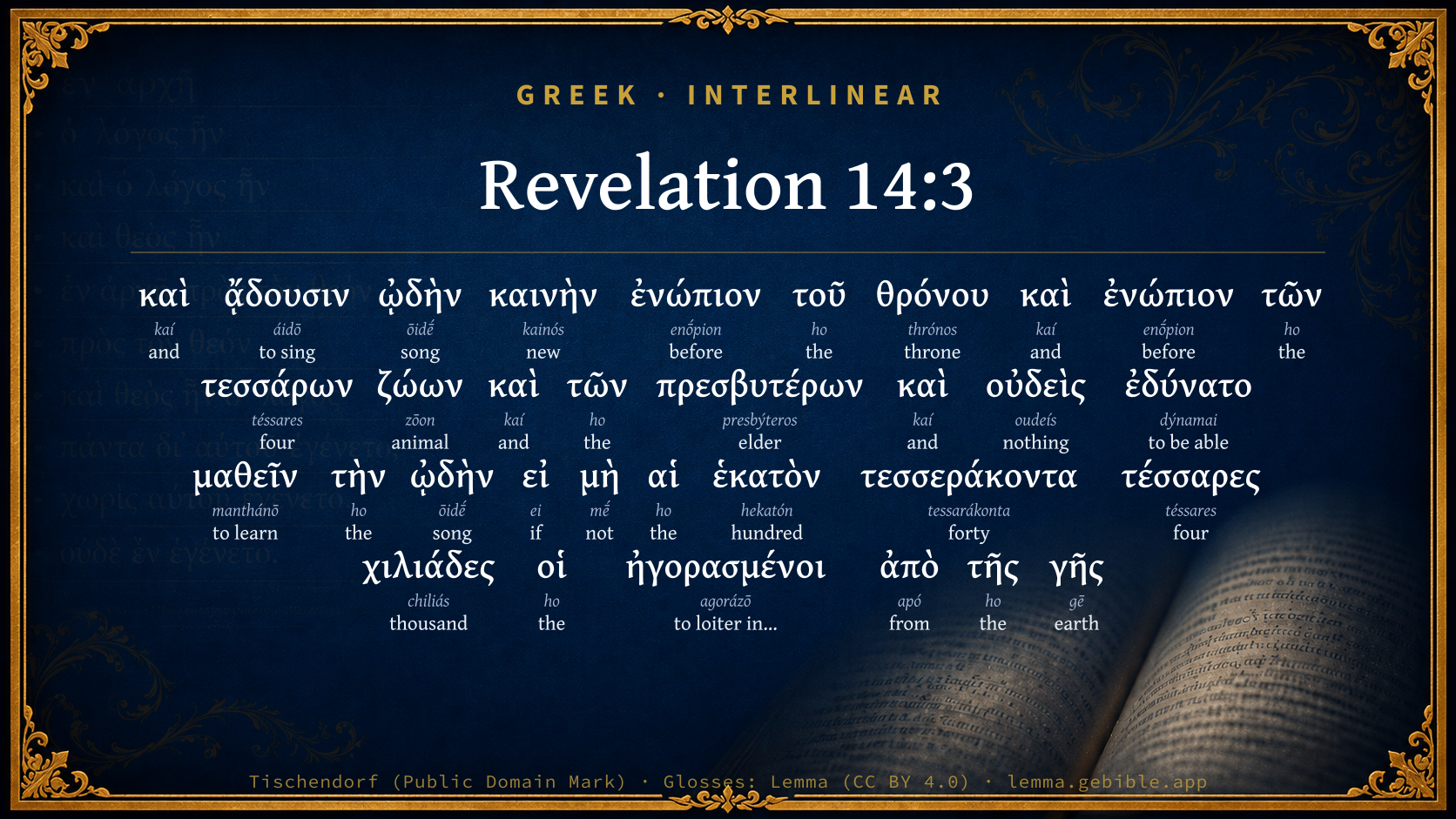
Greek (Tischendorf 8th ed.) Revelation 14:3 appears in the Greek New Testament. The text above is from the Tischendorf 8th edition. Each word links to its Strong’s number and a concise gloss. Click any word for its full Thayer’s Greek Lexicon entry.
Download image
Cite this verse

Revelation 14:3 (World English Bible). Public Domain. Lemma interlinear Bible study tool, https://lemma.gebible.app/v/revelation/14/3.

Show BibTeX & RIS
BibTeX
RIS
English Translation
They sing a new song before the throne, and before the four living creatures and the elders. No one could learn the song except the one hundred forty-four thousand, those who had been redeemed out of the earth.
World English Bible · Public Domain
Download a study sheet

One document with this verse’s original text, its word-by-word gloss line, the meaning frame, cross-references with their text, attributed commentary, and full source and license credits — printable, and it pastes into notes with its structure intact.

This verse Autodidact and up

Study sheet (.html) Plain text (.txt)

A passage Seminary Student

Up to 50 verses in one chapter. A passage sheet keeps up to 6 commentary sources and 12 cross-references per verse, in the order this page ranks them, and says so on the sheet whenever that leaves anything out. Ask for a single verse and you get the Autodidact verse sheet above.

Everything on this page stays free to read, with no account — the sheet is a download of what is already on screen, not access to it.

Want to remove ads? Support Godless Engineer
Compare translations 3

The same verse in 3 English versions, stacked beneath the original-language interlinear above. Click any original word for its lexicon entry.

Each is an independent rendering of the whole verse — the interlinear is not word-aligned to these translations.

Highlighted words mark where these versions differ — a whole-verse word diff, not a word-by-word alignment.

  • World English Bible Public Domain
    They sing a new song before the throne, and before the four living creatures and the elders. No one could learn the song except the one hundred forty-four thousand, those who had been redeemed out of the earth.
  • King James Version Public Domain
    And they sung as it were a new song before the throne, and before the four beasts, and the elders: and no man could learn that song but the hundred and forty and four thousand, which were redeemed from the earth.
  • unfoldingWord Literal Text CC BY-SA 4.0
    And they sing a new song before the throne and before the four living creatures and the elders, and no one was able to learn the song except the 144 thousands having been bought from the earth.

unfoldingWord Literal Text — © unfoldingWord, licensed CC BY-SA 4.0. Word-aligned USFM3 via Door43 (git.door43.org/unfoldingWord/en_ult).

Versions to compare (up to 4)

3 of 4 selected

Show all 19 translations

Every available English version of this verse, each an independent rendering of the whole verse.

  • World English Bible Public Domain
    They sing a new song before the throne, and before the four living creatures and the elders. No one could learn the song except the one hundred forty-four thousand, those who had been redeemed out of the earth.
  • Berean Standard Bible Public Domain
    And they sang a new song before the throne and before the four living creatures and the elders. And no one could learn the song except the 144,000 who had been redeemed from the earth.
  • Majority Standard Bible Public Domain
    And they sang a new song before the throne and before the four living creatures and the elders. And no one could learn the song except the 144,000 who had been redeemed from the earth.
  • King James Version Public Domain
    And they sung as it were a new song before the throne, and before the four beasts, and the elders: and no man could learn that song but the hundred and forty and four thousand, which were redeemed from the earth.
  • American Standard Version (1901) Public Domain
    and they sing as it were a new song before the throne, and before the four living creatures and the elders: and no man could learn the song save the hundred and forty and four thousand, `even' they that had been purchased out of the earth.
  • Revised Version (1885) Public Domain
    and they sing as it were a new song before the throne, and before the four living creatures and the elders: and no man could learn the song save the hundred and forty and four thousand, even they that had been purchased out of the earth.
  • Geneva Bible (1599) Public Domain
    And they sung as it were a newe song before the throne, and before the foure beasts, and the Elders: and no man could learne that song, but the hundreth, fourtie and foure thousand, which were bought from the earth.
  • Douay-Rheims (1899) Public Domain
    And they sung as it were a new canticle, before the throne, and before the four living creatures, and the ancients; and no man could say the canticle, but those hundred forty-four thousand, who were purchased from the earth.
  • Young's Literal Translation Public Domain
    and they sing, as it were, a new song before the throne, and before the four living creatures, and the elders, and no one was able to learn the song except the hundred forty-four thousands, who have been bought from the earth;
  • Literal Standard Version CC BY-SA 4.0
    and they sing, as it were, a new song before the throne, and before the four living creatures, and the elders, and no one was able to learn the song except the one hundred forty-four thousand who have been bought from the earth;
  • Unlocked Literal Bible CC BY-SA 4.0
    They sang a new song before the throne and before the four living creatures and the elders. No one could learn the song except for the 144,000 who had been bought from the earth.
  • unfoldingWord Literal Text CC BY-SA 4.0
    And they sing a new song before the throne and before the four living creatures and the elders, and no one was able to learn the song except the 144 thousands having been bought from the earth.
  • Darby Bible Public Domain
    and they sing a new song before the throne, and before the four living creatures and the elders. And no one could learn that song save the hundred [and] forty-four thousand who were bought from the earth.
  • World Messianic Bible Public Domain
    They sing a new song before the throne and before the four living creatures and the elders. No one could learn the song except the one hundred forty-four thousand, those who had been redeemed out of the earth.
  • Webster's Bible Public Domain
    And they sung as it were a new song before the throne, and before the four beasts, and the elders: and no man could learn that song but the hundred and forty four thousand, who were redeemed from the earth.
  • Free Bible Version CC BY-SA 4.0
    They sang a new song in front of the throne and the four living creatures and the elders. Nobody could learn the song except the 144,000, those who had been redeemed from the earth.
  • Bible in Basic English Public Domain
    And they made as it seemed a new song before the high seat, and before the four beasts and the rulers: and no man might have knowledge of the song but the hundred and forty-four thousand, even those from the earth whom God has made his for a price.
  • Text-Critical English NT CC BY 4.0
    They were singing a new song before the throne and before the four living creatures and the elders. No one could learn the song except the one hundred forty-four thousand who had been redeemed from the earth.
  • Tyndale New Testament (1534) Public Domain
    And they songe as it were a newe songe before the seate and before the foure beestes and the elders and no man coulde learne that songe but the hondred and xliiii.M. which were redemed from the erth.

Literal Standard Version (2020), Covenant Press — licensed CC BY-SA 4.0. Text via the HelloAO Bible API (eBible.org). Unlocked Literal Bible (unfoldingWord) — licensed CC BY-SA 4.0. Text via the HelloAO Bible API (eBible.org). unfoldingWord Literal Text — © unfoldingWord, licensed CC BY-SA 4.0. Word-aligned USFM3 via Door43 (git.door43.org/unfoldingWord/en_ult). Free Bible Version, Dr. Jonathan Gallagher — licensed CC BY-SA 4.0. Text via the HelloAO Bible API (eBible.org).

Word by word

More ways to search: Search by grammar → Find every occurrence → Compare this word →

Practice this passage: Drill this verse → Learn its vocabulary →

ᾄδουσιν
áidō
G103
“to sing”
Verb, Present, Active, Indicative, 3rd person, Plural
Part of Speech
Verb
Tense
Present
Voice
Active
Mood
Indicative
Person
3rd person
Number
Plural
Full Thayer's Definition

Origin: a primary word

TDNT: 03:43,2

1. to the praise of anyone, to sing
  1. καὶ kaí G2532 “and” Conjunction
  2. ᾠδὴν ōidḗ G5603 “song” Noun, Accusative, Singular, Feminine
  3. καινὴν kainós G2537 “new” Adjective, Accusative, Singular, Feminine
  4. ἐνώπιον enṓpion G1799 “before” Adverb
  5. τοῦ ho G3588 “the” Article, Genitive, Singular, Masculine
  6. θρόνου thrónos G2362 “throne” Noun, Genitive, Singular, Masculine
  7. καὶ kaí G2532 “and” Conjunction
  8. ἐνώπιον enṓpion G1799 “before” Adverb
  9. τῶν ho G3588 “the” Article, Genitive, Plural, Neuter
  10. τεσσάρων téssares G5064 “four” Adjective, Genitive, Plural, Neuter
  11. ζώων zōon G2226 “animal” Noun, Genitive, Plural, Neuter
  12. καὶ kaí G2532 “and” Conjunction
  13. τῶν ho G3588 “the” Article, Genitive, Plural, Masculine
  14. πρεσβυτέρων presbýteros G4245 “elder” Adjective, Genitive, Plural, Masculine, Comparative
  15. καὶ kaí G2532 “and” Conjunction
  16. οὐδεὶς oudeís G3762 “nothing” Adjective, Nominative, Singular, Masculine, Negative
  17. ἐδύνατο dýnamai G1410 “to be able” Verb, Imperfect, Middle or Passive deponent, Indicative, 3rd person, Singular
  18. μαθεῖν manthánō G3129 “to learn” Verb, Aorist, Active, Infinitive
  19. τὴν ho G3588 “the” Article, Accusative, Singular, Feminine
  20. ᾠδὴν ōidḗ G5603 “song” Noun, Accusative, Singular, Feminine
  21. εἰ ei G1487 “if” Conditional
  22. μὴ mḗ G3361 “not” Particle, Negative
  23. αἱ ho G3588 “the” Article, Nominative, Plural, Feminine
  24. ἑκατὸν hekatón G1540 “hundred” Adjective, Numeral (indeclinable)
  25. τεσσεράκοντα tessarákonta G5062 “forty” Adjective, Numeral (indeclinable)
  26. τέσσαρες téssares G5064 “four” Adjective, Nominative, Plural, Feminine
  27. χιλιάδες chiliás G5505 “thousand” Noun, Nominative, Plural, Feminine
  28. οἱ ho G3588 “the” Article, Nominative, Plural, Masculine
  29. ἠγορασμένοι agorázō G59 “to loiter in marketplace” Verb, Perfect, Passive, Participle, Nominative, Plural, Masculine
  30. ἀπὸ apó G575 “from” Preposition
  31. τῆς ho G3588 “the” Article, Genitive, Singular, Feminine
  32. γῆς gē G1093 “earth” Noun, Genitive, Singular, Feminine

About this verse

These counts appear in no published source. They are computed here, from the morphology-tagged text and Lemma’s own curated glosses. What Lemma adds →

33
words
21
distinct lemmas
Revelation
section

Notable vocabulary

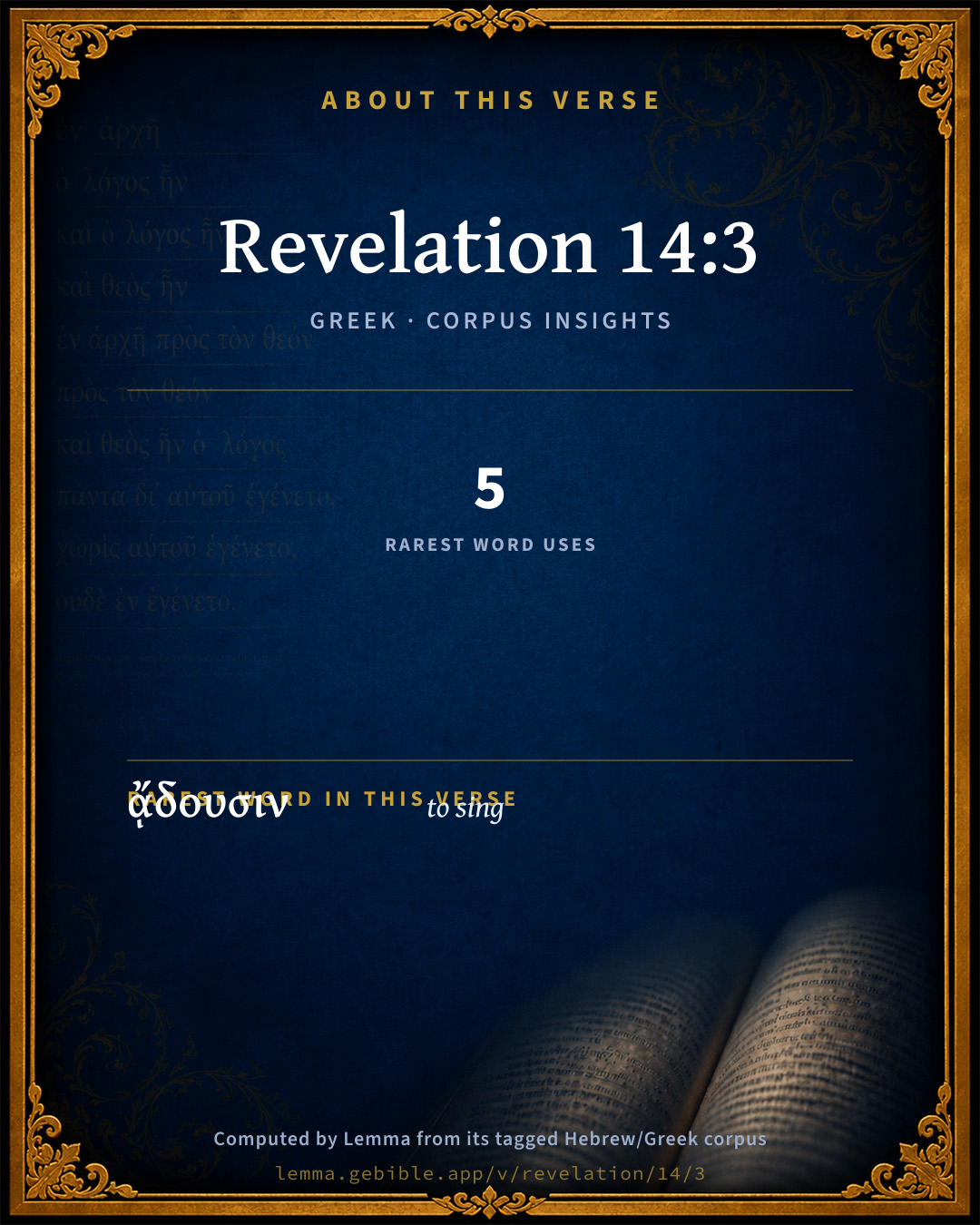
The rarest word here is ᾄδουσιν to sing G103 — appearing just 5 times in the whole Greek New Testament.

Shared distinctive vocabulary

ᾄδουσιν to sing G103 occurs in 5 verses of the Greek New Testament. Also found in:

Repetition

Words recur within this verse:

  • ᾠδὴν song G5603 ×2
  • ἐνώπιον before G1799 ×2
  • τεσσάρων four G5064 ×2
  • τοῦ the G3588 ×7
  • καὶ and G2532 ×4

Cross-references

16

Topical passages linked to Revelation 14:3 in the Treasury of Scripture Knowledge — connected by theme and wording, ordered by reader-vote popularity; previews shown in the World English Bible.

  • Revelation 5:9 They sang a new song, saying, "You are worthy to take the book, And to open its seals: For you were killed, And bought us for God with your blood, Out of every tribe, language, people, and nation,
  • Revelation 14:1 I saw, and behold, the Lamb standing on Mount Zion, and with him a number, one hundred forty-four thousand, having his name, and the name of his Father, written on their foreheads.
  • Revelation 15:3 They sang the song of Moses, the servant of God, and the song of the Lamb, saying, "Great and marvelous are your works, Lord God, the Almighty; Righteous and true are your ways, you King of the nations.
  • Psalms 98:1 Sing to Yahweh a new song, For he has done marvelous things! His right hand, and his holy arm, have worked salvation for him.
  • Psalms 149:1 Praise Yahweh! Sing to Yahweh a new song, His praise in the assembly of the saints.
  • Isaiah 42:10 Sing to Yahweh a new song, and his praise from the end of the earth; you who go down to the sea, and all that is therein, the isles, and the inhabitants of it.
  • Psalms 40:3 He has put a new song in my mouth, even praise to our God. Many shall see it, and fear, and shall trust in Yahweh.
  • Revelation 2:17 He who has an ear, let him hear what the Spirit says to the assemblies. To him who overcomes, to him I will give of the hidden manna, and I will give him a white stone, and on the stone a new name written, which no one knows but he who receives it.
  • Psalms 33:3 Sing to him a new song. Play skillfully with a shout of joy!
  • Psalms 96:1 Sing to Yahweh a new song! Sing to Yahweh, all the earth.
  • Psalms 144:9 I will sing a new song to you, God. On a ten-stringed lyre, I will sing praises to you.
  • Revelation 4:2–11 Immediately I was in the Spirit. Behold, there was a throne set in heaven, and one sitting on the throne
  • Psalms 25:14 The friendship of Yahweh is with those who fear him. He will show them his covenant.
  • Matthew 11:25–27 At that time, Jesus answered, "I thank you, Father, Lord of heaven and earth, that you hid these things from the wise and understanding, and revealed them to infants.
  • 1 Corinthians 1:18 For the word of the cross is foolishness to those who are dying, but to us who are saved it is the power of God.
  • 1 Corinthians 2:14 Now the natural man doesn't receive the things of God's Spirit, for they are foolishness to him, and he can't know them, because they are spiritually discerned.

Cross-references courtesy of OpenBible.info (CC BY 4.0).

Commentary

Notes on Revelation 14:3 from classic Christian and Jewish commentators (each source and its license shown beneath its notes). The classic Christian expositions comment on the surrounding passage and are grouped to its opening verse, so a note may address several verses; the Jewish commentaries on the Tanakh (Rashi and others) are per-verse, so they appear only where the commentator wrote on this verse.

Lemma curates 59 commentaries, every one of them public domain or Creative Commons licensed, each selected and text-cleaned for this edition rather than reprinted as found. About our sources →

Expositor's Greek Testament

ed. W. Robertson Nicoll

Rev 14:3 . Who sing the new song? angels or the redeemed? In Rev 5:9 it is chanted not before the living creatures and elders but by them; here it is not originally sung by the redeemed (as in Rev 15:3-4 Ezr 2:42 ) but is intelligible to them and to them alone. Their experience enabled them to enter into its meaning. This privilege is due to (Rev 14:4-5 ) their previous character and conduct, This inner circle are ascetics, παρθένοι . i.e. , not merely unmarried or free from sexual vice but celibates ( cf. Cheyne, Orig. Psalter , 446; Hoennicke, das Judenchristentum , 1908, 130 f.; Balden-sperger, 109; von Dobschütz, 39 f., 228, 261); cf. 1Co 7:32 . The prevailing Jewish respect for marriage did not check a tendency to celibacy which was by no means confined to the Essenes or Therapeutae. Even Methodius, who allegorises the seven heads of Rev 12:3 into the seven deadly sins and the stars of Rev 12:2 into heretics, takes this phrase literally, in the sense of virginity not simply of purity (so Epiph. Hær. xxx. 2); and, although the touch is too incidental to bear pressing, it is unmistakable ( cf. Introd. § 6). In the popular religion of Phrygia there was a feeling (expressed in the eunuchism, e.g. , of the priests at Hierapolis) that one came nearer to the divine life by annihilating the distinction of sex, while in the votive inscriptions of Asia Minor ( C. B. P. i. 137) marriage is not recognised as part of the divine or religious life. This atmosphere of local feeling, together with the lax moral conscience of the popular religion, would foster the religious tendency to regard celibates as pre-eminently near to God. ἀκολουθοῦντες : either a historic present to secure vividness ( ἀκολουθήσαντες , syr. S), in which case the allusion is to their earthly loyalty (reff.), or, more probably (in view of ὑπάγει , pres.), a description of their heavenly privilege and position ( cf. Rev 7:17 ), borrowed from Egyptian religion where the “followers of Horus,” the divine and victorious son of Osiris, were a series of celestial kings who were supposed to have reigned during the earlier dynasties. To be among the “followers of Horus” was an equivalent for immortal life. Cf. E. B. D. 101: “Let me rise up among those who follow the great God; I am the son of Maûti, and that which he abominateth is the spirit of falsehood [ cf. Rev 14:5 ]. I am in triumph!” ἀπό in 3, 4 is equivalent to the partitive ἐκ ( cf. Rev 5:9 ). ἀπαρχή : they form the firstfruits of mankind for God; others are to follow, but these are the élite , they have a prestige all their own. The idea of priority shades into that of superiority, though in a very different way from that of Rom 11:16 . Dr. Rendel Harris (in Present Day Papers , May, 1901) describes the interest and excitement at Jerusalem during the early days of summer when “the first ripe figs were in the market. When one’s soul desires the vintage or the fruitage of the summer … the trees that are a fortnight to the fore are the talk and delight of the town.” καὶ τ . ἀ ., usually taken as a scribe’s gloss. Elsewhere the saints are redeemed by, not for, the Lamb (Rev 5:9 ).

The Expositor's Greek Testament, edited by W. Robertson Nicoll (1897–1910) — public domain. Text from a community e-Sword module.

Jamieson, Fausset & Brown

Robert Jamieson, A. R. Fausset & David Brown

sung--Greek, "sing."

as it were--So A, C, and Vulgate read. It is "as it were" a new song; for it is, in truth, as old as God's eternal purpose. But B, Syriac, Coptic, ORIGEN, and ANDREAS omit these words.

new song-- (Rev 5:9-10). The song is that of victory after conflict with the dragon, beast, and false prophet: never sung before, for such a conflict had never been fought before; therefore new: till now the kingdom of Christ on earth had been usurped; they sing the new song in anticipation of His blood-bought kingdom with His saints.

four beasts--rather, as Greek, "four living creatures." The harpers and singers evidently include the 144,000: so the parallel proves (Rev 15:2-3), where the same act is attributed to the general company of the saints, the harvest (Rev 14:15) from all nations. Not as ALFORD, "the harpers and song are in heaven, but the 144,000 are on earth."

redeemed--literally, "purchased." Not even the angels can learn that song, for they know not experimentally what it is to have "come out of the great tribulation, and washed their robes white in the blood of the Lamb" (Rev 7:14).

Jamieson, Fausset & Brown — Commentary Critical and Explanatory on the Whole Bible (1871) — public domain (CC PDM 1.0). Text via the HelloAO Bible API.

Adam Clarke's Commentary

Verse 3. They sung-a new song] See Clarke on Re 5:9.

No man could learn that song] As none but genuine Christians can worship God acceptably, because they approach him through the only Mediator, so none can understand the deep things of God but such; nor can others know the cause why true believers exult so much in God through Christ, because they know not the communion which such hold with the Father and the Son through the Holy Ghost.

Adam Clarke's Commentary on the Bible (1810–1826) — public domain. Text from a community e-Sword/MySword module.

Ellicott's Commentary for English Readers

(3) And they . . .—Translate, And they (i.e., the heavenly harpers) sing a new song (the words “as it were” ought, perhaps, to be omitted) before the throne, and before the living creatures, and the elders (i.e., in the presence of God Himself, and creation, and the Church), and no one was able to learn the song except the hundred and forty-four thousand who were purchased from the earth. It is a heavenly song, and no spirit dulled by earthly desires can learn it. The Spirit of the Lord can open the dull ear to hear and to rejoice in the songs of God’s saints. Amid the world-noises of Babylon men can neither hear nor sing aright the Lord’s song (Psa_137:4); but the redeemed (the purchased from the earth) of the Lord can come with singing unto Zion (Isa_51:11).

A Bible Commentary for English Readers, edited by Charles John Ellicott (1878–1897) — public domain. Text from a community e-Sword module.

The Cambridge Bible for Schools and Colleges

gen. ed. J. J. S. Perowne

3. sung] More accurately, sing.

as it were] Should perhaps be omitted, as in Rev_5:9.

The Cambridge Bible for Schools and Colleges (gen. ed. J. J. S. Perowne; Cambridge University Press, 1878–1918) — public domain. Text from a community e-Sword module.

John Gill's Exposition

And they sung as it were a new song,.... The song of redeeming grace; the same with that in Rev 5:9; see the note there: this is to be understood of the 144,000, who sung it

before the throne, and before the four beasts and the elders; that is, publicly in the church, the ministers and members being present; of these; See Gill on Rev 4:4; See Gill on Rev 4:6;

and no man could learn that song but the hundred and forty and four thousand, which were redeemed from the earth; out of every kindred, tongue, people, and nation; from among the men of the earth, and out of the apostate church, called the earth, in opposition to the pure church, which so often goes by the name of heaven in this book; and these, in consequence of being redeemed by the blood of Christ, were called by grace out of the world; and such only can sing the song of redemption with application to themselves; and say he has redeemed us, and loved us, and washed us from our sins in his blood; to none but these is it given to know spiritually and experimentally the mysteries of electing and redeeming grace; the natural and carnal man neither knows nor receives the things of the Spirit of God; nor can he learn them by hearing, reading, study, and conversation, unless it be only in a notional and speculative way. The Jews speak of a new song, which the angels have never used (m);

"it is said, Psa 98:1; "sing unto the Lord a new song"; a new song, for there is an old song; but this song is what the angels never praised him with, and therefore it is new;''

and indeed the song of redeeming love is peculiar to men.

(m) Zohar in Numb. fol. 70. 4.

John Gill's Exposition of the Whole Bible (1746–1763) — public domain (CC PDM 1.0). Text via the HelloAO Bible API.

Trapp's Complete Commentary

John Trapp

3 And they sung as it were a new song before the throne, and before the four beasts, and the elders: and no man could learn that song but the hundred and forty and four thousand, which were redeemed from the earth.

Ver. 3. A new song] {See Trapp on "Rev 5:9"}

But the hundred, &c.] To whom alone it was given to understand the mysteries of God’s kingdom. Others could not skill of it.

From the earth] i.e. From the Antichristian rout and rabble. These dunghill cocks meddle not with that jewel, the joy of faith, but speak evil of what they know not.

John Trapp, A Commentary or Exposition upon All the Books of the Old and New Testament (1647–1656) — public domain. Text from a community e-Sword module.

Albert Barnes' Notes on the Bible

And they sung as it were a new song - See the notes on Rev 5:9. It was proper to call this “new,” because it was on a new occasion, or pertained to a new object. The song here was in celebration of the complete redemption of the church, and was the song to be sung in view of its final triumph over all its foes. Compare notes on Rev 7:9-10.

Before the throne - The throne of God in heaven. See the notes on Rev 4:2.

And before the four beasts - See the notes on Rev 4:6-8.

And the elders - See the notes on Rev 4:4.

And no man could learn that song, ... - None could understand it but the redeemed. That is, none who had not been redeemed could enter fully into the feelings and sympathies of those who were. A great truth is taught here. To appreciate fully the songs of Zion; to understand the language of praise; to enter into the spirit of the truths which pertain to redemption; one must himself have been redeemed by the blood of Christ. He must have known what it is to be a sinner under the condemnation of a holy law; he must have known what it is to be in danger of eternal death; he must have experienced the joys of pardon, or he can never understand, in its true import, the language used by the redeemed. And this is only saying what we are familiar with in other things. He who is saved from peril; he who is rescued from long captivity; he who is pardoned at the foot of the scaffold; he who is recovered from dangerous illness; he who presses to his bosom a beloved child just rescued from a watery grave, will have an appreciation of the language of joy and triumph which he can never understand who has not been placed in such circumstances: but of all the joy ever experienced in the universe, so far as we can see, that must be the most sublime and transporting, which will be experienced when the redeemed shall stand on Mount Zion above, and shall realize that they are saved.

Albert Barnes' Notes on the Bible (1834–1885) — public domain. Text from a community e-Sword/MySword module.

Haydock's Catholic Bible Commentary

They sung as it were a new canticle. In these visions, after persecutions, are sometimes introduced rejoicings to encourage the servants of God in their sufferings from the wicked world. --- No man could say (or sing) the canticle, but those hundred forty-four thousand: by which are signified the elect, who were not defiled with women. Some expound this literally of those who always lived virgins; others understand all those who lived or died with a pure and clean heart, exempt from the corruption of vices, and of whom it is said, (ver. 5) that in their mouth was found no lie, and that they were without spot for the throne of God. (Witham)

George Leo Haydock (1774–1849), Haydock's Catholic Family Bible and Commentary, 1859 edition — public domain. Excludes Psalms (Douay-Rheims chapter numbering differs from Protestant) and Deuterocanonical books (Catholic canon only).

Matthew Poole's English Annotations

And they sung as it were a new song before the throne: by the throne here is meant the throne of God in glory. The new song here spoken of, is probably the same with that we met with before, Rev 5:11,12, sang by the voice of many angels round about the throne and the beasts and the elders: called new, either for the excellency of it; or, because sung unto God after Christ was manifested in the flesh; the design of it was to declare the worthiness of Christ to receive power, and riches, and wisdom, and strength, and honour, and glory, and blessing: see Rev 5:12. Mr. Mede saith thus of it; "If God shall at any time make me fully to understand it, I will happily more largely explain it, for it is deeply settled in my mind, that the whole mystery of evangelical worship is in it contained." And quite through the Scripture generally, a new song signifies a song which praiseth God for some new benefits received from him.

And before the four beasts, and the elders; the throne, beasts, and elders, described before, Rev 4:1-11,

And no man could learn that song but the hundred and forty and four thousand, which were redeemed from the earth: during the reign of antichrist none could learn this new song, viz. to give glory to Jesus Christ alone, ascribing to him power, riches, wisdom, strength, honour, glory, and blessing; but a small number redeemed through the blood of Christ, from that vain conversation received by tradition from their fathers, 1Pe 1:18. All the other part of the world gave Christ’s honour and glory to the virgin Mary, angels, and saints, &c.

Matthew Poole's English Annotations on the Holy Bible (1683–1685) — public domain. Text from a community e-Sword/MySword module.

Whedon's Commentary on the Bible

Daniel D. Whedon

3. A new song—Different, quite, from the wail under the altar of Rev_6:10.

Before the throne—The invisible harpers become visible; from the ether they have descended on Moriah; they are before the Theophanic throne and its permanent court.

No man could learn that song—None but the redeemed can truly learn and truly sing the song of the redeemed. Others may imitate it by rote, but the full depth of its music is not in their souls, and the imitation is spurious and counterfeit. Hence it is clear that the harpers were not angels, but redeemed saints. They were an abridged specimen of the multitude that no man could number of Rev_7:9, and, like them, Gentile counterpart to the Israelite hundred forty and four thousand. The Israelite number, as being at home in the mystic Jerusalem, are on Zion; the Gentiles, as coming from all the nations, gather on Moriah, before the throne. It is a festal gathering. The new song indicates that an era auspicious of future triumph over the strongholds of Satan has opened.

Daniel D. Whedon (gen. ed.), Commentary on the Old and New Testaments (1874–1909) — public domain. Text from a community e-Sword module.

The Pulpit Commentary

And they sung as it were a new song before the throne, and before the four beasts, and the elders. They sing; that is to say, the heavenly inhabitants. The four living beings; viz. those of Rev_4:9, where see an explanation of the positions occupied, and of the nature and signification of the "living beings and the elders." The "new song," which can only be understood by the hundred and forty-four thousand, is (as explained by ver. 4) a song of victory won by those who have been tried in the world and subjected to temptations. And no man could learn that song but the hundred and forty and four thousand, which were redeemed from the earth; even they that had been purchased out of the earth (Revised Version). These only can know the song for the reason given above. The joys of heaven and the song of victory are not for those who have succumbed to the world.

Man training for the supersensuous heaven.

"No man could learn that song but the hundred and forty and four thousand, which were redeemed from the earth." The subject of these words is man training for the supersensuous heaven. Notice

I HEAVEN REQUIRES HIS TRAINING. "No man could learn that song." Man cannot blend in the happy harmony of the celestial state without previous training. Analogy would suggest this. In the physical system every being is fitted to his position, his organism is suited to his locality. These bodies of ours, as now constituted, could probably live in no other planet than this. In the social system the same principle of fitness is required. The stolid clown could not occupy the professor"s chair, nor could he who is reckless concerning law, right, and order occupy the bench of justice. It is just so in relation to heaven. To feel at home in the society of the holy, cheerfully to serve the Creator and his universe, and to be in harmony with all the laws, operations, and beings in the holy empire, we must manifestly be invested with the same character. But what is the training necessary?

1. Not mechanical. Ceremonial religion enjoins this.

2. Not intellectual. Theological training may be conducive, but it is not sufficient.

3. It is moral the training of the spiritual sympathies, the heart being brought to say, "Thy will be done." No one can "sing the song," blend in the harmonious action of heaven, without this. A man with corrupt sympathies could never sing in heaven; he would shriek. In the midst of happy myriads he would be alone. His darkness would conceal from him the outward sun; his inner flashes of guilt would change for him the God of love into a "consuming fire.

II REDEMPTION IS THE CONDITION OF HIS TRAINING. "Those who were redeemed from the earth." The redemption here referred to is evidently that procured by the love of Christ. The training requires something more than education; it needs emancipation, the deliverance of the soul from certain feelings and forces incompatible with holiness a deliverance from the guilt and power of evil. The grand characteristic of Christianity is that it is a power to redeem from all evil. No other system on earth can do this.

III THE EARTH IS THE SCENE OF HIS TRAINING. "Redeemed from the earth." The brightest fact in the history of the dark world is that it is a redemptive scene. Amidst all the clouds and storms of depravity and sorrow that sweep over our path, this fact rises up before us a bright orb that shall one day dispel all gloom and hush all tumult. Thank God, this is not a retributive, but a redemptive scene. But it should be remembered that it is not only a redemptive scene, but the only redemptive scene. There is no redemptive influence in heaven it is not required. A wonderful world is this! True, it is but a spark amidst the suns of the universe a tiny leaf in the mighty forests! Let the light be quenched and the leaf be destroyed, their absence would not be felt. Still it has a moral history the most momentous. Here Christ lived, laboured, died. Here millions of spirits are trained for heaven. What Marathon was to Greece, and Waterloo to Europe, this little earth is to the creation. Here the great battles of the spiritual universe are fought. It is the Thermopylae of the creation. D.T.

The Pulpit Commentary (1880–1919), ed. H.D.M. Spence-Jones & Joseph S. Exell — public domain. Text from a community e-Sword module.

John Wesley's Explanatory Notes

And they - The hundred forty-four thousand-Sing a new song - and none could learn that song - To sing and play it in the same manner. But the hundred forty-four thousand who were redeemed from the earth - From among men; from all sin.

John Wesley, Explanatory Notes Upon the Whole Bible (1754–1765) — public domain. Text via the GEBible commentary corpus.

The People's New Testament

B. W. Johnson

3. And they sung as it were a new song before the throne. A song that has some new features. It was sung in the presence of the Father and the attending princes of heaven. No man could learn that song but the hundred and forty four thousand. None could understand the song but them, those who had been redeemed.

B. W. Johnson's The People's New Testament with Notes (1889–1891) — public domain. Electronic text from the Christian Classics Ethereal Library (CCEL) ThML edition.

unfoldingWord translationNotes

Door43 World Missions Community

They sang a new song

"The 144,000 people sang a new song." This explains what the sound was that John heard. AT: "That sound was a new song that they sang"

the four living creatures

"living being" or "living thing." See how you translated "living creature" in Revelation 4:6

elders

This refers to the twenty-four elders around the throne. See how you translated "elders" in Revelation 4:4.

144,000

"one hundred forty-four thousand." See how you translated this in Revelation 7:4. (See: Numbers)

have not defiled themselves with women

Possible meanings are 1) "have never had immoral sexual relations with a woman" or 2) "have never had sexual relations with a woman." Defiling oneself with women may be a symbol of worshiping idols.

they have kept themselves sexually pure

Possible meanings are 1) "they did not have sexual relations with a woman who was not their wife" or 2) "they are virgins."

follow the Lamb wherever he goes

Doing what the Lamb does is spoken of as following him. AT: "they do whatever the Lamb does" or "they obey the Lamb" (See: Metaphor)

bought out of mankind as firstfruits

"Firstfruits" here is a metaphor for the first offering to be made to God in celebration of harvest. AT: "purchased out of the midst of the rest of mankind as a special celebration of salvation" (See: Metaphor)

No lie was found in their mouth

Their "mouth" refers to what they said." AT: "They never lied when they spoke" (See: Metonymy)

translationWords

throne

life

creature

elder

defile

pure

lamb

firstfruits

God

blameless

unfoldingWord translationNotes — © Distant Shores Media and the Door43 World Missions Community, licensed CC BY-SA 4.0. Source: git.door43.org/Door43/en_tn.

Cambridge Greek Testament for Schools and Colleges

3. ᾄδουσιν ὡς. Tisch[469] omits ὡς with אB2P.

[469] Tischendorf: eighth edition; where the text aud notes differ the latter are cited.

καινήν. א adds και ην, ην being in the first hand above the line.

τέσσαρες. א* has μίαν, reading Αʹ for Δʹ; C omits.

3. ᾄδουσιν ὡς ᾠδήν. The ὡς is perhaps mechanically inserted from the former clauses, it is not found in Rev 5:9. Naturally we should suppose the subject of ᾄδουσιν to be the harpers whom St John seems to hear without seeing: yet how can they be angels when we are told that only the ransomed of earth can learn the new song? If the hundred forty and four thousand are heard singing the new song in heaven and seen drawn up in battle array on Mount Sion (on the ruins of the holy city? see on Rev 12:1-6), the vision at this point becomes very like a dream.

Cambridge Greek Testament for Schools and Colleges (Cambridge University Press, 1896; 21 vols, various authors incl. Carr, Maclear, Plummer, Farrar, Lumby, Moule, M. R. James, Simcox) — public domain. Text from a community e-Sword module.

Vincent's Word Studies in the New Testament

Marvin R. Vincent

Beasts [ζωων] . Rev., living creatures. See on ch. Rev 4:6.

Redeemed [ηγορασμενοι] . Rev., correctly, purchased.

Marvin R. Vincent, Word Studies in the New Testament (1887–1900) — public domain. Text from a community e-Sword/MySword module.

Lesson kit

Teaching starters — assembled from the data on this page, not authored interpretation. Every prompt links to the verse data it draws on. Edit before teaching.

Revelation, in the Revelation, opens this verse with 33 words (21 distinct Greek lemmas). Its most distinctive word is áidō (“to sing”). A historical commentator’s framing appears above. Read the whole chapter for the surrounding context.

Discussion questions

  1. How does “to sing” (áidō) shape what this verse is saying?
  2. How does Ephesians 5:19, which shares the word «to sing», read alongside this verse?
  3. What does the repetition of “song” (2× in this one verse) do in this verse?
  4. These translations render this verse differently; the difference is in the English rendering, not the original. What questions does that raise?
  5. Compare how Expositor's Greek Testament and Jamieson, Fausset & Brown read this verse. Where do they agree or differ?

Things to notice

Reading settings

Reading text

Shown beneath each verse's original-language words.

Old Testament
Old Testament edition

Read the OT as the Masoretic Hebrew (MT) or the Greek Septuagint (LXX).

English shown for the Greek Septuagint (in the Hebrew ↔ Greek comparison).

Comparing translations? Open the Compare panel on any verse page to stack up to four side by side.