
Luke 22:44

Greek (Tischendorf 8th ed.) Luke 22:44 appears in the Greek New Testament. The text above is from the Tischendorf 8th edition. Each word links to its Strong’s number and a concise gloss. Click any word for its full Thayer’s Greek Lexicon entry.
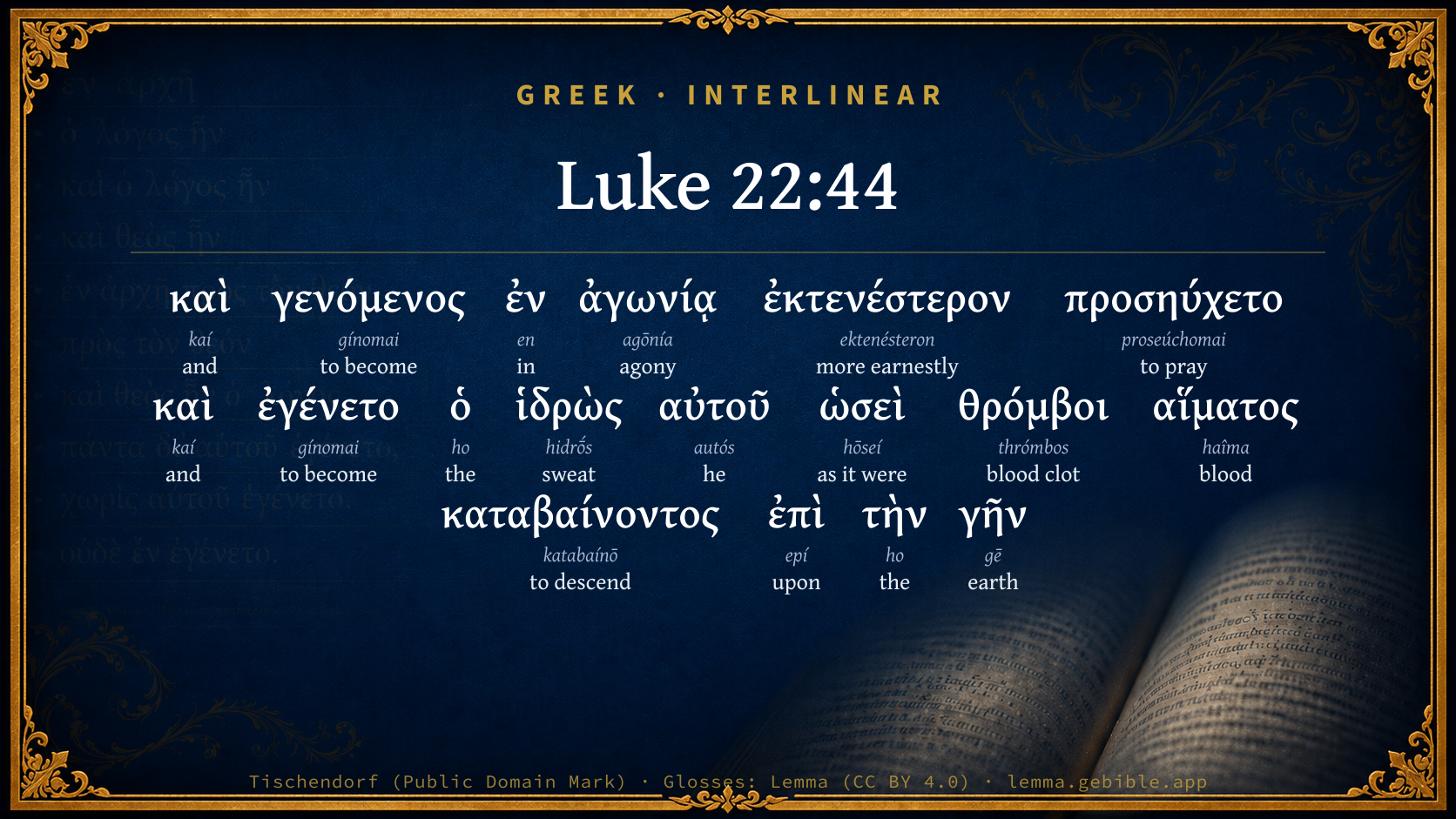
Download image
Cite this verse

Luke 22:44 (World English Bible). Public Domain. Lemma interlinear Bible study tool, https://lemma.gebible.app/v/luke/22/44.

Show BibTeX & RIS
BibTeX
RIS
English Translation
Being in agony he prayed more earnestly. His sweat became like great drops of blood falling down on the ground.
World English Bible · Public Domain
Highlights
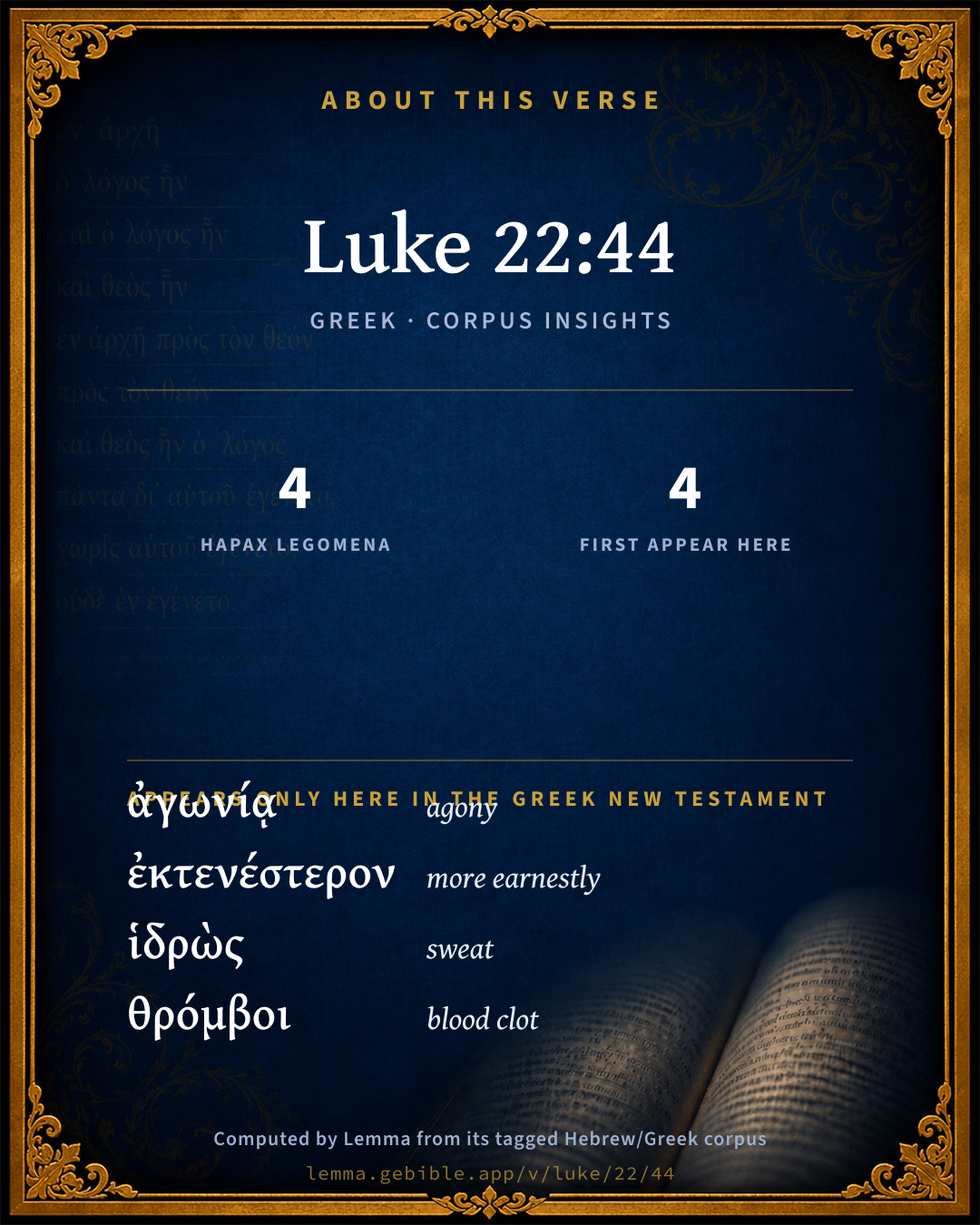
  • 4 hapax legomena — only here in the Greek New Testament
  • 4 first appearances in the Greek New Testament
Full analysis ↓
Download a study sheet

One document with this verse’s original text, its word-by-word gloss line, the meaning frame, cross-references with their text, attributed commentary, and full source and license credits — printable, and it pastes into notes with its structure intact.

This verse Autodidact and up

Study sheet (.html) Plain text (.txt)

A passage Seminary Student

Up to 50 verses in one chapter. A passage sheet keeps up to 6 commentary sources and 12 cross-references per verse, in the order this page ranks them, and says so on the sheet whenever that leaves anything out. Ask for a single verse and you get the Autodidact verse sheet above.

Everything on this page stays free to read, with no account — the sheet is a download of what is already on screen, not access to it.

Want to remove ads? Support Godless Engineer
Compare translations 3

The same verse in 3 English versions, stacked beneath the original-language interlinear above. Click any original word for its lexicon entry.

Each is an independent rendering of the whole verse — the interlinear is not word-aligned to these translations.

Highlighted words mark where these versions differ — a whole-verse word diff, not a word-by-word alignment.

  • World English Bible Public Domain
    Being in agony he prayed more earnestly. His sweat became like great drops of blood falling down on the ground.
  • King James Version Public Domain
    And being in an agony he prayed more earnestly: and his sweat was as it were great drops of blood falling down to the ground.
  • unfoldingWord Literal Text CC BY-SA 4.0
    And being in agony, he was praying more earnestly, and his sweat became like drops of blood falling on the ground.]

unfoldingWord Literal Text — © unfoldingWord, licensed CC BY-SA 4.0. Word-aligned USFM3 via Door43 (git.door43.org/unfoldingWord/en_ult).

Versions to compare (up to 4)

3 of 4 selected

Show all 19 translations

Every available English version of this verse, each an independent rendering of the whole verse.

  • World English Bible Public Domain
    Being in agony he prayed more earnestly. His sweat became like great drops of blood falling down on the ground.
  • Berean Standard Bible Public Domain
    And in His anguish, He prayed more earnestly, and His sweat became like drops of blood falling to the ground.
  • Majority Standard Bible Public Domain
    And in His anguish, He prayed more earnestly, and His sweat became like drops of blood falling to the ground.
  • King James Version Public Domain
    And being in an agony he prayed more earnestly: and his sweat was as it were great drops of blood falling down to the ground.
  • American Standard Version (1901) Public Domain
    And being in an agony he prayed more earnestly; and his sweat became as it were great drops of blood falling down upon the ground.
  • Revised Version (1885) Public Domain
    And being in an agony he prayed more earnestly: and his sweat became as it were great drops of blood falling down upon the ground.
  • Geneva Bible (1599) Public Domain
    But being in an agonie, hee prayed more earnestly: and his sweate was like drops of blood, trickling downe to the ground.
  • Douay-Rheims (1899) Public Domain
    And his sweat became as drops of blood, trickling down upon the ground.
  • Young's Literal Translation Public Domain
    and having been in agony, he was more earnestly praying, and his sweat became, as it were, great drops of blood falling upon the ground.
  • Literal Standard Version CC BY-SA 4.0
    and having been in agony, He was more earnestly praying, and His sweat became, as it were, great drops of blood falling on the ground.
  • Unlocked Literal Bible CC BY-SA 4.0
    Being in agony, he prayed more earnestly, and his sweat became like great drops of blood falling down upon the ground.
  • unfoldingWord Literal Text CC BY-SA 4.0
    And being in agony, he was praying more earnestly, and his sweat became like drops of blood falling on the ground.]
  • Darby Bible Public Domain
    And being in conflict he prayed more intently. And his sweat became as great drops of blood, falling down upon the earth.
  • World Messianic Bible Public Domain
    Being in agony, he prayed more earnestly. His sweat became like great drops of blood falling down on the ground.
  • Webster's Bible Public Domain
    And being in an agony, he prayed more earnestly: and his sweat was as it were great drops of blood falling to the ground.
  • Free Bible Version CC BY-SA 4.0
    In great distress Jesus prayed even harder, and his sweat fell like drops of blood onto the ground.
  • Bible in Basic English Public Domain
    And being in great trouble of soul, the force of his prayer became stronger, and great drops, like blood, came from him, falling to the earth.
  • Text-Critical English NT CC BY 4.0
    Being in agony, he prayed more earnestly, and his sweat became like drops of blood falling to the ground.
  • Tyndale New Testament (1534) Public Domain
    And he was in an agonye and prayed somwhat longer. And hys sweate was lyke droppes of bloud tricklynge doune to the grounde.

Literal Standard Version (2020), Covenant Press — licensed CC BY-SA 4.0. Text via the HelloAO Bible API (eBible.org). Unlocked Literal Bible (unfoldingWord) — licensed CC BY-SA 4.0. Text via the HelloAO Bible API (eBible.org). unfoldingWord Literal Text — © unfoldingWord, licensed CC BY-SA 4.0. Word-aligned USFM3 via Door43 (git.door43.org/unfoldingWord/en_ult). Free Bible Version, Dr. Jonathan Gallagher — licensed CC BY-SA 4.0. Text via the HelloAO Bible API (eBible.org).

Word by word

More ways to search: Search by grammar → Find every occurrence → Compare this word →

Practice this passage: Drill this verse → Learn its vocabulary →

ἀγωνίᾳ
agōnía
G74
“agony”
Noun, Dative, Singular, Feminine
Part of Speech
Noun
Case
Dative
Number
Singular
Gender
Feminine
Full Thayer's Definition

Origin: from G73

TDNT: 03:20,2

1. a struggle for victory a. gymnastic exercise, wrestling 2. of severe mental struggles and emotions, agony, anguish
  1. καὶ kaí G2532 “and” Conjunction
  2. γενόμενος gínomai G1096 “to become” Verb, Aorist, Middle deponent, Participle, Nominative, Singular, Masculine
  3. ἐν en G1722 “in” Preposition
  4. ἐκτενέστερον ektenésteron G1617 “more earnestly” Adverb, Comparative
  5. προσηύχετο proseúchomai G4336 “to pray” Verb, Imperfect, Middle or Passive deponent, Indicative, 3rd person, Singular
  6. καὶ kaí G2532 “and” Conjunction
  7. ἐγένετο gínomai G1096 “to become” Verb, Aorist, Middle deponent, Indicative, 3rd person, Singular
  8. ὁ ho G3588 “the” Article, Nominative, Singular, Masculine
  9. ἱδρὼς hidrṓs G2402 “sweat” Noun, Nominative, Singular, Masculine
  10. αὐτοῦ autós G846 “he” Personal pronoun, Genitive, Singular, Masculine
  11. ὡσεὶ hōseí G5616 “as it were” Adverb
  12. θρόμβοι thrómbos G2361 “blood clot” Noun, Nominative, Plural, Masculine
  13. αἵματος haîma G129 “blood” Noun, Genitive, Singular, Neuter
  14. καταβαίνοντος katabaínō G2597 “to descend” Verb, Present, Active, Participle, Genitive, Singular, Masculine
  15. ἐπὶ epí G1909 “upon” Preposition
  16. τὴν ho G3588 “the” Article, Accusative, Singular, Feminine
  17. γῆν gē G1093 “earth” Noun, Accusative, Singular, Feminine

About this verse

These counts appear in no published source. They are computed here, from the morphology-tagged text and Lemma’s own curated glosses. What Lemma adds →

18
words
15
distinct lemmas
Gospels
section

Notable vocabulary

4 hapax legomena — words that appear only here in the entire Greek New Testament:

  • ἀγωνίᾳ agony G74
  • ἐκτενέστερον more earnestly G1617
  • ἱδρὼς sweat G2402
  • θρόμβοι blood clot G2361

First appearance in Scripture

These words make their first canonical appearance in the Greek New Testament here:

  • ἀγωνίᾳ agony G74
  • ἐκτενέστερον more earnestly G1617
  • ἱδρὼς sweat G2402
  • θρόμβοι blood clot G2361

Shared distinctive vocabulary

ὡσεὶ as it were G5616 occurs in 20 verses of the Greek New Testament. Also found in:
Repetition

Words recur within this verse:

  • γενόμενος to become G1096 ×2
  • καὶ and G2532 ×2
  • ὁ the G3588 ×2

Cross-references

14

Topical passages linked to Luke 22:44 in the Treasury of Scripture Knowledge — connected by theme and wording, ordered by reader-vote popularity; previews shown in the World English Bible.

  • Lamentations 1:12 Is it nothing to you, all you who pass by? Look, and see if there be any sorrow like my sorrow, which is brought on me, With which Yahweh has afflicted [me] in the day of his fierce anger.
  • Hebrews 5:7 He, in the days of his flesh, having offered up prayers and petitions with strong crying and tears to him who was able to save him from death, and having been heard for his godly fear,
  • Psalms 22:12–21 Many bulls have surrounded me. Strong bulls of Bashan have encircled me.
  • Romans 8:32 He who didn't spare his own Son, but delivered him up for us all, how would he not also with him freely give us all things?
  • Psalms 130:1–2 Out of the depths I have cried to you, Yahweh.
  • Isaiah 53:10 Yet it pleased Yahweh to bruise him; he has put him to grief: when you shall make his soul an offering for sin, he shall see [his] seed, he shall prolong his days, and the pleasure of Yahweh shall prosper in his hand.
  • John 12:27 "Now my soul is troubled. What shall I say? 'Father, save me from this time?' But for this cause I came to this time.
  • Genesis 32:24–28 Jacob was left alone, and wrestled with a man there until the breaking of the day.
  • Psalms 143:6–7 I spread forth my hands to you. My soul thirsts for you, like a parched land. Selah.
  • Lamentations 3:53–56 They have cut off my life in the dungeon, and have cast a stone on me.
  • Jonah 2:2–3 He said, "I called because of my affliction to Yahweh. He answered me. Out of the belly of Sheol I cried. You heard my voice.
  • Psalms 22:1–2 My God, my God, why have you forsaken me? Why are you so far from helping me, and from the words of my groaning?
  • Psalms 69:14–18 Deliver me out of the mire, and don't let me sink. Let me be delivered from those who hate me, and out of the deep waters.
  • Psalms 88:1–18 Yahweh, the God of my salvation, I have cried day and night before you.

Cross-references courtesy of OpenBible.info (CC BY 4.0).

Commentary

Notes on Luke 22:44 from classic Christian and Jewish commentators (each source and its license shown beneath its notes). The classic Christian expositions comment on the surrounding passage and are grouped to its opening verse, so a note may address several verses; the Jewish commentaries on the Tanakh (Rashi and others) are per-verse, so they appear only where the commentator wrote on this verse.

Lemma curates 59 commentaries, every one of them public domain or Creative Commons licensed, each selected and text-cleaned for this edition rather than reprinted as found. About our sources →

Tyndale Open Study Notes

Tyndale Open Resources

22:44 his sweat fell to the ground like great drops of blood: The text does not say that Jesus sweated blood, as is often supposed, but that his sweat fell like blood pouring to the ground, which probably means that in his agony he sweated profusely.

Tyndale Open Study Notes — © Tyndale Open Resources, licensed CC BY-SA 4.0. Text via the HelloAO Bible API.

Bengel's Gnomon

Johann Albrecht Bengel

Luk 22:44. Ἐν ἀγωνίᾳ) Ἀγωνία, the height of grief and distress (comp. note on Mat 26:37, where the expressions are λυπεῖσθαι καὶ ἀδημονεῖν, for which Mark has ἐκθαμβεῖσθαι καὶ ἀδ.), arose from the presentation to Him of that cup. The same word occurs in 2Ma 3:14; 2Ma 3:16; 2Ma 3:21; 2Ma 15:19. It properly denotes the distress and agitation of mind which is attendant on entering upon a contest [ἀγών], and an arduous undertaking, even though unattended with any doubt as to the favourable issue.—ἐκτενέστερον, more intensely.[248] [This was done at His second and third departures, Mat 26:42; Mat 26:44; Mat 26:39. Therefore it was immediately after His first supplication that the angel appeared; and after each of His prayers we may suppose that the angel strengthened Jesus.”—V. g.]) The more intensely with both mind and voice: Heb 5:7. Therefore not only were the (three) nearer disciples (Peter, James, and John) able to hear Him, but also the eight others.—ἐγένετο δὲ, but His sweat became) Hereby is set forth (exhibited) the intensity of His distress and agony.—ὁ ἱδρῶς, sweat) Although it was cold at the time: Joh 18:18. [That sweat was drawn out by the power received through the angel, by the agony of the struggle, by the intensity of His prayers, and His desire of drinking the cup.—V. g.]—ὡσεὶ θρόμβοι) αἵματος θρόμβοι, clotted drops (hillocks), from θρέψαι, i.e. πῆξαι, to fix or coagulate. Θρόμβοι αἵματος, drops, thick and clotted, of real blood. The force of the particle ὡσεὶ falls on θρόμβοι, not on αἵματος, as is evident from the fact of it (not αἵματος) having the epithet, and in the Plural, καταβαίνοντες. The blood streaming from the pores in smaller drops became clotted together by reason of its copiousness. If the sweat had not been a bloody one, the mention of blood might have been altogether omitted, for the word θρόμβοι even by itself was sufficient to express thick sweat.—ἐπὶ τὴν γῆν, upon the earth) by reason of its copiousness. Thereby the earth received its blessing.

[248] More earnestly straining every nerve in prayer. Ἐκτενής, Th. τείνω, I stretch or strain.—E. and T.

Bengel's Gnomon of the New Testament — English translation (T&T Clark, Edinburgh, 1860) — public domain. Text from a community e-Sword module.

Expositor's Greek Testament

ed. W. Robertson Nicoll

Luk 22:44 . ἐν ἀγωνίᾳ , in an agony (of fear), or simply in “a great fear”. So Field ( Ot. Nor. ), who has an important note on the word ἀγωνία , with examples to show that fear is the radical meaning of the word. Loesner supports the same view with examples from Philo. Here only in N.T. From this word comes the name “The Agony in the Garden”. θρόμβοι , clots (of blood), here only in N.T.

The Expositor's Greek Testament, edited by W. Robertson Nicoll (1897–1910) — public domain. Text from a community e-Sword module.

Geneva Bible (1599)

Geneva Bible translators

These do not only show that Christ was true man, but other things also which the goodly have to consider of, wherein redemption of all mankind is contained in the son of God his debasing himself to the state of a servant: such things as no man can sufficiently declare.

This agony showeth that Christ strove much, and was in great distress: for Christ strove not only with the fears of death, as other men used to do, for so many martyrs might seem more constant than Christ, but with the fearful judgment of his angry Father, which is the fearfullest thing in the world: and the matter was, for that he took the burden of all our sins upon himself.

Geneva Bible (1599) marginal notes — public domain. Text via Bolls.life.

Adam Clarke's Commentary

Verse 44. Prayed more earnestly] With greater emphasis and earnestness than usual, with strong crying and tears, Heb 5:7; the reason given for which is, that he was in an agony. Kypke well observes, Vox αγωνια summum animi angorem et dolorem indicat; et idem est, quod αδημονειν, Mt 26:37; Mr 14:34. "The word αγωνια (agony) points out the utmost anguish and grief of soul, and is of the same import with αδημονειν in Matthew and Mark." See Clarke on Mt 26:37.

Drops of blood] See Clarke on Mt 26:38. Some have thought that the meaning of the words is, that the sweat was so profuse that every drop was as large as a drop of blood, not that the sweat was blood itself: but this does not appear likely. There have been cases in which persons in a debilitated state of body, or through horror of soul, have had their sweat tinged with blood. Dr. Mead from Galen observes, Contingere interdum, poros ex multo aut fervido spiritu adeo dilatari, ut etiam exeat sanguis per eos, fiatque sudor sanguineus. "Cases sometimes happen in which, through mental pressure, the pores may be so dilated that the blood may issue from them; so that there may be a bloody sweat." And Bishop PEARCE gives an instance from Thuanus (De Thou) of an Italian gentleman being so distressed with the fear of death that his body was covered with a bloody sweat. But it is fully evident that the fear of death could have no place in the mind of our blessed Lord. He was in the bloom of life, in perfect health, and had never suffered any thing from disease of any kind; this sweat was most assuredly produced by a preternatural cause. See at the end of the chapter. See Clarke on Lu 22:71.

Adam Clarke's Commentary on the Bible (1810–1826) — public domain. Text from a community e-Sword/MySword module.

Ellicott's Commentary for English Readers

(44) And being in an agony.—The Greek noun primarily describes a “conflict” or “struggle,” rather than mere physical pain. The phenomenon described is obviously one which would have a special interest for one of St. Luke’s calling, and the four words which he uses for “agony,” “drops,” “sweat,” “more earnestly” (literally, more intensely), though not exclusively technical, are yet such as a medical writer would naturally use. They do not occur elsewhere in the New Testament. The form of the expression, “as it were, great drops (better, clots) of blood,” leaves us uncertain, as the same Greek word does in “descending like a dove,” in Mat_3:16, whether it applies to manner or to visible appearance. On the latter, and generally received view, the phenomenon is not unparalleled, both in ancient and modern times. (Comp. the very term, “bloody sweat,” noted as a symptom of extreme exhaustion in Aristotle, Hist. Anim. iii.19, and Medical Gazette for December, 1848, quoted by Alford.) If we ask who were St. Luke’s informants, we may think either, as before, of one of the disciples, or, possibly, one of the women from whom, as above, he manifestly derived so much that he records. That “bloody sweat” must have left its traces upon the tunic that our Lord wore, and when the soldiers cast lots for it (Mat_27:35; Joh_19:24), Mary Magdalene, who stood by the cross, may have seen and noticed the fact (Joh_19:25), nor could it well have escaped the notice of Nicodemus and Joseph when they embalmed the body (Joh_19:40).

A Bible Commentary for English Readers, edited by Charles John Ellicott (1878–1897) — public domain. Text from a community e-Sword module.

The Cambridge Bible for Schools and Colleges

gen. ed. J. J. S. Perowne

44. being in an agony] The word which occurs here only in the N.T.— though we often have the verb agonizomai—means intense struggle and pressure of spirit, which the other Evangelists also describe in the strong words ademonein (Mat_26:37) and ekthambeisthai (Mar_14:33). It was an awful anguish of His natural life, and here alone (Mat_26:38; Joh_12:27) does He use the word ψυχὴ of Himself. It was not of course a mere shrinking from death and pain, which even the meanest natures can overcome, but the mysterious burden of the world’s guilt (2Co_5:21)—the shrinking of a sinless being from the depths of Satanic hate and horror through which He was to pass. As Luther says ‘our hard impure flesh’ can hardly comprehend the sensitiveness of a fresh unstained soul coming in contact with horrible antagonism.

as it were great drops of blood] Such a thing as a ‘bloody sweat’ seems not to be wholly unknown (Arist. Hist. Anim. iii. 19) under abnormal pathological circumstances. The blood of Abel ‘cried from the ground;’ but this blood ‘spake better things than the blood of Abel’ (Gen_4:10; Heb_12:24). St Luke does not however use the term ‘bloody sweat,’ but says that the dense sweat of agony fell from him “like blood gouts”—which may mean as drops of blood do from a wound.

The Cambridge Bible for Schools and Colleges (gen. ed. J. J. S. Perowne; Cambridge University Press, 1878–1918) — public domain. Text from a community e-Sword module.

John Gill's Exposition

And when he rose from prayer,.... The Syriac version reads, "from his prayer", having finished it; and the Persic and Ethiopic versions read, "from the place of prayer", or where he prayed:

and was come to his disciples; to the three, which he had left about the distance of a stone's cast:

he found them sleeping for sorrow; on his account; for he had signified unto them, how exceeding sorrowful he was; and they might perceive by his looks and gestures, the anxiety and distress of mind he was in, which must needs affect them; and besides, he had given them some intimations of his being to be betrayed by one of them, and of his sufferings and death, and speedy departure from them; and because of these things, sorrow had filled their hearts, and this had induced heaviness and sleep upon them; See Gill on Mat 26:40.

John Gill's Exposition of the Whole Bible (1746–1763) — public domain (CC PDM 1.0). Text via the HelloAO Bible API.

Trapp's Complete Commentary

John Trapp

44 And being in an agony he prayed more earnestly: and his sweat was as it were great drops of blood falling down to the ground.

Ver. 44. And being in an agony] Μη δια τουτο ατιμος, οτι δια σε ταπεινονος, saith a Greek father. Alphonsus is honoured in histories for this, that he abased himself so far as to help one of his subjects out of a ditch. Shall not Christ much more be honoured that helped all his out of the ditch of damnation.

He prayed more earnestly] εκτενεστερον, he bent, as it were, all his nerves, he intended the utmost activity of his spirit and of his speech; to make atonement for our dull and drowsy devotions.

Great drops of blood] Clotty blood (θρομβους αιματος) issuing through flesh and skin in great abundance. Oecolampadius tells of a certain poor man, who being kept hanging in the truss of the cord (which is a certain hanging by the hands behind, having a weighty stone fastened at their feet) the space of six hours, the sweat that dropped from his body for very pain and anguish, was almost blood. But here was no "almost" in our Saviour’s bloody sweat: while without any external violence, merely by the force of his own saddest thoughts working upon him, sanguinem congelatum quasi extruserit. (Bucholcer.) So great was Scanderbeg’s ardour in battle, that the blood burst out of his lips. But from oar Champion’s, not lips only, but whole body burst out a bloody sweat. Not his eyes only were fountains of tears, or his head waters, as Jeremiah wished, Jer 9:1, but his whole body was turned, as it were, into rivers of blood: a sweet comfort to such as are cast down for that, that their sorrow for sin is not so deep and soaking as they could desire.

Falling down to the ground] Through clothes and all, in a cold night; so great was the pressure of his passion here begun. He wept with his members; a strange kind of watering of a garden, as one saith.

John Trapp, A Commentary or Exposition upon All the Books of the Old and New Testament (1647–1656) — public domain. Text from a community e-Sword module.

Haydock's Catholic Bible Commentary

And his sweat became as drops of blood, &c. This has sometimes happened, though in a lesser degree, to persons under extraordinary grief, if we believe Aristotle, lib. iii. Animanium, chap. xix. p. 891, and lib. de part. Animalium, chap. v. p. 1156. Ed. Aureliæ Allobr. an 1607. --- This passage of Christ’s bloody sweat, and of the apparition of the angel, was heretofore wanting in divers both Greek and Latin copies; as appears by St. Jerome, (lib. ii. cont. Pelagianos. tom. iv, part 2, p. 521) and by St. Hilary, lib. x. de Trin. p. 1062. Nov. Ed. It seems to have been left out by ignorant transcribers, who thought it not consistent with the dignity of Christ. But we find it in the above-said place, in St. Jerome, in St. John Chrysostom (hom. lxxxiv. in Matt.), in St. Augustine (in Psalm cxl. tom. iv, p. 1564, and in Psalm xciii, p. 1013.) in St. Epiphanius in Ancorato, p. 36, Ed. Petav. (Witham)

George Leo Haydock (1774–1849), Haydock's Catholic Family Bible and Commentary, 1859 edition — public domain. Excludes Psalms (Douay-Rheims chapter numbering differs from Protestant) and Deuterocanonical books (Catholic canon only).

Whedon's Commentary on the Bible

Daniel D. Whedon

44. Sweat… great drops of blood—Instances of what has been called bloody sweat are on record numerous and authentic. Dr. Clarke on the passage quotes Galen through Mead as saying: “Cases sometimes happen in which, through mental pressure, the pores may be so dilated that the blood may issue from them; so that there may be a bloody sweat.” The Latin poet, Lucan, in his poem, the Pharsalia, vividly describes a case in which sudor rubet, the sweat is ruddy. Yet Luke affirms not that it was blood, but “as it were great drops of blood.”

§ 132. JESUS IS BETRAYED, Luk_22:47-53.

See notes on Mat_26:47-56; Mar_14:43-52; Joh_18:2-12.

Daniel D. Whedon (gen. ed.), Commentary on the Old and New Testaments (1874–1909) — public domain. Text from a community e-Sword module.

The Pulpit Commentary

And his sweat was as it were great drops of blood falling down to the ground. Some (for instance, Theophylact) understand this "as it were" to signify that the expression, "drops of blood," was simply parabolic; but it is far better to understand the words in their literal sense, as our Church does when it prays, "By thine agony and bloody sweat." Athanasius even goes so far as to pronounce a ban upon those who deny this sweat of blood. Commentators give instances of this blood-sweat under abnormal pathological circumstances. Some, though by no means all, of the oldest authorities omit these last two verses (43, 44). Their omission in many of these ancient manuscripts was probably due to mistaken reverence. The two oldest and most authoritative translations, the Itala (Latin) and Peshito (Syriac), contain them, however, as do the most important Fathers of the second century, Justin and Irenaeus. We have, then, apart from the evidence of manuscripts, the testimony of the earliest Christianity in Italy and Syria, Asia Minor and Gaul, to the genuineness of these two famous verses. They are printed in the ordinary text of the Revised English Version, with a side-note alluding to their absence in some of the ancient authorities.

The Pulpit Commentary (1880–1919), ed. H.D.M. Spence-Jones & Joseph S. Exell — public domain. Text from a community e-Sword module.

John Wesley's Explanatory Notes

And being in an agony - Probably just now grappling with the powers of darkness: feeling the weight of the wrath of God, and at the same time surrounded with a mighty host of devils, who exercised all their force and malice to persecute and distract his wounded spirit. He prayed more earnestly - Even with stronger cries and tars: and his sweat - As cold as the weather was, was as it were great drops of blood - Which, by the vehement distress of his soul, were forced out of the pores, in so great a quantity as afterward united in large, thick, grumous drops, and even fell to the ground.

John Wesley, Explanatory Notes Upon the Whole Bible (1754–1765) — public domain. Text via the GEBible commentary corpus.

Cambridge Greek Testament for Schools and Colleges

44. ἐν ἀγωνίᾳ. Comp. 2Ma 3:16-17. The word which occurs here only in the N.T.—though we often have the verb ἀγωνίζομαι—means intense struggle and pressure of spirit, which the other Evangelists also describe in the strong words ἀδημονεῖν (Mat 26:37) and ἐκθαμβεῖσθαι (Mar 14:33). It was an awful anguish of His natural life, and here alone (Mat 26:38; Joh 12:27) does He use the word ψυχὴ of Himself. It was not of course a mere shrinking from death and pain, which even the meanest natures can overcome, but the mysterious burden of the world’s guilt (2Co 5:21)—the shrinking of a sinless being from the depths of Satanic hate and horror through which He was to pass. As Luther says ‘our hard impure flesh’ can hardly comprehend the sensitiveness of a fresh unstained soul coming in contact with horrible antagonism.

ὡσεὶ θρόμβοι αἵματος. Such a thing as a ‘bloody sweat’ seems not to be wholly unknown (Arist. Hist. Anim. III. 19) under abnormal pathological circumstances. (It is said that in the Netherlands the Duke of Anjou died sweating blood.) The blood of Abel ‘cried from the ground;’ but this blood ‘spake better things than the blood of Abel’ (Gen 4:10; Heb 12:24). St Luke does not however use the term ‘bloody sweat,’ but says that the dense sweat of agony fell from him “like blood gouts”—which may mean as drops of blood do from a wound. This is the sense given to the words by Theophylact, Euthymius, Grotius, Hammond, Michaelis, Olshausen, Bleek, &c.

Cambridge Greek Testament for Schools and Colleges (Cambridge University Press, 1896; 21 vols, various authors incl. Carr, Maclear, Plummer, Farrar, Lumby, Moule, M. R. James, Simcox) — public domain. Text from a community e-Sword module.

Alford’s Greek Testament

Henry Alford

44.] The intention of the Evangelist seems clearly to be, to convey the idea that the sweat was (not fell like, but was) like drops of blood;—i.e. coloured with blood,—for so I understand the ὡσεί, as just distinguishing the drops highly coloured with blood, from pure blood. Aristotle, speaking of certain morbid states of the blood, says, ἐξυγραινομένου δὲ λίαν νοσοῦσιν· γίνεται γὰρ ἰχωροειδές, καὶ διοῤῥοῦται, οὕτως ὥστε ἤδη τινὲς ἴδισαν αἱματώδη ἱδρῶτα, Hist. Anim. iii. 19. To suppose that it only fell like drops of blood (why not drops of any thing else? and drops of blood from what, and where?) is to nullify the force of the sentence, and make the insertion of αἵματος not only superfluous but absurd.

We must not forget, in asking on what testimony this rests, that the marks of such drops would be visible after the termination of the agony. An interesting example of a sweat of blood under circumstances of strong terror, accompanied by loss of speech, is given in an article by Dr. Schneider in Casper’s Wochenschrift for 1848: and cited in the Medical Gazette for December of that year.

Henry Alford, The Greek Testament (1849–1861) — public domain. Text from a community e-Sword module.

International Critical Commentary

44. ὡσεὶ θρόμβοι αἵματος καταβαίνμοντες. Even if καταβαίνοντος (א V X, Vulg. Boh.) be right, the words do not necessarily mean more than that the drops of sweat in some way resembled drops of blood, e.g. by their size and frequency. But it is not likely that no more than this is intended, or that the words are a metaphorical expression. like our “tears of blood.” That Justin in referring to the statement omits αἵματος—ἱδρὼς ὡσεὶ θρόμβοι κατεχεῖτο (Try. 103.)—does not prove that he did not understand actual blood to be meant. Rather it shows that he considered that θρόμβοι, “clots,” sufficiently expressed “drops of blood.”2

The expression “bloody sweat” is probably a correct interpretation: and the possibility of blood exuding through the pores seems to be established by examples. Comp. Arist. Hist. Anim. 3:19. De Mezeray states of Charles 9. of France that “During the last two weeks of his life (May 1574) his constitution made strange efforts … blood gushed from all the outlets of his body, even from the pores of his skin; so that on, one occasion he was found bathed in a bloody sweat.” See W. Stroud, The Physical Cause the Death of Christ, 1847, pp. 85-88, 379-389. Schanz cites Lönarz, De sudore sanguinis, Bonn, 1850, and Langen, Die letzten Lebenstage, p. 214. Why is αἵματος added, if no αἶμα accompanied the ἱδρώς? It would be visible in the moonlight, when Jesus returned to the disciples: ubi quidem non solis oculis, sed quasi membris omnibus flevisse videtur (Bernard, In Dom. Palm. Serm. 3:4). Diatess-Tat. has “like a stream of blood.”

International Critical Commentary — older volumes (1896–1929), various authors — public domain. Text from a community e-Sword module.

Vincent's Word Studies in the New Testament

Marvin R. Vincent

Being in an agony [γενομενος εν αγωνια] . There is in the aorist participle a suggestion of a growing intensity in the struggle, which is not conveyed by the simple being. Literally, though very awkwardly, it is, having become in an agony : having progressed from the first prayer (began to pray, ver. 41) into an intense struggle of prayer and sorrow. Wycliffe's rendering hints at this : and he, made in agony, prayed. Agony occurs only here. It is used by medical writers, and the fact of a sweat accompanying an agony is also mentioned by them.

More earnestly [εκτενεστερον] . See on fervently, 1Pe 1:22. Was [εγενετο] . More correctly, as Rev., became. See on genomenov, being, above.

Great drops [θρομβοι] . Only here in New Testament : gouts or clots. Very common in medical language. Aristotle mentions a bloody sweat arising from the blood being in poor condition; and Theophrastus mentions a physician who compared a species of sweat to blood.

Marvin R. Vincent, Word Studies in the New Testament (1887–1900) — public domain. Text from a community e-Sword/MySword module.

Lesson kit

Teaching starters — assembled from the data on this page, not authored interpretation. Every prompt links to the verse data it draws on. Edit before teaching.

Luke, in the Gospels, opens this verse with 18 words (15 distinct Greek lemmas). Its most distinctive word is agōnía (“agony”). A historical commentator’s framing appears above. Read the whole chapter for the surrounding context.

Discussion questions

  1. The word agōnía carries the sense “agony.” How does it shape the verse?
  2. 4 words here appear nowhere else in the Greek New Testament. Why might the author reach for such rare wording?
  3. 4 words make their first appearance in Scripture here. What does this debut establish?
  4. How does Matthew 3:16, which shares the word «as it were», read alongside this verse?
  5. What does the repetition of “to become” (2× in this one verse) do in this verse?
  6. These translations render this verse differently; the difference is in the English rendering, not the original. What questions does that raise?
  7. Compare how Tyndale Open Study Notes and Bengel's Gnomon read this verse. Where do they agree or differ?

Things to notice

  • 4 words in this verse appear nowhere else in the Greek New Testament.
  • 4 words make their first canonical appearance in Scripture here.
  • These translations choose different wording for 6 words in this verse.
  • “to become” occurs 2× in this single verse.
  • 15 distinct Greek lemmas span 18 words in this verse.

Reading settings

Reading text

Shown beneath each verse's original-language words.

Old Testament
Old Testament edition

Read the OT as the Masoretic Hebrew (MT) or the Greek Septuagint (LXX).

English shown for the Greek Septuagint (in the Hebrew ↔ Greek comparison).

Comparing translations? Open the Compare panel on any verse page to stack up to four side by side.