

Hebrews 6:7
Greek (Tischendorf 8th ed.) Hebrews 6:7 appears in the Greek New Testament. The text above is from the Tischendorf 8th edition. Each word links to its Strong’s number and a concise gloss. Click any word for its full Thayer’s Greek Lexicon entry.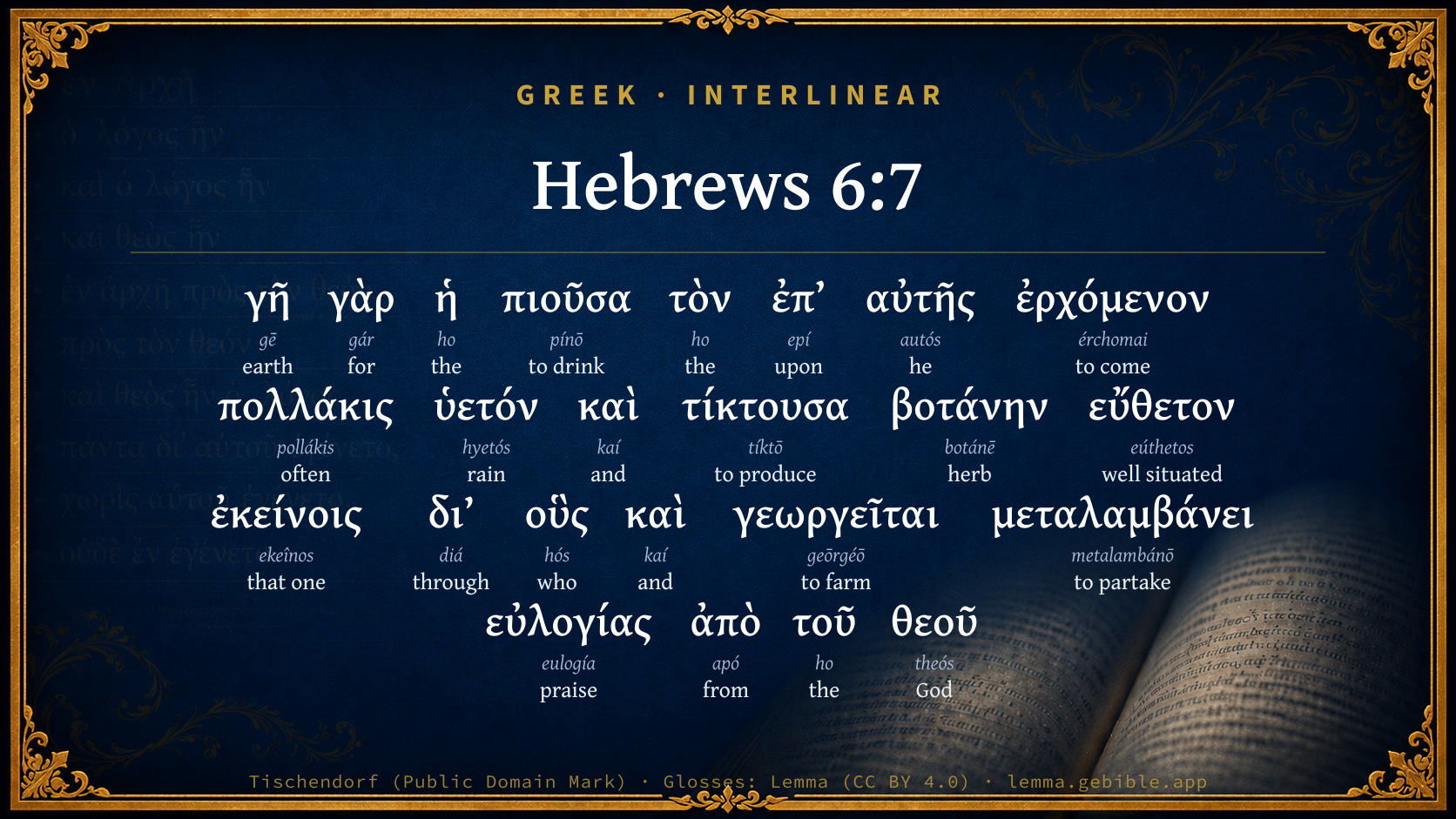
For the land which has drunk the rain that comes often on it, and brings forth a crop suitable for them for whose sake it is also tilled, receives blessing from God;
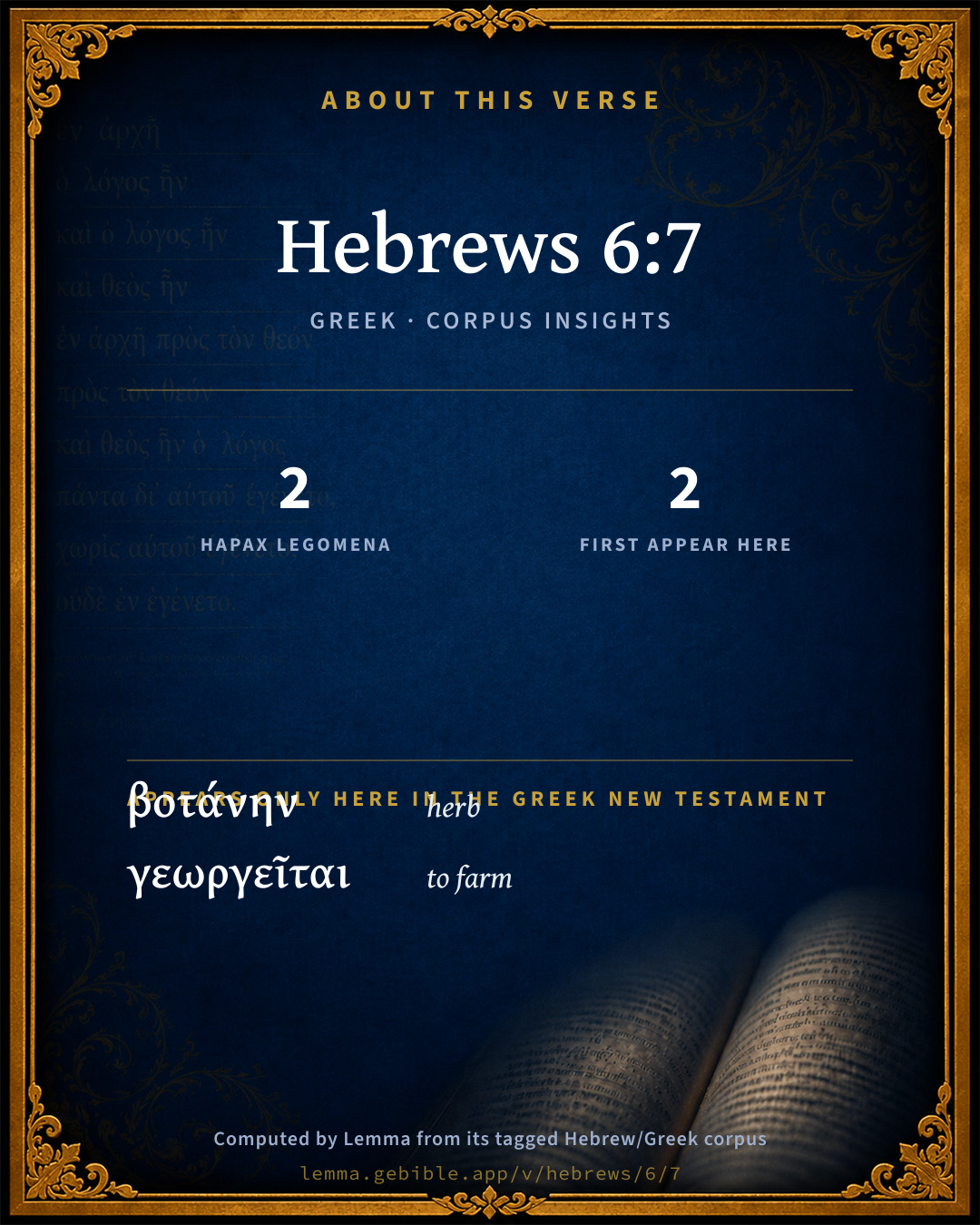
- 2 hapax legomena — only here in the Greek New Testament
- 2 first appearances in the Greek New Testament
Download a study sheet
One document with this verse’s original text, its word-by-word gloss line, the meaning frame, cross-references with their text, attributed commentary, and full source and license credits — printable, and it pastes into notes with its structure intact.
This verse Autodidact and up
A passage Seminary Student
Up to 50 verses in one chapter. A passage sheet keeps up to 6 commentary sources and 12 cross-references per verse, in the order this page ranks them, and says so on the sheet whenever that leaves anything out. Ask for a single verse and you get the Autodidact verse sheet above.
Everything on this page stays free to read, with no account — the sheet is a download of what is already on screen, not access to it.
Compare translations 3
The same verse in 3 English versions, stacked beneath the original-language interlinear above. Click any original word for its lexicon entry.
Each is an independent rendering of the whole verse — the interlinear is not word-aligned to these translations.
Highlighted words mark where these versions differ — a whole-verse word diff, not a word-by-word alignment.
-
World English Bible Public Domain
For the land which has drunk the rain that comes often on it, and brings forth a crop suitable for them for whose sake it is also tilled, receives blessing from God;
-
King James Version Public Domain
For the earth which drinketh in the rain that cometh oft upon it, and bringeth forth herbs meet for them by whom it is dressed, receiveth blessing from God:
-
unfoldingWord Literal Text CC BY-SA 4.0
For a land that drinks the rain that often comes upon it and produces useful vegetation for those for whom it is also cultivated shares a blessing from God,
unfoldingWord Literal Text — © unfoldingWord, licensed CC BY-SA 4.0. Word-aligned USFM3 via Door43 (git.door43.org/unfoldingWord/en_ult).
Show all 19 translations
Every available English version of this verse, each an independent rendering of the whole verse.
-
World English Bible Public Domain
For the land which has drunk the rain that comes often on it, and brings forth a crop suitable for them for whose sake it is also tilled, receives blessing from God;
-
Berean Standard Bible Public Domain
For land that drinks in the rain often falling on it and that produces a crop useful to those for whom it is tended receives the blessing of God.
-
Majority Standard Bible Public Domain
For land that drinks in the rain often falling on it and that produces a crop useful to those for whom it is tended receives the blessing of God.
-
King James Version Public Domain
For the earth which drinketh in the rain that cometh oft upon it, and bringeth forth herbs meet for them by whom it is dressed, receiveth blessing from God:
-
American Standard Version (1901) Public Domain
For the land which hath drunk the rain that cometh oft upon it, and bringeth forth herbs meet for them for whose sake it is also tilled, receiveth blessing from God:
-
Revised Version (1885) Public Domain
For the land which hath drunk the rain that cometh oft upon it, and bringeth forth herbs meet for them for whose sake it is also tilled, receiveth blessing from God:
-
Geneva Bible (1599) Public Domain
For the earth which drinketh in the raine that commeth oft vpon it, and bringeth foorth herbes meete for them by whome it is dressed, receiueth blessing of God.
-
Douay-Rheims (1899) Public Domain
For the earth that drinketh in the rain which cometh often upon it, and bringeth forth herbs meet for them by whom it is tilled, receiveth blessing from God.
-
Young's Literal Translation Public Domain
For earth, that is drinking in the rain many times coming upon it, and is bringing forth herbs fit for those because of whom also it is dressed, doth partake of blessing from God,
-
Literal Standard Version CC BY-SA 4.0
For the earth, having drunk in the rain coming on it many times, and is bringing forth herbs fit for those because of whom it is also dressed, partakes of blessing from God,
-
Unlocked Literal Bible CC BY-SA 4.0
For the land that drinks in the rain that often comes on it, and that gives birth to the plants useful to those for whom the land was worked—this is the land that receives a blessing from God.
-
unfoldingWord Literal Text CC BY-SA 4.0
For a land that drinks the rain that often comes upon it and produces useful vegetation for those for whom it is also cultivated shares a blessing from God,
-
Darby Bible Public Domain
For ground which drinks the rain which comes often upon it, and produces useful herbs for those for whose sakes also it is tilled, partakes of blessing from God;
-
World Messianic Bible Public Domain
For the land which has drunk the rain that comes often on it and produces a crop suitable for them for whose sake it is also tilled, receives blessing from God;
-
Webster's Bible Public Domain
For the earth which drinketh in the rain that cometh often upon it, and bringeth forth herbs fit for them by whom it is dressed, receiveth blessing from God:
-
Free Bible Version CC BY-SA 4.0
Land that has been watered by rain, and produces crops for those who farm it, has God's blessing.
-
Bible in Basic English Public Domain
For a land, drinking in the frequent rain and producing good plants for those for whom it is worked, has a blessing from God:
-
Text-Critical English NT CC BY 4.0
For land that has drunk the rain that often falls upon it, and produces a crop useful to those for whom it is cultivated, receives a blessing from God.
-
Tyndale New Testament (1534) Public Domain
For that erth which drinketh in the rayne wich cometh ofte vpon it and bringeth forth erbes mete for them that dresse it receaveth blessynge of god.
Literal Standard Version (2020), Covenant Press — licensed CC BY-SA 4.0. Text via the HelloAO Bible API (eBible.org). Unlocked Literal Bible (unfoldingWord) — licensed CC BY-SA 4.0. Text via the HelloAO Bible API (eBible.org). unfoldingWord Literal Text — © unfoldingWord, licensed CC BY-SA 4.0. Word-aligned USFM3 via Door43 (git.door43.org/unfoldingWord/en_ult). Free Bible Version, Dr. Jonathan Gallagher — licensed CC BY-SA 4.0. Text via the HelloAO Bible API (eBible.org).
Word by word
More ways to search: Search by grammar → Find every occurrence → Compare this word →
Practice this passage: Drill this verse → Learn its vocabulary →
- Appears 1× in the Greek New Testament
- First appears here
- Part of Speech
- Noun
- Case
- Accusative
- Number
- Singular
- Gender
- Feminine
Full Thayer's Definition
- γῆ gē G1093 “earth” Noun, Nominative, Singular, Feminine
- γὰρ gár G1063 “for” Conjunction
- ἡ ho G3588 “the” Article, Nominative, Singular, Feminine
- πιοῦσα pínō G4095 “to drink” Verb, Aorist, Active, Participle, Nominative, Singular, Feminine
- τὸν ho G3588 “the” Article, Accusative, Singular, Masculine
- ἐπ’ epí G1909 “upon” Preposition
- αὐτῆς autós G846 “he” Personal pronoun, Genitive, Singular, Feminine
- ἐρχόμενον érchomai G2064 “to come” Verb, Present, Middle or Passive deponent, Participle, Accusative, Singular, Masculine
- πολλάκις pollákis G4178 “often” Adverb
- ὑετόν hyetós G5205 “rain” Noun, Accusative, Singular, Masculine
- καὶ kaí G2532 “and” Conjunction
- τίκτουσα tíktō G5088 “to produce” Verb, Present, Active, Participle, Nominative, Singular, Feminine
- βοτάνην botánē G1008 “herb” Noun, Accusative, Singular, Feminine
- εὔθετον eúthetos G2111 “well situated” Adjective, Accusative, Singular, Feminine
- ἐκείνοις ekeînos G1565 “that one” Demonstrative pronoun, Dative, Plural, Masculine
- δι’ diá G1223 “through” Preposition
- οὓς hós G3739 “who” Relative pronoun, Accusative, Plural, Masculine
- καὶ kaí G2532 “and” Conjunction
- γεωργεῖται geōrgéō G1090 “to farm” Verb, Present, Passive, Indicative, 3rd person, Singular
- μεταλαμβάνει metalambánō G3335 “to partake” Verb, Present, Active, Indicative, 3rd person, Singular
- εὐλογίας eulogía G2129 “praise” Noun, Genitive, Singular, Feminine
- ἀπὸ apó G575 “from” Preposition
- τοῦ ho G3588 “the” Article, Genitive, Singular, Masculine
- θεοῦ theós G2316 “God” Noun, Genitive, Singular, Masculine
About this verse
These counts appear in no published source. They are computed here, from the morphology-tagged text and Lemma’s own curated glosses. What Lemma adds →
- 24
- words
- 21
- distinct lemmas
- General Epistles
- section
Notable vocabulary
2 hapax legomena — words that appear only here in the entire Greek New Testament:
First appearance in Scripture
These words make their first canonical appearance in the Greek New Testament here:
Shared distinctive vocabulary
εὔθετον well situated G2111 occurs in 3 verses of the Greek New Testament. Also found in:
Cross-references
14Topical passages linked to Hebrews 6:7 in the Treasury of Scripture Knowledge — connected by theme and wording, ordered by reader-vote popularity; previews shown in the World English Bible.
- Hosea 10:12 Sow to yourselves in righteousness, Reap according to kindness. Break up your fallow ground; For it is time to seek Yahweh, Until he comes and rains righteousness on you.
- Isaiah 44:3 For I will pour water on him who is thirsty, and streams on the dry ground; I will pour my Spirit on your seed, and my blessing on your offspring:
- Psalms 65:9–13 You visit the earth, and water it. You greatly enrich it. The river of God is full of water. You provide them grain, for so you have ordained it.
- Isaiah 55:10–13 For as the rain comes down and the snow from the sky, and doesn't return there, but waters the earth, and makes it bring forth and bud, and gives seed to the sower and bread to the eater;
- Psalms 126:6 He who goes out weeping, carrying seed for sowing, Will assuredly come again with joy, carrying his sheaves.
- Joel 2:21–26 Land, don't be afraid. Be glad and rejoice, for Yahweh has done great things.
- Leviticus 25:21 then I will command my blessing on you in the sixth year, and it shall bring forth fruit for the three years.
- Psalms 24:5 He shall receive a blessing from Yahweh, Righteousness from the God of his salvation.
- Psalms 104:11–13 They give drink to every animal of the field. The wild donkeys quench their thirst.
- Ezekiel 34:26 I will make them and the places round about my hill a blessing; and I will cause the shower to come down in its season; there shall be showers of blessing.
- James 5:7 Be patient therefore, brothers, until the coming of the Lord. Behold, the farmer waits for the precious fruit of the earth, being patient over it, until it receives the early and late rain.
- Malachi 3:10 Bring the whole tithe into the store-house, that there may be food in my house, and test me now in this," says Yahweh of hosts, "if I will not open you the windows of heaven, and pour you out a blessing, that there shall not be room enough for.
- Genesis 27:27 He came near, and kissed him. He smelled the smell of his clothing, and blessed him, and said, "Behold, the smell of my son Is as the smell of a field which Yahweh has blessed.
- Deuteronomy 28:11–12 Yahweh will make you plenteous for good, in the fruit of your body, and in the fruit of your cattle, and in the fruit of your ground, in the land which Yahweh swore to your fathers to give you.
Cross-references courtesy of OpenBible.info (CC BY 4.0).
Lesson kit
Teaching starters — assembled from the data on this page, not authored interpretation. Every prompt links to the verse data it draws on. Edit before teaching.
Hebrews, in the General Epistles, opens this verse with 24 words (21 distinct Greek lemmas). Its most distinctive word is botánē (“herb”). A historical commentator’s framing appears above. Read the whole chapter for the surrounding context.
Discussion questions
- What does “herb” (botánē) contribute to the verse as a whole?
- 2 words here appear nowhere else in the Greek New Testament. Why might the author reach for such rare wording?
- 2 words make their first appearance in Scripture here. What does this debut establish?
- How does Luke 9:62, which shares the word «well situated», read alongside this verse?
- What does the repetition of “the” (3× in this one verse) do in this verse?
- These translations render this verse differently; the difference is in the English rendering, not the original. What questions does that raise?
- Compare how The Biblical Illustrator and Joseph Benson's Commentary read this verse. Where do they agree or differ?
Things to notice
- 2 words in this verse appear nowhere else in the Greek New Testament.
- 2 words make their first canonical appearance in Scripture here.
- These translations choose different wording for 32 words in this verse.
- “the” occurs 3× in this single verse.
- 21 distinct Greek lemmas span 24 words in this verse.
Commentary
Notes on Hebrews 6:7 from classic Christian and Jewish commentators (each source and its license shown beneath its notes). The classic Christian expositions comment on the surrounding passage and are grouped to its opening verse, so a note may address several verses; the Jewish commentaries on the Tanakh (Rashi and others) are per-verse, so they appear only where the commentator wrote on this verse.
Lemma curates 59 commentaries, every one of them public domain or Creative Commons licensed, each selected and text-cleaned for this edition rather than reprinted as found. About our sources →
The Biblical Illustrator
Joseph S. Exell
The Biblical Illustrator, edited by Joseph S. Exell (c. 1880s–1900s) — public domain. Text from a community e-Sword module.
Joseph Benson's Commentary
Joseph Benson's Commentary on the Old and New Testaments (1811–1818) — public domain. Text from a community e-Sword module.
Tyndale Open Study Notes
Tyndale Open Resources
Tyndale Open Study Notes — © Tyndale Open Resources, licensed CC BY-SA 4.0. Text via the HelloAO Bible API.
Bengel's Gnomon
Johann Albrecht Bengel
Bengel's Gnomon of the New Testament — English translation (T&T Clark, Edinburgh, 1860) — public domain. Text from a community e-Sword module.
Meyer's Critical & Exegetical Commentary
Heinrich August Wilhelm Meyer
Meyer — Critical and Exegetical Commentary on the New Testament — English translation by Peter Christie, edited by Frederick Crombie (T&T Clark, 1880) — public domain. Text from a community e-Sword module.
Expositor's Greek Testament
ed. W. Robertson Nicoll
The Expositor's Greek Testament, edited by W. Robertson Nicoll (1897–1910) — public domain. Text from a community e-Sword module.
Geneva Bible (1599)
Geneva Bible translators
Geneva Bible (1599) marginal notes — public domain. Text via Bolls.life.
Jamieson, Fausset & Brown
Robert Jamieson, A. R. Fausset & David Brown
Jamieson, Fausset & Brown — Commentary Critical and Explanatory on the Whole Bible (1871) — public domain (CC PDM 1.0). Text via the HelloAO Bible API.
Adam Clarke's Commentary
Adam Clarke's Commentary on the Bible (1810–1826) — public domain. Text from a community e-Sword/MySword module.
John Calvin's Commentaries
John Calvin's Commentaries (1540-1563) — public domain. Text from the Calvin Translation Society English edition (1840s-50s) via the Christian Classics Ethereal Library (ccel.org). Calvin's coverage is partial (roughly two-thirds of the Bible); uncommented books and verses are honest gaps, never fabricated. The 19th-century editor's footnotes and remarks are omitted so the notes are faithfully Calvin's own voice.
Ellicott's Commentary for English Readers
A Bible Commentary for English Readers, edited by Charles John Ellicott (1878–1897) — public domain. Text from a community e-Sword module.
The Cambridge Bible for Schools and Colleges
gen. ed. J. J. S. Perowne
The Cambridge Bible for Schools and Colleges (gen. ed. J. J. S. Perowne; Cambridge University Press, 1878–1918) — public domain. Text from a community e-Sword module.
John Gill's Exposition
John Gill's Exposition of the Whole Bible (1746–1763) — public domain (CC PDM 1.0). Text via the HelloAO Bible API.
Trapp's Complete Commentary
John Trapp
John Trapp, A Commentary or Exposition upon All the Books of the Old and New Testament (1647–1656) — public domain. Text from a community e-Sword module.
Albert Barnes' Notes on the Bible
Albert Barnes' Notes on the Bible (1834–1885) — public domain. Text from a community e-Sword/MySword module.
Matthew Poole's English Annotations
Matthew Poole's English Annotations on the Holy Bible (1683–1685) — public domain. Text from a community e-Sword/MySword module.
Whedon's Commentary on the Bible
Daniel D. Whedon
Daniel D. Whedon (gen. ed.), Commentary on the Old and New Testaments (1874–1909) — public domain. Text from a community e-Sword module.
The Pulpit Commentary
The Pulpit Commentary (1880–1919), ed. H.D.M. Spence-Jones & Joseph S. Exell — public domain. Text from a community e-Sword module.
Burkitt's Expository Notes on the New Testament
William Burkitt
William Burkitt's Expository Notes on the New Testament (1700–1703) — public domain. Text from a community e-Sword module.
The People's New Testament
B. W. Johnson
B. W. Johnson's The People's New Testament with Notes (1889–1891) — public domain. Electronic text from the Christian Classics Ethereal Library (CCEL) ThML edition.
unfoldingWord translationNotes
Door43 World Missions Community
unfoldingWord translationNotes — © Distant Shores Media and the Door43 World Missions Community, licensed CC BY-SA 4.0. Source: git.door43.org/Door43/en_tn.
Cambridge Greek Testament for Schools and Colleges
Cambridge Greek Testament for Schools and Colleges (Cambridge University Press, 1896; 21 vols, various authors incl. Carr, Maclear, Plummer, Farrar, Lumby, Moule, M. R. James, Simcox) — public domain. Text from a community e-Sword module.
Vincent's Word Studies in the New Testament
Marvin R. Vincent
Marvin R. Vincent, Word Studies in the New Testament (1887–1900) — public domain. Text from a community e-Sword/MySword module.