
Ephesians 6:3

Greek (Tischendorf 8th ed.) Ephesians 6:3 appears in the Greek New Testament. The text above is from the Tischendorf 8th edition. Each word links to its Strong’s number and a concise gloss. Click any word for its full Thayer’s Greek Lexicon entry.
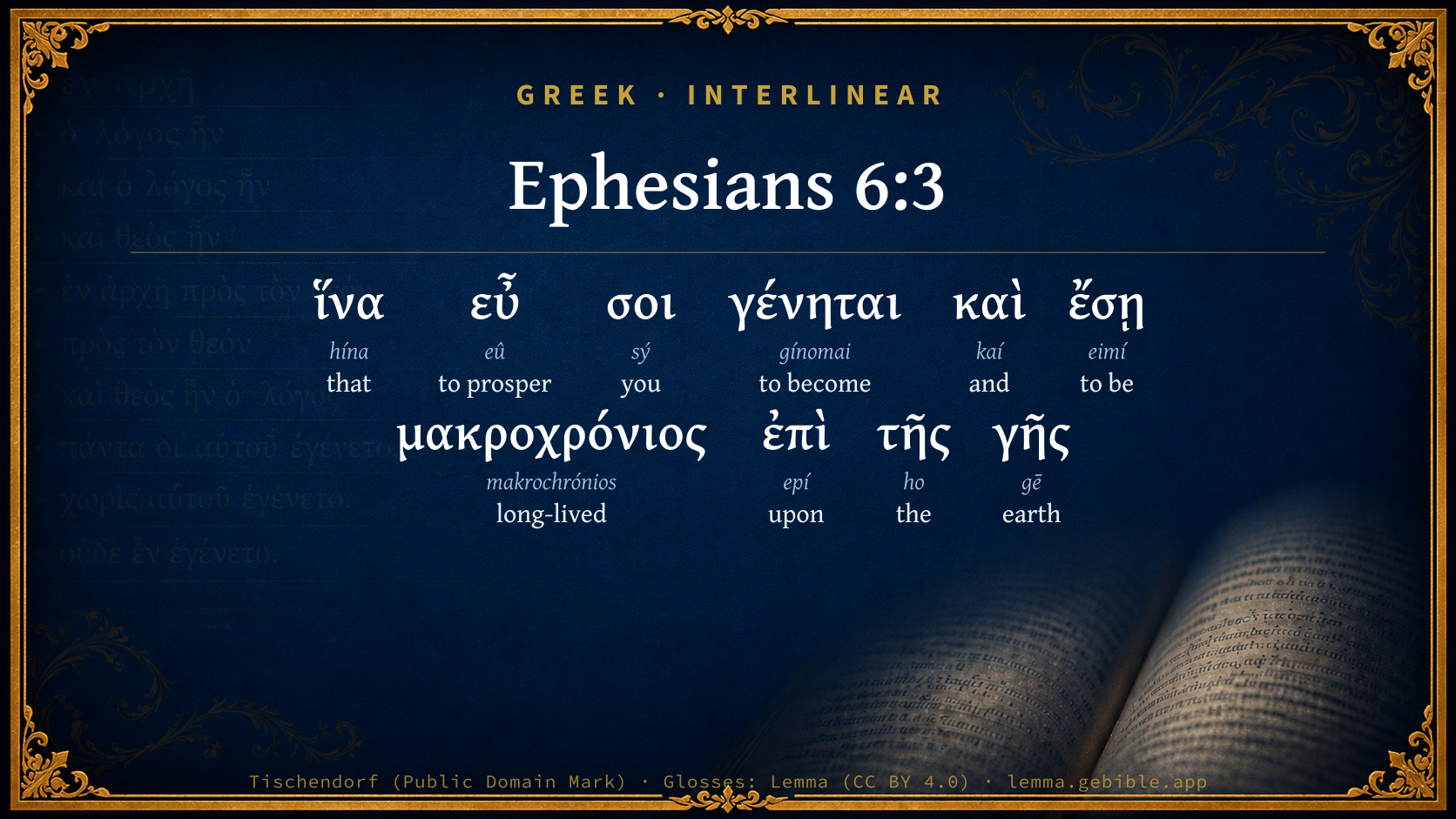
Download image
Cite this verse

Ephesians 6:3 (World English Bible). Public Domain. Lemma interlinear Bible study tool, https://lemma.gebible.app/v/ephesians/6/3.

Show BibTeX & RIS
BibTeX
RIS
English Translation
"that it may be well with you, and you may live long on the earth."
World English Bible · Public Domain
Highlights
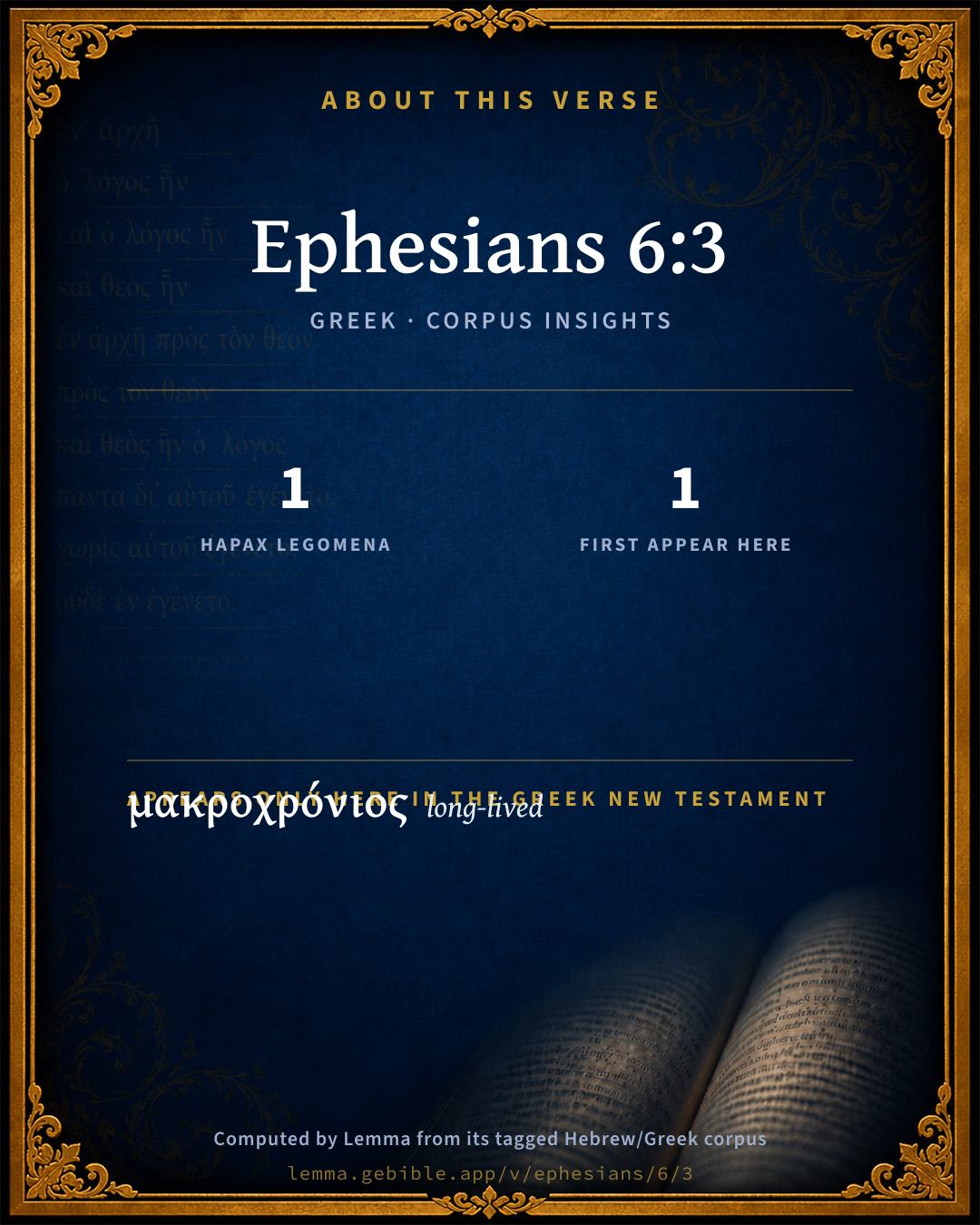
  • 1 hapax legomenon — only here in the Greek New Testament
  • 1 first appearance in the Greek New Testament
Full analysis ↓
Download a study sheet

One document with this verse’s original text, its word-by-word gloss line, the meaning frame, cross-references with their text, attributed commentary, and full source and license credits — printable, and it pastes into notes with its structure intact.

This verse Autodidact and up

Study sheet (.html) Plain text (.txt)

A passage Seminary Student

Up to 50 verses in one chapter. A passage sheet keeps up to 6 commentary sources and 12 cross-references per verse, in the order this page ranks them, and says so on the sheet whenever that leaves anything out. Ask for a single verse and you get the Autodidact verse sheet above.

Everything on this page stays free to read, with no account — the sheet is a download of what is already on screen, not access to it.

Want to remove ads? Support Godless Engineer
Compare translations 3

The same verse in 3 English versions, stacked beneath the original-language interlinear above. Click any original word for its lexicon entry.

Each is an independent rendering of the whole verse — the interlinear is not word-aligned to these translations.

Highlighted words mark where these versions differ — a whole-verse word diff, not a word-by-word alignment.

  • World English Bible Public Domain
    "that it may be well with you, and you may live long on the earth."
  • King James Version Public Domain
    That it may be well with thee, and thou mayest live long on the earth.
  • unfoldingWord Literal Text CC BY-SA 4.0
    “so that it may be well with you and you may be long-lived on the earth.”

unfoldingWord Literal Text — © unfoldingWord, licensed CC BY-SA 4.0. Word-aligned USFM3 via Door43 (git.door43.org/unfoldingWord/en_ult).

Versions to compare (up to 4)

3 of 4 selected

Show all 19 translations

Every available English version of this verse, each an independent rendering of the whole verse.

  • World English Bible Public Domain
    "that it may be well with you, and you may live long on the earth."
  • Berean Standard Bible Public Domain
    “that it may go well with you and that you may have a long life on the earth.”
  • Majority Standard Bible Public Domain
    “that it may go well with you and that you may have a long life on the earth.”
  • King James Version Public Domain
    That it may be well with thee, and thou mayest live long on the earth.
  • American Standard Version (1901) Public Domain
    that it may be well with thee, and thou mayest live long on the earth.
  • Revised Version (1885) Public Domain
    that it may be well with thee, and thou mayest live long on the earth.
  • Geneva Bible (1599) Public Domain
    That it may be well with thee, and that thou mayst liue long on earth.
  • Douay-Rheims (1899) Public Domain
    That it may be well with thee, and thou mayest be long lived upon earth.
  • Young's Literal Translation Public Domain
    which is the first command with a promise, `That it may be well with thee, and thou mayest live a long time upon the land.'
  • Literal Standard Version CC BY-SA 4.0
    which is the first command with a promise, “That it may be well with you, and you may live a long time on the land.”
  • Unlocked Literal Bible CC BY-SA 4.0
    “so that it may be well with you and you may live long on the earth.”
  • unfoldingWord Literal Text CC BY-SA 4.0
    “so that it may be well with you and you may be long-lived on the earth.”
  • Darby Bible Public Domain
    that it may be well with thee, and that thou mayest be long-lived on the earth.
  • World Messianic Bible Public Domain
    “that it may be well with you, and you may live long on the earth.”
  • Webster's Bible Public Domain
    That it may be well with thee, and thou mayest live long on the earth.
  • Free Bible Version CC BY-SA 4.0
    “that things may go well for you and you may live a long life on the earth.”
  • Bible in Basic English Public Domain
    So that all may be well for you, and your life may be long on the earth.
  • Text-Critical English NT CC BY 4.0
    “that it may be well with yoʋ and yoʋ may live long on the earth.”
  • Tyndale New Testament (1534) Public Domain
    that thou mayst be in good estate and lyve longe on the erthe.

Literal Standard Version (2020), Covenant Press — licensed CC BY-SA 4.0. Text via the HelloAO Bible API (eBible.org). Unlocked Literal Bible (unfoldingWord) — licensed CC BY-SA 4.0. Text via the HelloAO Bible API (eBible.org). unfoldingWord Literal Text — © unfoldingWord, licensed CC BY-SA 4.0. Word-aligned USFM3 via Door43 (git.door43.org/unfoldingWord/en_ult). Free Bible Version, Dr. Jonathan Gallagher — licensed CC BY-SA 4.0. Text via the HelloAO Bible API (eBible.org).

Word by word

More ways to search: Search by grammar → Find every occurrence → Compare this word →

Practice this passage: Drill this verse → Learn its vocabulary →

About this verse

These counts appear in no published source. They are computed here, from the morphology-tagged text and Lemma’s own curated glosses. What Lemma adds →

10
words
10
distinct lemmas
Pauline Epistles
section

Notable vocabulary

1 hapax legomenon — a word that appears only here in the entire Greek New Testament:

  • μακροχρόνιος long-lived G3118

First appearance in Scripture

This word makes its first canonical appearance in the Greek New Testament here:

  • μακροχρόνιος long-lived G3118

Shared distinctive vocabulary

εὖ to prosper G2095 occurs in 6 verses of the Greek New Testament. Also found in:
Cross-references

11

Topical passages linked to Ephesians 6:3 in the Treasury of Scripture Knowledge — connected by theme and wording, ordered by reader-vote popularity; previews shown in the World English Bible.

  • Deuteronomy 5:16 "Honor your father and your mother, as Yahweh your God commanded you; that your days may be long, and that it may go well with you, in the land which Yahweh your God gives you.
  • Deuteronomy 4:40 You shall keep his statutes, and his commandments, which I command you this day, that it may go well with you, and with your children after you, and that you may prolong your days in the land, which Yahweh your God gives you, forever.
  • Deuteronomy 12:28 Observe and hear all these words which I command you, that it may go well with you, and with your children after you forever, when you do that which is good and right in the eyes of Yahweh your God.
  • Deuteronomy 12:25 You shall not eat it; that it may go well with you, and with your children after you, when you shall do that which is right in the eyes of Yahweh.
  • Deuteronomy 6:3 Hear therefore, Israel, and observe to do it; that it may be well with you, and that you may increase mightily, as Yahweh, the God of your fathers, has promised to you, in a land flowing with milk and honey.
  • Deuteronomy 6:18 You shall do that which is right and good in the sight of Yahweh; that it may be well with you, and that you may go in and possess the good land which Yahweh swore to your fathers,
  • Deuteronomy 22:7 you shall surely let the hen go, but the young you may take to yourself; that it may be well with you, and that you may prolong your days.
  • Ruth 3:1 Naomi her mother-in-law said to her, My daughter, shall I not seek rest for you, that it may be well with you?
  • Psalms 128:1–2 Blessed is everyone who fears Yahweh, Who walks in his ways.
  • Isaiah 3:10 Tell the righteous "Good!" For they shall eat the fruit of their deeds.
  • Jeremiah 42:6 Whether it be good, or whether it be evil, we will obey the voice of Yahweh our God, to whom we send you; that it may be well with us, when we obey the voice of Yahweh our God.

Cross-references courtesy of OpenBible.info (CC BY 4.0).

Commentary

Notes on Ephesians 6:3 from classic Christian and Jewish commentators (each source and its license shown beneath its notes). The classic Christian expositions comment on the surrounding passage and are grouped to its opening verse, so a note may address several verses; the Jewish commentaries on the Tanakh (Rashi and others) are per-verse, so they appear only where the commentator wrote on this verse.

Lemma curates 59 commentaries, every one of them public domain or Creative Commons licensed, each selected and text-cleaned for this edition rather than reprinted as found. About our sources →

Bengel's Gnomon

Johann Albrecht Bengel

Eph 6:3. Εὖ σοὶ, well with thee) Let young persons attend to this statement.—καὶ ἔσῃ, and thou mayest [shalt] be) The LXX., in both passages, viz. that in Exodus, and that in Deuteronomy, where the Decalogue is recounted, have it, that thou mayest become long-lived, καὶ ἵνα μακροχρόνιος γένῃ, but Deu 22:7, that it may be well with thee, and thou mayest have many days—ἵνα εἆ σοι γένηται χαὶ πολυήμερος ἔσῃ, from the cod. Al., where the ed. Rom. has γένῃ: ἔσῃ, in the future of the subjunctive, is rare. He, who lives well for a long time, long experiences the favour or God, even in his children rendering him honour, and he has a long season of sowing the seed of an eternal harvest.—μακροχρόνιος, long-lived) The more tender age of childhood, according to its capacity of apprehension, is allured by the promise of long life; the exception of the cross is more expressly added to those that are grown up, and are of mature age. But length of days is promised, not only to single persons who honour their parents, but to their whole stock.—ἐπὶ τῆς γῆς, upon the earth [the land]) Moses, writing to Israel, says, in the good land, ἐπὶ τῆς γῆς ἀγαθῆς, which the Lord thy God giveth thee. At present godly men live equally well in every land, as Israel did in that which God gave them.

Bengel's Gnomon of the New Testament — English translation (T&T Clark, Edinburgh, 1860) — public domain. Text from a community e-Sword module.

Meyer's Critical & Exegetical Commentary

Heinrich August Wilhelm Meyer

Eph_6:3. After Paul has just said: the first commandment with promise, he now adduces the definite promise, on account of which this predicate pertains to that commandment, and that according to the LXX. of Exo_20:12, Deu_5:16, with immaterial variation (LXX.: καὶ ἵνα μακροχρ. γένῃ ἐπὶ τ. γ.), and with omission of the more precise designation of Palestine, which in the LXX. follows after γῆς. This omission, however, was not occasioned by the circumstance that the promise was to bear upon long life in general (Calvin, Koppe, Rückert, Matthies, Schenkel, and many), in which case, indeed, ἐπὶ τῆς γῆς might also have been left out; but Paul could so fully presuppose acquaintance with the complete words of the promise, that with the mere ἐπὶ τῆς γῆς enough was said to preclude any misunderstanding which should depart from the original sense: in the land, i.e. Palestine. So, namely, in accordance with the sense of the original text well known to the readers, is ἐπὶ τῆς γῆς to be understood, not as upon earth; for the promise is here adduced historically. Hence its original sense is not at all to be altered or spiritualized, or to be taken conditionally, as e.g. was done by Zanchius: if the promise is not fulfilled simpliciter, yet it is fulfilled commutations in majus; or by Calovius: Promissiones temporales cum conditions intelligendae, quantum sc. temporalia illa nobis salutaria fore Deus censuerit; comp. also Estius, who at the same time remarks (so again typically Olshausen, comp. Baumgarten-Crusius) that the land of Canaan prefigures the kingdom of heaven (comp. Mat_5:5), and the long life everlasting blessedness. Nor is it to be said, with Bengel, Morus, Stolz, Rosenmüller, Flatt, and Harless, that the earthly blessing is promised not to the individual, but to the people. For in the summons thou shalt in the Decalogue, although the latter on the whole (as a whole) is directed to the people, the individual is withal addressed, as is evident from the very commandments in which the neighbour is mentioned, and as is the view underlying all the N.T. citations from the Decalogue-law, Mat_15:4; Mat_5:21; Mat_5:27; Rom_7:7; Rom_13:9.

εὖ σοι γένηται] Comp. Gen_2:13; Deu_4:40; Sir_1:13. A Greek would employ εὖ πάσχειν, εὖ πράττειν, or the like, or even ἀγαθά σοι γένηται.

καὶ ἔσῃ κ.τ.λ.] is regarded by Winer, p. 258 [E. T. 361], and de Wette (comp. already Erasmus), not as dependent upon ἵνα, but as a direct continuation of the discourse. But this expedient is unnecessary, inasmuch as ἵνα with the future actually occurs in the case of Paul (see on 1Co_9:18; Gal_2:4); and is, moreover, here out of place, since there is not any direct continuation of the discourse in those passages of the O. T., the sense of which Paul reproduces. At Rev_22:14 also the future and subjunctive are interchanged after ἵνα, as also in classical writers the same variation after ὅπως is well known (see on the erroneous canon Dawesianus, Bremi, in Schaef. Appar. ad Dem. I. p. 277; Ellendt, Lex. Soph. II. p. 335 f.; Buttmann, Neutest. Gramm. p. 184 [E. T. 213]). And how aptly do the two modes of construction here suit the sense, so that γένηται expresses the pure becoming realized, and ἔσῃ μακροχρόν. the certain emergence and continued subsistence (Kühner, II. p. 491). The change is a logical climax.

Meyer — Critical and Exegetical Commentary on the New Testament — English translation by Peter Christie, edited by Frederick Crombie (T&T Clark, 1880) — public domain. Text from a community e-Sword module.

Expositor's Greek Testament

ed. W. Robertson Nicoll

Eph 6:3 . ἵνα εὖ σοι γένηται καὶ ἔσῃ μακροχρόνιος ἐπὶ τῆς γῆς : that it may be well with thee, and thou mayest live long on the land . The quotation of the commandment is continued according to the LXX, but with some variations, viz. , ἔσῃ for γένῃ , and the omission of τῆς ἀγαθῆς ἧς (Exo 20:12 , or ἧς alone as in Deu 5:16 ) Κύριος ὁ Θεός σου δίδωσί σοι . This clause is omitted perhaps as less suitable to those addressed (Abb.); or it may be with a view to generalise the statement and relieve it of all restrictions but those which necessarily condition the promises of temporal blessings (Ell.). Meyer strangely supposes that the quotation is left unfinished simply because the readers could easily complete it for themselves. In that case it might have been even shorter. The first clause promises temporal good generally; the second the particular blessing, so associated in the OT with the idea of the Divine favour, of length of days. The ἔσῃ is explained by not a few (Erasm., De Wette, Win., etc.; cf. Win.-Moult., p. 361) as a case of oratio variata , a transition from the ἵνα construction to direct narrative, = “and thou shalt be,” as the RV margin puts it. But there is no necessity for supposing such a change in the construction, as ἵνα with the fut. indic, though strange to Attic Greek (which yet uses ὅπως with that tense and mood), is found in the NT (1Co 9:18 ; Rev 22:14 ). In Attic Greek the idea would have been expressed not by εὖ γενέσθαι , but by εὖ πάσχειν , εὖ πράττειν or similar form (Mey.). In the OT original, ἐπὶ τῆς γῆς refers of course to the land of Canaan . Meyer thinks it must retain its historical sense here. But that, in its literal completeness, would be something inapplicable to Paul’s Christian readers. The fact that the quotation is broken off at this point, and that the more restricted, national terms of the OT promise are omitted, might warrant us in giving the phrase the larger sense of “on the earth” (with RV text). But it is best to take the phrase as far as possible in its historical sense, and translate it “on the land” (RV marg.), i.e. , the land on which your Christian lot is cast.

The Expositor's Greek Testament, edited by W. Robertson Nicoll (1897–1910) — public domain. Text from a community e-Sword module.

Hodge's Commentary on Romans, Ephesians & First Corinthians

Charles Hodge

Eph_6:2, Eph_6:3

This consideration is enforced by a reference to the express command of God. The duty is so important as to be included in that brief summary of the moral law given by God on Mount Sinai. It was engraven by the finger of God on the tables of stone, Honor thy father and thy mother. Any flagrant breach of this command was, according to the Mosaic law, punished with death. To honor is to reverence; and, therefore, the command has reference to the inward feeling as well as to the outward conduct. This precept is said to be πρώτη ἐν ἐπαγγελίᾳ. This may mean, it is the first commandment in the decalogue which has a specific promise attached; for the promise connected with the second commandment does not relate to the observance of that particular precept, but to keeping Gods covenant. Or it may mean that it is the first commandment of the second table of the law, and has a promise annexed; or, πρώτη may be taken here as in Mar_12:28, Mar_12:30, in the sense of chief, i.e. the first in importance. The sense would then be, Honor thy father and mother; this is the prime commandment, the first in importance among those relating to our social duties; and it has the specific promise annexed. It shall be well with thee on the earth. This view of the passage is on the whole to be preferred. It is not likely that Paul would call this the first commandment with promise, when it is in fact the only command in the decalogue which has any specific promise annexed to it. And to say that it is the first in order of arrangement in the second table of the law, not only adds nothing to its importance, but supposes the apostle to refer to a distinction between the two tables of the decalogue, not elsewhere recognized in Scripture.

The promise itself has a theocratical form in the Old Testament. That is, it has specific reference to prosperity and length of days in the land which God had given to his people as their inheritance. The apostle generalizes it by leaving out the concluding words, and makes it a promise not confined to one land or people, but to obedient children everywhere. If it be asked whether obedient children are in fact thus distinguished by long life and prosperity? The answer is, that this, like all other such promises, is a revelation of a general purpose of God, and makes known what will be the usual course of his providence. That some obedient children are unfortunate and short lived, is no more inconsistent with this promise, than that some diligent men are poor, is inconsistent with the declaration, The hand of the diligent maketh rich. Diligence, as a general rule, does secure riches; and obedient children, as a general rule, are prosperous and happy. The general promise is fulfilled to individuals, just so far as it shall serve for Gods glory, and their own good.

Charles Hodge — Commentary on Romans (1835), First Corinthians (1857), and Ephesians (1856) — public domain. Text from a community e-Sword module.

Jamieson, Fausset & Brown

Robert Jamieson, A. R. Fausset & David Brown

long on the earth--In Exo 20:12, "long upon the land which the Lord thy God giveth thee," which Paul adapts to Gospel times, by taking away the local and limited reference peculiar to the Jews in Canaan. The godly are equally blessed in every land, as the Jews were in the land which God gave them. This promise is always fulfilled, either literally, or by the substitution of a higher blessing, namely, one spiritual and eternal (Job 5:26; Pro 10:27). The substance and essence of the law are eternally in force: its accidents alone (applying to Israel of old) are abolished (Rom 6:15).

Jamieson, Fausset & Brown — Commentary Critical and Explanatory on the Whole Bible (1871) — public domain (CC PDM 1.0). Text via the HelloAO Bible API.

John Calvin's Commentaries

3. That it may be well with thee. The promise is — a long life; from which we are led to understand that the present life is not to be overlooked among the gifts of God. On this and other kindred subjects I must refer my reader to the Institutes of the Christian Religion; satisfying myself at present with saying, in a few words, that the reward promised to the obedience of children is highly appropriate. Those who shew kindness to their parents from whom they derived life, are assured by God, that in this life it will be well with them.

And that thou mayest live long on the earth. Moses expressly mentions the land of Canaan,

“that thy days may be long upon the land which the Lord thy God giveth thee.” (Exodus 20:12.)

Beyond this the Jews could not conceive of any life more happy or desirable. But as the same divine blessing is extended to the whole world, Paul has properly left out the mention of a place, the peculiar distinction of which lasted only till the coming of Christ.

John Calvin's Commentaries (1540-1563) — public domain. Text from the Calvin Translation Society English edition (1840s-50s) via the Christian Classics Ethereal Library (ccel.org). Calvin's coverage is partial (roughly two-thirds of the Bible); uncommented books and verses are honest gaps, never fabricated. The 19th-century editor's footnotes and remarks are omitted so the notes are faithfully Calvin's own voice.

Ellicott's Commentary for English Readers

(3) That it may be well with thee . . .—The quotation is but slightly varied from Exo_20:12; Deu_5:16. But by the omission of the limiting words, “which the Lord thy God hath given thee,” St. Paul at once generalises the application and determines it to the earth, and not to “the good land” of heaven. The words so interpreted are, therefore, a promise that obedience “in the Lord” to the great natural law on which society rests, shall bring with it reward on earth; just as our Lord tells us of “meekness” that it shall “inherit the earth” (Mat_5:5), and St. Paul of “godliness” that it “has the promise of the life that now is, as well as of that which is to come” (1Ti_4:8). The visible exemplification of this law is, indeed, as in all other cases, obscured by the disorder brought in by sin, and, moreover, is affected by the consideration that this life, being a discipline for heaven, must present, in the true sense of the word, “imperfection” or incompleteness, if viewed alone. But it is still a natural law, and is still accordingly fulfilled in actual experience. The promise is not to us so important as to them of old; but it is ours still.

(3, 4) Eph_6:21-24 form the conclusion of the Epistle, in commendation of Tychicus’ salutation and blessing. The extreme brevity and generality of this section here—in contrast with St. Paul’s practice in every other Epistle, except the Second Epistle to the Corinthians and the Epistle to the Galatians (both of which have the abruptness of indignation) and especially with the parallel Epistle to the Colossians—seem to bear on the question of the encyclical character of this Epistle.

A Bible Commentary for English Readers, edited by Charles John Ellicott (1878–1897) — public domain. Text from a community e-Sword module.

The Cambridge Bible for Schools and Colleges

gen. ed. J. J. S. Perowne

3. that, &c.] The Gr. is nearly verbatim from the LXX. of Exodus 20 and Deuteronomy 5. It is observable that the Apostle omits the last words of the original promise. Is not this on purpose, to dilate the reference to the utmost? The Sinaitic limitation was but a special application of a perpetual principle of Providence, illustrated, we may observe, in the remarkable instance of the durability of the Chinese race and empire in its “land.” Not for Jews only, nor for Christians only, is the promise, but for man, with such modifications of the meaning of “the earth,” or “land,” as circumstances may bring.

To seek a reference here to “the better country, that is, the heavenly” (Heb_11:16), is a lawful and beautiful accommodation, but not in point as an interpretation.

mayest live] Quite lit., “shall live.” And it may be so read. But usage makes it at least probable that the A. V. (and R.V., text) represent rightly the intention of the Greek.

Observe, in passing, the hint given in these verses of the familiarity of the Gentile converts of St Paul with the O.T., and of the Divine authority which, he takes it for granted, they recognized in the Decalogue. See further, Appendix H.

The Cambridge Bible for Schools and Colleges (gen. ed. J. J. S. Perowne; Cambridge University Press, 1878–1918) — public domain. Text from a community e-Sword module.

John Gill's Exposition

That it may be well with thee,.... In this world, and that which is to come; see Deu 5:16. The Jews (z) say,

"there are four things, which if a man does, he eats the fruit of them in this world, and the capital part remains for him in the world to come; and they are these, "honouring father and mother", doing acts of beneficence, making peace between a man and his neighbour, and learning of the law, which answers to them all.''

And thou mayest live long on the earth: length of days is in itself a blessing; and though men's days cannot be lengthened beyond God's purpose and decree; and though obedient children do not always live long; yet disobedience to parents often brings the judgments of God on children, so that they die not a common death, Sa2 18:14. On those words in Deu 32:47, the Jews (a) have this paraphrase;

"because it is your life, , "this is honouring father and mother; and through this thing ye shall prolong your days", this is beneficence.''

It may be observed, that the words in this promissory part are not the same as in the decalogue, where they stand thus, "that thy days may be long upon the land which the Lord thy God giveth thee", Exo 20:12, referring to the land of Canaan; for the law in the form of it, in which it was delivered by Moses, only concerned the people of the Jews; wherefore to suit this law, and the promise of it, to others, the apostle alters the language of it.

(z) Misna Peah, c. 1. sect. 1. T. Bab. Sabbat, fol. 127. 1, & Kiddushin, fol. 40. 1. (a) T. Hieros. Peah, fol. 15. 4.

John Gill's Exposition of the Whole Bible (1746–1763) — public domain (CC PDM 1.0). Text via the HelloAO Bible API.

Trapp's Complete Commentary

John Trapp

3 That it may be well with thee, and thou mayest live long on the earth.

Ver. 3. And thou mayest live long] Good children help to lengthen their parents’ days, as Joseph did Jacob’s. God therefore lengthens theirs in red-hostimentum, as it were. Or if he take from them this long lease, he gives them a freehold of better value.

John Trapp, A Commentary or Exposition upon All the Books of the Old and New Testament (1647–1656) — public domain. Text from a community e-Sword module.

Albert Barnes' Notes on the Bible

That it may be well with thee - This is found in the fifth commandment as recorded in Deu 5:16. The whole commandment as there recorded is, “Honour thy father and thy mother, as the Lord thy God hath commanded thee; that thy days may be prolonged, and that it may go well with thee in the land which the Lord thy God giveth thee.” The meaning here is, that they would be more happy, useful, and virtuous if they obeyed their parents than if they disobeyed them.

And thou mayest live long on the earth - In the commandment as recorded in Exo 20:12, the promise is, “that thy days may be long upon the land which the Lord thy God giveth thee.” This referred to the promised land - the land of Canaan. The meaning doubtless, is, that there would be a special providence, securing to those who were obedient to parents length of days. Long life was regarded as a great blessing; and this blessing was promised. The apostle here gives to the promise a more general form, and says that obedience to parents was connected at all times with long life. We may remark here:

(1) That long life is a blessing. It affords a longer space to prepare for eternity; it enables a man to be more useful; and it furnishes a longer opportunity to study the works of God on earth. It is not improper to desire it; and we should make use of all the means in our power to lengthen out our days, and to preserve and protect our lives.

(2) It is still true that obedience to parents is conducive to length of life, and that those who are most obedient in early life, other things being equal, have the best prospect of living long. This occurs because:

(a) obedient children are saved from the vices and crimes which shorten life. No parent will command his child to be a drunkard, a gambler, a spendthrift, a pirate, or a murderer. But these vices and crimes, resulting in most cases from disobedience to parents, all shorten life; and they who early commit them are certain of on early grave. No child who disobeys a parent can have any “security” that he will not fall a victim to such vices and crimes.

(b) Obedience to parents is connected with virtuous habits that are conducive to long life. It will make a child industrious, temperate, sober; it will lead him to restrain and govern his wild passions; it will lead him to form habits of self-government which will in future life save him from the snares of vice and temptation.

(c) Many a life is lost early by disobeying a parent. A child disobeys a father and goes into a dramshop; or he goes to sea; or he becomes the companion of the wicked - and he may be wrecked at sea, or his character on land may be wrecked forever. Of disobedient children there is perhaps not one in a hundred that ever reaches an honored old age.

(d) We may still believe that God, in his providence, will watch over those who are obedient to a father and mother. If he regards a falling sparrow Mat 10:29, he will not be unmindful of an obedient child; if he numbers the hairs of the head Mat 10:30, he will not be regardless of the little boy that honors him by obeying a father and mother.

Albert Barnes' Notes on the Bible (1834–1885) — public domain. Text from a community e-Sword/MySword module.

Matthew Poole's English Annotations

That thou mayest live long and happily. This promise is still fulfilled to believers, either in the thing itself here promised, or in a better way, God’s giving them eternal life.

Matthew Poole's English Annotations on the Holy Bible (1683–1685) — public domain. Text from a community e-Sword/MySword module.

Whedon's Commentary on the Bible

Daniel D. Whedon

3. Well with thee—For conduct early well regulated by home law, is likely to he followed by that well regulated conduct which will secure the well-being through life. The child and the youth that obeys and honours his parents in the spirit of the command—that is, in the Lord, and as obeying Christ—is a true Christian. And as the promise is given to him in that spirit and character, never, but as he apostatizes from that spirit and character, can it be otherwise than well with him. Misfortune cannot ruin him, death cannot destroy him, eternity will set its perpetual seal upon his well-being.

Live long on the earth—He to whom God’s law, commencing with parental law, is a regulator in life, keeps apart from violent counsels and violent men. Temperance, regular industry, and upright behaviour, are great prolongers of life. This is just as clear as the reverse fact that violence, intemperance, debauchery, war, or wild excitements of any kind, are the real murderers of three fourths of mankind, even in civilized Christendom. The average of human life would be lengthened by a purification, commencing in home law, of human character. So pointedly does the decalogue look to the right sort of parentage for the right sort of an age, a nation, or a race.

Meyer well refutes the notion that the promise of the fifth commandment was addressed to the people as a whole, by noting that them and thee show that it was a promise to each individual. Yet the long life of each would be the long enjoyment of Canaan to the whole.

Daniel D. Whedon (gen. ed.), Commentary on the Old and New Testaments (1874–1909) — public domain. Text from a community e-Sword module.

The Pulpit Commentary

That it may be well with thee, and thou mayest live long on the earth. A free rendering (after the manner of the apostle) of the reason annexed to the fifth commandment, "that thy days may be long in the land which the Lord thy God giveth thee." While the Decalogue was an expression of the will of God on matters of moral and indefeasible obligation, it had a local Hebrew element here and there. In the present ease the apostle drops what is specially Hebrew, adapting the promise in spirit to a wider area. The special promise of long life in the land of Canaan is translated into a general promise of prosperity and longevity. As before, we must not suppose that the apostle excludes exceptions. The promise is not for each individual; many good and obedient children do not live long. But the general tendency of obedience to parents is towards the results specified. Where obedience to parents is found, there is usually found along with it temperance, self-control, industry, regular ways of life, and other habits that tend towards prosperity and longevity. In Christian families there is commonly affection, unity, prayer, mutual helpfulness, reliance on God, trust in Christ, and all that makes life sweet and wholesome. The spirit of the promise is realized in such ways, and it may be likewise in special mercies vouchsafed to each family.

The Pulpit Commentary (1880–1919), ed. H.D.M. Spence-Jones & Joseph S. Exell — public domain. Text from a community e-Sword module.

John Wesley's Explanatory Notes

That thou mayest live long upon the earth - This is usually fulfilled to eminently dutiful children; and he who lives long and well has a long seed-time for the eternal harvest. But this promise, in the Christian dispensation, is to be understood chiefly in a more exalted and Spiritual sense.

John Wesley, Explanatory Notes Upon the Whole Bible (1754–1765) — public domain. Text via the GEBible commentary corpus.

The People's New Testament

B. W. Johnson

3. That it may be well with thee. Quoted from Exodus 20:12. This is the promise. A temporal blessing was conditioned upon the promise to Israel, and to honor parents still brings blessing.

B. W. Johnson's The People's New Testament with Notes (1889–1891) — public domain. Electronic text from the Christian Classics Ethereal Library (CCEL) ThML edition.

International Critical Commentary

3. ἵνα εὖ σοι γένηται, κ.τ.λ. The text in the Sept. proceeds: καὶ ἵνα μακροχρόνιος γένῃ ἐπὶ τῆς γῆς ἦς Κύριος ὁ Θεός σου διδωσί σοι. The latter words are probably omitted purposely as unsuitable to those addressed. The future ἔσῃ is to be regarded as dependent on ἵνα,—a construction which is found elsewhere in St. Paul, as 1Co 9:18, ἵνα ἀδάπανον θήσω τὸ εὐαγγ.: Gal 2:4, ἵνα ἡμᾶς καταδουλώσουσιν. In Rev 22:14 we have future and conjunctive, just as in classical writers future and conjunctive are used after ὅπως. It is possible that ἔσῃ is used here because there was no aor. conj. of the verb. In the passage referred to in Rev. the future is ἔσται.

International Critical Commentary — older volumes (1896–1929), various authors — public domain. Text from a community e-Sword module.

Vincent's Word Studies in the New Testament

Marvin R. Vincent

Thou mayest live long [εση μακροχρονιος] . Lit., mayest be long - lived. The adjective occurs only here.

Marvin R. Vincent, Word Studies in the New Testament (1887–1900) — public domain. Text from a community e-Sword/MySword module.

Lesson kit

Teaching starters — assembled from the data on this page, not authored interpretation. Every prompt links to the verse data it draws on. Edit before teaching.

Ephesians, in the Pauline Epistles, opens this verse with 10 words (10 distinct Greek lemmas). Its most distinctive word is makrochrónios (“long-lived”). A historical commentator’s framing appears above. Read the whole chapter for the surrounding context.

Discussion questions

  1. What does “long-lived” (makrochrónios) contribute to the verse as a whole?
  2. 1 word here appears nowhere else in the Greek New Testament. Why might the author reach for such rare wording?
  3. This is the first place “long-lived” appears in Scripture (first appears here). What does its debut here establish?
  4. How does Matthew 25:21, which shares the word «to prosper», read alongside this verse?
  5. These translations render this verse differently. What is at stake in choosing one wording over another?
  6. Compare how Bengel's Gnomon and Meyer's Critical & Exegetical Commentary read this verse. Where do they agree or differ?

Things to notice

  • 1 word in this verse appears nowhere else in the Greek New Testament.
  • 1 word makes its first canonical appearance in Scripture here.
  • These translations choose different wording for 5 words in this verse.
  • 10 distinct Greek lemmas span 10 words in this verse.

Reading settings

Reading text

Shown beneath each verse's original-language words.

Old Testament
Old Testament edition

Read the OT as the Masoretic Hebrew (MT) or the Greek Septuagint (LXX).

English shown for the Greek Septuagint (in the Hebrew ↔ Greek comparison).

Comparing translations? Open the Compare panel on any verse page to stack up to four side by side.