Revelation 1:5

Greek (Tischendorf 8th ed.) Revelation 1:5 appears in the Greek New Testament. The text above is from the Tischendorf 8th edition. Each word links to its Strong’s number and a concise gloss. Click any word for its full Thayer’s Greek Lexicon entry.
Download image
Cite this verse

Revelation 1:5 (World English Bible). Public Domain. Lemma interlinear Bible study tool, https://lemma.gebible.app/v/revelation/1/5.

Show BibTeX & RIS
BibTeX
RIS
English Translation
and from Jesus Christ, the faithful witness, the firstborn of the dead, and the ruler of the kings of the earth. To him who loves us, and washed us from our sins by his blood;
World English Bible · Public Domain
Download a study sheet

One document with this verse’s original text, its word-by-word gloss line, the meaning frame, cross-references with their text, attributed commentary, and full source and license credits — printable, and it pastes into notes with its structure intact.

This verse Autodidact and up

Study sheet (.html) Plain text (.txt)

A passage Seminary Student

Up to 50 verses in one chapter. A passage sheet keeps up to 6 commentary sources and 12 cross-references per verse, in the order this page ranks them, and says so on the sheet whenever that leaves anything out. Ask for a single verse and you get the Autodidact verse sheet above.

Everything on this page stays free to read, with no account — the sheet is a download of what is already on screen, not access to it.

Want to remove ads? Support Godless Engineer
Compare translations 3

The same verse in 3 English versions, stacked beneath the original-language interlinear above. Click any original word for its lexicon entry.

Each is an independent rendering of the whole verse — the interlinear is not word-aligned to these translations.

Highlighted words mark where these versions differ — a whole-verse word diff, not a word-by-word alignment.

  • World English Bible Public Domain
    and from Jesus Christ, the faithful witness, the firstborn of the dead, and the ruler of the kings of the earth. To him who loves us, and washed us from our sins by his blood;
  • King James Version Public Domain
    And from Jesus Christ, who is the faithful witness, and the first begotten of the dead, and the prince of the kings of the earth. Unto him that loved us, and washed us from our sins in his own blood,
  • unfoldingWord Literal Text CC BY-SA 4.0
    and from Jesus Christ, “the faithful witness,” “the firstborn” from the dead and “the ruler of the kings of the earth.” To the one loving us and having released us from our sins by his blood

unfoldingWord Literal Text — © unfoldingWord, licensed CC BY-SA 4.0. Word-aligned USFM3 via Door43 (git.door43.org/unfoldingWord/en_ult).

Versions to compare (up to 4)

3 of 4 selected

Show all 19 translations

Every available English version of this verse, each an independent rendering of the whole verse.

  • World English Bible Public Domain
    and from Jesus Christ, the faithful witness, the firstborn of the dead, and the ruler of the kings of the earth. To him who loves us, and washed us from our sins by his blood;
  • Berean Standard Bible Public Domain
    and from Jesus Christ, the faithful witness, the firstborn from the dead, and the ruler of the kings of the earth. To Him who loves us and has released us from our sins by His blood,
  • Majority Standard Bible Public Domain
    and from Jesus Christ, the faithful witness, the firstborn from the dead, and the ruler of the kings of the earth. To Him who loves us and has washed us from our sins by His blood,
  • King James Version Public Domain
    And from Jesus Christ, who is the faithful witness, and the first begotten of the dead, and the prince of the kings of the earth. Unto him that loved us, and washed us from our sins in his own blood,
  • American Standard Version (1901) Public Domain
    and from Jesus Christ, `who is' the faithful witness, the firstborn of the dead, and the ruler of the kings of the earth. Unto him that loveth us, and loosed us from our sins by his blood;
  • Revised Version (1885) Public Domain
    and from Jesus Christ, who is the faithful witness, the firstborn of the dead, and the ruler of the kings of the earth. Unto him that loveth us, and loosed us from our sins by his blood;
  • Geneva Bible (1599) Public Domain
    And from Iesus Christ, which is that faithful witnes, and that first begotten of the dead, and that Prince of the Kings of the earth, vnto him that loued vs, and washed vs from our sinnes in his blood,
  • Douay-Rheims (1899) Public Domain
    And from Jesus Christ, who is the faithful witness, the first begotten of the dead, and the prince of the kings of the earth, who hath loved us, and washed us from our sins in his own blood,
  • Young's Literal Translation Public Domain
    and from Jesus Christ, the faithful witness, the first-born out of the dead, and the ruler of the kings of the earth; to him who did love us, and did bathe us from our sins in his blood,
  • Literal Standard Version CC BY-SA 4.0
    and from Jesus Christ, the faithful witness, the firstborn out of the dead, and the ruler of the kings of the earth; to Him loving us and having released us from our sins in His blood,
  • Unlocked Literal Bible CC BY-SA 4.0
    and from Jesus Christ, who is the faithful witness, the firstborn from the dead, and the ruler of the kings of the earth. To the one who loves us and has released us from our sins by his blood—
  • unfoldingWord Literal Text CC BY-SA 4.0
    and from Jesus Christ, “the faithful witness,” “the firstborn” from the dead and “the ruler of the kings of the earth.” To the one loving us and having released us from our sins by his blood
  • Darby Bible Public Domain
    and from Jesus Christ, the faithful witness, the firstborn from the dead, and the prince of the kings of the earth. To him who loves us, and has washed us from our sins in his blood,
  • World Messianic Bible Public Domain
    and from Yeshua the Messiah, the faithful witness, the firstborn of the dead, and the ruler of the kings of the earth. To him who loves us, and washed us from our sins by his blood—
  • Webster's Bible Public Domain
    And from Jesus Christ, who is the faithful witness, and the first-begotten of the dead, and the prince of the kings of the earth. To him that loved us, and washed us from our sins in his own blood,
  • Free Bible Version CC BY-SA 4.0
    and from Jesus Christ the trustworthy witness, the firstborn from the dead, the ruler of earthly kings. To Jesus who loves us and freed us from our sins by his blood,
  • Bible in Basic English Public Domain
    And from Jesus Christ, the true witness, the first to come back from the dead, and the ruler of the kings of the earth. To him who had love for us and has made us clean from our sins by his blood;
  • Text-Critical English NT CC BY 4.0
    and from Jesus Christ, the faithful witness, the firstborn from the dead, and the ruler of the kings of the earth. To him who loves us and washed us from our sins with his blood
  • Tyndale New Testament (1534) Public Domain
    and from Iesus Christ which is a faythfull witnes and fyrst begotte of the deed: and Lorde over the kinges of the erth. Vnto him that loved vs and wesshed vs from synnes in his awne bloud

Literal Standard Version (2020), Covenant Press — licensed CC BY-SA 4.0. Text via the HelloAO Bible API (eBible.org). Unlocked Literal Bible (unfoldingWord) — licensed CC BY-SA 4.0. Text via the HelloAO Bible API (eBible.org). unfoldingWord Literal Text — © unfoldingWord, licensed CC BY-SA 4.0. Word-aligned USFM3 via Door43 (git.door43.org/unfoldingWord/en_ult). Free Bible Version, Dr. Jonathan Gallagher — licensed CC BY-SA 4.0. Text via the HelloAO Bible API (eBible.org).

Word by word

More ways to search: Search by grammar → Find every occurrence → Compare this word →

Practice this passage: Drill this verse → Learn its vocabulary →

πρωτότοκος
prōtótokos
G4416
“firstborn”
Adjective, Nominative, Singular, Masculine, Superlative
Part of Speech
Adjective
Case
Nominative
Number
Singular
Gender
Masculine
Degree
Superlative
Full Thayer's Definition

Origin: from G4413 and the alternate of G5088

TDNT: 20:32,0

1. the firstborn a. of man or beast b. of Christ, the first born of all creation
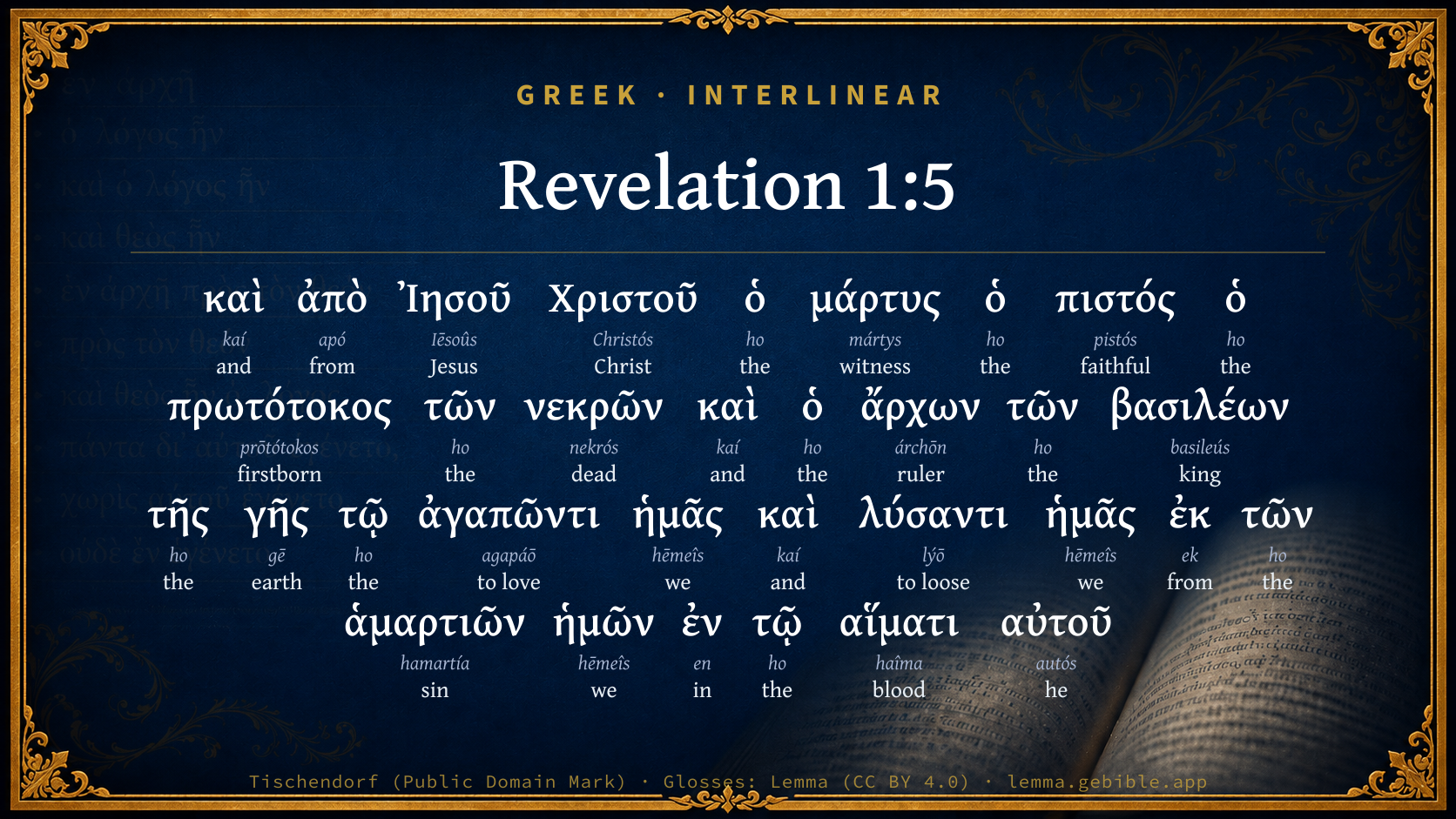
  1. καὶ kaí G2532 “and” Conjunction
  2. ἀπὸ apó G575 “from” Preposition
  3. Ἰησοῦ Iēsoûs G2424 “Jesus” Noun, Genitive, Singular, Masculine
  4. Χριστοῦ Christós G5547 “Christ” Noun, Genitive, Singular, Masculine
  5. ὁ ho G3588 “the” Article, Nominative, Singular, Masculine
  6. μάρτυς mártys G3144 “witness” Noun, Nominative, Singular, Masculine
  7. ὁ ho G3588 “the” Article, Nominative, Singular, Masculine
  8. πιστός pistós G4103 “faithful” Adjective, Nominative, Singular, Masculine
  9. ὁ ho G3588 “the” Article, Nominative, Singular, Masculine
  10. τῶν ho G3588 “the” Article, Genitive, Plural, Masculine
  11. νεκρῶν nekrós G3498 “dead” Adjective, Genitive, Plural, Masculine
  12. καὶ kaí G2532 “and” Conjunction
  13. ὁ ho G3588 “the” Article, Nominative, Singular, Masculine
  14. ἄρχων árchōn G758 “ruler” Noun, Nominative, Singular, Masculine
  15. τῶν ho G3588 “the” Article, Genitive, Plural, Masculine
  16. βασιλέων basileús G935 “king” Noun, Genitive, Plural, Masculine
  17. τῆς ho G3588 “the” Article, Genitive, Singular, Feminine
  18. γῆς gē G1093 “earth” Noun, Genitive, Singular, Feminine
  19. τῷ ho G3588 “the” Article, Dative, Singular, Masculine
  20. ἀγαπῶντι agapáō G25 “to love” Verb, Present, Active, Participle, Dative, Singular, Masculine
  21. ἡμᾶς hēmeîs G2249 “we” Personal pronoun, 1st person, Accusative, Plural
  22. καὶ kaí G2532 “and” Conjunction
  23. λύσαντι lýō G3089 “to loose” Verb, Aorist, Active, Participle, Dative, Singular, Masculine
  24. ἡμᾶς hēmeîs G2249 “we” Personal pronoun, 1st person, Accusative, Plural
  25. ἐκ ek G1537 “from” Preposition
  26. τῶν ho G3588 “the” Article, Genitive, Plural, Feminine
  27. ἁμαρτιῶν hamartía G266 “sin” Noun, Genitive, Plural, Feminine
  28. ἡμῶν hēmeîs G2249 “we” Personal pronoun, 1st person, Genitive, Plural
  29. ἐν en G1722 “in” Preposition
  30. τῷ ho G3588 “the” Article, Dative, Singular, Neuter
  31. αἵματι haîma G129 “blood” Noun, Dative, Singular, Neuter
  32. αὐτοῦ autós G846 “he” Personal pronoun, Genitive, Singular, Masculine

About this verse

These counts appear in no published source. They are computed here, from the morphology-tagged text and Lemma’s own curated glosses. What Lemma adds →

33
words
20
distinct lemmas
Revelation
section

Notable vocabulary

The rarest word here is πρωτότοκος firstborn G4416 — appearing just 8 times in the whole Greek New Testament.

Shared distinctive vocabulary

πρωτότοκος firstborn G4416 occurs in 8 verses of the Greek New Testament. Also found in:

Repetition

Words recur within this verse:

Cross-references

41

Topical passages linked to Revelation 1:5 in the Treasury of Scripture Knowledge — connected by theme and wording, ordered by reader-vote popularity; previews shown in the World English Bible.

  • Psalms 89:27 I will also appoint him my firstborn, The highest of the kings of the earth.
  • Hebrews 9:14 how much more will the blood of Christ, who through the eternal Spirit offered himself without blemish to God, cleanse your conscience from dead works to serve the living God?
  • 1 John 1:7 But if we walk in the light, as he is in the light, we have fellowship with one another, and the blood of Jesus Christ, his Son, cleanses us from all sin.
  • Revelation 17:14 These will war against the Lamb, and the Lamb will overcome them, for he is Lord of lords, and King of kings. They also will overcome who are with him, called and chosen and faithful."
  • Colossians 1:18 He is the head of the body, the assembly, who is the beginning, the firstborn from the dead; that in all things he might have the preeminence.
  • 1 Peter 1:19 but with precious blood, as of a lamb without spot, the blood of Christ;
  • Acts 26:23 how the Christ must suffer, and how, by the resurrection of the dead, he would be first to proclaim light both to these people and to the Gentiles."
  • Revelation 19:16 He has on his garment and on his thigh a name written, "KING OF KINGS, AND LORD OF LORDS."
  • John 18:37 Pilate therefore said to him, "Are you a king then?" Jesus answered, "You say that I am a king. For this reason I have been born, and for this reason I have come into the world, that I should testify to the truth. Everyone who is of the truth listens to my voice."
  • 1 John 4:10 In this is love, not that we loved God, but that he loved us, and sent his Son as the atoning sacrifice for our sins.
  • Revelation 3:14 "To the angel of the assembly in Laodicea write: "The Amen, the Faithful and True Witness, the Head of God's creation, says these things:
  • Revelation 7:14 I told him, "My lord, you know." He said to me, "These are those who came out of the great tribulation. They washed their robes, and made them white in the Lamb's blood.
  • 1 Corinthians 15:20–23 But now Christ has been raised from the dead. He became the first fruits of those who are asleep.
  • 1 Timothy 6:15 which in its own times he will show, who is the blessed and only Ruler, the King of kings, and Lord of lords;
  • Psalms 72:11 Yes, all kings shall fall down before him. All nations shall serve him.
  • Matthew 28:18 Jesus came to them and spoke to them, saying, "All authority has been given to me in heaven and on earth.
  • Acts 20:28 Take heed, therefore, to yourselves, and to all the flock, in which the Holy Spirit has made you overseers, to shepherd the assembly of the Lord and God which he purchased with his own blood.
  • Ephesians 2:4 But God, being rich in mercy, for his great love with which he loved us,
  • Daniel 7:14 There was given him dominion, and glory, and a kingdom, that all the peoples, nations, and languages should serve him: his dominion is an everlasting dominion, which shall not pass away, and his kingdom that which shall not be destroyed.
  • 1 Corinthians 6:11 Such were some of you, but you were washed. But you were sanctified. But you were justified in the name of the Lord Jesus, and in the Spirit of our God.
  • Ephesians 1:20–22 which he worked in Christ, when he raised him from the dead, and made him to sit at his right hand in the heavenly places,
  • Ephesians 5:2 Walk in love, even as Christ also loved you, and gave himself up for us, an offering and a sacrifice to God for a sweet-smelling fragrance.
  • Psalms 89:36–37 His seed will endure forever, His throne like the sun before me.
  • Isaiah 55:4 Behold, I have given him for a witness to the peoples, a leader and commander to the peoples.
  • Zechariah 13:1 "In that day there will be a spring opened to the house of David and to the inhabitants of Jerusalem, for sin and for uncleanness.
  • Galatians 2:20 I have been crucified with Christ, and it is no longer I that live, but Christ living in me. That life which I now live in the flesh, I live by faith in the Son of God, who loved me, and gave himself up for me.
  • John 13:1 Now before the feast of the Passover, Jesus knowing that his time had come that he would depart from this world to the Father, having loved his own who were in the world, he loved them to the end.
  • John 15:9 Even as the Father has loved me, I also have loved you. Remain in my love.
  • Ephesians 5:25–27 Husbands, love your wives, even as Christ also loved the assembly, and gave himself up for it;
  • 1 Timothy 6:13 I charge you before God, who gives life to all things, and before Christ Jesus, who before Pontius Pilate testified the good confession,
  • 1 John 5:7–10 For there are three who testify:
  • Revelation 11:15 The seventh angel sounded, and great voices in heaven followed, saying, "The kingdom of the world has become the Kingdom of our Lord, and of his Christ. He will reign forever and ever!"
  • John 13:8–10 Peter said to him, "You will never wash my feet!" Jesus answered him, "If I don't wash you, you have no part with me."
  • Deuteronomy 7:8 but because Yahweh loves you, and because he would keep the oath which he swore to your fathers, has Yahweh brought you out with a mighty hand, and redeemed you out of the house of bondage, from the hand of Pharaoh king of Egypt.
  • Proverbs 8:15–16 By me kings reign, And princes decree justice.
  • John 13:34 A new commandment I give to you, that you love one another, just like I have loved you; that you also love one another.
  • Romans 8:37 No, in all these things, we are more than conquerors through him who loved us.
  • Deuteronomy 23:5 Nevertheless Yahweh your God wouldn't listen to Balaam; but Yahweh your God turned the curse into a blessing to you, because Yahweh your God loved you.
  • John 3:11 Most assuredly I tell you, we speak that which we know, and testify of that which we have seen, and you don't receive our witness.
  • John 3:32 What he has seen and heard, of that he testifies; and no one receives his witness.
  • John 8:14–16 Jesus answered them, "Even if I testify about myself, my testimony is true, for I know where I came from, and where I am going; but you don't know where I came from, or where I am going.

Cross-references courtesy of OpenBible.info (CC BY 4.0).

Where the printed editions differ

1 variant

Places in this verse where the major printed Greek editions disagree on the wording in a way that affects the translation — a comparison of editions, not a manuscript-by-manuscript collation. The editions are the modern critical texts (Nestlé-Aland 28/27, SBL, Westcott-Hort, Tregelles, Tyndale House) and the traditional texts behind the KJV (the Textus Receptus and the Byzantine/Majority text). It is not a claim about which reading is original.

  1. Different wording
    λύσαντι

    “having released”

    In NA28NA27TynSBLWHTreg Not in TRByz

    λούσαντι (lousanti) 'having washed' occurs in traditional manuscripts (TR+Byz) instead of λύσαντι (lusanti) 'having released' in older manuscripts (NA28+NA27+Tyn+SBL+WH+Treg)

Textual data: Translators Amalgamated Greek New Testament (STEPBible TAGNT) · CC BY 4.0.

Commentary

Notes on Revelation 1:5 from classic Christian and Jewish commentators (each source and its license shown beneath its notes). The classic Christian expositions comment on the surrounding passage and are grouped to its opening verse, so a note may address several verses; the Jewish commentaries on the Tanakh (Rashi and others) are per-verse, so they appear only where the commentator wrote on this verse.

Lemma curates 59 commentaries, every one of them public domain or Creative Commons licensed, each selected and text-cleaned for this edition rather than reprinted as found. About our sources →

MacLaren's Expositions of Holy Scripture

Alexander MacLaren

Revelation

CHRIST’S PRESENT LOVE AND PAST LOOSING FROM SINS

Rev 1:5

The Revised Version rightly makes two slight but important changes in this verse, both of which are sustained by preponderating authority. For ‘ loved’ it reads ‘loveth,’ and for ‘ washed’ it reads ‘loosed’; the whole standing ‘Unto Him that loveth us, loosed us from our sins by His blood.’ Now the first of these changes obviously adds much to the force and richness of the representation, for it substitutes for a past a present and timeless love. The second of them, though it seems greater, is really smaller, for it makes no change in the meaning, but only in the figure under which the meaning is represented. If we read ‘washed,’ the metaphor would be of sin as a stain; if we read ‘loosed,’ the metaphor is of sin as a ‘chain.’ Possibly the context may somewhat favour the alteration, inasmuch as there would then be the striking contrast between the condition of captives or bondsmen, and the dignity of ‘kings and priests unto God,’ into which Jesus brings those whom He has freed from the bondage. Taking, then, these changes, and noting the fact that our text is the beginning of a doxology, we have here three points, the present love of Christ, the great past act which is its outcome and proof, and the praise which should answer that great love.

I. We have here that great thought of the present love of Christ.

The words seem to me to become especially beautiful, if we remember that they come from the lips of him whose distinction it was that he was ‘the disciple whom Jesus loved.’ It is as if he had said, ‘I share my privilege with you all. I was no nearer Him than you may be. Every head may rest on the breast where mine rested. Having the sweet remembrance of that early love, these things write I unto you that ye also may have fellowship with me in that which was my great distinction. I, the disciple whom Jesus loved, speak to you as the disciples whom Jesus loves.’

Mark that he is speaking of One who had been dead for half a century, and that he is speaking to people, none of whom had probably ever seen Jesus in His lifetime, and most of whom had’ not been born when He died. Yet to them all he turns with that profound and mighty present tense, and says, ‘He loveth us.’ He was speaking to all generations, and telling all the tribes of men of a love which is in active operation towards each of them, not only at the moment when John spoke to Asiatic Greeks, but at the moment when we Englishmen read his words, ‘Christ that loveth us.’

Now that great thought suggests two things, one as to the permanence, and one as to the sweep of Christ’s love. With regard to the permanence, we have here the revelation of One whose relation to life and death is altogether unique. For though we must believe that the dead do still cherish the love that lighted earth for them, we cannot suppose that their love embraces those whom on earth they did not know, or that for those who are still held in its grasp it can be a potence in active operation to bless them and to do them good. But here is a Man, to the exercise of whose love, to the clearness of whose apprehension and knowledge, to the outgoing of whose warm affection, the active energy of that affection life or death make no difference. The cold which stays the flow of all other human love, like frost laid upon the running streams which it binds in fetters, has no power over the flow of Christ’s love, which rolls on, unfrozen and unaffected by it. But not only docs Christ’s present love require that He should be lifted above death as it affects the rest of us, but it also demands for its explanation that we shall see in Him true Divinity. For this ‘loveth’ is the timeless present of that Divine nature, of which we cannot properly say either that it was or that it will be, but only that it for ever is, and the outgoings of His love are like the outgoings of that Divine energy of which we cannot properly say that it did or that it will do, but only that it ever does. His love, if I might use such a phrase, is lifted above all tenses, and transcends even the bounds of grammar. He did love. He does love. He will love. All three forms of speech must be combined in setting forth the ever present, because timeless and eternal, love of the Incarnate Word.

Then let me remind you too that this present love of Christ is undiminished by the glory to which Ho is exalted. We find clear and great differences between the picture of Jesus Christ in the four gospels and the picture of Him drawn in that magnificent vision of this chapter. But the differences are surface, and the identity is deep-lying. The differences affect position much rather than nature, and as we look upon that revelation which was given to the seer in his rocky Patmos, and with him ‘in the Spirit’ behold ‘the things that are,’ we carry into all the glory the thought ‘He loveth us’; and the breast girded with the golden girdle is as loving as that upon which John’s happy head lay, and the hand that holds the seven stars is as tender as when it was laid on little children in blessing or on lepers in cleansing; or as when it held up the sinking Apostle, or lifted the sick from their couches, or as when it was stretched on the Cross and pierced with the nails; and the face,’ which is as the sun shineth in his strength,’ is as gracious as when it beamed in pity upon wanderers and sorrowful ones, and drew by its beauty and its sweetness the harlots and publicans to His pity. The exalted Christ loves as did the lowly Christ on earth.

How different this prosaic, worried present would be if we could carry with us, as we may if we will, into all its trivialities, into all its monotony, into all its commonplace routine, into all its little annoyances and great sorrows, that one lambent thought as a source of light and strength and blessing, ‘He loveth us.’ Ah! brethren, we lose tremendously of what we might all possess, because we think so of ‘He loved,’ and travel back to the Cross for its proof, and think so comparatively seldom ‘He loveth,’ and feel the touch of His hand on our hearts for its token.

But here we have not only the present and permanent love, but we have the sweep and extent of it. ‘He loveth us.’ And though John was speaking primarily about a little handful of people scattered through some of the seaboard towns of Asia Minor, the principle upon which he could make the assertion in regard to them warrants us in extending the assertion not only to men that respond to the love, and believe in it, but right away over all the generations and all the successive files of the great army of humanity, down to the very ends of time, ‘He loveth us.’

That universality, wonderful as it is, and requiring for its basis the same belief in Christ’s Divine nature which the present energy of His love requires, has to be translated by each of us into an individualizing love which is poured upon each single soul, as if it were the sole recipient of the fullness of the heart of Christ. When we extend our thoughts or our sympathies to a crowd, we lose the individual. We generalize, as logicians say, by neglecting the particular instances. That is to say, when we look at the forest we do not see the trees. But Jesus Christ sees each tree, each stem, each branch, each leaf, just as when the crowd thronged Him and pressed Him, He knew when the tremulous finger, wasted and shrunken to skin and bone, was timidly laid on the hem of His garment; as there was room for all the five thousand on the grass, and no man’s plenty was secured at the expense of another man’s penury, so each of us has a place in that heart; and my abundance will not starve you, nor your feeding full diminish the supplies for me. Christ loves all, not with the vague general philanthropy with which men love the mass, but with the individualizing knowledge and special direction of affection towards the individual which demands for its fullness a Divine nature to exercise it. And so each of us may have our own rainbow, to each of us the sunbeam may come straight from the sun and strike upon our eye in a direct line, to each of us the whole warmth of the orb may be conveyed, and each of us may say, ‘He loved me, and gave Himself for me.’ Is that your conception of your relation to Jesus Christ and of Christ’s to you?

II. Notice the great proof and outcome of this present love.

Because it is timeless love, and has nothing to do with the distinction of past, present, and future, John lays hold of a past act as the manifestation of a present love. If we would understand what that love is which is offered to each of us in the present, we must understand what is meant and what is involved in that past act to which John points: ‘He loosed us from our sins by His own blood.’ Christ is the Emancipator, and the instrument by which He makes us free is ‘His own blood.’

Now there underlies that thought the sad metaphor that sin is captivity. There may be some kind of allusion in the Apostle’s mind to the deliverance from Egyptian bondage; and that is made the more probable if we observe that the next clause, ‘hath made us kings and priests unto God,’ points back to the great charter of Israel’s national existence which was given immediately after the Exodus. But, be that as it may, the notion of bondage underlies this metaphor of loosing a fetter. If we would be honest with ourselves, in our account of our own inward experiences, that bondage we all know. There is the bondage of sin as guilt, the sense of responsibility, the feeling that we have to answer for what we have done, and to answer -as I believe and as I think men’s consciences for the most part force them to believe-not only here but hereafter, when we appear before the judgment-seat of Christ. Guilt is a chain. And there is the bondage of habit, which ties and holds us with the cords of our sins, so as that, slight as the fetter may seem at first, it has an awful power of thickening and becoming heavier and more pressing, till at last it holds a man in a grip that he cannot get away from. I know of nothing in human life more mystically awful than the possible influence of habit. And you cannot break these fetters yourselves, brethren, any more than a man in a dungeon, shackled to the wall, can file through his handcuffs and anklets with a pin or a broken penknife. You can do a great deal, but you cannot deal with the past fact of guilt, and you can only very partially deal with the present fact of tyranny which the evil habit exercises on you.

‘He loosed us from our sins by His own blood.’ This is not the place to enter upon theological speculations, but I, for my part, believe that, although I may not get to the bottom of the bottomless, nor speak about the Divine nature with full knowledge of all that it is, Scripture is pledged to the fact that the death of Jesus Christ is the Sacrifice for the world’s sin. I admit that a full theory is not within reach, but I do not admit that therefore we are to falter in declaring that Christ’s death is indispensable in order that a man’s sin may be forgiven, and the fetters broken, in so far as guilt and condemnation and Divine disapprobation are concerned.

But that is only one side of the truth. The other, and in some aspects a far more important one, is that that same blood which shed delivers them that trust in Jesus Christ from the guilt of their sin, imparted to men, delivers them from the power of their sin. ‘The blood is the life,’ according to the simple physiology of the Old and of the New Testament. When we read in Scripture that the blood of Jesus Christ cleanses from all sin, as I believe we are intended to understand that word, the impartation of Christ’s life to us purifies our nature, and makes us, too, in our degree, and on condition of our own activity, and gradually and successively free from all evil. So as regards both aspects of the thralldom of sin, as guilt and as habit: ‘He has loosed us from our sins in His own blood.’

That is the great token and manifestation of His love. If we do not believe that, how else can we have any real conviction and proof of anything worth calling love as being in the heart of Jesus Christ to any of us? To me it seems that unless a man accepts that great thought, ‘He loved me, and gave Himself for me,’ and is daily working in my nature to make it and me more like Himself, he has no real proof that Jesus Christ cares a jot for him, or knows anything about him. But I, for my part, venture to say that looking on Christ and His past as this text does, we can look up to Christ in the present as the seer did, and, behold, enthroned by the side of the glory, the Man, the Incarnate Word, who loves with timeless love every single soul of man.

III. So, lastly, let me point you to the praise which should answer this present love and emancipation.

‘Unto Him,’ says John, ‘be’-or is-’glory and dominion for ever and ever.’ That present love, and that great past act which is its vindication and manifestation, are the true glory of God. For His glory lies, not in attributes, as we call them, that distinguish Him from the limitations of humanity, such as Omniscience and Omnipresence and Eternal Being and the like; all these are great, but they are not the greatest. The divinest thing in God is His love, and the true glory is the glory that rays out from Him whom we behold ‘full of grace and truth,’ full of love, and dying on the Cross. When we look at that weak man there yielding to the last infirmity of humanity, and yet in yielding to it manifesting His dominion over it, there we see God as we do not see Him anywhere besides. To Him is the glory for His love, and His ‘loosing’ manifest the glory, and from His love and His loosing accrue to Him glory beyond all other revenue of praise which comes to Him from creative and sustaining acts.

‘Unto Him be dominion,’ for His rule rests on His sacrifice and on His love. The crown of thorns prepared for the ‘many crowns’ of heaven, the sceptre of reed was the prophecy of the sceptre of the universe. The Cross was the footstool of His Throne. He is King of men because He has loved us perfectly, and given everything for us.

And so, brethren, the question of questions for each of us is, Is Jesus Christ my Emancipator? Do I see in Him He that looses me from my sins, and makes me free indeed, because the Son has made me free and a son? Do I render to Him the love which such a love requires? Do I find in Him my ever-present Lover and Friend, and is His love to me as a stimulus for all service, an amulet against every temptation, a breakwater in all storms, a light in every darkness, the pledge of a future heaven, and the beginning of a heaven even upon earth? I beseech you, recognize your fetters, and do not say ‘ we were never in bondage to any man.’ Recognize your Liberator, put your trust in Him; and then you will be able to join, even here on earth, and more perfectly hereafter, in that great storm and chorus of praise which is in heaven and on the earth, and under the earth, and such as are in the sea, and all that are in them, saying, ‘Blessing and honour and glory and power be unto Him that sitteth on the Throne and to the Lamb for ever and ever.’

Alexander MacLaren, Expositions of Holy Scripture (1904–1910) — public domain. Text from a community e-Sword module.

Tyndale Open Study Notes

Tyndale Open Resources

1:5-6 In this doxology, John gives reasons for praising Jesus. • Doxologies often conclude with the confessional Amen (see Rom 11:36; Phil 4:20), which expresses affirmation.

1:5 John gives three descriptions of Jesus Christ. (1) As the faithful witness, Jesus is our model for proclaiming the Good News of salvation (1:2). (2) The truth that Jesus was the first to rise from the dead is foundational to Christian faith (1 Cor 15:14, 17). (3) As ruler of all the kings of the world (see also Rev 17:14; 19:16), he is the absolute Lord of everything. Inhabitants of the Roman world were expected to declare Caesar as absolute lord; many early Christians died for their conviction that Jesus alone holds that position.

Tyndale Open Study Notes — © Tyndale Open Resources, licensed CC BY-SA 4.0. Text via the HelloAO Bible API.

Bengel's Gnomon

Johann Albrecht Bengel

Rev 1:5. Ἀπὸ Ἰησοῦ Χριστοῦ, ὁ μάρτυς, κ.τ.λ.) In this book apposition is frequently used between an oblique case and a nominative. We have collected examples in the App. p. 778 [Edit. ii. p. 488]. In this manner the Hebrews decline a nomenclature consisting of many words by only prefixing Mem, for instance: and in like manner the French, by the use of the preposition de, etc. Moreover Luke also has, ἐν τῷ αἵματί μου, τὸ ὑπὲρ ὑμῶν ἐκχυνόμενον, ch. Rev 22:20.—τῶν νεκρῶν) The editions read, ἐκ τῶν νεκρῶν.[8] It is only in the Apocalypse that my text shows a reading sometimes different from the printed editions. I have stated the reason at full length in the App. p. 788 [Ed. ii. p. 498 and following], and in either Defence [App. Crit. Ed. ii. P. iv. N. iv. and bx.]—ἈΓΑΠῶΝΤΙ[9]) This is the reading of the most ancient Alex. and of six others, not to be despised, and probably of a greater number, who have been overlooked by ancient collators. Others read ἀγαπήσαντι, on account of the following words, λούσαντι and ἐποίησεν: and it is preferred by Wolf. But the present participle includes the force of the præter-imperfect also. Οἱ μισοῦντες, οἱ ̔ ἀγαπῶντες, οἱ φιλοῦντες, οἱ δοξάζοντες, they who hated, who esteemed, who loved, who honoured: 2Sa 19:6; Lam 1:2; Lam 1:8. Thus Mat 2:20, οἱ ζητοῦντες, they who were seeking; 2Pe 1:19, φαίνοντι denotes a light which WAS SHINING, for it is followed by Aorist 1st, διαυγάσῃ and ἀνατείλῃ. Thus θεωροῦντες and ὤν the imperfect, Joh 9:8; Joh 9:25, and repeatedly. And the use of the word ἀγαπῶντι in the present with the force of a præterite was so much easier, because two aorists follow. And so the present is used for the præterite, when the præterite follows, ch. Rev 13:12. But ἀγαπῶντι is strictly a present, and denotes perpetual love, as Joh 3:35, ὁ Πατὴρ ΑΙ ΑΠΑ τὸν Υἱὸν, καὶ πάντα ΔΕΔΩΚΕΝ ἐν τῇ χειρὶ αὐτοῦ, The Father loveth the Son, and hath given all things into His hand: where the present and præterite are joined together. In the German translation of the Apocalypse I have designedly translated it, who loves us. And such passages, as I understand, displease many. But the style of John and the taste of the present day are as widely apart as the east and the west. In translating, I do not seek to gratify fastidious ears, but I scrupulously follow John, who wrote altogether in accordance with the sense of the Hebrew. This is a part of the reproach of Christ.[10]—αὐτοῦ) I have everywhere written ΑὐΤΟῦ, with a soft breathing,[11] even where it has a reflexive sense, following the example of Erasmus, who indeed, in his editions, almost indiscriminately edits αὐτοῦ, by way of concession to prejudices, as I imagine, and ΑὐΤΟῦ, even in a reflexive sense, from MSS. The reason has been mentioned once for all in the Appar. p. 453 [Ed. ii. p 93], (Buttigius agreeing with me in his preface to the New Testament); and it must be supposed to have been mentioned in each particular passage. Compare therefore on this passage also Appar. Crit. Ed. ii. p. 504. As with the Hebrews ê and other suffixes have both the relative and reciprocal force of the third person: so the writers of the new Testament use ΑὐΤΟῦ in either sense indiscriminately. And so in this passage, ch. Rev 1:5, ΑὐΤΟῦ altogether refers to Jesus Christ, who hath washed us in His own blood.

[8] ABCh Vulg. omit ἐκ. Rec. Text has no good authority for it.—E.

[9] So ABC: but Rec. Text with Vulg. ἀγαπήσαντι.—E.

[10] καὶ λούσαντι, and washed) In truth he who is not washed is unable to discharge the office of priest.—V. g.

[11] That indeed is done in Ed. maj. and min. of A. 1734, but in the Admonition prefixed to Ed. man. of A. 1753, my sainted father thus says:—In the pronunciation it is right to imitate the custom of the apostles in preference to that which is recent; but because in the reflexive use of αὐτοῦ, not only tiros, but even men of great learning, find a difficulty, I have caused αὑτοῦ to be printed in almost all those passages where the editions of the Stephens’ so read; and I wish the more prudent to remember that this is not to be taken as a rule of pronunciation, but rather as an aid to interpretation. You have a proof, reader, that Bengel was not one who did not know how to yield.—E. B.

Bengel's Gnomon of the New Testament — English translation (T&T Clark, Edinburgh, 1860) — public domain. Text from a community e-Sword module.

Meyer's Critical & Exegetical Commentary

Heinrich August Wilhelm Meyer

Rev_1:5. As from the seven spirits of God, as the Spirit of God and of the Lamb beheld in living concretion, comforting, warning, strengthening believers, but judging the world, grace and peace are wished; so also, finally (Rev_1:5-6), from Jesus Christ, since he is ὁ μάρτυς ὁ πιστὸς, κ.τ.λ. The construction with the genitive is not abandoned in order to indicate the immutability of the testimony,[589] neither is it aided by supplying ὅς ἐστίν:[590] but the importance of the ideas breaks through the limitations of regular form; the abrupt mode of speech makes prominent the intense independence of all three predicates. Compare the energetic change of construction in the sentences immediately following. All three predicates of Jesus Christ stand in pragmatic connection with the contents of the entire ἀποκάλυψις communicated through him, but not[591] in correspondence with the three themes of the ascription of praise, τ. ἀγαπῶντι, λύσαντι, and ἐποίησεν ἡμ. βασιλ., κ.τ.λ. Inconsistent with the conception and reference of the three predicates, is also the opinion that in them Christ is characterized according to the consecutive series of his works, and therefore according to his threefold office.[592]

Christ exalted to his majesty is first ὁ μάρτυς ὁ πιστός, i.e., the trustworthy[593] witness, and not because in his earthly life he testified, in general, to the divine truth,[594] and maintained it even unto death;[595] nor because what he has threatened and promised in the flesh[596] he will execute: but also, not alone because of the attestation to apocalyptic truth,[597] which reference, of course, must not be omitted, but absolutely as the very one through whom each and every divine revelation occurs, who communicates predictions not only to the prophets in general,[598] as at present to the writer of the Apoc.,[599] but also testifies to the truth[600] by reproving, admonishing, and comforting the churches. That, just on this account, Christ was the faithful witness in the flesh, is self-evident, but lies here beyond the sphere of the visions.

ὁ πρωτότοκος τῶν νεκρῶν. This figurative expression[601] agrees, as to its essential meaning, with the figure, ἈΠΑΡΧΗ ΤῶΝ ΚΕΚΟΙΜΗΜΈΝΩΝ, 1Co_15:20.[602] The figure is obliterated if ΠΡΩΤΌΤΟΚΟς,[603] without any thing further, be received like ἀρχή, the first.[604] Grot. already justly remarks, The resurrection is a birth.[605] Yet the view according to which the resurrection to a new life[606] appears as a birth is to be maintained in its simplicity, and not, as with Ebrard, to be further portrayed.[607] But, since Christ is the ΠΡΩΤΌΤ. Τ. ΝΕΚΡ., he may represent himself as in Rev_1:18; Rev_2:8; and that applies to him as returning, which Rev_1:7 represents as the fundamental thought of the book. [See Note XX., p. 123.] ΚΑῚ Ὁ ἌΡΧΩΝ ΤῶΝ ΒΑΣΙΛΈΩΝ Τῆς Γῆς. This, Christto whom, as the Messiah, and that too as one dead and risen again, the dominion over all things belongs[608]will prove himself to be, in the judgment, at his advent.[609]

[589] Grot., Stern.

[590] Er. Schmid, Schöttg.

[591] According to Ebrard.

[592] Ebrard. Cf. also Coccej., Vitr., Calov.

[593] Because true. Cf. Rev_3:14, Rev_19:11, Rev_21:5, Rev_22:6.

[594] Cf. Joh_3:11; 1Ti_6:13; Andr., Areth., Par., Coccej., Vitr., Grot., Calov., Eichh., Züll.

[595] Ebrard.

[596] Ewald compares Joh_7:7; Hengstenb., in addition to Joh_3:11; also Joh_16:33, etc.

[597] Rev_1:2, De Wette; cf. Heinr., Ew. ii.

[598] Rev_19:10.

[599] Rev_1:2; Rev_22:20; Rev_22:16.

[600] Rev_3:14.

[601] Cf. Col_1:18, πρωτότοκος ἔκ τ. νεκρ.

[602] Where also the partitive genitive denotes the mass to which Christ belongs.

[603] Cf. also Col_1:15, where Christ as the first-born is distinguished from that created by him.

[604] Hengstenb.

[605] Cf. also Ew.

[606] Cf. the ἔζησεν, Rev_2:8.

[607] That the expression ὠδῖνες, Act_2:24, properly has not been derived by Luke from the LXX. of Psa_18:5 (cf. Rev_1:6), but that Peter actually spake of the bands of death, is inferred from the fact that it is said that Christ could not have been held by it, viz., by death. That the birth-pangs of death could not have held Christ, that Christ forced his way through these birth-pangs of death, and therefore is to be understood as the first who opened the womb, is the inference of Ebrard.

[608] Psalms 2; cf. Act_13:33; Psalms 110, Psa_72:10 sqq., Psa_89:28; Isa_52:13 sqq.; Php_2:9; Mat_28:18.

[609] Cf. Rev_6:15, Rev_17:14, Rev_19:16.

If the three predicates of Christ just mentioned are presented without formal opposition, because in this way the unconditional objectivity of the ideas is the more forcibly marked, the subjective references in the following expressions, τ. ἀγαπ. ἡμᾶς, λυσ. ἡμας ἐκ τ. ἁμαρτ. ἡμῶν, ἐποιησ. ἡμῶν βασιλ., require that they be made in the form of a doxology. The new clause, τῷ ἀγαπῶντι ἡμ., looks from the very beginning to the close (ἀυτῷ) ἡ δόξα, κ.τ.λ.; the ἀυτῷ restoring the original form of the sentence after it had been interrupted, after a Hebraistic manner, by the finite tense, καὶ ἐποίησεν.[610]

The present, Τ. ἈΓΑΠῶΝΤΙ, is neither to be accounted for by the false reading ἈΓΑΠΉΣΑΝΤΙ, nor to be explained in the sense of an imperfect participle; but, on the contrary, the certainty that Christ continues to love his people is just as significant in the connection of the book as that of his being the faithful witness.[611] The bride is comforted, and rejoices in the coining of Him whom she loves.[612]

ΚΑῚ ΛΎΣΑΝΤΙ ἩΜᾶς ἘΚ ΤῶΝ ἉΜΑΡΤ. ἩΜ., Κ.Τ.Λ. The loosing which Christ has accomplished[613] by means of his blood[614] [see Note XXI., p. 124] represents our sins as a power enchaining us.[615] For the thought, cf. the similar conception of ἈΓΟΡΆΖΕΙΝ, Rev_5:9.[616] The reading ΛΟΎΣΑΝΤΙ[617] yields, according to another figure,[618] essentially the same idea, in both of which[619] the forgiveness of sins and liberation from their power[620] are comprised. Yet, even in an exegetical respect, the reading λύσαντι is preferable. As in Rev_5:9 the allied idea of the ἀγοράζειν, so also here the λύσαντι ἡμ. is followed by the declaration which, in most forcible opposition to the bondage of the sins from which we are delivered, ascribes to us a royal dominion and holy priesthood with God.

[610] De Wette, etc.

[611] Cf. Rev_3:19.

[612] Rev_22:17; cf. also Rom_8:37 sqq.

[613] In regard to the meaning of the aor. λύσαντι and ἐποίησεν, cf. Rev_5:10; Heb_7:27; Gal_2:20.

[614] Cf., concerning this meaning of the ἐν, Rev_6:8; Winer, p. 363.

[615] Rev_20:7, where also the ἐκ, Rev_9:14-15, Rev_20:3; cf. Mat_16:19; Mat_18:18.

[616] 1Co_6:20; Gal_3:13; Act_20:28; 1Pe_1:18; Eph_1:7; Mat_20:18.

[617] Cf. Critical Notes.

[618] Psa_2:4; Isa_1:16; Isa_1:18; Rev_7:14.

[619] Cf., on the other hand, De Wette.

[620] Cf. the καθαρίζειν of 1Jn_1:7.

NOTES BY THE AMERICAN EDITOR

XX. Rev_1:5. ὁ πρωτότοκος

Cf. Meyer on 1Co_15:20; Col_1:18. Others, indeed, were raised from the dead before Christs resurrection, e.g., the daughter of Jairus, and Lazarus; yet they were not raised to immortal life, but their souls were re-invested with mortal bodies. See the contrast drawn by Rom_6:9; also, in this chapter, Rev_5:13.

NOTES BY THE AMERICAN EDITOR

XXI. Rev_1:5. καὶ λὐσαντι

Beck, who, however, prefers the reading λούσαντι, adds on the ἑν τῷ αἵματι: For it is not the material, lifeless blood of one dead, but the spiritually quickened blood of the risen One, i.e., of one born anew by the resurrection, of the spiritually glorified Son of man. The sin-cleansing efficacy of the blood of Christ is, therefore, one that works inwardly, cleansing the heart and mind, towards God (Heb_9:14; cf. Heb_7:16; Heb_10:19-21). λούειν is, therefore, not merely judicial liberation from sin as a debt, nor moral liberation from the bondage of sin (as two parties of exegetes here try to maintain), but one divine act accomplished in the person, whereby the habitual, sinful nature of the human heart and mind, discontent with God, and hostility towards him, are removed, and changed into a communion of peace and love with God, into a new habit, whence, at last, the personal freedom from sin, and sanctification in God, result. Tait: Tell us not, then, that the death of Christ was merely that of a martyr, a spectacle before men and angels of the dignity of self-sacrifice,that it was intended to reconcile man to God by preaching to us, through a mortal, the evil of sin and the majesty of sorrow.

Meyer — Critical and Exegetical Commentary on the New Testament — English translation by Peter Christie, edited by Frederick Crombie (T&T Clark, 1880) — public domain. Text from a community e-Sword module.

Expositor's Greek Testament

ed. W. Robertson Nicoll

Rev 1:5 . ἀπὸ , κ . τ . λ ., another grammatical anomaly; as usual the writer puts the second of two nouns in apposition, in the nominative. ὁ μ . ὁ π . Jesus not merely the reliable witness to God but the loyal martyr: an aspect of his career which naturally came to the front in “the killing times”. ὁ πρωτότοκος (a Jewish messianic title by itself, Balden-sperger, 88) τ . ν ., his resurrection is the pledge that death cannot separate the faithful from his company. The thought of this and of the following trait ( cf. Mat 4:8 f.) is taken fröm Ps. 88:28, κἀγὼ πρωτότοκον θήσομαι αὐτόν , ὑψηλὸν παρὰ τοῖς βασιλεῦσιν τῆς γῆς . On the two allied functions of ruling and witnessing (Isa 55:4 ) cf. the different view of Joh 18:37 . At the inspiring thought of Christ’s lordship the prophet breaks into adoration ἀγαπῶντι κ . τ . λ . The eternal love ( cf. Rev 3:19 ) which Christ bears to his people is proved by his death, as a revelation of ( a ) what he has done for them by his sacrifice, and ( b ) what he has made of them (so Eph 5:25-26 = Rev 19:7-8 ). The negative deliverance from sins ( cf. Psa 129:8 ) at the cost of his own life ( ἐν instrumental) is a religious emancipation which issues in (6) a positive relationship of glorious religious privilege. βασιλείαν , ἱερεῖς , a literal ( cf. Charles on Jub. xvi. 18) and inaccurate rendering of ממלכת כחנים (Exo 19:6 ) to emphasise the royal standing of the Christian community in connexion with their Christ as ἄρχων , κ . τ . λ ., and also (Tit 2:3 ) their individual privilege of intimate access to God as the result of Christ’s sacrificial death. καὶ ἐποίησεν , the harsh anacolouthon breaks up the participial construction, ἡμᾶς , emphatic. “We Christians are now the chosen people. In us the Danielic prophecy of a reign of the saints is fulfilled and is to be fulfilled.” This is a characteristically anti-Jewish note. Persecution ( cf. 1Pe 2:5 ) deepened the sense of continuity in the early Christians, who felt driven back on the truth of election and divine protection; they were the true successors of all noble sufferers in Israel who had gone before ( cf. the argument of Heb 11:32 to Heb 12:2 ). In the Apocalypse the Christian church is invariably the true Israel, including all who believe in Christ, irrespective of birth and nationality. God reigns over them, and they reign, or will reign, over the world. In fact, Christians now and here are what Israel hoped to become, viz. , priest-princes of God, and this position has been won for them by a messiah whom the Jews had rejected, and whom all non-Christians will have to acknowledge as sovereign. According to rabbinic tradition, the messianic age would restore to Israel the priestly standing which it had lost by its worship of the golden calf; and by the first commandment (Mechilta on Exo 20:2 ), “slaves became kings”. There may also be an implicit anti-Roman allusion. We Christians, harried and despised, are a community with a great history and a greater hope. Our connection with Christ makes us truly imperial. The adoration of Christ, which vibrates in this doxology ( cf. Expos . ver. 302 307), is one of the most impressive features of the book. The prophet feels that the one hope for the loyalists of God in this period of trial is to be conscious that they owe everything to the redeeming love of Jesus. Faithfulness depends on faith, and faith is rallied by the grasp not of itself but of its object. Mysterious explanations of history follow, but it is passionate devotion to Jesus, and not any skill in exploring prophecy, which proves the source of moral heroism in the churches. Jesus sacrificed himself for us; αὐτῷ ἡ δόξα . From this inward trust and wonder, which leap up at the sight of Jesus and his grace, the loyalty of Christians flows.

This enthusiasm for Jesus naturally carries the prophet’s mind forward (Rev 1:7-8 ) to the time when the Lord’s majesty will flash out on mankind. He resumes the line of thought interrupted by the doxology of 5 b 6.

The Expositor's Greek Testament, edited by W. Robertson Nicoll (1897–1910) — public domain. Text from a community e-Sword module.

Geneva Bible (1599)

Geneva Bible translators

A most ample and grave commendation of Christ, first from his offices the Priesthood and kingdoms, secondly from his benefits, as his love toward us, and washing us with his blood, in this verse, and communication of his kingdom and Priesthood with us: thirdly from his eternal glory and power, which always is to be celebrated of us, verse 6. Finally from the accomplishment of all things once to be effected by him, at his second coming, what time he shall openly destroy the wicked, and comfort the godly in the truth, verse 7.

Geneva Bible (1599) marginal notes — public domain. Text via Bolls.life.

Jamieson, Fausset & Brown

Robert Jamieson, A. R. Fausset & David Brown

the faithful witness--of the truth concerning Himself and His mission as Prophet, Priest, and King Saviour. "He was the faithful witness, because all things that He heard of the Father He faithfully made known to His disciples. Also, because He taught the way of God in truth, and cared not for man, nor regarded the persons of men. Also, because the truth which He taught in words He confirmed by miracles. Also, because the testimony to Himself on the part of the Father He denied not even in death. Lastly, because He will give true testimony of the works of good and bad at the day of judgment" [RICHARD OF ST. VICTOR in TRENCH]. The nominative in Greek standing in apposition to the genitive, "Jesus Christ," gives majestic prominence to "the faithful witness."

the first-begotten of the dead-- (Col 1:18). Lazarus rose, to die again. Christ rose to die no more. The image is not as if the grave was the womb of His resurrection-birth [ALFORD]; but as Act 13:33; Rom 1:4, treat Christ's resurrection as the epoch and event which fulfilled the Scripture, Psa 2:7, "This day (at the resurrection) have I begotten Thee." It was then that His divine Sonship as the God-man was manifested and openly attested by the Father. So our resurrection and our manifested sonship, or generation, are connected. Hence "regeneration" is used of the resurrection-state at the restitution of all things (Mat 19:28).

the prince--or Ruler. The kingship of the world which the tempter offered to Jesus on condition of doing homage to him, and so shunning the cross, He has obtained by the cross. "The kings of the earth" conspired against the Lord's Anointed (Psa 2:2): these He shall break in pieces (Psa 2:9). Those who are wise in time and kiss the Son shall bring their glory unto Him at His manifestation as King of kings, after He has destroyed His foes.

Unto him that loved us--The oldest manuscripts read the present, ". . . loveth us." It is His ever-continuing character, He loveth us, and ever shall love us. His love rests evermore on His people.

washed us--The two oldest manuscripts read, "freed (loosed as from a bond) us": so ANDREAS and PRIMASIUS. One very old manuscript, Vulgate, and Coptic read as English Version, perhaps drawn from Rev 7:4. "Loosed us in (virtue of) His blood," being the harder reading to understand, is less likely to have come from the transcribers. The reference is thus to Greek, "lutron," the ransom paid for our release (Mat 20:28). In favor of English Version reading is the usage whereby the priests, before putting on the holy garments and ministering, washed themselves: so spiritually believers, as priests unto God, must first be washed in Christ's blood from every stain before they can serve God aright now, or hereafter minister as dispensers of blessing to the subject nations in the millennial kingdom, or minister before God in heaven.

Jamieson, Fausset & Brown — Commentary Critical and Explanatory on the Whole Bible (1871) — public domain (CC PDM 1.0). Text via the HelloAO Bible API.

Adam Clarke's Commentary

Verse 5. The faithful witness] The true teacher, whose testimony is infallible, and whose sayings must all come to pass.

The first-begotten of the dead] See Clarke on Col 1:18.

The prince of the kings] ο αρχων, The chief or head, of all earthly potentates; who has them all under his dominion and control, and can dispose of them as he will.

Unto him that loved us] This should begin a new verse, as it is the commencement of a new subject. Our salvation is attributed to the love of God, who gave his Son; and to the love of Christ, who died for us. See Joh 3:16.

Washed us from our sins] The redemption of the soul, with the remission of sins, and purification from unrighteousness, is here, as in all the New Testament, attributed to the blood of Christ shed on the cross for man.

Adam Clarke's Commentary on the Bible (1810–1826) — public domain. Text from a community e-Sword/MySword module.

Ellicott's Commentary for English Readers

(5) From Jesus Christ, who is the faithful witness, and the first begotten (or, firstborn) of the dead, and the prince (or, ruler) of the kings of the earth.—The triple title applied to Christ corresponds to the three ideas of this book. Christ the Revealing Prophet, the Life-giving High Priest, and the real Ruler of mankind.

The faithful witness.—There may be a reference here, it has been suggested by Prof. Plumptre, to the bow in the cloud, which is described in Psa_89:37 as the faithful witness. The coincidence of expression is remarkable: “I will make him my firstborn, higher than the kings of the earth; he shall stand fast as the sun before me, and as the faithful witness in heaven.” The idea of testimony and witness is a favourite one with St. John, who records its use by our Lord Himself. (Comp. Joh_3:32; Joh_5:36; Joh_18:37. See also Rev_19:10; Rev_22:18. Comp. also the work of the Only Begotten as stated in Joh_1:18.)

The prince (or ruler) of the kings of the earth.—The message does not come from One who will be, but who is the true ruler of all earthly potentates. The disposition to dwell on the future and more visibly recognised reign of Christ hereafter has tended to obscure the truth of His present reign. It is instructive to notice that this book, which describes so vividly the manifestations of Christ’s kingdom (Rev_11:15; Rev_12:10), claims for Him at the outset the place of the real King of kings. Such was the Apostle’s faith. “Above all emperors and kings, above all armies and multitudes, he thought of the Crucified as ruling and directing the course of history, and certain in His own due time to manifest His sovereignty” (Prof. Plumptre). “What are we to see in the simple Anno Domini of our dates and superscriptions, but that for some reason the great world-history has been bending itself to the lowly person of Jesus” (Bushnell). “A handful read the philosophers; myriads would die for Christ; they in their popularity could barely found a school; Christ from His cross rules the world” (Farrar, Witness of History). Such is a real kingship.

Unto him that loved us, and washed us.—Instead of “washed us,” some MSS. read, “loosed us.” There is only one letter’s difference in the two words in Greek. The general tone of thought would lead us to prefer “washed” as the true reading. On a solemn occasion, which St. John remembered clearly, our Lord had said, “If I wash thee not, thou hast no part with Me.” The thought of the “cleansing blood,” intensified by the recollection of the water and blood which he had seen flowing from Christ’s pierced side, often recurred to his mind (Rev_7:13-14; 1Jn_1:7; 1Jn_5:6-8).

A Bible Commentary for English Readers, edited by Charles John Ellicott (1878–1897) — public domain. Text from a community e-Sword module.

The Cambridge Bible for Schools and Colleges

gen. ed. J. J. S. Perowne

5. who is] These words are probably inserted in the A. V. and R. V. by way of marking the fact that “the faithful Witness” is in the nominative, not in apposition to the name “Jesus Christ.” But whether this has the same object as the anacoluthon of the previous verse—a sort of reverence that forbids the divine Name to be “governed” by any other word—is more doubtful: the general usage of the book appears to ignore the classical rule of apposition.

the faithful witness] See 1Ti_6:13 : Jesus Christ was in His Death much more than a martyr, but He was also the perfect type and example of martyrdom. Observe His own words in Joh_18:37—to which perhaps St Paul l. c. is referring. Here as in the next clause, see below, the language recalls Psa_89:37, perhaps too Isa_55:4.

first begotten of the dead] Explained by St Paul in Col_1:18, where He is called “the First-born” (the word is the same) “from the dead.” The sense of “first-born” or “first-begotten” is “first to enter life,” without any fanciful image of death as the womb of earth. The thought in Rom_1:4 is similar.

prince of the kings of the earth] A reminiscence (hardly to be called a quotation) of Psa_89:27, “I will make Him My First-born, higher than the kings of the earth.”

that loved] Read, that loveth. “It is His ever-abiding character, that He loveth His own, Joh_13:1” (Alford).

washed us] The balance of evidence is in favour of the reading “loosed us:” the preposition “in” might easily, in a Hebraistic book like this, be used of an instrument, where we should say “by,” or “with.” So we should probably render “redeemed us from our sins by His own Blood”—the Blood of Christ being conceived as the price of our redemption, as in 1Pe_1:18-19—not, as in Rev_7:14, Rev_22:14 (according to the preferable reading), and perhaps in St John’s 1Jn_1:7, as the cleansing fountain foretold in Zec_13:1. If therefore we ask “when Christ thus freed us,” the answer must be, at His Passion, not at our conversion or baptism.

The Cambridge Bible for Schools and Colleges (gen. ed. J. J. S. Perowne; Cambridge University Press, 1878–1918) — public domain. Text from a community e-Sword module.

John Gill's Exposition

And from Jesus Christ,.... Who, though the second Person in the Trinity, is mentioned last, because many things were to be said of him; and who is described in all his offices: in his prophetic office,

the faithful witness; as he is of his Father, of his mind and will, with respect to doctrine and worship; of his truth and faithfulness in his promises; and of his love, grace, and mercy, to his chosen; and of himself, of his true deity, proper sonship, and perfect equality with the Father; of his Messiahship, and of salvation through his obedience, sufferings, and death; and of all truth in general, to which he has bore a faithful testimony several ways, in his ministry, by his miracles, at his death, and by the shedding of his blood to seal it; by his Spirit since, and by the ministers of his word: he is described in his priestly office be

the first begotten of the dead: being the first that rose from the dead by his own power, and to an immortal life; for though some few were raised before him, yet not by themselves, nor to live for ever, but to die again. Moreover, he is the firstfruits of the resurrection, the pledge and earnest of it, as well as the efficient cause and exemplar of it. This character supposes that he died, as he did, for the sins of his people; and that he rose again from the dead, as he did, for their justification; and that he rose first as their head and representative, and opened the way of life for them. And he is described in his kingly office, for it follows,

and the Prince of the kings of the earth: which is not to be understood figuratively of the saints, who have power over sin, Satan, and the world, through the efficacious grace of Christ, and of whom he is Prince or King; but literally of the kings and princes of this world, over whom Christ is King and Lord, who receive their crowns and kingdoms from him, and rule by him, and are accountable to him, as they one day must be. Next follows a doxology, or an ascription of glory to him,

unto him that hath loved us; his own, his people, his church, his chosen, and who are given him by his Father; these he has loved with an everlasting and unchangeable love, with a love of complacency and delight, which passes knowledge, and will never end: and which he has shown in espousing their persons, undertaking their cause, assuming their nature, and in nothing more than in giving himself for them as a propitiatory sacrifice, or in dying and shedding his precious blood for them, as is next expressed:

and washed us from our sins in his own blood; which shows that these persons were loved before washed; they were not first washed, and then loved, but first loved, and then washed. Love was the cause of washing, and not washing the cause of love; hence it appears that they were in themselves filthy, and unclean through sin; and that they could not cleanse themselves by anything they could do; and that such was the love of Christ to them, that he shed his precious blood for them, which is a fountain opened, to wash in for sin, and which cleanses from all sin. This is to be understood, not of the sanctification of their natures, which is the work of the Spirit, but of atonement for their sins, and justification from them by the blood of Christ, whereby they are so removed, that they are all fair, and without spot. It is afterwards said, that these same persons are made priests; and it may be observed, that the priests were always washed, before they performed their service, as such (n). The Alexandrian copy and the Syriac and Arabic versions read, "and hath loosed us from our sins in", or "by his blood"; that is, from the guilt of them, which was bound upon them,

(n) Misn. Yoma, c. 3. sect. 2, 3, 4, 5, 6.

John Gill's Exposition of the Whole Bible (1746–1763) — public domain (CC PDM 1.0). Text via the HelloAO Bible API.

Trapp's Complete Commentary

John Trapp

5 And from Jesus Christ, who is the faithful witness, and the first begotten of the dead, and the prince of the kings of the earth. Unto him that loved us, and washed us from our sins in his own blood,

Ver. 5. And from Jesus Christ] Who is here set last of the three persons, because more is to be said of him; both as touching his threefold office, and a threefold benefit therehence redounding unto us.

That hath loved us] See Eze 16:6-9. Christ, that heavenly pelican, revived his dead young ones with his own heart-blood. (Pierii Hieroglyph.) He saw the wrath of God burning about them, and cast himself into the midst thereof, that he might quench it. Judah offered to be bound that Benjamin might go free. Jonathan risked his life and quitted his kingdom for love of David. Arsinoe interposed her own body between the murderer’s weapons and her children. But what was all this to this incomparable love of the Lord Jesus? When the Jews saw him weeping for Lazarus, "Behold," they say, "how he loved him." When we see him weeping, bleeding, dying for us, shall not we much more say so?

John Trapp, A Commentary or Exposition upon All the Books of the Old and New Testament (1647–1656) — public domain. Text from a community e-Sword module.

Albert Barnes' Notes on the Bible

And from Jesus Christ, who is the faithful witness - See the notes on Rev 1:2. He is faithful in the sense that he is one on whose testimony there may be entire reliance, or who is entirely worthy to be believed. From him “grace and peace” are appropriately sought, as one who hears such a testimony, and as the first-begotten from the dead, and as reigning over the kings of the earth. Thus, grace and peace are invoked from the infinite God in all his relations and operations: as the Father, the Source of all existence; as the Sacred Spirit, going forth in manifold operations upon the hearts of people; and as the Son of God, the one appointed to bear faithful testimony to the truth respecting God and future events.

And the first-begotten of the dead - The same Greek expression - πρωτότοκος prōtotokos - occurs in Col 1:18. See it explained in the notes on that passage. Compare the notes at 1Co 15:20.

And the prince of the kings of the earth - Who has over all the kings of the earth the pre-eminence which kings have over their subjects. He is the Ruler of rulers; King of kings. In Rev 17:14; Rev 19:16, the same thought is expressed by saying that he is the “King of kings.” No language could more sublimely denote his exalted character, or his supremacy. Kings and princes sway a scepter over the million of the earth, and the exaltation of the Saviour is here expressed by supposing that all those kings and princes constitute a community over which he is the head. The exaltation of the Redeemer is elsewhere expressed in different language, but the idea is one that everywhere prevails in regard to him in the Scriptures. Compare Mat 28:18; Mat 11:27; Joh 17:2; Eph 1:20-22; Phi 2:9-11; Col 1:15-18. The word “prince” - ὁ ἄρχων ho archōn - means properly, “ruler, leader, the first in rank.” We often apply the word “prince” to an heir to a throne who is not invested with absolute sovereignty. The word here, however, denotes that he actually exercises dominion over the rulers of the earth. As this is an authority which is claimed by God (compare Isa 10:5 ff; Isa 45:1 ff; Psa 47:2; Psa 99:1; Psa 103:9; Dan 4:34), and which can only pertain to God, it is clear that in ascribing this to the Lord Jesus it is implied that he is possessed of divine attributes. As much of the revelations of this book pertained to the assertion of power over the princes and rulers of this world, there was a propriety that, in the commencement, it should be asserted that he who was to exert that power was invested with the prerogative of a ruler of the nations, and that he had this right of control.

Unto him that loved us - This refers undoubtedly to the Lord Jesus, whose love for people was so strong that nothing more was necessary to characterize him than to speak of him as the one “who loved us.” It is manifest that the division in the verses should have been made here, for this commences a new subject, not having any special connection with what precedes. In Rev 1:4, and the first part of this verse, the writer had invoked grace from the Father, the Spirit, and the Saviour. In the latter clause of the verse there commences an ascription of praise to the Redeemer; an ascription to him particularly, because the whole book is regarded as a revelation from him Rev 1:1; because he was the one who especially appeared to John in the visions of Patmos; and because he was to be the great agent in carrying into execution the purposes revealed in this book.

And washed us from our sins in his own blood - He has removed the pollution of sin from our souls by his blood; that is, his blood has been applied to cleanse us from sin. Blood can be represented as having a cleansing power only as it makes an expiation for sin, for considered literally its effect would be the reverse. The language is such as would be used only on the supposition that he had made an atonement, and that it was by the atonement that we are cleansed; for in what sense could it be said of a martyr that he “had washed us from our sins in his blood?” How could this language be used of Paul or Polycarp; of Ridley or Cranmer? The doctrine that the blood of Christ cleanses us from sin, or purifies us, is one that is common in the Scriptures. Compare 1Jo 1:7; Heb 9:14. The specific idea of washing, however - representing that blood as washing sin away - is one which does not elsewhere occur. It is evidently used in the sense of “cleansing” or “purifying,” as we do this by “washing,” and as the blood of Christ accomplishes in respect to our souls, what washing with water does in respect to the body.

Albert Barnes' Notes on the Bible (1834–1885) — public domain. Text from a community e-Sword/MySword module.

Haydock's Catholic Bible Commentary

===============================

[BIBLIOGRAPHY]

Qui est testis fidelis, Greek: o martus o pistos. Martyr ille fidelis.

George Leo Haydock (1774–1849), Haydock's Catholic Family Bible and Commentary, 1859 edition — public domain. Excludes Psalms (Douay-Rheims chapter numbering differs from Protestant) and Deuterocanonical books (Catholic canon only).

Matthew Poole's English Annotations

And from Jesus Christ, who is the faithful witness: here is an express mention of Jesus Christ, because he was the procurer of our redemption, and our Mediator, to whom the Father committed all power as to the church. He is called the faithful and true witness; 1Ti 6:13, he witnessed a good confession before Pontius Plate; he bare record of himself, Joh 8:13,14; see also Isa 43:10; 55:4; Joh 18:37.

And the first begotten of the dead; that is, who first rose from the dead, viz. by his own power, Joh 10:18, and to die no more: see Act 13:34; 1Co 15:20.

And the prince of the kings of the earth: the King of kings, Rev 17:14; 19:16; 1Ti 6:15. The first name here given to Christ speaketh his prophetical office, the second his priestly office, this last his kingly office.

Unto him that loved us, and washed us from our sins in his own blood: here begins a doxology, or giving glory to Christ, (such forms are frequent in the Epistles), first, as he that washed us from our sins, both from the guilt and from the power and dominion of our sins, with his blood, paying a price, and satisfying God’s justice for, and meriting our sanctification: see Heb 9:14; 1Jo 1:7.

Matthew Poole's English Annotations on the Holy Bible (1683–1685) — public domain. Text from a community e-Sword/MySword module.

Whedon's Commentary on the Bible

Daniel D. Whedon

5. The faithful witness—Through whom, and attested by whom, all revelation comes from God to man, especially this apocalypse, whose seals are opened by his conquering power. This witness is faithful to give us truth alone. The word witness is a favourite term both in the Apocalypse and John’s Gospel and Epistles. It implies, not merely revelation, narrative, but—as in a permanent contrast with unbelief—a testimony, a strong, sure, reliable attestation.

First begotten of the dead—As the firstborn was the chief among his brethren, so this might mean that Christ was chief of all risen from the dead, and leader of the resurrection. So Rom_8:29, “firstborn” or chief “among many brethren.” It implies, also, priority of time; for though Lazarus was raised from the dead, yet he died again, and his rising was no part of the one great organic resurrection to immortal life. So that he was truly “the firstfruits of them that slept,” in order of time.

The conception that the grave is the earth’s womb, (as Alford,) from which the dead are born into life, is in the very dim background, as in all such expressions as used by the Hebrews. Note on Eph_2:2-3. On the difference between the phrases “from the dead,” and of the dead, see note on Luk_20:35.

Prince—Leader or ruler.

Of the kings—Lord of the resurrection in the world to come; Lord of all authority in the present world.

Unto him—To this double Lord of both worlds, who, supremely King himself, has made us to be a kingdom.

That loved us—True reading, and more expressive, that loveth us; for his love is an ever present and perpetual thing; whereas the washed was a past and transient deed. For λουσαντι, washed, another reading is λυσαντι, released, redeemed. The former is both the better supported and the more expressive term; and corresponds most strikingly with blood. The powerful image of washing the soul in blood, gives a vivid idea of the power of the atonement as working both our justification immediately, and our sanctification mediately, by the Spirit purchased for us at the price of the blood.

Daniel D. Whedon (gen. ed.), Commentary on the Old and New Testaments (1874–1909) — public domain. Text from a community e-Sword module.

The Pulpit Commentary

The faithful Witness. This was his function bear witness unto the truth". (Joh_18:37) The rainbow is called "the faithful witness". (Psa_89:37) The Firstborn of the dead. Christ was the first who was born to eternal life after the death which ends this life. (see Lightfoot on Col_1:15, Col_1:18; and comp. Psa_89:27) "The ruler of this world" offered Jesus the glory of the kingdoms of the world, if he would worship him. He won a higher glory by dying to conquer him, and thus the crucified Peasant became the Lord of Roman emperors, "the Ruler of the kings of the earth." The grammar of this verse is irregular; "the faithful Witness," etc., in the nominative being in apposition with "Jesus Christ" in the genitive. (comp. Rev_2:20 Rev_3:12 Rev_9:14 Rev_14:12) Unto him that loved us. The true reading gives "that loveth us" unceasingly. The supreme act of dying for us did not exhaust his love. In what follows it is difficult to decide between "washed" (lousanti) and "loosed" (lusanti), both readings being very well supported; but we should certainly omit "own" before "blood." The blood of Jesus Christ cleansing us from all sin is a frequent thought with the apostle who witnessed the piercing of the side. (Rev_7:13, 14 1Jn_5:6-8)

Vers. 5, 6. Doxology; or, the upspringing of praise.

"Unto him that loved us," etc. It has been remarked that the writer of the Revelation had hardly set himself down to his work ere he felt that he must lift up his heart in joyful doxology. The very mention of the name of the Lord Jesus, by whose Spirit he was writing, starts him off in this heart song of praise. He could not go on until he had given utterance to the irrepressible love for his Lord with which his soul was filled to overflowing. And this is his way. How many are the outbreaks of praise which we find in this book! It is a land full of fountains and springs and wells, out of which flow this river which makes glad the city of God. And St. John does not stand alone in this respect. All those holy men of old who were so privileged as to come into blessed contact with the Lord caught the contagion of praise. St. Paul is continually breaking forth into doxologies. "Now unto him that is able to do exceeding," etc.. (Eph_3:20; and cf. Rom_16:25 Rom_11:36 1Ti_1:17 Heb_13:20) And so St. Peter. (1Pe_4:11 1Pe_5:11) And so St. Jude, (Jud_1:24) etc. Thus is it with all the sacred writers. Truly might it have been said concerning them all, "They will be still praising thee." And blessed are they whose hearts are thus attuned, ever ready to give forth praise, sweet, clear, strong, full, whenever the spirit of Christ"s love touches them. Like as in those great concerts where royalty is expected to be present, the whole vast orchestra stand ready the moment the royal personages enter to begin the National Anthem: so should "praise wait" for God in all our hearts. And it has been pointed out how these doxologies grow in volume and emphasis as this book goes on. Here in these verses we read, "To him be glory and dominion forever and ever." But in the fourth chapter (ver. 9) we read of there being rendered "glory and honour and thanks to him that sat on the throne;" and in ver. 11 we read the same, "Thou art worthy, O Lord, to receive glory and honour and power." The doxology has grown from two to three notes of praise in each of these verses. But in Rev_5:13 we read, "And every creature ... heard I saying, Blessing, and honour, and glory, and power, be unto him," etc. Here we have four of these notes. But by the time we get to Rev_7:12 we have reached the number of perfection, and may not ask for more: "Blessing, and glory, and wisdom, and thanksgiving, and honour, and power, and might, be unto our God forever and ever. Amen." If you begin praising God, you are bound to go on; like a river which at its outset is but a tiny rill, yet increases more and more as it flows along. But what waked up this heart song of praise which we have here? There had been various and most blessed thoughts of Christ in St. John"s mind. In this very verse he tells how Christ is "the Faithful Witness," i.e. the Witness which told to men the perfect truth as to God and the life eternal. And here he is "the First Begotten from the dead," i.e. the pledge and guarantee of the resurrection of all the dead, as were the firstfruits of the harvest of the rest of the harvest. (1Co_15:21) Oh, blessed revelation this! Then was he not "Prince of the kings of the earth," i.e. supreme Lord and Master of them and of all that they do? In his hands they all are, and it is by his permission alone they rule. It was blessed and heart inspiring to know all this, but the fount of St. John"s praise was opened when his thought turned to those truths of which our text tells. When he thought of the Lord Jesus and of his great love, then he could contain himself no longer, but burst forth in this beautiful song of praise, "Unto him that loved us ... Amen." Let us look a little at these words of praise, and try and discover the springs from which such praise flows forth. And they seem to me to be mainly three.

I THE VIVID REALIZATION OF CHRIST HIMSELF. "Unto him, unto him, the apostle repeats, and it is evident that before the eyes of his soul the Lord Jesus Christ was evidently set forth. He seems to see him his looks, his movements, his Person; to hear his words, and to catch the accents of his voice. Christ is to him as real as any of his fellow men. And this is most important to the enkindling of love within our own souls. For the mere contemplation of love in the abstract will not stir them. You may tell me ever so much about maternal love, for example, but whilst it is contemplated in a merely general way, as that which belongs to many, it will not move me much. But tell me something about my own mother, and of her love to me, and that will be quite another matter. The most hardened and depraved have often been broken down and subdued to better things by memories of their mothers" love. But it was because it was their mothers" that it moved them so. And it is the same in regard to the love told of in our text. Had it been apart from a living person, apart from the Lord Jesus Christ, only a vague quality moving in the midst of men, however much it may have benefited them, it would never have aroused their gratitude or stirred their hearts. For that you must have such love centred in a person whom you can know and understand; and better still if you have already known him and he you. And if we have not known Christ, if his Name be to us a mere word, if he be to us shadowy and unreal, scarce a person at all, we cannot enter into or sympathize with such enthusiasm as his disciple here expresses. Is it not a constant and just reproach against our poor laws that their administration of relief elicits no gratitude on the part of those relieved? It benefits neither giver nor receiver. But let a benevolent person go himself or herself to those who need relief, and come into living personal contact with them, so that they may feel the good will for them that beats in their benefactor"s heart, and how different the result will be then! Conduct like that will wake up a response in almost the most insensate hearts, and the relief itself will be more prized for the sake of him or her who gives it than for itself. And so, did even Christ"s love come to us apart from him; did we not know and see him in it all; were we forgiven and saved we knew not how, or why, or by whom; we should feel no more gratitude on account of it than we do to the air we breathe or the water we drink. But when we see that it is Christ who loves us, Christ who washed us from our sins in his own blood, Christ who made us kings and priests unto God and his Father, then all is changed, and gratitude wakes up and praise bursts forth, and with Christ"s apostle we also say, "Unto him that," etc. Oh, my brethren, try to get this personal realization of Christ. It was the sense of its importance that first led to the use of pictures, crosses, crucifixes, and the like aids to such realization of Christ. They have been so much abused that many fear to use them at all; and they are by no means the only or the best way to attain to the result which is so much to be desired. But by the devout reading of the Gospels and the Word of God generally, by much meditation thereupon, by frequent and fervent prayer, the image of Christ, now so faint and dim in many hearts, will come out clear and vivid, distinct and permanent, to your great joy and abiding good. You know how the picture on the photographer"s plate is at first almost undiscernible, but he plunges it into the bath he has prepared for it, and then every line and form and feature become visible, and the picture is complete. Plunge your souls, my brethren, into the blessed bath of God"s Word and thought and prayer, and then to you, as to St. John, Christ will become visible, and he will be realized by you as he has never been before. And the result will be that prayer will become to you delightful, as is converse with a dear friend; and faith will keep her foothold firmly as ofttimes now she fails to do; and love will come and stay and grow towards Christ in our hearts; and heaven will have begun below. Such realization of Christ was one mainspring of this outburst of praise.

II ANOTHER WAS ST. JOHN"S DEEP SENSE OF THE GREATNESS OF CHRIST"S LOVE. He tells of four great facts.

1. Its compassion. "Unto him that loved us." Before the apostle"s mind there seems to rise up the vision of what he and his fellow believers had once been so foul and unclean, not with mere outward defilement, but with that inward foulness of the heart which to the Holy and Undefiled One could not but have been repulsive in the highest degree. And yet the Lord loved him. We can understand his pitying men so miserable, even whilst he condemned their sin; and we can understand how, on their repentance, he might pardon them. But to take them into his favour, to make them the objects of his love, that is wonderful indeed. And thus has he dealt with all of us. And his love is not a fitful passing thing a love that has been, but is not. The real reading of our text is in the present, the abiding sense: "Unto him that loveth us." Christ always loves his people. "Having loved his own, he loved them to the end." And it is so wonderful and unique a thing, that to mention it is description enough whereby it may be known that Christ is meant. For John does not mention our Lord"s name, but just as the expression, "the disciple whom Jesus loved," was sufficient to identify John, so "him that loved us" is sufficient to identify our Lord. For none such as he was ever loved such as we were, or loved us in such a way. But for such love, when realized and felt as St. John felt it, how could he do other than render praise?

2. The costly cleansing. "Hath washed us from our sins in his own blood." There is many a distressful condition into which a man may fall, and grateful will he be to him who saves him therefrom, as from sickness, poverty, affliction, disgrace, death; but there is no condition so truly terrible as that of sin. That is the root evil, the fons et origo of all else. Let that not be, and the rest change their nature directly, and can easily be borne; but where sin is there they all become charged with a sting and venom which but for this they could not have. Therefore to be delivered from all other evil and not from sin would be no deliverance worthy of the name; but to be delivered from sin is deliverance, salvation indeed, bringing along with it deliverance from all other evil whatsoever. And St. John felt this. He had heard how the Lord had said to the poor palsied one who had been let down through the roof into his presence, that he might be healed, "Son, be of good cheer; thy sins be forgiven thee? That word told the man himself, and all mankind beside, that our sins are our greatest enemies. There is no evil that can befall a man comparable with that. But it is from this sum of all evils that Christ cleanses. And at what cost? Nothing less than "his own blood." All manner of questions may be asked as to the relationship between the blood of Christ and our cleansing, and all manner of answers have been given, some more, some less satisfactory. But that is not now our concern. Only the fact that "without shedding of blood there is no remission," and that it is "the blood of Jesus Christ which cleanseth from all sin." And he was content to suffer death that so we might be saved. St. John had stood beneath the cross of his Lord, had been with him in Gethsemane, and he knew what this "washing us from our sins in his own blood" meant, what infinite love alone could have submitted to such a death. What wonder that his heart should overflow with praise?

3. And then there was also the coronation. He "hath made us kings." Surely none could look less like kings than the shivering crowd of persecuted people to whom St. John addressed his book. In what sense, then, could it be that Christ had made them kings.? Only, for the present, in the lordship he had given them over themselves, and over all the power of their adversaries. They could compel, by the force of the regal will with which their Lord had invested them, their trembling flesh, their wavering purpose, their crowd of earthly affections, to a steadfastness and courage which of themselves they had never known. And when thus equipped, strengthened with all might, crowned as kings, by God"s Spirit in the inner man, they could meet and defy, endure and vanquish, all their persecutors" power. It gave way to them, not they to it. Thus had the Lord made them kings.

4. And finally, the consecration. He "hath made us priests." True, no mitre decked their brow, no sacerdotal vestments hung from their shoulders; they belonged to no separate order, they claimed no ecclesiastical rank. But yet Christ had consecrated them. They were by him dedicated to God, they were holy unto the Lord, and in their prayers and supplications and manifold charities they offered, as priests should, "gifts and sacrifices for men." To hearts inflamed with the love of Christ this power of blessing and helping men, appertaining as it ever does to the priestly office, could not but be a further cause of gratitude and praise. Yes; the compassionate love, the costly cleansing, the coronation as kings, and the consecration as priests unto God, these did, as they well might, call forth this fervent praise. But there was yet a third cause, and it was

III His CERTAINTY THAT THESE BLESSINGS WERE REALLY HIS. If he had doubted, he would have been dumb. Zacharias became so because he doubted, but his glorious song of praise burst forth when doubt and dumbness were together gone. And so will it be with ourselves. If we only hope and trust that we are Christ"s, and Christ is ours; if we have not "the full assurance of the hope" which God"s Word is ever urging us to strive after; but are often saying and singing a point I long to know, Oft it causes anxious thought: Do I love the Lord or no? Am I his or am I not? until a better and brighter condition of mind be ours, we cannot praise Christ as St. John did. He was certain, that Christ loved him, that Christ had washed him from his sins, that Christ had made him king and priest unto God; he had no doubt of it whatsoever. Oh for like precious faith!

CONCLUSION. If we do truly desire such faith, it is proof that some measure of it is in us already. If, then, we do know what Christ has done for us, let us join in this "unto him," and render to him: Glory the glory which our renewed trust, our faithful witnessing for him, may bring to him. Dominion over our own hearts chief of all, keeping back no faculty or power, no feeling or desire, no purpose or will, but surrendering all to him. And this "forever and ever." Not a surrender made today and recalled tomorrow, but one to which, by his grace, we will forever stand. Oh that we may! Give, then, your heartfelt "Amen" to all this. As we read this verse, let us join in the "Amen," let it be our praise also. Amen and Amen. S.C.

Vers. 5-7. Christ and the soul

"Unto him that loved us, and washed us from our sins in his own blood, and hath made us kings and priests unto God and his Father; to him be glory," etc. These words suggest a few thoughts concerning Christ and the soul.

I CHRIST IS THE LOVER OF THE SOUL. "Unto him that loved us" (ver. 5). Other beings may love the human soul angels may, saints may but no one has loved it as Christ has.

1. He loved it with an absolutely disinterested love. Alas! we know but little of disinterested affection. With all our love for each other, there is generally a mixture of selfishness. But Christ had nothing to gain from the human spirit; its damnation would not diminish his blessedness; its salvation would not add to his ineffable bliss. He loved the soul for its own sake, as the offspring of God, endowed with wonderful capabilities, possessing in itself a fountain of influence that would spread indefinitely through all time and space.

2. He loved it with a practically self-sacrificing love. It was not a love that existed merely as an emotion, or that even wrought occasional services; it was a love that led to the sacrifice of himself. "He loved us, and gave himself for us. Greater love hath no man than this, that a man lay down his life.

3. He loved it with an earnestly forgiving love. "When we were enemies Christ died for the ungodly." He loved those who were not only out of sympathy with him, but who were in malignant hostility to him; and his love was not only such as to incline him to listen to petitions for pardon, but as inspired him with an intense longing to forgive his enemies. "Herein is love." Who ever loved like this? Here is a love whose height, depth, length, breadth, passeth all knowledge.

II CHRIST IS THE CLEANSER OF THE SOUL. "And washed "loosed us from our sins in his own blood" (ver. 5). The moral restoration of the soul to the knowledge, image, and enjoyment of God is represented in a variety of figures in the Bible, which is a highly figurative book. When the lost state of the soul is represented as a state of condemnation, then its restoration is represented as forgiveness or justification; when its lost state is represented as enmity to God, then its restoration is set forth under the metaphor of reconciliation; when its lest state is represented as a state of death or sleep, then its restoration is set forth as a quickening and awakening; when its lost state is represented as a bondage, then its restoration is set forth as an enfranchisement; when its lost state is represented as a state of pollution or uncleanness, then its restoration is represented as a washing or a cleansing. All these figurative expressions represent one thing the moral restoration of the soul; and this is spoken of in the text as wrought by Christ. "Washed us from our sins in his own blood." To be washed in blood is an expression that sounds incongruous and somewhat offensive; but it does not mean material blood, as the vulgar and the sensuous understand, but the spiritual blood, which is his moral life, his self-sacrificing love. The cleansing influence which is here applied to the blood is elsewhere applied to the "Name of Christ." Now "ye are clean through the word I have spoken;" again, "Sanctified through thy truth." Then to the "water of the Word," "That he might sanctify and cleanse it with the washing of water by the Word." The "Name," the "Word," the "Spirit," the "Truth," which are represented in such passages as cleansing the soul, must of course be regarded as meaning essentially the same thing as "blood" here, which stands for the moral spirit of Christ, which is the same thing as Christ himself. He it is who cleanseth the soul cleanseth it by his life. The figurative language here is purely Judaic, taken from the old temple ceremonies; for "almost all things were purified by the Law through blood." The grand mission and work of Christ are to put away sin from the soul. Sin is the guilt, sin is the curse, sin is the ruin of human nature. Sin is not so engrained, so wrought into the texture of the human soul that it cannot be removed; it can be washed out, it is separable from it, it can be detached.

III CHRIST IS THE ENNOBLER OF THE SOUL. "Hath made us kings and priests unto God" (ver. 6).

1. Christ makes souls kings." "I appoint unto you a kingdom, as my Father hath appointed unto me." Souls in their unregenerate state are paupers, prisoners, slaves; they are the mere creatures of internal passions and external circumstances. Christ enthrones the soul, gives it the sceptre of self control, and enables it to make all things subservient to its own moral advancement.

2. Christ makes souls "priests. True priests are in some respects greater than kings. Kings have to do with creatures, priests with God. Christ, then, is the Ennobler of souls. Worldly sovereigns may and do bestow titles of greatness on men. The wonder is that they should have the audacity to attempt to ennoble by bestowing titles. They cannot bestow greatness itself. Christ bestows true greatness greatness of thought, heart, sympathy, aim, nature. He alone is great whom Christ makes great; all others are in the bonds of corruption.

IV CHRIST IS THE DEITY OF THE SOUL. "To him be glory and dominion forever and ever." The souls whom Christ has loved, cleansed, and ennobled feel that he is their God, and render to him the willing and everlasting homage of their nature. "Unto him that loved us, and washed loosed us from our sins in by his own blood." God in Christ is the grand object of human worship, and those whom Christ has thus restored cannot but worship him. Worship with them is not a service, but a spirit; is not obedience to a law, but the irrepressible instinct of a life.

V CHRIST IS THE HOPE OF THE SOUL. "Behold, he cometh with clouds, and every eye shall see him" (ver. 7). The high probability is that this is a prophetic description of Christ as he came in his providence to the destruction of Jerusalem. Between his final advent and this there are so many striking resemblances that the description of the one is remarkably applicable to the other. Applying the words to the final advent, we have four facts concerning it.

1. Christ will come. Reason and conscience, as well as the Bible, teach this. Enoch, the seventh from Adam, prophesied of it; Job knew that he would stand again upon the earth. Christ and his apostles frequently and unequivocally taught it. (Luk_9:26)

2. His coming will be terribly grand. "On the clouds of heaven." The grandest objects to mortal eyes are the heavens that encircle us. Their vast expanse and immeasurable height, all radiant with rolling orbs in boundless variety, seem to bear us into the awful depths of infinitude. Anything strange on the face of those heavens has always a power to strike terror on human souls. Christ is represented as coming on the clouds. Daniel, in a vision, beheld him thus. (Dan_7:13) Christ himself declared that thus he would come. (Mat_24:30 Mat_26:64) Angels have declared the same. (Act_1:11) John beheld him on a "great white throne," so effulgent that the material universe melted away before it. How unlike the despised Galilaean!

3. His coming will be universally observed. "Every eye shall see him" (ver. 7). It is an event in which all are interested. Men in all ages and lands, from Adam "to the last of woman born." Men of all social grades and mental types are all vitally concerned in this stupendous event. Hence all shall see him.

(1) All shall see him immediately. Now we see him representatively by his words, ordinances, and ministers. But then we shall see him.

(2) All shall see him fully. Not one shall have a partial view, a mere passing aspect, but a full, complete vision. His full Person will fall complete on every eyeball.

(3) All shall see him impressively. The universe had never had such an impressive sight of him before.

4. His coming will be differently regarded.

(1) To some it will be a scene of poignant distress. "They also which pierced him: and all kindreds the tribes of the earth shall wail because of him mourn over him" (ver. 7). What inexpressible and inconceivable anguish will the rejecters of Christ experience then!

(2) To others it will be welcomed with delight. "Even so, Amen." The good, in all ages, have said, "Come, Lord Jesus." To his true disciples it will be a period in which all difficulties will be explained, all imperfections removed, all evils ended forever. But it is not in an outward or objective sense that this appearance of Christ is to be practically regarded. It is a subjective appearance. The heaven on which he is to appear is the individual soul, and the "clouds of heaven" are the clouds of thought and feeling that roll within us. D.T.

The work of works.

"Unto him that loved us, and washed us from our sins in his own blood!" Washing in blood is an incongruity. The word translated "washed" should be "loosened," and the general idea undoubtedly is, "Unto him that loosed us from our sins by his own life or, "by himself be glory." The words refer to the work of works.

I THIS IS THE MOST IMPORTANT OF ALL WORKS. Loosing a soul from sin. Sin is a chain of darkness, a chain that enslaves, not the mere body, but all the faculties of the soul, and confines it in the cell of moral ignorance and corruption. Fallen angels are represented as manacled in this chain of darkness. What a chain is this! It is

(1) heavy,

(2) galling,

(3) strong, and

(4) becomes stronger with the commission of every sin.

II THIS THE MOST IMPORTANT OF ALL WORKS, IS EFFECTED BY CHRIST, AND BY HIM ONLY. He is here represented as doing it by his own "blood." Sometimes the work is ascribed to "water," to the "Word," to "truth," to "grace," and to the "Spirit." The word is here used as a symbol of his self-sacrificing ministry. This is the work to which Christ gives his life. There is no other being in the universe that can break this chain save Christ. He came into the world to open the prison doors, and to set the captives free. "Ye shall know the truth, and the truth shall set you free.

III That for this, the most important of all works, CHRIST RECEIVES THE PRAISES OF ETERNITY. "Unto him that loved us." True gratitude implies a belief in three things.

1. A belief in the value of the service rendered. Where the service is trivial, and of no importance, gratitude will not be very stirring or strong.

2. A belief in the kindness of the motive which inspired the service. If a man renders us a service, and we feel that his motive was sordid and selfish, we could scarcely feel gratitude, however greatly he benefited us.

3. A belief in the undeservedness of the service on our part. If we feel that the service rendered was merited by us, and that the author was bound in justice to render it, we could feel but little if any gratitude. Now, for these three reasons gratitude to Christ must rise to the highest point a greater service could not be rendered; a kinder motive could not be imagined; a more undeserved benediction could not be conferred. "Unto him that loved us," etc.! D.T.

The Pulpit Commentary (1880–1919), ed. H.D.M. Spence-Jones & Joseph S. Exell — public domain. Text from a community e-Sword module.

John Wesley's Explanatory Notes

And from Jesus Christ, the faithful witness, the first begotten from the dead, and the prince of the kings of the earth - Three glorious appellations are here given him, and in their proper order. He was the faithful witness of the whole will of God before his death, and in death, and remains such in glory. He rose from the dead, as "the first fruits of them that slept;" and now hath all power both in heaven and earth. He is here styled a prince: but by and by he hears his title of king; yea, King of kings, and Lord of lords." This phrase, the kings of the earth, signifies their power and multitude, and also the nature of their kingdom. It became the Divine Majesty to call them kings with a limitation; especially in this manifesto from his heavenly kingdom; for no creature, much less a sinful man, can bear the title of king in an absolute sense before the eyes of God.

John Wesley, Explanatory Notes Upon the Whole Bible (1754–1765) — public domain. Text via the GEBible commentary corpus.

Scofield Reference Notes

C. I. Scofield

sins

Sin. (See Scofield "Rom 3:23").

The Scofield Reference Bible (1917 edition), notes by C. I. Scofield — public domain. Text from a community e-Sword module.

Burkitt's Expository Notes on the New Testament

William Burkitt

In the former verse our Saviour was considered in the excellency of his person, and with respect to what he is in himself; in this verse he is considered in the execution of his office, or with respect to what he is unto his church.

And here observe, 1. His affection in general towards us, he hath loved us; our blessed Redeemer hath given ample and full demonstration of his great and wonderful love unto his church and people, and none doth so properly and passionately love the church as Christ himself; before conversion he loves his people with a love of commiseration and compassion; after conversion, he loves them with a love of complacency and delight.

Observe, 2. The discovery and manifestation which Christ has made of this his love particularly towards us, He hath washed us from our sins in his own blood; that is, he hath given himself a sacrifice for our sins, and by the merit of his blood freed us from the guilt of sin in our justification, and also by the efficacy of that blood cleansed us from the filth of sin in our sanctification: the blood of Christ hath both a pacifying and a purifying influence; it pacifies God’s wrath, and purges the sinner’s conscience; the blood of Christ merited the Spirit of God for our sanctification, and so reconciled us to God, as well as obtained pardon for us, in a way of meritorious satisfaction, and so reconciled God to us: He washed us from our sins in his own blood.

Where note, A great emphasis in the double word of property.

1. Our sins; that is, every one of our own sins, without any imitation or exception whatsoever, as to the number or heinous nature of them: the sin against the Holy Ghost is indeed excepted; and this proceeds from the incapacity of the sinner, not from the inefficacy or insufficiency of Christ’s sacrifice for sin.

2. There is also an emphasis in the word of property with respect to Christ, when it is called his own blood: the Levitical priests sprinkled the people with blood, but it was not their own blood, but the blood of bulls and goats; but Christ spared not his own blood, and he did not barely sprinkle us with it, but washed us with it: it was not the blood of his finger, but the blood of his heart: his very life went with it; He washed us from our sins in his own blood.

Observe, 3. The consequent effect and happy result of all this love of Christ towards us, and undertaken for us, He hath made us kings and priests unto God.

1. Kings, not in a temporal but a spiritual sense; they reign as kings over their unruly lusts and corruptions, over Satan, over the world, over death the king of terrors; they begin their reign upon earth, without which it were impossible to perfect and complete it in heaven.

2. Priests, consecrating themselves a living sacrifice, holy and acceptable unto God, and offering up, not expiatory, but gratulatory sacrifices unto him, namely, prayer and praise, supplication and thanksgiving. Ye are an holy priesthood, to offer up spiritual sacrifices, acceptable to God by Jesus Christ. 1Pe 2:5

Observe, 4. After this description of Christ, follows an ascription of all that glory and honour, dominion and power, which is his due, and our duty to ascribe unto him: To him be glory and dominion for ever and ever. Amen.

Where note, That the same honour and glory, dominion and power, being here attributed and given to Christ, which Christ teaches us to ascribe and render unto God, Mat 6:1 it is a sure testimony that Christ is God, and as such to be acknowledged and adored by us: To whom be glory, &c.

William Burkitt's Expository Notes on the New Testament (1700–1703) — public domain. Text from a community e-Sword module.

The People's New Testament

B. W. Johnson

5. And from Jesus Christ. Some of the glories of Christ, the third whose grace is invoked, are named. The faithful witness. Because all that he says is faithful and true. The first born of the dead. See notes on Col. 1:18. Through Christ's resurrection from the dead life and immortality were brought to light for us all. Hence he is called the “first born.” The prince. The rightful ruler of all the rulers of the earth. Unto him that loveth us. The tense is present, as in the Revision. His love never ceases. Washed us. Rather, as in the Revision, “loosed us.” This was done by the shedding of his blood.

B. W. Johnson's The People's New Testament with Notes (1889–1891) — public domain. Electronic text from the Christian Classics Ethereal Library (CCEL) ThML edition.

Cambridge Greek Testament for Schools and Colleges

5. ἀπὸ Ἰησοῦ Χριστοῦ, ὁ μάρτυς. The anacoluthon is probably an intentional parallel to that in the previous verse, though here the threefold title might have been declined if the writer had pleased. There is a tendency throughout the book, where one clause stands in apposition to another, to put the nouns in the second clause in the nominative regardless of the rules of ordinary Greek.

ὁ μάρτυς ὁ πιστός. See 1Ti 6:13: Jesus Christ was in His Death much more than a martyr, but He was also the perfect type and example of martyrdom. Observe His own words in Joh 18:37—to which perhaps St Paul l.c. is referring. It may be doubted whether μάρτυς is used in the N.T. in the later sense of “martyr.” The distinction between martyrs and confessors was not fixed in the days of the Martyrs of Vienne and Lyons: whoever confessed Christ before men was still said to “bear witness” to Him.

ὁ πρωτότοκος τῶν νεκρῶν. “Firstborn” rather than “firstbegotten;” cf. τὰς ὠδῖνας τοῦ θανάτου Act 2:24, where the metaphor is hardly pressed so far as in 2Es 4:42. The genitive is explained by St Paul, Col 1:18 ὁ πρωτ. ἐκ τῶν νεκρῶν. The sense is that He is “first to enter life.” The thought in Rom 1:4 is similar.

ὁ ἄρχων τῶν βασιλέων τῆς γῆς. A reminiscence (hardly to be called a quotation) of Psa 89:27, “I will make Him My First-born, higher than the kings of the earth.”

τῷ ἀγαπῶντι. “It is His ever-abiding character, that He loveth His own,” Joh 13:1.—Alford. The contrast of tense between this clause and the next is quite correct, though it struck the later copyists as harsh.

λύσαντι. The balance of evidence is in favour of this reading. The preposition ἐν in a Hebraistic book like this would be used of an instrument, where we should say “by” or “with”: while to later readers the idea of “washing in” would seem more natural. So we should probably render “released us from our sins by His own Blood”—the Blood of Christ being conceived as the price of our redemption, as in 1Pe 1:18-19—not, as in Rev 7:14, Rev 22:14 (according to the preferable reading), and perhaps in St John’s Ep. I. Rev 1:7, as the cleansing fountain foretold in Zec 13:1. If therefore we ask “when Christ thus freed us,” the answer must be, at His Passion, not at our conversion or baptism.

Cambridge Greek Testament for Schools and Colleges (Cambridge University Press, 1896; 21 vols, various authors incl. Carr, Maclear, Plummer, Farrar, Lumby, Moule, M. R. James, Simcox) — public domain. Text from a community e-Sword module.

Vincent's Word Studies in the New Testament

Marvin R. Vincent

Jesus Christ. The Son. Placed after the Spirit because what is to follow in verses 5 - 8 relates to Him. This is according to John's manner of arranging his thoughts so that a new sentence shall spring out of the final thought of the preceding sentence. Compare the Prologue of the Gospel, and verses 1, 2, of this chapter.

The faithful witness [ο μαρτυς ο πιστος] . For the phraseology see on 1Jo 4:9. For witness, see on Joh 1:7; 1Pe 5:1. As applied to the Messiah, see Psa 89:37; Isa 55:4. The construction again departs from the grammatical rule. The words witness, first - born, ruler, are in the nominative case, instead of being in the genitive, in apposition with Jesus Christ. This construction, though irregular, nevertheless gives dignity and emphasis to these titles of the Lord. See on verse 4. The word pistov, faithful is used (1), of one who shows Himself faithful in the discharge of a duty or the administration of a trust (Mt 24:45; Luk 12:42). Hence, trustworthy (1Co 7:25; 2Ti 2:2). Of things that can be relied upon (1Ti 3:1; 2Ti 2:11). (2), Confiding; trusting; a believer (Gal 3:9; Act 16:1; 2Co 6:15; 1Ti 5:16). See on 1Jo 1:9. The word is combined with ajlhqinov, true, genuine in chapter Rev 3:14; Rev 19:11; 215; 22 6. Richard of St. Victor (cited by Trench) says : "A faithful witness, because He gave faithful testimony concerning all things which were to be testified to by Him in the world. A faithful witness, because whatever He heard from the Father, He faithfully made known to His disciples. A faithful witness, because He taught the way of God in truth, neither did He care for any one nor regard the person of men. A faithful witness, because He announced condemnation to the reprobate and salvation to the elect. A faithful witness, because He confirmed by miracles the truth which He taught in words. A faithful witness, because He denied not, even in death, the Father 's testimony to Himself. A faithful witness, because He will give testimony in the day of judgment concerning the works of the good and of the evil."

The first - begotten of the dead [ο πρωτοτοκος εκ των νεκρων] . Rev., the first - born. The best texts omit ejk from. Compare Col 1:18. The risen Christ regarded in His relation to the dead in Christ. He was not the first who rose from the dead, but the first who so rose that death was thenceforth impossible for Him (Rom 6:9); rose with that resurrection - life in which He will finally bring with Him those who sleep in Him (1Th 4:14). Some interpreters, rendering first - born, find in the phrase the metaphor of death as the womb which bare Him (see on Act 2:24). Others, holding by the rendering first - begotten, connect the passage with Psa 2:7, which by Paul is connected with the resurrection of Christ (Act 13:32, 33). Paul also says that Jesus "was declared to be the Son of God with power by the resurrection from the dead" (Rom 1:4). The verb tiktw which is one of the components of prwtotokov first - begotten or born, is everywhere in the New Testament used in the sense of to bear or to bring forth, and has nowhere the meaning beget, unless Jas 1:15 be an exception, on which see note. In classical Greek the meaning beget is common.

The Ruler of the kings of the earth [ο αρχων των βασιλεων της γης] . Through resurrection He passes to glory and dominion (Phi 2:9). The comparison with the kings of the earth is suggested by Psa 2:2. Compare Psa 89:27; Isa 52:15; 1Ti 6:16; and see Rev 6:15; Rev 17:4; Rev 19:16.

Unto Him that loved [τω αγαπησαντι] . The true reading is ajgapwnti that loveth. So Rev. Christ 's love is ever present See Joh 13:1. Washed [λουσαντι] . Read lusanti loosed. Trench remarks on the variation of readings as having grown out of a play on the words loutron, a bathing, and lutron a ransom, both of which express the central benefits which redound to us through the sacrifice and death of Christ. He refers to this play upon words as involved in the etymology of the name Apollo as given by Plato; viz., the washer [ο απολουων] and the absolver [ο απολυων] from all impurities. Either reading falls in with a beautiful circle of imagery. If washed, compare Psa 51:2; Isa 1:16, 18; Eze 36:25; Act 22:16; Eph 5:26; Tit 3:5. If loosed, compare Mt 20:28; 1Ti 2:6; 1Pe 1:18; Heb 9:12; Gal 3:13; Gal 4:5; Rev 5:9; Rev 14:3, 4.

Marvin R. Vincent, Word Studies in the New Testament (1887–1900) — public domain. Text from a community e-Sword/MySword module.

Lesson kit

Teaching starters — assembled from the data on this page, not authored interpretation. Every prompt links to the verse data it draws on. Edit before teaching.

Revelation, in the Revelation, opens this verse with 33 words (20 distinct Greek lemmas). Its most distinctive word is prōtótokos (“firstborn”). A historical commentator’s framing appears above. Read the whole chapter for the surrounding context.

Discussion questions

  1. The word prōtótokos carries the sense “firstborn.” How does it shape the verse?
  2. How does Luke 2:7, which shares the word «firstborn», read alongside this verse?
  3. What does the repetition of “the” (10× in this one verse) do in this verse?
  4. These translations render this verse differently. What is at stake in choosing one wording over another?
  5. Compare how MacLaren's Expositions of Holy Scripture and Tyndale Open Study Notes read this verse. Where do they agree or differ?

Things to notice

Reading settings

Reading text

Shown beneath each verse's original-language words.

Old Testament
Old Testament edition

Read the OT as the Masoretic Hebrew (MT) or the Greek Septuagint (LXX).

English shown for the Greek Septuagint (in the Hebrew ↔ Greek comparison).

Comparing translations? Open the Compare panel on any verse page to stack up to four side by side.