Revelation 8:5

Greek (Tischendorf 8th ed.) Revelation 8:5 appears in the Greek New Testament. The text above is from the Tischendorf 8th edition. Each word links to its Strong’s number and a concise gloss. Click any word for its full Thayer’s Greek Lexicon entry.
Download image
Cite this verse

Revelation 8:5 (World English Bible). Public Domain. Lemma interlinear Bible study tool, https://lemma.gebible.app/v/revelation/8/5.

Show BibTeX & RIS
BibTeX
RIS
English Translation
The angel took the censer, and he filled it with the fire of the altar, and threw it on the earth. There followed thunders, sounds, lightnings, and an earthquake.
World English Bible · Public Domain
Download a study sheet

One document with this verse’s original text, its word-by-word gloss line, the meaning frame, cross-references with their text, attributed commentary, and full source and license credits — printable, and it pastes into notes with its structure intact.

This verse Autodidact and up

Study sheet (.html) Plain text (.txt)

A passage Seminary Student

Up to 50 verses in one chapter. A passage sheet keeps up to 6 commentary sources and 12 cross-references per verse, in the order this page ranks them, and says so on the sheet whenever that leaves anything out. Ask for a single verse and you get the Autodidact verse sheet above.

Everything on this page stays free to read, with no account — the sheet is a download of what is already on screen, not access to it.

Want to remove ads? Support Godless Engineer
Compare translations 3

The same verse in 3 English versions, stacked beneath the original-language interlinear above. Click any original word for its lexicon entry.

Each is an independent rendering of the whole verse — the interlinear is not word-aligned to these translations.

Highlighted words mark where these versions differ — a whole-verse word diff, not a word-by-word alignment.

  • World English Bible Public Domain
    The angel took the censer, and he filled it with the fire of the altar, and threw it on the earth. There followed thunders, sounds, lightnings, and an earthquake.
  • King James Version Public Domain
    And the angel took the censer, and filled it with fire of the altar, and cast it into the earth: and there were voices, and thunderings, and lightnings, and an earthquake.
  • unfoldingWord Literal Text CC BY-SA 4.0
    And the angel took the censer and filled it from the fire of the altar and threw onto the earth, and thunders and sounds and lightnings and an earthquake happened.

unfoldingWord Literal Text — © unfoldingWord, licensed CC BY-SA 4.0. Word-aligned USFM3 via Door43 (git.door43.org/unfoldingWord/en_ult).

Versions to compare (up to 4)

3 of 4 selected

Show all 19 translations

Every available English version of this verse, each an independent rendering of the whole verse.

  • World English Bible Public Domain
    The angel took the censer, and he filled it with the fire of the altar, and threw it on the earth. There followed thunders, sounds, lightnings, and an earthquake.
  • Berean Standard Bible Public Domain
    Then the angel took the censer, filled it with fire from the altar, and hurled it to the earth; and there were peals of thunder, and rumblings, and flashes of lightning, and an earthquake.
  • Majority Standard Bible Public Domain
    Then the angel took the censer, filled it with fire from the altar, and hurled it to the earth; and there were peals of thunder, rumblings, flashes of lightning, and an earthquake.
  • King James Version Public Domain
    And the angel took the censer, and filled it with fire of the altar, and cast it into the earth: and there were voices, and thunderings, and lightnings, and an earthquake.
  • American Standard Version (1901) Public Domain
    And the angel taketh the censer; and he filled it with the fire of the altar, and cast it upon the earth: and there followed thunders, and voices, and lightnings, and an earthquake.
  • Revised Version (1885) Public Domain
    And the angel taketh the censer; and he filled it with the fire of the altar, and cast it upon the earth: and there followed thunders, and voices, and lightnings, and an earthquake.
  • Geneva Bible (1599) Public Domain
    And the Angel tooke the censer, and filled it with fire of the altar, and cast it into the earth, and there were voyces, and thundrings, and lightnings, and earthquake.
  • Douay-Rheims (1899) Public Domain
    And the angel took the censer, and filled it with the fire of the altar, and cast it on the earth, and there were thunders and voices and lightnings, and a great earthquake.
  • Young's Literal Translation Public Domain
    and the messenger took the censer, and did fill it out of the fire of the altar, and did cast `it' to the earth, and there came voices, and thunders, and lightnings, and an earthquake.
  • Literal Standard Version CC BY-SA 4.0
    and the messenger took the censer, and filled it out of the fire of the altar, and cast [it] to the earth, and there came voices, and thunders, and lightnings, and an earthquake.
  • Unlocked Literal Bible CC BY-SA 4.0
    The angel took the incense bowl and filled it with fire from the altar. Then he threw it down to the earth, and there were crashes of thunder, rumblings, flashes of lightning, and an earthquake.
  • unfoldingWord Literal Text CC BY-SA 4.0
    And the angel took the censer and filled it from the fire of the altar and threw onto the earth, and thunders and sounds and lightnings and an earthquake happened.
  • Darby Bible Public Domain
    And the angel took the censer, and filled it from the fire of the altar, and cast [it] on the earth: and there were voices, and thunders and lightnings, and an earthquake.
  • World Messianic Bible Public Domain
    The angel took the censer, and he filled it with the fire of the altar, then threw it on the earth. Thunders, sounds, lightnings, and an earthquake followed.
  • Webster's Bible Public Domain
    And the angel took the censer, and filled it with fire of the altar, and cast it upon the earth: and there were voices, and thunderings, and lightnings, and an earthquake.
  • Free Bible Version CC BY-SA 4.0
    The angel took the censer and filled it with fire from the altar, and threw it down upon the earth; there was the sound of thunder, with lightning flashes, and a terrible earthquake.
  • Bible in Basic English Public Domain
    And the angel took the vessel; and he made it full of the fire of the altar, and sent it down on the earth: and there came thunders and voices and flames and a shaking of the earth.
  • Text-Critical English NT CC BY 4.0
    Then the angel took the censer, filled it with fire from the altar, and threw it to the earth, and there were peals of thunder, rumblings, flashes of lightning, and an earthquake.
  • Tyndale New Testament (1534) Public Domain
    And the angell toke the senser and fylled it with fyre of the aultre and caste it into the erth and voyces were made and thondrynges and lightnynges and erthquake.

Literal Standard Version (2020), Covenant Press — licensed CC BY-SA 4.0. Text via the HelloAO Bible API (eBible.org). Unlocked Literal Bible (unfoldingWord) — licensed CC BY-SA 4.0. Text via the HelloAO Bible API (eBible.org). unfoldingWord Literal Text — © unfoldingWord, licensed CC BY-SA 4.0. Word-aligned USFM3 via Door43 (git.door43.org/unfoldingWord/en_ult). Free Bible Version, Dr. Jonathan Gallagher — licensed CC BY-SA 4.0. Text via the HelloAO Bible API (eBible.org).

Word by word

More ways to search: Search by grammar → Find every occurrence → Compare this word →

Practice this passage: Drill this verse → Learn its vocabulary →

λιβανωτόν
libanōtós
G3031
“censer”
Noun, Accusative, Singular, Masculine
Part of Speech
Noun
Case
Accusative
Number
Singular
Gender
Masculine
Full Thayer's Definition

Origin: from G3030

TDNT: 08:23,5

1. the gum exuding from a frankincense tree 2. a censer
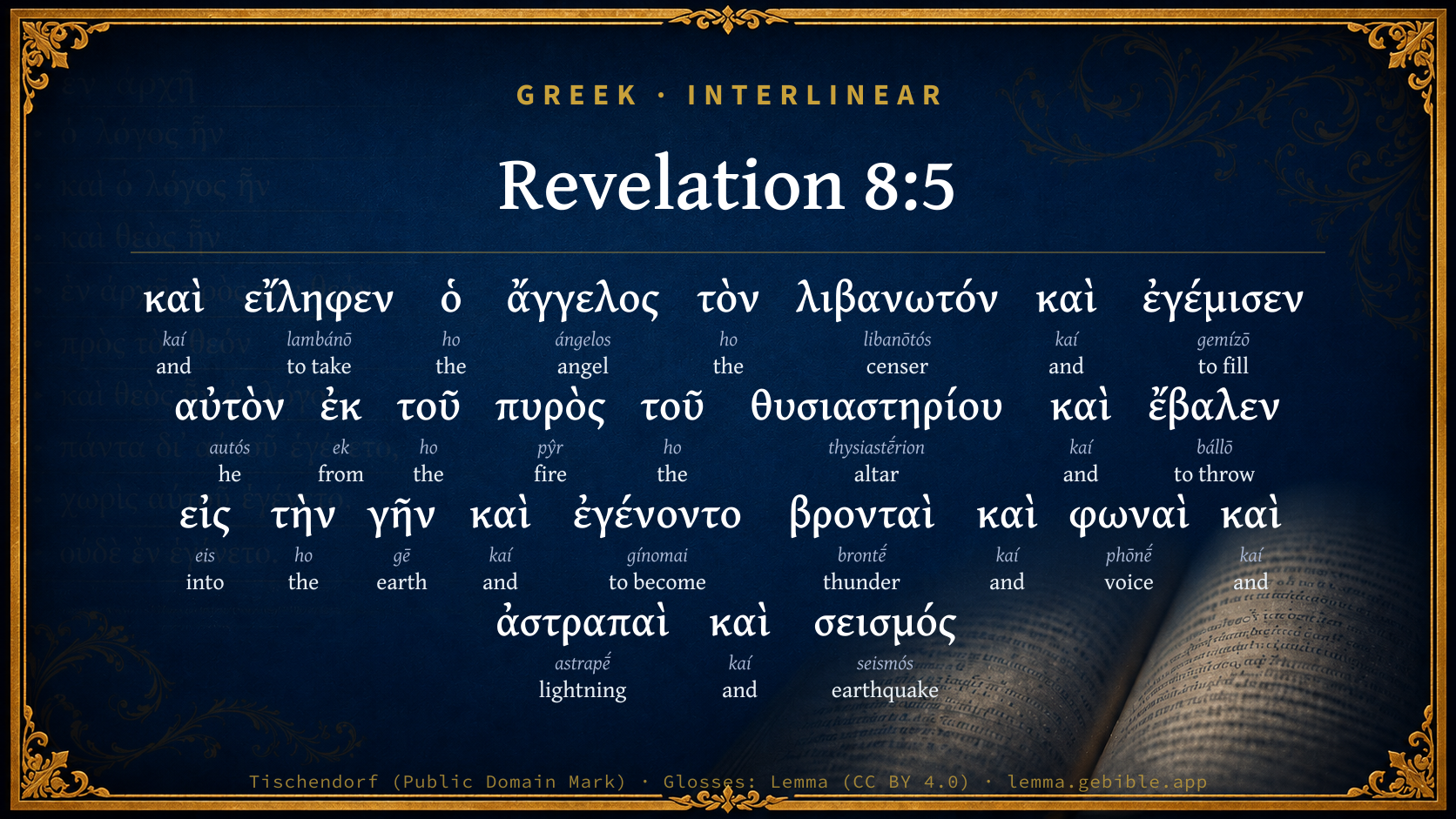
  1. καὶ kaí G2532 “and” Conjunction
  2. εἴληφεν lambánō G2983 “to take” Verb, Perfect, Active, Indicative, 3rd person, Singular
  3. ὁ ho G3588 “the” Article, Nominative, Singular, Masculine
  4. ἄγγελος ángelos G32 “angel” Noun, Nominative, Singular, Masculine
  5. τὸν ho G3588 “the” Article, Accusative, Singular, Masculine
  6. καὶ kaí G2532 “and” Conjunction
  7. ἐγέμισεν gemízō G1072 “to fill” Verb, Aorist, Active, Indicative, 3rd person, Singular
  8. αὐτὸν autós G846 “he” Personal pronoun, Accusative, Singular, Masculine
  9. ἐκ ek G1537 “from” Preposition
  10. τοῦ ho G3588 “the” Article, Genitive, Singular, Neuter
  11. πυρὸς pŷr G4442 “fire” Noun, Genitive, Singular, Neuter
  12. τοῦ ho G3588 “the” Article, Genitive, Singular, Neuter
  13. θυσιαστηρίου thysiastḗrion G2379 “altar” Noun, Genitive, Singular, Neuter
  14. καὶ kaí G2532 “and” Conjunction
  15. ἔβαλεν bállō G906 “to throw” Verb, Aorist, Active, Indicative, 3rd person, Singular
  16. εἰς eis G1519 “into” Preposition
  17. τὴν ho G3588 “the” Article, Accusative, Singular, Feminine
  18. γῆν gē G1093 “earth” Noun, Accusative, Singular, Feminine
  19. καὶ kaí G2532 “and” Conjunction
  20. ἐγένοντο gínomai G1096 “to become” Verb, Aorist, Middle deponent, Indicative, 3rd person, Plural
  21. βρονταὶ brontḗ G1027 “thunder” Noun, Nominative, Plural, Feminine
  22. καὶ kaí G2532 “and” Conjunction
  23. φωναὶ phōnḗ G5456 “voice” Noun, Nominative, Plural, Feminine
  24. καὶ kaí G2532 “and” Conjunction
  25. ἀστραπαὶ astrapḗ G796 “lightning” Noun, Nominative, Plural, Feminine
  26. καὶ kaí G2532 “and” Conjunction
  27. σεισμός seismós G4578 “earthquake” Noun, Nominative, Singular, Masculine

About this verse

These counts appear in no published source. They are computed here, from the morphology-tagged text and Lemma’s own curated glosses. What Lemma adds →

28
words
18
distinct lemmas
Revelation
section

Notable vocabulary

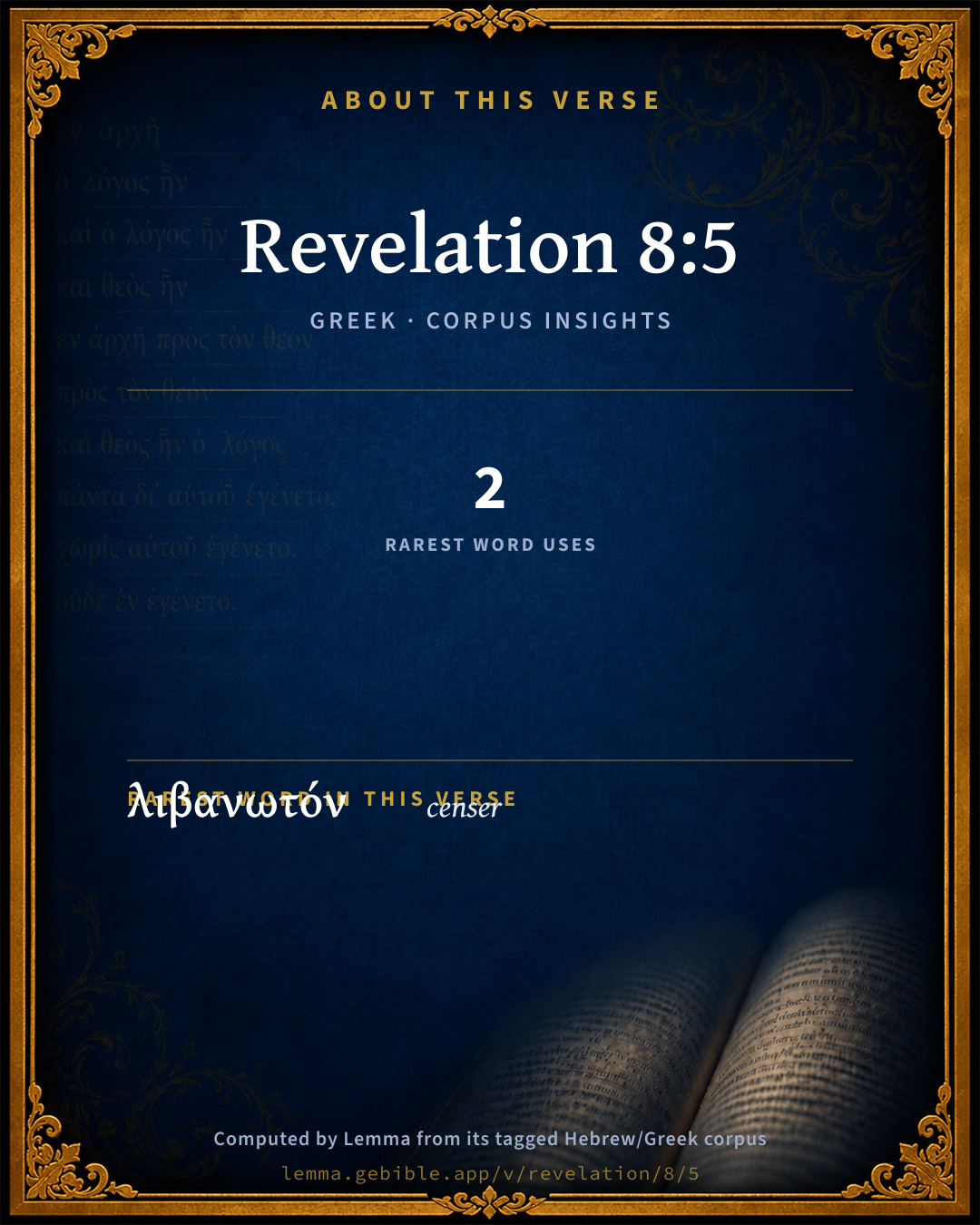
The rarest word here is λιβανωτόν censer G3031 — appearing just 2 times in the whole Greek New Testament.

Shared distinctive vocabulary

λιβανωτόν censer G3031 occurs in 2 verses of the Greek New Testament. Also found in:

Repetition

Words recur within this verse:

Cross-references

22

Topical passages linked to Revelation 8:5 in the Treasury of Scripture Knowledge — connected by theme and wording, ordered by reader-vote popularity; previews shown in the World English Bible.

  • Revelation 4:5 Out of the throne proceed lightnings, sounds, and thunders. There were seven lamps of fire burning before his throne, which are the seven Spirits of God.
  • Revelation 11:19 God's temple that is in heaven was opened, and the ark of the Lord's covenant was seen in his temple. Lightnings, sounds, thunders, an earthquake, and great hail followed.
  • Isaiah 29:6 She shall be visited of Yahweh of Hosts with thunder, and with earthquake, and great noise, with whirlwind and tempest, and the flame of a devouring fire.
  • Acts 16:26 Suddenly there was a great earthquake, so that the foundations of the prison were shaken; and immediately all the doors were opened, and everyone's bonds were loosened.
  • Leviticus 16:12 He shall take a censer full of coals of fire from off the altar before Yahweh, and two handfuls of sweet incense beaten small, and bring it within the veil:
  • 2 Samuel 22:7–9 In my distress I called on Yahweh; Yes, I called to my God: He heard my voice out of his temple, My cry [came] into his ears.
  • Psalms 18:13 Yahweh also thundered in the sky, The Most High uttered his voice: Hailstones and coals of fire.
  • Ezekiel 10:2–7 He spoke to the man clothed in linen, and said, Go in between the whirling [wheels], even under the cherub, and fill both your hands with coals of fire from between the cherubim, and scatter them over the city. He went in as I watched.
  • Matthew 27:52–54 The tombs were opened, and many bodies of the saints who had fallen asleep were raised;
  • 1 Kings 19:11 He said, Go forth, and stand on the mountain before Yahweh. Behold, Yahweh passed by, and a great and strong wind tore the mountains, and broke in pieces the rocks before Yahweh; but Yahweh was not in the wind: and after the wind an earthquake; but Yahweh was not in the earthquake:
  • Isaiah 30:30 Yahweh will cause his glorious voice to be heard, and will show the lighting down of his arm, with the indignation of [his] anger, and the flame of a devouring fire, with a blast, and tempest, and hailstones.
  • Isaiah 66:6 A voice of tumult from the city, a voice from the temple, a voice of Yahweh that renders recompense to his enemies.
  • Isaiah 66:14–16 You shall see [it], and your heart shall rejoice, and your bones shall flourish like the tender grass: and the hand of Yahweh shall be known toward his servants; and he will have indignation against his enemies.
  • Matthew 24:7 For nation will rise against nation, and kingdom against kingdom; and there will be famines, plagues, and earthquakes in various places.
  • Luke 12:49 "I came to throw fire on the earth. I wish it were already kindled.
  • Acts 4:31 When they had prayed, the place was shaken where they were gathered together. They were all filled with the Holy Spirit, and they spoke the word of God with boldness.
  • Revelation 6:12 I saw when he opened the sixth seal, and there was a great earthquake. The sun became black as sackcloth made of hair, and the whole moon became as blood.
  • Revelation 11:13 In that day there was a great earthquake, and a tenth of the city fell. Seven thousand people were killed in the earthquake, and the rest were terrified, and gave glory to the God of heaven.
  • Zechariah 14:5 You shall flee by the valley of my mountains; for the valley of the mountains shall reach to Azel; yes, you shall flee, just like you fled from before the earthquake in the days of Uzziah king of Judah. Yahweh my God will come, and all the holy ones with you.
  • Hebrews 12:18–19 For you have not come to a mountain that might be touched, and that burned with fire, and to blackness, darkness, tempest,
  • Revelation 16:1–21 I heard a loud voice out of the temple, saying to the seven angels, "Go and pour out the seven bowls of the wrath of God on the earth!"
  • Jeremiah 51:11 Make sharp the arrows; hold firm the shields: Yahweh has stirred up the spirit of the kings of the Medes; because his purpose is against Babylon, to destroy it: for it is the vengeance of Yahweh, the vengeance of his temple.

Cross-references courtesy of OpenBible.info (CC BY 4.0).

Commentary

Notes on Revelation 8:5 from classic Christian and Jewish commentators (each source and its license shown beneath its notes). The classic Christian expositions comment on the surrounding passage and are grouped to its opening verse, so a note may address several verses; the Jewish commentaries on the Tanakh (Rashi and others) are per-verse, so they appear only where the commentator wrote on this verse.

Lemma curates 59 commentaries, every one of them public domain or Creative Commons licensed, each selected and text-cleaned for this edition rather than reprinted as found. About our sources →

Tyndale Open Study Notes

Tyndale Open Resources

8:5 The action of the angel, as he throws fire . . . down upon the earth, signals the dramatic beginning of God’s judgment (see Gen 19:24; Exod 9:23; Lev 10:2; Deut 9:3; 2 Kgs 1:10). • thunder . . . lightning . . . earthquake: These earthly portents remind us of God’s power, presence, and judgment (also Rev 11:19; 16:18; see Exod 19:18-19; 1 Kgs 19:11-12; Isa 29:6).

Tyndale Open Study Notes — © Tyndale Open Resources, licensed CC BY-SA 4.0. Text via the HelloAO Bible API.

Expositor's Greek Testament

ed. W. Robertson Nicoll

Rev 8:5 . The censer, having offered incense to heaven, is now used to hurl fire upon the earth (adopted from Eze 10:2-7 ; cf. Lev 16:12 ). As at the close of the trumpets (Rev 11:19 ) and the bowls (Rev 16:18 ), physical disturbances here accompany the manifestation of God’s wrath and judgment. In answer to the prayers and longings of the saints (Renan, 393), God at last visits the impenitent pagan world with a series of catastrophes (Rev 8:8-9 ., cf. Rev 9:4 ), which herald the end and also give (though in vain, Rev 9:20-21 ) an opportunity for repentance.

Note on Rev 8:3-5 . This episode (in dumb show) of angel and incense, though apparently isolated, is an overture for the series of judgments, of which the successive trumpet-blasts are precursors. The prayers of all the saints, which, like those of the martyrs in Rev 6:10 , crave punishment upon God’s enemies throughout the earth, are supported and reinforced by the ministry of this angel, and answered at once by the succession of incidents beginning with Rev 8:5 . This object of Christian prayers, i.e. , the final crisis, when Christ returns to crush his enemies and inaugurate his reign, pervaded early Christianity as a whole. At special periods of intolerable persecution, it assumed under the stress of antagonism as here a more sensuous and plastic form than the ordinary consciousness of the church would have been usually disposed to cherish; yet the common prayer of the church in any case was for the speedy end of the world ( ἐλθέτω χάρις καὶ παρελθέτω ὁ κόσμος οὗτος Did. x.). In Apoc. Mos. (tr. Conybeare, Jewish Quart. Rev. , 1895, 216 235) 33, when the angels intercede for Adam at his ascension to heaven, they take golden censers and offer incense; whereupon smoke overshadows the very firmament. The intercession of angels on behalf of the saints, a result of their function as guardians, goes back to post-exilic Judaism with its inarticulated conception of the angels as helpful to mankind (Job 5:1 ; Job 33:23 ; Zec 1:12 ); subsequently the idea developed into a belief that the prayers of the pious won special efficacy as they were presented to God by angels such as Gabriel, Raphael, Michael, or the seven archangels ( cf. Tobit, loc. cit. ; Slav. En. vii. 5; En. ix. 2 11, xv. 2, xl. 6, xlvii. 2, xcix. 3, 16, civ. 1). In Christianity this rôle was naturally absorbed by Christ, who alone ratified and inspired his people’s supplications. But the old belief evidently lingered in pious circles of Jewish Christianity ( cf. Test. Lev 3:5 ), side by side with a complete acceptance of Christ’s heavenly function. The latter did not immediately or universally wither up such survivals of the older faith; popular religion tended then as now to be wider at several points than its theoretical principles (as in Origen, Cels. Rev 8:4 ; and Tertull. de Orat. xii.). Plato, in Sympos. 202 E., makes the δαίμονες present men’s prayers and offerings to the gods, and mediate the latter’s commands and recompence to men ( cf. Philo, de Somniis , i. 22, and on i. 1). See further Rev 17:1 , Rev 21:9 , for a similar state of matters in primitive Christianity with regard to the corresponding function of Jewish angels as intermediaries of revelation.

The Expositor's Greek Testament, edited by W. Robertson Nicoll (1897–1910) — public domain. Text from a community e-Sword module.

Jamieson, Fausset & Brown

Robert Jamieson, A. R. Fausset & David Brown

cast it into the earth--that is, unto the earth: the hot coals off the altar cast on the earth, symbolize God's fiery judgments about to descend on the Church's foes in answer to the saints' incense-perfumed prayers which have just ascended before God, and those of the martyrs. How marvellous the power of the saints' prayers!

there were--"there took place," or "ensued."

voices, and thunderings, and lightnings--B places the "voices" after "thunderings." A places it after "lightnings."

Jamieson, Fausset & Brown — Commentary Critical and Explanatory on the Whole Bible (1871) — public domain (CC PDM 1.0). Text via the HelloAO Bible API.

Adam Clarke's Commentary

Verse 5. Cast it into the earth] That is, upon the land of Judea; intimating the judgments and desolations which were now coming upon it, and which appear to be farther opened in the sounding of the seven trumpets.

There were voices] All these seem to point out the confusion, commotions, distresses, and miseries, which were coming upon these people in the wars which were at hand.

Adam Clarke's Commentary on the Bible (1810–1826) — public domain. Text from a community e-Sword/MySword module.

Ellicott's Commentary for English Readers

(5) And the angel . . .—Translate, And the angel has taken (or, took) the censer, and he filled it from the fire of the altar, and cast it (i.e., the fire or hot ashes which filled the censer) upon the earth. The prayers have gone up, and the sprinkling of the ashes earthward is the symbol of the answer descending from heaven. We may recall the similar action of Moses before Pharaoh, when he took ashes of the furnace and sprinkled it towards heaven, but it descended towards earth, as a symbol of the plague about to fall upon the land (Exo_9:8-10). The hot ashes are the tokens of the coming judgments. As in the parallel vision in Ezekiel (Eze_10:2), when the man clothed with linen is bidden to “go in between the wheels, even under the cherub, and fill his hand with coals of fire from between the cherubims, and scatter them over the doomed city;” so here the ashes fall—the judgments are at hand

And there were voices . . .—Or, And there took place thunders, and voices, and lightnings, and an earthquake. There is some variety among the MSS. in the order of the words here used. Some place “lightnings” before “voices.” These signs and sounds herald the approach of judgments. God has arisen in answer to the cry of His people. “The earth shook and trembled. There went up a smoke and a fire: coals were kindled at it. At the brightness that was before Him His thick clouds passed, hailstones and coals of fire. The Lord also thundered in the heavens, and the Highest gave His voice, hailstones and coals of fire. Yea, He sent out His arrows, and scattered them: He shot out lightnings and discomfited them . . . He delivered me from my strong enemy” (Psa_18:4-19). It is a solemn thought that we may send up prayers, and the answer may come down a judgment; for often it is only through judgment that true loving-kindness can make her way.

A Bible Commentary for English Readers, edited by Charles John Ellicott (1878–1897) — public domain. Text from a community e-Sword module.

The Cambridge Bible for Schools and Colleges

gen. ed. J. J. S. Perowne

5. and cast it] Probably cast the censer full of burning coals, but possibly only “scattered the fire,” as Num_16:37. The meaning must be, to represent the same instrument as obtaining God’s mercy on His people, and executing His vengeance on His enemies: cf. Eze_10:2.

there were voices, &c.] “Voices” and “thunders” should be transposed. We have similar signs in Rev_11:19, Rev_16:18, when the series of the seven trumpets and the seven vials respectively are ended: hence perhaps it is here rather than earlier that we are to look for the conclusion of the visions of the seven seals.

The Cambridge Bible for Schools and Colleges (gen. ed. J. J. S. Perowne; Cambridge University Press, 1878–1918) — public domain. Text from a community e-Sword module.

John Gill's Exposition

And the angel took the censer,.... The golden one before mentioned, the use of which was to take and carry in it burning coals of fire:

and filled it with fire of the altar; of burnt offering, for upon that, and not upon the altar of incense, fire was; the allusion is to the priest

"that was worthy to use a censer (e); who took a silver censer, and went to the top of the altar (of burnt offering), and having removed the coals there, and there took them in his censer, and went down and emptied them into a golden one, and there was scattered from it about a kab of coals;''

for the golden one held a kab less than the silver one (f);

and cast it into the earth: the Roman empire: by "fire" some understand the Spirit of God, and his gifts and graces, which sat upon the apostles as cloven tongues of fire on the day of Pentecost; and which they suppose were now plentifully bestowed on the ministers of the word, to enlighten them, inspire them with zeal, and abundantly fit them for the work of the ministry, in consequence of Christ's mediation and intercession: and others think the Gospel is intended, which is sometimes compared to fire, Jer 20:9, or else those contentions and quarrels which, through the corruptions of men, arise on account of the Gospel, Luk 12:49; though rather by fire here are meant the judgments of God, and his wrath and fury poured forth like fire upon the Roman empire, now become Christian; and so was an emblem of those calamities coming upon it at the sounding of the trumpets; and shows that as Christ prays and intercedes for his, own people, for their comfort and safety, so he will bring down, his judgments upon his and their enemies; see Eze 10:2; and the Targum on it:

and there were voices, and thunderings, and lightnings, and an earthquake; which may be understood either of the nature, use, and effects of the Gospel, speaking to the hearts of men by the sons of thunder, enlightening their minds, and shaking their consciences; the like were at the giving of the law, Exo 19:16; or rather of those terrors, distresses, and commotions in the world, because of God's righteous judgments, and which particularly will be at the sound of the seventh trumpet, and the pouring out of the seventh vial, Rev 11:15; the allusion is to the sounds that were heard at the time of the daily sacrifice; for besides the blowing of the trumpets by the priests, and the singing of the Levites, of which See Gill on Rev 8:2; there was a musical instrument called "magrephah" (g), which being sounded, a man could not hear another speak in Jerusalem: yea, they say it was heard as far as Jericho.

(e) Misn. Tamid. c. 5. sect. 5. (f) Vid. Misn. Yoma, c. 4. sect. 4. (g) Misn. Tamid. c. 5. sect. 6. & 3. 8.

John Gill's Exposition of the Whole Bible (1746–1763) — public domain (CC PDM 1.0). Text via the HelloAO Bible API.

Trapp's Complete Commentary

John Trapp

5 And the angel took the censer, and filled it with fire of the altar, and cast it into the earth: and there were voices, and thunderings, and lightnings, and an earthquake.

Ver. 5. And filled it with the fire of the altar] Fire, in token of fierce indignation, and from the altar; for Christ came to send fire on the earth, Luk 12:49; fire and sword, Mat 12:34; through men’s singular corruption and obstinace in not stooping to the sceptre of this kingdom. Hence fire and brimstone, storm and tempest, a fearful looking for of judgment and fiery indignation, which shall devour the adversaries, Heb 10:27. From the same altar, Christ, prayers go up, vengeance comes down.

John Trapp, A Commentary or Exposition upon All the Books of the Old and New Testament (1647–1656) — public domain. Text from a community e-Sword module.

Albert Barnes' Notes on the Bible

And the angel took the censer - Rev 8:3. This is a new symbol, designed to furnish a new representation of future events. By the former it had been shown that there would be much prayer offered; by this it is designed to show that, notwithstanding the prayer that would be offered, great and fearful calamities would come upon the earth. This is symbolized by casting the censer upon the earth, as if the prayers were not heard any longer, or as if prayer were now in vain.

And filled it with fire of the altar - An image similar to this occurs in Eze 10:2, where the man clothed in linen is commanded to go between the wheels under the cherub, and fill his hands with coals of fire from between the cherubims, and to scatter them over the city as a symbol of its destruction. Here the coals are taken, evidently, from the altar of sacrifice. Compare the notes on Isa 6:1. On these coals no incense was placed, but they were thrown at once to the earth. The new emblem, therefore, is the taking of coals, and scattering them abroad as a symbol of the destruction that was about to ensue.

And cast it into the earth - Margin, upon. The margin expresses undoubtedly the meaning. The symbol, therefore, properly denoted that fearful calamities were about to come upon the earth. Even the prayers of saints did not prevail to turn them away, and now the symbol of the scattered coals indicated that terrible judgments were about to come upon the world.

And there were voices - Sounds, noises. See the notes on Rev 4:5. The order is not the same here as there, but lightnings, thunderings, and voices are mentioned in both.

And an earthquake - Rev 6:12. This is a symbol of commotion. It is not necessary to look for a literal fulfillment of it, anymore than it is for literal “voices,” “lightnings,” or “thunderings.”

Albert Barnes' Notes on the Bible (1834–1885) — public domain. Text from a community e-Sword/MySword module.

Matthew Poole's English Annotations

I doubt not but by fire here, is to be understood the wrath of God, often in holy writ compared to fire, poured out upon the Roman empire, or the visible church. Upon which followed great judgments, and confusions, and tumults, expressed here, or ushered in, as before, Rev 6:1, with

thunderings; which being here more generally mentioned, are by and by more particularly expressed.

Matthew Poole's English Annotations on the Holy Bible (1683–1685) — public domain. Text from a community e-Sword/MySword module.

Whedon's Commentary on the Bible

Daniel D. Whedon

5. The censer has now been emptied of its incense. The angel then fills it with altar-fire, and flings the fire upon the earth, and terrible detonations arise. A most striking symbol. But we do not agree with Hengstenberg and Alford, that these vengeful voices and the judgments that follow are consequences of the prayers of all the saints. No. Save the martyrs’ cry for justice, the ascending prayer of the universal Church is for the world’s conversion, reformation, salvation. But on the contrary there is the terrible fire—the reverse of the incense—the ordinary Scripture symbol of divine wrath. And this emblem of wrath, fire, will, as will soon appear, be found in three if not in all four of the judgments of the four creational trumpets. In each appears, as it were, a coal from the angel’s censer. Yet this fire is more deeply the symbol of divine purity, indicating on the one side its purifying power in the believer, and on the other side its condemnatory and consuming power upon the profane. The earth, in its now fallen state, is, as it were, impregnated with sin, and when the fire of divine purity is cast upon it, then, as when two opposite chemical elements come together, a terrible explosion results. The incense of saintly prayer goes up to heaven; the fire of divine wrath is cast down upon the earth.

Voices… earthquake—The creational four in something of climax. These are but monitions of judgments soon to be realized.

Daniel D. Whedon (gen. ed.), Commentary on the Old and New Testaments (1874–1909) — public domain. Text from a community e-Sword module.

The Pulpit Commentary

And the angel took the censer, and filled it with fire of the altar, and cast it into the earth; taketh the censer, and he filled it with the fire of the altar, and cast it upon the earth (Revised Version). The angel now returns to the altar of burnt offering, whence he takes fire, which he casts upon the earth. This action denotes that God"s judgments are about to descend on the earth, and it therefore forms the visible token of God"s acceptance of the prayers of the saints, and his answer to them.

And there were voices, and thunderings, and lightnings, and an earthquake; and there followed thunders, and voices, etc. (Revised Version). The manifestation of God"s presence or of his judgments is continually accompanied by awe-striking phenomena, such as are here described. (see on Rev_6:12)

The Pulpit Commentary (1880–1919), ed. H.D.M. Spence-Jones & Joseph S. Exell — public domain. Text from a community e-Sword module.

John Wesley's Explanatory Notes

And there were thunderings, and lightnings, and voices, and an earthquake - These, especially when attended with fire, are emblems of God's dreadful judgments, which are immediately to follow.

John Wesley, Explanatory Notes Upon the Whole Bible (1754–1765) — public domain. Text via the GEBible commentary corpus.

Scofield Reference Notes

C. I. Scofield

angel

(See Scofield "Heb 1:4").

The Scofield Reference Bible (1917 edition), notes by C. I. Scofield — public domain. Text from a community e-Sword module.

Godbey's Commentary on the New Testament

William B. Godbey

5. Thunders, voices, and earthquakes all vividly symbolize the mighty agencies employed by Omnipotent Jehovah in the execution of these terrible castigatory judgments.

William B. Godbey, Commentary on the New Testament (1896–1900) — public domain. Text from a community e-Sword module.

The People's New Testament

B. W. Johnson

5. And the angel … filled it with the fire of the altar, and cast it upon the earth. Fire is usually a symbol of suffering. This fire cast from the altar upon the earth indicates that the judgments of God are about to fall upon it. The earth in the sense used by John is the great Roman Empire, which embraced the civilized world. There followed thunders, etc. These mutterings and the quaking are ominous of the terrible scenes to follow when the angels sound their trumpets.

B. W. Johnson's The People's New Testament with Notes (1889–1891) — public domain. Electronic text from the Christian Classics Ethereal Library (CCEL) ThML edition.

Cambridge Greek Testament for Schools and Colleges

5. βρονταὶ καὶ φωναὶ καὶ ἀστραπαί. With אB2. Text. Rec[289] reads φωναὶ καὶ βρ. καὶ ἀστ.; A cop[290] syr[291] read βρ. καὶ ἀστ. καὶ φωναί.

[289] Rec. Textus Receptus as printed by Scrivener.

[290] Coptic.

[291] Syriac.

5. εἴληφεν. See on Rev 5:7 for tense. As the Angel has the censer already we cannot refer to the common formula of the LXX. e.g. Lev 8:2, λάβε Ἀαρὼν καὶ τοὺς υἱοὺς αὐτοῦ καὶ τὰς στολὰς αὐτοῦ καὶ τὸ ἔλαιον τῆς χρίσεως καὶ τὸν μόσχον τὸν περὶ τῆς ἁμαρτίας, καὶ τοὺς δύο κριοὺς, καὶ τὸ κανοῦν τῶν ἀζύμων, and it is a little difficult to suppose that the censer is laid down after the incense from it has been emptied upon the Altar.

ἔβαλεν. Probably cast the censer full of burning coals, but possibly only “scattered the fire,” as Num 16:37. The meaning must be, to represent the same instrument as obtaining God’s mercy on His people, and executing His vengeance on His enemies: cf. Eze 10:2.

βρονταὶ καὶ φωναί. We have similar signs in Rev 11:19, Rev 16:18, when the series of the Seven Trumpets and the Seven Vials respectively are ended: hence perhaps it is here rather than earlier that we are to look for the conclusion of the visions of the Seven Seals.

Cambridge Greek Testament for Schools and Colleges (Cambridge University Press, 1896; 21 vols, various authors incl. Carr, Maclear, Plummer, Farrar, Lumby, Moule, M. R. James, Simcox) — public domain. Text from a community e-Sword module.

Alford’s Greek Testament

Henry Alford

5.] And the angel took (it is quite impossible to maintain a perfect sense: an aorist (ἐγέμισεν) is indeed coupled to εἴληφεν) the censer (after having used it as above, i. e. shaken from it the incense on the altar) and filled it (while the smoke was ascending) from the fire of the altar (i. e. from the ashes which were on the altar), and cast it (i. e. the fire with which the censer was filled: the hot ashes) towards the earth (to signify that the answer to the prayers was about to descend in the fire of God’s vengeance: see below, and compare Ezekiel in ref.): and there took place thunders and voices and lightnings and an earthquake (“per orationes sanctorum,” says Corn.-a-lap., “… precantium vindictam de impiis suisque persecutoribus, ignis vindictæ, i. e. tonitrua, fulgura et plagæ sequentes vii. angelorum et tubarum in impios sunt demissa.” All these immediate consequences of the casting down of the hot ashes on the earth are the symbolic precursors of the divine judgments about to be inflicted).

One point must here be noticed: the intimate connexion between the act of this incense-offering angel and the seven trumpets which follow. It belongs to them all: it takes place when now the seven angels have had their trumpets given them, and this series of visions is introduced. So that every interpretation must take this into account: remembering that the judgments which follow are answers to the prayers of the saints, and are inflicted on the enemies of the church.

Henry Alford, The Greek Testament (1849–1861) — public domain. Text from a community e-Sword module.

Vincent's Word Studies in the New Testament

Marvin R. Vincent

Took [ειληφεν] . Lit., hath taken. So Rev., in margin.

With the fire [εκ του πυρος] . Lit., "from or out off the fire," i e., the coals or hot ashes. For ejk out off see on chapter Rev 2:7.

Cast it into the earth. See Eze 10:2; Luk 12:49.

Marvin R. Vincent, Word Studies in the New Testament (1887–1900) — public domain. Text from a community e-Sword/MySword module.

Lesson kit

Teaching starters — assembled from the data on this page, not authored interpretation. Every prompt links to the verse data it draws on. Edit before teaching.

Revelation, in the Revelation, opens this verse with 28 words (18 distinct Greek lemmas). Its most distinctive word is libanōtós (“censer”). A historical commentator’s framing appears above. Read the whole chapter for the surrounding context.

Discussion questions

  1. How does “censer” (libanōtós) shape what this verse is saying?
  2. Revelation 8:3 shares the word «censer» with this verse. How do the two illuminate each other?
  3. “and” occurs 7× in this one verse. What is the effect of the repetition?
  4. These translations render this verse differently; the difference is in the English rendering, not the original. What questions does that raise?
  5. Reading how Tyndale Open Study Notes and Expositor's Greek Testament read this verse, where do the two commentators agree and where do they part?

Things to notice

Reading settings

Reading text

Shown beneath each verse's original-language words.

Old Testament
Old Testament edition

Read the OT as the Masoretic Hebrew (MT) or the Greek Septuagint (LXX).

English shown for the Greek Septuagint (in the Hebrew ↔ Greek comparison).

Comparing translations? Open the Compare panel on any verse page to stack up to four side by side.