Revelation 6:10

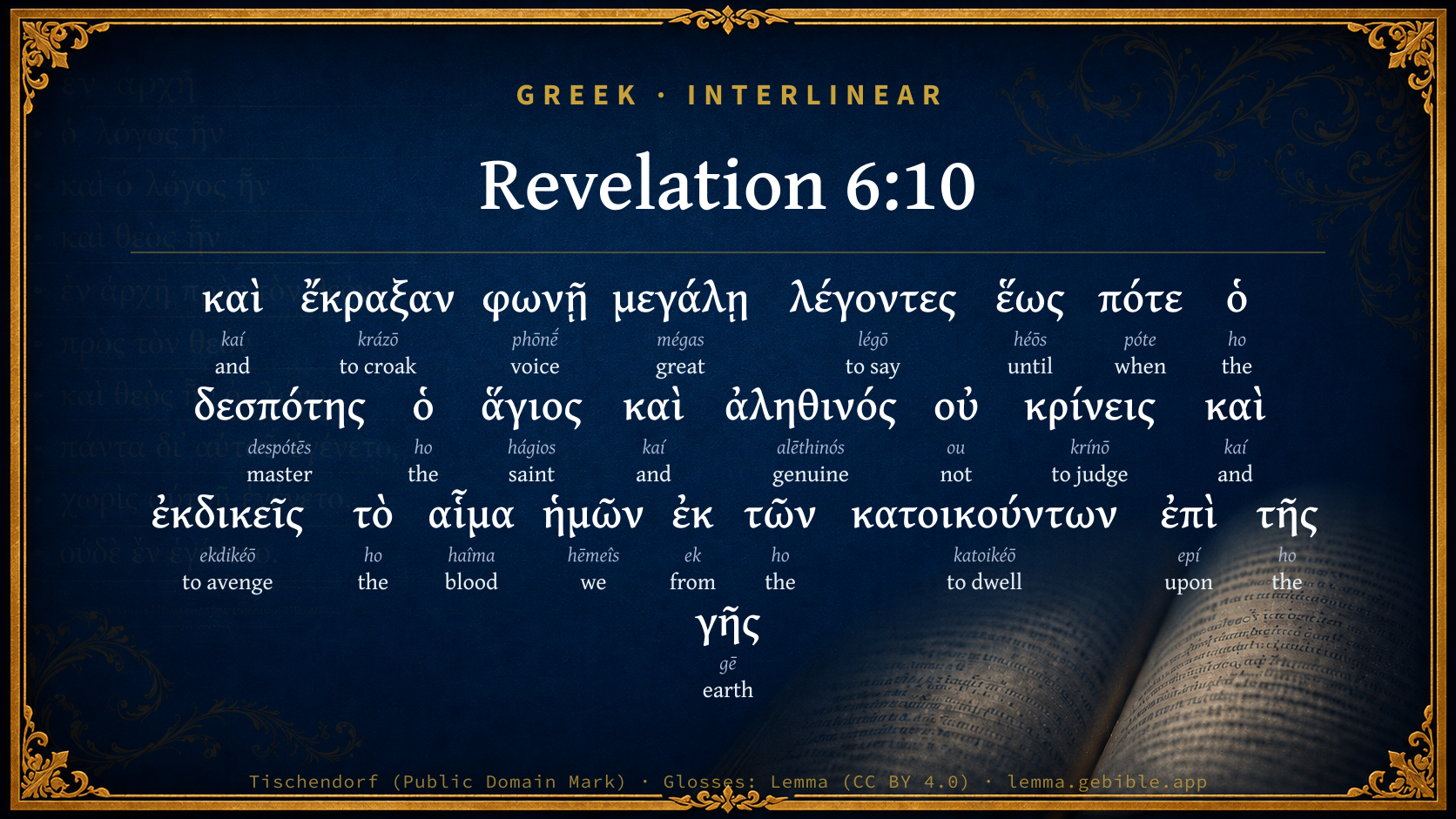
Greek (Tischendorf 8th ed.) Revelation 6:10 appears in the Greek New Testament. The text above is from the Tischendorf 8th edition. Each word links to its Strong’s number and a concise gloss. Click any word for its full Thayer’s Greek Lexicon entry.
Download image
Cite this verse

Revelation 6:10 (World English Bible). Public Domain. Lemma interlinear Bible study tool, https://lemma.gebible.app/v/revelation/6/10.

Show BibTeX & RIS
BibTeX
RIS
English Translation
They cried with a loud voice, saying, "How long, Master, the holy and true, until you judge and avenge our blood on those who dwell on the earth?"
World English Bible · Public Domain
Download a study sheet

One document with this verse’s original text, its word-by-word gloss line, the meaning frame, cross-references with their text, attributed commentary, and full source and license credits — printable, and it pastes into notes with its structure intact.

This verse Autodidact and up

Study sheet (.html) Plain text (.txt)

A passage Seminary Student

Up to 50 verses in one chapter. A passage sheet keeps up to 6 commentary sources and 12 cross-references per verse, in the order this page ranks them, and says so on the sheet whenever that leaves anything out. Ask for a single verse and you get the Autodidact verse sheet above.

Everything on this page stays free to read, with no account — the sheet is a download of what is already on screen, not access to it.

Want to remove ads? Support Godless Engineer
Compare translations 3

The same verse in 3 English versions, stacked beneath the original-language interlinear above. Click any original word for its lexicon entry.

Each is an independent rendering of the whole verse — the interlinear is not word-aligned to these translations.

Highlighted words mark where these versions differ — a whole-verse word diff, not a word-by-word alignment.

  • World English Bible Public Domain
    They cried with a loud voice, saying, "How long, Master, the holy and true, until you judge and avenge our blood on those who dwell on the earth?"
  • King James Version Public Domain
    And they cried with a loud voice, saying, How long, O Lord, holy and true, dost thou not judge and avenge our blood on them that dwell on the earth?
  • unfoldingWord Literal Text CC BY-SA 4.0
    And they cried out in a loud voice, saying, “Until when, holy and true Ruler, do you not judge and avenge our blood from the ones living on the earth?”

unfoldingWord Literal Text — © unfoldingWord, licensed CC BY-SA 4.0. Word-aligned USFM3 via Door43 (git.door43.org/unfoldingWord/en_ult).

Versions to compare (up to 4)

3 of 4 selected

Show all 19 translations

Every available English version of this verse, each an independent rendering of the whole verse.

  • World English Bible Public Domain
    They cried with a loud voice, saying, "How long, Master, the holy and true, until you judge and avenge our blood on those who dwell on the earth?"
  • Berean Standard Bible Public Domain
    And they cried out in a loud voice, “How long, O Lord, holy and true, until You avenge our blood and judge those who dwell upon the earth?”
  • Majority Standard Bible Public Domain
    And they cried out in a loud voice, “How long, O Lord, holy and true, until You judge those who dwell upon the earth and avenge our blood?”
  • King James Version Public Domain
    And they cried with a loud voice, saying, How long, O Lord, holy and true, dost thou not judge and avenge our blood on them that dwell on the earth?
  • American Standard Version (1901) Public Domain
    and they cried with a great voice, saying, How long, O Master, the holy and true, dost thou not judge and avenge our blood on them that dwell on the earth?
  • Revised Version (1885) Public Domain
    and they cried with a great voice, saying, How long, O Master, the holy and true, dost thou not judge and avenge our blood on them that dwell on the earth?
  • Geneva Bible (1599) Public Domain
    And they cried with a loud voice, saying, How long, Lord, which art holie and true! doest not thou iudge and auenge our blood on them that dwell on the earth?
  • Douay-Rheims (1899) Public Domain
    And they cried with a loud voice, saying: How long, O Lord (holy and true) dost thou not judge and revenge our blood on them that dwell on the earth?
  • Young's Literal Translation Public Domain
    and they were crying with a great voice, saying, `Till when, O Master, the Holy and the True, dost Thou not judge and take vengeance of our blood from those dwelling upon the land?'
  • Literal Standard Version CC BY-SA 4.0
    and they were crying with a great voice, saying, “Until when, O Master, the Holy and the True, do You not judge and take vengeance of our blood from those dwelling on the earth?”
  • Unlocked Literal Bible CC BY-SA 4.0
    They cried out with a loud voice, “How long, Ruler over all, holy and true, until you judge those who live on the earth, and until you avenge our blood?”
  • unfoldingWord Literal Text CC BY-SA 4.0
    And they cried out in a loud voice, saying, “Until when, holy and true Ruler, do you not judge and avenge our blood from the ones living on the earth?”
  • Darby Bible Public Domain
    and they cried with a loud voice, saying, How long, O sovereign Ruler, holy and true, dost thou not judge and avenge our blood on them that dwell upon the earth?
  • World Messianic Bible Public Domain
    They cried with a loud voice, saying, “How long, Master, the holy and true, until you judge and avenge our blood on those who dwell on the earth?”
  • Webster's Bible Public Domain
    And they cried with a loud voice, saying, How long, O Lord, holy and true, dost thou not judge and avenge our blood on them that dwell on the earth?
  • Free Bible Version CC BY-SA 4.0
    They cried out, shouting, “How long, Lord who is holy and true, before you will judge and bring to justice those on earth who spilled our blood?”
  • Bible in Basic English Public Domain
    And they gave a great cry, saying, How long will it be, O Ruler, holy and true, before you take your place as judge and give punishment for our blood to those on the earth?
  • Text-Critical English NT CC BY 4.0
    They cried out with a loud voice, “How long, O Master, Holy and True, will yoʋ not judge those who dwell on the earth and avenge our blood?”
  • Tyndale New Testament (1534) Public Domain
    and they cryed with a lowde voyce sayinge: How loge tariest thou lorde holy and true to iudge and to avenge oure bloud on them that dwell on the erth?

Literal Standard Version (2020), Covenant Press — licensed CC BY-SA 4.0. Text via the HelloAO Bible API (eBible.org). Unlocked Literal Bible (unfoldingWord) — licensed CC BY-SA 4.0. Text via the HelloAO Bible API (eBible.org). unfoldingWord Literal Text — © unfoldingWord, licensed CC BY-SA 4.0. Word-aligned USFM3 via Door43 (git.door43.org/unfoldingWord/en_ult). Free Bible Version, Dr. Jonathan Gallagher — licensed CC BY-SA 4.0. Text via the HelloAO Bible API (eBible.org).

Word by word

More ways to search: Search by grammar → Find every occurrence → Compare this word →

Practice this passage: Drill this verse → Learn its vocabulary →

ἐκδικεῖς
ekdikéō
G1556
“to avenge”
Verb, Present, Active, Indicative, 2nd person, Singular
Part of Speech
Verb
Tense
Present
Voice
Active
Mood
Indicative
Person
2nd person
Number
Singular
Full Thayer's Definition

Origin: from G1558

TDNT: 09:22,2

1. to vindicate one's right, do one justice a. to protect, defend, one person from another 2. to avenge a thing a. to punish a person for a thing
  1. καὶ kaí G2532 “and” Conjunction
  2. ἔκραξαν krázō G2896 “to croak” Verb, Aorist, Active, Indicative, 3rd person, Plural
  3. φωνῇ phōnḗ G5456 “voice” Noun, Dative, Singular, Feminine
  4. μεγάλῃ mégas G3173 “great” Adjective, Dative, Singular, Feminine
  5. λέγοντες légō G3004 “to say” Verb, Present, Active, Participle, Nominative, Plural, Masculine
  6. ἕως héōs G2193 “until” Adverb
  7. πότε póte G4219 “when” Particle, Interrogative
  8. ὁ ho G3588 “the” Article, Nominative, Singular, Masculine
  9. δεσπότης despótēs G1203 “master” Noun, Nominative, Singular, Masculine
  10. ὁ ho G3588 “the” Article, Nominative, Singular, Masculine
  11. ἅγιος hágios G40 “saint” Adjective, Nominative, Singular, Masculine
  12. καὶ kaí G2532 “and” Conjunction
  13. ἀληθινός alēthinós G228 “genuine” Adjective, Nominative, Singular, Masculine
  14. οὐ ou G3756 “not” Particle, Negative
  15. κρίνεις krínō G2919 “to judge” Verb, Present, Active, Indicative, 2nd person, Singular
  16. καὶ kaí G2532 “and” Conjunction
  17. τὸ ho G3588 “the” Article, Accusative, Singular, Neuter
  18. αἷμα haîma G129 “blood” Noun, Accusative, Singular, Neuter
  19. ἡμῶν hēmeîs G2249 “we” Personal pronoun, 1st person, Genitive, Plural
  20. ἐκ ek G1537 “from” Preposition
  21. τῶν ho G3588 “the” Article, Genitive, Plural, Masculine
  22. κατοικούντων katoikéō G2730 “to dwell” Verb, Present, Active, Participle, Genitive, Plural, Masculine
  23. ἐπὶ epí G1909 “upon” Preposition
  24. τῆς ho G3588 “the” Article, Genitive, Singular, Feminine
  25. γῆς gē G1093 “earth” Noun, Genitive, Singular, Feminine

About this verse

These counts appear in no published source. They are computed here, from the morphology-tagged text and Lemma’s own curated glosses. What Lemma adds →

26
words
20
distinct lemmas
Revelation
section

Notable vocabulary

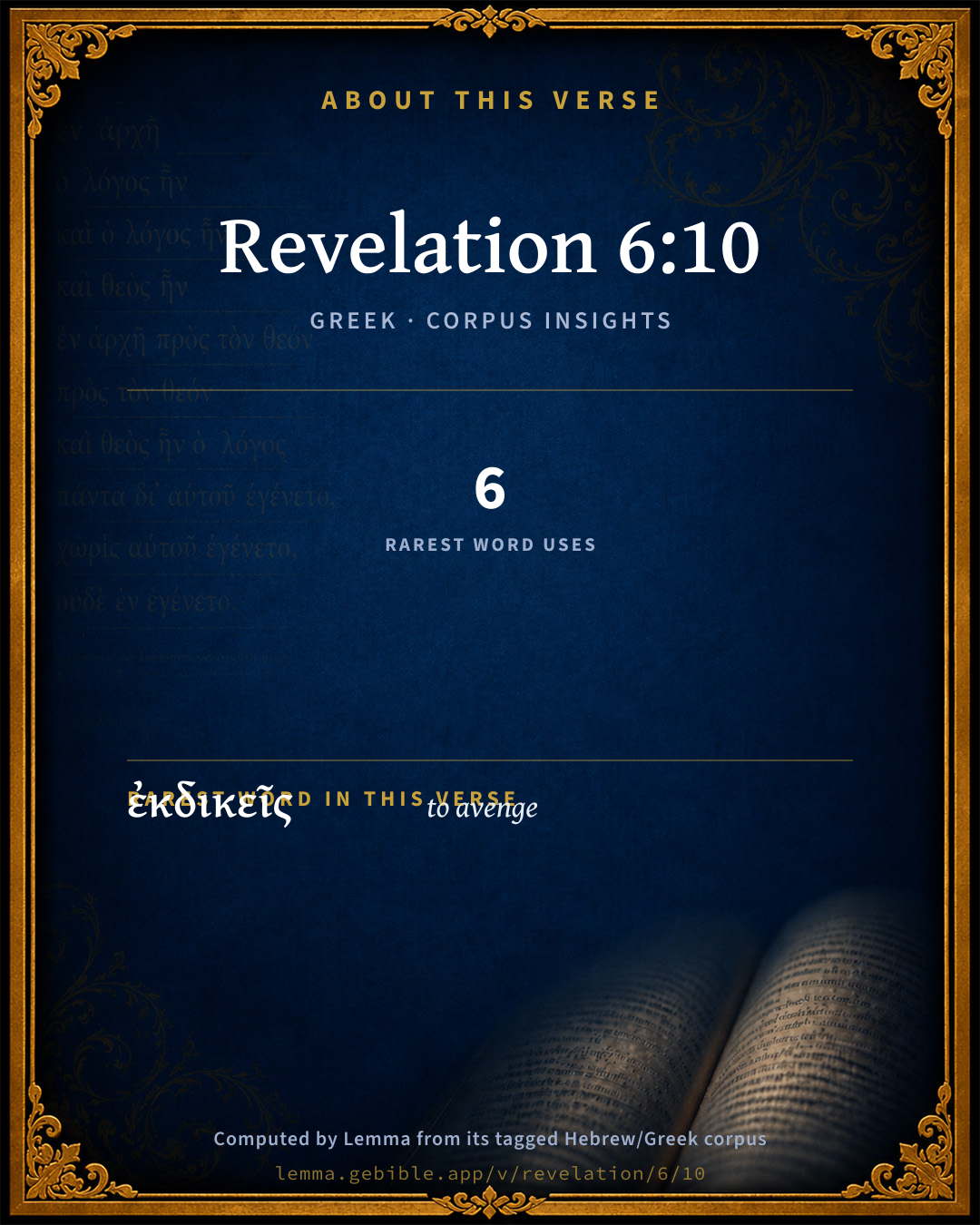
The rarest word here is ἐκδικεῖς to avenge G1556 — appearing just 6 times in the whole Greek New Testament.

Shared distinctive vocabulary

ἐκδικεῖς to avenge G1556 occurs in 6 verses of the Greek New Testament. Also found in:

Repetition

Words recur within this verse:

Cross-references

29

Topical passages linked to Revelation 6:10 in the Treasury of Scripture Knowledge — connected by theme and wording, ordered by reader-vote popularity; previews shown in the World English Bible.

  • Revelation 19:2 for true and righteous are his judgments. For he has judged the great prostitute, who corrupted the earth with her sexual immorality, and he has avenged the blood of his servants at her hand."
  • Psalms 9:12 For he who avenges blood remembers them. He doesn't forget the cry of the afflicted.
  • Revelation 11:18 The nations were angry, and your wrath came, as did the time for the dead to be judged, and to give your bondservants the prophets, their reward, as well as to the saints, and those who fear your name, to the small and the great; and to destroy those who destroy the earth."
  • Luke 18:7–8 Won't God avenge his chosen ones, who are crying out to him day and night, and yet he exercises patience with them?
  • Romans 12:19 Don't seek revenge yourselves, beloved, but give place to God's wrath. For it is written, "Vengeance belongs to me; I will repay, says the Lord."
  • 2 Thessalonians 1:6–8 Since it is a righteous thing with God to repay affliction to those who afflict you,
  • Revelation 16:5–7 I heard the angel of the waters saying, "You are righteous, who are and who were, you Holy One, because you have judged these things.
  • Luke 21:22 For these are days of vengeance, that all things which are written may be fulfilled.
  • Revelation 3:7 "To the angel of the assembly in Philadelphia write: "He who is holy, he who is true, he who has the key of David, he who opens and no one can shut, and who shuts and no one opens, says these things:
  • Zechariah 1:12 Then the angel of Yahweh replied, "O Yahweh of Hosts, how long will you not have mercy on Jerusalem and on the cities of Judah, against which you have had indignation these seventy years?"
  • Revelation 18:20 Rejoice over her, O heaven, you saints, apostles, and prophets; for God has judged your judgment on her."
  • Deuteronomy 32:36–43 For Yahweh will judge his people, Repent himself for his servants; When he sees that [their] power is gone, There is none [remaining], shut up or left at large.
  • Revelation 15:3–4 They sang the song of Moses, the servant of God, and the song of the Lamb, saying, "Great and marvelous are your works, Lord God, the Almighty; Righteous and true are your ways, you King of the nations.
  • Genesis 4:10 Yahweh said, "What have you done? The voice of your brother's blood cries to me from the ground.
  • 1 Samuel 24:12 Yahweh judge between me and you, and Yahweh avenge me of you; but my hand shall not be on you.
  • Psalms 58:10–11 The righteous shall rejoice when he sees the vengeance. He shall wash his feet in the blood of the wicked;
  • Psalms 79:10 Why should the nations say, "Where is their God?" Let it be known among the nations, before our eyes, That vengeance for your servants' blood is being poured out.
  • Isaiah 63:1–6 Who is this who comes from Edom, with dyed garments from Bozrah? this who is glorious in his clothing, marching in the greatness of his strength? I who speak in righteousness, mighty to save.
  • Revelation 18:24 In her was found the blood of prophets and of saints, and of all who have been slain on the earth."
  • Judges 16:28 Samson called to Yahweh, and said, Lord Yahweh, remember me, Please, and strengthen me, Please, only this once, God, that I may be at once avenged of the Philistines for my two eyes.
  • Psalms 74:9–10 We see no miraculous signs. There is no longer any prophet, Neither is there among us anyone who knows how long.
  • Hebrews 12:24 to Jesus, the mediator of a new covenant, and to the blood of sprinkling that speaks better than that of Abel.
  • Revelation 3:10 Because you kept my command to endure, I also will keep you from the hour of testing, which is to come on the whole world, to test those who dwell on the earth.
  • Psalms 13:1 How long, Yahweh? Will you forget me forever? How long will you hide your face from me?
  • Psalms 35:17 Lord, how long will you look on? Rescue my soul from their destruction, My precious life from the lions.
  • Psalms 94:3–4 Yahweh, how long will the wicked, How long will the wicked triumph?
  • Isaiah 61:2 to proclaim the year of Yahweh's favor, and the day of vengeance of our God; to comfort all who mourn;
  • Daniel 12:6 One said to the man clothed in linen, who was above the waters of the river, How long shall it be to the end of these wonders?
  • Daniel 8:13 Then I heard a holy one speaking; and another holy one said to that certain one who spoke, How long shall be the vision [concerning] the continual [burnt-offering], and the disobedience that makes desolate, to give both the sanctuary and the host to be trodden under foot?

Cross-references courtesy of OpenBible.info (CC BY 4.0).

Commentary

Notes on Revelation 6:10 from classic Christian and Jewish commentators (each source and its license shown beneath its notes). The classic Christian expositions comment on the surrounding passage and are grouped to its opening verse, so a note may address several verses; the Jewish commentaries on the Tanakh (Rashi and others) are per-verse, so they appear only where the commentator wrote on this verse.

Lemma curates 59 commentaries, every one of them public domain or Creative Commons licensed, each selected and text-cleaned for this edition rather than reprinted as found. About our sources →

Ellicott's Commentary for English Readers

(10) How long . . .?—Better. Until when. O Master (the word is the correlative of “servant,” see Rev_6:10) the Holy and True, dost Thou not judge and avenge our blood from (on) those who dwell on the earth? By a dramatic figure the persecuted and slain ones are represented as crying for retribution on their oppressors. It is not the Christians themselves (Luk_23:34; and Act_7:60) who cry for vengeance, any more than it was Abel himself who cried from the ground to God: it was the blood of Abel (Gen_4:10), the earth disclosed her blood, and refused to cover her slain. The forgotten or ignored wrongs of generations come forth from oblivion and cry for vengeance. It is a poetical description, but it is not fiction. The righteous blood shed does fall upon the world in retribution: the laws of God avenge themselves, though the victims do not live to behold the reward of the ungodly. On the epithets Holy and True, see Notes on Rev_3:7.

A Bible Commentary for English Readers, edited by Charles John Ellicott (1878–1897) — public domain. Text from a community e-Sword module.

Tyndale Open Study Notes

Tyndale Open Resources

6:10 The martyrs shouted to the Sovereign Lord because they trusted in his power to redress their grievances. • how long: Is God slow to act? Will justice be done? God does act decisively (see 6:12-14); his wrath (6:16-17) must be understood in terms of justice, fairness, and righteousness (see Exod 34:5-7; Neh 9:17; Pss 103:8; 145:8; Joel 2:13; Jon 4:2; Rom 2:6-11). • avenge our blood: This cry for God’s justice follows the pattern of imprecatory (vengeance) psalms (see Pss 6:3; 74:10; 79:5; 80:4; 137:1-9). It also reflects the covenant curses of Deut 28:53-57; 32:35 (quoted in Rom 12:19).

Tyndale Open Study Notes — © Tyndale Open Resources, licensed CC BY-SA 4.0. Text via the HelloAO Bible API.

Expositor's Greek Testament

ed. W. Robertson Nicoll

Rev 6:10 . Like Clem. Rom., John is fond of δεσπότης as implying the divine might and majesty ( 3Ma 3:29 ; 3Ma 5:28 ). This severe and awe-inspiring conception ( cf. Philo, quis rer. div. haer. 6) means that God will vindicate his holiness, which had been outraged by the murder of the δοῦλοι for whom he is responsible. In contemporary pagan religions throughout Asia Minor, the punishment of wrong-doing is often conceived in the same way, viz. , as the answer to the sufferer’s appeal ( cf. Introd. § 2), not simply as a spontaneous act of divine retribution. “How long wilt thou refrain from charging and avenging our blood upon ( ἐκ as in 1Sa 24:13 , Psa 42:1 ) those who dwell on the earth” ( i.e. , pagans)? The bleeding heart of primitive Christendom stands up and cries, “I have suffered”. For ἐκδικεῖν αἷμα cf. Dittenberger’s Sylloge Inscript. Graec. 816 (1 cent. A.D.) ἵνα ἐγδικήσῃς τὸ αἷμα τὸ ἀναίτιον , etc.; for ἐκδ . ἐκ (= מן ) of vengeance, cf. Luk 18:3-8 ( ἀπὸ ), a close parallel in thought, though this pathetic, impatient thirst for blood-revenge, which has “the full drift of Psa 94 below it” (Selwyn) is inferior not only to 1Pe 2:23 but to the synoptic wail. The Jewish atmosphere is unmistakable ( cf. 2Ma 7:36 ; also Deissmann’s Licht vom Osten , 312 f.), but this does not mean that the passage was necessarily written by a Jew. In that case we should have expected some allusion to the vicarious, atoning power of the martyrs’ death ( R. J. 181). The prophet evidently anticipated further persecution, since he wrote on the verge of the end precipitated by the Domitianic policy ( cf. on Rev 2:13 ). Such persecution follows natural disturbances, as in the synoptic apocalypse (Mat 24:6-7 ; Mat 24:21 f.), but the outline of the fifth seal is taken from Enoch, where (xlvii.) the prayer and blood of the martyred saints “rise from the earth before the Lord of Spirits,” while the angels rejoice that such blood has not been shed in vain. In En. xcvii. 3 5 the prayer of the righteous for vengeance overtakes their persecutors on the day of judgment with woeful issues (xxix. 3, 16). “Persist in your cry for judgment, and it shall appear unto you; for all your tribulation will be visited on the rulers, and on all their helpers, and on those who plundered you” (civ. 3, cf. xxii. 6, 7, where Abel’s pirit complains of Cain). κατ . κ . τ . λ . always in Apocalypse opposed to the saints, almost as “the world” to “the pious” in modern phraseology. This usage is largely paralleled by that of the Noachic interpolations in Enoch (see Charles on xxxvii. 5), where the phrase has either unfavourable or neutral associations. ἅγιος here (as Joh 17:11 = Did. x. 3, πανάγιος Clem. Rom. xxxv. 3, lviii. 1) applied by a comparatively rare usage (1Pe 1:15 and Rev 4:8 being dependent on O.T.) to God, whose intense holiness must be in antagonism to the evil and contradictions of the world (Titius, 9 11).

The Expositor's Greek Testament, edited by W. Robertson Nicoll (1897–1910) — public domain. Text from a community e-Sword module.

Jamieson, Fausset & Brown

Robert Jamieson, A. R. Fausset & David Brown

How long--Greek, "Until when?" As in the parable the woman (symbol of the Church) cries day and night to the unjust judge for justice against her adversary who is always oppressing her (compare below, Rev 12:10); so the elect (not only on earth, but under Christ's covering, and in His presence in Paradise) cry day and night to God, who will assuredly, in His own time, avenge His and their cause, "though He bear long with them." These passages need not be restricted to some particular martyrdoms, but have been, and are receiving, and shall receive partial fulfilments, until their last exhaustive fulfilment before Christ's coming. So as to the other events foretold here. The glory even of those in Paradise will only be complete when Christ's and the Church's foes are cast out, and the earth will become Christ's kingdom at His coming to raise the sleeping saints.

Lord--Greek, "Master"; implying that He has them and their foes and all His creatures as absolutely at His disposal, as a master has his slaves; hence, in Rev 6:11, "fellow servants," or fellow slaves follows.

holy--Greek, "the Holy one."

avenge--"exact vengeance for our blood."

on--Greek, "from them."

that dwell on the earth--the ungodly, of earth, earthly, as distinguished from the Church, whose home and heart are even now in heavenly places.

Jamieson, Fausset & Brown — Commentary Critical and Explanatory on the Whole Bible (1871) — public domain (CC PDM 1.0). Text via the HelloAO Bible API.

Adam Clarke's Commentary

Verse 10. And they cried with a loud voice] That is, their blood, like that of Abel, cried for vengeance; for we are not to suppose that there was any thing like a vindictive spirit in those happy and holy souls who had shed their blood for the testimony of Jesus. We sometimes say Blood cries for blood; that is, in the order of Divine justice, every murderer, and every murdering persecutor, shall be punished.

O Lord] ο δεσποτης Sovereign Lord, supreme Ruler; one having and exercising unlimited and uncontrolled authority.

Holy] In thy own nature, hating iniquity;

And true] In all thy promises and threatenings;

Dost thou not judge] The persecutors;

And avenge our blood] Inflict signal punishment;

On them that dwell on the earth?] Probably meaning the persecuting Jews; they dwelt επιτηςγης, upon that land, a form of speech by which Judea is often signified in the New Testament.

Adam Clarke's Commentary on the Bible (1810–1826) — public domain. Text from a community e-Sword/MySword module.

The Cambridge Bible for Schools and Colleges

gen. ed. J. J. S. Perowne

10. How long] Cf. Psa_94:3.

O Lord] Not the ordinary word of reverence applied to God, but one meaning (as we say) “lord and master.” It is used of God in Luk_2:29, Act_4:24; and of Christ in Judges 4 (according to the right reading and probable translation), 2Pe_2:1. Perhaps, as the usual word “Lord” in the N. T. and other Hellenistic writings stands for the Name Jehovah, so this is used where the sense “Lord” is really meant, i.e. it answers to the name Adonai, which the Jews pronounced instead of the Unutterable Name, and which Symeon and the Apostolic Church no doubt used in their thanksgivings. Their use of the word, especially in the latter instance, shews that it is no argument for these Martyrs being only Jews—as though it proved a servile rather than filial spirit, as some have imagined: at most, it only proves Jewish habits of expression, and it needs no proof that such prevail throughout this Book.

dost thou not … avenge] It has been argued again from this, that the temper of the Martyrs’ souls is less than Christian. But however right it may be to contrast 2Ch_24:22 with Act_7:60, no one can surely imagine that the spirit of this passage is a selfish desire for personal vengeance. As we meet with the germ of the thought in Psa_94:3, so we have a developement of it, substantially identical with this, from the mouth of Christ Himself, Luk_18:2-8. Faith looks on evil with a hatred like God’s own—shares God’s will that it shall not triumph, and trusts in God that it will not: but without sharing the depth of God’s counsels, Who knows best how and when to overthrow it. Therefore the Church on earth (the probable meaning of the Widow) and the Saints in heaven, cry alike to God to execute His own purpose, and bring the reign of evil to an end—and He does not yet, but He surely will.

The Cambridge Bible for Schools and Colleges (gen. ed. J. J. S. Perowne; Cambridge University Press, 1878–1918) — public domain. Text from a community e-Sword module.

John Gill's Exposition

And they cried with a loud voice,.... With great ardour and fervency, being very pressing and importunate; and which shows that they were awake, and not asleep, and that the soul does not sleep with the body in the grave, or is after the death of that in a state of insensibility and inactivity, as some imagine:

saying, how long, O Lord, holy and true; the person they address is either the Lamb in the midst of the throne, with whom they were, and under the shelter of whom they were safe and happy; or God the Father, who sat upon the throne, whom they call "holy", because being so in his nature, and as appears in all his works, he could not but hate, and so revenge the evil that was done to them by their cruel persecutors; and whereas he is "true" to all his threatenings, as well as his promises, and faithful to every word of his, they doubted not but he would judge and avenge them of their enemies; but they seem desirous to know how long it would be first: saying,

dost thou not judge and avenge our blood on them that dwell on the earth? the men of the world, idolatrous persons, earthly princes, who had shed their blood; and which they desire not out of any sinful or malicious affection, but that the holiness and justice of God might appear, and also his truth and faithfulness in his promises to them, and threatenings to his enemies; and that God in all things might be glorified, and his church and people on earth might be supported and delivered; see Job 24:12.

John Gill's Exposition of the Whole Bible (1746–1763) — public domain (CC PDM 1.0). Text via the HelloAO Bible API.

Trapp's Complete Commentary

John Trapp

10 And they cried with a loud voice, saying, How long, O Lord, holy and true, dost thou not judge and avenge our blood on them that dwell on the earth?

Ver. 10. And they cried] When God intends deliverance to his people, he poureth out upon them "the spirit of grace and supplication," Zec 12:9-10.

How long, O Lord] Calvin had this speech always in his mouth, breathing out his holy desires in the behalf of the afflicted Churches, with whose sufferings he was more affected than with anything that befell himself. (Beza in Vita.)

Dost thou not judge and avenge] The glorified souls cannot be properly said to desire revenge; but the cry which they make must be understood to be the provocation of God to vengeance which their sufferings produce in the same sort as Abel’s blood is said to cry. (Thorndike.)

That dwell on the earth] In opposition to the inhabitants of heaven. As names written in heaven stand opposed to those that are written in the earth, Luk 10:20; Jer 17:13.

John Trapp, A Commentary or Exposition upon All the Books of the Old and New Testament (1647–1656) — public domain. Text from a community e-Sword module.

Matthew Poole's English Annotations

And they cried with a loud voice; their blood cried, or their souls cried to God,

saying, How long, O Lord, holy; and therefore thou canst not abide iniquity, and of all iniquity canst least abide innocent blood, which is the blood of thy saints, whose blood is precious in thy sight.

And true; and who art true to thy word of threatenings against blood thirsty men, and to thy promises for the deliverance of thy people.

Dost thou net judge and avenge our blood on them that dwell on the earth? Dost thou not judge our cause, and avenge us, who have committed vengeance to thee, not daring to avenge ourselves upon wicked men, who dwelling upon the earth are seen, and their practices known to and by thee, and are under thy power, so as thou canst at pleasure do it.

Matthew Poole's English Annotations on the Holy Bible (1683–1685) — public domain. Text from a community e-Sword/MySword module.

Whedon's Commentary on the Bible

Daniel D. Whedon

10. How long—Of course there was no literal utterance by martyred souls of these words. It is a dramatic form of expressing the profound thought that murdered innocence has a claim on the divine justice for timely retribution. The words are an inspired assurance that Jehovah holds himself bound to be not only holy and true, but retributively just. And this is strikingly recognised by Jesus himself in the parable of the unjust judge, and his closing words, so wonderfully like the present passage: “Shall not God avenge his own elect, which cry day and night unto him? I tell you that he will avenge them speedily.” Luk_18:7-8, where see our notes.

Judge—An appeal for either temporal retribution or for a speedy final judgment throne.

Them that dwell on the earth—The profane world; omitting all mention of the few saintly exceptions. So our Lord: “Ye shall be hated of all nations for my name’s sake.” Mat_24:9.

Daniel D. Whedon (gen. ed.), Commentary on the Old and New Testaments (1874–1909) — public domain. Text from a community e-Sword module.

The Pulpit Commentary

And they cried with a loud voice, saying; i.e. the souls cried. Ebrard, Dusterdieck, Hengstenberg, make "the slain" nominative, in contradistinction to the "souls," which is both unnecessary and unnatural. Zullig compares Gen_4:10, "The voice of thy brother"s blood crieth unto me from the ground." How long? (comp. Zec_1:12, Zec_1:13, "How long wilt thou not have mercy on Jerusalem? And the Lord answered with good words and comfortable words No doubt the souls waiting in Paradise are answered by "comfortable words," yet, not having lost their interest in earthly struggles, nor their longing for the triumphant vindication of God"s glory, they cry, "How long?," not as needing the time to be shortened for their own sakes, for they rest, though not yet entered into the fulness of God"s glory. O Lord, holy and true; O Master, the holy and true (Revised Version). "Master" (despothv) is the correlative of "servant" (doulov). This is the only instance of its occurrence in the Apocalypse. (On "true," see previous passages.) Deal thou not judge and avenge our blood. The cry is not a petition for personal revenge, but a request for the termination of those ills which for a time afflict man, and the termination of which must, by virtue of God"s eternal justice, be accompanied by visible retribution on the wicked. (Cf. Bede, "Those souls which offered themselves a living sacrifice to God pray eternally for his coming to judgment, not from any vindictive feeling against their enemies, but in a spirit of zeal and love for God"s glory and justice, mid for the coming of that day when sin, which is rebellion against him, will be destroyed, and their own bodies will be raised. And so in that prayer wherein Christ teaches us to forgive our enemies, we are also taught to say, "Thy kingdom come. The passage has given rise to varying interpretations, which are thought to be more consonant with the spirit of the gospel. Thus Williams would understand the souls to represent only the Old Testament saints, especially as it is not explicitly said that they died for the witness of Jesus, as in Rev_20:4. On them that dwell on the earth. That is, on the worldly, those who have taken the side of the world in its conflict with Christianity.

The Pulpit Commentary (1880–1919), ed. H.D.M. Spence-Jones & Joseph S. Exell — public domain. Text from a community e-Sword module.

John Wesley's Explanatory Notes

And they cried - This cry did not begin now, but under the first Roman persecution. The Roman themselves had already avenged the martyrs slain by the Jews on that whole nation. How long - They knew their blood would be avenged; but not immediately, as is now shown them. O Lord - The Greek word properly signifies the master of a family: it is therefore beautifully used by these, who are peculiarly of the household of God. Thou Holy One and true - Both the holiness and truth of God require him to execute judgment and vengeance. Dost thou not judge and avenge our blood? - There is no impure affection in heaven: therefore, this desire of theirs is pure and suitable to the will of God. The martyrs are concerned for the praise of their Master, of his holiness and truth: and the praise is given him, chap. xix, 2, where the prayer of the martyrs is changed into a thanksgiving:- Thou holy One and true: "True and right are thy judgments." How long dost thou not judge "He hath judged the great whore, and avenge our blood? and hath avenged the blood of his servants."

John Wesley, Explanatory Notes Upon the Whole Bible (1754–1765) — public domain. Text via the GEBible commentary corpus.

The People's New Testament

B. W. Johnson

10. And they cried with a loud voice. Their cry denotes that the church had suffered long and severely, and they raise a cry for deliverance.

B. W. Johnson's The People's New Testament with Notes (1889–1891) — public domain. Electronic text from the Christian Classics Ethereal Library (CCEL) ThML edition.

Cambridge Greek Testament for Schools and Colleges

10. ἔκραξαν φωνῇ μεγάλῃ, λέγοντες. Hipp[245] reads καὶ ἐβόησαν καὶ εἶπον πρὸς τὸν θεόν.

[245] St Hippolytus. The readings not given by Tischendorf are from the newly published 4th book of his commentary on Daniel.

10. ἕως πότε. Psalms 94 (93 LXX.):3 ἕως πότε ἁμαρτωλοὶ κύριε, ἕως πότε ἁμαρτωλοὶ καυχήσονται;

ὁ δεσπότης. Not the ordinary word of reverence applied to God, but one meaning (as we say) “lord and master.” It is used of God in Luk 2:29; Act 4:24, and of Christ in Jud 1:4 (according to the right reading and probable translation); 2Pe 2:1. Perhaps, as the usual word “Lord” in the N.T. and other Hellenistic writings stands for the Name Jehovah, so this is used where the sense “Lord” is really meant, i.e. it answers to the name Adonai, which the Jews pronounced instead of the Unutterable Name, and which Symeon and the Apostolic Church no doubt used in their thanksgivings. The use of the word after the Incarnation, and especially after the Ascension, shews that it is no argument for these Martyrs being only Jews—as though it proved a servile rather than filial spirit, as some have imagined: at most, it only proves Jewish habits of expression, and it needs no proof that such prevail throughout this Book.

οὐ κρίνεις καὶ ἐκδικεῖς. It has been argued again from this, that the temper of the Martyrs’ souls is less than Christian. But however right it may be to contrast 2Ch 24:22 with Act 7:60, no one can surely imagine that the spirit of this passage is a selfish desire for personal vengeance. As we meet with the germ of the thought in Psa 94:3, so we have a developement of it, substantially identical with this, from the mouth of Christ Himself, Luk 18:2-8. Faith looks on evil with a hatred like God’s own—shares God’s will that it shall not triumph and trusts in God that it will not: but without sharing the depth of God’s counsels, Who knows best how and when to overthrow it. Therefore the Church on earth (the probable meaning of the Widow) and the Saints in heaven cry alike to God to execute His own purpose, and bring the reign of evil to an end—and He does not yet, but He surely will.

Cambridge Greek Testament for Schools and Colleges (Cambridge University Press, 1896; 21 vols, various authors incl. Carr, Maclear, Plummer, Farrar, Lumby, Moule, M. R. James, Simcox) — public domain. Text from a community e-Sword module.

Vincent's Word Studies in the New Testament

Marvin R. Vincent

They cried [εκραζον] . See on Mr 5:5.

How long [εως ποτε] . Lit., until when. Compare Zec 1:12.

O Lord [ο δεσποτης] . See on 2Pe 2:1. Only here in Revelation. Addressed to God rather than to Christ, and breathing, as Professor Milligan remarks, "the feeling of Old Testament rather than of New Testament relation." Compare Act 4:24; Jude 1:4.

True [αληθινος] . See on Joh 1:9; Rev 3:7.

Judge [κρινεις] . Originally the verb means to separate; thence the idea of selection : to pick out, and so to discriminate or judge.

Avenge [εκδικεις] . Compare Luk 18:3; Rom 12:19.

On the earth [επι της γης] . Earth, in Revelation, is generally to be understood of the ungodly earth.

Marvin R. Vincent, Word Studies in the New Testament (1887–1900) — public domain. Text from a community e-Sword/MySword module.

Lesson kit

Teaching starters — assembled from the data on this page, not authored interpretation. Every prompt links to the verse data it draws on. Edit before teaching.

Revelation, in the Revelation, opens this verse with 26 words (20 distinct Greek lemmas). Its most distinctive word is ekdikéō (“to avenge”). A historical commentator’s framing appears above. Read the whole chapter for the surrounding context.

Discussion questions

  1. What does “to avenge” (ekdikéō) contribute to the verse as a whole?
  2. Luke 18:3 shares the word «to avenge» with this verse. How do the two illuminate each other?
  3. “the” occurs 5× in this one verse. What is the effect of the repetition?
  4. These translations render this verse differently. What is at stake in choosing one wording over another?
  5. Reading how Ellicott's Commentary for English Readers and Tyndale Open Study Notes read this verse, where do the two commentators agree and where do they part?

Things to notice

Reading settings

Reading text

Shown beneath each verse's original-language words.

Old Testament
Old Testament edition

Read the OT as the Masoretic Hebrew (MT) or the Greek Septuagint (LXX).

English shown for the Greek Septuagint (in the Hebrew ↔ Greek comparison).

Comparing translations? Open the Compare panel on any verse page to stack up to four side by side.