Revelation 12:4

Greek (Tischendorf 8th ed.) Revelation 12:4 appears in the Greek New Testament. The text above is from the Tischendorf 8th edition. Each word links to its Strong’s number and a concise gloss. Click any word for its full Thayer’s Greek Lexicon entry.
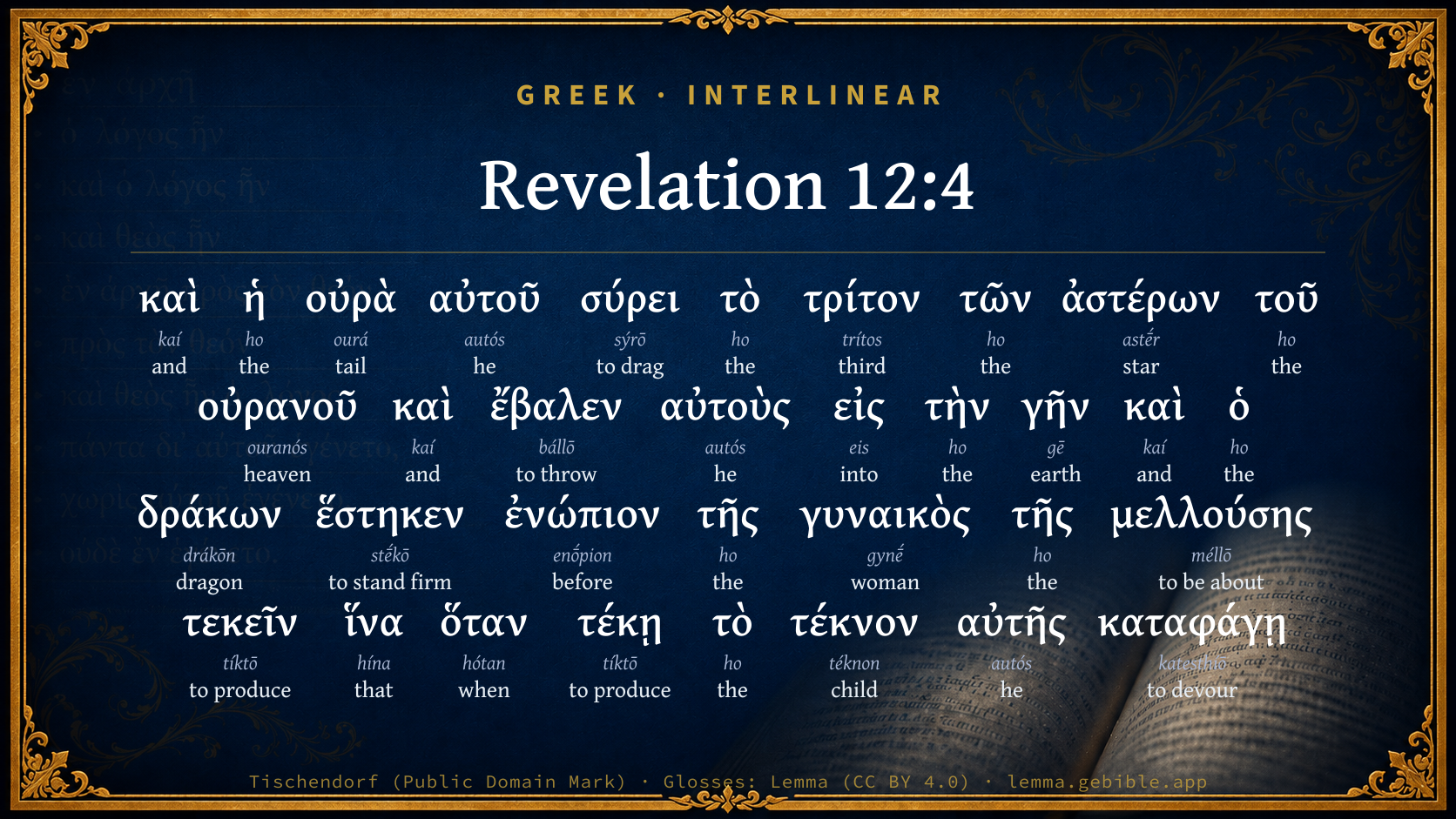
Download image
Cite this verse

Revelation 12:4 (World English Bible). Public Domain. Lemma interlinear Bible study tool, https://lemma.gebible.app/v/revelation/12/4.

Show BibTeX & RIS
BibTeX
RIS
English Translation
His tail drew one third of the stars of the sky, and threw them to the earth. The dragon stood before the woman who was about to give birth, so that when she gave birth he might devour her child.
World English Bible · Public Domain
Download a study sheet

One document with this verse’s original text, its word-by-word gloss line, the meaning frame, cross-references with their text, attributed commentary, and full source and license credits — printable, and it pastes into notes with its structure intact.

This verse Autodidact and up

Study sheet (.html) Plain text (.txt)

A passage Seminary Student

Up to 50 verses in one chapter. A passage sheet keeps up to 6 commentary sources and 12 cross-references per verse, in the order this page ranks them, and says so on the sheet whenever that leaves anything out. Ask for a single verse and you get the Autodidact verse sheet above.

Everything on this page stays free to read, with no account — the sheet is a download of what is already on screen, not access to it.

Want to remove ads? Support Godless Engineer
Compare translations 3

The same verse in 3 English versions, stacked beneath the original-language interlinear above. Click any original word for its lexicon entry.

Each is an independent rendering of the whole verse — the interlinear is not word-aligned to these translations.

Highlighted words mark where these versions differ — a whole-verse word diff, not a word-by-word alignment.

  • World English Bible Public Domain
    His tail drew one third of the stars of the sky, and threw them to the earth. The dragon stood before the woman who was about to give birth, so that when she gave birth he might devour her child.
  • King James Version Public Domain
    And his tail drew the third part of the stars of heaven, and did cast them to the earth: and the dragon stood before the woman which was ready to be delivered, for to devour her child as soon as it was born.
  • unfoldingWord Literal Text CC BY-SA 4.0
    And his tail sweeps away a third of the stars of heaven and hurled them down to the earth. And the dragon stood before the woman being about to give birth so that when she gave birth he might devour her child.

unfoldingWord Literal Text — © unfoldingWord, licensed CC BY-SA 4.0. Word-aligned USFM3 via Door43 (git.door43.org/unfoldingWord/en_ult).

Versions to compare (up to 4)

3 of 4 selected

Show all 19 translations

Every available English version of this verse, each an independent rendering of the whole verse.

  • World English Bible Public Domain
    His tail drew one third of the stars of the sky, and threw them to the earth. The dragon stood before the woman who was about to give birth, so that when she gave birth he might devour her child.
  • Berean Standard Bible Public Domain
    His tail swept a third of the stars from the sky, tossing them to the earth. And the dragon stood before the woman who was about to give birth, ready to devour her child as soon as she gave birth.
  • Majority Standard Bible Public Domain
    His tail swept a third of the stars from the sky, hurling them to the earth. And the dragon stood before the woman who was about to give birth, ready to devour her child as soon as she gave birth.
  • King James Version Public Domain
    And his tail drew the third part of the stars of heaven, and did cast them to the earth: and the dragon stood before the woman which was ready to be delivered, for to devour her child as soon as it was born.
  • American Standard Version (1901) Public Domain
    And his tail draweth the third part of the stars of heaven, and did cast them to the earth: and the dragon standeth before the woman that is about to be delivered, that when she is delivered he may devour her child.
  • Revised Version (1885) Public Domain
    And his tail draweth the third part of the stars of heaven, and did cast them to the earth: and the dragon stood before the woman which was about to be delivered, that when she was delivered he might devour her child.
  • Geneva Bible (1599) Public Domain
    And his taile drew the thirde part of the starres of heauen, and cast them to the earth. And the dragon stood before the woman, which was ready to be deliuered, to deuoure her childe, when shee had brought it foorth.
  • Douay-Rheims (1899) Public Domain
    And his tail drew the third part of the stars of heaven, and cast them to the earth: and the dragon stood before the woman who was ready to be delivered; that, when she should be delivered, he might devour her son.
  • Young's Literal Translation Public Domain
    and his tail doth draw the third of the stars of the heaven, and he did cast them to the earth; and the dragon did stand before the woman who is about to bring forth, that when she may bring forth, her child he may devour;
  • Literal Standard Version CC BY-SA 4.0
    and his tail draws the third of the stars of the sky, and he cast them to the earth; and the dragon stood before the woman who is about to bring forth, that when she may bring forth, he may devour her child;
  • Unlocked Literal Bible CC BY-SA 4.0
    His tail swept away a third of the stars in heaven and hurled them down to the earth. The dragon stood before the woman who was about to give birth, so that when she gave birth, he would devour her child.
  • unfoldingWord Literal Text CC BY-SA 4.0
    And his tail sweeps away a third of the stars of heaven and hurled them down to the earth. And the dragon stood before the woman being about to give birth so that when she gave birth he might devour her child.
  • Darby Bible Public Domain
    and his tail draws the third part of the stars of the heaven; and he cast them to the earth. And the dragon stood before the woman who was about to bring forth, in order that when she brought forth he might devour her child.
  • World Messianic Bible Public Domain
    His tail drew one third of the stars of the sky, and threw them to the earth. The dragon stood before the woman who was about to give birth, so that when she gave birth he might devour her child.
  • Webster's Bible Public Domain
    And his tail drew the third part of the stars of heaven, and cast them to the earth: and the dragon stood before the woman who was ready to be delivered, to devour her child as soon as it was born.
  • Free Bible Version CC BY-SA 4.0
    His tail swept away a third of the stars of heaven and threw them down to the earth. The dragon stood right in front of the woman who was giving birth, so that he could eat her child as soon as it was born.
  • Bible in Basic English Public Domain
    And his tail was pulling a third part of the stars of heaven down to the earth, and the dragon took his place before the woman who was about to give birth, so that when the birth had taken place he might put an end to her child.
  • Text-Critical English NT CC BY 4.0
    His tail swept down a third of the stars of heaven and hurled them to the earth. Then the dragon stood in front of the woman who was about to give birth, so that when she gave birth he could devour her child.
  • Tyndale New Testament (1534) Public Domain
    and his tayle drue the thyrde parte of the starres and cast them to the erth. And the dragon stode before the woman which was reddy to be delyvred: for to devoure her chylde as sone as it were borne.

Literal Standard Version (2020), Covenant Press — licensed CC BY-SA 4.0. Text via the HelloAO Bible API (eBible.org). Unlocked Literal Bible (unfoldingWord) — licensed CC BY-SA 4.0. Text via the HelloAO Bible API (eBible.org). unfoldingWord Literal Text — © unfoldingWord, licensed CC BY-SA 4.0. Word-aligned USFM3 via Door43 (git.door43.org/unfoldingWord/en_ult). Free Bible Version, Dr. Jonathan Gallagher — licensed CC BY-SA 4.0. Text via the HelloAO Bible API (eBible.org).

Word by word

More ways to search: Search by grammar → Find every occurrence → Compare this word →

Practice this passage: Drill this verse → Learn its vocabulary →

οὐρὰ
ourá
G3769
“tail”
Noun, Nominative, Singular, Feminine
Part of Speech
Noun
Case
Nominative
Number
Singular
Gender
Feminine
Full Thayer's Definition

Origin: apparently a root word

TDNT: None

1. a tail
  1. καὶ kaí G2532 “and” Conjunction
  2. ἡ ho G3588 “the” Article, Nominative, Singular, Feminine
  3. αὐτοῦ autós G846 “he” Personal pronoun, Genitive, Singular, Masculine
  4. σύρει sýrō G4951 “to drag” Verb, Present, Active, Indicative, 3rd person, Singular
  5. τὸ ho G3588 “the” Article, Accusative, Singular, Neuter
  6. τρίτον trítos G5154 “third” Adjective, Accusative, Singular, Neuter
  7. τῶν ho G3588 “the” Article, Genitive, Plural, Masculine
  8. ἀστέρων astḗr G792 “star” Noun, Genitive, Plural, Masculine
  9. τοῦ ho G3588 “the” Article, Genitive, Singular, Masculine
  10. οὐρανοῦ ouranós G3772 “heaven” Noun, Genitive, Singular, Masculine
  11. καὶ kaí G2532 “and” Conjunction
  12. ἔβαλεν bállō G906 “to throw” Verb, Aorist, Active, Indicative, 3rd person, Singular
  13. αὐτοὺς autós G846 “he” Personal pronoun, Accusative, Plural, Masculine
  14. εἰς eis G1519 “into” Preposition
  15. τὴν ho G3588 “the” Article, Accusative, Singular, Feminine
  16. γῆν gē G1093 “earth” Noun, Accusative, Singular, Feminine
  17. καὶ kaí G2532 “and” Conjunction
  18. ὁ ho G3588 “the” Article, Nominative, Singular, Masculine
  19. δράκων drákōn G1404 “dragon” Noun, Nominative, Singular, Masculine
  20. ἕστηκεν stḗkō G4739 “to stand firm” Verb, Imperfect, Active, Indicative, 3rd person, Singular
  21. ἐνώπιον enṓpion G1799 “before” Adverb
  22. τῆς ho G3588 “the” Article, Genitive, Singular, Feminine
  23. γυναικὸς gynḗ G1135 “woman” Noun, Genitive, Singular, Feminine
  24. τῆς ho G3588 “the” Article, Genitive, Singular, Feminine
  25. μελλούσης méllō G3195 “to be about” Verb, Present, Active, Participle, Genitive, Singular, Feminine
  26. τεκεῖν tíktō G5088 “to produce” Verb, Aorist, Active, Infinitive
  27. ἵνα hína G2443 “that” Conjunction
  28. ὅταν hótan G3752 “when” Conjunction
  29. τέκῃ tíktō G5088 “to produce” Verb, Aorist, Active, Subjunctive, 3rd person, Singular
  30. τὸ ho G3588 “the” Article, Accusative, Singular, Neuter
  31. τέκνον téknon G5043 “child” Noun, Accusative, Singular, Neuter
  32. αὐτῆς autós G846 “he” Personal pronoun, Genitive, Singular, Feminine
  33. καταφάγῃ katesthíō G2719 “to devour” Verb, Aorist, Active, Subjunctive, 3rd person, Singular

About this verse

These counts appear in no published source. They are computed here, from the morphology-tagged text and Lemma’s own curated glosses. What Lemma adds →

34
words
21
distinct lemmas
Revelation
section

Notable vocabulary

The rarest word here is οὐρὰ tail G3769 — appearing just 5 times in the whole Greek New Testament.

Shared distinctive vocabulary

οὐρὰ tail G3769 occurs in 3 verses of the Greek New Testament. Also found in:

Repetition

Words recur within this verse:

  • τεκεῖν to produce G5088 ×2
  • ἡ the G3588 ×9
  • καὶ and G2532 ×3
  • αὐτοῦ he G846 ×3

Cross-references

10

Topical passages linked to Revelation 12:4 in the Treasury of Scripture Knowledge — connected by theme and wording, ordered by reader-vote popularity; previews shown in the World English Bible.

  • Daniel 8:9–12 Out of one of them came forth a little horn, which grew exceeding great, toward the south, and toward the east, and toward the glorious [land].
  • Revelation 12:9 The great dragon was thrown down, the old serpent, he who is called the devil and Satan, the deceiver of the whole world. He was thrown down to the earth, and his angels were thrown down with him.
  • John 8:44 You are of your Father, the devil, and you want to do the desires of your father. He was a murderer from the beginning, and doesn't stand in the truth, because there is no truth in him. When he speaks a lie, he speaks on his own; for he is a liar, and the father of it.
  • Revelation 12:2–3 She was with child. She cried out in pain, laboring to give birth.
  • Exodus 1:16 and he said, "When you perform the duty of a midwife to the Hebrew women, and see them on the birth stool; if it is a son, then you shall kill him; but if it is a daughter, then she shall live."
  • Matthew 2:3–16 When Herod the king heard it, he was troubled, and all Jerusalem with him.
  • 1 Peter 5:8 Be sober and self-controlled. Be watchful. Your adversary the devil, walks around like a roaring lion, seeking whom he may devour.
  • Revelation 8:7 The first sounded, and there followed hail and fire, mixed with blood, and they were thrown to the earth. One third of the earth was burnt up, and one third of the trees were burnt up, and all green grass was burnt up.
  • Revelation 9:10 They have tails like those of scorpions, and stings. In their tails they have power to harm men for five months.
  • Revelation 9:19 For the power of the horses is in their mouths, and in their tails. For their tails are like serpents, and have heads, and with them they harm.

Cross-references courtesy of OpenBible.info (CC BY 4.0).

Commentary

Notes on Revelation 12:4 from classic Christian and Jewish commentators (each source and its license shown beneath its notes). The classic Christian expositions comment on the surrounding passage and are grouped to its opening verse, so a note may address several verses; the Jewish commentaries on the Tanakh (Rashi and others) are per-verse, so they appear only where the commentator wrote on this verse.

Lemma curates 59 commentaries, every one of them public domain or Creative Commons licensed, each selected and text-cleaned for this edition rather than reprinted as found. About our sources →

Bengel's Gnomon

Johann Albrecht Bengel

Rev 12:4. Καταφάγῃ, to devour) The notion formerly prevailed with many persons, that serpents were accustomed eagerly to desire the flesh of new-born infants.—Pricæus.

Bengel's Gnomon of the New Testament — English translation (T&T Clark, Edinburgh, 1860) — public domain. Text from a community e-Sword module.

Expositor's Greek Testament

ed. W. Robertson Nicoll

Rev 12:4 . The symbolism is a reminiscence of an ætiological myth in astrology ( cf. the cauda of the constellation Scorpio) and of the primitive view which regarded the dark cloud as a snake enfolding the luminaries of heaven in its hostile coils (Job 3:8 ; Job 26:13 , with A. B. Davidson’s notes). Thus the Iranians ( S. B. E. iv. p. lxxiii., Darmesteter) described the fiend as a serpent or dragon not on the score of craftiness but “because the storm fiend envelops the goddess of light with the coils of the cloud as with a snake’s fold”. The same play of imagination would interpret eclipses and falling stars, and, when the pious were compared to stars (as in Egyptian theology, Plut. de Iside , 21), it was but a step to the idea of Dan 8 . ( cf. Sib. Or. ver. 512 f., the battle of the stars), where Antiochus Epiphanes does violence to some devout Israelites who are characterised as stars flung rudely down to earth ( i.e. , martyred, 1 Maccabees 1.) Originally, this description of the dragon lashing his tail angrily and sweeping down a third of the stars probably referred to the seduction of angels from their heavenly rank (so 8 9) to serve his will (Weiss). But John, in recasting the tradition, may have thought of the Danielic application, i.e. , of the devil succeeding in crushing by martyrdom a certain number of God’s people. In this event, they would include at least, if they are not to be identified with, the pre-Christian martyrs of Judaism ( cf. Heb 11:32 f. Mat 23:35 ). ἕστηκεν , a conventional posture of the ancient dragon cf. e.g. , Pliny, H. N. viii. 3, “nec flexu multiplici ut reliquae serpentes corpus impellit, sed celsus et erectus in medio incedens”; ibid. viii. 14, for serpents devouring children. The mother of Zoroaster had also a vision of wild beasts waiting to devour her child at its birth. This international myth of the divine child menaced at birth readily lent itself to moralisation, or afforded terms for historical applications, e.g. , the abortive attack on Moses, the prototype of messiah (Baldensperger, 141, 142) at his birth (Act 7:20 f.) and the vain efforts of Herod against the messiah. The animosity of Pytho for Leto was due to a prophecy that the latter’s son would vanquish him.

The Expositor's Greek Testament, edited by W. Robertson Nicoll (1897–1910) — public domain. Text from a community e-Sword module.

Vincent's Word Studies in the New Testament

Marvin R. Vincent

:Rev12_4 Rev 12:4Of the stars of heaven. Some expositors find an allusion to the fallen angels (Jude 1:6).

Did cast them to the earth. Compare Dan 8:10.

To devour her child as soon as it was born [ινα οταν τεκη το τεκνον αυτης καταφαγη] . Rev., more literally, that when she was delivered he might devour her child. Professor Milligan says : "In these words we have the dragon doing what Pharaoh did to Israel (Exo 1:15 - 22), and again and again, in the Psalms and the Prophets, Pharaoh is spoken of as the dragon (Psa 74:13; Isa 27:1; Isa 51:9; Eze 29:3). Nor is it without interest to remember that Pharaoh 's crown was wreathed with a dragon (the asp or serpent of Egypt), and that just as the eagle was the ensign of Rome, so the dragon was that of Egypt. Hence the significance of Moses ' rod being turned into a serpent."

Marvin R. Vincent, Word Studies in the New Testament (1887–1900) — public domain. Text from a community e-Sword/MySword module.

Geneva Bible (1599)

Geneva Bible translators

He withstood that elect Church of the Jews which was now ready to bring forth the Christian Church, and watched for that she should bring forth. For the whole Church, and whole body is compared unto a woman: and a part of the Church unto that which is brought forth as we have noted at large upon, Cant. 7:6.

Christ mystical (as they call him) that is the whole Church, consisting of the person of Christ as the head, and of the body united thereunto by the Spirit, so is the name of Christ taken, 1 Cor. 12:12.

After the description of Satan followeth this action, that is, his battle offered unto the Church partly to that which is visible wherein the wheat is mingled with the chaff, and the good fish with that which is evil: a good part thereof, though in appearance it shined as the Stars shine in heaven, he is said to thrust down out of heaven and to pervert: for if it were possible he would pervert even the elect, Matt. 24:24, and partly to the elect members of the holy Catholic Church in the second part of this verse. Many therefore of the members of this visible Church (saith S. John) he overthrew and triumphed upon them.

Geneva Bible (1599) marginal notes — public domain. Text via Bolls.life.

Jamieson, Fausset & Brown

Robert Jamieson, A. R. Fausset & David Brown

drew--Greek, present tense, "draweth," "drags down." His dragging down the stars with his tail (lashed back and forward in his fury) implies his persuading to apostatize, like himself, and to become earthy, those angels and also once eminent human teachers who had formerly been heavenly (compare Rev 12:1; Rev 1:20; Isa 14:12).

stood--"stands" [ALFORD]: perfect tense, Greek, "hesteken."

ready to be delivered--"about to bring forth."

for to devour, &c.--"that when she brought forth, he might devour her child." So the dragon, represented by his agent Pharaoh (a name common to all the Egyptian kings, and meaning, according to some, crocodile, a reptile like the dragon, and made an Egyptian idol), was ready to devour Israel's males at the birth of the nation. Antitypically the true Israel, Jesus, when born, was sought for destruction by Herod, who slew all the males in and around Bethlehem.

Jamieson, Fausset & Brown — Commentary Critical and Explanatory on the Whole Bible (1871) — public domain (CC PDM 1.0). Text via the HelloAO Bible API.

Adam Clarke's Commentary

NOTES ON CHAP. XII., BY J. E. C.

Verse 4. And his tail drew the third part of the stars of heaven] It is not unusual in Scripture, as Dr. Mitchell observes, to call the hindmost of an enemy the tail, as in Jos 10:19: Ye shall cut off the hindmost of them, which is literally in Hebrew, אותם וזנבתם "Ye shall cut off their tail." See also De 25:18. It is also observable that the word ουρα, in this verse, has been used by the Greeks in the same sense with the Hebrew word זנב already referred to. Thus ουρα στρατου, which we would translate the rear of an army, is literally the tail of an army. See the Thesaurus of Stephens, in loc. The tail of the dragon is therefore the heathen Roman power in its seventh or last form of government, viz., the imperial power; and is not, as Dr. Mitchell supposes, to be restricted to the last heathen Roman emperors. The heathen imperial power is said to draw the third part of the stars of heaven, by which has generally been understood that the Roman empire subjected the third part of the princes and potentates of the earth. But that this is not a correct statement of the fact is evident from the testimony of ancient history. The Roman empire was always considered and called the empire of the world by ancient writers. See Dionys. Halicar., Antiq. Rom. lib. i., prope principium; Pitisci Lexicon Antiq. Roman., sub voc. imperium; Ovidii Fast., lib. ii. l. 683; Vegetius de Re Militari, lib. i. c. 1., c., c. And it is even so named in Scripture, for St. Luke, in the second chapter of his gospel, informs us that there went out a decree from Caesar Augustus that THE WHOLE WORLD should be taxed, by which is evidently meant the Roman empire. The whole mystery of this passage consists in the misapprehension of its symbolical language. In order therefore to understand it, the symbols here used must be examined. By heaven is meant the most eminent or ruling part of any nation. This is evident from the very nature of the symbol, for "heaven is God's throne" they therefore who are advanced to the supreme authority in any state are very properly said to be taken up into heaven, because they are raised to this eminence by the favour of the Lord, and are ministers of his to do his pleasure. And the calamity which fell upon Nebuchadnezzar was to instruct him in this important truth, that the heavens do rule that is, that all monarchs possess their kingdoms by Divine appointment, and that no man is raised to power by what is usually termed the chances of war, but that "the Most High ruleth in the kingdom of men, and giveth it to whomsoever he will, and setteth up over it the basest of men." The meaning of heaven being thus ascertained, it cannot be difficult to comprehend the meaning of earth, this being evidently its opposite, that is, every thing in subjection to the heaven or ruling part. Stars have already been shown to denote ministers of religion; and this is more fully evident from Re 1:16 of this book, where the seven stars which the Son of God holds in his right hand are explained to signify the seven angels (or messengers) of the seven Churches, by whom must be meant the seven pastors or ministers of these Churches. The resemblance of ministers to stars is very striking; for as the stars give light upon the earth, so are ministers the lights of the cause they advocate; and their position in heaven, the symbol of domination, very fitly betokens the spiritual authority of priests or ministers over their flocks. Hence, as the woman, or Christian Church, has upon her head a crown of twelve stars, which signifies that she is under the guidance of the twelve apostles, who are the twelve principal lights of the Christian world, so has the dragon also his stars or ministers. The stars therefore which the dragon draws with his tail must represent the whole body of pagan priests, who were the stars or lights of the heathen world. But in what sense can it be said that the heathen Roman empire, which ruled over the whole known world, only draws a third part of the stars of heaven? The answer is: The religious world in the time of St. John was divided into three grand branches, viz., the Christian world, the Jewish world, and the heathen and pagan world: consequently, as a dragon, a fabulous animal, is an emblem of a civil power supporting a religion founded in fable; it necessarily follows that the stars or ministers of the Jews and Christians cannot be numbered among those which he draws with his tail, as they were not the advocates of his idolatry, but were ministers of a religion founded by the God of heaven, and consequently formed no part of the pagan world, though they were in subjection in secular matters to the pagan Roman empire. The tail of the dragon therefore draweth after him the whole heathen world.

And did cast then to the earth] That is, reduced all the pagan priests under the Roman yoke. The words of the prophecy are very remarkable. It is said the tail of the dragon draweth, (for so συρει should be translated,) but it is added, and HATH CAST then upon the earth, to show that at the time the Apocalypse was written the world was divided into the three grand religious divisions already referred to; but that the tail of the dragon, or the pagan Roman power under its last form of government, had brought the whole heathen world (which was a third part of the religious world in the apostolic age) into subjection previously to the communication of the Revelation to St. John. It is the dragon's tail that draws the third part of the stars of heaven, therefore it was during the dominion of his last form of government that Christianity was introduced into the world; for in the time of the six preceding draconic forms of government, the world was divided religiously into only two grand branches, Jews and Gentiles. That the sense in which the third part is here taken is the one intended in the prophecy is put beyond all controversy, when it is considered that this very division is made in the first and third verses, in which mention is made of the woman clothed with the sun-the Christian Church, the moon under her feet, or Jewish Church, and the dragon, or heathen power. Thus the heathen IMPERIAL government is doubly represented, first, by one of the seven draconic heads, to show that it was one of those seven heathen forms of government which have been successively at the head of the Roman state; and secondly, by the dragon's tail, because it was the last of those seven. For a justification of this method of interpretation, see on the angel's double explanation of the heads of the beast, Rev 17:9; Rev 17:10; Rev 17:16.

And the dragon stood before the woman, c.] Constantius Chlorus, the father of Constantine, abandoned the absurdities of paganism, and treated the Christians with great respect. This alarmed the pagan priests, whose interests were so closely connected with the continuance of the ancient superstitions, and who apprehended that to their great detriment the Christian religion would become daily more universal and triumphant throughout the empire. Under these anxious fears they moved Diocletian to persecute the Christians. Hence began what is termed the tenth and last general persecution, which was the most severe of all, and continued nearly ten years (see Mosheim's Ecclesiastical History of the Third Century;) and as it was the Divine pleasure that, at this time, a great deliverer should be raised up in behalf of his suffering people, the woman, or Christian Church, is very appropriately represented as overtaken with the pangs of labour, and ready to be delivered. Before the death of Constantius, the heathen party, aware that Constantine would follow the example of his father, who so much favoured the Christians, beheld him with a watchful and malignant eye. Many were the snares that, according to Eusebius, were laid for him by Maximin and Galerius: he relates the frequent and dangerous enterprises to which they urged him, with the design that he might lose his life. When Galerius heard of the death of Constantius, and that he had appointed Constantine his successor, he was filled with the most ungovernable rage and indignation, notwithstanding he did not dare to take any steps contrary to the interest of Constantine. The dread of the armies of the west, which were mostly composed of Christians, was a sufficient check to all attempts of that kind. Thus the dragon, or heathen power, stood before the woman, or Christian Church, to devour her son, or deliverer, as soon as he was born. See Dr. Mitchell's Exposition of the Revelation, in loc.

Adam Clarke's Commentary on the Bible (1810–1826) — public domain. Text from a community e-Sword/MySword module.

Ellicott's Commentary for English Readers

(4) And his tail . . .—Translate, And his tail drags (or, sweeps) away the third part of the stars of the heaven, and casts them to the earth. The stars are the light- bearers, the illustrious of earth, who were given by God high place that they might be burning and shining lights for Him. A large proportion of these are drawn away in the train of evil; they are cast down from their high position of noble opportunities of good work and great work; they are dragged down from the height of the grandest possibilities of good to the low level of a life enslaved to evil.

And the dragon.—Translate, And the dragon stands (not “stood”) before the woman who is about to bring forth, that whenever she has brought forth he may devour her child. The spirit of evil is represented as ever on the watch to destroy the first tokens of better things. Our minds go back to the hatred and fear of Pharaoh, setting a watch for the offspring of Israel and ordering their destruction; and even more are we reminded of the jealous hatred of Herod seeking the life of the infant Christ. It seems clear that it is on this last incident that the present vision is primarily built up; but its meaning is much wider than this. It shows us that evermore, as Herod waited to destroy Christ, the devil, the old spirit whose malignity wrought through the fears of Pharaoh and of Herod, is on the watch to destroy every token of good and every resemblance to Christ in the world. The mission of the Church is to bring forth in her members this life of Christ before men: the aim of the wicked spirit is to destroy that life. The same hostility which was shown to the infant Christ is active against His children: “If they have persecuted Me, they will also persecute you.”

A Bible Commentary for English Readers, edited by Charles John Ellicott (1878–1897) — public domain. Text from a community e-Sword module.

The Cambridge Bible for Schools and Colleges

gen. ed. J. J. S. Perowne

4. And his tail drew] The great serpent crawls along the vault of the sky, and the wrigglings of his tail remove the stars from their places. “Drew” is literally draweth.

stood] Perhaps more accurately standeth.

for to devour her child] Symbolises the enmity of the serpent against the seed of the woman, beginning with the intended treachery of Herod, and massacre of the Innocents; but including also the malice that pursued Him through life, the temptation, and at last the Cross.

The Cambridge Bible for Schools and Colleges (gen. ed. J. J. S. Perowne; Cambridge University Press, 1878–1918) — public domain. Text from a community e-Sword module.

John Gill's Exposition

And his tail drew the third part of the stars of heaven, and did cast them to the earth,.... So Solinus (e) speaks of dragons that have power not only in their teeth, but in their tails, and do more hurt by striking than by biting; and the great serpent, which Attilius Regulus and his army fought with, not only destroyed many of his soldiers with its vast mouth, but dashed many to pieces with its tail (f); which serpent, Pliny (g) says, was a hundred and twenty foot long: this is said in allusion to Antiochus Epiphanes, in Dan 8:10; and designs either the subduing of the third part of the principalities, states, and kingdoms of the known world, to the Roman empire, through its great power and strength; which lay in its tail, in its train of armies which attended it, whereby such a number of nations were drawn into subjection to it, insomuch that the empire was called all the world, Luk 2:1; or else the influence the dragon should have upon the ministers of the word, who are compared to stars, Rev 1:20; by causing them to relinquish their ministry, and drop their heavenly employment, and fall from that high and honourable state in which they were, into a carnal, earthly, and worldly religion; and that either through policy, cunning, and flattery, or through sorcery, magic art, lying oracles, and prophecy; see Isa 9:15; or through the violence of persecution they had not power to withstand; of which falling stars there are many instances, as the ecclesiastical histories of those times show:

and the dragon stood before the woman which was ready to be delivered, for to devour her child as soon as it was born; just as the dragon Pharaoh lay in the midst of his rivers, in the river Nile, Eze 29:3; to slay the male children of Israel as soon as born; and as the dragon Herod sought to take away the life of Jesus quickly after his birth; and as Satan is like a roaring lion, seeking whom he may devour, so the Pagan empire, or the Pagan emperors, took every opportunity to stifle the kingdom of Christ in embryo, and to prevent the bringing forth of any illustrious person; and sought to destroy him as soon as he appeared, who might be thought, or suspected to be an instrument of encouraging and establishing the kingdom of Christ in the empire: the instances Brightman produces are appropriate, and to the purpose; as of Maximinus destroying Alexander the son of Mammea, who he saw was inclined to the Christians; and of Decius taking off the two Philips, father and son, who were favourable to their cause; but especially the watchfulness of the dragon to destroy the man child was very manifest in the Roman emperors towards Constantine; Dioclesian and Galerius, observing his virtuous disposition in his youth, left nothing unattempted to cut him off privately; he was sent against the Sarmatians, a cruel and savage people, in hopes he would have been destroyed by them; and was set to fight with a lion in the theatre, under a pretence of exercising and showing his valour; and many other methods were used to take away his life, but none succeeded.

(e) Polyhist. c. 43. (f) Valer. Maxim. l. 1. c. 8. (g) Nat. Hist. l. 8. c. 14.

John Gill's Exposition of the Whole Bible (1746–1763) — public domain (CC PDM 1.0). Text via the HelloAO Bible API.

Trapp's Complete Commentary

John Trapp

4 And his tail drew the third part of the stars of heaven, and did cast them to the earth: and the dragon stood before the woman which was ready to be delivered, for to devour her child as soon as it was born.

Ver. 4. And his tail drew] A monstrous tail for length and strength. One interprets it as his dog-like flattering tail, whence the proverb grew, Cauda blandiri, to be flattered by a tail, κερκω σαινειν. Julian the Apostate drew many from the faith by flatteries and fair promises. Luther was offered a cardinalship to be quiet. (Bp Carlton’s Thankf. Remem.) The pope offered Queen Elizabeth to confirm the English Liturgy by his authority, granting also the use of the sacraments under both kinds, so that she would join herself to the Roman Church. And how the pope clawed our king when he was in Spain, A. D. 1623, is better known than that I need here to relate. (Jac. Revius, vit. Pontif.)

And the dragon stood before the woman] This implieth, 1. His readiness and nearness; 2. His instance and diligence.

For to devour her child] As that dragon Pharaoh (so he is called, Isa 51:9) sought to make away the newly born babes of Israel, Exo 1:22. Thus the dragon Maximinus devoured Alexander the son of Mammaea; and thus Decius devoured the two Philips, because they seemed somewhat to favour the Christians. Thus Philip, king of Spain, suffered his eldest son Charles to be murdered by the cruel Inquisition, because he was any whit inclinable to the reformed religion. Constantine the Great had like to have lost his life for the like cause, but that God strangely preserved him for a better purpose.

John Trapp, A Commentary or Exposition upon All the Books of the Old and New Testament (1647–1656) — public domain. Text from a community e-Sword module.

Albert Barnes' Notes on the Bible

And his tail drew the third part of the stars of heaven - The word rendered “drew” - συρω surō - means to “draw, drag, haul.” Prof. Stuart renders it “drew along”; and explains it as meaning that “the danger is represented as being in the upper region of the air, so that his tail may be supposed to interfere with and sweep down the stars, which, as viewed by the ancients, were all set in the visible expanse or welkin.” So Dan 8:10, speaking of the little horn, says that “it waxed great, even to the host of heaven, and it cast down some of the host and of the stars to the ground.” See the notes on that passage. The main idea here undoubtedly is that of power, and the object of John is to show that the power of the dragon was as if it extended to the stars, and as if it dragged down a third part of them to the earth, or swept them away with its tail, leaving two-thirds unaffected.

A power that would sweep them all away would be universal; a power that would sweep away one-third only would represent a dominion of that extent only. The dragon is represented as floating in the air - a monster extended along the sky - and one-third of the whole expanse was subject to his control. Suppose, then, that the dragon here was designed to represent the Roman pagan power; suppose that it referred to that power about to engage in the work of persecution, and at a time when the church was about to be greatly enlarged, and to fill the world; suppose that it referred to a time when but one-third part of the Roman world was subject to pagan influence, and the remaining two-thirds were, for some cause, safe from this influence - all the conditions here referred to would be fulfilled. Now it so happens that at a time when the “dragon” had become a common standard in the Roman armies, and had in some measure superseded the eagle, a state of things did exist which well corresponds with this representation.

There were times under the emperors when, in a considerable part of the empire, after the establishment of Christianity, the church enjoyed protection, and the Christian religion was tolerated, while in other parts paganism still prevailed, and waged a bitter warfare with the church. “Twice, at least, before the Roman empire became, divided permanently into the two parts, the Eastern and the Western, there was a “tripartite” division of the empire. The first occurred 311 a.d., when it was divided between Constantine, Licinius, and Maximin; the other 337 a.d., on the death of Constantine, when it was divided between his three sons, Constantine, Constans, and Constantius.” “In two-thirds of the empire, embracing its whole European and African territory, Christians enjoyed toleration; in the other, or Asiatic portion, they were still, after a brief and uncertain respite, exposed to persecution, in all its bitterness and cruelty as before” (Elliott). I do not deem it absolutely essential, however, in order to a fair exposition of this passage, that we should be able to refer to minute historical facts with names and dates. A sufficient fulfillment is found if there was a period when the church, bright, glorious, and prosperous, was apparently about to become greatly enlarged, but when the monstrous pagan power still held its sway over a considerable part of the world, exposing the church to persecution. Even after the establishment of the church in the empire, and the favor shown to it by the Roman government, it was long before the pagan power ceased to rage, and before the church could be regarded as safe.

And the dragon stood before the woman which was ready to be delivered, for to devour her child - To prevent the increase and spread of the church in the world.

Albert Barnes' Notes on the Bible (1834–1885) — public domain. Text from a community e-Sword/MySword module.

Haydock's Catholic Bible Commentary

His tail drew the third part of the stars: a great part of mankind. This is spoken with an allusion to the fall of Lucifer from heaven, with the rebellious angels, driven from thence by St. Michael. (Witham) --- According to Pastorini, the passage refers to the angels whom Lucifer drew after him by sin to the earth. Menochius interprets it of those bishops and eminent persons who fell under the weight of persecution, and apostatized. --- And the dragon stood before the woman, &c. The devil is always ready, as far as God permits him, to make war against the Church and the faithful servants of God. The woman, the Church, brought a man child, or rather many men children, stout and valiant in the profession of the true faith, able to resist and triumph over the attempts of the persecutors in all nations, not of themselves, but by the grace and power of Jesus Christ, their protector, whi is able to rule all nations as it were with a rod of iron, to frustrate all their attempts, and turn their hearts as he pleaseth. (Witham)

George Leo Haydock (1774–1849), Haydock's Catholic Family Bible and Commentary, 1859 edition — public domain. Excludes Psalms (Douay-Rheims chapter numbering differs from Protestant) and Deuterocanonical books (Catholic canon only).

Matthew Poole's English Annotations

The tail of the red dragon signifies his followers, his civil and military officers, whosoever were by him employed to execute his commands. By the stars, here, are either meant the ministers of the Christian church, or the professors of it.

And did cast them to the earth; turning them out of their places and stations, making them as useless as he could.

And the dragon stood before the woman which was ready to be delivered, for to devour her child as soon as it was born; that is, before the church that was ready to propagate itself, watching upon her increase to devour them. I take this to be a much more probable sense than theirs who understand it of Constantine; for I know not, with reference to him, who should be understood by the red dragon. Mr. Mede hath ingeniously observed, that Pharaoh was a type of this red dragon. He is resembled by a dragon, Psa 74:13,14; Isa 51:9; Eze 29:3, and watched upon God’s ancient church to destroy it, as the pagan emperors did upon the Christian church.

Matthew Poole's English Annotations on the Holy Bible (1683–1685) — public domain. Text from a community e-Sword/MySword module.

Whedon's Commentary on the Bible

Daniel D. Whedon

4. Third part of the stars—Allusively based on the history of the fallen angels, and given here to magnify the dragon’s power.

Daniel D. Whedon (gen. ed.), Commentary on the Old and New Testaments (1874–1909) — public domain. Text from a community e-Sword module.

The Pulpit Commentary

And his tail drew the third part of the stars of heaven, and did cast them to the earth; draweth (Revised Version). Not the stars with which the woman is crowned (see ver. 1), but other stars. In describing the vast power of the devil, St. John seems to allude to the tremendous result of his rebellious conduct in heaven, in effecting the fall of other angels with himself. (Jud_1:6) The seer does not here interrupt his narrative to explain the point, but returns to it after ver. 6, and there describes briefly the origin and cause of the enmity of the devil towards God. The third part (as in Rev_8:7, et seq. ) signifies a considerable number, but not the larger part. And the dragon stood before the woman which was ready to be delivered, for to devour her child as soon as it was born; which was about to be delivered, that when she was delivered, he might devour her child (Revised Version). A graphic picture of what is true of Christ himself of the Church, both Jewish and Christian, and of every individual member of the Church. This is another example of the personal history of Christ being repeated in the history of his Church. The devil, in the person of Herod, attempts to prevent the salvation of the world; through Pharaoh he endeavours to crush the chosen people of God, through whom the Messiah was to bless all the earth; by means of the power of Rome he labours to exterminate the infant Church of Christ.

The Pulpit Commentary (1880–1919), ed. H.D.M. Spence-Jones & Joseph S. Exell — public domain. Text from a community e-Sword module.

John Wesley's Explanatory Notes

And his tail - His falsehood and subtilty. Draweth - As a train. The third part - A very large number. Of the stars of heaven - The Christians and their teachers, who before sat in heavenly places with Christ Jesus. And casteth them to the earth - Utterly deprives them of all those heavenly blessings. This is properly a part of the description of the dragon, who was not yet himself on earth, but in heaven: consequently, this casting them down was between the beginning of the seventh trumpet and the beginning of the third woe; or between the year 847 and the year 947; at which time pestilent doctrines, particularly that of the Manichees in the east, drew abundance of people from the truth. And the dragon stood before the woman, that when she had brought forth, he might devour the child - That he might hinder the kingdom of Christ from spreading abroad, as it does under this trumpet.

John Wesley, Explanatory Notes Upon the Whole Bible (1754–1765) — public domain. Text via the GEBible commentary corpus.

Burkitt's Expository Notes on the New Testament

William Burkitt

That is, "Herod watched to destroy Christ as soon as he was born, Mat 2:1-12 so while the church was endeavouring to propagate Christianity and make converts to Christ, the dragon watched, intending to devour them." The devil’s great design is to crush every good thing in the beginning, to nip grace in the bud, to kill the infant church in the cradle; he is therefore said to stand before the woman, to prevent all possibility of her child’s escape. Behold his bloody cruelty! but though he stood before her, he had no power to hurt or touch either, mother or child: behold his powerful restraint!

Observe farther, The child’s birth, preservation, and preferment.

1. Its birth, she brought forth a child, not children: to show the paucity of the church’s members, and also their unity, they are all but one man child, make up all but one body, and the dragon’s purpose was to devour all in one, and all at once.

2.Its preservation, the child is caught up to God, and to his throne; that is, heaven took it immediately into its care and protection, out of the dragon’s reach, to his shameful disappointment.

3. Its preferment, it was to rule all nation’s with a rod of iron; that is, with such severity, mixed with lenity, as was needful; the church shall prevail against all opposers.

Observe lastly, After the woman’s delivery, her flight into the wilderness is set down, and her continuance for a long time, together with God’s protection over her; a plain allusion to Elijah’s flying into the wilderness from the rage of idolatrous and bloody Jezebel, and God’s feeding him extraordinarily at the brook of Cherith.

From the woman’s that is, the church’s flying into the wilderness for a while, we learn, That the visibility of the church is not always conspicuous, to her enemies especially.

2. That it is sometimes lawful to fly in time of hot and bitter persecution: the woman fled into the wilderness.

3. In that the woman had a place, and food prepared for her, we learn God’s provident care for his church in the day and hour of her greatest extremities; when she lurks and hides herself in obscurity. During the time of antichrist’s reign, God will take care that some shall feed her with wholesome food, the doctrine of the gospel, that sincere milk of the word, to the intent that she may grow thereby.

William Burkitt's Expository Notes on the New Testament (1700–1703) — public domain. Text from a community e-Sword module.

The People's New Testament

B. W. Johnson

4. And his tail drew a third part of the stars. This may indicate the great power of the dragon. Perhaps it has a more particular meaning. We have found under the 8th and 9th chapters that the old Roman world was divided into three parts, that the term third part was used of these divisions. In the early part of the fourth century, when the great triumph of Christianity over Paganism was about to be realized, the Roman world shows this division; in two parts toleration is shown; in the remaining third part there is the most bitter persecution, and finally the ruler of this part, Maximus, enters upon war with Constantine with the vow that if successful he will restore everywhere the old Pagan religion. This may be symbolized. And the dragon stood before the woman. This symbolizes an effort to destroy the saints, the seed of the woman, the children of the Church.

B. W. Johnson's The People's New Testament with Notes (1889–1891) — public domain. Electronic text from the Christian Classics Ethereal Library (CCEL) ThML edition.

Cambridge Greek Testament for Schools and Colleges

4. καὶ ἡ οὐρὰ αὐτοῦ σύρει. Is σύρει part of the description of the dragon, while ἔβαλεν marks an event? If so, we should understand that the great serpent coils himself over a third of the sky, and seems to sweep the stars in his train: when he is cast down they are cast down with him after the war in heaven. This of course would be an allegory of the fall of the angels. If not, we must suppose that the wrigglings of his tail are always casting down the stars, and explain the change of tense, if at all, as a Hebraism.

ἵνα … καταφάγῃ symbolises the enmity of the serpent against the seed of the woman, beginning with the intended treachery of Herod, and massacre of the Innocents; but including also the malice that pursued Him through life, the temptation, and at last the Cross.

Cambridge Greek Testament for Schools and Colleges (Cambridge University Press, 1896; 21 vols, various authors incl. Carr, Maclear, Plummer, Farrar, Lumby, Moule, M. R. James, Simcox) — public domain. Text from a community e-Sword module.

Lesson kit

Teaching starters — assembled from the data on this page, not authored interpretation. Every prompt links to the verse data it draws on. Edit before teaching.

Revelation, in the Revelation, opens this verse with 34 words (21 distinct Greek lemmas). Its most distinctive word is ourá (“tail”). A historical commentator’s framing appears above. Read the whole chapter for the surrounding context.

Discussion questions

  1. What does “tail” (ourá) contribute to the verse as a whole?
  2. Revelation 9:10 shares the word «tail» with this verse. How do the two illuminate each other?
  3. “to produce” occurs 2× in this one verse. What is the effect of the repetition?
  4. These translations render this verse differently. What is at stake in choosing one wording over another?
  5. Reading how Bengel's Gnomon and Expositor's Greek Testament read this verse, where do the two commentators agree and where do they part?

Things to notice

  • These translations choose different wording for 25 words in this verse.
  • “to produce” occurs 2× in this single verse.
  • 21 distinct Greek lemmas span 34 words in this verse.

Reading settings

Reading text

Shown beneath each verse's original-language words.

Old Testament
Old Testament edition

Read the OT as the Masoretic Hebrew (MT) or the Greek Septuagint (LXX).

English shown for the Greek Septuagint (in the Hebrew ↔ Greek comparison).

Comparing translations? Open the Compare panel on any verse page to stack up to four side by side.