Hebrews 8:4

Greek (Tischendorf 8th ed.) Hebrews 8:4 appears in the Greek New Testament. The text above is from the Tischendorf 8th edition. Each word links to its Strong’s number and a concise gloss. Click any word for its full Thayer’s Greek Lexicon entry.
Download image
Cite this verse

Hebrews 8:4 (World English Bible). Public Domain. Lemma interlinear Bible study tool, https://lemma.gebible.app/v/hebrews/8/4.

Show BibTeX & RIS
BibTeX
RIS
English Translation
For if he were on earth, he would not be a priest at all, seeing there are priests who offer the gifts according to the law;
World English Bible · Public Domain
Download a study sheet

One document with this verse’s original text, its word-by-word gloss line, the meaning frame, cross-references with their text, attributed commentary, and full source and license credits — printable, and it pastes into notes with its structure intact.

This verse Autodidact and up

Study sheet (.html) Plain text (.txt)

A passage Seminary Student

Up to 50 verses in one chapter. A passage sheet keeps up to 6 commentary sources and 12 cross-references per verse, in the order this page ranks them, and says so on the sheet whenever that leaves anything out. Ask for a single verse and you get the Autodidact verse sheet above.

Everything on this page stays free to read, with no account — the sheet is a download of what is already on screen, not access to it.

Want to remove ads? Support Godless Engineer
Compare translations 3

The same verse in 3 English versions, stacked beneath the original-language interlinear above. Click any original word for its lexicon entry.

Each is an independent rendering of the whole verse — the interlinear is not word-aligned to these translations.

Highlighted words mark where these versions differ — a whole-verse word diff, not a word-by-word alignment.

  • World English Bible Public Domain
    For if he were on earth, he would not be a priest at all, seeing there are priests who offer the gifts according to the law;
  • King James Version Public Domain
    For if he were on earth, he should not be a priest, seeing that there are priests that offer gifts according to the law:
  • unfoldingWord Literal Text CC BY-SA 4.0
    Now if indeed he were on earth, he would not be a priest at all, there are the ones offering the gifts according to the law;

unfoldingWord Literal Text — © unfoldingWord, licensed CC BY-SA 4.0. Word-aligned USFM3 via Door43 (git.door43.org/unfoldingWord/en_ult).

Versions to compare (up to 4)

3 of 4 selected

Show all 19 translations

Every available English version of this verse, each an independent rendering of the whole verse.

  • World English Bible Public Domain
    For if he were on earth, he would not be a priest at all, seeing there are priests who offer the gifts according to the law;
  • Berean Standard Bible Public Domain
    Now if He were on earth, He would not be a priest, since there are already priests who offer gifts according to the law.
  • Majority Standard Bible Public Domain
    For if He were on earth, He would not be a priest, since there are already priests who offer gifts according to the law.
  • King James Version Public Domain
    For if he were on earth, he should not be a priest, seeing that there are priests that offer gifts according to the law:
  • American Standard Version (1901) Public Domain
    Now if he were on earth, he would not be a priest at all, seeing there are those who offer the gifts according to the law;
  • Revised Version (1885) Public Domain
    Now if he were on earth, he would not be a priest at all, seeing there are those who offer the gifts according to the law;
  • Geneva Bible (1599) Public Domain
    For he were not a Priest, if he were on the earth, seeing there are Priestes that according to the Lawe offer giftes,
  • Douay-Rheims (1899) Public Domain
    If then he were on earth, he would not be a priest: seeing that there would be others to offer gifts according to the law,
  • Young's Literal Translation Public Domain
    for if, indeed, he were upon earth, he would not be a priest -- (there being the priests who are offering according to the law, the gifts,
  • Literal Standard Version CC BY-SA 4.0
    for if, indeed, He were on earth, He would not be a priest (there being the priests who are offering the gifts according to the Law,
  • Unlocked Literal Bible CC BY-SA 4.0
    Now if Christ were on earth, he would not be a priest at all, since there are those who offer the gifts according to the law.
  • unfoldingWord Literal Text CC BY-SA 4.0
    Now if indeed he were on earth, he would not be a priest at all, there are the ones offering the gifts according to the law;
  • Darby Bible Public Domain
    If then indeed he were upon earth, he would not even be a priest, there being those who offer the gifts according to the law,
  • World Messianic Bible Public Domain
    For if he were on earth, he would not be a priest at all, seeing there are priests who offer the gifts according to the Torah,
  • Webster's Bible Public Domain
    For if he were on earth, he would not be a priest, seeing there are priests that offer gifts according to the law:
  • Free Bible Version CC BY-SA 4.0
    Now if he was here on earth, he wouldn't be a priest at all, because there are already priests to present the offerings that the law requires.
  • Bible in Basic English Public Domain
    If he had been on earth he would not have been a priest at all, because there are other priests who make the offerings ordered by the law;
  • Text-Critical English NT CC BY 4.0
    For if he were on earth, he would not even be a priest, since there are already priests who offer gifts according to the law.
  • Tyndale New Testament (1534) Public Domain
    For he were not a preste yf he were on the erth where are prestes that acordynge to the lawe offer giftes

Literal Standard Version (2020), Covenant Press — licensed CC BY-SA 4.0. Text via the HelloAO Bible API (eBible.org). Unlocked Literal Bible (unfoldingWord) — licensed CC BY-SA 4.0. Text via the HelloAO Bible API (eBible.org). unfoldingWord Literal Text — © unfoldingWord, licensed CC BY-SA 4.0. Word-aligned USFM3 via Door43 (git.door43.org/unfoldingWord/en_ult). Free Bible Version, Dr. Jonathan Gallagher — licensed CC BY-SA 4.0. Text via the HelloAO Bible API (eBible.org).

Word by word

More ways to search: Search by grammar → Find every occurrence → Compare this word →

Practice this passage: Drill this verse → Learn its vocabulary →

δῶρα
dōron
G1435
“offering”
Noun, Accusative, Plural, Neuter
Part of Speech
Noun
Case
Accusative
Number
Plural
Gender
Neuter
Full Thayer's Definition

Origin: a present

TDNT: 04:46,2

1. a gift, present a. gifts offered in expression of honour 1. of sacrifices and other gifts offered to God 2. of money cast into the treasury for the purposes of the temple and for the support of the poor 2. the offering of a gift or of gifts
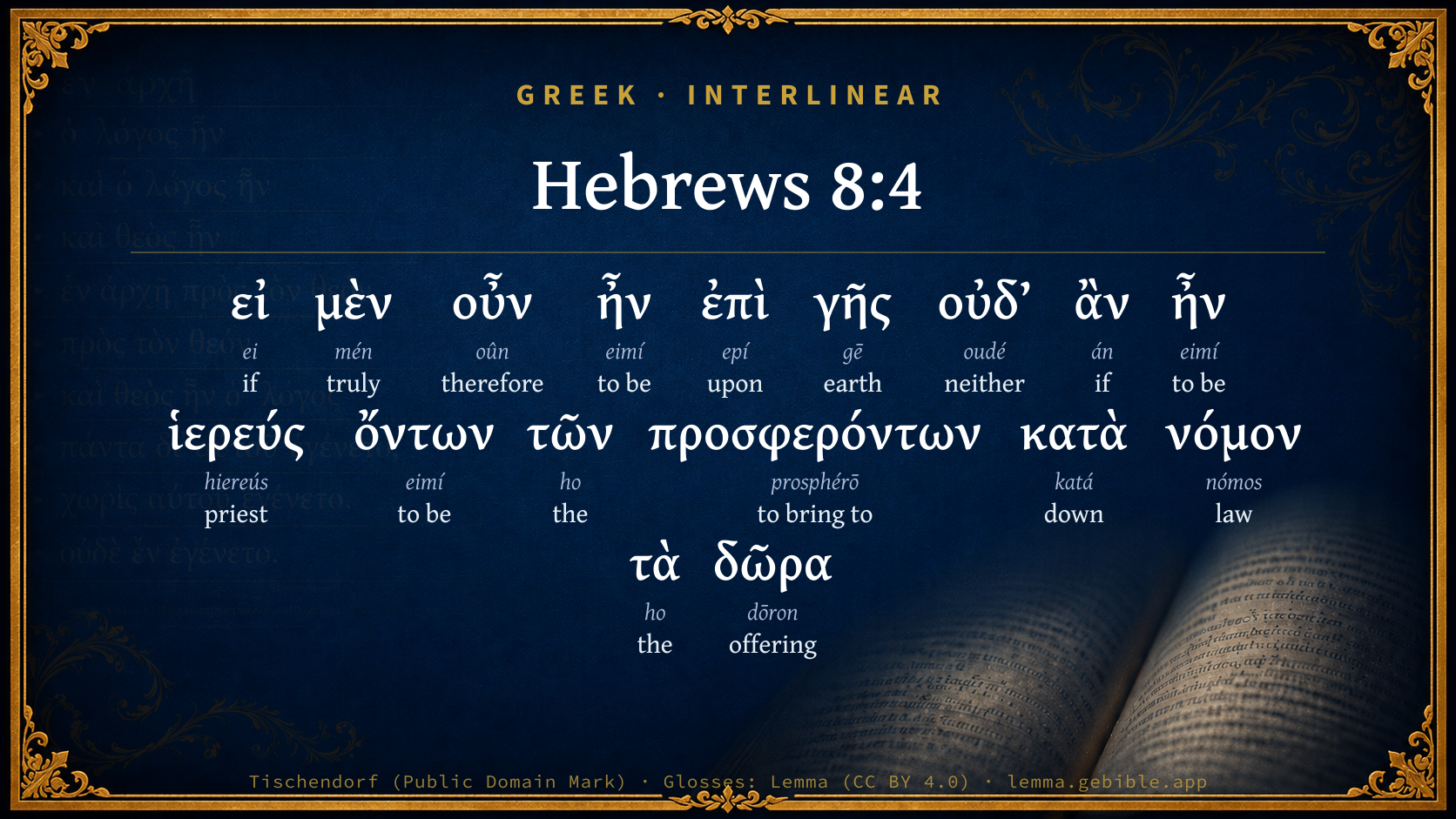
  1. εἰ ei G1487 “if” Conditional
  2. μὲν mén G3303 “truly” Particle
  3. οὖν oûn G3767 “therefore” Conjunction
  4. ἦν eimí G1510 “to be” Verb, Imperfect, Active, Indicative, 3rd person, Singular
  5. ἐπὶ epí G1909 “upon” Preposition
  6. γῆς gē G1093 “earth” Noun, Genitive, Singular, Feminine
  7. οὐδ’ oudé G3761 “neither” Conjunction, Negative
  8. ἂν án G302 “if” Particle
  9. ἦν eimí G1510 “to be” Verb, Imperfect, Active, Indicative, 3rd person, Singular
  10. ἱερεύς hiereús G2409 “priest” Noun, Nominative, Singular, Masculine
  11. ὄντων eimí G1510 “to be” Verb, Present, Active, Participle, Genitive, Plural, Masculine
  12. τῶν ho G3588 “the” Article, Genitive, Plural, Masculine
  13. προσφερόντων prosphérō G4374 “to bring to” Verb, Present, Active, Participle, Genitive, Plural, Masculine
  14. κατὰ katá G2596 “down” Preposition
  15. νόμον nómos G3551 “law” Noun, Accusative, Singular, Masculine
  16. τὰ ho G3588 “the” Article, Accusative, Plural, Neuter

About this verse

These counts appear in no published source. They are computed here, from the morphology-tagged text and Lemma’s own curated glosses. What Lemma adds →

17
words
14
distinct lemmas
General Epistles
section

Notable vocabulary

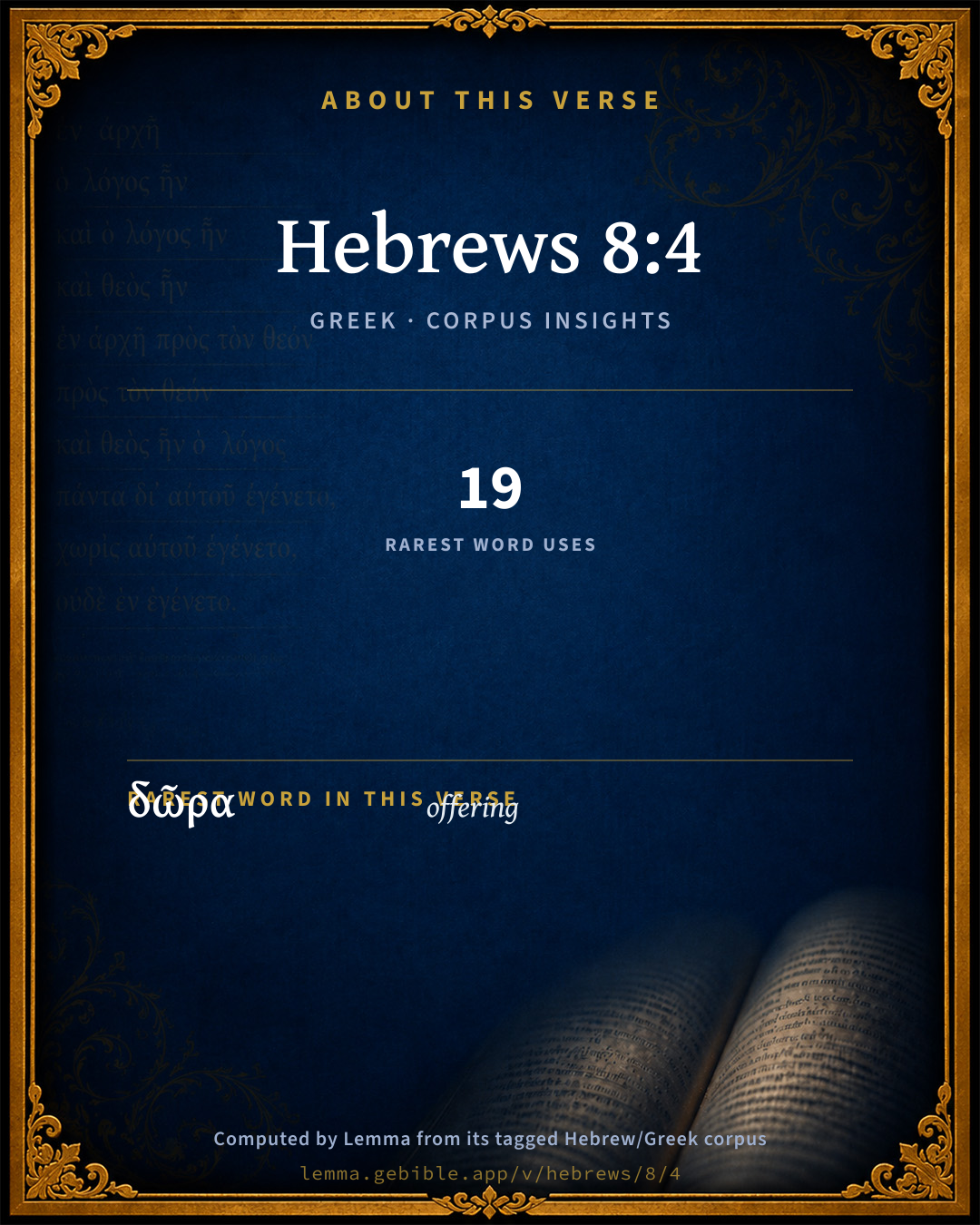
The rarest word here is δῶρα offering G1435 — appearing just 19 times in the whole Greek New Testament.

Shared distinctive vocabulary

δῶρα offering G1435 occurs in 17 verses of the Greek New Testament. Also found in:

Repetition

Words recur within this verse:

Cross-references

7

Topical passages linked to Hebrews 8:4 in the Treasury of Scripture Knowledge — connected by theme and wording, ordered by reader-vote popularity; previews shown in the World English Bible.

  • Hebrews 7:11–15 Now if there was perfection through the Levitical priesthood (for under it the people have received the law), what further need was there for another priest to arise after the order of Melchizedek, and not be called after the order of Aaron?
  • Hebrews 5:1 For every high priest, being taken from among men, is appointed for men in things pertaining to God, that he may offer both gifts and sacrifices for sins.
  • Numbers 16:40 to be a memorial to the children of Israel, to the end that no stranger, who isn't of the seed of Aaron, comes near to burn incense before Yahweh; that he not be as Korah, and as his company: as Yahweh spoke to him by Moses.
  • Numbers 17:12–13 The children of Israel spoke to Moses, saying, Behold, we perish, we are undone, we are all undone.
  • Numbers 18:5 You shall keep the charge of the sanctuary, and the charge of the altar; that there be wrath no more on the children of Israel.
  • 2 Chronicles 26:18–19 and they withstood Uzziah the king, and said to him, It pertains not to you, Uzziah, to burn incense to Yahweh, but to the priests the sons of Aaron, who are consecrated to burn incense: go out of the sanctuary; for you have trespassed; neither shall it be for your honor from Yahweh God.
  • Hebrews 11:4 By faith, Abel offered to God a more excellent sacrifice than Cain, through which he had testimony given to him that he was righteous, God bearing witness with respect to his gifts; and through it he, being dead, still speaks.

Cross-references courtesy of OpenBible.info (CC BY 4.0).

Where the printed editions differ

2 variants

Places in this verse where the major printed Greek editions disagree on the wording in a way that affects the translation — a comparison of editions, not a manuscript-by-manuscript collation. The editions are the modern critical texts (Nestlé-Aland 28/27, SBL, Westcott-Hort, Tregelles, Tyndale House) and the traditional texts behind the KJV (the Textus Receptus and the Byzantine/Majority text). It is not a claim about which reading is original.

  1. Different wording
    οὖν

    “then”

    In NA28NA27TynSBLWHTreg Not in TRByz

    γὰρ (gar) 'for' occurs in traditional manuscripts (TR+Byz) instead of οὖν (oun) 'then' in older manuscripts (NA28+NA27+Tyn+SBL+WH+Treg)

  2. Extra text
    ἱερέων

    “priests”

    In TRByz Not in NA28NA27TynSBLWHTreg

    ἱερέων (hi'ereōn) 'priests' is only in traditional manuscripts (TR+Byz)

Textual data: Translators Amalgamated Greek New Testament (STEPBible TAGNT) · CC BY 4.0.

Commentary

Notes on Hebrews 8:4 from classic Christian and Jewish commentators (each source and its license shown beneath its notes). The classic Christian expositions comment on the surrounding passage and are grouped to its opening verse, so a note may address several verses; the Jewish commentaries on the Tanakh (Rashi and others) are per-verse, so they appear only where the commentator wrote on this verse.

Lemma curates 59 commentaries, every one of them public domain or Creative Commons licensed, each selected and text-cleaned for this edition rather than reprinted as found. About our sources →

Tyndale Open Study Notes

Tyndale Open Resources

8:4 If he were here on earth: Under the old order Jesus would not even be a priest, as previously discussed (see 7:13-14). But Jesus is in heaven, which makes his priestly service distinct from and superior to that of the priests of the old covenant (8:5; 9:11, 24; 10:12).

Tyndale Open Study Notes — © Tyndale Open Resources, licensed CC BY-SA 4.0. Text via the HelloAO Bible API.

Bengel's Gnomon

Johann Albrecht Bengel

Heb 8:4. Γὰρ, for) The reason why he said ἐν τοῖς οὐρανοῖς, in the heavens, Heb 8:1: a Chiasmus: comp. Heb 8:2-3.—ἐπὶ γῆς) If our Priest were a priest upon the earth, if His priesthood terminated on the earth, He would not even be [in the true sense] a priest at all. Christ, whilst He discharged the duties of the priesthood, entered into heaven.—ὄντων) inasmuch as there were already at the time priests existing.

Bengel's Gnomon of the New Testament — English translation (T&T Clark, Edinburgh, 1860) — public domain. Text from a community e-Sword module.

Meyer's Critical & Exegetical Commentary

Heinrich August Wilhelm Meyer

Heb_8:4. A sacrificial priest Christ can only be, either in the earthly or the heavenly sanctuary; for a third, besides these two, there is not. The author now proves, Heb_8:4, that He cannot be a priest in the earthly sanctuary, whence it then follows of itself that He must be so in the heavenly one.

εἰ ἦν] not: if He had been (Böhme, Kuinoel), but: if He were. Το εἰ μὲν οὖν ἦν ἐπὶ γῆς we have, moreover, neither, with Grotius, Wolf, and others, to supply μόνον, nor, with Zeger, Bengel, Carpzov, Heinrichs, Böhme, and others, ἀρχιερεύς or ἱερεύς. It signifies nothing more than: if He were now on earth, had His dwelling-place upon earth.

οὐδʼ ἂν ἦν ἱερεύς] He would not even be a priest. Incorrectly Bleek, Bisping, and Ewald: He would not even be a priestnot to say a high priest. For the augmenting οὐδέ can refer only to the whole proposition, not specially to ἱερεύς, since otherwise οὐδʼ ἱερεὺς ἂν ἦν must have been written. ἱερεύς is therefore to be taken as a more general expression for the more definite ἀρχιερεύς. Yet more erroneously Primasius, Seb. Schmidt, Wolf, Rambach, Carpzov, and others: He would not be that unique, real, or true priest, that everlasting priest after the manner of Melchisedecwhich, without an addition, the words cannot by any means signify.

The reason why Christ, if He were dwelling upon earth, could not at all be a priest, is contained in the ὄντων … τὰ δῶρα. For on earth there are, of a truth, the legally appointed priests already present, and with these Jesus, since He belonged not to the tribe of Levi, but to the tribe of Judah (Heb_7:14), has nothing in common.

ὄντων τῶν προσφερόντων κατὰ νόμον τὰ δῶρα] since assuredly there are present (ὄντων has the emphasis), sc. on earth, those who in accordance with law (i.e. according to the norm of the Mosaic law) offer the gifts, namely the Levites, among whom Christ could not be reckoned, ὄντων and προσφερόντων designate that which is still existing at the time of our author. To take the words as participles of the past (Peshito, Vulgate, Grotius,[86] Braun, and others), is already forbidden by the present λατρεύουσιν, Heb_8:5.

[86] This writer with the explanation entirely foreign to the subject: Erant, nempe quum psalmus iste scriberetur.

Heb_8:4-5. Return (οὖν) from the subsidiary remark, Heb_8:3, to the main thought in Heb_8:2 (τῶν ἁγίων καὶ τῆς σκηνῆς τῆς ἀληθινῆς, ἣν κ.τ.λ.), and proof for the same.

Meyer — Critical and Exegetical Commentary on the New Testament — English translation by Peter Christie, edited by Frederick Crombie (T&T Clark, 1880) — public domain. Text from a community e-Sword module.

Expositor's Greek Testament

ed. W. Robertson Nicoll

Heb 8:4 . εἰ μὲν οὖν ἐπὶ γῆς … “And indeed if He were on earth He would not even be a priest, since there are those who according to law offer the gifts”. μὲν οὖν = et quidem (Devarius, p. 125) or, it might be rendered “If however,” see Hermann’s Viger , p. 442. Vaughan says: “The οὖν is (as usual) in accordance with the above statement ; here, namely, that He must have something to offer ”. The apodosis in Heb 8:6 . νυνι δε . The argument is, given or assumed as already proved that Christ is our High Priest, it must be in Heaven He exercises His ministry, for if He were on earth, He would not even be a priest, not to say, a High Priest. [As Bleek has it, “er würde nicht einmal Priester sein, geschweige denn Hohe priester”.] He could not be a priest, because the priestly office on earth is already filled. The law [ κατὰ νόμον ], which can not be interfered with, regulates all that concerns the earthly priesthood (Heb 7:12 ), and by this law He is excluded from priestly office, not being of the tribe of Levi (Heb 7:14 ). τὰ δῶρα “the gifts” further emphasises the rigorous prescriptions of the law. The absence of the article before νόμον does not necessitate though it suggests the translation “according to law”.

The Expositor's Greek Testament, edited by W. Robertson Nicoll (1897–1910) — public domain. Text from a community e-Sword module.

Geneva Bible (1599)

Geneva Bible translators

He giveth a reason why he said that our high Priest is in the heavenly sanctuary and not in the earthly: because, saith he, if he were now on the earth, he could not minister in the earthly sanctuary, seeing there are yet Levitical Priests, which are appointed for him, that is to say, to be patterns of that perfect example. And to what purpose should the patterns serve when the true and original example is present.

Geneva Bible (1599) marginal notes — public domain. Text via Bolls.life.

Jamieson, Fausset & Brown

Robert Jamieson, A. R. Fausset & David Brown

Implying that Christ's priestly office is exercised in heaven, not in earth; in the power of His resurrection life, not of His earthly life.

For--The oldest manuscripts read, "accordingly then."

if, &c.--"if He were on earth, He would not even (so the Greek) be a priest" (compare Heb 7:13-14); therefore, certainly, He could not exercise the high priestly function in the earthly Holy of Holies.

seeing that, &c.--"since there are" already, and exist now (the temple service not yet being set aside, as it was on the destruction of Jerusalem), "those (the oldest manuscripts omit 'priests') who offer the (appointed) gifts according to (the) law." Therefore, His sacerdotal "ministry" must be "in the heavens," not on earth (Heb 8:1). "If His priesthood terminated on the earth, He would not even be a priest at all" [BENGEL]. I conceive that the denial here of Christ's priesthood on earth does not extend to the sacrifice on the cross which He offered as a priest on earth; but applies only to the crowning work of His priesthood, the bringing of the blood into the Holy of Holies, which He could not have done in the earthly Holy of Holies, as not being an Aaronic priest. The place (the heavenly Holy of Holies) was as essential to the atonement being made as the oblation (the blood). The body was burnt without the gate; but the sanctification was effected by the presentation of the blood within the sanctuary by the high priest. If on earth, He would not be a priest in the sense of the law of Moses ("according to the law" is emphatic).

Jamieson, Fausset & Brown — Commentary Critical and Explanatory on the Whole Bible (1871) — public domain (CC PDM 1.0). Text via the HelloAO Bible API.

Adam Clarke's Commentary

Verse 4. For if he were on earth] As the Jewish temple was standing when this epistle was written, the whole temple service continued to be performed by the legal priests, descendants of Aaron, of the tribe of Levi; therefore if Christ had been then on earth, he could not have performed the office of a priest, being of the tribe of Judah, to which tribe the office of the priesthood did not appertain.

There are priests that offer gifts] This is an additional proof that this epistle was written before the destruction of Jerusalem. As the word θυσιαι, sacrifices, is not added here as it is in Heb 8:3, is it any evidence that bloody sacrifices had then ceased to be offered? Or, are both kinds included in the word δωρα, gifts? But is δωρον, a gift, ever used to express a bloody sacrifice? I believe the Septuagint never used it for זבח zebach, which signifies an animal offered to God in sacrifice.

Adam Clarke's Commentary on the Bible (1810–1826) — public domain. Text from a community e-Sword/MySword module.

John Calvin's Commentaries

4. For if he were on earth, etc. It is now beyond dispute that Christ is a high priest; but as the office of a judge does not exist without laws and statutes, so the office of sacrificing must be connected with Christ as a priest: yet he has no earthly or visible sacrifice; he cannot then be a priest on earth. We must always hold this truth that when the Apostle speaks of the death of Christ, he regards not the external action, but the spiritual benefit. He suffered death as men do, but as a priest he atoned for the sins of the world in a divine manner; there was an external shedding of blood, but there was also an internal and spiritual purgation; in a word, he died on earth, but the virtue and efficacy of his death proceeded from heaven.

What immediately follows some render thus, “He could not be a priest of the number of those who offer gifts according to the Law.” But the words of the Apostle mean another thing; and therefore I prefer this rendering, “He could not be a priest as long as there are priests who,” etc. For he intends to show one of these two things, either that Christ is no priest, while the priesthood of the Law continued, as he had no sacrifice, or that the sacrifices of the law ceased as soon as Christ appeared. The first of these is against all reason, for it is an act of impiety to deprive Christ of his priesthood. It then remains for us to confess, that the Levitical order is now abolished.

John Calvin's Commentaries (1540-1563) — public domain. Text from the Calvin Translation Society English edition (1840s-50s) via the Christian Classics Ethereal Library (ccel.org). Calvin's coverage is partial (roughly two-thirds of the Bible); uncommented books and verses are honest gaps, never fabricated. The 19th-century editor's footnotes and remarks are omitted so the notes are faithfully Calvin's own voice.

Ellicott's Commentary for English Readers

(4) For if he were . . .—The oldest Greek MSS. and two important versions read, “If then He were”; and two other changes in the text of this verse also rest on high authority. In its correct form the verse will stand thus: If then He were on earth, He would not even be a priest (that is, He would not be a priest at all), seeing there are those who according to law offer the gifts. The argument somewhat resembles that of Heb_7:13-14; there, however, the impediment is that of tribe; here the thought is that the place is preoccupied by men who by express command are bringing the gifts unto God.

A Bible Commentary for English Readers, edited by Charles John Ellicott (1878–1897) — public domain. Text from a community e-Sword module.

The Cambridge Bible for Schools and Colleges

gen. ed. J. J. S. Perowne

4. For if he were] Rather, “now if He were still on earth.”

if he were on earth] His sanctuary must be a heavenly one, for in the earthly one He had no standpoint.

he should not be a priest] He would not even be so much as a Priest at all; still less a High Priest; for He was of the Tribe of Judah (Heb_7:14), and the Law had distinctly ordained that “no stranger, which is not of the seed of Aaron, come near to offer incense before the Lord” (Num_16:40).

seeing that there are priests that offer gifts according to the law] Rather (omitting “priests” with the best mss.), since “there are (already) those who offer their gifts according to the Law.” The writer could not possibly have used these present tenses if the Epistle had been written after the Fall of Jerusalem. Jewish institutions are, indeed, spoken of in the present tense, after the fall of Jerusalem, by Barnabas and Clement of Rome; but they are merely using an everyday figure of speech. In case of the Epistle to the Hebrews the argument would have gained such indefinite force and weight in passages like this by appealing to a fact so startling as the annulment of the Mosaic system by God Himself, working by the unmistakeable demonstrations of history, that no writer similarly circumstanced could possibly have passed over such a point in silence.

The Cambridge Bible for Schools and Colleges (gen. ed. J. J. S. Perowne; Cambridge University Press, 1878–1918) — public domain. Text from a community e-Sword module.

John Gill's Exposition

For if he were on earth, he should not be a priest,.... The Socinians from hence attempt to prove that Christ was not a priest, and did not offer sacrifice on earth; whereas his coming into the world, and his appearance in human nature, was in the character of a priest, and to qualify himself for one; his death was his sacrifice, which was on earth; and he never offered but one sacrifice; and it was after he had offered himself that he went to heaven; so the sacrifices under the law were first offered, before their blood was carried within: but the meaning is, either if "that" was on earth, namely, what it was necessary he should have to offer; if his human nature had been earthly, had been of men, had come by ordinary generation, he had not been properly, only typically a priest, at most; and had been no better than the typical ones; yea, he would have been needless, nay, might not have offered, not being of Levi's tribe, and could not have existed as a priest with the sons of Aaron; but he had his human nature in another way, through the power of the Holy Ghost from above, and therefore is said to come from above, from heaven, and to be the Lord from heaven: or the sense is, if he was on earth, and had not died, he had not been a priest; and if he had died and remained under the power of death, he had been a priest of no account and use; and had he rose again and remained on earth, without going to heaven, with his blood and sacrifice, he had not been a perfect priest; if Christ had remained on earth, the Levitical priesthood had remained, and so he would have been no priest, since two priesthoods could not have subsisted together. The Levitical priesthood was in force while Christ was on earth; Christ's priesthood was not perfected on earth; the Levitical priesthood remaining while he was on earth, proves he was not then a perfect priest, or had not completed his priesthood; had he been so, that would not have subsisted; it was necessary therefore that Christ should enter into the holy place, to put an end to the Levitical priesthood: moreover, if he had remained on earth, he had been needless;

seeing that there are priests that offer gifts according to the law; there were priests when Christ was upon earth; their work was to offer gifts the people brought, and sacrifices for sin, and that according to the law of Moses, which till the death of Christ was in full force.

John Gill's Exposition of the Whole Bible (1746–1763) — public domain (CC PDM 1.0). Text via the HelloAO Bible API.

Trapp's Complete Commentary

John Trapp

4 For if he were on earth, he should not be a priest, seeing that there are priests that offer gifts according to the law:

Ver. 4. He should not be a priest] Because not of the tribe of Levi, whose priesthood lasted so long as Christ lived on earth, and was done away by his death.

John Trapp, A Commentary or Exposition upon All the Books of the Old and New Testament (1647–1656) — public domain. Text from a community e-Sword module.

Albert Barnes' Notes on the Bible

For if he were on earth, he should not be a priest - He could not perform that office. The design of this is, to show a reason why he was removed to heaven. The reason was, that on earth there were those who were set apart to that office, and that he, not being of the same tribe with them, could not officiate as priest. There was an order of people here on earth consecrated already to that office, and hence, it was necessary that the Lord Jesus, in performing the functions of the office, should be removed to another sphere.

Albert Barnes' Notes on the Bible (1834–1885) — public domain. Text from a community e-Sword/MySword module.

Haydock's Catholic Bible Commentary

If then he were on earth, he would not be a priest. He speaks of a priest according to the custom of the Jews, where none were priests but of the tribe of Levi, and Jesus Christ was of the tribe of Juda: and if the law of Moses was to continue, there would not be wanting priests to offer sacrifices according to their worship, though such priests were only employed about things that were types[2] and shadows of heavenly things in the new law after Christ’s coming, and of the sacrifices by which he offered himself on the cross. And this God doubtless revealed to Moses, when he said to him: take heed "thou make all things according to the pattern which was shewn thee on the mount." (Witham) --- Earth, &c. That is, if he were not of a higher condition than the Levitical order of earthly priests, and had not another kind of sacrifice to offer, he should be excluded by them from the priesthood, and its functions, which by the law were appropriated to their tribe. (Challoner)

===============================

[BIBLIOGRAPHY]

Exemplari et umbræ deserviunt, Greek: upodeigmati, kai skia latreuousi. It signifies, that they served God by those things that were types and figures of more perfect and heavenly things.

====================

George Leo Haydock (1774–1849), Haydock's Catholic Family Bible and Commentary, 1859 edition — public domain. Excludes Psalms (Douay-Rheims chapter numbering differs from Protestant) and Deuterocanonical books (Catholic canon only).

Matthew Poole's English Annotations

For if he were on earth, he should not be a priest: this gives the reason why the Levitical gifts and offerings were inconsistent with Christ’s priesthood: for if he were earthly for person or office, or was existing on earth, or in an earthly sanctuary or tabernacle proper to the law, he could not by Divine ordination be an offering priest, being not of Aaron’s family, nor of the tribe of Levi, nor such a priest as he was made by God’s oath after Melchisedec’s order, if he were for temper, office, or place of ministry earthly.

Seeing that there are priests that offer gifts according to the law: this earthly office, state, and work, was by the law settled on Aaron’s family, and none could legally offer sacrifices or gifts in God’s earthly tabernacle or temple, but his sons alone. Christ, as he was not of that tribe, so he never was either in the court of the priests, or in the holy place in the temple, neither did minister in them as a priest at all; this was proper and peculiar only to his types.

Matthew Poole's English Annotations on the Holy Bible (1683–1685) — public domain. Text from a community e-Sword/MySword module.

Whedon's Commentary on the Bible

Daniel D. Whedon

4. For—It is as yet an unexplained somewhat; for so entirely is this high priest out of the order of earthly high priests, that, if he were on earth, (were being here emphatic,) he would not be a priest at all. Our writer seems about to explain this somewhat, but the current of his thought is veered (after the Pauline style, note on Eph_3:1; Eph_3:14) by a view opening upon him of Christ’s elevation to the mediatorship of the new covenant, and he defers considering the somewhat… to offer to Heb_10:5-17.

Priests… law—The priesthood on earth are a regular line, offering gifts, and by regular law. And in this line, and with these gifts, and according to this law, Christ would be no priest. For he was not descended from Levi; he never performed any sacrifices, and the law forbade him to be a priest. Yet the Being who on earth gazed upon the offerers of sacrifice, unadmitted to perform the rite, was sole original of all—was both sole priest and victim.

Daniel D. Whedon (gen. ed.), Commentary on the Old and New Testaments (1874–1909) — public domain. Text from a community e-Sword module.

John Wesley's Explanatory Notes

But if he were on earth - If his priesthood terminated here. He could not be a priest - At all, consistently with the Jewish institutions. There being other priests - To whom alone this office is allotted.

John Wesley, Explanatory Notes Upon the Whole Bible (1754–1765) — public domain. Text via the GEBible commentary corpus.

The People's New Testament

B. W. Johnson

4. On earth, he should not be a priest. The law required all the priests who served in the temple to be of the tribe of Levi, but he was not of the tribe of Levi, or of the priests appointed to serve at the altar, hence could not serve at an earthly altar, or in an earthly sanctuary. The law was in force as long as he was on earth and that excluded him.

B. W. Johnson's The People's New Testament with Notes (1889–1891) — public domain. Electronic text from the Christian Classics Ethereal Library (CCEL) ThML edition.

Cambridge Greek Testament for Schools and Colleges

4. εἰ μὲν οὖν ἦν. “Now if He were still on earth.”

ἐπὶ γῆς. His sanctuary must be a heavenly one, for in the earthly one He had no standpoint.

οὐδʼ ἂν ἦν ἱερεύς. He would not even be so much as a Priest at all; still less a High Priest; for He was of the Tribe of Judah (Heb 7:14), and the Law had distinctly ordained that “no stranger, which is not of the seed of Aaron, come near to offer incense before the Lord” (Num 16:40).

ὄντων τῶν προσφερόντων κ.τ.λ. “Since there are (already) those who offer their gifts according to the Law.” The writer could not possibly have used these present tenses if the Epistle had been written after the Fall of Jerusalem. Jewish institutions are, indeed, spoken of in the present tense, after the fall of Jerusalem, by Barnabas and Clement of Rome; but they are merely using an every-day figure of speech. In the case of the Epistle to the Hebrews the argument would have gained such indefinite force and weight in passages like this by appealing to a fact so startling as the annulment of the Mosaic system by God Himself, working by the unmistakable demonstrations of history, that no writer similarly circumstanced could possibly have passed over such a point in silence.

Cambridge Greek Testament for Schools and Colleges (Cambridge University Press, 1896; 21 vols, various authors incl. Carr, Maclear, Plummer, Farrar, Lumby, Moule, M. R. James, Simcox) — public domain. Text from a community e-Sword module.

Alford’s Greek Testament

Henry Alford

4.] Yea, if (or as rec., “For if …,” which follows more smoothly and naturally on the position of ver. 2, and on that very account is probably a correction. Hofmann, as above, laying all the stress on the aor. προσενέγκῃ, takes the γάρ as justifying that aorist: Er muss ein nicht erst darzubringendes, sondern, dargebrachtes Opfer haben:—denn wäre er auf Erden … But see on this above. The connexion is obvious: ‘our High Priest must have somewhat to offer. But on earth this could not be: for’ &c.) he were (not, “had been,” though grammatically it might be so: the pres. part. ὄντων, which follows, and λατρεύουσι, continuing it, shew that this ἧν is spoken of a continuing, not of a past hypothesis) on earth (some, as Grot., Wolf, al., supply μόνον after γῆς—and something in the same view Œc., τοῦτο δὲ ἦν εἰ μὴ ἐτεθνήκει, μηδὲ ἐγερθεὶς ἀνελήφη: and Thdrt., περιττὸν ἦν αὐτὸν ἐν τῇ γῇ διαιτώμενον ἱερέα καλεῖν: others, as Gerhard, Heinrichs, al., supply ἀρχιερεύς or ἱερεύς: but this it seems to me would stultify the argument. There is no need of any thing supplied) He would not even be a priest (observe the emphasis: which is not, as Bleek, He would not even be a priest, much less a High Priest (οὐδʼ ἱερεὺς ἂν ἦν), but the stress is on the verb ἦν, and it is taken ex concesso that the ἀρχιερεύς belonged to the genus ἱερεύς: ‘He would not even belong to the category of priests.’ In the background lies, ‘and if not so, certainly could not be a High Priest:’ but it is not brought forward, nor does it belong to the argument, which continues ὄντων, not ὄντος), since there are (ὄντων, emphatic: ‘there are already:’ not, “were” (as Grot.: “erant, nempe quum Psalmus iste scriberetur”), as is shewn by λατρεύουσιν below. The time indicated is that of writing the Epistle) those who offer the gifts according to (the) law (the law, equally, with or without the article; not only because but one law can be meant, but because the art. is so constantly omitted after a preposition even when required in translation),

Henry Alford, The Greek Testament (1849–1861) — public domain. Text from a community e-Sword module.

Vincent's Word Studies in the New Testament

Marvin R. Vincent

Rend. "Now if he were on earth he would not be a priest at all, seeing that there are those who offer the gifts according to the law." Christ could not be a priest on earth, because there is an order of priests already established by law; and as Christ was not of the tribe of Levi (ch. 7 13, 14) he could have nothing in common with them.

Marvin R. Vincent, Word Studies in the New Testament (1887–1900) — public domain. Text from a community e-Sword/MySword module.

Westcott on Hebrews & the Epistles of John

Brooke Foss Westcott

4. εἰ μὲν οὖν.. ἱερεύς... Now tf He were still upon carth, He would not be a priest at all, and therefore still less High-priest....The argument is directed to shew that, since Christ as Highpriost must do charnctoristio sorvicc, the scene of His service must be heaven and not earth. The wish therefore which many entertained for some priestly work of Ohrist on earth

τὰ δῶρα] vot ‘gifts’ in the abstract, but ‘the gifts’ which God requires. The simple term is here used to include offerings of all kinds (c. xi. 4; Matt. v. 21; xxiii. 18 £.).

5,6 The earthly Leovitical service points to that which corresponds with a better covenant.

Brooke Foss Westcott (1825–1901), The Epistle to the Hebrews (1889) and The Epistles of St John (1883) — public domain (pre-1929). Text recovered from Internet Archive / Google Books OCR scans. Westcott’s Gospel of John commentary is not included (its OCR lost the chapter running-heads required for reliable verse-keying). Some Greek quoted in the Hebrews volume is imperfectly rendered by the OCR.

Lesson kit

Teaching starters — assembled from the data on this page, not authored interpretation. Every prompt links to the verse data it draws on. Edit before teaching.

Hebrews, in the General Epistles, opens this verse with 17 words (14 distinct Greek lemmas). Its most distinctive word is dōron (“offering”). A historical commentator’s framing appears above. Read the whole chapter for the surrounding context.

Discussion questions

  1. The word dōron carries the sense “offering.” How does it shape the verse?
  2. Matthew 2:11 shares the word «offering» with this verse. How do the two illuminate each other?
  3. “to be” occurs 3× in this one verse. What is the effect of the repetition?
  4. These translations render this verse differently; the difference is in the English rendering, not the original. What questions does that raise?
  5. Reading how Tyndale Open Study Notes and Bengel's Gnomon read this verse, where do the two commentators agree and where do they part?

Things to notice

Reading settings

Reading text

Shown beneath each verse's original-language words.

Old Testament
Old Testament edition

Read the OT as the Masoretic Hebrew (MT) or the Greek Septuagint (LXX).

English shown for the Greek Septuagint (in the Hebrew ↔ Greek comparison).

Comparing translations? Open the Compare panel on any verse page to stack up to four side by side.