Revelation 21:24

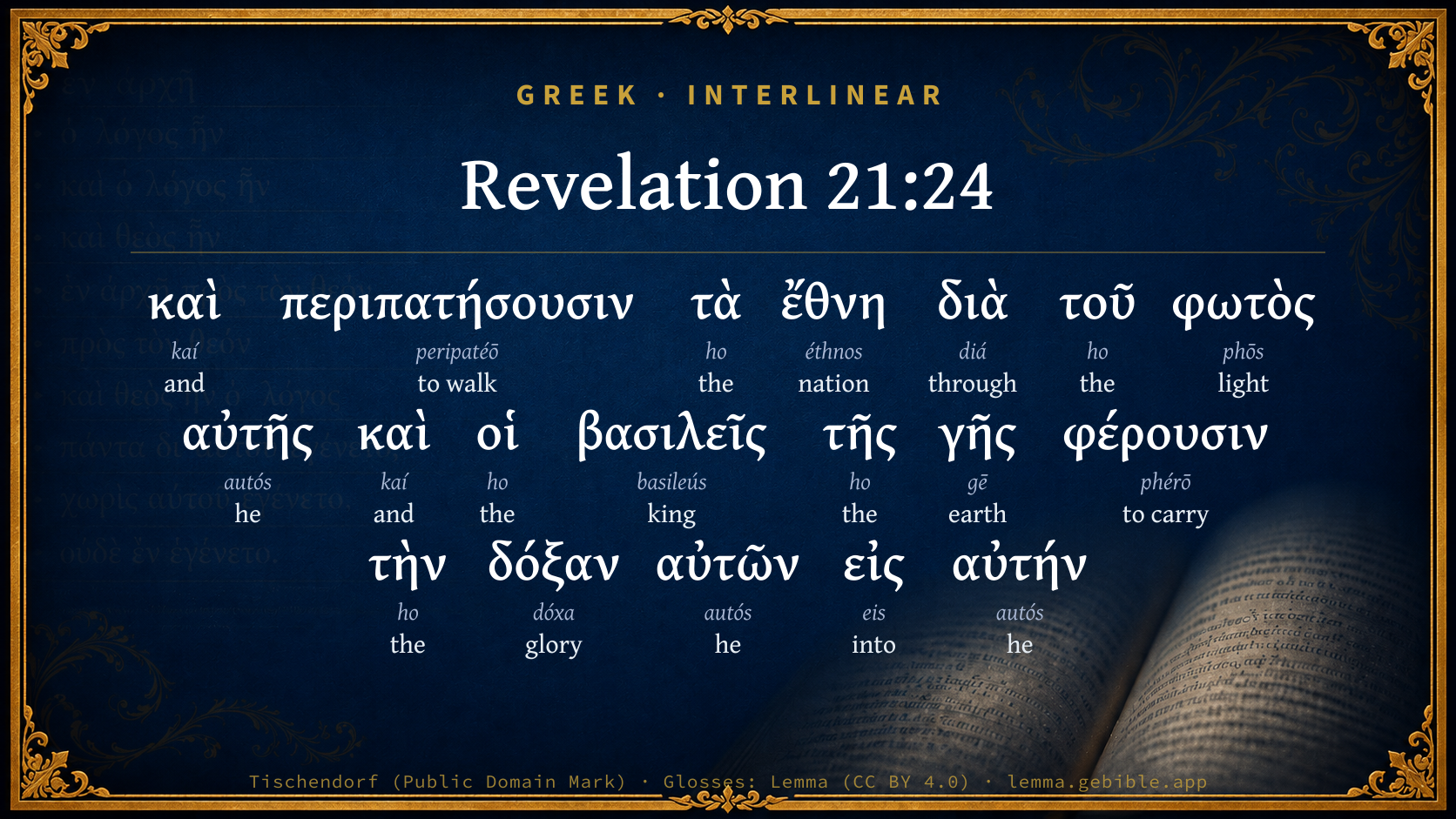
Greek (Tischendorf 8th ed.) Revelation 21:24 appears in the Greek New Testament. The text above is from the Tischendorf 8th edition. Each word links to its Strong’s number and a concise gloss. Click any word for its full Thayer’s Greek Lexicon entry.
Download image
Cite this verse

Revelation 21:24 (World English Bible). Public Domain. Lemma interlinear Bible study tool, https://lemma.gebible.app/v/revelation/21/24.

Show BibTeX & RIS
BibTeX
RIS
English Translation
The nations will walk in its light. The kings of the earth bring the glory and honor of the nations into it.
World English Bible · Public Domain
Download a study sheet

One document with this verse’s original text, its word-by-word gloss line, the meaning frame, cross-references with their text, attributed commentary, and full source and license credits — printable, and it pastes into notes with its structure intact.

This verse Autodidact and up

Study sheet (.html) Plain text (.txt)

A passage Seminary Student

Up to 50 verses in one chapter. A passage sheet keeps up to 6 commentary sources and 12 cross-references per verse, in the order this page ranks them, and says so on the sheet whenever that leaves anything out. Ask for a single verse and you get the Autodidact verse sheet above.

Everything on this page stays free to read, with no account — the sheet is a download of what is already on screen, not access to it.

Want to remove ads? Support Godless Engineer
Compare translations 3

The same verse in 3 English versions, stacked beneath the original-language interlinear above. Click any original word for its lexicon entry.

Each is an independent rendering of the whole verse — the interlinear is not word-aligned to these translations.

Highlighted words mark where these versions differ — a whole-verse word diff, not a word-by-word alignment.

  • World English Bible Public Domain
    The nations will walk in its light. The kings of the earth bring the glory and honor of the nations into it.
  • King James Version Public Domain
    And the nations of them which are saved shall walk in the light of it: and the kings of the earth do bring their glory and honour into it.
  • unfoldingWord Literal Text CC BY-SA 4.0
    And the nations will walk by the light of her, and the kings of the earth bring their glory into her.

unfoldingWord Literal Text — © unfoldingWord, licensed CC BY-SA 4.0. Word-aligned USFM3 via Door43 (git.door43.org/unfoldingWord/en_ult).

Versions to compare (up to 4)

3 of 4 selected

Show all 19 translations

Every available English version of this verse, each an independent rendering of the whole verse.

  • World English Bible Public Domain
    The nations will walk in its light. The kings of the earth bring the glory and honor of the nations into it.
  • Berean Standard Bible Public Domain
    By its light the nations will walk, and into it the kings of the earth will bring their glory.
  • Majority Standard Bible Public Domain
    By its light the nations will walk, and into it the kings of the earth will bring their glory and the honor of the nations.
  • King James Version Public Domain
    And the nations of them which are saved shall walk in the light of it: and the kings of the earth do bring their glory and honour into it.
  • American Standard Version (1901) Public Domain
    And the nations shall walk amidst the light thereof: and the kings of the earth bring their glory into it.
  • Revised Version (1885) Public Domain
    And the nations shall walk amidst the light thereof: and the kings of the earth do bring their glory into it.
  • Geneva Bible (1599) Public Domain
    And the people which are saued, shall walke in the light of it: and the Kings of the earth shall bring their glorie and honour vnto it.
  • Douay-Rheims (1899) Public Domain
    And the nations shall walk in the light of it: and the kings of the earth shall bring their glory and honour into it.
  • Young's Literal Translation Public Domain
    and the nations of the saved in its light shall walk, and the kings of the earth do bring their glory and honour into it,
  • Literal Standard Version CC BY-SA 4.0
    and the nations will walk by its light, and the kings of the earth bring their glory and honor into it,
  • Unlocked Literal Bible CC BY-SA 4.0
    The nations will walk by the light of that city. The kings of the earth will bring their splendor into it.
  • unfoldingWord Literal Text CC BY-SA 4.0
    And the nations will walk by the light of her, and the kings of the earth bring their glory into her.
  • Darby Bible Public Domain
    And the nations shall walk by its light; and the kings of the earth bring their glory to it.
  • World Messianic Bible Public Domain
    The nations will walk in its light. The kings of the earth bring the glory and honor of the nations into it.
  • Webster's Bible Public Domain
    And the nations of them who are saved shall walk in the light of it: and the kings of the earth bring their glory and honor into it.
  • Free Bible Version CC BY-SA 4.0
    The nations will walk by its light, and the kings of the earth bring their glory into the city.
  • Bible in Basic English Public Domain
    And the nations will go in its light: and the kings of the earth will take their glory into it.
  • Text-Critical English NT CC BY 4.0
    The nations will walk by its light, and the kings of the earth will bring the glory and honor of the nations to the city to present to God.
  • Tyndale New Testament (1534) Public Domain
    And the people which are saved shall walke in the light of it: and the kynges of the erth shall brynge their glory vnto it.

Literal Standard Version (2020), Covenant Press — licensed CC BY-SA 4.0. Text via the HelloAO Bible API (eBible.org). Unlocked Literal Bible (unfoldingWord) — licensed CC BY-SA 4.0. Text via the HelloAO Bible API (eBible.org). unfoldingWord Literal Text — © unfoldingWord, licensed CC BY-SA 4.0. Word-aligned USFM3 via Door43 (git.door43.org/unfoldingWord/en_ult). Free Bible Version, Dr. Jonathan Gallagher — licensed CC BY-SA 4.0. Text via the HelloAO Bible API (eBible.org).

Word by word

More ways to search: Search by grammar → Find every occurrence → Compare this word →

Practice this passage: Drill this verse → Learn its vocabulary →

φέρουσιν
phérō
G5342
“to carry”
Verb, Present, Active, Indicative, 3rd person, Plural
Part of Speech
Verb
Tense
Present
Voice
Active
Mood
Indicative
Person
3rd person
Number
Plural
Full Thayer's Definition

Origin: "a primary verb (for which other and apparently not cognate ones are used in certain tenses only, namely, oio oy'-o; and enegko en-eng'-ko)"

TDNT: 09:56,1

1. to carry a. to carry some burden 1. to bear with one's self b. to move by bearing; move or, to be conveyed or borne, with the suggestion of force or speed 1. of persons borne in a ship over the sea 2. of a gust of wind, to rush 3. of the mind, to be moved inwardly, prompted c. to bear up i.e. uphold (keep from falling) 1. of Christ, the preserver of the universe 2. to bear, i.e. endure, to endure the rigour of a thing, to bear patiently one's conduct, or spare one (abstain from punishing or destroying) 3. to bring, bring to, bring forward a. to move to, apply b. to bring in by announcing, to announce c. to bear i.e. bring forth, produce; to bring forward in a speech d. to lead, conduct
  1. καὶ kaí G2532 “and” Conjunction
  2. περιπατήσουσιν peripatéō G4043 “to walk” Verb, Future, Active, Indicative, 3rd person, Plural
  3. τὰ ho G3588 “the” Article, Nominative, Plural, Neuter
  4. ἔθνη éthnos G1484 “nation” Noun, Nominative, Plural, Neuter
  5. διὰ diá G1223 “through” Preposition
  6. τοῦ ho G3588 “the” Article, Genitive, Singular, Neuter
  7. φωτὸς phōs G5457 “light” Noun, Genitive, Singular, Neuter
  8. αὐτῆς autós G846 “he” Personal pronoun, Genitive, Singular, Feminine
  9. καὶ kaí G2532 “and” Conjunction
  10. οἱ ho G3588 “the” Article, Nominative, Plural, Masculine
  11. βασιλεῖς basileús G935 “king” Noun, Nominative, Plural, Masculine
  12. τῆς ho G3588 “the” Article, Genitive, Singular, Feminine
  13. γῆς gē G1093 “earth” Noun, Genitive, Singular, Feminine
  14. τὴν ho G3588 “the” Article, Accusative, Singular, Feminine
  15. δόξαν dóxa G1391 “glory” Noun, Accusative, Singular, Feminine
  16. αὐτῶν autós G846 “he” Personal pronoun, Genitive, Plural, Masculine
  17. εἰς eis G1519 “into” Preposition
  18. αὐτήν autós G846 “he” Personal pronoun, Accusative, Singular, Feminine

About this verse

These counts appear in no published source. They are computed here, from the morphology-tagged text and Lemma’s own curated glosses. What Lemma adds →

19
words
12
distinct lemmas
Revelation
section

Repetition

Words recur within this verse:

Cross-references

21

Topical passages linked to Revelation 21:24 in the Treasury of Scripture Knowledge — connected by theme and wording, ordered by reader-vote popularity; previews shown in the World English Bible.

  • Zechariah 8:22–23 Yes, many peoples and strong nations will come to seek Yahweh of Hosts in Jerusalem, and to entreat the favor of Yahweh."
  • Revelation 21:26 and they shall bring the glory and the honor of the nations into it so that they may enter.
  • Revelation 22:2 in the middle of its street. On this side of the river and on that was the tree of life, bearing twelve kinds of fruits, yielding its fruit every month. The leaves of the tree were for the healing of the nations.
  • Isaiah 66:18 For I [know] their works and their thoughts: [the time] comes, that I will gather all nations and languages; and they shall come, and shall see my glory.
  • Zechariah 2:11 Many nations shall join themselves to Yahweh in that day, and shall be my people; and I will dwell in the midst of you, and you shall know that Yahweh of Hosts has sent me to you.
  • Romans 15:10–12 Again he says, "Rejoice, you Gentiles, with his people."
  • Isaiah 52:15 so shall he sprinkle many nations; kings shall shut their mouths at him: for that which had not been told them shall they see; and that which they had not heard shall they understand.
  • Isaiah 55:5 Behold, you shall call a nation that you don't know; and a nation that didn't know you shall run to you, because of Yahweh your God, and for the Holy One of Israel; for he has glorified you.
  • Isaiah 60:3–10 Nations shall come to your light, and kings to the brightness of your rising.
  • Isaiah 60:16 You shall also suck the milk of the nations, and shall suck the breast of kings; and you shall know that I, Yahweh, am your Savior, and your Redeemer, the Mighty One of Jacob.
  • Psalms 22:27 All the ends of the earth shall remember and turn to Yahweh. All the relatives of the nations shall worship before you.
  • Psalms 72:10–11 The kings of Tarshish and of the isles will bring tribute. The kings of Sheba and Seba shall offer gifts.
  • Romans 15:16 that I should be a servant of Christ Jesus to the Gentiles, ministering as a priest the Gospel of God, that the offering up of the Gentiles might be made acceptable, sanctified by the Holy Spirit.
  • Isaiah 2:2 It shall happen in the latter days, that the mountain of Yahweh's house shall be established on the top of the mountains, And shall be raised above the hills; And all nations shall flow to it.
  • Jeremiah 4:2 and you shall swear, As Yahweh lives, in truth, in justice, and in righteousness; and the nations shall bless themselves in him, and in him shall they glory.
  • Romans 15:26 For it has been the good pleasure of Macedonia and Achaia to make a certain contribution for the poor among the saints who are at Jerusalem.
  • Deuteronomy 32:43 Rejoice, you nations, [with] his people: For he will avenge the blood of his servants, Will render vengeance to his adversaries, Will make expiation for his land, for his people.
  • Isaiah 2:5 House of Jacob, come, and let us walk in the light of Yahweh.
  • Isaiah 55:10 For as the rain comes down and the snow from the sky, and doesn't return there, but waters the earth, and makes it bring forth and bud, and gives seed to the sower and bread to the eater;
  • Isaiah 60:13 The glory of Lebanon shall come to you, the fir tree, the pine, and the box tree together, to beautify the place of my sanctuary; and I will make the place of my feet glorious.
  • Isaiah 66:11–12 that you may suck and be satisfied with the breasts of her consolations; that you may milk out, and be delighted with the abundance of her glory.

Cross-references courtesy of OpenBible.info (CC BY 4.0).

Where the printed editions differ

6 variants

Places in this verse where the major printed Greek editions disagree on the wording in a way that affects the translation — a comparison of editions, not a manuscript-by-manuscript collation. The editions are the modern critical texts (Nestlé-Aland 28/27, SBL, Westcott-Hort, Tregelles, Tyndale House) and the traditional texts behind the KJV (the Textus Receptus and the Byzantine/Majority text). It is not a claim about which reading is original.

  1. Extra text
    τῶν σωζομένων

    “those being saved”

    In TR Not in NA28NA27TynSBLWHTregByz

    τῶν σωζομένων (tōn sōzomenōn) 'those being saved' is only in traditional manuscripts (TR)

  2. Different wording
    τὴν

    “the”

    In NA28NA27TynSBLWHTregTR Not in Byz

    αὐτῷ (autō) 'to him' occurs in a few manuscripts (Byz) instead of τὴν (tēn) 'the' in older manuscripts (NA28+NA27+Tyn+SBL+WH+Treg+TR)

  3. Extra text
    καὶ

    “and”

    In TRByz Not in NA28NA27TynSBLWHTreg
  4. Extra text
    τὴν

    “the”

    In TR Not in NA28NA27TynSBLWHTregByz
  5. Extra text
    τιμὴν

    “honor”

    In TRByz Not in NA28NA27TynSBLWHTreg

    καὶ τὴν τιμὴν (kai tēn timēn) 'and the honor' is only in traditional manuscripts (TR+Byz)

  6. Different wording
    αὐτῶν

    “of them”

    In NA28NA27TynSBLWHTregTR Not in Byz

    τῶν ἐθνῶν (tōn ethnōn) 'of the nations' occurs in a few manuscripts (Byz) instead of αὐτῶν (autōn) 'of them' in older manuscripts (NA28+NA27+Tyn+SBL+WH+Treg+TR)

Textual data: Translators Amalgamated Greek New Testament (STEPBible TAGNT) · CC BY 4.0.

Commentary

Notes on Revelation 21:24 from classic Christian and Jewish commentators (each source and its license shown beneath its notes). The classic Christian expositions comment on the surrounding passage and are grouped to its opening verse, so a note may address several verses; the Jewish commentaries on the Tanakh (Rashi and others) are per-verse, so they appear only where the commentator wrote on this verse.

Lemma curates 59 commentaries, every one of them public domain or Creative Commons licensed, each selected and text-cleaned for this edition rather than reprinted as found. About our sources →

Tyndale Open Study Notes

Tyndale Open Resources

21:24-25 The nations: God’s promise to Abraham is fulfilled (Gen 12:3; see Isa 2:3). • In Revelation, the kings of the world usually refer to God’s enemies (Rev 6:15; 17:18; 18:3, 9). Now that the enemies have been destroyed (16:9, 11; 19:1-2, 19-21), the picture is of God’s glory as reflected in those people who have repented (14:6-7; cp. 11:13) and walk with God (5:9; 15:4). • The gates that are never . . . closed contrast with the ancient scene in which closed gates protected cities from enemies, particularly at night. The people enjoy peace and security in God’s supremacy (see Isa 60:11). God’s enemies have been destroyed, and fear and failure have ended (see Zech 14:7; John 11:8-10; 12:35-36).

Tyndale Open Study Notes — © Tyndale Open Resources, licensed CC BY-SA 4.0. Text via the HelloAO Bible API.

Bengel's Gnomon

Johann Albrecht Bengel

Rev 21:24. Τὰ ἔθνη) Erasmus added τῶν σωζομένων,[235] and so did innumerable editors, evidently following his authority without any further examination. If Erasmus were alive at the present day, he would immediately, in my opinion, expunge the commentary of Andreas, which he eagerly caught at as the text. He also and others, who first revised the New Testament in Greek, if they should compare the copious materials collected in these two centuries, with that scantiness with which they themselves formerly had to contend, would willingly yield to the truth, and would exhort the most eager defenders of the reading established by them, in some instances with such difficulty, either to follow or lead them to better things.—ΔΙᾺ) answers to the prefix ì, Isa 60:3. In the LXX. it is Τῷ ΦΩΤῚ, without a preposition.—ΦΈΡΟΥΣΙ) The present, after the future ΠΕΡΙΠΑΤΉΣΟΥΣΙ, has the force of a future: comp. Rev 21:26.

[235] ABh Vulg. reject τῶν σωζομένων, which the Rec. Text has without authority.—E.

Bengel's Gnomon of the New Testament — English translation (T&T Clark, Edinburgh, 1860) — public domain. Text from a community e-Sword module.

Meyer's Critical & Exegetical Commentary

Heinrich August Wilhelm Meyer

Rev_21:24-27. The men who enter into the city.

The description is based throughout upon O. T. prophecies,[4359] so that it definitely marks how the mystery of God, which He had long since promised through the prophets, finds then its fulfilment.[4360] Hereby the future expression, now employed by John, is explained, while the aor., written besides in Rev_21:23 b, reports what has been beheld.[4361] In the tone and language of the ancient prophets, John describes the people who are to find entrance into the future city. In general, as has been said, Rev_21:27, in a decisive way, they are only such as are written in the book of life;[4362] but in Rev_21:24-26, the Gentiles are expressly designated as those who, according to the ancient prophecies, are to find admission into the city. Thus by this statement, derived from the ancient prophetical declarations, the ideas of those expositors are not justified who conceive of the heathen and kings, as dwelling outside of the city,[4363] or who even attempt to determine what had been the moral condition, during their earthly life, of the heathen admitted now into the new Jerusalem.[4364] The essentially parallel description, Rev_7:9 sqq., leads to the fact that believers from the heathen are to be regarded as entitled to an abode in the new Jerusalem; but the peculiar character of the description is conditioned by the O. T. prototypes, upon which John depends, although in its perspective, that which occurs in the earthly period of the Messianic timeas the conversion of the heathen, which is represented by the heathen coming to the earthly Jerusalem, and bringing presentsdoes not appear definitely separated from that which, to N. T. prophecy, having the first appearance of the Lord back of it, lies only on the other side of the second coming of the Lord. Altogether inapplicable is the remark made in critical interests,[4365] that the writer of the Apocalypse announces his anti-Pauline-Judaizing view, by making the distinction between heathen and Jews continue, even at the completion of the kingdom of God, in opposition to Gal_3:28, 1Co_15:28. It is, indeed, directly stated how the natural distinction is no longer applicable, since the heathen, just as the Jews, receive full citizenship in the new Jerusalem, and, in like manner, participate in the blessed glory of the holy city. Cf. Rev_22:2. Emphasis on works also in the Apoc.[4366] is not intensified to a bold opposition to Paul.[4367] Cf. Rom_2:9 sqq.; 2Co_5:10

διὰ τοῦ φωτὸς αὐτῆς. With correct meaning, Andr. explains ἐν τῷ φωτί; but the expression gives rather the pictorial view as to how the heathen pursue their way through the light that radiates from the city shining in the δόξα of God (cf. Rev_21:23).[4368]

τὴν δόξαν αὐτῶν, viz., τῶν βασιλεών.[4369] Not until Rev_21:26 is any thing said of the δόξα κ. τιμ. τῶν ἐθνων.[4370]

καὶ οί πυλῶνες, κ.τ.λ. The constant standing-open of the gates is admissible, for the reason that there is no night, and therefore the bringing-in of glorious gifts (Rev_21:26) need not be interrupted.[4371] To οἴσουσι,[4372] an impersonal subject is to be supplied,[4373] and not οί βασιλεῖς.[4374]

πᾶν κοινὸν. Cf. Act_10:14

ποιοῦν βδέλυγμα καὶ ψεῦδος. Cf. Rev_17:4 sq., Rev_21:8, Rev_22:15. The more definitely the sins of the heathen are mentioned as the reason for their exclusion from the holy city, the more significant it is to reckon the heathen nations and kings of the earth designated, Rev_21:24 sqq., among those who are written in the book of life. For they also enter into the city, bringing gifts, and that, too, as citizens who are to remain therein. Thus the innate universalism of the genuine ancient-prophetic Apocalyptics which lies at the foundation also of passages like Rev_5:9, Rev_7:9, is expressed the more pregnantly, because the heathen, received into the new Jerusalem, are designated in the same words (τὰ ἔθνη, οἱ βασιλεῖς τῆς γῆς) as were employed by ch. 13 in the expression standing for the heathen world worshipping the beast.

[4359] Isa_60:3; Isa_60:11; Psa_72:10.

[4360] Cf. Rev_10:7.

[4361] Cf. Rev_22:3 sqq. with Rev_21:1 sq.; also Rev_18:9; Rev_18:15, with Rev_18:17.

[4362] Cf. Rev_20:15.

[4363] Ewald, De Wette, Bleek, etc.

[4364] Storr., Diss. II. in Apoc. quaedam loca, p. 355: Provided, according to the measure of their ability and knowledge, they were devoted to godliness, truth, and right. See Comment. theolog. edit. a Velthus., Kuin. et Rup., vol. v. Likewise Ebrard.

[4365] Hilgenfeld, Introduction, p. 449.

[4366] Rev_20:12, etc.

[4367] Hilgenfeld ut supra.

[4368] Hengstenb. Cf., on the other hand, De Wette: By means of its light.

[4369] De Wette, Bleek.

[4370] Cf. Isa_46:12.

[4371] Cf. Isa_40:11.

[4372] Cf. Rev_12:6, Rev_10:11.

[4373] Luther, Bengel, De Wette, Hengstenb., Ew. ii., etc.

[4374] Ew. i., Züll.

Meyer — Critical and Exegetical Commentary on the New Testament — English translation by Peter Christie, edited by Frederick Crombie (T&T Clark, 1880) — public domain. Text from a community e-Sword module.

Jamieson, Fausset & Brown

Robert Jamieson, A. R. Fausset & David Brown

of them which are saved . . . in--A, B, Vulgate, Coptic, and ANDREAS read "(the nations shall walk) by means of her light": omitting "of them which are saved." Her brightness shall supply them with light.

the kings of the earth--who once had regard only to their glory, having been converted, now in the new Jerusalem do bring their glory into it, to lay it down at the feet of their God and Lord.

and honour--so B, Vulgate, and Syriac. But A omits the clause.

Jamieson, Fausset & Brown — Commentary Critical and Explanatory on the Whole Bible (1871) — public domain (CC PDM 1.0). Text via the HelloAO Bible API.

Adam Clarke's Commentary

Verse 24. The nations of them which are saved] This is an illusion to the promise that the Gentiles should bring their riches, glory, and excellence, to the temple at Jerusalem, after it should be rebuilt. See Re 21:26.

Adam Clarke's Commentary on the Bible (1810–1826) — public domain. Text from a community e-Sword/MySword module.

Ellicott's Commentary for English Readers

(24) And the nations of them which are saved . . .—We must omit, with the best MSS., the words “of them which are saved,” and read, And the nations shall walk by means of its light, and the kings of the earth carry their glory into her. The outlook of the prophet is from the loneliness and depression of the then persecuted and despised churches; but in the vision he sees her beautiful and enlarged and honoured. All nations and peoples flock within the walls: it is the echo of the ancient prophecies. “All kings shall fall down before Him: all nations shall serve Him.” The Church and kingdom of Christ increase without end; and all will cast their glory at His feet, and call Him blessed in whom all have been blessed (Psa_72:11; Psa_72:17).

A Bible Commentary for English Readers, edited by Charles John Ellicott (1878–1897) — public domain. Text from a community e-Sword module.

The Cambridge Bible for Schools and Colleges

gen. ed. J. J. S. Perowne

24. of them which are saved] Should be omitted. Notice that the new Jerusalem is not the only inhabited part of the new earth, but only its centre and capital, as the earthly Jerusalem was in chap. 20. It follows from Rev_20:15, that all the dwellers in the new earth are those who were written in the Lamb’s Book of Life; but it does not appear who among them have the further privilege of citizenship in the Holy City. That there is such a further privilege, above the lot of all the Elect, has been already suggested by Rev_7:4; Rev_7:9, Rev_14:1-5.

in the light] Read, by or through the light.

and the kings of the earth &c.] Apparently, civic government is still needed, or at any rate still exists, among “the nations” of the regenerate earth. But probably this is only a part of the imagery: Jerusalem is conceived (as in Isa_45:14; Isa_49:23; Isa_60:10-11) as an imperial city receiving the tribute of the world, simply because that was the form of world-wide sovereignty recognised and understood in the prophets’ times.

and honour] Should be omitted: the words come in from Rev_21:26.

The Cambridge Bible for Schools and Colleges (gen. ed. J. J. S. Perowne; Cambridge University Press, 1878–1918) — public domain. Text from a community e-Sword module.

John Gill's Exposition

And the gates of it shall not be shut at all by day,.... Which does not design the free communication between the living saints on the new earth, and the raised ones in the new heaven, as some have thought, for these shall be together, and make up one body; but rather the universal collection, and free admission of all the saints from all parts into this city; though it seems best to interpret it of the safety of the inhabitants, see Jer 49:31 who will have no enemy to fear, and therefore need never shut their gates; the beast and false prophet will have been taken, and cast into the lake of fire long ago; ungodly men will be destroyed in the general conflagration, and Satan will be bound in the bottomless pit during the thousand years:

for there shall be no night there; this is a reason given why it is before said the gates shall not be shut by day, since it is unusual to shut gates in the day, unless in time of war, because there will be no night in this city, and so no need of ever shutting the gates; the night time being the season for thieves and robbers, and for enemies to make their incursions, and to surprise: but here will be no night; either literally, times and seasons, as measured by the revolutions of the sun and moon, will be no more, they will not have the use they have; at least this city will stand in no need of them. The Jews say (c), that the world to come will be , "all day": or mystically and figuratively, there will be no night of spiritual darkness and desertion, of drowsiness, sleepiness, and inactivity, of error and heresy, or of calamity and distress of any kind; all which are sometimes signified by night in Scripture; see Sol 3:1 Isa 26:9.

(c) Bereshit Rabba, sect. 91. fol. 79. 4.

John Gill's Exposition of the Whole Bible (1746–1763) — public domain (CC PDM 1.0). Text via the HelloAO Bible API.

Trapp's Complete Commentary

John Trapp

24 And the nations of them which are saved shall walk in the light of it: and the kings of the earth do bring their glory and honour into it.

Ver. 24. And the nations] See Isa 9:3; and that he speaketh of the life to come, see Rev 21:11; Rev 21:18-19; Rev 21:21.

Do bring their glory] Despise and cast away all for heaven. Canutus set his crown upon the crucifix; which, according to the course of those times, was held greatest devotion. King Edward VI assured the Popish rebels of Devonshire, that he would rather lose his crown than not maintain the cause of God he had taken in hand to defend. Nazianzen rejoiced that he had something of value (viz. his Athenian learning) to part with for Christ, &c.

John Trapp, A Commentary or Exposition upon All the Books of the Old and New Testament (1647–1656) — public domain. Text from a community e-Sword module.

Albert Barnes' Notes on the Bible

And the nations of them which are saved - All the nations that are saved; or all the saved considered as nations. This imagery is doubtless derived from that in Isaiah, particularly Isa 60:3-9. See the notes on that passage.

Shall walk in the light of it - Shall enjoy its splendor, and be continually in its light.

And the kings of the earth do bring their glory and honour into it - All that they consider as constituting their glory, treasures, crowns, scepters, robes. The idea is, that all these will be devoted to God in the future days of the church in its glory, and will be, as it were, brought and laid down at the feet of the Saviour in heaven. The language is derived, doubtless, from the description in Isa 60:3-14. Compare Isa 49:23.

Albert Barnes' Notes on the Bible (1834–1885) — public domain. Text from a community e-Sword/MySword module.

Haydock's Catholic Bible Commentary

The kings of the earth shall bring their glory; the elect, of all states and conditions, shall now be exalted like kings, or rather infinitely above the glory that we can imagine of any kings in this world. (Witham)

George Leo Haydock (1774–1849), Haydock's Catholic Family Bible and Commentary, 1859 edition — public domain. Excludes Psalms (Douay-Rheims chapter numbering differs from Protestant) and Deuterocanonical books (Catholic canon only).

Matthew Poole's English Annotations

And the nations of them, which are saved shall walk in the light of it; all that go to heaven shall be thus happy.

And the kings of the earth do bring their glory and honour into it; and such kings of the earth as shall come into heaven, shall see all their honour and glory swallowed up in the glory and honour of that place and state; and confess that all their crowns are infinitely short of this blessed and glorious crown, all their thrones nothing to these thrones.

Matthew Poole's English Annotations on the Holy Bible (1683–1685) — public domain. Text from a community e-Sword/MySword module.

Whedon's Commentary on the Bible

Daniel D. Whedon

24. Of… saved—Though doubtless giving a true meaning, these words appear to be a spurious reading, inserted by some copyist as an explanatory note.

Shall walk in the light of it—So powerful is the light of the present divine Essence, so transparent the vehicle in which it is contained, that the radiant day is flung over the vast surface of the heavenly earth. The nations of all the redeemed, in their resurrection glory, however numerous and however distant, walk in the noonday light thereof. This city is the ample luminary of all the heavenly world. Alford and Wordsworth both speak as if those kings were monarchs in our present old earth. This ignores the fact that this earth is the heavenly land, beyond the millennium, the resurrection, and the judgment. These all are kings, even though they have no subjects; and all are priests, even though there be no sacrifice. Yet kings may be there bearing rule. It is not clear that there are no degrees of the blessedness and glory of the subjects of the heavenly monarchy. Even in the new earth there may be “principalities and powers,” rulers over ten cities, and rulers over five cities. These kings may be the representatives through whom the spontaneous movements of the heavenly polity are transacted and superintended, so that the sweet harmony and blessed rhythm are ever preserved. Or we may suppose that each king, that is, every celestial dweller, has within his own being a realm. greater or lesser, of powers, glories, and felicities, infinitely superior to all earthly royalty. Or there may be in the nature and structure of the new earth, a common, undivided domain, of which each single heavenly being is a most rich and powerful proprietor, user, and king. Then what a royalty, is it not, to walk the golden streets, through the very dense divine glory, and as a prince to behold the face of the Monarch of the Universe!

Bring their glory and honour into it—Neither the nations nor the kings of this heavenly earth dwell in the capital. They come from far, many of them, and then they bring not trade, or manufactures, or garden truck, into town. But they bring their glory, (a somewhat doubtful reading,) their own affluence of magnificent being, history, and character; and their honour, that is, their adoration, for the resident King of kings in his capital. Even in this appears, perhaps, a difference of ranks and honours. Some kings are farther distant in the earth than others. On the very distant realms perhaps a dimmer glory shines. More seldom visits, less amount of glory brought, less full vision of the royal countenance, may be allowed to some kings than others. When Whitefield was asked by a bigoted follower if he expected to see Wesley in heaven, “Yes,” answered the great-hearted evangelist, “unless he should stand so much nearer the throne that I cannot descry him.”

Daniel D. Whedon (gen. ed.), Commentary on the Old and New Testaments (1874–1909) — public domain. Text from a community e-Sword module.

The Pulpit Commentary

And the nations of them which are saved shall walk in the light of it; and the nations shall walk by means of her light. Omit "of them which are saved." The description, following that of Isaiah, makes use of earthly symbolism; but it is not, therefore, to be supposed (as Afford) that there will be hereafter a real earth with inhabitants. "The nations" are the redeemed, described in this way on account of their selection from every "kindred, and nation, and tribe, and tongue": (Rev_7:9) not the wicked nations of Rev_16:19. Though the Authorized Version is probably incorrect in inserting "of them which are saved," yet these words appear to give the correct sense of the passage. The description is evidently still founded on the prophetical writings, "And the Gentiles shall come to thy light, and kings to the brightness of thy rising". (Isa_60:3) And the kings of the earth do bring their glory and honour into it. Omit "and honour," according to a, A, P, and others. Not that there are literal kings and earth. The language is intended to convey an idea of God"s supreme glory and unquestioned authority. There are now no kings to dispute his sway. Instead, all join in promoting his glory.

The Pulpit Commentary (1880–1919), ed. H.D.M. Spence-Jones & Joseph S. Exell — public domain. Text from a community e-Sword module.

John Wesley's Explanatory Notes

And the nations - The whole verse is taken from Isaiah lx, 3. Shall walk by the light thereof - Which throws itself outward from the city far and near. And the kings of the earth - Those of them who have a part there. Bring their glory into it - Not their old glory, which is now abolished; but such as becomes the new earth, and receives an immense addition by their entrance into the city.

John Wesley, Explanatory Notes Upon the Whole Bible (1754–1765) — public domain. Text via the GEBible commentary corpus.

Scofield Reference Notes

C. I. Scofield

saved

Scofield "Rom 1:16".

The Scofield Reference Bible (1917 edition), notes by C. I. Scofield — public domain. Text from a community e-Sword module.

The People's New Testament

B. W. Johnson

24. And the nations … walk in the light of it. The redeemed of all nations enjoy the light of the city. The kings. The idea is that all who have earthly dignities and honors shall make them offerings to the New Jerusalem.

B. W. Johnson's The People's New Testament with Notes (1889–1891) — public domain. Electronic text from the Christian Classics Ethereal Library (CCEL) ThML edition.

Expositor's Greek Testament

ed. W. Robertson Nicoll

Further traits borrowed from Isa 60 . (see reff.).

The Expositor's Greek Testament, edited by W. Robertson Nicoll (1897–1910) — public domain. Text from a community e-Sword module.

Cambridge Greek Testament for Schools and Colleges

24. καὶ περιπ.… αὐτῆς. 1 reads καὶ τὰ ἔθνη τῶν σωζομένων (from And. comm[847]) τῷ φωτὶ αὐτῆς περιπατήσουσι τά ἔθνη διὰ τοῦ φωτὸς αὐτῆς. Text. Rec[848] inserts ἐν and omits the last six words.

[847] comm. Andreas’ Commentary: the text of the MSS. differs.

[848] Rec. Textus Receptus as printed by Scrivener.

φέρουσιν τὴν δόξαν αὐτῶν. B2 … φέρουσιν αὐτῷ δόξαν καὶ τιμὴν τῶν ἐθνῶν.

24. τὰ ἔθνη. Notice that the new Jerusalem is not the only inhabited part of the new earth, but only its centre and capital, as the earthly Jerusalem was in chap. 20. It follows from Rev 20:15, that all the dwellers in the new earth are those who were written in the Lamb’s Book of Life; but it does not appear who among them have the further privilege of citizenship in the Holy City. That there is such a further privilege, above the lot of all the Elect, has been already suggested by Rev 7:4; Rev 7:9, Rev 14:1-5.

St Irenæus, who understood like St Justin that the new Jerusalem would be the seat of the millennial reign, quotes the presbyters who had seen John for the remarkable theory that the holy city will be the lowest stage of eternal glory: those who bear fruit thirtyfold will tarry there, those who bear sixtyfold will be in Paradise, those who bear a hundredfold in heaven.

οἱ βασιλεῖς τῆς γῆς. Apparently, civic government is still needed, or at any rate still exists, among “the nations” of the regenerate earth. But probably this is only a part of the imagery: Jerusalem is conceived (as in Isa 45:14; Isa 49:23; Isa 60:10-11) as an imperial city receiving the tribute of the world, simply because that was the form of world-wide sovereignty recognised and understood in the prophets’ times.

Cambridge Greek Testament for Schools and Colleges (Cambridge University Press, 1896; 21 vols, various authors incl. Carr, Maclear, Plummer, Farrar, Lumby, Moule, M. R. James, Simcox) — public domain. Text from a community e-Sword module.

Vincent's Word Studies in the New Testament

Marvin R. Vincent

Of them which are saved. Omit.

In the light [εν τω φωτι] . Read dia tou fwtov "amidst the light" or "by the light."

Do bring [φερουσιν] . The present tense, denoting habit.

Glory and honor. Omit and honor. Compare Isa 60:3.

Marvin R. Vincent, Word Studies in the New Testament (1887–1900) — public domain. Text from a community e-Sword/MySword module.

Lesson kit

Teaching starters — assembled from the data on this page, not authored interpretation. Every prompt links to the verse data it draws on. Edit before teaching.

Revelation, in the Revelation, opens this verse with 19 words (12 distinct Greek lemmas). Its most distinctive word is phérō (“to carry”). A historical commentator’s framing appears above. Read the whole chapter for the surrounding context.

Discussion questions

  1. The word phérō carries the sense “to carry.” How does it shape the verse?
  2. Zechariah 8:22–23 shares this passage’s theme. How do the two illuminate each other?
  3. “the” occurs 5× in this one verse. What is the effect of the repetition?
  4. These translations render this verse differently; the difference is in the English rendering, not the original. What questions does that raise?
  5. Reading how Tyndale Open Study Notes and Bengel's Gnomon read this verse, where do the two commentators agree and where do they part?

Things to notice

Reading settings

Reading text

Shown beneath each verse's original-language words.

Old Testament
Old Testament edition

Read the OT as the Masoretic Hebrew (MT) or the Greek Septuagint (LXX).

English shown for the Greek Septuagint (in the Hebrew ↔ Greek comparison).

Comparing translations? Open the Compare panel on any verse page to stack up to four side by side.