Revelation 11:18

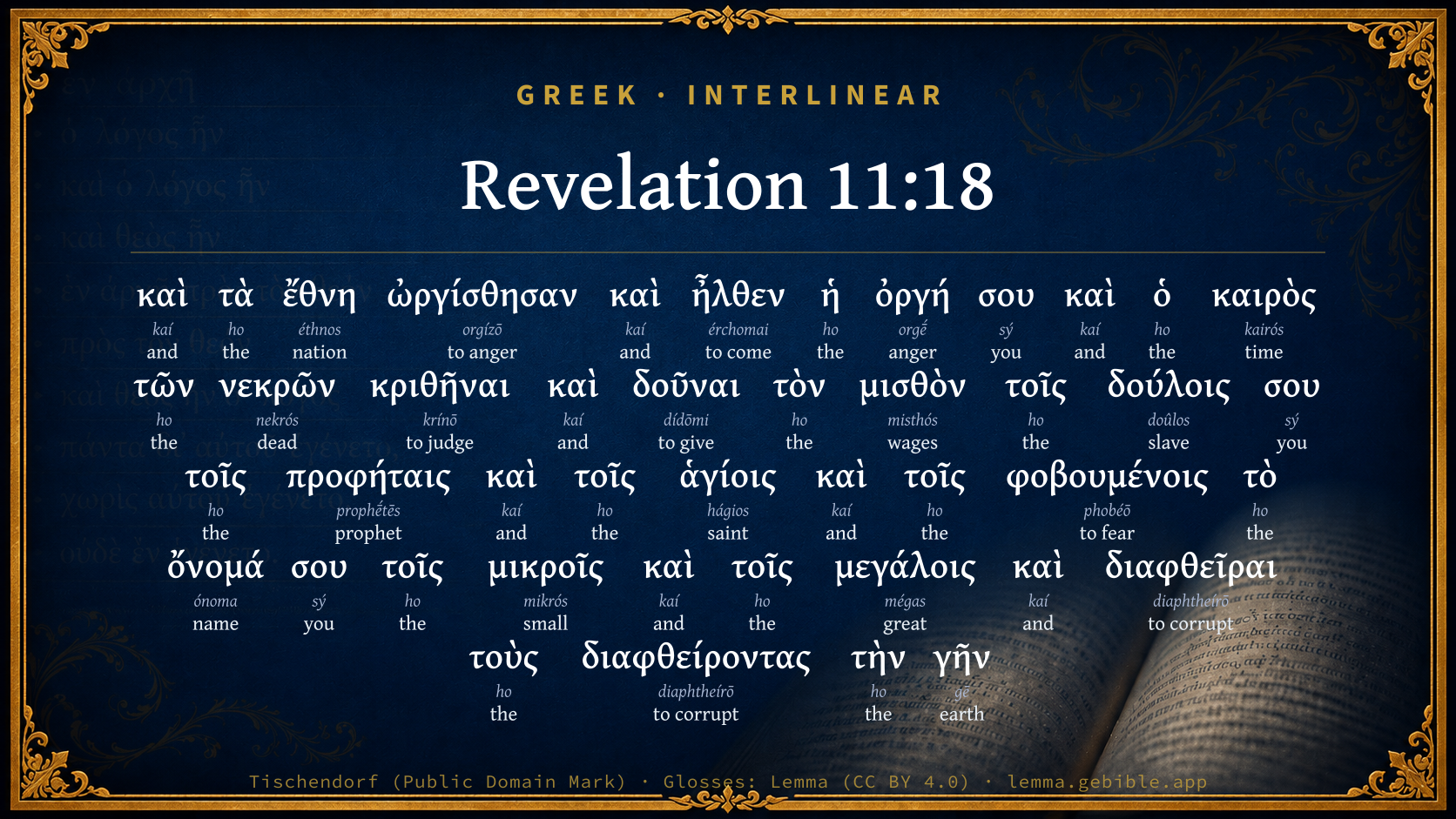
Greek (Tischendorf 8th ed.) Revelation 11:18 appears in the Greek New Testament. The text above is from the Tischendorf 8th edition. Each word links to its Strong’s number and a concise gloss. Click any word for its full Thayer’s Greek Lexicon entry.
Download image
Cite this verse

Revelation 11:18 (World English Bible). Public Domain. Lemma interlinear Bible study tool, https://lemma.gebible.app/v/revelation/11/18.

Show BibTeX & RIS
BibTeX
RIS
English Translation
The nations were angry, and your wrath came, as did the time for the dead to be judged, and to give your bondservants the prophets, their reward, as well as to the saints, and those who fear your name, to the small and the great; and to destroy those who destroy the earth."
World English Bible · Public Domain
Download a study sheet

One document with this verse’s original text, its word-by-word gloss line, the meaning frame, cross-references with their text, attributed commentary, and full source and license credits — printable, and it pastes into notes with its structure intact.

This verse Autodidact and up

Study sheet (.html) Plain text (.txt)

A passage Seminary Student

Up to 50 verses in one chapter. A passage sheet keeps up to 6 commentary sources and 12 cross-references per verse, in the order this page ranks them, and says so on the sheet whenever that leaves anything out. Ask for a single verse and you get the Autodidact verse sheet above.

Everything on this page stays free to read, with no account — the sheet is a download of what is already on screen, not access to it.

Want to remove ads? Support Godless Engineer
Compare translations 3

The same verse in 3 English versions, stacked beneath the original-language interlinear above. Click any original word for its lexicon entry.

Each is an independent rendering of the whole verse — the interlinear is not word-aligned to these translations.

Highlighted words mark where these versions differ — a whole-verse word diff, not a word-by-word alignment.

  • World English Bible Public Domain
    The nations were angry, and your wrath came, as did the time for the dead to be judged, and to give your bondservants the prophets, their reward, as well as to the saints, and those who fear your name, to the small and the great; and to destroy those who destroy the earth."
  • King James Version Public Domain
    And the nations were angry, and thy wrath is come, and the time of the dead, that they should be judged, and that thou shouldest give reward unto thy servants the prophets, and to the saints, and them that fear thy name, small and great; and shouldest destroy them which destroy the earth.
  • unfoldingWord Literal Text CC BY-SA 4.0
    And the nations were enraged, but your wrath has come and the time for the dead to be judged, and to give a reward to your servants the prophets and to the saints and to the ones fearing your name, the small and the great, and to destroy the ones destroying the earth.”

unfoldingWord Literal Text — © unfoldingWord, licensed CC BY-SA 4.0. Word-aligned USFM3 via Door43 (git.door43.org/unfoldingWord/en_ult).

Versions to compare (up to 4)

3 of 4 selected

Show all 19 translations

Every available English version of this verse, each an independent rendering of the whole verse.

  • World English Bible Public Domain
    The nations were angry, and your wrath came, as did the time for the dead to be judged, and to give your bondservants the prophets, their reward, as well as to the saints, and those who fear your name, to the small and the great; and to destroy those who destroy the earth."
  • Berean Standard Bible Public Domain
    The nations were enraged, and Your wrath has come. The time has come to judge the dead and to reward Your servants the prophets, as well as the saints and those who fear Your name, both small and great—and to destroy those who destroy the earth.”
  • Majority Standard Bible Public Domain
    The nations were enraged, and Your wrath has come. The time has come to judge the dead and to reward Your servants the prophets, as well as the saints and those who fear Your name, both small and great—and to destroy those who destroy the earth.”
  • King James Version Public Domain
    And the nations were angry, and thy wrath is come, and the time of the dead, that they should be judged, and that thou shouldest give reward unto thy servants the prophets, and to the saints, and them that fear thy name, small and great; and shouldest destroy them which destroy the earth.
  • American Standard Version (1901) Public Domain
    And the nations were wroth, and thy wrath came, and the time of the dead to be judged, and `the time' to give their reward to thy servants the prophets, and to the saints, and to them that fear thy name, the small and the great; and to destroy them that destroy the earth.
  • Revised Version (1885) Public Domain
    And the nations were wroth, and thy wrath came, and the time of the dead to be judged, and the time to give their reward to thy servants the prophets, and to the saints, and to them that fear thy name, the small and the great; and to destroy them that destroy the earth.
  • Geneva Bible (1599) Public Domain
    And the Gentiles were angrie, and thy wrath is come, and the time of the dead, that they shoulde be iudged, and that thou shouldest giue reward vnto thy seruants the Prophets, and to the Saintes, and to them that feare thy Name, to small and great, and shouldest destroy them, which destroy the earth.
  • Douay-Rheims (1899) Public Domain
    And the nations were angry, and thy wrath is come, and the time of the dead, that they should be judged, and that thou shouldest render reward to thy servants the prophets and the saints, and to them that fear thy name, little and great, and shouldest destroy them who have corrupted the earth.
  • Young's Literal Translation Public Domain
    and the nations were angry, and Thine anger did come, and the time of the dead, to be judged, and to give the reward to Thy servants, to the prophets, and to the saints, and to those fearing Thy name, to the small and to the great, and to destroy those who are destroying the land.'
  • Literal Standard Version CC BY-SA 4.0
    and the nations were angry, and Your anger came, and the time of the dead to be judged, and to give the reward to Your servants, to the prophets, and to the holy ones, and to those fearing Your Name, to the small and to the great, and to destroy those who are destroying the earth.”
  • Unlocked Literal Bible CC BY-SA 4.0
    The nations were enraged, but your wrath has come. The time has come for the dead to be judged and for you to reward your servants the prophets, those who are believers, and those who feared your name, both the unimportant and the mighty. The time has come for you to destroy those who are destroying the earth.”
  • unfoldingWord Literal Text CC BY-SA 4.0
    And the nations were enraged, but your wrath has come and the time for the dead to be judged, and to give a reward to your servants the prophets and to the saints and to the ones fearing your name, the small and the great, and to destroy the ones destroying the earth.”
  • Darby Bible Public Domain
    And the nations have been full of wrath, and thy wrath is come, and the time of the dead to be judged, and to give the recompense to thy servants the prophets, and to the saints, and to those who fear thy name, small and great; and to destroy those that destroy the earth.
  • World Messianic Bible Public Domain
    The nations were angry, and your wrath came, as did the time for the dead to be judged, and to give your bondservants the prophets, their reward, as well as to the holy ones and those who fear your name, to the small and the great, and to destroy those who destroy the earth.”
  • Webster's Bible Public Domain
    And the nations were angry, and thy wrath is come, and the time of the dead, that they should be judged, and that thou shouldest give reward to thy servants the prophets, and to the saints, and them that fear thy name, small and great; and shouldest destroy them who destroy the earth.
  • Free Bible Version CC BY-SA 4.0
    The nations became furious, but your judgment has come, the time when the dead will be judged. This is the time when your servants the prophets and the believers will be given their reward, those who respect your authority, both the weak and the powerful. This is also the time when you will destroy those who destroy the earth.
  • Bible in Basic English Public Domain
    And the nations were angry, and your wrath has come, and the time for the dead to be judged, and the time of reward for your servants, the prophets, and for the saints, and for those in whom is the fear of your name, small and great, and the time of destruction for those who made the earth unclean.
  • Text-Critical English NT CC BY 4.0
    The nations were angry, but yoʋr wrath has come, and the time has come for judging the dead, and for rewarding yoʋr servants the prophets, along with the saints and those who fear yoʋr name, both small and great, and for destroying those who destroy the earth.”
  • Tyndale New Testament (1534) Public Domain
    And the nacions were angry and thy wrath is come and the tyme of the deed that they shuld be iudged and that thou shuldest geve rewarde vnto thy servauntes the prophettes and saynctes and to them that feare thy name small and great and shuldest destroye them which destroye the erth.

Literal Standard Version (2020), Covenant Press — licensed CC BY-SA 4.0. Text via the HelloAO Bible API (eBible.org). Unlocked Literal Bible (unfoldingWord) — licensed CC BY-SA 4.0. Text via the HelloAO Bible API (eBible.org). unfoldingWord Literal Text — © unfoldingWord, licensed CC BY-SA 4.0. Word-aligned USFM3 via Door43 (git.door43.org/unfoldingWord/en_ult). Free Bible Version, Dr. Jonathan Gallagher — licensed CC BY-SA 4.0. Text via the HelloAO Bible API (eBible.org).

Word by word

More ways to search: Search by grammar → Find every occurrence → Compare this word →

Practice this passage: Drill this verse → Learn its vocabulary →

διαφθεῖραι
diaphtheírō
G1311
“to corrupt”
Verb, Aorist, Active, Infinitive
Part of Speech
Verb
Tense
Aorist
Voice
Active
Mood
Infinitive
Full Thayer's Definition

Origin: from G1225 and G5351

TDNT: 10:33,1

1. to change for the worse, to corrupt a. of minds, morals 2. to destroy, ruin a. to consume 1. of bodily vigour and strength 2. of the worm or moth that eats provisions, clothing, etc. b. to destroy, to kill
  1. καὶ kaí G2532 “and” Conjunction
  2. τὰ ho G3588 “the” Article, Nominative, Plural, Neuter
  3. ἔθνη éthnos G1484 “nation” Noun, Nominative, Plural, Neuter
  4. ὠργίσθησαν orgízō G3710 “to anger” Verb, Aorist, Passive, Indicative, 3rd person, Plural
  5. καὶ kaí G2532 “and” Conjunction
  6. ἦλθεν érchomai G2064 “to come” Verb, Aorist, Active, Indicative, 3rd person, Singular
  7. ἡ ho G3588 “the” Article, Nominative, Singular, Feminine
  8. ὀργή orgḗ G3709 “anger” Noun, Nominative, Singular, Feminine
  9. σου sý G4771 “you” Personal pronoun, 2nd person, Genitive, Singular
  10. καὶ kaí G2532 “and” Conjunction
  11. ὁ ho G3588 “the” Article, Nominative, Singular, Masculine
  12. καιρὸς kairós G2540 “time” Noun, Nominative, Singular, Masculine
  13. τῶν ho G3588 “the” Article, Genitive, Plural, Masculine
  14. νεκρῶν nekrós G3498 “dead” Adjective, Genitive, Plural, Masculine
  15. κριθῆναι krínō G2919 “to judge” Verb, Aorist, Passive, Infinitive
  16. καὶ kaí G2532 “and” Conjunction
  17. δοῦναι dídōmi G1325 “to give” Verb, Aorist, Active, Infinitive
  18. τὸν ho G3588 “the” Article, Accusative, Singular, Masculine
  19. μισθὸν misthós G3408 “wages” Noun, Accusative, Singular, Masculine
  20. τοῖς ho G3588 “the” Article, Dative, Plural, Masculine
  21. δούλοις doûlos G1401 “slave” Noun, Dative, Plural, Masculine
  22. σου sý G4771 “you” Personal pronoun, 2nd person, Genitive, Singular
  23. τοῖς ho G3588 “the” Article, Dative, Plural, Masculine
  24. προφήταις prophḗtēs G4396 “prophet” Noun, Dative, Plural, Masculine
  25. καὶ kaí G2532 “and” Conjunction
  26. τοῖς ho G3588 “the” Article, Dative, Plural, Masculine
  27. ἁγίοις hágios G40 “saint” Adjective, Dative, Plural, Masculine
  28. καὶ kaí G2532 “and” Conjunction
  29. τοῖς ho G3588 “the” Article, Dative, Plural, Masculine
  30. φοβουμένοις phobéō G5399 “to fear” Verb, Present, Middle or Passive deponent, Participle, Dative, Plural, Masculine
  31. τὸ ho G3588 “the” Article, Accusative, Singular, Neuter
  32. ὄνομά ónoma G3686 “name” Noun, Accusative, Singular, Neuter
  33. σου sý G4771 “you” Personal pronoun, 2nd person, Genitive, Singular
  34. τοῖς ho G3588 “the” Article, Dative, Plural, Masculine
  35. μικροῖς mikrós G3398 “small” Adjective, Dative, Plural, Masculine
  36. καὶ kaí G2532 “and” Conjunction
  37. τοῖς ho G3588 “the” Article, Dative, Plural, Masculine
  38. μεγάλοις mégas G3173 “great” Adjective, Dative, Plural, Masculine
  39. καὶ kaí G2532 “and” Conjunction
  40. τοὺς ho G3588 “the” Article, Accusative, Plural, Masculine
  41. διαφθείροντας diaphtheírō G1311 “to corrupt” Verb, Present, Active, Participle, Accusative, Plural, Masculine
  42. τὴν ho G3588 “the” Article, Accusative, Singular, Feminine
  43. γῆν gē G1093 “earth” Noun, Accusative, Singular, Feminine

About this verse

These counts appear in no published source. They are computed here, from the morphology-tagged text and Lemma’s own curated glosses. What Lemma adds →

44
words
21
distinct lemmas
Revelation
section

Notable vocabulary

The rarest word here is διαφθεῖραι to corrupt G1311 — appearing just 6 times in the whole Greek New Testament.

Shared distinctive vocabulary

διαφθεῖραι to corrupt G1311 occurs in 5 verses of the Greek New Testament. Also found in:

Repetition

Words recur within this verse:

  • διαφθεῖραι to corrupt G1311 ×2
  • τὰ the G3588 ×14
  • καὶ and G2532 ×8
  • σου you G4771 ×3

Cross-references

45

Topical passages linked to Revelation 11:18 in the Treasury of Scripture Knowledge — connected by theme and wording, ordered by reader-vote popularity; previews shown in the World English Bible.

  • Revelation 19:5 A voice came forth from the throne, saying, "Give praise to our God, all you his servants, you who fear him, the small and the great!"
  • Revelation 20:12 I saw the dead, the great and the small, standing before the throne, and they opened books. Another book was opened, which is the book of life. The dead were judged out of the things which were written in the books, according to their works.
  • Revelation 6:10–11 They cried with a loud voice, saying, "How long, Master, the holy and true, until you judge and avenge our blood on those who dwell on the earth?"
  • Revelation 13:10 If anyone has captivity, he will go. If anyone is with the sword, he must be killed. Here is the endurance and the faith of the saints.
  • Revelation 20:4–5 I saw thrones, and they sat on them, and judgment was given to them. I saw the souls of those who had been beheaded for the testimony of Jesus, and for the word of God, and such as didn't worship the beast nor his image, and didn't receive the mark on their forehead and on their hand. They lived, and reigned with Christ for the thousand years.
  • Revelation 22:12 "Behold, I come quickly. My reward is with me, to repay to each man according to his work.
  • Psalms 103:11 For as the heavens are high above the earth, So great is his loving kindness toward those who fear him.
  • Psalms 115:13–14 He will bless those who fear Yahweh, Both small and great.
  • Micah 7:15–17 "As in the days of your coming forth out of the land of Egypt, I will show them marvelous things."
  • Hebrews 11:25–26 choosing rather to share ill treatment with God's people, than to enjoy the pleasures of sin for a time;
  • Psalms 2:5 Then he will speak to them in his anger, And terrify them in his wrath:
  • Psalms 85:9 Surely his salvation is near those who fear him, That glory may dwell in our land.
  • Psalms 110:5 The Lord is at your right hand. He will crush kings in the day of his wrath.
  • Isaiah 34:1–10 Come near, you nations, to hear; and listen, you peoples: let the earth hear, and the fullness of it; the world, and all things that come forth from it.
  • Matthew 5:12 Rejoice, and be exceedingly glad, for great is your reward in heaven. For that is how they persecuted the prophets who were before you.
  • Luke 1:50 His mercy is for generations of generations on those who fear him.
  • Hebrews 9:27 Inasmuch as it is appointed for men to die once, and after this, judgment,
  • Revelation 6:15–17 The kings of the earth, the princes, the commanding officers, the rich, the strong, and every slave and free person, hid themselves in the caves and in the rocks of the mountains.
  • Revelation 14:10 he also will drink of the wine of the wrath of God, which is prepared unmixed in the cup of his anger. He will be tormented with fire and sulfur in the presence of the holy angels, and in the presence of the Lamb.
  • Revelation 15:1 I saw another great and marvelous sign in the sky: seven angels having the seven last plagues, for in them God's wrath is finished.
  • Revelation 15:7 One of the four living creatures gave to the seven angels seven golden bowls full of the wrath of God, who lives forever and ever.
  • Psalms 2:1–3 Why do the nations rage, And the peoples plot a vain thing?
  • Psalms 147:11 Yahweh takes pleasure in those who fear him, In those who hope in his loving kindness.
  • Ecclesiastes 8:12 Though a sinner commits crimes a hundred times, and lives long, yet surely I know that it will be better with those who fear God, who are reverent before him.
  • Ecclesiastes 12:13 This is the end of the matter. All has been heard. Fear God, and keep his commandments; for this is the whole duty of man.
  • Isaiah 26:19–21 Your dead shall live; my dead bodies shall arise. Awake and sing, you who dwell in the dust; for your dew is [as] the dew of herbs, and the earth shall cast forth the dead.
  • Isaiah 63:1–6 Who is this who comes from Edom, with dyed garments from Bozrah? this who is glorious in his clothing, marching in the greatness of his strength? I who speak in righteousness, mighty to save.
  • Daniel 7:9–10 I saw until thrones were placed, and one who was ancient of days sat: his clothing was white as snow, and the hair of his head like pure wool; his throne was fiery flames, [and] the wheels of it burning fire.
  • Daniel 7:26 But the judgment shall be set, and they shall take away his dominion, to consume and to destroy it to the end.
  • Daniel 8:25 Through his policy he shall cause craft to prosper in his hand; and he shall magnify himself in his heart, and in [their] security shall he destroy many: he shall also stand up against the prince of princes; but he shall be broken without hand.
  • Joel 3:9–14 Proclaim this among the nations: Prepare war. Stir up the mighty men. Let all the warriors draw near. Let them come up.
  • Zechariah 14:2–3 For I will gather all nations against Jerusalem to battle; and the city will be taken, the houses rifled, and the women ravished. half of the city will go out into captivity, and the rest of the people will not be cut off from the city.
  • 2 Thessalonians 1:5–7 This is an obvious sign of the righteous judgment of God, to the end that you may be counted worthy of the Kingdom of God, for which you also suffer.
  • Revelation 11:2 Leave out the court which is outside of the temple, and don't measure it, for it has been given to the gentiles. They will tread the holy city under foot for forty-two months.
  • Revelation 18:6 Return to her just as she returned, and repay her double as she did, and according to her works. In the cup which she mixed, mix to her double.
  • Revelation 20:15 If anyone was not found written in the book of life, he was cast into the lake of fire.
  • Daniel 11:44–12:2 But news out of the east and out of the north shall trouble him; and he shall go forth with great fury to destroy and utterly to sweep away many.
  • Revelation 16:1–21 I heard a loud voice out of the temple, saying to the seven angels, "Go and pour out the seven bowls of the wrath of God on the earth!"
  • Revelation 19:15 Out of his mouth proceeds a sharp, double-edged sword, that with it he should strike the nations. He will rule them with a rod of iron. He treads the winepress of the fierceness of the wrath of God, the Almighty.
  • Ezekiel 38:9–23 You shall ascend, you shall come like a storm, you shall be like a cloud to cover the land, you, and all your hordes, and many peoples with you.
  • Revelation 10:7 but in the days of the voice of the seventh angel, when he is about to sound, then the mystery of God is finished, as he declared to his servants, the prophets.
  • Revelation 11:9–10 From among the peoples, tribes, languages, and nations people will look at their dead bodies for three and a half days, and will not allow their dead bodies to be laid in a tomb.
  • Revelation 17:12–15 The ten horns that you saw are ten kings who have received no kingdom as yet, but they receive authority as kings, with the beast, for one hour.
  • Revelation 18:16–24 saying, 'Woe, woe, the great city, she who was dressed in fine linen, purple, and scarlet, and decked with gold and precious stones and pearls!
  • Revelation 19:19–21 I saw the beast, and the kings of the earth, and their armies, gathered together to make war against him who sat on the horse, and against his army.

Cross-references courtesy of OpenBible.info (CC BY 4.0).

Commentary

Notes on Revelation 11:18 from classic Christian and Jewish commentators (each source and its license shown beneath its notes). The classic Christian expositions comment on the surrounding passage and are grouped to its opening verse, so a note may address several verses; the Jewish commentaries on the Tanakh (Rashi and others) are per-verse, so they appear only where the commentator wrote on this verse.

Lemma curates 59 commentaries, every one of them public domain or Creative Commons licensed, each selected and text-cleaned for this edition rather than reprinted as found. About our sources →

Tyndale Open Study Notes

Tyndale Open Resources

11:18 The nations were filled with wrath when they refused to do as God commanded (see Ps 2). But things will now be different because God’s wrath has come. God will reward his holy people (see Rev 22:12) with new life as his children (see John 1:12; 20:31). • fear your name: God’s name implies his nature; fearing God’s name means accepting who he is (see “Fear of the Lord” Theme Note). • The end of the age will be the time to destroy those who have not accepted God’s love (see John 3:16-20). They will go into the lake of fire (Rev 20:15). This doom of God’s enemies is the third and final terror (11:14).

Tyndale Open Study Notes — © Tyndale Open Resources, licensed CC BY-SA 4.0. Text via the HelloAO Bible API.

Bengel's Gnomon

Johann Albrecht Bengel

Rev 11:18. Καὶ ὁ καιρὸς) that is, ἐστίν. For ὁ καιρὸς does not seem here to be joined with ἦλθεν (although often in other places time is both understood to be, and is said to come, and that, in one place, jointly, Psa 102:14), since that sentence, τὰ ἔθνη ὠργίσθησαν, και ἦλθεν ἡ ὀργή σου, is now finished. In like manner, ἐστὶ is understood after the verb ἔρχομαι, ch. Rev 22:12. In like manner, ὁ καιρὸς (namely, ἐστι) τοῦ ἄρξασθαι τὸ κρίμα, 1Pe 4:17; πότε ὁ καιρός ἐστιν, Mar 13:33.—τῶν νεκρῶν, of the dead) of mortals and the departed. The German Exegesis quotes many passages of Scripture speaking in this manner. Add the son of Sirach, before noticed, on Jud 1:4.—κριθῆναι) This verb, equally with δοῦναι καὶ διαφθεῖραι, is spoken concerning God, and answers to the Hebrew נשפט, which is likewise spoken of God. Isa 66:16; Eze 38:22, in the Hebrew; and Eze 17:20; Eze 20:35-36; Joe 3:2, in the Hebrew, and in the Septuagint, where, however, the reading is not κριθῆναι, but διακριθῆναι; and Jer 2:35; Jer 25:31, in which the Septuagint has κρίνομαι. There is an allusion to the wonderful συγκατάβασις (condescension) of the Supreme Judge, whereby, for the sake of showing the justice of His cause, He blends discussion [“controversy”] with His unbending judgment. Ὅπως ἂν νικήσῃς ἐν τῷ κρίνεσθαί σε, Rom 3:4, note.

Bengel's Gnomon of the New Testament — English translation (T&T Clark, Edinburgh, 1860) — public domain. Text from a community e-Sword module.

Expositor's Greek Testament

ed. W. Robertson Nicoll

Rev 11:18 . ὠργ . = defiant rage ( cf. Rev 16:11 ), not the mere terror of Rev 6:17 , at the messianic ὀργή . The prophets are as usual the most prominent of the ἅγιοι . If the καὶ after ἁγίοις is retained, it is epexegetic (as in Gen 4:4 , Gal 6:16 ), not a subtle mark of division between Jewish and Gentile Christians (Vólter) or (in a Jewish source) saints and proselytes. The same interpretation (for φοβ . cf. Introd. § 6) must be chosen, if καὶ is omitted (as, e.g. , by Bousset and Baljon), but the evidence is far too slight to justify the deletion. διαφθ . “When Nero perished by the justest doom/Which ever the destroyer yet destroyed” (Byron). Contrast the exultant tone of this retrospective thanksgiving with the strain of foreboding which is sounded in Rev 12:12 before the actual conflict.

The Expositor's Greek Testament, edited by W. Robertson Nicoll (1897–1910) — public domain. Text from a community e-Sword module.

Geneva Bible (1599)

Geneva Bible translators

A speech of the Hebrew language, as much to say, as Gentiles being angry thine inflamed wrath came upon them and showed itself from heaven, occasioned by their anger and fury.

Geneva Bible (1599) marginal notes — public domain. Text via Bolls.life.

Jamieson, Fausset & Brown

Robert Jamieson, A. R. Fausset & David Brown

the nations were angry--alluding to Psa 99:1, Septuagint, "The Lord is become King: let the peoples become angry." Their anger is combined with alarm (Exo 15:14; Kg2 19:28, "thy rage against Me is come up into Mine ears, I will put My hook in thy nose," &c.). Translate, as the Greek is the same. "The nations were angered, and Thy anger is come." How petty man's impotent anger, standing here side by side with that of the omnipotent God!

dead . . . be judged--proving that this seventh trumpet is at the end of all things, when the judgment on Christ's foes and the reward of His saints, long prayed for by His saints, shall take place.

the prophets--as, for instance, the two prophesying witnesses (Rev 11:3), and those who have showed them kindness for Christ's sake. Jesus shall come to effect by His presence that which we have looked for long, but vainly, in His absence, and by other means.

destroy them which destroy the earth--Retribution in kind (compare Rev 16:6; Luk 19:27). See on Dan 7:14-18.

Jamieson, Fausset & Brown — Commentary Critical and Explanatory on the Whole Bible (1871) — public domain (CC PDM 1.0). Text via the HelloAO Bible API.

Adam Clarke's Commentary

Verse 18. The nations were angry] Were enraged against thy Gospel, and determined to destroy it.

Thy wrath is come] The time to avenge thy servants and to destroy all thy enemies.

The time of the dead, that they should be judged] The word κρινειν, to judge, is often used in the sense of to avenge. The dead, here, may mean those who were slain for the testimony of Jesus, and the judging is the avenging of their blood.

Give reward unto thy servants] Who have been faithful unto death.

The prophets] The faithful teachers in the Church, the saints-the Christians.

And them that fear thy name] All thy sincere followers.

Destroy them which destroy the earth.] All the authors, fomenters, and encouragers of bloody wars.

Adam Clarke's Commentary on the Bible (1810–1826) — public domain. Text from a community e-Sword/MySword module.

The Cambridge Bible for Schools and Colleges

gen. ed. J. J. S. Perowne

18. destroy them which destroy] The verb used twice over is ambiguous, and perhaps has a meaning that we should express differently in the two places; as in 1Co_3:17. Thus neither the marginal rendering nor the text is wrong.

The Cambridge Bible for Schools and Colleges (gen. ed. J. J. S. Perowne; Cambridge University Press, 1878–1918) — public domain. Text from a community e-Sword module.

John Gill's Exposition

And the nations were angry,.... See Psa 99:1, which the Septuagint render, the "Lord reigns, let the nations be angry". This refers not to the times of the dragon, or the Pagan Roman emperors, who were wroth with the woman, the church, and made war with her seed; but Rome Papal, and its Gentiles, are intended; these are the nations that antichrist reigns over: and it does not so much design their anger against Christ, and his people, expressed by their anathemas, excommunications, murders; and massacres, and bloody persecutions, which could not be cause of thanksgiving to the elders; but their anger and resentment at his power and reign, at having the outward court taken from them, said to be given them, Rev 11:2; and at their loss of power, profit, pleasure, and plenty, through the fall of Babylon, and the setting up of Christ's kingdom; and though these things will make the Gentiles, the followers of antichrist, gnash their teeth, it will occasion joy and thanksgiving among the saints:

and thy wrath is come: the time is come to make Babylon, or the Romish antichrist, to drink of the wine of the fierceness of divine wrath; as the time of the Lamb's wrath and vengeance upon Rome Pagan was come at the opening of the sixth seal, so the time of his wrath and vengeance on Rome Papal will be come at the sounding of the seventh trumpet:

and the time of the dead, that they should be judged; not the time of the wicked, who are dead in sins, while they live, and who die in their sins, not their time to be raised from the dead, in order to be judged, for they will not rise till after the thousand years are ended; nor the time of the dead in Christ, who will rise upon Christ's personal coming, at the beginning of the thousand years; but this trumpet respects not the personal coming of Christ to raise the dead, and judge the world, but his spiritual coming to reign in his churches, and judge their enemies: the time of those that were dead for Christ, whose blood had been shed in his cause, the time for the vindication of them, and avenging their blood, is now come; the souls of those under the altar had been a long time crying to God to avenge their blood on them that dwell on the earth; and now the time will be come, when God will judge his people, vindicate their cause; and when he, to whom vengeance belongs, will repay it, by pouring out the vials of his wrath on the antichristian party, by giving them blood to drink, because they are worthy; this judgment will issue in the fall and ruin both of the western and eastern antichrist.

And that thou shouldest give reward unto thy servants; not a reward of debt, but of grace; not the recompence of reward, or the reward of the inheritance in heaven; but some marks of honour and respect; some measure of happiness, peace, and joy, which Christ of his rich grace will give to his ministers and churches, and all that love him in this glorious period of time; and who are distinguished in the following manner,

the prophets, and to the saints, and them that fear thy name, small and great: by the "prophets" are meant, not the prophets of the Old Testament, but the prophets of the New; and not those extraordinary persons, who are distinguished on the one hand from apostles and evangelists, and on the other from pastors and teachers, who had an extraordinary gift of interpreting the Scriptures, and of foretelling things to come; but the ministers of the word, the two prophets or witnesses, who had prophesied in sackcloth, but shall now be clothed with salvation: and by "the saints" are designed such as were set apart by God the Father from eternity, and whose sins are expiated by the blood of Christ, and who are internally sanctified by the, Spirit of God, and externally separated from the rest of mankind, and incorporated into a Gospel church state, and are in holy fellowship one with another: and they that "fear the name" of God are such as truly love and reverence him, and worship him in Spirit and in truth, but are not members of any particular church; who yet will be taken notice of by the Lord, and a book of remembrance be written for them; so the proselytes from among the Gentiles are distinguished from the Israelites by the same character; See Gill on Act 13:16; or rather this is a general character of both ministers and churches, since to fear the name of the Lord is a phrase that includes all religious worship, internal and external. And now all these, "small and great", whether greater or lesser believers, whether men of larger or meaner gifts and abilities, will all have the same reward, enjoy the same church privileges, partake of the same ordinances, in the purity of them, have the same communion with God, and fellowship with Christ, and one another, and share in, the same common peace, and liberty, and security from enemies: the last thing taken notice of by these elders, as matter of thanksgiving, is the destruction of antichrist.

And shouldest destroy them which destroy the earth; or "corrupt it"; meaning antichrist and his followers; who destroy the bodies, souls, and estates of men, and not only the inhabitants of the earth, but even the earth itself; for through that laziness and idleness which they spread wherever they come, a fruitful country is turned into barrenness; who corrupt the minds of men with false doctrine, idolatry, and superstition, and the bodies of women and men with all uncleanness and filthiness, with fornication, sodomy, &c. Rev 19:2; and are the cause of their own destruction, and the destruction of others; which, upon the blowing of the seventh trumpet, will come swiftly and irrecoverably. Now will Babylon sink as a millstone into the sea, never to be seen more; both the western and eastern antichrists are intended; the former is called the son of perdition, because of his destroying others, and going into perdition himself; and the latter is called "Abaddon" and "Apollyon", which both signify a destroyer, Th2 1:4.

John Gill's Exposition of the Whole Bible (1746–1763) — public domain (CC PDM 1.0). Text via the HelloAO Bible API.

Trapp's Complete Commentary

John Trapp

18 And the nations were angry, and thy wrath is come, and the time of the dead, that they should be judged, and that thou shouldest give reward unto thy servants the prophets, and to the saints, and them that fear thy name, small and great; and shouldest destroy them which destroy the earth.

Ver. 18. Were angry] Sed vanae sine viribus irae; the wrath of these men turned to the glory of God.

That they should be judged] According to their prayer, and thy promise, Rev 6:10-11.

And shouldest destroy them] God usually retaliates and proportions jealousy to jealousy, provocation to provocation, Deu 32:21; frowardness to frowardness, Psa 18:26; contrariety to contrariety, Lev 26:18; Lev 26:21; destruction to destruction, as here. He pays them home in their own coin.

John Trapp, A Commentary or Exposition upon All the Books of the Old and New Testament (1647–1656) — public domain. Text from a community e-Sword module.

Albert Barnes' Notes on the Bible

And the nations were angry - Were enraged against thee. This they had shown by their opposition to his laws; by persecuting his people; by slaying his witnesses; by all the attempts which they had made to destroy his authority on the earth. The reference here seems to be to the whole series of events preceding the final establishment of his kingdom on the earth; to all the efforts which had been made to throw off his government and to crush his church. At this period of glorious triumph it was natural to look back to those dark times when the “nations raged” (compare Psa 2:1-3), and when the very existence of the church was in jeopardy.

And thy wrath is come - That is, the time when thou wilt punish them for all that they have done in opposition to thee, and when the wicked shall be cut off. There will be, in the setting up of the kingdom of God, some manifestation of his wrath against the powers that opposed it; or something that will show his purpose to destroy his enemies, and to judge the wicked. The representations in this book lead us to suppose that the final establishment of the kingdom of God on the earth will be introduced or accompanied by commotions and wars which will end in the overthrow of the great powers that have opposed his reign, and by such awful calamities in those portions of the world as shall show that God has arisen in his strength to cut off his enemies, and to appear as the vindicator of his people. Compare the notes on Rev 16:12-16; Rev. 19:11-26.

And the time of the dead, that they should be judged - According to the view which the course of the exposition thus far pursued leads us to entertain of this book, there is reference here, in few words, to the same thing which is more fully stated in Rev 20:1-15, and the meaning of the sacred writer will, therefore, come up for a more distinct and full examination when we consider that chapter. See the notes on Rev 20:4-6, Rev 20:12-15. The purpose of the writer does not require that a detailed statement of the order of the events referred to should be made here, for it would be better made when, after another line of illustration and of symbol Rev 11:19; Rev. 12–19, he should have reached the same catastrophe, and when, in view of both the mind would be prepared for the fuller description with which the book closes, Rev. 20–22. All that occurs here, therefore, is a very general statement of the final consumation of all things.

And that thou shouldest give reward unto thy servants - The righteous. Compare Mat 25:34-40; Rev 21:22. That is, in the final winding-up of human affairs, God will bestow the long-promised reward on those who have been his true friends. The wicked that annoyed and persecuted them will annoy and persecute them no more; and the righteous will be publicly acknowledged as the friends of God. For the manner in which this will be done, see the details in Rev. 20–22.

The prophets - All who, in every age, have faithfully proclaimed the truth. On the meaning of the word, see the notes on Rev 10:11.

And to the saints - To all who are holy - under whatever dispensation, and in whatever land, and at whatever time, they may have lived. Then will be the time when, in a public manner, they will be recognized as belonging to the kingdom of God, and as being his true friends.

And them that fear thy name - Another way of designating his people, since religion consists in a profound veneration for God, Mal 3:16; Job 1:1; Psa 15:4; Psa 22:23; Psa 115:11; Pro 1:7; Pro 3:13; Pro 9:10; Isa 11:2; Act 10:22, Act 10:35.

Small and great - Young and old; low and high; poor and rich. The language is designed to comprehend all, of every class, who have a claim to be numbered among the friends of God, and it furnishes a plain intimation that people of all classes will be found at last among his true people. One of the glories of the true religion is, that, in bestowing its favors, it disregards all the artificial distinctions of society, and addresses man as man, welcoming all who are human beings to the blessings of life and salvation. This will be illustriously shown in the last period of the world’s history, when the distinctions of wealth, and rank, and blood shall lose the importance which has been attributed to them, and when the honor of being a child of God shall have its true place. Compare Gal 3:28.

And shouldest destroy them which destroy the earth - That is, all who have, in their conquests, spread desolation over the earth and who have persecuted the righteous, and all who have done injustice and wrong to any class of people. Compare the notes on Rev 20:13-15.

Here ends, as I suppose, the first series of visions referred to in the volume sealed with the seven seals, Rev 5:1. At this point, where the division of the chapter should have been made, and which is properly marked in our common Bibles by the sign of the paragraph (),there commences a new series of visions, intended also, but in a different line, to extend down to the consummation of all things. The former series traces the history down mainly through the series of civil changes in the world, or the outward affairs which affect the destiny of the church; the latter - the portion still before us - embraces the same period with a more direct reference to the rise of antichrist, and the influence of that power in affecting the destiny of the Church. When that is completed Rev 11:19; Rev. 12–19, the way is prepared Rev. 20–22 for the more full statement of the final triumph of the gospel, and the universal prevalence of religion, with which the book so appropriately closes. That portion of the book, therefore, refers to the same period as the one which has just been considered under the sounding of the seventh trumpet, and the description of the final state of things would have immediately succeeded if it had not been necessary, by another series of visions, to trace more particularly the history of antichrist on the destiny of the church, and the way in which that great and fearful power would be finally overcome. See the Analysis of the Book, part 5. The way is then prepared for the description of the state of things which will exist when all the enemies of the church shall be subdued; when Christianity shall triumph; and when the predicted reign of God shall be set up on the earth, Rev. 20–22.

Albert Barnes' Notes on the Bible (1834–1885) — public domain. Text from a community e-Sword/MySword module.

Matthew Poole's English Annotations

And the nations were angry; those who have not been of thy true Israel, but old or modern Gentiles, they have been angry long enough.

And thy wrath is come; now it is time for thee to show thyself angry, and thou hast begun to do it.

And the time of the dead, that they should be judged; the time is come for thee to judge the cause of thy faithtful witnesses, and all those who have died in testimony to thy truth.

And that thou shouldest give reward unto thy servants the prophets; and for thee to reward such as have faithfully revealed thy will.

And to the saints; and not only them, but all thy holy ones.

And them that fear thy name, small and great; without respect to their quality in the world, be they little or great.

And shouldest destroy them which destroy the earth; the time also is come, when thou hast destroyed, or wilt destroy, that antichristian brood, which so long hath plagued the earth, and destroyed thy people in it.

Matthew Poole's English Annotations on the Holy Bible (1683–1685) — public domain. Text from a community e-Sword/MySword module.

Whedon's Commentary on the Bible

Daniel D. Whedon

18. Nations were angry—On the side of antichrist they will rally in arms against God and the Lamb.

Wrath is come—In the terrible carnage of Rev_19:11-21, and the fire from heaven of Rev_20:9.

Judged— Rev_20:11.

Daniel D. Whedon (gen. ed.), Commentary on the Old and New Testaments (1874–1909) — public domain. Text from a community e-Sword module.

The Pulpit Commentary

And the nations were angry. (cf. Psa_2:1, which appears to be in the mind of the seer, for ver. 9 of the same psalm is referred to in Rev_12:5) "The nations" raged in the period of their persecution of the Church, as set forth under the visions of the seals. They were angry, says Hengstenberg, at the progress of the kingdom of God, after the Word was made flesh. And thy wrath is come; thy wrath came. This verse points conclusively to the judgment day, the events of which, however, as before remarked (see on ver. 15), are merely indicated, not fully described. This is the last final infliction upon the wicked, the seventh of the trumpet plagues. And the time of the dead, that they should be judged; to be judged. Vitringa and others understand this judgment to refer to the dead martyrs who are now vindicated; but the meaning probably extends to all the dead, both classes of whom are referred to in the following part of the verse. And that thou shouldest give reward unto thy servants the prophets, and to the saints, and them that fear thy Name, small and great; and shouldest destroy them which destroy the earth; and to give their reward... and to destroy, etc. Though mikrou toulov , "the small and the great," is in the accusative ease, it is in apposition with the preceding datives, profhtaiv agioiv, foboumenoiv , "prophets, saints, those that fear." The wicked are those who "destroy the earth," since it is on their account that the world is destroyed; they "destroy the earth" also by corrupting it, which is the force of diafyeirai . In what way this destruction of the wicked is accomplished we are not told.

The Pulpit Commentary (1880–1919), ed. H.D.M. Spence-Jones & Joseph S. Exell — public domain. Text from a community e-Sword module.

John Wesley's Explanatory Notes

And the heathen nations were wroth - At the breaking out of the power and kingdom of God. This wrath of the heathens now rises to the highest pitch; but it meets the wrath of the Almighty, and melts away. In this verse is described both the going forth and the end of God's wrath, which together take up several ages. And the time of the dead is come - Both of the quick and dead, of whom those already dead are far the more numerous part. That they be judged - This, being infallibly certain, they speak of as already present. And to give a reward - At the coming of Christ, chap. xxii, 12; but of free grace, not of debt,

1. To his servants the prophets:

2. To his saints: to them who were eminently holy:

3. To them that fear his name: these are the lowest class. Those who do not even fear God will have no reward from him. Small and great - All universally, young and old, high and low, rich and poor. And to destroy them that destroyed the earth - The earth was destroyed by the "great whore" in particular, chap. xix, 2; xvii, 2, 5; but likewise in general, by the open rage and hate of wicked men against all that is good; by wars, and the various destruction and desolation naturally flowing therefrom; by such laws and constitutions as hinder much good, and occasion many offenses and calamities; by public scandals, whereby a door is opened for all dissoluteness and unrighteousness; by abuse of secular and spiritual powers; by evil doctrines, maxims, and counsels; by open violence and persecution; and by sins crying to God to send plagues upon the earth. This great work of God, destroying the destroyers, under the trumpet of the seventh angel, is not the third woe, but matter of joy, for which the elders solemnly give thanks. All the woes, and particularly the third, go forth over those "who dwell upon the earth;" but this destruction, over those "who destroy the earth," and were also instruments of that woe.

John Wesley, Explanatory Notes Upon the Whole Bible (1754–1765) — public domain. Text via the GEBible commentary corpus.

unfoldingWord translationNotes

Door43 World Missions Community

Connecting Statement:

The twenty-four elders continue praising God.

General Information:

The words "you" and "your" refer to God.

were enraged

"were extremely angry"

your wrath has come

Existing in the present is spoken of as having come. AT: "You are ready to show your anger" (See: Metaphor)

The time has come

Existing in the present is spoken of as having come. AT: "The time is right" or "Now is the time" (See: Metaphor)

the prophets, those who are believers, and those who feared your name

This list explains what "your servants" means. These were not three completely different groups of people. The prophets also were believers and feared God's name. "Name" here is a metonym for the person of Jesus Christ. AT: "the prophets, those who are believers, and those who fear you" or "the prophets and the others who are believers and fear your name" (See: Metonymy)

translationWords

nation

wrath

die

judge

reward

servant

prophet

believe

fear

might

unfoldingWord translationNotes — © Distant Shores Media and the Door43 World Missions Community, licensed CC BY-SA 4.0. Source: git.door43.org/Door43/en_tn.

Cambridge Greek Testament for Schools and Colleges

18. καιρός. C reads κλῆρος.

κριθῆναι καί. Primas[388] omits.

[388] Primasius, edited by Haussleiter.

καὶ τοῖς ἁγ. καὶ τοῖς φοβ. A reads καὶ τοὺς ἁγ. καὶ τοὺς φοβ.

τοῖς μικροῖς καὶ τοῖς μεγάλοις. Lach[389] Treg[390] W. H[391] read τοὺς μικροὺς καὶ τοὺς μεγὰλους with א* AC.

[389] Lachmann’s larger edition.

[390] Tregelles.

[391] H. Westcott aud Hort.

καὶ διαφθεἱραι. A omits καὶ.

18. ὁ καιρὸς τῶν νεκρῶν κριθῆναι. The mention of the general Judgement here so long before the end of the book is not really a difficulty if we suppose that the Seven Trumpets form a separate vision, and that each vision carries us up to the End, or at least to the very verge of it.

τοῖς μικροῖς καὶ τοῖς μεγάλοις. See crit. notes: the accusative, which in almost all critical texts comes in somewhere or other after the dative, would be quite natural after a verb like ἀποτῖσαι, which is only once found in N.T., Phm 1:19, where D2 reads ἀποδώσω as if ἀποτίσω was difficult.

διαφθεῖραι τοὺς διαφθείροντας. Possibly, as A. V[396] margin, we should translate the participle “corrupt,” not “destroy”: there is an inverse change of sense in 1Co 3:17.

[396] Authorised Version.

Cambridge Greek Testament for Schools and Colleges (Cambridge University Press, 1896; 21 vols, various authors incl. Carr, Maclear, Plummer, Farrar, Lumby, Moule, M. R. James, Simcox) — public domain. Text from a community e-Sword module.

Vincent's Word Studies in the New Testament

Marvin R. Vincent

Were angry [οργισθησαν] . See on wrath, Joh 3:36 Compare Psa 2:1.

The time [ο καιρος] . See on Mt 12:1.

Reward [μισθον] . See on 2Pe 2:13.

Destroy [διαφθειραι] . Also to corrupt.

Which destroy [τους διαφθειροντας] . Or, the destroyers.

Marvin R. Vincent, Word Studies in the New Testament (1887–1900) — public domain. Text from a community e-Sword/MySword module.

Lesson kit

Teaching starters — assembled from the data on this page, not authored interpretation. Every prompt links to the verse data it draws on. Edit before teaching.

Revelation, in the Revelation, opens this verse with 44 words (21 distinct Greek lemmas). Its most distinctive word is diaphtheírō (“to corrupt”). A historical commentator’s framing appears above. Read the whole chapter for the surrounding context.

Discussion questions

  1. How does “to corrupt” (diaphtheírō) shape what this verse is saying?
  2. Luke 12:33 shares the word «to corrupt» with this verse. How do the two illuminate each other?
  3. “to corrupt” occurs 2× in this one verse. What is the effect of the repetition?
  4. These translations render this verse differently. What is at stake in choosing one wording over another?
  5. Reading how Tyndale Open Study Notes and Bengel's Gnomon read this verse, where do the two commentators agree and where do they part?

Things to notice

  • These translations choose different wording for 17 words in this verse.
  • “to corrupt” occurs 2× in this single verse.
  • 21 distinct Greek lemmas span 44 words in this verse.

Reading settings

Reading text

Shown beneath each verse's original-language words.

Old Testament
Old Testament edition

Read the OT as the Masoretic Hebrew (MT) or the Greek Septuagint (LXX).

English shown for the Greek Septuagint (in the Hebrew ↔ Greek comparison).

Comparing translations? Open the Compare panel on any verse page to stack up to four side by side.