Mark 4:8

Greek (Tischendorf 8th ed.) Mark 4:8 appears in the Greek New Testament. The text above is from the Tischendorf 8th edition. Each word links to its Strong’s number and a concise gloss. Click any word for its full Thayer’s Greek Lexicon entry.

Download image
Cite this verse

Mark 4:8 (World English Bible). Public Domain. Lemma interlinear Bible study tool, https://lemma.gebible.app/v/mark/4/8.

Show BibTeX & RIS
BibTeX
RIS
English Translation
Others fell into the good ground, and yielded fruit, growing up and increasing. Some brought forth thirty times, some sixty times, and some one hundred times as much."
World English Bible · Public Domain
Download a study sheet

One document with this verse’s original text, its word-by-word gloss line, the meaning frame, cross-references with their text, attributed commentary, and full source and license credits — printable, and it pastes into notes with its structure intact.

This verse Autodidact and up

Study sheet (.html) Plain text (.txt)

A passage Seminary Student

Up to 50 verses in one chapter. A passage sheet keeps up to 6 commentary sources and 12 cross-references per verse, in the order this page ranks them, and says so on the sheet whenever that leaves anything out. Ask for a single verse and you get the Autodidact verse sheet above.

Everything on this page stays free to read, with no account — the sheet is a download of what is already on screen, not access to it.

Want to remove ads? Support Godless Engineer
Compare translations 3

The same verse in 3 English versions, stacked beneath the original-language interlinear above. Click any original word for its lexicon entry.

Each is an independent rendering of the whole verse — the interlinear is not word-aligned to these translations.

Highlighted words mark where these versions differ — a whole-verse word diff, not a word-by-word alignment.

  • World English Bible Public Domain
    Others fell into the good ground, and yielded fruit, growing up and increasing. Some brought forth thirty times, some sixty times, and some one hundred times as much."
  • King James Version Public Domain
    And other fell on good ground, and did yield fruit that sprang up and increased; and brought forth, some thirty, and some sixty, and some an hundred.
  • unfoldingWord Literal Text CC BY-SA 4.0
    And others fell on the good soil, and it was giving fruit, growing up and being increased, and one was bearing 30, and one, 60, and one, 100.”

unfoldingWord Literal Text — © unfoldingWord, licensed CC BY-SA 4.0. Word-aligned USFM3 via Door43 (git.door43.org/unfoldingWord/en_ult).

Versions to compare (up to 4)

3 of 4 selected

Show all 19 translations

Every available English version of this verse, each an independent rendering of the whole verse.

  • World English Bible Public Domain
    Others fell into the good ground, and yielded fruit, growing up and increasing. Some brought forth thirty times, some sixty times, and some one hundred times as much."
  • Berean Standard Bible Public Domain
    Still other seed fell on good soil, where it sprouted, grew up, and produced a crop—one bearing thirtyfold, another sixtyfold, and another a hundredfold.”
  • Majority Standard Bible Public Domain
    Still other seed fell on good soil, where it sprouted, grew up, and produced a crop—one bearing thirtyfold, another sixtyfold, and another a hundredfold.”
  • King James Version Public Domain
    And other fell on good ground, and did yield fruit that sprang up and increased; and brought forth, some thirty, and some sixty, and some an hundred.
  • American Standard Version (1901) Public Domain
    And others fell into the good ground, and yielded fruit, growing up and increasing; and brought forth, thirtyfold, and sixtyfold, and a hundredfold.
  • Revised Version (1885) Public Domain
    And others fell into the good ground, and yielded fruit, growing up and increasing; and brought forth, thirtyfold, and sixtyfold, and a hundredfold.
  • Geneva Bible (1599) Public Domain
    Some againe fell in good grounde, and did yeelde fruite that sprong vp, and grewe, and it brought foorth, some thirtie folde, some sixtie folde, and some an hundreth folde.
  • Douay-Rheims (1899) Public Domain
    And some fell upon good ground; and brought forth fruit that grew up, and increased and yielded, one thirty, another sixty, and another a hundred.
  • Young's Literal Translation Public Domain
    and other fell to the good ground, and was giving fruit, coming up and increasing, and it bare, one thirty-fold, and one sixty, and one an hundred.'
  • Literal Standard Version CC BY-SA 4.0
    and other fell to the good ground, and was giving fruit, coming up and increasing, and it was bearing, one thirty-fold, and one sixty, and one a hundred.”
  • Unlocked Literal Bible CC BY-SA 4.0
    Other seed fell into good soil and it produced a crop growing up and increasing thirty, sixty, and even a hundred times.”
  • unfoldingWord Literal Text CC BY-SA 4.0
    And others fell on the good soil, and it was giving fruit, growing up and being increased, and one was bearing 30, and one, 60, and one, 100.”
  • Darby Bible Public Domain
    And another fell into the good ground, and yielded fruit, growing up and increasing; and bore, one thirty, and one sixty, and one a hundred.
  • World Messianic Bible Public Domain
    Others fell into the good ground and yielded fruit, growing up and increasing. Some produced thirty times, some sixty times, and some one hundred times as much.”
  • Webster's Bible Public Domain
    And other fell on good ground, and yielded fruit that sprang up, and increased, and brought forth, some thirty, and some sixty, and some a hundred.
  • Free Bible Version CC BY-SA 4.0
    Other seeds fell on good soil where they sprouted and grew. They produced a harvest of some thirty, some sixty, and some a hundred times what was planted.
  • Bible in Basic English Public Domain
    And some, falling on good earth, gave fruit, coming up and increasing, and giving thirty, sixty, and a hundred times as much.
  • Text-Critical English NT CC BY 4.0
    But other seed fell into good soil and produced fruit that grew and increased; some bore thirty, some sixty, and some a hundred times more than what was sown.”
  • Tyndale New Testament (1534) Public Domain
    And some fell vpon good grounde and dyd yelde frute that sproge and grewe and brought forthe: some thirty folde some sixtie folde and some an hundred folde.

Literal Standard Version (2020), Covenant Press — licensed CC BY-SA 4.0. Text via the HelloAO Bible API (eBible.org). Unlocked Literal Bible (unfoldingWord) — licensed CC BY-SA 4.0. Text via the HelloAO Bible API (eBible.org). unfoldingWord Literal Text — © unfoldingWord, licensed CC BY-SA 4.0. Word-aligned USFM3 via Door43 (git.door43.org/unfoldingWord/en_ult). Free Bible Version, Dr. Jonathan Gallagher — licensed CC BY-SA 4.0. Text via the HelloAO Bible API (eBible.org).

Word by word

More ways to search: Search by grammar → Find every occurrence → Compare this word →

Practice this passage: Drill this verse → Learn its vocabulary →

ἑξήκοντα
hexḗkonta
G1835
“sixty”
Adjective, Numeral (indeclinable)
Part of Speech
Adjective · Numeral (indeclinable)
Full Thayer's Definition

Origin: the tenth multiple of G1803

TDNT: None

1. sixty
  1. καὶ kaí G2532 “and” Conjunction
  2. ἄλλα állos G243 “another” Adjective, Nominative, Plural, Neuter
  3. ἔπεσεν píptō G4098 “to fall” Verb, Aorist, Active, Indicative, 3rd person, Singular
  4. εἰς eis G1519 “into” Preposition
  5. τὴν ho G3588 “the” Article, Accusative, Singular, Feminine
  6. γῆν gē G1093 “earth” Noun, Accusative, Singular, Feminine
  7. τὴν ho G3588 “the” Article, Accusative, Singular, Feminine
  8. καλήν kalós G2570 “good” Adjective, Accusative, Singular, Feminine
  9. καὶ kaí G2532 “and” Conjunction
  10. ἐδίδου dídōmi G1325 “to give” Verb, Imperfect, Active, Indicative, 3rd person, Singular
  11. καρπὸν karpós G2590 “fruit” Noun, Accusative, Singular, Masculine
  12. ἀναβαίνοντα anabaínō G305 “to ascend” Verb, Present, Active, Participle, Nominative, Plural, Neuter
  13. καὶ kaí G2532 “and” Conjunction
  14. αὐξανόμενον auxánō G837 “to increase” Verb, Present, Passive, Participle, Nominative, Singular, Neuter
  15. καὶ kaí G2532 “and” Conjunction
  16. ἔφερεν phérō G5342 “to carry” Verb, Imperfect, Active, Indicative, 3rd person, Singular
  17. εἰς eis G1519 “into” Preposition
  18. τριάκοντα triákonta G5144 “thirty” Adjective, Numeral (indeclinable)
  19. καὶ kaí G2532 “and” Conjunction
  20. εἰς eis G1519 “into” Preposition
  21. καὶ kaí G2532 “and” Conjunction
  22. εἰς eis G1519 “into” Preposition
  23. ἑκατόν hekatón G1540 “hundred” Adjective, Numeral (indeclinable)

About this verse

These counts appear in no published source. They are computed here, from the morphology-tagged text and Lemma’s own curated glosses. What Lemma adds →

24
words
15
distinct lemmas
Gospels
section

Notable vocabulary

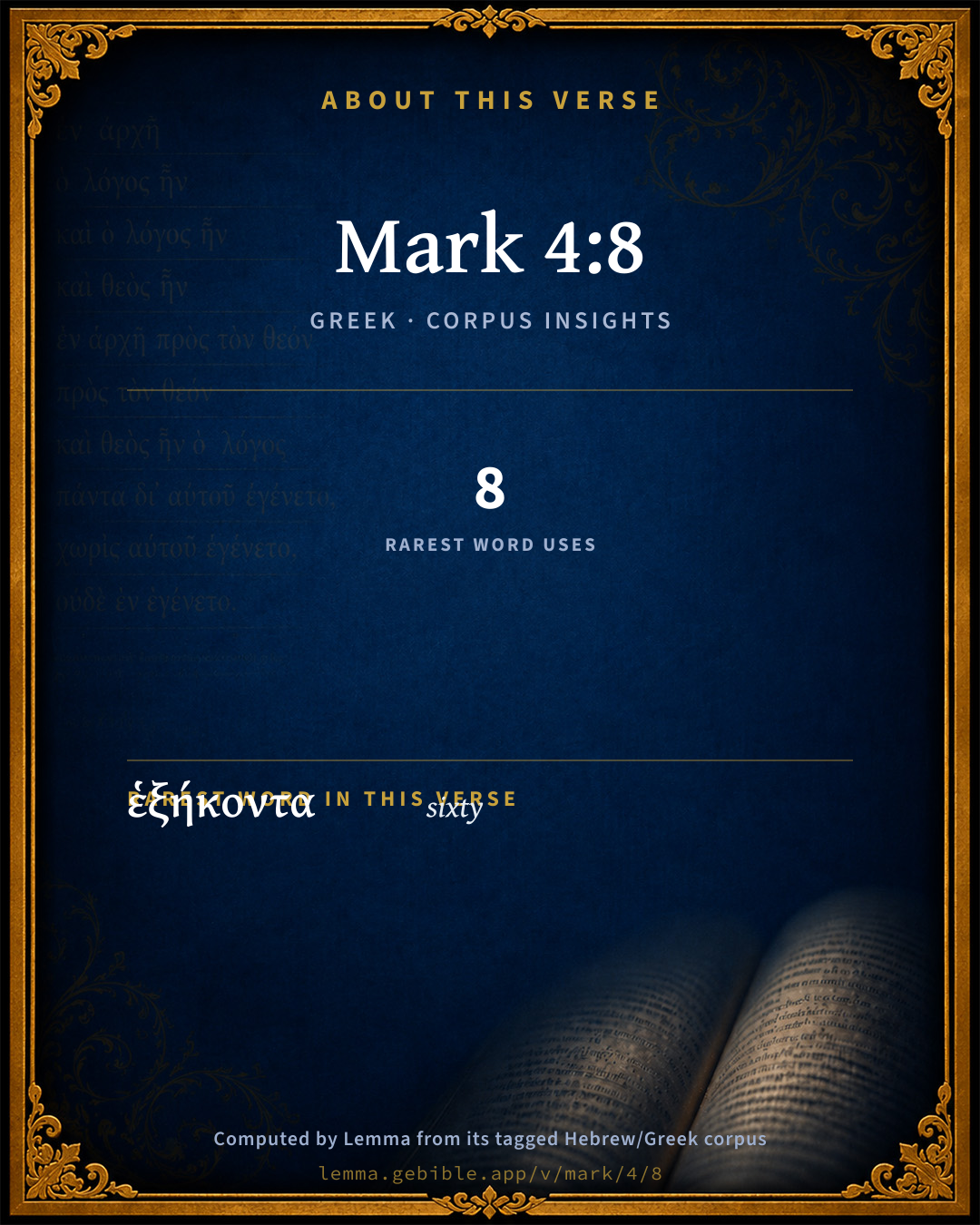
The rarest word here is ἑξήκοντα sixty G1835 — appearing just 8 times in the whole Greek New Testament.

Shared distinctive vocabulary

ἑξήκοντα sixty G1835 occurs in 8 verses of the Greek New Testament. Also found in:

Repetition

Words recur within this verse:

Cross-references

18

Topical passages linked to Mark 4:8 in the Treasury of Scripture Knowledge — connected by theme and wording, ordered by reader-vote popularity; previews shown in the World English Bible.

  • John 15:5 I am the vine. You are the branches. He who remains in me, and I in him, the same bears much fruit, for apart from me you can do nothing.
  • Colossians 1:6 which has come to you; even as it is in all the world and is bearing fruit and growing, as it does in you also, since the day you heard and knew the grace of God in truth;
  • Genesis 26:12 Isaac sowed in that land, and reaped in the same year one hundred times what he planted. Yahweh blessed him.
  • Mark 4:20 These are those which were sown on the good ground: such as hear the word, and accept it, and bear fruit, some thirty times, some sixty times, and some one hundred times."
  • Jeremiah 23:29 Isn't my word like fire? says Yahweh; and like a hammer that breaks the rock in pieces?
  • Matthew 13:8 and others fell on good soil, and yielded fruit: some one hundred times as much, some sixty, and some thirty.
  • Acts 17:11 Now these were more noble than those in Thessalonica, in that they received the word with all readiness of the mind, examining the Scriptures daily to see whether these things were so.
  • 1 Peter 2:1–3 Putting away therefore all wickedness, all deceit, hypocrisies, envies, and all evil speaking,
  • Isaiah 58:1 Cry aloud, don't spare, lift up your voice like a trumpet, and declare to my people their disobedience, and to the house of Jacob their sins.
  • Matthew 13:23 What was sown on the good ground, this is he who hears the word, and understands it, who most assuredly bears fruit, and brings forth, some one hundred times as much, some sixty, and some thirty."
  • Luke 8:8 Other fell into the good ground, and grew, and brought forth fruit one hundred times." As he said these things, he called out, "He who has ears to hear, let him hear!"
  • Luke 8:15 That in the good ground, these are such as in an honest and good heart, having heard the word, hold it tightly, and bring forth fruit with patience.
  • John 1:12–13 But as many as received him, to them he gave the right to become God's children, to those who believe in his name:
  • John 3:19–21 This is the judgment, that the light has come into the world, and men loved the darkness rather than the light; for their works were evil.
  • John 7:17 If anyone desires to do his will, he will know about the teaching, whether it is from God, or if I am speaking from myself.
  • Philippians 1:11 being filled with the fruits of righteousness, which are through Jesus Christ, to the glory and praise of God.
  • Hebrews 4:1–2 Let us fear therefore, lest perhaps a promise being left of entering into his rest, anyone of you should seem to have come short of it.
  • James 1:19–22 So, then, my beloved brothers, let every man be swift to hear, slow to speak, and slow to anger;

Cross-references courtesy of OpenBible.info (CC BY 4.0).

Commentary

Notes on Mark 4:8 from classic Christian and Jewish commentators (each source and its license shown beneath its notes). The classic Christian expositions comment on the surrounding passage and are grouped to its opening verse, so a note may address several verses; the Jewish commentaries on the Tanakh (Rashi and others) are per-verse, so they appear only where the commentator wrote on this verse.

Lemma curates 59 commentaries, every one of them public domain or Creative Commons licensed, each selected and text-cleaned for this edition rather than reprinted as found. About our sources →

The Biblical Illustrator

Joseph S. Exell

Mar_4:8; Mar_4:20

And other fell on good ground, and did yield fruit that sprang up and increased.

The character of sincere hearers considered

1. That these hearers have honest and good hearts. The ground must be properly manured and prepared, before the seed can so mingle with it as to produce fruit. In like manner, the powers of the soul must be renewed by Divine grace, before the instructions of Gods Word can so incorporate with them as to become fruitful. Their understanding is illuminated, and a new bent is given to their will. So,

2. They hear the Word after a different manner, and to a very different purpose from what others do, and from what they themselves formerly did. They hear it with attention, candour, meekness, and simplicity; and then-to go on with our Saviours account of these hearers-they,

3. Understand the Word. This is not expressly said, as I remember, of either of the former characters. Their knowledge is, in short, experimental and practical.

4. They keep the Word. The seed once lodged in the heart remains there. It is not caught away by the wicked one, it is not destroyed by the scorching beams of persecution, nor is it choked by the thorns of worldly cares and pleasures. It is laid up in the understanding, memory, and affections; and guarded with attention and care, as the most invaluable treasure. And, indeed, how is it imaginable that the man who has received the truth in the love of it, has ventured his everlasting all on it, and has no other ground of hope whatever, should be willing to part with this good Word of the grace of God! sooner would he renounce his dearest temporal enjoyments, yea, even life itself. Again,

5. They bring forth fruit. The seed springs up, looks green, and promises a fair harvest. They profess the Christian name, and live answerable to it. Their external conduct is sober, useful, and honourable; and their temper is pious, benevolent, and holy. The fruit they bear is of the same nature with the seed whence it springs.

6. They bring forth fruit with patience. It is a considerable time before the seed disseminates, rises into the stalk and the ear, and ripens into fruit (Jam_5:7).

7. And lastly. They bring forth fruit in different degrees, some thirty, some sixty, and some an hundred fold. And now, in order to the fully discussing this argument, we shall-

I. Show the necessity of the hearts being made honest and good, in order to mens duly receiving the word and keeping it; this will clearly appear on a little reflection. I suppose it will scarce be denied that the will and affections have a considerable influence on the operations of the understanding and judgment. To a mind, therefore, under the tyranny of pride and pleasure, positions that are hostile to these passions will not easily gain admission. Their first appearance will create prejudice. And if that prejudice does not instantly preclude all consideration, it will yet throw insuperable obstructions in the way of impartial inquiry. If it does not absolutely put out the eye of reason, it will yet raise such dust before it as will effectually prevent its perceiving the object. What men do not care to believe, they will take pains to persuade themselves is not true. When once a new bias is given to the will and affections, and a man, from a proud, becomes a humble man, from a lover of this world, a lover of God, his prejudices against the gospel will instantly subside. The thick vapours exhaled from a sensual heart, which had obscured his understanding, will disperse; and the light of Divine truth shine in upon him with commanding evidence. He will receive the truth in the love of it. How important, then, is regeneration! This leads us-

II. To describe the kind of fruit which such persons will bear. It is good fruit-fruit of the same nature with the seed whence it grows, and the soil with which it is incorporated: of the same nature with the gospel itself which is received in faith, and with those holy principles which are infused by the blessed Spirit. Here let us dwell a little more particularly on the nature and tendency of the gospel. God is in Christ reconciling the world to Himself, not imputing their trespasses to them. O how inflexible the justice, how venerable the holiness, and how boundless the goodness of God! And if this be the gospel, who can hesitate a moment upon the question respecting its natural and proper tendency? How can piety languish and die amidst this scene of wonders? How can the heart, occupied with these sentiments, remain unsusceptible to the feelings of justice, truth, humanity, and benevolence? How can a man believe himself to be that guilty, depraved, helpless wretch which this gospel supposes him to be, and not be humble? How can he behold the Creator of the world expiring in agonies on the cross, and follow Him thence a pale, breathless corpse to the tomb, and not feel a sovereign contempt for the pomps and vanities of this transitory state? But to bring the matter more fully home to the point before us, what kind of a man is the real Christian? Let us contemplate his character, and consider what is the general course of his life. Instructed in this Divine doctrine, and having his heart made honest and good, he will be a man of piety, integrity, and purity. The grace of God, which bringeth salvation, will teach him to deny ungodliness, and worldly lusts, and to live soberly, righteously, and godly in this present world (Tit_2:11-12). As to piety. A due regard to the authority of the blessed God will have a commanding influence upon his temper and practice. As to social duties. His conduct will be governed by the rule his Divine Master has laid down, of doing to others as he would have them do to him. As to personal duties. He will use the comforts of life, which he enjoys as the fruits of Divine benevolence, with temperance and moderation. Such are the fruits which they bring forth, who hear the Word in the manner our Saviour describes, and who keep it in good and honest hearts (Eph_4:1; Php_1:27; Gal_5:22-23). But it is not meant by this description of the Christian to raise him above the rank of humanity, or to give a colouring to the picture which it will not bear. He is still a man, not an angel. To fix the standard of real religion at a mark to which none can arrive, is to do an injury to religion itself, as well as to discourage the hearts of its best friends. But though perfection, in the strict sense of the term, is not to be admitted, yet the fruit which every real Christian bears is good fruit.

1. How gracious is that influence which the blessed God exerts, to make the heart honest and good, and so dispose it to receive the Word, and profit by it!

2. From the nature and tendency of the gospel, which has been just delineated, we derive a strong presumptive evidence of its truth.

3. Of what importance is it that we converse intimately with the gospel, in order to our bringing forth the fruits of holiness!

4. And lastly, How vain a thing is mere speculation in religion! We have discoursed on the two first heads, and proceed now-

III. To consider the great variety there is among Christians in regard of degrees of fruitfulness and the reasons of it. First, as to the fact that there are degrees of fruitfulness, a little observation will sufficiently prove it. Fruitfulness may be considered in regard both of the devout affections of the heart, and the external actions of the life; in each of which views it will admit of degrees. The variety is prodigious. What multitudes live harmless, sober, and regular lives. Their obedience is rather negative than positive. They bring no dishonour on their profession, nor yet are they very ornamental and exemplary. Others are strictly conscientious and circumspect in their walk, far removed from all appearance of gaiety and dissipation, and remarkably serious and constant in their attendance upon religious duties; but, for want of sweetness of temper, or of that sprightliness and freedom which a lively faith inspires, the fruit they bear is but slender, and of an unpleasant flavour. There are those, further, in whom seriousness and cheerfulness are happily united, and whose conduct is amiable in the view of all around them; but then, moving in a narrow sphere, and possessing no great zeal or resolution, their lives are distinguished by few remarkable exertions for the glory of God, and the good of others. And again, there are a number whose bosoms, glowing with flaming zeal and ardent love, are rich in good works, never weary in well-doing, and full of the fruits of righteousness, to the praise and the glory of God. In the garden of God there are trees of different growth. Some newly planted, of slender stature and feeble make, which yet bring forth good, though but little, fruit. And here and there you see one that out-tops all the rest, whose roots spread far and wide, and whose boughs are laden in autumn with rich and large fruit. Such variety is there among Christians. And variety there is; too, in the different species of good works. Some are eminent in this virtue, and some in that; while perhaps a few abound in every good word and work. Whoever consults the history of religion in the Bible will see all that has been said exemplified in the characters and lives of a long scroll of pious men. Not to speak here of the particular excellences that distinguished these men of God from each other, it is enough to observe that some vastly outshone others. The proportions of a hundred, sixty, and thirty fold might be applied to patriarchs, prophets, judges, kings, apostles, and the Christians of the primitive church. Between, for instance, an Abraham that offered up his only son, and a righteous Lot, that lingered at the call of an angel. Secondly, inquire into the grounds and reasons of this disparity among Christians respecting the fruits of holiness. These are of very different consideration. Many of them will be found to have no connection at all with the inward temper of the mind; a reflection, therefore, upon them will give energy to what has been said in regard of the charity we ought to exercise in judging of others. Let us begin, then-

1. With mens worldly circumstances. The affluent Christian you will see pouring his bounty on all around him. But the poor Christian can render few, if any, of these services to his fellow creatures.

2. Opportunity is another ground of distinction among Christians in regard of fruitfulness. By opportunity I mean occasions of usefulness, which arise under the particular and immediate direction of Divine Providence. A Daniel shall have such easy access to the presence of a mighty tyrant as shall enable him to whisper the most beneficial counsels in his ear; and an apostle, by being brought in chains before a no less powerful prince, shall have an opportunity of defending the cause of his Divine Master in the most essential manner.

3. Mental abilities have a considerable influence in this matter. What shining talents do some good men possess! They have extensive learning, great knowledge of mankind, much sagacity and penetration, singular fortitude, a happy manner of address, flowing language, and a remarkable sweetness of temper.

4. The different means of religion that good men enjoy are another occasion of their different degrees of fruitfulness.

5. That the comparative different state of religion in one Christian and another is the more immediate and direct cause of their different fruitfulness. But this plain general truth we may affirm, leaving everyone to apply it to himself, that, in proportion as religion is on the advance or decline in a mans heart, so will his external conduct be more or less exemplary.

6. And lastly, the greater or less effusion of Divine influences.

IV. The blessedness of those who, hearing the word, and keeping it in honest and good hearts, bring forth the fruits of holiness.

1. As to the pleasure that accompanies ingenuous obedience. Great peace have they, says David, who love Thy law, and nothing shall offend them (Psa_119:165).

2. Fruitfulness affords a noble proof of a mans uprightness, and so tends indirectly, as well as directly, to promote his happiness.

3. The esteem, too, in which he is held among his fellow Christians must contribute not a little to his comfort.

4. How glorious will be the rewards which the fruitful Christian will receive at the hands of the Great Husbandman on the day of harvest! That day is approaching. Mark the perfect man; behold the upright; for the end of that man is peace. Going down to death like a shock of corn fully ripe, the precious grain shall lie secure in the bosom of the earth; angels shall keep their vigils about it: while the immortal spirit, acquiring its highest degree of perfection, shall join the company of the blessed above. (S. Stennett, D. D.)

Some thirty fold

Everyone has observed the difference between those who may be called good Christians, in the matter of their good works-how some seem to produce twice or thrice the fruit that others do. Some are, compared with others, three times more careful in all the trilling matters which make up so much of life; three times more self-denying, three times more liberal, three times more humble, subdued, and thankful. Does not the Lord recognize this difference in the parable of the pounds-when the nobleman, in leaving, gives a pound to each of his servants; and one servant makes it ten pounds, and another five; and he commends both, but gives to the more industrious worker twice the reward? (M. F. Sadler.)

Patience

Patience is power. With time and patience the mulberry leaf becomes satin. (Eastern Proverb.)

Never think that Gods delays are Gods denials. Hold on; hold fast; hold out: Patience is genius. (Buffon.)

Meditation

Meditation is partly a passive, partly an active state. Whoever has pondered long over a plan which he is anxious to accomplish, without distinctly seeing at first the way, knows what meditation is. The subject itself presents itself in leisure moments spontaneously: but then all this sets the mind at work-contriving, imagining, rejecting, modifying. It is in this way that one of the greatest of English engineers, a man uncouth and unaccustomed to regular discipline of mind, is said to have accomplished his most marvellous triumphs. He threw bridges over almost impracticable torrents, and pierced the eternal mountains for his viaducts. Sometimes a difficulty brought all the work to a pause; then he would shut himself up in his room, eat nothing, speak to no one, abandon himself intensely to the contemplation of that on which his heart was set; and at the end of two or three days, would come forth serene and calm, walk to the spot, and quietly give orders which seemed the result of superhuman intuition. This was meditation. (F. W. Robertson.)

The numerical relations of good and evil

In the parable of the four sorts of ground whereon the seed was sown, the last alone proved fruitful. There the bad were more than the good. But amongst the servants, two improved their talents, or pounds, and one only buried them. Here the good were more than the bad. Again, amongst the ten virgins, five were wise and five were foolish. There the good and bad were equal. I see, that concerning the number of the saints in comparison to the reprobates, no certainty can be collected from these parables. Good reason, for it is not their principal purpose to meddle with that point. Grant that I may never rack a Scripture simile beyond the true intent thereof. (Thomas Fuller.)

Favourable moral conditions

A great deal of fire falleth upon a stone and it burneth not, but a dry chip soon taketh fire. (T. Maclaren.)

The Biblical Illustrator, edited by Joseph S. Exell (c. 1880s–1900s) — public domain. Text from a community e-Sword module.

Bengel's Gnomon

Johann Albrecht Bengel

Mar 4:8 Ἐδίδου, yielded: ἔφερεν, brought forth) The subject is ἄλλο, some:[32] comp. Mar 4:4-7.—ἀναβαίνοντα, springing up) above all obstacles.

[32] So ADab Vulg. and Lachm. But ἄλλα BCL Memph. Tischend.—ED.

Bengel's Gnomon of the New Testament — English translation (T&T Clark, Edinburgh, 1860) — public domain. Text from a community e-Sword module.

Ellicott's Commentary for English Readers

(8) Some thirty . . .—For the most part the parable is almost verbally identical with that in St. Matthew. Here, however, we note the difference, sufficient to establish a certain measure of independence, of an ascending instead of a descending scale.

A Bible Commentary for English Readers, edited by Charles John Ellicott (1878–1897) — public domain. Text from a community e-Sword module.

The Cambridge Bible for Schools and Colleges

gen. ed. J. J. S. Perowne

8. some thirty] St Luke says simply “and bare fruit an hundred-fold.” St Matthew says “some an hundred-fold, some sixty fold, some thirty-fold.” St Mark begins from the lowest return, and ascends to the highest. It is said of Isaac that he sowed and “received in the same year an hundred-fold” (Gen_26:12). Herodotus tells us that two hundred-fold was a common return in the plain of Babylon, while a kind of white maize often in Palestine returns several hundred-fold. Observe the four kinds of soil. In the first the seed did not spring up at all; in the second it sprang up, but soon withered away; in the third it sprang up and grew, but yielded no fruit; in the fourth it sprang up, grew, and brought forth fruit; and as there are three causes of unfruitfulness, so there are three degrees of fruitfulness, but only one cause of fruitfulness.

The Cambridge Bible for Schools and Colleges (gen. ed. J. J. S. Perowne; Cambridge University Press, 1878–1918) — public domain. Text from a community e-Sword module.

John Gill's Exposition

And he said unto them,.... To the multitude of hearers that were on the sea shore attending to the word preached, and among whom, doubtless, there were all those sorts of hearers mentioned in this parable:

he that hath ears to hear, let him hear: observe, and take notice of what has been said, as being of the greatest moment and importance: for a larger explanation and illustration of this parable, see the notes on Mat 13:3.

John Gill's Exposition of the Whole Bible (1746–1763) — public domain (CC PDM 1.0). Text via the HelloAO Bible API.

Trapp's Complete Commentary

John Trapp

8 And other fell on good ground, and did yield fruit that sprang up and increased; and brought forth, some thirty, and some sixty, and some an hundred.

Ver. 8. Fruit that sprang up and increased] This is spoken in opposition to the thorny ground, where the thorns grow up together with the grain, and shaded it; whereas the good ground brings forth fruit increasing, and ascending: αναβαινοντα και αυξανοντα, and although it have many thorns, yet grace is superior to corruption, and keeps it under.

John Trapp, A Commentary or Exposition upon All the Books of the Old and New Testament (1647–1656) — public domain. Text from a community e-Sword module.

The Pulpit Commentary

Vers. 8, 20. The Word fruitful in the heart.

Most varied results attend the preaching of the gospel. Look at our Lord"s own ministry. On the one hand, we are told, "He did there no mighty works because of their unbelief;" "yet they believed not upon him; "and we find him exclaiming, "Woe unto you, cities!" etc. On the other hand, "the multitude heard him gladly;" of the Samaritans, "many more believed because of his word," and sometimes, in their eagerness, "they pressed upon him to hear," etc. Nor was this fact peculiar to Christ"s ministry; the apostles confessed that they were to some a savor of life, to others of death; and the historian records, as a matter of fact, that "some believed, and some believed not." So is it with Christian preachers in every age; there are instances which rejoice and recompense them, and others which disappoint and depress them. The great Teacher foretells in this part of the parable that there shall ever be cases in which the Lord"s Word "shall not return unto him void.

I THE PREPARED SOIL. The good ground was in contrast with the several varieties of poor and bad soil. It was soft and yielding, as distinguished from the trodden earth of the wayside. It was deep, as distinguished from the shallow sprinkling of earth upon the rock beneath. It was clean as distinguished from the foul, weedy, thorny land. So with the honest and good heart, prepared by Divine influences and responsive to Divine culture and care. There is in this figurative language no countenance given to fatalism. We meet with good ground sometimes amongst those brought up in the Christian family and Church, as in Timothy; sometimes amongst those not specially privileged, but candid and guileless, as in Nathanael; sometimes even among the outwardly wicked, who yet may not be hardened, but may be ready to welcome deliverance from their evil ways, as in some of the publicans and sinners. Similar instances are recorded in the Acts of the Apostles.

II THE VITAL PROCESS. In the other cases, the seed sooner or later perishes; in this case it lives. It is neither stolen, nor starved, nor choked. The reason is that the soil accepts and retains the seed. So with the heart that not only receives but holds fast the Word of life, that cherishes and matures it, that gives it a resting-place, and welcomes all heavenly influences which can quicken and strengthen and prosper it. That nature will develop into Divine life and immortal fruitfulness which ponders the truth of God, assimilates it, keeps for it the place of honor, pre-eminence, and power, gives it room and scope and play, watches over it and prays for its vitality, energy, and increase. In such a nature the seed germinates and lives and grows, for it finds there congenial soil and cordial welcome and sustenance. The power of this life is that of the Holy Spirit: "God giveth the increase.

III THE FRUITFUL HARVEST. What is meant by "fruit"? Spiritual result for spiritual toil and agency and culture. In the case of the sinner, the first and most welcome fruit is that of conversion unto God. But the rich fruits expected are these: obedience, righteousness, holiness, Christlikeness, consecration, self-denial, usefulness. "The fruit of the Spirit is love, joy, peace," etc. Such fruit is the only proof of life and growth. "By their fruits ye shall know them;" i.e. by the quality, the flavour, and fragrance of the moral produce. "Herein is my Father glorified, that ye bear much fruit;" i.e. by abundance alone can the husbandman be satisfied and recompensed. The multiplication of the seed is one of the many points of resemblance between the physical and the spiritual life. Who has not seen a heart changed by one sermon, a life made anew by one utterance or by one lesson of Divine providence? Seemingly an insignificant seed, yet a crop of glorious ripeness and luxuriance. And as for variety, every congregation of Christians is a living witness to this. Either because the same opportunities have been, in some eases, more diligently used, or because different advantages have been employed with equal assiduity; it results that some yield fruit thirty, some sixty, and others a hundredfold.

PRACTICAL LESSONS.

1. The responsibility of hearing the Word. God provides the seed; but the preparation of the soil is largely in our hands.

2. The expectation of the Sower is great in proportion to the greatness of our advantages. Nothing less than much fruit can satisfy him from you.

The Pulpit Commentary (1880–1919), ed. H.D.M. Spence-Jones & Joseph S. Exell — public domain. Text from a community e-Sword module.

unfoldingWord translationNotes

Door43 World Missions Community

increasing thirty, sixty, and even a hundred times

The amount of grain produced by each plant is being compared to the single seed from which it grew. Ellipsis is used here to shorten the phrases but they can be written out. AT: "Some plants bore thirty times as much as the seed that the man had planted, some produced sixty times as much grain, and some produced a hundred times as much grain" (See: Ellipsis)

thirty ... sixty ... a hundred

"30 ... 60 ... 100." These may be written as numerals. (See: Numbers)

Whoever has ears to hear

This is a way of referring to everyone there who was hearing what Jesus was saying. AT: "Whoever can hear me" or "Everyone who can hear me (See: Idiom)

let him hear

Here the word "hear" means to pay attention. AT: "let him listen carefully" or "must pay careful attention to what I am saying" (See: Metonymy)

translationWords

grain

unfoldingWord translationNotes — © Distant Shores Media and the Door43 World Missions Community, licensed CC BY-SA 4.0. Source: git.door43.org/Door43/en_tn.

Cambridge Greek Testament for Schools and Colleges

8. ἄλλα ([687][688][689][690] 33) rather than ἄλλο ([691][692][693][694]).

[687] Codex Sinaiticus. 4th cent. Discovered by Tischendorf in 1859 at the Monastery of St Katharine on Mount Sinai. Now at St Petersburg. The whole Gospel, ending at Mar 16:8. Photographic facsimile, 1911.

[688] Codex Vaticanus. 4th cent., but perhaps a little later than א. In the Vatican Library almost since its foundation by Pope Nicolas V., and one of its greatest treasures. The whole Gospel, ending at Mar 16:8. Photographic facsimile, 1889.

[689] Codex Ephraemi. 5th cent. A palimpsest: the original writing has been partially rubbed out, and the works of Ephraem the Syrian have been written over it; but a great deal of the original writing has been recovered; of Mark we have Mar 1:17 to Mar 6:31, Mar 8:5 to Mar 12:29, Mar 13:19 to Mar 16:20. In the National Library at Paris.

[690] Codex Regius. 8th cent. An important witness. At Paris. Contains Mar 1:1 to Mar 10:15; Mar 10:30 to Mar 15:1; Mar 15:20 to Mar 16:20, but the shorter ending is inserted between Mar 16:8 and Mar 16:9, showing that the scribe preferred it to the longer one.

[691] Codex Alexandrinus. 5th cent. Brought by Cyril Lucar, Patriarch of Constantinople, from Alexandria, and afterwards presented by him to King Charles I. in 1628. In the British Museum. The whole Gospel. Photographic facsimile, 1879.

[692] Codex Bezae. 6th cent. Has a Latin translation (d) side by side with the Greek text, and the two do not quite always agree. Presented by Beza to the University Library of Cambridge in 1581. Remarkable for its frequent divergences from other texts. Contains Mark, except Mar 16:15-20, which has been added by a later hand. Photographic facsimile, 1899.

[693] Codex Sangallensis. 9th or 10th cent. Contains the Gospels nearly complete, with an interlinear Latin translation. The text of Mark is specially good, agreeing often with CL. At St Gall.

[694] Codex Petropolitanus. 9th cent. Gospels almost complete. Mar 16:18-20 is in a later hand.

8. τὴν γῆν τὴν καλήν. All three have the double art., which emphasizes the adj. (Mar 3:29); Lk. has ἀγαθήν, which is stronger than καλήν. Only twice, and then of persons, does Mk use ἀγαθός, Mar 10:17-18; in Mar 3:4 we should read ἀγαθοποιῆσαι. Mt. and Lk. have ἀγαθός often; it means what is good in its results, while καλός is what is good as an object of contemplation.

ἐδίδου … ἔφερεν. The change from aorists to imperfects is accurate. The mistake of taking ἀναβαίνοντα with καρπόν (fruit does not spring up) produced the false reading αὐξανόμενον, which is followed in A.V. On the participles see Mar 1:15.

εἰς τριάκοντα. The texts are so tangled that it is impossible to determine what word should precede the numeral in each case; but we must have the same word in each case. An estimate of the evidence which gives a change of word (εἰς … ἐν … ἐν) is intolerable. When we have decided for εις … εις … εις, or for εν … εν … εν, we have then to choose between εἰς and εἷς, or between ἐν and ἕν. If εις is preferred, εἰς “up to” is better than εἷς. If εν is preferred, ἕν is better than ἐν. In any case, after three groups of failures in the neut. sing., we have three groups of successes, the gender of which depends on the reading adopted. A hundredfold is not an imaginary increase; cf. Gen 26:12. Herodotus (i. 193) speaks of even threehundredfold.

Cambridge Greek Testament for Schools and Colleges (Cambridge University Press, 1896; 21 vols, various authors incl. Carr, Maclear, Plummer, Farrar, Lumby, Moule, M. R. James, Simcox) — public domain. Text from a community e-Sword module.

International Critical Commentary

8. καὶ ἄλλα—and others; σπέρματα is understood, the word being taken individually, instead of collectively, as in the other parts of the parable.

ἄλλα, others, instead of ἄλλο, other, Tisch. (Treg.) WH. RV. א * and cb BCL 28, 33, 124, one ms. of Lat. Vet. Memph. etc.

ἐδίδου κάρπον—gave fruit. Probably, in this case, as in v. 7, this means the grain itself, and not the stalks, but in this case, the participles ἀναβαίνοντα and αὐξάνοντα must agree with ἄλλα, and not with καρπὸν. The reading αὐξανόμενον favored by T Tr. forces the agreement with καρπόν. That of WH. RV. αὐξανόμενα, forces the agreement with ἄλλα. The internal evidence thus confirms the latter reading; cf. καρποφοροῦσιν v. 20.

αὐξανόμενον, instead of αὐξάνοντα, Tisch. Treg. ADL Δ 238. αὐξανόμενα WH. RV. א B.

εἰς τριάκοντα—up to thirty, denoting the degree of fruitfulness.

εἰς τριάκοντα, instead of ἓν τριάκοντα, Tisch. Treg. WH. RV. א BCL Δ 28 etc. εἰς ἑξήκοντα, and εἰς ἕκατον Tisch. Treg. WH. marg. RV. א C* Δ 28 etc. ἐν with the last two WH. BLEFGKMUV II etc.

International Critical Commentary — older volumes (1896–1929), various authors — public domain. Text from a community e-Sword module.

Vincent's Word Studies in the New Testament

Marvin R. Vincent

That sprang up and increased [αναβαινοντα και αυξανομενον] . The Rev. literally renders the participles, growing up and increasing, thus describing the process more vividly. These two participles, moreover, explain the use of the imperfect tense ejdidou [ψιελδεδ] , denoting continuance. It began to yield and kept yielding as it increased.

Thirty [εις τριακοντα] . Lit., up to thirty.

Marvin R. Vincent, Word Studies in the New Testament (1887–1900) — public domain. Text from a community e-Sword/MySword module.

Lesson kit

Teaching starters — assembled from the data on this page, not authored interpretation. Every prompt links to the verse data it draws on. Edit before teaching.

Mark, in the Gospels, opens this verse with 24 words (15 distinct Greek lemmas). Its most distinctive word is hexḗkonta (“sixty”). A historical commentator’s framing appears above. Read the whole chapter for the surrounding context.

Discussion questions

  1. What does “sixty” (hexḗkonta) contribute to the verse as a whole?
  2. How does Matthew 13:8, which shares the word «sixty», read alongside this verse?
  3. What does the repetition of “into” (4× in this one verse) do in this verse?
  4. The translations on this page render this verse differently — a whole-verse word diff, not a word-by-word alignment. What might account for the different wordings?
  5. Compare how The Biblical Illustrator and Bengel's Gnomon read this verse. Where do they agree or differ?

Things to notice

Reading settings

Reading text

Shown beneath each verse's original-language words.

Old Testament
Old Testament edition

Read the OT as the Masoretic Hebrew (MT) or the Greek Septuagint (LXX).

English shown for the Greek Septuagint (in the Hebrew ↔ Greek comparison).

Comparing translations? Open the Compare panel on any verse page to stack up to four side by side.