
Acts 17:26

Greek (Tischendorf 8th ed.) Acts 17:26 appears in the Greek New Testament. The text above is from the Tischendorf 8th edition. Each word links to its Strong’s number and a concise gloss. Click any word for its full Thayer’s Greek Lexicon entry.
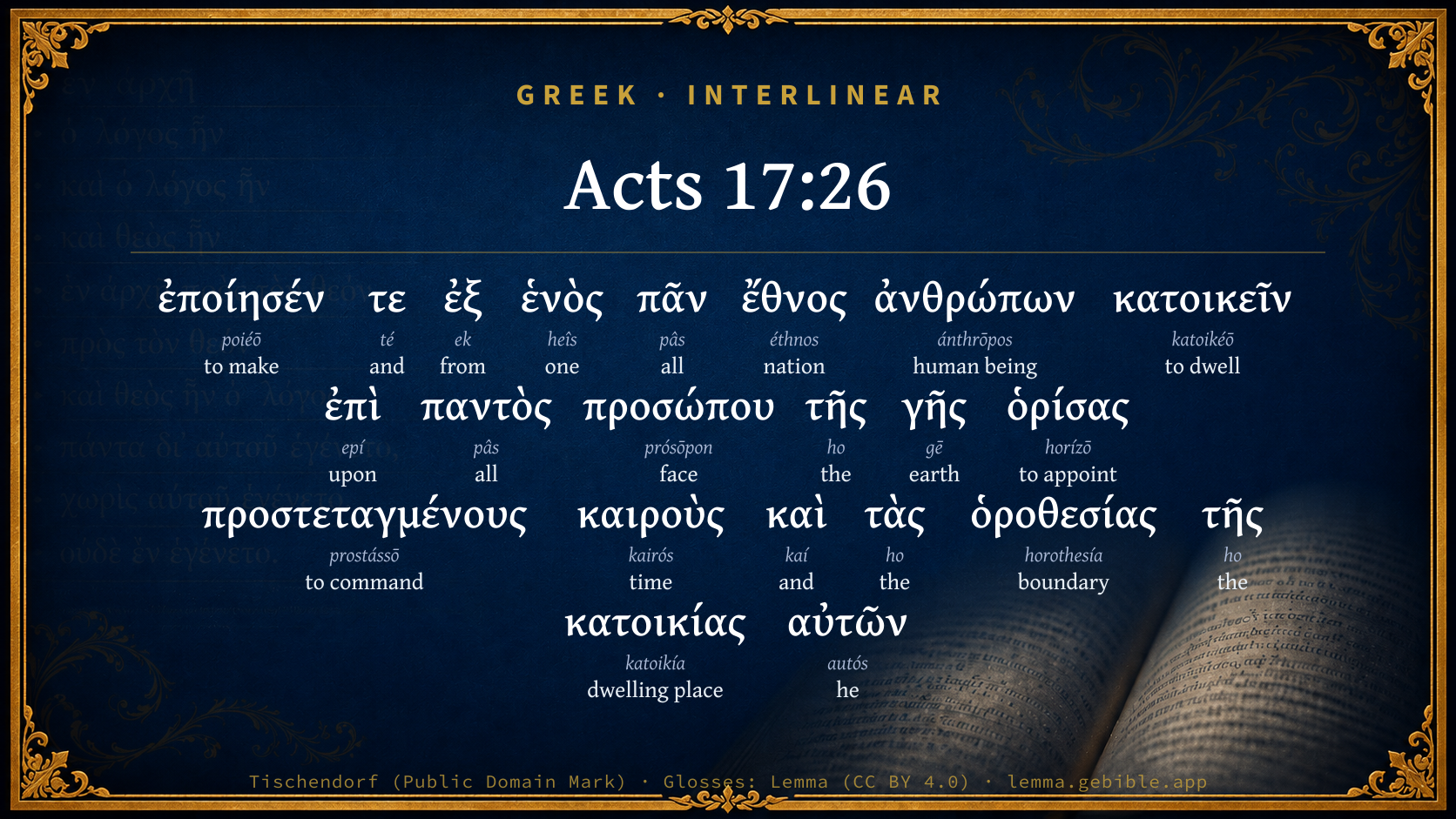
Download image
Cite this verse

Acts 17:26 (World English Bible). Public Domain. Lemma interlinear Bible study tool, https://lemma.gebible.app/v/acts/17/26.

Show BibTeX & RIS
BibTeX
RIS
English Translation
He made from one blood every nation of men to dwell on all the surface of the earth, having determined appointed seasons, and the boundaries of their dwellings,
World English Bible · Public Domain
Highlights
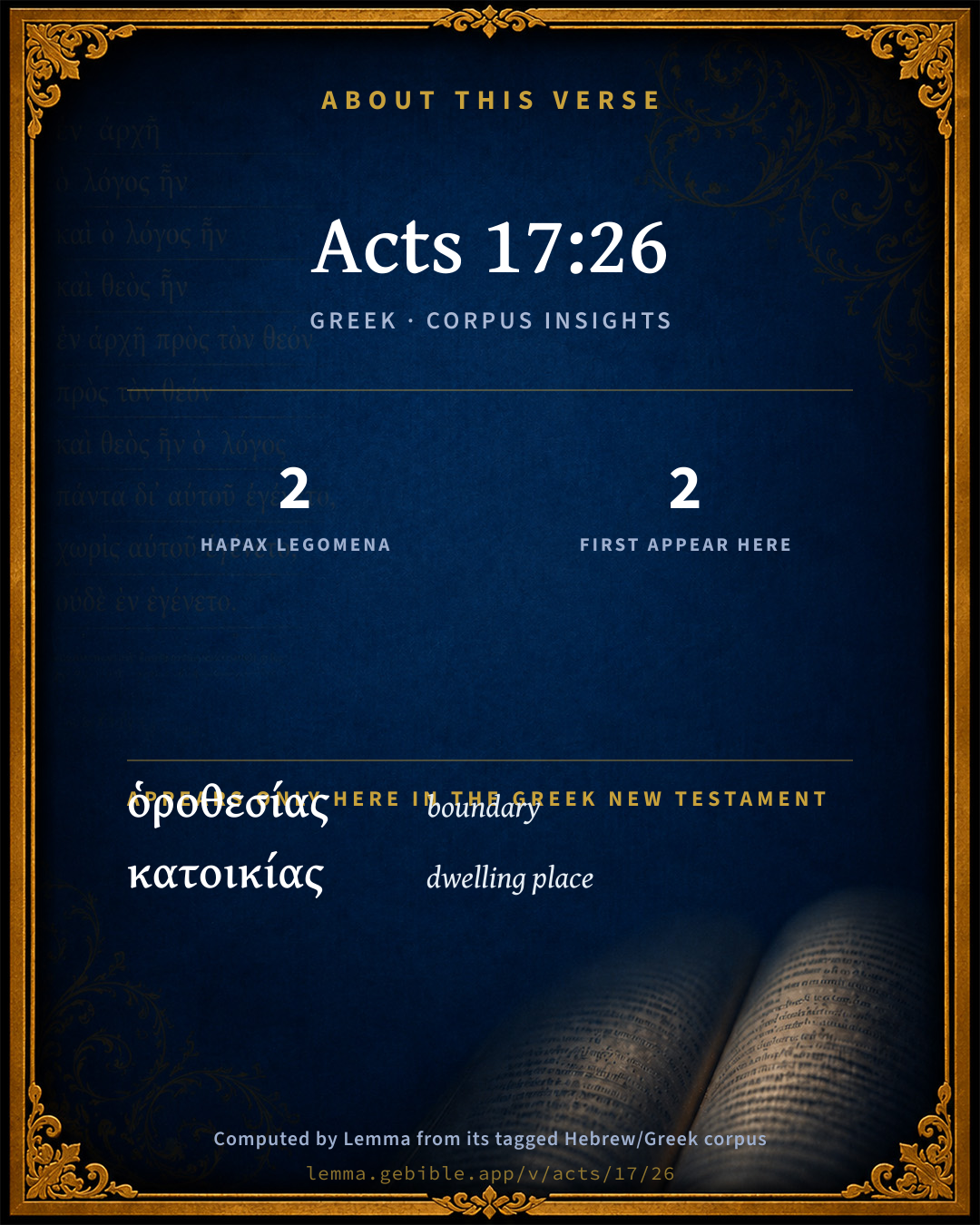
  • 2 hapax legomena — only here in the Greek New Testament
  • 2 first appearances in the Greek New Testament
Full analysis ↓
Download a study sheet

One document with this verse’s original text, its word-by-word gloss line, the meaning frame, cross-references with their text, attributed commentary, and full source and license credits — printable, and it pastes into notes with its structure intact.

This verse Autodidact and up

Study sheet (.html) Plain text (.txt)

A passage Seminary Student

Up to 50 verses in one chapter. A passage sheet keeps up to 6 commentary sources and 12 cross-references per verse, in the order this page ranks them, and says so on the sheet whenever that leaves anything out. Ask for a single verse and you get the Autodidact verse sheet above.

Everything on this page stays free to read, with no account — the sheet is a download of what is already on screen, not access to it.

Want to remove ads? Support Godless Engineer
Compare translations 3

The same verse in 3 English versions, stacked beneath the original-language interlinear above. Click any original word for its lexicon entry.

Each is an independent rendering of the whole verse — the interlinear is not word-aligned to these translations.

Highlighted words mark where these versions differ — a whole-verse word diff, not a word-by-word alignment.

  • World English Bible Public Domain
    He made from one blood every nation of men to dwell on all the surface of the earth, having determined appointed seasons, and the boundaries of their dwellings,
  • King James Version Public Domain
    And hath made of one blood all nations of men for to dwell on all the face of the earth, and hath determined the times before appointed, and the bounds of their habitation;
  • unfoldingWord Literal Text CC BY-SA 4.0
    And from one he made every nation of men to live on all the face of the earth, having determined appointed seasons and the boundaries of their habitation,

unfoldingWord Literal Text — © unfoldingWord, licensed CC BY-SA 4.0. Word-aligned USFM3 via Door43 (git.door43.org/unfoldingWord/en_ult).

Versions to compare (up to 4)

3 of 4 selected

Show all 19 translations

Every available English version of this verse, each an independent rendering of the whole verse.

  • World English Bible Public Domain
    He made from one blood every nation of men to dwell on all the surface of the earth, having determined appointed seasons, and the boundaries of their dwellings,
  • Berean Standard Bible Public Domain
    From one man He made every nation of men, that they should inhabit the whole earth; and He determined their appointed times and the boundaries of their lands.
  • Majority Standard Bible Public Domain
    From one blood He made every nation of men, that they should inhabit the whole earth; and He determined their appointed times and the boundaries of their lands.
  • King James Version Public Domain
    And hath made of one blood all nations of men for to dwell on all the face of the earth, and hath determined the times before appointed, and the bounds of their habitation;
  • American Standard Version (1901) Public Domain
    and he made of one every nation of men to dwell on all the face of the earth, having determined `their' appointed seasons, and the bounds of their habitation;
  • Revised Version (1885) Public Domain
    and he made of one every nation of men for to dwell on all the face of the earth, having determined their appointed seasons, and the bounds of their habitation;
  • Geneva Bible (1599) Public Domain
    And hath made of one blood all mankinde, to dwell on all the face of the earth, and hath assigned the seasons which were ordeined before, and the boundes of their habitation,
  • Douay-Rheims (1899) Public Domain
    And hath made of one, all mankind, to dwell upon the whole face of the earth, determining appointed times, and the limits of their habitation.
  • Young's Literal Translation Public Domain
    He made also of one blood every nation of men, to dwell upon all the face of the earth -- having ordained times before appointed, and the bounds of their dwellings --
  • Literal Standard Version CC BY-SA 4.0
    He also made every nation of man of one blood, to dwell on all the face of the earth—having ordained times before appointed, and the bounds of their dwellings—
  • Unlocked Literal Bible CC BY-SA 4.0
    From one man he made every nation of people to live on the surface of the earth, having determined their appointed seasons and the boundaries of their living areas,
  • unfoldingWord Literal Text CC BY-SA 4.0
    And from one he made every nation of men to live on all the face of the earth, having determined appointed seasons and the boundaries of their habitation,
  • Darby Bible Public Domain
    and has made of one blood every nation of men to dwell upon the whole face of the earth, having determined ordained times and the boundaries of their dwelling,
  • World Messianic Bible Public Domain
    He made from one blood every nation of men to dwell on all the surface of the earth, having determined appointed seasons and the boundaries of their dwellings,
  • Webster's Bible Public Domain
    And hath made of one blood all nations of men to dwell on all the face of the earth, and hath determined the times before appointed, and the bounds of their habitation;
  • Free Bible Version CC BY-SA 4.0
    From one man he made all the peoples who live on the earth, and decided beforehand when and where they should live.
  • Bible in Basic English Public Domain
    And he has made of one blood all the nations of men living on all the face of the earth, ordering their times and the limits of their lands,
  • Text-Critical English NT CC BY 4.0
    From one bloodline he created every nation of mankind to dwell on the entire face of the earth. He determined their appointed times and the boundaries of where they would dwell,
  • Tyndale New Testament (1534) Public Domain
    and hath made of one bloud all nacions of men for to dwell on all the face of the erthe and hath assigned before how longe tyme and also the endes of their inhabitacion

Literal Standard Version (2020), Covenant Press — licensed CC BY-SA 4.0. Text via the HelloAO Bible API (eBible.org). Unlocked Literal Bible (unfoldingWord) — licensed CC BY-SA 4.0. Text via the HelloAO Bible API (eBible.org). unfoldingWord Literal Text — © unfoldingWord, licensed CC BY-SA 4.0. Word-aligned USFM3 via Door43 (git.door43.org/unfoldingWord/en_ult). Free Bible Version, Dr. Jonathan Gallagher — licensed CC BY-SA 4.0. Text via the HelloAO Bible API (eBible.org).

Word by word

More ways to search: Search by grammar → Find every occurrence → Compare this word →

Practice this passage: Drill this verse → Learn its vocabulary →

ὁροθεσίας
horothesía
G3734
“boundary”
Noun, Accusative, Plural, Feminine
Part of Speech
Noun
Case
Accusative
Number
Plural
Gender
Feminine
Full Thayer's Definition

Origin: from a compound of the base of G3725 and a derivative of G5087

TDNT: None

1. a setting of boundaries, laying down limits 2. a definite limit, bounds
  1. ἐποίησέν poiéō G4160 “to make” Verb, Aorist, Active, Indicative, 3rd person, Singular
  2. τε té G5037 “and” Particle
  3. ἐξ ek G1537 “from” Preposition
  4. ἑνὸς heîs G1520 “one” Adjective, Genitive, Singular, Neuter
  5. πᾶν pâs G3956 “all” Adjective, Accusative, Singular, Neuter
  6. ἔθνος éthnos G1484 “nation” Noun, Accusative, Singular, Neuter
  7. ἀνθρώπων ánthrōpos G444 “human being” Noun, Genitive, Plural, Masculine
  8. κατοικεῖν katoikéō G2730 “to dwell” Verb, Present, Active, Infinitive
  9. ἐπὶ epí G1909 “upon” Preposition
  10. παντὸς pâs G3956 “all” Adjective, Genitive, Singular, Neuter
  11. προσώπου prósōpon G4383 “face” Noun, Genitive, Singular, Neuter
  12. τῆς ho G3588 “the” Article, Genitive, Singular, Feminine
  13. γῆς gē G1093 “earth” Noun, Genitive, Singular, Feminine
  14. ὁρίσας horízō G3724 “to appoint” Verb, Aorist, Active, Participle, Nominative, Singular, Masculine
  15. προστεταγμένους prostássō G4367 “to command” Verb, Perfect, Passive, Participle, Accusative, Plural, Masculine
  16. καιροὺς kairós G2540 “time” Noun, Accusative, Plural, Masculine
  17. καὶ kaí G2532 “and” Conjunction
  18. τὰς ho G3588 “the” Article, Accusative, Plural, Feminine
  19. τῆς ho G3588 “the” Article, Genitive, Singular, Feminine
  20. κατοικίας katoikía G2733 “dwelling place” Noun, Genitive, Singular, Feminine
  21. αὐτῶν autós G846 “he” Personal pronoun, Genitive, Plural, Masculine

About this verse

These counts appear in no published source. They are computed here, from the morphology-tagged text and Lemma’s own curated glosses. What Lemma adds →

22
words
19
distinct lemmas
Acts
section

Notable vocabulary

2 hapax legomena — words that appear only here in the entire Greek New Testament:

  • ὁροθεσίας boundary G3734
  • κατοικίας dwelling place G2733

First appearance in Scripture

These words make their first canonical appearance in the Greek New Testament here:

  • ὁροθεσίας boundary G3734
  • κατοικίας dwelling place G2733

Shared distinctive vocabulary

ὁρίσας to appoint G3724 occurs in 8 verses of the Greek New Testament. Also found in:
Repetition

Words recur within this verse:

Cross-references

15

Topical passages linked to Acts 17:26 in the Treasury of Scripture Knowledge — connected by theme and wording, ordered by reader-vote popularity; previews shown in the World English Bible.

  • Deuteronomy 32:7–8 Remember the days of old, Consider the years of many generations: Ask your father, and he will show you; Your elders, and they will tell you.
  • Genesis 3:20 The man called his wife Eve, because she was the mother of all living.
  • Malachi 2:10 Don't we all have one father? Hasn't one God created us? Why do we deal treacherously every man against his brother, profaning the covenant of our fathers?
  • Romans 5:12–19 Therefore, as sin entered into the world through one man, and death through sin; and so death passed to all men, because all sinned.
  • 1 Corinthians 15:22 For as in Adam all die, so also in Christ all will be made alive.
  • 1 Corinthians 15:47 The first man is of the earth, made of dust. The second man is the Lord from heaven.
  • Job 12:23 He increases the nations, and he destroys them. He enlarges the nations, and he leads them captive.
  • Job 14:5 Seeing his days are determined, The number of his months is with you, And you have appointed his bounds that he can't pass;
  • Psalms 31:15 My times are in your hand. Deliver me from the hand of my enemies, and from those who persecute me.
  • Genesis 9:19 These three were the sons of Noah, and from these, the whole earth was populated.
  • Daniel 11:35 Some of those who are wise shall fall, to refine them, and to purify, and to make them white, even to the time of the end; because it is yet for the time appointed.
  • Daniel 11:27 As for both these kings, their hearts shall be to do mischief, and they shall speak lies at one table: but it shall not prosper; for yet the end shall be at the time appointed.
  • Hebrews 2:3 how will we escape if we neglect so great a salvation-- which at the first having been spoken through the Lord, was confirmed to us by those who heard;
  • Isaiah 14:31 Howl, gate; cry, city; you are melted away, Philistia, all of you; for there comes a smoke out of the north, and there is no straggler in his ranks.
  • Isaiah 45:21 Declare you, and bring [it] forth; yes, let them take counsel together: who has shown this from ancient time? who has declared it of old? Haven't I, Yahweh? and there is no God else besides me, a just God and a Savior; there is no one besides me.

Cross-references courtesy of OpenBible.info (CC BY 4.0).

Where the printed editions differ

1 variant

Places in this verse where the major printed Greek editions disagree on the wording in a way that affects the translation — a comparison of editions, not a manuscript-by-manuscript collation. The editions are the modern critical texts (Nestlé-Aland 28/27, SBL, Westcott-Hort, Tregelles, Tyndale House) and the traditional texts behind the KJV (the Textus Receptus and the Byzantine/Majority text). It is not a claim about which reading is original.

  1. Extra text
    αἵματος

    “blood”

    In TRByz Not in NA28NA27TynSBLWHTreg

    αἵματος (aimatos) 'blood' is only in traditional manuscripts (TR+Byz)

Textual data: Translators Amalgamated Greek New Testament (STEPBible TAGNT) · CC BY 4.0.

Commentary

Notes on Acts 17:26 from classic Christian and Jewish commentators (each source and its license shown beneath its notes). The classic Christian expositions comment on the surrounding passage and are grouped to its opening verse, so a note may address several verses; the Jewish commentaries on the Tanakh (Rashi and others) are per-verse, so they appear only where the commentator wrote on this verse.

Lemma curates 59 commentaries, every one of them public domain or Creative Commons licensed, each selected and text-cleaned for this edition rather than reprinted as found. About our sources →

The Biblical Illustrator

Joseph S. Exell

Act_17:26

And hath made of one blood all the nations.

All of one blood

1. This is not the gospel, but it is the foundation on which the gospel builds--that humanity is one; that race distinctions are superficial, and not radical; that there is a universal brotherhood, originating in the universal Fatherhood of God. This is familiar enough to us, for our common speech is stocked with phrases and expressions which recognise it. But then no man believed in it. Jew and Greek, and Roman and barbarian were alike in this. They had their separate deities and their separate origin. Every people was proud of its own birthright, and deemed itself the elect of its own god, and regarded it as a natural law that they should despise or hate all others. Into this condition of things the inspired message of the apostles came, flinging its living cords over the wide gaps, and binding human society with a new and Divine bond.

2. And the greater our knowledge of men, the more irresistibly is this truth forced upon us. Everywhere there are substantially the same emotions, longings, regrets, some sort of conscience, hope; everywhere man is susceptible to the touch of love, moved by persuasions of kindness, thrilled by the voice of pity. Everywhere man confesses that he cannot live by bread alone, and is everywhere a praying creature. And everywhere there is in man a capacity for growth unlimited. Even among the lowest races, where science has sought, and will for ever seek in vain, for the missing link between the animal and man, proofs innumerable have been given that one or two generations are enough to work a transformation more than magical. Truly God hath made of our blood all nations of men, and the Christ who can redeem any one man is proved by that very fact to be the possible Redeemer of all.

3. How beautifully, and with what profound wisdom, does Paul here acknowledge that universal religious instinct in man which makes humanity one. They have all sought after God, if haply they might find Him, and He has not been far from any one of them. In every religion there has been something true. They have touched His feet if they have not seen His face. Their shrines have been vestibules to His Temple, if they had not been the Temple itself. Today, in all our mission work we are coming back to the generous thought of the apostle. The heathen world is becoming better known, its religions better understood, its gross errors and undying truths and aspirations more carefully and lovingly distinguished, and, therefore, the scope and nature of our work more clearly and hopefully defined. To understand the souls with which we deal is the first essential of evangelistic work. And verily there is hardly a truth of the Christian revelation which is not, at least, foreshadowed in the religious conceptions of the great Eastern races. We know, alas! too well, that all these things have been buried out of sight under successive layers of corruption. Yet, if we have patience to dig beneath the mass, we are always stumbling upon decayed forms of truth, and it is no little advantage to the missionary to be able to say, I came not to destroy but to restore and fulfil. Moreover, we are learning to respect those people and not simply to despise them. We are finding out not only that they are lost, but that they are really worth saving. India was the greatest of all empires before the names of Rome and Greece were known. Its people belong to the same Aryan stock as ourselves. All these races have proved themselves capable of all that we have attained, and they have fallen from all that because, as Paul says, though they once knew God, they became vain in their imagination, etc. It is the picture of Eden with a particular rendering. But whenever there is a paradise lost Christ speaks of a paradise regained. Our missionaries go to their work burning and inspired with an infinite hope, because they go where there are memories of a golden past. What has been may yet be again. They are a people to whom we can confidently say, If thou canst believe, all things are possible to him that believeth. (J. G. Greenhough, M. A.)

Mankind are one family

I. The truth of this doctrine. That mankind are one family; that a common origin, and common nature, belong to all nations.

1. We read (Gen_1:27-28). Now as we read of no more creations of man, but on the contrary, that after the formation of man, Jehovah rested on the seventh day, from all His work which He had made, it is evident that if we admit the correctness of the Mosaic account of the creation, we must admit that nations of every colour, and of every mode of life, are the descendants of one pair. This I think more specially appears from another statement in this early history (Gen_3:20).

2. There is reason to believe from other considerations, as well as from the words of our text, that it was the design of Almighty God, that the human race should spread over and people the whole earth; and one cannot but admire how His providence, by colonisation, adventure, and other means, continues to pursue the same design.

3. The sacred writers often express themselves in such terms as can only comport with the identity of the human species, for which we contend (Num_27:16; Rom_5:12; 1Co_15:22).

4. Against this doctrine, however, there has been advanced one objection, which, on account of the boldness and the frequency with which it has been put forth, it is proper to notice. It is this--the difference in colour, form, and manners is so great in different nations of men, as to prove that they cannot have had a common origin. In answer to this objection, it is to be remarked--

(1) That between the snowy whiteness of the most delicate European, and the jet black of the negro, there is, in the varieties of the human kind, every conceivable, intermediate shade of colour. And does the objector mean to say that men must have had as many distinct originals as there are distinct shades of colour in the nations of the globe?

(2) But perhaps he will choose to rest his objection rather on the conformation than on the colour of the body. But can the objector be ignorant that the different nations of Europe exhibit striking characteristic distinctions in their personal structure and appearance? Have we not an example of this in the Germans and the French?

(3) I might insist on the erect stature of man--on the bonal and muscular provisions by which this stature is produced--and on other anatomical peculiarities by which man in all his varieties is essentially distinguished from all the lower animals. And I do so far insist on this, as to affirm that Rousseau, and others, who have intimated that the negro man, and the simile of the woods, are only varieties of the same species, either wrote in utter ignorance of this department of physiology and comparative anatomy, or, what is worse, attempted to impose upon the world a wilful, wicked, and most detestable falsehood!

(4) With those who seek truth on this question it will be enough to know that all e great features which identify man are found alike in men of every colour and of every clime.

(a) One of these features is reason. The powers of ratiocination belong to man alone.

(b) Man is the only creature on earth endowed with the gift of speech.

(c) I pass over the institutions of law and government--the cultivation of science, literature, and the arts--the relations of domestic life--and the strength and durability of the natural affections. But there is another peculiarity of man on which I am bound to insist; and that is, his capacity for religion. I say that man possesses a power to contemplate, love, and worship the infinite Spirit, his Creator and Lord; and that he is the only inhabitant of earth that has this power. To my judgment this is the broad, deep, indelible mark which distinguishes man from the most sagacious of the brutes, more than any other of his characteristics.

II. The essential consequence of this doctrine to a consistent and acceptable Christian practice.

1. It is indispensable, in point of fact, to the exercise of a true faith in our Lord Jesus Christ. To suppose that shade of colour destroyed identity of species, were to us a horrid thought I for there is reason to believe that the holy Jesus Himself had not the European whiteness, but rather the Palestinian form and hue; so that if any nation must be excluded from the blessings of redemption on account of the shape of their bodies or colour of their skin, it is the English nation, and in the interdict we have our share!

2. The doctrine I have laid before you is no less necessary to enable us to feel and to act in a right manner in reference to the distinctions of rank and circumstances among men. If the father of a numerous family finds it expedient to appoint one child this task, and another that; and to one a task less easy or less honourable than to another; those children will not, surely, on this account, forget that they are brothers and sisters, that they have one father, and are equally the objects of his care and love. The use of this allusion is easy. Let the most exalted by riches, rank, office, or fame, keep in mind that he is but man, and never forget the kindliness and respect due from him to the meanest being partaking our common nature! And if there be men who choose to play the tyrant and oppressor--speaking and acting as though more than human blood flowed in their veins--let not this degrade the poor in his own eyes; let him act right in the sight of his God, and time shall show which is the greatest man!

3. It would be wrong were I to omit this further inference; that if all nations were of one blood, it must be in the highest degree criminal for one nation to enslave another.

4. In fine, from the doctrine that mankind are one family I might deduce that whole course of virtuous Christian demeanour which is due from man to man.

(1) Justice and integrity to all.

(2) Reparation where injury has been inflicted.

(3) Forbearance towards the errors and infirmities of men.

(4) Assistance to the weak, the distressed, the sorrowful, the aged, the widow, and the fatherless, according to the ability which God has given us.

(5) Instruction to the ignorant; in other words, the impartation of the religion of Jesus to them who have it not. To those near us, our own family, neighbourhood, and country, first to be sure; but not forgetting the most distant of our brethren. (James Bromley.)

The origin of mankind

I. The fact. The truth of the declaration will appear, if we consider--

1. The great similarity which is visible among the various nations of the earth. They all have the same--

(1) Exterior form.

(2) Mode of moving. They all walk erect.

(3) Use of speech, or power of articulation. None of the lower species have this.

(4) Intellectual faculties. The most uncultivated nations appear to possess the same native powers of the mind as the most civilised.

(5) Moral dispositions, they have all gone out of the way, there is none that doeth good, no, not one.

(6) Birth, growth, decay, and dissolution.

2. The ignorance in which they have generally been involved for many ages past, and the slow progress they have made in knowledge, learning, and civilisation.

3. The farther back we trace their origin, the more they become blended together and mixed into one. There is no nation but the Jews that appears unmixed. If different nations have originated from different sources, it is very strange that not one of them has been able to retain the knowledge of their distinct origin. But if they are all of one blood this is not strange.

II. Objections.

1. Some have said it was impossible for one family to spread over all the world. To this I reply--

(1) That it was easy for one family to scatter into any inhabitable parts of the earth where they could travel by land.

(2) As to those nations who have inhabited Iceland and America, we can conceive of various ways by which they came to these places. It has been conjectured that many islands were once connected to the main land; and that this was the case in respect to the continents. If this be true, then the difficulty is entirely removed. But if this be not true, it is easy to suppose, that those on the continent could devise means to get to the nearest islands. And as navigation was early discovered by this means, they could get to remote islands and continents.

2. Some nations presume to carry their antiquity several thousand years higher than others, such as the Babylonians, Egyptians, and Chinese. But--

(1) They have no history or monuments to prove their great antiquity.

(2) The most ancient and faithful historians bear full testimony to the contrary.

3. It is farther objected that the great diversity in the customs, manners and complexions of different nations, is inconsistent with the supposition of their common origin. It is easy to answer that all these things may be accounted for by the different circumstances and climates in which they have lived.

III. Inferences. If it be the truth that all nations are of one blood, then--

1. We may justly conclude that the Bible is the Word of God. It confirms the account which the Bible gives of--

(1) The Creation, which tells us that mankind sprang from the same two parents.

(2) The Fall. Though men have sought out many inventions to account for the universal depravity of mankind; yet the Bible gives the only rational account of it, that by one mans disobedience all were made sinners.

(3) The Deluge. The heathen have some dark traditions concerning this awful catastrophe, but they could never give any rational account of it. It cannot be credibly accounted for but on the supposition that all nations are of one blood, universally depraved, and universally deserve destruction.

2. That notion of patriotism which is generally imbibed and admired, is false and unscriptural. One nation has no more right to seek its own interests exclusively, or in opposition to the interests of other nations, than one member of the same family has to seek his interest in opposition to the interest of the rest of the family. All nations are morally bound to seek each others interests, and to refrain from doing anything which they deem to be injurious.

3. They have no right to enslave one another. All men have natural and inalienable rights, which never ought to be taken from them by force and violence.

4. God has manifested peculiar care, wisdom, and kindness in fixing the various places of their residence, in the best manner, according to their relations to and connections with each other. And as He fixed the bounds of their habitations, so He fixed their times. That is, the time when every nation should rise or fall, or become mixed with any other nation. It requires great care, wisdom, and kindness in a parent to dispose of his numerous family in the wisest and best manner; it requires more in a prince; but it required far greater in God.

5. God has exercised His absolute sovereignty in a very striking manner. He has made great and innumerable distinctions among the nations and inhabitants of the earth. How differently did He treat the three branches of Noahs family, Isaac and Ishmael, Jacob and Esau! He has placed one nation in a warm and another in a cold country, one in a rich, and another in a poor. And it is impossible for any one of the human family to be happy in this world, or the next, without seeing and loving His sovereignty.

6. We have ground to think that the world will stand many centuries longer. The earth is far from being fully inhabited.

7. The whole family of Adam will be immensely numerous. If the seed of Abraham will be as the stars of heaven for multitude, what will be the seed of Adam? Their numbers will be beyond human calculation, if not beyond human conception. This immense family are to have one universal and solemn meeting at the Day of Judgment. (N. Emmons, D. D.)

The unity of the race

I. There is precisely the same plan in all the races--Of bone, nerve, artery, structure, etc. The great functions and organs are the same. If the African had his heart in his liver it would be a tough argument; but what difference does it make that his hair is kinked? The surgeon, the nurse, the dietician will treat him and you exactly alike. Yet you hear men say, Look at his flat nose. Do you suppose that he is one with the man who has a Grecian nose? But is not the sense of smell the same in both? The variation of superficial form does not touch the question of unity of function and structure. In fact the differences between one part of the human family and another is no greater than that which exists in a single household where one child is a genius and another practical, one poetic and another prosaic.

II. All the races of men are educable. It is not so with the lower animals. You can carry them a very little way in education, and all the rest is trick. But the moment you strike humanity at its very lowest you find capacity of culture. If you take the greatest savages and put them in better relations and conditions they show that they belong to the universal race of man.

III. All have the sense of the beautiful. There is no proof that this exists to any considerable degree in the animal kingdom. But sometimes, as among the Indians, you find this sense highly developed in the most uncultured.

IV. All have the perception of wit and humour. Man is the only laughing animal in the world.

V. Moral sense is common to all. Where men believe in killing their fathers and mothers they think it right, though their understanding is darkened, and they are misguided, just as a mariner makes his way towards a false light believing it to be true, and thus wrecks his vessel.

VI. The whole world is susceptible of sympathetic understanding, cooperation, and like social conditions. It would be impossible to herd together the different races of animals unless you pare their nails, extract their teeth, or stupefy them. But men of all nations can associate. Conclusion:

1. These thoughts are made emphatic by the undesigned tendency to unity which the growth of the worlds affairs is producing. The economic and scientific developments of the age are working alike for all the nations. Great mechanical and commercial improvements are bringing the whole world together. The Turk is borrowing civilisation from the European; and the European is bringing more threads of knowledge from Chinamen and Japanese. Mountains and oceans no longer divide. We tunnel the one and throw a nerve through the other.

2. The Church proposes, as it long has done, to move out on this tide. It has made a great many mistakes, but there never has been a time when it did not set its face towards human unity, and teach that God belonged to all men alike. (H. W. Beecher.)

The unity of the race consistent with its diversities

At a public meeting of the Anthropological Society the assertion was made that the aborigines of Australia, the negroes of Africa, and other miserable outcasts did not belong to the human family at all, but were merely a superior kind of orang-outang, or gorilla; that, not possessing souls, they require none of the sympathy and care the friends of missions were so anxious to extend to them. Immediately a young African requested permission to address the meeting. All eyes being fixed upon him, with a dignified mien and an unfaltering voice, he spoke as follows:--Mr. Chairman, ladies, and gentleman,--The speaker who has just addressed the meeting thinks that I and my brethren of the negro race are not men because we have curly hair, our craniums are thick, and we have a shuffling gait when we walk. I have lately been down in Dorsetshire, where I observed the farm labourers have a shuffling gait; and I thought that my countrymen, who generally walk much better, might be tempted to laugh at them for their awkwardness if they saw them, but I do not think they would doubt their humanity on that account. And as to our curly hair, I think that need be no disparagement to us, as I have known persons of fair complexion try to make theirs curl without success. With regard to the thickness of our skulls, I may observe, that I suppose our Almighty and All-wise Creator knew what He was doing when he made us so. Our home is in a very hot and sultry climate, where the fiery rays of the sun have great power, and where the inner region of the cranium no doubt requires such a defence. If, by any mistake in our conformation, we had been made with skulls as frail as that of the learned gentleman who last spoke, our brains, under the influence of the heat, might have become as thin and addled as his appears to be, judging from the foolish and unphilosophical statement which he has made, and then it might have been reasonably doubted whether we were men worth listening to. The young negro resumed his seat amid thundering applause; and for once, at least, it appeared to be the general opinion that the black was as clever as the white man.

Gospel aspects of the unity of the race

I. The natural unity of the race. This is--

1. Taught in the Bible.

2. Corroborated by tradition.

3. Confirmed by science.

(1) A chemist can prove the difference between the human and animal blood, but finds no difference between the blood of negro and European.

(2) Philology has reduced languages into a few orderly classes, and these again into a common tongue.

This doctrine offers the only solution to the problem of the origin of--

(1) Universal depravity with its universal consciousness of guilt.

(2) Sacrificial worship which men have always and everywhere practised.

II. The common interest of our race in the provisions of redemption. The doctrine implies--

1. Our common need of redemption as well as a common capacity for enjoying its benefits. By one man sin entered into the world, etc.

2. That salvation for Adam and his fallen posterity must have been provided for all men. The race existed potentially in the first man Adam; when, therefore, redemption was extended to him it was intended to benefit his offspring. He who has made of one blood all nations has made our Redeemer a Ransom for all.

III. The responsibility of the Church in relation to the race.

1. This springs out of the conscious brotherhood of man. If we fully believe that we share in the common evils of the Fall, and in the love of Christ, how can any who experience the great salvation avoid all sense of obligation to save others?

2. This is set forth authoritatively by Christ. Go ye into all the world.

3. The successive openings for missions, and the growing resources of Christian nations are intended to quicken this. (W. Hansford.)

Brotherhood

This doctrine has three parts--

I. The unity of the creator.

1. Each nation in the dim past had its own gods, and the belief that they were superior to those of their neighbours.

2. But opposed to this is the revelation of one God, Creator, Universal Governor who is over all, and all in all.

II. The unity of mankind.

1. God created man--male and female.

2. This was one act, not divided or repeated at intervals in different places.

3. From this one pair the world has been peopled, through the laws of generation and dispersion. This contradicts the superstition of the heathen in reference to their origin, e.g., the Athenian belief that they were autochthons, springing from the soil.

III. The unity of destiny.

1. Man has a common nature, a mind that thinks, a heart that feels, a will that chooses, a soul that never dies.

2. Each nation has the same problems of society, government, and religion, to discover and apply.

3. Each nation is subject to the same diseases, physical and moral, and runs a like career of ruin or prosperity.

IV. Results.

1. The purple tide of related blood from one spring writes a common declaration of rights which no Christian is at liberty to disregard. Simply to be a man or woman is to have claims upon the whole race.

2. Nations are so bound together in progress and privileges, material, moral and spiritual, that whatever helps or injures man in one quarter of the globe is ultimately a help or an injury to all.

3. It is the common duty of Christian nations to labour for the general diffusion of religion and civilization, so that peace, art, and science may universally prevail, and every human faculty find unhindered liberty to develop itself to the glory of God, individual wellbeing, and the good of mankind. (Preachers Monthly.)

And hath determined the times before appointed, and the bounds of their habitations.--

Consequences flowing out of the Divine Fatherhood to the race

I. God, as the Father of all, has, in a sovereign manner, disposed of the different nations of men. As a father disposes of his estate to his sons, and as his simple will determines the allotment of each, so has God appointed men to dwell, etc. (Gen_1:28). And if it be asked, Why is this nation here or that nation there? the answer is, Not by accident, but because God so determined it. And if it be still further asked, To what is to be ascribed the mutations of nations, the dying out of some peoples, or their absorption into others? the answer is, The will of God hath determined the times as well as the bounds of the habitation of each. This representation of the apostle--

1. Supplies to us a deeper and juster view of the philosophy of human history than is usually suggested. Whilst, on the one hand, we repudiate the doctrine of separate centres of creation, and treat as a fantasy the doctrine of development, we are, on the other hand, taught to turn aside from the opinion that all human varieties are due to mere differences of climate and outward circumstance. The persistency of races--the retention, generation after generation, by whole communities of the peculiar characteristics of the variety to which they belong; and that under the most altered conditions of climate, occupation, food, is against that. Look, e.g., at the Jews, and at the Europeans settled in Africa, or the Africans in North America.

2. Enables us to read and understand aright the worlds history. There are some who see in national changes nothing but the results of fixed mechanical laws. Others, again, see nothing but the result of either an ungoverned caprice or of the ordinary passions and tendencies of men. But on neither of these hypotheses can a real philosophy of history be built. We can reach this only by keeping fast hold of the truth, that all human operations are conducted under the superintendence of an infinitely wise and powerful Being, who, without interfering with mans free will, or interrupting any of the ordinary laws of nature, regulates all events according to the council of His own will, and uses all agencies as the instruments of a vast world plan, of which He alone knows the compass and the details. On these two poles all true philosophy of history turns. If we view man as a mere piece of organised mechanism, we cannot bring the phenomena of his history within the range of modern science at all; if we deny or overlook Gods supremacy we are out upon a wide sea, across which no path is drawn, and over which no light rests.

3. Shows us how contrary to the primary order of the world, and the will of the great Father of the race, are all attempts to extirpate races, or to drive people from their native soil, or to take forcible possession of it. God, no doubt, may overrule such deeds; but the deeds themselves are impious. Each nation holds the country it has aboriginally occupied by Divine right--by the will of the common Father. Who can tell how many of the calamities that befall great nations are just retributions for the deeds of rapine and wrong perpetrated in the day of the nations pride and strength on some weaker or some utterly defenceless people?

II. The duty binding on men to seek after God. This Paul brings in as describing the purpose which God had in distributing the nations, and allotting to each its place and time.

1. By being thus distributed over the whole face of the globe, and placed under the constant superintendence of God, the nations had the entire revelation of God in nature and in providence subjected to their study.

2. That it is mans duty to search after God, is one of the primary truths of morals and of natural religion. In his present state man neither knows God aright, nor are his relations with God such as they originally were. Hence he needs to seek after God that he may enter into right relations and true communion with Him. These words depict mans course in regard to this great matter. Endowed with a religious principle, men feel themselves constrained by the highest wants of their nature to seek after God; and yet, when left to their own unaided efforts, it has ever been only as one who gropes in the dark and at a peradventure, that they have pursued their search. To a few of the higher and purer spirits there came, like angels visits, ever and anon, brief revelations of the hidden mystery, just and true thoughts of the Infinite. But for the mass of men it was a fruitless groping, until at length, baffled and disheartened, they were ready to carry their homage to any altar that priestcraft or superstition might erect, or at the best, to embody at once their deathless longings and their conscious impotence in an altar to An Unknown God.

3. To what is this melancholy failure to be traced? Not, the apostle reminded the Athenians, to want of means and materials of success. God, whom they thus haplessly groped after, was, all the while, not far from every one of them. Not only are the evidences of the Divine existence and attributes presented in copious abundance on every hand, but the fact that man is the offspring of God supplies to him the most natural help for realising the truth concerning God. For, if man be Gods child, he must have a natural capacity for God. And there is thus a solid basis laid in the very constitution of mans nature on which a true theology may be built; and when the page of creation and providence is opened before a being so fitted and prepared to learn the lessons they so abundantly teach concerning God, it can only be through some perversity of his own mind that he fails to attain to the knowledge of God (Rom_1:20-22). But sin had seduced them from God, so it became the great obstacle to their receiving those right views of God which the phenomena around them so clearly taught.

4. It was thus that the nations were betrayed into idolatry. Nothing can be more absurd in itself than to represent the Great Spirit under the similitude of any creature; and nothing can be more inconsistent than for those who call themselves Gods offspring to think that the Godhead is like unto gold, or silver, or stone graven by art or mans device. Who of us would accept any image that human skill could produce as a fit representation of that which really constitutes us--our soul? And this is the true source of all those wrong, deluding, and debasing views of God, by which men are still led astray, even where the light of written revelation is enjoyed. Would that all who shudder at the thought of Atheism were equally alive to the evil and danger of a false, imperfect, or fanciful Theism! (W. L. Alexander, D. D.)

God in history

He manifests therein--

I. His creative power, causing the human spirit to be unfolded in the multiplicity of national spirits.

II. His gracious goodness, giving to each nation time and space to develop its peculiarity.

III. His judicial righteousness, appointing to each nation, whether it be Greece or Rome or Israel, the end and limit to its power and prosperity.

IV. His holy love--the whole history of the world aiming at this that the kingdom of God may come and that men may seek and find Him. (K. Gerok.)

God in history

The doctrine that God hath determined the times before appointed, and the bounds of their habitations, was taught by Moses--When the Most High divided to the nations their inheritance, when He separated the sons of Adam, He set the bounds of the people according to the number of the Children of Israel. The periods of their existence have been defined, and its limits mapped out by God. By the periods he means not simply their natural duration, but also the crisis or turning points in their national experience. And they had many of them in their own history. Not to speak of such epochs as the return of the Heracleids, the religious mission of Epimenides, the deeds of the Alcmaeonids, the despotism of Pisistratus, or the usurpation of the thirty tyrants, there had been the battle of Marathon, when Asiatic invasion was repelled by a gallant handful, and, ten years after, the victorious naval action at Salamis--both of them hair-breadth escapes for Athens, and both securing against loss of liberty and degradation into a Persian satrapy. These momentous junctures were the fore-appointment of an unrecognised Protector, who settles the limits of nations; for there is a boundary which they cannot pass, no matter what their ambition, and what the success of their arms. Their own defeats, and the ostracism of so many of their leaders, had shown this. Miltiades the patriot of Marathon, and Themistocles the hero of Salamis, had been sent into exile for misadventures by which the ambitious projects of Greece were limited, and similar had been the fate of Cimon and Alcibiades. Beyond certain termini Athens could not, with all her skill and valour, carry her arms; an unseen arm defined her bounds, and kept her within them. Minerva could not protect: Xerxes had burned her dwelling, and her spear and shield had neither repelled Philip from the north, nor beaten back the Roman warriors from the west. She stood immovable on that rock, defenceless against the invader. The sudden death of Alexander broke into four principalities the huge empire which he contemplated. But the Divine providence is all-embracing, and all history proclaims it. The battle of Zama relieved Italy and civilisation from all fears of Carthage. The Saracen power was thrown out of central Europe at a very critical period, and the tide of Turkish fanaticism was finally checked under the walls of Vienna. He blew with His winds and dispersed the Spanish Armada. Borodino, Leipzig, Trafalgar, and Waterloo set bounds to France in recent times, and Blenheim and Ramillies in days gone by. Bunkers Hill put an end to British supremacy in the older American colonies. And the moral purpose of God in the allocation and government of the different nations was a special one--That they should seek the Lord, if haply they might feel after Him, and find Him, though He be not far from every one of us. Why do nations cease to be, and why are their bounds invaded and broken down? Simply because they do not own or follow out this Divine purpose. They deify themselves and forget Him who is above them--live but for themselves, and feel after aggrandisement, and not after Him. The Canaanites were ripe for expulsion on the invasion of Joshua, and so were the Jews themselves before the Roman Titus. The liberties of Greece had been struck down on the fatal field of Chaeronea, and many a nation has been dispossessed of its soil. No people have an irrevocable charter to it; they possess it only so long as they are worthy of it, and act in harmony with Him who planted them in it. And they are displaced that the new occupant may be put upon its trial, too. In this light may be viewed those conquests which are establishing modern colonies--the conqueror in turn is judged, and will, if God decrees it, be in turn exiled. The Anglo-Saxon has driven back the Celt to the verge of the Atlantic, but the Sclave may be commissioned to exercise the same force upon the Anglo-Saxon if he do not service as Gods tenant of His lands. And thus God shall be for Britain, so long as Britain is for God. (Prof. Eadie.)

The Biblical Illustrator, edited by Joseph S. Exell (c. 1880s–1900s) — public domain. Text from a community e-Sword module.

Bengel's Gnomon

Johann Albrecht Bengel

Act 17:26. Ἐξ ἑνὸς) There is added in most copies αἵματος, which I know not whether Irenæu[98] himself read. Ἀνθρώπου [so some MSS. of Vulg. have homine for omne] might equally well be understood from what follows, πᾶν ἔθνος ἀνθρώπων.[99] At all events the antithesis is between ἑνὸς and πᾶν, of one and every (viz. race).—πᾶν ἔθνος, every race) He does not say, πάντα ἔθνη, all nations. “We all are one nation.—ὁρίσας, having determined or defined) That there is a God who gave the earth to men to dwell in, Paul proves from the order of times and of places, which indicates the consummate Wisdom of the Governor, superior to all human counsels: Deu 32:8; Deu 2:5; Deu 2:9, etc.; Psa 74:17; Psa 115:16.—προστεταγμένους) So the LXX., Jer 5:24, κατὰ καιρὸν πληρώσεως προστάγματος θερισμοῦ, “at the time of the fulfilment of the appointment of harvest:” and Sir 39:16; Sir 39:18, πᾶν πρόσταγμα ἐν καιρῷ αὐτοῦ ἔσται· ἐν προστάγματι αὐτοῦ πᾶσα ἡ εὐδοκία.—ὁροθεσίας, the bounds) by means of mountains, rivers, etc.

[98] renæus (of Lyons, in Gaul: born about 130 A.D., and died about the end of the second century). The Editio Renati Massueti, Parisinæ, a. 1710.

[99] The margin of the Ed. 2, as also of the Germ. Vers., leaves the decision to the reader.—E. B.

AB Vulg. Memph. Theb. omit αἵματος. But DEde and both Syr. Versions support αἵματος.—E. and T.

Bengel's Gnomon of the New Testament — English translation (T&T Clark, Edinburgh, 1860) — public domain. Text from a community e-Sword module.

Meyer's Critical & Exegetical Commentary

Heinrich August Wilhelm Meyer

Act_17:26-27. The single origin of men and their adjusted diffusion upon the earth was also His work, in order that they should seek and find Him who is near to all.

ἐποίσε … κατοικεῖν] He has made that, from (proceeding from) one blood, every nation of men should dwell upon all the face of the earth (comp. Gen_11:8). Castalio, Calvin, Beza, and others: fecitque ex uno sanguine omne genus hominum, ut inhabitaret (after ἀνθρ. a comma). Against this is the circumstance that ὁρίσας κ.τ.λ. contains the modal definition, not to the making (to the producing) of the nations, but to the making-them-to-dwell, as is evident from τῆς κατοικίας αὐτῶν; so that this interpretation is not according to the context.

ἐξ ἑνὸς αἵματος] See, respecting αἷμα as the seat of life propagating itself by generation, on Joh_1:13. Paul, by this remark, that all men through one heavenly Father have also one earthly father, does not specially oppose, as Stolz, Kuinoel, and others, following older interpreters, assume, the belief of the Athenians that they were αὐτόχθονες (see Wetstein in loc.); the whole discourse is elevated above so special a polemic bearing. But he speaks in the way of general and necessary contrast to the polytheistic nature-religions, which derived the different nations from different origins in their myths. Quite irrelevant is what Olshausen suggests as the design of Paul, that he wished to represent the contempt in which the Jews were held among the Greeks as absurd.

ἐπὶ πᾶν τὸ πρόσωπ. τ. γῆς] refers to the idea of the totality of the nations dwelling on the earth, which is contained in πᾶν ἔθνος (every nation).

ὁρίσας] Aorist participle contemporaneous with ἐποίησε, specifying how God proceeded in that ἐποίησε κ.τ.λ: inasmuch as He has fixed the appointed periods and the definite boundaries of their (the nations) dwelling. τῆς κατοικ. αὐτ. belongs to bothto προστετ. καιρ., and to τὰς ὁροθ. God has determined the dwelling (κατοικία, Polyb. v. 78. 5; Strabo, v. p. 246) of the nations, according both to its duration in time and to its extension in space. Both, subject to change, run their course in a development divinely ordered. Comp. Job_12:23. Others take προστετ. καιρ. independently of τ. κατοικ. αὐτ. (so Baumgarten); but thereby the former expression presents itself in perplexing indefiniteness. The sense of the epochs of the world set forth by Daniel (Baumgarten) must have been more precisely indicated than by the simple καιρούς. Lachmann has separated προστεταγμ. into πρὸς τεταγμένους unnecessarily, contrary to all versions and Fathers, also contrary to the reading προτεταγμ. in D* Iren. interpr.

ἡ ὁροθεσία is not elsewhere preserved, but τὸ ὁροθέσιον; see Bornemann.

Meyer — Critical and Exegetical Commentary on the New Testament — English translation by Peter Christie, edited by Frederick Crombie (T&T Clark, 1880) — public domain. Text from a community e-Sword module.

Expositor's Greek Testament

ed. W. Robertson Nicoll

Act 17:26 . “And he hath made of one every nation of men for to dwell,” R.V., so also A.V. takes ἐποίησε separately from κατοικεῖν , not “caused to dwell”; ἐποίησε , cf. Act 17:24 , he made, i.e. , created of one; see Hackett’s note. κατοικεῖν : infinitive of purpose. ἐξ ἑνὸς ( αἵματος ), see critical note. Rendall renders “from one father” as the substantive really understood, the idea of offspring being implied by ἐξ , cf. Heb 2:11 ; Heb 11:12 : Ramsay, “of one nature , every race of men,” etc. Such teaching has often been supposed to be specially directed against the boast of the Athenians that they were themselves αὐτόχθονες (so recently Zöckler, and see instances in Wetstein, cf. e.g. , Arist., Vesp. , 1076; Cicero, Pro Flacco , xxvi.); but whilst the Apostle’s words were raised above any such special polemic, yet he may well have had in mind the characteristic pride of his hearers, whilst asserting a truth which cut at the root of all national pride engendered by polytheism on the one hand, by a belief in a god of this nation or of that, or of a philosophic pride engendered by a hard Stoicism on the other. When Renan and others speak of Christianity extending its hand to the philosophy of Greece in the beautiful theory which it proclaimed of the moral unity of the human race ( Saint Paul , p. 197) it must not be forgotten that Rome and not Greece manifested the perfection of Pagan ethics, and that, even so, the sayings of a Seneca or an Epictetus wanted equally with those of a Zeno “a lifting power in human life”. The cosmopolitanism of a Seneca no less than that of a Zeno failed; the higher thoughts of good men of a citizenship, not of Ephesus or elsewhere, but of the world, which were stirring in the towns where St. Paul preached, all these failed, Die Heraklitischen Briefe , p. 91 (Bernays); it was not given to the Greek or to the Roman, but to the Jew, separated though he was from every other nation, to safeguard the truth of the unity of mankind, and to proclaim the realisation of that truth through the blood of a Crucified Jew (Alford). On the Stoic cosmopolitanism see amongst recent writers G. H. Rendall, Marcus Antoninus , Introd., pp.88, 118, 137 (1898). ἐπὶ πᾶν τὸ πρόσωπον τῆς γῆς , cf. Gen 2:6 ; Gen 11:8 , etc.; Winer-Moulton, xviii., 4, cf. in Latin, maris facies , Æn., v., 768, naturæ vultus , Ovid, Met. , i., 6. ὁρίσας προτεταγ . καιροὺς : if we read προστεταγ . see critical note, “having determined their appointed seasons,” R.V. καιρ . not simply seasons in the sense used in addressing the people of Lystra, Act 14:17 , as if St. Paul had in mind only the course of nature as divinely ordered, and not also a divine philosophy of history. If the word was to be taken with κατοικίας it would have the article and χρόνος would be more probably used, cf. also πρόσταγμα , Jer 5:24 , Sir 39:16 . It is natural to think of the expression of our Lord Himself, Luk 21:24 , καιροὶ ἐθνῶν , words which may well have suggested to St. Paul his argument in Romans 9-11, but the thought is a more general one. In speaking thus, before such an audience, of a Providence in the history of mankind, assigning to them their seasons and their dwellings, the thought of the Stoic πρόνοια may well have been present to his mind; but if so it was by way of contrast (“sed non a Stoicis Paulo erat discenda πρόνοια ,” Blass, in loco ). St. Paul owed his doctrine of Providence to no school of philosophy, but to the sacred Scriptures of his nation, which had proclaimed by the mouth of lawgiver, patriarch, psalmist, and prophet alike, that the Most High had given to the nations their inheritance, that it was He Who had spread them abroad and brought them in, that it was His to change the times and the seasons, Deu 32:8 , Job 12:23 , Psa 115:16 , Dan 2:21 , see further the note on πρόνοια , Wisdom of Solomon Act 14:3 (Act 17:2 ), Speaker’s Commentary (Farrar). τὰς ὁροθεσίας τῆς κατοικίας : the first noun is not found elsewhere either in classical or biblical Greek, but cf. Blass, Gram. , p. 69. κατοικία : only here in N.T., but frequent in LXX; found also in Polyb., of a dwelling; so in Strabo, of a settlement, a colony. Here, as in the former part of the verse, we need not limit the words to the assertion of the fact that God has given to various nations their different geographical bounds of mountain, river or sea; as we recognise the influence exerted upon the morale of the inhabitants of a country by their physical surroundings, St. Paul’s words teach us to see also in these conditions “the works of the Lord” the words of the most scientific observer perhaps of Palestine, Karl Ritter, are these: “Nature and the course of history show that here, from the beginning onwards there cannot be talk of any chance”: G. A. Smith, Historical Geography of the Holy Land , pp. 112, 113, and 302, 303 ff.; Curtius, “Paulus in Athen.,” Gesammelte Abhandlungen , ii., 531, 536.

The Expositor's Greek Testament, edited by W. Robertson Nicoll (1897–1910) — public domain. Text from a community e-Sword module.

Geneva Bible (1599)

Geneva Bible translators

Of one stock and one beginning.

God is wonderful in all his works, but especially in the work of man: not that we should stand amazed at his works, but that we should lift up our eyes to the workman.

Geneva Bible (1599) marginal notes — public domain. Text via Bolls.life.

Jamieson, Fausset & Brown

Robert Jamieson, A. R. Fausset & David Brown

and hath made of one blood all nations of men to dwell on all the face of the earth--Holding with the Old Testament teaching, that in the blood is the life (Gen 9:4; Lev 17:11; Deu 12:23), the apostle sees this life stream of the whole human race to be one, flowing from one source [BAUMGARTEN].

and hath determined the times before appointed, and the bounds of their habitation--The apostle here opposes both Stoical Fate and Epicurean Chance, ascribing the periods and localities in which men and nations flourish to the sovereign will and prearrangements of a living God.

Jamieson, Fausset & Brown — Commentary Critical and Explanatory on the Whole Bible (1871) — public domain (CC PDM 1.0). Text via the HelloAO Bible API.

Adam Clarke's Commentary

Verse 26. Hath made of one blood] In AB, some others, with the Coptic, AEthiopic, Vulgate, Itala, Clement, and Bede, the word αιματος, blood, is omitted. He hath made of one (meaning Adam) all nations of men; but αιμα, blood, is often used by the best writers for race, stock, kindred: so Homer, Iliad, vi. ver. 211:

Ταυτης τοι γενεης τε και αἱματος ευχομαι ειναι.

I glory in being of that same race and blood.

So Virgil, AEn. viii. ver. 142, says;

Sic genus amborum scindit se SANGUINE ab uno.

Thus, from one stock, do both our stems divide.

See many examples of this form in Kypke. The Athenians had a foolish notion that they were self-produced, and were the aboriginals of mankind. Lucian ridicules this opinion, Αθηναιοι φασι τους πρωτους ανθρωπους εκ της Αττικης αναφυναι, καθαπερ τα λαχανα. The Athenians say that the first men sprung up in Attica, like radishes. Luc. Philo-pseud. 3.

To dwell on all the face of the earth] God in his wisdom produced the whole human race from one man; and, having in his providence scattered them over the face of the earth, by showing them that they sprang from one common source, has precluded all those contentious wars and bloodshed which would necessarily have taken place among the nations of the world, as each in its folly might have arrogated to itself a higher and more excellent origin than another.

And hath determined the times before appointed] Instead of προτεταγμενους καιρους, the times before appointed, ABDE, and more than forty others, with both the Syriac, all the Arabic, the Coptic, AEthiopic, MS. Slavonian, Vulgate, and Itala, read προστεταγμενους καιρους, the appointed times. The difference between the two words is this: προτασσειν signifies to place before others; but προστασσειν is to command, decree, appoint. The προστεταγμενοι καιροι, are the constituted or decreed times; that is, the times appointed by his providence, on which the several families should go to those countries where his wisdom designed they should dwell. See Ge 10:5-32; and see Pearce and Rosenmuller.

And the bounds of their habitations] Every family being appointed to a particular place, that their posterity might possess it for the purposes for which infinite wisdom and goodness gave them their being, and the place of their abode. Every nation had its lot thus appointed by God, as truly as the Israelites had the land of Canaan. But the removal of the Jews from their own land shows that a people may forfeit their original inheritance, and thus the Canaanites have been supplanted by the Jews; the Jews by the Saracens; the Saracens by the Turks; the Greeks by the Romans; the Romans by the Goths and Vandals; and so of others. See the notes on Ge 11:1-32.

Adam Clarke's Commentary on the Bible (1810–1826) — public domain. Text from a community e-Sword/MySword module.

John Calvin's Commentaries

26. And he hath made of one blood. Paul doth now show unto the men of Athens to what end mankind was created, that he may by this means invite and exhort them to consider the end of their life. This is surely filthy unthankfulness of men, seeing they all enjoy the common life, not to consider to what end God hath given them life; and yet this beastly blockishness doth possess the more part, so that do not consider to what end they be placed in the world, neither do they remember the Creator of heaven and earth, whose good things they do devour. Therefore, after that Paul hath intreated of the nature of God, he putteth in this admonition in due season, that men must be very careful to know God, because they be created for the same end, and born for that purpose; for he doth briefly assign unto them this cause of life, to seek God. Again, forasmuch as there was not one kind of religion only in the world, but the Gentiles were distract into divers sects, he telleth them that this variety came from corruption. For to this end, in my judgment, tendeth that when he saith, that all were created of one blood. For consanguinity and the same original ought to have been a bond of mutual consent among them; but it is religion which doth most of all join men together, or cause them to fly one another’s company. Whereupon it followeth, that they be revolted from nature who disagree so much in religion and the worship of God; because, wheresoever they be born, and whatsoever place [clime] of the world they inhabit, they have all one Maker and Father, who must be sought of all men with one consent. And surely neither distance of places, nor bounds of countries, nor diversity of manners, neither any cause of separation among men, doth make God unlike to himself. In sum, he meant to teach that the order of nature was broken, when as religion was pulled in pieces among them, and that that diversity, which is among them, is a testimony that godliness is quite overthrown, because they are fallen away from God the Father of all, upon whom all kindred dependeth.

To dwell upon the face of the earth. Luke doth briefly gather, as he useth to do, the sum of Paul’s sermon; and it is not to be doubted, but that Paul did first show that men are set here as upon a theater, to behold the works of God; and, secondly, that he spake of the providence of God, which doth show forth itself in the whole government of the world. For when he saith, that God appointeth the times ordained before, and the bounds of men’s habitations, his meaning is, that this world is governed by his hand and counsel, and that men’s affairs fall not out by chance, as profane men dream. And so we gather out of a few words of Luke, that Paul did handle most weighty matters. For when he saith that the times were ordained before by him, he doth testify that he had determined, before men were created, what their condition and estate should be. When we see divers changes in the world; when we see realms come to ruin, lands altered, cities destroyed, nations laid waste, we foolishly imagine that either fate or fortune beareth the swing in these matters; but God doth testify in this place by the mouth of Paul, that it was appointed before in his counsel how long he would have the state of every people to continue, and within what bounds he would have them contained. But and if he have appointed them a certain time and appointed the bounds of countries, undoubtedly he hath also set in order the whole course of their life.

And we must note, that Paul doth attribute to God not only a bare foreknowledge and cold speculation, as some men do indiscreetly, but he placeth the cause of those things which fall out, in his counsel and beck. For he saith not that the times were only foreseen, but that they were appointed and set in such order as pleased him best. And when he addeth also that God had appointed from the beginning those things which he had ordained before his meaning is, that he executeth by the power of his Spirit those things which he hath decreed in his counsel according to that:

“Our God is in heaven; he hath done whatsoever he would,” (Psalm 115:3.)

Now, we see, as in a camp, every troop and band hath his appointed place, so men are placed upon earth, that every people may be content with their bounds, and that among these people every particular person may have his mansion. But though ambition have, oftentimes raged, and many, being incensed with wicked lust, have past their bounds, yet the lust of men hath never brought to pass, but that God hath governed all events from out of his holy sanctuary. For though men, by raging upon earth, do seem to assault heaven, that they may overthrow God’s providence, yet they are enforced, whether they will or no, rather to establish the same. Therefore, let us know that the world is so turned over through divers tumults, that God doth at length bring all things unto the end which he hath appointed.

John Calvin's Commentaries (1540-1563) — public domain. Text from the Calvin Translation Society English edition (1840s-50s) via the Christian Classics Ethereal Library (ccel.org). Calvin's coverage is partial (roughly two-thirds of the Bible); uncommented books and verses are honest gaps, never fabricated. The 19th-century editor's footnotes and remarks are omitted so the notes are faithfully Calvin's own voice.

Ellicott's Commentary for English Readers

(26) And hath made of one blood all nations of men.—Literally, every nation. The previous verses had given what we may venture to call St. Paul’s Philosophy of Religion. This gives his Philosophy of History. And the position was one which no Greek, above all, no Athenian, was likely to accept. For him the distinction between the Greek and the barbarian was radical and essential. The one was by nature meant to be the slave of the other. (Aristot. Pol. i. 2, 6.) In rising above his own prejudices of fancied superiority of race, the Apostle felt that he could attack, as from a vantage-ground, the prejudices of others. He naturally accepted the truth as it was presented to him in the Mosaic history of the Creation; but the truth itself, stated in its fullest form, would remain, even if we were to accept other theories of the origin of species and the history of man. There is a oneness of physical structure, of conditions and modes of life, of possible or actual development, which forbids any one race or nation, Hebrew, Hellenic, Latin, or Teutonic, to assume for itself that it is the cream and flower of humanity.

Hath determined the times before appointed.—The better MSS. give simply, “the appointed seasons.” Few words, even in St. Paul’s teaching, are more pregnant with significance. They justify all that the wise of heart have said as to the “manifold wisdom of God,” as seen in history and in the education of mankind. The special gifts of character of each race—Hebrew thought of God, Greek sense of beauty, Roman sense of law, Teutonic truthfulness, Keltic impulsiveness, Negro docility—have all their work to do. All local circumstances of soil and climate that influence character come under the head of the “bounds of men’s habitation.” All conditions of time—the period at which each race has been called to play its part in the drama of the world’s history—come under the head of the “appointed seasons.”

A Bible Commentary for English Readers, edited by Charles John Ellicott (1878–1897) — public domain. Text from a community e-Sword module.

The Cambridge Bible for Schools and Colleges

gen. ed. J. J. S. Perowne

26. and hath made of one blood] All the best MSS. omit the word “blood.” And this seems to bring out more fully what the Apostle desires to dwell on; the Fatherhood of God. It is not that men are all of one family and so all equal in God’s eyes, and ought to be in the eyes of one another. But when we read “they are made of One” we are carried back to the higher thought of the prophet (Mal_2:10), “Have we not all one Father?” This was a philosophy not likely to be acceptable to the Athenians among whom the distinction between Greeks and Barbarians was as radical as that which has grown up in America between white man and “nigger,” or between Europeans and natives in India.

for to dwell on all the face of the earth] For His children the Father provided a home.

and hath determined the times before appointed] The word προστεταγμένους has more authority than προτεταγμένους and gives a better sense. The times (rather seasons) are appointed unto men, but it is not so clear what “before-appointed” could mean. Read “And hath determined their appointed seasons.” (So R. V.) The “seasons” referred to are those which God has ordained for seed-time and harvest, summer and winter, day and night, which are fixed by his decree and make the earth a fitting abode for men.

and the bounds of their habitation] i.e. where they can dwell and where they cannot.

The Cambridge Bible for Schools and Colleges (gen. ed. J. J. S. Perowne; Cambridge University Press, 1878–1918) — public domain. Text from a community e-Sword module.

John Gill's Exposition

And hath made of one blood,.... That is, of one man's blood; the Vulgate Latin version reads, "of one"; and the Arabic version of De Dieu reads, "of one man"; of Adam, the first parent of all mankind, and who had the blood of all men in his veins: hence the Jews (u) say,

"the first man was , "the blood of the world";''

and this by propagation has been derived from him, and communicated to all mankind. They also say (w), that

"the reason why man was created alone (or there was but one man created) was, on account of families, that they might not be stirred up one against another;''

that is, strive and contend with one another about pre-eminence: and they add,

"that the righteous might not say we are the sons of the righteous, and ye are the sons of the wicked.''

And it is a certain truth that follows upon this, that no man has any reason to vaunt over another, and boast of his blood and family; and as little reason have any to have any dependence upon their being the children of believers, or to distinguish themselves from others, and reject them as the children of unbelievers, when all belong to one family, and are of one man's blood, whether Adam or Noah: of whom are

all nations of men, for to dwell on all the face of the earth; for from Adam sprung a race of men, which multiplied on the face of the earth, and peopled the world before the flood; these being destroyed by the flood, and Noah and his family saved, his descendants were scattered all over the earth, and repeopled it: and this is the original of all the nations of men, and of all the inhabitants of the earth; and stands opposed to the fabulous accounts of the Heathens, which the apostle might have in his view, that men at first grew up out of the earth, or after the flood were formed of stones, which Deucalion and Prometheus threw over their heads; and particularly the Athenians boasted that they sprung out of the earth, which Diogenes ridiculed as common with mice and worms. But the apostle ascribes all to one blood:

and hath determined the times before appointed; how long the world he has made shall continue; and the several distinct periods, ages, and generations, in which such and such men should live, such and such nations should exist, and such monarchies should be in being, as the Assyrian, Persian, Grecian, and Roman, and how long they should subsist; as also the several seasons of the year, as seedtime and harvest, cold and heat, summer and winter, and day and night; and which are so bounded, and kept so distinct in their revolutions, as not to interfere with, and encroach upon each other; and likewise the several years, months, and days of every man's life; see Job 7:1 to which may be added, the times of the law and Gospel; the time of Christ's birth and death; the time of the conversion of particular persons; and all their times of desertion, temptation, affliction, and comfort; the times of the church's sufferings, both under Rome Pagan and Rome Papal; of the holy city being trodden under foot, of the witnesses prophesying in sackcloth, and of their being killed, and their bodies lying unburied, and of their resurrection and ascension to heaven, Rev 2:10 Rev 11:12 the time of antichrist's reign and ruin, Rev 13:5 and of Christ's personal coming, and the day of judgment, Ti1 6:15 and of his reign on earth for a thousand years, Rev 20:4. All these are appointed times, and determined by the Creator and Governor of the world:

and the bounds of their habitation; where men shall dwell, and how long they shall continue there the age or distinct period of time, in which every man was, or is to come into the world, is fixed and determined by God; nor can, nor does anyone come into the world sooner or later than that time; and also the particular country, city, town, and spot of ground where he shall dwell; and the term of time how long he shall dwell there, and then remove to another place, or be removed by death. And to this agrees the Ethiopic version, which renders the whole thus, "and hath appointed his times, and his years, how long they shall dwell"; see Deu 32:8 to which the apostle seems to refer.

(u) Caphtor, fol. 37. 2. (w) T. Hieros. Sanhedrin, fol. 22. 2.

John Gill's Exposition of the Whole Bible (1746–1763) — public domain (CC PDM 1.0). Text via the HelloAO Bible API.

Trapp's Complete Commentary

John Trapp

26 And hath made of one blood all nations of men for to dwell on all the face of the earth, and hath determined the times before appointed, and the bounds of their habitation;

Ver. 26. And hath made of one blood] This our brainsick diggers do much beat upon, and would therefore lay all level, and have all things common. One of their progenitors came to the Emperor Sigismund, and calling him brother, asked him for means; because he was his brother, and one of the same blood. He gave him a tester, and told him, if all his brethren would do the like for him, he should soon become a rich man.

John Trapp, A Commentary or Exposition upon All the Books of the Old and New Testament (1647–1656) — public domain. Text from a community e-Sword module.

Albert Barnes' Notes on the Bible

And hath made of one blood - All the families of mankind are descended from one origin or stock. However different their complexion, features, or language, yet they are derived from a common parent. The word blood is often used to denote “race, stock, kindred.” This passage affirms that all the human family are descended from the same ancestor; and that, consequently, all the variety of complexion, etc., is to be traced to some other cause than that they were originally different races created. See Gen. 1; compare Mal 2:10. The design of the apostle in this affirmation was probably to convince the Greeks that he regarded them all as brethren; that, although he was a Jew, yet he was not enslaved to any narrow notions or prejudices in reference to other people. It follows from the truth here stated that no one nation, and no individual, can claim any pre-eminence over others in virtue of birth or blood. All are in this respect equal; and the whole human family, however they may differ in complexion, customs, and laws, are to be regarded and treated as brethren. It follows, also, that no one part of the race has a right to enslave or oppress any other part, on account of difference of complexion. No one has a right because:

He finds his fellow guilty of a skin

Not colored like his own; and having power

T’ enforce the wrong, for such a worthy cause to

Doom and devote him as his lawful prey.

For to dwell ... - To cultivate and until the earth. This was the original command Gen 1:28; and God, by his providence, has so ordered it that the descendants of one family have found their way to all lands, and have become adapted to the climate where he has placed them.

And hath determined - Greek: ὁρίσας horisas. Having fixed, or marked out a boundary. See the notes on Rom 1:4. The word is usually applied to a field. It means here that God “marked out,” or “designated in his purpose,” their future abodes.

The times before appointed - This evidently refers to the dispersion and migration of nations. And it means that God had, in his plan, fixed the times when each country should be settled, and the rise, the prosperity, and the fall of each nation. The different continents and islands have not, therefore, been settled by chance, but by a wise rule, and in accordance with God’s arrangement and design.

And the bounds of their habitation - Their limits and boundaries as a people. By customs, laws, inclinations, and habits he has fixed the boundaries of their habitations, and disposed them to dwell there. We may learn:

That the revolutions and changes of nations are under the direction of infinite wisdom; That people should not be restless and dissatisfied with the place where God has located them; That God has given sufficient limits to all, so that it is not needful to invade others; and, That wars of conquest are evil.

God has given to people their places of abode, and we have no right to disturb those abodes, or to attempt to displace them in a violent manner. This strain of remark by the apostle was also opposed to all the notions of the Epicurean philosophers, and yet so obviously true and just that they could not gainsay or resist it.

Albert Barnes' Notes on the Bible (1834–1885) — public domain. Text from a community e-Sword/MySword module.

Matthew Poole's English Annotations

Hath made of one blood:

1. To teach all charity and compassion towards one another, being so nearly allied to one another.

2. As also to admire God more in that variety that appears in men’s shapes and voices, but especially in the dispositions of their minds; whenas they all come from one stock and stem.

Hath determined the times. &c.: the apostle asserts the providence of God against these Athenian philosophers, that nothing comes by chance, or a fatuitous concourse of atoms; but that God is in every thing, though men know it not, or rather will not consider it, Job 7:1; 14:5,14. This doctrine was preached by Moses, who tells the people, that God is their life, and the length of their days, that they might love him, and obey his voice, and cleave unto him, Deu 30:20.

Matthew Poole's English Annotations on the Holy Bible (1683–1685) — public domain. Text from a community e-Sword/MySword module.

Whedon's Commentary on the Bible

Daniel D. Whedon

26-29. The argument here is, that God being an all-governing, all-pervading Spirit, all material imaging of him degrades him. Or, more fully, (26,) God has made one human race, (27,) to so appreciate his universal spiritual nature, (28,) being cognate with our own spiritual nature, (29,) as to realize the unworthiness of all statuary to represent him.

26. Made of one blood—The apostle does not here explicitly declare that all men have descended from one pair of parents; though, in the opinion of the best philosophers, he states a fact which implies it. He asserts the unity of the living nature (for “the blood is the life”) of men. One of the greatest proofs of the oneness of man’s nature is the power of intermingling the blood in generation. It is a general, if not universal, test of a species that the sexual union be fertile. All the varieties of man are by this test proved to be the same species; and all other earthly beings are by the same test excluded from humanity. Anatomically, “the missing link” between man and brute has, up to this date, never been discovered; and, spiritually, even Professor Huxley declares that the difference “is practically infinite.”

Times… bounds—God has not abandoned man, like a pile of crawling maggots, to pure random. He has preconstructed for his race a scheme and a history, with predetermined periods of time and boundaries in space.

Daniel D. Whedon (gen. ed.), Commentary on the Old and New Testaments (1874–1909) — public domain. Text from a community e-Sword module.

The Pulpit Commentary

He made for hath made, A.V.; of one for of one blood, A.V. and T.R.; every nation for all nations, A.V.; having determined their appointed seasons for and hath determined the times before appointed, A.V. From the unity of God Paul deduces the unity of the human race, allcreated by God, all sprung from one ancestor, or one blood (whichever reading we take), and so not to have their several national gods, but all to be united in the worship of the one true and living God, the Father of them all. It may be remarked by the way that the languages of the earth, differing like the skins and the features of the different races, and corresponding to those various bounds assigned by God to their habitations, yet bear distinct and emphatic testimony to this unity. They are variations, more or less extended, of the speech of man. Bounds of their habitation; taav k.t.l.: the word only occurs here; elsewhere, though rarely, tasia.

The Pulpit Commentary (1880–1919), ed. H.D.M. Spence-Jones & Joseph S. Exell — public domain. Text from a community e-Sword module.

John Wesley's Explanatory Notes

He hath made of one blood the whole nation of men - By this expression the apostle showed them in the most unaffected manner, that though he was a Jew, be was not enslaved to any narrow views, but looked on all mankind as his brethren: having determined the times - That it is God who gave men the earth to inhabit, Paul proves from the order of times and places, showing the highest wisdom of the Disposer, superior to all human counsels. And the bounds of their habitation - By mountains, seas, rivers, and the like.

John Wesley, Explanatory Notes Upon the Whole Bible (1754–1765) — public domain. Text via the GEBible commentary corpus.

Scofield Reference Notes

C. I. Scofield

blood

"blood" is not in the best manuscripts. R.V. omits.

The Scofield Reference Bible (1917 edition), notes by C. I. Scofield — public domain. Text from a community e-Sword module.

Godbey's Commentary on the New Testament

William B. Godbey

26. “And of one [i. e., one man, Adam; “blood,” as in E. V., not in the original] he made every race of men to dwell upon the whole face of the earth.” Having first expounded to them the God of Providence, filling the world with His benefactions, he astounds them by certifying that He can not be represented by gold, silver or any artistic display, neither does He want a temple to dwell in, thus casting a dark shadow of depreciation over all the wonderful works of art which filled their city with idolatrous worship; proceeding on from an exposition of Providence, delineating the august majesty of the divine administration culminating in the final judgment, for which He proposes to prepare all nations by righteousness purchased for them by His Son, whom He has raised from the dead, thus giving inspiration and gracious possibility to the faith of all the people in the world preparatory to the momentous responsibilities of the final judgment, when all the world must stand before the tribunal of that “Unknown God” and give an account of all the deeds done in the body, whether good or evil. We need not wonder that these profound philosophers revolted at the very mention of the resurrection of the dead, as they had no revelation, and discarded all Jewish miracles as mere superstition. Of course, they were stunned and disgusted at the irreconcilably unphilosophical doctrine of the resurrection. Though Paul approached them so judiciously and favorably, he was forced, finally, to alienate them, thus making the worst failure of his ministry at the world’s literary and philosophical metropolis, illustrating the significant fact that unsanctified learning is always a citadel of Satanic power inimical to God, and sending many smart folks down to hell. The policy of popular churches in educating heathens before they convert them is wrong, as educated people are only the more difficult to save. The true policy is to go for nothing but salvation, until you get them saved, and educate them afterward. It is easier to convert a hundred illiterate, ignorant people than one highly-cultured infidel, as knowledge is a citadel of power, and with the unsaved always occupied by the devil. This accounts for Paul’s failure at Athens, not making converts enough to organize a church.

When I was there my guide showed me the superscription of Dionysius on the very wall of the Areopagus, stating that that was a part of the wall of a church edifice that bore his name, some inferring that this Dionysius, the Areopagite, went on and built up a church at Athens. It is more than likely that the church was organized and the edifice built in some after age and named for Dionysius, the Pauline convert, as there were no church edifices built in the Apostolic churches until A. D. 150.

William B. Godbey, Commentary on the New Testament (1896–1900) — public domain. Text from a community e-Sword module.

McGarvey & Pendleton's Commentaries

J. W. McGarvey

See notes on verse 22

J. W. McGarvey (with Philip Y. Pendleton), Commentaries on the New Testament (The Fourfold Gospel, 1914; Acts; and the epistles) — public domain. Text from a community e-Sword/MySword module.

unfoldingWord translationNotes

Door43 World Missions Community

General Information:

Here the words "he" and "him" refer to the one true God, the creator.

General Information:

The words "their" and "them" refer to every nation of people living on the surface of the earth.

General Information:

In using the word "us," Paul includes himself, his audience, and every nation. (See: Inclusive "We")

one man

This means Adam, the first person God created. This can be stated to include Eve. It was through Adam and Eve that God made all other people. AT: "one couple"

having determined their appointed seasons and the boundaries of their living areas

This can be stated as a new sentence. AT: "And he determined when and where they would live"

so that they should search for God and perhaps they may feel their way toward him and find him

Here "search for God" represents desiring to know him, and "feel their way toward him and find him" represents praying and having a relationship with him. AT: "so that they should want to know God and perhaps pray to him and become one of his people" (See: Metaphor)

Yet he is not far from each one of us

This can be stated in positive form. AT: "Yet he is very near to everyone of us" (See: Litotes)

translationWords

nation

appoint

seek

God

unfoldingWord translationNotes — © Distant Shores Media and the Door43 World Missions Community, licensed CC BY-SA 4.0. Source: git.door43.org/Door43/en_tn.

Cambridge Greek Testament for Schools and Colleges

26. αἵματος omitted with אAB. Not represented in Vulg.

προστεταγμένους with אABDEHLP. Vulg. ‘statuta tempora.’

26. ἐποίησέν τε ἐξ ἑνὸς πᾶν ἔθνος ἀνθρώπων, and hath made of one every nation of men. Thus would he bring out most prominently the doctrine of the common Fatherhood of God. It is not merely that men are all of one family and so all equal in God’s eyes, and ought to be in the eyes of one another. When we read ‘they are made of One’ we are carried back to the higher thought of the prophet (Mal 2:10), ‘Have we not all one Father?’ This was a philosophy not likely to be acceptable to the Athenians, among whom the distinction between Greeks and Barbarians was as radical as that which has grown up in America between white man and ‘nigger,’ or between Europeans and natives of India.

κατοικεῖν ἐπὶ παντὸς προσώπου τῆς γῆς, for to dwell on all the face of the earth. For His children the Father has provided a home.

ὁρίσας προστεταγμένους καιρούς, having determined their appointed seasons. The ‘seasons’ referred to are those which God has ordained for seed-time and harvest, summer and winter, day and night, which are fixed by His decree and make the earth a fitting abode for men.

καὶ τὰς ὁροθεσίας τῆς κατοικίας αὐτῶν, and the bounds of their habitation, i.e. where they can dwell and where they cannot; or, perhaps, where each nation and tribe should dwell.

Cambridge Greek Testament for Schools and Colleges (Cambridge University Press, 1896; 21 vols, various authors incl. Carr, Maclear, Plummer, Farrar, Lumby, Moule, M. R. James, Simcox) — public domain. Text from a community e-Sword module.

Alford’s Greek Testament

Henry Alford

26.] ἐξ ἑνὸς [αἵμ.] was said, be it remembered, to a people who gave themselves out for αὐτόχθονες: but we must not imagine that to refute this was the object of the words: they aim far higher than this, and controvert the whole genius of polytheism, which attributed to the various nations differing mythical origins, and separate guardian gods. It is remarkable, that though of all people the Jews were the most distinguished in their covenant state from other nations of the earth, yet to them only was given the revelation of the true history of mankind, as all created of one blood: a doctrine kept as it were in store for the gospel to proclaim.

Not, ‘hath made of one blood,’ &c., as E. V., but caused every nation of men (sprung) of one [blood] to dwell, &c. See Mat 5:32; Mar 7:37.

παντὸς προσώπου] The omission of the art. may be accounted for by the words following ἐπί (see Middleton, vi. 1): or, perhaps, by the parallelism of πᾶν ἔθνος, παντὸς προσώπου: or perhaps, as πὰς οἶκος Ἰσραήλ, ch. 2:36, because πρόσωπον τῆς γῆς is regarded as one appellative. See note on πᾶσα οἰκοδομή, Eph 2:21.

καιρ.… ὁροθ.] He who was before (ver. 24) the Creator, then (ver. 25) the Preserver, is now the Governor of all men: prescribing to each nation its space to dwell in, and its time of endurance.

προστετ., not προτ., appointed, ‘ordered by Him.’

Henry Alford, The Greek Testament (1849–1861) — public domain. Text from a community e-Sword module.

Vincent's Word Studies in the New Testament

Marvin R. Vincent

Before appointed [προτεταγμενους] . The Rev., properly, omits before, following the reading of the best texts, prostetagmenouv, assigned.

Bounds [οροθεσιας] . Only here in New Testament. The word, in the singular, means the fixing of boundaries, and so is transferred to the fixed boundaries themselves.

Marvin R. Vincent, Word Studies in the New Testament (1887–1900) — public domain. Text from a community e-Sword/MySword module.

Lesson kit

Teaching starters — assembled from the data on this page, not authored interpretation. Every prompt links to the verse data it draws on. Edit before teaching.

Acts, in the Acts, opens this verse with 22 words (19 distinct Greek lemmas). Its most distinctive word is horothesía (“boundary”). A historical commentator’s framing appears above. Read the whole chapter for the surrounding context.

Discussion questions

  1. How does “boundary” (horothesía) shape what this verse is saying?
  2. 2 words here appear nowhere else in the Greek New Testament. Why might the author reach for such rare wording?
  3. 2 words make their first appearance in Scripture here. What does this debut establish?
  4. How does Luke 22:22, which shares the word «to appoint», read alongside this verse?
  5. What does the repetition of “all” (2× in this one verse) do in this verse?
  6. These translations render this verse differently. What is at stake in choosing one wording over another?
  7. Compare how The Biblical Illustrator and Bengel's Gnomon read this verse. Where do they agree or differ?

Things to notice

  • 2 words in this verse appear nowhere else in the Greek New Testament.
  • 2 words make their first canonical appearance in Scripture here.
  • These translations choose different wording for 16 words in this verse.
  • “all” occurs 2× in this single verse.
  • 19 distinct Greek lemmas span 22 words in this verse.

Reading settings

Reading text

Shown beneath each verse's original-language words.

Old Testament
Old Testament edition

Read the OT as the Masoretic Hebrew (MT) or the Greek Septuagint (LXX).

English shown for the Greek Septuagint (in the Hebrew ↔ Greek comparison).

Comparing translations? Open the Compare panel on any verse page to stack up to four side by side.