Revelation 14:6

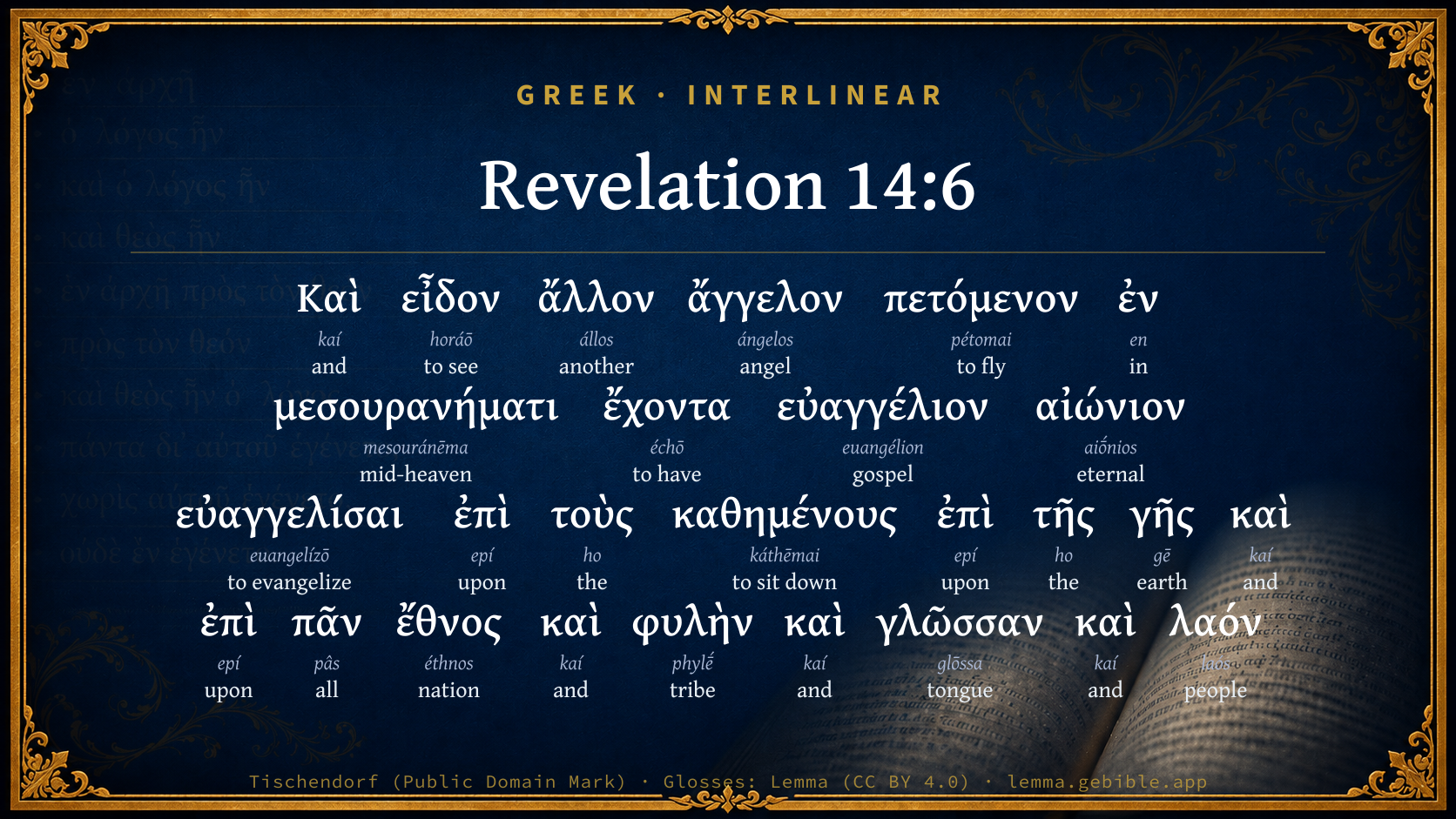
Greek (Tischendorf 8th ed.) Revelation 14:6 appears in the Greek New Testament. The text above is from the Tischendorf 8th edition. Each word links to its Strong’s number and a concise gloss. Click any word for its full Thayer’s Greek Lexicon entry.
Download image
Cite this verse

Revelation 14:6 (World English Bible). Public Domain. Lemma interlinear Bible study tool, https://lemma.gebible.app/v/revelation/14/6.

Show BibTeX & RIS
BibTeX
RIS
English Translation
I saw an angel flying in mid heaven, having an eternal Gospel to proclaim to those who dwell on the earth, and to every nation, tribe, language, and people.
World English Bible · Public Domain
Download a study sheet

One document with this verse’s original text, its word-by-word gloss line, the meaning frame, cross-references with their text, attributed commentary, and full source and license credits — printable, and it pastes into notes with its structure intact.

This verse Autodidact and up

Study sheet (.html) Plain text (.txt)

A passage Seminary Student

Up to 50 verses in one chapter. A passage sheet keeps up to 6 commentary sources and 12 cross-references per verse, in the order this page ranks them, and says so on the sheet whenever that leaves anything out. Ask for a single verse and you get the Autodidact verse sheet above.

Everything on this page stays free to read, with no account — the sheet is a download of what is already on screen, not access to it.

Want to remove ads? Support Godless Engineer
Compare translations 3

The same verse in 3 English versions, stacked beneath the original-language interlinear above. Click any original word for its lexicon entry.

Each is an independent rendering of the whole verse — the interlinear is not word-aligned to these translations.

Highlighted words mark where these versions differ — a whole-verse word diff, not a word-by-word alignment.

  • World English Bible Public Domain
    I saw an angel flying in mid heaven, having an eternal Gospel to proclaim to those who dwell on the earth, and to every nation, tribe, language, and people.
  • King James Version Public Domain
    And I saw another angel fly in the midst of heaven, having the everlasting gospel to preach unto them that dwell on the earth, and to every nation, and kindred, and tongue, and people,
  • unfoldingWord Literal Text CC BY-SA 4.0
    And I saw another angel flying in midair, having the eternal gospel to proclaim to the ones living on the earth, even to every nation and tribe and language and people,

unfoldingWord Literal Text — © unfoldingWord, licensed CC BY-SA 4.0. Word-aligned USFM3 via Door43 (git.door43.org/unfoldingWord/en_ult).

Versions to compare (up to 4)

3 of 4 selected

Show all 19 translations

Every available English version of this verse, each an independent rendering of the whole verse.

  • World English Bible Public Domain
    I saw an angel flying in mid heaven, having an eternal Gospel to proclaim to those who dwell on the earth, and to every nation, tribe, language, and people.
  • Berean Standard Bible Public Domain
    Then I saw another angel flying overhead, with the eternal gospel to proclaim to those who dwell on the earth—to every nation and tribe and tongue and people.
  • Majority Standard Bible Public Domain
    Then I saw an angel flying overhead, with the eternal gospel to proclaim to those who dwell on the earth—to every nation and tribe and tongue and people.
  • King James Version Public Domain
    And I saw another angel fly in the midst of heaven, having the everlasting gospel to preach unto them that dwell on the earth, and to every nation, and kindred, and tongue, and people,
  • American Standard Version (1901) Public Domain
    And I saw another angel flying in mid heaven, having eternal good tidings to proclaim unto them that dwell on the earth, and unto every nation and tribe and tongue and people;
  • Revised Version (1885) Public Domain
    And I saw another angel flying in mid heaven, having an eternal gospel to proclaim unto them that dwell on the earth, and unto every nation and tribe and tongue and people;
  • Geneva Bible (1599) Public Domain
    Then I sawe another Angel flie in the mids of heauen, hauing an euerlasting Gospel, to preach vnto them that dwell on the earth, and to euery nation, and kinred, and tongue, and people,
  • Douay-Rheims (1899) Public Domain
    And I saw another angel flying through the midst of heaven, having the eternal gospel, to preach unto them that sit upon the earth, and over every nation, and tribe, and tongue, and people:
  • Young's Literal Translation Public Domain
    And I saw another messenger flying in mid-heaven, having good news age-during to proclaim to those dwelling upon the earth, and to every nation, and tribe, and tongue, and people,
  • Literal Standard Version CC BY-SA 4.0
    And I saw another messenger flying in midair, having continuous good news to proclaim to those dwelling on the earth, and to every nation, and tribe, and tongue, and people,
  • Unlocked Literal Bible CC BY-SA 4.0
    I saw another angel flying in midair, who had the eternal message of good news to proclaim to those who live on the earth—to every nation, tribe, language, and people.
  • unfoldingWord Literal Text CC BY-SA 4.0
    And I saw another angel flying in midair, having the eternal gospel to proclaim to the ones living on the earth, even to every nation and tribe and language and people,
  • Darby Bible Public Domain
    And I saw another angel flying in mid-heaven, having [the] everlasting glad tidings to announce to those settled on the earth, and to every nation and tribe and tongue and people,
  • World Messianic Bible Public Domain
    I saw an angel flying in mid heaven, having an eternal Good News to proclaim to those who dwell on the earth—to every nation, tribe, language, and people.
  • Webster's Bible Public Domain
    And I saw another angel fly in the midst of heaven, having the everlasting gospel to preach to them that dwell on the earth, and to every nation, and kindred, and language, and people,
  • Free Bible Version CC BY-SA 4.0
    Then I saw another angel flying in mid-heaven. He had the eternal good news to announce to those who lived on the earth, to every nation, tribe, language, and people.
  • Bible in Basic English Public Domain
    And I saw another angel in flight between heaven and earth, having eternal good news to give to those who are on the earth, and to every nation and tribe and language and people,
  • Text-Critical English NT CC BY 4.0
    Then I saw an angel flying directly overhead, with an eternal gospel to preach to those who dwell on the earth, to every nation, tribe, tongue, and people.
  • Tyndale New Testament (1534) Public Domain
    And I sawe an angell flye in the myddes of heven havynge an everlastynge gospell to preache vnto them that sytt and dwell on the erth and to all nacions kinreddes and tonges and people

Literal Standard Version (2020), Covenant Press — licensed CC BY-SA 4.0. Text via the HelloAO Bible API (eBible.org). Unlocked Literal Bible (unfoldingWord) — licensed CC BY-SA 4.0. Text via the HelloAO Bible API (eBible.org). unfoldingWord Literal Text — © unfoldingWord, licensed CC BY-SA 4.0. Word-aligned USFM3 via Door43 (git.door43.org/unfoldingWord/en_ult). Free Bible Version, Dr. Jonathan Gallagher — licensed CC BY-SA 4.0. Text via the HelloAO Bible API (eBible.org).

Word by word

More ways to search: Search by grammar → Find every occurrence → Compare this word →

Practice this passage: Drill this verse → Learn its vocabulary →

μεσουρανήματι
mesouránēma
G3321
“mid-heaven”
Noun, Dative, Singular, Neuter
Part of Speech
Noun
Case
Dative
Number
Singular
Gender
Neuter
Full Thayer's Definition

Origin: from a presumed compound of G3319 and G3772

TDNT: None

1. mid-heaven 2. the highest point in the heavens, which the sun occupies at noon, where what is done can be seen and heard by all
  1. Καὶ kaí G2532 “and” Conjunction
  2. εἶδον horáō G3708 “to see” Verb, Aorist, Active, Indicative, 1st person, Singular
  3. ἄλλον állos G243 “another” Adjective, Accusative, Singular, Masculine
  4. ἄγγελον ángelos G32 “angel” Noun, Accusative, Singular, Masculine
  5. πετόμενον pétomai G4072 “to fly” Verb, Present, Middle or Passive deponent, Participle, Accusative, Singular, Masculine
  6. ἐν en G1722 “in” Preposition
  7. ἔχοντα échō G2192 “to have” Verb, Present, Active, Participle, Accusative, Singular, Masculine
  8. εὐαγγέλιον euangélion G2098 “gospel” Noun, Accusative, Singular, Neuter
  9. αἰώνιον aiṓnios G166 “eternal” Adjective, Accusative, Singular, Neuter
  10. εὐαγγελίσαι euangelízō G2097 “to evangelize” Verb, Aorist, Active, Infinitive
  11. ἐπὶ epí G1909 “upon” Preposition
  12. τοὺς ho G3588 “the” Article, Accusative, Plural, Masculine
  13. καθημένους káthēmai G2521 “to sit down” Verb, Present, Middle or Passive deponent, Participle, Accusative, Plural, Masculine
  14. ἐπὶ epí G1909 “upon” Preposition
  15. τῆς ho G3588 “the” Article, Genitive, Singular, Feminine
  16. γῆς gē G1093 “earth” Noun, Genitive, Singular, Feminine
  17. καὶ kaí G2532 “and” Conjunction
  18. ἐπὶ epí G1909 “upon” Preposition
  19. πᾶν pâs G3956 “all” Adjective, Accusative, Singular, Neuter
  20. ἔθνος éthnos G1484 “nation” Noun, Accusative, Singular, Neuter
  21. καὶ kaí G2532 “and” Conjunction
  22. φυλὴν phylḗ G5443 “tribe” Noun, Accusative, Singular, Feminine
  23. καὶ kaí G2532 “and” Conjunction
  24. γλῶσσαν glōssa G1100 “tongue” Noun, Accusative, Singular, Feminine
  25. καὶ kaí G2532 “and” Conjunction
  26. λαόν laós G2992 “people” Noun, Accusative, Singular, Masculine

About this verse

These counts appear in no published source. They are computed here, from the morphology-tagged text and Lemma’s own curated glosses. What Lemma adds →

27
words
20
distinct lemmas
Revelation
section

Notable vocabulary

The rarest word here is μεσουρανήματι mid-heaven G3321 — appearing just 3 times in the whole Greek New Testament.

Shared distinctive vocabulary

μεσουρανήματι mid-heaven G3321 occurs in 3 verses of the Greek New Testament. Also found in:

Repetition

Words recur within this verse:

Cross-references

27

Topical passages linked to Revelation 14:6 in the Treasury of Scripture Knowledge — connected by theme and wording, ordered by reader-vote popularity; previews shown in the World English Bible.

  • Mark 16:15 He said to them, "Go into all the world, and preach the Gospel to the whole creation.
  • Ephesians 3:9–11 and to make all men see what is the administration of the mystery which for ages has been hidden in God, who created all things through Jesus Christ;
  • Revelation 8:13 I saw, and I heard an eagle, flying in mid heaven, saying with a loud voice, "Woe! Woe! Woe for those who dwell on the earth, because of the other voices of the trumpets of the three angels, who are yet to sound!"
  • Psalms 139:24 See if there is any wicked way in me, And lead me in the everlasting way.
  • Isaiah 51:6 Lift up your eyes to the heavens, and look on the earth beneath; for the heavens shall vanish away like smoke, and the earth shall wax old like a garment; and those who dwell therein shall die in like manner: but my salvation shall be forever, and my righteousness shall not be abolished.
  • Isaiah 51:8 For the moth shall eat them up like a garment, and the worm shall eat them like wool; but my righteousness shall be forever, and my salvation to all generations.
  • Romans 16:25
  • Psalms 145:13 Your kingdom is an everlasting kingdom. Your dominion endures throughout all generations.
  • Daniel 6:25–26 Then king Darius wrote to all the peoples, nations, and languages, who dwell in all the earth: Peace be multiplied to you.
  • Matthew 10:27 What I tell you in the darkness, speak in the light; and what you hear whispered in the ear, proclaim on the housetops.
  • Revelation 3:10 Because you kept my command to endure, I also will keep you from the hour of testing, which is to come on the whole world, to test those who dwell on the earth.
  • Isaiah 6:6–7 Then one of the seraphim flew to me, having a live coal in his hand, which he had taken with the tongs from off the altar.
  • Daniel 9:21 yes, while I was speaking in prayer, the man Gabriel, whom I had seen in the vision at the beginning, being caused to fly swiftly, touched me about the time of the evening offering.
  • 2 Thessalonians 2:16 Now our Lord Jesus Christ himself, and God our Father, who loved us and gave us eternal comfort and good hope through grace,
  • Colossians 1:23 if it is so that you continue in the faith, grounded and steadfast, and not moved away from the hope of the Gospel which you heard, which is being proclaimed in all creation under heaven; of which I, Paul, was made a servant.
  • Titus 1:1–3 Paul, a servant of God, and an apostle of Jesus Christ, according to the faith of God's chosen ones, and the knowledge of the truth which is according to godliness,
  • Hebrews 13:20 Now may the God of peace, who brought again from the dead the great shepherd of the sheep with the blood of an eternal covenant, our Lord Jesus,
  • Revelation 13:7 It was given to him to make war with the saints, and to overcome them. Authority over every tribe, people, language, and nation was given to him.
  • Genesis 1:6 God said, "Let there be an expanse in the midst of the waters, and let it divide the waters from the waters."
  • 2 Samuel 23:5 Most assuredly my house is not so with God; Yet he has made with me an everlasting covenant, Ordered in all things, and sure: For it is all my salvation, and all [my] desire, Although he doesn't make it grow.
  • Psalms 119:142 Your righteousness is an everlasting righteousness. Your law is truth.
  • Isaiah 45:17 [But] Israel shall be saved by Yahweh with an everlasting salvation: you shall not be disappointed nor confounded world without end.
  • Ezekiel 1:14 The living creatures ran and returned as the appearance of a flash of lightning.
  • Daniel 4:1 Nebuchadnezzar the king, to all the peoples, nations, and languages, who dwell in all the earth: Peace be multiplied to you.
  • Revelation 10:11 They told me, "You must prophesy again over many peoples, nations, languages, and kings."
  • Isaiah 6:2 Above him stood the seraphim. Each one had six wings. With two he covered his face. With two he covered his feet. With two he flew.
  • Isaiah 40:8 The grass withers, the flower fades; but the word of our God shall stand forever.

Cross-references courtesy of OpenBible.info (CC BY 4.0).

Commentary

Notes on Revelation 14:6 from classic Christian and Jewish commentators (each source and its license shown beneath its notes). The classic Christian expositions comment on the surrounding passage and are grouped to its opening verse, so a note may address several verses; the Jewish commentaries on the Tanakh (Rashi and others) are per-verse, so they appear only where the commentator wrote on this verse.

Lemma curates 59 commentaries, every one of them public domain or Creative Commons licensed, each selected and text-cleaned for this edition rather than reprinted as found. About our sources →

Matthew Henry's Commentary

In this part of the chapter we have three angels or messengers sent from heaven to give notice of the fall of Babylon, and of those things that were antecedent and consequent to that great event.

I. The first angel was sent on an errand antecedent to it, and that was to preach the everlasting gospel, Rev 14:6, Rev 14:7. Observe, 1. The gospel is an everlasting gospel; it is so in its nature, and it will be so in its consequences. Though all flesh be grass, the word of the Lord endureth for ever. 2. It is a work fit for an angel to preach this everlasting gospel; such is the dignity, and such is the difficulty of that work! And yet we have this treasure in earthen vessels. 3. The everlasting gospel is of great concern to all the world; and, as it is the concern of all, it is very much to be desired that it should be made known to all, even to every nation, and kindred, and tongue, and people. 4. The gospel is the great means whereby men are brought to fear God, and to give glory to him. Natural religion is not sufficient to keep up the fear of God, nor to secure to him glory from men; it is the gospel that revives the fear of God, and retrieves his glory in the world. 5. When idolatry creeps into the churches of God, it is by the preaching of the gospel, attended by the power of the Holy Spirit, that men are turned from idols to serve the living God, as the Creator of the heaven, and the earth, and the sea, and the fountains of waters, Rev 14:7. To worship any God besides him who created the world is idolatry.

II. The second angel follows the other, and proclaims the actual fall of Babylon. The preaching of the everlasting gospel had shaken the foundations of antichristianism in the world, and hastened its downfall. By Babylon is generally understood Rome, which was before called Sodom and Egypt, for wickedness and cruelty, and is now first called Babylon, for pride and idolatry. Observe, 1. What God has fore-ordained and foretold shall be done as certainly as if it were done already. 2. The greatness of the papal Babylon will not be able to prevent her fall, but will make it more dreadful and remarkable. 3. The wickedness of Babylon, in corrupting, debauching, and intoxicating the nations round about her, will make her fall just and will declare the righteousness of God in her utter ruin, Rev 14:8. Her crimes are recited as the just cause of her destruction.

III. A third angel follows the other two, and gives warning to all of that divine vengeance which would overtake all those that obstinately adhered to the antichristian interest after God had thus proclaimed its downfall, Rev 14:9, Rev 14:10. If after this (this threatening denounced against Babylon, and in part already executed) any should persist in their idolatry, professing subjection to the beast and promoting his cause, they must expect to drink deep of the wind of the wrath of God; they shall be for ever miserable in soul and body; Jesus Christ will inflict this punishment upon them, and the holy angels will behold it and approve of it. Idolatry, both pagan and papal, is a damning sin in its own nature, and will prove fatal to those who persist in it, after fair warning given by the word of Providence; those who refuse to come out of Babylon, when thus called, and resolve to partake of her sins, must receive of her plagues; and the guilt and ruin of such incorrigible idolaters will serve to set forth the excellency of the patience and obedience of the saints. These graces shall be rewarded with salvation and glory. When the treachery and rebellion of others shall be punished with everlasting destruction, then it will be said, to the honour of the faithful (Rev 14:12): Here is the patience of the saints; you have before seen their patience exercised, now you see it rewarded.

Matthew Henry's Commentary on the Whole Bible (1708–1710) — public domain (CC PDM 1.0). Text via the HelloAO Bible API.

The Cambridge Bible for Schools and Colleges

gen. ed. J. J. S. Perowne

The Angel with the Everlasting Gospel, Rev_14:6-7

6. another angel] Different from the many mentioned before, perhaps especially distinguished from the one who appears in ch. 10, but see Rev_14:17, Rev_18:1, where such a reference is hardly possible.

in the midst of heaven] See on Rev_8:13.

the everlasting gospel] Strictly speaking, these words have not the article, but neither has “[the] Gospel of God” in Rom_1:1. Even if, therefore, the grammatical usage of this Book were more regular than it is, it would be needless to translate “an eternal piece of good news,” in which, moreover, it would be hard to find a sense for the epithet. No doubt “gospel” is used in its constant N. T. sense; and the gospel is called “everlasting,” as declaring the eternal truth of God. The preaching of the Gospel here stands in the same relation to God’s Judgement as in St Mat_24:14. But notice, that the name is applied to the whole truth of God, not to what was revealed by Christ only: for the substance of the angel’s message is pure natural theism.

The Cambridge Bible for Schools and Colleges (gen. ed. J. J. S. Perowne; Cambridge University Press, 1878–1918) — public domain. Text from a community e-Sword module.

The Biblical Illustrator

Joseph S. Exell

Rev_14:6-8

And I saw another angel fly in the midst of heaven, having the everlasting gospel to preach.

The angel in mid-heaven

I. The revival of a missionary spirit in the Church of Christ. We say a revival, for that spirit not only formed a necessary element all through the new dispensation, but it had its recognised place in the old. How many of the prophets of Judah and Israel, in varied words and imagery, exulted in the prospect of times when the exclusive privileges of the covenant-land would cease, when nations sitting in darkness would see the great Light! How often in the Psalms do we find the same aspirations! The sweetest strains of the minstrel monarch of Israel are missionary odes. It was the apostolic age, however, which was the era for the grand development of missionary zeal. But was missionary ardour to expire with the primitive era in the Church of Christ? a transient outburst of enthusiasm, when Peter and John crossed the borders of Palestine for the regions of Asia Minor and the distant lands of the dispersion; or when Paul braved the surges of the Adriatic and confronted the merchant princes of Corinth, the philosophers of Athens, and the captains of Imperial Rome? Far away in the distant east there lay a mighty empire. Poetry had sung of it as the climes of the sun, and British arms and enterprise had claimed it as their proudest trophy. But the darkness of spiritual death is brooding over it, and polluted fires are rising from unnumbered altars. Thither the Angel of the vision wings His way. Altar-fire after altar-fire is quenched. The chime of the Sabbath bell and the hum of the Christian school break the stillness of moral solitude, and he comes back to tell, In the region and shadow of death light has sprung forth. The evangelist beheld the Angel of the vision flying. It denoted at once suddenness and rapidity.

II. The instrumentality employed, the everlasting gospel. This was the book the Mission Angel held in his hand. It may seem to proud reason a poor weapon with which to effect the moral conquest of the world. And more especially when that gospel is proclaimed, not by angels, but by feeble men. But the foolishness of God is wiser than men, and the weakness of God is stronger than men. It seems to be a law or distinguishing feature in His government of the world that the mightiest ends are effected by the simplest and often unlikeliest means; that results are brought about by agencies and instrumentalities in themselves apparently inadequate to produce them. Look at His providential dealings as these are recorded in the page of Scripture. It was the sling of a shepherd-boy and a few pebbles from the brook which brought to the dust the giant of Philistia. Twelve humble fishermen from Tiberias shores (1Co_1:27-29). And, powerful in the past, the same moral and spiritual forces are still to be mighty for the pulling down of heathen strongholds. Countless Dagons are to fall before this Ark of God. And who can fail to admire the wondrous adaptation of that everlasting gospel to all characters, and ages, and times! The vision of the text, moreover, tells us it is destined, on a yet vaster scale, to vindicate its title to be the power of God unto salvation unto the very ends of the earth--the grand fulcrum and lever in one which is to elevate degraded humanity.

III. The extent of the commission: To preach to them that dwell on the earth, and to every nation, and kindred, and tongue, and people. (J. R. Macduff, D. D.)

The flight of the angel through heaven

I. The subject of his ministration: The everlasting gospel. This blessing God designs by the Christian ministry to confer upon the whole world.

1. The heathen have lost the knowledge of God. We may infer the greatness of this loss from the fact that the knowledge of God is the only foundation of religion. But how can this knowledge be restored? It is only taught by three volumes--Nature, Providence, and Revelation. But Nature and Providence never taught this knowledge without the comment of Revelation. Nothing restores the lost knowledge of God but the gospel.

2. They are without the knowledge of their sinful state.

3. They are without the knowledge of acceptance and pardon through the true Mediator.

II. The characteristics of this ministry.

1. It is the ministry of men. The term angel is not a designation of nature, but of office; ministers are called angels in Holy Scripture. The ministry of the gospel is exercised by men, that they may not only teach doctrine, but be the witnesses of what they teach.

2. It is an authorised ministry. An angel is a messenger, and a messenger must be sent. The command of the Lord is, Go ye into all the world, etc.

3. It is an open and undisguised ministry. St. Paul gloried in using great plainness of speech. There is nothing in Christianity that requires concealment.

4. It is a zealous and successful ministry. The attitude of flying, in which the angel is placed before us in the text, denotes zeal and activity; an eagerness to deliver the message, and to carry it into the remotest regions. And, thank God, we have such a ministry in progress. It has met with difficulties, and future difficulties await it, yet it is pressing onward.

III. Its extensive commission. It is sent to every nation, and kindred, and tongue, and people.

1. The gospel is equally needed by all nations, and equally adapted to all.

2. There is an essential difference between the Jewish and Christian dispensations. The Jewish dispensation was restricted to one nation and period; the Christian dispensation is universal, embracing all the different tribes of men, and extending to the end of time.

3. The extensive commission recorded in the text is the foundation of universal philanthropy.

4. It gives noble and expanded views to Christians. Study and understand your own religion. It is not one amongst many modifications of human opinion. It is from God, and it is intended by Him, like Aarons rod, to swallow up every other.

IV. The specific objects of the angels ministry.

1. The angel cries out, Fear Him. The fear of the Lord is the beginning of wisdom, the source and guard of virtue. But the heathen are without it. They have religious fear, but not the fear of God. The fear of God is a mixture of awe and love.

2. To establish His worship. This is another effect of the promulgation of the gospel. Instead of idols, to place the true God in His temples. Instead of polluting orgies, to teach men to wash their hands in innocency, and thus to encompass Gods altar. Instead of vain mediators, to have the name of Jesus in which to trust.

3. To claim for God His revenue of praise and glory.

Lessons:

1. Behold, then, a glorious object of contemplation--the progress of the angel in the midst of heaven.

2. It depends on you to speed or delay the angel.

3. Let it not discourage us, that the world maybe tossed and troubled. (R. Watson.)

An ideal preacher

I. His theme is glorious.

1. A gospel-message of Divine love.

2. An ever-enduring gospel.

(1) Because its elementary truths are absolute.

(2) Because its redemptive provisions are complete.

3. A world-wide gospel.

(1) A necessity to all mankind.

(2) Equal to all mankind.

II. His movements are expeditious.

1. The message is urgent.

2. The time is short.

3. Life is uncertain.

III. His sphere is elevated. It is the characteristic of all truly regenerated men that they are not of the flesh, but of the Spirit; that they set their affections on things above; that though in the world, they are not of the world; that they live in heavenly places. (Homilist.)

The dissemination of good and the destruction of evil

I. The dissemination of good.

1. The gospel in itself is good. It is at once the mirror and the medium of eternal good.

2. The gospel in its ministry is good. It comes from heaven, and is conveyed by heavenly messengers to men.

3. The gospel in its universality is good. It overleaps all geographic boundaries, all tribal, linguistic distinctions, and addresses man as man.

4. The gospel in its purpose is good. Its supreme aim is to induce all men to worship Him who made heaven, earth, and sea.

II. The destruction of evil.

1. This aggregation of evil must fall. Faith is to overcome the world.

2. This aggregation of evil falls as the good advances. (D. Thomas, D. D.)

The preaching of the everlasting gospel

I. The commission to preach the gospel. Some persons are heard falsely to argue that there is no need to send the tidings of redemption to the heathen; that they will be saved or be lost, according to their use or abuse of the light they have received; and that to impart to them the gospel is only to increase their condemnation, if they die unbelieving. But to such cavils we need not reply. Our Lords command, as well as the conduct of the angel in our text, is clear and express.

II. The manner in which that commission is to be executed.

1. By calling sinners to repentance.

2. By directing them to Christ.

3. By warning them of a future judgment. (C. Clayton, M. A.)

The undying theme--the originality and acceptability of the gospel

1. The gospel, in its authorship, is one with nature.

2. The gospel, in its comprehension or extent, includes heaven and earth. The flying angel unites the two, and shows in clear and bold figure the celestial origin of the gospel. It is no growth of the darkened earth--no high stage of a merely natural development--no offspring of civilisation. Heaven and earth are made one again in the gospel.

3. The gospel, in its history, advances from the deepest obscurity to the highest prominence.

4. The gospel, in its design, unites the particular and the universal.

5. The gospel, in its spirit, unites the purest mercy with the most perfect justice.

I. A statement of the gospel.

1. Its originality. That is original which is the first of its kind, and stands alone. Absolute originality is to be found in God alone; for the Divine mind alone has the power of pure creation. The gospel is original, whether we view it as emanating from God, as a series of facts in human history, or as a new life in man--that is, whether we view it as a creation of God the Father, of God the Son, or of God the Holy Ghost.

2. Its acceptability lies in this--that it satisfies the demands of an honest and earnest mind. Is proof required that the Word of God, as a historical and literary production, is what it claims to be? It possesses more evidence on this point than any other book. But the point in respect of which the gospel is most widely and warmly accepted is that it satisfies the heart and conscience.

II. How the gospel is everlasting. We may here take the two aspects under which we have just considered the gospel, and show how the epithet everlasting applies to each--how it is for ever original or new, and how it is for ever good or acceptable.

1. The gospel is everlasting in its originality. The word new has two meanings, not only different, but apparently opposed to each other, which yet, taken together, give all the more complete an idea of the gospel. We call that new which is the first of its kind; we also call that new which is the last or latest of its kind. The gospel is the first and last system of truth, the oldest and the newest thought of God. It is everlasting, although new. Other new things soon lose their freshness, wither, and grow old; but it remains ever new, full of the life of God, fresh as the morning of creation. It continues new by ever growing newer--ever leading us deeper into its source in God.

2. The gospel is everlasting in its acceptability. We do not grow insensible to its influence through repeated experience of its power. The more we come into living contact with it, the more do we see its beauty and profundity--the more do we see that its meaning and charm are quite inexhaustible. (F. Ferguson.)

The missionary angel

1. It is the everlasting gospel, because it deals with everlasting things. It proclaims the everlasting God.

2. It is the everlasting gospel because it emanates from the everlasting God.

3. The everlasting gospel because it is based upon the everlasting covenant.

4. The everlasting gospel because it guarantees to us everlasting life, the life of communion; the life of knowledge, of entering more and more into the mind of God, and drawing our whole lifes power from Him, the Lord our God.

5. The everlasting gospel because it is sure to bring to us everlasting joy. (E. A. Stuart, M. A.)

The everlasting gospel

I. The angel spoken of is not merely an individual, but the representative of all faithful ministers of the gospel.

II. The title which the Spirit of God here gives it. It is called in our text the everlasting gospel.

1. It is called the everlasting gospel because the substance of it was settled in eternity by the triune Jehovah, in the counsel and in the covenant of peace. It is the revelation of the eternal purpose of God.

2. It is called the everlasting gospel because, in spite of all the opposition that has been offered to it, it has continued still to be preached, and it will always so continue.

3. Another reason is because, amidst all the changes to which this sublunary state is subject, the gospel alone is unchangeable, and alone affords a safe and solid foundation, on which the people of God can rest.

4. Once more, it is called the everlasting gospel, because all its promises are yea and amen in Christ Jesus, and never can be revoked.

III. The instrumentality employed in its promulgation.

IV. The predicted triumphs of the gospel. (R. Shutte, M. A.)

The everlasting gospel

Some one not long ago published a book with the title, Gospels of Yesterday. It discussed the writings of several authors who, in our generation, have caught the popular ear, and analysed their doctrines with keen incisiveness. At present I will not pass a judgment on its estimates. But how striking the name itself! Gospels of Yesterday--how many there have been of them! They lasted as long as they could, but the world outgrew them. There is only one gospel which is everlasting. Now, why is this? What makes the gospel of Christ everlasting?

I. Its universal message. The reason why so many gospels have been doomed to become gospels of yesterday has been because they have addressed themselves to what is transient or partial in human nature, and not to what is permanent and universal. Men have been hailed as saviours of society because they have been able to give relief from a need pressing at some particular time, or because their doctrines have fallen in with some passing phase of popular sentiment. But the glory of Christianity is that its teaching is addressed to what is most characteristic in human nature and absolutely the same in all members of the human race, whether they be rich or poor, whether they inhabit the one hemisphere or the other, and whether they live in ancient or modern times. You have only to glance at the most outstanding words of the gospel to see this. Take, for example, the word soul. This word was in the very forefront of the teaching of Jesus. Jesus went down to the child, the beggar, the harlot--the weakest and most despised members of the human family; and when He was able to find even in them this infinitely precious thing, it was manifest that He had discovered the secret of a universal religion; because, if this existed even in the lowest, then it existed in all. Or take another great word of the message of the gospel: take the word sin. This word also is borne on the forefront of Christianity, and how universal is the response which it finds in the heart of man! Not to multiply illustrations too much, take only one more--the word eternity. This is also a word which the gospel carries on its very front. It speaks of it wherever it goes. Christ brought life and immortality to light by the gospel; He spoke of the objects of the world invisible as one who had lived among them; and He spoke to men of a home of many mansions to which they were to aspire. Now, this message strikes a chord in every human heart.

II. Its particular message. The great things in human nature are, as I have said, common to all; yet human nature is never precisely the same in any two specimens. There were never in this world even two faces absolutely alike; and much less are the minds ever precisely alike which lie behind the faces. The gifts of nature, such as beauty, strength, ability, genius, are distributed in ever-varying proportions, and the various circumstances in which people grow up emphasise the natural differences. Some are born to wealth, others to poverty; the gifts of some are improved by education, the genius of others is buried beneath the hard conditions of adversity. What a difference it makes in the fate of a human being whether he is born in the heart of Africa or in the capital of England! But the gospel has a message for this difference in each specimen of human nature, and for each quarter of the globe and each age of the world, as well as for that which is common to all. God has a special message for every age. His gospel has a word in season for every condition of life--for the little child, and the young man in his prime, and for old age--a word for the multitude and a word for the few. The Chinese, when they accept the gospel, will find secrets in it which the British have never discovered; the twentieth century will discover phases of the Christian life which are lacking in the nineteenth. We have not exhausted Christ, and we have not exhausted the gospel of Christ. (J. Stalker, D. D.)

The gospel in terms of duration

This word gospel, we bethink us, gets only its modern form in our homelier phrase good news. The word here linked with it, therefore, is scarcely the sort of word we would naturally link with it--an eternal gospel. Eternal good news? The combination is one which strikes our ear as if it contradicted itself. News flashes and fades. How little is there that we would still call news after a days sun has set upon it! Yet there is a sense in which news may be said sometimes to last. The news is so important to us that it lingers in the heart, and in a manner keeps itself fresh. The gospel is always new, because you are always gathering something further of its import, or sighting something hitherto unexplored of its sublimity.

I. The gospel has in it every element of durability.

1. There are some enterprises, some houses of business so safe, as you call them--so set for enduring--that even prudent men will count upon the future of them as if it were present. Such concerns are always conceived and conducted, you will find, on principles of wisdom--of wisdom that is calm and clear-sighted, fit to anticipate dangers and to provide for difficulties, so that surprise or loss is made as unlikely as may be. Such concerns, moreover, are usually built up slowly--grow firm as they grow great, and at every stage are solid all through to the heart. This element of durability belongs to the gospel. It took existence under a wisdom which was at once infinite in its range and eternal in its experience. The gospel was matured in sight of every difficulty and every danger it could ever meet. It has never shown the least kinship with things hasty, immature, unstable. It is built into the system of things, and is thus settled upon foundations that are too deep and broad to come within the power of any law of destruction or damage or change.

2. There is another important element of durability in the gospel. The Divine justice, it is evident--the eternal sense of what is morally due, and the eternal fulfilling of what is morally right--cannot afford to brook the least breath of contravention. Now, it is an eminent peculiarity of the gospel, that it stands in the most intimate harmony with justice. It is such, that whithersoever it goes supreme justice goes with it.

3. The gospel has still another element of durability. Purity is proof against decay; impurity is decay already begun. And the gospel is a holy thing. It sprang from holiness: it was framed upon holiness; it makes for holiness.

4. I will name only one thing more about the gospel which involves its enduringness. We count upon the success of an undertaking which has abundance of strength behind it. What project would we not reckon secure of a firm place in history if the flag of every nation were unfurled around it, and every heart was knit to every other in the resolve that it should prosper and last? But all our figures are poor when we bring them alongside of the fact concerning the strength which girds this gospel. It is the gospel of the Omnipotent. But is His gospel then omnipotent? Virtually it is.

II. The gospel may be called eternal because duration hitherto has been so full of it. The material universe, we have come to know, is stupendously great. Thought wearies itself in a wilderness of world-systems; and when our glasses have carried our vision farthest into the teeming depths of space, we more than conjecture that we have only been gazing around the horizon-line of an ocean of Divine handiwork. Yet, in the minds of those to whom both are equally known, the gospel bulks larger than this universe that is so nearly infinite. We catch stray echoes of the converse of mightier intelligences than time can hold--of beings who know creation with a knowledge which dwarfs all our science into the knowledge of children; and for once that they are thinking of Gods creation they are ten times thinking of Gods salvation. And this, we may assure ourselves, does no more than reflect the thought of the adorable Creator. The Lord of the gospel is the Lord of creation, and He is the Lord of creation as the Lord of the gospel--this actually now, and this potentially from before the world began. This gospel would seem to be the oldest thing we know. For it has the look of being more than an eternal thought of the Divine mind, and more than an eternal purpose of the Divine will; it wears an appearance of completeness, of maturity, of readiness, of actuality almost; it has gotten a prerogative of making a place for itself among eternal things, and of casting its own influence into the whole current of the immeasurable past. We listen on this sea-board of time, and the sound which reaches us out of the shoreless eternity is a gospel-sound. We are hearing the far-coming murmur of an eternal gospel.

III. The gospel may be spoken of as eternal because it will always be what it has always been. No change is to be detected in its character or its contents through all the changes that have come to pass in its condition and its circumstances. It has not even developed, save in manifestation and in the spread of its influence among men. What, then, of the future? What of the coming generations of the history of the gospel in the world? These may see more of change than even the past generations have seen. Shall the gospel itself be touched with change? The Scriptures, which hold the revelation of it from the beginning, may come to be beheld in a light so searching, that venerable beliefs as to their formation may be universally modified. Meanwhile the gospel will stand as it has never but stood; and the total result of all new light, of all new movement, will be the more full and luminous display of what those tidings are which abide for ever. And is it so? Shall this gospel which we so poorly preach, and which men are so slow to hear--shall it be to some of us our theme, our motive, our inspiration, the breath of our life, when the first ages of redemption have gone far into the past? Still new?--and still the same? Even so. The same Saviour, the same great kinship to Him, the same clearing of the dark past, the same upward road to spiritual health and power, the same everlasting righteousness, the same mercy, the same love, the same peace and joy made up to eternal measure--this, with deepening knowledge of what it all means, and ever-gathering enrichment from what it all infolds, will the gospel of Jesus Christ continue to be as long as eternity continues I

IV. The gospel may be called eternal, in contrast to so much that is associated with it in the world. Is there anything at all in the world that is unshifting and sure? We think little about the uncertainty of things, because we know so little else. Yet it would be a luxury, we imagine, to be able to fix our thought, not to say our hope or our love, upon something which will not catch the general infection of things as it gets into treacherous motion, or slips our grasp, or vanishes, leaving us to soothe as we can our aching hearts. It is this gospel. It is what brings us to the friendly stability of God as a personal and present and settled possession. For the good tidings, from generation to generation, from man to man, from experience to experience, abides the same enriching, comforting, rectifying thing, unable to disappoint or deceive. (J. A. Kerr Bain, M. A)

The everlasting gospel

I. The gospel. It is a glad message from God to man; good news from heaven to earth.

1. Of Gods free love.

2. Of Gods great gift.

3. Of Gods propitiation for sin.

4. Of Gods righteousness.

5. Of Gods kingdom.

II. The everlasting gospel. (H. Bonar, D. D.)

The survival of the fittest

I. Because it gathers up all the teachings of nature. Ii. Because it fulfils all the predictions of prophecy.

III. Because it meets the universal wants of man.

IV. Because it possesses immortal youth.

V. Because it is ever gaining fresh empire and renown.

VI. Because its author has risen and reigns for ever. (F. W. Brown.)

The gospel of retribution

1. What, then, is this gospel? It is the gospel of retribution; we are to fear and glorify God because the hour of His judgment is come. This is the truth which the angel flying in mid-heaven, between God and man, proclaims and always will proclaim. This is the truth which St. John calls an eternal gospel--not the gospel, and still less the only gospel, but still glad tidings of great joy to us and to all mankind. Are you disappointed? Do you say, That is true enough, no doubt. Sooner or later the actions of men do round upon them in the strangest way. A man may as soon jump off his own shadow as evade the consequences of his own deeds. But we need no apostle, no angel out of heaven, to teach us that. Our poets, our moralists, our philosophers, our very novelists, have long sung in that key. And our own hearts, our consciences, our experience of life, have taken up and swelled the strain. We need no future witness to the fact of retribution. But there is no gospel in the fact. It brings no good tidings to us, but rather tidings of despair. A gospel of redemption would be good news indeed if it could possibly be true; but a gospel of retribution is a mere contradiction in terms. Are you so sure that every man must receive according to his deeds that you have made your ways and doings good, that you dread and resist every temptation to do evil? You respect and observe the law of gravity because you are quite sure that it k a law. Do you show an equal respect for the law of retribution? Consider, again, if the law of retribution is familiar to you, is it nothing to you to be assured that what you admit to be a law is also a gospel? When we are told that Gods judgments on sin are an eternal gospel, a gospel for all beings in all ages, what is implied? This is implied--and there is no truth more precious or more practical--that the judgments of God are corrective, disciplinary, redemptive; that they are designed to turn us away from the sins by which they are provoked. Nothing can be more wholesome for us, and no truer or nobler comfort can be given us when we are suffering the painful consequences of our evil deeds, than the assurance that these retributions are intended for our good; not to injure or destroy us, but to quicken life in us, or the godly sorrow which worketh life. And, surely, up to a certain point at least, we can see that this law is a good law, deterring us from evil, driving and inviting us toward that which is good. But if the law work good it is good; i.e., it is a gospel as well as a law. It would be bad news that the law was to be repealed. That there is much in the operation of this law which as yet we cannot fathom, or cannot prove to be good, must be admitted. One mans guilt is another mans loss or pain. We often suffer as much from our ignorance as from our sins. The best people often have the hardest life. And here, as we cannot walk by sight we must walk by faith. Retribution is a gospel, an eternal gospel, because it is medicinal and redemptive, because it either corrects that which is evil in us, or because it is a discipline by which we are prepared for larger good.

2. But this mystery of unprovoked or disproportionate suffering may grow clearer to us as we consider that, in his eternal gospel, St. John includes not only present, but also future judgments. The angel is always proclaiming judgment, but he also proclaims hours of judgment, crises in which the whole story of a life, a race, or an age, is summed up, and finally adjusted by an unerring standard. Such an hour was then at hand. Such an hour is never far off from any one of us. No fact, no truth, proclaimed by Christ and by His angels or messengers, has been invested with more awful terrors than this of the last judgment--the last, or at least the last for us, the judgment which closes this earthly span. And, to flesh and blood, it must always be full of terror. And yet there are considerations which may well abate our surprise. For, with all his fear of judgment, there is a deep craving for justice in every mans heart, and a profound conviction that, in some respects at least, he has never had it, or never had it to the full. His neighbours have wronged him. He has had to suffer for their folly, their extravagance, their crimes, their sins. His actions have been misrepresented, his motives misconstrued. Or circumstances have been against him, and he has never been able to get the culture he longed for and prized. Poverty, drudgery, grief, and care have exhausted him, leaving him no leisure and no force for pursuing the loftier aims of life. Or he has been unfortunate in the relationships he has formed, and found them a burden instead of a help. As you all know, there are men who, in a thousand different ways, have been crippled, hampered, thwarted, defeated in the race of life, who have never had a fair chance, whose hearts have been shaken and soured by the accidents and changes of time. And if to any of these sufferers from misfortune or injustice, sitting in darkness and asking, What does it all mean? you could say with conviction and authority, It means that the end is not yet; but the end is coming. God will yet do you ample justice, redress all your wrongs, compensate you for all your losses, turn all your sorrows into joy, make you what you would be, and enable you to do and to get all you crave--would not such a message be a true gospel to him? If he could believe it, would it not be to him as life from the dead? Would he be slow to give glory unto God? And is it not good news that when we pass from the hasty censures of a busy and careless, if not a cruel, world, we shall be weighed in finer scales and a truer balance? that our most inward and delicate motives will be taken into account, as well as the blundering actions which so ill expressed them by One who knows us altogether, and reads the thoughts and intents of the heart? Fear God, then, and give Him glory, for the hour of His judgment is coming and is nigh. You cannot help but fear Him, indeed, for His pure eyes must discern much evil in you which you have failed to detect; and at His bar you will have to answer for your injustice to your neighbours, for the wrongs you have done them, for your misconstructions of their characters, their actions, their motives. But, according to St. John, with fear or reverence we are to blend thanksgiving. According to him, retribution is a gospel as well as a law, and we are to give glory to God even as we advance toward His judgment-seat. How should either an apostle, or an angel, bid us bless God for the hour of judgment as for a gospel, if there were no mercy, no hope, no blessing in it?

3. This gospel is an eternal, or universal, gospel, a gospel for all ages, for all men. It is proclaimed unto every nation, and tribe, and tongue and people. And here, surely, we may find a theme for praise. The world is full of injustice, full of misery. And as you think of these common events, events as common in every other circle as in your own, what a gospel is this which the angel, flying in mid-heaven, proclaims with a great voice: This world is not all. It is not the end, but only the beginning; and the beginnings of life are always obscure and mysterious. The hour of judgment is coming, in which the mystery will be explained and vindicated; in which God will redress every wrong, compensate every loss. Take the world as it is, cut it off from the great astronomical system of which it forms part, and it is a mystery which none can fathom. And take human life as it is, as a story without a sequel, and you can only give it up as aa insoluble problem, a mighty maze without a plan. But listen to this gospel of retribution, connect this world with the world, or worlds, in heaven, regard the present life as an introduction to, a discipline for, a larger, happier life to come, and your burden is eased; the problem becomes capable of a happy solution. If you must still fear God, you can also give Him glory because the hour of His judgment is coming, the hour at which He will gather the whole world under His rule, and all nations and tribes, and tongues and peoples, shall become His people and know Him for their God. That this law of retribution has another aspect, that the justice of God must be full of terror for as many as cleave to their sins and will not let them go, none of us are likely to forget. (S. Cox, D. D.)

The gospel enduring

Mineralogists and geologists are predicting in doleful strains the exhaustion of coal. Even such an eminent Christian philosopher as Dr. Chalmers believed that the mineral, vegetable, and animal resources of nature would fail to keep pace with the wants of a rapidly increasing population. But the gospel is eternal. Jesus Christ, the same yesterday, to-day, and for ever. Amid all lifes vicissitudes He is unalterable in love and power.

There followed another angel, saying, Babylon is fallen.--

The doom of the world-power

The second angel follows on the first; the doom of the world-city, the metropolis of the empire of the world-power, follows the proclamation of the gospel. The principles of Christs gospel must undermine the world-power: the fall of some Babylon principle has almost always succeeded the age of spiritual revival. Pagan Rome goes down before the gospel. (Bp. Boyd Carpenter.)

The Biblical Illustrator, edited by Joseph S. Exell (c. 1880s–1900s) — public domain. Text from a community e-Sword module.

Joseph Benson's Commentary

Rev 14:6-7. And — As a further motive to Christian patience and constancy, this vision of the happy state of faithful Christians was followed by another; I saw another angel — A second is mentioned Rev 14:8; a third, Rev 14:9. These denote great messengers of God, with their assistants. The first exhorts to the fear and worship of God, the second proclaims the fall of Babylon, the third gives warning concerning the beast. Happy were they who made a right use of these divine messages! Fly — Or flying, going on swiftly; in the midst of heaven — Through the air; having the everlasting gospel to preach unto every nation and people — Both to Jews and Gentiles, even as far as the authority of the beast had extended. In the fourth and fifth verses the nature and character of the true Christian Church, in opposition to the wicked antichristian kingdom, were described; and here it is predicted that three principal efforts would be made toward a reformation at three different times, represented by the three angels appearing one after another. Or, that the gospel, here said to be everlasting, because, like its Divine Author, it is the same yesterday, to- day, and for ever, should be preached during this period, in opposition to the novel doctrines of the beast and the false prophet, which should be rooted up, Mat 15:13. And the swiftness with which the gospel should be disseminated and spread over the world, is admirably represented by the swift flight of the first angel; and the nature of the doctrine, and the earnestness wherewith it should be especially inculcated, is set forth by the first clause of the next verse; saying, with a loud voice — That is, urging in the most zealous and forcible manner, Fear God, and give glory to him, who made heaven, earth, the sea, &c. — Revere, stand in awe of, dread to offend, worship, and serve him; for the hour of his judgment is come — It is now denounced with certainty, and in due time will be fully executed on the impenitent, unbelieving, and disobedient. “It is,” says Bishop Newton, “a solemn and emphatic exhortation to forsake the reigning idolatry and superstition, and such exhortations were made even in the first and earliest times of the beast. Besides several of the Greek emperors, who strenuously opposed the worship of images, Charlemagne himself held a council at Frankfort in the year 794, consisting of about three hundred French, and German, and Italian, and Spanish, and British bishops, who condemned all sorts of adoration or worship of images, and rejected the second council of Nice, which had authorized and established it. At the same time the Caroline books, as they are called, four books written by Charles himself, or by his authority, proving the worship of images to be contrary to the Scripture, and to the doctrine and practice of antiquity, were approved by the council, and transmitted to the pope. Lewis the Pious, the son and successor of Charles, held a council at Paris, in the year 824, which ratified the acts of the council of Frankfort, and the Caroline books, and affirmed that, according to the Scripture and the fathers, adoration was due to God alone. Several private persons also taught and asserted the same Scriptural doctrines. Claude, bishop of Turin, declares, that ‘we are not commanded to go to the creature that we may be made happy, but to the Creator himself; and therefore we should not worship dead men; they are to be imitated, not to be adored; let us, together with the angels, worship one God.’ Agobard, archbishop of Lyons, wrote a whole book against images, and says, that ‘angels or saints may be loved and honoured, but not be served and worshipped; let us not put our trust in man, but in God, lest that prophetic denunciation should redound on us, Cursed is the man who trusteth in man.’ Many other bishops and writers of Britain, Spain, Italy, Germany, and France, professed the same sentiments; and this public opposition of emperors and bishops to the worship of saints and images, in the eighth and ninth centuries, appears to be meant particularly by the loud voice of this first angel flying aloft, and calling upon the world to worship God. In another respect, too, these emperors and bishops resemble this angel having the everlasting gospel to preach unto every nation; for in their time, and greatly by their means, the Christian religion was propagated and established among the Saxons, Danes, Swedes, and many other northern nations.”

Joseph Benson's Commentary on the Old and New Testaments (1811–1818) — public domain. Text from a community e-Sword module.

Whedon's Commentary on the Bible

Daniel D. Whedon

b. Three Angels Hovering In Mid-Heaven Over Jerusalem, Rev_14:6-13.

1. First angel proclaims the triumphal everlasting gospel, Rev_14:6-7.

From mount Zion, where the martyr army is uttering its chant, the eye of the seer standing on Moriah is directed sky-wards, and beholds objects in next verse.

6. Another angel—In addition to the many angels who have appeared in former scenes.

The everlasting gospel—The truth of Jesus, everlasting in its endurance, unlike the falsehoods it contradicts. It is here strikingly intimated that the very beginning and source of the overthrow of antichrist’s citadel is the everlasting gospel. It is divine truth that is to overthrow this mighty stronghold of error and sin, which the “Lord shall consume with the breath of his mouth.” 2Th_2:8.

Nation… kindred… tongue… people—The cosmical four, implying the utmost universality, unlimited to any one land or continent. It is strictly a universal gospel, proclaimed to all mankind, and destined to universal diffusion.

Daniel D. Whedon (gen. ed.), Commentary on the Old and New Testaments (1874–1909) — public domain. Text from a community e-Sword module.

Scofield Reference Notes

C. I. Scofield

gospel

Gospel. This great theme may be summarized as follows:

I. In itself the word Gospel means good news.

II. Four forms of the Gospel are to be distinguished"

(1) The Gospel of the kingdom. This is the good news that God purposes to set up on the earth, in fulfilment of the Davidic Covenant 2Sa 7:16 a kingdom, political, spiritual, Israelitish, universal, over which God’s Son, David’s heir, shall be King, and which shall be, for one thousand years, the manifestation of the righteousness of God in human affairs. (See Scofield "Mat 3:2").

Two preachings of this Gospel are mentioned, one past, beginning with the ministry of John the Baptist, continued by our Lord and His disciples, and ending with the Jewis rejection of the King. The other is yet future Mat 24:14 during the great tribulation, and immediately preceding the coming of the King in glory.

(2) The Gospel of the grace of God. This is the good news that Jesus Christ, the rejected King, has died on the cross for the sins of the world, that He was raised from the dead for our justification, and that by Him all that believe are justified from all things. This form of the Gospel is described in many ways. It is the Gospel "of God" Rom 1:1 because it originates in His love; "of Christ" 2Co 10:14 because it flows from His sacrifice, and because He is the alone Object of Gospel faith; of the "grace of God" Act 20:24 because it saves those whom the law curses; of "the glory"; 1Ti 1:11; 2Co 4:4 because it concerns Him who is in the glory, and who is bringing the many sons to glory Heb 2:10 of "our salvation" Eph 1:13 because it is the "power of God unto salvation to every one that believeth" Rom 1:16 of "the uncircumcision" Gal 2:7 because it saves wholly apart from forms and ordinances of "peace" Eph 6:15 because through Christ it makes peace between the sinner and God, and imparts inward peace.

(3) The everlasting Gospel Rev 14:6. This is to be preached to the earth-dwellers at the very end of the great tribulation and immediately preceding the judgment of the nations Mat 15:31. It is neither the Gospel of the kingdom, nor of grace. Though its burden is judgment, not salvation, it is good news to Israel and to those who, during the tribulation, have been saved; Rev 7:9-14; Luk 21:28; Psa 96:11-13; Isa 35:4-10.

(4) That which Paul calls, "my Gospel" Rom 2:16. This is the Gospel of the grace of God in its fullest development, but includes the revelation of the result of that Gospel in the outcalling of the church, her relationships, position, privileges, and responsibility. It is the distinctive truth of Ephesians and Colossians, but interpenetrates all of Paul’s writings.

III. There is "another Gospel" Gal 1:6; 2Co 11:4 "which is not another," but a perversion of the Gospel of the grace of God, against which we are warned. It has many seductive forms, but the test is one--it invariably denies the sufficiency of grace alone to save, keep, and perfect, and mingles with grace some kind of human merit. In Galatia it was law, in Colosse fanaticism Col 2:18, etc. In any form its teachers lie under the awful anathema of God.

angel (See Scofield "Heb 1:4").

The Scofield Reference Bible (1917 edition), notes by C. I. Scofield — public domain. Text from a community e-Sword module.

Tyndale Open Study Notes

Tyndale Open Resources

14:6-13 Three angels are flying through the sky with messages from God.

14:6-7 The first angel proclaims the eternal Good News, which includes the message that God will sit as judge—the end is near, so this message provides a last-chance summons to repentance.

Tyndale Open Study Notes — © Tyndale Open Resources, licensed CC BY-SA 4.0. Text via the HelloAO Bible API.

Bengel's Gnomon

Johann Albrecht Bengel

Rev 14:6. Ἄγγελον, an angel) Under the name of angels the preachers of the heavenly doctrine come, in Rev 14:6; Rev 14:8-9. [They are opposed to him who published the threefold woe, ch. Rev 8:13.—V. g.] But as to that which G. G. Zeltner has in his Diss, de Chiliasmo præsenti, § 13, p. 22: Nor shall we be opposed, to it, if any one should affirm that the aid of Angels, or of one in particular, was employed here (Rev 21:1) in animating the Confessors of the Gospel, in the same sense in which an angel is said also to have stood beside Paul, Act 27:23, comp. with Daniel 10 throughout the whole chapter; and we admit that this explanation is MOST of all approved by us: we think that is more suitable to the three heralds (preachers) here mentioned.— αἰώνιον, existing through eternal ages) αἰὼν, an age, is attributed to the Gospel, or to the office of publishing it, which the angel here has. It is therefore a definite age,[157] which, in accordance with the analogy of the other times, consists of two periods (chroni), and extends from the publishing of this Gospel to the judgment day itself. This length of the age in particular, besides many other things, affords an occasion for considering whether this angel be Arndt. We are not so certain that the second angel is already come; if he is already come, it must be understood of Spener. The third precedes the close of the 42 months by a shorter interval: although the worship of the beast himself, and not only the worship of the image, which is subsequent, is forbidden by him.—εὐαγγελίσαι) There is a similarity of expression in πειρασμοῦ—πειράσαι, ch. Rev 3:10, and εὐαγγέλιον—εὐαγγελίσαι, in this passage.—τοὺς καθημένους) Several copies read τοὺς κατοικοῦντας,[158] according to the more usual phraseology of the Apocalypse. The Reuchlinian Manuscript has joined both readings: the better part of the copies, together with Lat. Orig. To sit on the earth is something more innocent than to dwell on the earth: the latter is the part of citizens, the former of persons less closely connected with it. They whom the three woes strike are spoken of as dwelling upon the earth: they to whom the everlasting Gospel is preached, as sitting on the earth. The difference between the words plainly appears from Isa 18:3, כל ישבי תבל ושכני ארץ.

[157] But that the notion of a definite age contributes in no slight degree to confirm the harmony of the rest of the chronology of Scripture, the sainted Author appears to me to have proved in his Ord. temp. Ed. I. p. 410, Ed. II. p. 352, n. 20, saying, Paul makes repeated mention τῶν αἰώνων, of the ages, especially in the Epistles which were written when the close of the fourth space of a thousand years was now drawing near. Rom 16:25; Eph 2:7; Eph 3:9; Col 1:26; 1Ti 1:17; 2Ti 1:9; Tit 1:2; especially 1Co 10:11, where he says that τὰ τέλη τῶν αἰώνων, the ends of the ages, have arrived. The duration of the world contains 35 times, or 7 periods (chroni), or 3 1/2 ages altogether: and when Paul wrote thus. 18 times were just on the close, and 17 times still remained. These are in the ratio of 1 8/10 to 1 7/10, and are in the total 3 ½ ages. We do not know how distinct a knowledge the apostles had respecting the past and future times of the world, before the Apocalypse was given to John, but undoubtedly they were so governed by God, that their expressions admirably agreed with the discovery about hereafter to take place. Comp. D. Burscher, in dem Versuch einer kurzen Erläuterung des Prophet Jeremiæ Leips. 1756, pp. 255, 256.—E. B.

[158] BC Orig. Vulg. Cypr. 312 read καθημἐνους. Rec. Text has κατοικοῦντας, with A Memph. Syr.—E.

Bengel's Gnomon of the New Testament — English translation (T&T Clark, Edinburgh, 1860) — public domain. Text from a community e-Sword module.

Meyer's Critical & Exegetical Commentary

Heinrich August Wilhelm Meyer

Rev_14:6 sq. ἄλλον ἄγγ., as Rev_10:1, in distinction from those that appeared in former scenes. Against the idea and phraseology of the Apoc., Hilgenf.[3478] refers the ἌΛΛΟΝ ἌΓΓ. to the Messiah, designated in Rev_14:1, whom he regards the first with respect to the angel here mentioned (Rev_14:6; Rev_14:8-9).

ΠΕΤΌΜΕΝΟΝ ἘΝ ΜΕΣΟΥΡΑΝΉΜΑΤΙ. Like the eagle which (Rev_8:13) flies in the zenith, this angel is to reach the whole earth with its cry.

ἜΧΟΝΤΑ. Cf. Rev_10:2, Rev_1:16.

ΕὐΑΓΓΈΛΙΟΝ ΑἸΏΝΙΟΝ. As the article is lacking, the gospel of Gods eternal counsel of salvation cannot be meant.[3479] Too generally, and missing the idea ΑἸΏΝΙΟΝ, C. a Lap. also explains: A message which promises eternal blessings in heaven. This reference De Wette combines, without proper clearness, with that which is alone correct, to the decree of God from eternity with respect to the things proclaimed in the gospel which the angel has. It is not, however, the summons to repentance sounded forth in Rev_14:7, that forms the contents of the message, which is a gospel because of a term being afforded even enemies for repentance;[3480] but the authentic explanation is to be derived from Rev_10:7,[3481] where by the same expression (ΕὐΗΓΓΈΛΙΣΕ) reference is made directly to the eternal counsel of God, with respect to the glorious end at the coming of the Lord. As all patience and victorious fidelity of believers depend upon this message, it also contains the ground for the succeeding call to repentance in Rev_14:7.

ΕὐΑΓΓΕΛΊΣΑΙ ἘΠῖ ΤΟῪς ΚΑΘΗΜΈΝΟΥς, Κ.Τ.Γ. The infin., which explains the idea ΕὐΑΓΓΈΛΙΟΝ, is in its formal dependence upon ἜΧΟΝΤΑ to be explained indeed from expressions like Luk_12:50; Luk_7:40, Joh_16:12 :[3482] yet the distinction is to be observed, that in this passage the ΕὐΑΓΓ. ΑἸΏΝ. appears chiefly as the visible object which the angel has (ἜΧ., see above) in his handpossibly in the form of a little book.[3483] The ἘΠῚ with the acc. following ΕὐΑΓΓΕΛΊΣΑΙ, which does not occur elsewhere in such combination, has a meaning analogous to that of the ἘΠΊ with the dative occurring with ΠΡΟΦΗΤΕῦΣΑΙ. Not without violence is Ewalds explanation: Abovebecause the angel flies above all lands.

To the dwellers on earth goes forth the evangelical message of the angel in the same sense as in Rev_10:11, the προφητεῦσαι of John, which has indeed also an evangelical import (Rev_10:7). [See Note LXXVI., p. 000.] To the ungodly dwellers on earth, there proceeds from the message which is to all believers, a true ΕὐΑΓΓΈΛΙΟΝ, but threatens the Lords enemies with his coming to judgment, the strongest admonition to repentance. In Rev_14:7, therefore, there follows: ΦΟΒΉΘΗΤΕ ΤῸΝ ΘΕῸΝ ΚΑῚ ΔΌΤΕ ΑὐΤῷ ΔΌΞΑΝ,[3484] with the express emphasis of the reason just indicated: ὍΤΙ ἩΛΘΕΝ, Κ.Τ.Λ.[3485]

ΚΑῚ ΠΡΟΣΚΥΝΉΣΑΤΕ Τῷ ΠΟΙΉΣΑΝΤΙ, Κ.Τ.Λ. They are to worship, not the beast, but Him who has manifested himself by his work of creation as the sole true God and Lord of the world, who also will punish his despisers.[3486]

[3478] p. 438.

[3479] This is the same as the opinion of the old Protestant expositors, who understand, by the angel, Luther. See also Ebrard.

[3480] Hengstenb.; cf. against him, Ebrard.

[3481] Cf. Züll.

[3482] De Wette.

[3483] Rev_10:2.

[3484] Cf. Rev_11:13.

[3485] Cf. Rev_11:18, Rev_6:7.

[3486] Cf. Rev_4:11; lsa. Isa_40:12 sqq., Isa_41:1 sqq.

NOTES BY THE AMERICAN EDITOR

LXXVI. Rev_14:7. εὐγγέλιον αἰώνιον

Alford says briefly on Düsterdiecks interpretation: I should have thought that such a rendering only needed mentioning to be repudiated. Ch. Rev_10:7, which is adduced to justify it, is quite beside the purpose. Ebrard really anticipates every objection to the older interpretation here urged: The older exegetes, together with Lücke, are probably right when they understand the contents of the message in general as the message of the salvation in Christ. An eternal message of joy that is, indeed, which the angel here brings; he brings a message which is eternal as to its contents, and, therefore, is eternal also, according to its announcement, as since the foundation of the world there has been no other message of joy and salvation, and in eternity there will be no other. That the definite article does not stand here, is owing to the fact that the message is to be described, as it appears to the ἔθνεσι, κ.τ.λ., viz., as one new to them. The angel has an eternal message of salvation to bring them. So also Gebhardt, who refers, besides, to the error of our author in conceiving of something being intended by this proclamation for the ungodly inhabitants of the earth, that is different from the real contents of the message. Gebhardt regards the angel only an Apocalyptic art-device to describe vividly the publication of Christianity in ever-widening circles, which is in reality accomplished by the apostles and other preachers, and coinciding in meaning with Mat_24:14.

Rev_14:6-20. Two visions, whose beginning in each case is marked by the formula καὶ εἱδον (Rev_14:6; Rev_14:14), bringing the declarations of the judgment upon the world paying homage to the beast (ch. 13), stand therefore in inner connection with the vision (Rev_14:1-5), because they serve in their way for the encouragement of believers oppressed by the beast and his worshippers. The first vision (Rev_14:6-13). The first vision is concluded with an express reference to the foundation of the patience for believers lying here (Rev_14:12), since a heavenly voice proclaims a glorious promise for those who are faithful, and expressly enjoins that John should write down this assurance that is so important (Rev_14:13).

Meyer — Critical and Exegetical Commentary on the New Testament — English translation by Peter Christie, edited by Frederick Crombie (T&T Clark, 1880) — public domain. Text from a community e-Sword module.

Expositor's Greek Testament

ed. W. Robertson Nicoll

Rev 14:6-20 : the fearful doom of the impenitent pagans is announced in a triple vision of angels (Rev 14:6-13 ), whereupon a proleptic summary of the final judgment on the world follows (Rev 14:14-20 ). In 6 13, 12 13 and καὶ ἐν τ . ἀ . (10) are the only specifically Christian touches; but the latter need not even be a scribal gloss, and 6 11 is intelligible as the outburst of a vehement Jewish Christian apocalyptist. The stylistic data do not justify any hypothesis of an edited source. The first angel (Rev 14:6-7 ) announces ( εὐαγγελίσαι here, and perhaps also in Rev 10:7 , in neutral sense of LXX., 2Sa 18:19-20 ; Dio Cass. lxi. 13) to the universe the news that the divine purpose is now to be consummated, but that there is still ( cf. Rev 11:3 ) a chance to repent (implicit, cf. Mar 1:15 ). The sterner tone of Rev 8:13 to Rev 9:21 is due to the fact that men were there accounted as strictly responsible for their idolatry and immorality. Here the nations are regarded in the first instance as having been seduced by Rome into the Imperial cultus (Rev 14:8-9 ); hence they get a warning and a last opportunity of transferring their allegiance to its rightful object. The near doom of the empire, of which the prophet is convinced even in the hour of her aggrandisement (Rev 13:8 ), is made a motive for urging her beguiled adherents to repent in time and her Christian victims to endure (Rev 14:12 ). The substance of this proclamation is not much of a gospel, and the prophet evidently does not look for much result, if any. Its “pure, natural theism” (Simcox) is paralleled by that of Rom 2:5 f.

Rev 14:6 . πετόμενον : angels begin to fly in the Jewish heaven about the beginning of the first century B.C. (En. lxi. 1).

The Expositor's Greek Testament, edited by W. Robertson Nicoll (1897–1910) — public domain. Text from a community e-Sword module.

Geneva Bible (1599)

Geneva Bible translators

This Angel is a type or figure of the good and faithful servants of God, whom God especially from that time of Boniface the eighth, hath raised up to the publishing of the Gospel of Christ, both by preaching and by writing. So God first, near unto the time of the same Boniface, used Peter Cassiodorus an Italian: after, Arnold de villa nova, a Frenchman, then Occam, Dante, Petrarch, after that Johannes de rupe casa, a Franciscan: after again, John Wycliff an Englishman, and so continually one or another unto the restoring of the truth and enlarging of his Church.

The other part (as I said in the first verse) is of the acts of the Lamb, the manner whereof is delivered in two sorts, of his speech, and of his facts. His speeches are set forth unto verse 13 of this chapter, and his facts unto chapter 16. In the speech of the Lamb, which is the word of the Gospel, are taught in this place, these things: The service of the godly consisting inwardly of reverence towards God, and outwardly of the glorifying of him: the visible sign of which is adoration, verse 7. The overthrowing of wicked Babylon, verse 8, and the fall of every one of the ungodly which worship the beast, verses 9, 10, 11. Finally, the state of the holy servants of God both present, verse 11, and to come, most blessed, according to the promise of God, verse 15.

Geneva Bible (1599) marginal notes — public domain. Text via Bolls.life.

Jamieson, Fausset & Brown

Robert Jamieson, A. R. Fausset & David Brown

Here begins the portion relating to the Gentile world, as the former portion related to Israel. Before the end the Gospel is to be preached for a WITNESS unto all nations: not that all nations shall be converted, but all nations shall have had the opportunity given them of deciding whether they will be for, or against, Christ. Those thus preached to are "they that dwell (so A, Coptic, and Syriac read. But B, C, ORIGEN, Vulgate, CYPRIAN, 312, read, 'SIT,' compare Mat 4:16; Luk 1:79, having their settled home) on the earth," being of earth earthy: this last season of grace is given them, if yet they may repent, before "judgment" (Rev 14:7) descends: if not, they will be left without excuse, as the world which resisted the preaching of Noah in the the hundred twenty years "while the long-suffering of God waited." "So also the prophets gave the people a last opportunity of repentance before the Babylonian destruction of Jerusalem, and our Lord and His apostles before the Roman destruction of the holy city" [AUBERLEN]. The Greek for "unto" (epi, in A and C) means literally, "upon," or "over," or "in respect to" (Mar 9:12; Heb 7:13). So also "TO every nation" (Greek, "epi," in A, B, C, Vulgate, Syriac, ORIGEN, ANDREAS, CYPRIAN, and PRIMASIUS). This, perhaps, implies that the Gospel, though diffused over the globe, shall not come savingly unto any save the elect. The world is not to be evangelized till Christ shall come: meanwhile, God's purpose is "to take out of the Gentiles a people for His name," to be witnesses of the effectual working of His Spirit during the counter-working of "the mystery of iniquity."

everlasting gospel--the Gospel which announces the glad tidings of the everlasting kingdom of Christ, about to ensue immediately after the "judgment" on Antichrist, announced as imminent in Rev 14:7. As the former angel "flying through the midst of heaven" (Rev 8:13) announced "woe," so this angel "flying in the midst of heaven" announced joy. The three angels making this last proclamation of the Gospel, the fall of Babylon (Rev 14:8), the harlot, and the judgment on the beast worshippers (Rev 14:9-11), the voice from heaven respecting the blessed dead (Rev 14:13), the vision of the Son of man on the cloud (Rev 14:11), the harvest (Rev 14:15), and the vintage (Rev 14:18), form the compendious summary, amplified in detail in the rest of the book.

Jamieson, Fausset & Brown — Commentary Critical and Explanatory on the Whole Bible (1871) — public domain (CC PDM 1.0). Text via the HelloAO Bible API.

Adam Clarke's Commentary

Verse 6. Another angel fly in the midst of heaven, having the everlasting Gospel] Whether this angel mean any more than a particular dispensation of providence and grace, by which the Gospel shall be rapidly sent throughout the whole world; or whether it mean any especial messenger, order of preachers, people, or society of Christians, whose professed object it is to send the Gospel of the kingdom throughout the earth, we know not. But the vision seems truly descriptive of a late institution, entitled THE BRITISH AND FOREIGN BIBLE SOCIETY, whose object it is to print and circulate the Scriptures of the Old and New Testaments, through all the habitable world, and in all the languages spoken on the face of the earth. Already they have been the instruments, by actually printing (or by affording the means to different nations to print for themselves) the Bible in a vast number of languages and dialects, so that it has been sent in hundreds of thousands of copies, in whole or in part, to almost every part of the globe: viz., in their native language to the Welsh; in Erse to the Irish; in Gaelic to the Highlands of Scotland; in Manks to the Isle of Man; in French, Italian, Portuguese, and Spanish, to those countries and Switzerland; in Low Dutch to Holland, c. in High Dutch to Germany, Prussia, c. Through them a similar society has been established at St. Petersburgh, by which the Bible has been sent in Slavonic to the Russians and in different dialects to the people of that vast empire; besides the Turkish, Tartaric, and Calmuck. They have also sent the Holy Scriptures in ancient and modern Greek to Asia Minor and the different isles of the Mediterranean Sea; in Arabic and AEthiopic to Egypt and Abyssinia; in Syriac to the Holy Land, and to the Christians at Travancore. They have also greatly and effectually assisted a very worthy society in the East Indies, whose indefatigable and incomparable missionaries, the Rev. Messrs. Carey, Marshman, and Ward, have translated the Scriptures into the principal languages of India; and they have furnished the means of printing a complete translation of the New Testament in the Chinese language at Canton, by the Rev. Mr. Morrison. In short, almost every nation in the universe has, through this society, directly or indirectly received, or is receiving, the words of eternal life; so that it appears to answer the description of the Apocalyptic "angel, flying in the midst of heaven, having the everlasting Gospel to preach unto them that dwell on the earth, and to every nation, and kindred, and tongue, and people."

Adam Clarke's Commentary on the Bible (1810–1826) — public domain. Text from a community e-Sword/MySword module.

Ellicott's Commentary for English Readers

(6) And I saw . . .—Better, And I saw another angel flying in mid-heaven, having an everlasting gospel, to declare glad tidings over them that sit on the earth, and over every nation, and tribe, and tongue, and people. In view of the world the gospel is proclaimed; this is the good news that God loves the world, has redeemed mankind, that they belong to Him. This word of God is the sword of the Spirit, and the weapon (not carnal) which the Church uses against her foes. It is represented as in the hand of an angel rising in view of all nations: “The sound has gone out unto all lands.”

A Bible Commentary for English Readers, edited by Charles John Ellicott (1878–1897) — public domain. Text from a community e-Sword module.

John Gill's Exposition

And I saw another angel,.... This is to be understood not of one of the ministering spirits so called; for though wings are sometimes ascribed to angels, and Gabriel is said to fly swiftly; and though they desire to look into the mysteries of the everlasting Gospel, yet the preaching of that is not committed to any of them; but a minister of the Gospel is intended, who is the angel of the church, for in this book pastors of churches are so called, Rev 1:20; and not a single minister of the Gospel is meant, but a set of Gospel ministers; and some think that those are designed who appeared in the eighth and ninth centuries, both in the eastern and western empire, against the worshipping of images; since this angel calls upon the inhabitants of the earth to fear God, give glory to him, and worship him, and not images; but there was little of the everlasting Gospel preached in those times. Others are of opinion that those who preceded, and led on to the Reformation, are pointed at by this angel, such as Wickliff in England, Franciscus Petrarcha in Italy, John Huss and Jerom of Prague in Bohemia, with others; but these also had not the everlasting Gospel in its clearness and purity, nor did they preach it to all the inhabitants of the earth; rather I think a set of Gospel preachers are intended, who will appear at the beginning of the spiritual reign of Christ, and will be a means of ushering it in; and these are the watchmen of Zion, who will give the Lord no rest till he has made Jerusalem the praise of the whole earth; and who will then see eye to eye in Gospel mysteries, and will publish good tidings of peace and salvation, and proclaim Zion's King reigning, Isa 62:6; this angel is called "another", being distinct from the voice heard Rev 14:2, though he is the first with respect to the following angels, as appears from Rev 14:9; the place where John saw this angel, and the position he was in, follow:

fly in the midst of heaven: the church, the great congregation, the several congregations of the saints; in the midst of which these ministers will preach righteousness, salvation, loving kindness, and truth, as Christ has done before them; and from hence the word of the Lord will go forth to all parts of the world: they will preach the Gospel openly and publicly, with great freedom, boldness, and intrepidity, in the view of all men, not fearing the faces of any; and the Gospel ministered by them will have a swift, sudden, and universal spread; they themselves will run to and fro, and the Gospel will run and be glorified, and the earth will be filled with the knowledge of the Lord, and multitudes will flock to Christ, who in that day will be alone exalted; for these ministers will come forth publicly:

having the everlasting Gospel; the Gospel in its fulness and purity; the Gospel of the grace of God, of free justification by the righteousness of Christ, of peace and pardon by his blood, and of complete salvation by him; called everlasting, because the substance of it was settled from all eternity, in the council and covenant of peace; it was ordained before the world was, and was hid in God from the beginning; and the revelation of it was of old; it was made to our first parents immediately after the fall, and was spoken of by all God's holy prophets which have been since the world began; it was preached before unto Abraham, and in the times of Isaiah, and by other prophets, and so is no new upstart doctrine: besides, the matter of it is everlasting; it treats of everlasting things; of the eternal election of persons to salvation; of God's everlasting love to them; of an everlasting covenant he made with Christ on their account; of blessings, promises, and grace given to them in him, before the world began; and of his being set up so early as a Mediator, and of his going forth in a way of grace from everlasting; as well as it reveals an everlasting righteousness, and brings life and immortality, or eternal life to light, or shows the way to everlasting life and happiness; to which may be added, that it will abide for ever, it will always remain, and that inexpugnable, maugre all the opposition of hell and earth; it will continue till all the elect of God are gathered in, notwithstanding the violence of persecutors, or the craft of seducers; nor will it be antiquated and made void by another Gospel succeeding it, for there will be no other: now this the ministers of those times will "have"; not in their heads only, by knowledge, but in their hearts, by experience, and will have it in their mouths, and speak it out freely and openly, and will have a commission from Christ to preach it, and gifts qualifying them for it:

to preach to them that dwell on the earth; that are in the apostate church, carnal, unregenerate, and earthly persons. The Complutensian edition reads, "that sit on the earth"; as persons abject, mean, and distressed, to whom the Gospel is acceptable:

and to every nation, and kindred, and tongue, and people; whether Jews, Turks, or Pagans; for the Gospel, as before observed, will now have an universal spread all the world over.

John Gill's Exposition of the Whole Bible (1746–1763) — public domain (CC PDM 1.0). Text via the HelloAO Bible API.

Trapp's Complete Commentary

John Trapp

6 And I saw another angel fly in the midst of heaven, having the everlasting gospel to preach unto them that dwell on the earth, and to every nation, and kindred, and tongue, and people,

Ver. 6. And I saw another angel] This is held to be John Wycliffe, who wrote more than two hundred volumes against the pope, and was a means of much good to many. The Lady Ann, wife to King Richard II, sister to Wenceslaus, king of Bohemia, by living here was made acquainted with the gospel; whence also many Bohemians coming hither, conveyed Wycliffe’s books into Bohemia, whereby a good foundation was laid for the following reformation.

In the midst of heaven] Not in fastigio caeli, in the height of heaven, as some render it; but allow rather, and as it were in the mid-heaven, because of the imperfection of his doctrine when it was first divulged.

Having the everlasting gospel] The ancient truth, no new doctrine. A gentleman being asked by a Papist, Where was your religion before Luther? answered, In the Bible, where yours never was. It is called the eternal gospel (saith Brightman), as if the Holy Ghost would on purpose meet with the offence of those times, when the truth (that was restored) should commonly be condemned of novelty.

John Trapp, A Commentary or Exposition upon All the Books of the Old and New Testament (1647–1656) — public domain. Text from a community e-Sword module.

Albert Barnes' Notes on the Bible

And I saw another angel - This must, of course, mean a different one from someone mentioned before; but no such angel is referred to in the previous chapters, unless we go back to Rev 12:7. It is not necessary, however, to suppose that John refers to a particular angel immediately preceding this. In the course of these visions he had seen many angels; and now, accustomed to these visions, he says that he saw “another” one employed in a remarkable embassy, whose message was suited to cheer the hearts of the desponding, and to support the souls of the persecuted and the sad - for his appearing was the pledge that the gospel would be ultimately preached to all that dwell upon the earth. The design of this vision is, therefore, substantially the same as the former - to cheer the heart, and to sustain the courage and the faith of the church, in the persecutions and trials which were yet to come, by the assurance that the gospel would be ultimately triumphant.

Fly in the midst of heaven - In the air; so as to appear to be moving along the face of the sky. The scene cannot be in heaven, as the gospel is not to be preached there; but the word must denote “heaven” as it appears to us - the sky. Prof. Stuart renders it correctly “mid-air.” He is represented as flying, to denote the rapidity with which the gospel would spread through the world in that future period referred to. Compare the notes on Isa 6:2.

Having the everlasting gospel - The gospel is here called everlasting or eternal:

(a)Because its great truths have always existed, or it is conformed to eternal truth;

(b)Because it will forever remain unchanged - not being liable to fluctuation like the opinions held by people;

(c)Because its effects will be everlasting - in the redemption of the soul and the joys of heaven. In all the glorious eternity before the redeemed, they will be but developing the effects of that gospel on their own hearts, and enjoying the results of it in the presence of God.

To preach unto them that dwell on the earth - To all people - as is immediately specified. Compare Mat 28:19; Mar 16:15.

And to every nation, and kindred, ... - To all classes and conditions of people; to all human beings, without any distinction or exception. See the notes on Rev 7:9. The truth here taught is, that the gospel is to be preached to all people as on an equality, without any reference to their rank, their character, or their complexion; and it is implied also, that at the time referred to this will be done. When that time will be the writer does not intimate further, than that it would be after the beast and his adherents had attempted to stay its progress; and for the fulfillment of this, therefore, we are to look to a period subsequent to the rise and fall of that great anti-Christian power symbolized by the beast and his image. This is in entire accordance with the prediction in Daniel. See the notes on Dan 7:19-22.

Albert Barnes' Notes on the Bible (1834–1885) — public domain. Text from a community e-Sword/MySword module.

Haydock's Catholic Bible Commentary

Another angel,...saying: Fear the Lord.[1] By this Angel are represented the preachers of the gospel, exhorting all men to a true faith and a good life. (Witham)

===============================

[BIBLIOGRAPHY]

I cannot but admire how Dr. W., after his learned modern divines, Mr. Mede and Mr. Whiston, could hook in the popish antichrist in so many places on this chapter, as ver. 7, where it is said fear God, the Christians, says he, are forewarned not to fall into any corruptions the visible Church afterwards fell into, particularly popery. According to a great many of our Protestant adversaries, the popes have been the great antichrist ever since the destruction of the heathen Roman emperors in the fourth age [century], and yet no man ever dreamt of it or suspected it. The Protestants tell the people, they need but open their Bibles and Testaments to see and find the monstrous popish antichrist, the frightful beast with seven heads and ten horns; and what is more strange than all the rest, not any one of the Latin or Greek Church for so many ages [centuries] could ever see the leas appearance of what to them is visible at the first sight. The Greek Church, by an unfortunate schism, was divided from the Latin in the ninth age [century]: they wanted not learned men among them, well read in the Scriptures, who omitted nothing that could be alleged to justify their schism and separation from the pope of Rome. It is possible that neither Photius nor any one among them should see this truth, so palpable that every Protestant presently discovers it at the opening of his New Testament? This at once would have justified their separation. This invention, which doubtless was suggested by the most subtle adversary of popery, first came, says the bishop of Meaux on the Apocalypse, from the late Manicheans, a sect among the Albigenses, as infamous for their errors as for their manners, (see Nat. Alex. tom. 6, Sæc. 11. and 12. p. 490. and tom. 7. Sæc. 13. p. 66) who, among other detestable blasphemies against God, against Jesus Christ and his blessed Mother, taught the people that pope Silvester in Constantine’s time was antichrist, and the Church from that time was become a den of thieves, and the harlot in the Apocalypse. I scarce think the reasons they brought will be approved by the writers of the late reformation, inasmuch, said they, as the Church and ministers of the Church were then permitted to receive ecclesiastical benefices and revenues. These heretics were followed in some points by Wycliffe and his disciples; but perhaps upon a strict examination, they only meant that the pope and bishops taught antichristian doctrine, and so were to be esteemed adversaries to Christ and precursors of antichrist. We may look upon Luther (though he denied the Apocalypse of St. John to be canonical Scripture) and the Lutherans and Calvinists, to be the true inventors of this empty and incoherent fable of the popish antichrist, twelve hundred years after the popes had successively one after another been the one, great, and famous antichrist. These lovers of novelty, liberty, and Church lands found the obscure revelations in the Apocalypse very convenient for their arbitrary fancies, where they could make the wicked Babylon not signify the heathen Roman empire, with St. Irenæus and the primitive fathers, but to be the Christian popish Rome; and the scarlet whore must be the popes and cardinals who wear scarlet and purple. An argument not inferior to that Mr. Andrew Willet, who found out the pope to be the angel that opened with a key the bottomless pit, because, he said he, who give the cross keys for this arms but the pope? The last reformers of the faith found their ingenious expositions of the Apocalypse a fit means to stir up kings and princes, as well as the ignorant populace and unthinking mob against the tyranny of this Babylon: it is not my remark, nor that of the bishop of Meaux only, but of their learned Dr. Hammond, who, after he hath given us the extravagant and trifling ravings of Mr. Brightman, says, "that what such writers aim at, is to put the people in mind that they are to pull down antichrist. Nothing (says Dr. Hammond) can be more effectual towards the raising and fomenting of commotions." It is evident the country parson can never be at a loss, or want matter, to excite his parishioners (as occasion offers itself) to a detestation of popery and all papists, if he has but Mr. Brightman’s revelations on the seven epistles in the second and third chapters of St. John’s Apocalypse, written to the Protestant churches by name. See what we have cited on those chapters. If he keep by him Mr. Willet’s expositions of the number of the name of antichrist, whereby he may prove that the three letters are each of them crosses, and that the sign of the cross, still retained by papists, is in very deed the cognizance of antichrist. He may confirm the same by Mr. Willet’s evident demonstration, as he himself calls it. Take it in his own words, in his Synop. Papismi. Controv. 4. q. 16. "Antichrist, says he, is the great whore of Babylon, i.e. of Rome: and here Willet devoutly, we are to note the singular providence of God, who suffereth not a jot of his word to fall to the ground: for even so verily, in the year 853, next after Leo. IV. there was a right whore elected pope, called John, or if you will, Joan VIII. who fell in labour in the midst of a solemn procession: thus then by evident demonstration it appeareth that the pope is the whore of Babylon, and consequently antichrist." Is not this witty? No matter if by the same logic every whore that ever lived in Rome may be proved antichrist. But as for the story of pope Joan, David Blondel, a French hugonot, has shewn it to be a fable; for it neither was pope John, nor Joan, that succeeded Leo IV. in the year 853. Leo IV. died in July 853, to whom succeeded, in August or September of the same year, Benedict III. so that no place is found for pope John or Joan, to reign after Leo two years and five months, as the authors of that story pretend. The parson, if need be, may add the expositions on the seven vials of the learned and pious divine, Mr. Mede, as Dr. W. calls him: (though the bishop of Meaux looks upon him as a mere enthusiast) the effusion of the first vial, says Mede, was when the Waldenses and Albigenses, and the followers of Wycliffe, and Hus began to renounce popery. The second vial was completed by what is more eminently styled the reformation, begun by Luther, and carried on afterwards by many others. The third vial was completed partly by the laws made here in England in the reign of queen Elizabeth against popish priests, partly by the great overthrow given to the Spanish armada, in the year 1588, and also to the Spanish forces in the Netherlands. See the rest in Dr. W. p. 127. But Dr. W. with Mr. Whiston, looks upon the vials to be all still future. I cannot think that the learned men among the Protestants believe the popes to be antichrist, especially since time, that discovers what is true as to matters of fact, that are pretended to be foretold, has confuted the conjectures of de Moulin, Jurieu, Mede, Whiston, &c. I must here do justice to divers learned men of the Protestant communion. Grotius, in a letter (epist. 557.) to the Protestant John Gerard Vossius, tells him, "that they who did not believe the popes to be antichrist, nevertheless judged it necessary to give such interpretations, for the public good of the Protestant religion." See Mons. de Meaux in his advertisement, num. 1. The same Vossius answers, (ep. 571.) "that he himself having told a certain minister of Dort, whom he calls thickscull, (lourde tete) that he should not impose on the people, even against popery, that minister presently asked him if he was for taking the papists’ part, whom, said he, we cannot run down too much, that the people may the more detest their Church. This, adds Vossius, is much the same as some others said to me at Amsterdam: why should not we say the pope is antichrist? must we leave off saying so? and make the people leave our communion more and more, as if too many did not leave it already?" This was a secret that was not to be divulged. Of our English Protestants, I have read Dr. Hammond’s paraphrase and notes, on the second chapter of Thessalonians; and on the Revelation or Apocalypse, he never pretends that the popes are antichrist. The predictions in St. John, of the beasts, of the fall of Babylon, of the great harlot, he expounds, as fulfilled already, by the destruction of pagan Rome, and of its idolatry, superstitions, auguries, under the heathen emperors, much after the same manner as Alcazar, and as the bishop of Meaux and other Catholic writers. Mr. Richard Montague, in his Gag. p. 74, writes thus: "Whether the pope be that antichrist, or not, the Church (of England) resolveth not, tendereth it not to be believed any way. Some, I grant, are very peremptory indeed that he is. He, for instance, who wrote and printed it, I am as sure the pope is antichrist, that antichrist spoken of in the Scripture, as that Jesus Christ is God: but they that are so resolute, peremptory, and certain, let them answer for themselves. The Church is not tied, nor any one that I know of, to make good their private imaginations. For myself, I profess ingenuously I am not of opinion that the bishops of Rome personally are the antichrist....nor yet that the bishops of Rome successively are that antichrist," &c. He only holds the pope and papists to be antichrists improperly in the sense that St. John says, there are many antichrists. He cites for the same opinion Melancthon and others. Mr. Thorndike, in his just weights and measures, (chap. ii.) speaking to those two points, that the pope is antichrist, and papists idolaters. "The truth, says he, is, they of the Church of Rome have overcharged us, in calling us heretics....but they that would have the pope antichrist, and the papists idolaters, have revived it upon them, and taken their revenge beyond the bounds of blameless defence....Let them not lead the people by the nose, to believe that they can prove the supposition, which they cannot," &c. The same Mr. Thorndike, in chap. 19, p. 125, &c. shews more at large that their reverencing images in churches is no idolatry. And again, (p. 149) "having shewed, says he, why the Church of Rome cannot be charged with idolatry, I may from hence infer that the pope cannot be antichrist." Yet Dr. W. on the Apocalypse, has another argument to prove the pope is antichrist, that is, by a new invention, the mystical antichrist, foretold by St. John, and his reign to be twelve hundred and sixty years, only because he supposeth that the pope and papists give divine honour, the honour that is due to God alone, to images, saints, and Angels. This he continually repeats, and takes it for a thing granted. It seems very strange, that so learned a doctor, after such mistakes have been canvassed and cleared, as appears by what hath been written by Mr. Thorndike on this subject, should still run on in this groundless supposition, contrary to all the protestations which the Catholics have constantly made. Every little papist boy or girl can assure the doctor, that they have been always taught to give divine worship to God alone: they will recite to him the words of their catechism, that they pray indeed before images, to put them in mind of things thereby represented, but they do not pray to them, because they know they can neither see, nor hear, nor help them: they will tell him that the Angels and saints, even the blessed Virgin Mother of Christ, and the true mother of God made man, is no more than a creature below God, at an infinite distance; and so that the inferior honour that we pay to them, is nothing like to that supreme and divine honour, which we pay to God alone. In a word we know, and have always professed that images, Angels, and saints are but creatures; and as we are not such fools as to think them Gods, so neither are we so senseless as to pay them divine honour.

====================

George Leo Haydock (1774–1849), Haydock's Catholic Family Bible and Commentary, 1859 edition — public domain. Excludes Psalms (Douay-Rheims chapter numbering differs from Protestant) and Deuterocanonical books (Catholic canon only).

Matthew Poole's English Annotations

God having in a vision showed unto his servant John the reign and rage of antichrist, Rev 13:1-18, and in this chapter the care he would extend toward his church for the preservation of a godly seed during his reign, he now cometh by further visions to instruct him in what should be done during antichrist’s reign of forty-two months. The gospel should be preached: this I take to be the substance of this verse. This angel seems to me to represent faithful ministers’ speed and diligence to preach the gospel in all parts of the world. It is called

the everlasting gospel, either with reference to the time past, as much as to say, the old gospel; or to the time to come, it being that doctrine of salvation, besides which there neither is, nor ever shall be, revealed any other while the world endureth, Act 4:12.

Matthew Poole's English Annotations on the Holy Bible (1683–1685) — public domain. Text from a community e-Sword/MySword module.

The Pulpit Commentary

And I saw another angel fly in the midst of heaven. "Another" is omitted in some manuscripts, but should probably be inserted. "In mid heaven," as in Rev_8:13, etc. Having the everlasting gospel to preach unto them that dwell on the earth, and to every nation, and kindred, and tongue, and people; having an eternal gospel... every nation and tribe and tongue and people. "Probably (though not certainly) "the gospel" in the ordinary sense, which is the signification of the expression throughout the New Testament, though the word is not found elsewhere in St. John"s writings. The idea of this and the following verses is to portray the certainty of coming judgment. As a preliminary to this, the gospel is proclaimed to the whole world, in accordance with our Lord"s words in Mat_24:14. The gospel is eternal in its unalterable nature, (cf. Gal_1:9) and in contrast to the power of the beast, which is set for destruction. (cf. Rev_13:7) The fourfold enumeration shows the universal nature of the proclamation of the gospel (cf. Rev_5:9, etc.) in reference to the world.

Vers. 6-11. The three angels.

The varied scenes in this book are, to us, not so much pictures of events which, when once occurring, exhaust the meaning of the prophecy, but rather representations of what is continuously going on and repeatedly renewing itself of present day realities, and not merely of passing incident. The passage before us, looked at in this light, is full of most stimulating teaching; full of comfort to those whose faces are set in the right direction, and full of terrific warning to others. We can bear a great deal if we know what the worst wilt be, and that sooner or later it will be over. To see through a trouble is a great relief in it, and, a fortiori, if at the end there is glory. In these sentences will be found the key to a great deal in the book, and, in fact, an indication of its aim. The believer is shown that there is much tribulation awaiting the Church ere the end shall come; but there will be an end to it, and brightness beyond it. It is otherwise with the scene set before the ungodly. In their horizon there is no discernible ray of light. And all the visions of this book thus alternate between the light and the shade. In the paragraph before us for present study we have a vision of three angels flying in the midst of heaven. Their messages are precisely those which are being given throughout the Christian age; they belong as much to this century as to any other; to any other as much as to this. They give three messages which are perpetually true. We wilt study their messages seriatim.

I THE FIRST ANGEL. (Vers. 6, 7)

1. He has something.

(1) What is it? "A gospel good tidings. We know what these are. Free salvation for every penitent.

(2) For whom is it? For "every nation," etc. No nation so civilized that it is not needed. No nation so degraded that it will not suffice.

(3) For how long? "An eternal gospel." One that will be suitable, true, and adequate throughout the whole age for which it is intended. To the end of the age there will be no other. No advance in natural knowledge can ever put men beyond the need of it, and no philosophy of man can ever be any substitute for it.

(4) For what purpose? To proclaim it. It is to be heralded far and wide. Not merely as a witness, to condemn the rejectors of it; but mainly as "the power of God unto salvation to every one that believeth." This gospel is the rod of God"s strength.

2. He says something. To this gospel (in itself a message) there is also attached a message: "Fear God... the hour of his judgment is come." Krisiv , not krima the judging process ever going on; not the issue, or sentence. The way in which man receives the gospel is in itself a test or proof of what he is. "For judgment I am come into this world." This is not the hour of God"s final sentence. That is in reserve. But it is a judging hour. Whenever and wherever the gospel is preached and only there is the actual trial going on, whether men will turn to the light or turn from it. Men are called on to give glory to him, acknowledging his majesty, confessing their sin, and receiving God"s pardon.

II THE SECOND ANGEL. (Ver. 8) He has to make the proclamation, "Babylon the great," etc. It seems as if this were inserted by anticipation. The fuller detail of riffs is given later on. "Nothing," says Dr. Lee, "is more marked than the contrast which is maintained between Babylon as the type of the world, and Jerusalem as the type of the Church. The one is introduced by the foundation of Babel soon after the Deluge; the other by the establishment of the house of David in the city of Zion. Babylon is a scene of confusion. Jerusalem is as a city that is compact together." Babylon breaks up. Jerusalem is the city that emerges out of the ruins. Thus the second angel is a coworker with the first. One is God"s messenger to draw men out of the world. The second is one who proclaims the certain downfall of the great world agency which has set up its false attractions and lured men by its harlotry to forsake the Lord. And from the very first the sentence hath gone forth against this great Babylon, that she must fall. The false in life, in religion, in commerce, must go. All wickedness is decaying, and will utterly perish before the Lord. The heathen were wont to say, "The feet of the gods are shod with wool, but their hands are hands of iron.

III THE THIRD ANGEL. (Vers. 9-11, "If any one," etc.) This is a proclamation to the individual. If (tiv) any one. The judgment on great world powers may be national; that on the individual is personal. The former in this life only; the latter in the next also. "Worshippeth;" present tense, "is worshipping." If any is so found when the Lord cometh to judgment, if he is then drinking of "the wine of the wrath of Babylon"s fornication," another cup shall be given him (him" emphatic). "He also shall drink," etc. Of what? Of the wine of the unmixed wrath of God. Unmixed wrath? What can that be? God grant that we may never know! But may we not say thus much? It will be pure and holy wrath, unmixed with any foreign ingredients. It will not he marred by weakness, nor by excess, nor by defect. It will be a pure and perfect equity dealing with sin. The figurative expressions here "brimstone," "smoke are terrible ones, drawn from the destruction of Sodom and Gomorrah; and only such figures will avail to set forth the destructive and devouring effect of holy wrath upon a guilty soul. What is the effect? "No rest;" "torment." There never can be any rest for a guilty conscience under the sway of Infinite Holiness. To those ill at ease with God there must be torment. The structure of mind and conscience necessitates this. For how long? "Forever and ever" (Authorized Version); in the margin of the Revised Version, "for ages of ages." This is the more nearly exact translation of the original. It does not affirm the absolute endlessness of the punishment. Since the word "age" has a plural, it plainly is not necessarily infinite. For no such word could have a plural. Infinity cannot even be doubled, much less be multiplied indefinitely. Further, no finite multiple of a finite term can possibly reach infinity. So that to affirm the absolute unendingness of this punishment would be to go beyond the text. At the same time, it is equally clear that the words are so terrible that they do not bring in sight any end of it. Nor is there the slightest gleam of light in the horizon for the finally impenitent.

More at length, elsewhere, has the present writer developed this dread theme. The position to which we are shut up in Scripture is this: God has not shown us an end to future punishment. We dare not affirm that it never will end; but if any one does that, he does it entirely at his own risk. Objection: "But this phrase is the very strongest which is employed in the Word of God to denote absolute unendingness. We reply, No. It is a fearfully strong expression for an indefinitely prolonged period; but there are stronger expressions; e.g. "Thy kingdom is a kingdom of all the ages"; (cf. Psa_145:13) "To him be glory... through all the generations of the age of the ages"; (Eph_3:21) "My salvation shall be forever, and my righteousness shall not be abolished"; (Isa_51:6) "Not after the law of a carnal commandment, but after the power of an indissoluble life,". (Heb_7:16) The strongest expressions, which declare absolute unendingness, are reserved in Scripture for the good alone. Even when we grant all this, however, the outlook for the wicked is one of unspeakable gloom; of a night with no revealed morn beyond it. There is, however, one more feature of this penalty. It will be inflicted "in the presence of the holy angels, and in the presence of the Lamb." There is a profound interest taken in the destinies of man in the distant places of creation. The angels are supremely concerned for the honour of the Son of God. And they will acknowledge that God"s judgments are right. The Son of God, too, who died for us, will himself be the Judge. All things are put into his hand. "God so loved the world that he gave his Son;" but he does not love less that Son whom he gave. And while he will not dishonour that Son by letting any sinner who repents remain unforgiven, so neither will he dishonour him by letting any one who rejects such a Saviour remain unpunished. Finally, we deem it of infinite moment, when a preacher has to handle these awful themes (and handle them he must if he would declare "the whole counsel of God"), that he should show with vivid clearness that it is sin which is to be mainly dreaded, rather than its penalty. Sin is the infraction of law. The punishment is God"s defence of law. Could we wish for a time to come when existing sin would not be punished? Could we wish that the punishment of sin should be in any other hands than those of a pure and holy God? Could we wish that God should give a law, and never guard its honour? Could we wish that he should give us a gospel, and then let it be rejected with impunity? Could we wish that he should surrender the Son of his love, and then let him be trampled underfoot, and remain unvindicated? "But," it may be said, "while I fully confirm that, still I do long for the time to come when sin will cease altogether." Be it so. If God wills it, so it will be sooner or later; but we cannot find any clear disclosure of that. Three things only remain for us to see to:

(1) To hate sin as God hates it.

(2) To seek his grace to slay it in us.

(3) And then to cooperate with him in putting it down everywhere.

Vers. 6, 7. The gospel of judgment.

St. John beholds "another angel flying in mid heaven, having an eternal gospel to proclaim." Concerning this gospel note

I IT IS NOT THE GOSPEL. The gospel is that which tells to sinful man that there is eternal life for him in Christ; "that Christ Jesus came into the world to save sinners." This is a very different gospel. It is one of judgment. Its message is, "The hour of God"s judgment is come." And the message of the second angel (ver. 8) points to one scene where that judgment has already fallen; and the message of the third angel (ver. 9) is one of awful threatening against the sin which would bring the judgment upon "any man." Very far removed, then, is this gospel from that which we commonly understand by the word "gospel.

II BUT IT IS A GOSPEL. Any message that announces the destruction of a power that is cursing the human race, and spreading misery and despair on all sides, must be a gospel. Like the news that a ferocious wild beast that has slain many is at last itself slain. There have been men who, from their crimes, their ambition, their unscrupulous cruelty, and the devastations that they have caused, have won for themselves the name of "enemies of the human race." When, then, these cruel oppressors have met their fate and been overthrown, the tidings have justly filled men"s hearts with joy. In view of similar facts, the psalms bid us "Sing unto the Lord a new song: sing unto the Lord, all the earth... for he cometh to judge the earth." Judgment and joy are joined together as cause and effect. And so here this message from God, that "the hour of his judgment has come," is a joyful message, a gospel. In the New Testament Christ"s destructive work, his overthrow of Satan and all the power of hell, is, as is right, gratefully and constantly commemorated. And to the persecuted Church, groaning beneath the oppression of the tiger in human shape, who then ruled the world, and whose thirst for blood no amount of slaughter could slake, must it not have been a gospel for them that this angel proclaimed?

III AND IT IS AN "ETERNAL" GOSPEL. For not once alone, but throughout all the ages of the world, its message has been sooner or later embodied in deed. The tyrants and oppressors of God"s people have been hurled from their place of power which they had so abused, and have had to meet and endure the awful judgment of God. The records are in the Bible, and in all the world beside. It is a fearful fact for him to face who, Pharaoh like, is hardening himself against God, but a blessed fact for those who groan beneath his cruelty. It is the conviction of this eternal gospel which gives patience to men who witness cruelty and outrage inflicted on those who cannot defend themselves. They know that the God of this gospel lives, and in due time will reveal and vindicate himself as the Refuge of the distressed, and the Helper of the helpless.

a. AND IT IS FOR ALL NATIONS FOR HUMANITY AT LARGE. Rev_13:7 "the beast" had power given him by the devil "over all kindreds, and tongues, and nations," so now this gospel was to be proclaimed from the mid heavens, where the angel was seen swiftly flying "over the word, epi , is the same every nation, and tribe, and tongue, and people." God forgetteth none; he knows and is touched with the sorrows of all; he is the all Father, the "our Father, which art in heaven." His "chariot wheels do doubtless oftentime seem "long in coming;" but he will come. Man anxiously scans the heavens, and frequently fails to see the angel that St. John saw; but the rush of his pinions shall one day be heard, and the brightness of his countenance shall one day be seen, and the "great voice" with which he shall give forth his message shall fall upon our listening ears. Let all who hope in God rejoice; let all his foes and ours be in great fear.

b. GOD IS CONCERNED TO MAKE IT KNOWN. The gospel is entrusted to men. "We have this treasure in earthen vessels," said St. Paul, "and he hath committed unto us the word of reconciliation." But this gospel of judgment is committed to an angel, who is seen flying swiftly to make proclamation of it far and wide. These facts, that it is an angel to whom it is entrusted, that the angel flies swiftly, that he proclaims his message with "a great voice, all seem to point to the Divine urgency and concern that it should be made known. Nor is the reason far to seek. There is nothing so hinders man"s belief in the goodness of God as the experience of the cruelty of his fellow man. The children of Israel would "not listen" to Moses, who came to them with the good news of deliverance, "by reason of their bondage." Their fellow man was the highest placed of any being they knew, and he was hard and cruel, and shut out sight and thought and faith of that far other Being, who was their fathers" God the God of Abraham, Isaac, and Jacob. And how many there are who through fear "are all their lifetime subject to bondage"! It is of no use to proclaim to such a scheme of mercy; they ask for justice justice upon their oppressors, justice for themselves and those who suffer with them. Men can believe in and respect justice without mercy, but they can neither respect nor believe in mercy without justice. Therefore, to the great company of the oppressed, the proclamation of judgment is a gospel, and must precede the message which we specially call the gospel. And therefore the angel is sent, and on speedy wing and with loud voice the gospel of judgment is proclaimed.

VI WHAT SHOULD BE ITS EFFECTS.

1. The fear of God. (Ver. 7) What other could result from such a message? And a blessed result it would be.

2. The giving of glory to God. From the delivered people, and from those who were filled with salutary fear, there would be this giving of glory. And this for God"s revelation of his righteousness; for his deliverance of them from oppression. And on the part of the wicked who had heard and believed God"s warning, they would give glory for that they had been spared, and not cut off in their sins, as they well might have been.

3. Worship. This, with fear and the giving of glory, had been demanded for "the beast" by himself, and the demand had been complied with. But it is now demanded for God, who, as the Creator of all things and the Judge of all the earth, alone has right to worship. Oh that wherever there be a hardened heart, the message of judgment may come with such power as that there shall be real repentance, revealing itself in holy fear of God, in giving him glory, and in the worship of his Name! S.C.

Vers. 6, 7. "The everlasting gospel.

The hearts of the faithful have been strengthened and comforted by the vision of the pure heavenly community whose united voice was as that of "harpers harping with their harps." Now another vision brightens the eye of the holy seer. At present the idea of a gospel universally diffused has not been specially represented. Incidentally we have heard the voices of the elders proclaiming praise to him who had redeemed them from "every tribe, and tongue, and people, and nation." And we have heard the word of the angel concerning the little book: "Thou must prophesy again before many peoples, and nations, and tongues, and kings." Now, in harmony with the prevalent habit of the book, the vision or teaching is repeated, but in another form. It is a definite assurance to the little Church, in its dispersion, and apparent conquest, when its voice is silenced by the severities of persecuting violence. Fear not; the gospel shall be proclaimed, and proclaimed to all; nor shall it be crushed; it is an everlasting gospel. Inasmuch as he who partakes of the gospel partakes of the spirit of the gospel, it would be his most fervent desire that all should participate in the blessedness and peace of that gospel. To him, therefore, the cheering news of its universal diffusion must bring what the whole book is designed to bring the utmost consolation. Of the gospel we learn

I THAT IT IS A GOSPEL OF PERPETUAL ENDURANCE. "An eternal gospel." It is ever to be proclaimed as good news. It never ceases to be good news. It may be hindered, and for a time even apparently destroyed; but it still lives. It is eternal.

II IT IS FOR ALL. The good news is not to be confined to a few, or to favoured races only. It is for "them i.e. all them that dwell on the earth," even for "every nation, and tribe, and tongue, and people." The universal diffusion of the gospel is a pledge that persecution shall not "stamp it out.

III IN ITS TEACHING IT URGES:

1. The fear of the LordFear God which is the beginning of all wisdom; and to heathen and idolatrous nations the first truth.

2. The paying to him due honour. "Give him glory.

3. It declares the approach of his judicial rule. "The hour of his judgment is come.

4. It calls to his worship as the true Lord, who "made the heaven, and the earth, and sea, and fountains of waters. R.G.

Vers. 6-8. The dissemination of good, and the destruction of evil.

"And I saw another angel fly in the midst of heaven, having the everlasting gospel to preach unto them that dwell on the earth, and to every nation," etc. In these verses two subjects are suggested

I THE DISSEMINATION OF GOOD. The good here is called "the everlasting eternal gospel" (ver. 6).

1. The gospel in itself is good. It is at once the mirror and the medium of eternal good. It contains and communicates to man that which reflects the Divine character and constitutes the heaven of souls. "Everlasting eternal. Good is eternal. Unlike evil, it never had a commencement, and. will never have an end; it is as old as God himself.

2. The gospel in its ministry is good. "And I saw another angel fly flying in the midst of mid heaven" (ver. 6). It comes from heaven and is conveyed by heavenly messengers to men. Angels are so interested in this gospel that they speed their flight through mid heaven bearing its blessed message.

3. The gospel in its universality is good. "Having the everlasting eternal gospel to preach proclaim unto them that dwell on the earth, and to every nation, and kindred tribe, and tongue, and people" (ver. 6). It overleaps all geographical boundaries, all tribal, national, linguistic distinctions, and addresses man as man.

4. The gospel in its purpose is good. "Saying with a loud voice he saith with a great voice, Fear God, and give glory to him; for the hour of his judgment is come: and worship him that made heaven, and earth, and the sea, and the fountains of waters" (ver. 7). The supreme aim of the gospel is to induce all men to worship him who made heaven, earth, and sea. Man is made for worship. There is no instinct in the soul deeper, stronger, more operative; there is no service for the soul more worthy, nay, so worthy and so blest, as that of worship. Worship is the Paradise of souls.

II THE DESTRUCTION OF EVIL. "And there followed another angel another, a second angel, followed, saying, Babylon is fallen, is fallen fallen, fallen is Babylon, that great city the great, because she which hath made all nations drink of the wine of the wrath of her fornication" (ver. 8). I take Babylon here as standing, not for the capital of Syria, not for Rome, either pagan or papal, nor for the site, the masonry, the institutions, or the populations of any city that ever has been or ever will be, but as representing the spirit of evil that moulded and mastered the old metropolis of Assyria. Babylon to me stands as the mighty aggregation of all the moral evils at work throughout all society in all the metropolises of the universe. This aggregation of evil is what Paul calls "the world." Two remarks are suggested.

1. This aggregation of evil must fall. Babylon must tumble into dust. The colossal image will not only be smashed into atoms by the "little stone" of truth, but every particle will be borne away by the winds of Divine influence, so that "no place will be found for it." Faith is to overcome the world.

2. This aggregation of evil falls as the good advances. The gospel having been proclaimed to every "nation," and "tongue," and "people," and all brought to worship him that made heaven and earth, Babylon totters, crumbles, and rots. The gospel destroys the spirit of evil, and its forms fall to pieces. You may destroy the forms of evil in the habits and institutions of the world, but unless the spirit is extinguished you have done no good. Burn up Rome, but if its spirit remains it will grow and work, and produce, perchance, forms more hideous and oppressive. No pontiff that ever occupied the papal chair has ever had more popery in his nature than can be found in many a Protestant clergyman, ay, and in many a Nonconformist minister too.

CONCLUSION. Would you have Babylon to fall? Then speed on the gospel; not the gospel of sects or of creeds, but the gospel of the evangelists. D.T.

An ideal preacher.

"And I saw another angel," etc. It is legitimate, and it may be useful, to look at these words as symbolizing the ideal preacher. Looking at them in this light, we observe concerning the ideal preacher

I HIS THESE IS GLORIOUS. "The everlasting gospel." Observe:

1. It is a gospel. That is "good news," or "glad tidings." It is a message, not of Divine partiality or Divine wrath to the world, but of Divine love the love of the great Father for his fallen children.

2. It is an ever enduring gospel. Everlasting:

(1) Because its elementary truths are absolute. These truths are the existence of God as Maker and Manager of the universe; the obligation of all moral beings to love him supremely because of his supreme goodness, etc. These are mere specimens of the truths that abound in the gospel, and as such they cannot die out, they must continue as the laws of nature. Continue, not only amidst all the revolutions of time, the discoveries of true science, but amidst all the cycles of eternity.

(2) Because its redemptive provisions are complete. Its special mission is to effect man"s restoration to the knowledge, image, and enjoyment of his Maker. It has all the elements and the powers for the purpose, Nothing is lacking, nothing can be added to it. It is complete. It is everlasting in the sense that the sun is everlasting, because it contains all that the centre of the planetary system requires to fulfil its purpose. Thus it contains the things that cannot be moved.

3. It is a world wide gospel. "To preach unto them that dwell on the earth, and to every nation, and kindred, and tongue, and people." This means that it is not for a sect or a class, but for humanity. It is for man as man, irrespective of his colour, his country, his character.

(1) It is a necessity to all mankind. It is the supreme necessity of unregenerate mankind the world over and the ages through. If a man is to be happy, he must have it. It is not merely adapted to him, it is essential to him.

(2) It is equal to all mankind. It is not like a feast, prepared for so many and no more; it is more like a perfect piece of music, having in it an exhaustless power a power as capable of charming all souls as one, pouring its thrilling and inspiring influence over all lands, down through all times with unabated power Such, then, is the theme which the ideal preacher has to propound; not the speculations of the theologists or the crotchets of the sect, not the crudities of his own brain, but the "everlasting gospel." What a sublime mission!

II THAT HIS MOVEMENTS ARE EXPEDITIOUS. "Fly in the midst of heaven." He is to move, not like the ordinary terrestrial beings on the earth, but rather like the swift fowls of the air impulses excited, eyes dilated, pinions expanded, darting on their ethereal way. It is characteristic of an ideal preacher that he is expeditious. He is not a drone; he is on fire. lie is "instant in season and out of season," like his great Original; he worketh while it is "called today," knowing "the night cometh when no man can work." Why thus expeditious?

1. The message is urgent. The world is guilty; it bears pardon. The world is diseased, about dying; it bears elements of life. The world is enthralled a captive of the arch enemy of the universe; it bears liberty.

2. The time is short. Short, when compared not merely with a future life, but with the work necessary to be done. There is not a moment to spare. "Today, saith the Spirit." The Spirit knows the urgency of the work, and the time necessary for its fulfilment.

3. Life is uncertain. Uncertain both for the preacher and for his hearers. "Boast not thyself of tomorrow; for thou knowest not what a day may bring forth." Hence the necessity of this expeditious movement.

III THAT HIS SPHERE IS ELEVATED. "Fly in the midst of heaven," or "in mid heaven." It is the characteristic of all truly regenerated men that they are not of the flesh, but of the Spirit; that they set their "affections on things above;" that though "in the world," they are "not of the world;" that they live in heavenly places. All these representations mean that they live and move on a level high up and distinct from the level on which worldly men live and work. Like Christ, they have "meat to eat" that the world knows nothing of. They are "separate from sinners." This is preeminently the case with the ideal preacher, he moves above the highest; he does not mind earthly things; uninfluenced by worldly motives, despising worldly aims and fashions, towering like an angel above them all. Ah me! how different this ideal to the actual conventional preachers! Do they mow through mid heaven? Do they not rather crawl on the earth, trade even in the gospel, and make gain of godliness"? The great reason why preaching is so ineffective now is because we preachers move not in this elevated sphere, but are down with the common herd in spirit.

CONCLUSION. Such, then, is the ideal preacher, and all Church history shows that the men who have approached nearest to this ideal have achieved the greatest victories for souls Paul, Augustine, Savonarola, Tanner, Whitefield, Wesley, etc. D.T.

The Pulpit Commentary (1880–1919), ed. H.D.M. Spence-Jones & Joseph S. Exell — public domain. Text from a community e-Sword module.

John Wesley's Explanatory Notes

And I saw another angel - A second is mentioned, verse 8; a third, verse 9. chap. xiv, 8, 9 These three denote great messengers of God with their assistants; three men who bring messages from God to men. The first exhorts to the fear and worship of God; the second proclaims the fall of Babylon; the third gives warning concerning the beast. Happy are they who make the right use of these divine messages! Flying - Going on swiftly. In the midst of heaven - Breadthways. Having an everlasting gospel - Not the gospel, properly so called; but a gospel, or joyful message, which was to have an influence on all ages. To preach to every nation, and tribe, and tongue, and people - Both to Jew and gentile, even as far as the authority of the beast had extended.

John Wesley, Explanatory Notes Upon the Whole Bible (1754–1765) — public domain. Text via the GEBible commentary corpus.

Kretzmann's Popular Commentary

Paul E. Kretzmann

The angel in mid-heaven:

v. 6. And I saw another angel fly in the midst of heaven, having the everlasting Gospel to preach unto them that dwell on the earth, and to every nation and kindred and tongue and people,

v. 7. saying with a loud voice, Fear God and give glory to Him; for the hour of His Judgment is come; and worship Him that made heaven and earth and the sea and the fountains of waters.

Here is a scene full of majesty and power: And I saw another angel flying in mid-heaven, having an eternal Gospel to proclaim to those that live on the earth, and to every nation and tribe and tongue and people, saying with a powerful voice, Fear God and give Him glory; for the hour of His Judgment has come; and worship Him that made the heaven and the earth and the sea and the springs of water. This passage has been understood by Lutheran commentators, and undoubtedly correctly, to apply to Doctor Martin Luther and the Reformation. For he, as the angel of the Lord, different from the other angels spoken of in the previous chapters, brought back and preached the eternal Gospel of the justification of a poor sinner through the merits of Jesus Christ alone, by faith. In the very midst of the kingdom of Anti-Christ he preached this Gospel, and with such divine zeal and power that many thousands of captives were filled with joy over the deliverance here proclaimed. To fear God alone, that was the message which Luther brought back once more, and not to quail before the power of him that usurped the throne of God; to give honor to the Lord only, and not to him that has taken His place with idolatrous ambition. To worship God in Christ alone, that was the content of the proclamation of Luther, to address Him in spirit and in truth, through the merits of Jesus Christ. For, truly, the time was come when the Lord’s hour of Judgment upon the world had appeared, when He wanted to make a selection and distinction between those that belonged to Anti-Christ and those whom He wanted for Himself. And therefore the true believers should adore, give divine honor, only to the almighty Creator of the world and of all it contains. The very words of the seer contain one of the mottoes of the Reformation: To God alone all glory! Thus Luther, called by God through His Word in a most singular manner, preached publicly, cheerfully, and loudly, in the midst of the dark kingdom of Anti-Christ, the pure, unadulterated Gospel of the Lord. With great power he testified that the faith of the Christians could and should rest, not on the word of the Pope or of any man, not on the resolutions of church assemblies and councils, but solely and alone on the Word of Christ as it is written in the Scriptures of the Old and New Testaments. With great power he testified that a man is justified and saved in no way and in no part by his own work and merit, but wholly and only through the work of Christ, which is imputed to the believer by faith. And with great power he testified that the works of the Christians that please the Lord are not such as they choose for themselves, but such as are performed by justified children of God, by faith, through the Holy Ghost, for love of God and their neighbor, and to the honor of the Lord. This Gospel, as preached by Luther, was propagated as though the angels themselves were carrying it forth from the little town of Wittenberg to all tongues and peoples; and the Church of the Reformation is still continuing its victorious course through the countries.

Paul E. Kretzmann, Popular Commentary of the Bible (1921–1924) — public domain. Text from a community e-Sword module.

Burkitt's Expository Notes on the New Testament

William Burkitt

Here St. John has another vision of an angel flying in the midst of heaven with great swiftness, which interpreters apprehend to signify the faithful minister’s zeal and diligence in preaching the glad tidings of the gospel to a lost world.

Where note, 1. The title given to the gospel of Christ, it is called the everlasting gospel: so it is, partly in regard of its author the everlasting God, partly because it promises and offers everlasting life; but chiefly because it was preached from the beginning of the world, and shall continue to the end of the world, and never be abrogated, as the legal administration was.

Note, 2. The universality of that grace and salvation which in and by the gospel is held forth and tendered even unto all nations, tongues, kindreds, and people; so that none are debarred, but those who by impenitency and unbelief do willfully and finally debar themselves.

Note, 3. That God’s sending the everlasting gospel to be preached, is here called the hour of his judgment; the preaching the gospel is the hour of mercy to some, but wrath and judgment ot others, even to all refusers and contemners; and accordingly all are warned to fear God, and give glory to him, and, instead of worshipping idols and images, to worship the true God according to his will revealed in his word.

William Burkitt's Expository Notes on the New Testament (1700–1703) — public domain. Text from a community e-Sword module.

The People's New Testament

B. W. Johnson

6, 7. I saw another angel flying in mid heaven. An angel is a messenger. Any agency that does God's work or carries his message may be an angel. This angel is a symbol. (1) His flying indicates some movement or change that shall take place with great rapidity. (2) The fact that he has the everlasting gospel shows that the movement symbolized is the evangelization of the world. (3) That the movement will be world wide is shown in that he speaks to all races. (4) His proclamation shows that he not only offers the glad tidings, but declares the consequences of their rejection. This all implies that the purification of the Church will be followed by a mighty gospel impulse which will sweep over the world. There is a sublime missionary spirit on the part of the revived Church. Full of zeal, breathing the spirit of the Master, permeated with the apostolic spirit, as in the days of old it will go everywhere preaching the world. The old, old story told by a holy people, told with a burning zeal and overflowing love, shall exhibit its divine power in the salvation of the nations.

B. W. Johnson's The People's New Testament with Notes (1889–1891) — public domain. Electronic text from the Christian Classics Ethereal Library (CCEL) ThML edition.

unfoldingWord translationNotes

Door43 World Missions Community

Connecting Statement:

John begins to describe the next part of his vision. This is the first of three angels who proclaim judgment on the earth.

every nation, tribe, language, and people

This means that people from every ethnic group are included. See how you translated a similar list in Revelation 5:9.

the hour of his judgment has come

Here "the hour" represents the time that has been chosen for something, and the hour having "come" is a metaphor for now being the chosen time. The idea of "judgment" can be expressed with a verb. AT: "now is the time that God has chosen for judgment" or "it is now the time for God to judge people" (See: Metaphor and Abstract Nouns)

translationWords

angel

eternity

good news

preach

nation

tribe

people group

fear

glory

judge

worship

unfoldingWord translationNotes — © Distant Shores Media and the Door43 World Missions Community, licensed CC BY-SA 4.0. Source: git.door43.org/Door43/en_tn.

Cambridge Greek Testament for Schools and Colleges

6, 7. THE ANGEL WITH THE EVERLASTING GOSPEL

6. ἐπὶ τοὺς καθημένους. Text. Rec[476] omits ἐπὶ with B2 and substitutes κατοικοῦντας for καθ. with A. 1 36 add τοὺς κατ. after τοὺς καθ.

[476] Rec. Textus Receptus as printed by Scrivener.

6. ἄλλον ἄγγελον. Different from the many mentioned before, perhaps especially distinguished from the one who appears in ch. 10, but see Rev 14:17; Rev 18:1, where such a reference is hardly possible.

ἐν μεσουρανήματι. See on Rev 8:13.

εὐαγγέλιον αἰώνιον. It is true that these words have not the article, but neither has “[the] Gospel of God” in Rom 1:1. Even if, therefore, the grammatical usage of this book were more regular than it is, it would be needless to translate “an eternal piece of good news,” in which, moreover, it would be hard to find a sense for the epithet. No doubt “gospel” is used in its constant N.T. sense; and the gospel is called “everlasting,” as declaring the eternal truth of God. The preaching of the Gospel here stands in the same relation to God’s Judgement as in St Mat 24:14. But notice, that the name is applied to the whole truth of God, not to what was revealed by Christ only: for the substance of the angel’s message is pure natural theism. Hence some infer a distinction between the “Gospel of the Kingdom” preached to Israel during a limited “Day of Visitation,” and the “Everlasting Gospel” proclaimed to all nations till the end of the world.

εὐαγγελίσαι. See on Rev 10:7.

ἐπὶ τοὺς καθημένους ἐπὶ τῆς γῆς. The phrase is only found here and is suggested by the picture of men sitting on the ground while the angel flies overhead.

Cambridge Greek Testament for Schools and Colleges (Cambridge University Press, 1896; 21 vols, various authors incl. Carr, Maclear, Plummer, Farrar, Lumby, Moule, M. R. James, Simcox) — public domain. Text from a community e-Sword module.

Alford’s Greek Testament

Henry Alford

6-13.] Three Angels appear in midheaven, announcing three details of the period of the coming prophecy. A proclamation of the blessedness of the holy dead. These four announcements form the text and the compendium of the rest of the book: see Prolegg. § v. parr. 57 ff. And I saw an[other] angel (besides those already mentioned) flying in mid-heaven (see ch. 8:13), having the everlasting gospel (such and no other is the meaning of εὐαγγέλιον αἰώνιον, notwithstanding that it is anarthrous. From this latter circumstance no argument can be derived in the case of a word which had become so technical an one: even in Rom 1:1, we have ἀφωρισμένος εἰς εὐαγγέλιον θεοῦ: and in no place in the N. T. does the word occur in any other than the technical sense of “the Gospel.” Besides which, the epithet αἰώνιος here, if nothing else, fixes it to this meaning. Düsterd., wishing to evade the prophetic sense, would render it, a message of good tidings (viz. regarding the Lord’s coming) determined by God from everlasting. And so Grot. (“bonum nuntium jampridem a Deo definitum”), Ewald, Züllig, Hengstb., al. I should have thought such a rendering only needed mentioning to be repudiated. Ch. 10:7, which is adduced to justify it, is quite beside the purpose. See there.

The epithet αἰώνιος, here only applied to the Gospel, belongs to it as from everlasting to everlasting, like Him whose word it is: in contrast to the enemies of God whose destruction is in view) to preach (see reff.) to (“over,” throughout the extent of, and thus “upon.” Or we may justify it as in reff., by the signification “with reference to,” “towards.” Ch. 10:11, which is referred to by Düsterd., is not to the point) those that sit (reff.) upon the earth, and to every nation and tribe and tongue and people (cf. Mat 24:14, κηρυχθήσεται τοῦτο τὸ εὐαγγέλιον τῆς βασιλείας ἐν ὅλῃ τῇ οἰκουμένῃ, εἰς μαρτυρίαν πᾶσιν τοῖς ἔθνεσιν· καὶ τότε ἥξει τὸ τέλος), saying with a loud voice, Fear God and give Him glory (the message of repentance ever accompanies the hearing of the Gospel among the nations; cf. the first preaching of our Lord and of His Forerunner, Mat 4:17, Mat 3:2, and St. Paul’s message to the Thessalonians, 1Th 1:9), because the season of His judgment is come (see the citation from Mat_24 above: the time of the end is close at hand when this great era of Christian missions is inaugurated: see below): and worship Him who made the heaven and the earth and the sea and fountains of waters (i. e. turn from idols and vanities to serve the living and true God. The division of the waters into the sea and the fountains is one kept up through this prophecy: cf. ch. 8:8-11, 16:3, 4). And another second angel followed (“Quot res nunciandæ, totidem nuncii,” of Grot., is not strictly correct, the last being announced merely by a voice in heaven. But it belongs to the solemnity of this series of proclamations that a separate place and marked distinction should dignify each of them) saying, Babylon the great is fallen, [is fallen] (aor. of that which is past; only to be expressed in English by a perfect), which hath given all the nations to drink of the wine of the wrath of her fornication (two things are mingled: 1) the wine of her fornication, of which all nations have drunk, ch. 17:2; and 2) the wine of the wrath of God which He shall give her to drink, ver. 10, and ch. 16:19. The latter is the retribution for the former: the former turns into the latter: they are treated as one and the same. Grot. and Ewald would render θυμός venenum; and Ewald and Züllig understand by οἴνου τοῦ θυμοῦ, vini fervidi, neither of which the words will bear. The whole is from Jer_51 (28):7, 8, where Babylon is a cup in the Lord’s hand of which the nations are made to drink.

This is the first mention of Babylon, hereafter to be so much spoken of. I reserve treatment of the interpretation till ch. 17: only mentioning by anticipation that Rome, pagan and papal, but principally papal, is intended). And another third angel followed them saying with a loud voice, If any one worshippeth the beast and his image (see above, ch. 13:15), and receiveth the mark on his forehead or upon his hand (ch. 13:16), he also (καί either 1) may be quasi-redundant, introducing the apodosis merely as an addition to the protasis, or 2) may mean, as well as Babylon. The former sense seems to me the more probable) shall drink (we have the second person πίεσαι of the same future form in Luk 17:8: see also Psa 74:8, cited below) of the wine of the wrath of God, which is mingled (i. e. as E.V. poured into the cup. From the almost universal custom of mixing wine with water, the common term for preparing wine, putting it into the cup, came to be κεράννυμι. Hence the apparent contradiction in terms here, τοῦ κεκερασμένου ἀκράτου (and in Psa 74:8 below). On Od. ε. 93, κέρασσε δὲ νέκταρ ἐρυθρόν, Eustathius says, οὐ δηλοῖ κρᾶμά τι, ἀλλʼ ἀντὶ τοῦ ἐνέχει κεῖται. See Wetst., who gives several citations in which κεράννυμι itself is derived from κέρας, a drinking-horn) pure (unmixed: cf. Galen in Wetst., οἶνον ἄκρατον εἶναι λέγομεν, ᾧ μὴ μέμικται τὸ ὕδωρ, ἢ παντάπασιν ὀλίγον μέμικται.

The figure of the cup of the Lord’s wrath is found in ref. Ps., ποτήριον ἐν χειρὶ κυρίου, οἴνου ἀκράτου πλῆρες κεράσματος.… πίονται πάντες οἱ ἁμαρτωλοὶ τῆς γῆς, from which this is evidently taken) in the cup of His anger, and shall be tormented with fire and brimstone in the presence of the angels and in the presence of the Lamb (see ch. 20:10, and ref. Isa. from which the imagery comes. De Wette is certainly wrong in interpreting ἐνώπιον “nach dem Urtheile,” “in the judgment of.” It is literal, and the meaning as in Luk 16:23 ff., that the torments are visible to the angels and the Lamb). And the smoke of their torment goeth up to ages of ages (see ref. Isa., and Gen 19:28, which doubtless is the fountain-head: also ch. 19:3): and they have not rest (from torment) day and night who worship the beast and his image; and whoever (from speaking collectively the solemn declaration becomes even more solemn by individualizing) receives the mark of his name. Here (viz. in the inference to be drawn from the certainty of everlasting torment to all who worship the beast or receive his mark: that all the saints of God must refuse to do either) is the endurance of the saints, who keep (the independent nom. construction, see reff.) the commandments of God and the faith of Jesus (gen. objective, which has Him for its object: compare ref. Mark). And I heard a voice out of heaven (whose, is not told us, and it is in vain to speculate: certainly not, as Hengstb., from the spirits of the just themselves. The γράψον would rather point to the angel who reveals the visions to the Seer, ch. 1:1, and compare ch. 4:1, and 19:9), saying, Write, Blessed are the dead who die in the Lord henceforth (the connexion is not difficult. The mention of the endurance of the saints brings with it the certainty of persecution unto death. The present proclamation declares the blessedness of all who die not only in persecution, but in any manner, in the Lord, in the faith and obedience of Christ. And the special command to write this, conveys special comfort to those in all ages of the church who should read it. But it is not so easy to assign a fit meaning to ἀπʼ ἄρτι. That it belongs to the former sentence, not to the following one, is I conceive plain: few will be found to join with Lambert Bos, Exercitt. p. 209, in connecting it to ναί, and making it = ἀπηρτισμένως, absoluté. And, thus joined with the former sentence, it must express some reason why this blessedness is to be more completely realized from this time when it a proclaimed, than it was before. Now this reason will quickly appear, if we consider the particular time, in connexion with which the proclamation is made. The harvest of the earth is about to be reaped; the vintage of the earth to be gathered. At this time it is, that the complete blessedness of the holy dead commences: when the garner is filled and the chaff cast out. And that not on account of their deliverance from any purgatorial fire, but because of the completion of this number of their brethren, and the full capacities of bliss brought in by the resurrection. Nor can it legitimately be objected to this, that the pres. part. ἀποθνήσκοντες requires a continuance of that which is imported by it: that the deaths implied must follow after the proclamation. For no doubt this would be so, the proclamation itself being anticipatory, and the harvest not yet actually come: but on the other hand so much must hardly be built upon the pres. part., which is so often used to designate a class only, not to fix a time). Yea, saith the Spirit (the utterance of the voice from heaven still continues. The affirmation of the Spirit (reff.) ratifies the blessedness proclaimed, and assigns a reason for it), that they shall rest (the ἵνα gives the ground of the μακάριοι, and the construction with an indic. fut. is a mixed one compounded of “that they may,” and “in that they shall.” The future ἀναπαήσονται from ἀναπαύω is formed as κατακαήσομαι from κατακαύω. It seems not to be elsewhere found) from their labours: for their works follow with them (γάρ, which has seemed so difficult, and which apparently gave rise to the δέ of the rec., is in fact easily explained. They rest from their labours, because the time of working is over, their works accompanying them not in a life of activity, but in blessed memory: wherefore not labour, but rest is their lot. Wetst. quotes from Aboth vi. 9, “hora discessus hominis non comitantur eum argentum aut aurum aut lapides pretiosi aut margaritæ, sed lex et opera bona”).

Henry Alford, The Greek Testament (1849–1861) — public domain. Text from a community e-Sword module.

Vincent's Word Studies in the New Testament

Marvin R. Vincent

In the midst of heaven [εν μεσουρανηματι] . Rev., in mid - heaven. See on ch. Rev 8:13.

The everlasting Gospel (eujaggelion aijwnion). No article. Hence Rev., an eternal Gospel. Milligan thinks this is to be understood in the same sense as prophesying (ch. 10 11). Aijwnion includes more than mere duration in time. It is applied to that of which time is not a measure. As applied to the Gospel it marks its likeness to Him whose being is not bounded by time.

To preach unto [ευαγγελισαι επι] . Rev., proclaim, which is better, because more general and wider in meaning. Epi which is omitted from the Rec. Tex. is over, throughout the extent of. Compare Mt 24:14. That dwell [κατοικουντας] . Read kaqhmenouv that sit. So Rev., in margin. Compare Mt 4:16; Luk 1:79.

Marvin R. Vincent, Word Studies in the New Testament (1887–1900) — public domain. Text from a community e-Sword/MySword module.

Lesson kit

Teaching starters — assembled from the data on this page, not authored interpretation. Every prompt links to the verse data it draws on. Edit before teaching.

Revelation, in the Revelation, opens this verse with 27 words (20 distinct Greek lemmas). Its most distinctive word is mesouránēma (“mid-heaven”). A historical commentator’s framing appears above. Read the whole chapter for the surrounding context.

Discussion questions

  1. How does “mid-heaven” (mesouránēma) shape what this verse is saying?
  2. Revelation 8:13 shares the word «mid-heaven» with this verse. How do the two illuminate each other?
  3. “upon” occurs 3× in this one verse. What is the effect of the repetition?
  4. The translations on this page render this verse differently — a whole-verse word diff, not a word-by-word alignment. What might account for the different wordings?
  5. Reading how Matthew Henry's Commentary and The Cambridge Bible for Schools and Colleges read this verse, where do the two commentators agree and where do they part?

Things to notice

Reading settings

Reading text

Shown beneath each verse's original-language words.

Old Testament
Old Testament edition

Read the OT as the Masoretic Hebrew (MT) or the Greek Septuagint (LXX).

English shown for the Greek Septuagint (in the Hebrew ↔ Greek comparison).

Comparing translations? Open the Compare panel on any verse page to stack up to four side by side.