
1 Kings 1:23

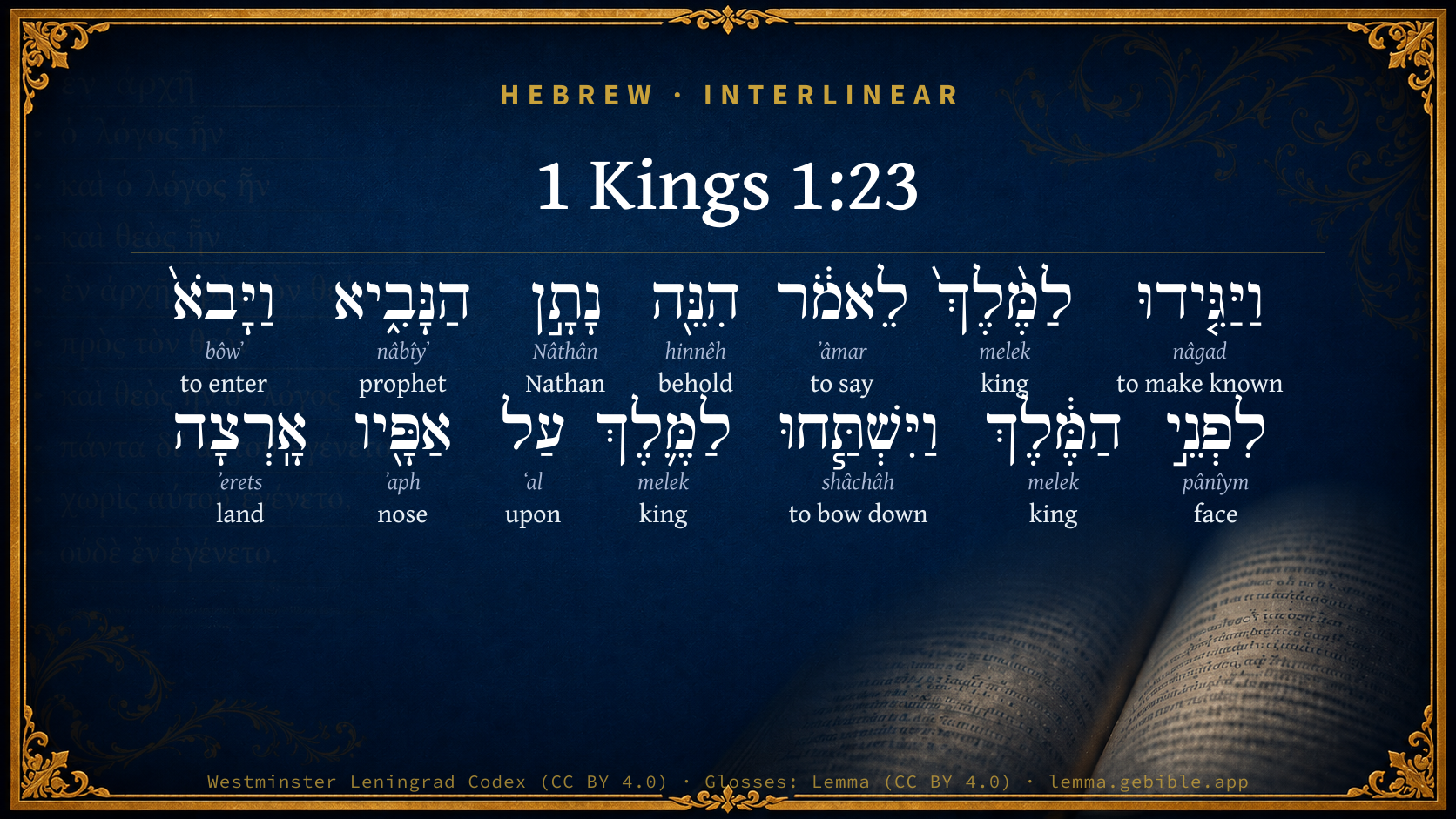
Hebrew (Westminster Leningrad Codex) 1 Kings 1:23 appears in the Hebrew Old Testament. The text above is from the Westminster Leningrad Codex. Each word links to its Strong’s number, a concise gloss, and parsing drawn from the Open Scriptures Hebrew Bible morphology. Click any word for its full Brown-Driver-Briggs (BDB) entry.
Download image
Cite this verse

1 Kings 1:23 (World English Bible). Public Domain. Lemma interlinear Bible study tool, https://lemma.gebible.app/v/1-kings/1/23.

Show BibTeX & RIS
BibTeX
RIS
English Translation
They told the king, saying, Behold, Nathan the prophet. When he was come in before the king, he bowed himself before the king with his face to the ground.
World English Bible · Public Domain
Download a study sheet

One document with this verse’s original text, its word-by-word gloss line, the meaning frame, cross-references with their text, attributed commentary, and full source and license credits — printable, and it pastes into notes with its structure intact.

This verse Autodidact and up

Study sheet (.html) Plain text (.txt)

A passage Seminary Student

Up to 50 verses in one chapter. A passage sheet keeps up to 6 commentary sources and 12 cross-references per verse, in the order this page ranks them, and says so on the sheet whenever that leaves anything out. Ask for a single verse and you get the Autodidact verse sheet above.

Everything on this page stays free to read, with no account — the sheet is a download of what is already on screen, not access to it.

Want to remove ads? Support Godless Engineer
Compare translations 3

The same verse in 3 English versions, stacked beneath the original-language interlinear above. Click any original word for its lexicon entry.

Each is an independent rendering of the whole verse — the interlinear is not word-aligned to these translations.

Highlighted words mark where these versions differ — a whole-verse word diff, not a word-by-word alignment.

  • World English Bible Public Domain
    They told the king, saying, Behold, Nathan the prophet. When he was come in before the king, he bowed himself before the king with his face to the ground.
  • King James Version Public Domain
    And they told the king, saying, Behold Nathan the prophet. And when he was come in before the king, he bowed himself before the king with his face to the ground.
  • unfoldingWord Literal Text CC BY-SA 4.0
    And they declared to the king, saying, “Behold, Nathan the prophet.” And he came to the face of the king, and he prostrated himself to the king with his nose to the ground.

unfoldingWord Literal Text — © unfoldingWord, licensed CC BY-SA 4.0. Word-aligned USFM3 via Door43 (git.door43.org/unfoldingWord/en_ult).

Versions to compare (up to 4)

3 of 4 selected

Show all 18 translations

Every available English version of this verse, each an independent rendering of the whole verse.

  • World English Bible Public Domain
    They told the king, saying, Behold, Nathan the prophet. When he was come in before the king, he bowed himself before the king with his face to the ground.
  • Berean Standard Bible Public Domain
    So the king was told, “Nathan the prophet is here.” And Nathan went in and bowed facedown before the king.
  • Majority Standard Bible Public Domain
    So the king was told, “Nathan the prophet is here.” And Nathan went in and bowed facedown before the king.
  • King James Version Public Domain
    And they told the king, saying, Behold Nathan the prophet. And when he was come in before the king, he bowed himself before the king with his face to the ground.
  • American Standard Version (1901) Public Domain
    And they told the king, saying, Behold, Nathan the prophet. And when he was come in before the king, he bowed himself before the king with his face to the ground.
  • Revised Version (1885) Public Domain
    And they told the king, saying, Behold, Nathan the prophet. And when he was come in before the king, he bowed himself before the king with his face to the ground.
  • Geneva Bible (1599) Public Domain
    And they tolde the King, saying, Beholde, Nathan the Prophet. And when he was come in to the King, hee made obeisance before the King vpon his face to the ground.
  • Douay-Rheims (1899) Public Domain
    And they told the king, saying: Nathan the prophet is here. And when he was come in before the king, and had worshipped, bowing down to the ground,
  • Young's Literal Translation Public Domain
    and they declare to the king, saying, `Lo, Nathan the prophet;' and he cometh in before the king, and boweth himself to the king, on his face to the earth.
  • Literal Standard Version CC BY-SA 4.0
    and they declare to the king, saying, “Behold, Nathan the prophet”; and he comes in before the king, and bows himself to the king, on his face to the earth.
  • Unlocked Literal Bible CC BY-SA 4.0
    The servants told the king, “Nathan the prophet is here.” When he came in before the king, he prostrated himself before the king with his face to the ground.
  • unfoldingWord Literal Text CC BY-SA 4.0
    And they declared to the king, saying, “Behold, Nathan the prophet.” And he came to the face of the king, and he prostrated himself to the king with his nose to the ground.
  • Darby Bible Public Domain
    And they told the king saying, Behold, Nathan the prophet. And when he was come in before the king, he bowed himself before the king with his face to the ground.
  • World Messianic Bible Public Domain
    They told the king, saying, “Behold, Nathan the prophet!” When he had come in before the king, he bowed himself before the king with his face to the ground.
  • Webster's Bible Public Domain
    And they told the king, saying, Behold, Nathan the prophet. And when he had come in before the king, he bowed himself before the king with his face to the ground.
  • Free Bible Version CC BY-SA 4.0
    The king was told, “Nathan the prophet is here.” Nathan went in to see the king. He bowed down with his face to the ground.
  • Bible in Basic English Public Domain
    And they said to the king, Here is Nathan the prophet. And when he came in before the king, he went down on his face on the earth.
  • JPS Tanakh (1917) Public Domain
    And they told the king, saying: 'Behold Nathan the prophet.' And when he was come in before the king, he bowed down before the king with his face to the ground.

Literal Standard Version (2020), Covenant Press — licensed CC BY-SA 4.0. Text via the HelloAO Bible API (eBible.org). Unlocked Literal Bible (unfoldingWord) — licensed CC BY-SA 4.0. Text via the HelloAO Bible API (eBible.org). unfoldingWord Literal Text — © unfoldingWord, licensed CC BY-SA 4.0. Word-aligned USFM3 via Door43 (git.door43.org/unfoldingWord/en_ult). Free Bible Version, Dr. Jonathan Gallagher — licensed CC BY-SA 4.0. Text via the HelloAO Bible API (eBible.org).

Word by word

More ways to search: Search by grammar → Find every occurrence → Compare this word →

Practice this passage: Drill this verse → Learn its vocabulary →

נָתָ֣ן
Nâthân
H5416
“Nathan”
Noun, Proper
Part of Speech
Noun
Type
Proper
Full BDB Definition

Origin: from H5414

TWOT: None

Nathan = "giver" - a son of David by Bathsheba - the eminent prophet in the time of David and Solomon - a man of Zobah, father of one of David's mighty warriors - father of Azariah who was over the officers of Solomon - son of Attai and father of Zabad of the tribe of Judah - brother of Joel of the tribe of Judah - one of the head men who returned from Babylon with Ezra - a man with a foreign wife in the time of Ezra - head of a family of Israel who shall mourn when they look on Him whom they pierced
  1. וַיַּגִּ֤ידוּ nâgad H5046 “and · to make known” Conjunction + Verb, Hiphil, Sequential Imperfect, 3rd Person, Masculine, Plural
  2. לַמֶּ֨לֶךְ֙ melek H4428 “to/for the · king” Preposition, Determined + Noun, Common, Masculine, Singular, Absolute
  3. לֵאמֹ֔ר ʼâmar H559 “to say” Preposition + Verb, Qal, Infinitive Construct
  4. הִנֵּ֖ה hinnêh H2009 “behold” Particle, Demonstrative
  5. הַנָּבִ֑יא nâbîyʼ H5030 “the · prophet” Particle, Definite Article + Noun, Common, Masculine, Singular, Absolute
  6. וַיָּבֹא֙ bôwʼ H935 “and · to enter” Conjunction + Verb, Qal, Sequential Imperfect, 3rd Person, Masculine, Singular
  7. לִפְנֵ֣י pânîym H6440 “to/for · face(s) of” Preposition + Noun, Common, Both, Plural, Construct
  8. הַמֶּ֔לֶךְ melek H4428 “the · king” Particle, Definite Article + Noun, Common, Masculine, Singular, Absolute
  9. וַיִּשְׁתַּ֧חוּ shâchâh H7812 “and · to bow down” Conjunction + Verb, Hithpael, Sequential Imperfect, 3rd Person, Masculine, Singular
  10. לַמֶּ֛לֶךְ melek H4428 “to/for the · king” Preposition, Determined + Noun, Common, Masculine, Singular, Absolute
  11. עַל ʻal H5921 “upon” Preposition
  12. אַפָּ֖יו ʼaph H639 “nostrils · his” Noun, Common, Masculine, Dual, Construct + Suffix, Personal, 3rd Person, Masculine, Singular
  13. אָֽרְצָה ʼerets H776 “land · toward” Noun, Common, Both, Singular, Absolute + Suffix, Demonstrative

About this verse

These counts appear in no published source. They are computed here, from the morphology-tagged text and Lemma’s own curated glosses. What Lemma adds →

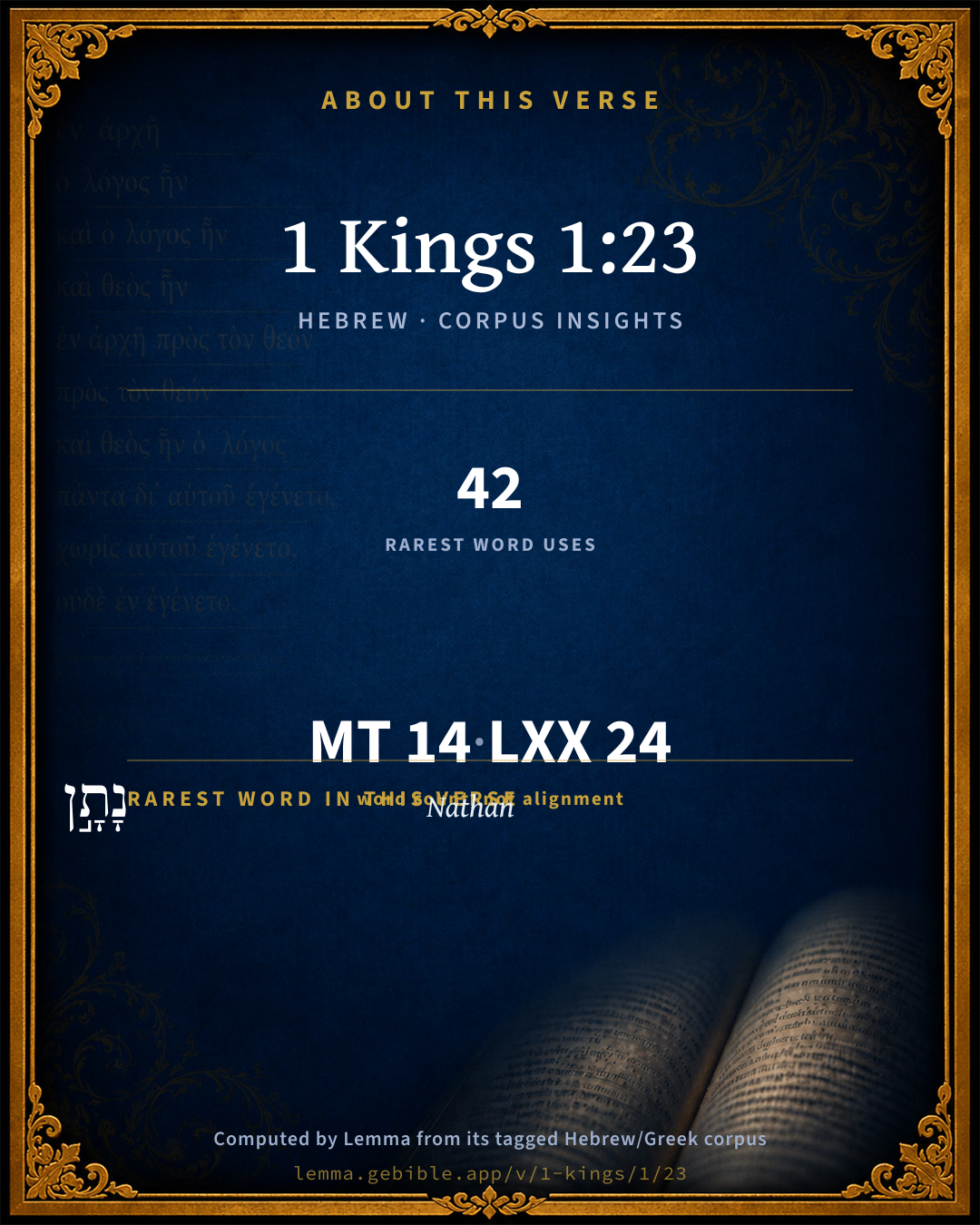
14
words
12
distinct lemmas
Historical
section

Shared distinctive vocabulary

נָתָ֣ן Nathan H5416 occurs in 39 verses of the Hebrew Bible. Also found in:

Grammatical profile

  • 4 verbs
  • 8 nouns
  • 1 preposition
  • 1 particle

Verb forms

  • וַיַּגִּ֤ידוּ Hiphil · Sequential Imperfect
  • לֵאמֹ֔ר Qal · Infinitive Construct
  • וַיָּבֹא֙ Qal · Sequential Imperfect
  • וַיִּשְׁתַּ֧חוּ Hithpael · Sequential Imperfect

Repetition

A word recurs within this verse — often emphatic in Hebrew:

  • לַמֶּ֨לֶךְ֙ king H4428 ×3

Hebrew & Septuagint length

In English translation the verse runs 29 words from the Hebrew and 26 from the Septuagint (LXX English) — closely comparable.

A rough comparison of the two English renderings, which tokenize alike — not a word-level alignment.

Word counts can differ between the Hebrew and the Greek without any difference in meaning — e.g. the Hebrew direct-object marker אֵת has no separate Greek word, and Greek often adds the article ὁ.

In the original languages it is 14 Hebrew tokens and 24 Greek tokens — but the two are counted differently (Hebrew bundles its prefixes and suffixes into one token; the Greek is in lemma form), so that isn’t a like-for-like length.

Cross-references

3

Topical passages linked to 1 Kings 1:23 in the Treasury of Scripture Knowledge — connected by theme and wording, ordered by reader-vote popularity; previews shown in the World English Bible.

  • 1 Kings 1:16 Bathsheba bowed, and did obeisance to the king. The king said, What would you?
  • Romans 13:7 Give therefore to everyone what you owe: taxes to whom taxes are due; customs to whom customs; respect to whom respect; honor to whom honor.
  • 1 Peter 2:17 Honor all men. Love the brotherhood. Fear God. Honor the king.

Cross-references courtesy of OpenBible.info (CC BY 4.0).

Hebrew and Greek witnesses Masoretic Hebrew ↔ Greek Septuagint

The same verse in the two great witnesses to the Old Testament, shown verse-for-verse.

These are two independent witnesses, not word-aligned to each other, and the Septuagint is shown in lemma (dictionary) form.

Hebrew 1 Kings 1:23 Masoretic · Westminster Leningrad Codex

וַיַּגִּ֤ידוּ לַמֶּ֨לֶךְ֙ לֵאמֹ֔ר הִנֵּ֖ה נָתָ֣ן הַנָּבִ֑יא וַיָּבֹא֙ לִפְנֵ֣י הַמֶּ֔לֶךְ וַיִּשְׁתַּ֧חוּ לַמֶּ֛לֶךְ עַל אַפָּ֖יו אָֽרְצָה

They told the king, saying, Behold, Nathan the prophet. When he was come in before the king, he bowed himself before the king with his face to the ground.

World English Bible · Public Domain

Greek LXX 1 Kings 1:23 Septuagint · lemma form

καί ἀναἀγγέλλω ὁ βασιλεύς ἰδού ναθαν ὁ προφήτης καί εἰςἔρχομαι κατά πρόσωπον ὁ βασιλεύς καί προςκυνέω ὁ βασιλεύς κατά πρόσωπον αὐτός ἐπί ὁ γῆ

Behold, Nathan the prophet is here: and he came in to the king's presence, and did obeisance to the king with his face to the ground.

LXX2012 (modern English Septuagint) · Public Domain

Hebrew: Westminster Leningrad Codex (CC BY 4.0). Greek: Septuagint (public domain); English from LXX2012 (modern English Septuagint) (Public Domain). How the Septuagint differs from the Hebrew →

Targum (Aramaic paraphrase)

1

The Targum is the ancient Jewish Aramaic paraphrase of the Hebrew Scriptures — an interpretive translation, not the Hebrew text itself. Onkelos (literal) and Pseudo-Jonathan (expansive) render the Torah, and Jonathan the Prophets. Coverage is partial: where no permissively-licensed English translation exists for a verse, only the Aramaic is shown. This is verse-level text, not a word-by-word alignment to the Hebrew.

  1. Targum Jonathan Prophets (Joshua–Malachi)
    וְחַוִיאוּ לְמַלְכָּא לְמֵימָר הָא נָתָן נְבִיָא וַאֲתָא קֳדָם מַלְכָּא וּסְגִיד לְמַלְכָּא עַל אַפּוֹהִי עַל אַרְעָא:

    (no public-domain English translation for this verse)

    Targum Jonathan — Aramaic: “Mikraot Gedolot” (public domain). English: “Sefaria Community Translation” (CC0 1.0 (public-domain dedication)); “London "Chaldee Paraphrase," 1871” (public domain). Text via Sefaria.

Commentary

Notes on 1 Kings 1:23 from classic Christian and Jewish commentators (each source and its license shown beneath its notes). The classic Christian expositions comment on the surrounding passage and are grouped to its opening verse, so a note may address several verses; the Jewish commentaries on the Tanakh (Rashi and others) are per-verse, so they appear only where the commentator wrote on this verse.

Lemma curates 59 commentaries, every one of them public domain or Creative Commons licensed, each selected and text-cleaned for this edition rather than reprinted as found. About our sources →

Trapp's Complete Commentary

John Trapp

1Ki 1:23 And they told the king, saying, Behold Nathan the prophet. And when he was come in before the king, he bowed himself before the king with his face to the ground.

Ver. 23. Behold Nathan the prophet.] Who was a privy counsellor to David, though he had so sharply reproved him. {2Sa 12:1-12}

He bowed himself before the king.] Note here the exemplary modesty and submission of so great a prophet. How far from this is the false prophet of Rome!

John Trapp, A Commentary or Exposition upon All the Books of the Old and New Testament (1647–1656) — public domain. Text from a community e-Sword module.

Geneva Bible (1599)

Geneva Bible translators

Acknowledging him to be the true and worthy King appointed of God, as the figure of his Christ.

Geneva Bible (1599) marginal notes — public domain. Text via Bolls.life.

John Gill's Exposition

And they told the king,.... Some that attended at the door, or were in the chamber:

saying, behold, Nathan the prophet; or he is in the room, which the king through his infirmities might not be sensible of:

and when he was come in before the king; nearer to him, and as to be properly in his presence:

he bowed himself before the king with his face to the ground; showing him the same reverence, though in bed, as if on his throne.

John Gill's Exposition of the Whole Bible (1746–1763) — public domain (CC PDM 1.0). Text via the HelloAO Bible API.

The Pulpit Commentary

And they told the king, saying, Behold Nathan the prophet we are scarcely justified in seeing in this "solemn announcement of his approach" an "indication of the consideration in which he was held" (Stanley). It is difficult to see how otherwise he could be announced. It is clear that he was constantly spoken of as "the prophet" (vers. 10, 22, 34, 38, etc. Cf. 2Sa_7:2 2Sa_12:25) And when he was come in before Hebrews and he came before three words instead of six the king, he bowed himself before the king with his face to the ground see on vers. 16, 20; and cf. ver. 31, where we have a similar expression. "In the Assyrian sculptures, ambassadors are represented with their faces actually touching the earth before the feet of the monarch" (Rawlinson). This profound reverence on the part of Nathan is the more remarkable, when we remember how he had once denounced David to his face. (1Sa_12:7) Then promptly, without hesitation said the king, The one saith Heb. this is saying," i.e., keeps saying This is my son that liveth, and thy son is the dead; and the other saith, Nay, but thy son is the dead and my son is the living.

The Pulpit Commentary (1880–1919), ed. H.D.M. Spence-Jones & Joseph S. Exell — public domain. Text from a community e-Sword module.

Lesson kit

Teaching starters — assembled from the data on this page, not authored interpretation. Every prompt links to the verse data it draws on. Edit before teaching.

1 Kings, in the Historical, opens this verse with 14 words (12 distinct Hebrew lemmas). Its most distinctive word is Nâthân (“Nathan”). A historical commentator’s framing appears above. Read the whole chapter for the surrounding context.

Discussion questions

  1. How does “Nathan” (Nâthân) shape what this verse is saying?
  2. How does 2 Samuel 5:14, which shares the word «Nathan», read alongside this verse?
  3. What does the repetition of “king” (3× in this one verse) do in this verse?
  4. These translations render this verse differently; the difference is in the English rendering, not the original. What questions does that raise?
  5. «וַיַּגִּ֤ידוּ» is a Hiphil Sequential Imperfect verb. How does that grammatical form shape the action described?
  6. Compare how Trapp's Complete Commentary and Geneva Bible (1599) read this verse. Where do they agree or differ?

Things to notice

Reading settings

Reading text

Shown beneath each verse's original-language words.

Old Testament
Old Testament edition

Read the OT as the Masoretic Hebrew (MT) or the Greek Septuagint (LXX).

English shown for the Greek Septuagint (in the Hebrew ↔ Greek comparison).

Comparing translations? Open the Compare panel on any verse page to stack up to four side by side.