Revelation 13:11

Greek (Tischendorf 8th ed.) Revelation 13:11 appears in the Greek New Testament. The text above is from the Tischendorf 8th edition. Each word links to its Strong’s number and a concise gloss. Click any word for its full Thayer’s Greek Lexicon entry.
Download image
Cite this verse

Revelation 13:11 (World English Bible). Public Domain. Lemma interlinear Bible study tool, https://lemma.gebible.app/v/revelation/13/11.

Show BibTeX & RIS
BibTeX
RIS
English Translation
I saw another beast coming up out of the earth. He had two horns like a lamb, and he spoke like a dragon.
World English Bible · Public Domain
Download a study sheet

One document with this verse’s original text, its word-by-word gloss line, the meaning frame, cross-references with their text, attributed commentary, and full source and license credits — printable, and it pastes into notes with its structure intact.

This verse Autodidact and up

Study sheet (.html) Plain text (.txt)

A passage Seminary Student

Up to 50 verses in one chapter. A passage sheet keeps up to 6 commentary sources and 12 cross-references per verse, in the order this page ranks them, and says so on the sheet whenever that leaves anything out. Ask for a single verse and you get the Autodidact verse sheet above.

Everything on this page stays free to read, with no account — the sheet is a download of what is already on screen, not access to it.

Want to remove ads? Support Godless Engineer
Compare translations 3

The same verse in 3 English versions, stacked beneath the original-language interlinear above. Click any original word for its lexicon entry.

Each is an independent rendering of the whole verse — the interlinear is not word-aligned to these translations.

Highlighted words mark where these versions differ — a whole-verse word diff, not a word-by-word alignment.

  • World English Bible Public Domain
    I saw another beast coming up out of the earth. He had two horns like a lamb, and he spoke like a dragon.
  • King James Version Public Domain
    And I beheld another beast coming up out of the earth; and he had two horns like a lamb, and he spake as a dragon.
  • unfoldingWord Literal Text CC BY-SA 4.0
    And I saw another beast coming up from the earth, and it had two horns like a lamb but it was speaking like a dragon.

unfoldingWord Literal Text — © unfoldingWord, licensed CC BY-SA 4.0. Word-aligned USFM3 via Door43 (git.door43.org/unfoldingWord/en_ult).

Versions to compare (up to 4)

3 of 4 selected

Show all 19 translations

Every available English version of this verse, each an independent rendering of the whole verse.

  • World English Bible Public Domain
    I saw another beast coming up out of the earth. He had two horns like a lamb, and he spoke like a dragon.
  • Berean Standard Bible Public Domain
    Then I saw another beast rising out of the earth. This beast had two horns like a lamb, but spoke like a dragon.
  • Majority Standard Bible Public Domain
    Then I saw another beast rising out of the earth. This beast had two horns like a lamb, but spoke like a dragon.
  • King James Version Public Domain
    And I beheld another beast coming up out of the earth; and he had two horns like a lamb, and he spake as a dragon.
  • American Standard Version (1901) Public Domain
    And I saw another beast coming up out of the earth; and he had two horns like unto lamb, and he spake as a dragon.
  • Revised Version (1885) Public Domain
    And I saw another beast coming up out of the earth; and he had two horns like unto a lamb, and he spake as a dragon.
  • Geneva Bible (1599) Public Domain
    And I beheld another beast comming vp out of the earth, which had two hornes like the Lambe, but he spake like the dragon.
  • Douay-Rheims (1899) Public Domain
    And I saw another beast coming up out of the earth, and he had two horns, like a lamb, and he spoke as a dragon.
  • Young's Literal Translation Public Domain
    And I saw another beast coming up out of the land, and it had two horns, like a lamb, and it was speaking as a dragon,
  • Literal Standard Version CC BY-SA 4.0
    And I saw another beast coming up out of the earth, and it had two horns like a lamb, and it was speaking as a dragon,
  • Unlocked Literal Bible CC BY-SA 4.0
    Then I saw another beast coming up out of the earth. It had two horns like a lamb, and it spoke like a dragon.
  • unfoldingWord Literal Text CC BY-SA 4.0
    And I saw another beast coming up from the earth, and it had two horns like a lamb but it was speaking like a dragon.
  • Darby Bible Public Domain
    And I saw another beast rising out of the earth; and it had two horns like to a lamb, and spake as a dragon;
  • World Messianic Bible Public Domain
    I saw another beast coming up out of the earth. He had two horns like a lamb and it spoke like a dragon.
  • Webster's Bible Public Domain
    And I beheld another beast coming up out of the earth, and he had two horns like a lamb, and he spoke as a dragon.
  • Free Bible Version CC BY-SA 4.0
    Then I saw another beast, rising up from the earth. He had two horns like a lamb, but he spoke like a dragon.
  • Bible in Basic English Public Domain
    And I saw another beast coming up out of the earth; and he had two horns like a lamb, and his voice was like that of a dragon.
  • Text-Critical English NT CC BY 4.0
    Then I saw another beast coming up out of the earth. He had horns like a lamb, but he spoke like a dragon.
  • Tyndale New Testament (1534) Public Domain
    And I behelde another best commynge vp oute of the erth and he had two hornes like a lambe and he spake as dyd the dragon.

Literal Standard Version (2020), Covenant Press — licensed CC BY-SA 4.0. Text via the HelloAO Bible API (eBible.org). Unlocked Literal Bible (unfoldingWord) — licensed CC BY-SA 4.0. Text via the HelloAO Bible API (eBible.org). unfoldingWord Literal Text — © unfoldingWord, licensed CC BY-SA 4.0. Word-aligned USFM3 via Door43 (git.door43.org/unfoldingWord/en_ult). Free Bible Version, Dr. Jonathan Gallagher — licensed CC BY-SA 4.0. Text via the HelloAO Bible API (eBible.org).

Word by word

More ways to search: Search by grammar → Find every occurrence → Compare this word →

Practice this passage: Drill this verse → Learn its vocabulary →

κέρατα
kéras
G2768
“horn”
Noun, Accusative, Plural, Neuter
Part of Speech
Noun
Case
Accusative
Number
Plural
Gender
Neuter
Full Thayer's Definition

Origin: from a primary kar (the hair of the head)

TDNT: 14:09,4

1. a horn a. of animals b. since animals (esp. bulls) defend themselves with their horns, the horn with the Hebrews (and other nations) is a symbol of strength and courage, and used as such in a variety of phrases 1. a mighty and valiant helper, the author of deliverance, of the Messiah c. a projecting extremity in a shape like a horn, a point, apex: as of an altar
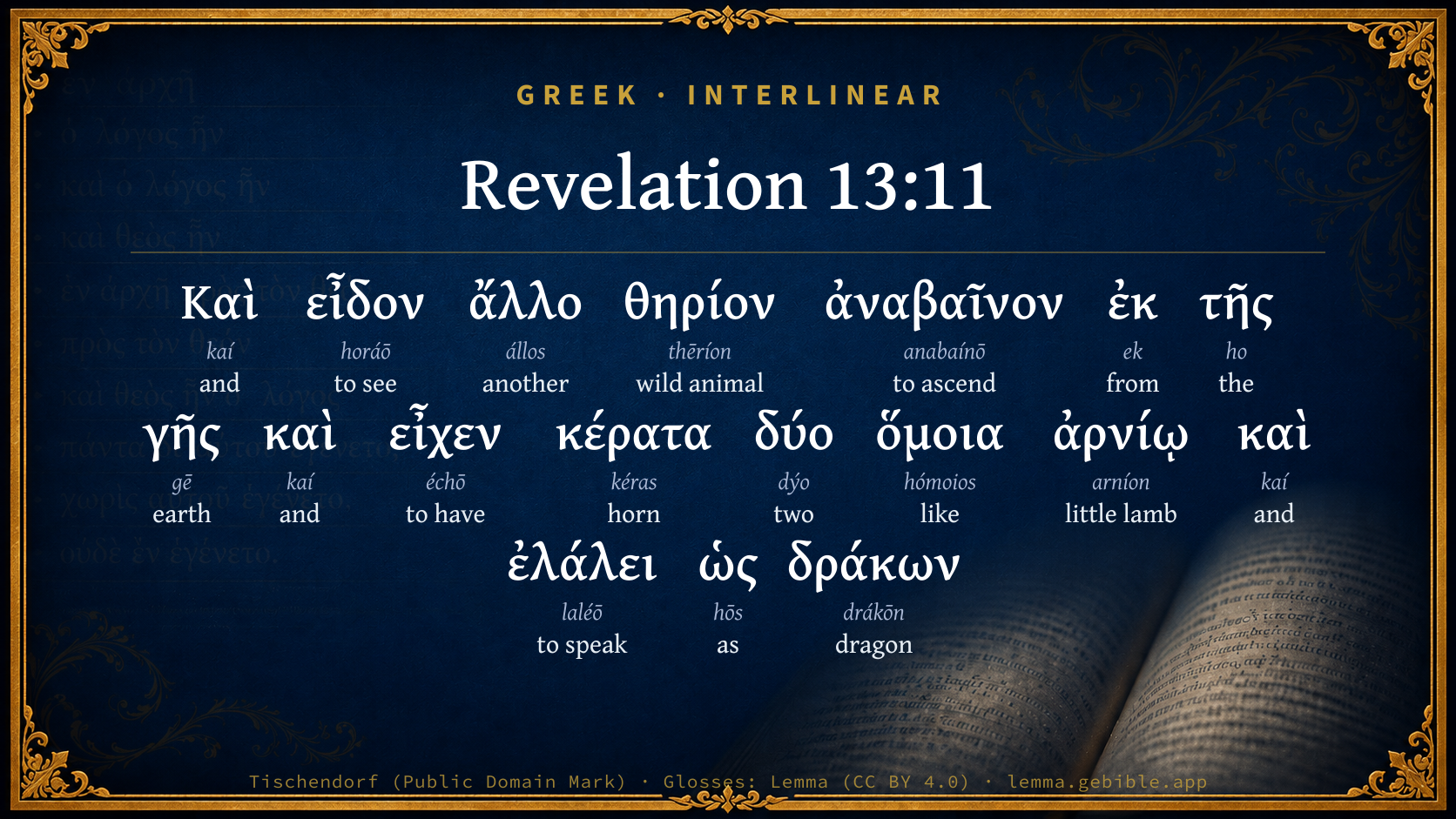
  1. Καὶ kaí G2532 “and” Conjunction
  2. εἶδον horáō G3708 “to see” Verb, Aorist, Active, Indicative, 1st person, Singular
  3. ἄλλο állos G243 “another” Adjective, Accusative, Singular, Neuter
  4. θηρίον thēríon G2342 “wild animal” Noun, Accusative, Singular, Neuter
  5. ἀναβαῖνον anabaínō G305 “to ascend” Verb, Present, Active, Participle, Accusative, Singular, Neuter
  6. ἐκ ek G1537 “from” Preposition
  7. τῆς ho G3588 “the” Article, Genitive, Singular, Feminine
  8. γῆς gē G1093 “earth” Noun, Genitive, Singular, Feminine
  9. καὶ kaí G2532 “and” Conjunction
  10. εἶχεν échō G2192 “to have” Verb, Imperfect, Active, Indicative, 3rd person, Singular
  11. δύο dýo G1417 “two” Adjective, Numeral (indeclinable)
  12. ὅμοια hómoios G3664 “like” Adjective, Accusative, Plural, Neuter
  13. ἀρνίῳ arníon G721 “little lamb” Noun, Dative, Singular, Neuter
  14. καὶ kaí G2532 “and” Conjunction
  15. ἐλάλει laléō G2980 “to speak” Verb, Imperfect, Active, Indicative, 3rd person, Singular
  16. ὡς hōs G5613 “as” Adverb
  17. δράκων drákōn G1404 “dragon” Noun, Nominative, Singular, Masculine

About this verse

These counts appear in no published source. They are computed here, from the morphology-tagged text and Lemma’s own curated glosses. What Lemma adds →

18
words
16
distinct lemmas
Revelation
section

Notable vocabulary

The rarest word here is κέρατα horn G2768 — appearing just 11 times in the whole Greek New Testament.

Shared distinctive vocabulary

κέρατα horn G2768 occurs in 10 verses of the Greek New Testament. Also found in:

Repetition

A word recurs within this verse:

Cross-references

13

Topical passages linked to Revelation 13:11 in the Treasury of Scripture Knowledge — connected by theme and wording, ordered by reader-vote popularity; previews shown in the World English Bible.

  • Daniel 7:8 I considered the horns, and, behold, there came up among them another horn, a little one, before which three of the first horns were plucked up by the roots: and, behold, in this horn were eyes like the eyes of a man, and a mouth speaking great things.
  • 2 Corinthians 11:13–15 For such men are false apostles, deceitful workers, masquerading as Christ's apostles.
  • Matthew 7:15 "Beware of false prophets, who come to you in sheep's clothing, but inwardly are ravening wolves.
  • Revelation 17:6 I saw the woman drunken with the blood of the saints, and with the blood of the martyrs of Jesus. When I saw her, I wondered with great amazement.
  • Daniel 7:24–25 As for the ten horns, out of this kingdom shall ten kings arise: and another shall arise after them; and he shall be diverse from the former, and he shall put down three kings.
  • Romans 16:18 For those who are such don't serve our Lord, Jesus Christ, but their own belly; and by their smooth and flattering speech, they deceive the hearts of the innocent.
  • Revelation 11:7 When they have finished their testimony, the beast that comes up out of the abyss will make war with them, and overcome them, and kill them.
  • Revelation 12:3–4 Another sign was seen in heaven. Behold, a great red dragon, having seven heads and ten horns, and on his heads seven crowns.
  • Revelation 13:17 and that no one would be able to buy or to sell, unless he has that mark, the name of the beast or the number of his name.
  • Revelation 16:13 I saw coming out of the mouth of the dragon, and out of the mouth of the beast, and out of the mouth of the false prophet, three unclean spirits, something like frogs;
  • 2 Thessalonians 2:4 he who opposes and exalts himself against all that is called God or that is worshiped; so that he sits as God in the temple of God, setting himself up as God.
  • Revelation 12:17–13:1 The dragon grew angry with the woman, and went away to make war with the rest of her seed, who keep God's commandments and hold Jesus' testimony.
  • Revelation 17:8 The beast that you saw was, and is not; and is about to come up out of the abyss and to go into destruction. Those who dwell on the earth and whose names have not been written in the book of life from the foundation of the world will marvel when they see that the beast was, and is not, and shall be present.

Cross-references courtesy of OpenBible.info (CC BY 4.0).

Commentary

Notes on Revelation 13:11 from classic Christian and Jewish commentators (each source and its license shown beneath its notes). The classic Christian expositions comment on the surrounding passage and are grouped to its opening verse, so a note may address several verses; the Jewish commentaries on the Tanakh (Rashi and others) are per-verse, so they appear only where the commentator wrote on this verse.

Lemma curates 59 commentaries, every one of them public domain or Creative Commons licensed, each selected and text-cleaned for this edition rather than reprinted as found. About our sources →

Jamieson, Fausset & Brown

Robert Jamieson, A. R. Fausset & David Brown

another beast--"the false prophet."

out of the earth--out of society civilized, consolidated, and ordered, but still, with all its culture, of earth earthy: as distinguished from "the sea," the troubled agitations of various peoples out of which the world power and its several kingdoms have emerged. "The sacerdotal persecuting power, pagan and Christian; the pagan priesthood making an image of the emperors which they compelled Christians to worship, and working wonders by magic and omens; the Romish priesthood, the inheritors of pagan rites, images, and superstitions, lamb-like in Christian professions, dragon-like in word and act" [ALFORD, and so the Spanish Jesuit, LACUNZA, writing under the name BEN EZRA]. As the first beast was like the Lamb in being, as it were, wounded to death, so the second is like the Lamb in having two lamb-like horns (its essential difference from the Lamb is marked by its having TWO, but the Lamb SEVEN horns, Rev 5:6). The former paganism of the world power, seeming to be wounded to death by Christianity, revives. In its second beast-form it is Christianized heathendom ministering to the former, and having earthly culture and learning to recommend it. The second beast's, or false prophet's rise, coincides in time with the healing of the beast's deadly wound and its revival (Rev 13:12-14). Its manifold character is marked by the Lord (Mat 24:11, Mat 24:24), "Many false prophets shall rise," where He is speaking of the last days. As the former beast corresponds to the first four beasts of Daniel, so the second beast, or the false prophet, to the little horn starting up among the ten horns of the fourth beast. This Antichristian horn has not only the mouth of blasphemy (Rev 13:5), but also "the eyes of man" (Dan 7:8): the former is also in the first beast (Rev 13:1, Rev 13:5), but the latter not so. "The eyes of man" symbolize cunning and intellectual culture, the very characteristic of "the false prophet" (Rev 13:13-15; Rev 16:14). The first beast is physical and political; the second a spiritual power, the power of knowledge, ideas (the favorite term in the French school of politics), and scientific cultivation. Both alike are beasts, from below, not from above; faithful allies, worldly Antichristian wisdom standing in the service of the worldly Antichristian power: the dragon is both lion and serpent: might and cunning are his armory. The dragon gives his external power to the first beast (Rev 13:2), his spirit to the second, so that it speaks as a dragon (Rev 13:11). The second, arising out of the earth, is in Rev 11:7; Rev 17:8, said to ascend out of the bottomless pit: its very culture and world wisdom only intensify its infernal character, the pretense to superior knowledge and rationalistic philosophy (as in the primeval temptation, Gen 3:5, Gen 3:7, "their EYES [as here] were opened") veiling the deification of nature, self, and man. Hence spring Idealism, Materialism, Deism, Pantheism, Atheism. Antichrist shall be the culmination. The Papacy's claim to the double power, secular and spiritual, is a sample and type of the twofold beast, that out of the sea, and that out of the earth, or bottomless pit. Antichrist will be the climax, and final form. PRIMASIUS OF ADRUMENTUM, in the sixth century, says, "He feigns to be a lamb that he may assail the Lamb--the body of Christ."

Jamieson, Fausset & Brown — Commentary Critical and Explanatory on the Whole Bible (1871) — public domain (CC PDM 1.0). Text via the HelloAO Bible API.

Ellicott's Commentary for English Readers

THE APPEARANCE OF THE SECOND WILD BEAST.

For the understanding of this portion of the vision we must notice the contrasts and resemblances between this and the former wild beast. They are both wild beasts: they both have horns: they both have a dragon-like inspiration (Rev_13:11): they both tyrannise over men; but, on the other hand, the second beast is less monstrous in appearance: we read only of two horns, and we hear nothing of seven heads. He somewhat resembles a lamb; he rises from the earth, and not from the sea; his power lies in deception (Rev_13:13-14) as well as violence; e seems to possess more supernatural power: yet the whole of his work is directed to magnifying the first beast (Rev_13:12). Do not these features lead to the conclusion that the principles which the second wild beast supports are the same as those on which the former wild beast acted, but that he supports them with more subtlety, intelligence, and culture? But for all the deception he employs, his work, when stripped of its specious drapery and seen in its naked ugliness, is to promote the honour of the first wild beast. Because of this seductiveness, and of his efforts to support his mission with higher sanctions (Rev_13:13), he is called in later chapters (Rev_16:13; Rev_19:20; Rev_20:10) the False Prophet; the force and appropriateness of this designation becomes more apparent when we notice that the features which are assumed bear a deceptive resemblance to those of a lamb. The advancing intelligence of the world, its increase in knowledge and wisdom, the wider diffusion of culture and thought, produce a change in the general fashion of life, but the spirit which animates. society is unchanged. The second wild beast is that change which is a change of mode, but not of spirit—a change of manners, but not of heart; there is more refinement, more civilisation, more mind, but it is still the world-power which is worshipped; it is the self-seeking adoration of pleasures, honours, occupations, influences which spring from earth and end in earth—the pursuit of powers which are worldly. Some see in this second wild beast the Pagan priesthood aiding the imperial power, the embodiment of the first wild beast; others-see in it the Papal sacerdotal power, the heir of Pagan rites; others, again, would combine the two, and view this second wild beast as the sacerdotal persecuting power, Pagan and Christian. I believe that, though there is truth in these views, they are too narrow. It is true that priesthoods—Pagan and Christian—have often devoted their influence to the upholding of the great world-power; it is true that men called to be Christian teachers forgot their function, and used their knowledge and power to bolster up the power of the beast and to make men worship the world, as though there were nothing higher for men to worship than this world could afford; it is true that they used, in later days, their powers to aggrandize the Church rather than to reform the world and regenerate men: in so far as they did this they acted like the second wild beast; but the stretch of the vision embraces more than these. All who use their knowledge, their culture, their wisdom, to teach men that there is nothing worthy of worship save what they can see, and touch, and taste, are acting the part of the second wild beast; and be they apostles of science, or apostles of culture, or apostles of logical immorality, or apostles of what is called materialism, if their teaching leads men to limit their worship to the visible and the tangible, they are making men worship the beast who is the adversary of the servants of the Lamb.

(11) And I beheld . . . Better, And I saw another wild beast rising out of the earth. Both wild beasts rise from beneath. The sea, out of which the first rises, represents the tumultuous impulses and passions of mankind; the earth, the more fixed element of human, thought and wisdom, or society consolidated and disciplined by intelligence and culture: the wisdom, however, which guides this wild beast is not divine wisdom, but that wisdom which a sacred writer described as earthly, sensual, devilish (Jas_3:17).

He had two horns like (those of) a lamb.—There is an appearance of gentleness about him, but he spake as a dragon; the voice betrayeth him. He that is of the earth is earthly, and speaketh of the earth. The spirit of the adversary is in him (Joh_3:31; Joh_8:44).

A Bible Commentary for English Readers, edited by Charles John Ellicott (1878–1897) — public domain. Text from a community e-Sword module.

The Cambridge Bible for Schools and Colleges

gen. ed. J. J. S. Perowne

The Beast from the Land, Rev_13:11-16

11. another beast] Afterwards called the False Prophet, Rev_16:13, Rev_19:20, Rev_20:10. Some think that it is he, rather than the first Beast, who is to be identified with St Paul’s “Man of Sin,” the personal Antichrist—the first Beast being the antichristian Empire. But in Rev_17:11 sqq. it seems plain that the seven-headed Beast, who is primarily a polity, at length becomes embodied in a person.

two horns] Perhaps two, only because that is the natural number for a lamb—the only significance of the number being, that they are not seven or ten.

like a lamb … as a dragon] No doubt the obvious view is right, that he looks like Christ and is like Satan. Alford well compares St Mat_7:15—though the resemblance is in the sense, not the language or even the image, so that perhaps there is no conscious reference.

The Cambridge Bible for Schools and Colleges (gen. ed. J. J. S. Perowne; Cambridge University Press, 1878–1918) — public domain. Text from a community e-Sword module.

The Biblical Illustrator

Joseph S. Exell

Rev_13:11-12

Another beast coming up out of the earth.

The second beast

The antichrist, though an individual, is not alone. He not only has the ten sovereignties working into his hand with all their power and strength, but he has a more intimate and more potent companion, hardly less remarkable than himself, duplicating his power, and without whom he could not be what he is. This second beast has two horns like a lamb. Horns are the symbols of power; but these horns have no diadems, and are like the horns of a gentle domestic animal. Political sovereignty, war, conquest, and the strength of military rule are therefore out of the question here. This beast is a spiritual teacher, and not a king or warrior. His power has a certain softness and domesticity about it, which is sharply distinguished from the great, regal horns of the first beast, although in reality of the same wild beast order, and belonging to the same dragon brood. What, then, are we to understand by these two lamblike horns or the twofold power of this beast? Taking the whole history of all religions, true and false, from the beginning until now, and searching for the elements of their hold on mens minds, their power, it will be found to reside in two things, which, in the absence of better terms, we may call naturalism and supernaturalism, that is, the presence of revelations, or what are accepted as revelations, from the superior powers, and held to be Divine and binding; or conclusions of natural conscience and reason, deemed sacredly obligatory because believed to be good and true. It is difficult to conceive on what other foundation a religion can rest; and analysis will show that on one or the other of these, or on both combined, all religions do rest, and must rest. Here is the seat of their strength, their power, whether true or false, the horns by which they push their way to dominion over the hearts and lives of men. They are just two, and no more. As a religionist, therefore, this beast-prophet could have but two horns. But he has two horns, and hence both the two only powers in a religion; therefore he is at once a naturalist and a supernaturalist--a scientist and a spiritualist--a rationalist, yet asserting power above ordinary nature and in command of nature. In other words, he claims to be the bearer of the sum total of the universal wisdom, in which all reason and all revelation are fused into one great system, claimed to be the ultimatum of all truth, the sublime and absolute universeology. And professing to have everything natural and supernatural thus solved and crystallised as the one eternal and perfect wisdom, he must necessarily present himself as the one absolute apostle and teacher of all that ought to command the thought, faith, and obedience of man. The same helps to a right idea of the further particular concerning this beast, to wit, that, though having but the two horns like a lamb, he yet speaks like a dragon. He is lamb-like in that he proposes to occupy only the mild, domestic, and inoffensive position of spiritual adviser. What more gentle and innocent than the counselling of people how to live and act for the securement of their happiness! But the words are like the dragon, in that such professions and claims are in fact the assumption of absolute dominion over the minds, souls, consciences, and hearts of men to bind them irrevocably, and to compel them to think and act only as he who makes them shall dictate and prescribe. Only to the eternal God belongs such a power; and when claimed by a creature is, indeed, the speech of the devil, the spirit of hell usurping the place and prerogatives of the Holy Ghost. Hence, also, in so far as this beast is able to maintain and enforce these prophetic claims, he exerciseth all the authority of the first beast. There is no more complete or exalted dominion under the sun than such a sway over the intellect and will of universal humanity. The first beast, in all his imperial power, has no greater authority than the common acknowledgment of such claims would give. When this is exercised all the authority of the first beast is exercised. But the first beast is quite willing that his hellish consociate should assert and press these claims; for the two are but different persons in the same infernal trinity, the second witnessing to the first as the Spirit witnesseth to the Son. And a most efficient minister does this false prophet prove to be. Eight times it is written of him that he causeth. First, we have the statement that he causeth the earth and those that dwell in it to worship the first beast, whose stroke of death was healed. They are induced to accept the beast as the deity, and to worship him as God. It seems like a fable. But, with all the weird strangeness of the record, the literal realisation of it is neither impossible nor improbable. There is nothing in it to which depraved human nature is not competent, and even predisposed and prone. The King of Parthia, kneeling before Nero, said to him, You are my god, and I am come to adore you as I adore the sun. My destiny is to be determined by your supreme will, to which Nero replied, I make you King of Armenia, that the whole universe may know it belongs to me to give or to take away crowns. It may be said that these were ancient, pagan, and benighted times, and that such abominations can never again be palmed upon mankind. But they were the times which produced our classics. The same has also occurred in later days with far less reason or apology, and among those who claimed to be the most advanced and enlightened of mortals. How was it in the comparatively recent period of the French Revolution? How was it with those world-renowned savants, whose boast was to dethrone the King of heaven as well as the monarchs of the earth? Did they not sing halleluias to the busts of Marat and Lepelletier, not only in the streets of Paris and Brest, but in many of the churches all over France? How came it that Robespierre was named and celebrated as a divinity, a superhuman being, The New Messiah! Can we blot out what Alison and Lacretelle and Thiers have written, that Marat was universally deified, that the churches received his statues as objects of sacred regard, and that a new worship was everywhere set up in their honour? Is it to be ignored how the foremost men of the nation, in state ceremony, conveyed a woman in grand procession to the Cathedral of Notre Dame, unveiled and kissed her before the high altar as the Goddess of Reason, and exhorted the multitude to cease trembling before the powerless thunders of the God of their fears, and sacrifice only to such as this? (J. A. Seiss, D. D.)

He spake as a dragon.--

Speaking as a dragon

The words remind us of the description given by our Lord of those false teachers who come in sheeps clothing, but inwardly are ravening wolves. (W. Milligan, D. D.)

His speech is as a dragon

Not as the former beast-the mouth of a lion, and speaking great things--but rather with subtlety and feigned persuasion, as the old serpent in paradise. For he would not be like a lamb, says Tichonius, if he spake openly; he feigns Christianity. (Isaac Williams, B.D.)

The Biblical Illustrator, edited by Joseph S. Exell (c. 1880s–1900s) — public domain. Text from a community e-Sword module.

Joseph Benson's Commentary

Rev 13:11-12. And I beheld another beast, &c. — From the description of the ten-horned beast, or Roman state in general, the prophet passeth to that of the two-horned beast, or Roman Church in particular. The beast with ten crowned horns is the Roman empire, as divided into ten kingdoms; the beast with two horns like a lamb is the Roman hierarchy, or body of the clergy, regular and secular. This beast is otherwise called the false prophet; than which there cannot be a stronger or plainer argument to prove that false doctors or teachers were particularly designed. For the false prophet, no more than the beast, is a single man, but a body or succession of men, propagating false doctrines, and teaching lies for sacred truths. As the first beast rose up out of the sea, that is, out of the wars and tumults of the world, so this beast groweth up out of the earth — Like plants, silently and without noise; and the greatest prelates have often been raised from monks, and men of the lowest birth. He had two horns like a lamb — He had, both regular and secular, the appearance of a lamb; he derived his powers from the lamb, and pretended to be like a lamb, all meekness and mildness; but he spake as a dragon — He had a voice of terror, like Roman emperors, in usurping divine titles, in commanding idolatry, and in persecuting and slaying the true worshippers of God and faithful servants of Jesus Christ. He is an ecclesiastical person, but intermixeth himself much in civil affairs. He is the prime minister, adviser, and mover of the first beast, or the beast before mentioned. He exerciseth all the power of the first beast before him — He holdeth imperium in imperio, an empire within an empire; claimeth a temporal authority as well as a spiritual, and enforceth his canons and decrees with the sword of the civil magistrate. As the first beast concurs to maintain his authority, so he in return confirms and maintains the sovereignty and dominion of the first beast over his subjects; and causeth the earth, and them who dwell therein, to worship the first beast, whose deadly wound was healed — He supports tyranny, as he is by tyranny supported. He enslaves the consciences, as the first beast subjugates the bodies of men. This ecclesiastical power, as Whiston observes, is the common centre and cement which unites all the distinct kingdoms of the Roman empire; and, by joining with them, procures them a blind obedience from their subjects: and so he is the occasion of the preservation of the old Roman empire in some kind of unity, and name, and strength, which otherwise would have been quite dissolved by the inundations and wars succeeding the settlement of the barbarous nations in that empire. “Here,” says Mr. Faber, “we have a plain prediction of some spiritual power, which should arrogate to itself universal or catholic authority in religious matters; which should coexist, upon the most friendly terms, with the ten-horned temporal empire, instigating it to persecute, during the space of forty-two prophetic months, all such as should dare to dispute its usurped domination; and which, in short, should solve the symbolical problem of two contemporary beasts, by exhibiting to the world the singular spectacle of a complete empire within an empire. Where we are to look for this power, since the great Roman beast was divided into ten horns, let the impartial voice of history determine. Daniel, who fully delineates the character of the little horn, is silent respecting the two-horned beast; and John, who as fully delineates the character of the two-horned beast, is entirely silent respecting the little horn. The little horn and the two-horned beast act precisely in the same capacity; each exercising the power of the first beast before him, and each perishing in one common destruction with him.” — Vol. 2. pp. 291-293.

Joseph Benson's Commentary on the Old and New Testaments (1811–1818) — public domain. Text from a community e-Sword module.

Burkitt's Expository Notes on the New Testament

William Burkitt

Here St. John enters upon the description of a second beast, very different from the former, yet not succeeding the former, but appearing during his continuance; and this beast (whoever he is) we find sundry ways here described, namely,

1. By his original he ascended out of the earth, Rev 13:11. which denotes his rise from a small beginning to a mighty height, as those things which from small seeds grow out of the earth to be tall trees. Thus has one arisen from being Episcopus urbis, to be Episcopus orbis.

2. He is said to have two horns, whereas the former beast had ten, Rev 13:1. which signifies ten kingdoms, into which the Roman empire, after its dissolution, should be divided. Accordingly, by the two horns here, in all reason may be understood two of those kingdoms of which this beast (whoever he be) shall be possessed.

3. He is said to look like a lamb, but to speak like a dragon; that is, to pretend to great meekness, and make a show of much lenity and mildness in his proceedings, but should really be very cruel: pretending to do all without violence, but doing indeed all by force, assisted by his armed dragons, and booted apostles, with javelins in their hands.

4. It is affirmed, Rev 13:12 that he shall arise during the continuance of the first beast, and engage in his cause assuming to himself as great, or a greater, power than any emperors did before him, causing the earth, that is, all earthly-minded men who are subject to him, to worship the first beast, that is, to yield as great reverence nad obedience to his decrees for establishing idolatry, as ever the people did under the Pagan emperors.

5. He is remarkable for working wonders, and particularly for causing fire to come down from heaven in the sight of men; that is, he seemeth to the deluded multitude to do as great miracles as Elias did, who brought down fire from heaven to confirm the religion he professed: in like manner the beast here works wonders seemingly great, lying wonders, false miracles, such as false prophets may work, and have wrought for confirming their false doctrines: accordingly we find this beast here called the false prophet elsewhere, Rev 16:8-9. He requires the inhabitants of the earth to make an image to the beast, that is, he persuades them, now professing Christianity, to introduce and bring in such a kind of idolatry, that the old heathenish idolatry may seem to revive again.

Here note, That the idolatry of the Church of Rome is a living image of the old heathenish idolatry; this is but the image of that, that was performed to heathen deities, this to departed saints. Popery, says the learned Dr. More, is such a Christianity, as in all points answers the model of the old execrable heathenism, with which the Gentiles were enamoured then, as are the Papists now: thus the wounded and dead image of Pagan idolatry revived, and lives again in Papal idolatry. Good God! that any persons professing to know and worship the blessed Jesus should thus dishonour him, by intermixing the old heathenish superstitions, or something worse, with his holy institutions.

William Burkitt's Expository Notes on the New Testament (1700–1703) — public domain. Text from a community e-Sword module.

Tyndale Open Study Notes

Tyndale Open Resources

13:11-18 another beast: This second beast, the third member of the evil trinity (see study note on 12:18–13:18), is later called the “false prophet” (16:13). As a high priest of false religion, he leads the world into worshiping the first beast and the dragon (see also 16:13-14).

13:11 The beast is portrayed as a lamb, the same symbol used to represent Christ (see 5:6-13; 7:9-17; 14:1-4), but this lamb spoke like a dragon. The image is of a fraudulent messiah. • The two horns might stand for two emperors, perhaps Nero and Domitian.

Tyndale Open Study Notes — © Tyndale Open Resources, licensed CC BY-SA 4.0. Text via the HelloAO Bible API.

Bengel's Gnomon

Johann Albrecht Bengel

Rev 13:11. Καὶ, and) The description of the two beasts most strictly coheres, as does the description of more joyful circumstances in the following chapter.—ἄλλο θηρίον, another beast) This is afterwards more frequently called the false prophet: and here his very action is described, as that of the false prophet. That bewitched power and wisdom, which independent of the Word of GOD, without a Redeemer and a Comforter, is reverenced by many individually and collectively, having no dread of Deism, Socinianism, and Pelagianism, abusing the dogma respecting the internal Word, which would without scruple reconcile Christianity with Mahometanism itself, and moreover the perverse interpretation of the Apocalypse itself, and of the whole of the Sacred Scripture, will be favourable to the beast. D. Lange, in Epicr. p. 391, etc., entertains a different opinion from me respecting this beast also. I will here also notice some points cursorily. Now I nowhere say, that from the times of Hildebrand the second beast was subservient to the former one (on account of the common advantage of both, but rather on account of his own, as is the practice of the wicked). Nor do I say, that the 42 months of the former beast are common to the two; but I imitate the expression of the text, which is explained in its proper place. The former beast has an origin much more ancient than the other; but when this also has arisen, it exists together with the former one. Gregory VII. has long ceased to live; but that his cause has not yet expired, his Legenda testify. I never thought, that his image flourished at the same time with the former beast. I had treated incidentally of the destruction of the beast and the false prophet at p. 733, but more plainly, in its place, p. 935. If the venerable man had perceived the idea of the beast, presented by the Apocalypse and held by me, he would not have blended with one another so many important points. We have replied above to the argument, which he subjoins at p. 393.—ἐκ τῆς γῆς, out of the earth) The earth [land], as opposed to the sea, comp. Rev 13:1, is Asia; which contains Palestine, Persia, etc.

Bengel's Gnomon of the New Testament — English translation (T&T Clark, Edinburgh, 1860) — public domain. Text from a community e-Sword module.

Meyer's Critical & Exegetical Commentary

Heinrich August Wilhelm Meyer

Rev_13:11-17. The second beast, which John sees rising from the earth, is described as an accomplice of the first beast; by deceitful speeches and miraculous signs, he leads astray the inhabitants on earth to the worship of the beast from the sea.

That this second θηρίονwhich appears in this form from the beginning as essentially related to the first beast[3338]is a personification of false prophecy, is correctly recognized already by Irenaeus.[3339] John himself gives this interpretation, Rev_16:13, Rev_19:20, Rev_20:10. But from the connection with Rev_13:1-10, the more restricted determination results, that the subject treated is that form of heathen-Roman prophecy which was just as magical as mantic; and this peculiarity, with all its auguries, interpretations of omens, etc., formed an important support of the Roman secular power.[3340] The various references to papal Rome[3341] are precluded by the explanation of Rev_13:1 sqq. [Note LXXIII., p. 387.]

[3338] See on Rev_13:1.

[3339] L. V., c. 28, 2, ed. Stieren, I., p. 794.

[3340] Cf. Victorin., Andr., Hammond, Grot., Eichh., Ewald, De Wette; also Hengstenb.

[3341] Coccej., Calov., Vitr., etc.

ἐκ τῆς γῆς. Incorrectly, Grot.: private origin. Ewalds explanation that the continent of Asia[3342] is to be regarded the theatre for those who had prophesied the return of Neroeven apart from the difficult limitation of the idea τ. γῆςhas no support in Rev_13:3.[3343] The explanation also of Hengstenb., that by ἐκ τ. γῆς in contrast with ἐκ τῶν ἄνω, or ἐκ τοῦ οὐρανοῦ,[3344] the earthly, worldly nature[3345] is indicated, does not lie at all in the context. The ἘΚ Τῆς Γῆς[3346] has respect, on the contrary, to the idea of the κατοικοῦντες ἐπὶ τὴς γῆς. The beast rises from the earth, because he is to work upon the whole earth, and all the inhabitants of the earth[3347]

κέρατα δύο ὅμοια ἀρνίῳ. The compendious comparison[3348] is not acknowledged by Ebrard when he commends the explanation as probable: The beast has two horns, like (ὅμοιον instead of ὅμοια) a lamb (so that, then, the horns also were like the horns of the lamb). Concerning the form of this beast, nothing further is expressed than that it had two horns like the horns of a lamb. The interpretation of this figure must be mistaken, if, notwithstanding the omission of the art. before ἀρνίῳ, a contrast is immediately found to the Lamb with seven horns,[3349] and it is then declared that the beast which has only two horns is far inferior in fulness of strength to that of the Lamb, although the similarity to Christ consists in that the wisdom also of this world is hidden,[3350] or that the beast especially resembles the Lamb of God in the manner in which he exercises its dominion over the Church.[3351] But while it is very difficult to regard the beast with his two horns of a lamb as in contrast with the Lamb with seven horns, a comparison with the beast out of the sea is readily made. This had ten horns, which must be further described in another respect; but the beast out of the earth has two horns, whose meaning lies in what is further said concerning them: they resemble the horns of a lamb,even in their number they were no more than those of a lamb. The number has, therefore, in itself no special reference,possibly in the same way as the ten horns (Rev_13:1),[3352]but only expresses, like the entire form of the horns, the resemblance to a lamb in the appearance of the beast, and designates the peculiarity of pseudo-prophetism, which, in Mat_7:15,[3353] is symbolized in a somewhat different way.

καὶ ἐλάλει ὡς δράκων. The precise reference to the dragon, in whose service also this second beast stands,[3354] forbids the omission of the art.; besides, no speaking of the dragon is at all mentioned by Rev_12:1. The ὡς δράκων[3355] designates the crafty speech of the tempter.[3356] An allusion, however, to the relation to the dragonwhich also is not denied by Ewald, Züll., etc.lies in the fact that he is described not as Ὡς ὍΦΙς, but as Ὡς ΔΡ[3357]

[3342] Bengel, in his way, remarks: The earth is here also Asia, to which already for a long time a greater part of the papal views … referred.

[3343] See on that passage.

[3344] Cf. Joh_8:32.

[3345] ἐκ τοῦ κόσμου τοὐτου.

[3346] Cf. Rev_13:1, ἑκ. τ. θαλ.

[3347] Cf., immediately afterwards, Rev_13:12.

[3348] As Rev_9:10.

[3349] Rev_5:6.

[3350] Hengstenb.

[3351] Ebrard; who, after the manner of Vitr., etc., finds a fulfilment of the prophecy concerning the second beast, in the papacy, with respect to its spiritual power. Vitr. interprets the two horns as referring more definitely to the two monastic orders.

[3352] Against Wetst., who refers to Titus and Domitian; against Hammond, who explains: The twofold power of priests, viz., that of miracles and of prophecy.

[3353] Cf. Beda, Andr., Ewald.

[3354] Victorin.: He spoke, full of the malice of the devil. Andr., etc. Cf. also Hengstenb.: As a dragon, in fact, as well as as the dragon.

[3355] Cf. Gen_3:1 sqq.; Ewald, De Wette.

[3356] Cf. Rev_13:14, πλανᾷ, with Gen_3:13.

[3357] Cf. Rev_12:9.

NOTES BY THE AMERICAN EDITOR

LXXIII. Rev_13:11 sqq. ἄλλο θηρίον

In harmony with Düsterdieck, Gebhardt: Heathen witchcraft and soothsaying; the heathen religion as divination and magic according to its demoniacal origin and background, and its demoniacal influence on the mind. Rev_13:12 : The idolatrous homage by which the empire was consecrated and strengthened, it owed to the demoniacal influence of its religion upon the mind. Rev_13:13 : In its approaching climax of development, it will work wonders which will compare in appearance with the greatest miracles of the true prophets; for example, with those of an Elias. Rev_13:14 : If the heathen religion, with its demoniacal power, had already deluded the world, much more will it be so in the expected completion of that power; and as already it consecrated images to the Caesars for divine homage, as to gods, so with the appearance of the personal antichrist, it will fully bring the world to set him up as God, and to render him divine honors. Rev_13:15 : The seer knew, and did not doubt, what was said among the heathen about speaking images; and he expected, therefore, that heathen sorcery would succeed in giving life, the spirit of life (cf. Rev_11:11), to the image of the beast, so that it would speak, and thus be fully manifested to the world in its usurped divinity. And, indeed, in his time it had already happened that Christians were put to death because they refused to pay divine honors to the emperor; so, naturally, would it be in the future, as John foresaw, that refusal to worship the speaking image, as in the case of Nebuchadnezzar (Dan_2:6), would end in death. Rev_13:16-17 : The Christians were already variously and seriously hindered in business, because in the Roman Empire the heathen religion penetrated and governed all civil relations. Indeed, in this respect, they were under a ban. There needed only one step more. The worshippers of the beast would willingly place the name, or number of the name, of the beast upon their right hands, or upon their foreheads, or in the most conspicuous places; and those who would not consent to this, Christians included, would be able neither to buy nor sell; they would be shut out from intercourse, banned, marked, and robbed of the vital air in civil and social life.

Meyer — Critical and Exegetical Commentary on the New Testament — English translation by Peter Christie, edited by Frederick Crombie (T&T Clark, 1880) — public domain. Text from a community e-Sword module.

Expositor's Greek Testament

ed. W. Robertson Nicoll

Rev 13:11-18 : the Imperial alter ego or the second beast, a monster from the land (identified afterwards with the traditional “false prophet,” Rev 16:13 , Rev 19:20 , Rev 20:10 ). This mythological figure is not any individual like Simon Magus or Alexander of Abonoteichos or Apollonius of Tyana or Balaam redivivus, but a personification of some order or institution devoted to the interests of the empire on its religious side, i.e. , the priests of the Cæsar-cult in the provinces and especially ( cf. Introd. § 6) in Asia Minor, where the local dignitaries acted through the Diet of Asia in order to superintend and popularise the cult (so Holtzm., Pfleid., Charles, Bartlet, Porter, Bousset, Forbes, Swete). The following description brings out the cunning, suavity, and arrogance of this sacerdotal power.

Rev 13:11 . ἐκ τῆς γῆς the mythological trait is applied geographically to Asia Minor ( i.e. , the East). Here again the cosmological antithesis has been transformed into a political application. The marine monster cannot exercise dominion over the land except through an intermediary ἐκ τῆς γῆς . Cf. Apoc. Bar. xxix. 4, where the two beasts, leviathan and behemoth, rise from the sea and the land, as in the ancient Semitic and Babylonian mythology the dry land and the deep were the habitations of the two primeval monsters (En. lx. 7f. , 4 Esd. 6:49 f.), who represented the chaos-opponent of heaven. The mild appearance of the beast ( ὁμ . ἀρν . does not mean that he deceived men with the name of the Lamb) is accompanied by a plausible appeal ( cf. Weinel, 21 f.). The allusion (Rev 13:12 ), borrowed from the older dragonmyth, is to the seductive inducements held out by the Beast to Christians, such as considerations of loyalty, patriotism, self-interest, and the like. These are backed by (Rev 13:13 ) miracles, which together with magic are also connected with Nero redivivus in Asc. Isa. iv. 9 11 ( cf. A. C. 175 f.). The deceptive influence of miracles was a sure sign of the end, in early Christian literature ( cf. the lines of the πρεσβύτης cited by Irenæus, Rev 1:15 ; Rev 1:6 ). Most Oriental cults practised such tricks lavishly, and constant warnings against them were heard ( cf. Weinel 9; Friedlander, iii. 458 f., 521 f.).

The Expositor's Greek Testament, edited by W. Robertson Nicoll (1897–1910) — public domain. Text from a community e-Sword module.

Geneva Bible (1599)

Geneva Bible translators

That is, in show he resembled the Lamb (for what is more mild or more humble than to be the servant of the servants of God) but in deed he played the part of the Dragon, and of the Wolf, Matt. 7:15. For even Satan changeth himself into an Angel of light, 2 Cor. 11:14, and what should his honest disciples and servants do?

The second member of the vision, concerning the ecclesiastical dominion, which in Rome succeeded that which was politic, and is in the power of the corporation of false Prophets, and of the forgers of false doctrine. Wherefore the same body or corporation is called of S. John by the name of false prophet, Rev. 6:13, 19 and 20. The form of this beast is first described in this verse, then his acts, in the verses following, and the whole speech is concluded in the last verse. This beast is by his breed a Son of the earth (as they say) obscurely born, and by little and little creeping up out of his abject estate.

Geneva Bible (1599) marginal notes — public domain. Text via Bolls.life.

Matthew Henry's Commentary

Those who think the first beast signifies Rome pagan by this second beast would understand Rome papal, which promotes idolatry and tyranny, but in a more soft and lamb-like manner: those that understand the first beast of the secular power of the papacy take the second to intend its spiritual and ecclesiastical powers, which act under the disguise of religion and charity to the souls of men. Here observe,

I. The form and shape of this second beast: He had two horns like a lamb, but a mouth that spoke like the dragon. All agree that this must be some great impostor, who, under a pretence of religion, shall deceive the souls of men. The papists would have it to be Apollonius Tyranaeus; but Dr. More has rejected that opinion, and fixes it upon the ecclesiastical powers of the papacy. The pope shows the horns of a lamb, pretends to be the vicar of Christ upon earth, and so to be vested with his power and authority; but his speech betrays him, for he gives forth those false doctrines and cruel decrees which show him to belong to the dragon, and not to the Lamb.

II. The power which he exercises: All the power of the former beast (Rev 13:12); he promotes the same interest, pursues the same design in substance, which is, to draw men off from worshipping the true God to worshipping those who by nature are no gods, and subject the souls and consciences of men to the will and authority of men, in opposition to the will of God. This design is promoted by the popery as well as by paganism, and by the crafty arts of popery as well as by the secular arm, both serving the interests of the devil, though in a different manner.

III. The methods by which this second beast carried on his interests and designs; they are of three sorts: - 1. Lying wonders, pretended miracles, by which they should be deceived, and prevailed with to worship the former beast in this new image or shape that was now made for him; they would pretend to bring down fire from heaven, as Elias did, and God sometimes permits his enemies, as he did the magicians of Egypt, to do things that seem very wonderful, and by which unwary persons may be deluded. It is well known that the papal kingdom has been long supported by pretended miracles. 2. Excommunications, anathemas, severe censures, by which they pretend to cut men off from Christ, and cast them into the power of the devil, but do indeed deliver them over to the secular power, that they may be put to death; and thus, notwithstanding their vile hypocrisy, they are justly charged with killing those whom they cannot corrupt. 3. By disfranchisement, allowing none to enjoy natural, civil, or municipal rights, who will not worship that papal beast, that is, the image of the pagan beast. It is made a qualification for buying and selling the rights of nature, as well as for places of profit and trust, that they have the mark of the beast in their forehead and in their right hand, and that they have the name of the beast and the number of his name. It is probable that the mark, the name, and the number of the beast, may all signify the same thing - that they make an open profession of their subjection and obedience to the papacy, which is receiving the mark in their forehead, and that they oblige themselves to use all their interest, power, and endeavour, to promote the papal authority, which is receiving the mark in their right hands. We are told that pope Martin V. in his bull, added to the council of Constance, prohibits Roman catholics from suffering any heretics to dwell in their countries, or to make any bargains, use any trades, or bear any civil offices, which is a very clear interpretation of this prophecy.

IV. We have here the number of the beast, given in such a manner as shows the infinite wisdom of God, and will sufficiently exercise all the wisdom and accuracy of men: The number is the number of a man, computed after the usual manner among men, and it is 666. Whether this be the number of the errors and heresies that are contained in popery, or rather, as others, the number of the years from its rise to its fall, is not certain, much less what that period is which is described by these prophetic numbers. The most admired dissertation on this intricate subject is that of Dr. Potter, where the curious may find sufficient entertainment. It seems to me to be one of those seasons which God has reserved in his own power; only this we know, God has written Mene Tekel upon all his enemies; he has numbered their days, and they shall be finished, but his own kingdom shall endure for ever.

Matthew Henry's Commentary on the Whole Bible (1708–1710) — public domain (CC PDM 1.0). Text via the HelloAO Bible API.

Adam Clarke's Commentary

Verse 11. And I beheld another beast coming up out of the earth] As a beast has already been shown to be the symbol of a kingdom or empire, the rising up of this second beast must consequently represent the rising up of another empire. This beast comes up out of the earth; therefore it is totally different from the preceding, which rose up out of the sea. Earth here means the Latin world, for this word has been shown to import this already in several instances; the rising up of the beast out of this earth must, consequently, represent the springing up of some power out of a state of subjection to the Latin empire: therefore the beast, here called another beast, is another LATIN empire. This beast is the spiritual Latin empire, or, in other words, the Romish hierarchy; for with no other power can the prophetic description yet to be examined be shown to accord. In the time of Charlemagne the ecclesiastical power was in subjection to the civil, and it continued to be so for a long time after his death; therefore the beast, whose deadly wound was healed, ruled over the whole Latin world, both clergy and laity; these, consequently, constituted but one beast or empire. But the Latin clergy kept continually gaining more and more influence in the civil affairs of the empire, and in the tenth century their authority was greatly increased. In the subsequent centuries the power of the Romish hierarchy ascended even above that of the emperors, and led into captivity the kings of the whole Latin world, as there will be occasion to show in commenting upon the following verses. Thus the Romish hierarchy was at length entirely exempted from the civil power, and constituted another beast, as it became entirely independent of the secular Latin empire. And this beast came up out of the earth; that is, the Latin clergy, which composed a part of the earth or Latin world, raised their authority against that of the secular powers, and in process of time wrested the superintendence of ecclesiastical affairs from the secular princes.

And he had two horns] As the seven-headed beast is represented as having ten horns, which signify so many kingdoms leagued together to support the Latin Church, so the beast which rises out of the earth has also two horns, which must consequently represent two kingdoms; for if horns of a beast mean kingdoms in one part of the Apocalypse, kingdoms must be intended by this symbol whenever it is used in a similar way in any other part of this book. As the second beast is the spiritual Latin empire, the two horns of this beast denote that the empire thus represented is composed of two distinct spiritual powers. These, therefore, can be no other, as Bishop Newton and Faber properly observe, than the two grand independent branches of the Romish hierarchy, viz., the Latin clergy, REGULAR and SECULAR. "The first of these comprehends all the various monastic orders, the second comprehends the whole body of parochial clergy." These two grand branches of the hierarchy originally constituted but one dominion, as the monks as well as the other clergy were in subjection to the bishops: but the subjection of the monks to their diocesans became by degress less apparent; and in process of time, through the influence and authority of the Roman pontiffs, they were entirely exempted from all episcopal jurisdiction, and thus became a spiritual power, entirely independent of that of the secular clergy.

Like a lamb] As lamb, in other parts of the Apocalypse, evidently means Christ, who is the Lamb of God which taketh away the sin of the world, it must have a similar import in this passage; therefore the meaning here is evidently that the two horns of the beast, or the regular and secular clergy, profess to be the ministers of Christ, to be like him in meekness and humility, and to teach nothing that is contrary to godliness. The two-horned beast, or spiritual Latin empire, has in reality the name, and in the eyes of the Latin world the appearance, of a CHRISTIAN power. But he is only so in appearance, and that alone among his deluded votaries; for when he spake:-

He spake as a dragon.] The doctrines of the Romish hierarchy are very similar to those contained in the old heathen worship; for he has introduced "a new species of idolatry, nominally different, but essentially the same, the worship of angels and saints instead of the gods and demi-gods of antiquity."

Adam Clarke's Commentary on the Bible (1810–1826) — public domain. Text from a community e-Sword/MySword module.

John Gill's Exposition

And he exerciseth all the power of the first beast before him,.... Sitting in the same seat, having the same power and authority from the dragon, making war with the saints by preaching and writing against them, by anathemas, excommunications, and bulls, and so overcame and silenced them, or delivered them over to the secular arm to be put to death, ruling over the consciences of men in a tyrannical way, in all nations, kindreds, and tongues, in the empire; and all this before, in the presence, and under the influence of the secular power, of the Papacy, signified by the first beast, and with his good liking, and for his credit and support:

and causeth the earth, and them that dwell therein; the Roman empire, and the inhabitants of it, especially the carnal and earthly part of them:

to worship the first beast; to be subject to the temporal power of the Papacy, or to submit to the pope as a temporal lord, to give homage and tribute to him, and the like, in order to support his worldly power and grandeur; and this was caused or brought about by his emissaries, his spiritual vassals, his legates, cardinals, priests, &c. by their exhortations, persuasions, and commands, delivered both in writing and preaching:

whose deadly wound was healed; which deadly wound was given the Roman empire under its sixth head, the emperors, when they ceased, and was healed by the pope, the seventh head, being set as a temporal monarch over the ten kingdoms in it.

John Gill's Exposition of the Whole Bible (1746–1763) — public domain (CC PDM 1.0). Text via the HelloAO Bible API.

Trapp's Complete Commentary

John Trapp

11 And I beheld another beast coming up out of the earth; and he had two horns like a lamb, and he spake as a dragon.

Ver. 11. And I beheld another beast] Another in shape, but the same in substance with the former. For here Antichrist appears not as an emperor, but as an impostor. That these two are both one, see Rev 17:11; Rev 19:20.

Coming up out of the earth] Set up by earthly men and earthly means, of base beginning, Gigas quasi νηγενης. Ego supernas, vos infernates estis, saith our Saviour to the Jews, "I am from above, ye are from beneath;" ye are earth sprung, as so many mushrooms, Joh 8:23.

And he had two horns] Two horns in his mitre, two keys in his hand, two swords borne before him, a twofold pretended power, secular and sacred, as king and priest, in the Lamb’s stead, whose ape he is.

Spake as a dragon] That is, saith Diodatus, he used an absolute command over consciences, raised himself through devilish pride and execrable boasting, Rev 18:7. Or thus; though he hath two horns like the Lamb, that is, professeth the meekness and innocence of Christ, yet he speaks like the dragon, which is to be understood partly of his blasphemies, partly of his diabolical doctrines, partly of hellish courses thundered out against true professors, and partly of his great promises to those that adore him. (Downh. of Antich.)

John Trapp, A Commentary or Exposition upon All the Books of the Old and New Testament (1647–1656) — public domain. Text from a community e-Sword module.

Albert Barnes' Notes on the Bible

And I beheld another beast - Compare the notes on Rev 13:1. This was so distinct from the first that its characteristics could be described, though, as shown in the Analysis of the Chapter, there was in many points a strong resemblance between them. The relations between the two will be more fully indicated in the notes.

Coming up out of the earth - Prof. Stuart renders this, “ascending from the land.” The former was represented as rising up out of the sea Rev 13:1; indicating that the power was to rise from a perturbed or unsettled state of affairs - like the ocean. This, from what was more settled and stable - as the land is more firm than the waters. It may not be necessary to carry out this image; but the natural idea, as applied to the two forths of the Roman power supposed to be here referred to, would be that the former - the secular power that sustained the papacy - rose out of the agitated state of the nations in the invasions of the northern hordes, and the convulsions and revolutions of the falling empire of Rome; and that the latter, the spiritual power itself - represented by the beast coming up from the land - grew up under the more settled and stable order of things. It was comparatively calm in its origin, and had less the appearance of a frightful monster rising up from the agitated ocean. Compare the notes on Rev 13:1.

And he had two horns like a lamb - In some respects he resembled a lamb; that is, he seemed to be a mild, gentle, inoffensive animal. It is hardly necessary to say that this is a most striking representation of the actual manner in which the power of the papacy has always been put forth - putting on the apparent gentleness of the lamb; or laying claim to great meekness and humility, even when deposing kings, and giving away crowns, and driving thousands to the stake, or throwing them into the dungeons of the Inquisition.

And he spake as a dragon - See the notes on Rev 12:3. The meaning here is, that he spoke in a harsh, haughty, proud, arrogant tone - as we should suppose a dragon would if he had the power of utterance. The general sense is, that while this “beast” had, in one respect in its resemblance to a lamb - the appearance of great gentleness, meekness, and kindness, it had, in another respect, a haughty, imperious, and arrogant spirit. How appropriate this is, as a symbol, to represent the papacy, considered as a spiritual power, it is unnecessary to say. It will be admitted, whatever may be thought of the design of this symbol, that if it was in fact intended to refer to the papacy, a more appropriate one could not have been chosen.

Albert Barnes' Notes on the Bible (1834–1885) — public domain. Text from a community e-Sword/MySword module.

Haydock's Catholic Bible Commentary

I saw another[2] beast, &c. He had two horns like those of the Lamb, pretending to imitate Christ by an outward sanctity, and by working strange things. (Witham) --- This second beast with two horns may be understood of the heathenish priests and magicians, the principal promoters both of idolatry and persecution. (Challoner)

===============================

[BIBLIOGRAPHY]

Vidi aliam bestiam, Greek: eidon allo therion. Another wild beast. St. Irenæus calls this second beast armigerum primæ, and takes notice that he is also called in other places of the Apocalypse (Chap. xvi. 13. and xix. 20. and xx. 10.) the false prophet, pseudopropheta of the first beast. By what is said in this chapter, this second beast must live and act at the same time with the first; for it is said, ver. 12, that he exercised all the power of the former beast in his sight, Greek: enopion autou; and again, ver. 14, that he did wonders in the sight of the first beast, Greek: enopion tou theriou. 2. It is said that this second beast made all that dwelt on the earth adore the first beast. 3. That he made all persons make an image to the first beast, that was wounded and cured, and that they should be slain who adored not that image. 4. He caused that all persons should have the character of the first beast, and the number of his name, i.e. of the name of the first beast. All those who hold that the first beast in this chapter is antichrist, who is to come a little before the end of the world, hold in like manner that the second beast is not come, but will also come at the same time; and that he is to be a famous imposter and false prophet in antichrist’s time. But they who hold the first beast not to be antichrist, but to be the idolatry of heathen Rome, by the second beast understand the philosophers and magicians, who were accustomed to raise the indignation of the pagan emperors against Christians. This exposition of the bishop of Meaux, and of divers Catholic interpreters, I shall here give in Dr. Hammond’s words: "By the second beast is meant magic, auguries, adn oracles of heathens, made use of to advance idol worship. This beast had two horns, two powers, with some resemblance of Christ, the Lamb; the power of doing some kind of miracles, even of making fire seem to come down from heaven, as Philostratus relates of Apollonius of Thanea, (lib. v. chap. v.) and the pretended power of prophecy by dubious and obscure oracles; by which also they engaged the emperors to promote idolatry, and to make bloody edicts against Christianity, to force every one to join in their heathen worship, and to shew that they did so by exterior marks and signs, by tickets, to shew that they had sacrificed to idols, otherwise they should be incapable of buying and selling, i.e. of enjoying any particular advantages, or the common benefits of life." Dr. Hammond did not think it worth taking notice of, that so many writers of the pretended reformation would have the second beast to be a great many popes, whom they affirm to be the most famous antichrist. Never was there a more groundless or a more malicious invention, without shadow of authority or reason, and evidently contradictory to both, which I may shew as occasion offers, and as far as these short notes will permit. Here I shall only touch upon what relates to that which is set in this chapter. 1. The late reformers, some of them, make the first beast the popish antichrist, (as we may see in the bishop of Meaux, and also in Dr. Wells) and some affirm this of the second beast. The two beasts are quite different: are they both the popish antichrist? 2. Some of them prove the popes to be the second beast, because the popes mitre has a resemblance of his two horns: does this deserve an answer? See the bishop of Meaux. 3. Is it not as ridiculous to pretend that by fire coming from heaven, is meant the pope’s excommunications? Is not the power of excommunication grounded in St. Paul? Do not the Protestants themselves own, and make use of this power? 4. Those Protestants who tell us the second beast is the popish antichrist, say that the first beast was the state of paganism in the Roman empire. This, as they own, was destroyed before the popes began to be antichrist: how does this agree with what is here said of the second beast, antichrist’s armiger, that he exercised all his power in the sight and in the presence of the first beast? 5. How can they pretend that the popes ever ordered all to be slain who would not adore the first beast? (that is, heathen idols, or the images of heathen gods, of Jupiter, Mars, &c.) or who did not bear on his forehead or hand the character, the mark, or the number of some of the heathen gods or heathen emperors? 6. If the second beast be the popish antichrist, all those Protestants have been guilty of a grievous oversight, who have endeavoured to prove the popes antichrist, by finding the number 666 in their names, or in the word Lateinos; for it is evident by this chapter, (ver. 17) that the number of the name belongs to the first beast, and not to the second. 7. This contradicts what the Protestants teach with St. Paul (2 Thessalonians. ii.) that antichrist is to be the man of sin, who will make himself adored above all that is called or worshipped as God; whereas, in this place of the Apocalypse, the second beast does not make himself, but the first beast, to be adored. Therefore this second beast is not the popish antichrist. Of this more in the following chapters.

George Leo Haydock (1774–1849), Haydock's Catholic Family Bible and Commentary, 1859 edition — public domain. Excludes Psalms (Douay-Rheims chapter numbering differs from Protestant) and Deuterocanonical books (Catholic canon only).

Matthew Poole's English Annotations

There are great disputes about this other beast, who is represented or signified by it. The popish writers say it is some eminent impostor, who shall appear in the world before the coming of antichrist. Others would have it to be magic practised by Apollonius Thyaneus, the vanity of which notion Dr. More hath sufficiently demonstrated. The generality of protestant writers agree it to be antichrist himself, the same beast which was before spoken of, only in another form. The design, and time, and power of both is the same; neither hath this other beast any other figure assigned to him; and in the end of this chapter we shall find mention but of one beast, the mark, name, and number of the beast, mentioned Rev 13:16-18, is but of one beast; and we shall find the power of both to be the same; only he is called another, because appearing in another form, or under another type. The former beast typified the civil power of antichrist; this, his ecclesiastical power. He is said to have come up out of the earth; either because he was of a meaner extraction than the other, or because he stole upon the world insensibly. The pope and the clergy are judged by the best interpreters to be here meant.

And he had two horns like a lamb; he pretends to the power of Christ, as his vicar, and therefore is said to ha

ve horns like a lamb.

And he spake as a dragon; but he should speak terribly; or his doctines should be such as the apostle calls doctrines of devils; or his words and practice should be like those of the great red dragon.

Matthew Poole's English Annotations on the Holy Bible (1683–1685) — public domain. Text from a community e-Sword/MySword module.

Whedon's Commentary on the Bible

Daniel D. Whedon

11. Two horns like a lamb—As the lamb is contrasted with the beast, antichrist, so is this two-horned, as a corrupt ministry, contrasted with the elders, the true ministry. And as this beast is called “false prophet,” so it is clear that he is an ecclesiastical symbol. And his two horns very well represent the double power, ecclesiastical and secular, wielded by the Roman clerical hierarchy.

Spake as a dragon—As if he were a second dragon. He mimics the lamb in appearance, but he equals the dragon in speech. That is, he pretends to be as Christ while he talks like Satan. This emblem suits nothing in history but a corrupt clergy.

Daniel D. Whedon (gen. ed.), Commentary on the Old and New Testaments (1874–1909) — public domain. Text from a community e-Sword module.

The Pulpit Commentary

And I beheld another beast. Compare the wording of this introduction with that of ver. 1. We shall find reason to interpret this beast as self deceit that form of plausibility by which men persuaded themselves into a belief that they might without harm worship the former beast. (see on following verses). It has been remarked that mention is often made of the first beast without the second, (cf. Rev_11:7 Rev_13:1 Rev_17:3, etc.) but never of the second without the first. This fact supports the interpretation given above. Coming up out of the earth. Perhaps in contrast with the former beast, which arose from the sea (ver. 1). In the vision of Da 7 the four beasts, which rise from the sea (ver. 3), are declared in ver. 17 to typify four kings which arise from the earth. It is doubtful, therefore, whether we are justified in attaching special significance to this phrase. Some writers understand thereby, "rising up from amongst settled, ordered society of men." More likely, the writer wishes to show the universal character of the temptations with which Christians are assailed; and thus one beast seems to pertain to the sea, and the other to the earth, thus dividing the whole world between them. And he had two horns like a lamb, and he spake as a dragon. That is, while simulating an appearance of Christ, his words betrayed his devilish nature. The aim of this beast throughout is to assume a plausible exterior, that men may be beguiled by him (cf. vers. 13-17). Such is the nature of that self deceit which we believe this beast to typify. Many men, who were not to be tempted into a renunciation of Christ by the bitter persecution of the first beast, because coming in such a form they recognized easily its true nature, were nevertheless beguiled into such acts by specious reasoning and the deceit of their own hearts. Christians at all times are only too ready to be deceived by those who "by good words and fair speeches deceive the hearts of the simple". (Rom_16:18) Whether as in ancient times it he merely to throw a few grains of incense upon the altar of some heathen deity, or as in modern times to conform to some common but unworthy requirement of society, men are apt to be led astray by arguments which look fair, but which as surely accomplish the devil"s object as if it had been attained by direct persecution. (On the form of the word "lamb," arnion , see on Rev_5:6)

Vers. 11-17. Subtle dangers.

The Book of Revelation presents us with a view of the conflict between the varied kingdoms of this world and the undivided kingdom of our God and of his Christ, and it uniformly declares to us this one consolatory truth, that these kingdoms shall become submissive to his kingdom. These kingdoms present themselves in the great world drama as various powers standing more or less in active opposition to the dominion of Christ over the life of men in opposition to truth, to righteousness, and to God. "Another beast" arises, not from the sea, but "coming up out of the earth;" not from the world, in its heaving, disordered, tumultuous state, but from the solid earth from the world in its settled order. It is not the power of rude violence, but as it were of meekness. "He had two horns like unto a lamb a smaller measure of power than pertains to the true Lamb, and smaller than is found on the seven-headed beast. But the character is complex. The speech is "as a dragon." It is foul, hellish, Satanic. He doeth great signs.

"He deceiveth them that dwell on the earth by reason of the signs." The beast is distinguished by speech. This may indicate a connection with the intellectual and moral, not the physical or even the political, world. Is it a representation of the vast intellectual powers of the world if, and when, inspired by the evil spirit? Is it "wisdom the wisdom of this world in its opposition to the wisdom that cometh down from above? It has elements of the world, for it is of the beast; it has elements of the fiend, for it partakes of the quality of the dragon; it is a spirit of error, for it is a false prophet. But it is not merely error, for it is animated by an evil spirit. It is worldly wisdom, the tongue set on fire of hell the human mind in its opposition to God. "Intellectual weapons which have united with external violence to attack the new principle which had begun to manifest itself in the life of mankind" (Neander). "He doeth great wonders". (see Mat_24:24) Here are all "signs and Dying wonders," by which men are deceived who cleave not to the truth. Perhaps visible signs, prestiges, prodigies, wonders, soothsayers, witchcraft, and fraud of a barbarous age; and then, as times change, the pretended wonders of the intellect. "It would seem like a new heathendom sinking down again to the deification of nature and humanity." It maketh an image. Often in heathen Roman times was the image of the beast set up, and the alternative lay between martyrdom and apostasy. But not only in imperial Roman times, or papal or Protestant persecuting times, but in times of proud philosophical, materialistic, atheistic, earthly wisdom that stands in opposition to God; and that is none the less exclusive towards men that accept it not. Proud, anti-Godlike, anti-Christlike wisdom persecutes to the death. The profession of the simple Christian faith is a sign for exclusion and proscription. Intellectual pride laughs in its sleeve at the simplicity of Christ. Here the Church is to learn

I THE EXCEEDINGLY VARIED CHARACTER OF THE ENEMIES OF THE TRUTH. Every spirit not of God will oppose the true.

II THE NECESSITY FOR WATCHFULNESS AGAINST THE MOST SPECIOUS OPPONENTS.

III THE EXTREMELY DANGEROUS CHARACTER OF EVERY SPIRIT THAT IS OF THE EARTH, OR THAT PARTAKES OF THE NATURE OF THE BEAST.

IV THE NECESSITY FOR PURITY, FIDELITY, AND PATIENCE. Purity

(1) of doctrine, and

(2) of life.

Fidelity

(1) to the Word, and

(2) to convictions, and

(3) to the indications of Divine providence.

Patience

(1) in maintaining the reproach and profession of Christ, and

(2) in enduring the severities of rude persecution or the proud rejection of a self-wise world. R.G.

The Pulpit Commentary (1880–1919), ed. H.D.M. Spence-Jones & Joseph S. Exell — public domain. Text from a community e-Sword module.

John Wesley's Explanatory Notes

And I saw another wild beast - So he is once termed to show his fierceness and strength, but in all other places, "the false prophet." He comes to confirm the kingdom of the first beast. Coming up - After the other had long exercised his authority. Out of the earth - Out of Asia. But he is not yet come, though he cannot be far off for he is to appear at the end of the forty-two months of the first beast. And he had two horns like a lamb - A mild, innocent appearance. But he spake like a dragon - Venomous, fiery, dreadful. So do those who are zealous for the beast.

John Wesley, Explanatory Notes Upon the Whole Bible (1754–1765) — public domain. Text via the GEBible commentary corpus.

Kretzmann's Popular Commentary

Paul E. Kretzmann

The second beast:

v. 11. And I beheld another beast coming up out of the earth; and he had two horns like a lamb, and he spake as a dragon.

v. 12. And he exerciseth all the power of the first beast before him, and causeth the earth and them which dwell therein to worship the first beast, whose deadly wound was healed.

v. 13. And he doeth great wonders, so that he maketh fire come down from heaven on the earth in the sight of men

v. 14. and deceiveth them that dwell on the earth by the means of those miracles which he had power to do in the sight of the beast, saying to them that dwell on the earth that they should make an image to the beast which had the wound by a sword and did live.

That there is a close connection between the two beasts of this chapter is here again evident: And I saw another beast ascending out of the earth, and it had two horns like a lamb and spoke like a dragon, and the full authority of the first beast he exerts before him; and he causes the earth and those that dwell on it that they worship the first beast, whose deadly wound was healed. It would be foolish to attempt an interpretation of all the details of this picture, but the general trend seems to be clear. This beast is also a great kingdom or power exerted like that of a king or emperor, although with a lamblike aspect. This beast is the successor of the first beast and takes his place in every respect, differing from him only in form. He succeeds above all in making men worship the first beast, to overlook the wound which had really struck a vital spot, which had laid open the real nature of the first beast.

To this end the second beast shows great activity: And he performs great signs, so that he also causes fire to come down from heaven to the earth before men; and he seduces those that dwell upon the earth through the signs which were granted to him to perform before the beast, saying to them that dwell upon the earth to make images to the beast which has the wound from the sword and still lived. In this beast is fulfilled what St. Paul had prophesied, namely, that his coming is after the working of Satan with all power and signs and lying wonders, and with all deceivableness of unrighteousness in them that perish, 2Th 2:9-10. It would be foolish to ascribe all the so-called miracles that are performed by antichristian prophets to superstition; for the devil knows how to use the forces of nature to his ends if God gives him permission. So great was the influence of this beast that he even succeeded in making men set up the first beast as an idol, as a god in the midst of God’s true temple, and to give him divine worship.

Paul E. Kretzmann, Popular Commentary of the Bible (1921–1924) — public domain. Text from a community e-Sword module.

The People's New Testament

B. W. Johnson

11, 12. I beheld another beast coming up out of the earth. John sees this second monster coming up out of the earth, a beast that has two horns like a lamb, and a voice like the voice of a dragon. There is a close connection existing between the ten-horned and the two-horned beast. The latter (1) exercises the power of the first beast before him, (2) causeth the earth to worship the first beast, (3) says to the earth that it should make an image of the first beast (verse 14), (4) gives life unto the image of the first beast, and (5) causes those who will not worship the image to be slain (verse 15). These statements show that there exists a close connection between the two, and that the last is the supporter and restorer of the first. We have found the first to be a symbolical representation of the temporal power of Rome. Most Protestant commentators see in the second beast the spiritual power of Rome, the power which gave life to, and built up, the temporal dominion of the Papacy. The Papal claims are two-fold, both of spiritual and temporal dominion. St. Peter with the sword and the keys is always represented as the symbol of the Papal power; the sword of temporal sway, and the keys of the kingdom. The Pope not only claims to be the vicar of Christ, but the rightful ruler of the kings of the earth, and in this capacity, in the days of his greatness, has made and deposed kings, and granted kingdoms. Two horns like a lamb … spake like a dragon. There is a similitude like the Lamb of God; a counterfeit representation; but a voice like the old dragon of pagan Rome. Both features show themselves. It professes to be Christian power. Sometimes its servants do a really lamb-like work, but then again we hear the dragon's voice. It can hardly be necessary to state that symbolism could choose no language more appropriate to represent the harsh, arrogant utterances of Rome when she puts forth her power, or asserts her authority. Whoever has heard the harsh orders of the priest to his flock, has heard the dragon's voice. How appropriately this language describes the bulls of Popes, or the fulminations of anathemas and excommunications against their enemies!

B. W. Johnson's The People's New Testament with Notes (1889–1891) — public domain. Electronic text from the Christian Classics Ethereal Library (CCEL) ThML edition.

unfoldingWord translationNotes

Door43 World Missions Community

Connecting Statement:

John begins to describe another beast who appears in his vision.

it spoke like a dragon

Harsh speech is spoken of as if it were the roar of a dragon. AT: "it spoke harshly like a dragon speaks" (See: Simile)

dragon

This was a large, fierce reptile, like a lizard. For Jewish people, it was a symbol of evil and chaos. The dragon is also identified as "the devil or Satan." See how you translated this in Revelation 12:3. (See: Symbolic Language)

the earth and those who live on it

"everyone on the earth"

the one whose lethal wound had been healed

This can be stated in active form. AT: "the one who had a lethal wound that healed" (See: Active or Passive)

lethal wound

"deadly wound." This was an injury that was serious enough that it could have made him die.

translationWords

beast

earth

horn

lamb

authority

worship

cure

unfoldingWord translationNotes — © Distant Shores Media and the Door43 World Missions Community, licensed CC BY-SA 4.0. Source: git.door43.org/Door43/en_tn.

Cambridge Greek Testament for Schools and Colleges

11–16. THE BEAST FROM THE LAND

11. ἄλλο θηρίον. Afterwards called the False Prophet, Rev 16:13, Rev 19:20, Rev 20:10. Some think that it is he, rather than the first Beast, who is to be identified with St Paul’s “Man of Sin,” the personal Antichrist—the first Beast being the antichristian Empire. But in Rev 17:11 sqq. it seems plain that the seven-headed Beast, who is primarily a polity, at length becomes embodied in a person.

κέρατα δύο. Perhaps two only, because that is the natural number for a lamb—the only significance of the number being, that they are not seven or ten. Perhaps there is a reference to Dan 8:3: as Nero’s pride and guilt foreshadowed Antichrist’s, so the homage he seemed to receive from a representative of the one great rival empire may have foreshadowed Antichrist’s universal sway. It may be noted too, that Tiridates was a Magian who observed the rules of the order on the throne. But the meaning of the Vision is not to be gathered from the events of the time which not improbably coloured its imagery.

ὅμοια ἀρνίῳ … ὡς δράκων. No doubt the obvious view is right, that he looks like Christ and is like Satan. Alford well compares St Mat 7:15—though the resemblance is in the sense, not the language or even the image, so that perhaps there is no conscious reference.

Cambridge Greek Testament for Schools and Colleges (Cambridge University Press, 1896; 21 vols, various authors incl. Carr, Maclear, Plummer, Farrar, Lumby, Moule, M. R. James, Simcox) — public domain. Text from a community e-Sword module.

Alford’s Greek Testament

Henry Alford

11-18.] The second wild-beast, the reviver and the upholder of the first. It may be well to premise a few remarks, tending to the right understanding of this portion of the prophecy. 1) These two beasts are identical as to genus: they are both θηρία, ravaging powers, hostile to God’s flock and fold. 2) They are diverse in origin. The former came up out of the sea: that is, if we go back to the symbolism of Daniel, was an empire, rising up out of confusion into order and life: the latter comes out of the earth: i. e. we may not unreasonably say, arises out of human society and its progress: which as interpreted by the context, will import its origin and gradual development during the reign and progress of the secular empire denoted by the former beast. 3) The second beast is, in its zeal and action, entirely subsidiary to the first. It wields its authority, works miracles in its support, causes men to make and to worship its image; nay, itself is lost in the splendour and importance of the other. 4) An important distinction exists between the two beasts, in that this second one has two horns like a lamb. In other words, this second beast puts on a mild and lamb-like appearance, which the other did not. But it speaks as a dragon: its words, which carry its real character, are fierce and unrelenting: while it professes that which is gentle, its behests are cruel.

And now I may appeal to the reader, whether all these requisites do not meet in that great wasting Power which arose, not out of anarchy and conquest, but out of men’s daily life and habits, out of and in the presence of the last form of the secular power, which was the Empire of Pagan Rome; I mean, the sacerdotal persecuting power, which, gentle in its aspect and professions, was yet cruel in its actions; which did all the deeds of the Empire, in its presence, which kept up its image, its laws, its formulæ, its privileges; which, coming in as it did by a corrupt and ambitious priesthood, deceived by its miracles the dwellers on earth, and by them maintained the image of the despotic secular power? Surely it is this Latin Christianity, in its ecclesiastico-secular form, not identical with, but as preparing the way for, the great apostasy, helping, so to speak, to place the woman on the beast, as in ch. 17, that is here depicted before us. It is this which, owing its power in the main to imposture and unwarrantably assumed spiritual authority, deserves best the name of the false prophet, expressly given to this second beast in ch. 19:20. Nor would I limit the interpretation, as has generally been done, by dividing off Pagan from Christian. Primarily, this second beast plainly sets forth the Pagan sacerdotal power; this it was that made the image of the Emperors, that compelled Christians to worship that image, that wrought signs and wonders by its omens and magic. But as the first beast, still subsisting, has passed into a so-called Christian Roman Empire, so has the second beast into a so-called Christian priesthood, the veritable inheritor of pagan rites, images, and superstitions; actually the continuators, nomine mutato, of the same worship in the same places; that of the Virgin for that of Venus, Cosmas and Damian for Romulus and Remus, the image of Peter for that of Jupiter Tonans: lamb-like in profession, with the names and appearances of Christianity, but dragon-like in word and act. And this was surely never more strikingly shewn than at the time when I am writing (Jan. 1860), when the Papal priesthood is zealously combining in the suicidal act of upholding the temporal power as necessary to the spiritual pre-eminence of their “Lord God the Pope.” So that I believe the interpretation of the second beast to be, the sacerdotal persecuting power, pagan and Christian, as the first is the secular persecuting power, pagan or Christian. I conceive the view which would limit it to the priesthood of Paganism (Hammond, Grot., Ewald, De Wette, Hengstb., Düsterd.) quite insufficient for the importance of the prophecy; while that of Elliott, al., which would limit it to the priesthood of the Papacy, fails notably in giving a meaning to its acts as here described, the making an image to the beast and causing men to worship it. And I saw another beast coming up out of the earth (see the preceding note), and it had two horns like a Iamb (i. e. like the two horns of a lamb: see ref. It is quite true that the absence of the article before ἀρνίῳ forbids the idea that a direct comparison is intended between this lamb-like beast, and the Lamb on Mount Sion: but it does not follow from this that no reference is made to that Lamb in the choice of the animal to which this beast is compared. I believe the choice is made to set forth the hybrid character of this second beast: see more below. The number may perhaps be of no special import, but merely inserted to complete the similarity: it, as a lamb has, had two horns), and it spoke as a dragon (here again we cannot doubt that the term is chosen on account of the dragon which has been before mentioned. It is no objection to this, that we do not hear of that dragon speaking (Düsterd.): the character of the animal explains what kind of speech is meant, and the acts of the dragon were of that kind. And as to this second beast, though its appearance and profession are sacerdotal, its words and acts are devilish. The whole description strongly recalls to our mind our Lord’s προσέχετε ἀπὸ τῶν ψευδοπροφητῶν, οἵτινες ἔρχονται πρὸς ὑμᾶς ἐν ἐνδύμασιν προβάτων, ἔσωθεν δέ εἰσιν λύκοι ἅρπαγες, Mat 7:15). And it worketh all the power (performs all the acts of authority) of the first beast in his presence (while the first beast is subsisting and beholding; and as the expression seems to shew, being in a relation to it of serving and upholding), and maketh the earth and those that dwell in it to worship (construction, see reff.) the first beast, whose wound of death was healed (this was formerly, ver. 4, described as the reason why the world wondered after the former beast): and worketh great miracles, so that (ἵνα depends on μεγάλα: “miracula magna, tam magna, ut” &c. So that ἵνα ποιῇ = ὥστε ποιεῖν. See Winer, edn. 6, § 53. 6, who as well as Düsterd. finds fault with Bengel for recognizing here a feature of St. John’s style. But Bengel only remarks “ἵνα frequens Johanni particula: in omnibus suis libris non nisi semel, Joh 3:16. ὥστε posuit:” and this is true and applicable to the case here in hand, where ὥστε would naturally have stood,—whatever may be the minute shade of difference between the force of ἵνα as connected with the previous words in various passages. We know that the Apocalypse is written in a laxer style and more faulty Greek than either the Gospel or the Epistles: what wonder, if the use of ἵνα epexegetic be carried further in it, and from its meaning of ideal purpose be extended to detail of matter of fact? Granting the two meanings to be even as far apart as Düsterd. insists, may we not say that the Writer who so often uses the one is just the person who, when writing less strictly, was likely to use the other?

As to the fact described, it is notorious enough that the great arm of support of the sacerdotal power, pagan and papal, has ever been the claim to work miracles) he even maketh fire to come down from the heaven to the earth in the sight of men (“hæc magi per angelos refugas et hodie faciunt,” says Victorinus, writing in the beginning of the fourth century, before yet the Empire professed Christianity. But it is probable that this special miracle is mentioned to recall the spirit and power of Elias, and shew how the false prophet shall counterfeit the true). And he deceiveth those who dwell on the earth on account of (the prep. expresses not the instrument, but the ground of the deceit: the imposture succeeds, because of …) the miracles which it has been given to him to work in the presence of the beast, ordering those who dwell on the earth to make an image to the beast (dat. commodi) who hath the stroke of the sword and lived (this part of the prophecy seems to describe the acts of the pagan sacerdotal power then presently to follow. See more below). And it was given to him to give breath (or, spirit; by inference, life) to the image of the beast, that the image of the beast should even speak, and should cause (the regular subject to ποιήσῃ is the image, not the second beast) that as many as do not worship the image of the beast, shall be slain. The Seer is now describing facts which history substantiates to us in their literal fulfilment. The image of Cæsar was every where that which men were made to worship: it was before this that the Christian martyrs were brought to the test, and put to death if they refused the act of adoration. The words of Pliny’s letter to Trajan are express on the point: “cum præeunte me deos appellarent, et imagini tuæ, quam propter hoc jusseram cum simulacris numinum afferri, thure ac vino supplicarent, præterea maledicerent Christo, quorum nihil cogi posse dicuntur qui sunt revera Christian, dimittendos esse putavi.” Above he had said, “perseverantes duci jussi.” And if it be said as an objection to this, that it is not an image of the Emperor but of the beast itself which is spoken of, the answer is very simple, that as the Seer himself in ch. 17:11, does not hesitate to identify one of the ἑπτὰ βασιλεῖς with the beast itself, so we may fairly assume that the image of the beast for the time being would be the image of the reigning Emperor.

It is not so easy to assign a meaning to the giving life and speech to the image of the beast. Victorinus gives a curious explanation: “faciet etiam ut imago aurea Antichristo in templo Hierosolymis ponatur, et intret angelus refuga et inde voces et sortes reddat.” The allusion probably is to some lying wonders permitted to the Pagan priests to try the faith of God’s people. We cannot help, as we read, thinking of the moving images, and winking and speaking pictures, so often employed for purposes of imposture by their far less excusable Papal successors. And he (i. e. the second beast, more naturally than the image) maketh all men, the small and the great, and the rich and the poor, and the free and the bond, that they should give them (i. e. stamp on them. The subject to δῶσιν is left uncertain: it will naturally be understood to be, those whose office it is: see reff. It evidently is not as Düsterd., “that they impress on themselves:” nor does this at all follow from ch. 14:9, 11, 16:2, 19:20, 20:4, which he quotes to support it, but merely that they may refuse to receive it, and by receiving it become apostates from God) a mark (such a mark as masters set on their slaves, or monarchs on their soldiers, a brand, stamped or burnt in, στίγματα, see note on Gal 6:17, and Grotius and Wetst. here. We read in 3 Macc. 2:29, of Ptolemy Philopater, that he ordered the Jews in Alexandria to be forcibly enrolled, τούτους τε ἀπογραφομένους χαράσσεσθαι καὶ διὰ πυρὸς εἰς τὸ σῶμα παρασήμῳ Διονύσου κισσοφύλλῳ. And Philo, de Monarch. i. § 8, vol. ii. p. 221, mentions idolaters who confessed their idolatry by ἐν τοῖς σώμασι καταστίζοντες αὐτὴν σιδήρῳ πεπυρωμένῳ πρὸς ἀνεξάλειπτον διαμονήν, οὐδὲ γὰρ χρόνῳ ταῦτα διαμαυροῦνται) on their right hand (στίγματά ἐστι τῶν στρατευομένων ἐν ταῖς χερσίν, Ælian. in Grot.) or upon (before, the fact of the mark being visible on the hand was prominent, and the gen. was used: now, that of the act of impression is, and the accus. is used) their forehead (i. e. in some conspicuous part of the body, that all may see it: or as Aug. Civ. Dei, xx. 9. 3, vol. vii. p. 674, “in fronte, propter professionem: in manu, propter operationem”), [and] that no one should be able to buy or to sell, except he who has the mark, the name of the beast, or the number of his name (τὸ ὄνομα κ.τ.λ. is in apposition with τὸ χάραγμα: it is in this that the mark consists: either in the name stamped in letters, or in the number of the name thus stamped, i. e. the number which those letters make when added together according to their numerical value. The practice of thus calculating the numerical value of the letters in names was widely prevalent: see the instances collected by Mr. Elliott, vol. iii. pp. 220 ff.: and more below.

This particular in the prophetic description seems to point to the commercial and spiritual interdicts which have, both by Pagan and by Papal persecutors, been laid on nonconformity: from even before the interdict of Diocletian mentioned by in his hymn on Justin Martyr (“non illis emendi quidquam, Aut vendendi copia: nec ipsam haurire aquam Dabatur licentia, antequam sacrificarent Detestandis idolis.” Mede, p. 511) through those of the middle ages (of which Mr. Elliott gives an example from Harduin vi. ii. 1684, in a canon of the 3rd Lateran Council under Pope Alexander III., “ne quis eos—scil. hæreticos—in domibus vel in terra sua tenere vel fovere vel negotiationem cum eis exercere præsumat”), down to the last remaining civil disabilities imposed on nonconformity in modern Papal or Protestant countries. For these last have their share in the enormities of the first and second beast in as far as they adopt or continue their practices.

With regard to the circumstance of the imposition of the mark, I conceive that with the latitude here given, that it may be the name or the number, and having regard to the analogy of the mark inscribed on the saints (ch. 7:1 ff.: cf. ch. 13:1), we need not be anxious to find other than a general and figurative interpretation. As it is clear that in the case of the servants of God no actual visible mark is intended, so it may well be inferred here that the mark signifies rather conformity and addiction to the behests of the beast, than any actual stigma impressed. Certainly we fail to recognize any adequate exposition of such stigma in the sign of the Cross as propounded by Mr. Elliott (iii. 236), or in the monogram on the labarum as succeeded by the Papal cross-keys of Bp. Wordsworth (Apocalypse, Appendix G: see also his note in loc.)). Here is wisdom (these words serve to direct attention to the challenge which follows: see ver. 10, where ὧδέ ἐστιν is similarly used): let him who hath understanding calculate the number of the beast (the terms of the challenge serve at once to shew that the feat proposed is possible, and that it is difficult. Irenæus’s view, that if St. John had meant the number to be known he would have declared it, and that of Andreas, ὁ χρόνος ἀποκαλύψει, are, it seems to me, excluded by these considerations. The number may be calculated: and is intended to be known): for (gives a reason why the calculation may be made) it is the number of a man (i. e. is counted as men generally count: not, as Bede, Grot., al., and recently Hofmann, Schriftb. ii. 637, the number belonging to an individual man: see against this the reff. which are decisive as to usage), and the number of it (the beast) is six hundred sixty-six (of all the hundreds of attempts which have been made in answer to the challenge, there is but one which seems to approach near enough to an adequate solution to require serious consideration. And that one is the word mentioned, though not adopted, by Irenæus, v. 30. 3, p. 330 (the passage cited in the Prolegg. § i. par. 7), viz. λατεῖνος (the diphthong ει being, as all critical students of the Greek text know, not only an allowable way, but the usual way, of writing the long i by the Greeks of the time): (λ = 30) + (α = 1) + (τ = 300) + (ε = 5) + (ι = 10) + (ν = 50) + (ο =70) + (ς = 200) = 666. This name describes the common character of the rulers of the former Pagan Roman Empire,—“Latini sunt qui nunc regnant,” Iren.: and, which Irenæus could not foresee, unites under itself the character of the latter Papal Roman Empire also, as revived and kept up by the agency of its false prophet the priesthood. The Latin Empire, the Latin Church, Latin Christianity, have ever been its commonly current appellations: its language, civil and ecclesiastical, has ever been Latin: its public services, in defiance of the most obvious requisite for public worship, have ever been throughout the world conducted in Latin: there is no one word which could so completely describe its character, and at the same time unite the ancient and modern attributes of the two beasts, as this. Short of saying absolutely that this was the word in St. John’s mind, I have the strongest persuasion that no other can be found approaching so near to a complete solution. See however the remarks on this subject in the Prolegomena, § v. par. 32, where I have after all thought it best to leave the matter in doubt).

Henry Alford, The Greek Testament (1849–1861) — public domain. Text from a community e-Sword module.

Lesson kit

Teaching starters — assembled from the data on this page, not authored interpretation. Every prompt links to the verse data it draws on. Edit before teaching.

Revelation, in the Revelation, opens this verse with 18 words (16 distinct Greek lemmas). Its most distinctive word is kéras (“horn”). A historical commentator’s framing appears above. Read the whole chapter for the surrounding context.

Discussion questions

  1. The word kéras carries the sense “horn.” How does it shape the verse?
  2. How does Luke 1:69, which shares the word «horn», read alongside this verse?
  3. What does the repetition of “and” (3× in this one verse) do in this verse?
  4. The translations on this page render this verse differently — a whole-verse word diff, not a word-by-word alignment. What might account for the different wordings?
  5. Compare how Jamieson, Fausset & Brown and Ellicott's Commentary for English Readers read this verse. Where do they agree or differ?

Things to notice

Reading settings

Reading text

Shown beneath each verse's original-language words.

Old Testament
Old Testament edition

Read the OT as the Masoretic Hebrew (MT) or the Greek Septuagint (LXX).

English shown for the Greek Septuagint (in the Hebrew ↔ Greek comparison).

Comparing translations? Open the Compare panel on any verse page to stack up to four side by side.