Revelation 13:8

Greek (Tischendorf 8th ed.) Revelation 13:8 appears in the Greek New Testament. The text above is from the Tischendorf 8th edition. Each word links to its Strong’s number and a concise gloss. Click any word for its full Thayer’s Greek Lexicon entry.
Download image
Cite this verse

Revelation 13:8 (World English Bible). Public Domain. Lemma interlinear Bible study tool, https://lemma.gebible.app/v/revelation/13/8.

Show BibTeX & RIS
BibTeX
RIS
English Translation
All who dwell on the earth will worship him, everyone whose name has not been written from the foundation of the world in the book of life of the Lamb who has been killed.
World English Bible · Public Domain
Download a study sheet

One document with this verse’s original text, its word-by-word gloss line, the meaning frame, cross-references with their text, attributed commentary, and full source and license credits — printable, and it pastes into notes with its structure intact.

This verse Autodidact and up

Study sheet (.html) Plain text (.txt)

A passage Seminary Student

Up to 50 verses in one chapter. A passage sheet keeps up to 6 commentary sources and 12 cross-references per verse, in the order this page ranks them, and says so on the sheet whenever that leaves anything out. Ask for a single verse and you get the Autodidact verse sheet above.

Everything on this page stays free to read, with no account — the sheet is a download of what is already on screen, not access to it.

Want to remove ads? Support Godless Engineer
Compare translations 3

The same verse in 3 English versions, stacked beneath the original-language interlinear above. Click any original word for its lexicon entry.

Each is an independent rendering of the whole verse — the interlinear is not word-aligned to these translations.

Highlighted words mark where these versions differ — a whole-verse word diff, not a word-by-word alignment.

  • World English Bible Public Domain
    All who dwell on the earth will worship him, everyone whose name has not been written from the foundation of the world in the book of life of the Lamb who has been killed.
  • King James Version Public Domain
    And all that dwell upon the earth shall worship him, whose names are not written in the book of life of the Lamb slain from the foundation of the world.
  • unfoldingWord Literal Text CC BY-SA 4.0
    And all the ones living on the earth will worship it, of whom his name has not been written in the Book of Life of the Lamb having been slain from the foundation of the world.

unfoldingWord Literal Text — © unfoldingWord, licensed CC BY-SA 4.0. Word-aligned USFM3 via Door43 (git.door43.org/unfoldingWord/en_ult).

Versions to compare (up to 4)

3 of 4 selected

Show all 19 translations

Every available English version of this verse, each an independent rendering of the whole verse.

  • World English Bible Public Domain
    All who dwell on the earth will worship him, everyone whose name has not been written from the foundation of the world in the book of life of the Lamb who has been killed.
  • Berean Standard Bible Public Domain
    And all who dwell on the earth will worship the beast—all whose names have not been written from the foundation of the world in the Book of Life belonging to the Lamb who was slain.
  • Majority Standard Bible Public Domain
    And all who dwell on the earth will worship the beast—all whose names have not been written from the foundation of the world in the Book of Life belonging to the Lamb who was slain.
  • King James Version Public Domain
    And all that dwell upon the earth shall worship him, whose names are not written in the book of life of the Lamb slain from the foundation of the world.
  • American Standard Version (1901) Public Domain
    And all that dwell on the earth shall worship him, `every one' whose name hath not been written from the foundation of the world in the book of life of the Lamb that hath been slain.
  • Revised Version (1885) Public Domain
    And all that dwell on the earth shall worship him, every one whose name hath not been written in the book of life of the Lamb that hath been slain from the foundation of the world.
  • Geneva Bible (1599) Public Domain
    Therefore all that dwell vpon the earth, shall worship him, whose names are not written in the booke of life of that Lambe, which was slaine from the beginning of the world.
  • Douay-Rheims (1899) Public Domain
    And all the dwell upon the earth adored him, whose names are not written in the book of life of the Lamb, which was slain from the beginning of the world.
  • Young's Literal Translation Public Domain
    And bow before it shall all who are dwelling upon the land, whose names have not been written in the scroll of the life of the Lamb slain from the foundation of the world;
  • Literal Standard Version CC BY-SA 4.0
    And all who are dwelling on the earth will worship him, whose names have not been written in the Scroll of Life of the Lamb slain from the foundation of the world;
  • Unlocked Literal Bible CC BY-SA 4.0
    All who live on the earth will worship it, everyone whose name was not written, since the creation of the world, in the Book of Life, which belongs to the Lamb, who had been slaughtered.
  • unfoldingWord Literal Text CC BY-SA 4.0
    And all the ones living on the earth will worship it, of whom his name has not been written in the Book of Life of the Lamb having been slain from the foundation of the world.
  • Darby Bible Public Domain
    and all that dwell on the earth shall do it homage, [every one] whose name had not been written from [the] founding of [the] world in the book of life of the slain Lamb.
  • World Messianic Bible Public Domain
    All who dwell on the earth will worship him, everyone whose name has not been written from the foundation of the world in the book of life of the Lamb who has been killed.
  • Webster's Bible Public Domain
    And all that dwell upon the earth shall worship him, whose names are not written in the book of life of the Lamb slain from the foundation of the world.
  • Free Bible Version CC BY-SA 4.0
    Everybody living on earth will worship him, those whose names had not been written in the book of life—the book of life that belongs to the Lamb slain from the beginning of the world.
  • Bible in Basic English Public Domain
    And all who are on the earth will give him worship, everyone whose name has not been from the first in the book of life of the Lamb who was put to death.
  • Text-Critical English NT CC BY 4.0
    All who dwell on the earth will worship him, everyone whose name has not been written from the foundation of the world in the book of life of the Lamb who was slain.
  • Tyndale New Testament (1534) Public Domain
    and all that dwell apon the erth worshipt him: whose names are not written in the boke of lyfe of the lambe which was kylled from the begynnynge of the worlde.

Literal Standard Version (2020), Covenant Press — licensed CC BY-SA 4.0. Text via the HelloAO Bible API (eBible.org). Unlocked Literal Bible (unfoldingWord) — licensed CC BY-SA 4.0. Text via the HelloAO Bible API (eBible.org). unfoldingWord Literal Text — © unfoldingWord, licensed CC BY-SA 4.0. Word-aligned USFM3 via Door43 (git.door43.org/unfoldingWord/en_ult). Free Bible Version, Dr. Jonathan Gallagher — licensed CC BY-SA 4.0. Text via the HelloAO Bible API (eBible.org).

Word by word

More ways to search: Search by grammar → Find every occurrence → Compare this word →

Practice this passage: Drill this verse → Learn its vocabulary →

ἐσφαγμένου
spházō
G4969
“to slaughter”
Verb, Perfect, Passive, Participle, Genitive, Singular, Neuter
Part of Speech
Verb
Tense
Perfect
Voice
Passive
Mood
Participle
Case
Genitive
Number
Singular
Gender
Neuter
Full Thayer's Definition

Origin: a primary verb

TDNT: 22:25,1

1. to slay, slaughter, butcher 2. to put to death by violence 3. mortally wounded
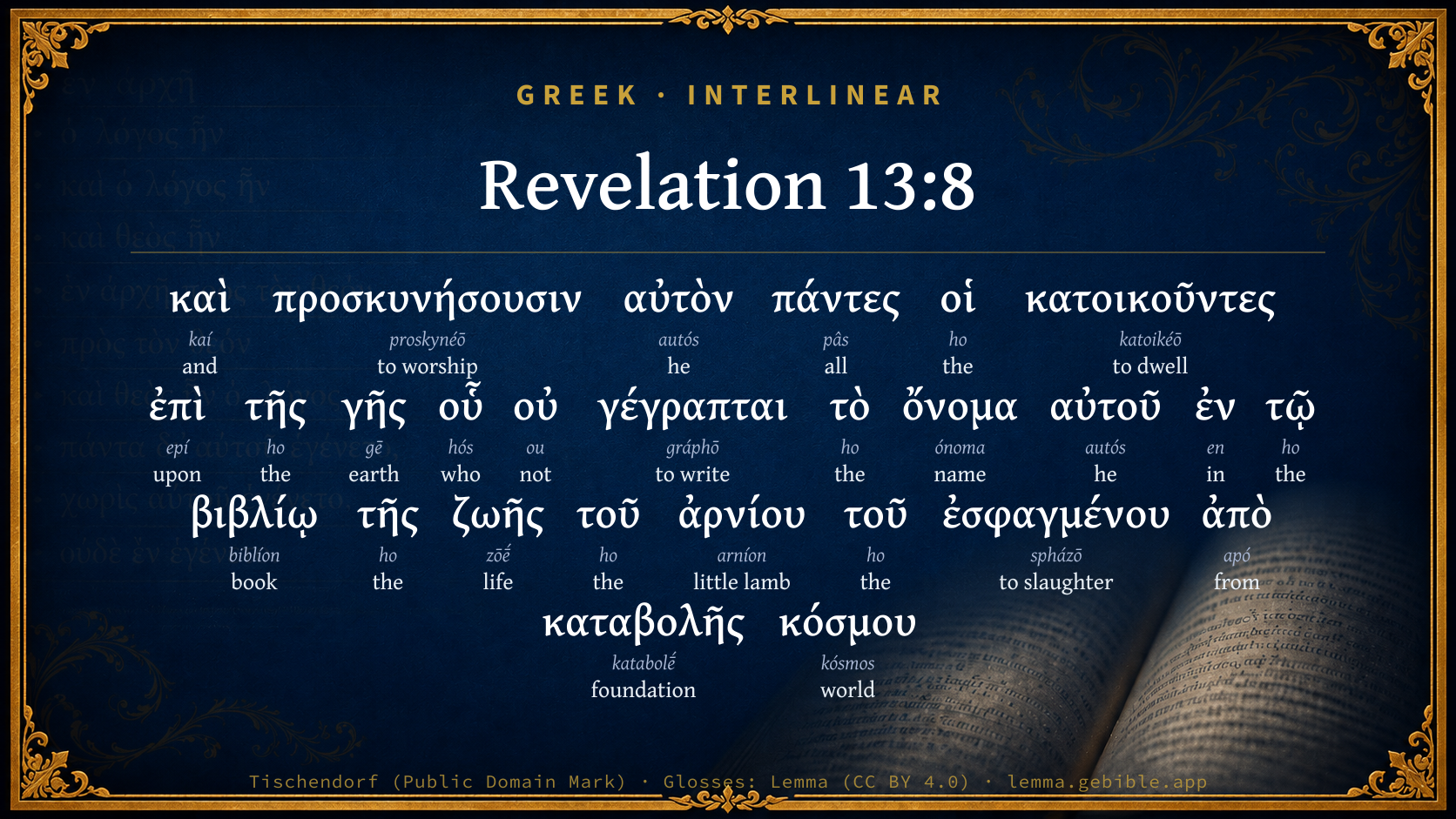
  1. καὶ kaí G2532 “and” Conjunction
  2. προσκυνήσουσιν proskynéō G4352 “to worship” Verb, Future, Active, Indicative, 3rd person, Plural
  3. αὐτὸν autós G846 “he” Personal pronoun, Accusative, Singular, Masculine
  4. πάντες pâs G3956 “all” Adjective, Nominative, Plural, Masculine
  5. οἱ ho G3588 “the” Article, Nominative, Plural, Masculine
  6. κατοικοῦντες katoikéō G2730 “to dwell” Verb, Present, Active, Participle, Nominative, Plural, Masculine
  7. ἐπὶ epí G1909 “upon” Preposition
  8. τῆς ho G3588 “the” Article, Genitive, Singular, Feminine
  9. γῆς gē G1093 “earth” Noun, Genitive, Singular, Feminine
  10. οὗ hós G3739 “who” Relative pronoun, Genitive, Singular, Masculine
  11. οὐ ou G3756 “not” Particle, Negative
  12. γέγραπται gráphō G1125 “to write” Verb, Perfect, Passive, Indicative, 3rd person, Singular
  13. τὸ ho G3588 “the” Article, Nominative, Singular, Neuter
  14. ὄνομα ónoma G3686 “name” Noun, Nominative, Singular, Neuter
  15. αὐτοῦ autós G846 “he” Personal pronoun, Genitive, Singular, Masculine
  16. ἐν en G1722 “in” Preposition
  17. τῷ ho G3588 “the” Article, Dative, Singular, Neuter
  18. βιβλίῳ biblíon G975 “book” Noun, Dative, Singular, Neuter
  19. τῆς ho G3588 “the” Article, Genitive, Singular, Feminine
  20. ζωῆς zōḗ G2222 “life” Noun, Genitive, Singular, Feminine
  21. τοῦ ho G3588 “the” Article, Genitive, Singular, Neuter
  22. ἀρνίου arníon G721 “little lamb” Noun, Genitive, Singular, Neuter
  23. τοῦ ho G3588 “the” Article, Genitive, Singular, Neuter
  24. ἀπὸ apó G575 “from” Preposition
  25. καταβολῆς katabolḗ G2602 “foundation” Noun, Genitive, Singular, Feminine
  26. κόσμου kósmos G2889 “world” Noun, Genitive, Singular, Masculine

About this verse

These counts appear in no published source. They are computed here, from the morphology-tagged text and Lemma’s own curated glosses. What Lemma adds →

27
words
20
distinct lemmas
Revelation
section

Notable vocabulary

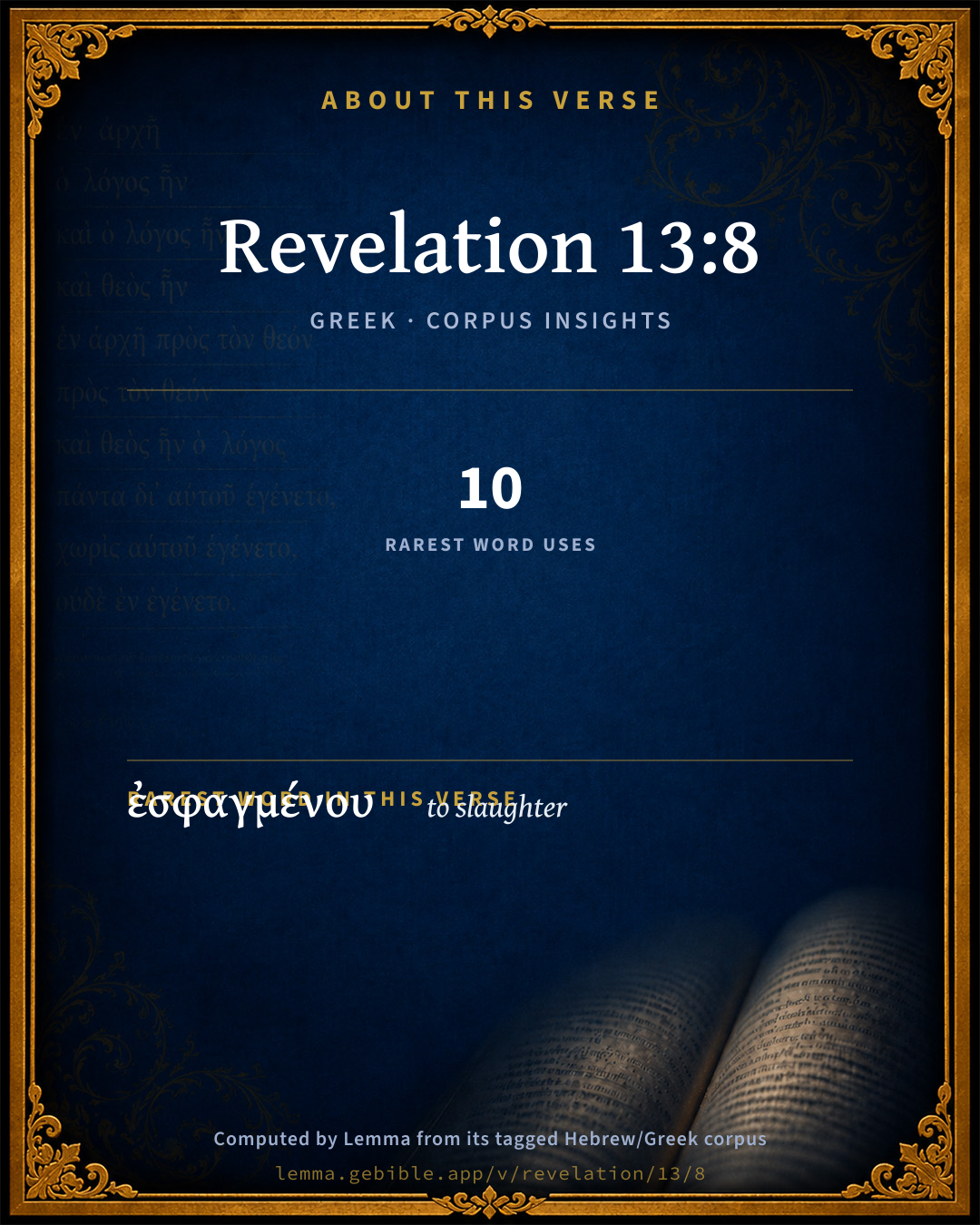
The rarest word here is ἐσφαγμένου to slaughter G4969 — appearing just 10 times in the whole Greek New Testament.

Shared distinctive vocabulary

ἐσφαγμένου to slaughter G4969 occurs in 9 verses of the Greek New Testament. Also found in:

Repetition

Words recur within this verse:

  • οἱ the G3588 ×7
  • αὐτὸν he G846 ×2

Cross-references

19

Topical passages linked to Revelation 13:8 in the Treasury of Scripture Knowledge — connected by theme and wording, ordered by reader-vote popularity; previews shown in the World English Bible.

  • 1 Peter 1:19–20 but with precious blood, as of a lamb without spot, the blood of Christ;
  • Ephesians 1:4 even as he chose us in him before the foundation of the world, that we would be holy and without blemish before him in love;
  • Matthew 25:34 Then the King will tell those on his right hand, 'Come, blessed of my Father, inherit the Kingdom prepared for you from the foundation of the world;
  • Revelation 17:8 The beast that you saw was, and is not; and is about to come up out of the abyss and to go into destruction. Those who dwell on the earth and whose names have not been written in the book of life from the foundation of the world will marvel when they see that the beast was, and is not, and shall be present.
  • Revelation 3:5 He who overcomes will be arrayed in white garments, and I will in no way blot his name out of the book of life, and I will confess his name before my Father, and before his angels.
  • Titus 1:2 in hope of eternal life, which God, who can't lie, promised before eternal times;
  • John 1:29 The next day, he saw Jesus coming to him, and said, "Behold, the Lamb of God, who takes away the sin of the world!
  • Revelation 21:27 There will in no way enter into it anything profane, or one who causes an abomination or a lie, but only those who are written in the Lamb's book of life.
  • Revelation 5:12 saying with a loud voice, "Worthy is the Lamb who has been killed to receive the power, wealth, wisdom, strength, honor, glory, and blessing!"
  • Daniel 12:1 "At that time shall Michael stand up, the great prince who stands for the children of your people; and there shall be a time of trouble, such as never was since there was a nation even to that same time: and at that time your people shall be delivered, everyone who shall be found written in the book.
  • Philippians 4:3 Yes, I beg you also, true yoke-fellow, help these women, for they labored with me in the Gospel, with Clement also, and the rest of my fellow workers, whose names are in the book of life.
  • Luke 10:20 Nevertheless, don't rejoice in this, that the spirits are subject to you, but rejoice that your names are written in heaven."
  • Exodus 32:32 Yet now, if you will, forgive their sin-- and if not, please blot me out of your book which you have written."
  • Revelation 5:6–9 I saw in the midst of the throne and of the four living creatures, and in the midst of the elders, a Lamb standing, as though it had been slain, having seven horns, and seven eyes, which are the seven Spirits of God, sent out into all the earth.
  • Isaiah 4:3 It will happen, that he who is left in Zion, and he who remains in Jerusalem, shall be called holy, even everyone who is written among the living in Jerusalem;
  • Revelation 3:10 Because you kept my command to endure, I also will keep you from the hour of testing, which is to come on the whole world, to test those who dwell on the earth.
  • Revelation 3:20 Behold, I stand at the door and knock. If anyone hears my voice and opens the door, then I will come in to him, and will dine with him, and he with me.
  • Revelation 13:3–4 One of his heads looked like it had been wounded fatally. His fatal wound was healed, and the whole earth marveled at the beast.
  • Revelation 13:14–15 He deceives my own people who dwell on the earth because of the signs he was granted to do in front of the beast; saying to those who dwell on the earth, that they should make an image to the beast who had the sword wound and lived.

Cross-references courtesy of OpenBible.info (CC BY 4.0).

Commentary

Notes on Revelation 13:8 from classic Christian and Jewish commentators (each source and its license shown beneath its notes). The classic Christian expositions comment on the surrounding passage and are grouped to its opening verse, so a note may address several verses; the Jewish commentaries on the Tanakh (Rashi and others) are per-verse, so they appear only where the commentator wrote on this verse.

Lemma curates 59 commentaries, every one of them public domain or Creative Commons licensed, each selected and text-cleaned for this edition rather than reprinted as found. About our sources →

Tyndale Open Study Notes

Tyndale Open Resources

13:8 Those who worshiped the beast receive its mark (13:15-17) and are not listed in the Book of Life (see 20:12).

Tyndale Open Study Notes — © Tyndale Open Resources, licensed CC BY-SA 4.0. Text via the HelloAO Bible API.

Bengel's Gnomon

Johann Albrecht Bengel

Rev 13:8. Προσκυνήσουσιν, shall worship) The verb in ordinary use, when the ceremonies about the Pope are treated of, is adoration (worship); and connected with this by derivation is a kiss, that is, of his feet, just as προσκυνεῖν, κυνεῖν, κύειν, is to kiss; whence נשק, LXX. 1Ki 19:18, and Symmachus, Psa 2:12, προσκυνεῖν.—ἀπὸ) ἀπὸ is here equivalent to before, as Mat 25:34, note, and is plainly construed with οὐ γέγραπται [not as Engl. With ἐσφαγμένου], and that so easily, that it is not even to be called an instance of Hyperbaton (See Append.). All doubt is removed by a passage strictly parallel, ch. Rev 17:8. The Apocalypse often makes mention of the Lamb slain: it never adds, from the foundation of the world; nor indeed was He slain from the foundation of the world: Heb 9:26. They who allege that He was thus slain in the Divine decree, in a like sense will say that He was born, raised from the dead, and ascended into heaven, from the foundation of the world.

Bengel's Gnomon of the New Testament — English translation (T&T Clark, Edinburgh, 1860) — public domain. Text from a community e-Sword module.

Meyer's Critical & Exegetical Commentary

Heinrich August Wilhelm Meyer

Rev_13:8. καὶ προσκυνήσουσιν αὐτὸν, κ.τ.λ. Notwithstanding א (αὐτῷ), undoubtedly the correct reading, αὐτόν, cannot be explained by the reference to the king, of the masc. in which the beast itself, Rev_17:11, appears personified;[3319] for that entirely special idea must be definitely indicated within ch. 13 if without any thing further it is thus to be diverted. The ΑὐΤΌΝ pertains, however, to the chief subject Ὁ ΔΡΆΚΩΝ. The worship of the dragon is here mentioned immediately after the description of the beast, for the same reason as Rev_13:4 in connection with Rev_13:3; the more mightily the instrument of the dragon is presented to the inhabitants of the earth, the more naturally they come to the adoration of that which itself only serves the beast. Corresponding with this is also the future form ΠΡΟΣΚΥΝΉΣΟΥΣΙΝ.[3320] As the activity of the beast, according to its decisive part, still impends,[3321] so also the adoration of the dragon occasioned thereby.

Οὖ Οὐ ΓΈΓΡΑΠΤΑΙ Τ. ὌΝ. ΑὐΤΟῦ. The sing. of the relative,[3322] to which, according to the Hebraic way, the demonstr. is added,[3323] is explained[3324] by the presentation of the details which are comprised in the entire ΚΑΤΟΙΚ. ἘΠῚ Τ. Γ.

ἘΝ Τῶ ΒΙΒΛΊῼ, Κ.Τ.Λ. Without doubt,[3325] the concluding clause ἈΠῸ ΚΑΤΑΒΟΛῆς ΚΌΣΜΟΥ belongs to ΓΈΓΡΑΠΤΑΙ,[3326] not to the ἘΣΦΑΓΜΈΝΟΥ, as neither the explanation of the eternal predestination of the death of Christ,[3327] nor that of the sufferings of Christ in his people from Abel on,[3328] agrees with the expression and the connection of this passage. The characteristic of the inhabitants of the earth, in contrast with the saints refusing to worship the dragon, contains already, in the most pregnant manner, all the points upon which the patience of the saints expressly emphasized immediately afterwards, Rev_13:10, depends. Those who worship the Lamb slain, of course, must suffer persecution; but just to the Lamb slain belongs the book of life,[3329] in which from eternity the names of believers are written: they, therefore, like the Lamb, conquer by their victory,[3330] and through all ΘΛῖΨΙς pass to the glory of eternal life,[3331] while the enemy, in spite of his temporary victory,[3332] incurs sure judgment. [See Note LXXII., p. 387.]

[3319] Hengstenb.

[3320] Cf., on the other hand, Rev_13:4.

[3321] Cf. Rev_13:7, where it is first given the beast, on Gods part, what it is to do.

[3322] See Critical Notes.

[3323] Rev_3:8, Rev_12:6; Rev_12:14.

[3324] De Wette.

[3325] Cf. Rev_17:8.

[3326] Hammond, Beng., Heinr., Ewald, Züll., De Wette, Hengstenb.

[3327] 1Pe_1:20; Beda, Eichh.

[3328] Cf. C. a Lap.

[3329] Rev_3:5.

[3330] Cf. Rev_3:21.

[3331] Cf. Rev_7:14.

[3332] Rev_13:7.

Meyer — Critical and Exegetical Commentary on the New Testament — English translation by Peter Christie, edited by Frederick Crombie (T&T Clark, 1880) — public domain. Text from a community e-Sword module.

Expositor's Greek Testament

ed. W. Robertson Nicoll

Rev 13:8 . Standing on the verge of this crisis (note the change to the future tense), the prophet anticipates the almost universal success of the Cæsar-cult ( cf. Rev 3:10 ). Only the elect will be able to resist its appeal ( cf. Mat 24:25 ). As in the O.T., the consciousness of predestination is made a moral lever ( cf. Rev 17:8 ). The rest of mankind who succumb to the cult are plainly not on the celestial burgessroll or register. cf. the instructive second-century gloss on Act 5:39 . As a rule the faithless in life are deceived (2Th 2:2-10 ; Asc. Isa. iv. 7, 8), but here the Imperial cultus occupies the place of the false prophet in Mar 13:12 , etc, τοῦ ἀ . τοῦ ἐσφαγμένου , which transfers to Christ the possession of the divine register of citizens in the heavenly state, is usually taken as a scribe s gloss (after Rev 21:27 where the position of ἀρνίου is less difficult). Elsewhere the book of life appears by itself. In any case, ἀπὸ κ . κ . goes with γέγραπται , not ἐσφαγμένου .

The Expositor's Greek Testament, edited by W. Robertson Nicoll (1897–1910) — public domain. Text from a community e-Sword module.

Geneva Bible (1599)

Geneva Bible translators

That is, such as are not from everlasting elect in Christ Jesus. For this is that Lamb slain, of which the fifth Chapter, verse six. These words I do with Aretas distinguish in this manner: Whose names are not written even from the laying of the foundation of the world, in the book of life, of the Lamb slain. And this distinction is confirmed by a like place hereafter, Rev. 17:8.

Geneva Bible (1599) marginal notes — public domain. Text via Bolls.life.

Jamieson, Fausset & Brown

Robert Jamieson, A. R. Fausset & David Brown

all that dwell upon the earth--being of earth earthy; in contrast to "them that dwell in heaven."

whose names are not written--A, B, C, Syriac, Coptic, and ANDREAS read singular, "(every one) whose (Greek, 'hou'; but B, Greek, 'hon,' plural) name is not written."

Lamb slain from the foundation of the world--The Greek order of words favors this translation. He was slain in the Father's eternal counsels: compare Pe1 1:19-20, virtually parallel. The other way of connecting the words is, "Written from the foundation of the world in the book of life of the Lamb slain." So in Rev 17:8. The elect. The former is in the Greek more obvious and simple. "Whatsoever virtue was in the sacrifices, did operate through Messiah's death alone. As He was "the Lamb slain from the foundation of the world," so all atonements ever made were only effectual by His blood" [BISHOP PEARSON, Exposition of the Creed].

Jamieson, Fausset & Brown — Commentary Critical and Explanatory on the Whole Bible (1871) — public domain (CC PDM 1.0). Text via the HelloAO Bible API.

Adam Clarke's Commentary

Verse 8. And all that dwell upon the earth shall worship him, whose names are not written in the book of life of the Lamb] The earth here is the Latin world, as has been observed before in similar cases. The meaning therefore is, that all the corrupt part of mankind who are inhabitants of the Latin world shall submit to the religion of the empire, except, as Bishop Newton expresses it, "those faithful few whose names, as citizens of heaven, were enrolled in the registers of life."

Slain from the foundation of the world.] That is, of the Christian world; for this has been shown to be the meaning of all kindreds, and tongues, and nations. The year of the crucifixion is properly the commencement of Christianity, as the apostles then first began to promulgate the religion of Christ with the Holy Ghost sent down from heaven. But as Jesus Christ was in the Divine purpose appointed from the foundation of the world to redeem man by his blood, he therefore is, in a very eminent sense, the Lamb slain from the foundation of the world, i.e., from the creation.

Adam Clarke's Commentary on the Bible (1810–1826) — public domain. Text from a community e-Sword/MySword module.

Ellicott's Commentary for English Readers

(8) And all that dwell . . .—Better, And all they that dwell on the earth shall worship him (every one) whose name has not been written in the book of life of the Lamb that has been slain from the foundation of the world. This is the climax of his triumph: he, or it, is worshipped; but the saints, though conquered, conquer; they do not worship after the fashion of the deluded or self-seeking. A stronger tie binds them to a better allegiance; their names are in the Lamb’s Book of Life. There is some doubt about the connection of the words “from the foundation of the world.” Some connect them with the word “written”: this would express that the names were written “from the foundation of the world” in the book. Others connect them with the word “slain”: this expresses that the Lamb was slain from the foundation of the world. For the former view, the similar passage in Rev_17:8 is cited; but, on the other hand, the phrase “from the foundation of the world” is connected in other parts of the Bible with certain aspects of the work of Christ (1Pe_1:19-20, and Joh_17:24), and it seems more natural to take the words in their simple order. Whatever view we take, the verse proclaims that the security of God’s saints is based on the eternal love of God. “An eternal deliverer is the only refuge from this great world-tyranny; “the strength of the tempted is in Him who is the same in love and righteousness through all the ages.

A Bible Commentary for English Readers, edited by Charles John Ellicott (1878–1897) — public domain. Text from a community e-Sword module.

The Cambridge Bible for Schools and Colleges

gen. ed. J. J. S. Perowne

8. whose names] Read, whose name, the pronoun as well as the noun being singular.

the book of life of the Lamb] Rev_21:27 : see note on Rev_5:1.

from the foundation of the world] Perhaps in Greek, as in English, it is most natural to connect these words with “slain:” and 1Pe_1:19-20 works out what, on this view, would be the sense. But the similar clause Rev_17:8 seems to prove that the words are to be taken with “written:” it is God’s purpose of individual election, not of universal redemption, that is here dated “from the foundation of the world.”

The Cambridge Bible for Schools and Colleges (gen. ed. J. J. S. Perowne; Cambridge University Press, 1878–1918) — public domain. Text from a community e-Sword module.

John Gill's Exposition

And all that dwell upon the earth shall worship him,.... The inhabitants of the Roman empire, the idolatrous part of it, the men of the world, earthly minded men; who are as they came into the world, and are of the earth, earthly, and seek only after earthly honours, pleasures, and profits; these are the admirers and adorers of the beast:

whose names are not written in the book of life of the Lamb slain from the foundation of the world; by which book is meant God's predestination of men to eternal life, or his decree of election; why this is called the "book of life"; see Gill on Rev 3:5; and their "names being written therein from the foundation of the world", Rev 17:8, for such a construction the words will bear, denotes that election is eternal, and is not an act of time, nor dependent upon anything done in time; and that it is of particular persons, and not of bodies of men, of nations and churches, and still less of propositions, or of persons so and so qualified, or under such conditions and circumstances; and that it is perfectly well known to God, and is sure and certain in its effects, and is unchangeable and irrevocable; for what is written in it, is written, and will always stand, not upon the foot of works, but of the sovereign grace of God; and this is called the Lamb's book; that is, Christ, who is compared to a Lamb for its harmlessness, meekness, and patience, and was typified by the lambs in the legal sacrifices; and this book is called his, because he was present at the making of it, and was concerned in putting down the names in it, Joh 13:18, and he himself stands first in it as the elect of God, and the head of all the elect, who, as members, were chosen in him: the act of election was made in him, and stands sure in him; and he is the author and giver of that life, which men are chosen unto both here and hereafter: and he may be said to be "slain from the foundation of the world"; in the decree and purpose of God, by which he was set forth, or foreappointed to be the propitiation for sin, and was foreordained, before the foundation of the world, to redeem his people by his blood, and in the promise of God immediately after the fall of man, that the seed of the woman should have his heel bruised, and he himself should bruise the serpent's head, which made it as sure as if it was then done; and in the sacrifices, which were immediately upon this offered up, and were types of the death and sacrifice of Christ; and in the faith of the saints, which brings distant things near, and considers them as if present; and also in his members, in Abel, and others, in whom he suffered, as he still does in his people; to which may be added, that such is the efficacy of the bloodshed and death of Christ, that it reached to all the saints from the beginning of the world, for the justification of their persons, the atonement of their sins, and cleansing from them; for the remission of sins, that are past, and for the redemption of transgressions under the first testament; for Old Testament saints from the beginning are saved by the grace of the Lord Jesus, as New Testament ones are. Something like this the Jews say (e) of the Messiah upon Gen 49:11,

"he washed , "from the day that the world was created"; who is he? this is the King Messiah.--It is written Gen 1:2; "and the Spirit of God", &c. This is the Spirit of the King Messiah; and from the day that the world was created; he washed his garments in wine;''

which the Jewish writers (f) understand of blood, which for its redness is like to wine; though they interpret it of the blood of the slain, with which the garments of the Messiah will be stained. Now such whose names are not written in this book of the Lamb, who have no interest in electing grace, nor in redemption by Christ, the slain Lamb of God, nor any right unto eternal life, who are reprobate persons, vessels of wrath fitted for destruction, who are foreordained to condemnation, and are given up to believe a lie, that they might be damned, these are the followers and worshippers of antichrist.

(e) Zohar in Gen. fol. 128. 2, 3. (f) Targum Jon. & Jerus. & Aben Ezra in Gen. xlix. 11.

John Gill's Exposition of the Whole Bible (1746–1763) — public domain (CC PDM 1.0). Text via the HelloAO Bible API.

Trapp's Complete Commentary

John Trapp

8 And all that dwell upon the earth shall worship him, whose names are not written in the book of life of the Lamb slain from the foundation of the world.

Ver. 8. Whose names are not written] He then that lives and dies a Papist cannot be saved.

Slain from the foundation] sc. 1. In God’s purpose; 2. In his promise; 3. In the faith of his people; 4. In the sacrifices; 5. In the martyrs; the first that ever died, died for religion. Christ undertook to pay our debt in the fulness of time; and hence we were enlarged. A man may let a prisoner loose, upon a promise to pay the debt a year after.

John Trapp, A Commentary or Exposition upon All the Books of the Old and New Testament (1647–1656) — public domain. Text from a community e-Sword module.

Albert Barnes' Notes on the Bible

And all that dwell upon the earth shall worship him - That is, as immediately stated, all whose names are not in the book of life. On the word “worship,” see the notes on Rev 13:4.

Whose names are not written in the book of life of the Lamb - That is, of the Lord Jesus - the Lamb of God. See the notes on Phi 4:3. Compare the notes on Joh 1:29. The representation here is, that the Lord Jesus keeps a book or register, in which are recorded the names of all who shall obtain everlasting life.

Slain from the foundation of the world - See the notes on Rev 5:6. Compare the notes on Rev 3:5. The meaning here is, not that he was actually put to death “from the foundation of the world,” but that the intention to give him for a sacrifice was formed then, and that it was so certain that it might be spoken of as actually then occurring. See Rom 4:17. The purpose was so certain, it was so constantly represented by bloody sacrifices from the earliest ages, all typifying the future Saviour, that it might be said that he was “slain from the foundation of the world.” Prof. Stuart, however (Com. in loco), supposes that this phrase should be connected with the former member of the sentence, “whose names are not written, from the foundation of the world, in the life-book of the Lamb, which was slain.” Either construction makes good sense; but it seems to me that what is found in our common version is the most simple and natural.

Albert Barnes' Notes on the Bible (1834–1885) — public domain. Text from a community e-Sword/MySword module.

Haydock's Catholic Bible Commentary

Slain from the beginning. In the foreknowledge of God; and in as much as all mercy and grace, from the beginning, were given in view of his death and passion. (Challoner)

George Leo Haydock (1774–1849), Haydock's Catholic Family Bible and Commentary, 1859 edition — public domain. Excludes Psalms (Douay-Rheims chapter numbering differs from Protestant) and Deuterocanonical books (Catholic canon only).

Matthew Poole's English Annotations

God here showed his prophet the general subjection that would be of all people to the papacy, except some few, whom he had chosen to eternal life and salvation, whom Christ had redeemed with his blood, and would preserve from this pollution.

Matthew Poole's English Annotations on the Holy Bible (1683–1685) — public domain. Text from a community e-Sword/MySword module.

Whedon's Commentary on the Bible

Daniel D. Whedon

8. All… shall worship him—Millions on the earth are now paying that homage.

Names… not written—Who are not justified by faith in Christ.

Daniel D. Whedon (gen. ed.), Commentary on the Old and New Testaments (1874–1909) — public domain. Text from a community e-Sword module.

The Pulpit Commentary

And all that dwell upon the earth shall worship him, whose names are not written in the book of life of the Lamb; every one whose name hath not been written, as in the Revised Version. "Him," auton , masculine, although referring to the neuter, yhrion , because the personality of Satan under the figure of the beast is borne in mind. "Whose name," singular, referring to the individuals of whom the pantev , "all," are composed. This verse states in another form what has been related in the latter part of the preceding verse. Those over whom the beast has authority are those who worship him, and whose names have not "been written in the book of life." The expression, "book of life," is found only in this book and Php_4:3. In all the places where it occurs it seems to refer primarily to Christians. (cf. Php_4:3 Rev_3:5 Rev_20:12, 15 21:27 22:19) At baptism the Christian"s name is written in the "book of life," from which there is always a possibility of it being blotted out. (Rev_3:5) Those who are not Christians have not their name in the "book of life," but worship the beast, that is, pay allegiance to him. It is "the book of life of the Lamb," because it is through "the Lamb" that there exists a "book of life" for men. Slain from the foundation of the world; or, that hath been slain. It is natural to connect the words, "from the foundation of the world," with "slain," and not with "written." The latter course has been followed by Bengel, Dusterdieck, De Wette, Ewald, Hengstenberg, and others, and in the margin of the Revised Version, and is in accordance with Rev_17:8, "Whose names were not written in the book of life from the foundation of the world". (see also Mat_25:34 Eph_1:4) "The Lamb hath been slain from the foundation of the world," because from "the foundation of the world" (cf. Heb_9:26) his death has been efficacious for the salvation of men; and because his death "was foreordained before the foundation of the world," although manifest only in the last times. (1Pe_1:20) What was foreknown to and ordained by God is spoken of as having taken place. This latter sense must be the meaning if we adopt the alternative reading.

Christ sacrificed in eternity.

"The Lamb slain from the foundation of the world." From this wonderful declaration we conclude

I THAT THE THINGS THAT ARE TO HAPPEN IN THE UNIVERSE IN THE MOST DISTANT FUTURE ARE TO GOD AS FACTS ALREADY ACCOMPLISHED. As a fact in this world"s history the crucifixion of Christ was enacted about eighteen centuries ago, and yet here it is declared to have occurred before all time, before any creature existed, when he lived alone in the solitudes of eternity. Two things are here disclosed:

1. That God"s intelligence is infinite. He knows not only all that has been, and all that is, but all that ever will be. All the generations that are yet to appear on this earth, with their commerce, politics, literature, religions, are facts to him. All the worlds and systems which are yet to be launched into immensity are to him realities. The slaying of Christ on Calvary was a fact to him ages before his purpose became realized to men. "Eternity, with all its years, Stands open to thy view: To thee, great God, there"s nothing old appears; To thee there"s nothing new.

2. That God"s purposes are unfrustratable. Christ"s death was according to God"s eternal decree. It was his "determinate counsel," and after millions of ages it was accomplished. What God has purposed must come to pass the conversion of the world, the resurrection of the dead, the transactions of the judgment day, etc., all are inevitable things. "Heaven and earth shall pass away.

II THAT SELF-SACRIFICING LOVE IS AN ETERNAL PRINCIPLE IN THE CREATION. Here it is in the mind of God before all worlds. Christ was slain before the "foundation of the world." Self-sacrificing love is a new and a rare thing to us, the men of this little planet, because we have fallen from the eternal order of things; but it is an old and common principle in God"s creation.

1. It is the root of the universe. What is the creation but love going forth in infinite gifts? Every life that breathes, every plant that blooms, every star that shines, is a gift of love.

2. It is typified in all material existences. Where is there a thing to be found throughout the vast domain of nature that is made for itself? All existences work, live, and die for the good of others. "The several kingdoms of nature depend on and, therefore, help each other. The mineral is the solid basis on which is spread out the vegetable the body that its vesture clothes. The vegetable directly nourishes the animal. The tree does not grow for itself; it cradles the birds, and feeds animated races, and shades the traveller until he blesses it. Of all the thousand and ninety species of plants that botany has classified, not one, from the vast oak to the weed that springs out of its mould, and the moss that clings to its bark, but takes its appointed place in a related family. The atmosphere would lose its salubrity but for the salt and bitter sea. The ground would catch no fertilizing streams if the clouds did not kindly drop them from the sky. The flowers wait for the falling light before they unveil their beauty. All growing things are buttressed up by the vast ribs of everlasting granite that sleep in sunless caverns. Heat, electricity, magnetism, attraction, send their subtle powers through nature, and play through all its works, as unseen and silent as the Eternal Spirit they bear witness of. Everything helps, and everything is helped.

3. It agrees with the moral constitution of the soul. The soul is so formed:

(1) That it can recognize nothing morally praiseworthy that does not spring from it. Disinterestedness must be the soul of any conduct it can heartily commend.

(2) Its conscience can approve of no act of its own that is not inspired by it. Our consciences have not a single smile for the avaricious and self seeking.

(3) Its happiness can only be realized as it is controlled by it. "He that seeketh his life shall lose it, and he that loseth it shall find it." Self-oblivious benevolence is the fountain of human joy. This eternal principle of self-sacrificing love we must have in us before we can be saved; it is, in fact, salvation. "Except ye eat the flesh of the Son of God and drink his blood, ye have no life in you." The flesh and the blood here stand for the vitality of Christ. And what was this moral life, the moral essence of Christ, the soul of his soul, the moral blood? Self-sacrificing love. And this we must get into us or die.

III THAT REDEMPTION IS NO AFTER THOUGHT IN THE ARRANGEMENTS OF THE UNIVERSE. It is true that the slain Lamb of Calvary came to meet and master an evil the world"s depravity. He came to "put away sin by the sacrifice of himself." But it was all according to the eternal order of things. Miserably narrow and God-degrading ideas of Christ"s work are popular in the pulpits of some of the sects. Sometimes it is spoken of as an expedient which the Almighty took a long time to contrive in order to overcome a state of things that had sprung up in his kingdom. Like some human king, he had a great deal to do in order to hit upon the best plan to harmonize his attributes, to reconcile mercy to justice, to maintain the order of his government, and, at the same time, save and forgive repentant rebels. And sometimes it is so spoken of as if the original system which God established with humanity was defective, did not work well, broke down, and thus not only disappointed the Creator, but taxed his wisdom greatly in order to invent an expedient that should meet the difficulty. Away with such notions! They are repugnant to reason, they are an insult to Omniscience, they are a libel on the gospel, they are obstructive to Christianity.

1. God foresaw the fall from eternity. This is an undeniable fact. Why did he not prevent it? Ah! why?

2. God ordained the remedy from eternity. Redemption was no after thought; it is an essential part, and, perhaps, a primary part of the original scheme of the universe. All that are redeemed to moral order, rectitude, and peace by Christ, are so redeemed "according to his own purpose and grace, which was given us in Christ Jesus before the world began.

IV THAT OUR PLANET WAS PROBABLY FORMED FOR THE SPECIAL PURPOSE OF BECOMING THE THEATRE OF GOD"S REDEMPTIVE LOVE TO MAN, This is saying more than that Christ came into the world. There are men who argue from the littleness of this planet the absurdity of this. But material magnitude is nothing to God; spiritual existences and moral facts are vitally interesting to him. But the text leads us beyond leads us to believe that this world was made for the express purpose. As God had the idea of redemption before the "foundation of the world," and as the idea is being worked out here, is it not probable that this idea guided him in its formation? Small in bulk as our planet is when compared with that of other orbs that roll in splendour under the eye of God, it has a grand moral distinction. Its dust formed the fruits that fed the body of the Son of God. Here he lived, laboured, suffered, and was buried, and here his grand work is being carried on. If it be moral facts that give importance to places, is there a more important spot than this earth? D.T.

The Pulpit Commentary (1880–1919), ed. H.D.M. Spence-Jones & Joseph S. Exell — public domain. Text from a community e-Sword module.

John Wesley's Explanatory Notes

And all that dwell upon the earth will worship him - All will be carried away by the torrent, but the little flock of true believers. The name of these only is written in the Lamb's book of life. And if any even of these "make shipwreck of the faith," he will blot them "out of his book;" although they were written therein from (that is, before) the foundation of the world, chap. xvii, 8.

John Wesley, Explanatory Notes Upon the Whole Bible (1754–1765) — public domain. Text via the GEBible commentary corpus.

Scofield Reference Notes

C. I. Scofield

world

Kosmos, Summary: In the sense of the present world-system, the ethically bad sense of the word, refers to the "order," "arrangement," under which Satan has organized the world of unbelieving mankind upon his cosmic principle of force, greed, selfishness, ambition, and pleasure. Mat 4:8; Mat 4:9; Joh 12:31; Joh 14:30; Joh 18:36; Eph 2:2; Eph 6:12; 1Jn 2:15-17. This world- system is imposing and powerful with armies and fleets; is often outwardly religious, scientific, cultured, and elegant; but, seething with national and commercial rivalries and ambitions, is upheld in any real crisis only by armed force, and is dominated by Satanic principles.

The Scofield Reference Bible (1917 edition), notes by C. I. Scofield — public domain. Text from a community e-Sword module.

The People's New Testament

B. W. Johnson

8–10. And all that dwell upon the earth shall worship him. All except the true and faithful saints, hidden in obscurity but known above and recorded in the book of life, shall give him homage.

B. W. Johnson's The People's New Testament with Notes (1889–1891) — public domain. Electronic text from the Christian Classics Ethereal Library (CCEL) ThML edition.

Cambridge Greek Testament for Schools and Colleges

8. οὗ … τὸ ὄνομα. Text. Rec[448] has ὧν … τὰ ὀνόματα with אP.

[448] Rec. Textus Receptus as printed by Scrivener.

8. πάντες … οὖ. The singulars after the plural here are not more difficult than the plurals after the singular in St Joh 17:2 [24]; 1Jn 5:16.

ἐν τῷ βιβλίῳ τῆς ξωῆς τοῦ ἀρνίου, Rev 21:27: see note on Rev 5:1.

ἀπὸ καταβολῆς κόσμου. Perhaps in Greek, as in English, it is most natural to connect these words with “slain”: and 1Pe 1:19-20 works out what, on this view, would be the sense. But the similar clause Rev 17:8 seems to prove that the words are to be taken with “written”: it is God’s purpose of individual election, not of universal redemption, that is here dated “from the foundation of the world.”

Cambridge Greek Testament for Schools and Colleges (Cambridge University Press, 1896; 21 vols, various authors incl. Carr, Maclear, Plummer, Farrar, Lumby, Moule, M. R. James, Simcox) — public domain. Text from a community e-Sword module.

Vincent's Word Studies in the New Testament

Marvin R. Vincent

From the foundation of the world. These words may be construed with slain or with written. In favor of the latter is ch. 18 8; of the former, 1Pe 1:19, 20. Alford, pertinently as I think, urges the position of the words in favor of the connection with slain, and says that had it not been for the apparent difficulty of the sense thus conveyed, no one would have thought of going so far back as to hath been written for a connection. Render, as Rev., the lamb that hath been slain from the foundation of the world. Katabolh foundation is literally a throwing or laying down, from kataballw to throw down; hence a laying down of a foundation.

Marvin R. Vincent, Word Studies in the New Testament (1887–1900) — public domain. Text from a community e-Sword/MySword module.

Lesson kit

Teaching starters — assembled from the data on this page, not authored interpretation. Every prompt links to the verse data it draws on. Edit before teaching.

Revelation, in the Revelation, opens this verse with 27 words (20 distinct Greek lemmas). Its most distinctive word is spházō (“to slaughter”). A historical commentator’s framing appears above. Read the whole chapter for the surrounding context.

Discussion questions

  1. The word spházō carries the sense “to slaughter.” How does it shape the verse?
  2. How does 1 John 3:12, which shares the word «to slaughter», read alongside this verse?
  3. What does the repetition of “the” (7× in this one verse) do in this verse?
  4. The translations on this page render this verse differently — a whole-verse word diff, not a word-by-word alignment. What might account for the different wordings?
  5. Compare how Tyndale Open Study Notes and Bengel's Gnomon read this verse. Where do they agree or differ?

Things to notice

Reading settings

Reading text

Shown beneath each verse's original-language words.

Old Testament
Old Testament edition

Read the OT as the Masoretic Hebrew (MT) or the Greek Septuagint (LXX).

English shown for the Greek Septuagint (in the Hebrew ↔ Greek comparison).

Comparing translations? Open the Compare panel on any verse page to stack up to four side by side.