John 21:9

Greek (Tischendorf 8th ed.) John 21:9 appears in the Greek New Testament. The text above is from the Tischendorf 8th edition. Each word links to its Strong’s number and a concise gloss. Click any word for its full Thayer’s Greek Lexicon entry.
Download image
Cite this verse

John 21:9 (World English Bible). Public Domain. Lemma interlinear Bible study tool, https://lemma.gebible.app/v/john/21/9.

Show BibTeX & RIS
BibTeX
RIS
English Translation
So when they got out on the land, they saw a fire of coals there, and fish laid on it, and bread.
World English Bible · Public Domain
Download a study sheet

One document with this verse’s original text, its word-by-word gloss line, the meaning frame, cross-references with their text, attributed commentary, and full source and license credits — printable, and it pastes into notes with its structure intact.

This verse Autodidact and up

Study sheet (.html) Plain text (.txt)

A passage Seminary Student

Up to 50 verses in one chapter. A passage sheet keeps up to 6 commentary sources and 12 cross-references per verse, in the order this page ranks them, and says so on the sheet whenever that leaves anything out. Ask for a single verse and you get the Autodidact verse sheet above.

Everything on this page stays free to read, with no account — the sheet is a download of what is already on screen, not access to it.

Want to remove ads? Support Godless Engineer
Compare translations 3

The same verse in 3 English versions, stacked beneath the original-language interlinear above. Click any original word for its lexicon entry.

Each is an independent rendering of the whole verse — the interlinear is not word-aligned to these translations.

Highlighted words mark where these versions differ — a whole-verse word diff, not a word-by-word alignment.

  • World English Bible Public Domain
    So when they got out on the land, they saw a fire of coals there, and fish laid on it, and bread.
  • King James Version Public Domain
    As soon then as they were come to land, they saw a fire of coals there, and fish laid thereon, and bread.
  • unfoldingWord Literal Text CC BY-SA 4.0
    Then when they got out upon the land, they see a charcoal fire kindled and a fish laid on it and a bread loaf.

unfoldingWord Literal Text — © unfoldingWord, licensed CC BY-SA 4.0. Word-aligned USFM3 via Door43 (git.door43.org/unfoldingWord/en_ult).

Versions to compare (up to 4)

3 of 4 selected

Show all 19 translations

Every available English version of this verse, each an independent rendering of the whole verse.

  • World English Bible Public Domain
    So when they got out on the land, they saw a fire of coals there, and fish laid on it, and bread.
  • Berean Standard Bible Public Domain
    When they landed, they saw a charcoal fire there with fish on it, and some bread.
  • Majority Standard Bible Public Domain
    When they landed, they saw a charcoal fire there with fish on it, and some bread.
  • King James Version Public Domain
    As soon then as they were come to land, they saw a fire of coals there, and fish laid thereon, and bread.
  • American Standard Version (1901) Public Domain
    So when they got out upon the land, they see a fire of coals there, and fish laid thereon, and bread.
  • Revised Version (1885) Public Domain
    So when they got out upon the land, they see a fire of coals there, and fish laid thereon, and bread.
  • Geneva Bible (1599) Public Domain
    Assoone then as they were come to land, they sawe hoate coales, and fish laide thereon, and bread.
  • Douay-Rheims (1899) Public Domain
    As soon then as they came to land, they saw hot coals lying, and a fish laid thereon, and bread.
  • Young's Literal Translation Public Domain
    when, therefore, they came to the land, they behold a fire of coals lying, and a fish lying on it, and bread.
  • Literal Standard Version CC BY-SA 4.0
    when, therefore, they came to the land, they behold a fire of coals lying [there], and a fish lying on it, and bread.
  • Unlocked Literal Bible CC BY-SA 4.0
    When they got out upon the land, they saw a charcoal fire there and fish laid on it, with bread.
  • unfoldingWord Literal Text CC BY-SA 4.0
    Then when they got out upon the land, they see a charcoal fire kindled and a fish laid on it and a bread loaf.
  • Darby Bible Public Domain
    When therefore they went out on the land, they see a fire of coals there, and fish laid on it, and bread.
  • World Messianic Bible Public Domain
    So when they got out on the land, they saw a fire of coals there, with fish and bread laid on it.
  • Webster's Bible Public Domain
    As soon then as they had come to land, they saw a fire of coals there, and fish laid upon them, and bread.
  • Free Bible Version CC BY-SA 4.0
    Once they'd landed they saw a fire with fish cooking on it, and some bread.
  • Bible in Basic English Public Domain
    When they got to land, they saw a fire of coals there, with fish cooking on it, and bread.
  • Text-Critical English NT CC BY 4.0
    When they had gone ashore, they saw a charcoal fire there with a fish lying on it, and bread.
  • Tyndale New Testament (1534) Public Domain
    Assone as they were come to londe they sawe hoot coles and fysshe layd ther on and breed.

Literal Standard Version (2020), Covenant Press — licensed CC BY-SA 4.0. Text via the HelloAO Bible API (eBible.org). Unlocked Literal Bible (unfoldingWord) — licensed CC BY-SA 4.0. Text via the HelloAO Bible API (eBible.org). unfoldingWord Literal Text — © unfoldingWord, licensed CC BY-SA 4.0. Word-aligned USFM3 via Door43 (git.door43.org/unfoldingWord/en_ult). Free Bible Version, Dr. Jonathan Gallagher — licensed CC BY-SA 4.0. Text via the HelloAO Bible API (eBible.org).

Word by word

More ways to search: Search by grammar → Find every occurrence → Compare this word →

Practice this passage: Drill this verse → Learn its vocabulary →

ἀνθρακιὰν
anthrakiá
G439
“burning coal”
Noun, Accusative, Singular, Feminine
Part of Speech
Noun
Case
Accusative
Number
Singular
Gender
Feminine
Full Thayer's Definition

Origin: from G440

TDNT: None

1. a heap of burning coals
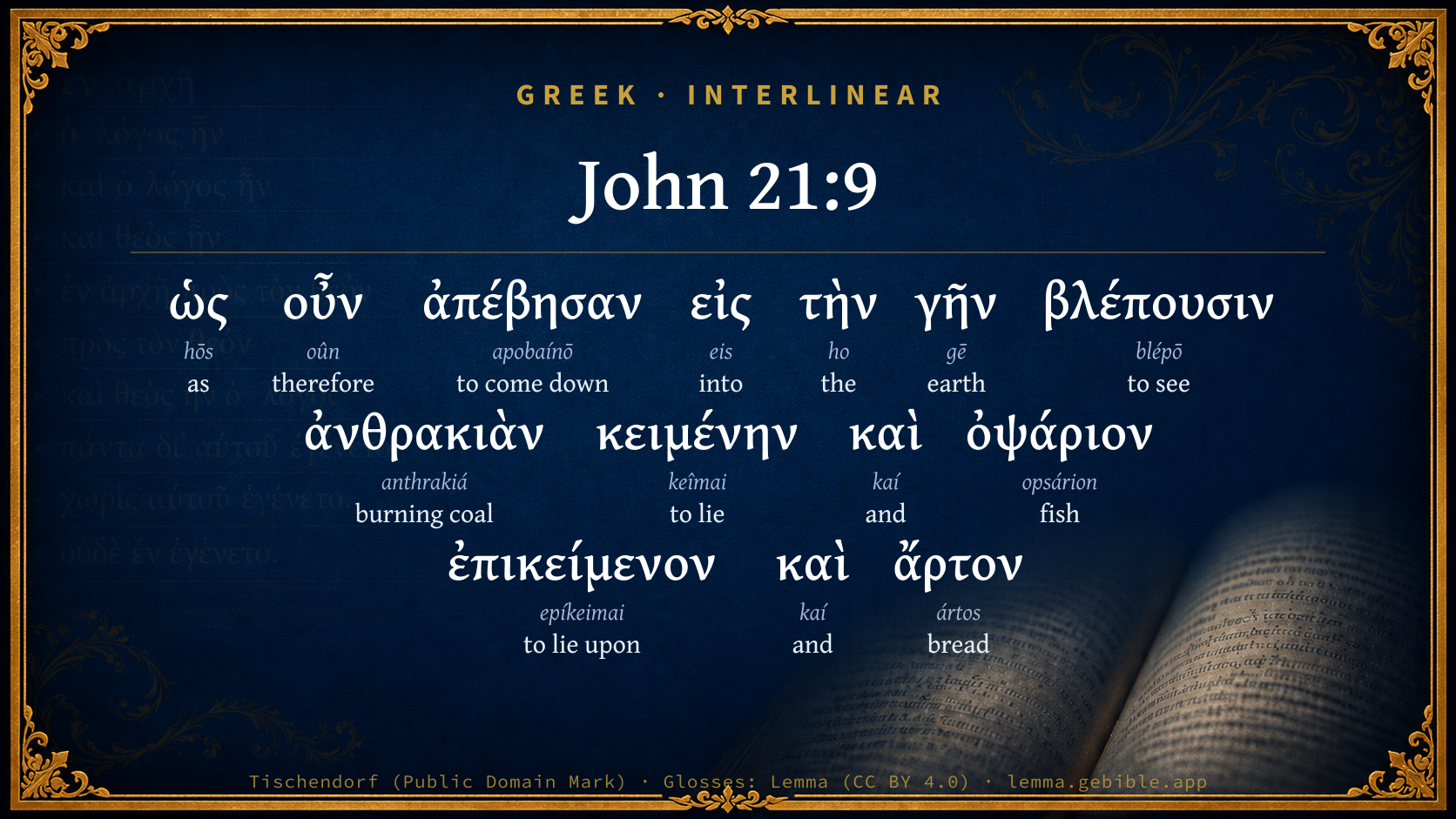
  1. ὡς hōs G5613 “as” Adverb
  2. οὖν oûn G3767 “therefore” Conjunction
  3. ἀπέβησαν apobaínō G576 “to come down” Verb, Aorist, Active, Indicative, 3rd person, Plural
  4. εἰς eis G1519 “into” Preposition
  5. τὴν ho G3588 “the” Article, Accusative, Singular, Feminine
  6. γῆν gē G1093 “earth” Noun, Accusative, Singular, Feminine
  7. βλέπουσιν blépō G991 “to see” Verb, Present, Active, Indicative, 3rd person, Plural
  8. κειμένην keîmai G2749 “to lie” Verb, Present, Middle or Passive deponent, Participle, Accusative, Singular, Feminine
  9. καὶ kaí G2532 “and” Conjunction
  10. ὀψάριον opsárion G3795 “fish” Noun, Accusative, Singular, Neuter
  11. ἐπικείμενον epíkeimai G1945 “to lie upon” Verb, Present, Middle or Passive deponent, Participle, Accusative, Singular, Neuter
  12. καὶ kaí G2532 “and” Conjunction
  13. ἄρτον ártos G740 “bread” Noun, Accusative, Singular, Masculine

About this verse

These counts appear in no published source. They are computed here, from the morphology-tagged text and Lemma’s own curated glosses. What Lemma adds →

14
words
13
distinct lemmas
Gospels
section

Notable vocabulary

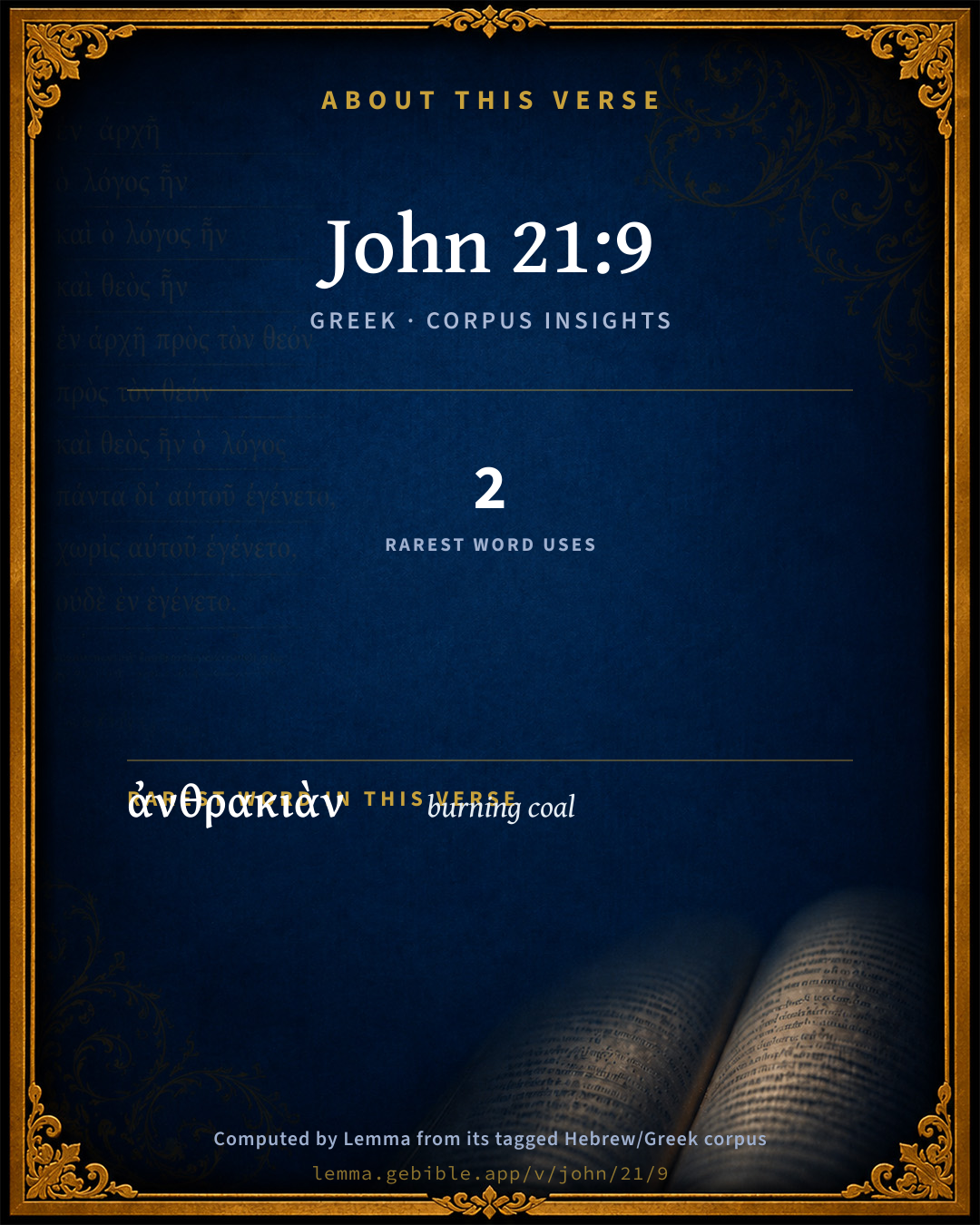
The rarest word here is ἀνθρακιὰν burning coal G439 — appearing just 2 times in the whole Greek New Testament.

Shared distinctive vocabulary

ἀνθρακιὰν burning coal G439 occurs in 2 verses of the Greek New Testament. Also found in:

Repetition

A word recurs within this verse:

Cross-references

4

Topical passages linked to John 21:9 in the Treasury of Scripture Knowledge — connected by theme and wording, ordered by reader-vote popularity; previews shown in the World English Bible.

  • 1 Kings 19:5–6 He lay down and slept under a juniper tree; and, behold, an angel touched him, and said to him, Arise and eat.
  • John 21:10 Jesus said to them, "Bring some of the fish which you have just caught."
  • John 21:13 Then Jesus came and took the bread, gave it to them, and the fish likewise.
  • John 18:18 Now the servants and the officers were standing there, having made a fire of coals, for it was cold. They were warming themselves. Peter was with them, standing and warming himself.

Cross-references courtesy of OpenBible.info (CC BY 4.0).

Commentary

Notes on John 21:9 from classic Christian and Jewish commentators (each source and its license shown beneath its notes). The classic Christian expositions comment on the surrounding passage and are grouped to its opening verse, so a note may address several verses; the Jewish commentaries on the Tanakh (Rashi and others) are per-verse, so they appear only where the commentator wrote on this verse.

Lemma curates 59 commentaries, every one of them public domain or Creative Commons licensed, each selected and text-cleaned for this edition rather than reprinted as found. About our sources →

The Biblical Illustrator

Joseph S. Exell

Joh_21:9-11

As soon as they were come to land they saw a fire of coals there.

The two fires--a contrast

(Text, and Joh_18:18)

I. THE FIRE IN THE PALACE COURT.

1. A scene of sorrow--the Saviours trial.

2. A place of temptation--in the company of Christs enemies.

3. A witness of sin--the denials of Peter.

II. THE FIRE UPON THE SEA-SHORE.

1. A scene of glory--the presence of the risen Lord.

2. A place of safety--the society of Jesus and His friends.

3. A witness of grace--Peters restoration. (T. Whitelaw, D. D.)

The fire on the shore

1. You cannot fail to be impressed with the sense as of something strange and unearthly. You feel that, like Moses in Horeb, you must put off the shoes from your feet, ere you approach this mysterious fire.

(1) One explanation of the fire and repast, of course, is that they were provided to supply the bodily wants of the disciples.

(2) Another makes the whole transaction refer especially to St. Peter. The thrice-repeated question reminded him of his three-fold denial; the miraculous draught called to mind his office from which he fell; and the fire of coals would recall that other fire by which he denied his Master.

2. But these explanations do not meet the whole of the facts. We have, then, to seek one which shall satisfy all parts of the narrative: and this is to be found in the progress of the Gospel, and the connection between the Old and New Dispensations.

I. THE FISH. In one parable the kingdom of heaven is likened unto a net, which gathered of every kind; so that we have Christs authority for considering that the miraculous draught represented the bringing of multitudes into the Church through the instrumentality of the preachers of the gospel. It is observable also that Simon Peter is said to have drawn the net to land: there may have been a reference here to the fact that Peter was entrusted with the opening the Church to the Gentiles. For there can be no doubt that there was a special reference to the combining of all nations in the visible Church. The number of fishes is to be carefully noted. It appears that one hundred and fifty and three was exactly the number of varieties of fish then known, so that we may most justly conclude that the number was an indication that persons of all nations and conditions should enter into the Church. And then the remark as to the net not being broken must be considered as prophetic of the capacity of the Christian Church; unlike the Jewish, which was not constructed for enlargement and extension.

II. THE FIRE OF COALS AND THE PREPARED REPAST.

1. You are to observe that the Jewish and the Christian Dispensations are not so truly distinct economies, as component parts of one great plan. There have never been two ways in which sinners might be saved. In the New Testament, indeed, we have the clearer exposition of the great scheme of mercy; but there is no difference whatsoever in the doctrine propounded. This great truth is figuratively taught here. There was already a fire kindled, and on the fire there were fish already laid; and when the newly-caught fish were placed on the same fire, was it not shown that the Church, before and after the coming of Christ, was virtually but one and the same? that its members had to be brought to the same altar, and to be purified by the same flame? I know not why we should not think that that strange fire, mysteriously kindled on the lonely shore, was typical of the propitiatory work of the Redeemer, through whom alone the men of any age can be presented as a sacrifice acceptable unto God. There is no altar but the one Mediator, and no fire but that of His oblation, which will answer for those who seek to consecrate themselves, a whole burnt offering to God. And what could be a more lively parable of this fact than that, when standing on the margin of the sea, the separating line between time and eternity, Christ caused an altar to rise, mysterious as Himself, and crowned it with burning coals, which had not been kindled by any earthly flame; and then placed on it representatives of the one visible Church as it had subsisted before His incarnation, and as it was to subsist till He should come to judgment? It seems to have been a lesson peculiarly needed by the apostles, that they were not to consider themselves as going forth on a new mission, of which no notices had been previously issued. Accordingly Christ had forcibly reminded them that One soweth, and another reapeth. And now He repeats something of the same lesson.

2. But, further, the Evangelist is careful in noting that our Lord took bread as well as fish and gave to His disciples. Now, Christ had fed a great multitude with a few loaves and fishes, typifying how the truth of His religion should suffice for the spiritual sustenance of the world. The disciples would naturally be reminded of this miracle here, and that the food which Christ delivered to them as spiritual pastors would be an abundant provision for all men. In conclusion, we would show you into how beautiful an allegory some of the facts may be wrought, when a broader view is taken, one which shall more distinctly comprehend ourselves.

1. It is an appropriate simile which likens life to a voyage which has variety of terminations--sometimes in calm, sometimes in storm; the vessel, in one case, casting anchor in placid waters, so that the Spirit has but to step gently ashore; in another, suffering shipwreck, so that there is fearful strife and peril in escaping from the waves, Of all it will have to be said, as of those with St. Paul, some by swimming, some on boards, and some on broken pieces of the ship--it came to pass that they escaped all safe to land.

2. Let it satisfy us that whatever the mode in which the soul of the righteous is dismissed--whether that mode be imagined in Peters casting himself into the sea and struggling to the land, or whether it be represented in the quieter approachings of the boat with the other disciples--the soul will find preparation for its reception: Christ stands upon the shore, expecting His faithful servants; and of all of them it will have to be said, As soon as they were come to land, they saw a fire of coals there, and fish laid thereon, and bread. This may well shadow out that, to the faithful in Christ, the moment of being detached from the body is the moment of being admitted into happiness. As soon as they were come to land--no delay, no interval--all that was needed was found ready; the fire kindled, and the banquet spread.

3. Yet who doubts that the righteous will not only find the material of happiness prepared, but that they will carry with them additions to that material, and make heaven all the richer? It is the communion of saints; and whilst each saint shall draw cause of rapture from those who have gone before, they also shall draw cause of rapture from Him. Ah, then, how beautifully apposite the direction, Bring of the fish which ye have now caught! The marriage-supper of the Lamb shall be furnished from the contributions of every generation. Blessed are the dead which die in the Lord, &c. They rest from their labours, in that, as soon as they come to land, they see a fire of coals there, and fish laid thereon, and bread: their works do follow them, in that they are then bidden to bring of the fish which they have caught. (H. Melvill, B. D.)

Materials for the banquet

Mineral coal is still a thing of uncommon use or knowledge in the East, except on the steamers. But charcoal is the coal; it is made and used everywhere, and is sold by weight. Upon the coals the bread or loaf is baked, either on a pan or piece of metal; or directly on (or under) the coals themselves, protected by a layer of ashes. The variety of modes of baking, and of bread, which one sees at an Oriental camp-fire, are many. The picture here is doubtless that of both bread and fish cooking at the fire; not of baked bread waiting for the fish to be done. The loaf was, or is, a flat cake. (S. S. Times.)

Bring of the fish which ye have now caught

Christ requires human co-operation

Jesus had no need of the disciples help in providing fish for His breakfast or for theirs; but He asked their help just as if He did need it. If they had refused to bring the fish, He would have been no loser; but the loss would have been theirs. So it is always in every sphere of Christian activity. Jesus never needs help; but Jesus constantly calls for help. The gain through responding to that call, or the loss through refusing, is to the disciple, not to the Master. Jesus can get on without your money or your services in the Sunday-school, in the church, in the community about you, or in the missionary field; but you cannot get on as you might if you refuse your help in any one of these fields. Jesus asks for a share of all the fish you catch, of all the crops you gather, of all the money you get, of all the time and strength you have. If you refuse to render it to Him, the loss is yours. How great that loss may be only eternity can disclose. (H. C. Trumbull, D. D.)

Simon Peter went up and drew the net to land

Pulling in the net

If you are always mending and setting the net, you wont catch many fish. Whoever heard of a man going out to fish, and setting his net, and then letting it stop there, and never pulling it in. Why, everybody would laugh at the mans folly. There was a minister in Manchester who came to me one day and said, I wish you would tell me why we ministers don t succeed better than we do. So I took up the idea of pulling in the net, and I said, You ought to pull in your nets. There are a great many in Manchester who can preach much better than I can, but then I pull in the net. A great many people have objections to inquiry-meetings; and when I had pointed out the importance of them, the minister said, I never did pull in the net, but I will try next Sunday morning. He did so, and eight persons, anxious inquirers, went into his study. The next Sunday he came down to see me, and said he had never had such a Sunday in his life. The next time he drew the net there were forty, and when he came to see me at the Opera House, the other day, he said, Moody, I have had eight hundred conversions this last year. It is a great mistake I did not begin earlier to pull in the net. So, my friends, if you want to catch men, just pull in the net. If you only catch one it will be something. It may be a little child, but I have known a little child convert a whole family. Why, you dont know whats in that little dull-headed boy in the inquiry-room, he may become a Martin Luther--a reformer that shall make the world tremble. (D. L. Moody.)

The Biblical Illustrator, edited by Joseph S. Exell (c. 1880s–1900s) — public domain. Text from a community e-Sword module.

Joseph Benson's Commentary

Joh 21:9-14. As soon as they were come to land, they saw a fire of coals — The effect of Christ’s wonder-working power; and fish laid thereon, and bread — Which also he had prepared by a miracle, that they might see how easily he could make provision for them, when they were destitute of the ordinary means of supply. We need not be curious in inquiring whence this fire, fish, and bread came, any more than whence the meat came which the ravens brought Elijah. He that could multiply the loaves and fishes that were, could make new ones if he pleased, or turn stones into bread, fish, or flesh. We may take comfort from this instance of Christ’s care of his disciples; persuaded he has wherewith to supply all our wants, and knows what things we have need of. It is especially encouraging to Christ’s ministers, whom he hath made fishers of men, to learn, by such an instance, that they may depend upon him who employs them to provide for them what he sees to be needful. Jesus saith, Bring of the fish ye have now caught — Christ gave this order either because the fish already broiling on the fire was not sufficient for the company, or rather, perhaps, to show them the reality and greatness of the miracle, by making them attend to the number and largeness of the fish which they had caught, and to the circumstance of the net’s not being broken. Simon Peter went up, and — With the help of his brethren; drew the net to land — As Peter in the former instance had showed a more zealous affection to his Master’s person than any of them, so in this he showed a more ready obedience to his Master’s commands. Full of great fishes, a hundred and fifty and three — These were many more than they needed for their present supply; but they might sell them, and the money would serve to bear their expenses on their journey back to Jerusalem, whither they were shortly to return, and to support them while they waited there. And for all there were so many — And great fishes too; yet was not the net broken — So that they witnessed miracle upon miracle wrought for them. Jesus saith, Come and dine — Or, come and eat; for the word αριστησατε, here used, signifies sometimes to take meat in the morning, which is the meaning of it here. Dr. Doddridge reads, Come and refresh yourselves; and Bishop Pearce, Come and breakfast. “The ancients used regularly but two meals in a day; we use three. As of our three, dinner and supper have been regarded as the two principal, it has obtained, not only with us, but all over Europe, to call the first meal of the ancients by the first of these two, which is dinner; and the second by the latter, which is supper. It is the order which has fixed the names of these meals, and not the precise time of the day at which they were eaten, which is commonly variable.” — Campbell. None of the disciples durst — Or rather, presumed, or ventured to ask him, Who art thou? — For, as the last-mentioned divine justly observes, “the verb ετολμα, which our translators render durst, does not always, in the use of Greek authors, sacred or profane, express the boldness or courage implied in the English verb to dare, by which it is commonly rendered. When joined with a negative, as in this place, it often expresses merely a disinclination, arising from modesty, delicacy, respect, or an averseness to be troublesome in putting unnecessary questions. And it may here be properly translated presumed, or ventured; an interpretation confirmed by the words immediately following. The sense then will be, They knew him to be the Lord, and therefore did not presume to ask him a needless question. To say they durst not ask him, tends to convey the notion that our Lord’s manner of conversing with his disciples was harsh and forbidding, than which nothing can be more contrary to truth. It is not said by the evangelist here, that Jesus now ate with them; but his invitation to them in this verse implies it. Besides, Peter testifies, (Act 10:41,) that his apostles did eat and drink with him after he rose from the dead; meaning to tell Cornelius that that was one of the many infallible proofs by which he showed himself alive after his passion. It is reasonable, therefore, to think that he ate with his apostles on this occasion. Thus Jesus proved to his disciples anew the reality of his resurrection, not only by eating with them, but by working a miracle like that which, at the beginning of his ministry, made such an impression upon them as disposed them to be his constant followers. This is the third time Jesus showed himself to his disciples, &c. — The evangelist does not say that it was the third time Jesus appeared, but the third time that he appeared to his disciples; that is, to his apostles in a body; for in reality it was his seventh appearance. Besides, John himself has taken notice of three appearances before this.

Joseph Benson's Commentary on the Old and New Testaments (1811–1818) — public domain. Text from a community e-Sword module.

Whedon's Commentary on the Bible

Daniel D. Whedon

THE MIRACULOUS BREAKFAST—Emblem of the eternal banquet, Joh_21:9-14.

9. Fire of coals—They did not make the fire, but found it already made by the divine power of Jesus. But was this a creation out of nothing? We reply: It may have been but a sensible miracle. That is, the divine power may have so operated upon the senses of the disciples as that all the phenomena of fire and food may have been presented to their perceptions without any positive creation of substance. It would have been to them but a waking vision, taking place amid surrounding realities, possessing all the vividness and force of reality. Or, more probably the divine power of the Lord, which had just collected the fishes from the different parts of the lake to the right side of the boat, may have concentrated the elements of fire, fuel, and food from any part of creation upon that shore. Jesus, therefore, was wanting in no power to furnish the means and material of this emblematic feast. So He who upon the high ground of heaven watches his ministry and Church, will in due season have full power to provide an eternal banquet, and bring his elect to its participation.

Daniel D. Whedon (gen. ed.), Commentary on the Old and New Testaments (1874–1909) — public domain. Text from a community e-Sword module.

Tyndale Open Study Notes

Tyndale Open Resources

21:9 Cooked fish and bread were the mainstays of the Galilean diet; Jesus provided the men with breakfast. The charcoal fire is reminiscent of the scene of Peter’s denials (18:18).

Tyndale Open Study Notes — © Tyndale Open Resources, licensed CC BY-SA 4.0. Text via the HelloAO Bible API.

Bengel's Gnomon

Johann Albrecht Bengel

Joh 21:9. Βλέπουσιν, they see) unexpectedly. A miracle.—ὀψάριον, a small fish) a single one.—ἄρτον, a loaf) a single one: Joh 21:13, “Jesus taketh the loaf” [Engl. vers., ‘bread,’ loses the force of the article]. Jesus entertained His disciples at a feast: and with food, which would have been only enough for one guest, He fed them all.

Bengel's Gnomon of the New Testament — English translation (T&T Clark, Edinburgh, 1860) — public domain. Text from a community e-Sword module.

Expositor's Greek Testament

ed. W. Robertson Nicoll

Joh 21:9 . Ὡς οὖν … ἄρτον . “When, then, they got out upon the land, they see a fire (or heap) of coals laid and fish laid thereon, and bread”; or, possibly, “a fish” and “a loaf,” but see Joh 21:13 . For ἀνθρακιά , see Joh 18:18 . The disciples were evidently surprised at this preparation.

The Expositor's Greek Testament, edited by W. Robertson Nicoll (1897–1910) — public domain. Text from a community e-Sword module.

Jamieson, Fausset & Brown

Robert Jamieson, A. R. Fausset & David Brown

they saw--"see."

a fire of coals, and fish laid thereon, and bread--By comparing this with Kg1 19:6, and similar passages, the unseen agency by which Jesus made this provision will appear evident.

Jamieson, Fausset & Brown — Commentary Critical and Explanatory on the Whole Bible (1871) — public domain (CC PDM 1.0). Text via the HelloAO Bible API.

Adam Clarke's Commentary

Verse 9. They saw a fire, c.] This appears to have been a new miracle. It could not have been a fire which the disciples had there, for it is remarked as something new besides, they had caught no fish, Joh 21:5, and here was a small fish upon the coals, and a loaf of bread provided to eat with it. The whole appears to have been miraculously prepared by Christ.

Adam Clarke's Commentary on the Bible (1810–1826) — public domain. Text from a community e-Sword/MySword module.

Ellicott's Commentary for English Readers

(9) They saw a fire of coals there, and fish laid thereon, and bread.—In the original the tenses are present, describing the scene as it was impressed on the mind of the writer. They saw a fire of coals and fish lying thereon, and bread, or, perhaps,. . . . and a fish lying thereon, and a loaf.

For “fire of coals” comp. Note on Joh_18:18.

For the word rendered “fish,” comp. Joh_21:10; Joh_21:13, and Notes on Joh_6:9; Joh_6:11. In this passage and in Joh_21:13 only it occurs in the singular, but it seems clear that it may be collective, as our word “fish.”

A Bible Commentary for English Readers, edited by Charles John Ellicott (1878–1897) — public domain. Text from a community e-Sword module.

The Cambridge Bible for Schools and Colleges

gen. ed. J. J. S. Perowne

9. As soon as … they saw] Better, When therefore … they see.

a fire of coals] See on Joh_18:18 : the word occurs only there and here in N.T. [10]. ‘There’ is literally laid.

fish laid thereon, and bread] Or possibly, a fish laid thereon and a loaf. But the singulars may be collectives as in the A. V. The word for fish (opsarion) is similar in meaning, though not in derivation, to the one used in Joh_21:5. (See on Joh_6:9.) In Joh_21:11 yet another word is used (ichthus), which means ‘fish’ generally, whether for eating or not.

The Cambridge Bible for Schools and Colleges (gen. ed. J. J. S. Perowne; Cambridge University Press, 1878–1918) — public domain. Text from a community e-Sword module.

John Gill's Exposition

As soon then as they were come to land,.... As soon as they were come out of the ship, and safe on shore, not only Peter, but all the rest of the disciples:

they saw a fire of coals there: on the shore, to their great surprise:

and fish laid there; which could not be any that they had taken, for, as yet, the net was not drawn up, and the fish took out:

and bread; not upon the coals baking, but hard by, being ready prepared to eat with the fish, when sufficiently broiled. This was all of Christ's preparing, and a considerable proof of his deity; and a confirmation of that provision he will make for his ministering servants, whilst they are about his work, and in this world; and a representation of that spiritual and eternal refreshment they shall have with him in heaven to all eternity, when they have done their work.

John Gill's Exposition of the Whole Bible (1746–1763) — public domain (CC PDM 1.0). Text via the HelloAO Bible API.

Trapp's Complete Commentary

John Trapp

9 As soon then as they were come to land, they saw a fire of coals there, and fish laid thereon, and bread.

Ver. 9. And fish laid thereon and bread] A feast of Christ’s own providing; to assure them that they should never lack necessaries; superfluities they may want without prejudice. Nature is content with a little, grace with less. Luther dined often with a herring, Junius with an egg; as knowing, that they were not to live to eat, but eat to live. Ill doth it become a servant of the Highest to be a slave to his palate. Epicurus dum palato quid sit optimum iudicat, caeli palatium non suspexit, saith Ennius.

John Trapp, A Commentary or Exposition upon All the Books of the Old and New Testament (1647–1656) — public domain. Text from a community e-Sword module.

Albert Barnes' Notes on the Bible

They saw a fire ... - We have no knowledge whence this was produced - whether it was, as Grotius supposes, by a miracle, or whether it was a place occupied by other fishermen, where they also might cook the fish which they had caught. As no miracle is mentioned, however, there is no reason for supposing that any existed in the case.

Albert Barnes' Notes on the Bible (1834–1885) — public domain. Text from a community e-Sword/MySword module.

Haydock's Catholic Bible Commentary

Hot coals lying, and a fish laid thereon, and bread. The fish caught in the net were not yet drawn to land. These things, then, were created out of nothing, or miraculously transported thither, by the divine power. (Witham)

George Leo Haydock (1774–1849), Haydock's Catholic Family Bible and Commentary, 1859 edition — public domain. Excludes Psalms (Douay-Rheims chapter numbering differs from Protestant) and Deuterocanonical books (Catholic canon only).

Matthew Poole's English Annotations

As to the question whence this fish came, there are three opinions: some think that our Saviour caught it out of the sea without a net, or by his power commanded it to come to his service; others think that the history is transposed, and this verse should in its true order come after the eleventh; but it is most probable that Christ by his Divine power created the fish, as well as the coals and the bread.

Matthew Poole's English Annotations on the Holy Bible (1683–1685) — public domain. Text from a community e-Sword/MySword module.

The Pulpit Commentary

So when they were come to land (literally, with Revised Version, got out of the boat upon the land; a reads anebhsan instead of apebhsan), they see a fire of coals there. The word anyrakia occurs only in Joh_18:18 and in this place. It is derived from anyrax , a "coal of fire," or burning charcoal. Observe the form keimenhn , (of Joh_2:6) which implies that the burning brazier was placed there for a purpose. And fish laid thereon, and a loaf. (Oqarion and oqaria , used both in the singular and the plural for the roast relish eaten with bread, and, by reason of the customary food of the people, is often used for "fish" or "fishes.") Our Lord was regarding the whole of this proceeding from the standing of one who would meet their hunger, and was conscious of power to feed the world in its utmost need. So the provision which was thus made in advance for the need of the disciples becomes symbolic of Christ"s power to meet all the wants of the dying world. Numerous speculations have been hazarded about the method employed by our Lord to prepare this meal. The early Fathers, Chrysostom, Theophylact, with Grotius, have appealed to Christ"s creative power. Luthardt thinks of the ministry of angels. Some have suggested that Peter prepared the hasty repast during the interval that elapsed between his landing on the shore and the approach of the boat. Our Lord, who knew how to arrange for the last supper with his disciples, and who had all the resources of Providence, and hosts of disciples along the shore, would, with superlative ease, and without revealing himself to strangers, have made this simple meal; and, with his knowledge of the ease, would have still delighted to act towards his beloved ones as at once their Host and their Minister. He simply prepared for his own what he has been doing ever since.

Vers. 9-14. The repast on the seashore.

I THE LORD MAKES PROVISION FOR THE IMMEDIATELY" PRESSING WANT OF THE DISCIPLES.

1. They must have been hungry and exhausted with the long and fruitless efforts of the night. Mark our Lord"s consideration for their bodily comfort! "Thou shalt eat the labor of thy hands." "Come and dine.

2. Mark the awe of the disciples. "None of the disciples durst ask him, Who art thou? knowing that it was the Lord." There was something mysterious in the appearance and manner of the Lord that kept them in awe.

II THE OBJECT OF THIS REPAST.

1. It was partly to make the disciples feel their continued dependence upon the Lord.

2. It was partly to afford an opportunity for his significantly important dealing with the Apostle Peter.

The Pulpit Commentary (1880–1919), ed. H.D.M. Spence-Jones & Joseph S. Exell — public domain. Text from a community e-Sword module.

Kretzmann's Popular Commentary

Paul E. Kretzmann

The meal on the beach:

v. 9. As soon, then, as they were come to land, they saw a fire of coals there, and fish laid thereon and bread.

v. 10. Jesus saith unto them, Bring of the fish which ye have now caught.

v. 11. Simon Peter went up, and drew the net to land full of great fishes, an hundred and fifty and three; and for all there were so many, yet was not the net broken.

v. 12. Jesus saith unto them, Come and dine. And none of the disciples durst ask Him, Who art Thou? knowing that it was the Lord.

v. 13. Jesus then cometh and taketh bread, and giveth them, and fish likewise.

v. 14. This is now the third time that Jesus showed Himself to His disciples after that He was risen from the dead.

While the disciples came to land, in one way or the other, the lord had kindled afire and provided both bread and fish for breakfast. Note the narration of details peculiar to an eye-witness. Note also that the providence of Jesus is well able to take care of all the needs of His disciples, whether they be small or great. Upon the order of Jesus that they should bring of the fish which they had caught and had now towed to the shore, Simon Peter went aboard the skiff, and, single-handed, drew the net up on the beach. His love for the Master and the excitement of the occasion gave him almost superhuman strength. Many a labor of love in the interest of Christ and the Church has seemed impossible from the standpoint of human reckoning, but has proved a comparatively easy matter when undertaken in the fear of the Lord and with the firm conviction that it was the Lord’s will. Two items are emphasized by the evangelist at this point: the fact that the net contained a total of one hundred and fifty-three fishes, not small ones, but large and heavy; and that the net, in spite of the great weight, did not tear. All these details come together to make a picture of Christ’s almighty power which cannot be gainsaid by the enemies. This miracle teaches the believers of all times that the Lord can and will take care of their physical needs; He will provide their daily bread for them. Theirs is but to work in their calling with all faithfulness and not to give way to idleness on the one hand, and to foolish anxiety on the other. The Lord, having now provided the meal, invited the disciples to breakfast. And the disciples were glad to come, although with some restraint. Whereas before His Passion they had been on a friendly basis with their Master, a new dignity and aloofness forced their awed respect. They all knew that it was the Lord, and did not dare ask questions. Jesus now came forward and assumed the role of host, distributing both bread and fish to them. Almost every action of the Lord reminded the disciples of some incident in the Lord’s ministry, and made them raise their hearts in thankful prayer for the blessing of His presence. Incidentally, this third appearance to a larger body of disciples reminded them of the great calling which they were now soon to enter upon. The Lord did not get out of touch with His messengers; He did not permit their thoughts to get away entirely from the real life-work which was awaiting them.

Paul E. Kretzmann, Popular Commentary of the Bible (1921–1924) — public domain. Text from a community e-Sword module.

Cambridge Greek Testament for Schools and Colleges

9. ἀνθρακιάν. see on Joh 18:18: the word occurs only there and here in N.T. [15]; moreover κεῖσθαι is more frequent in S. John’s writings than elsewhere. We are uncertain whether ὀψάριον and ἄρτον are generic or not, fish and bread, or a fish and a loaf: ὀψάριον occurs only in S. John (Joh 6:9; Joh 6:11) in N.T. [16].

Cambridge Greek Testament for Schools and Colleges (Cambridge University Press, 1896; 21 vols, various authors incl. Carr, Maclear, Plummer, Farrar, Lumby, Moule, M. R. James, Simcox) — public domain. Text from a community e-Sword module.

Alford’s Greek Testament

Henry Alford

9-14.] The significant meal: see below on ver. 14.

9.] The rationalist and semi-rationalist interpreters have taken great offence at the idea of a miracle being here intended. But is it possible to understand the incident otherwise? As Stier says, let any child reading the chapter be the judge. And what difficulty is there in such a fire and fish being provided either by the Lord Himself, or by the ministry of angels at His bidding?

ὀψάριον] See reff.: a word peculiar to John, and = ἰχθύδια, Mat 15:34: Mar 8:7. It is probably here not ‘a fish,’ but fish.

Henry Alford, The Greek Testament (1849–1861) — public domain. Text from a community e-Sword module.

International Critical Commentary

9. ἀπέβησαν, “they disembarked.” ἀποβαίνειν does not occur again in Jn.; and it is noteworthy that the only other place in the Greek Bible where it is found in the sense of “disembark” is Luk 5:2 (cf. Abbott, Diat. 1763).

For ἀνθρακιάν, see on 18:18. The Vulg. rendering of ἀνθρακιὰν κειμένην is prunas positas; but some O.L. texts have carbones positos, while others (a b c ff2r) have carbones incensos, as if they read ἀνθρακιὰν καιομένην. It is possible that this is the original reading, for καιομένην would readily be corrupted into κειμένην, more expecially as ἐπικείμενον follows in the next line.

ὡς οὖν ἀπέβησαν. ὡς οὖν is thoroughly Johannine; see on 4:40.

ὀψάριον. We have had the word ὀψάρια already at 6:9, where it probably means “dried fish” (see note in loc.). But here the ὀψάρια (v. 10) are the fresh fish which had just been caught, and in v. 11 the net is said to have been full “of great fishes.” In fact, despite the derivation of the word, ὀψάριον came to mean “a fish” or “fish” vaguely, whether fresh caught or dried; just as πᾶν τὸ ὄψος τῆς θαλάσσης in Num 11:22 means “all the fish of the sea.” See on v. 5.

The ὀψάριον which was cooking on the fire was not one of the fish which had just been caught; for it is only after the disciples see it that the net is drawn ashore. It was provided, along with the bread, by Jesus. Some have thought that the singular forms ὀψάριον, ἄρτον, are significant; and that there is here an allusion to a sacramental meal—one fish, one loaf. But neither ὀψάριον nor ἄρτον necessarily signify one fish or one loaf only; both may be taken generally as “fish,” “bread.” See further, on v. 13.

The story of Luk 24:42, where the disciples give Jesus a piece of broiled fish (ἰχθύος ὀπτοῦ μέρος), presents some likeness to the present passage, but there the Risen Jesus asks for food (cf. 21:5) and eats it. Jn. does not say that He ate anything, but only that He presided at the meal by the lake-side.

International Critical Commentary — older volumes (1896–1929), various authors — public domain. Text from a community e-Sword module.

Vincent's Word Studies in the New Testament

Marvin R. Vincent

They were come to land [απεβησαν εις την γην] . Not of the arrival of the boat, but of the going ashore of the boatmen. Rev., therefore, correctly, they got out upon the land.

A fire of coals. Charcoal. See Joh 18:18.

Fish [οψαριον] . See on 6 9.

Bread [αρτον] . Or, a loaf. See on Mt 4:1; Mt 7:9.

Marvin R. Vincent, Word Studies in the New Testament (1887–1900) — public domain. Text from a community e-Sword/MySword module.

Godet's Commentaries

Frédéric Louis Godet

Vv. 9-11. “When therefore they were come to land, they see a fire of coals there, and a fish laid thereon and bread. 10. Jesus says to them, Bring of the fish which you have just taken. 11. Simon Peter went up on the boat and drew the net to land, full of great fishes, a hundred and fifty-three; and although there were so many, the net was not broken.”

If this draught of fishes is for the disciples the symbol and pledge of the success of their preaching, the meal is undoubtedly the emblem of the spiritual and temporal assistance on which they may count on the part of their glorified Lord, as long as this work shall continue. Grotius, Olshausen and others have thought that in contrast with the sea which represents the field of labor, the land and the meal represent heaven, from whence Jesus aids the believers, and where He receives them after death. We are more naturally led to the first sense by the preceding question: “You have, then, nothing to eat?”

The word ἀνθρακία, coal-fire, is found only here and in the story of the denial of St. Peter, and this in John only (Joh 18:18; Mark and Luke have πῦρ and φῶς).

The singularὀψάριον, roasted fish, is taken by Luthardt, Meyer, Weiss, in the collective sense: fish, as if there were several. They rest upon Joh 21:13. But in that place there is the article, which may have the generic sense. If there were several, why should Jesus request them to bring of their own? Joh 21:10 and Joh 6:9, where the plural is used, speak rather in favor of the singular sense of ὀψάριον . Only the narrative does not lay stress upon this; for in that case ἕνwould have been necessary.

Whence came this bread and fish? Luthardt thinks of the ministry of angels; Baumleinand Weiss attribute the whole to the action of Peter. This disciple may, indeed, have kindled the fire; but whence could he have procured the bread and the fish? Lampe thinks that Jesus had procured these articles of food from some fishermen of the neighborhood; at all events, He did not create them; this procedure would be contrary to all the antecedents (Joh 2:7, Joh 6:9; comp. Vol. I., pp. 349, 350; Vol. II., p. 7). The words: it is the Lord, relieve us, undoubtedly, from the necessity of disturbing ourselves with this question (Luk 19:31).

The articles of food offered by Jesus must be made complete by the product of their own fishing. This detail would be absolutely incomprehensible, unless this whole scene had a symbolic sense. Jesus wishes to tell them that He will occupy Himself with their wants, but that their faithful labor must co-operate with His benediction and His aid; comp. Psa 128:2 : “The fruit of thy labor thou shalt eat.”— He drew: of course, with the aid of his companions; but Peter was the one who directed.

The number one hundred and fifty-three has been made the text of the strangest commentaries. Cyril of Alexandria sees herein the emblem of God and the Church (100 representing the Gentiles, 50 the Jews, 3 the Trinity). Augustine gives himself to unheard-of subtleties (see Westcott, who enumerates a large number of other strange explanations, of Gregory the Great, Rupert of Deutz, etc.). Hengstenberg sees in this number an allusion to the 153,600 Canaanitish proselytes who were received into the theocracy in the time of Solomon (2Ch 2:17). According to an expression which is somewhat common at the present day among our critics, this number came from the idea accepted at that time among naturalists, that the total number of kinds of fishes is 153. Koestlin has, indeed, cited a passage from Jerome, which seems to prove the existence of this idea among the learned men of the period by a saying of a Cilician poet, named Oppian, a contemporary of Marcus Aurelius: “Those who have written on the species of animals,...and among them the very learned Oppian, the Cilician, say that there are 153 kinds of fish, which were all taken by the apostles, and of which none remained uncaught.”

This number would, therefore, be the symbol of the totality of the Gentile nations. Hilgenfeld, to complete this interpretation, holds that the fish and the bread which Jesus had previously prepared represent the Jewish people. But Strauss observes (Leben Jesu, 1864, p. 414) that Oppian does not himself indicate the total 153, but that he gives only a not very clear enumeration, the sum of which may as easily be a larger or smaller number as this number itself. Then the work of Oppian is later than that of John, and we are led by the sentence of Jerome himself to conclude that John’s number has been taken advantage of for the purpose of this scientific fable. As to the idea of Hilgenfeld (Einl., p. 718), how can we suppose that a reasonable writer should have been willing to represent the Jewish people under the figure of a roasted fish and bread?

The mention of this number is no more surprising than that of the number of men who were fed and of baskets which were filled, after the multiplication of the loaves, in ch. 6. It is the simple fact recalled to mind to prove two things: 1. The richness of the draught of fishes; 2. The lively interest with which the apostles counted the fishes that were taken.

The fact that the net was unbroken is mentioned, perhaps, as a symbol of the special protection of the Lord given to the Church, and to all those whom it contains.

Frédéric Louis Godet — Commentaries on Luke, John, Romans, and 1 Corinthians — English translation (T&T Clark, Edinburgh, 1870s–1890s) — public domain. Text from a community e-Sword module.

Lesson kit

Teaching starters — assembled from the data on this page, not authored interpretation. Every prompt links to the verse data it draws on. Edit before teaching.

John, in the Gospels, opens this verse with 14 words (13 distinct Greek lemmas). Its most distinctive word is anthrakiá (“burning coal”). A historical commentator’s framing appears above. Read the whole chapter for the surrounding context.

Discussion questions

  1. How does “burning coal” (anthrakiá) shape what this verse is saying?
  2. How does John 18:18, which shares the word «burning coal», read alongside this verse?
  3. What does the repetition of “and” (2× in this one verse) do in this verse?
  4. These translations render this verse differently. What is at stake in choosing one wording over another?
  5. Compare how The Biblical Illustrator and Joseph Benson's Commentary read this verse. Where do they agree or differ?

Things to notice

Reading settings

Reading text

Shown beneath each verse's original-language words.

Old Testament
Old Testament edition

Read the OT as the Masoretic Hebrew (MT) or the Greek Septuagint (LXX).

English shown for the Greek Septuagint (in the Hebrew ↔ Greek comparison).

Comparing translations? Open the Compare panel on any verse page to stack up to four side by side.