
Romans 9:28

Greek (Tischendorf 8th ed.) Romans 9:28 appears in the Greek New Testament. The text above is from the Tischendorf 8th edition. Each word links to its Strong’s number and a concise gloss. Click any word for its full Thayer’s Greek Lexicon entry.
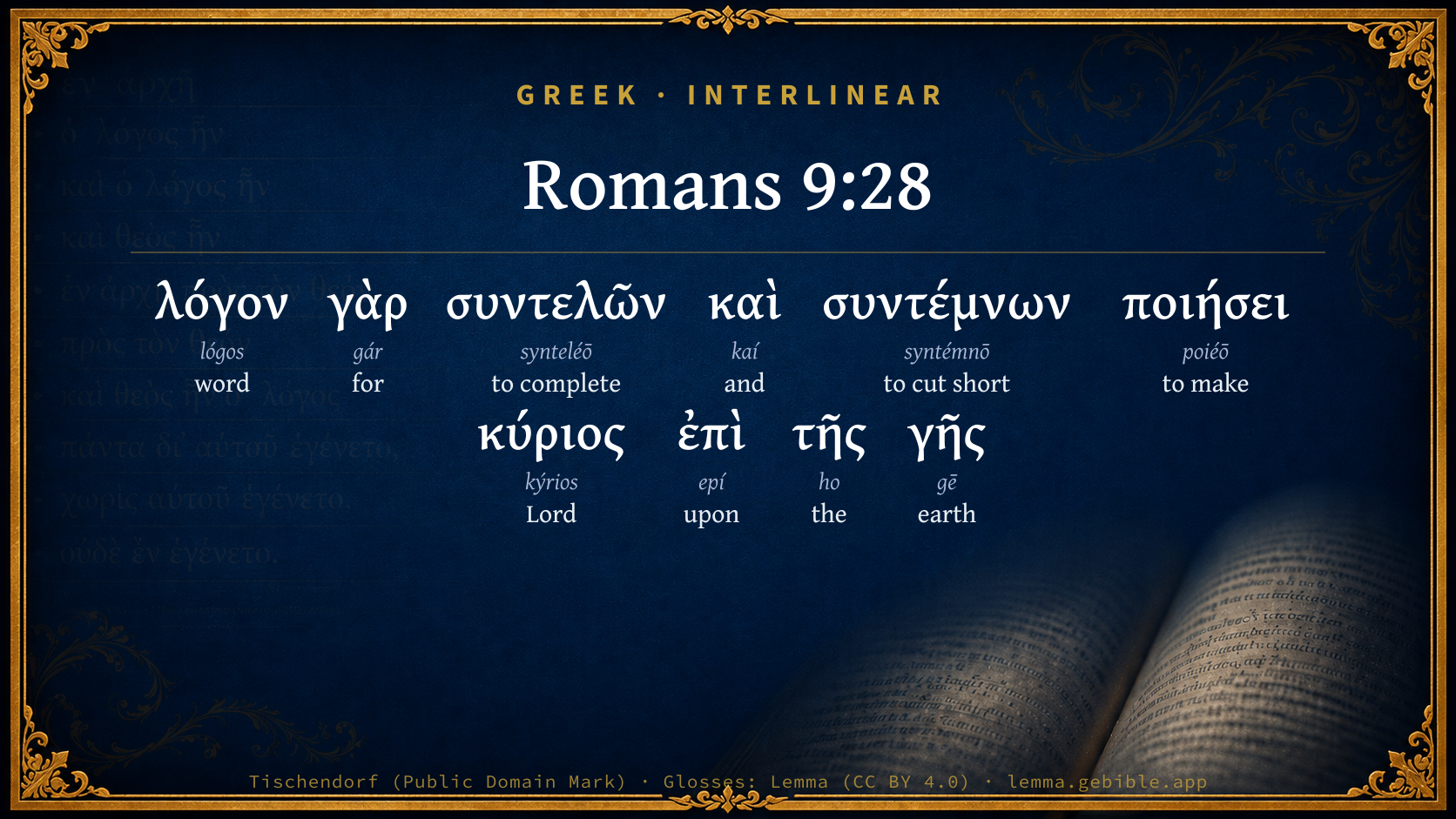
Download image
Cite this verse

Romans 9:28 (World English Bible). Public Domain. Lemma interlinear Bible study tool, https://lemma.gebible.app/v/romans/9/28.

Show BibTeX & RIS
BibTeX
RIS
English Translation
For He will finish the work and cut it short in righteousness, Because the LORD will make a short work upon the earth."
World English Bible · Public Domain
Highlights
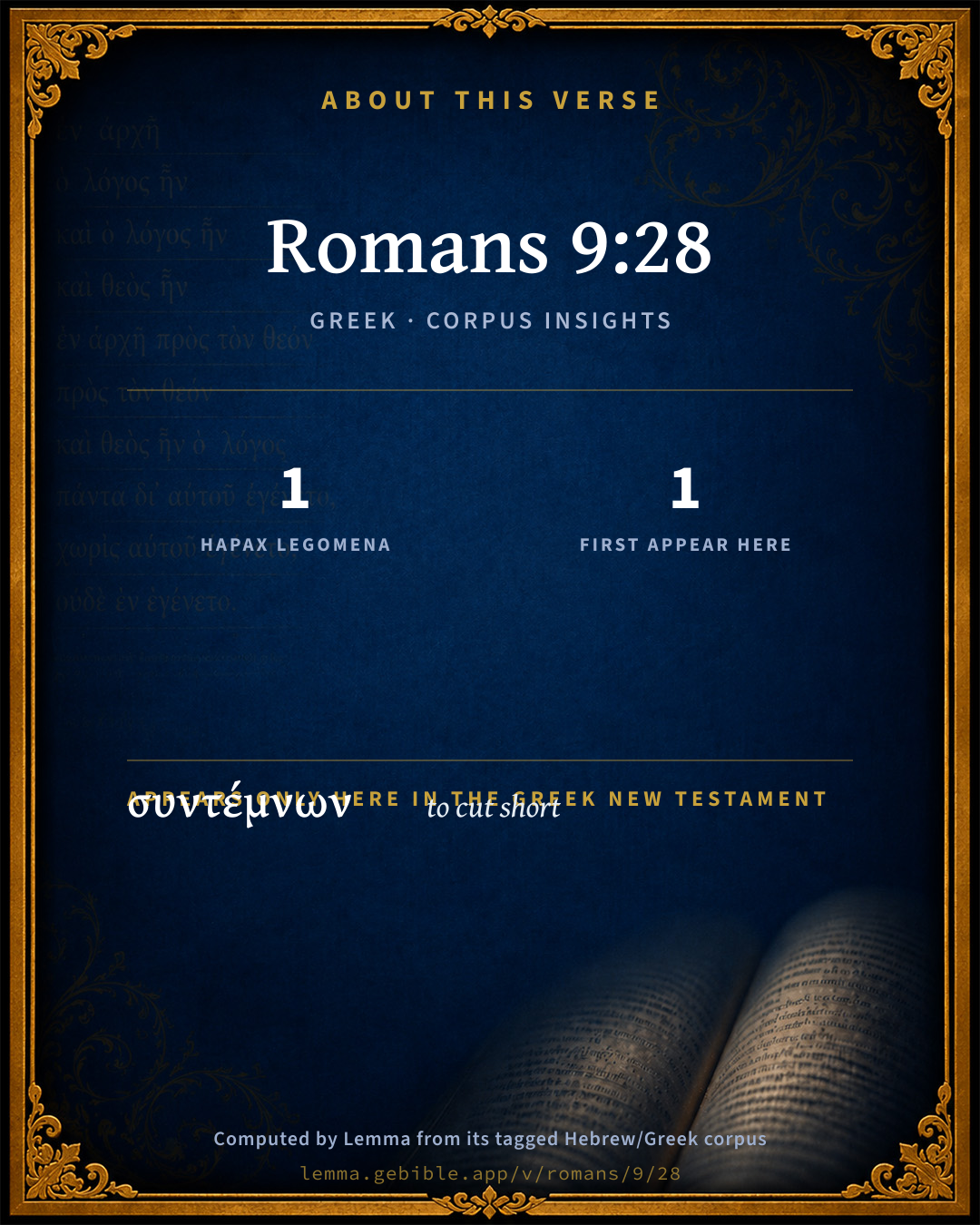
  • 1 hapax legomenon — only here in the Greek New Testament
  • 1 first appearance in the Greek New Testament
Full analysis ↓
Download a study sheet

One document with this verse’s original text, its word-by-word gloss line, the meaning frame, cross-references with their text, attributed commentary, and full source and license credits — printable, and it pastes into notes with its structure intact.

This verse Autodidact and up

Study sheet (.html) Plain text (.txt)

A passage Seminary Student

Up to 50 verses in one chapter. A passage sheet keeps up to 6 commentary sources and 12 cross-references per verse, in the order this page ranks them, and says so on the sheet whenever that leaves anything out. Ask for a single verse and you get the Autodidact verse sheet above.

Everything on this page stays free to read, with no account — the sheet is a download of what is already on screen, not access to it.

Want to remove ads? Support Godless Engineer
Compare translations 3

The same verse in 3 English versions, stacked beneath the original-language interlinear above. Click any original word for its lexicon entry.

Each is an independent rendering of the whole verse — the interlinear is not word-aligned to these translations.

Highlighted words mark where these versions differ — a whole-verse word diff, not a word-by-word alignment.

  • World English Bible Public Domain
    For He will finish the work and cut it short in righteousness, Because the LORD will make a short work upon the earth."
  • King James Version Public Domain
    For he will finish the work, and cut it short in righteousness: because a short work will the Lord make upon the earth.
  • unfoldingWord Literal Text CC BY-SA 4.0
    for the Lord will carry out his word on the earth, finishing and cutting short.”

unfoldingWord Literal Text — © unfoldingWord, licensed CC BY-SA 4.0. Word-aligned USFM3 via Door43 (git.door43.org/unfoldingWord/en_ult).

Versions to compare (up to 4)

3 of 4 selected

Show all 19 translations

Every available English version of this verse, each an independent rendering of the whole verse.

  • World English Bible Public Domain
    For He will finish the work and cut it short in righteousness, Because the LORD will make a short work upon the earth."
  • Berean Standard Bible Public Domain
    For the Lord will carry out His sentence on the earth thoroughly and decisively.”
  • Majority Standard Bible Public Domain
    For the Lord will carry out His sentence thoroughly and decisively in righteousness, because He will cut short the matter on the earth.”
  • King James Version Public Domain
    For he will finish the work, and cut it short in righteousness: because a short work will the Lord make upon the earth.
  • American Standard Version (1901) Public Domain
    for the Lord will execute `his' word upon the earth, finishing it and cutting it short.
  • Revised Version (1885) Public Domain
    for the Lord will execute his word upon the earth, finishing it and cutting it short.
  • Geneva Bible (1599) Public Domain
    For he wil make his account, and gather it into a short summe with righteousnes: for the Lord will make a short count in the earth.
  • Douay-Rheims (1899) Public Domain
    For he shall finish his word, and cut it short in justice; because a short word shall the Lord make upon the earth.
  • Young's Literal Translation Public Domain
    for a matter He is finishing, and is cutting short in righteousness, because a matter cut short will the Lord do upon the land.
  • Literal Standard Version CC BY-SA 4.0
    for a matter He is finishing, and is cutting short in righteousness, because a matter cut short will the LORD do on the land.”
  • Unlocked Literal Bible CC BY-SA 4.0
    for the Lord will carry out his sentence on the earth, completely and without delay.”
  • unfoldingWord Literal Text CC BY-SA 4.0
    for the Lord will carry out his word on the earth, finishing and cutting short.”
  • Darby Bible Public Domain
    for [he] is bringing the matter to an end, and [cutting [it] short in righteousness; because] a cutting short of the matter will [the] Lord accomplish upon the earth.
  • World Messianic Bible Public Domain
    for he will finish the work and cut it short in righteousness, because the Lord will make a short work upon the earth.”
  • Webster's Bible Public Domain
    For he will finish the work, and cut it short in righteousness: because a short work will the Lord make upon the earth.
  • Free Bible Version CC BY-SA 4.0
    For the Lord is going to quickly and completely finish his work of judgment on the earth.”
  • Bible in Basic English Public Domain
    For the Lord will give effect to his word on the earth, putting an end to it and cutting it short.
  • Text-Critical English NT CC BY 4.0
    For the Lord will settle the matter swiftly and justly; his sentence will be executed upon the earth without delay.”
  • Tyndale New Testament (1534) Public Domain
    He finyssheth the worde verely and maketh it short in ryghtwesses. For a short worde will god make on erth.

Literal Standard Version (2020), Covenant Press — licensed CC BY-SA 4.0. Text via the HelloAO Bible API (eBible.org). Unlocked Literal Bible (unfoldingWord) — licensed CC BY-SA 4.0. Text via the HelloAO Bible API (eBible.org). unfoldingWord Literal Text — © unfoldingWord, licensed CC BY-SA 4.0. Word-aligned USFM3 via Door43 (git.door43.org/unfoldingWord/en_ult). Free Bible Version, Dr. Jonathan Gallagher — licensed CC BY-SA 4.0. Text via the HelloAO Bible API (eBible.org).

Word by word

More ways to search: Search by grammar → Find every occurrence → Compare this word →

Practice this passage: Drill this verse → Learn its vocabulary →

About this verse

These counts appear in no published source. They are computed here, from the morphology-tagged text and Lemma’s own curated glosses. What Lemma adds →

10
words
10
distinct lemmas
Pauline Epistles
section

Notable vocabulary

1 hapax legomenon — a word that appears only here in the entire Greek New Testament:

  • συντέμνων to cut short G4932

First appearance in Scripture

This word makes its first canonical appearance in the Greek New Testament here:

  • συντέμνων to cut short G4932

Shared distinctive vocabulary

συντελῶν to complete G4931 occurs in 7 verses of the Greek New Testament. Also found in:
Cross-references

10

Topical passages linked to Romans 9:28 in the Treasury of Scripture Knowledge — connected by theme and wording, ordered by reader-vote popularity; previews shown in the World English Bible.

  • Isaiah 10:23 For a full end, and that determined, will the Lord, Yahweh of Hosts, make in the midst of all the earth.
  • Psalms 9:8 He will judge the world in righteousness. He will administer judgment to the peoples in uprightness.
  • Isaiah 30:12–14 Therefore thus says the Holy One of Israel, "Because you despise this word, and trust in oppression and perverseness, and rely thereon;
  • Acts 17:31 because he has appointed a day in which he will judge the world in righteousness by the man whom he has ordained; of which he has given assurance to all men, in that he has raised him from the dead."
  • Revelation 19:11 I saw the heaven opened, and behold, a white horse, and he who sat on it is called Faithful and True. In righteousness he judges and makes war.
  • Psalms 65:5 By awesome deeds of righteousness, you answer us, God of our salvation. You who are the hope of all the ends of the earth, Of those who are far away on the sea;
  • Isaiah 5:16 But Yahweh of Hosts is exalted in justice, And God the Holy One is sanctified in righteousness.
  • Isaiah 28:22 Now therefore don't you be scoffers, lest your bonds be made strong; for a decree of destruction have I heard from the Lord, Yahweh of Hosts, on the whole earth.
  • Daniel 9:26–27 After the sixty-two weeks the Anointed One shall be cut off, and shall have nothing: and the people of the prince who shall come shall destroy the city and the sanctuary; and the end of it shall be with a flood, and even to the end shall be war; desolations are determined.
  • Matthew 24:21 for then there will be great oppression, such as has not been from the beginning of the world until now, no, nor ever will be.

Cross-references courtesy of OpenBible.info (CC BY 4.0).

Where the printed editions differ

1 variant

Places in this verse where the major printed Greek editions disagree on the wording in a way that affects the translation — a comparison of editions, not a manuscript-by-manuscript collation. The editions are the modern critical texts (Nestlé-Aland 28/27, SBL, Westcott-Hort, Tregelles, Tyndale House) and the traditional texts behind the KJV (the Textus Receptus and the Byzantine/Majority text). It is not a claim about which reading is original.

  1. Extra text
    ἐν δικαιοσύνῃ ὅτι λόγον συντετμημένον

    “in righteousness for word brought swiftly”

    In TRByz Not in NA28NA27TynSBLWHTreg

    ἐν δικαιοσύνῃ ὅτι λόγον συντετμημένον (en dikaiosunē hoti logon suntetmēmenon) 'in righteousness for word brought swiftly' is only in traditional manuscripts (TR+Byz)

Textual data: Translators Amalgamated Greek New Testament (STEPBible TAGNT) · CC BY 4.0.

Commentary

Notes on Romans 9:28 from classic Christian and Jewish commentators (each source and its license shown beneath its notes). The classic Christian expositions comment on the surrounding passage and are grouped to its opening verse, so a note may address several verses; the Jewish commentaries on the Tanakh (Rashi and others) are per-verse, so they appear only where the commentator wrote on this verse.

Lemma curates 59 commentaries, every one of them public domain or Creative Commons licensed, each selected and text-cleaned for this edition rather than reprinted as found. About our sources →

McGarvey & Pendleton's Commentaries

J. W. McGarvey

for the Lord will execute his word upon the earth, finishing it and cutting it short . [ Isa_10:22-23 . This prophecy, like that of Hosea, refers to the return of the ten tribes in the latter days, and is therefore an unfulfilled prophecy, save as it had a preliminary and minor literal fulfillment in the destruction of Jerusalem, a few years after Paul wrote this Epistle, which was the climax of rejection for the generation to which Paul wrote, and the full establishment of that age-long rejection of the majority which pertains unto this day. Daniel, dealing with its spiritual fulfillment, foretold that the labors of the Christ "confirming the covenant" with Israel would only last a week--a jubilee week having in it eight years, or from A. D. 26 to A. D. 34 ( Dan_9:27 ). How small the remnant gathered then! In the centuries since how small the ingathering! And, alas! now that we have come to the "latter days" and the last gathering, and the final literal and spiritual fulfillment of the prophecy, it gives us assurance of no more than a mere remnant still! Rom_9:28 ; as given in full by Isaiah, is thus happily paraphrased by Riddle, "He (the Lord) is finishing and cutting short the word (making it a fact by rapid accomplishment) in righteousness, for a cut-short word (one rapidly accomplished) will the Lord make (execute, render actual) upon the earth." When we consider that the Lord reckons a thousand years as but a day, how short was the spiritual privilege of the eight years exclusive ministry of Jesus and his apostles! and how brief was the forty years' (A. D. 30-70) temporal privilege between the crucifixion and the destruction of Jerusalem! Isaiah's word shows us that the final fulfillment will be also a brief season, a cut-short word, doubtless a repetition of Daniel's week.]

J. W. McGarvey (with Philip Y. Pendleton), Commentaries on the New Testament (The Fourfold Gospel, 1914; Acts; and the epistles) — public domain. Text from a community e-Sword/MySword module.

Bengel's Gnomon

Johann Albrecht Bengel

Rom 9:28. Λόγον) a thing heard, and therefore spoken, Isa 28:22.—συντελῶν και συντέμνων) supply, as is often necessary in Hebrew, the word is, comp. Act 24:5; 2Pe 1:17; Heb. כלה ונהרצה and כליון הרוע. The Lord συντελεῖ, will consummate His λόγον word [decree] concerning Israel, in respect to the appointed [fixed] punishment (so that it becomes כלה, consummated, completed); and at the same time συντέμνει λόγον, cuts short His word, in respect to the termination [will make a speedy termination] of the punishment (so that נחרצה becomes כלה, this decree becomes consummated). The word Lord is to be supplied from the following clause; and the owrd συντελῶν may be taken either as the subject, or rather, since the article is wanting, as a part of the predicate [the Lord is about to consummate, etc.]—ἐν δικαιοσὑνη, שוטף צדקה. Isa 10:22.

Bengel's Gnomon of the New Testament — English translation (T&T Clark, Edinburgh, 1860) — public domain. Text from a community e-Sword module.

Meyer's Critical & Exegetical Commentary

Heinrich August Wilhelm Meyer

Rom_9:28. The Hebrew runs: כִּלָּיוֹן חָרוּץ שֹׁטֵף צְדָקָה כִּי כָלָה וְנֶֽחֱרָצָה אֲדֹנָי יְהֹוָה צְבָאוֹת עֹשֶׂה בְּקֶרֶב כָּלּ־הָאָרֶץ. Extirpation is decided, streaming justice (i.e. penal justice); for extirpation and decision (penal decision) the Lord Jehovah Zebaoth makes (i.e. is on the point of executing) in the midst of the whole earth (on Zion). The LXX. did not understand these words, and translated them incorrectly (on how they came to do so, see Fritzsche, also Maier, in the Theol. Jahrb. 1845, I. p. 190 f.). This cannot be denied; nor are we, with Olshausen, to attempt to conceal or smooth over the fact by arbitrary interpretation of the Hebrew. Paul has nevertheless felt no scruple in abiding by their translation with a few unimportant deviations, since its sense is not less suitable than that of the original to the connection and object which the declaration here subserves. The words, as Paul has them, mean: For utterance-accomplishing and (as matter of fact, through a speedy execution of it) shortcutting in righteousness (is He); for a short-cut utterance (i.e. a saying in which the whole penal decision is summarily included) will the Lord bring to pass on the earth. In reference to single expressions, remark: (1) λόγον, which belongs to both participles, is neither decree (usually so taken, but this is not its meaning), nor matter of fact (Beza, Melancthon, Castalio, Calvin, Koppe, Reithmayr, formerly also Hofmann, Weissag. u. Erf. II. p. 213, and various others), which it never denotes with Paul, nor reckoning, which, in connection with ποιεῖν, would be contrary to idiom, but dictum, an utterance, which He has delivered; and this indeed, in the first clause of the verse, which expresses the executive justice of God in general, is to be understood quite generally; comp. Erasmus, Paraphr.: quicquid dixit, plene praestet et quidem compendio. In the second clause, on the other hand, which adduces proof of that general description of God with the concrete case, the occurrence of which is predicted, the divine saying of Rom_9:27, delivered through the prophet, is intended. (2) συντέμνειν, used of something that is said (speeches, answers, and the like), like συναιρεῖν, never denotes in Greek anything else than to cut short (Plato, Protag. p. 334 D, Ephesians 3, p. 318 B; Aeschines, p. 32. 23; Euripides, Iph. A. 1249, Aeol. fr. v. 2; Lucian, bis. accus. 28; Soph. fragm. 411, Dind.; 2Ma_10:10; Pflugk, ad Eur. Hec. 1180), and it is therefore inadmissible to depart from this signification of the συντομία λόγων (Plato, Phaedr. p. 267 B). We must, however, observe that in συντέμνων this comprising in short must be a matter of fact, consisting in the short summary despatch of the matter (comp. LXX. Isa_28:22; Eur. Rhes. 450), like our cut it short; while, on the other hand, συντετμημένον (perfect) refers to the concise, short, and stern style in which the saying itself is conceived (τὸ ὑπόλειμμα σωθήσεται!). Passages in which συντέμνειν denotes overtake and the like (as Soph. Ant. 1090) have no bearing on the present one. Neither are we to adopt what Tholuck reads into it, that God will accomplish the promise delivered in Isa_10:20-21, only with great limitation of the number of the people, which would, besides, be not at all suitable to the perfect participle συντετμημένον. Moreover, the LXX. cannot have meant λόγον of the word of promise, but, according to the sense of the original, only of the penal judicial declaration. (3) ἐν δικαιοσύνῃ does not stand for the righteousness of faith (Fritzsche), but is to be referred, according to the context, as in the Hebrew, to the judicial righteousness of God. (4) The participles συντετ. and συντέμνων require only ἐστί to be supplied. See Hermann, ad Viger. p. 776; Bernhardy, p. 470; Kühner, II. 1, p. 37. And (5) as respects the argumentative force of the γάρ, it lies in the fact that, if God causes such a penal judgment to be issued on Israel, the part of the people remaining spared, which obtains salvation, can only be the ὑπόλειμμα out of the mass, that which remains over. Incorrectly Hofmann, in accordance with his erroneous interpretation of Rom_9:27-28, explains: So long as this present world-period endures, Israels final salvation might remain in suspense; but Jehovah leaves it not on this footing, He makes an end, and settles accounts with the world, and the remnant which is then Israels people returns to Him and attains to salvation.

Meyer — Critical and Exegetical Commentary on the New Testament — English translation by Peter Christie, edited by Frederick Crombie (T&T Clark, 1880) — public domain. Text from a community e-Sword module.

Hodge's Commentary on Romans, Ephesians & First Corinthians

Charles Hodge

Rom_9:27, Rom_9:28

The second part of the apostles conclusion, Rom_9:24, is, that the Jews, as such, were not to be included in the kingdom of Christ, which, of course, is implied in all those predictions which speak of them as in general cut off and rejected. Two such passages Paul quotes from Isaiah The first is from Isa_10:22, Isa_10:23. Though the number of the children of Israel be as the sand of the sea, a remnant shall be saved, for he will finish the work and cut it short in righteousness: because a short work will the Lord make upon the earth. This passage is nearer the lxx translation than to the Hebrew. The general sense is the same in both, and also in the apostles version, However numerous the children of Israel might be, only a small portion of them should escape the judgments of God. This being the case, it is evident that the mere being a Jew was never considered sufficient to secure the divine favor. The portion of the prophecy contained in Rom_9:27 is the principal point, Only a few of the Jews were to be saved. What is contained in Rom_9:28 is an amplification, or states the converse of the preceding proposition. Most of the Jews should be cut off. The passage in Isaiah, therefore, is strictly applicable to the apostlesobject.‹51›

Our version of Rom_9:28 is consistent with the original.‹52› But it may also be rendered, He will execute and determine on the judgment with righteousness, for a judgment determined on, will the Lord execute in the earth. The word (λόγον) rendered work in our version, means properly a word, something spoken, and may refer to a promise, or threatening, according to the context. Here of course a threatening is intended; the judgment threatened by the prophet in the context. The word (συντελῶν) rendered he will finish, means bringing to an end, and here perhaps, executing at once, bringing to an end speedily. And the term (συντέμνων) translated cutting short, may mean deciding upon. See Dan_9:24, Seventy weeks are determined (συνετμήθησαν) upon my people. But the ordinary sense of the word is in favor of our version, and so is the context.‹53› If it were allowable to take the same word in different senses in the same passage, the verse might be rendered thus, For he will execute the judgment, and accomplish it speedily, for the judgment determined upon will the Lord execute in the earth. The same word is used in one of these senses, Dan_9:24, and in the other in Dan_9:26 of the same chapter. See, too, an analogous example in 1Co_3:17, If any man (φθείρει) defile the temple of God, him will God (φθερεῖ) destroy. Here the same word is rendered correctly, first defile, and then destroy. We may, therefore, render the last clause of the verse either as in our version, or as given above.

Charles Hodge — Commentary on Romans (1835), First Corinthians (1857), and Ephesians (1856) — public domain. Text from a community e-Sword module.

Geneva Bible (1599)

Geneva Bible translators

God purposeth to bring the unkind and unthankful people to an extreme fewness.

Geneva Bible (1599) marginal notes — public domain. Text via Bolls.life.

Jamieson, Fausset & Brown

Robert Jamieson, A. R. Fausset & David Brown

For he will finish the work, and cut--"is finishing the reckoning, and cutting it"

it short in righteousness; because a short work--"reckoning"

will the Lord make upon the earth-- (Isa 10:22-23), as in the Septuagint. The sense given to these words by the apostle may seem to differ from that intended by the prophet. But the sameness of sentiment in both places will at once appear, if we understand those words of the prophet, "the consumption decreed shall overflow with righteousness," to mean that while a remnant of Israel should be graciously spared to return from captivity, "the decreed consumption" of the impenitent majority should be "replete with righteousness," or illustriously display God's righteous vengeance against sin. The "short reckoning" seems to mean the speedy completing of His word, both in cutting off the one portion and saving the other.

Jamieson, Fausset & Brown — Commentary Critical and Explanatory on the Whole Bible (1871) — public domain (CC PDM 1.0). Text via the HelloAO Bible API.

Adam Clarke's Commentary

Verse 28. For he will finish the work, and cut it short, c.] These appear to be forensic terms, and refer to the conclusion of a judicial proceeding the Lord has tried and found them guilty, and will immediately execute upon them the punishment due to their transgressions.

Adam Clarke's Commentary on the Bible (1810–1826) — public domain. Text from a community e-Sword/MySword module.

John Calvin's Commentaries

28. For I will finish and shorten the matter, etc. Omitting various interpretations, I will state what appears to me to be the real meaning: The Lord will so cut short, and cut off his people, that the residue may seem as it were a consumption, that is, may have the appearance and the vestige of a very great ruin. However, the few who shall remain from the consumption shall be a proof of the work of God’s righteousness, or, what I prefer, shall serve to testify the righteousness of God throughout the world. As word often in Scripture means a thing, the consummated word is put for consumption. Many interpreters have here been grossly mistaken, who have attempted to philosophize with too much refinement; for they have imagined, that the doctrine of the gospel is thus called, because it is, when the ceremonies are cut off, a brief compendium of the law; though the word means on the contrary a consumption. And not only here is an error committed by the translator, but also in Isaiah 10:22, 23; Isaiah 28:22; and in Ezekiel 11:13; where it is said, “Ah! ah! Lord God! wilt thou make a completion of the remnant of Israel?” But the Prophets meant to say, “Wilt thou destroy the very remnant with utter destruction?” And this has happened through the ambiguity of the Hebrew word. For as the word, כלה, cale, means to finish and to perfect, as well as to consume, this difference has not been sufficiently observed according to the passages in which it occurs.

But Isaiah has not in this instance adopted one word only, but has put down two words, consumption, and termination, or cutting off; so that the affectation of Hebraism in the Greek translator was singularly unseasonable; for to what purpose was it to involve a sentence, in itself clear, in an obscure and figurative language? It may be further added, that Isaiah speaks here hyperbolically; for by consumption he means diminution, such as is wont to be after a remarkable slaughter.

John Calvin's Commentaries (1540-1563) — public domain. Text from the Calvin Translation Society English edition (1840s-50s) via the Christian Classics Ethereal Library (ccel.org). Calvin's coverage is partial (roughly two-thirds of the Bible); uncommented books and verses are honest gaps, never fabricated. The 19th-century editor's footnotes and remarks are omitted so the notes are faithfully Calvin's own voice.

Ellicott's Commentary for English Readers

(28) For he will finish.—Literally, according to the correct reading, For a sentence, accomplishing and abridging it, will the Lord execute upon the earth; in other words, “A short and summary sentence will the Lord execute upon the earth.” The severity of the sentence is a proof that only a remnant can be saved from it. St. Paul follows the LXX., with but slight deviation. The sense of the Hebrew appears to be somewhat different:—“For though thy people. O Israel, were as the sand of the sea, but a remnant of them shall return: a destruction is decreed overflowing with righteousness—i.e., penal justice. For destruction by a sure decree will Jehovah of Hosts perform in the midst of all the earth.” (Cheyne.)

A Bible Commentary for English Readers, edited by Charles John Ellicott (1878–1897) — public domain. Text from a community e-Sword module.

The Cambridge Bible for Schools and Colleges

gen. ed. J. J. S. Perowne

28. for he will finish, &c.] These words agree closely with the letter of the LXX., but not with that of the Heb. They convey the point of the Heb., however, quite enough for the purpose of the quotation; and St Paul thus adopts them.—In some important documents the quotation ends with “cut it short;” but the evidence is not conclusive.—The main purport of this verse is clear: the Prophet foretells summary and severe judgments on Israel, such as to leave ere long only a “remnant” able and willing to “return.”—“In righteousness:”—i.e. “in righteous severity”

The Cambridge Bible for Schools and Colleges (gen. ed. J. J. S. Perowne; Cambridge University Press, 1878–1918) — public domain. Text from a community e-Sword module.

John Gill's Exposition

And as Esaias said before,.... In the beginning of his prophecy, in Isa 1:9.

Except the Lord of sabaoth had left us a seed; the title and character the great God goes by here, is "Lord of sabaoth", that is, "of hosts", or "armies"; the Septuagint often leave the word untranslated, as here and elsewhere, as in Sa1 1:11. He is Lord of the hosts of heaven, the sun, moon, and stars, whom he brings forth by number, calls by their names, and them to praise him; of the angels, the multitude of the heavenly host, that do his pleasure, fight under him, and for him; and of the hosts of nations, of the several kingdoms of the world, who are all under his government, and among whom he acts according to his sovereign will and pleasure. Kimchi on the place says, he is called so,

"because of "the hosts above", and because of "the hosts below", who are the Israelites, that are called "hosts"; wherefore he would not consume us all, as we deserved:''

no, according to the council of his own will, he left them "a seed"; or as it is in Isaiah, a very small remnant": and so the Syriac here, a remnant"; both signify one and the same, namely, a few persons only: "a remnant" signifies a few, which remain out of a large number; and so does "seed", which is reserved for sowing again, after the whole stock is sold off, or consumed: and the leaving of this small number designs God's gracious acts of reserving in the election of a people for himself; the calling them by his grace in time, and preserving them from general corruption; which if he had not done among the Jews, as Jarchi on the text says,

"of himself, and by his mercies, and not for our righteousnesses,''

we had been as Sodoma, and been made like unto Gomorrha; the cities which God destroyed with fire and brimstone from heaven, for their iniquities: had it not been for electing grace, they would have been like the inhabitants of these cities for wickedness; and the case would have been the same with us and with the whole world, had it not been for God's act of election, choosing some to holiness here, and happiness hereafter. The decree of election is so far from being a door to licentiousness, that it is the true spring and source of all real holiness, that has been, or is in the world; and had it not been for this, there would have been no such thing as holiness in the world; and consequently not only Judea, but thee whole world, were it not for this, must have been long before now, like Sodom and Gomorrah, in their punishment.

John Gill's Exposition of the Whole Bible (1746–1763) — public domain (CC PDM 1.0). Text via the HelloAO Bible API.

Trapp's Complete Commentary

John Trapp

28 For he will finish the work, and cut it short in righteousness: because a short work will the Lord make upon the earth.

Ver. 28. A short work] When once he sets to work to cut off hypocrites.

John Trapp, A Commentary or Exposition upon All the Books of the Old and New Testament (1647–1656) — public domain. Text from a community e-Sword module.

Matthew Poole's English Annotations

This verse is also found in that forecited place, Isa 10:22, 23. The apostle in this, and in the other citations, follows the Seventy, which was a received translation, and had been in request about three hundred years, though in this, and in other places, it is very different from the Hebrew text. That which God is said to finish, and cut short, is his work; the Greek is λογος, which signifies his word, or the account, as some read it. This is brought in as a reason why a remnant only should be saved; because God would shorten the acconnt, or (as we read it) make a short work, in the Jewish World. He would bring a sudden destruction upon that people. Sennacherib and the Assyrians, or Titus Vespasian and the Romans, shall make a complete and speedy conquest of them; few of them shall remain, the greater part being involved, first in infidelity, then in destruction. The apostle makes those few to be a type of God’s elect among that people, that should be saved by faith in Jesus Christ.

Matthew Poole's English Annotations on the Holy Bible (1683–1685) — public domain. Text from a community e-Sword/MySword module.

Whedon's Commentary on the Bible

Daniel D. Whedon

28. For—The apostle’s words are nearly a verbatim quotation from the Septuagint, and so quite different from the English translation.

Daniel D. Whedon (gen. ed.), Commentary on the Old and New Testaments (1874–1909) — public domain. Text from a community e-Sword module.

John Wesley's Explanatory Notes

For he is finishing or cutting short his account - In rigorous justice, will leave but a small remnant. There will be so general a destruction, that but a small number will escape.

John Wesley, Explanatory Notes Upon the Whole Bible (1754–1765) — public domain. Text via the GEBible commentary corpus.

Scofield Reference Notes

C. I. Scofield

Lord

Adonai Jehovah. Isa 10:23.

The Scofield Reference Bible (1917 edition), notes by C. I. Scofield — public domain. Text from a community e-Sword module.

Godbey's Commentary on the New Testament

William B. Godbey

28. “For perfecting and cutting it short, the Lord will verify his work upon the earth.” When God’s time comes to restore the Jews, I know He will astonish the world by the miracles of His summary prophetical fulfillments.

William B. Godbey, Commentary on the New Testament (1896–1900) — public domain. Text from a community e-Sword module.

The People's New Testament

B. W. Johnson

28. For he will finish the work. This verse, quoted from Isaiah, shows why only a remnant will be left. God's righteous judgment will cut the rest off from his favor.

B. W. Johnson's The People's New Testament with Notes (1889–1891) — public domain. Electronic text from the Christian Classics Ethereal Library (CCEL) ThML edition.

Cambridge Greek Testament for Schools and Colleges

28. λόγον γὰρ συντελῶν κ.τ.λ. Cf. Isa 28:22 = LXX[195] πράγματα: λόγον w. ποιήσει, ‘shall effect a reckoning upon earth, completely and briefly.’

[195] LXX. the Septuagint Version of the Old Testament

Cambridge Greek Testament for Schools and Colleges (Cambridge University Press, 1896; 21 vols, various authors incl. Carr, Maclear, Plummer, Farrar, Lumby, Moule, M. R. James, Simcox) — public domain. Text from a community e-Sword module.

Alford’s Greek Testament

Henry Alford

28.] The reference of this latter part of the citation is not very plain. It is almost verbatim from the LXX, the γάρ (which is found in Aא but not in B) being perhaps adopted by the Apostle as continuing the testimony, = ‘for the prophet proceeds,’—and the LXX having κατάλειμμα for ὑπόλειμμα (see digest), and ἐν τῇ οἰκουμένῃ ὅλῃ for ἐπὶ τῆς γῆς. The literal rendering of the Heb. is, “The consummation (or consumption) decided, overfloweth with righteousness: for a decision (or consumption) and a decree shall the Lord Jehovah of Sabaoth make in the midst of all the land.” As it stands in the LXX, the meaning seems to be, the Lord will complete and soon fulfil His word in righteousness (viz. his denunciation of consuming the Assyrian and liberating the remnant of His people): for the Lord will make a rapidly accomplished word in the midst of all the land. The E. V., Calv., and others, render λόγον, ‘work,’ a signification which it never has. If the above interpretation be correct, and the view which I have taken of the analogy of prophecy, it will follow that this verse is adduced by the Apostle as confirming the certainty of the salvation of the remnant of Israel, seeing that now, as then, He with whom a thousand years are as a day, will swiftly accomplish His prophetic word in righteousness.

Henry Alford, The Greek Testament (1849–1861) — public domain. Text from a community e-Sword module.

International Critical Commentary

28. λόγον γὰρ συντελῶν καὶ συντέμνων ποιήσει Κύριος ἐπὶ τῆς γῆς: συντελῶν, ‘accomplishing,’ συντέμνων, ‘abridging.’ Cf. Isa 28:22 διότι συντετελεσμένα καὶ συντετμημένα πράγματα ἤκουσα παρὰ Κυρίου Σαβαώθ, ἅ ποιήσει ὲπὶ πᾶσαν τὴν γῆν. ‘For a word, accomplishing and abridging it, that is, a sentence conclusive and concise, will the Lord do upon the earth.’

Three critical points are of some interest:

(1) The variations in the MSS. of the Gr. Test. For ὑπόλειμμα (ὑπόλιμμα WH.) of the older MSS. (א A B Eus.), later authorities read κατάλειμμα to agree with the LXX. In ver. 28 λόγον γὰρ συντελῶν καὶ συντέμνων ποιήσει Κύριος ἐπὶ τῆς γῆς is the reading of א A B a few minusc., Pesh. Boh. Aeth., Exo 2:3; Western and Syrian authorities add after συντέμνων, ἐν δικαιοσύνῃ· ὅτι λόγον συντετμημένον to suit the LXX. Alford defends the T. R. on the plea of homoeoteleuton (συντέμνων and συντετμημένον), but the insertion of γάρ after λόγον which is preserved in the T. R. (where it is ungrammatical) and does not occur in the text of the LXX, shows that the shortened form was what St. Paul wrote.

(2) The variations from the LXX. The LXX reads καὶ ἐὰν γένηται ὁ λαὸς Ἰσραὴλ ὡς ἡ ἄμμος τῆς θαλάσσης, τὸ κατάλειμμα αὐτῶν σωθήσεται. λόγον συντελῶν καὶ συντέμνων ἐν δικαιοσύνῃ ὅτι λόγον συντετμημένον Κύριος ποιήσει ἐν τῇ οἰκουμένῃ ὅλῃ. St. Paul substitutes ἀριθμὸς τῶν υἱῶν Ἰσραήλ, a reminiscence from Hos 1:10, the words immediately preceding those quoted by him above. The later part of the quotation he considerably shortens.

(3) The variations of the LXX from the Hebrew. These appear to arise from an inability to translate. For ‘a final work and a decisive, overflowing with righteousness,’ they wrote ‘a word, accomplishing and abridging it in righteousness,’ and for ‘a final work and a decisive,’ ‘a word abridged will the Lord do,’ &c.

International Critical Commentary — older volumes (1896–1929), various authors — public domain. Text from a community e-Sword module.

Vincent's Word Studies in the New Testament

Marvin R. Vincent

For the reading of the A. V. read as Rev. The Lord will execute His word upon the earth, finishing and cutting it short. Difficulty arises on account of the variation in the Greek text and the difference between the reading adopted by the best authorities and the Septuagint, and again on account of the variation of the latter from the Hebrew. The Hebrew reads : Extirpation is decided, flowing with righteousness, for a consumption and decree shall the Lord of hosts make in the midst of all the land. The Rev. adopts the shorter reading of the Septuagint.

Work [λογον] . It does not mean work, but word, utterance, doctrine; not decree, which logov never means, though the idea may underlie it. Better reckoning.

Finish - cut short [συντελων - συντεμνων] . The preposition sun together signifies summarily; bringing to an end at the same time. Compare the peculiar word ejkolobwqhsan should be shortened, in Mt 24:22, and see note. Omit in righteousness.

Marvin R. Vincent, Word Studies in the New Testament (1887–1900) — public domain. Text from a community e-Sword/MySword module.

Godet's Commentaries

Frédéric Louis Godet

Vv. 28 explains this idea of a saved remnant. This time, indeed, judgment will be carried out neither by halves nor over a long period. It will be, says Isaiah, a sudden and summary execution which will fall not upon this or that individual, but on the nation as a whole. Such is the meaning of the Hebrew and of the LXX., though the latter have somewhat modified the form of the original. Isaiah says literally: “Destruction is resolved on; it makes righteousness overflow; for the Lord works on the earth destruction and decree.” The LXX. translate: “The Lord fulfils the sentence; He cuts short righteously, because He will execute a summary reckoning upon all the earth.” Paul reproduces this second form while abridging it; for it is probable we should prefer the shortest reading, that of the oldest Mjj. and of the Peshito (see the note), since that of the T. R. merely restores the text of the LXX. The word λόγος might undoubtedly signify decree; but in connection with the terms number and remnant of Rom 9:27, as well as with the two participles συντελῶν and συντέμνων, consummating and cutting short, the word ought here to preserve its natural meaning of reckoning: “God will this time make His reckoning with Israel by a short and summary process.” In this threatening the feeling of indignation prevails. Paul subjoins to it a second saying, Rom 9:29, which rather breathes sadness and compassion; it is taken from Isa 1:9. He no longer quotes it with the word κράζει, he cries; he uses the calmer term προείρηκεν, he said before. Some expositors explain this preposition πρό, before, contained in the verb, by the circumstance that in the Book of Isaiah this passage occurs before that which had just been quoted, Rom 9:27-28. This meaning is puerile; for the position has no importance. Paul wishes to bring out the idea that the prophetical mouth of Isaiah having once declared the fact, it must be expected that one day or other it would be realized. The meaning of this saying is, that without a quite peculiar exercise of grace on the part of the Lord, the destruction announced Rom 9:27-28 would have been more radical still, as radical as that which overtook the cities of the plain, of which there remained not the slightest vestige.—Σπέρμα, a germ, a shoot; this word expresses the same idea as ὑπόλειμμα, the remnant, Rom 9:27. But, as is well said by Lange, it adds to it the idea of the glorious future which is to spring from that remnant.

Instead of saying: we should have been made like to, Paul says, with the LXX., made like as, thus heaping up two forms of comparison, so as to express the most absolute assimilation. Such would have been the course of justice; and if Israel will find fault, they have only one thing for which to blame God, that is, for not having annihilated them utterly.

No, certainly; by concluding a special covenant with Israel, God had not abdicated the right of judging them, and alienated His liberty in respect of them and of the rest of mankind. His promise had never had this bearing, and the rejection of Israel does it no violence. But thus far the problem had been treated only from the formal point of view; the question had been only as to God’s right. The apostle now enters upon the matter involved. The right being established, it remains to examine what use God has made of it. This is the subject treated by the apostle in the following passage, which extends from Rom 9:30 to the end of chap. 10.

Frédéric Louis Godet — Commentaries on Luke, John, Romans, and 1 Corinthians — English translation (T&T Clark, Edinburgh, 1870s–1890s) — public domain. Text from a community e-Sword module.

Lesson kit

Teaching starters — assembled from the data on this page, not authored interpretation. Every prompt links to the verse data it draws on. Edit before teaching.

Romans, in the Pauline Epistles, opens this verse with 10 words (10 distinct Greek lemmas). Its most distinctive word is syntémnō (“to cut short”). A historical commentator’s framing appears above. Read the whole chapter for the surrounding context.

Discussion questions

  1. What does “to cut short” (syntémnō) contribute to the verse as a whole?
  2. 1 word here appears nowhere else in the Greek New Testament. Why might the author reach for such rare wording?
  3. This is the first place “to cut short” appears in Scripture (first appears here). What does its debut here establish?
  4. How does Mark 13:4, which shares the word «to complete», read alongside this verse?
  5. These translations render this verse differently; the difference is in the English rendering, not the original. What questions does that raise?
  6. Compare how McGarvey & Pendleton's Commentaries and Bengel's Gnomon read this verse. Where do they agree or differ?

Things to notice

  • 1 word in this verse appears nowhere else in the Greek New Testament.
  • 1 word makes its first canonical appearance in Scripture here.
  • These translations choose different wording for 12 words in this verse.
  • 10 distinct Greek lemmas span 10 words in this verse.

Reading settings

Reading text

Shown beneath each verse's original-language words.

Old Testament
Old Testament edition

Read the OT as the Masoretic Hebrew (MT) or the Greek Septuagint (LXX).

English shown for the Greek Septuagint (in the Hebrew ↔ Greek comparison).

Comparing translations? Open the Compare panel on any verse page to stack up to four side by side.