Revelation 13:14

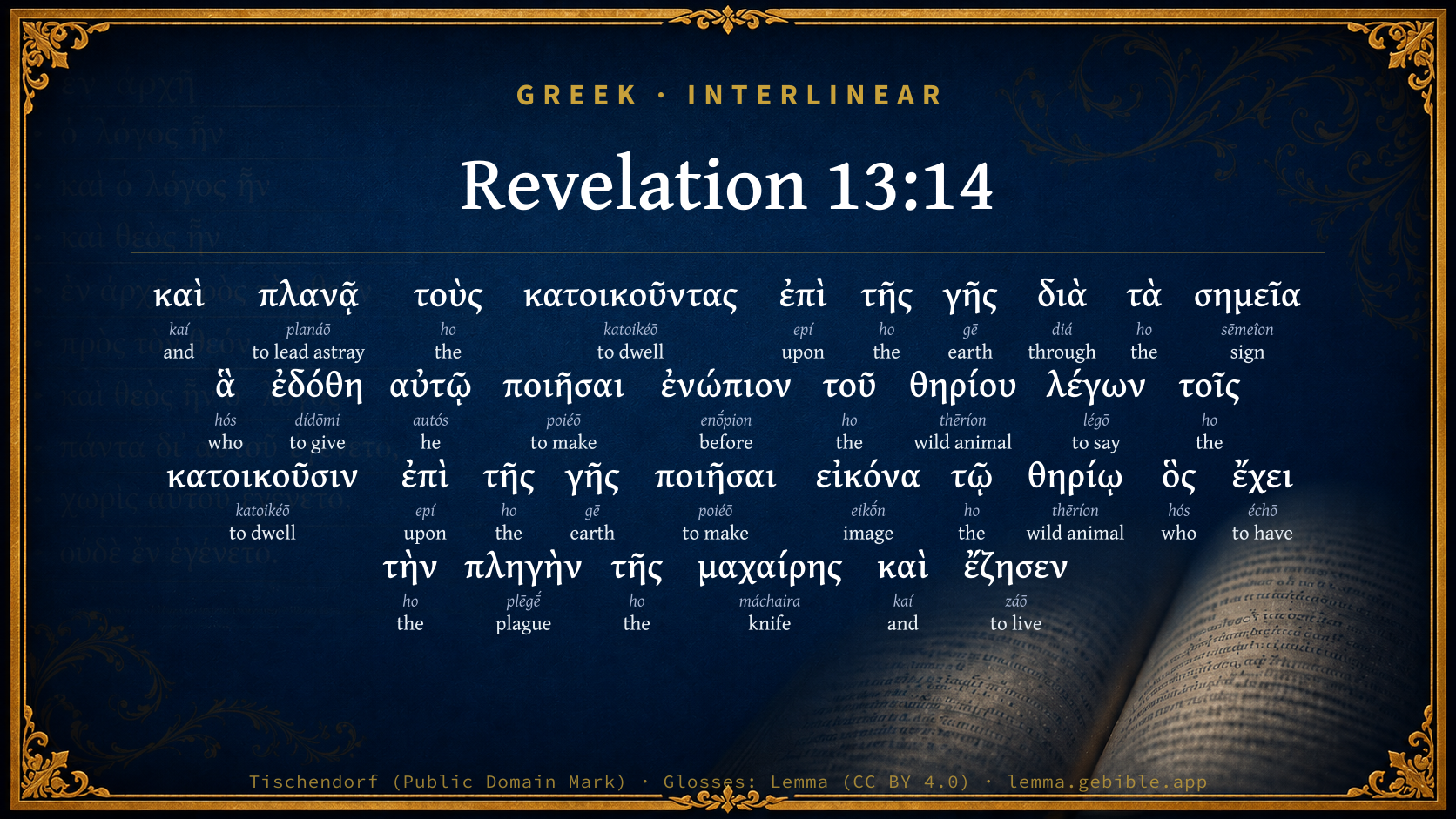
Greek (Tischendorf 8th ed.) Revelation 13:14 appears in the Greek New Testament. The text above is from the Tischendorf 8th edition. Each word links to its Strong’s number and a concise gloss. Click any word for its full Thayer’s Greek Lexicon entry.
Download image
Cite this verse

Revelation 13:14 (World English Bible). Public Domain. Lemma interlinear Bible study tool, https://lemma.gebible.app/v/revelation/13/14.

Show BibTeX & RIS
BibTeX
RIS
English Translation
He deceives my own people who dwell on the earth because of the signs he was granted to do in front of the beast; saying to those who dwell on the earth, that they should make an image to the beast who had the sword wound and lived.
World English Bible · Public Domain
Download a study sheet

One document with this verse’s original text, its word-by-word gloss line, the meaning frame, cross-references with their text, attributed commentary, and full source and license credits — printable, and it pastes into notes with its structure intact.

This verse Autodidact and up

Study sheet (.html) Plain text (.txt)

A passage Seminary Student

Up to 50 verses in one chapter. A passage sheet keeps up to 6 commentary sources and 12 cross-references per verse, in the order this page ranks them, and says so on the sheet whenever that leaves anything out. Ask for a single verse and you get the Autodidact verse sheet above.

Everything on this page stays free to read, with no account — the sheet is a download of what is already on screen, not access to it.

Want to remove ads? Support Godless Engineer
Compare translations 3

The same verse in 3 English versions, stacked beneath the original-language interlinear above. Click any original word for its lexicon entry.

Each is an independent rendering of the whole verse — the interlinear is not word-aligned to these translations.

Highlighted words mark where these versions differ — a whole-verse word diff, not a word-by-word alignment.

  • World English Bible Public Domain
    He deceives my own people who dwell on the earth because of the signs he was granted to do in front of the beast; saying to those who dwell on the earth, that they should make an image to the beast who had the sword wound and lived.
  • King James Version Public Domain
    And deceiveth them that dwell on the earth by the means of those miracles which he had power to do in the sight of the beast; saying to them that dwell on the earth, that they should make an image to the beast, which had the wound by a sword, and did live.
  • unfoldingWord Literal Text CC BY-SA 4.0
    And it deceives the ones living on the earth through the signs that have been granted to it to do before the beast, telling the ones living on the earth to make an image to the beast that has the wound of the sword and has lived.

unfoldingWord Literal Text — © unfoldingWord, licensed CC BY-SA 4.0. Word-aligned USFM3 via Door43 (git.door43.org/unfoldingWord/en_ult).

Versions to compare (up to 4)

3 of 4 selected

Show all 19 translations

Every available English version of this verse, each an independent rendering of the whole verse.

  • World English Bible Public Domain
    He deceives my own people who dwell on the earth because of the signs he was granted to do in front of the beast; saying to those who dwell on the earth, that they should make an image to the beast who had the sword wound and lived.
  • Berean Standard Bible Public Domain
    Because of the signs it was given to perform on behalf of the first beast, it deceived those who dwell on the earth, telling them to make an image to the beast that had been wounded by the sword and yet had lived.
  • Majority Standard Bible Public Domain
    Because of the signs it was given to perform on behalf of the first beast, it deceived my own people who dwell on the earth, telling them to make an image to the beast that had been wounded by the sword and yet had lived.
  • King James Version Public Domain
    And deceiveth them that dwell on the earth by the means of those miracles which he had power to do in the sight of the beast; saying to them that dwell on the earth, that they should make an image to the beast, which had the wound by a sword, and did live.
  • American Standard Version (1901) Public Domain
    And he deceiveth them that dwell on the earth by reason of the signs which it was given him to do in the sight of the beast; saying to them that dwell on the earth, that they should make an image to the beast who hath the stroke of the sword and lived.
  • Revised Version (1885) Public Domain
    And he deceiveth them that dwell on the earth by reason of the signs which it was given him to do in the sight of the beast; saying to them that dwell on the earth, that they should make an image to the beast, who hath the stroke of the sword, and lived.
  • Geneva Bible (1599) Public Domain
    And deceiued them that dwell on the earth by the signes, which were permitted to him to doe in the sight of the beast, saying to them that dwell on the earth, that they should make the image of the beast, which had the wound of a sword, and did liue.
  • Douay-Rheims (1899) Public Domain
    And he seduced them that dwell on the earth, for the signs, which were given him to do in the sight of the beast, saying to them that dwell on the earth, that they should make the image of the beast, which had the wound by the sword, and lived.
  • Young's Literal Translation Public Domain
    and it leadeth astray those dwelling on the land, because of the signs that were given it to do before the beast, saying to those dwelling upon the land to make an image to the beast that hath the stroke of the sword and did live,
  • Literal Standard Version CC BY-SA 4.0
    and it leads astray those dwelling on the earth, because of the signs that were given it to do before the beast, saying to those dwelling on the earth to make an image to the beast that has the wound of the sword and lived,
  • Unlocked Literal Bible CC BY-SA 4.0
    By the signs it was permitted to do, it deceived those who lived on the earth. It told them to make an image in honor of the beast that had the sword wound but lived.
  • unfoldingWord Literal Text CC BY-SA 4.0
    And it deceives the ones living on the earth through the signs that have been granted to it to do before the beast, telling the ones living on the earth to make an image to the beast that has the wound of the sword and has lived.
  • Darby Bible Public Domain
    And it deceives those that dwell upon the earth by reason of the signs which it was given to it to work before the beast, saying to those that dwell upon the earth to make an image to the beast, which has the wound of the sword, and lived.
  • World Messianic Bible Public Domain
    He deceives my own people who dwell on the earth because of the signs he was granted to do in front of the beast, saying to those who dwell on the earth that they should make an image to the beast who had the sword wound and lived.
  • Webster's Bible Public Domain
    And deceiveth them that dwell on the earth by the means of those miracles which he had power to do in the sight of the beast; saying to them that dwell on the earth, that they should make an image to the beast, which had the wound by a sword, and lived.
  • Free Bible Version CC BY-SA 4.0
    He deceived those who live on the earth by the miracles he performed on behalf of the beast, ordering the people that they should make an image for the beast who had received the fatal sword wound but came back to life.
  • Bible in Basic English Public Domain
    And those who are on the earth are turned from the true way by him through the signs which he was given power to do before the beast; giving orders to those who are on the earth to make an image to the beast, who was wounded by the sword, and came to life.
  • Text-Critical English NT CC BY 4.0
    By the signs he was permitted to do in the presence of the first beast, he deceived my own people who dwell on the earth, telling those who dwell on the earth to make an image of the first beast, who had a wound from the sword but still lived.
  • Tyndale New Testament (1534) Public Domain
    And deceaved them that dwelt on the erth by the meanes of those signes which he had power to doo in the sight of the beest sayinge to the that dwelt on the erth: that they shuld make an ymage vnto the beest which had the woude of a swearde and dyd lyve.

Literal Standard Version (2020), Covenant Press — licensed CC BY-SA 4.0. Text via the HelloAO Bible API (eBible.org). Unlocked Literal Bible (unfoldingWord) — licensed CC BY-SA 4.0. Text via the HelloAO Bible API (eBible.org). unfoldingWord Literal Text — © unfoldingWord, licensed CC BY-SA 4.0. Word-aligned USFM3 via Door43 (git.door43.org/unfoldingWord/en_ult). Free Bible Version, Dr. Jonathan Gallagher — licensed CC BY-SA 4.0. Text via the HelloAO Bible API (eBible.org).

Word by word

More ways to search: Search by grammar → Find every occurrence → Compare this word →

Practice this passage: Drill this verse → Learn its vocabulary →

πληγὴν
plēgḗ
G4127
“plague”
Noun, Accusative, Singular, Feminine
Part of Speech
Noun
Case
Accusative
Number
Singular
Gender
Feminine
Full Thayer's Definition

Origin: from G4141

TDNT: None

1. a blow, stripe, a wound 2. a public calamity, heavy affliction, plague,
  1. καὶ kaí G2532 “and” Conjunction
  2. πλανᾷ planáō G4105 “to lead astray” Verb, Present, Active, Indicative, 3rd person, Singular
  3. τοὺς ho G3588 “the” Article, Accusative, Plural, Masculine
  4. κατοικοῦντας katoikéō G2730 “to dwell” Verb, Present, Active, Participle, Accusative, Plural, Masculine
  5. ἐπὶ epí G1909 “upon” Preposition
  6. τῆς ho G3588 “the” Article, Genitive, Singular, Feminine
  7. γῆς gē G1093 “earth” Noun, Genitive, Singular, Feminine
  8. διὰ diá G1223 “through” Preposition
  9. τὰ ho G3588 “the” Article, Accusative, Plural, Neuter
  10. σημεῖα sēmeîon G4592 “sign” Noun, Accusative, Plural, Neuter
  11. ἃ hós G3739 “who” Relative pronoun, Nominative, Plural, Neuter
  12. ἐδόθη dídōmi G1325 “to give” Verb, Aorist, Passive, Indicative, 3rd person, Singular
  13. αὐτῷ autós G846 “he” Personal pronoun, Dative, Singular, Neuter
  14. ποιῆσαι poiéō G4160 “to make” Verb, Aorist, Active, Infinitive
  15. ἐνώπιον enṓpion G1799 “before” Adverb
  16. τοῦ ho G3588 “the” Article, Genitive, Singular, Neuter
  17. θηρίου thēríon G2342 “wild animal” Noun, Genitive, Singular, Neuter
  18. λέγων légō G3004 “to say” Verb, Present, Active, Participle, Nominative, Singular, Masculine
  19. τοῖς ho G3588 “the” Article, Dative, Plural, Masculine
  20. κατοικοῦσιν katoikéō G2730 “to dwell” Verb, Present, Active, Participle, Dative, Plural, Masculine
  21. ἐπὶ epí G1909 “upon” Preposition
  22. τῆς ho G3588 “the” Article, Genitive, Singular, Feminine
  23. γῆς gē G1093 “earth” Noun, Genitive, Singular, Feminine
  24. ποιῆσαι poiéō G4160 “to make” Verb, Aorist, Active, Infinitive
  25. εἰκόνα eikṓn G1504 “image” Noun, Accusative, Singular, Feminine
  26. τῷ ho G3588 “the” Article, Dative, Singular, Neuter
  27. θηρίῳ thēríon G2342 “wild animal” Noun, Dative, Singular, Neuter
  28. ὃς hós G3739 “who” Relative pronoun, Nominative, Singular, Masculine
  29. ἔχει échō G2192 “to have” Verb, Present, Active, Indicative, 3rd person, Singular
  30. τὴν ho G3588 “the” Article, Accusative, Singular, Feminine
  31. τῆς ho G3588 “the” Article, Genitive, Singular, Feminine
  32. μαχαίρης máchaira G3162 “knife” Noun, Genitive, Singular, Feminine
  33. καὶ kaí G2532 “and” Conjunction
  34. ἔζησεν záō G2198 “to live” Verb, Aorist, Active, Indicative, 3rd person, Singular

About this verse

These counts appear in no published source. They are computed here, from the morphology-tagged text and Lemma’s own curated glosses. What Lemma adds →

35
words
20
distinct lemmas
Revelation
section

Notable vocabulary

The rarest word here is πληγὴν plague G4127 — appearing just 22 times in the whole Greek New Testament.

Shared distinctive vocabulary

πληγὴν plague G4127 occurs in 21 verses of the Greek New Testament. Also found in:

Repetition

Words recur within this verse:

  • κατοικοῦντας to dwell G2730 ×2
  • ἐπὶ upon G1909 ×2
  • γῆς earth G1093 ×2
  • ποιῆσαι to make G4160 ×2
  • θηρίου wild animal G2342 ×2
  • τοὺς the G3588 ×9
  • καὶ and G2532 ×2
  • ἃ who G3739 ×2

Cross-references

23

Topical passages linked to Revelation 13:14 in the Treasury of Scripture Knowledge — connected by theme and wording, ordered by reader-vote popularity; previews shown in the World English Bible.

  • Revelation 12:9 The great dragon was thrown down, the old serpent, he who is called the devil and Satan, the deceiver of the whole world. He was thrown down to the earth, and his angels were thrown down with him.
  • Revelation 19:20 The beast was taken, and with him the false prophet who worked the signs in his sight, with which he deceived those who had received the mark of the beast and those who worshiped his image. These two were thrown alive into the lake of fire that burns with sulfur.
  • Revelation 13:8 All who dwell on the earth will worship him, everyone whose name has not been written from the foundation of the world in the book of life of the Lamb who has been killed.
  • 2 Thessalonians 2:4 he who opposes and exalts himself against all that is called God or that is worshiped; so that he sits as God in the temple of God, setting himself up as God.
  • Daniel 11:36 The king shall do according to his will; and he shall exalt himself, and magnify himself above every god, and shall speak marvelous things against the God of gods; and he shall prosper until the indignation be accomplished; for that which is determined shall be done.
  • 2 Thessalonians 2:9–12 even he whose coming is according to the working of Satan with all power and signs and lying wonders,
  • Revelation 13:3–4 One of his heads looked like it had been wounded fatally. His fatal wound was healed, and the whole earth marveled at the beast.
  • Revelation 13:11–12 I saw another beast coming up out of the earth. He had two horns like a lamb, and he spoke like a dragon.
  • Revelation 13:15 It was given to him to give breath to it, to the image of the beast, that the image of the beast should both speak, and cause as many as wouldn't worship the image of the beast to be killed.
  • Revelation 14:9 Another angel, a third, followed them, saying with a great voice, "If anyone worships the beast and his image, and receives a mark on his forehead, or on his hand,
  • Revelation 14:11 The smoke of their torment goes up forever and ever. They have no rest day and night, those who worship the beast and his image, and whoever receives the mark of his name.
  • Revelation 15:2 I saw something like a sea of glass mixed with fire, and those who overcame the beast, his image, and the number of his name, standing on the sea of glass, having harps of God.
  • Revelation 16:2 The first went, and poured out his bowl into the earth, and it became a harmful and evil sore on the people who had the mark of the beast, and who worshiped his image.
  • Revelation 18:23 The light of a lamp will shine no more at all in you. The voice of the bridegroom and of the bride will be heard no more at all in you; for your merchants were the princes of the earth; for with your sorcery all the nations were deceived.
  • Revelation 20:3–4 and cast him into the abyss, and shut it, and sealed it over him, that he should deceive the nations no more, until the thousand years were finished. After this, he must be freed for a short time.
  • Revelation 20:10 The devil who deceived them was thrown into the lake of fire and sulfur, where the beast and the false prophet are also. They will be tormented day and night forever and ever.
  • 2 Kings 20:7 Isaiah said, Take a cake of figs. They took and laid it on the boil, and he recovered.
  • 2 Kings 22:20 Therefore, behold, I will gather you to your fathers, and you shall be gathered to your grave in peace, neither shall your eyes see all the evil which I will bring on this place. They brought the king word again.
  • Job 12:16 With him is strength and wisdom; The deceived and the deceiver are his.
  • Isaiah 44:20 He feeds on ashes; a deceived heart has turned him aside; and he can't deliver his soul, nor say, Is there not a lie in my right hand?
  • Ezekiel 14:9 If the prophet be deceived and speak a word, I, Yahweh, have deceived that prophet, and I will stretch out my hand on him, and will destroy him from the midst of my people Israel.
  • Ezekiel 16:17 You also took your beautiful jewels of my gold and of my silver, which I had given you, and made for yourself images of men, and played the prostitute with them;
  • Ezekiel 8:10 So I went in and saw; and see, every form of creeping things, and abominable animals, and all the idols of the house of Israel, portrayed on the wall round about.

Cross-references courtesy of OpenBible.info (CC BY 4.0).

Where the printed editions differ

1 variant

Places in this verse where the major printed Greek editions disagree on the wording in a way that affects the translation — a comparison of editions, not a manuscript-by-manuscript collation. The editions are the modern critical texts (Nestlé-Aland 28/27, SBL, Westcott-Hort, Tregelles, Tyndale House) and the traditional texts behind the KJV (the Textus Receptus and the Byzantine/Majority text). It is not a claim about which reading is original.

  1. Extra text
    ἐμοὺς

    “mine”

    In Byz Not in NA28NA27TynSBLWHTregTR

    ἐμοὺς (emous) 'mine' is only in a few manuscripts (Byz)

Textual data: Translators Amalgamated Greek New Testament (STEPBible TAGNT) · CC BY 4.0.

Commentary

Notes on Revelation 13:14 from classic Christian and Jewish commentators (each source and its license shown beneath its notes). The classic Christian expositions comment on the surrounding passage and are grouped to its opening verse, so a note may address several verses; the Jewish commentaries on the Tanakh (Rashi and others) are per-verse, so they appear only where the commentator wrote on this verse.

Lemma curates 59 commentaries, every one of them public domain or Creative Commons licensed, each selected and text-cleaned for this edition rather than reprinted as found. About our sources →

Whedon's Commentary on the Bible

Daniel D. Whedon

Living image of the first beast—the Popedom, Rev_13:14-18.

14. Deceiveth—All these miracles were deceptions.

Power to do—Either by aid of Satan or by ample means of combination and juggling machinery.

In the sight of the beast—For his benefit and great approval.

Saying— The clergy are the counsellors of submission to the spiritual empire.

They should make—The pope is elected, indeed, by the clergy; but the popedom, and so every pope, is created by the popular superstition under the teachings of the clergy. That it is by the two-horned lamb, the clergy, that this is effected, is notorious. Says Mosheim, on the second century, “The monks, who from their supposed sanctity had the greatest influence with the multitude, held up the pope to their [the people’s] veneration, even as a god.” And of a later date he says, “The Jesuits have turned the Roman pontiff into a terrestrial deity, and put him almost on a footing with the divine Saviour.” He adds, “It may be easily proved that the Jesuits did no more in this than to propagate the doctrines as they found them to have been before the Reformation.” Down to our own hour Pius IX. claimed all the two-horned beast conferred on the image. To a Belgian delegation, who presented him a tiara, That pope said, “You offer me gifts—a tiara, a symbol of my threefold royal dignity in heaven, upon earth, and in purgatory.” He denounced the Old Catholics as heretics, “for they refuse to recognise the divine prerogatives of the vicar of Jesus Christ on earth, and to obey his supreme jurisdiction.” To another set of visitors he said, “The voice which now sounds in your ears is the voice of Him whom I represent on earth.”

All the power which the pope once possessed of dethroning monarchs and disposing of kingdoms arose from the fact that the popular mind, under the clerical influence, firmly supported the pope as above emperor or king, being the representative of God and entitled to be called God.

An image—A concentrated representative of, and likeness to, the spiritual empire. He was to be its living executive miniature. At the same time he was to be an idol to be worshipped. The symbol of an image is supposed to be based upon the custom of the Roman emperors to place their statues in a temple or other public place requiring divine honors to be paid to them. But here, 1. It is the spiritual empire itself that is to be imaged, and no individual person. 2. Powers and actions of a great living agent are attributed to it. 3. The images of the emperor were multitudinous, and set up in all parts of the empire; this is a single image. If the seer had intended the countless images, for instance, of Nero, he would naturally have used the plural, and expatiated on their great number.

An image to the beast, which… did live—As an image, all the qualities and powers of the pontifical empire are gathered and impersonated in him. He is symbol and representative executive; and so ruler; not as hereditary sovereigns are, by natural inheritance, for he is made, not born, an image. And so most of the predicates made applicable to the beast are also applicable to the pope, and vice versa. The pope is one of the clergy, and so goes to make up the two-horned lamb. He is part of the papal empire, and so is one with the beast. The name, whether Latinus, Latin, or otherwise, belongs to beast and image—that is to pope or papal Church alike. The image fitted to the beast after he did live from his deadly wound, and his persecutions and exploits, are after his living from his death. If the beast therefore be, as some think, Nero, then most of Nero’s persecutions were after his imaginary resurrection. But the resurrection never took place, and so the persecutions could never take place. The persecutions, though predicted, were as imaginary as the resurrection. If the beast was the supreme Roman power, then it was after its death in the Emperor and revival in the Pope that the persecutions took place. That is, the persecutions were papal, not pagan. The persecutor was not the emperor but the pope.

Daniel D. Whedon (gen. ed.), Commentary on the Old and New Testaments (1874–1909) — public domain. Text from a community e-Sword module.

Tyndale Open Study Notes

Tyndale Open Resources

13:14-15 he was allowed. . . . He was then permitted: God never relinquishes ultimate authority. These creatures of evil have been allowed to rebel against God, but they are not in control.

Tyndale Open Study Notes — © Tyndale Open Resources, licensed CC BY-SA 4.0. Text via the HelloAO Bible API.

Bengel's Gnomon

Johann Albrecht Bengel

Rev 13:14. Τῆς μαχαίρας, of the sword) It had been strictly speaking a wound by the sword. For Henry V., in his transaction with Callixto II., calls the contention which had preceded WAR [GUERRA].

Bengel's Gnomon of the New Testament — English translation (T&T Clark, Edinburgh, 1860) — public domain. Text from a community e-Sword module.

Expositor's Greek Testament

ed. W. Robertson Nicoll

Rev 13:14 . As Beliar sets up “his image before him in every city” ( Asc. Isa. iv. 11, after 10 = “and there will be the power of his miracles in every city and region”), so here the εἰκών or bust of the emperor as the Neronic antichrist representing the empire ( cf. the hint repeated from Rev 13:12 c ) is brought forward along with the statues of the gods to receive offerings of wine and incense from the citizens. For the naîve identification of such images with the deities they represented see Friedländer, iii. 500 f. λέγων = κελεύων (Blass § 72, 5).

The Expositor's Greek Testament, edited by W. Robertson Nicoll (1897–1910) — public domain. Text from a community e-Sword module.

Geneva Bible (1599)

Geneva Bible translators

In the Greek the word is in the Dative case, as much to say, as unto the worship, honor and obeying of the beast: for by this maintenance of images this Pseudoprophetical beast doth mightily profit the beast of Rome, of whom long ago he received them. Wherefore the same is hereafter very fitly called the image of the beast, for that images have their beginning from the beast, and have their form or manner from the will of the beast, and have their end and use fixed in the profit and commodity of the beast.

That is, images by enallage or change of the number: for the worship of them ever since the second Council of Nice, hath been ordained in the Church by public credit, and authority contrary unto the Law of God.

Geneva Bible (1599) marginal notes — public domain. Text via Bolls.life.

Jamieson, Fausset & Brown

Robert Jamieson, A. R. Fausset & David Brown

deceiveth them that dwell on the earth--the earthly-minded, but not the elect. Even a miracle is not enough to warrant belief in a professed revelation unless that revelation be in harmony with God's already revealed will.

by the means of those miracles--rather as Greek, "on account of (because of; in consequence of) those miracles."

which he had power to do--Greek, "which were given him to do."

in the sight of the beast--"before him" (Rev 13:12).

which--A, B, and C read, "who"; marking, perhaps, a personal Antichrist.

had--So B and ANDREAS read. But A, C, and Vulgate read, "hath."

Jamieson, Fausset & Brown — Commentary Critical and Explanatory on the Whole Bible (1871) — public domain (CC PDM 1.0). Text via the HelloAO Bible API.

Adam Clarke's Commentary

Verse 14. Saying to them that dwell on the earth, that they should make an image to the beast, which had the wound by a sword, and did live.] The image of the beast must designate a person who represents in himself the whole power of the Latin empire, therefore it cannot be the emperor; for though he was, according to his own account, supremum caput Christianitatis, the supreme head of Christendom, yet he was only the chief of the Germanic confederation, and consequently was only sovereign of the principal power of the Latin empire. The image of the beast must be the supreme ruler of the Latin empire, and as it is through the influence of the false prophet that this image is made for the first beast, this great chief must be an ecclesiastic. Who this is has been ably shown by Bishop Newton in his comment on the following verse.

Adam Clarke's Commentary on the Bible (1810–1826) — public domain. Text from a community e-Sword/MySword module.

Ellicott's Commentary for English Readers

(14) And deceiveth them . . .—Better, And he leads astray those who dwell on the earth because of the signs which were given him to do in the presence of the wild beast; saying to those who dwell on the earth, to make an image to the wild beast that has the stroke of the sword and lived. He leads astray: this is the key to his success, he deifies the spirit of worldliness; but he does it by deception and subtlety: there is an appearance of wonderful power: he can work lying wonders. When men lose the sense of duty,—the will to ask, “Is it right?”—they become an easy prey to some specious deception. This is the reason that, both in the old and new dispensations, a caution against “immoral marvels” is entered (see Deu_13:1-3; Mat_24:24; and 2Th_2:9); mere greatness, either of achievement or of miracle, is no guarantee of a good cause. The motto “Might is right is the motto of worldliness; “Right is might” is the motto of faith, and those who hold it cannot worship the beast, even though the stroke of his death-wound is healed. Men have appealed to lying miracles on behalf of a death-wounded creed: the cleverness of self-interested partisanship is seldom barren of imposing expedients.

A Bible Commentary for English Readers, edited by Charles John Ellicott (1878–1897) — public domain. Text from a community e-Sword module.

The Cambridge Bible for Schools and Colleges

gen. ed. J. J. S. Perowne

14. deceiveth] Rev_19:20. There is still a reminiscence of St Mat_24:24.

an image] We cannot tell how, or how literally, this prophecy will be fulfilled in the last days: but it is certainly relevant to remember how the refusal of worship to the Emperor’s image was made the test of Christianity in the primitive persecutions—perhaps especially by humane and reluctant persecutors like Pliny (see his famous letter to Trajan) who acted not from fanaticism, but from supposed political necessity. And the king-worship of the sixteenth and seventeenth centuries,—the maxim, earlier acted on than avowed, cujus regio ejus religio,—shews us the really Antichristian element in the persecutions of that age.—To the ingenious theory, that the second Beast is the Papacy, and “the image of the first Beast” the mediaeval Empire, it is a fatal objection that, though the Popes may be said to have made and vivified the “Holy Roman Empire,” they certainly did not make the world worship it; they might more plausibly be charged with making it worship them.

The Cambridge Bible for Schools and Colleges (gen. ed. J. J. S. Perowne; Cambridge University Press, 1878–1918) — public domain. Text from a community e-Sword module.

John Gill's Exposition

And he had power to give life unto the image of the

beast,.... Or "breath"; he breathed into it, and animated it; he gave this new religion a sanction, he confirmed and established it, and obliged all in his dominions to embrace and acknowledge it; and this he did by his decrees and canons, and those that refused were delivered over to the secular power, which he also exercised under another consideration:

that the image of the beast should both speak: so that it was not like Nebuchadnezzar's golden image that he set up, which required another to speak for it and demand adoration to it; and should seem to be preferable to the dumb idols of the Gentiles, which have mouths, but speak not; and may be understood either of the images of the virgin Mary, and other saints, which it is pretended, and the people are made to believe, that they do at times actually speak, and really weep and laugh, as it may serve their different purposes; or this image may be said to speak by the decrees, canons, anathemas, curses, threatenings, persuasions, doctrines, and blasphemies of the pope and his clergy; so that this image is like both the first and second beast; it has a mouth speaking blasphemies, as the first, and it speaks like a dragon, as the second;

and cause that as many as would not worship the image of the beast should be killed: which, according to the generality of copies, refers to the image itself, that that has a power from the beast as to speak, so to put to death those that refuse to worship it; but the Complutensian edition reads , "and causes": that is, the beast causes, or orders all those that will not worship the image, to be killed; that is, that as many as will not embrace and profess the Popish religion shall be put to death; and these are the known orders and decrees of the Papacy, which have been executed by the Inquisition, and other hands, in innumerable instances; the blood of all the saints and prophets is found in Rome Papal, and will be avenged; these are the martyrs of Jesus, with whose blood the whore on the scarlet coloured beast has been made drunk; and this sense is confirmed by the eastern versions.

John Gill's Exposition of the Whole Bible (1746–1763) — public domain (CC PDM 1.0). Text via the HelloAO Bible API.

Trapp's Complete Commentary

John Trapp

14 And deceiveth them that dwell on the earth by the means of those miracles which he had power to do in the sight of the beast; saying to them that dwell on the earth, that they should make an image to the beast, which had the wound by a sword, and did live.

Ver. 14. That they should make an image] An emperor, saith Aretius, an image of him at least, chosen indeed by the seven electors of Germany, but confirmed by the pope; who therefore is said to give life to the image of the beast, whereby he both speaketh and acteth, Rev 13:15. For if the pope confirm not the new elect, he is no emperor.

John Trapp, A Commentary or Exposition upon All the Books of the Old and New Testament (1647–1656) — public domain. Text from a community e-Sword module.

Albert Barnes' Notes on the Bible

And deceiveth them that dwell on the earth by the means of those miracles - Nothing could possibly be more descriptive of the papacy than this. It has been kept up by deception and delusion, and its pretended miracles have been, and are to this day, the means by which this is done. Anyone in the slightest degree acquainted with the pretended miracles practiced at Rome, will see the propriety of this description as applied to the papacy. The main fact here stated, that the papacy would endeavor to sustain itself by pretended miracles, is confirmed by an incidental remark of Mr. Gibbon, when speaking of the pontificate of Gregory the Great; he says: “The credulity or the prudence of Gregory was always disposed to confirm the truths of religion by the evidence of ghosts, miracles, and resurrections” (Decline and Fall, 3:210). Even within a month of the time that I am writing (October 5, 1850), intelligence has been received in this country of extraordinary privileges conferred on some city in Italy, because the eyes of a picture of the Virgin in that city have miraculously moved - greatly to the “confirmation of the faithful.”

Such things are constantly occurring; and it is by these that the supremacy of the papacy has been and is sustained. The Breviary teems with examples of miracles performed by the saints. For instance: Francis Xavier turned a sufficient quantity of salt water into fresh to save the lives of five hundred travelers who were dying of thirst, enough being left to allow a large exportation to different parts of the world, where it performed astonishing cures. Raymond de Pennafort laid his cloak on the sea, and sailed from Majorca to Barcelona, a distance of a hundred and sixty miles, in six hours. Juliana lay on her death-bed; her stomach rejected all solid food, and in consequence she was prevented from receiving the eucharist. In compliance with her earnest solicitations, the consecrated wafer was laid on her breast; the priest prayed; the wafer vanished, and Juliana expired. Many pages might be filled with accounts of modern miracles of the most ridiculous description, yet believed by Roman Catholics - the undoubted means by which papal Rome “deceives the world,” and keeps up its ascendency in this age. See Forsyth’s Italy, ii. pp. 154-157; Rome in the Nineteenth Century, i. p. 40, 86, ii. p. 356, 3, pp. 193-201; Lady Morgan’s Italy, ii. p. 306, iii. p. 189; Graham’s Three Months’ Residence, etc., p. 241.

Saying to them that dwell on the earth - That is, as far as its influence would extend. This implies that there would be authority, and that this authority would be exercised to secure this object.

That they should make an image to the beast - That is, something that would represent the beast, and that might be an object of worship. The word rendered “image” - εἰκών eikōn - means properly:

(a)An image, effigy, figure, as an idol, image, or figure;

(b)A likeness, resemblance, similitude.

Here the meaning would seem to be that, in order to secure the acknowledgment of the beast, and the homage to be rendered to him, there was something like a statue made, or that John saw in vision such a representation - that is, that a state of things existed as if such a statue were made, and people were constrained to acknowledge this. All that is stated here would be fulfilled if the old Roman civil power should become to a large extent dead, or cease to exert its influence over people, and if then the papal spiritual power should cause a form of domination to exist strongly resembling the former in its general character and extent, and if it should secure this result - that the world would acknowledge its sway or render it homage as it did to the old Roman government. This would receive its fulfillment if it be supposed that the first “beast” represented the ancient Roman civil power as such; that this died away - as if the head had received a fatal wound; that it was again revived under the influence of the papacy; and that, under that influence, a civil government, strongly resembling the old Roman dominion, was caused to exist, depending for its vital energy on the papacy, and, in its turn, lending its aid to support the papacy.

All this in fact occurred in the decline of the Roman power after the time of Constantine, and its final apparent extinction, as if “wounded to death,” in the exile of the last of the emperors, the son of Orestes, who assumed the names of Romulus and Augustus, names which were corrupted, the former by the Greeks into Momyllus, and the latter by the Latins “into the contemptible diminutive Augustulus.” See Gibbon 2:381. Under him the empire ceased, until it was revived in the days of Charlemagne. In the empire which then sprung up, and which owed much of its influence to the sustaining aid of the papacy, we discern the “image” of the former Roman power; the prolongation of the Roman ascendency over the world. On the exile of the feeble son of Orestes (476 a.d.), the government passed into the hands of Odoacer, “the first barbarian who reigned in Italy” (Gibbon); and then the authority was divided among the sovereignties which sprang up after the conquests of the barbarians, until the “empire” was again restored in the time and the person of Charlemagne. See Gibbon, iii. 344ff.

Which had the wound by a sword, and did live - Which had a wound that was naturally fatal. but whose fatal consequences were prevented by the intervention of another power. See the notes on Rev 13:3. That is, according to the explanation given above, the Roman imperial power was “wounded with a fatal wound” by the invasions of the northern hordes - the sword of the conquerors. Its power, however, was restored by the papacy, giving life to what resembled essentially the Roman civil jurisdiction - the “image” of the former beast; and that power, thus restored, asserted its dominion again, as the prolonged Roman dominion - the fourth kingdom of Daniel (see the notes on Dan 7:19 ff) - over the world.

Albert Barnes' Notes on the Bible (1834–1885) — public domain. Text from a community e-Sword/MySword module.

Matthew Poole's English Annotations

The Lord showeth his prophet by what means the papacy should cheat the world, viz. by pretences of miracles, which it had a power to work, (the doctrines of the Church of Rome to this are sufficiently known), all which are done

in the sight of the beast, that is, to his honour, and to gain him a reputation. As God gave his prophets and apostles a power to work true miracles for the confirmation of their mission from him, and of the doctrines which they brought; so he permitted others to work lying wonders for the confirmation of their false doctrine. The apostle therefore describeth the coming of antichrist to be with all power and signs and lying wonders, and with all deceivableness of unrighteousess, 2Th 2:9,10.

Saying to them that dwell on the earth, that they should make an image to the beast, which had the wound by a sword, and did live: these words show the design of this last mentioned beast, viz. to make an image to the beast which had the wound by a sword. Mr. Mede’s notion here seemeth best to me, that by the beast which had the wound by a sword, is to be understood the dragon, of whose wound we read, Rev 6:1-17. He was the type of the pagan emperors, whom God rooted out. Antichrist’s design was to make an image of that old beast, in which it might again live; which he did by his setting up the veneration of images, and the invocation of saints; the pagan idolatry lying chiefly in their adoration of persons (who had been famous amongst them) when they were dead, making them their mediators to their supreme gods, and in the veneration of their images and statues. The making the image of this beast, was the restoring of the same idolatry, changing only the names of princes and great soldiers, whom the pagans worshipped after their death, into the names of saints; in which image the dragon lived again: and it is sufficiently known how the Romish clergy deceiveth people into this idolatry by their stories of miracles done by such saints.

Matthew Poole's English Annotations on the Holy Bible (1683–1685) — public domain. Text from a community e-Sword/MySword module.

The Pulpit Commentary

And deceiveth them that dwell on the earth by the means of those miracles which he had power to do in the sight of the beast, he deceives by employing false signs, and he deceives by inducing men to believe that the worship of the first beast is allowable. Those "that dwell on the earth" are the worldly minded, as in ver. 12. "Which he had power to do" should rather be "which it was given him to do," as in the Revised Version. The power possessed by the beast does not originate with himself; he possesses it only subject to the will of God (cf. vers. 5 and 7). Thus the second beast self deceit beguiles men. They accept exhibitions of power external to God as evidences of an independence and self sufficiency which do not exist apart from God, forgetful of the fact that this power is derived from God: it is given by him. (For "in the sight of the beast," see on ver. 12) Saying to them that dwell on the earth. Legwn , "saying," masculine, agrees with the neuter yhrion . The writer uses the masculine, as in ver. 8, because of the personified nature of the beast. It is not fair to press the word (as some writers do) into the signification that a man must be intended. "Them that dwell on the earth the worldly minded (vide supra). That they should make an image to the beast, which had the wound by a sword, and did live; who hath the stroke of a sword, and lived, as in the Revised Version. The masculine as before (vide supra). This beast suggested that men should set up an image of the first beast, not in order to pay greater honour to the first beast, but that an apparent alternative might be offered to men, so that those who hesitated to pay direct allegiance to the first beast might overcome their scruples and worship something which resembled him, while allowing them to, as it were, cheat their own consciences by persuading themselves that they were not worshipping the beast himself. These two classes of men are, of course, essentially one; they are, in reality, all followers of the beast; but still there is a difference in the manner in which they become worshippers of the beast. The distinction of the two classes seems to be kept in mind in Rev_19:20 and Rev_20:4, where, however, all are included in the same condemnation. Thus the apostle teaches us that those who, by specious and plausible reasoning, who, in short, by self deceit, allow themselves to east in their lot with the worldly the avowed followers of the first beast are equally guilty with those who openly proclaim themselves followers of the world. (On the last part of the verse, the nature of the sword stroke, see on ver. 3)

The Pulpit Commentary (1880–1919), ed. H.D.M. Spence-Jones & Joseph S. Exell — public domain. Text from a community e-Sword module.

John Wesley's Explanatory Notes

Before the wild beast - Whose usurped majesty is confirmed by these wonders. Saying to them - As if it were from God. To make an image to the wild beast - Like that of Nebuchadnezzar, whether of gold, silver, or stone. The original image will be set up where the beast himself shall appoint. But abundance of copies will be taken, which may be carried into all parts, like those of Diana of Ephesus.

John Wesley, Explanatory Notes Upon the Whole Bible (1754–1765) — public domain. Text via the GEBible commentary corpus.

The People's New Testament

B. W. Johnson

14. And deceiveth … by reason of those miracles. The object of these false miracles was to rivet the chains of the spiritual dominion, so as to build up the temporal sway of the papacy. The dragon-lamb commanded men to make an image of the beast, and to offer it homage.

B. W. Johnson's The People's New Testament with Notes (1889–1891) — public domain. Electronic text from the Christian Classics Ethereal Library (CCEL) ThML edition.

Cambridge Greek Testament for Schools and Colleges

14. ποιῆσαι εἰκόνα. A reads ποιῆσαι εἰκόναν. א prefixes καί.

14. πλανᾷ. Rev 19:20. There is still a reminiscence of St Mat 24:24.

εἰκόνα. We cannot tell how, or how literally, this prophecy will be fulfilled in the last days: but it is certainly relevant to remember how the refusal of worship to the Emperor’s image was made the test of Christianity in the primitive persecutions—perhaps especially by humane and reluctant persecutors like Pliny (see his famous letter to Trajan), who acted not from fanaticism, but from supposed political necessity. And the king-worship of the sixteenth and seventeenth centuries,—the maxim, earlier acted on than avowed, cujus regio ejus religio,—shews us the really Antichristian element in the persecutions of that age. To the ingenious theory, that the second Beast is the Papacy, and “the image of the first Beast” the mediaeval Empire, it is a fatal objection that, though the Popes may be said to have made and vivified the “Holy Roman Empire,” they certainly did not make the world worship it—they might more plausibly be charged with making it worship them.

Cambridge Greek Testament for Schools and Colleges (Cambridge University Press, 1896; 21 vols, various authors incl. Carr, Maclear, Plummer, Farrar, Lumby, Moule, M. R. James, Simcox) — public domain. Text from a community e-Sword module.

Vincent's Word Studies in the New Testament

Marvin R. Vincent

An image to the beast [εικονα τω θηριω] . Eijkwn is a figure or likeness. thus Mt 22:20, of the likeness of Caesar on the coin. Rom 1:24, an image of men, birds, beasts, etc. Col 3:10, "the image of Him that created him;" i e., the moral likeness of renewed men to God. Christ is called the image of God (Col 1:15; 2Co 4:4). Besides the idea of likeness, the word involves the idea of representation, though not of perfect representation. Thus, man is said to be the image of God (1Co 11:7). In this it resembles carakthr image in Heb 1:3. Caesar's image on the coin, the reflection of the sun in the water (Plato, "Phaedo," 99); and the statue or image of the beast in this passage, are eijkwn.

The word also involves the idea of manifestation. Thus, Col 1:15, where, in the image there is an implied contrast with the invisible God. Hence Philo applied the term to the Logos. See on Joh 1:1.

The word played an important part in the Arian controversy, in which the distinction was sharply emphasized between eijkwn image as assuming a prototype, and therefore as properly representing the relation of the Son to the Father, and oJmoiwma likeness, as implying mere similitude, and not embodying the essential verity of the prototype. The image involves the likeness, but the likeness does not involve the image. The latter may imply only an accidental resemblance, while the former is a veritable representation. Christ is therefore the eijkwn of God.

The image of the beast occurs ten times in Revelation; four times in this chapter, and in Rev 14:9, 11; Rev 14:2; Rev 16:2; Rev 19:20; Rev 20:4.

Marvin R. Vincent, Word Studies in the New Testament (1887–1900) — public domain. Text from a community e-Sword/MySword module.

Lesson kit

Teaching starters — assembled from the data on this page, not authored interpretation. Every prompt links to the verse data it draws on. Edit before teaching.

Revelation, in the Revelation, opens this verse with 35 words (20 distinct Greek lemmas). Its most distinctive word is plēgḗ (“plague”). A historical commentator’s framing appears above. Read the whole chapter for the surrounding context.

Discussion questions

  1. What does “plague” (plēgḗ) contribute to the verse as a whole?
  2. Luke 10:30 shares the word «plague» with this verse. How do the two illuminate each other?
  3. “to dwell” occurs 2× in this one verse. What is the effect of the repetition?
  4. These translations render this verse differently. What is at stake in choosing one wording over another?
  5. Reading how Whedon's Commentary on the Bible and Tyndale Open Study Notes read this verse, where do the two commentators agree and where do they part?

Things to notice

  • These translations choose different wording for 29 words in this verse.
  • “to dwell” occurs 2× in this single verse.
  • 20 distinct Greek lemmas span 35 words in this verse.

Reading settings

Reading text

Shown beneath each verse's original-language words.

Old Testament
Old Testament edition

Read the OT as the Masoretic Hebrew (MT) or the Greek Septuagint (LXX).

English shown for the Greek Septuagint (in the Hebrew ↔ Greek comparison).

Comparing translations? Open the Compare panel on any verse page to stack up to four side by side.